Đề kiểm tra Tích của một vecto với một số lớp 10 (có lời giải) - Đề 3
22 câu hỏi
Phần 1. Câu hỏi trắc nghiệm nhiều phương án lựa chọn. Thí sinh trả lời từ câu 1 đến câu 12. Mỗi câu hỏi, thí sinh chỉ chọn 1 phương án.
Cho hình bình hành \(ABCD\), điểm \(M\) thõa mãn \(4\overrightarrow {AM} = \overrightarrow {AB} + \overrightarrow {AD} + \overrightarrow {AC} \). Khi đó điểm \(M\) là:
Trung điểm của \(AC\)
Điểm \(C\)
Trung điểm của \(AB\)
Trung điểm của \(AD\)
Chọn A
\[\overrightarrow {MA} = \frac{1}{3}\overrightarrow {MB} \].
\[\overrightarrow {AM} = \frac{1}{4}\overrightarrow {AB} \].
\[\overrightarrow {BM} = \frac{3}{4}\overrightarrow {BA} \].
\[\overrightarrow {MB} = - 3\overrightarrow {MA} \].
Chọn A
\(\overrightarrow {AM} = \frac{1}{5}\overrightarrow {AB} \)
\(\overrightarrow {MA} = - \frac{1}{4}\overrightarrow {MB} \)
\(\overrightarrow {MB} = - 4\overrightarrow {MA} \)
\(\overrightarrow {MB} = - \frac{4}{5}\overrightarrow {AB} \)
Chọn D

Ta thấy \(\overrightarrow {MB} \) và \(\overrightarrow {AB} \) cùng hướng nên \(\overrightarrow {MB} = - \frac{4}{5}\overrightarrow {AB} \) là sai.
\(AB = AC\)
\(\exists k \ne 0:\overrightarrow {AB} = k.\overrightarrow {AC} \)
\(\overrightarrow {AC} - \overrightarrow {AB} = \overrightarrow {BC} \)
\(\overrightarrow {MA} + \overrightarrow {MB} = 3\overrightarrow {MC} ,\forall \) điểm \(M\)
Chọn B
\(\overrightarrow {OA} + \overrightarrow {OB} + \overrightarrow {OC} = \overrightarrow {OD} + \overrightarrow {OE} + \overrightarrow {OF} \)
\(2\left( {\overrightarrow {OA} + \overrightarrow {OB} + \overrightarrow {OC} } \right) = 3\left( {\overrightarrow {OD} + \overrightarrow {OE} + \overrightarrow {OF} } \right)\)
\(\overrightarrow {OA} + \overrightarrow {OB} + \overrightarrow {OC} = 2\left( {\overrightarrow {OD} + \overrightarrow {OE} + \overrightarrow {OF} } \right)\)
\(\overrightarrow {OA} + \overrightarrow {OB} + \overrightarrow {OC} = 3\left( {\overrightarrow {OD} + \overrightarrow {OE} + \overrightarrow {OF} } \right)\)
Chọn A
Ta có: \(2\overrightarrow {OA} + \overrightarrow {OB} + \overrightarrow {OC} = 2\overrightarrow {OA} + 2\overrightarrow {OM} = 4\overrightarrow {OD} \) (1)
Tương tự \(\overrightarrow {OA} + 2\overrightarrow {OB} + \overrightarrow {OC} = 4\overrightarrow {OE} \) (2)
\(\overrightarrow {OA} + \overrightarrow {OB} + 2\overrightarrow {OC} = 4\overrightarrow {OF} \) (3)
Cộng vế vói vế (1), (2), (3) ta được đáp án A
\(\overrightarrow {MD} + \overrightarrow {ME} + \overrightarrow {MF} = \frac{1}{2}\overrightarrow {MO} \)
\(\overrightarrow {MD} + \overrightarrow {ME} + \overrightarrow {MF} = \frac{2}{3}\overrightarrow {MO} \)
\(\overrightarrow {MD} + \overrightarrow {ME} + \overrightarrow {MF} = \frac{3}{4}\overrightarrow {MO} \)
\(\overrightarrow {MD} + \overrightarrow {ME} + \overrightarrow {MF} = \frac{3}{2}\overrightarrow {MO} \)
Chọn D
Qua M kẻ các đường thẳng \({A_1}{B_1}//AB,{A_2}{C_1}//AC,{B_2}{C_2}//BC\)
\( \Rightarrow \) Các tam giác đều \(\Delta M{B_1}{C_1},\Delta M{A_1}{C_2},\Delta M{A_2}{B_2}\)
Ta có: \(\overrightarrow {MD} = \frac{1}{2}\left( {\overrightarrow {M{B_1}} + \overrightarrow {M{C_1}} } \right),\overrightarrow {ME} = \frac{1}{2}\left( {\overrightarrow {M{A_1}} + \overrightarrow {M{C_2}} } \right),\overrightarrow {MF} = \frac{1}{2}\left( {\overrightarrow {M{B_2}} + \overrightarrow {M{A_2}} } \right)\)
\( \Rightarrow \overrightarrow {MD} + \overrightarrow {ME} + \overrightarrow {MF} = \frac{1}{2}\left( {\overrightarrow {M{A_1}} + \overrightarrow {M{A_2}} } \right) + \frac{1}{2}\left( {\overrightarrow {M{B_1}} + \overrightarrow {M{B_2}} } \right) + \frac{1}{2}\left( {\overrightarrow {M{C_1}} + \overrightarrow {M{C_2}} } \right)\)
\( = \frac{1}{2}\left( {\overrightarrow {MA} + \overrightarrow {MB} + \overrightarrow {MC} } \right) = \frac{3}{2}\overrightarrow {MO} \).
Cho tứ giác ABCD. I, J lần lượt là trung điểm của AB và DC. G là trung điểm của IJ. Xét các mệnh đề:
(I) \(\overrightarrow {AB} + \overrightarrow {AC} + \overrightarrow {AD} = 4\overrightarrow {AG} \) (II) \(\overrightarrow {IA} + \overrightarrow {IC} = 2\overrightarrow {IG} \) (III) \(\overrightarrow {JB} + \overrightarrow {ID} = \overrightarrow {JI} \)
Mệnh đề sai là:(I) và (II)
(II) và (III)
Chỉ (I)
Tất cả đều sai
Chọn B
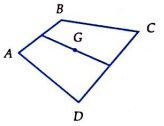
\[\begin{array}{l}\overrightarrow {AB} + \overrightarrow {AC} + \overrightarrow {AD} = \overrightarrow {AG} + \overrightarrow {GB} + \left( {\overrightarrow {AG} + \overrightarrow {GC} } \right) + \left( {\overrightarrow {AG} + \overrightarrow {GD} } \right)\\ = 3\overrightarrow {AG} + \overrightarrow {GB} + \overrightarrow {GC} + \overrightarrow {GD} = 4\overrightarrow {GA} + \left( {\overrightarrow {GA} + \overrightarrow {GB} } \right) + \left( {\overrightarrow {GC} + \overrightarrow {GD} } \right) = 4\overrightarrow {AG} + 2I + 2\overrightarrow {GJ} = 4\overrightarrow {AG} \end{array}\]
(II) và (III) sai vì G không phải là trung điểm của AC và BD.
Điểm I là tâm đường tròn ngoại tiếp \(\Delta ABC\).
Điểm I là tâm đường tròn nội tiếp \(\Delta ABC\).
Điểm I là trực tâm của \(\Delta ABC\).
Điểm I là trọng tâm của \(\Delta ABC\).
Chọn B
Lấy \(A'\) sao cho \(\frac{{A'B}}{{A'C}} = \frac{c}{b}\) hay \(AA'\) là đường phân giác.
Ta có: \(a\overrightarrow {IA} + b\overrightarrow {IB} + c\overrightarrow {IC} = \overrightarrow 0 \Leftrightarrow a\overrightarrow {IA} + \left( {b + c} \right)\overrightarrow {IA'} = \overrightarrow 0 \)
\( \Leftrightarrow \) I thuộc đoạn \(AA'\) và \(\frac{{IA}}{{IA'}} = \frac{{b + c}}{a} = \frac{c}{{\frac{{ac}}{{b + c}}}} = \frac{{BA}}{{BA'}}\)
\( \Rightarrow \) I là tâm đường tròn nội tiếp \(\Delta ABC\).
Điểm I là trung điểm của cạnh AC
Điểm C là trung điểm của cạnh IA
Điểm C chia đoạn IA theo tỉ số \( - 2\)
Điểm I chia đoạn AC theo tỉ số 2
Chọn C
\(\begin{array}{l}2\overrightarrow {IA} - 3\overrightarrow {IB} = 3\overrightarrow {BC} \Leftrightarrow 2\overrightarrow {IA} - 2\overrightarrow {IB} - \overrightarrow {IB} = 3\overrightarrow {BC} \Leftrightarrow 2\left( {\overrightarrow {IA} - \overrightarrow {IB} } \right) = 2\overrightarrow {BC} + \overrightarrow {IB} + \overrightarrow {BC} \\ \Leftrightarrow 2\overrightarrow {BA} = 2\overrightarrow {BC} + \overrightarrow {IC} \Leftrightarrow 2\overrightarrow {BA} - 2\overrightarrow {BC} = \overrightarrow {IC} \Leftrightarrow 2\overrightarrow {CA} = \overrightarrow {IC} \Leftrightarrow \overrightarrow {CI} = - 2\overrightarrow {CA} \end{array}\)
Điểm K là trung điểm cạnh AM
Điểm K là trung điểm cạnh BN
Điểm K là trung điểm cạnh BC
Điểm K là trung điểm cạnh MN
Chọn D
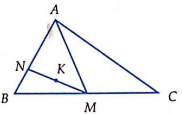
M là trung điểm AB nên \(\overrightarrow {AB} = 2\overrightarrow {AM} \),\(\overrightarrow {AC} = 2\overrightarrow {AN} \Leftrightarrow 3\overrightarrow {AB} + 2\overrightarrow {AC} - 12\overrightarrow {AK} = \overrightarrow 0 \)
\( \Leftrightarrow 6\overrightarrow {AM} + 6\overrightarrow {AN} - 12\overrightarrow {AK} = \overrightarrow 0 \Leftrightarrow \overrightarrow {AK} = \frac{1}{2}\left( {\overrightarrow {AM} + \overrightarrow {AN} } \right)\)\( \Rightarrow \) K là trung điểm của MN.
N là trọng tâm \(\Delta ABC\)
N là trung điểm của BC
N là trung điểm của AK với K là trung điểm của BC
N là đỉnh thứ tư của hình bình hành nhận AB và AC làm 2 cạnh
Chọn C
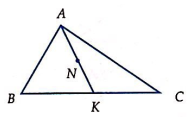
Gọi K là trung điểm BC\( \Rightarrow \overrightarrow {NB} + \overrightarrow {NC} = 2\overrightarrow {NK} \)
Nên \(2\overrightarrow {NA} + \overrightarrow {NB} + \overrightarrow {NC} = \overrightarrow 0 \)\( \Leftrightarrow 2\overrightarrow {NA} + 2\overrightarrow {NK} = \overrightarrow 0 \Leftrightarrow \overrightarrow {NA} + \overrightarrow {NK} = \overrightarrow 0 \)\( \Rightarrow \) N là trung điểm AK
M là trung điểm cạnh AB
M là trung điểm cạnh BC
M chia đoạn AB theo tỉ số 2
M là trọng tâm \(\Delta ABC\)
Chọn D
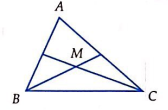
\(\overrightarrow {MA} + 2\overrightarrow {MB} = \overrightarrow {CB} \Leftrightarrow \overrightarrow {MA} + \overrightarrow {MB} + \overrightarrow {MB} = \overrightarrow {CM} + \overrightarrow {MC} \)
\( \Leftrightarrow \overrightarrow {MA} + \overrightarrow {MB} + \overrightarrow {MC} = \overrightarrow {0 \Rightarrow } \) M là trọng tâm \(\Delta ABC\)
Phần 2. Trắc nghiệm lựa chọn đúng sai. Thí sinh trả lời từ câu 1 đến câu 4. Trong mỗi ý a), b), c), d) ở mỗi câu, thí sinh chọn đúng hoặc sai.
Cho \(\Delta ABC\) nội tiếp đường tròn tâm \(O,H\) là trực tâm tam giác, \(D\) là điểm đối xứng của \(A\) qua \(O\). Khi đó:
a) \(BD//CH\)
b) \(CD//BH\)
a) \(\overrightarrow {HA} + \overrightarrow {HB} + \overrightarrow {HC} = 3\overrightarrow {HO} \);
d) \(\overrightarrow {OA} + \overrightarrow {OB} + \overrightarrow {OC} = 3\overrightarrow {OH} \)
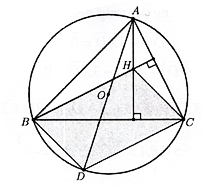
Xét tam giác \(ABD\) nội tiếp đường tròn đường kính \(AD\) nên \(AB \bot BD\); mặt khác \(AB \bot CH\) nên \(BD//CH\) (1).
Tương tự, tam giác \(ACD\) nội tiếp đường tròn đường kính \(AD\) nên \(AC \bot CD\); mặt khác \(AC \bot BH\) nên \(CD//BH\) (2).
Từ (1) và (2) suy ra \(BDCH\) là hình bình hành.
Ta có: \(\overrightarrow {HA} + \overrightarrow {HB} + \overrightarrow {HC} = \overrightarrow {HA} + \overrightarrow {HD} = 2\overrightarrow {HO} \) (vì \(O\) là trung điểm \(AD\)).
Ta có: \(\overrightarrow {OA} + \overrightarrow {OB} + \overrightarrow {OC} = \overrightarrow {OH} + \overrightarrow {HA} + \overrightarrow {OH} + \overrightarrow {HB} + \overrightarrow {OH} + \overrightarrow {HC} \)
\( = 3\overrightarrow {OH} + (\overrightarrow {HA} + \overrightarrow {HB} + \overrightarrow {HC} ) = 3\overrightarrow {OH} + 2\overrightarrow {HO} = \overrightarrow {OH} {\rm{. }}\)
Cho tam giác \(ABC\) có trọng tâm \(G\). Khi đó:
a) \(|\overrightarrow {MA} + \overrightarrow {MB} - 2\overrightarrow {MC} | = |\overrightarrow {AM} - \overrightarrow {AB} |\) khi và chỉ khi tập hợp điểm \(M\) là đường tròn tâm \(B\), bán kính \(R = CG\).
b) \(2|\overrightarrow {MA} + \overrightarrow {MB} + \overrightarrow {MC} | = 3|\overrightarrow {MB} + \overrightarrow {MC} |\) khi và chỉ khi tập hợp điểm \(M\) là đường trung trực của đoạn thẳng \(GI\) (với \(I\) là trung điểm của \(BC\)).
c) \(|\overrightarrow {MA} + \overrightarrow {MB} + \overrightarrow {MC} | = 2028\) khi và chỉ khi tập hợp điểm \(M\) là đường tròn tâm \(G\), bán kính \(R = 626\).
d) \(|3\overrightarrow {AM} - 3\overrightarrow {AC} | = |\overrightarrow {MA} + 2\overrightarrow {MB} |\) khi và chỉ khi tập hợp điểm \(M\) là đường trung trực của đoạn thẳng \(IC\) với \(\overrightarrow {AI} = \frac{2}{3}\overrightarrow {AB} \).
a) Sai | b) Đúng | c) Sai | d) Đúng |
a) Ta có: \(|\overrightarrow {MA} + \overrightarrow {MB} - 2\overrightarrow {MC} | = |\overrightarrow {AM} - \overrightarrow {AB} | \Leftrightarrow |\overrightarrow {MA} + \overrightarrow {MB} + \overrightarrow {MC} - 3\overrightarrow {MC} | = |\overrightarrow {BM} |\) \( \Leftrightarrow |3\overrightarrow {MG} - 3\overrightarrow {MC} | = BM \Leftrightarrow |3(\overrightarrow {MG} - \overrightarrow {MC} )| = BM \Leftrightarrow 3|\overrightarrow {CG} | = BM \Leftrightarrow BM = 3CG\).
Nhận xét: Ba điểm \(B,C,G\) cố định. Vậy tập hợp điểm \(M\) là đường tròn tâm \(B\), bán kính \(R = 3CG\).
b) Ta có: \(2|\overrightarrow {MA} + \overrightarrow {MB} + \overrightarrow {MC} | = 3|\overrightarrow {MB} + \overrightarrow {MC} | \Leftrightarrow 2|3\overrightarrow {MG} | = 3|2\overrightarrow {MI} |\)
(với \(I\) là trung điểm của \(BC\) ).
\( \Leftrightarrow 6MG = 6MI \Leftrightarrow MG = MI{\rm{. }}\)
Nhận xét: Hai điểm \(G,I\) cố định. Vậy tập hợp điểm \(M\) là đường trung trực của đoạn thẳng \(GI\).
c) Gọi \(G\) là trọng tâm tam giác \(ABC\) nên \(G\) cố định.
Ta có: \(|\overrightarrow {MA} + \overrightarrow {MB} + \overrightarrow {MC} | = 2028 \Leftrightarrow |3\overrightarrow {MG} | = 2028 \Leftrightarrow 3MG = 2028 \Leftrightarrow MG = 676\).
Vậy tập hợp điểm \(M\) là đường tròn tâm \(G\), bán kính \(R = 676\).
d) Ta có: \(3\overrightarrow {AM} - 3\overrightarrow {AC} = 3(\overrightarrow {AM} - \overrightarrow {AC} ) = 3\overrightarrow {CM} \) (1).
Gọi \(I\) thỏa mãn \(\overrightarrow {IA} + 2\overrightarrow {IB} = \vec 0 \Leftrightarrow \overrightarrow {IA} + 2\overrightarrow {IA} + 2\overrightarrow {AB} = \vec 0 \Leftrightarrow \overrightarrow {AI} = \frac{2}{3}\overrightarrow {AB} \).
Suy ra \(I\) là điểm cố định. Khi đó:
\(\overrightarrow {MA} + 2\overrightarrow {MB} = \overrightarrow {MI} + \overrightarrow {IA} + 2(\overrightarrow {MI} + \overrightarrow {IB} ) = 3\overrightarrow {MI} + (\overrightarrow {IA} + 2\overrightarrow {IB} ) = 3\overrightarrow {MI} + \vec 0 = 3\overrightarrow {MI} {\rm{ (2)}}{\rm{. }}\)
Thay (1) và (2) vào hệ thức \(|3\overrightarrow {AM} - 3\overrightarrow {AC} | = |\overrightarrow {MA} + 2\overrightarrow {MB} |\), ta được:
\(|3\overrightarrow {CM} | = |3\overrightarrow {MI} | \Leftrightarrow 3CM = 3MI \Leftrightarrow MC = MI.\)
Vậy tập hợp điểm \(M\) là đường trung trực của đoạn thẳng \(IC\).
Cho hình thang cân \(ABCD\) có \(AB//CD,AB = 2AD = 2CD,E\) là trung điểm cạnh \(AB\). Khi đó:
a) \(\overrightarrow {AB} = 2\overrightarrow {DC} \);
b) \(\overrightarrow {DE} = - \overrightarrow {CB} \);
c) \(\overrightarrow {CA} + \overrightarrow {CB} = 2\overrightarrow {CE} \);
d) \(\overrightarrow {AD} = \overrightarrow {EC} \);
e) \(\overrightarrow {AB} + \overrightarrow {EB} = 3\overrightarrow {DC} \);
f) \(\overrightarrow {DE} = \frac{1}{2}(\overrightarrow {DA} + \overrightarrow {DB} )\).
a) Đúng | b) Sai | c) Đúng | d) Đúng |
e) Đúng | f) Đúng |
|
|
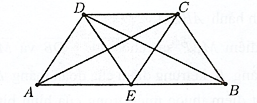
Ta có: \(AE = CD = \frac{1}{2}AB,AE//CD\) nên \(AECD\) là hình bình hành (*).
Hoàn toàn tương tự, ta chứng minh được \(BCDE\) là hình bình hành (**).
a) Mệnh đề đúng.
b) Mệnh đề sai (do \((**))\).
c) Mệnh đề đúng (tính chất trung điểm).
d) Mệnh đề đúng (do (*)).
e) Mệnh đề đúng. Vì \(\overrightarrow {AB} + \overrightarrow {EB} = 2\overrightarrow {EB} + \overrightarrow {EB} = 3\overrightarrow {EB} = 3\overrightarrow {DC} \).
f) Mệnh đề đúng (tính chất trung điểm).
Cho hình bình hành \(ABCD\), tâm \(O\). Gọi \(M,N\) theo thứ tự là trung điểm của \(AB,CD\) và \(P\) là điểm thỏa mãn hệ thức: \(\overrightarrow {OP} = - \frac{1}{3}\overrightarrow {OA} \). Khi đó:
a) \(\overrightarrow {OA} + 3\overrightarrow {OP} = \vec 0\)
b) \(3\overrightarrow {AP} - 3\overrightarrow {AC} = \vec 0\)
c) Ba điểm \(B,P,N\) không thẳng hàng
d) Ba đường thẳng \(AC,BD,MN\) đồng quy
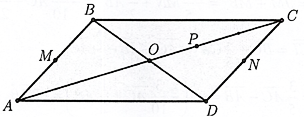
Ta có: \(\overrightarrow {OA} = - 3\overrightarrow {OP} \Leftrightarrow \overrightarrow {OA} + 3\overrightarrow {OP} = \vec 0\).
Khi đó: \(3\overrightarrow {AP} - 2\overrightarrow {AC} = 3(\overrightarrow {AO} + \overrightarrow {OP} ) - 2.2\overrightarrow {AO} = \overrightarrow {OA} + 3\overrightarrow {OP} = \vec 0\).
Ta có: \(\overrightarrow {OP} = - \frac{1}{3}\overrightarrow {OA} = \frac{1}{3}\overrightarrow {OC} \Rightarrow P\) là trọng tâm của tam giác \(BCD\), do vậy trung tuyến \(BN\) của tam giác \(BCD\) đi qua trọng tâm \(P\) đó. Vậy ba điểm \(B,P,N\) thẳng hàng.
Nhận xét: \(AC\) và \(BD\) cắt nhau tại tâm \(O\) là trung điểm của mỗi đường.
Mặt khác \(:\overrightarrow {OM} + \overrightarrow {ON} = \frac{1}{2}(\overrightarrow {OA} + \overrightarrow {OB} ) + \frac{1}{2}(\overrightarrow {OC} + \overrightarrow {OD} ) = \frac{1}{2}(\overrightarrow {OA} + \overrightarrow {OC} ) + \frac{1}{2}(\overrightarrow {OB} + \overrightarrow {OD} ) = \vec 0\).
Do đó \(O\) là trung điểm của \(MN\) hay \(AC,BD,MN\) đồng quy tại \(O\).
Phần 3. Câu hỏi trắc nghiệm trả lời ngắn. Thí sinh trả lời từ câu 1 đến câu 6
Cho \(\Delta ABC\). Gọi \(M\) là điểm thỏa \(\overrightarrow {MB} + 2\overrightarrow {MC} = \vec 0\). Phân tích \(\overrightarrow {AM} \) theo \(\overrightarrow {AB} \) và \(\overrightarrow {AC} \).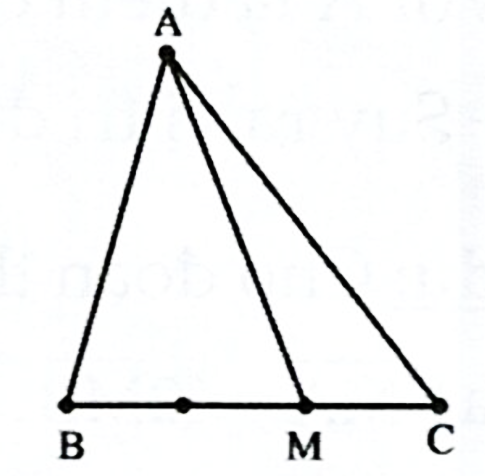
\(\overrightarrow {MB} + 2\overrightarrow {MC} = \vec 0 \Leftrightarrow \overrightarrow {AB} - \overrightarrow {AM} + 2(\overrightarrow {AC} - \overrightarrow {AM} ) = \overrightarrow 0 \)
\( \Leftrightarrow 3\overrightarrow {AM} = \overrightarrow {AB} + 2\overrightarrow {AC} \Leftrightarrow \overrightarrow {AM} = \frac{1}{3}\overrightarrow {AB} + \frac{2}{3}\overrightarrow {AC} \).
Cho \(\Delta ABC\). Gọi \(M\) là điểm trên đoạn \(BC\) sao cho \(MC = 2MB\). Phân tích \(\overrightarrow {AM} \) theo \(\overrightarrow {AB} \) và \(\overrightarrow {AC} \).
Cách \(1:MC = 2MB,\overrightarrow {MB} \) và \(\overrightarrow {MC} \) ngược hướng nên \(\overrightarrow {MC} = - 2\overrightarrow {MB} \Leftrightarrow 3\overrightarrow {AM} = 2\overrightarrow {AB} + \overrightarrow {AC} \Leftrightarrow \overrightarrow {AM} = \frac{2}{3}\overrightarrow {AB} + \frac{1}{3}\overrightarrow {AC} \).
Cách 2: \(\overrightarrow {AM} = \overrightarrow {AB} + \overrightarrow {BM} = \overrightarrow {AB} + \frac{1}{3}\overrightarrow {BC} = \overrightarrow {AB} + \frac{1}{3}(\overrightarrow {AC} - \overrightarrow {AB} ) = \frac{2}{3}\overrightarrow {AB} + \frac{1}{3}\overrightarrow {AC} \).
Cho 2 điểm phân biệt \(A\) và \(B\) và hai số \(\alpha \) và \(\beta \) với \(\alpha + \beta \ne 0\).
Khi đó tồn tại bao nhiêu điểm \(I\) thỏa \(\alpha \overrightarrow {IA} + \beta \overrightarrow {IB} = \vec 0\).
\(\alpha \overrightarrow {IA} + \beta \overrightarrow {IB} = \vec 0 \Leftrightarrow - \alpha \overrightarrow {AI} + \beta (\overrightarrow {AB} - \overrightarrow {AI} ) = \vec 0 \Leftrightarrow (\alpha + \beta )\overrightarrow {AI} = \beta \overrightarrow {AB} \) \( \Leftrightarrow \overrightarrow {AI} = \frac{\beta }{{\alpha + \beta }}\overrightarrow {AB} \).
Do \(A,B\) cố định, \(\frac{\beta }{{\alpha + \beta }}\overrightarrow {AB} \) không đổi nên tồn tại duy nhất điểm \[I\] thỏa: \(\alpha \overrightarrow {IA} + \beta \overrightarrow {IB} = \vec 0\).
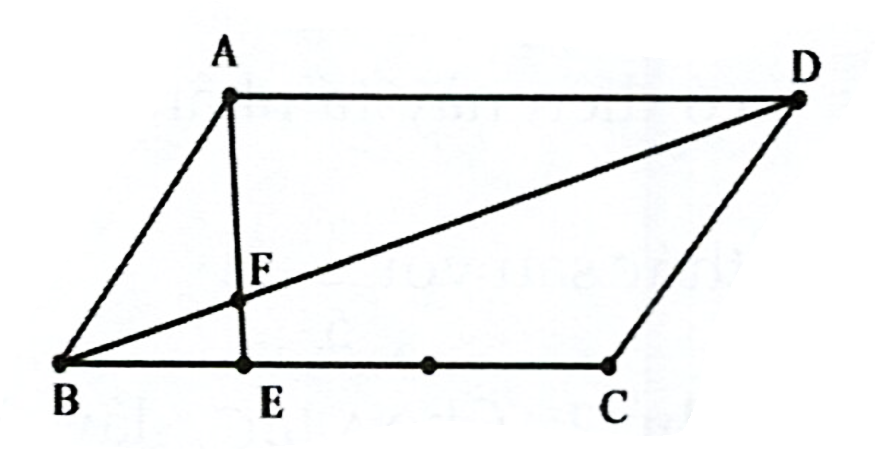
Ta phân tích \(\overrightarrow {AE} \) và \(\overrightarrow {AF} \) theo 2 vectơ \(\overrightarrow {AB} \) và \(\overrightarrow {AD} \).
\(\overrightarrow {AE} = \overrightarrow {AB} + \overrightarrow {BE} = \overrightarrow {AB} + \frac{1}{3}\overrightarrow {BC} = \overrightarrow {AB} + \frac{1}{3}\overrightarrow {AD} \)
\(\overrightarrow {AF} = \overrightarrow {AB} + \overrightarrow {BF} = \overrightarrow {AB} + \frac{1}{4}(\overrightarrow {AD} - \overrightarrow {AB} ) = \frac{3}{4}\overrightarrow {AB} + \frac{1}{4}\overrightarrow {AD} \).
Xét hệ: \(\left\{ {\begin{array}{*{20}{l}}{\overrightarrow {AE} = \overrightarrow {AB} + \frac{1}{3}\overrightarrow {AD} }\\{\overrightarrow {AF} = \frac{3}{4}\overrightarrow {AB} + \frac{1}{4}\overrightarrow {AD} }\end{array} \Leftrightarrow \left\{ {\begin{array}{*{20}{l}}{\overrightarrow {AE} = \overrightarrow {AB} + \frac{1}{3}\overrightarrow {AD} }\\{\frac{4}{3}\overrightarrow {AF} = \overrightarrow {AB} + \frac{1}{3}\overrightarrow {AD} }\end{array} \Rightarrow \overrightarrow {AE} = \frac{4}{3}\overrightarrow {AF} } \right.} \right.\)
\(\begin{array}{l}3\overrightarrow {IA} + 2\overrightarrow {IC} - 2\overrightarrow {ID} = \vec 0 \Leftrightarrow 3\overrightarrow {IA} + 2(\overrightarrow {IC} - \overrightarrow {ID} ) = \vec 0\\ \Leftrightarrow 3\overrightarrow {IA} + 2\overrightarrow {DC} = \vec 0 \Leftrightarrow 3\overrightarrow {AI} + 2\overrightarrow {AB} = \vec 0 \Leftrightarrow \overrightarrow {AI} = \frac{2}{3}\overrightarrow {AB} \\\overrightarrow {JA} - 2\overrightarrow {JB} + 2\overrightarrow {JC} = \vec 0 \Leftrightarrow \overrightarrow {AJ} + 2(\overrightarrow {JC} - \overrightarrow {JB} ) = \vec 0 \Leftrightarrow \overrightarrow {AJ} = 2\overrightarrow {BC} \Leftrightarrow \overrightarrow {AJ} = 2\overrightarrow {AD} \\\overrightarrow {IO} = \overrightarrow {AO} - \overrightarrow {AI} = \frac{1}{2}\overrightarrow {AC} - \frac{2}{3}\overrightarrow {AB} = \frac{1}{2}(\overrightarrow {AB} + \overrightarrow {AD} ) - \frac{2}{3}\overrightarrow {AB} = - \frac{1}{6}\overrightarrow {AB} + \frac{1}{2}\overrightarrow {AD} \end{array}\)
\(\overrightarrow {IJ} = \overrightarrow {AJ} - \overrightarrow {AI} = 2\overrightarrow {AD} - \frac{2}{3}\overrightarrow {AB} = - \frac{2}{3}\overrightarrow {AB} + 2\overrightarrow {AD} \)
Ta có: \(\left\{ {\begin{array}{*{20}{l}}\begin{array}{l}\overrightarrow {IO} = - \frac{1}{6}\overrightarrow {AB} + \frac{1}{2}\overrightarrow {AD} \\\overrightarrow {IJ} = - \frac{2}{3}\overrightarrow {AB} + 2\overrightarrow {AD} \end{array}\end{array} \Leftrightarrow \left\{ {\begin{array}{*{20}{l}}\begin{array}{l}6\overrightarrow {IO} = - \overrightarrow {AB} + 3\overrightarrow {AD} \\\frac{3}{2}\overrightarrow {IJ} = - \overrightarrow {AB} + 3\overrightarrow {AD} \end{array}\end{array} \Rightarrow 6\overrightarrow {IO} = \frac{3}{2}\overrightarrow {IJ} \Leftrightarrow \overrightarrow {IJ} = 4\overrightarrow {IO} } \right.} \right.\)
\(\begin{array}{l}\overrightarrow {IA} + 3\overrightarrow {IC} = \vec 0 \Leftrightarrow - \overrightarrow {AI} + 3(\overrightarrow {AC} - \overrightarrow {AI} ) = \vec 0 \Leftrightarrow 4\overrightarrow {AI} = 3\overrightarrow {AC} \Leftrightarrow \overrightarrow {AI} = \frac{3}{4}\overrightarrow {AC} .\\\overrightarrow {BI} = \overrightarrow {AI} - \overrightarrow {AB} = \frac{3}{4}\overrightarrow {AC} - \overrightarrow {AB} = - \overrightarrow {AB} + \frac{3}{4}\overrightarrow {AC} .\\\overrightarrow {JA} + 2\overrightarrow {JB} + 3\overrightarrow {JC} = \vec 0 \Leftrightarrow \overrightarrow {BA} - \overrightarrow {BJ} - 2\overrightarrow {BJ} + 3(\overrightarrow {BC} - \overrightarrow {BJ} ) = \vec 0\\ \Leftrightarrow \overrightarrow {BA} - \overrightarrow {BJ} - 2\overrightarrow {BJ} + 3\overrightarrow {BC} - 3\overrightarrow {BJ} = \vec 0 \Leftrightarrow 6\overrightarrow {BJ} = \overrightarrow {BA} + 3\overrightarrow {BC} \\ \Leftrightarrow 6\overrightarrow {BJ} = - \overrightarrow {AB} + 3(\overrightarrow {AC} - \overrightarrow {AB} ) \Leftrightarrow 6\overrightarrow {BJ} = - 4\overrightarrow {AB} + 3\overrightarrow {AC} \Leftrightarrow \overrightarrow {BJ} = - \frac{2}{3}\overrightarrow {AB} + \frac{1}{2}\overrightarrow {AC} \end{array}\)
Ta có: \(\left\{ {\begin{array}{*{20}{l}}{\overrightarrow {BI} = - \overrightarrow {AB} + \frac{3}{4}\overrightarrow {AC} }\\{\overrightarrow {BJ} = - \frac{2}{3}\overrightarrow {AB} + \frac{1}{2}\overrightarrow {AC} }\end{array} \Leftrightarrow \left\{ {\begin{array}{*{20}{l}}{\overrightarrow {BI} = - \overrightarrow {AB} + \frac{3}{4}\overrightarrow {AC} }\\{\frac{3}{2}\overrightarrow {BJ} = - \overrightarrow {AB} + \frac{3}{4}\overrightarrow {AC} }\end{array} \Rightarrow \overrightarrow {BI} = \frac{3}{2}\overrightarrow {BJ} } \right.} \right.\)