Đề 6
50 câu hỏi
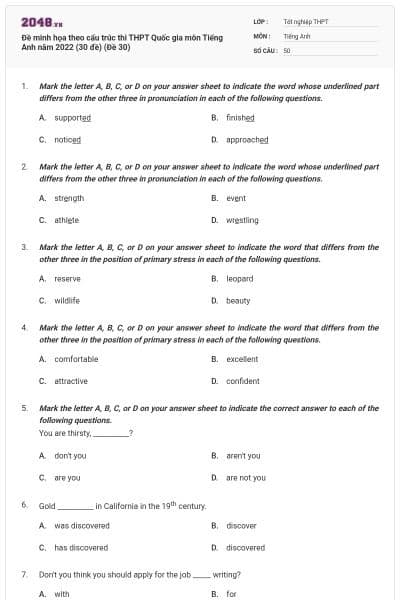
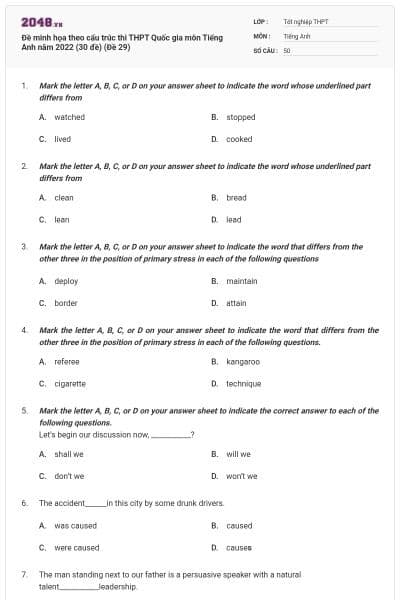
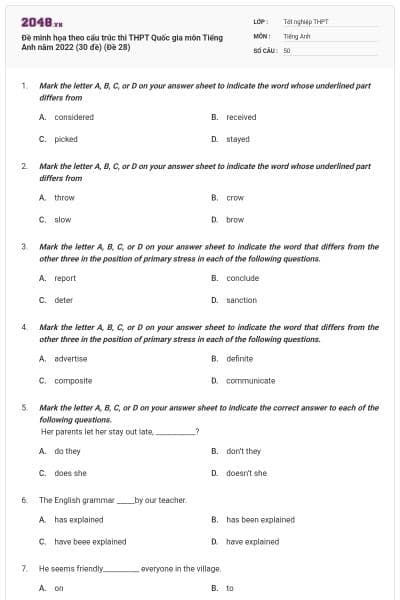
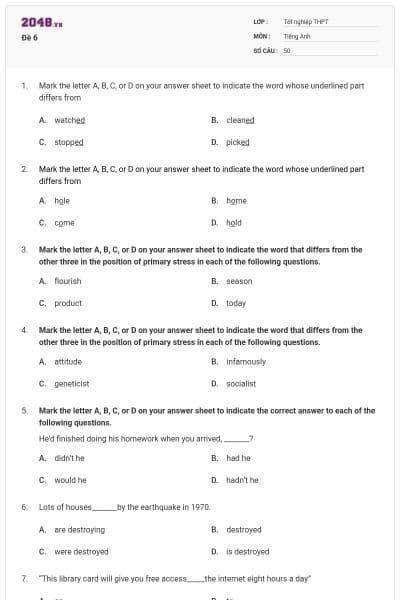
watched
cleaned
stopped
picked
Kiến thức: Phát âm “ed”
Giải thích:
Cách phát âm đuôi “ed”:
+ Đuôi “ed” được phát âm là /id/ khi động từ có phát âm kết thúc là /t/ hay /d/
+ Đuôi “ed” được phát âm là /t/ khi động từ có phát âm kết thúc là /s/,/f/,/p/,/ʃ/,/tʃ/,/k/
+ Đuôi “ed” được phát âm là /d/ với các trường hợp còn lại
A.watched/wɒtʃt/ B. cleaned /kliːnd/
C.stopped/stɒpt/ D. picked/pɪkt/
Phần gạch chân đáp án B phát âm là /d/, còn lại là /t/.
Chọn B
Mark the letter A, B, C, or D on your answer sheet to indicate the word whose underlined part differs from
hole
home
come
hold
Kiến thức: Phát âm “əʊ”
Giải thích:
A.hole /həʊl/ B. home /həʊm/
C.come /kʌm/ D. hold/həʊld/
Phần gạch chân đáp án C phát âm là /ʌ/, còn lại là /əʊ/.
Chọn C
Mark the letter A, B, C, or D on your answer sheet to indicate the word that differs from the other three in the position of primary stress in each of the following questions.
flourish
season
product
today
D nhấn trọng âm ở âm tiết thứ 2, còn lại nhấn âm thứ 1.
A.flourish /ˈflʌrɪʃ/ (v): thịnh vượng, phát đạt; thành công; phát triển, mọc sum sê (cây), viết hoa mỹ, nói hoa mỹ, khoa trương, (âm nhạc) dạo nhạc một cách bay bướm; thổi một hồikèn
B.season /ˈsiːzn/ (n):mùa
C.product /ˈprɒdʌkt/ (n): sảnphẩm
D.today /təˈdeɪ/ (n): ngày nay, hômnay
Đáp án D.
Mark the letter A, B, C, or D on your answer sheet to indicate the word that differs from the other three in the position of primary stress in each of the following questions.
attitude
infamously
geneticist
socialist
C nhấn trọng âm ở âm tiết thứ 2, còn lại nhấn âm thứ 1.
A .attitude /ˈætɪtjuːd/ (n): tháiđộ
B. infamously /ˈɪnfəməsli/ (adv): một cách ônhục
C. geneticist /dʒəˈnetɪsɪst/ (n): nhà nghiên cứu về di truyền học, nhà di truyềnhọc
D. socialist /ˈsəʊʃəlɪst/ (n): người theo chủ nghĩa xãhội
Đáp án C.
Mark the letter A, B, C, or D on your answer sheet to indicate the correct answer to each of the following questions.
He’d finished doing his homework when you arrived, _______?
didn’t he
had he
would he
hadn’t he
Trợ động từ “had” và thể khẳng định đầu câu hỏi=> câu hỏi đuôi sẽ ở dạng phủ định “hadn’t” .
Đáp án D (hadn’t he) đúng.
Tạm dịch: Anh ấy đã hòan thành tất cả bài tập về nhà khi bạn tới, có phải không
Đáp án D.
are destroying
destroyed
were destroyed
is destroyed
Phương pháp giải:
Kiến thức: Câu bị động:
Giải chi tiết: Câu bị động thì Quá khứ đơn. Hành động được nhấn mạnh là nhà cửa bị phá hủy bởi trận động đất.
S + was/were + V-ed/V3
Tạm dịch: Nhiều ngôi nhà của bị phá hủy bởi trận động đất năm 1970.
Đáp án C.
on
to
from
in
Cụm từ access to sth: Truy cập vào cái gì
Đáp án B đúng.
Tạm dịch: Thẻ thư viện này sẽ cho phép bạn truy cập Internet 8 tiếng miễn phí mỗi ngày.
Đáp án B.
For more
More
The more
The most
So sánh đồng tiến : càng ngày càng…
S+ V+ more+ and +more + long adj/ adv |
Tạm dịch : Càng hiểu biết nhiều hơn về Jim thì tôi càng yêu quí anh ấy.
Đáp án C
old black leather skipping
Leather black old skipping
Skipping black old leather
Leather old black skipping
Kiến thức: Trật tự tính từ
Giải thích:
Trật tự 8 loại tính từ:
1. Opinion and general description (Ý kiến hoặc miêu tả chung) Ví dụ: nice, awesome,lovely
2. Dimension / Size / Weight (Kích cỡ, cân nặng)Ví dụ: big, small,heavy
3. Age (Tuổi, niên kỷ)Ví dụ: old, new, young, ancient.
4. Shape (Hình dạng) Ví dụ: round, square, oval.
5. Color (Màu sắc)Ví dụ: green, red, blue,black
6. Country of origin (Xuất xứ) Ví dụ: Swiss, Italian,English.
7. Material (Chất liệu) Ví dụ: woolly, cotton, plastic.
8. Purpose and power (Công dụng)
=> Age (old) – Material (leather) => Purpose and power (skipping)
Tạm dịch: Con gái tôi thích nhảy dây da màu đen đã cũ vào sáng sớm để giữ dáng vào lúc sáng sớm.
Đáp án. A
watched
was watching
had watched
is watching
B
Kiến thức: Sự phối hợp về thì của động từ
Giải thích: Thì quá khứ đơn và quá khứ tiếp diễn kết hợp trong câu: Diễn tả hành động đang xảy ra trong quá khứ thì một hành động khác xen vào, hành động đang xảy ra chi thì quá khứ tiếp diễn, hành động xen vào chia thì quá khứ đơn
Cấu trúc: S + was/ were + V_ing + when + S + Ved/bqt
Tạm dịch: Bố tôi đang xem TV khi tôi về nhà.
because
in spite of
although
because of
Đáp án C
Kiến thức được hỏi: Liên từ
Because + mệnh đề: bởi vì, do
In spite of + danh từ/cụm danh từ: dù cho, mặc dù
although + mệnh đề: dù cho, mặc dù
Because of + danh từ/cụm danh từ: bởi vì, do
Tạm dịch: Nhiều người tin anh ta, mặc dù anh ta thường xuyên nói dối
Till you arrived
When you are arriving
By the time you arrive
Before you arrived
Kiến thức: mệnh đề trạng ngữ
Giải thích:
- Dấu hiệu: “By the time + S + V simple present , S+ will have +v3/ed
Các đáp án khác sai thì
Tạm dịch: Vào thời điểm bạn đến, tôi sẽ hoàn thành bài văn.
Chọn C
Finding
After finding
Having found
We found
Đáp án C
Kiến thức về phân từ hoàn thành
Phân từ hoàn thành dùng rút ngắn mệnh đề khi hành động trong mệnh đề đó đã xảy ra trước.
Tạm dịch: Khi đã tìm ra được khách sạn, chúng tôi tìm một nơi nào đó để ăn tối.
responsibly
responsible
responsibility
responsive
Kiến thức về từ loại
Xét các đáp án
A. responsibly /rɪˈspɒnsəbli/ (adv): một cách đáng tin cậy; một cách có trách nhiệm
B. responsible /rɪˈspɒnsəbl/ (adj): chịu trách nhiệm
C. responsibility /rɪˌspɒnsəˈbɪləti/ (n): trách nhiệm
D. responsive /rɪˈspɒnsɪv/ (adj): phản ứng nhanh, nhiệt tình
Căn cứ vào mạo từ “the”. Sau mạo từ “the” cần một danh từ nên ta chọn C
Tạm dịch: Bạn có nghĩ làm việc nhà là trách nhiệm của phụ nữ không?
=> Đáp án C.
set off
went through
carried out
left out
Kiến thức về cụm động từ
Xét các đáp án:
A. set off (v): khởi hành, xuất phát
B. went through (v): trải qua
C. carried out (v): tiến hành
D. left out (v): bỏ lỡ
Tạm dịch: Khi họ khởi hành đến bãi biển, mặt trời đang chói chang, nhưng khi họ đến nơi thì trời đã đầy mây.
=> Đáp án A.
done
taken
made
given
Đáp án C
Kiến thức Verb kết hợp với danh từ
Make + (a lot of) contributions to sự doing st: đóng góp nhiều/cống hiến cho cái gì
Tạm dịch: Rất nhiều nhà doanh nhân hào phóng đã đóng góp đáng kể trong việc giúp đỡ những người đang cần được giúpđỡ.
hole
gap
blank
crevice
B
Kiến thức từ cùng trường nghĩa.
A.Hole : lỗ, hố
B. gap: lỗ hỗng, kẽ hở
C. blank : rỗng
D. crevice : vết nứt, nẻ ( trên bề mặt đá)
+cụm “ bridge a /the gap: thu hẹp khoảng cách
Tạm dịch: các bô lão xem lễ hội để thu hẹp sự khác biệt của họ và những người mới chuyển đến.
break the bank
turn the page
make the grade
tie the knot
Kiến thức về thành ngữ
Xét các đáp án:
A. break the bank: có giá rất đắt
B. turn the page: có một khởi đầu mới ( thường sau những khó khăn)
C. make the grade: biểu hiện tốt để đạt được cái gì
D. tie the knot: làm đám cưới
Tạm dịch: Sau 6 năm quen nhau, Martha và Billy đã quyết định làm đám cưới.
=> Đáp án D.
tears
sorrow
sadness
upset
A.
Kiến thức về cụm từ cố định
To be in flood of tears: rất buồn
Tạm dịch: Đứa trẻ nghèo khổ đã rất buồn khi chiếc xe đẹp của nó bị mất.
Mark the letter A, B, C or D to indicate the word(s) CLOSEST in meaning to the underlined word(s) in each of the following questions.
Computers are becoming much more sophisticated machines.
expensive
complicated
convenient
difficult to operate
Đáp án B
Complicated (adj): phức tạp = sophisticated (adj)
Máy tính đang trở thành máy móc tinh vi hơn nhiều.
arrange
complain
exchange
explain
Đáp án D
account for (phr. V): giải thích
arrange (v): sắp xếp
complain (v): phàn nàn
exchange (v): trao đổi
explain (v): giải thich
Học sinh đó được yêu cầu giải thích cho sự vắng mặt của cô ấy ở tiết học cuối cùng
Mark the letter A, B, C or D to indicate the word(s) OPPOSITE in meaning to the underlined word(s) in each of the following questions.
I was going to have a go at parachuting but lost my nerve at the last minute.
was determined to go ahead
lost my temper
was discouraged from trying
grew out of it
Đáp án A
Từ trái nghĩa – kiến thức về thành ngữ
Tạm dịch: Tôi định sẽ thử nhảy dù nhưng tôi mất hết can đảm vào phút chót.
=> lose sb’s nerve: mất can đảm, nhụt chí
Xét các đáp án:
A. be determined to do st: quyết tâm làm gì
B. lose sb’s temper: nóng giận
C. be discouraged from st/doing st: bị can ngăn, làm nhụt chí, chán nản khi làm gì
D. grow out of st/doing st: không còn thích cái gì
=> lose sb’s nerve >< be determined to do st => Đáp án là A
seriously
insignificantly
largely
commonly
Đáp án B
Từ trái nghĩa – kiến thức về từ vựng
Tạm dịch: Bùng nổ dân số ở các thành phố lớn đã ảnh hưởng nghiêm trọng đến chất lượng không khí và nước.
=> severely /sɪˈvɪrli/ (adv): nghiêm trọng, dữ dội
Xét các đáp án:
A. seriously /ˈsɪriəsli/ (adv): nghiêm trọng, trầm trọng
B. insignificantly /ˌɪnsɪɡˈnɪfɪkəntli/ (adv): không quan trọng, tầm thường
C. largely /ˈlɑːrdʒli/ (adv): rộng rãi
D. commonly /ˈkɒmənli/ (adv): thường thường
=> severely >< insignificant => Đáp án là B
Mark the letter A, B, C, or D on your answer sheet to indicate the sentence that best completes each of the following exchanges
Hana and Jenifer are talking about a book they have just read.
- Hana: “The book is really interesting and educational.” - Jenifer: “___________.”
Don’t mention it
That’s nice of you to say so.
I’d love it.
I couldn’t agree more.
Đáp án D
Tình huống giao tiếp
Tạm dịch: Hana và Jenifer đang nói chuyện về cuốn sách mà họ vừa mới đọc
-Hana: “Cuốn sách này thực sự thú vị và mang tính giáo dục.”
-Jenifer: “___________________________.”
Xét các đáp án:
A. Đừng đề cập đến điều đó. (Dùng để đáp lại lời cảm ơn)
B. Bạn thật tốt bụng khi nói như vậy. (Dùng để đáp lại lời khen)
C. Tôi thích nó.
D. Tôi hoàn toàn đồng ý với bạn.
*Để bày tỏ quan điểm của mình về ý kiến của đối phương, khi đồng ý ta dùng “I couldn’t agree more” thể hiện ý đồng tình tuyệt đối với ý kiến đó.
James: "Do you know that many inventions were inspired by the natural world?"
Anna: “____________________.”
Of course. You're right.
There is no hope about it.
Well, that sounds interesting.
Yes, I couldn't agree more.
đáp án C
Tình huống giao tiếp
Tạm dịch: James: Bạn có biết rằng nhiều phát minh được lấy cảm hứng từ thế giới tự nhiên?
Anna: "______________________."
A. Tất nhiên rồi. Bạn nói đúng.
B. Không có hy vọng về nó.
C. Chà, nghe có vẻ thú vị.
D. Có, tôi hoàn toàn đồng ý.
Read the following passage and mark the letter A, B, C, or D on your answer sheet to indicate the correct word or phrase that best fits each of the numbered blanks.
Amparo Lasén, the Spanish sociologist who conducted the study found that Londoners use their cell phones the least in public. If they are with others, they prefer to let calls be answered by voice mail (a recorded message) and then they check for messages later. If the English do answer a call on the street, they seem to dislike talking with others around. They tend to move away from a crowded sidewalk and seek out a place (26) ________ they cannot be heard, such as the far side of a subway entrance or even the edge of a street. They seem to feel that the danger of the traffic is (27) ___________ to the risk of having their conversation be overheard. This has led to a behavior that Laser has called "clustering." At a busy time of day on the streets of London, you may find small crowds of cell phone users grouped together, each one talking into a cell phone. Even when it is raining—as it is often in London—people still prefer not to hold their conversations where others could hear. They talk (28) _____________ their umbrellas or in a doorway.
In Paris, however, there are stricter rules about how and when to use cell phones. It is not considered polite to use a phone in a restaurant, (29) ______________, though it might be acceptable in the more informal setting of a café. One special custom that has developed in cafés seems unique to Paris. Young women often place their cell phones on the table beside them to signal that they are expecting someone. When the friend arrives, the phone is (30) _____________. In fact, the French are generally very disapproving of phone use in public and are quick to express that disapproval, even to strangers.
(Adapted from “Advanced Reading Power” by Beatrice S. Mikulecky and Linda Jeffries)
which
when
where
what
Đáp án C
Kiến thức về mệnh đề quan hệ:
Ở đây ta cần một trạng từ quan hệ chỉ địa điểm, để thay thế cho danh từ “a place” phía trước.
They tend to move away from a crowded sidewalk and seek out a place (1)______ they cannot be heard, such as the far side of a subway entrance or even the edge of a street. (Họ có xu hướng di chuyển ra khỏi một vỉa hè đông đúc và tìm kiếm một nơi, mà họ không thể bị nghe thấy, chẳng hạn như phía xa của một lối vào tàu điện ngầm hoặc thậm chí ở mép của một con đường.)
preferable
prefer
preference
preferential
Đáp án A
Kiến thức về từ loại:
A. preferable /ˈprefərəbəl/ (a): tốt hơn
B. prefer /prɪˈfɜːr/ (v): thích
C. preference /ˈprefərəns/ (n): sự thích hơn, sự ưu tiên
D. preferential /prefərˈenʃəl/ (a): ưu đãi
Sau động từ to be ta cần một tính từ. Từ đó, ta loại B, C
They seem to feel that the danger of the traffic is (2)_______ to the risk of having their conversation be overheard. (Họ dường như cảm thấy rằng mối nguy hiểm của giao thông là tốt hơn so với nguy cơ khiến cuộc trò chuyện của họ bị nghe thấy.)
They talk (28) _____________ their umbrellas or in a doorway.
on
under
in
after
Đáp án B
Kiến thức về giới từ:
Căn cứ vào nghĩa của câu:
They talk (3) ________their umbrellas or in a doorway. (Họ nói chuyện dưới những chiếc ô của mình hoặc ở một khu vực cửa ra vào.)
for examples
moreover
nevertheless
for instance
Đáp án D
Kiến thức về từ nối:
A. for examples (cụm này sai vì dư chữ “s”)
B. moreover /mɔːˈrəʊvər/: hơn thế
C. nevertheless /nevəðəˈles/: tuy nhiên
D. for instance: ví dụ
Căn cứ vào nghĩa của câu:
In Paris, however, there are stricter rules about how and when to use cell phones. It is not considered polite to use a phone in a restaurant, (4)____ , though it might be acceptable in the more informal setting of a café.
(Tuy nhiên, tại Paris, có những quy định chặt chẽ hơn về cách thức và thời điểm sử dụng điện thoại di động. Ví dụ, việc sử dụng điện thoại trong nhà hàng không được coi là lịch sự, mặc dù điều đó có thể được chấp nhận trong môi trường không chính thức của quán cà phê.)
When the friend arrives, the phone is (30) _____________. In fact, the French are generally very disapproving of phone use in public and are quick to express that disapproval, even to strangers.
put away
put back
put down
put aside
Đáp án A
Kiến thức về cụm động từ:
A. put away: cất đi
B. put back: trả lại, thay thế
C. put down: dừng, trả tiền
D. put aside: tiết kiệm
Căn cứ vào nghĩa của câu:
Young women often place their cell phones on the table beside them to signal that they are expecting someone. When the friend arrives, the phone is (5)______ . (Những người phụ nữ trẻ tuổi thường đặt điện thoại di động lên bàn bên cạnh họ để ra hiệu rằng họ đang chờ ai đó. Khi người bạn đó đến, điện thoại sẽ được cất đi.)
Read the following passage and mark the letter A, B, C, or D on your answer sheet to indicate the correct answer to each of the questions from 31- 35
Orbis is an organisation which helps blind people of everywhere. It has built an eye hospital inside an aeroplane and flown it all over the world with an international medico team. Samantha Graham, a fourteen-year-old schoolgirl from England, went with the plane to Mongolia. Samantha tells the story, of the Eukhtuul, a young Mongolian girl.
'Last year, when Eukhtuul was walking home from school, she was attacked by boys with sticks and her eyes were badly damaged. Dr. Duffey, an Orbis doctor, said that without an operation she would never see again, I thought about all the things I do that she couldn't, things like reading schoolbooks, watching television, seeing friends, and I realised how lucky I am.'
'The Orbis team agreed to operate on Eukhtuul and I was allowed to watch, together with some Mongolian medical students. I prayed the operation would be successful. The next day I waited nervously with Eukhtuul while Dr. Duffey removed her bandages. "In six months yoursight will be back to normal," he said. Eukhtuul smiled, her mother cried, and I had to wipe away some tears,too!'
Now Eukhtuul wants to study hard to become a doctor. Her whole future has changed thanks to a simple operation. We should all think more about how much our sight means to us.’
(Source: haps..Mooks.google.corn.vnj
What information can be learned from this passage?
the best way ofstudyingmedicine
the international work of some eyedoctors
the difficulties forblindtravellers
the life of schoolchildren inMongolia
Đáp án B
Chủ đề INTERNATIONAL ORGANIZATIONS
Thông tin nào có thể rút ra được từ đoạn văn này
A. Cách tốt nhất của việc nghiên cứu y học
B. Công việc quốc tế của các bác sĩ chuyên khoamắt
C. Những khó khăn đối với lữ khách bị mù
D. Cuộc sống của học sinh ởMongolia
Căn cứ vào thông tin sau trong đoạn văn: “The Orbis team agreed to operate on Eukhtuul and I was allowed to watch, together with some Mongolian medical students. I prayed the operation would be successful. The next day i waited nervously with Eukhtuul while Dr. Duffey removed her bandages. (Đội ngũ Orbis đã đồng ý phẫu thuật cho EukhffluJ và tôi được phép xem, cùng với một số sinh viên y khoa Mông Cổ. Tôi đã cầu nguyện cho ca phẫu thuật sẽ thành công. Ngày hôm sau tôi hồi hộp chờ đợi cùng Eukhtqu trong lúc bác sĩ Dufiey tháo băng.)
The word "she" in the passage refersto .
thewriter
thenurse
Eukhtuul
the medicalstuden
Đáp án C
Từ “She” trong đoạn văn đề cập đến ________.
A.tácgiả B.ytá C.Eukhtuul D. học sinhkhoay Căn cứ vào thông tin trong đoạn văn: “Last year, when Eukhtuul was walking home from school, she was attacked by boys with sticks and her eyes were badly damaged. Dr. Duffey, an Orbis doctor, said that Without an operation she would never see again. l thought about all the things I do that she couldn't, things like reading schoolbooks, watching television, seeing Friends, and I realised how lucky I am." (Năm ngoái, khi Eukhtuul đang đi bộ từ trường về nhà, có đã bị các cậu bé tấn công bằng gậy và đôi mắt của có bị hỏng nặng. Tiến sĩ Duffey, một bác sĩ của Orbis, nói rằng nếu không phẫu thuật cô sẽ không bao giờ nhìn thấy nữa. Tôi nghĩ về tất cả những việc tôi làm mà cô ấy không thể, những việc như đọc sách học, xem tivi, gặp bạn bè và tôi nhận ra mình thật maymắn.)
angry aboutEukhtuul'sexperience
grateful for her ownsight
proud of thedoctor'sskill
surprised by Eukhtuul'sability
Đáp án B
Sau khi gặp Eukhtuul, Samantha cảm thấy__________.
A. tức giận về điều mà Eukhtqu trải qua
B. trân trọng thị giác của cô ấy
C. tự hào về kỹ năng của bác sĩ
D. ngạc nhiên trước khả năng của Eukhtuul
Căn cứ vào thông tin sau trong đoạn văn: “Now Eukhtuul wants to study hard to become a doctor. Her whole future has changed'thanks to a simple operation. We should all think more about how much our sight means to us.” (Bây giờ Eukhtuul muốn học tập chăm chỉ để trở thành bác sĩ. Tương lai của cô ấy đã thay đổi nhờ một thao tác phẫu thuật đơn giản. Tất cảchúngta nên suy nghĩ nhiều hơn về ý nghĩa của thị giác đối với chúng ta.)
After some time she will see as well as before.
Before she recovers, she needs another operation.
She can see better but can never have normal eyes.
She can't see perfectlyagain.
Đáp án A
Kết quả cuộc phẫu thuật của Eukhtuul như thế nào?
A. Sau một thời gian cô ấy sẽ nhìn tốt như trước.
B. Trước khi hồi phục, cô ấy cần một cuộc phẫu thuật khác.
C. Cô ấy có thể nhìn tốt hơn nhưng đôi mắt không bao giờ trở lại bình thường được.
D. Cô ấy hoàn toàn không thể nhìn thấy được nữa.
Căn cứ vào thông tin sau trong câu: “In six months your sight will be back to normal,” he said.
(“Trong vòng sáu tháng, thị giác của bạn sẽ trở lại bình thường,” bác sĩnói.)
to describe adangeroustrip
to explain how sight can belost
to report apatient'scure
to warn against playing withsticks
Đáp án C
Mục đích chính của tác giả khi viết bài văn này là gì?
A. để mô tả một cuộc hành trình nguy hiểm
B. để mô tả thị giác có thể bị mất như thế nào
C. để thuật lại quá trình điều trị cho một bệnh nhân
D. để cảnh báo việc chơi vớigậy
Cả bài văn nói về quá trình điều trị thị giác cho Eukhtuul
Read the following passage and mark the letter A, B, C, or D on your answer sheet to indicate the correct answer to each of the questions from 36- 42
Grandparents are becoming the forgotten generation, with youngsters now too busy to listen to their stories from the oldendays.
A study of 1,000 five to 18 year-olds reveals just 21 per cent will visit their older relatives to hear about how their lives were different in the past; such as where they worked, how it was living in the war, and how they met the love of their life. More than half of youths have no idea what job their grandparent did before retirement - admitting they'd never thought to ask. Sadly, one in 10 admitted they are simply not interested in their grandmother's or grandad's previous job or talents and interests, and a quarter only turn up to see them for pocket money. But 23 per cent claim the reason they don't know anything about their older relatives is because they don't really get the chance to talkproperly.
Geoff Bates, spokesman for McCarthy 8/. Stone's Inspirational Generation campaign, said: We know this generation have lived full lives with heroic tales to tell and so much to offer, but how many of us have actually thought to ask these questions of our older family members? We want to shout about the amazing feats retirees have achieved in their lifetime and put the spotlight on the wonderfully colorful lives of today's older people. We are calling on parents and children to talk to their grandparents, to find out what they have done in their lives - and continue to do, and tell us all about it so we can give them the credit they deserve."
Researchers found that although 65 per cent of youngsters do see their grandparents every single week, 37 per cent claim this is only because their parents want them to. And while 39 per cent talk to their grandparents on the phone, Facebook or Skype at least once a week - 16 percent once a day - conversation is rarely focused on what they are doing or have done in the past. Four in 10 kids have no idea what their grandparents proudest achievements are, while 30 per cent don't know if they have any special skills or talents. And 42 per cent don't spend any time talking about their grandparent's history -and are therefore clueless about what their grandmother or grandad was like when they were younger. Perhaps due to this lack of communication and respect, just six per cent of children say they look up to their grandparents as a role model and inspiration. However, grandchildren are agreed their grandparents are both loving and friendly, while 43 per cent think they're funny - with 23 per cent admitting they often have more fun with their elderly relatives than theirparents.
(Source: haps://www.independent.co.uk)
Which of the following could be the main idea of the passage?
Grandparents are outdated people in theirfamilies.
Young people now do not concern much about theirgrandparents.
Grandparents are not interested in telling stories about their life in the past anymore.
Young people are too busy to take care of their grandparents.
Đáp án B
Chủ đề GENERATION GAP
Câu nào trong các câu sau có thể là ý chính của đoạn văn?
A. Ông bà là những người lạc hậu trong gia đình.
B. Con cháu ngày nay không còn quan tâm nhiều đến ông bà họnữa.
C. Ông bà không còn hứng thú kể những câu chuyện về cuộc đời trong quá khứ của họ nữa.
D. Con cháu quá bận rộn để chăm sóc cho ông bà của chúng.
Căn cứ vào thông tin đoạn 1:
“Grandparents are becoming the forgotten generation, with youngsters now too busy to listen to their stories from the olden days." (Ông bà đang dần trở thành thế hệ bị lãng quên khi những thanh niên thời nay quá bận rộn để lắng nghe những câu chuyện từ thời xưa của họ.)
Merely over one fifth of people in the survey keep asking about the bygone time of their grandparents.
Over 50% of the young don't know about their older relatives' professions before superannuation.
Most of youths visit their grandparents to ask formoney.
Nearly a quarter of young people don't have proper opportunities to converse with their olderrelatives.
Đáp án C
Theo bản nghiên cứu ở đoạn văn số 2, thông tin nào sau đây là không đúng?
A. Chỉ hơn 1/5 những người tham gia cuộc khảo sát vẫn tiếp tục hỏi về quãng thời gian trong quákhứ của ông bàhọ.
B. Hơn 50% những người trẻ không biết về nghề nghiệp của ông bà trước khi nghỉhưu.
C. Hầu hết thanh niên đến thăm ông bà chỉ để xin tiền.
D. Gần 1/4 thanh niên không có dịp phù hợp để nói chuyện với ông bà mình. Từ khóa: the study in paragraph 2/ not true
Căn cứ thông tin đoạn 2:
“A study of 1,000 five to 18 year-olds reveals just 21 per cent will visit their older relatives to hear about how their lives were different in the past; such as where they worked, how it was living in the
war, and how they met the love of their life. More than half of youths have no idea what job their grandparent did before retirement - admitting they’d never thought to ask. Sadly, one in 10 admitted they are simply not interested in their grandmother’s or grandad’s previous job or talents and interests, and a quarter only turn up to see them for pocket money. But 23 per cent claim the reason they don’t know anything about their older relatives is because they don’t really get the chance to taikproperly."
(Một nghiên cứu gồm 1000 người từ 5-18 tuổi chỉ ra rằng chỉ có 21% trong số họ sẽ đến thăm ông bà để lắng nghe xem cuộc sống của họ bây giờ khác nhau thế nào so với cuộc sống trong quá khứ; như là ông hà họ làm việc ở đâu, cuộc sống trong chiến tranh thế nàọ và họ gặp nửa kia của mìnhra sao. Hơn một nửa thanh niên không biết gì về nghề nghiệp của ông bà trước khi nghỉ hưu - họthừa nhận là không hề có ý định hỏi về điều đó. Đáng buồn là, 1/10 số người được hỏi thừa nhận đơn giản chỉ là họ không có hứng thú với công việc, tài năng hay sở thích của ông bà họ trước đây, và 1/4 chỉ đến thăm ông bà để xin tiền tiêu vặt. Nhưng 23% nói rằng nguyên nhân họ không biết gì về ông bà là do họ không thực sự có dịp phù hợp để tròchuyện).
accomplishments
failures
difficulties
differences
Đáp án A
Từ "feats” trong đoạn 3 gần nghĩa nhất với từ ________.
A.thànhtựu B.thấtbại C.khókhăn D. sựkhácbiệt Từ đồng nghĩa: feats (nhiều công, thành tựu) = accomplishments
“We want to shout about the amazing feats retirees have achieved in their lifetime and put the spotlight on the wonderfully colorful lives of today‘s older people.” (Chúng tôi muốn reo vang các chiến công đáng ngạc nhiên mà những người về hưu đã đạt được trong cuộc đời của họ và làm nổi bật cuộc đời đầy màu sắc tuyệt vời của những người già ngàynay).
parents
children
colorfullives
grandparents
Đáp án D
Từ “they” trong đoạn 3 để cập đến từ nào?
A.bốmẹ B.concái C. cuộc sống đầymàusắc D. ôngbà
Căn cứ thông tin đoạn 3:
“We are calling on parents and children to talk to their grandparents, to find out what they havedone in their lives - and continue to do, and tell us all about it so we can give them the credit they desertve.”
(Chúng tôi đang kêu gọi các bậc cha mẹ và con cháu nói chuyện với ông bà, để tìm hiểu xem họ đã làm những gì trong cuộc đời - và tiếp tục sẽ làm gì, sau đó nói lại với chúng tôi để chúng tôi có thể tặng họ sự công nhận mà họ xứng đáng cóđược).
encourages people to ask more questions about their grandparents'jobs.
would like to honour the retirees with their remarkable achievements and experienced life.
hopes to give recognition to the older family members.
intends to retell the heroic tails of the older generation and find out what they have donein thepast.
Đáp án B
Có thể suy ra từ đoạn 3 rằng Chiến dịch thế hệ truyền cảm hứng của McCarthy & Stone ______.
A. khuyến khích mọi người hỏi nhiều câu hỏi về nghề nghiệp của ông bà họ.
B. mong muốn tôn vinh những người về hưu với các thành tựu đáng kể và cuộc sống đầy kinhnghiệm củahọ.
C. hi vọng mang sự công nhận đến cho các người già trong gia đình.
D. dự định kể lại các câu chuyện anh hùng của thế hệ ông bà và tìm hiểu xem họ đã làm gì trongquákhứ.
Từ khóa: McCarthy & Stone's Inspirational Generationcampaign
Căn cứ thông tin đoạn 3:
“We want to shout about the amazing feats retirees have achieved in their lifetime and put the spotlight on the wonderfully colorful lives of today’s older people. We are calling on parents and children to talk to their grandparents, to find out what they have done in their lives — and continue to do, and tell us all about it so we can giVe them the credit theydeserve."
(Chúng tôi muốn reo vang các chiến công đáng ngạc nhiên mà những người về hưu đã đạt đượctrong cuộc đời của họ và làm nổi bật cuộc đời đầy màu sắc tuyệt vời của những người già ngàynay. Chúng tôi đang kêu gọi các bậc cha mẹ và con cháu nói chuyện với ông bà, để tìm hiểu xem họ đã làm những gì trong cuộc đời - và tiếp tục sẽ làm gì, sau đó nói lại với chúng tôi để chúng tôi cóthể tặng họ sự công nhận mà họ xứng đáng có được).
37%
65%
28%
39%
Đáp án C
Theo đoạn văn cuối, tỉ lệ những người trẻ tuổi tự nguyện đến thăm ông bà mình mỗi tuần là
___.
A.37% B.65% C.28% D.39%
Từ khoa: proportion/ the young/ voluntarily visiting their older family members
Căn cứ thông tin đoạn cuối:
“Researchers found that although 65 per cent of youngsters do see their grandparents every single week, 37 per cent claim this is only because their parents want them to."
(Các nhà nghiên cứu thấy rằng mặc dù 65% thanh thiếu niên thật sự có đến thăm ông bà hàngtuần,nhưng37%trongsốđókhẳngđịnhđólàbởivìbốmẹchúngmuốnchúnglàmnhưvậy).
=> Như vậy, chỉ có 28% trong số 65% đó la tự nguyện đến thăm ông bà hàngtuần.
disincentive
encumbrance
stimulation
hindrance
Đáp án C
Từ “inspiration” trong đoạn cuối có nghĩa là _________.
A. sựnảnlòng B.gánhnặng C. sựkhíchlệ D. sựcảntrở Từ đồng nghĩa: inspiration (nguồn cảm hứng, khích lệ) = stimulation
“Perhaps due to this lack of communication and respect, just six per cent of children say they look up to their grandparents as a role model and inspiration." (Có thể là vì thiếu sự giao tiếp và kính trọng, chỉ có 6% trẻ em nói rằng họ kính trọng ông bà mình như 1 tấm gương và nguồn cảm hứng).
Mark the letter A, B, C or D to indicate the underlined part that needs correction in each of the following questions.
Time passed (A) very quickly (B) when (C) you get older (D).
passed
quickly
when
older
A
Đáp án: A. passed à passes
Trong câu đã cho “Time passed very quickly when you get older.”, động từ được chia ở thì hiện tại do mệnh đề “when” chia ở hiện tại. “Time” là một danh từ không đếm được đóng chức năng là chủ ngữ, vì vậy, “es” phải được thêm vào động từ “pass”. Trong trường hợp này, “passed” phải được sửa lại là “passes”.
were discussing
its
of
during
B
Đáp án B: “its” à “their”
Chủ ngữ ‘some of my friends’ là số nhiều nên sở hữu cách cũng phải để ở số nhiều để đảm bảo sự hòa hợp giữa chủ ngữ và tính từ sở hữu.
Trong trường hợp này, “its” cần được sửa lại là “their”
The media have (A) produced live covering (B) of Michael Jackson’s fans around the world (C) mourning for (D)him.
have
covering
around the world
for
B
Kiến thức : Lỗi sai – từ vựng
Giải thích:
- covering (n): sự bao bọc, sự che phủ
- coverage (n): việc đưa tin về sự kiện nào đó/ sự phát sóng
Như vậy từ cần ở đây là: coverage (live coverage: phát sóng trực tiếp) và phương tiện truyền thông thì phát sóng.
Tạm dịch: Các phương tiện truyền thông đã sản xuất các chương trình phát sóng trực tiếp về người hâm mộ Michael Jackson trên khắp thế giới thương tiếc ông.
Mark the letter A, B, C, or D to indicate the sentence that is closest in meaning to each of the following questions.
Phuong started to study English when he was in secondary school
Phuong was studying English when he was in secondary school.
Phuong studied English in secondary school.
Phuong has never studied English.
Phuong has studied English since he was in secondary school.
D
Đáp án: D. Phuong has studied English since he was in secondary school.
(dùng thì hiện tại hoàn thành để diễn tả một hành động xảy ra trong quá khứ.)
Câu đã cho tạm dịch là: Phương bắt đầu học tiếng Anh khi em ấy đang học cấp 2 và giờ em ấy vẫn học tiếng Anh.
- Câu “Phuong was studying English when he was in secondary school” không thích hợp: động từ “study” chia ở quá khứ tiếp diễn, không còn liên quan đến hiện tại (“when he was in secondary school” chỉ thời gian quá khứ.
- Câu “Phuong studied English in secondary school”: hành động “study” đã hoàn thành trong quá khứ ? không thích hợp.
- Câu “Phuong has never studied English”: trạng từ “never” diễn đạt nghĩa trái với câu gốc ? không thích hợp.
He reminded me to call him as soon as he arrived at the airport.
He denied calling me as soon as he arrived at the airport.
He promised to call me as soon as he arrived at the airport.
He objected to calling me as soon as he arrived at the airport.
C
Kiến thức : Lời nói gián tiếp
Giải thích: “Tôi sẽ gọi cho bạn ngay sau khi tôi đến sân bay,” anh ta nói với tôi.
A. Anh ấy nhắc nhở tôi gọi cho anh ấy ngay sau khi anh ấy đến sân bay.
B. Anh ấy phủ nhận gọi cho tôi ngay sau khi anh ấy đến sân bay.
C. Anh ấy hứa gọi cho tôi ngay sau khi anh ấy đến sân bay.
D. Anh ấy phản đối gọi cho tôi ngay sau khi anh ấy đến sân bay.
Xét về nghĩa, đáp án C là phù hợp.
Joey shouldn’t have put all his money on the lottery.
Joey needn’t have put all his money on the lottery.
Joey may not have put all his money on the lottery.
Joey can’t have put all his money on the lottery.
A
Kiến thức : Động từ khuyết thiếu
Giải thích: Joey đã đặt hết tiền vào vé số, điều này là sai lầm lớn của anh ấy.
- should + have + Vp2: lẽ ra phải/ nên làm gì (có nghĩa là nên nhưng không làm)
- shouldn’t + have + Vp2: lẽ ra không phải/ không nên làm gì (có nghĩa là không nên nhưng đã làm)
- needn’t + have + Vp2: đã không cần làm gì (có nghĩa là không nhưng đã làm)
- may not/ might not/ could not + have + Vp2: không có thể (suy đoán 1 điều không chắc chắn trong quá khứ)
- can’t + have + Vp2: chắc chắn không làm gì (suy đoán 1 điều chắc chắn không xảy ra trong quá khứ)
Tạm dịch:
A. Joey đã không nên đặt hết tiền của mình vào vé số.
B. Joey đã không cần đặt hết tiền của mình vào vé số.
C. Joey không có thể đã đặt hết tiền của mình vào vé số.
D. Joey chắc chắn không đặt hết tiền của mình vào vé số.
Xét về nghĩa, đáp án A là hợp lí.
Mark the letter A, B, C, or D to indicate the sentence that best combines each pair of sentences in the following questions.
Susan didn’t apply for the summer job in the café. She now regretsit.
Susan wishes that she applied for the summer job in thecafé.
Susan feels regret because she didn’t apply for the summer job in thecafé.
If only Susan didn’t apply for the summer job in thecafé.
Susan wishes that she had applied for the summer job in thecafé.
Đáp án: D
Giải thích:
Câu gốc ở thì quá khứ đơn, vậy viết lại với giả định về một điều trái với quá khứ, dùng quá khứ hoàn thành.
Loại A vì mệnh đề sau “wish” đang viết lại với quá khứ đơn, diễn tả giả định trái với hiện tại.
Loại B vì “feel + tính từ”. Ta có:
regret (v): hối hận
regretful (adj): hối hận
Loại C vì mệnh đề sau “If only” đang viết lại với quá khứ đơn, diễn tả giả định trái với hiện tại.
Đáp án D đúng nghĩa và cấu trúc.
Dịch: Susan đã không nộp đơn xin việc làm mùa hè ở quán cà phê. Bây giờ cô ấy hối hận.
→ Susan ước gì cô ấy đã nộp đơn xin việc làm mùa hè tại quán cà phê.
Hardly had he informed us about his investing in the company when Hans arrived at the meeting.
Only after investing in the company did Hans informs us of his arrival at the meeting.
No sooner had Hans arrived at the meeting than he told us about his investing in the company.
Not until Hans told us that he would invest in the company did he arrive at the meeting.
D
Kiến thức: đảo ngữ
Giải thích: Hans nói với chúng tôi về đầu tư của mình trong công ty. Ông đã làm điều đó ngay khi đến cuộc họp.
Các đáp án:
A. Chỉ sau khi đầu tư vào công ty Hans mới bảo cho chúng tôi khi ông ấy đến cuộc họp.
B. Mãi cho đến khi Hans nói với chúng tôi rằng ông sẽ đầu tư vào công ty ông mới đến cuộc họp.
C. Ngay khi ông thông báo cho chúng tôi về việc đầu tư của mình trong công ty thì Hans đến cuộc họp.
D. Ngay khi Hans đến tại cuộc họp thì ông ấy nói với chúng tôi về đầu tư của mình trong công ty.
Xét về nghĩa, đáp án D là hợp lí.