ĐỀ 19
50 câu hỏi
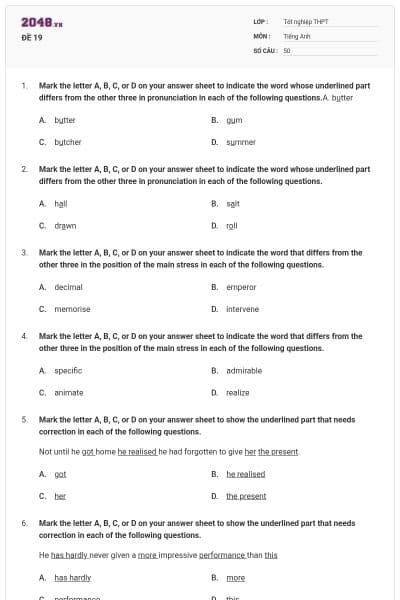
Mark the letter A, B, C, or D on your answer sheet to indicate the word whose underlined part differs from the other three in pronunciation in each of the following questions.A. butter
butter
gum
butcher
summer
Đáp án C
Đọc là âm [ʊ], còn lại đọc là âm [ʌ]
A. /ˈbʌtə(r)/
B. /ɡʌm/
C. /ˈbʊtʃə(r)/
D. /ˈsʌmə(r)/
Mark the letter A, B, C, or D on your answer sheet to indicate the word whose underlined part differs from the other three in pronunciation in each of the following questions.
hall
salt
drawn
roll
Đáp án D
Đọc là âm [əʊ], còn lại đọc là âm [ɔː]
A. /hɔːl/
B. /sɔːlt/
C. /drɔːn/
D. /rəʊl/
Mark the letter A, B, C, or D on your answer sheet to indicate the word that differs from the other three in the position of the main stress in each of the following questions.
decimal
emperor
memorise
intervene
Đáp án D
Trọng âm nhấn âm số 3, âm còn lại nhấn âm số 1
A. /ˈdesɪml/
B. /ˈempərə(r)/
C. /ˈmeməraɪz/
D. /ɪntəˈviːn/
Mark the letter A, B, C, or D on your answer sheet to indicate the word that differs from the other three in the position of the main stress in each of the following questions.
specific
admirable
animate
realize
Đáp án A
Trọng âm nhấn âm số 2, âm còn lại nhấn âm số 1
A. /spəˈsɪfɪk/
B. /ˈædmərəbl/
C. /ˈænɪmeɪt/
D. /ˈriːəlaɪz/
Mark the letter A, B, C, or D on your answer sheet to show the underlined part that needs correction in each of the following questions.
Not until he got home he realised he had forgotten to give her the present.
got
he realised
her
the present
Đáp án B
B. did he realise: khi đặt “Not until” ở đầu câu để nhấn mạnh, chúng ta phải đảo động từ gọi là “Inversion”.
Câu này khi viết theo cách bình thường sẽ là: “He did not realise he had fogotten to give her the present until he (had) got home”.
Mark the letter A, B, C, or D on your answer sheet to show the underlined part that needs correction in each of the following questions.
He has hardly never given a more impressive performance than this
has hardly
more
performance
this
Đáp án A
A. bỏ trạng từ “hardly”: trong mệnh đề này đã có trạng từ phủ định “never” nên không thể dùng thêm một trạng từ phủ định như “hardly”.
Đây là vấn đề thường được gọi là “tránh dùng phủ định kép trong cùng một mệnh đề, ví dụ trong mệnh đề đã có “never” hoặc “not” thì không dùng thêm “hardly”, “rarely”, “barely” hoặc “scarcely”.
Mark the letter A, B, C, or D on your answer sheet to show the underlined part that needs correction in each of the following questions.
The student must have her assessment form fill in by the examiner during the oral exam
must have
fill in
during
oral exam
Đáp án B
B. filled in: đây là loại câu “Causative: Have sth done”, với ý nghĩa đưa việc gì cho người khác làm chứ không phải tự mình làm.
Chúng ta có thể viết câu này cách khác như sau: “The student must let the examiner fill in her assessment form suring the oral exam”.
Mark the letter A, B, C, or D on your answer sheet to indicate the underlined part that needs correction in each of the following questions.
___________________with my previous job, I would have won a higher promotion and I in this unfortunate position now
Unless I had stayed I am not
If I stayed / would not be
If had I stayed I will not be
Had I stayed / would not be
Đáp án D
Ta thấy cuối câu có từ “ now” , ta nghĩ ngay tới câu điều kiện loại trộn
If + S + had + Ved/3, S + would/could/should + Vbare infinitive
= Had + S + Ved/3, S + would/could/should + Vbare infinitive
Vi vậy đáp án D – đáp án đúng
Mark the letter A, B, C, or D on your answer sheet to indicate the underlined part that needs correction in each of the following questions.
Quite soon, the world is going to ____________energy resources
get into
run out of
keep up with
come up against
Đáp án B
Get into: Vào, đi vào, lâm vào, mắc phải, nhiễm.
Run out of: cạn kiệt
Keep up with: bắt kịp, đuổi kịp
Come up against: đương đầu, gặp phải
“Khá sớm, thế giới sẽ _________ nguồn năng lượng”
Ta thấy, đáp án B có nghĩa thích hợp với nội dung câu
Mark the letter A, B, C, or D on your answer sheet to indicate the underlined part that needs correction in each of the following questions.
I know you are upset about breaking up with Tom, but there are plenty more
horses in the stable
cows in the shed
tigers in the jungle
fish in the sea
Đáp án D
A. horses in the stable : ngựa trong chuồng ngựa
B. cows in the shed : bò trong cái lều
C. tigers in the jungle : con hổ trong rừng
D. fish in the sea : cá ngoài biển
“Tôi biết bạn đang buồn về chia tay với Tom, nhưng có rất nhiều hơn................................”
Ta thấy, đáp án D –Ý nói có rất nhiều cá trong biển, nghĩa là có nhiều sự lựa chọn (về người), đặc biệt thông dụng khi nói về việc hẹn hò.
Mark the letter A, B, C, or D on your answer sheet to indicate the underlined part that needs correction in each of the following questions.
It's no good pretending; you've got to reality
get down to
bargain for
come up against
face up to
Đáp án D
“Không tốt khi giả vờ, bạn phải....................thực tế”
A. get down to: Bắt tay vào việc gì
B. bargain for: dự tính làm gì
C. come up against : đương đầu, gặp phải
D. face up to: đối mặt với việc gì
Đáp án D – thích hợp cho trường hợp này
Mark the letter A, B, C, or D on your answer sheet to indicate the underlined part that needs correction in each of the following questions.
Not only to speak to him, but she also vowed never to see him again.
she refused
did she refuse
she did refuse
when she refused
Đáp án B
Đảo ngữ với Not only
Not only + auxiliary verbs (nếu là động từ thường) / be + S + V/adj/adv+ ... + but + S + also + O
He is not only good at English but he can also draw very well.
Not only is he good at English but he can also draw very well.
(Anh ta không chỉ giỏi tiếng Anh mà anh ta còn vẽ rất đẹp.)
Mark the letter A, B, C, or D on your answer sheet to indicate the underlined part that needs correction in each of the following questions.
It was so foggy that the driver couldn't the traffic signs
break out
keep out
make out
take out
Đáp án C
“Trời quá nhiều sương mù đến nỗi lái xe không thể___________tín hiệu giao thông”
A. break out: nổ ra, bùng nổ
B. keep out: ngăn cản không cho vào
C. make out: hiểu được, năm được ý, đọc được
D. Take out: chuyển cái gì đó ra ngoài
Đáp án C – đáp án thích hợp
Mark the letter A, B, C, or D on your answer sheet to indicate the underlined part that needs correction in each of the following questions.
I'll have to go to the funeral of Ms. Jane, a of mine
heart to heart
body and soul
flesh and blood
skin and bones
Đáp án C
“Tôi sẽ phải đi đến đám tang của bà Jane, một____________ của tôi.”
A.Heart to heart: chân thành
B. Body and soul: hết lòng, hết dạ
C. Flesh and blood: người có máu mủ ruột thịt => Đáp án C đáp án chính xác
D.Skin and bones: tiều tụy thảm thương, chỉ còn da bọc xương
Mark the letter A, B, C, or D on your answer sheet to indicate the underlined part that needs correction in each of the following questions.
Wood that has been specially treated is regular wood
as water resistant much more than
water resistant much more than
more than water resistant
much more water resistant than
Đáp án D
Ta có cấu trúc so sánh : S + tobe/V + more + long adj/adv + than + S
Ta còn có thể sử dụng thêm từ: much, far để tăng mức độ so sánh
Ta thấy đáp án A là đáp án chính xác
Mark the letter A, B, C, or D on your answer sheet to indicate the underlined part that needs correction in each of the following questions.
Matthew's hands were covered in oil because he his bike
had been mending
has mended
has been mending
had mended
Đáp án A
Ta thấy câu này tình huống ở quá khứ
Bàn tay của Matthew có dầu vì................................: Ta thấy rằng có dấu vết ở quá khứ vì vậy chúng ta dùng thì QKHTTD để nhấn mạnh hành động trong quá khứ để lại dấu vết ở quá khứ
Mark the letter A, B, C, or D on your answer sheet to indicate the underlined part that needs correction in each of the following questions.
We found some real at the market
prizes
goods
bargains
items
Đáp án C
“Chúng tôi đã thây một vài.....................ở chợ”
A. prizes : giải thưởng
B. goods : hàng hoá
C. bargains :món hời
D. items: mặt hàng (ghi trong hóa đơn....)
Đáp án C – đáp án chính xác
Mark the letter A, B, C, or D on your answer sheet to indicate the underlined part that needs correction in each of the following questions.
The at the football match cheered their team on.
congregation
onlookers
audience
spectators
Đáp án D
...................................trận đấu bóng đá cổ vũ đội bóng của họ
A. congregation: giáo đoàn
B. onlookers: người xem (người xem truyền hinh.............)
C. audienc : khán giả, thính giả
D. spectators: người xem, khán giả (của 1 cuộc biểu diễn, thi đấu..............)
Ta thấy, câu này nói đến trận đấu bóng đá vì vậy đáp án D thích hợp
Mark the letter A, B, C, or D on your answer sheet to indicate the underlined part that needs correction in each of the following questions.
I'm sorry you've decided not to go with us on the river trip, but you change your mind, there will still be enough room on the boat for you
even
nevertheless
in the event that
provided that
Đáp án C
Ta có: in the event that + S+V: trong trường hợp cái gì đó xảy ra
Tạm dịch câu: “Tôi rất tiếc bạn đã quyết định không đi với chúng tôi trên chuyến đi trên sông, nhưng ___________bạn thay đổi quyết định, vẫn sẽ có đủ chỗ trên tàu cho bạn”
A. Even: thậm chí
B. Nevertheless: Tuy nhiên
C. Provided that: miễn là
Ta thấy đáp án A B D không thích hợp với ý nghĩa câu trên
Mark the letter A, B, C, or D on your answer sheet to indicate the most suitable response to complete each of the following exchanges
Peter: "I've been awarded a scholarship to study in America." ~ Kate: "Uh, really? "
Take care of yourself
Congratulations
You are always lucky
Lucky as you are
Đáp án B
Peter: "Tôi đã được trao tặng một suất học bổng du học ở Mỹ." ~ Kate: "Uh, thực sao?____"
Ta thấy có đáp án B – câu chúc mừng dành cho tình huống người khác thông báo về tin vui
Mark the letter A, B, C, or D on your answer sheet to indicate the most suitable response to complete each of the following exchanges
- John: "I can't see the stage very well from here." - Jack: " "
Neither can't I
So do I
Neither I can
I can't, either
Đáp án D
Ta thấy câu John nói mang tính chất phủ định “Tôi không thể nhìn thấy sân khấu tốt từ đây”
Ta có, câu đáp lại đồng tình với câu ở dạng phủ định ta có: either/ neither cũng để thể hiện sự đồng tình nhưng cặp từ này được dùng cho câu phủ định mang nghĩa ‘cũng không’.
Cấu trúc: – S1 + V1 (phủ định). Neither to be/ auxiliary verb S1.
Eg: I don’t like playing football. Neither does John.
He isn’t good at Maths. Neither am I.
Jane hasn’t finished her homework yet. Neither has John.
– S1 + V1 (phủ định). S1 + to be/ auxiliary verb, either.
Eg: I don’t like playing football. John does, either.
He isn’t good at Maths. I am, either.
Jane hasn’t finished her homework yet. John has, either.
Chú ý: Khi trong mệnh đề 1 có một cụm trợ động từ như will go, must do, can take,… thì khi chuyển sang câu đồng tình, những trợ động từ trong mệnh đề 1 được dùng lại.
Eg: I cannot speak Japanese. Neither can he.
Jane mustn’t eat candies at night. Jim must, either.
Read the following passage and mark the letter A, B, C, or D on your answer sheet to indicate the correct answer for each of the blanks
Sugar was for a long time a luxury and in the opinion of the medical profession it still should be. During the nineteenth century, however, manufactures discovered (22) ______ of producing it in vast quantities and it has since become one of the staple articles of diet, particularly for the lower social classes. It has the advantages of being comparatively cheap, easily digested, rich in energy and useful for flavoring. Its major drawbacks are that it lacks every nourishing quality except that of giving energy, and because of its attractive flavor it (23)______ to displace other much more valuable foods from the diet. Most serious of all is its adverse (24) _____ on health, since excessive consumption can cause heart trouble, obesity and dental decay. The latter is widespread among the inhabitants of western countries. From the very young to the very old, (25) ______ anyone escapes. Yet if parents would drastically reduce the (26) ______ of confectionery they allow their children to eat, the extend of dental decay would soon be made
Điền ô số 22
recipes
means
uses
methods
Đáp án D
“During the nineteenth century, however, manufactures discovered (55)______ of producing it in vast quantities”
Tạm dịch – Trong suốt thể kỉ 19, các nhà san xuất phát hiện ra____________sản xuất nó với số lượng khổng lồ.
Đáp án D – method – phương pháp, cách thức (METHOD OF STH - a particular way of doing something)
Các đáp án khác
A – công thức nấu món ăn
B – phương tiện, biện pháp (means (of something/of doing something) an action, an object or a system by which a result is achieved; a way of achieving or doing something)
C – cách sử dụng
Read the following passage and mark the letter A, B, C, or D on your answer sheet to indicate the correct answer for each of the blanks
Sugar was for a long time a luxury and in the opinion of the medical profession it still should be. During the nineteenth century, however, manufactures discovered (22) ______ of producing it in vast quantities and it has since become one of the staple articles of diet, particularly for the lower social classes. It has the advantages of being comparatively cheap, easily digested, rich in energy and useful for flavoring. Its major drawbacks are that it lacks every nourishing quality except that of giving energy, and because of its attractive flavor it (23)______ to displace other much more valuable foods from the diet. Most serious of all is its adverse (24) _____ on health, since excessive consumption can cause heart trouble, obesity and dental decay. The latter is widespread among the inhabitants of western countries. From the very young to the very old, (25) ______ anyone escapes. Yet if parents would drastically reduce the (26) ______ of confectionery they allow their children to eat, the extend of dental decay would soon be made
Điền ô số 23
approaches
comes
include
tends
Đáp án D
Ta có: tend to V: có xu hướng, khuynh hướng làm gì
Read the following passage and mark the letter A, B, C, or D on your answer sheet to indicate the correct answer for each of the blanks
Sugar was for a long time a luxury and in the opinion of the medical profession it still should be. During the nineteenth century, however, manufactures discovered (22) ______ of producing it in vast quantities and it has since become one of the staple articles of diet, particularly for the lower social classes. It has the advantages of being comparatively cheap, easily digested, rich in energy and useful for flavoring. Its major drawbacks are that it lacks every nourishing quality except that of giving energy, and because of its attractive flavor it (23)______ to displace other much more valuable foods from the diet. Most serious of all is its adverse (24) _____ on health, since excessive consumption can cause heart trouble, obesity and dental decay. The latter is widespread among the inhabitants of western countries. From the very young to the very old, (25) ______ anyone escapes. Yet if parents would drastically reduce the (26) ______ of confectionery they allow their children to eat, the extend of dental decay would soon be made
Điền ô số 24
influence
affect
focus
effect
Đáp án D
Ta thấy vị trí cần điền là 1 danh từ
Ta có: EFFECT ON STH : Có ảnh hưởng , tác động
(effect (on somebody/something) a change that somebody/something causes in somebody/something else; a result)
Các đáp án khác
A – influence on sth: ảnh hưởng, tác động
(the effect that somebody/something has on the way a person thinks or behaves or on the way that something works or develops)
B – affect (v) ảnh hưởng
C – focus (v) tập trung
Read the following passage and mark the letter A, B, C, or D on your answer sheet to indicate the correct answer for each of the blanks
Sugar was for a long time a luxury and in the opinion of the medical profession it still should be. During the nineteenth century, however, manufactures discovered (22) ______ of producing it in vast quantities and it has since become one of the staple articles of diet, particularly for the lower social classes. It has the advantages of being comparatively cheap, easily digested, rich in energy and useful for flavoring. Its major drawbacks are that it lacks every nourishing quality except that of giving energy, and because of its attractive flavor it (23)______ to displace other much more valuable foods from the diet. Most serious of all is its adverse (24) _____ on health, since excessive consumption can cause heart trouble, obesity and dental decay. The latter is widespread among the inhabitants of western countries. From the very young to the very old, (25) ______ anyone escapes. Yet if parents would drastically reduce the (26) ______ of confectionery they allow their children to eat, the extend of dental decay would soon be made
Điền ô số 25
difficulty
hardly
harshly
severely
Đáp án B
“…., (44)______ anyone escapes”
Ta co: Hardly anyone – Hầu như không có ai
Các đáp án khác k thích hợp
A – (a) khó khăn
C – (adv) cay nghiệt, khắc nghiệt
D – (a) khắt khe, gay gắt , khốc liệt
Read the following passage and mark the letter A, B, C, or D on your answer sheet to indicate the correct answer for each of the blanks
Sugar was for a long time a luxury and in the opinion of the medical profession it still should be. During the nineteenth century, however, manufactures discovered (22) ______ of producing it in vast quantities and it has since become one of the staple articles of diet, particularly for the lower social classes. It has the advantages of being comparatively cheap, easily digested, rich in energy and useful for flavoring. Its major drawbacks are that it lacks every nourishing quality except that of giving energy, and because of its attractive flavor it (23)______ to displace other much more valuable foods from the diet. Most serious of all is its adverse (24) _____ on health, since excessive consumption can cause heart trouble, obesity and dental decay. The latter is widespread among the inhabitants of western countries. From the very young to the very old, (25) ______ anyone escapes. Yet if parents would drastically reduce the (26) ______ of confectionery they allow their children to eat, the extend of dental decay would soon be made
Điền ô số 26
value
quality
number
amount
Đáp án D
“Yet if parents would drastically reduce the (45)______________ of confectionery they allow their children to eat,…”
- confectionery (uncountable nound (n) bánh kẹo (SWEET/ CANDY, CHOCOLATE …)
Ta có: AMOUNT OF + N(không đếm được)
Mark the letter A, B, C; or D on your answer sheet to indicate the word(s) CLOSEST in meaning to the underlined word(s) in each of the following questions.
The newscaster gave a concise account of the tragedy
long and detailed
complicated and intricate
sad and depressing
short and clear
Đáp án: D
Giải thích:
Kiến thức: Từ vựng – Từ đồng nghĩa
concise (adj) ngắn gọn, súc tích
Xét các đáp án:
A. long and detailed: dài và chi tiết
B. complicated and intricate: phức tạp và khó hiểu
C. sad and depressing: buồn và thất vọng
D. short and clear: ngắn và rõ ràng
concise = short and clear
Dịch: Phát thanh viên đã tường thuật ngắn gọn về thảm kịch.
Mark the letter A, B, C; or D on your answer sheet to indicate the word(s) CLOSEST in meaning to the underlined word(s) in each of the following questions.
There were so many members of the political party who had gone against the leader that he resigned.
apposed
insisted
invited
opposed
Đáp án D
Ta có: go against someone/something to oppose someone or something (Phản đối ai/cái gì)
A. apposed : đặt 1 vật lên vật khác
B. insisted : khăng khăng
C. invented : mời
D. opposed: chống đối, phản đối
=>Đồng nghĩa với “go against”
Mark the letter A, B, G or D on your answer sheet to indicate the word(s) OPPOSITE in meaning to the underlined word(s) in each of the following questions.
It gives out light, but not heat and so is safe to use near inflammable liquids
difficult to burn
easy to burn
sunburnt
semi-burnt
Đáp án A
Inflammable (a) dễ cháy.
A. khó để cháy => Trái nghĩa với từ “inflammable”
B. dễ dàng cháy
C. cháy nắng
D. bán cháy
Mark the letter A, B, G or D on your answer sheet to indicate the word(s) OPPOSITE in meaning to the underlined word(s) in each of the following questions.
Experts hope that the vaccine will be mass-produced soon.
produced in great numbers
produced in small numbers
produced cheaply
produced with high cost
Đáp án B
mass-produced : sản xuất số lượng lớn
A. sản xuất với số lượng lớn
B. sản xuất với số lượng nhỏ: => Trái nghĩa với “ Mass produced”
C. sản xuất với giá rẻ
D. sản xuất với chi phí cao
Read the following passage and mark the letter A, B, C, or D on your answer sheet to indicate the correct answer to each of the questions
Archimedes’s Principle is a law of physics that states that when an object is totally or partially immersed in a fluid, it experiences an upthrust equal to the weight of the fluid displaced. The principle is most frequently applied to the behaviour of objects in water, and helps to explain floating and sinking, and why objects seem lighter in water. It also applies to balloons.
The key word in the principle is “upthrust”, which refers to the force acting upward to reduce the apparent weight of the object when it is under water. If, for example, a metal block with a volume of 100 cm3 is dipped in water, it displaces an equal volume of water, which has a weight of approximately 1 N (3.5 oz). The block therefore seems to weigh about 1 N less.
An object will float if its average density is less than that of water. If it is totally submerged, the weight of the water it displaces (and hence the upthrust on it) is greater than its own weight, and it is forced upward and out of water, until the weight if water displaced by submerged part is exactly equal to the weight of the floating object. Thus a block of wood with a density six tenthsthat of water will float with six tenths of its volume under water, since at that point the weight of fluid displaced is the same as the blocks’s own weight. If a dense material is made into a suitable shape, it will float because of Archimedes’s principle. A ship floats, whereas a block of iron of the same mass sinks.
It is also because of Archimedes’s principle that ships float lower in the water when they are heavily loaded (more water must be displaced to give the necessary upthrust). In addition, they cannot be so heavily loaded if they are to sail in fresh water as they can if they are to sail in the sea, since fresh water is less dense than sea water, and so more water must be displaced to give the necessary upthrust. This means the ship is lower in the water, which can be dangerous in rough weather.
From “Archimedes’s Principle”, MicrosoftÒ Student 2008[DVD]. Microsoft Corporation, 2007.
What happens when something is immersed in a fluid?
It will be pushed further down with a force, equal to the weight of the fluid displaced.
It receives an upward force, equal to the weight of the fluid displaced
It receives a download force, equal to the weight of the fluid displaced
The fluid will expand the object and overflow to the floor
Đáp án B
It receives an upward force, equal to the weight of the fluid displaced: “Nó nhận một lực đẩy lên tương đương với trọng lượng của chất lỏng bị chiếm chỗ”.
Câu này thích hợp với câu hỏi: “Điều gì xảy ra khi một vật nào đó nổi lên trong một chất lỏng?”
Chúng ta có thể tìm thấy ý này trong câu đầu của đoạn một: “Archimedes’s Principle is a law of physics that states that when an object is totally or partially immersed in a fluid, it experiences an upthrust equal to the weight of the fluid displaced.”
Read the following passage and mark the letter A, B, C, or D on your answer sheet to indicate the correct answer to each of the questions
Archimedes’s Principle is a law of physics that states that when an object is totally or partially immersed in a fluid, it experiences an upthrust equal to the weight of the fluid displaced. The principle is most frequently applied to the behaviour of objects in water, and helps to explain floating and sinking, and why objects seem lighter in water. It also applies to balloons.
The key word in the principle is “upthrust”, which refers to the force acting upward to reduce the apparent weight of the object when it is under water. If, for example, a metal block with a volume of 100 cm3 is dipped in water, it displaces an equal volume of water, which has a weight of approximately 1 N (3.5 oz). The block therefore seems to weigh about 1 N less.
An object will float if its average density is less than that of water. If it is totally submerged, the weight of the water it displaces (and hence the upthrust on it) is greater than its own weight, and it is forced upward and out of water, until the weight if water displaced by submerged part is exactly equal to the weight of the floating object. Thus a block of wood with a density six tenthsthat of water will float with six tenths of its volume under water, since at that point the weight of fluid displaced is the same as the blocks’s own weight. If a dense material is made into a suitable shape, it will float because of Archimedes’s principle. A ship floats, whereas a block of iron of the same mass sinks.
It is also because of Archimedes’s principle that ships float lower in the water when they are heavily loaded (more water must be displaced to give the necessary upthrust). In addition, they cannot be so heavily loaded if they are to sail in fresh water as they can if they are to sail in the sea, since fresh water is less dense than sea water, and so more water must be displaced to give the necessary upthrust. This means the ship is lower in the water, which can be dangerous in rough weather.
From “Archimedes’s Principle”, MicrosoftÒ Student 2008[DVD]. Microsoft Corporation, 2007.
The word “volume” in the passage refers to ______.
loudness
quantity
frequency
lenght
Đáp án B
B. quantity: từ “quantity” có nghĩa là “số lượng”.
Cụm từ “a volume of water” trong đoạn hai có nghĩa là “một lượng nước”.
Câu A “loudness” có nghĩa là “độ lớn của âm thanh”.
Câu C “frequency” có nghĩa là “tần suất”.
Câu D “length” có nghĩa là “độ dài”.
Read the following passage and mark the letter A, B, C, or D on your answer sheet to indicate the correct answer to each of the questions
Archimedes’s Principle is a law of physics that states that when an object is totally or partially immersed in a fluid, it experiences an upthrust equal to the weight of the fluid displaced. The principle is most frequently applied to the behaviour of objects in water, and helps to explain floating and sinking, and why objects seem lighter in water. It also applies to balloons.
The key word in the principle is “upthrust”, which refers to the force acting upward to reduce the apparent weight of the object when it is under water. If, for example, a metal block with a volume of 100 cm3 is dipped in water, it displaces an equal volume of water, which has a weight of approximately 1 N (3.5 oz). The block therefore seems to weigh about 1 N less.
An object will float if its average density is less than that of water. If it is totally submerged, the weight of the water it displaces (and hence the upthrust on it) is greater than its own weight, and it is forced upward and out of water, until the weight if water displaced by submerged part is exactly equal to the weight of the floating object. Thus a block of wood with a density six tenthsthat of water will float with six tenths of its volume under water, since at that point the weight of fluid displaced is the same as the blocks’s own weight. If a dense material is made into a suitable shape, it will float because of Archimedes’s principle. A ship floats, whereas a block of iron of the same mass sinks.
It is also because of Archimedes’s principle that ships float lower in the water when they are heavily loaded (more water must be displaced to give the necessary upthrust). In addition, they cannot be so heavily loaded if they are to sail in fresh water as they can if they are to sail in the sea, since fresh water is less dense than sea water, and so more water must be displaced to give the necessary upthrust. This means the ship is lower in the water, which can be dangerous in rough weather.
From “Archimedes’s Principle”, MicrosoftÒ Student 2008[DVD]. Microsoft Corporation, 2007.
The word “displaces” in the passage almost means “_____”
takes the place of
takes place
replaces with a new one
puts in position
Đáp án A
A. takes the place of: động từ “displaces” trong đoạn ba có nghĩa là “chiếm chỗ của”.
Còn các đáp
Câu B “takes places” có nghĩa là “xảy ra”.
Câu C “replaces with a new one = thay thế bằng một cái mới”, không đúng với ý nghĩa trong câu.
Câu D “puts in position” có nghĩa là “đặt vào vị trí”.
Read the following passage and mark the letter A, B, C, or D on your answer sheet to indicate the correct answer to each of the questions
Archimedes’s Principle is a law of physics that states that when an object is totally or partially immersed in a fluid, it experiences an upthrust equal to the weight of the fluid displaced. The principle is most frequently applied to the behaviour of objects in water, and helps to explain floating and sinking, and why objects seem lighter in water. It also applies to balloons.
The key word in the principle is “upthrust”, which refers to the force acting upward to reduce the apparent weight of the object when it is under water. If, for example, a metal block with a volume of 100 cm3 is dipped in water, it displaces an equal volume of water, which has a weight of approximately 1 N (3.5 oz). The block therefore seems to weigh about 1 N less.
An object will float if its average density is less than that of water. If it is totally submerged, the weight of the water it displaces (and hence the upthrust on it) is greater than its own weight, and it is forced upward and out of water, until the weight if water displaced by submerged part is exactly equal to the weight of the floating object. Thus a block of wood with a density six tenthsthat of water will float with six tenths of its volume under water, since at that point the weight of fluid displaced is the same as the blocks’s own weight. If a dense material is made into a suitable shape, it will float because of Archimedes’s principle. A ship floats, whereas a block of iron of the same mass sinks.
It is also because of Archimedes’s principle that ships float lower in the water when they are heavily loaded (more water must be displaced to give the necessary upthrust). In addition, they cannot be so heavily loaded if they are to sail in fresh water as they can if they are to sail in the sea, since fresh water is less dense than sea water, and so more water must be displaced to give the necessary upthrust. This means the ship is lower in the water, which can be dangerous in rough weather.
From “Archimedes’s Principle”, MicrosoftÒ Student 2008[DVD]. Microsoft Corporation, 2007.
A block of wood with a density seven tenths that of water will ____
go up and down the sink
float with a half of its volume under water
float with an equal volume of its volume under water
sink immediately when submerged
Đáp án C
C. float with an equal volume of its volume under water
Ý nghĩa của cả câu: “Một khối gỗ có tỉ trọng bảy phần mười tỉ trọng của nước sẽ nổi lên với một thể tích tương đương với thể tích chìm của nước”.
Chúng ta có thể tìm thấy ý này trong câu ba của đoạn 3: “Thus a block of wood with a density six tenths that of water will float with six tenths of its volume under water, since at that point the weight of fluid displaces is the same as the block’s own weight”.
Read the following passage and mark the letter A, B, C, or D on your answer sheet to indicate the correct answer to each of the questions
Archimedes’s Principle is a law of physics that states that when an object is totally or partially immersed in a fluid, it experiences an upthrust equal to the weight of the fluid displaced. The principle is most frequently applied to the behaviour of objects in water, and helps to explain floating and sinking, and why objects seem lighter in water. It also applies to balloons.
The key word in the principle is “upthrust”, which refers to the force acting upward to reduce the apparent weight of the object when it is under water. If, for example, a metal block with a volume of 100 cm3 is dipped in water, it displaces an equal volume of water, which has a weight of approximately 1 N (3.5 oz). The block therefore seems to weigh about 1 N less.
An object will float if its average density is less than that of water. If it is totally submerged, the weight of the water it displaces (and hence the upthrust on it) is greater than its own weight, and it is forced upward and out of water, until the weight if water displaced by submerged part is exactly equal to the weight of the floating object. Thus a block of wood with a density six tenthsthat of water will float with six tenths of its volume under water, since at that point the weight of fluid displaced is the same as the blocks’s own weight. If a dense material is made into a suitable shape, it will float because of Archimedes’s principle. A ship floats, whereas a block of iron of the same mass sinks.
It is also because of Archimedes’s principle that ships float lower in the water when they are heavily loaded (more water must be displaced to give the necessary upthrust). In addition, they cannot be so heavily loaded if they are to sail in fresh water as they can if they are to sail in the sea, since fresh water is less dense than sea water, and so more water must be displaced to give the necessary upthrust. This means the ship is lower in the water, which can be dangerous in rough weather.
From “Archimedes’s Principle”, MicrosoftÒ Student 2008[DVD]. Microsoft Corporation, 2007.
A ship floats, whereas a block of iron of the same mass sinks because the ship ____
is made of wood
is lighter
has buoys
has a special shape
Đáp án D
D. has a special shape: ý nghĩa cả câu này: “Một chiếc tàu nổi bềnh bồng trong khi một khối sắt có trọng lượng giống như thế thì chìm bởi vì chiếc tàu có hình dáng đặc biệt”.
Chúng ta có thể tìm thấy ý này trong hai câu cuối của đoạn 3: “If a dense material is made into a suitable shape, it will float because of Archimedes’ principle. A ship floats, whereas a block of iron of the same mass sinks”.
Read the following passage and mark the letter A, B, C, or D on your answer sheet to indicate the correct answer to each of the questions
Archimedes’s Principle is a law of physics that states that when an object is totally or partially immersed in a fluid, it experiences an upthrust equal to the weight of the fluid displaced. The principle is most frequently applied to the behaviour of objects in water, and helps to explain floating and sinking, and why objects seem lighter in water. It also applies to balloons.
The key word in the principle is “upthrust”, which refers to the force acting upward to reduce the apparent weight of the object when it is under water. If, for example, a metal block with a volume of 100 cm3 is dipped in water, it displaces an equal volume of water, which has a weight of approximately 1 N (3.5 oz). The block therefore seems to weigh about 1 N less.
An object will float if its average density is less than that of water. If it is totally submerged, the weight of the water it displaces (and hence the upthrust on it) is greater than its own weight, and it is forced upward and out of water, until the weight if water displaced by submerged part is exactly equal to the weight of the floating object. Thus a block of wood with a density six tenthsthat of water will float with six tenths of its volume under water, since at that point the weight of fluid displaced is the same as the blocks’s own weight. If a dense material is made into a suitable shape, it will float because of Archimedes’s principle. A ship floats, whereas a block of iron of the same mass sinks.
It is also because of Archimedes’s principle that ships float lower in the water when they are heavily loaded (more water must be displaced to give the necessary upthrust). In addition, they cannot be so heavily loaded if they are to sail in fresh water as they can if they are to sail in the sea, since fresh water is less dense than sea water, and so more water must be displaced to give the necessary upthrust. This means the ship is lower in the water, which can be dangerous in rough weather.
From “Archimedes’s Principle”, MicrosoftÒ Student 2008[DVD]. Microsoft Corporation, 2007.
The word “upthrust” in the passage refers to the _____
upward push
upper side of an object
upturned force
upside-down turn
Đáp án A
A. upward push: từ “upthrust” trong đoạn bốn đề cập đến “lực đẩy từ dưới lên = upward push”.
Còn các đáp án khác
Câu B “upperside of an object”: phía bên trên của một vật.
Câu C “upward force”: lực làm lật tàu, thuyền.
Câu D “upside-down turn”: việc lật lại từ trên xuống dưới.
Read the following passage and mark the letter A, B, C, or D on your answer sheet to indicate the correct answer to each of the questions
Archimedes’s Principle is a law of physics that states that when an object is totally or partially immersed in a fluid, it experiences an upthrust equal to the weight of the fluid displaced. The principle is most frequently applied to the behaviour of objects in water, and helps to explain floating and sinking, and why objects seem lighter in water. It also applies to balloons.
The key word in the principle is “upthrust”, which refers to the force acting upward to reduce the apparent weight of the object when it is under water. If, for example, a metal block with a volume of 100 cm3 is dipped in water, it displaces an equal volume of water, which has a weight of approximately 1 N (3.5 oz). The block therefore seems to weigh about 1 N less.
An object will float if its average density is less than that of water. If it is totally submerged, the weight of the water it displaces (and hence the upthrust on it) is greater than its own weight, and it is forced upward and out of water, until the weight if water displaced by submerged part is exactly equal to the weight of the floating object. Thus a block of wood with a density six tenthsthat of water will float with six tenths of its volume under water, since at that point the weight of fluid displaced is the same as the blocks’s own weight. If a dense material is made into a suitable shape, it will float because of Archimedes’s principle. A ship floats, whereas a block of iron of the same mass sinks.
It is also because of Archimedes’s principle that ships float lower in the water when they are heavily loaded (more water must be displaced to give the necessary upthrust). In addition, they cannot be so heavily loaded if they are to sail in fresh water as they can if they are to sail in the sea, since fresh water is less dense than sea water, and so more water must be displaced to give the necessary upthrust. This means the ship is lower in the water, which can be dangerous in rough weather.
From “Archimedes’s Principle”, MicrosoftÒ Student 2008[DVD]. Microsoft Corporation, 2007.
Ships cannot be so heavily loaded if they want to sail in fresh water as they sail in the sea, because ____
fresh water is ‘lighter’ than sea water
there’s too much salt in sea water
sea water is ‘saltier’ than fresh water
fresh water is more polluted
Đáp án A
A. fresh water is ‘lighter’ than sea water: ý nghĩa của cả câu này là “Tàu thuyền không thể được chất nặng khi chúng đi trên sông như khi chúng đi trên biển, bởi vì nước sông thì nhẹ hơn nước biển”.
Chúng ta có thể tìm thấy ý này trong câu hai của đoạn bốn: “In addition, they cannot be so heavily loaded….to give the necesssary upthrust”
Read the following passage and mark the letter A, B, C, or D on your answer sheet to indicate the correct answer to each of the questions
Archimedes’s Principle is a law of physics that states that when an object is totally or partially immersed in a fluid, it experiences an upthrust equal to the weight of the fluid displaced. The principle is most frequently applied to the behaviour of objects in water, and helps to explain floating and sinking, and why objects seem lighter in water. It also applies to balloons.
The key word in the principle is “upthrust”, which refers to the force acting upward to reduce the apparent weight of the object when it is under water. If, for example, a metal block with a volume of 100 cm3 is dipped in water, it displaces an equal volume of water, which has a weight of approximately 1 N (3.5 oz). The block therefore seems to weigh about 1 N less.
An object will float if its average density is less than that of water. If it is totally submerged, the weight of the water it displaces (and hence the upthrust on it) is greater than its own weight, and it is forced upward and out of water, until the weight if water displaced by submerged part is exactly equal to the weight of the floating object. Thus a block of wood with a density six tenthsthat of water will float with six tenths of its volume under water, since at that point the weight of fluid displaced is the same as the blocks’s own weight. If a dense material is made into a suitable shape, it will float because of Archimedes’s principle. A ship floats, whereas a block of iron of the same mass sinks.
It is also because of Archimedes’s principle that ships float lower in the water when they are heavily loaded (more water must be displaced to give the necessary upthrust). In addition, they cannot be so heavily loaded if they are to sail in fresh water as they can if they are to sail in the sea, since fresh water is less dense than sea water, and so more water must be displaced to give the necessary upthrust. This means the ship is lower in the water, which can be dangerous in rough weather.
From “Archimedes’s Principle”, MicrosoftÒ Student 2008[DVD]. Microsoft Corporation, 2007.
Archimedes’ Principle explains why ____
all objects will float
Archimedes became
objects seem lighter in water
humans can swim
Đáp án C
C. objects seem lighter in water: Định lí Archimedes giải thích tại sao: các vật thể có thể nhẹ hơn nước.
Chúng ta có thể tìm thấy ý này trong câu hai của đoạn một : “The principle is most frequently applied….and why objects seem lighter in water”.
Read the following passage and mark the letter A, B, C, or D on your answer sheet to indicate the correct answer to each of the questions from 31 to 40.
In the West, cartoons are used chiefly to make people laugh. The important feature of all these cartoons is the joke and the element of surprise which is contained. Even though it is very funny, a good cartoon is always based on close observation of a particular feature of life and usually has a serious purpose.
Cartoons in the West have been associated with political and social matters for many years. In wartime, for example, they proved to be an excellent way of spreading propaganda. Nowadays cartoons are often used to make short, sharp comments on politics and governments as well as on a variety of social matters. In this way, the modern cartoon has become a very powerful force in influencing people in Europe and the United States.
Unlike most American and European cartoons, however, many Chinese cartoon drawings in the past have also attempted to educate people, especially those who could not read and write. Such cartoons about the lives and sayings of great men in China have proved extremely useful in bringing education to illiterate and semi-literate people throughout China. Confucius, Mencius and Laozi have all appeared in very interesting stories presented in the form of cartoons. The cartoons themselves have thus served to illustrate the teachings of the Chinese sages in a very attractive way.
In this sense, many Chinese cartoons are different from Western cartoons in so far as they do not depend chiefly on telling jokes. Often, there is nothing to laugh at when you see Chines cartoons. This is not their primary aim. In addition to commenting on serious political and social matters, Chinese cartoons have aimed at spreading the traditional Chinese thoughts and culture as widely as possible among the people.
Today, howerver, Chinese cartoons have an added part to play in spreading knowledge. They offer a very attractive and useful way of reaching people throughout the world, regardless of the particular country in which they live. Thus, through cartoons, the thoughts and teachings of the old Chinese philosophers and sages can now reach people who live in such countries as Britain, France, America, Japan, Malaysia or Australia and who are unfamiliar with the Chinese culture.
Until recently, the transfer of knowledge and culture has been overwhelmingly from the West to the East and not vice versa. By means of cartoons, however, publishing companies in Taiwan, Hong Kong and Singapore are now having success in correcting this imbalance between the East and the West.
Cartoons can overcome language barriers in all foreign countries. The vast increase in the popularity of these cartoons serves to illustrate the truth of Confucius’s famous saying “One picture is worth a thousand words."
Which of the following clearly characterizes Western cartoons?
Originality, freshness, and astonishment
Humour, unexpectedness, and criticism
Enjoyment, liveliness, and carefulness
Seriousness, propagande, and attractiveness
Đáp án B
B. “Humour, unexpectedness, and criticism”: đặc tính phim hoạt hình của phương Tây là “hài hước, bất ngờ và phê phán”.
Chúng ta có thể thấy chi tiết này trong đoạn 1, câu: “The important feature …. serious purpose”, và trong đoạn 2, câu: “Nowadays cartoons are often …. of social matters”.
Read the following passage and mark the letter A, B, C, or D on your answer sheet to indicate the correct answer to each of the questions from 31 to 40.
In the West, cartoons are used chiefly to make people laugh. The important feature of all these cartoons is the joke and the element of surprise which is contained. Even though it is very funny, a good cartoon is always based on close observation of a particular feature of life and usually has a serious purpose.
Cartoons in the West have been associated with political and social matters for many years. In wartime, for example, they proved to be an excellent way of spreading propaganda. Nowadays cartoons are often used to make short, sharp comments on politics and governments as well as on a variety of social matters. In this way, the modern cartoon has become a very powerful force in influencing people in Europe and the United States.
Unlike most American and European cartoons, however, many Chinese cartoon drawings in the past have also attempted to educate people, especially those who could not read and write. Such cartoons about the lives and sayings of great men in China have proved extremely useful in bringing education to illiterate and semi-literate people throughout China. Confucius, Mencius and Laozi have all appeared in very interesting stories presented in the form of cartoons. The cartoons themselves have thus served to illustrate the teachings of the Chinese sages in a very attractive way.
In this sense, many Chinese cartoons are different from Western cartoons in so far as they do not depend chiefly on telling jokes. Often, there is nothing to laugh at when you see Chines cartoons. This is not their primary aim. In addition to commenting on serious political and social matters, Chinese cartoons have aimed at spreading the traditional Chinese thoughts and culture as widely as possible among the people.
Today, howerver, Chinese cartoons have an added part to play in spreading knowledge. They offer a very attractive and useful way of reaching people throughout the world, regardless of the particular country in which they live. Thus, through cartoons, the thoughts and teachings of the old Chinese philosophers and sages can now reach people who live in such countries as Britain, France, America, Japan, Malaysia or Australia and who are unfamiliar with the Chinese culture.
Until recently, the transfer of knowledge and culture has been overwhelmingly from the West to the East and not vice versa. By means of cartoons, however, publishing companies in Taiwan, Hong Kong and Singapore are now having success in correcting this imbalance between the East and the West.
Cartoons can overcome language barriers in all foreign countries. The vast increase in the popularity of these cartoons serves to illustrate the truth of Confucius’s famous saying “One picture is worth a thousand words.”
Chinese cartoons have been useful as an important means of________
educating ordinary people
spreading Western ideas
political propaganda in wartime
amusing people all the time
Đáp án A
A. “educating ordinary people”: phim hoạt hình Trung Quốc thì có tác dụng như một phương tiện “giáo dục giới tính bình dân”.
Chúng ta thấy chi tiết này trong đoạn 3, câu: “Unlike most Ảmerican ….. who could not read and write”.
Read the following passage and mark the letter A, B, C, or D on your answer sheet to indicate the correct answer to each of the questions from 31 to 40.
In the West, cartoons are used chiefly to make people laugh. The important feature of all these cartoons is the joke and the element of surprise which is contained. Even though it is very funny, a good cartoon is always based on close observation of a particular feature of life and usually has a serious purpose.
Cartoons in the West have been associated with political and social matters for many years. In wartime, for example, they proved to be an excellent way of spreading propaganda. Nowadays cartoons are often used to make short, sharp comments on politics and governments as well as on a variety of social matters. In this way, the modern cartoon has become a very powerful force in influencing people in Europe and the United States.
Unlike most American and European cartoons, however, many Chinese cartoon drawings in the past have also attempted to educate people, especially those who could not read and write. Such cartoons about the lives and sayings of great men in China have proved extremely useful in bringing education to illiterate and semi-literate people throughout China. Confucius, Mencius and Laozi have all appeared in very interesting stories presented in the form of cartoons. The cartoons themselves have thus served to illustrate the teachings of the Chinese sages in a very attractive way.
In this sense, many Chinese cartoons are different from Western cartoons in so far as they do not depend chiefly on telling jokes. Often, there is nothing to laugh at when you see Chines cartoons. This is not their primary aim. In addition to commenting on serious political and social matters, Chinese cartoons have aimed at spreading the traditional Chinese thoughts and culture as widely as possible among the people.
Today, howerver, Chinese cartoons have an added part to play in spreading knowledge. They offer a very attractive and useful way of reaching people throughout the world, regardless of the particular country in which they live. Thus, through cartoons, the thoughts and teachings of the old Chinese philosophers and sages can now reach people who live in such countries as Britain, France, America, Japan, Malaysia or Australia and who are unfamiliar with the Chinese culture.
Until recently, the transfer of knowledge and culture has been overwhelmingly from the West to the East and not vice versa. By means of cartoons, however, publishing companies in Taiwan, Hong Kong and Singapore are now having success in correcting this imbalance between the East and the West.
Cartoons can overcome language barriers in all foreign countries. The vast increase in the popularity of these cartoons serves to illustrate the truth of Confucius’s famous saying “One picture is worth a thousand words.”
The major differences between Chinese cartoons and Western cartoons come from their_______
purposes
nationalities
values
styles
Đáp án A
A. purposes: sự khác biệt chủ yếu của phim hoạt hình Trung Quốc và phim hoạt hình phương Tây là ở “mục đích” làm phim.
Chúng ta thấy chi tiết này khi đọc ý chính của đoạn 4 nói về mục đích làm phim hoạt hình của Trung Quốc và ý của đoạn 1 và 2 nói về mục đích phim hoạt hình của phương Tây.
Read the following passage and mark the letter A, B, C, or D on your answer sheet to indicate the correct answer to each of the questions from 31 to 40.
In the West, cartoons are used chiefly to make people laugh. The important feature of all these cartoons is the joke and the element of surprise which is contained. Even though it is very funny, a good cartoon is always based on close observation of a particular feature of life and usually has a serious purpose.
Cartoons in the West have been associated with political and social matters for many years. In wartime, for example, they proved to be an excellent way of spreading propaganda. Nowadays cartoons are often used to make short, sharp comments on politics and governments as well as on a variety of social matters. In this way, the modern cartoon has become a very powerful force in influencing people in Europe and the United States.
Unlike most American and European cartoons, however, many Chinese cartoon drawings in the past have also attempted to educate people, especially those who could not read and write. Such cartoons about the lives and sayings of great men in China have proved extremely useful in bringing education to illiterate and semi-literate people throughout China. Confucius, Mencius and Laozi have all appeared in very interesting stories presented in the form of cartoons. The cartoons themselves have thus served to illustrate the teachings of the Chinese sages in a very attractive way.
In this sense, many Chinese cartoons are different from Western cartoons in so far as they do not depend chiefly on telling jokes. Often, there is nothing to laugh at when you see Chines cartoons. This is not their primary aim. In addition to commenting on serious political and social matters, Chinese cartoons have aimed at spreading the traditional Chinese thoughts and culture as widely as possible among the people.
Today, howerver, Chinese cartoons have an added part to play in spreading knowledge. They offer a very attractive and useful way of reaching people throughout the world, regardless of the particular country in which they live. Thus, through cartoons, the thoughts and teachings of the old Chinese philosophers and sages can now reach people who live in such countries as Britain, France, America, Japan, Malaysia or Australia and who are unfamiliar with the Chinese culture.
Until recently, the transfer of knowledge and culture has been overwhelmingly from the West to the East and not vice versa. By means of cartoons, however, publishing companies in Taiwan, Hong Kong and Singapore are now having success in correcting this imbalance between the East and the West.
Cartoons can overcome language barriers in all foreign countries. The vast increase in the popularity of these cartoons serves to illustrate the truth of Confucius’s famous saying “One picture is worth a thousand words.”
The passage is intended to present________
a contrast between Western cartoons and Chinese cartoons
an opinion about how cartoons entertain people
a description of cartoons of all kinds the world over
an outline of Western cartoons and Chinese cartoons
Đáp án A
A. a contrast between Western cartoons and Chinese cartoons: bài đọc có ý định trình bày “sự tương phản giữa phim hoạt hình phương Tây và phim hoạt hình Trung Quốc”.
Read the following passage and mark the letter A, B, C, or D on your answer sheet to indicate the correct answer to each of the questions from 31 to 40.
In the West, cartoons are used chiefly to make people laugh. The important feature of all these cartoons is the joke and the element of surprise which is contained. Even though it is very funny, a good cartoon is always based on close observation of a particular feature of life and usually has a serious purpose.
Cartoons in the West have been associated with political and social matters for many years. In wartime, for example, they proved to be an excellent way of spreading propaganda. Nowadays cartoons are often used to make short, sharp comments on politics and governments as well as on a variety of social matters. In this way, the modern cartoon has become a very powerful force in influencing people in Europe and the United States.
Unlike most American and European cartoons, however, many Chinese cartoon drawings in the past have also attempted to educate people, especially those who could not read and write. Such cartoons about the lives and sayings of great men in China have proved extremely useful in bringing education to illiterate and semi-literate people throughout China. Confucius, Mencius and Laozi have all appeared in very interesting stories presented in the form of cartoons. The cartoons themselves have thus served to illustrate the teachings of the Chinese sages in a very attractive way.
In this sense, many Chinese cartoons are different from Western cartoons in so far as they do not depend chiefly on telling jokes. Often, there is nothing to laugh at when you see Chines cartoons. This is not their primary aim. In addition to commenting on serious political and social matters, Chinese cartoons have aimed at spreading the traditional Chinese thoughts and culture as widely as possible among the people.
Today, howerver, Chinese cartoons have an added part to play in spreading knowledge. They offer a very attractive and useful way of reaching people throughout the world, regardless of the particular country in which they live. Thus, through cartoons, the thoughts and teachings of the old Chinese philosophers and sages can now reach people who live in such countries as Britain, France, America, Japan, Malaysia or Australia and who are unfamiliar with the Chinese culture.
Until recently, the transfer of knowledge and culture has been overwhelmingly from the West to the East and not vice versa. By means of cartoons, however, publishing companies in Taiwan, Hong Kong and Singapore are now having success in correcting this imbalance between the East and the West.
Cartoons can overcome language barriers in all foreign countries. The vast increase in the popularity of these cartoons serves to illustrate the truth of Confucius’s famous saying “One picture is worth a thousand words.”
Which of the following could be the best title for the passage?
A Very Powerful Force in Influencing People
Cartoons as a Way of Educating People
Chinese Cartoons and Western Cartoons
An Excellent Way of Spreading Propaganda
Đáp án C
C. Chinese Cartoons nd Western Cartoons: tựa đề thích hợp cho bài đọc này sẽ là “Phim hoạt hình Trung Quốc và phim hoạt hình phương Tây.
Read the following passage and mark the letter A, B, C, or D on your answer sheet to indicate the correct answer to each of the questions from 31 to 40.
In the West, cartoons are used chiefly to make people laugh. The important feature of all these cartoons is the joke and the element of surprise which is contained. Even though it is very funny, a good cartoon is always based on close observation of a particular feature of life and usually has a serious purpose.
Cartoons in the West have been associated with political and social matters for many years. In wartime, for example, they proved to be an excellent way of spreading propaganda. Nowadays cartoons are often used to make short, sharp comments on politics and governments as well as on a variety of social matters. In this way, the modern cartoon has become a very powerful force in influencing people in Europe and the United States.
Unlike most American and European cartoons, however, many Chinese cartoon drawings in the past have also attempted to educate people, especially those who could not read and write. Such cartoons about the lives and sayings of great men in China have proved extremely useful in bringing education to illiterate and semi-literate people throughout China. Confucius, Mencius and Laozi have all appeared in very interesting stories presented in the form of cartoons. The cartoons themselves have thus served to illustrate the teachings of the Chinese sages in a very attractive way.
In this sense, many Chinese cartoons are different from Western cartoons in so far as they do not depend chiefly on telling jokes. Often, there is nothing to laugh at when you see Chines cartoons. This is not their primary aim. In addition to commenting on serious political and social matters, Chinese cartoons have aimed at spreading the traditional Chinese thoughts and culture as widely as possible among the people.
Today, howerver, Chinese cartoons have an added part to play in spreading knowledge. They offer a very attractive and useful way of reaching people throughout the world, regardless of the particular country in which they live. Thus, through cartoons, the thoughts and teachings of the old Chinese philosophers and sages can now reach people who live in such countries as Britain, France, America, Japan, Malaysia or Australia and who are unfamiliar with the Chinese culture.
Until recently, the transfer of knowledge and culture has been overwhelmingly from the West to the East and not vice versa. By means of cartoons, however, publishing companies in Taiwan, Hong Kong and Singapore are now having success in correcting this imbalance between the East and the West.
Cartoons can overcome language barriers in all foreign countries. The vast increase in the popularity of these cartoons serves to illustrate the truth of Confucius’s famous saying “One picture is worth a thousand words.”
In general, Chinese cartoons are now aiming at_______
illustrating the truth of Chinese great men’s famous sayings
bringing education to illiterate and semi-literate people in the world
spreading the Chinese ideas and cultural values throughout the world
disseminating traditional practices in China and throughout the world
Đáp án C
C. spreading the Chinese ideas and cultural values throughout the world: nhìn chung phim hoạt hình Trung Quốc ngày nay nhắm đến việc “phổ biến tư tưởng và giá trị Trung Quốc ra khắp thế giới”.
Chúng ta tìm thấy chi tiết này trong đoạn 5, câu: “Today, however, Chinese cartoons ….in spreading knowledge”. Và câu: “Thus, through cartoons, the thoughts and teachings….the Chinese culture”.
Read the following passage and mark the letter A, B, C, or D on your answer sheet to indicate the correct answer to each of the questions from 31 to 40.
In the West, cartoons are used chiefly to make people laugh. The important feature of all these cartoons is the joke and the element of surprise which is contained. Even though it is very funny, a good cartoon is always based on close observation of a particular feature of life and usually has a serious purpose.
Cartoons in the West have been associated with political and social matters for many years. In wartime, for example, they proved to be an excellent way of spreading propaganda. Nowadays cartoons are often used to make short, sharp comments on politics and governments as well as on a variety of social matters. In this way, the modern cartoon has become a very powerful force in influencing people in Europe and the United States.
Unlike most American and European cartoons, however, many Chinese cartoon drawings in the past have also attempted to educate people, especially those who could not read and write. Such cartoons about the lives and sayings of great men in China have proved extremely useful in bringing education to illiterate and semi-literate people throughout China. Confucius, Mencius and Laozi have all appeared in very interesting stories presented in the form of cartoons. The cartoons themselves have thus served to illustrate the teachings of the Chinese sages in a very attractive way.
In this sense, many Chinese cartoons are different from Western cartoons in so far as they do not depend chiefly on telling jokes. Often, there is nothing to laugh at when you see Chines cartoons. This is not their primary aim. In addition to commenting on serious political and social matters, Chinese cartoons have aimed at spreading the traditional Chinese thoughts and culture as widely as possible among the people.
Today, howerver, Chinese cartoons have an added part to play in spreading knowledge. They offer a very attractive and useful way of reaching people throughout the world, regardless of the particular country in which they live. Thus, through cartoons, the thoughts and teachings of the old Chinese philosophers and sages can now reach people who live in such countries as Britain, France, America, Japan, Malaysia or Australia and who are unfamiliar with the Chinese culture.
Until recently, the transfer of knowledge and culture has been overwhelmingly from the West to the East and not vice versa. By means of cartoons, however, publishing companies in Taiwan, Hong Kong and Singapore are now having success in correcting this imbalance between the East and the West.
Cartoons can overcome language barriers in all foreign countries. The vast increase in the popularity of these cartoons serves to illustrate the truth of Confucius’s famous saying “One picture is worth a thousand words.”
The word “imbalance” in paragraph 6 refers to________
The mismatch between the East cartoons and the West cartoons
the influence of the East cartoons over the West cartoons
the dominant cultural influence of the West over the East
the discrimination between the West culture and the East culture
Đáp án C
C. the dominant culture influence of the West over the East: từ “imbalance” trong đoạn 6 nói đến “ảnh hưởng văn hóa thống trị của phương Tây đối với phương Đông”.
Nghĩa đen của từ “imbalance” là “sự mất cân đối”. Chúng ta thấy chi tiết này trong câu: “Until recently,….and not vice versa”.
Mark the letter A, B, C, or D on your answer sheet to indicate the sentence that best combines each pair of sentences in the following questions.
He was successful because he was determined to pursue personal goals. He was not talented
His success lay in his natural ability, not in his determination to pursue personal goals
In addition to his determination, his talent ensured his success in pursuing his goals
His determination to pursue personal goals made him successful and talented
It was his determination to persue personal goals, not talent, that contributed to his success
Đáp án D
Tạm dịch: “Chính là lòng quyết tâm theo đuổi mục đích cá nhân, chứ không phải do tài năng, đã đóng vào sự thành công của anh ấy”, câu này diễn tả đúng ý của câu cho sẵn.
Mark the letter A, B, C, or D on your answer sheet to indicate the sentence that best combines each pair of sentences in the following questions.
I did not arrive in time. I was not able to see her off.
She had left because I was not on time
I did not go there, so I could not see her off
I was not early enough to see her off
I arrived very late to say goodbye to her
Đáp án C
C. I was not early enough to see her off: “Tôi đã không đến kịp để chia tay với cô ây”, câu này là cách nối thích hợp và đúng nhất của hai mệnh đề cho sẵn.
Mark the letter A, B, C, or D on your answer sheet to indicate the sentence that is CLOSEST in meaning to each of the following questions.
David was narrowly defeated and blew his own chance of becoming a champion.
Losing the championship came as a terrible blow to David
In spite of the narrow defeat, David won the championship
As a result of his narrow defeat, David did not win the championship
But for his title as the former champion, David would not have defeated his rivals
Đáp án: C
Giải thích:
Câu gốc nói rằng David bị đánh bại một cách sít sao và đánh mất cơ hội trở thành nhà vô địch. Vậy đáp án đúng phải thể hiện được ý nghĩa rằng do thất bại sít sao, David không giành được chức vô địch.
A. Losing the championship came as a terrible blow to David. – Sai vì không đề cập đến việc anh ta "đánh mất cơ hội".
B. In spite of the narrow defeat, David won the championship. – Sai vì mâu thuẫn với nghĩa gốc (David không thắng).
C. As a result of his narrow defeat, David did not win the championship. – Đúng vì diễn đạt lại ý nghĩa của câu gốc một cách chính xác.
D. But for his title as the former champion, David would not have defeated his rivals. – Sai vì thông tin không liên quan đến câu gốc.
Dịch: Do thất bại sít sao, David đã không giành được chức vô địch.
Mark the letter A, B, C, or D on your answer sheet to indicate the sentence that is CLOSEST in meaning to each of the following questions.
If you had stuck to what we originally agreed on, everything would have been fine.
If you had not kept to what was originally agreed on, ever/thing would have been fine
Things went wrong because you violated our original agreement
If you had changed our original agreement, everything would have been fine
As you fulfilled the original contract, things went wrong
Đáp án B
B. Things went wrong because you violated our original agreement: “Mọi việc hỏng bét vì anh đã vi phạm những thỏa thuận ban đầu của chúng ta”, đây là câu tình huống thực tế cho câu điều kiện trong câu cho sẵn: “Nếu anh bám sát những gì chúng ta đã thỏa thuận thì mọi chuyện đã tốt đẹp”.
Mark the letter A, B, C, or D on your answer sheet to indicate the sentence that is CLOSEST in meaning to each of the following questions.
"I would be grateful if you could send me further details of the job," he said to me.
He flattered me because I sent him further details of the job
He felt great because further details of the job had been sent to him
He thanked me for sending him further details of the job
He politely asked me to send him further details of the job
Đáp án: D
Giải thích:
Dịch: Anh ấy nói với tôi rằng: “Tôi sẽ rất biết ơn nếu anh có thể gửi cho tôi thêm thông tin chi tiết về công việc này”.
Dùng câu điều kiện loại 2 để đưa ra lời đề nghị một cách lịch sự.
Xét các đáp án:
A. Anh ấy nịnh tôi vì tôi đã gửi cho anh ấy thêm thông tin chi tiết về công việc.
B. Anh ấy cảm thấy tuyệt vời vì tôi đã gửi cho anh ấy thêm thông tin chi tiết về công việc.
C. Anh ấy cảm ơn tôi vì đã gửi cho anh ấy thêm thông tin chi tiết về công việc.
D. Anh ấy lịch sự yêu cầu tôi gửi cho anh ấy thêm thông tin chi tiết về công việc.
Đáp án D phù hợp nhất về nghĩa.