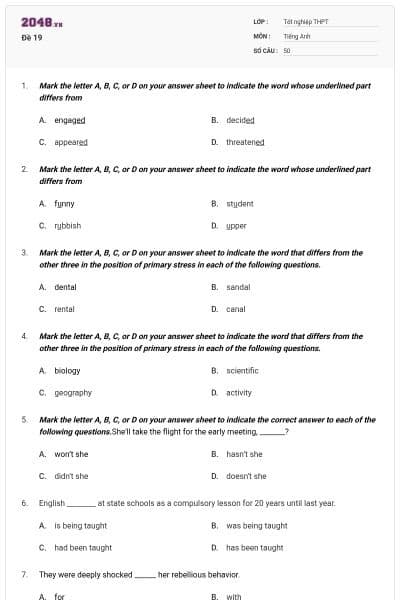
Đề 19
50 câu hỏi
engaged
decided
appeared
threatened
Kiến thức: Cách phát âm đuôi “ed”
Giải thích:
A. engaged /ɪnˈɡeɪdʒd/
B. decided /dɪˈsaɪdɪd/
C. appeared /əˈpɪəd/
D. threatened /ˈθretnd/
Quy tắc phát âm động từ đuôi –ed dựa vào chữ cái kết thúc:
Những động từ có chữ cái kết thúc tận cùng là:
TH 1: t, d => đuôi –ed được phát âm là /id/
TH 2: p, pe; k, ke; ff, ph, gh; ss, ce, se, x; ch; sh => đuôi –ed được phát âm là /t/
TH 3: còn lại => đuôi –ed được phát âm là /d/
Phần gạch chân phương án B được phát âm là /ɪd/, còn lại phát âm là /d/.
Chọn B.
funny
student
rubbish
upper
Kiến thức: Cách phát âm “u”
Giải thích:
A. funny /ˈfʌni/
B. student /ˈstjuːdnt/
C. rubbish /ˈrʌbɪʃ/
D. upper /ˈʌpə(r)/
Phần gạch chân phương án B được phát âm là /juː/, còn lại phát âm là /ʌ/.
Chọn B.
dental
sandal
rental
canal
Kiến thức: Trọng âm từ có 2 âm tiết
Giải thích:
A. dental /ˈdentl/
B. sandal /ˈsændl/
C. rental /ˈrentl/
D. canal /kəˈnæl/
Quy tắc:
- Động từ thường có trọng âm rơi vào âm tiết thứ hai.
- Danh từ, tính từ thường có trọng âm rơi vào âm thứ nhất.
Trọng âm đáp án D rơi vào âm thứ 2, còn lại là âm 1.
Chọn D.
biology
scientific
geography
activity
Kiến thức: Trọng âm từ có 4 âm tiết
Giải thích:
A. biology /baɪˈɒlədʒi/
B. scientific /saɪənˈtɪfɪk/
C. geography /dʒiˈɒɡrəfi/
D. activity /ækˈtɪvəti/
Quy tắc: Những từ có tận cùng là đuôi “-logy”, “-ic”, “-graphy”, “-ity” thường có trọng âm rơi vào âm tiết đứng ngay trước nó.
Trọng âm đáp án B rơi vào âm thứ 3, còn lại là âm 2.
Chọn B.
won’t she
hasn’t she
didn't she
doesn't she
Kiến thức: Câu hỏi đuôi
Giải thích:
Vế trước câu hỏi đuôi dạng khẳng định => câu hỏi đuôi dạng phủ định
Vế trước: She'll take => câu hỏi đuôi: won’t she?
Tạm dịch: Cô ấy sẽ đáp chuyến bay cho cuộc họp sớm phải không?
Chọn A.
is being taught
was being taught
had been taught
has been taught
Kiến thức: Câu bị động
Giải thích:
Dấu hiệu : last year, thì quá khứ =>loại A, D, for 20 years (thì quá khứ hoàn thành) => loại B.
Công thức: S + had been + Ved/V3.
Tạm dịch: Cho đến năm ngoái, Tiếng Anh đã được dạy như là môn học bắt buộc ở các trường công lập được 20 năm .
Chọn C.
for
with
to
at
Kiến thức: Giới từ
Giải thích:
A. for: cho B. with: với C. to: tới, đến D. at: tại
=> be shocked at somebody/ something: bị sốc với ai/ việc gì
Tạm dịch: Họ vô cùng sốc trước hành vi nổi loạn của cô.
Chọn D.
The younger
Younger
The youngest
Youngest
Kiến thức: So sánh đồng tiến (càng... thì càng)
The + (so sánh hơn) adj/ adv+S + V, the (so sánh hơn) adj/adv + S + V
=> The adj-er + S1 + V1, the adj-er + S2 +V2: càng... càng
yong => younger
easy => easier
Tạm dịch: Bạn càng học sớm một ngôn ngữ nào đó thì càng dễ học.
Chọn A.
beautiful tall young
beautiful young tall
tall beautiful young
young tall beautiful
Kiến thức về trật tự của tính từ:
* Opinion - tính từ chỉ quan điểm, sự đánh giá. Ví dụ: beautiful, wonderful, terrible...
• Size - tính từ chỉ kích cỡ. Ví dụ: big, small, long, short, tall...
• Age - tính từ chỉ độ tuổi. Ví dụ: old, young, old, new...
* Color - tính từ chỉ màu sắc. Ví dụ: orange, yellow, light blue, dark brown ....
* Origin – tính từ chỉ nguồn gốc, xuất xứ. Ví dụ: Japanese, American, British, Vietnamese...
• Material - tính từ chỉ chất liệu. Ví dụ: stone, plastic, leather, steel, silk...
* Purpose – tính từ chỉ mục đích, tác dụng.
=> Opinion (beautiful) - Size (tall)- Age(young)
Tạm dịch: Mặc dù đã là mẹ của 3 đứa trẻ, Joana vẫn còn là một thiếu phụ trẻ trung cao ráo xinh đẹp.
Chọn đáp án A
was hiking
is hiking
hiked
had hiked
A
Kiến thức: Sự phối hợp về thì của động từ
Giải thích: Thì quá khứ đơn và quá khứ tiếp diễn kết hợp trong câu: Diễn tả hành động đang xảy ra trong quá khứ thì một hành động khác xen vào, hành động đang xảy ra chi thì quá khứ tiếp diễn, hành động xen vào chia thì quá khứ đơn
Cấu trúc: S + Ved/bqt while she + was +Ving
Tạm dịch: Linda đã chụp những bức ảnh tuyệt đẹp về những con bướm khi cô ấy đang đi bộ đường dài trong rừng.
Because
Although
Despite
Because of
Đáp án B
Phương pháp giải:
Kiến thức: Mệnh đề nhượng bộ
Giải chi tiết:
A. Because + S + V: bởi vì … => chỉ nguyên nhân
B. Although + S + V: mặc dù … => chỉ sự nhượng bộ
C. Despite + N/V-ing: mặc dù …
D. Because of + V/V-ing: bởi vì …
=> loại C & D vì sau chỗ trống là 1 mệnh đề (chủ ngữ: the sky, động từ: was, tân ngữ: grey and cloudy)
Tạm dịch: Mặc dù bầu trời xám xịt và nhiều mây nhưng chúng tôi đã đến bãi biển.
have graduated
will graduate
will have graduated
am going to graduate
Đáp án A
Phương pháp giải:
Kiến thức: Mệnh đề chỉ thời gian
Giải chi tiết:
Mệnh đề chỉ thời gian bắt đầu bằng các liên từ chỉ thời gian, ví dụ: when, until, as soon as,…
Động từ trong mệnh đề chỉ thời gian chia thì hiện tại đơn hoặc hiện tại hoàn thành.
Động từ trong mệnh đề chính chia thì tương lai.
Cấu trúc: Liên từ chỉ thời gian + S + V-hiện tại đơn/hiện tại hoàn thành, S + V-tương lai đơn
Tạm dịch: Ngay sau khi tôi tốt nghiệp, tôi sẽ trở về quê hương.
To work
Work
Having worked
worked
C
Kiến thức: Mệnh đề phân tử / Rút gọn mệnh đề đồng ngữ
Giải thích:
Khi 2 mệnh đề có cùng chủ ngữ (I) thì có thể rút gọn 1 trong 2 mệnh đề về dạng:
- V-ing / Having P2: nếu mệnh đề được rút gọn mang nghĩa chủ động
- P2 (quá khứ phân từ): nếu mệnh đề được rút gọn mang nghĩa bị động
Chủ ngữ “I” có thể làm chủ (tự thực hiện hành động “work”=> nghĩa chủ động.
Tạm dịch: Làm việc chăm chỉ cả ngày, tôi đã kiệt sức.
solve
solvable
solutions
solvability
D
Kiến thức về từ loại
Chỗ trống cần điền một danh từ vì trước nó là tính từ nên đáp án A, B sai.
Đáp án D không phù hợp về nghĩa.
Dịch: Những giải pháp nhanh chóng và dễ dàng này có thể hiệu quả trong ngắn hạn, nhưng chúng phải trả phí.
lets in
accounts for
cares for
takes in
B
Kiến thức: Từ vựng
A. let sb/sth in: cho phép ai đó/ cái gì đó đi vào
B. account for: giải thích cho, chiếm
C. care for: chăm sóc
D. take in: hiểu
Tạm dịch: Thị trường Nhật Bản chiếm 35% doanh thu của công ty.
lose
take
keep
gain
Kiến thức: Từ vựng
A. lose: đánh mất
B. take: lấy được
C. keep: giữ
D. gain: có được
▪️ Lose control over sb/sth: đánh mất quyền kiểm soát
Tạm dịch: Nỗi sợ lớn nhất đó là con người có thể bị đánh mất quyển kiểm soát do robot
Đáp án A
gates
walls
barriers
fences
C
▪️ Kiến thức: Từ vựng
Break down barriers: phá bỏ rào cản để hiểu nhau hơn
Tạm dịch: Các cuộc nói chuyện nhằm phá bỏ rào cản giữa 2 nhóm
a real kick in the pants
an open and shut case
a shot in the dark
a mail in the coffin
Kiến thức: Thành ngữ
A. Một bài học để ứng xử tốt hơn
B. Vấn đề dễ giải quyết
C. Sự cố gắng không đem lại kết quả
D. giọt nước làm tràn ly/ quá sức chịu đựng
Tạm dịch: Không nộp được bản đề nghị đúng hạn là giọt nước làm tràn ly (điều quá sức) đối với Tom
→ Chọn đáp án D
Subject
Curriculum
Program
Obligation
Kiến thức: Từ vựng
▪️ National curriculum: chương trình giảng dạy quốc gia
Tạm dịch: Ở các trường công lập, học sinh phải theo học chương trình giảng dạy quốc gia do Bộ giáo dục và đào tạo quy định
→ Chọn đáp án B
Mark the letter A, B, C, or D on your answer sheet to indicate the word CLOSEST in meaning to the underlined word in each of the following questions.
Every time he opens his mouth, he immediately regrets what he said. He’s always putting his foot in his mouth.
making a mistake
doing things in the wrong order
saying embarrassing things
speaking indirectly
Kiến thức: Thành ngữ
▪️ Put your foot in your mouth: nói điều gì đó ngu ngốc xúc phạm, làm người khác xấu hổ.
A. mắc sai lầm
B. làm gì đó sai thứ tự
C. nói những điều gây xấu hổ
D. nói 1 cách gián tiếp
Tạm dịch: Mỗi lần anh ta mở miệng, anh ta ngay lập tức hối hận vì những gì đã nói. Anh ta thường nói những điều ngu ngốc gây ảnh hướng đến người khác.
→ Chọn đáp án C
demanding
outstanding
dominant
essential
Kiến thức: Từ vựng
▪️ Indispensable: cần thiết, không thể thiếu
A. đòi hỏi khắt khe B. nổi bật C. lấn át, có ưu thế hơn D. cần thiết
Tạm dịch: Trong các gia đình Navajo, ông bà và họ hàng đóng vai trò quan trọng trong việc nuôi dạy trẻ.
→ Chọn đáp án D
Mark the letter A, B, C, or D on your answer sheet to indicate the word(s) OPPOSITE in meaning to the underlined word(s) in each of the following questions.
I must have a watch since punctuality is imperative in my new job.
being late
being efficient
being cheerful
being courteous
Kiến thức: Từ vựng
▪️ Punctuality: sự đúng giờ
A. muộn B. hiệu quả C. vui vẻ D. lịch sự
Tạm dịch: Tôi phải mua đồng hồ thôi vì công việc mới yêu cầu phải đúng giờ.
→ Chọn đáp án A
lovesick
wild
tragic
romantic
Kiến thức: Từ vựng
▪️ Lovey – dovey: âu yếm, trìu mến
A. thất tình B. hoang dã C. bi thảm D. lãng mạn
Tạm dịch: Anh ấy sẽ tặng Joe 1 bông hồng đỏ và 1 bài thơ lãng mạn mà anh ấy viết
→ Chọn đáp án C
Mark the letter A, B, C, or D on your answer sheet to indicate the sentence that best completes the following exchanges.
- Mike: “My first English test was not as good as I expected.”
- Thomas: “__________________”
Never mind, better job next time!
Good Heavens!
That’s brilliant enough!
It’s okay, don’t worry.
Kiến thức: Hội thoại giao tiếp
Dịch đề:
Mike: Bài kiểm tra tiếng anh đầu tiên có kết quả không tốt như là tôi mong đợi
A. Không sao, lần sau sẽ tốt hơn!
B. Trời ơi!
C. Vậy là đủ xuất sắc rồi
D. Không sao đâu, đừng lo lắng
→ Chọn đáp án A
- John: “Do you think that we should use public transportation to protect our environment?”
- Linda: “___________________”
Well, that’s very surprising
Yes, it’s an absurd idea
Of course not. You bet
There is no doubt about it
Kiến thức: Hội thoại giao tiếp
John: Bạn có nghĩ là chúng ta nên sử dụng phương tiện giao thông công cộng để bảo vệ môi trường không?
A. Điều này thật là bất ngờ
B. Vâng, nó là 1 ý tưởng vô lý
C. Tất nhiên là không. Cậu chắc chắn chứ
D. Tớ hoàn toàn đồng ý
→ Chọn đáp án D
Read the following passage and mark the letter A, B, C or D on your answer sheet to choose the word or phrase that best fits each other numbered blanks.
Wind is a clean source of renewable energy that produces no air or water pollution. And since the wind is free, operational costs are nearly zero (26) _______ a turbine is erected. Mass production and technology advances are making turbines cheaper, and (27) _______ governments offer tax incentives to spur wind-energy development. Drawbacks include complaints from (28) _______ that wind turbines are ugly and noisy. The slowly rotating blades can also kill birds and bats, but not nearly as many as cars, power lines, and high-rise buildings do. The wind is also variable: If it's not blowing, there's no electricity generated. Nevertheless, the wind energy industry is (29) _______. Thanks to global efforts to combat climate change, such as the Paris Agreement, renewable energy is seeing a boom in growth, in (30) _______ wind energy has led the way. From 2000 to 2015, cumulative wind capacity around the world increased from 17,000 megawatts to more than 430,000 megawatts. In 2015, China also surpassed the EU in the number of installed wind turbines and continues to lead installation efforts.
(Adapted from https://www.nationalgeographic.com/)
therefore
once
though
so that
Kiến thức: Liên từ
A. vì vậy B. khi C. mặc dù D. để
Tạm dịch: Và bởi vì gió là miễn phí, chi phí vận hành sẽ gần như bằng 0 một khi tua bin được xây dựng.
→ Chọn đáp án B
few
many
a little
much
Kiến thức: Lượng từ
A. rất ít, gần như không có (dùng cho danh từ đếm được)
B. nhiều (dùng cho danh từ đếm được)
C. một chút (dùng cho danh từ không đếm được)
D. nhiều (dùng cho danh từ không đếm được)
‘’Goverments’’ là danh từ số nhiều đếm được
→ Chọn đáp án B
locals
foreigners
master
levels
Kiến thức: Từ vựng đọc hiểu
A. người dân địa phương
B. người nước ngoài
C. cao thủ
D. cấp độ
Tạm dịch: Những khó khăn bao gồm lời phàn nàn từ người dân địa phương rằng tuabin gió xấu và ồn ào
→ Chọn đáp án A
relating
worrying
booming
informing
Kiến thức: Từ vựng đọc hiểu
A. có tính liên quan
B. lo lắng
C. bùng nổ
D. sự thông báo
Tạm dịch: Tuy nhiên, nền công nghiệp năng lượng gió đang bùng nổ.
→ Chọn đáp án C
when
which
why
Who
Kiến thức: Ngữ pháp
▪️ In which: trong đó, nơi mà
→ Chọn đáp án B
Read the following passage and mark the letter A, B, C, or D to indicate the correct answer to each of the question.
Some doctors think that you should drink a glass of water each morning. You should drink this water first thing, before doing anything else. The temperature of the water should be similar to body temperature; neither too hot nor too cold.
Why should you drink this water? Water helps your body in many ways. It helps clean out your kidneys. It prepares your stomach for digestion. Water can also help your intestines work better. After drinking water, the intestines can more easily take out nutrients from our food. Water also helps us go to the bathroom more easily.
Scientists suggest that people take in 1,600 milliliters of water each day. But don’t drink all of that water in one sitting. If you do, your kidneys will have to work much harder to eliminate it. It’s better to drink some in the morning and some in the afternoon. Some people think it’s better to drink between meals and not during meals. They think water dilutes the juices produced in our stomachs. This can interfere with normal digestion.
Are you drinking enough water every day? Check the color of your urine. If it is light yellow, you are probably drinking enough. If your urine is very dark yellow, you probably need to drink more water. A little more water each day could make you much healthier.
(Adapted from Reading Challenge 1 by Casey Malarcher and Andrea Janzen)
What is the main idea of the passage?
The importance of water
The advice of the doctors
How to drink water correctly?
The best amount of water to drink
Đáp án A
Ý chính của đoạn văn này là gì?
A. Tầm quan trọng của nước
B. Lời khuyên của các bác sĩ
C. Uống nước thế nào là hợp lý?
D. Lượng nước phù hợp nhất để uống
Căn cứ vào các thông tin
Some doctors think that you should drink a glass of water each morning. (Một vài bác sĩ khuyên bạn nên uống một cốc nước vào mỗi buổi sáng).
Why should you drink this water? (Tại sao bạn lại nên uống nước này?)
Như vậy, nội dung bài đọc đang xoay quanh tầm quan trọng của nước.
kidneys
stomach
intestines
livers
Đáp án D
Theo đoạn văn, nước rất tốt cho các bộ phận trong cơ thể, ngoại trừ __________.
A. thận
B. dạ dày
C. ruột
D. gan
Từ khóa: water/ good/ organs/ except
Căn cứ thông tin đoạn 2:
Water helps your body in many ways. It helps clean out your kidneys. It prepares your stomach for digestion. Water can also help your intestines work better. After drinking water, the intestines can more easily take out nutrients from our food.
(Nước giúp cơ thể bạn theo nhiều cách. Nó có thể giúp bạn làm sạch thận. Nó giúp dạ dày chuẩn bị sẵn sàng để tiêu hóa thức ăn. Nước cũng có thể làm cho ruột bạn hoạt động tốt hơn. Sau khi uống nước, đường ruột có thể dễ dàng hấp thu dưỡng chất từ thức ăn hơn.)
your body
your kidney
water
your stomach
Đáp án C
Từ “it” trong đoạn 2 đề cập đến từ ____________.
A. cơ thể bạn
B. thận của bạn
C. nước
D. dạ dày bạn
Căn cứ thông tin đoạn 2:
Water helps your body in many ways. It helps clean out your kidneys. It prepares your stomach for digestion. (Nước giúp cơ thể bạn theo nhiều cách. Nó có thể giúp bạn làm sạch thận. Nó giúp dạ dày chuẩn bị sẵn sàng để tiêu hóa thức ăn).
preserve
remove
absorb
process
Đáp án B
Từ “eliminate” trong đoạn 3 gần nghĩa nhất với từ ____________.
A. duy trì
B. loại bỏ
C. hấp thụ
D. xử lý
Từ đồng nghĩa: eliminate (loại bỏ) = remove
If you do, your kidneys will have to work much harder to eliminate it.
(Nếu bạn làm vậy, thận của bạn sẽ phải làm việc chăm chỉ hơn để loại bỏ nó).
The first thing you should do every morning is to drink water.
You shouldn’t drink too much water at the same time.
Drinking water while having meals may interfere with normal digestion.
You need to drink more water if your urine is light yellow.
Đáp án D
Câu nào sau đây là không đúng?
A. Điều đầu tiên bạn nên làm mỗi buổi sáng là uống nước.
B. Bạn không nên uống quá nhiều nước một lúc.
C. Uống nước trong khi đang dùng bữa có thể can thiệp đến sự tiêu hóa thông thường.
D. Bạn nên uống thêm nước nếu nước tiểu màu vàng nhạt.
Từ khóa: not true
Căn cứ các thông tin sau:
Some doctors think that you should drink a glass of water each morning. You should drink this water first thing, before doing anything else. (Một vài bác sĩ khuyên bạn nên uống một cốc nước vào mỗi buổi sáng. Bạn nên uống nước trước tiên, trước khi làm bất kì việc gì khác).
Scientists suggest that people take in 1,600 milliliters of water each day. But don’t drink all of that water in one sitting. (Các nhà khoa học đề nghị mỗi người nên uống 1,6 lít nước mỗi ngày. Nhưng đùng uống tất cả số nước đó trong 1 lần).
Some people think it’s better to drink between meals and not during meals. They think water dilutes the juices produced in our stomachs. This can interfere with normal digestion. (Vài người cho rằng tốt hơn là uống nước giữa các bữa ăn và không uống trong khi ăn. Họ cho rằng nước sẽ làm loãng dung dịch tiết ra trong dạ dày. Điều này có thể ngăn cản sự tiêu hóa thông thường).
Check the color of your urine. If it is light yellow, you are probably drinking enough. (Hãy kiểm tra màu nước tiểu của bạn. Nếu nó màu vàng nhạt, bạn hẳn là đã uống đủ nước).
Read the following passage and mark the letter A, B, C, or D to indicate the correct answer to each of the question.
Grandparents are becoming the forgotten generation, with youngsters now too busy to listen to their stories from the olden days.
A study of 1,000 five to 18 year-olds reveals just 21 per cent will visit their older relatives to hear about how their lives were different in the past; such as where they worked, how it was living in the war, and how they met the love of their life. More than half of youths have no idea what job their grandparent did before retirement – admitting they’d never thought to ask. Sadly, one in 10 admitted they are simply not interested in their grandmother’s or grandad’s previous job or talents and interests, and a quarter only turn up to see them for pocket money. But 23 per cent claim the reason they don’t know anything about their older relatives is because they don’t really get the chance to talk properly.
Geoff Bates, spokesman for McCarthy & Stone’s Inspirational Generation campaign, said: “We know this generation have lived full lives with heroic tales to tell and so much to offer, but how many of us have actually thought to ask these questions of our older family members? We want to shout about the amazing feats retirees have achieved in their lifetime and put the spotlight on the wonderfully colorful lives of today’s older people. We are calling on parents and children to talk to their grandparents, to find out what they have done in their lives – and continue to do, and tell us all about it so we can give them the credit they deserve.”
Researchers found that although 65 per cent of youngsters do see their grandparents every single week, 37 per cent claim this is only because their parents want them to. And while 39 per cent talk to their grandparents on the phone, Facebook or Skype at least once a week – 16 per cent once a day – conversation is rarely focused on what they are doing or have done in the past. Four in 10 kids have no idea what their grandparents proudest achievements are, while 30 per cent don’t know if they have any special skills or talents. And 42 per cent don’t spend any time talking about their grandparent’s history – and are therefore clueless about what their grandmother or grandad was like when they were younger. Perhaps due to this lack of communication and respect, just six per cent of children say they look up to their grandparents as a role model and inspiration. However, grandchildren are agreed their grandparents are both loving and friendly, while 43 per cent think they’re funny – with 23 per cent admitting they often have more fun with their elderly relatives than their parents.
(Source: https://www.independent.co.uk)
Which of the following could be the main idea of the passage?
Grandparents are outdated people in their families.
Young people now do not concern much about their grandparents.
Grandparents are not interested in telling stories about their life in the past any more.
Young people are too busy to take care of their grandparents.
Đáp án B
Câu nào trong các câu sau có thể là ý chính của đoạn văn?
A. Ông bà là những người lạc hậu trong gia đình.
B. Con cháu ngày nay không còn quan tâm nhiều đến ông bà họ nữa.
C. Ông bà không còn hứng thú kể những câu chuyện về cuộc đời trong quá khứ của họ nữa.
D. Con cháu quá bận rộn để chăm sóc cho ông bà của chúng.
Căn cứ vào thông tin đoạn 1:
Grandparents are becoming the forgotten generation, with youngsters now too busy to listen to their stories from the olden days. (Ông bà đang dần trở thành thế hệ bị lãng quên khi những thanh niên thời nay quá bận rộn để lắng nghe những câu chuyện từ thời xưa của họ.)
Merely over one fifth of people in the survey keep asking about the bygone time of their grandparents.
Over 50% of the young don’t know about their older relatives’ professions before superannuation.
Most of youths visit their grandparents to ask for money.
Nearly a quarter of young people don’t have proper opportunities to converse with their older relatives.
Đáp án C
Theo bản nghiên cứu ở đoạn văn số 2, thông tin nào sau đây là không đúng?
A. Chỉ hơn 1/5 những người tham gia cuộc khảo sát vẫn tiếp tục hỏi về quãng thời gian trong quá khứ của ông bà họ.
B. Hơn 50% những người trẻ không biết về nghề nghiệp của ông bà trước khi nghỉ hưu.
C. Hầu hết thanh niên đến thăm ông bà chỉ để xin tiền.
D. Gần ¼ thanh niên không có dịp phù hợp để nói chuyện với ông bà mình.
Từ khóa: the study in paragraph 2/ not true
Căn cứ thông tin đoạn 2:
A study of 1,000 five to 18 year-olds reveals just 21 per cent will visit their older relatives to hear about how their lives were different in the past; such as where they worked, how it was living in the war, and how they met the love of their life. More than half of youths have no idea what job their grandparent did before retirement – admitting they’d never thought to ask. Sadly, one in 10 admitted they are simply not interested in their grandmother’s or grandad’s previous job or talents and interests, and a quarter only turn up to see them for pocket money. But 23 per cent claim the reason they don’t know anything about their older relatives is because they don’t really get the chance to talk properly.
(Một nghiên cứu gồm 1000 người từ 5-18 tuổi chỉ ra rằng chỉ có 21% trong số họ sẽ đến thăm ông bà để lắng nghe xem cuộc sống của họ bây giờ khác nhau thế nào so với cuộc sống trong quá khứ; như là ông bà họ làm việc ở đâu, cuộc sống trong chiến tranh thế nào và họ gặp nửa kia của mình ra sao. Hơn một nửa thanh niên không biết gì về nghề nghiệp của ông bà trước khi nghỉ hưu – họ thừa nhận là không hề có ý định hỏi về điều đó. Đáng buồn là, 1/10 số người được hỏi thừa nhận đơn giản chỉ là họ không có hứng thú với công việc, tài năng hay sở thích của ông bà họ trước đây, và ¼ chỉ đến thăm ông bà để xin tiền tiêu vặt. Nhưng 23% nói rằng nguyên nhân họ không biết gì về ông bà là do họ không thực sự có dịp phù hợp để trò chuyện).
accomplishments
failures
difficulties
differences
Đáp án A
Từ “feats” trong đoạn 3 gần nghĩa nhất với từ _________.
A. thành tựu
B. thất bại
C. khó khăn
D. sự khác biệt
Từ đồng nghĩa: feats (chiến công, thành tựu) = accomplishments
We want to shout about the amazing feats retirees have achieved in their lifetime and put the spotlight on the wonderfully colorful lives of today’s older people. (Chúng tôi muốn reo vang các chiến công đáng ngạc nhiên mà những người về hưu đã đạt được trong cuộc đời của họ và làm nổi bật cuộc đời đầy màu sắc tuyệt vời của những người già ngày nay).
parents
children
colorful lives
grandparents
Đáp án D
Từ “they” trong đoạn 3 đề cập đến từ nào?
A. bố mẹ
B. con cái
C. cuộc sống đầy màu sắc
D. ông bà
Căn cứ thông tin đoạn 3:
We are calling on parents and children to talk to their grandparents, to find out what they have done in their lives – and continue to do, and tell us all about it so we can give them the credit they deserve.
(Chúng tôi đang kêu gọi các bậc cha mẹ và con cháu nói chuyện với ông bà, để tìm hiểu xem họ đã làm những gì trong cuộc đời – và tiếp tục sẽ làm gì, sau đó nói lại với chúng tôi để chúng tôi có thể tặng họ sự công nhận mà họ xứng đáng có được).
encourages people to ask more questions about their grandparents’ jobs.
would like to honour the retirees with their remarkable achievements and experienced life.
hopes to give recognition to the older family members.
intends to retell the heroic tails of the older generation and find out what they have done in the past.
Đáp án B
Có thể suy ra từ đoạn 3 rằng Chiến dịch thế hệ truyền cảm hứng của McCarthy & Stone ______________.
A. khuyến khích mọi người hỏi nhiều câu hỏi về nghề nghiệp của ông bà họ.
B. mong muốn tôn vinh những người về hưu với các thành tựu đáng kể và cuộc sống đầy kinh nghiệm của họ.
C. hi vọng mang sự công nhận đến cho các người già trong gia đình.
D. dự định kể lại các câu chuyện anh hùng của thế hệ ông bà và tìm hiểu xem họ đã làm gì trong quá khứ.
Từ khóa: McCarthy & Stone’s Inspirational Generation campaign
Căn cứ thông tin đoạn 3:
We want to shout about the amazing feats retirees have achieved in their lifetime and put the spotlight on the wonderfully colorful lives of today’s older people. We are calling on parents and children to talk to their grandparents, to find out what they have done in their lives – and continue to do, and tell us all about it so we can give them the credit they deserve.
(Chúng tôi muốn reo vang các chiến công đáng ngạc nhiên mà những người về hưu đã đạt được trong cuộc đời của họ và làm nổi bật cuộc đời đầy màu sắc tuyệt vời của những người già ngày nay. Chúng tôi đang kêu gọi các bậc cha mẹ và con cháu nói chuyện với ông bà, để tìm hiểu xem họ đã làm những gì trong cuộc đời – và tiếp tục sẽ làm gì, sau đó nói lại với chúng tôi để chúng tôi có thể tặng họ sự công nhận mà họ xứng đáng có được).
37%
65%
28%
39%
Đáp án C
Theo đoạn văn cuối, tỉ lệ những người trẻ tuổi tự nguyện đến thăm ông bà mình mỗi tuần là ____________.
A. 37%
B. 65%
C. 28%
D. 39%
Từ khóa: proportion/ the young/ voluntarily visiting their older family members
Căn cứ thông tin đoạn cuối:
Researchers found that although 65 per cent of youngsters do see their grandparents every single week, 37 per cent claim this is only because their parents want them to.
(Các nhà nghiên cứu thấy rằng mặc dù 65% thanh thiếu niên thật sự có đến thăm ông bà hàng tuần, nhưng 37% trong số đó khẳng định đó là bởi vì bố mẹ chúng muốn chúng làm như vậy).
Như vậy, chỉ có 28% trong số 65% đó là tự nguyện đến thăm ông bà hàng tuần.
disincentive
encumbrance
stimulation
hindrance
Đáp án C
Từ “inspiration” trong đoạn cuối có nghĩa là _________.
A. sự nản lòng
B. gánh nặng
C. sự khích lệ
D. sự cản trở
Từ đồng nghĩa: inspiration (nguồn cảm hứng, khích lệ) = stimulation
Perhaps due to this lack of communication and respect, just six per cent of children say they look up to their grandparents as a role model and inspiration.
(Có thể là vì thiếu sự giao tiếp và kính trọng, chỉ có 6% trẻ em nói rằng họ kính trọng ông bà mình như 1 tấm gương và nguồn cảm hứng).
Mark the letter A, B, C, or D on your answer sheet to indicate the underlined part that needs correction in each of the followingquestions.
We (A) had (B) dinner when the (C) phone suddenly (D) rang.
We
had
the
suddenly
B
Đáp án B: “had”
+ Đây là câu miêu tả hai hành động xảy ra trong quá khứ, với một hành động đang diễn ra thì một hành động khác đột nhiên chen vào với dâu hiệu ‘when the phone suddenly rang’. Động từ diễn tả hành động đang diễn ra chia ở thì quá khứ tiếp diễn, hành động chen vào chen vào để ở thì quá quá khứ đơn.
+ Trong trường hợp này, “had” cần sửa lại là “were having”
were
its
were made of
and
Đáp án: B
Giải thích:
Tính từ sở hữu:
“a few classrooms” là chủ ngữ số nhiều nên ta dùng tính từ sở hữu “their” để quy chiếu.
Sửa: its → their
Dịch: Chỉ có một vài lớp học và những bức tường của chúng được làm bằng bùn và rơm.
invention
skyscrapers
considered
practicable.
D sửa thành: Practical
Sau khi phát minh ra điện thoại, các tòa nhà trọc trời không được coi như là phù hợp nữa
Practice có 2 tính từ: practical & practicable
Practical: thực thế, phù hợp
Practicable: khả thi có thể thực hiện được = possible
Mark the letter A, B, C, or D on your answer sheet to indicate the sentence that is closest in meaning to each of the following questions
It is a long time since we last met each other.
We haven't met each other for a long time.
The last time we met each other is a long time ago.
We last met each other for a long time.
We started meeting each other a long time ago.
Đáp án: A
Giải thích:
Câu gốc: "It is a long time since we last met each other." có nghĩa là đã lâu rồi kể từ lần cuối cùng chúng ta gặp nhau.
Cấu trúc: It is + khoảng thời gian + since + S + last + V (quá khứ đơn) = S + haven't/hasn't + V3/ed + for + khoảng thời gian
Xét các đáp án khác:
B. The last time we met each other is a long time ago. → Sai vì cấu trúc đúng phải là "was a long time ago", không dùng "is".
C. We last met each other for a long time. → Sai vì "for a long time" không đi với "last met".
D. We started meeting each other a long time ago. → Sai vì câu này mang nghĩa chúng ta bắt đầu gặp nhau từ lâu, không phù hợp với nghĩa gốc.
Chọn A. We haven't met each other for a long time.
Dịch: Đã lâu rồi chúng ta không gặp nhau.
Tom wanted to take a break with Daisy.
Tom advised Daisy to take a break.
Tom suggested not taking a break.
Tom wanted to take a break, and so did Daisy.
Đáp án B
Kiến thưc: Câu trực tiếp ở câu If 2 sang câu gián tiếp dùng với To +V
If I were + Pro/ N, S + would + V +st
èAdvised sb to +V
You are able to buy a big house with little money.
You can’t buy a big house with little money.
You will buy a big house with little money.
You have to buy a big house with little money.
Đáp án: B
Giải thích:
Dịch: Bạn không thể mua được một ngôi nhà lớn với số tiền ít ỏi.
A. Bạn có thể mua được một ngôi nhà lớn với số tiền ít ỏi.
B. Bạn không thể mua được một ngôi nhà lớn với số tiền ít ỏi.
C. Bạn sẽ mua được một ngôi nhà lớn với số tiền ít ỏi.
D. Bạn phải mua một ngôi nhà lớn với số tiền ít ỏi.
Dựa vào nghĩa, chọn B.
Mark the letter A, B, C, or D on your answer sheet to indicate the sentence that best combines each pair of sentences in the following questions
You are not tactful; that is why you are always offending other people.
You must have offended other people because you are not tactful.
If you were tactful, you would satisfy other people.
I wish you were tactful so that you don’t offend other people.
You should have been tactful so that you didn’t offend other people.
C
Kiến thức: câu ao ước
Do thì là hiện tại nên chúng ta áp dụng công thức:
S + wish + S + quá khứ đơn
Not only does he study well, but also he sings well.
Not only he studies well, but also does he sing well.
Not only he does study well, but also does he sing well.
Not only he studies well, but also he sings well.
Đáp án A
Kiến thức: inversion
Not only + TDT + S + V +St, But S + also + V +St