Đề 17
50 câu hỏi
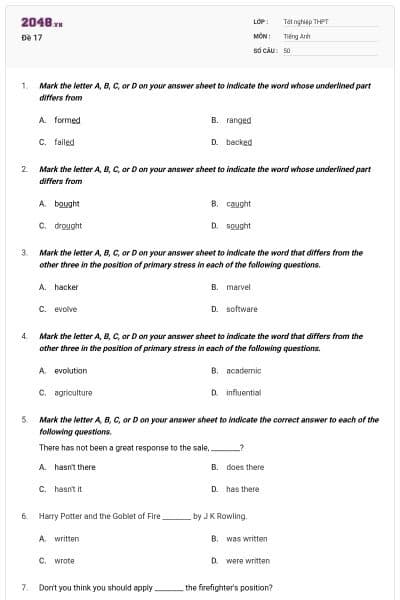
formed
ranged
failed
backed
Kiến thức: Phát âm đuôi “-ed”
Giải thích:
A. formed /fɔːmd/
B. ranged /reɪndʒd/
C. failed /feɪld/
D. backed /bækt/
Quy tắc: Cách phát âm đuôi “-ed”:
- /t/: khi động từ có phát âm kết thúc là /s/, /f/, /p/, /ʃ/, /tʃ/, /k/ và /s/.
- /id/: khi động từ có phát âm kết thúc là /t/ hay /d/
- /d/: với những trường hợp còn lại
Phần gạch chân đáp án D được phát âm là /t/, còn lại là /d/.
Chọn D.
bought
caught
drought
sought
Kiến thức: Phát âm nguyên âm đôi “-ou”, “-au”
Giải thích:
A. bought /bɔːt/
B. caught /kɔːt/
C. drought /draʊt/
D. sought /sɔːt/
Phần gạch chân đáp án C được phát âm là /aʊ/, còn lại là /ɔː/.
Chọn C.
hacker
marvel
evolve
software
Kiến thức: Trọng âm từ có 2 âm tiết
Giải thích:
A. hacker /ˈhækə(r)/
B. marvel /ˈmɑːvl/
C. evolve /ɪˈvɒlv/
D. software /ˈsɒftweə(r)/
Quy tắc:
- Đa số danh từ có 2 âm tiết => trọng âm rơi vào âm tiết 1.
- Đa số động từ có 2 âm tiết => trọng âm rơi vào âm tiết 2.
Trọng âm đáp án C rơi vào âm thứ 2, còn lại là âm thứ 1.
Chọn C.
evolution
academic
agriculture
influential
Kiến thức: Trọng âm từ có 4 âm tiết
Giải thích:
A. evolution /evəˈluːʃn/
B. academic /ækəˈdemɪk/
C. agriculture /ˈæɡrɪkʌltʃə(r)/
D. influential /ɪnfluˈenʃl/
Quy tắc: Những từ có tận cùng là đuôi “-ion”, “-ic”, “-ial” thường có trọng âm rơi vào âm tiết đứng ngay trước nó.
Trọng âm đáp án C rơi vào âm thứ 1, còn lại là âm thứ 3.
Chọn C.
Mark the letter A, B, C, or D on your answer sheet to indicate the correct answer to each of the following questions.
There has not been a great response to the sale, ________?
hasn't there
does there
hasn't it
has there
Kiến thức: Câu hỏi đuôi
Giải thích:
Chủ ngữ của mệnh đề chính là “there” => chủ ngữ câu hỏi đuôi: there
Động từ của mệnh đề chính dạng phủ định “has not been” => động từ câu hỏi đuôi: has
Tạm dịch: Đã không có phản hồi tốt cho việc bán hàng, đúng không?
Chọn D.
written
was written
wrote
were written
Kiến thức: Câu bị động
Giải thích:
Dấu hiệu: “by J K Rowling” (bởi J K Rowling) loại C
Công thức: S + tobe + Ved/V3.
Dấu hiệu: giữa hai danh từ có “and” => động từ cùng chia ở bị động số nhiều => loại A, B,
Tạm dịch: Hary Portter và the Goblet of Fire được viết bởi J K Rowling.
Chọn D.
with
for
at
in
Kiến thức: Giới từ
Giải thích: apply for sth: ứng tuyển vào (vị trí nào)
Tạm dịch: Bạn không nghĩ mình nên ứng tuyển vào vị trí lính cứu hỏa sao?
Chọn B.
you may become more worried
you more worried may become
the more worried you may become
the more worry you may become
Kiến thức: So sánh đồng tiến (càng... thì càng)
The + (so sánh hơn) adj/ adv+S + V, the (so sánh hơn) adj/adv + S + V
=> The adj-er + S1 + V1, the more adj S2 +V2: càng... càng
rich => richer
worried => the more worried
Tạm dịch: Bạn càng trở nên giàu có thì bạn càng trở nên lo lắng
Chọn C.
new Italian leather
new leather Italian
leather new Italian
leather Italian new
Kiến thức: Trật tự tính từ
Giải thích:
Khi có nhiều tính từ cùng đứng trước 1 danh từ, sắp xếp chúng theo thứ tự: OSASCOMP + N. Trong đó:
O – opinion: quan điểm
S – size: kích thước
A – age: độ tuổi
S – shape: hình dạng
C – colour: màu sắc
O – origin: nguồn gốc
M – material: chất liệu
P – purpose: mục đích
N – noun: danh từ
Nếu có số thứ tự => đứng trước tính từ & danh từ
=> Trật tự tính từ: “new” – chỉ độ tuổi + “Italian” – chỉ nguồn gốc + “leather” – chỉ chất liệu
Tạm dịch: Cô ấy đã mua một chiếc áo khoác da mới của Ý để làm quà cho con gái.
Chọn A.did
would do
was doing
had done
C
Kiến thức: Sự phối hợp về thì của động từ
Giải thích: Thì quá khứ đơn và quá khứ tiếp diễn kết hợp trong câu: Diễn tả hành động đang xảy ra trong quá khứ thì một hành động khác xen vào, hành động đang xảy ra chi thì quá khứ tiếp diễn, hành động xen vào chia thì quá khứ đơn
Cấu trúc: S + was/ were + V_ing + when + S + Ved/bqt
Tạm dịch: Jane đang làm bài tập về nhà thì bạn của cô ấy yêu cầu cô ấy cũng làm bài tập của anh ấy.
In spite of
Although
Therefore
However
B
Kiến thức về liên từ
Loại đáp án A vì in spite of + Np/N
Dựa vào nghĩa và dấu hiện thì loại C, D vậy chọn B là phù hợp nhất
Question 11: Mặc dù chưa có đủ thông tin về ảnh hưởng của khói trong khí quyển nhưng các bác sĩ đã chứng minh rằng ô nhiễm không khí gây ra các bệnh về phổi. A. Mặc dù B. Mặc dù C. Do đó D. Tuy nhiên
By the time she finished the homework
After she was finishing the homework
When she finished the homework
As soon as she has finished the homework
D
Kiến thức mệnh đề trạng ngữ chỉ thời gian.
Loại đáp án A, C,B vì sai thì
As soon as + s+ HTĐ/HTHT , S+ will +Vo
Tạm dịch:Ngay sau khi cô ấy làm xong bài tập, cô ấy sẽ đi ngủ.
A. Đến khi cô ấy hoàn thành bài tập về nhà B. Sau khi cô ấy hoàn thành bài tập về nhà
C. Khi cô ấy hoàn thành bài tập về nhà D. Ngay khi cô ấy hoàn thành bài tập về nhà
Finish
To finish
Having finished
Finished
C
Kiến thức: Mệnh đề phân tử / Rút gọn mệnh đề đồng ngữ
Giải thích:
Khi 2 mệnh đề có cùng chủ ngữ (she) thì có thể rút gọn 1 trong 2 mệnh đề về dạng:
- V-ing / Having P2: nếu mệnh đề được rút gọn mang nghĩa chủ động
- P2 (quá khứ phân từ): nếu mệnh đề được rút gọn mang nghĩa bị động
Chủ ngữ “he” có thể làm chủ (tự thực hiện hành động “finish” => nghĩa chủ động.
Tạm dịch:. Sau khi sửa xe xong, anh ta mang nó ra đường để chạy thử.
enthusiasts
enthusiasm
enthuse
enthusiastic
Đáp án A.
A. enthusiasts(n): người đammê
B. enthusiasm(n): sự đammê
C. enthuse(v): làm cho đammê
D. enthusiastic(adj): đammê
Dịch nghĩa: Giải đấu thực sự trở thành 1 lễ hội gây ấn tượng với người hâm mộ thể thao.
takeon
get off
goabout
putin
Đáp án: A
Giải thích:
Kiến thức: Cụm động từ
A. take on (v): tiếp quản, đảm nhận
B. get off (v): xuống (xe, máy bay)
C. go about (v): truyền đi, bắt tay vào việc
D. put in (v): thực hiện, thêm vào
Dựa vào nghĩa, chọn A.
Dịch: Ở quốc gia của họ, hội chữ thập đỏ và cộng đồng Lưỡi liềm đỏ gánh vác trách nhiệm làm giảm nhẹ nỗi đau của cộng đồng.
play
lose
take
enjoy
Ta có cụm từ “take part in” có nghĩa là tham gia vào.
Dịch Question: Việt Nam đã sẵn sàng tham gia vào SEA Games lần thứ 24 được đăng cai tổ chức bởi Thái Lan vào cuối năm 2007 với tổng cộng 958 vận động viên.
employment
post
work
career
Đáp án B : post
Kiến thức kiểm tra: Sự lựa chọn từ đúng/ Danh từ
Giải thích chi tiết:
"Post” là viết tắt của “position” - vị trí công việc.
Từ đồng nghĩa của từ “post” là “a job”. Sự khác biệt giữa “job”, “work”, “employment” và “career” là:
• job: ám chỉ một vị trí làm việc, nghề nghiệp cụ thể
• Work: nghĩa rộng và khái quát hơn job”, ám chỉ công việc cần hoàn thành để đạt tiêu nào đó (Có thể là mục tiêu trong công việc hoặc mục tiêu ngoài công việc). Trong cách sử dụng này, “work” là một danh từ không đếm được.
• employment: việc làm nói chung, trạng thái có công ăn việc làm.
• career: sự nghiệp, ám chỉ cả quá trình thay đổi và phát triển về chuyên môn của một người. Sự nghiệp của một người có thể trải qua nhiều vị trí việc làm jobs) khác nhau.
Đáp án A, C, D không đúng vì không thích hợp về nghĩa.
Ý nghĩa cả Question: Anh ấy rất tự tin ứng tuyển vị trí giảng viên ở trường Đại học Bales.
footthebill
carrythecan
hatchthechicken
catchtheworms
Đáp án B
Kiến thức về thành ngữ
A.foot the bill: thanh toántiền
carry the can: chịu trách nhiém, chịu sự chỉtrích
don't count yours the chicken before they hatch: đừng vội làm gì khi chưa chắcchắc
catch the worms: nắm bắt cơhội
Tạm dịch: Ai đó phải chịu trách nhiệm cho thảm họa này. Ai sẽ chịu trách nhiệm đây?
exert
resolve
resort
recourse
Đáp án C
Kiến thức về cụm từ cố định
C. Resort to sth: phải động đến ai, viện đến, nhờ tới ai/cái gì. Các lựa chọn còn lại không phù hợp.
Exert on sb/sth: áp dụng cáigì.
Resolve on /upon/against St / doing st: kiênquyết.
Have a recourse to Sb / sth: nhờ cậy ai, cái gì.
Tạm dịch: Cho dù anh ta có tức giận đến cỡ nào thì anh cũng chẳng bao giờ viện tới bạo lực.
Mark the letter A, B, C, or D on your answer sheet to indicate the word CLOSEST in meaning to the underlined word in each of the following questions.
Mr. Henderson was determined to remain neutral.
unhurried
uncommitted
counterfeit
genuine
Kiến thức về từ đồng nghĩa:
neutral = uncommitted: trung lập
Các đáp án khác:
A. unmarried: không kết hôn
B. untroubled: không băn khoăn, lo lắng
D. unhurried: không vội vã
Dịch nghĩa: Ông Henderson quyết tâm giữ phe trung lập.
Chọn đáp án B
cheap
unattractive
counterfeit
genuine
Kiến thức về từ đồng nghĩa:
• fake = counterfeit (adj): giả mạo
Các đáp án còn lại:
A. cheap (adj): rẻ
B. unattractive (adj): không hấp dẫn
D. genuine (adj): thật
Dịch nghĩa: Anh ấy quyết định không mua chiếc đồng hồ giả và đợi đến khi có nhiều tiền hơn.
Chọn đáp án C
Mark the letter A, B, C, or D on your answer sheet to indicate the word(s) OPPOSITE in meaning to the underlined word(s) in each of the following questions.
This year, due to COVID 19, the global productivity is not prolific.
barren
yielding
generative
productive
Kiến thức về từ trái nghĩa:
• prolific (adj): sinh sản nhiều, sản xuất nhiều, đẻ nhiều; sai (quả), lắm quả
A. barren (adj): không đem lại kết quả, cằn cỗi (đất)
B. yielding (adj): (nông nghiệp); (tài chính) đang sinh lợi
C. generative (adj): Có khả năng sinh ra, sinh ra
D. productive (adj): sản xuất nhiều; sinh sản nhiều người, động vật..); màu mỡ, phong phú (đất.)
Dịch: Năm nay, do COVID 19, năng suất toàn cầu không cao.
Chọn đáp án A
interfere
ignore
concern
refrain
Kiến thức về idioms:
* To poke one's nose: chõ mũi vào việc của người khác
>< ignore (v): phớt lờ
Các đáp án còn lại:
A. interfere (v): Can thiệp, xen vào, dính vào
C. concern (v): Liên quan, dính líu tới; nhúng vào
D. refrain (v): Kiềm lại, dằn lại, tự kiềm chế, cố nhịn, cố nín (cơn giận.)
Dịch: Ở công ty của họ, mọi người không thích anh ấy vì anh ấy luôn chúi mũi vào chuyện của người khác.
Chọn đáp án BMark the letter A, B, C, or D on your answer sheet to indicate the sentence that best completes the following exchanges.
Judie performed very well in writing lesson. Her teacher is paying her a compliment.
Teacher: "Judie, you've written a much better essay this time."
Judie: “___________.”
You're welcome.
Writing? Why?
What did you say? I'm so shy.
Thank you. It's really encouraging
Kiến thức về giao tiếp xã hội:
Phân tích đáp án:
A. You're welcome: dùng để đáp lại lời cảm ơn: Thank you - You are welcome.
B. Writing? Why?: Viết ư? Vì sao? - Sai vì câu này tỏ ra là học sinh đang không hiểu là thầy giáo nói gì, sai về văn cảnh.
C. What did you say? I'm so shy: Thầy/cô nói gì cơ? Em ngại quá - Sai vì không phù hợp trong văn cảnh sư phạm và lịch sự (Question trả lời này hơi suồng sã)
D. Thank you. It's really encouraging: Cảm ơn thầy/cô. Lời khen thực sự tạo động lực cho em rất nhiều.
Tạm dịch: Giáo viên: “Judie, lần này bạn đã viết một bài luận tốt hơn đó.”
Chọn đáp án D
Jenny and Jimmy are talking about university education
- Jenny: "I think having a university degree is the only way to succeed in life."
- Jimmy: “_____________. There were successful people without a degree”.
I can't agree more
That's life
That's all right
I don't quite agree
Kiến thức về giao tiếp xã hội:
Jenny và Jimmy đang nói về giáo dục đại học.
- Jenny: "Mình nghĩ rằng có bằng đại học là cách duy nhất để thành công trong cuộc sống."
- Jimmy: "___________. Có những người thành công mà không có bằng cấp."
A. Mình hoàn toàn đồng ý B. Cuộc sống là thế
C. Chính xác D. Mình không hoàn toàn đồng ý
Chọn đáp án DRead the following passage and mark the letter A, B, C or D on your answer sheet to choose the word or phrase that best fits each other numbered blanks.
One of the most wondrous and iconic animals to walk the Earth, Bengal tigers, (26) _________ are majestic and rare. They're also one of the biggest cat species in the world. On average, Bengals are larger than (27) _______ tiger species, but the largest tiger ever (28) _______ was a Siberian. As such, Bengals are considered the second largest tiger species.
Today, wild Bengal tigers are animals that only live in Bangladesh, Bhutan, India, and Nepal. (29) _________ there are more Bengals than any other tiger subspecies on the Indian subcontinent, the populations are endangered. Conservation efforts are working to some degree, but they're not (30) __________ the poaching, deforestation, and human encroachment that has devastated wild tiger habitats over the past 50 years.
who
whom
which
that
Kiến thức về mệnh đề quan hệ:
• “which” ở đây thay thế cho “Bengal tigers”
Thông tin: One of the most wondrous and iconic animals to walk the Earth, Bengal tigers, (25) ______ are majestic and rare.
Một trong những loài động vật kỳ diệu và mang tính biểu tượng nhất trên Trái đất, hổ Bengal, rất hùng vĩ và quý hiếm.
Chọn đáp án C
the other
another
others
other
Kiến thức ngữ pháp:
A. the other: cái/người còn lại trong hai cái/người
B. another + danh từ đếm được số ít: một người/vật khác.
C. others = other + Danh từ (số nhiều): những người/cái khác
Thông tin: On average, Bengals are larger than (26) ________ tiger species
Trung bình, Bengal lớn hơn các loài hổ khác
Chọn đáp án D
known
recorded
considered
preserved
Kiến thức về từ vựng:
A. known: được biết đến
B. recorded: được ghi nhận
C. considered: được xem xét
D. preserved: được bảo tồn
Thông tin: but the largest tiger ever (27) ________ was a Siberian
nhưng con hổ lớn nhất từng được ghi nhận là loài Siberia
Therefore
Because
Although
However
Kiến thức về liên kết Question:
A. Therefore: do đó
B. Because clause: bởi vì
C. Although clause: dù cho, dẫu cho
D. However: tuy nhiên
Thông tin: (28)________ there are more Bengals than any other tiger subspecies on the Indian subcontinent, the populations are endangered.
Mặc dù có nhiều Bengal hơn bất kỳ phân loài hỗ nào khác trên tiểu lục địa Ấn Độ, nhưng quần thể này đang bị đe dọa.
Chọn đáp án C
Conservation efforts are working to some degree, but they're not (30) __________ the poaching, deforestation, and human encroachment that has devastated wild tiger habitats over the past 50 years.
outbreaking
outbidding
outdancing
outpacing
Kiến thức về từ vựng:
A. outbreaking: bùng nổ
B. outbidding: tăng giá cạnh tranh
C. outdance: nhảy giỏi hơn (ai), nhảy lâu hơn (ai)
D. outpace: vượt qua
Thông tin: but they're not (29) ________ the poaching, deforestation, and human encroachment that has devastated wild tiger habitats over the past 50 years.
nhưng chúng không vượt qua được nạn săn trộm, phá rừng và sự xâm lấn của con người đã tàn phá môi trường sống của hổ hoang dã trong 50 năm qua.
Chọn đáp án DRead the following passage and mark the letter A, B, C, or D to indicate the answer to each of the question.
During the past half-century, our species has embarked on a remarkable social experiment. For the first time in human history, great numbers of people - at all ages, in all places, of every political persuasion - have begun settling down as singletons. Until the second half of the last century, most of us married young and parted only at death. If death came early, we remarried quickly; if late, we moved in with family, or they with us. Now we marry later. We divorce, and stay single for years or decades.
The rise of living alone has produced significant social benefits, too. Young and middle-aged solos have helped to revitalise cities, because they are more likely to spend money, socialise and participate in public life. Contemporary solo dwellers in the US are primarily women: about 18 million, compared with 14 million men. The majority, more than 16 million, are middle-aged adults between the ages of 3S and 64. The elderly account for about 11 million of the total. Young adults between 18 and 34 number increased more than 5 million, compared with 500,000 in 1950, making them the fastest-growing segment of the solo-dwellingpopulation.
Despite fears that living alone may be environmentally unsustainable, solos tend to live in apartments rather than in big houses, and in relatively green cities rather than in car-dependent suburbs. There's good reason to believe that people who live alone in cities consume less energy than if they coupled up and decamped to pursue a single-family home.
The best title for this passagecouldbe .
the rise insololiving
figures about solo dwellers in theUS
the increaseindivorce
solos have tendency to live in smallhouses
đáp án A
Chủ đề về LlFE IN THE FUTURE
Tiêu đề tốt nhất cho đoạn văn này cóthểlà .
A. Số người sống độc thântăng
B. Số liệu về người sống độc thân ởMỹ
C. Số vụ ly hôntăng
D. người độc thân thích sống trong những ngôi nhànhỏ
Căn cứ vào thông tin toàn bài:
Thông tin “số người độc thân ở Mỹ; ly hôn; thích sống trong nhà nhỏ" đều được đề cập trong bài nhưng chưa bao quát toàn bài.
From the beginning of the last century, people married at young age and only death separated them.
Until the second half of the last century, a large number of people married young and parted only atdeath.
From the beginning of last century, people have begun settling down assingletons.
Until the second half of the last century, people divorce, and stay single for years ordecades
đáp án B
Phát biểu nào có lẽ là ĐÚNG theo đoạn 1?
A. Từ đầu thế kỉ trước, con người đã kết hôn sớm và chỉ cái chết mới chia rẽ đượchọ.
B. Tận cho đến nửa sau của thế kỉ trước, một số lượng lớn người kết hôn sớm và chỉ chia xa khichết.
C. Từ đầu thế kỉ trước, con người đã bắt đầu sống độcthân.
D. Tận đến nửa sau của thế kỉ trước, con người ly hôn và sống độc thân trong nhiều nămliền.
Căn cứ vào thông tin đoạn 1:
Tạm dịch: “Until the second half of the last century, most of us married young and parted only at death.”
(Cho đến nửa sau của thế kỷ trước, hầu hết chúng ta kết hôn trẻ và chỉ chia tay khi chết.)
singletons
the elderly
predecessors
youngadults
đáp án D
Từ ” them” trong đoạn 2 thay thếcho từ .
A. những người độcthân
B. người già
C. tổ tiên
D. những người trẻ
Căn cứ vào thông tin đoạn 1:
“Young adults between 18 and 34 number increased more than 5 million, compared with 500,000 in 1950, making them the fastest-growing segment of the solo-dwelling population.” (Thanh niên từ 18 đến 34 tuổi tăng hơn 5 triệu, so với 500.000 vào năm 1950, khiến họ trở thành phân khúc phát triển nhanh nhất của dân số độc thân.)
The elderly take up for a large number of the total solodwellers
In the US, more male choose to live alone thanfemale
Solos dwellers have helped to renew cities as they seem to spend money, socialize and take part in publiclife
There are fewer middle-aged solos than the elderly who livealone
đáp án C
Trong đoạn 2, tác giả gợiý rằng .
A. Người già chiếm một số lượng lớn trong tổng dân số sống độcthân
B. Ở Mỹ, nhiều đàn ông chọn sống độc thân hơn phụnữ
C. Những người sống độc thân đã giúp tái sinh lại thành phố vì họ dường như tiêu nhiều tiền, giao tiếp và tham gia các hoạt động xãhội.
D. Có nhiều người trung tuổi sống độc thân hơn là ngườigià.
Căn cứ vào thông tin đoạn 2:
“The rise of living alone has produced significant social benefits, too. Young and middle-aged solos have helped to revitalise cities, because they are more likely to spend money, socialise and participate in public
life.” (Sự nổi lên của việc sống một mình cũng đã tạo ra nhiều lợi ích xã hội đáng ghi nhận. Người sống đơn thân trẻ hoặc trung tuổi góp phần thổi sức sống mới cho các thành phố vì họ có xu hướng tiêu dùng, giao thiệp và tham gia vào đời sống cộng đồng hơn.)
coupled up
quit
livedseparately
lived together
đáp án C
Từ “decamped” trong đoạn 3 cónghĩalà .
A. couple up: kết đôi/ kếthôn
B. quit: từbỏ
C. live separately: sống riêng/ lythân
D. live together: sốngchung
Căn cứ vào thông tin đoạn 2:
Tạm dịch: "There's good reason to believe that people who live alone in cities consume less energy than if they coupled up and decamped to pursue a single-family home." (Có lý do chính đáng để tin rằng người sống một mình ở các thành phố tiêu thụ ít năng lượng hơn khi họ sống chung với nhau rồi lại li thân để xây tổ ấm đơn thân của riêng mình.)
Read the following passage and mark the letter A, B, C, or D to indicate the answer to each of the question.
Educating children at home as an alternative to formal education is an option chosen by families in many parts of the world. The homeschooling movement is popular in the United States, where close to one million Children are educated at home. In Canada, 1 percent of school-age children are homeschooled, and the idea also enjoys growing popularity in Australia, where 20,000 families homeschool their children. The movement is not limited to these countries. Homeschooling families can be found all over the world, from Japan to Taiwan to Argentina to South Africa.
Homeschooling is not a novel idea. In fact, the idea of sending children to spend most of their day away from home at a formal school is a relatively new custom. In the United States, for example, it was not until the latter part of the nineteenth century that state governments began making school attendance compulsory. Before that, the concept of a formal education was not so widespread. Children learned the skills they would need for adult life at home from tutors or their parents, through formal instruction or by working side by side with the adults of the family.
In the modern developed world, where the vast majority of children attend school, families choose homeschooling for a variety of reasons. For people who live in remote areas, such as the Australian outback or the Alaskan Wilderness, homeschooling may be their only option. Children who have exceptional talents in the arts or other areas may be homeschooled so that they have more time to devote to their special interests. Much of the homeschooling movement is made up of families who, for various reasons, are dissatisfied with the schools available to them. They may have a differing educational philosophy, they may be concerned about the safety of the school environment, or they may feel that the local schools cannot adequately address their children's educational needs. Although most families continue to choose a traditional classroom education for their children, homeschooling as an alternative educational option is becoming more popular.
Which of the following could be the main idea of the passage?
A new form of school:Homeschooling
Homeschool option: a common form of education all over theworld.
The reasons why children should be educated athome.
The origin ofHomeschooling.
đáp án B
Chủ đề EDUCATION
Question nào trong các Question sau đây có thể là ý chính của đoạn văn?
A. Một loại hình trường học mới: Giáo dục tạigia.
B. Giáo dục tại gia: Một hình thức giáo dục phổ biến trên khắp thếgiới.
C. Những nguyên nhân tại sao trẻ em nên được giáo dục ởnhà.
D. Nguồn gốc của hình thức giáo dục tạigia.
Căn cứ vào đoạn văn đầu tiên:
"Educating children at home as an alternative to formal education is an option chosen by families in many parts of the world. The homeschooling movement is popular in the United States, where close to one million children are educated at home. In Canada, 1 percent of school-age children are homeschooled, and the idea also enjoys growing popularity in Australia, where 20,000 families homeschool their children. The movement is not limited to these countries. Homeschooling families can be foundall
over the world, from Iapan to Taiwan to Argentina to South Africa.”
(Giáo dục trẻ em tại nhà như một hình thức thay thế cho giáo dục chính quy là một loại hình được lựa chọn bởi các gia đình ở nhiều nơi trên thế giới. Phong trào giáo dục tại gia rất phổ biến ở Hoa Kỳ, nơi gần một triệu trẻ em được dạy dỗ tại nhà của chúng. Ở Canada, 1 phần trăm trẻ em trong độ tuổi đi học được học tại nhà, và ý tưởng này cũng rất phổ biến ở Úc, nơi 20.000 gia đình tự dạy dỗ con em của họ. Phong trào giáo dục này không bị giới hạn ở các nước được nêu trên. Các gia đình cho con cái học tại nhà có thể được tìm thấy trên khắp thế giới, từ Nhật Bản đến Đài Loan đến Argentina đến cả Nam Phi.)
the second half of the19th century
the beginning of the 19thcentury
the former part of the19thcentury
the end of the 19thcentury
đáp án A
Từ “that” trong đoạn 2 đề cập đến từ nào?
A. nửa sau thế kỉthứ 19 B. đầu thế kỉ thứ19
C. nửa đầu thế kỉthứ 19 D. cuối thế kỉ thứ19
Căn cứ vào thông tin đoạn 2:
“In the United States, for example, it was not until the latter part of the nineteenth century that state governments began making school attendance compulsory. Before that, the concept of a formal education was not so widespread."
(Ví dụ, ở Hoa Kỳ, mãi đến nửa sau của thế kỉ thứ 19 thì chính phủ mới bắt buộc học sinh đi học. Trước đó, khái niệm về 1 nền giáo dục chính thức không quá phổ biến).
uncommon
customary
exceptional
prevalent
đáp án C
Từ “widespread” trong đoạn 2 gần nghĩanhấtlà .
A. khôngphổ biến B. theo phong tục thông thường
C.khác thường D. phổbiến
Từ đồng nghĩa: widespread = prevalent: phổ biến
Căn cứ vào thông tin đoạn 2:
"Before that, the concept of a formal education was not so widespread." (Trước đó, khái niệm về 1 nền giáo dục chính thức không quá phổ biến).Many families in both developed and developing countries choose to educate their children at home.
Parents or tutors were the ones who taught the children necessary skills insociety.
People got familiar with school attendance before choosing to learn athome.
Before modern times, most students did not attend theschool.
đáp án C
Theo đoạn văn, những thông tin sau là đúng về giáo dục tại gia,ngoạitrừ .
A. Nhiều gia đình ở cả nước phát triển và nước đang phát triển lựa chọn giáo dục con cái họ ởnhà.
B. Cha mẹ hay gia sư là những người dạy những đứa trẻ các kĩ năng cần thiết trong xãhội.
C. Người dân quen với nền giáo dục chính thức trước khi lựa chọn học ởnhà.
D. Trước thời hiện đại, đa số học sinh không đến trường. Từ khóa: true /homeschooling
Căn cứ vào nội dung trong bài:
- "Homeschooling families can be found all over the world, from Japan to Taiwan to Argentina to South Africa." (Các gia đình cho con cái học tại nhà có thế được tìm thấy trên khắp thế giới, từ Nhật Bản đến Đài Loan đến Argentina đến cả NamPhi).
- "Children learned the skills they would need for adult life at home from tutors or their parents, through formal instruction or by working side by side with the adults of the family." (Những đứa trẻ học các kĩ năng mà chúng sẽ cần cho cuộc sống sau này ở nhà từ gia sư hay bố mẹ chúng, thông qua sự hướng dẫn chính thức hay bằng cách làm việc bên cạnh những người lớn trong giađình.)
- "Homeschooling is not a novel idea. In fact, the idea of sending children to; spend most of their day away from home at a formal school is a relatively new custom.” (Giáo dục tại gia không phải là 1 ý tưởng mới lạ. Trên thực tế ý tưởng đưa con cái đến học tại trường chính quy trong phần lớn thời gian trong ngày mới là 1 phong tục tương đối mớimẻ.)
have no choice but stay at home tolearn.
prefer to improve their extraordinaryinterests.
are not contented with the philosophy of the schoolsavailable.
believe that their needs to study is more than what a normal school canprovide.
đáp án A
Như đã được đề cập trong đoạn cuối, những đứa trẻ ở vùng sâuvùngxa .
A. không có sự lựa chọn nào ngoài việc học tạinhà.
B. thích tập trung vào những sở thích đặc biệt của chúnghơn.
C. không hài lòng với triết lý của các trường hiệncó.
D. tin rằng nhu cầu học tập của chúng nhiều hơn những gì mà 1 trường học thông thường có thể cung cấp. Từ khóa: children in ruralareas
Căn cứ vào thông tin đoạn cuối:
“For people who live in remote areas, such as the Australian outback or the Alaskan wilderness, homeschooling may be their only option.” (Với những người sống ở vùng sâu vùng xa như vùng rừng núi của Australia hay vùng hoang dã Alaska, giáo dục tại gia có thể coỉ là lựa chọn duy nhất của họ).
parents’ satisfaction plays an important role in the number of students attendingclass.
teachers’ qualifications may be one of the reasons why students come toschool.
not many children in modern society are allowed to be educated athome.
some schools are unable to provide a safe environment for theirstudents.
đáp án A
Có thể suy ra từ đoạncuốirằng .
A. sự hài lòng của bố mẹ đóng 1 vai trò quan trọng với số lượng học sinh đếnlớp.
B. năng lực của giáo viên có thể là 1 trong các lý do tại sao học sinh đihọc.
C. không nhiều trẻ em trong xã hội hiện đại được cho phép học tập tạinhà.
D. một số trường học không thể cung cấp 1 môi trường an toàn cho học sinh củahọ.
Căn cứ thông tin đoạn cuối:
“Much of the homeschooling movement is made up of families who, for various reasons, are dissatisfied with the schools available to them.” (Phần lớn phong trào giáo dục tại gia được hình thành từ các gia đình, vì nhiều lý do khác nhau, mà không hài lòng với các trường học có sẵn cho họ).
correctly
applicably
sufficiently
inappropriately
đáp án C
Từ “adequately” trong đoạn 3 gần nghĩa nhấtvớitừ .
A. 1 cáchchínhxác B. có thể ứng dụngđược
C. đầy đủ,thíchđáng D. không hợplý
Từ đồng nghĩa: adequately = sufficiently: thích đáng, thỏa đáng
“They may have a differing educational philosophy, they may be concerned about the safety of the school environment, or they may feel that the local schools cannot adequately address their Children's educational needs.”
(Họ có thể có 1 triết lý giáo dục khác, họ có thể lo lắng về sự an toàn trong môi trường học đường, hoặc họ có thể cảm thấy các trường học ở địa phương không thể giải quyết thỏa đáng nhu cầu giáo dục của con cái họ).
Mark the letter A, B, C, or D on your answer sheet to indicate the underlined part that needs correction in each of the following questions.
My (A) younger sister start learning (B) English when (C) she was at primary school (D).
My
start learning
when
primary school
A
Đáp án A: “start learning”
+ Động từ “start” phải được chia ở quá khứ đơn để hoà hợp thì với mệnh đề phía sau. Vì vây, “start learning” phải được sửa lại là “started learning”.
having
his
painted
construction
Đáp án: B
Giải thích:
Kiến thức: Tính từ sở hữu
Tính từ sở hữu tương ứng với “they” là “their”.
Sửa: his → their
Dịch: Họ đang thuê một công ty xây dựng sơn lại ngôi nhà của họ.
I’m becoming
forgetable
myself
the
Đáp án: B
Giải thích:
Kiến thức: Từ vựng
forgettable (adj): có thể quên thay bằng
forgetful (adj): hay quên
Sửa: forgettable → forgetful
Dịch: Tôi ngày càng hay quên. Tuần trước tôi đã tự nhốt mình bên ngoài nhà hai lần.
It's 4 years since she last lived in her hometown.
She didn't come back to her hometown 4 years ago.
She started coming back to her hometown 4 years ago.
She hasn’t come back to her hometown for 4 years.
Dùng cấu trúc:
S + have/ has + not + Ved/3………for/ since + time a. The last time + S + Ved/2……was + b. S + last + Ved/2 …… |
The teacher reminded the students to submit their assignments by Thursday.
The teacher allowed the students to submit their assignments by Thursday.
The teacher ordered the students to submit their assignments by Thursday.
The teacher encouraged the students to submit their assignments by Thursday.
A
Kiến thức về Question tường thuật
Cụm từ Remember to…/ Don’t forget to …. Diễn đạt sự nhắc nhở , khi thuật lại dùng động từ remind to…( nhắc nhở)
Xét đáp án chọn A.
The teacher reminded the students to submit their assignments by Thursday.
They couldn’t have practiced hard for the games as they won a lot of medals
They must have practiced hard for the games as they won a lot of medals
They shouldn’t have practiced hard for the games as they won a lot of medals
They might have practiced hard for the games as they won a lot of medals.
B
Kiến thức về câu với cụm khiếm khuyết hoàn thành để suy đoán
Must have Ved-3 :chắc chắn , ắt hẳn đã gần nghĩa nhất với câu gốc
I’m sure that they had practiced…(Tôi chắc rằng họ đã…..)
Xét đáp án chọn B.
Mark the letter A, B, C, or D on your answer sheet to indicate the sentence that best combines each pair of sentences in the following questions
He broke up with her but now he thinks that was a mistake.
He wishes he hadn't broken up with her.
He wishes not to have broken her up.
He regrets having not broken up with her.
He was mistaken with breaking up with her.
A
Kiến thức: câu ao ước
Giải thích:
Ngữ cảnh “broke” thì quá khứ đơn. => câu ước ngược lại với quá khứ
Công thức câu ước trong quá khứ: S + wish + S + had PP
Hardly had I arrived home when I was called immediately back to the office 10 kilometers away.
Because I had just arrived home, I was called immediately back to the office 10 kilometers away.
Should I had just arrived home, I was called immediately back to the office 10 kilometers away.
Whenever I had just arrived home, I was called immediately back to the office 10 kilometers away.
A
Kiến thức về cấu trúc câu và đảo ngữ
Cấu trúc: S + had+hardly + Ved-3……when S+Ved-2…… : ai vừa ……….. thì ……..
= hardly……when….= ….no sooner….than…..
Khi hardly đặt đầu câu dùng thêm cấu trúc đảo ngữ
Hardly + had+ S + Ved-3…when……
Xét đáp án chọn A.
Tôi vừa về đến nhà. Tôi được gọi ngay về trụ sở cách đó 10 km
A. Vừa về đến nhà thì tôi được gọi ngay lập tức trở lại văn phòng cách đó 10 km.
B. Vì tôi vừa về đến nhà, tôi được gọi ngay lập tức trở lại văn phòng cách đó 10 km.
C. Nếu tôi vừa về đến nhà, tôi được gọi ngay lập tức trở lại văn phòng cách đó 10 km.
D. Bất cứ khi nào tôi vừa về đến nhà, tôi được gọi ngay lập tức trở lại văn phòng cách đó 10 km.