Đề 15
50 câu hỏi
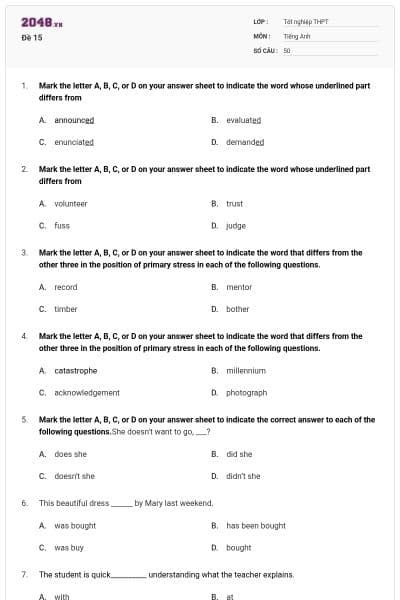
announced
evaluated
enunciated
demanded
Đáp án A
Đáp án A đúng vì phần gạch chân của đáp án A là âm /t/. Các đáp án còn lại có phần gạch chân là âm /ɪd/.
A. announced /əˈnaʊnst/ (v): thông báo
B. evaluated /ɪˈvæljueɪt/ (v): đánh giá
C. enunciated /ɪˈnʌnsieɪtɪd/ (v): phát âm rõ ràng
D. demanded /dɪˈmɑːndɪd/ (v): yêu cầu/ nhu cầu
volunteer
trust
fuss
judge
Phần gạch chân của đáp án A đọc là âm /ə/, còn phần gạch chân của các phương án còn lại được đọc là âm /ʌ/.
A. volunteer /ˌvɒlənˈtɪə(r)/ (n/v): sự tình nguyện, tình nguyện viên/ tình nguyện
B. trust /trʌst/ (n/v): sự tin tưởng/ tin tưởng
C. fuss /fʌs/ (n): sự kích động, gây rối
D. judge /dʒʌdʒ/ (v): đánh giá
Đáp án A
record
mentor
timber
bother
Đáp án A đúng vì đáp án A có trọng âm rơi vào âm tiết thứ 2. Các đáp án còn lại có trọng âm rơi vào âm tiết thứ nhất.
A. record /ˈrekɔːd/ (v): ghi âm
B. mentor /ˈmentɔː(r)/ (n): người hướng dẫn
C. timber /ˈtɪmbə(r)/ (n): gỗ
D. bother /ˈbɒðə(r)/ (v): nỗ lực/ lo lắng
* Mở rộng: record vừa là danh từ, vừa là động từ. Khi record là danh từ, trọng âm rơi vào âm tiết thứ 1. Khi record là động từ, trọng âm rơi vào âm tiết thứ 2.
Đáp án A
catastrophe
millennium
acknowledgement
photograph
Đáp án D đúng vì đáp án D có trọng âm rơi vào âm tiết thứ 1. Các đáp án còn lại có trọng âm rơi vào âm tiết thứ 2.
A. catastrophe /kəˈtæstrəfi/ (n): thảm họa
B. millennium /mɪˈleniəm/ (n): thiên niên kỉ
C. acknowledgement /əkˈnɒlɪdʒmənt/ (n): sự ghi nhận/ thừa nhận
D. photograph /ˈfəʊtəɡrɑːf/ (n): bức ảnh chụp
Đáp án D
does she
did she
doesn't she
didn’t she
Kiến thức: Câu hỏi đuôi
Giải thích:
Câu hỏi đuôi của thì Hiện tại đơn . Phần tường thuật thể phủ định, ngôi thứ 3 số ít => đuôi câu hỏi thể khẳngđịnh.
Công thức: S + doesn’t + V (bare), does + S?
Tạm dịch: Cô ấy không muốn đi, có phải không?
Đáp án : A
was bought
has been bought
was buy
bought
Phương pháp giải:
Kiến thức: Câu bị động:
Giải chi tiết: Câu bị động thì Quá khứ đơn. Trạng từ chỉ thời gian last weekend nên chọn Quá khứ đơn. Hành động được nhấn mạnh là chiếc đầm đẹp được mua bởi Mary.
S + động từ tobe + V-ed/V3
Tạm dịch: Chiếc đầm đẹp này được Mary mua vào cuối tuần trước.
Đáp án: A
with
at
on
of
quick at st: nhanh về cái gì
Tạm dịch: Học sinh nhanh chóng hiểu những gì giáo viên giải thích.
Đáp án: B
high and high
higher and the highest
high and higher
higher and higher
Đáp án: D
Giải thích:
Kiến thức: Câu so sánh
tính từ dạng so sánh hơn + and + tính từ dạng so sánh hơn: ngày càng
Chọn D.
Dịch: Tỷ lệ có việc làm ở phụ nữ ngày càng cao.
an old wooden European beautiful
a beautiful old European wooden
an old beautiful wooden European
a wooden old beautiful European
Giải thích:
Trậttựtínhtừ:GhinhớcụmOpSASCOMP:Opinionýkiến/đánhgiácánhân-Sizekíchcỡ-Agecũ/mới
-Shapehìnhdáng-Colormàusắc-Originnguồngốc-Materialchấtliệu-Purposemụcđíchsửdụng.
Đối chiếu các từ đã cho ta sắp xếp được:
Opinionýkiến/đánhgiácánhân (beautiful) -Agecũ/mới (old) -Originnguồngốc (European) -Materialchấtliệu (wooden)
Dịch nghĩa: Những du khách tới việc bảo tàng địa phương đều bị ấn tượng bởi chiếc ghế xích đu xinh đẹp cổ điển mang phong cách châu Âu làm bằng gỗ.
Đáp án B
was walking
would walk
walked
had walked
A
Kiến thức: Sự phối hợp về thì của động từ
Giải thích: Thì quá khứ đơn và quá khứ tiếp diễn kết hợp trong câu: Diễn tả hành động đang xảy ra trong quá khứ thì một hành động khác xen vào, hành động đang xảy ra chi thì quá khứ tiếp diễn, hành động xen vào chia thì quá khứ đơn
Cấu trúc: + S + Ved/bqt while S + was/ were + V_ing
Tạm dịch: Paul nhận thấy một quảng cáo tuyển dụng khi anh ấy đang đi bộ trên phố.
or
because
although
however
C
Kiến thức về liên từ
A. or: hoặc
B. because: bởi vì
C. although: mặc dù
D. however: tuy nhiên
Tạm dịch: Chiếc xe đã qua sử dụng mà Patrick mua hầu như vẫn còn mới mặc dù nó được sản xuất vào những năm 1990.
the moment you see him
until you are seeing him
after you will see him
as soon as you saw him
Đáp án A
Kiến thức: Mệnh đề chỉ thời gian / Sự hòa hợp thì trong mệnh đề
Giải thích:
Mệnh đề chính chia thì tương lai => động từ trong mệnh đề chỉ thời gian chia thì hiện tại (hiện tại đơn, hiện tại hoàn thành).
Loại luôn được các phương án B, C, D do sai thì.
the monent : vào lúc
until : cho tới khi
as soon as: ngay khi
after: sau khi
Tạm dịch: Bạn sẽ nhận ra anh ấy ngay khi nhìn thấy anh ấy chứ?
live
Having lived
To live
seeing
B
Kiến thức: Mệnh đề phân tử / Rút gọn mệnh đề đồng ngữ
Giải thích:
Khi 2 mệnh đề có cùng chủ ngữ (Mary) thì có thể rút gọn 1 trong 2 mệnh đề về dạng:
- V-ing / Having P2: nếu mệnh đề được rút gọn mang nghĩa chủ động
- P2 (quá khứ phân từ): nếu mệnh đề được rút gọn mang nghĩa bị động
Chủ ngữ “Mary” có thể làm chủ (tự thực hiện hành động “live” => nghĩa chủ động.
Tạm dịch: Đã sống ở thị trấn này một thời gian dài, Mary không muốn chuyển đến nơi khác.
excite
excitement
exciting
excited
D
Kiến thức về dạng từ
A. excite /ɪk'saɪt/ (v): hào hứng
B. excitement /ɪk'saɪtmənt/ (n): sự hào hứng
C. exciting /ɪk'saɪtŋ/ (a): thú vị
D. excited /ɪk'saɪtɪd/ (a): hào hứng
* Phân biệt:
Excited - dùng để diễn tả cảm nhận của chủ thể (thường là con người)
Exciting - dùng để chỉ tính chất của sự vật
Tạm dịch: Tối qua họ háo hức về việc tham gia tổ chức tình nguyện của địa phương đến nỗi không thể ngủ.
show up
get up
put up
go up
A
Kiến thức về cụm động từ
A. show up = turn up =arrive: xuất hiện, đến
B. get up: thức dậy
C. put up: đưa lên
D. go up: tăng lên
Tạm dịch: Ở Việt Nam, bạn không nên đến nhà ai đó vào ngày đầu tiên của năm mới trừ khi bạn được chủ nhà mời.
doing
going
playing
practicing
A
Kiến thức về cụm từ
Người ta dùng:
+“play” khi muốn nói chơi các môn thể thao đồng đội (play football/badminton...)
+ "do" khi muốn nói chơi các môn thể thao cá nhân (do yoga...)
+ "go" khi đi với các từ có đuôi -ing (go camping/fishing...)
=> Do gymnastics: tập gym
Tạm dịch: Cô ấy đã tập gym từ khi 5 tuổi.
slim
narrow
thin
light
A
Đáp án A - câu hỏi từ vựng
Câu này chọn đáp án đúng phù hợp với nghĩa và kết hợp từ.
Đáp án A - slim (gầy gò/ nhỏ bé), theo kết hợp từ (collocation), đi với danh từ “chance” và phù hợp với nghĩa của câu.
A. slim (a): gầy gò/ nhỏ bé
B. narrow (a): hẹp
C. thin (a): mảnh khảnh/ gầy
D. light (a): nhẹ
Tạm dịch: Mặc dù cô ấy học rất chăm chỉ, cô ấy chỉ có một khả năng nhỏ để vượt qua kì thi.
cards
boards
papers
days
A
Kiến thức về thành ngữ
Be on the cards: chắc chắn, khả năng cao sẽ xảy ra
Tạm dịch: Các chuyên gia nói rằng một đợt dịch cúm khác rất có thể sẽ bùng nổ.
lending
taking
putting
heading
C
Kiến thức về cụm từ cố định
Cụm từ: Put (sth) into use: thực thi để cho cái gì phát huy tác dụng bằng cách cho nó đi vào sử dụng hay hoạt động thực hiện chức năng
Tạm dịch: Ian đã không hề gặp chút khó khăn nào khi thực thi những kế hoạch hoàn hảo mà bạn bè anh ta đã chuẩn bị cho anh ta.
Cấu trúc cần lưu ý:
-Have (no) difficulty in sth/doing sth: (không) gặp khó khăn trong việc làm gì
-Prepare for sb/sth: chuẩn bị cho ai hay cái gì
Mark the letter A, B, C, or D on your answer sheet to indicate the word(s) CLOSEST in meaning to the underlined word(s) in each of the following questions.
The doctor is busy right now, but he could probably fit you in later.
look after you
examine your health problem
find time to see you
try to cure your illness
Đáp án C
Từ đồng nghĩa – kiến thức về cụm động từ
A. look after you (phr.): chăm sóc bạn
B. examine your health problem (phr.): kiểm tra vấn đề sức khỏe của bạn
C. find time to see you (phr.): tìm thời gian để gặp bạn
D. try to cure your illness (phr.): cố gắng chữa bệnh cho bạn
Tạm dịch: Bây giờ bác sĩ đang bận, nhưng ông ấy có thể thu xếp thời gian gặp bạn sau.
Vì vậy, fit you in có nghĩa tương đồng với phương án C.
agreement
obedience
rudeness
respect
Đáp án C
Từ đồng nghĩa – kiến thức về từ vựng
impudence: Hành động trơ trẽn ,lời nói khiếm nhã
Tạm dịch: Ông chủ của anh ta đã quá đủ sự khiếm nhã của anh ta, và không muốn thuê anh ta nữa.
Các phương án:
A. agreement: Sự đồng ý , thỏa thuận
B. obedience: Sự ngoan ngoãn, vâng lời
C. rudeness: Sự cộc cằn, thô lỗ,khiếm nhã
D. respect: sự tôn trọng
Mark the letter A, B, C, or D on your answer sheet to indicate the word(s) OPPOSITE in meaning to the underlined word(s) in each of the following questions.
Most of the school-leavers are sanguine about the idea of going to work and earning money.
pessimistic
expected
fearsome
excited
Đáp án A
Từ trái nghĩa – kiến thức về từ vựng
Sanguine (a) : Lạc quan
Tạm dịch: Hầu hết những người ra trường đều lạc quan về ý tưởng đi làm và kiếm tiền.
A. pessimistic : bi quan
B. expected : được trông chờ,mog đợi
C. fearsome : đángsợ, dễ sợ
D. excited :Háo hức , phấn chấn
work inahaste
workslowly
work as fastas possible
workstrenuously
Đáp án B
Tạm dịch: Chúng tôi phải làm việc liên tục để có thể hoàn thành hạn chót cho các khách hàng vào ngày mai.
→ work against the clock: làm việc không ngừng nghỉ
Xét các đáp án:
A. work in a haste: làm việc trong vộivã
B. work slowly: làm việc chậmchạp
C. work as fast as possible: làm việc nhanh nhất cóthể
D. work strenously: làm việc hăngsay
Mark the letter A, B, C, or D on your answer sheet to indicate the option that best completes each of the following exchanges.
Two students are chatting in the corridor after class.
- Tim: “Geography is certainly one of the most interesting subjects.”
- Laura: “ _______________”
I don't think so. You can say that again
I'm afraid I'm not with you. It gives me a headache
That's OK. As long as you like it
That's not true. I can't understand how you feel
Đáp án B
Kiến thức về ngôn ngữ giao tiếp
Cuộc hội thoại thuộc chủ đề đưa ra ý kiến cá nhân.
- Tim: "Địa lý chắc chắn là một trong những môn học thú vị nhất".
Các phương án
A. Tôi không nghĩ là như vậy. Tôi hoàn toàn đồng ý
B. Tôi e rằng tôi không đồng ý với bạn. Nó khiến tôi đau đầu. (Là lời đáp thể hiện quan điểm cá nhân đối với ý kiến của người nói.)
C. Vậy là được rồi. Miễn là bạn thích nó
D. Điều đó không đúng. Tôi không hiểu bạn cảm thấy thế nào
Tình huống :Hai học sinh đang trò chuyện trên hành lang sau giờ học.
- Tim: "Địa lý chắc chắn là một trong những môn học thú vị nhất".
- Laura: "Tôi e rằng tôi không đồng ý với bạn. Nó khiến tôi đau đầu".
Two friends Peter and Linda are talking about pets.
- Peter: “Well, cats are very good at catching mice around the house."
- Linda: “______________”
Nothing more to say.
You can say that again.
Yes, I hope so.
No, dogs are very good, too.
Đáp án B
Kiến thức về ngôn ngữ giao tiếp
Lời đáp cần thể hiện sự đồng ý hay không đồng ý với quan điểm của người nói.
You can say that again , No doubt about it, I quite agree with you, I can’t agree more , Absolutely : Diễn đạt sự đồng ý
- Peter: "Chà, mèo rất giỏi bắt chuột quanh nhà."
Read the following passage and mark the letter A, B, C, or D on your answer sheet to indicate the correct word or phrase that best fits each of the numbered blanks from 26 to 30.
The World Health Organization (WHO) is warning young people all over the world that they are also at risk from COVID-19. The WHO said young people are not exempt from catching the coronavirus. Many young people ___ (26) _____believe they will not catch the virus because of their age. They think it is a disease that only older people catch. The WHO said the truth is ____ (27) ____young people are catching the coronavirus and becoming ill or dying from it. It added that young people are also spreading the disease to their parents, grandparents and _____ (28) ___people. The White House also urged young adults to follow advice and to avoid gathering in large groups to help prevent the spread of the virus.
The Director-General of the WHO said: "Today, I have a message for young people: You are not invincible." He added: "This coronavirus could put you in hospital for weeks, or even kill you. Even if you don't get sick, the choices you make about where you go could be the difference between life and death for someone else." The WHO said: "A significant proportion of patients___ (29) _____in hospital for COVID-19 around the world are aged under 50." New York Governor Andrew Cuomo said many young people are not ___ (30) _____the state's social-distancing rules. He told young people that: "This is a public health issue and you cannot be endangering other peoples' health."
( Source: https://breakingnewsenglish.com/)
really
mistakenly
strongly
frequently
Đáp án B
Kiến thức về từ vựng- Từ đồng nghĩa
Các phương án:
A.really : thật sự
B. mistakenly: Sai lầm
C.strongly: Mạnh mẽ
D. frequently: Thường xuyên
Giải thích : Dựa vào thông tin “ The WHO said young people are not exempt from catching the coronavirus’’(Tổ chức y tế thế giới nói rằngngười trẻ tuổi không miễn nhiễm với virutcorona) và thông tin” Many young people mistakenly believe they will not catch the virus because of their age.” (Nhiều người trẻ tuổi sai lầm khi nghĩ rằng họ sẽ không nhiễm virut nhờ vào tuổi trẻ của mình)
why
what
that
when
Đáp án C
Kiến thức về mệnh đề danh từ
Sau động từ to be có thể dùng danh từ, cụm danh từ hoặc mệnh đề danh từ
Mệnh đề danh từ bắt đầu bằng That ( rằng, là) hoặc từ nghi vấn ( what,where, when , why, how…)
Tạm dịch: WHO cho biết sự thật là bạn đang bị nhiễm coronavirus và đang bị bệnh hoặc sắp chết vì nó.
other
others
the others
the other
Đáp án A
Kiến thức về từ vựng
Các phương án:
A. other (adjective) + danh từ số nhiều : những…khác ( nói chung)
B. others (pronoun) = other+ danh từ số nhiều : những…khác ( nói chung)
Others không dùng với danh từ theo sau
C. the others ( pronoun) : Những cái / người còn lại trong nhóm vừa đề cập đến
D. the other : cái, người còn lại trong nhóm vừa đề cập đến
Giải thích: It added that young people are also spreading the disease to their parents, grandparents and other people. (…người trẻ tuổi cũng lan truyền bệnh cho ba mẹ ông bà họ và những người khác nữa)
to treat
to be treated
treating
treated
Đáp án D
Kiến thức về rút gọn mệnh đề quan hệ sau danh từ
Thay vì mệnh đề quan hệ sau danh từ có thể thay thế bằng cụm phân từ (Ving): nếu danh từ làm hành động hoặc (Ved-3): nếu danh từ không làm, chỉ nhận hành động)
Các phương án
A. to treat
B. to be treated
C. treating
D. treated
Tạm dịch: "A significant proportion of patients___(28)______ in hospital for COVID-19 around the world are aged under 50."
(Tỉ lệ caocác bệnh nhân được điều trị ở bệnh việntrên thế giới ở độ tuổi dưới 50)
following
doing
making
keeping
Đáp án A
Kiến thức về cụm từ
follow/obey/observe a rule: tuân thủ, tuân theo qui định
Các phương án
A. following
B. doing
C. making
D. keeping
Tạm dịch: Thống đốc bang New York Andrew Cuomo cho biết nhiều người trẻ tuổi đang không có chấp hành quy tắc đứng cách xa của tiểu bang
Read the following passage and mark the letter A, B, C, or D to indicate the answer to each of the question.
There are many African tribes but, for many people, the Masai are the most well-known. They are famous for their bright red clothing and their ceremonies with lots of music and dancing. Probably, one of the most colorful ceremonies is the festival of "Eunoto," when the teenage boys of the Masai become men.
Eunoto lasts for many days and Masai people travel across the region to get to a special place near the border between Kenya and Tanzania. The teenage boys who travel with them are called "warriors." This is a traditional name from the past when young men fought with other tribes.
At the beginning of the ceremony, the teenagers paint their bodies while their mothers start to build a place called the "Osingira," a sacred room in the middle of the celebrations. Later, the senior elders from different tribes will sit inside this place and, at different times, the boys go inside to meet them. Later in the day, the boys run around the Osingira, going faster and faster each time.
The teenagers also have to alter their appearance at Eunoto. Masai boys' hair is very long before the ritual but they have to cut it off. In Masai culture, hair is an important symbol. For example, when a baby grows into an infant, the mother cuts the child's hair and gives the child a name. At a Masai wedding, the hair of the bride is also cut off as she becomes a woman. And so, at Eunoto, the teenage boy’s mother cuts his hair off at sunrise.
On the final day, the teenagers meet the senior elders one more time. They get this advice: "Now you are men, use your heads and knowledge." Then, people start to travel back to their homes and lands. The teenagers are no longer warriors. They are adult men and now they will get married and have children. Later in life, they will be the leaders of their communities.
(Adapted from "Life" by John Hughes, Helen Stephenson and Paul Dummett)
What is the passage mainly about?
The ceremony that marks the beginning of Masai boys' adulthood
The importance of Eunoto in African people's lives
The journey by Masai teenage boys to the festival of Eunoto
The reasons for the Masai's popularity over other African tribes
Đáp án: A
Kiến thức: Đọc hiểu
Giải thích: Nội dung chính của bài nói về cái gì:
A. Lễ kỷ niệm đánh dấu sự trưởng thành của các cậu bé Masai
B: Cuộc hành trình của các cậu bé người Masai tới lễ Eunoto
C: Sự quan trọng của lễ Eunoto trong cuộc sống người châu Phi
D: Lý do dẫn đến việc người Masai được biết đến nhiều hơn các bộ lạc khác ở châu Phi.
Thông tin: Câu 3 – đoạn 1 “Probably, one of the most colorful ceremonies is the festival of "Eunoto," when the teenage boys of the Masai become men.”
Tạm dịch: Có lẽ, một trong những lễ kỉ niệm sắc màu nhất là lễ hội Eunoto khi những cậu bé tộc người Masai trở thành đàn ông.
the boys
different tribes
the senior elders
their mothers
Đáp án: C
Kiến thức: Đọc hiểu
Giải thích: Từ “them” ở đoạn 3 liên quan đến _______.
A. the boys: những cậu bé B. different tribes: những bộ tộc khác
C. the senior elders: những người lớn tuổi D. their mothers: mẹ chúng
Tân ngữ ‘them’ thay cho những người nhiều tuổi trong bộ lạc.
Thông tin: Câu 2 – đoạn 3: “Later, the senior elders from different tribes will sit inside this place and, at different times, the boys go inside to meet them”.
Tạm dịch: Sau đó, những người lớn tuổi từ các bộ tộc khác sẽ ngồi ở bên trong nơi này và các cậu bé đi vào trong để gặp họ.
change
differ
distinguish
maintain
Đáp án: A
Kiến thức : Đọc hiểu
Giải thích:
Từ “alter” ở đoạn 4 đồng nghĩa với _______.
A. thay đổi B. khác nhau C. phân biệt D. khác nhau
alter (v) = change (v): thay đổi
Painting their bodies
Receiving new names
Changing their clothes
Fighting with other tribes
Đáp án: A
Kiến thức : Đọc hiểu
Giải thích: Theo bài đọc, các cậu bé làm gì tại Eunoto?
A. vẽ vào người chúng B. Nhận tên mới
C. thay quân áo D. Đánh nhau với bộ tộc khác
Thông tin: Câu 1 – đoạn 3: “At the beginning of the ceremony, the teenagers paint their bodies while their mothers start to build a place called the "Osingira," a sacred room in the middle of the celebrations.”
Tạm dịch: Đầu buổi lễ, những cậu bé vẽ lên người chúng trong khi mẹ chúng bắt đầu xây một nơi được gọi là “Osingira”, một căn phòng tin ngưỡng ở giữa các hoạt động kỉ niệm.
The Masai teenage boys are given advice from senior elders before attending Eunoto.
The Masai teenage boys will become adults and get married after attending Eunoto.
Eunoto lasts for a day across the region between Kenya and Tanzania.
Eunoto is the ceremony for both Masai teenage boys and girls.
Đáp án: B
Kiến thức : Đọc hiểu
Giải thích: Theo bài đọc, thông tin nào dưới đây là đúng?
A. Các cậu bé Masai được các già làng cho lời khuyên trước khi dự lễ (thực tế là vào ngày cuối cùng của lễ)
B. Các cậu bé Masai được công nhận là người trưởng thành và kết hôn sau lễ Eunoto
C. Lễ Eunoto kéo dài 1 ngày ở khu vực 2 quốc gia (thực tế là Eunoto lasts for many days)
D. Lễ Eunoto dành cho cả bé trai và bé gái (không đúng, chỉ dành cho trai)
Thông tin: Đoạn cuối: “On the final day, the teenagers meet the senior elders one more time. They get this advice: "Now you are men, use your heads and knowledge." Then, people start to travel back to their homes and lands. The teenagers are no longer warriors. They are adult men and now they will get married and have children. Later in life, they will be the leaders of their communities.”
Tạm dịch: Vào ngày cuối cùng, các cậu bé gặp những người lớn tuổi thêm một lần nữa. Chúng nhận được lời khuyên này: “Bây giờ, con đã là đàn ông, hãy dùng cái đầu và kiến thức.” Sau đó, mọi người trở về nhà. Các cậu bé không còn là những chiến binh. Chúng là đàn ông trưởng thành và bây giờ chúng sẽ kết hôn và sinh con. Sau này trong cuộc sống, chúng sẽ là những thủ lĩnh của cộng đồng.
Read the following passage and mark the letter A, B, C, or D to indicate the answer to each of the question.
For hundreds of years, giving flowers has been a social means of communication. In the United States, flowers are often given during rites of passage, for commemorating special occasions or as a heartfelt gift between loved ones and friends. Flower gifting also occurs in most countries around the world. However, the meanings and traditions often vary.
While students traditionally gave their favorite teacher an apple in past years, in China, teachers are given flowers. Peonies are by far the flower most often given in China. They are also quite popularly used for weddings. Strangely, potted plants are not considered a pleasant gift among Asian cultures. The people believe that like a plant confined by a pot, the gift symbolizes a binding or restriction.
In Russia, in lieu of giving birthday presents, the guest of honor receives a single flower or an unwrapped bouquet. Floral arrangements or baskets are not given. Russians celebrate a holiday known as Woman’s Day. Traditional gifts include red roses, hyacinths or tulips. When there is a funeral or other occasion where someone wishes to express sympathy, carnations, lilies or roses are given in circular configurations, which signify the transition of birth, life and death to rebirth. In this instance, the color of choice is commonly yellow. For joyous occasions, arrangements and bouquets generally contain an odd number of flowers.
In the times of ancient Rome, brides carried flowers to scare away evil spirits and encourage fertility. The Dutch believed that flowers were food for the soul. When invited to someone’s home in Great Britain, it is tradition to bring a gift of flowers. All types are acceptable except white lilies, which are usually seen at funerals. Not unlike the United States, red roses are a symbol of love. Flowers are generally gifted in odd numbered increments regardless of the occasion. However, the Brits also have superstitions regarding the number 13, so the number is avoided.
In the southern region of the continent, flowers are traditionally given during Christmas. Egyptians are much more conservative and restrict flower gifting to funerals and weddings. While certain flowers may have significant meanings for some, flowers in Las Vegas and across the United States flowers are an accepted gift for any reason desired.
(Source: http://www.flowersofthefieldlv.com/ )
What does the topic mainly discuss?
The fascinating tradition of giving flowers.
The different meaning of flowers in different cultures.
The comparison of giving flowers between Asian and European cultures.
The kinds of flowers people often give others in different cultures.
Đáp án: A
Kiến thức : Đọc hiểu
Giải thích: Đoạn văn này chủ yếu thảo luận về chủ đề gì?
A. Truyền thống thú vị về việc tặng hoa.
B. Nghĩa khác nhau của các loài hoa trong các nền văn hoá khác nhau.
C. Sự so sánh việc tặng hoa giữa văn hoá Châu Á và Châu Âu.
D. Những loại hoa mọi người thường tặng trong các văn hoá khác nhau.
Thông tin: Đoạn 1: “Flower gifting also occurs in most countries around the world. However, the meanings and traditions often vary.”
Tạm dịch: Tặng hoa cũng xuất hiện ở hầu hết các nước trên thế giới. Tuy nhiên, ý nghĩa và truyền thống thường khác nhau.
Students
Teachers
Flowers
Peonies
Đáp án: D
Kiến thức : Đọc hiểu
Giải thích: Từ “They” trong đoạn 2 đề cập đến từ nào?
A. Học sinh B. Giáo viên C. Hoa D. Hoa mẫu đơn
“They” là đại từ thay thế cho danh từ hoa mẫu đơn trong câu trước.
Thông tin: Đoạn 2: “Peonies are by far the flower most often given in China. They are also quite popularly used for weddings.”
Tạm dịch: Hoa mẫu đơn là loài hoa từ lâu vẫn thường được tặng nhất ở Trung Quốc. Chúng cũng được sử dụng khá phổ biến trong các đám cưới.
red roses
hyacinths
tulips
yellow roses
Đáp án: D
Kiến thức : Đọc hiểu
Giải thích: Theo đoạn văn, những loài hoa sau thường được tặng vào ngày Quốc Tế Phụ nữ ở Nga, ngoại trừ ________.
A. hoa hồng đỏ B. hoa lan dạ hương C. hoa tulip D. hoa hồng vàng
Thông tin: Đoạn 3: “Russians celebrate a holiday known as Woman’s Day. Traditional gifts include red roses, hyacinths or tulips. When there is a funeral or other occasion where someone wishes to express sympathy, carnations, lilies or roses are given in circular configurations, which signify the transition of birth, life and death to rebirth. In this instance, the color of choice is commonly yellow.”
Tạm dịch: Người Nga tổ chức 1 ngày lễ gọi là ngày Quốc tế Phụ nữ. Những món quà truyền thống bao gồm hoa hồng đỏ, hoa lan dạ hương hay hoa tulip. Khi có đám tang hay các dịp khác mà người ta thường muốn bày tỏ sự cảm thông thì hoa cẩm chướng, hoa huệ tây hay hoa hồng được kết theo hình tròn, có ý nghĩa là sự chuyển giao giữa sự sinh ra, lớn lên và chết đi để tái sinh. Trong dịp này, màu sắc thường được chọn là màu vàng.
fecundity
good spirit
happiness
loyalty
Đáp án: A
Kiến thức : Đọc hiểu
Giải thích: Từ “fertility” trong đoạn 4 có thể được thay thế tốt nhất bằng từ nào?
A. sự mắn đẻ B. tinh thần tốt C. hạnh phúc D. sự thuỷ chung
Từ đồng nghĩa: fertility (khả năng sinh sản) = fecundity
Thông tin; Đoạn 4: “In the times of ancient Rome, brides carried flowers to scare away evil spirits and encourage fertility.”
Tạm dịch: Trong thời La Mã cổ đại, cô dâu thường mang hoa để xua đuổi các linh hồn ma quỷ và khuyến khích khả năng sinh sản.
deep-seated belief
unfounded belief
religious belief
traditional belief
Đáp án: B
Kiến thức : Đọc hiểu
Giải thích: Từ “superstitions” trong đoạn 4 gần nghĩa nhất với từ _______.
A. niềm tin lâu đời B. niềm tin vô căn cứ
C. niềm tin tôn giáo D. niềm tin truyền thống
Từ đồng nghĩa: superstitions (mê tín) =unfounded belief.
Thông tin: Đoạn 4: “Flowers are generally gifted in odd numbered increments regardless of the occasion. However, the Brits also have superstitions regarding the number 13, so the number is avoided.”
Tạm dịch: Hoa thường được tặng theo số lẻ bất kể vào dịp nào. Tuy nhiên, người Anh cũng có mê tín về số 13, vì vậy số này được tránh tặng.
China
Russia
Great Britain
United States
Đáp án: C
Kiến thức : Đọc hiểu
Giải thích: Ở đất nước nào người ta không nên mang hoa huệ tây trắng đến nhà người khác?
A. Trung Quốc B. Nga C. Anh D. Hoa Kỳ
Thông tin đoạn 4: “When invited to someone’s home in Great Britain, it is tradition to bring a gift of flowers. All types are acceptable except white lilies, which are usually seen at funerals.”
Tạm dịch: Khi được mời tới nhà ai đó ở Anh, mang quà là hoa là nét truyền thống. Tất cả các loại hoa đều được chấp nhận ngoại trừ hoa huệ tây trắng, loài hoa thường thấy ở các đám tang.
People can give flowers to the American in any occasion.
Egyptians are rather comfortable when receiving flowers at funerals and weddings.
Flowers given in Britain are in even numbers in any case.
At the funerals in any cultures, flowers are gifted in circular configurations.
Đáp án: A
Kiến thức : Đọc hiểu
Giải thích: Có thể suy ra từ đoạn văn rằng ________.
A. Người ta có thể tặng hoa cho người Mỹ vào bất kì dịp nào.
B. Người Ai Cập khá thoải mái trong việc nhận hoa ở đám tang và đám cưới.
C. Hoa ở nước Anh được tặng theo số chẵn ở mọi trường hợp.
D. Ở đám tang ở bất kì văn hoá nào, hoa được tặng theo hình vòng tròn.
Thông tin đoạn cuối: “In the southern region of the continent, flowers are traditionally given during Christmas. Egyptians are much more conservative and restrict flower gifting to funerals and weddings. While certain flowers may have significant meanings for some, flowers in Las Vegas and across the United States flowers are an accepted gift for any reason desired.”
Tạm dịch: Ở khu vực phía nam của châu lục, hoa thường được tặng theo truyền thống vào dịp Giáng sinh. Người Ai Cập thận trọng hơn nhiều và giới hạn việc tặng hoa vào đám tang hay đám cưới. Trong khi 1 số loài hoa thường có những ý nghĩa khác nhau, hoa ở Las Vegas và xuyên suốt nước Mỹ là 2 món quà được chấp nhận cho bất kì lý do nào.
won't
have gone
because
a fever
B
Đáp án: B. have gone
- Will + have + past participle: dùng để diễn tả một hành động sẽ được hoàn thành cho tới một thời điểm trong tương lai.
- Câu trên chỉ hành động có thể sẽ xảy ra trong tương lai, vì vậy cần dùng tương lai đơn thay vì tương lai hoàn thành. Do đó “have gone” sửa thành “go”.students
in the
their
own
C.
Kiến thức: sự hoà hợp giữa chủ ngữ và tính từ sở hữu cách
“Each of the students” là số ít nên tính từ sở hữu sau đó cũng dùng tính từ sở hữu dành cho số ít. Vì vậy: Sửa: their => his/ her
Dịch: Mỗi học sinh trong lớp kế toán phải đánh máy bài nghiên cứu của riêng mình trong học kỳ này.
As soon as
were crossing
at
ran
A
Đáp án A: “As soon as ”.
+ Câu đã cho miêu tả 2 hành động trong quá khứ, trong đó một hành động đang xảy ra trong quá khứ (thì quá khứ tiếp diễn) thì một hành động khác đột nhiên xen vào (quá khứ đơn) và liên từ thường dùng là while (trước mệnh đề quá khứ tiếp diễn) và when (trước mệnh đề quá khứ đơn).
+ Trong trường hợp này, “as soon as” cần được sửa lại thành ‘while’.
Mark the letter A, B, C, or D on your answer sheet to indicate the sentence that is closest in meaning to each of the following questions
He started to practise swimming when he was a kid
Thanh practiced swimming when he was a kid.
Thanh has practiced swimming since he was a kid.
Thanh was a swimmer when he was a kid.
Thanh was a swimmer as a kid.
B
Đáp án: B.“Thanh has practiced swimming since he was a kid.” Dùng thì hiện tại hoàn thành để diễn tả hành động bắt đầu trong quá khứ và vẫn tiếp diễn ở hiện tại.
- Câu đã cho tạm dịch là: “Thanh bắt đầu tập bơi khi còn nhỏ”
- Câu ”Thanh practiced swimming when he was a kid.” Diễn đạt một hành động đã hoàn thành trong quá khứ, không liên quan tới hiện tại. -> không cận nghĩa với câu gốc.
- Câu “Thanh was a swimmer when he was a kid.” Diễn đạt một trạng thái trong qúa khứ. -> không cận nghĩa với câu gốc.
- Câu “Thanh was a swimmer as a kid.” Cũng là một cách diễn đạt một trạng thái trong quá khứ. -> không cận nghĩa với câu gốc.
Steve advised Mike not touch the electric wires as it might be deadly.
Steve warned Mike not to touch the wires as it might be deadly.
Steve suggested that Mike not touch the electric wires as it might be deadly.
Steve accused Mike of touching the electric wires as it might be deadly.
B
Câu gốc thể hiện sự cảnh báo: Steve nói với Mike “Đừng chạm vào dây điện. Có thể chết người đấy”
A. Steve khuyên Mike không chạm vào dây điện vì nó có thể chết người=> sai nghĩa
B. Steve cảnh bào Mike không chạm vào dây điện vì nó có thể chết người => đúng
C. Steve gợi ý Mike không chạm vào dây điện vì nó có thể chết người => sai nghĩa
D. Steve buộc tội Mike không chạm vào dây điện vì nó có thể chết người => sai nghĩa
Warn sb not to V = warn sb against Ving
We should discuss this matter in great detail
We might discuss this matter in great detail
We needn’t discuss this matter in great detail
We mustn’t discuss this matter in great detail
C
It isn’t necessary for sb to V = S + needn’t V
I wish you wouldn’t leave your clothes all over thefloor.
I expect you to clean thefloor.
I regret not leaving your clothes all over thefloor.
I wish you hadn’t left your clothes all over thefloor.
Đáp án A.
Câu gốc: Căn phòng bừa bộn. Tôi hy vọng bạn không để quần áo trên sàn nhà.
= A. Tôi ước bạn sẽ không để quần áo trên sàn nhà. Các đáp án khác:
B. Tôi mong bạn dọn sàn nhà. => sai nghĩa
C. Tôi rất tiếc không để quần áo của bạn trên sàn nhà. => sai nghĩa
D. Tôi ước bạn đã bỏ quần áo trên sàn nhà. => sai thì
Had we arrived at the airport, we would have realized our passports were still at home.
Only after we realized our passports were still at home, did we arrive at the airport.
Only when we realized our passports were still at home, did we arrive at the airport.
Not until we arrived at the airport, did we realize that our passports were still at home.
D
A. Sai cấu trúc
B. Sai trật từ hành động (chúng tôi đến sân bay trước và nhân thấy việc để quên hộ chiếu xảy ra sau)
C. Sai trật từ hành động (như đáp án B)
D. Đúng