ĐỀ 14
50 câu hỏi
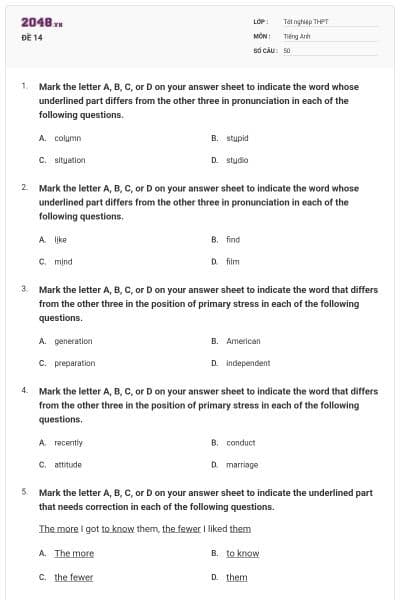
Mark the letter A, B, C, or D on your answer sheet to indicate the word whose underlined part differs from the other three in pronunciation in each of the following questions.
column
stupid
situation
studio
Đáp án A
Đọc là âm [ə], còn lại đọc là âm [ju]
A. column /ˈkɒl.əm/ (n): cột
B. stupid /ˈstjuː.pɪd/ (adj): ngu ngốc
C. situation /ˌsɪtʃ.uˈeɪ.ʃən/ (n): tình hình, vị trí, trạng thái
D. studio /ˈstjuː.di.əʊ/ (n): phòng thu
Mark the letter A, B, C, or D on your answer sheet to indicate the word whose underlined part differs from the other three in pronunciation in each of the following questions.
like
find
mind
film
Đáp án D
Đọc là âm [i], còn lại đọc là âm [aɪ]
A. like /laɪk/ (v): thích
B. find /faɪnd/ (v): tìm kiếm
C. mind /maɪnd/ (n): đầu óc, trí tuệ
D. film /fɪlm/ (n): bộ phim
Mark the letter A, B, C, or D on your answer sheet to indicate the word that differs from the other three in the position of primary stress in each of the following questions.
generation
American
preparation
independent
Đáp án B
Trọng âm nhấn âm số 2, âm còn lại nhấn âm số 3
A. generation /ˌdʒen.əˈreɪ.ʃən/ (n): thế hệ; sự sản xuất
B. American /əˈmer.ɪ.kən/ (adj): thuộc về, liên quan đến nước Mỹ
C. preparation/ˌprep.ərˈeɪ.ʃən/ (n): sự chuẩn bị
D. independent /ˌɪn.dɪˈpen.dənt/ (n): độc lập
Mark the letter A, B, C, or D on your answer sheet to indicate the word that differs from the other three in the position of primary stress in each of the following questions.
recently
conduct
attitude
marriage
Đáp án B
Trọng âm nhấn âm số 2, âm còn lại nhấn âm số 1
A. recently /ˈriː.səntli/ (adv): gần đây, mới đây
B. conduct /kənˈdʌkt/ (v): tổ chức, thực hiện; ứng xử; dẫn điện
(n): cách tổ chức; hành vi
C. attitude /ˈæt.ɪ.tʃuːd/ (n): thái độ, quan điểm
D. marriage/ˈmær.ɪdʒ/ (n): hôn nhân
Mark the letter A, B, C, or D on your answer sheet to indicate the underlined part that needs correction in each of the following questions.
The more I got to know them, the fewer I liked them
The more
to know
the fewer
them
Đáp án C
Giải thích: Đây là một dạng của cấu trúc so sánh kép:
The more / less + S + V, the more / less + S + V = càng … càng …
Còn cấu trúc so sánh kép sử dụng “the fewer” bắt buộc phải có danh từ đếm được số nhiều đứng sau nó và trước mệnh đề.
Sửa lỗi: the fewer => the less
Dịch nghĩa: Tôi càng biết họ nhiều hơn, tôi càng ít thích họ hơn.
A. The more = càng hơn
Vế này của cấu trúc so sánh kép đã được sử dụng đúng.
B. to know = biết
Cấu trúc get to do sth = đến được trạng thái mà biết rõ, cảm nhận rõ, … cái gì
D. them = họ
Mark the letter A, B, C, or D on your answer sheet to indicate the underlined part that needs correction in each of the following questions.
The rings of Saturn are so distant to be seen from Earth without a telescope
of
so
be
without
Đáp án B
Giải thích: Có hai cấu trúc nhấn mạnh có nghĩa tương đương nhau
Too + adj + to + V(nguyên thể) = quá đến nỗi mà
So + adj + that + mệnh đề = quá đến nỗi mà
Trong câu, sau tính từ “distant” đã có dạng to + V(nguyên thể)nên cần dung công thức thứ nhất.
Sửa lỗi: so =>too
Dịch nghĩa: Các vành đai của sao Thổ ở quá xa để có thể được nhìn thấy mà không cần kính thiên văn.
A. of = của
The rings of Saturn = Các vành đai của sao Thổ
C. be
Sau “to” là một động từ nguyên thể, nhưng ở đây dùng dạng bị động nên động từ tobe sẽ được giữ nguyên dạng nguyên thể, còn động từ chính vẫn được chia phân từ.
D. without = không cần, không có
Mark the letter A, B, C, or D on your answer sheet to indicate the underlined part that needs correction in each of the following questions.
Do you know how much Vitamin C does an onion have? As much as two apples do
Do you know
how much
does an onion have
As much as
Đáp án C
Giải thích: Khi một câu hỏi đóng vai trò một mệnh đề tân ngữ (mệnh đề đứng sau động từ) trong một câu hỏi khác thì không cần trợ động từ trong câu hỏi ấy nữa và động từ được chia bình thường.
Sửa lỗi: does an onion have => an onion has
Dịch nghĩa: Bạn có biết có bao nhiêu vitamin C mà một củ hành tây có không? Nhiều như hai quả táo có.
A. Do you know = bạn có biết
B. how much = bao nhiêu
D. As much as = nhiều như
Mark the letter A, B, C, or D on your answer sheet to indicate the correct answer to each of the following questions.
The train whistle warned us of its ____________ departure.
previous
imminent
subsequent
former
Đáp án B
Giải thích: Imminent (adj) = sắp xảy ra / cấp bách
Dịch nghĩa: Tiếng còi tàu cảnh báo chúng tôi về sự khởi hành sắp tới của nó.
A. previous (adj) = trước, đã qua, đã xảy ra
C. subsequent (adj) = tiếp theo, sau đó
D. former (adj) = trước đây, cựu
Mark the letter A, B, C, or D on your answer sheet to indicate the correct answer to each of the following questions.
Time and neglect had ____________ the property
deteriorated
enhanced
flourished
acclimatized
Đáp án A
Giải thích: Deteriorate (v) = làm hư hỏng, làm giảm giá trị
Dịch nghĩa: Thời gian và sự xao lãng đã làm hư hỏng đi tài sản này.
B. enhanced (v) = cải thiện, nâng cao
C. flourished (v) = phát triển mạnh mẽ, nẩy nở, mọc lên
D. acclimatized (v) = làm quen với thời tiết, địa điểm hoặc hoàn cảnh mới
Mark the letter A, B, C, or D on your answer sheet to indicate the correct answer to each of the following questions.
An artist ____________ will do his best to express innocence and inexperience in the child’s face
portraying a child
who portray a child
he portrays a child
portrayed a child
Đáp án A
Giải thích: Sau chỗ trống đã có một động từ cho câu nên chỗ trống chỉ có thể là một mệnh đề quan hệ hoặc mệnh đề rút gọn để bổ sung ý nghĩa cho chủ ngữ. Động từ "portray" mang tính chủ động nên có thể rút gọn thành dạng V-ing.
Dịch nghĩa: Một họa sĩ vẽ chân dung một đứa trẻ sẽ làm hết sức mình để thể hiện sự ngây thơ và thiếu kinh nghiệm trong khuôn mặt của trẻ.
B. who portray a child = người vẽ chân dung một đứa trẻ
Đây là cấu trúc mệnh đề quan hệ, tuy nhiên chủ ngữ là danh từ số ít nên động từ cần được chia ở dạng số ít.
C. he portrays a child = anh vẽ chân dung một đứa trẻ
Đây là một mệnh đề hoàn chỉnh rồi chứ không phải mệnh đề dùng để bổ nghĩa cho chủ ngữ.
D. portrayed a child = được vẽ chân dung một đứa trẻ
Động từ “portray” không mang tính bị động nên không thể rút gọn thành dạng phân từ.
Mark the letter A, B, C, or D on your answer sheet to indicate the correct answer to each of the following questions.
Which ____________ agency do you work for?
ads
advertised
advertising
advertisement
Đáp án C
Giải thích: Advertising (n) = sự quảng cáo, ngành quảng cáo
Advertising agency = công ty quảng cáo
Dịch nghĩa: Công ty quảng cáo nào mà bạn đang làm cho vậy?
A. ads (n) = quảng cáo (trên tivi, báo đài, mạng Internet, …), là từ viết tắt của danh từ “advertisement”.
Đây là danh từ chỉ một sản phẩm quảng cáo cụ thể nên không thể lấy làm danh từ ghép để chỉ công việc quảng cáo nói chung.
B. advertised (adj) = được quảng cáo
Phân biệt giữa sử dụng tính từ để bổ nghĩa cho danh từ và sử dụng danh từ ghép: ta sử dụng tính từ đứng trước danh từ khi đó là một thuộc tính, đặc điểm của bản thân danh từ đó, còn khi hai từ chỉ là có sự liên quan đến nhau thì sử dụng danh từ ghép.
Trong trường hợp này, quảng cáo không phải đặc điểm của bản thân công ty mà là có sự liên quan đến nên không thể dùng tính từ đứng trước mà phải sử dụng danh từ ghép.
D. advertisement (n) = quảng cáo (trên tivi, báo đài, mạng Internet, …)
Đây là danh từ chỉ một sản phẩm quảng cáo cụ thể nên không thể lấy làm danh từ ghép để chỉ công việc quảng cáo nói chung.
Mark the letter A, B, C, or D on your answer sheet to indicate the correct answer to each of the following questions.
His face looks ____________, but I can’t remember his name
similar
alike
memorable
familiar
Đáp án D
Giải thích: Familiar (n) = quen thuộc
Dịch nghĩa: Khuôn mặt anh ấy nhìn quen thuộc, nhưng tôi không thể nhớ tên của anh ấy.
A. similar (adj) = giống nhau, dùng để so sánh giữa hai danh từ trở lên.
B. alike (adj) = giống nhau, dùng để so sánh giữa hai danh từ trở lên.
C. memorable (adj) = đáng nhớ, đáng kỷ niệm
Mark the letter A, B, C, or D on your answer sheet to indicate the correct answer to each of the following questions.
There is a ____________ of skilled craftsmen in the industry
warn
fault
lack
short
Đáp án C
Giải thích: Lack (n) = sự thiếu hụt
Dịch nghĩa: Có một sự thiếu hụt về thợ thủ công lành nghề trong ngành công nghiệp này.
A. warn (n) = sự cảnh báo
B. fault (n) = lỗi, sự sai sót, thiếu sót
D. short (adj) = ngắn, thiếu
Mark the letter A, B, C, or D on your answer sheet to indicate the correct answer to each of the following questions.
I know you’re annoyed, but you must try to control your ____________.
blood
storm
explosion
temper
Đáp án D
Giải thích: Cấu trúc
Control sb’s temper = kiểm soát cơn giận
Dịch nghĩa: Tôi biết rằng bạn thấy khó chịu, nhưng bạn phải học cách kiểm soát cơn giận của mình.
A. blood (n) = máu
B. storm (n) = cơn bão
C. explosion (n) = vụ nổ, sự bùng nổ
Mark the letter A, B, C, or D on your answer sheet to indicate the correct answer to each of the following questions.
You will have to go for an interview tomorrow, but don't worry. It's just a _________
form
format
formation
formality
Đáp án D
Giải thích: Formality (n) = hình thức
Dịch nghĩa: Bạn sẽ phải đi phỏng vẫn vào ngày mai. Nnhưng đừng lo, đó chỉ là hình thức thôi.
A. form (n) = loại, kiểu / tờ đơn / hình dáng, cấu trúc / sự khỏe mạnh / cách làm, cách cư xử
B. format (n) = định dạng, khổ sách, kích thước
C. formation (n) = sự hình thành / sự tổ chức / hệ thống
Mark the letter A, B, C, or D on your answer sheet to indicate the correct answer to each of the following questions.
Mr. Jones knew who had won the contest, but he kept it under his ____________ until it was announced publicly
cap
tongue
hat
umbrella
Đáp án C
Giải thích: Cấu trúc
Keep sth under sb’s hat = giữ bí mật
Dịch nghĩa: Ông Jones đã biết ai đã chiến thắng cuộc thi, nhưng ông giữ bí mật cho đến khi nó được chính thức tuyên bố.
A. cap (n) = mũ lưỡi trai
B. tongue (n) = cái lưỡi / giọng nói
D. umbrella (n) = chiếc ô
Mark the letter A, B, C, or D on your answer sheet to indicate the correct answer to each of the following questions.
A fire must have a readily available supply of oxygen. ________, it will stop burning
Consequently
Furthermore
Otherwise
However
Đáp án C
Giải thích: Giữa hai câu có mối quan hệ điều kiện – kết quả. Do đó ta cần sử dụng từ nối có tính điều kiện.
Otherwise = nếu không thì
Dịch nghĩa: Một ngọn lửa phải có một nguồn cung cấp oxy luôn sẵn sàng. Nếu không, nó sẽ ngừng cháy.
A. Consequently = kết quả là
Đây là từ nối giữa hai vế hoặc hai câu có mối quan hệ nhân quả.
B. Furthermore = thêm vào đó
Đây là từ nối để bổ sung thêm ý kiến.
D. However = tuy nhiên
Đây là từ nối giữa hai vế hoặc hai câu có mối quan hệ nhượng bộ.
Mark the letter A, B, C, or D on your answer sheet to indicate the correct answer to each of the following questions.
He is the manager of the factory. He’s ________it
charged with
charged
in charge
in charge of
Đáp án D
Giải thích: Cấu trúc
Be in charge of sth = chịu trách nhiệm về cái gì
Dịch nghĩa: Ông ấy là người quản lý của nhà máy. Ông ấy chịu trách nhiệm về nó.
A. charged with = bị buộc tội
B. charged = đặt giá / trả bằng thẻ tín dụng / tấn công / sạc điện / giao nhiệm vụ / rót đầy ly / lên nòng súng
C. in charge = phụ trách, chịu trách nhiệm
Chỉ dùng được “in charge” khi phía sau nó không có danh từ, nếu có danh từ phải dùng “in charge of”.
Mark the letter A, B, C, or D on your answer sheet to indicate the correct answer to each of the following questions.
________becoming extinct is of great concern to zoologists
That giant pandas are
Giant pandas are
Are giant pandas
Giant panda is
Đáp án A
Giải thích: Mệnh đề bắt đầu bằng "That" được coi như một danh từ không đếm được, có thể đứng làm chủ ngữ trong câu và động từ khi đó được chia ở dạng số ít.
Dịch nghĩa: Việc những con gấu trúc khổng lồ đang bị tuyệt chủng là mối quan tâm rất lớn của các nhà động vật học.
B. Giant pandas are
Nếu sử dụng như vậy thì một câu sẽ có hai động từ chính trong khi không có từ nối hay phương tiện ngăn cách giữa hai động từ đó. Như vậy là sai ngữ pháp câu.
C. Are giant pandas
Đây không phải là một câu hỏi đúng sai nên không thể dùng như vậy.
D. Giant panda is
Nếu sử dụng như vậy thì một câu sẽ có hai động từ chính trong khi không có từ nối hay phương tiện ngăn cách giữa hai động từ đó. Như vậy là sai ngữ pháp câu.
Mark the letter A, B, C, or D on your answer sheet to indicate the most suitable response to complete each of the following exchanges.
Son: “What is the process of ________________, Dad?”
Father: “Well, it involves the heating of liquid such as milk in order to kill harmful bacteria.”
industrialization
pasteurization
commercialization
globalization
Đáp án B
Giải thích: Pasteurization (n) = sự khử trùng
Từ cần điền vào chỗ trống đã được giải thích nghĩa cụ thể trong câu trả lời của người bố.
Dịch nghĩa: Con trai : "Quá trình khử trùng là gì hả bố ?"
Bố : "À, nó liên quan đến việc đun sôi chất lỏng ví dụ như sữa để giết chết các vi khuẩn có hại."
A industrialization (n) = sự công nghiệp hóa
C. commercialization (n) = sự thương mại hóa
D. globalization (n) = sự toàn cầu hóa
Mark the letter A, B, C, or D on your answer sheet to indicate the most suitable response to complete each of the following exchanges.
‘‘Well it was nice talking to you, but I have to dash.’’
‘‘_______________________’’.
Ok, see you
Yes, I enjoyed talking to you, too
Well, another time
That’s nice
Đáp án A
Giải thích: Lời John nói chính là sự xin phép đi trước, rời khỏi cuộc nói chuyện. Do đó, người đối thoại cũng sẽ chào tạm biệt.
Dịch nghĩa: John : "Ôi nói chuyện với bạn thật là tuyệt, nhưng tôi phải nhanh chóng đi ngay."
Jane : "Ok. Gặp lại bạn sau"
B. Yes, I enjoyed talking to you, too. = Có, tôi cũng thích nói chuyện với bạn.
John không hỏi là Jane có thích nói chuyện với cậu ấy không, nên không thể trả lời như vậy.
C. Well, another time = Ồ, lần khác vậy
Là câu nói lịch sự khi lời mời bị từ chối.
D. That's nice = Điều đó thật tuyệt
Là một câu trả lời lịch sự khi bạn không quan tâm đến điều người đối diện đang nói, hoặc không có tâm trạng để nghe.
Mark the letter A, B, C, or D on your answer sheet to indicate the word(s) CLOSEST in meaning to the underlined word(s) in each of the following questions.
This dinosaur was known to be carnivorous
vegetative
nocturnal
tardy
flesh-eating
Đáp án D
Giải thích: Carnivorous (adj) = Flesh – eating (adj) = ăn thịt
Dịch nghĩa: Con khủng long này được biết đến là loài ăn thịt.
A. vegetative (adj) = liên quan đến đời sống thực vật, người thực vật
B. nocturnal (adj) = thuộc về ban đêm
C. tardy (adj) = chậm chạp, không vội vàng
Mark the letter A, B, C, or D on your answer sheet to indicate the word(s) CLOSEST in meaning to the underlined word(s) in each of the following questions.
His approach was so stealthy that no one noticed him coming
fast
secretive
expected
noisy
Đáp án B
Giải thích: Stealthy (adj) = lén lút
Secretive (adj) = bí mật
Dịch nghĩa: Cách tiếp cận của anh ta quá lén lút, bí mật đến nỗi mà không ai nhận thấy anh ta đến.
A. fast (adj) = nhanh
C. expected (adj) = được trông ngóng
D. noisy (adj) = ồn ào
Mark the letter A, B, C, or D on your answer sheet to indicate the word(s) OPPOSITE in meaning to the underlined word(s) in each of the following questions.
The International Organizations are going to be in a temporary way in the country
soak
permanent
complicated
guess
Đáp án B
Giải thích: Temporary (adj) = tạm thời >< permanent (adj) = lâu dài
Dịch nghĩa: Các tổ chức quốc tế sẽ trong một tình trạng tạm thời trong nước.
A. soak (v) = ướt đẫm
C. complicated (adj) = phức tạp
C. guess (n) = khách mời
Mark the letter A, B, C, or D on your answer sheet to indicate the word(s) OPPOSITE in meaning to the underlined word(s) in each of the following questions.
The US troops are using much more sophisticated weapons in the Far East
expensive
complicated
simple and easy to use
difficult to operate
Đáp án C
Giải thích: Sophisticated (adj) = phức tạp >< simple and easy to use = đơn giản và dễ sử dụng
Dịch nghĩa: Quân đội Mỹ đang sử dụng các loại vũ khí phức tạp hơn nhiều ở vùng Viễn Đông.
A. expensive (adj) = đắt đỏ
B. complicated (adj) = phức tạp
D. difficult to operate = khó hoạt động
Mark the letter A, B, C, or D on your answer sheet to indicate the sentence that is closest in meaning to each of the following questions.
It was his lack of confidence that surprised me
He surprised me by his lack of confidence
That his lack of confidence surprised me
That he lacked of confidence surprised me
What surprised me was his lack of confidence
Đáp án D
Giải thích: Câu gốc sử dụng cấu trúc nhấn mạnh:
It + is / was / will be + Noun + that + V = đó chính là … mà …
Dịch nghĩa: Đó chính là sự thiếu tự tin của anh ấy mà làm tôi ngạc nhiên.
Phương án D. What surprised me was his lack of confidence sử dụng cấu trúc nhấn mạnh:
What + V + is / was / will be + Noun = Điều mà … là …
Dịch nghĩa: Điều mà khiến tôi ngạc nhiên là sự thiếu tự tin của anh ấy.
Đây là phương án có nghĩa của câu sát với nghĩa câu gốc nhất.
A. He surprised me by his lack of confidence = Anh ta đã làm tôi ngạc nhiên bằng sự thiếu tự tin của anh ấy.
Cấu trúc: Surprise sb by sth = làm ai ngạc nhiên bằng cái gì
Trong câu gốc là người nói bị ngạc nhiên khi thấy sự thiếu tự tin của anh ta, anh ta không cố tính làm người khác ngạc nhiên về điều đó, còn câu này sử dụng cấu trúc trên thì có nghĩa là anh ta chủ động làm người nói ngạc nhiên bằng sự thiếu tự tin của mình.
B. That his lack of confidence surprised me = Sự thiếu tự tin của anh ta làm tôi ngạc nhiên.
Sau “That” phải là một mệnh đề, chứ không phải một danh từ, thì mới đứng đầu câu làm chủ ngữ được.
C. That he lacked of confidence surprised me = Việc mà anh ta thiếu sự tự tin làm tôi ngạc nhiên.
Cấu trúc: Lack sth = thiếu cái gì ( không có cấu trúc “lack of sth”).
Mark the letter A, B, C, or D on your answer sheet to indicate the sentence that is closest in meaning to each of the following questions.
I read two books, but I didn’t find them interesting
None of the two books I read was interesting
Either of the books I read weren’t interesting
Neither of the books I read was interesting
The two books I read wasn’t interesting
Đáp án C
Giải thích: Câu gốc sử dụng từ nối "but" để diễn tả sự nhượng bộ.
Dịch nghĩa: Tôi đã đọc hai quyển sách, nhưng tôi đã không cảm thấy chúng thú vị.
Phương án C. Neither of the books I read was interesting sử dụng cấu trúc:
Neither of + Noun (số nhiều) + V (số ít) = không cái nào trong hai cái
Dịch nghĩa: Không quyển nào trong hai quyển sách tôi đã đọc là thú vị cả.
Đây là phương án có nghĩa của câu sát với nghĩa câu gốc nhất.
A. None of the two books I read was interesting = Không quyển nào trong hai quyển sách tôi đã đọc là thú vị cả.
None of + Noun (số nhiều) + V (số ít) = không cái nào trong số từ ba cái trở lên
Danh từ đi sau None of phải là danh từ chỉ người, sự vật, hiện tượng có từ 3 đơn vị trở lên, chứ không dùng với danh từ chỉ 2 người, 2 sự vật, hiện tượng.
B. Either of the books I read weren’t interesting = Một trong hai quyển sách tôi đã đọc không thú vị.
Either of + N (số nhiều) + V (số ít) = hoặc cái này hoặc cái kia
Cấu trúc với Either of chỉ nói đến một trong hai danh từ được nhắc đến chứ không nói cả hai danh từ, làm cho nghĩa câu gốc bị thay đổi. Hơn nữa, động từ phải được chia ở dạng số ít.
D. The two books I read wasn’t interesting = Hai quyển sách tôi đã đọc không thú vị.
Chủ ngữ là danh từ số nhiều nên động từ cũng phải chia ở dạng số nhiều.
Mark the letter A, B, C, or D on your answer sheet to indicate the sentence that is closest in meaning to each of the following questions.
“I didn’t break the window,” Jim said
Jim refused to break the window
Jim denied breaking the window
Jim admitted breaking the window
Jim told he didn’t break the window
Đáp án B
Giải thích: Câu gốc là câu trực tiếp
Dịch nghĩa: “Tôi đã không làm vỡ cửa sổ”, Jim nói.
Phương án B. Jim denied breaking the window sử dụng cấu trúc:
Deny + V-ing = phủ nhận đã làm việc gì
Dịch nghĩa: Jim phủ nhận đã làm vỡ cửa sổ.
Đây là phương án có nghĩa của câu sát với câu gốc nhất.
A. Jim refused to break the window = Jim từ chối làm vỡ cửa sổ.
C. Jim admitted breaking the window = Jim thừa nhận đã làm vỡ của sổ.
D. Jim told he didn’t break the window = Jim nói cậu ấy đã không làm vỡ cửa sổ.
Khi chuyển từ câu trực tiếp thành câu gián tiếp thì thì của cộng từ phải được lùi xuống. Trong câu gốc, thì của động từ là quá khứ đơn nên khi viết lại cần lùi thành quá khứ hoàn thành.
Mark the letter A, B, C, or D on your answer sheet to indicate the sentence that best combines each pair of sentences in the following questions.
Calling Jim is pointless. His phone is out of order
It is useless calling Jim because his phone is out of order
It’s no use to call Jim because his phone is out of order
There’s no point in calling Jim because his phone is out of order
It’s worth calling Jim because his phone is out of order
Đáp án A
Giải thích: Giữa hai câu có mối quan hệ nguyên nhân – kết quả.
Pointless (adj) = không có ý nghĩa
Dịch nghĩa: Gọi điện cho Jim là không có ý nghĩa gì. Điện thoại của cậu ấy bị hỏng.
Phương án A. It is useless to call Jim because his phone is out of order sử dụng từ nối “because” thể hiện mối quan hệ nhân quả và cấu trúc:
Useless + V-ing / to V = không có ích khi làm gì
Dịch nghĩa: Không có ích gì khi gọi điện cho Jim bởi vì điện thoại của cậu ấy bị hỏng.
Đây là phương án có nghĩa của câu sát với nghĩa câu gốc nhất.
B. It’s no use to call Jim because his phone is out of order = Không có ích khi gọi điện cho Jim bởi vì điện thoại của cậu ấy bị hỏng.
Cấu trúc: It’s no use + V-ing = không có ích khi làm gì. Do đó phương án này động từ “call” chia là “calling” mới đúng cấu trúc.
C. There’s no point in calling Jim because his phone is out of order = Không có mục tiêu gì khi gọi điện cho Jim bởi vì điện thoại của cậu ấy bị hỏng.
Cấu trúc: There’s no point in + V-ing = không có mục tiêu, lý do
Phương án này không phù hợp về nghĩa so với câu gốc đưa ra.
D. It’s worth calling Jim because his phone is out of order = Đáng để gọi điện cho Jim bởi vì điện thoại của cậu ấy bị hỏng.
Phương án này có ý nghĩa hoàn toàn trái ngược với nghĩa câu gốc.
Mark the letter A, B, C, or D on your answer sheet to indicate the sentence that best combines each pair of sentences in the following questions.
His wife helped him. He was able to finish his book
Without his wife’s help, he couldn’t have finished his book
If it weren’t for his wife’s help, he couldn’t have finished his book
But for his wife’s help, he couldn’t finish his book
Hadn’t it been for his wife’s help, he couldn’t have finished his book
Đáp án A
Giải thích: Giữa hai câu có mối quan hệ nhân quả.
Dịch nghĩa: Vợ anh đã giúp đỡ anh. Anh đã có thể hoàn thành cuốn sách của mình.
Phương án A. Without his wife’s help, he couldn’t have finished his book sử dụng cấu trúc câu điều kiện loại 3 đặc biệt:
Without + Noun, S + would / could / might … + (not) + have + V(phân từ) = nếu không nhờ vào .. thì đã …
Dịch nghĩa: Nếu không nhờ vào sự giúp đỡ của vợ anh ta, anh đã không thể hoàn thành được cuốn sách của mình.
Đây là phương án có nghĩa của câu sát với nghĩa câu gốc nhất.
B. If it weren’t for his wife’s help, he couldn’t have finished his book = Nếu không có sự giúp đỡ của vợ, anh ấy không thể hoàn thành cuốn sách của mình.
Cấu trúc: If it hadn’t been for + Noun, S + would / could / might … + (not) + have + V(phân từ) = nếu không nhờ vào .. thì đã …
Không có cấu trúc “If it weren’t for” như câu trên.
C. But for his wife’s help, he couldn’t finish his book = Nếu không có sự giúp đỡ của vợ, anh ấy không thể hoàn thành cuốn sách của mình.
Cấu trúc: But for + Noun, S + would / could / might … + (not) + have + V(phân từ) = nếu không nhờ vào .. thì đã …
Với cấu trúc “But for”, vế kết quả không chia theo dạng câu điều kiện loại 2 như câu trên.
D. Hadn’t it been for his wife’s help, he couldn’t finish his book = Nếu không có sự giúp đỡ của vợ, anh ấy không thể hoàn thành cuốn sách của mình.
Cấu trúc: Hadn’t it been for + Noun, S + would / could / might … + (not) + have + V(phân từ) = nếu không nhờ vào .. thì đã …
Với cấu trúc đảo ngữ câu điều kiện loại 3, vế kết quả không chia theo dạng câu điều kiện loại 2 như câu trên.
Read the following passage and mark the letter A, B, C, or D on your answer sheet to indicate the correct word or phrase that best fits each of the numbered blanks from 31 to 35.
It stands to reason that a city like Los Angeles, which is home to the rich and famous, is also where you find the Association of Celebrity Personal Assistants.
Celebrity Personal Assistants is a unique group among Hollywood professionals. (31)_______ the lawyers and agents who rub shoulders with the stars and make millions, personal assistants (PAs) are not paid well. They typically earn about $56,000 a year which, (32)_______ their round-the-clock obligations, isn’t much by Hollywood standards. As for the job description, it’s also far from glamorous.
Responsibilities include doing laundry, fetching groceries and paying bills. So what's the attraction? One celebrity PA says, ‘I don’t (33)_______ myself a vain or superficial person, but it would be wrong to say that we all don't like being close to someone's that's powerful.’ But not everyone is qualified for the job.
Rita Tateel teaches would-be assistants to the stars and begins her lessons with some (34)_______ truths: 'You must be in good health at all times, because you are running a celebrity's life. If you get sick their life can't just stop. And you need to be flexible and able to (35)_______ in all kinds of hours. You have to be a can-do person. If there’s one word that celebrities don't want to hear, that word is “no”.’
Điền ô số 31
However
Unlike
Despite
Similarly
Đáp án B
Giải thích: Giữa hai vế của câu có ý nghĩa trái ngược nhau, do đó từ nối cũng cần thể hiện sự trái ngược. Sau chỗ trống là một danh từ nên từ nối "Unlike" là phù hợp nhất.
Dịch nghĩa: Unlike the lawyers and agents who rub shoulders with the stars and make millions, personal assistants (PAs) are not paid well = Không giống như các luật sư và quản lý người sánh vai với các ngôi sao và kiếm hàng triệu, những trợ lý cá nhân (PAs) không được trả lương tốt.
A. However = tuy nhiên
Đây là từ nối giữa hai vế hoặc hai câu có mối quan hệ nhượng bộ.
C. Despite + Noun = mặc dù
Đây là từ nối giữa hai vế hoặc hai câu có mối quan hệ nhượng bộ.
D. Similarly = tương tự
Đây là từ nối giữa hai vế hoặc hai câu có mối quan hệ tương đồng
Read the following passage and mark the letter A, B, C, or D on your answer sheet to indicate the correct word or phrase that best fits each of the numbered blanks from 31 to 35.
It stands to reason that a city like Los Angeles, which is home to the rich and famous, is also where you find the Association of Celebrity Personal Assistants.
Celebrity Personal Assistants is a unique group among Hollywood professionals. (31)_______ the lawyers and agents who rub shoulders with the stars and make millions, personal assistants (PAs) are not paid well. They typically earn about $56,000 a year which, (32)_______ their round-the-clock obligations, isn’t much by Hollywood standards. As for the job description, it’s also far from glamorous.
Responsibilities include doing laundry, fetching groceries and paying bills. So what's the attraction? One celebrity PA says, ‘I don’t (33)_______ myself a vain or superficial person, but it would be wrong to say that we all don't like being close to someone's that's powerful.’ But not everyone is qualified for the job.
Rita Tateel teaches would-be assistants to the stars and begins her lessons with some (34)_______ truths: 'You must be in good health at all times, because you are running a celebrity's life. If you get sick their life can't just stop. And you need to be flexible and able to (35)_______ in all kinds of hours. You have to be a can-do person. If there’s one word that celebrities don't want to hear, that word is “no”.’
Điền ô số 32
given
received
spend
being
Đáp án A
Giải thích: Given = xem xét đến, tính đến
Đây là một từ nối thể hiện điều kiện.
Dịch nghĩa: They typically earn about $56,000 a year which, given their round-the-clock obligations, isn’t much by Hollywood standards = Họ thường kiếm được khoảng $ 56,000 một năm mà đó, xem xét đến nghĩa vụ suốt cả ngày của họ, không phải là nhiều so với tiêu chuẩn Hollywood.
B. received (adj / v) = được nhận
C. spend (v) = chi tiêu, sử dụng
D. being = là
Read the following passage and mark the letter A, B, C, or D on your answer sheet to indicate the correct word or phrase that best fits each of the numbered blanks from 31 to 35.
It stands to reason that a city like Los Angeles, which is home to the rich and famous, is also where you find the Association of Celebrity Personal Assistants.
Celebrity Personal Assistants is a unique group among Hollywood professionals. (31)_______ the lawyers and agents who rub shoulders with the stars and make millions, personal assistants (PAs) are not paid well. They typically earn about $56,000 a year which, (32)_______ their round-the-clock obligations, isn’t much by Hollywood standards. As for the job description, it’s also far from glamorous.
Responsibilities include doing laundry, fetching groceries and paying bills. So what's the attraction? One celebrity PA says, ‘I don’t (33)_______ myself a vain or superficial person, but it would be wrong to say that we all don't like being close to someone's that's powerful.’ But not everyone is qualified for the job.
Rita Tateel teaches would-be assistants to the stars and begins her lessons with some (34)_______ truths: 'You must be in good health at all times, because you are running a celebrity's life. If you get sick their life can't just stop. And you need to be flexible and able to (35)_______ in all kinds of hours. You have to be a can-do person. If there’s one word that celebrities don't want to hear, that word is “no”.’
Điền ô số 33
describe
know
consider
think
Đáp án C
Giải thích: Cấu trúc
Consider + sb / sth + sb / sth = coi ai / cái gì là ai / cái gì
Dịch nghĩa: I don’t consider myself a vain or superficial person, but it would be wrong to say that we all don't like being close to someone's that's powerful = Tôi không xem mình là một người vô ích hay hời hợt, nhưng nó sẽ là sai lầm khi nói rằng tất cả chúng ta không thích được gần gũi với một ai đó quyền lực.
A. describe + sb / sth + as + sb / sth = miêu tả ai / cái gì như là ai / cái gì
B. know (v) = biết
D. think (v) = suy nghĩ
Read the following passage and mark the letter A, B, C, or D on your answer sheet to indicate the correct word or phrase that best fits each of the numbered blanks from 31 to 35.
It stands to reason that a city like Los Angeles, which is home to the rich and famous, is also where you find the Association of Celebrity Personal Assistants.
Celebrity Personal Assistants is a unique group among Hollywood professionals. (31)_______ the lawyers and agents who rub shoulders with the stars and make millions, personal assistants (PAs) are not paid well. They typically earn about $56,000 a year which, (32)_______ their round-the-clock obligations, isn’t much by Hollywood standards. As for the job description, it’s also far from glamorous.
Responsibilities include doing laundry, fetching groceries and paying bills. So what's the attraction? One celebrity PA says, ‘I don’t (33)_______ myself a vain or superficial person, but it would be wrong to say that we all don't like being close to someone's that's powerful.’ But not everyone is qualified for the job.
Rita Tateel teaches would-be assistants to the stars and begins her lessons with some (34)_______ truths: 'You must be in good health at all times, because you are running a celebrity's life. If you get sick their life can't just stop. And you need to be flexible and able to (35)_______ in all kinds of hours. You have to be a can-do person. If there’s one word that celebrities don't want to hear, that word is “no”.’
Điền ô số 34
such
hard
heavy
advice
Đáp án B
Giải thích: Hard truth = sự thật mà không dễ chịu, không tuyệt vời khiến người khác khó chấp nhận.
Đây là thành ngữ nên sự kết hợp từ là cố định.
Dịch nghĩa: Rita Tateel teaches would-be assistants to the stars and begins her lessons with some hard truths = Rita Tateel dạy những trợ lý tương lai cho các ngôi sao và bắt đầu bài học của cô với một số sự thật trần trụi.
A. such
C. heavy (adj) = nặng
D. advice (n) = lời khuyên
Read the following passage and mark the letter A, B, C, or D on your answer sheet to indicate the correct word or phrase that best fits each of the numbered blanks from 31 to 35.
It stands to reason that a city like Los Angeles, which is home to the rich and famous, is also where you find the Association of Celebrity Personal Assistants.
Celebrity Personal Assistants is a unique group among Hollywood professionals. (31)_______ the lawyers and agents who rub shoulders with the stars and make millions, personal assistants (PAs) are not paid well. They typically earn about $56,000 a year which, (32)_______ their round-the-clock obligations, isn’t much by Hollywood standards. As for the job description, it’s also far from glamorous.
Responsibilities include doing laundry, fetching groceries and paying bills. So what's the attraction? One celebrity PA says, ‘I don’t (33)_______ myself a vain or superficial person, but it would be wrong to say that we all don't like being close to someone's that's powerful.’ But not everyone is qualified for the job.
Rita Tateel teaches would-be assistants to the stars and begins her lessons with some (34)_______ truths: 'You must be in good health at all times, because you are running a celebrity's life. If you get sick their life can't just stop. And you need to be flexible and able to (35)_______ in all kinds of hours. You have to be a can-do person. If there’s one word that celebrities don't want to hear, that word is “no”.’
Điền ô số 35
take
adapt
get
put
Đáp án B
Giải thích: Adapt (v) = thích nghi
Dịch nghĩa: And you need to be flexible and able to put in all kinds of hours. = Và bạn cần phải linh hoạt và có thể thích nghi với tất cả các múi giờ.
A. take (v) = lấy đi, mang đi / cầm / chiếm / uống thuốc …
C. get (v) = nhận được / tìm kiếm / đến nơi nào / mắc phải …
D. put (v) = đặt, để / liệng / nhét …
Read the following passage and mark the letter A, B, C, or D on your answer sheet to indicate the correct answer to each of the questions from 36 to 42.
The ability of falling cats to right themselves in midair and land on their feet has been a source of wonder for ages. Biologists long regarded it as an example of adaptation by natural selection, but for physicists it bordered on the miraculous.
Newton's laws of motion assume that the total amount of spin of a body cannot change unless an external torque speeds it up or slows it down. If a cat has no spin when it isreleased and experiences no external torque, it ought not to be able to twist around as it falls.
In the speed of its execution, the righting of a tumbling cat resembles a magician's trick. The gyrations of the cat in midair are too fast for the human eye to follow, so the process is obscured. Either the eye must be speeded up, or the cat's fall slowed down for the phenomenon to be observed. A century ago the former was accomplished by means of high-speed photography using equipment now available in any pharmacy. But in the nineteenth century the capture on film of a falling cat constituted a scientific experiment.
The experiment was described in a paper presented to the Paris Academy in 1894. Two sequences of twenty photographs each, one from the side and one from behind, show a white cat in the act of righting itself. Grainy and quaint though they are, the photos show that the cat was dropped upside down, with no initial spin, and still landed on its feet. Careful analysis of the photos reveals the secret; as the cat rotates the front of its body clockwise, the rear and tail twist counterclockwise, so that the total spin remains zero, in perfect accord with Newton's laws. Halfway down, the cat pulls in its legs before reversing its twist and then extends them again, with the desired end result. The explanation was that while nobody can acquire spin without torque, a flexible one can readily change its orientation, or phase. Cats know this instinctively, but scientists could not be sure how it happened until they increased the speed of their perceptions a thousandfold.
What does the passage mainly discuss?
The explanation of an interesting phenomenon
Miracles in modern science
Procedures in scientific investigation
The differences between biology and physics
Đáp án A
Giải thích: Bài đọc xoay quanh việc giải thích hiện tượng mèo có thể xoay mình khi bị thả từ trên cao xuống và đáp xuống đất bằng bốn chân an toàn.
Phương án A. The explanation of an interesting phenomenon = Một lời giải thích cho một hiện tượng thú vị, là phương án thể hiện chủ đề của bài chính xác nhất.
B. Miracles in modern science = Phép lạ trong khoa học hiện đại
C. Procedures in scientific investigation = Thủ tục trong nghiên cứu khoa học
D. The differences between biology and physics = Sự khác biệt giữa sinh học và vật lý.
Read the following passage and mark the letter A, B, C, or D on your answer sheet to indicate the correct answer to each of the questions from 36 to 42.
The ability of falling cats to right themselves in midair and land on their feet has been a source of wonder for ages. Biologists long regarded it as an example of adaptation by natural selection, but for physicists it bordered on the miraculous.
Newton's laws of motion assume that the total amount of spin of a body cannot change unless an external torque speeds it up or slows it down. If a cat has no spin when it isreleased and experiences no external torque, it ought not to be able to twist around as it falls.
In the speed of its execution, the righting of a tumbling cat resembles a magician's trick. The gyrations of the cat in midair are too fast for the human eye to follow, so the process is obscured. Either the eye must be speeded up, or the cat's fall slowed down for the phenomenon to be observed. A century ago the former was accomplished by means of high-speed photography using equipment now available in any pharmacy. But in the nineteenth century the capture on film of a falling cat constituted a scientific experiment.
The experiment was described in a paper presented to the Paris Academy in 1894. Two sequences of twenty photographs each, one from the side and one from behind, show a white cat in the act of righting itself. Grainy and quaint though they are, the photos show that the cat was dropped upside down, with no initial spin, and still landed on its feet. Careful analysis of the photos reveals the secret; as the cat rotates the front of its body clockwise, the rear and tail twist counterclockwise, so that the total spin remains zero, in perfect accord with Newton's laws. Halfway down, the cat pulls in its legs before reversing its twist and then extends them again, with the desired end result. The explanation was that while nobody can acquire spin without torque, a flexible one can readily change its orientation, or phase. Cats know this instinctively, but scientists could not be sure how it happened until they increased the speed of their perceptions a thousandfold.
The word “process” in line 10 refers to
the righting of a tumbling cat
the cat's fall slowed down
high-speed photography
a scientific experiment
Đáp án A
Thông tin: In the speed of its execution, the righting of a tumbling cat resembles a magician's trick. The gyrations of the cat in midair are too fast for the human eye to follow, so the process is obscured.
Dịch nghĩa: Trong tốc độ thực hiện của nó, là sự xoay người của một con mèo nhào lộn giống trò lừa của một nhà ảo thuật. Các xoay chuyển của con mèo trên không trung quá nhanh để mắt con người có thể theo dõi, vì vậy quá trình bị che khuất.
Quá trình được nhắc đến ở đây chính là quá trình xoay người của con mèo được thả từ trên cao.
B. the cat's fall slowed down = sự rơi của con mèo chậm lại
C. high – speed photography = nhiếp ảnh tốc độ cao
D. a scientific experiment = một thí nghiệm khoa học
Read the following passage and mark the letter A, B, C, or D on your answer sheet to indicate the correct answer to each of the questions from 36 to 42.
The ability of falling cats to right themselves in midair and land on their feet has been a source of wonder for ages. Biologists long regarded it as an example of adaptation by natural selection, but for physicists it bordered on the miraculous.
Newton's laws of motion assume that the total amount of spin of a body cannot change unless an external torque speeds it up or slows it down. If a cat has no spin when it isreleased and experiences no external torque, it ought not to be able to twist around as it falls.
In the speed of its execution, the righting of a tumbling cat resembles a magician's trick. The gyrations of the cat in midair are too fast for the human eye to follow, so the process is obscured. Either the eye must be speeded up, or the cat's fall slowed down for the phenomenon to be observed. A century ago the former was accomplished by means of high-speed photography using equipment now available in any pharmacy. But in the nineteenth century the capture on film of a falling cat constituted a scientific experiment.
The experiment was described in a paper presented to the Paris Academy in 1894. Two sequences of twenty photographs each, one from the side and one from behind, show a white cat in the act of righting itself. Grainy and quaint though they are, the photos show that the cat was dropped upside down, with no initial spin, and still landed on its feet. Careful analysis of the photos reveals the secret; as the cat rotates the front of its body clockwise, the rear and tail twist counterclockwise, so that the total spin remains zero, in perfect accord with Newton's laws. Halfway down, the cat pulls in its legs before reversing its twist and then extends them again, with the desired end result. The explanation was that while nobody can acquire spin without torque, a flexible one can readily change its orientation, or phase. Cats know this instinctively, but scientists could not be sure how it happened until they increased the speed of their perceptions a thousandfold.
Why are the photographs mentioned in line 16 referred to as an “experiment”?
The photographs were not very clear
The purpose of the photographs was to explain the process
The photographer used inferior equipment
The photographer thought the cat might be injured
Đáp án B
Thông tin: Either the eye must be speeded up, or the cat's fall slowed down for the phenomenon to be observed. A century ago the former was accomplished by means of high-speed photography using equipment now available in any pharmacy. But in the nineteenth century the capture on film of a falling cat constituted a scientific experiment.
Dịch nghĩa: Hoặc là con mắt được đẩy nhanh tốc độ, hoặc là sự rơi của con mèo chậm lại để hiện tượng này được quan sát. Một thế kỷ trước, điều thứ nhất đã được thực hiện bằng phương tiện của nhiếp ảnh tốc độ cao sử dụng các thiết bị sẵn có ngày nay ở bất kỳ hiệu thuốc nào. Nhưng trong thế kỷ mười chín, sự chụp phim của một con mèo rơi xuống tạo thành một thí nghiệm khoa học.
Như vậy những bức ảnh được gọi là thí nghiệm bởi vì mục đích của nó là ghi lại hình ảnh và giải thích hiện tượng về con mèo.
A. The photographs were not very clear = Các hình ảnh không phải là rất rõ ràng.
Không có thông tin như vậy trong bài.
C. The photographer used inferior equipment = Các nhiếp ảnh gia sử dụng thiết bị kém.
Không có thông tin như vậy trong bài.
D. The photographer thought the cat might be injured = Các nhiếp ảnh gia cho rằng con mèo có thể bị thương.
Không có thông tin như vậy trong bài.
Read the following passage and mark the letter A, B, C, or D on your answer sheet to indicate the correct answer to each of the questions from 36 to 42.
The ability of falling cats to right themselves in midair and land on their feet has been a source of wonder for ages. Biologists long regarded it as an example of adaptation by natural selection, but for physicists it bordered on the miraculous.
Newton's laws of motion assume that the total amount of spin of a body cannot change unless an external torque speeds it up or slows it down. If a cat has no spin when it isreleased and experiences no external torque, it ought not to be able to twist around as it falls.
In the speed of its execution, the righting of a tumbling cat resembles a magician's trick. The gyrations of the cat in midair are too fast for the human eye to follow, so the process is obscured. Either the eye must be speeded up, or the cat's fall slowed down for the phenomenon to be observed. A century ago the former was accomplished by means of high-speed photography using equipment now available in any pharmacy. But in the nineteenth century the capture on film of a falling cat constituted a scientific experiment.
The experiment was described in a paper presented to the Paris Academy in 1894. Two sequences of twenty photographs each, one from the side and one from behind, show a white cat in the act of righting itself. Grainy and quaint though they are, the photos show that the cat was dropped upside down, with no initial spin, and still landed on its feet. Careful analysis of the photos reveals the secret; as the cat rotates the front of its body clockwise, the rear and tail twist counterclockwise, so that the total spin remains zero, in perfect accord with Newton's laws. Halfway down, the cat pulls in its legs before reversing its twist and then extends them again, with the desired end result. The explanation was that while nobody can acquire spin without torque, a flexible one can readily change its orientation, or phase. Cats know this instinctively, but scientists could not be sure how it happened until they increased the speed of their perceptions a thousandfold
Which of the following can be inferred about high-speed photography in the late 1800's?
It was a relatively new technology
The necessary equipment was easy to obtain
The resulting photographs are difficult to interpret
It was not fast enough to provide new information
Đáp án A
Thông tin: A century ago the former was accomplished by means of high-speed photography using equipment now available in any pharmacy. But in the nineteenth century the capture on film of a falling cat constituted a scientific experiment.
Dịch nghĩa: Một thế kỷ trước, điều thứ nhất đã được thực hiện bằng phương tiện của nhiếp ảnh tốc độ cao sử dụng các thiết bị sẵn có ngày nay ở bất kỳ hiệu thuốc nào. Nhưng trong thế kỷ mười chín, sự chụp phim của một con mèo rơi xuống tạo thành một thí nghiệm khoa học.
Một thế kỷ trước (tức là thế kỷ XX) thì nhiếp ảnh tốc độ cao đã phổ biến đến mức dụng cụ có thể được tìm thấy ở bất cứ hiệu thuốc nào. Nhưng trước đó, ở thế kỷ XIX thì nó tạo thành thì nghiệm khoa học, nghĩa là nó còn rất mới mẻ, là một công nghệ mới.
Phương án A. It was a relatively new technology = nó là một công nghệ rất mới, là phương án chính xác nhất.
B. The necessary equipment was easy to obtain = Các thiết bị cần thiết là dễ dàng để có được.
Đó là khi ở thế kỷ XX thì các thiết bị cần thiết mới dễ dàng có được, chứ cuối những năm 1800 thì không.
C. The resulting photographs are difficult to interpret = Những hình ảnh thu được rất khó để giải thích.
Không có thông tin như vậy trong bài.
D. It was not fast enough to provide new information = Nó không đủ nhanh để cung cấp thông tin mới.
Không có thông tin như vậy trong bài.
Read the following passage and mark the letter A, B, C, or D on your answer sheet to indicate the correct answer to each of the questions from 36 to 42.
The ability of falling cats to right themselves in midair and land on their feet has been a source of wonder for ages. Biologists long regarded it as an example of adaptation by natural selection, but for physicists it bordered on the miraculous.
Newton's laws of motion assume that the total amount of spin of a body cannot change unless an external torque speeds it up or slows it down. If a cat has no spin when it isreleased and experiences no external torque, it ought not to be able to twist around as it falls.
In the speed of its execution, the righting of a tumbling cat resembles a magician's trick. The gyrations of the cat in midair are too fast for the human eye to follow, so the process is obscured. Either the eye must be speeded up, or the cat's fall slowed down for the phenomenon to be observed. A century ago the former was accomplished by means of high-speed photography using equipment now available in any pharmacy. But in the nineteenth century the capture on film of a falling cat constituted a scientific experiment.
The experiment was described in a paper presented to the Paris Academy in 1894. Two sequences of twenty photographs each, one from the side and one from behind, show a white cat in the act of righting itself. Grainy and quaint though they are, the photos show that the cat was dropped upside down, with no initial spin, and still landed on its feet. Careful analysis of the photos reveals the secret; as the cat rotates the front of its body clockwise, the rear and tail twist counterclockwise, so that the total spin remains zero, in perfect accord with Newton's laws. Halfway down, the cat pulls in its legs before reversing its twist and then extends them again, with the desired end result. The explanation was that while nobody can acquire spin without torque, a flexible one can readily change its orientation, or phase. Cats know this instinctively, but scientists could not be sure how it happened until they increased the speed of their perceptions a thousandfold.
The word “rotates” in line 19 is closest in meaning to
drops
turns
controls
touches
Đáp án B
Giải thích: Rotate (v) = xoay quanh, quay vòng
Turn (v) = xoay, quay tròn
Dịch nghĩa: Careful analysis of the photos reveals the secret; as the cat rotates the front of its body clockwise, the rear and tail twist counterclockwise, so that the total spin remains zero, in perfect accord with Newton's laws = Phân tích cẩn thận các bức ảnh tiết lộ bí mật; khi con mèo quay mặt trước của cơ thể của nó theo chiều kim đồng hồ, phía sau và đuôi xoắn ngược chiều kim đồng hồ, do đó tổng lực xoay vẫn bằng không, phù hợp hoàn hảo với định luật của Newton.
A. drops (v) = rơi xuống, giảm xuống
C. controls (v) = kiểm soát
D. touches (v) = chạm vào
Read the following passage and mark the letter A, B, C, or D on your answer sheet to indicate the correct answer to each of the questions from 36 to 42.
The ability of falling cats to right themselves in midair and land on their feet has been a source of wonder for ages. Biologists long regarded it as an example of adaptation by natural selection, but for physicists it bordered on the miraculous.
Newton's laws of motion assume that the total amount of spin of a body cannot change unless an external torque speeds it up or slows it down. If a cat has no spin when it isreleased and experiences no external torque, it ought not to be able to twist around as it falls.
In the speed of its execution, the righting of a tumbling cat resembles a magician's trick. The gyrations of the cat in midair are too fast for the human eye to follow, so the process is obscured. Either the eye must be speeded up, or the cat's fall slowed down for the phenomenon to be observed. A century ago the former was accomplished by means of high-speed photography using equipment now available in any pharmacy. But in the nineteenth century the capture on film of a falling cat constituted a scientific experiment.
The experiment was described in a paper presented to the Paris Academy in 1894. Two sequences of twenty photographs each, one from the side and one from behind, show a white cat in the act of righting itself. Grainy and quaint though they are, the photos show that the cat was dropped upside down, with no initial spin, and still landed on its feet. Careful analysis of the photos reveals the secret; as the cat rotates the front of its body clockwise, the rear and tail twist counterclockwise, so that the total spin remains zero, in perfect accord with Newton's laws. Halfway down, the cat pulls in its legs before reversing its twist and then extends them again, with the desired end result. The explanation was that while nobody can acquire spin without torque, a flexible one can readily change its orientation, or phase. Cats know this instinctively, but scientists could not be sure how it happened until they increased the speed of their perceptions a thousandfold.
According to the passage, a cat is able to right itself in midair because it is
frightened
smallintelligent
intelligent
flexible
Đáp án D
Thông tin: The explanation was that while nobody can acquire spin without torque, a flexible one can readily change its orientation, or phase. Cats know this instinctively…
Dịch nghĩa: Lời giải thích là trong khi không ai có thể quay mà không có mô-men xoắn, một người linh hoạt có thể dễ dàng thay đổi hướng của nó, hoặc giai đoạn. Mèo biết điều này theo bản năng …
Như vậy, lý do mèo có thể tự xoay mình trong không trung là bởi vì cơ thể nó linh hoạt nên có thể điều khiển được hướng hoặc giai đoạn xoay.
Phương án D. flexible (adj) = linh hoạt, là phương án chính xác nhất.
A. frightened (adj) = bị sợ hãi
B. small (adj) = nhỏ
C. intelligent (adj) = thông minh
Read the following passage and mark the letter A, B, C, or D on your answer sheet to indicate the correct answer to each of the questions from 36 to 42.
The ability of falling cats to right themselves in midair and land on their feet has been a source of wonder for ages. Biologists long regarded it as an example of adaptation by natural selection, but for physicists it bordered on the miraculous.
Newton's laws of motion assume that the total amount of spin of a body cannot change unless an external torque speeds it up or slows it down. If a cat has no spin when it isreleased and experiences no external torque, it ought not to be able to twist around as it falls.
In the speed of its execution, the righting of a tumbling cat resembles a magician's trick. The gyrations of the cat in midair are too fast for the human eye to follow, so the process is obscured. Either the eye must be speeded up, or the cat's fall slowed down for the phenomenon to be observed. A century ago the former was accomplished by means of high-speed photography using equipment now available in any pharmacy. But in the nineteenth century the capture on film of a falling cat constituted a scientific experiment.
The experiment was described in a paper presented to the Paris Academy in 1894. Two sequences of twenty photographs each, one from the side and one from behind, show a white cat in the act of righting itself. Grainy and quaint though they are, the photos show that the cat was dropped upside down, with no initial spin, and still landed on its feet. Careful analysis of the photos reveals the secret; as the cat rotates the front of its body clockwise, the rear and tail twist counterclockwise, so that the total spin remains zero, in perfect accord with Newton's laws. Halfway down, the cat pulls in its legs before reversing its twist and then extends them again, with the desired end result. The explanation was that while nobody can acquire spin without torque, a flexible one can readily change its orientation, or phase. Cats know this instinctively, but scientists could not be sure how it happened until they increased the speed of their perceptions a thousandfold.
How did scientists increase “the speed of their perceptions a thousandfold” (lines 25-26)?
By analyzing photographs
By observing a white cat in a dark room
By dropping a cat from a greater height
By studying Newton's laws of motion
Đáp án A
Thông tin: Either the eye must be speeded up, or the cat's fall slowed down for the phenomenon to be observed. A century ago the former was accomplished by means of high-speed photography using equipment now available in any pharmacy … Careful analysis of the photos reveals the secret
Dịch nghĩa: Hoặc là con mắt được đẩy nhanh tốc độ, hoặc là sự rơi của con mèo chậm lại để hiện tượng này được quan sát. Một thế kỷ trước, điều thứ nhất đã được thực hiện bằng phương tiện của nhiếp ảnh tốc độ cao sử dụng các thiết bị sẵn có ngày nay ở bất kỳ hiệu thuốc nào … Phân tích cẩn thận các bức ảnh tiết lộ bí mật
Như vậy để tăng tốc độ của nhận thức của họ một nghìn lần thì các nhà khoa học phải nhờ đến công cụ là nhiếp ảnh tốc đọ cao và phân tích các bức ảnh.
Phương án A. By analyzing photographs = bằng cách phân tích các bức ảnh, là phương án chính xác nhất.
B. By observing a white cat in a dark room = Bằng cách quan sát một con mèo trắng trong một căn phòng tối.
C. By dropping a cat from a greater height = Khi thả một con mèo từ độ cao lớn hơn.
D. By studying Newton's laws of motion = Bằng cách nghiên cứu quy luật chuyển động của Newton.
Read the following passage and mark the letter A, B, C, or D on your answer sheet to indicate the correct answer to each of the questions from 43 to 50.
With Robert Laurent and William Zorach, direct carving enters into the story of modern sculpture in the United States. Direct carving - in which the sculptors themselves carve stone or wood with mallet and chisel - must be recognized as something more than just a technique. Implicit in it is an aesthetic principle as well: that the medium has certain qualities of beauty and expressiveness with which sculptors must bring their own aesthetic sensibilities into harmony. For example, sometimes the shape or veining in a piece of stone or wood suggests, perhaps even dictates, not only the ultimate form, but even the subject matter.
The technique of direct carving was a break with the nineteenth-century tradition in which the making of a clay model was considered the creative act and the work was then turned over to studio assistants to be cast in plaster or bronze or carved in marble.
Neoclassical sculptors seldom held a mallet or chisel in their own hands, readily conceding that the assistants they employed were far better than they were at carving the finished marble. With the turn-of-the-century Crafts movement and the discovery of nontraditional sources of inspiration, such as wooden African figures and masks, there arose a new urge for hands-on, personal execution of art and an interaction with the medium. Even as early as the 1880's and 1890's, nonconformist European artists were attempting direct carving. By the second decade of the twentieth century, Americans — Laurent and Zorach most notably — had adopted it as their primary means of working.
Born in France, Robert Laurent(1890-1970)was a prodigy who received his education in the United States. In 1905 he was sent to Paris as an apprentice to an art dealer, and in the years that followed he witnessed the birth of Cubism, discovered primitive art, and learned the techniques of woodcarving from a frame maker.
Back in New York City by 1910, Laurent began carving pieces such as The Priestess, which reveals his fascination with African, pre-Columbian, and South Pacific art. Taking a walnut plank, the sculptor carved the expressive, stylized design. It is one of the earliest examples of direct carving in American sculpture. The plank's form dictated the rigidly frontal view and the low relief. Even its irregular shape must have appealed to Laurent as a break with a long-standing tradition that required a sculptor to work within a perfect rectangle or square.
The word “medium” in line 5 could be used to refer to
stone or wood
mallet and chisel
technique
principle
Đáp án A
Thông tin: Direct carving - in which the sculptors themselves carve stone or wood with mallet and chisel - must be recognized as something more than just a technique. Implicit in it is an aesthetic principle as well: that the medium has certain qualities of beauty and expressiveness with which sculptors must bring their own aesthetic sensibilities into harmony.
Dịch nghĩa: Chạm khắc trực tiếp - trong đó các nhà điêu khắc tự khắc bằng đá hoặc gỗ với vồ và đục - phải được công nhận là một cái gì đó nhiều hơn một kỹ thuật. Tiềm ẩn trong nó cũng là một nguyên tắc thẩm mỹ: rằng phương tiện có những phẩm chất nhất định của vẻ đẹp và biểu cảm mà nhà điêu khắc phải mang sự nhạy cảm thẩm mỹ riêng của chúng vào sự hòa hợp.
Như vậy từ “medium” chính là các phương tiện để nhà điêu khắc thực hiện công việc, mà trong bài được đưa ra cụ thể là đá hoặc gỗ.
Phương án A. stone or wood = đá hoặc gỗ, là phương án chính xác nhất.
B. mallet and chisel = vồ và đục
Đây là những dụng cụ để thực hiện việc điêu khắc, chúng không được miêu tả là những vật có vẻ đẹp nhất định mà nhà điêu khắc cần khai thác.
C. technique (n) = kỹ thuật
“Technique” được nhắc đến để nhấn mạnh vai trò của chạm khắc trực tiếp nhiều hơn một kỹ thuật đơn thuần, chứ không phải một phương tiện mang vẻ đẹp trong nó.
D. principle (n) = nguyên tắc
Bản thân từ “medium” chính là nằm trong nguyên tắc được nhắc đến, chứ không phải thay thế cho từ “principle”.
Read the following passage and mark the letter A, B, C, or D on your answer sheet to indicate the correct answer to each of the questions from 43 to 50.
With Robert Laurent and William Zorach, direct carving enters into the story of modern sculpture in the United States. Direct carving - in which the sculptors themselves carve stone or wood with mallet and chisel - must be recognized as something more than just a technique. Implicit in it is an aesthetic principle as well: that the medium has certain qualities of beauty and expressiveness with which sculptors must bring their own aesthetic sensibilities into harmony. For example, sometimes the shape or veining in a piece of stone or wood suggests, perhaps even dictates, not only the ultimate form, but even the subject matter.
The technique of direct carving was a break with the nineteenth-century tradition in which the making of a clay model was considered the creative act and the work was then turned over to studio assistants to be cast in plaster or bronze or carved in marble.
Neoclassical sculptors seldom held a mallet or chisel in their own hands, readily conceding that the assistants they employed were far better than they were at carving the finished marble. With the turn-of-the-century Crafts movement and the discovery of nontraditional sources of inspiration, such as wooden African figures and masks, there arose a new urge for hands-on, personal execution of art and an interaction with the medium. Even as early as the 1880's and 1890's, nonconformist European artists were attempting direct carving. By the second decade of the twentieth century, Americans — Laurent and Zorach most notably — had adopted it as their primary means of working.
Born in France, Robert Laurent(1890-1970)was a prodigy who received his education in the United States. In 1905 he was sent to Paris as an apprentice to an art dealer, and in the years that followed he witnessed the birth of Cubism, discovered primitive art, and learned the techniques of woodcarving from a frame maker.
Back in New York City by 1910, Laurent began carving pieces such as The Priestess, which reveals his fascination with African, pre-Columbian, and South Pacific art. Taking a walnut plank, the sculptor carved the expressive, stylized design. It is one of the earliest examples of direct carving in American sculpture. The plank's form dictated the rigidly frontal view and the low relief. Even its irregular shape must have appealed to Laurent as a break with a long-standing tradition that required a sculptor to work within a perfect rectangle or square.
What is one of the fundamental principles of direct carving?
A sculptor must work with talented assistants
The subject of a sculpture should be derived from classical stories
The material is an important element in a sculpture
Designing a sculpture is a more creative activity than carving it
Đáp án C
Thông tin: Implicit in it is an aesthetic principle as well: that the medium has certain qualities of beauty and expressiveness with which sculptors must bring their own aesthetic sensibilities into harmony. For example, sometimes the shape or veining in a piece of stone or wood suggests, perhaps even dictates, not only the ultimate form, but even the subject matter.
Dịch nghĩa: Tiềm ẩn trong nó cũng là một nguyên tắc thẩm mỹ: rằng phương tiện có những phẩm chất nhất định của vẻ đẹp và biểu cảm mà nhà điêu khắc phải mang sự nhạy cảm thẩm mỹ riêng của chúng vào sự hòa hợp. Ví dụ, đôi khi hình dạng hoặc hoa văn trong một mảnh đá hay gỗ cho thấy, có lẽ thậm chí quyết định, không chỉ hình thức cuối cùng, mà cả chủ đề.
Phương án C. The material is an important element in a sculpture = nguyên liệu là một yếu tố quan trọng trong một tác phẩm điêu khắc; là phương án chính xác nhất.
A. A sculptor must work with talented assistants = Một nhà điêu khắc phải làm việc với các trợ lý tài năng.
Neoclassical sculptors seldom held a mallet or chisel in their own hands, readily conceding that the assistants they employed were far better than they were at carving the finished marble. = Các nhà điêu khắc tân cổ điển hiếm khi tự cầm một vồ hoặc đục trong tay mình, sẵn sàng thừa nhận rằng các trợ lý họ sử dụng là giỏi hơn nhiều so với họ khi khắc tạc tác phẩm đá cẩm thạch hoàn chỉnh.
Đây là sự thật thường xảy ra, nhưng không có nguyên tắc nào quy định một nhà điêu khắc phải làm việc với các trợ lý tài năng.
B. The subject of a sculpture should be derived from classical stories = Các chủ đề của một tác phẩm điêu khắc nên được bắt nguồn từ những câu chuyện cổ điển.
Không có thông tin như vậy trong bài.
D. Designing a sculpture is a more creative activity than carving it = Thiết kế một tác phẩm điêu khắc là một hoạt động sáng tạo hơn khắc nó.
Không có thông tin như vậy trong bài.
Read the following passage and mark the letter A, B, C, or D on your answer sheet to indicate the correct answer to each of the questions from 43 to 50.
With Robert Laurent and William Zorach, direct carving enters into the story of modern sculpture in the United States. Direct carving - in which the sculptors themselves carve stone or wood with mallet and chisel - must be recognized as something more than just a technique. Implicit in it is an aesthetic principle as well: that the medium has certain qualities of beauty and expressiveness with which sculptors must bring their own aesthetic sensibilities into harmony. For example, sometimes the shape or veining in a piece of stone or wood suggests, perhaps even dictates, not only the ultimate form, but even the subject matter.
The technique of direct carving was a break with the nineteenth-century tradition in which the making of a clay model was considered the creative act and the work was then turned over to studio assistants to be cast in plaster or bronze or carved in marble.
Neoclassical sculptors seldom held a mallet or chisel in their own hands, readily conceding that the assistants they employed were far better than they were at carving the finished marble. With the turn-of-the-century Crafts movement and the discovery of nontraditional sources of inspiration, such as wooden African figures and masks, there arose a new urge for hands-on, personal execution of art and an interaction with the medium. Even as early as the 1880's and 1890's, nonconformist European artists were attempting direct carving. By the second decade of the twentieth century, Americans — Laurent and Zorach most notably — had adopted it as their primary means of working.
Born in France, Robert Laurent(1890-1970)was a prodigy who received his education in the United States. In 1905 he was sent to Paris as an apprentice to an art dealer, and in the years that followed he witnessed the birth of Cubism, discovered primitive art, and learned the techniques of woodcarving from a frame maker.
Back in New York City by 1910, Laurent began carving pieces such as The Priestess, which reveals his fascination with African, pre-Columbian, and South Pacific art. Taking a walnut plank, the sculptor carved the expressive, stylized design. It is one of the earliest examples of direct carving in American sculpture. The plank's form dictated the rigidly frontal view and the low relief. Even its irregular shape must have appealed to Laurent as a break with a long-standing tradition that required a sculptor to work within a perfect rectangle or square.
The word “dictates” in line 8 is closest in meaning to
reads aloud
determines
includes
records
Đáp án B
Giải thích: Dictate (v) = ra lệnh, chỉ đạo
Determine (v) = quyết định
Dịch nghĩa: For example, sometimes the shape or veining in a piece of stone or wood suggests, perhaps even dictates, not only the ultimate form, but even the subject matter = Ví dụ, đôi khi hình dạng hoặc hoa văn trong một mảnh đá hay gỗ cho thấy, có lẽ thậm chí quyết định, không chỉ hình thức cuối cùng, mà cả chủ đề.
A. reads aloud (v) = đọc to
C. includes (v) = bao gồm
D. records (v) = ghi lại, lưu trữ lại
Read the following passage and mark the letter A, B, C, or D on your answer sheet to indicate the correct answer to each of the questions from 43 to 50.
With Robert Laurent and William Zorach, direct carving enters into the story of modern sculpture in the United States. Direct carving - in which the sculptors themselves carve stone or wood with mallet and chisel - must be recognized as something more than just a technique. Implicit in it is an aesthetic principle as well: that the medium has certain qualities of beauty and expressiveness with which sculptors must bring their own aesthetic sensibilities into harmony. For example, sometimes the shape or veining in a piece of stone or wood suggests, perhaps even dictates, not only the ultimate form, but even the subject matter.
The technique of direct carving was a break with the nineteenth-century tradition in which the making of a clay model was considered the creative act and the work was then turned over to studio assistants to be cast in plaster or bronze or carved in marble.
Neoclassical sculptors seldom held a mallet or chisel in their own hands, readily conceding that the assistants they employed were far better than they were at carving the finished marble. With the turn-of-the-century Crafts movement and the discovery of nontraditional sources of inspiration, such as wooden African figures and masks, there arose a new urge for hands-on, personal execution of art and an interaction with the medium. Even as early as the 1880's and 1890's, nonconformist European artists were attempting direct carving. By the second decade of the twentieth century, Americans — Laurent and Zorach most notably — had adopted it as their primary means of working.
Born in France, Robert Laurent(1890-1970)was a prodigy who received his education in the United States. In 1905 he was sent to Paris as an apprentice to an art dealer, and in the years that followed he witnessed the birth of Cubism, discovered primitive art, and learned the techniques of woodcarving from a frame maker.
Back in New York City by 1910, Laurent began carving pieces such as The Priestess, which reveals his fascination with African, pre-Columbian, and South Pacific art. Taking a walnut plank, the sculptor carved the expressive, stylized design. It is one of the earliest examples of direct carving in American sculpture. The plank's form dictated the rigidly frontal view and the low relief. Even its irregular shape must have appealed to Laurent as a break with a long-standing tradition that required a sculptor to work within a perfect rectangle or square.
How does direct carving differ from the nineteenth-century tradition of sculpture?
Sculptors are personally involved in the carving of a piece
Sculptors find their inspiration in neoclassical sources
Sculptors have replaced the mallet and chisel with other tools
Sculptors receive more formal training
Đáp án A
Thông tin: Direct carving - in which the sculptors themselves carve stone or wood with mallet and chisel … Neoclassical sculptors seldom held a mallet or chisel in their own hands
Dịch nghĩa: Chạm khắc trực tiếp - trong đó các nhà điêu khắc tự khắc bằng đá hoặc gỗ với vồ và đục … Các nhà điêu khắc tân cổ điển hiếm khi tự cầm một vồ hoặc đục trong tay mình
Như vậy sự khác nhau cơ bản giữa chạm khắc trực tiếp và chạm khắc truyền thống là nhà điêu khắc tự mình làm ra sản phẩm.
Phương án A. Sculptors are personally involved in the carving of a piece = Các nhà điêu khắc tham gia một cách cá nhân vào việc chạm khắc một tác phẩm; là phương án chính xác nhất.
B. Sculptors find their inspiration in neoclassical sources = Các nhà điêu khắc tìm thấy cảm hứng của họ trong các nguồn tân cổ điển.
C. Sculptors have replaced the mallet and chisel with other tools = Các nhà điêu khắc đã thay thế vồ và đục bởi các dụng cụ khác.
D. Sculptors receive more formal training = Các nhà điêu khắc được đào tạo chính quy hơn.
Read the following passage and mark the letter A, B, C, or D on your answer sheet to indicate the correct answer to each of the questions from 43 to 50.
With Robert Laurent and William Zorach, direct carving enters into the story of modern sculpture in the United States. Direct carving - in which the sculptors themselves carve stone or wood with mallet and chisel - must be recognized as something more than just a technique. Implicit in it is an aesthetic principle as well: that the medium has certain qualities of beauty and expressiveness with which sculptors must bring their own aesthetic sensibilities into harmony. For example, sometimes the shape or veining in a piece of stone or wood suggests, perhaps even dictates, not only the ultimate form, but even the subject matter.
The technique of direct carving was a break with the nineteenth-century tradition in which the making of a clay model was considered the creative act and the work was then turned over to studio assistants to be cast in plaster or bronze or carved in marble.
Neoclassical sculptors seldom held a mallet or chisel in their own hands, readily conceding that the assistants they employed were far better than they were at carving the finished marble. With the turn-of-the-century Crafts movement and the discovery of nontraditional sources of inspiration, such as wooden African figures and masks, there arose a new urge for hands-on, personal execution of art and an interaction with the medium. Even as early as the 1880's and 1890's, nonconformist European artists were attempting direct carving. By the second decade of the twentieth century, Americans — Laurent and Zorach most notably — had adopted it as their primary means of working.
Born in France, Robert Laurent(1890-1970)was a prodigy who received his education in the United States. In 1905 he was sent to Paris as an apprentice to an art dealer, and in the years that followed he witnessed the birth of Cubism, discovered primitive art, and learned the techniques of woodcarving from a frame maker.
Back in New York City by 1910, Laurent began carving pieces such as The Priestess, which reveals his fascination with African, pre-Columbian, and South Pacific art. Taking a walnut plank, the sculptor carved the expressive, stylized design. It is one of the earliest examples of direct carving in American sculpture. The plank's form dictated the rigidly frontal view and the low relief. Even its irregular shape must have appealed to Laurent as a break with a long-standing tradition that required a sculptor to work within a perfect rectangle or square.
The word “witnessed” in line 23 is closest in meaning to
influenced
studied
validated
observed
Đáp án D
Giải thích: Witness (v) = chứng kiến
Observe (v) = quan sát
Dịch nghĩa: In 1905 he was sent to Paris as an apprentice to an art dealer, and in the years that followed he witnessed the birth of Cubism, discovered primitive art, and learned the techniques of woodcarving from a frame maker = Năm 1905, ông đã được gửi đến Paris như một người học việc cho một kẻ buôn tác phẩm nghệ thuật, và trong những năm sau đó, ông đã chứng kiến sự ra đời của chủ nghĩa Lập thể, phát hiện ra nghệ thuật nguyên thủy, và học được các kỹ thuật khắc gỗ từ một nhà sản xuất khung.
A. influenced (v) = ảnh hưởng, tác động
B. studied (v) = học tập
C. validated (v) = xác nhận, làm cho có hiệu lực
Read the following passage and mark the letter A, B, C, or D on your answer sheet to indicate the correct answer to each of the questions from 43 to 50.
With Robert Laurent and William Zorach, direct carving enters into the story of modern sculpture in the United States. Direct carving - in which the sculptors themselves carve stone or wood with mallet and chisel - must be recognized as something more than just a technique. Implicit in it is an aesthetic principle as well: that the medium has certain qualities of beauty and expressiveness with which sculptors must bring their own aesthetic sensibilities into harmony. For example, sometimes the shape or veining in a piece of stone or wood suggests, perhaps even dictates, not only the ultimate form, but even the subject matter.
The technique of direct carving was a break with the nineteenth-century tradition in which the making of a clay model was considered the creative act and the work was then turned over to studio assistants to be cast in plaster or bronze or carved in marble.
Neoclassical sculptors seldom held a mallet or chisel in their own hands, readily conceding that the assistants they employed were far better than they were at carving the finished marble. With the turn-of-the-century Crafts movement and the discovery of nontraditional sources of inspiration, such as wooden African figures and masks, there arose a new urge for hands-on, personal execution of art and an interaction with the medium. Even as early as the 1880's and 1890's, nonconformist European artists were attempting direct carving. By the second decade of the twentieth century, Americans — Laurent and Zorach most notably — had adopted it as their primary means of working.
Born in France, Robert Laurent(1890-1970)was a prodigy who received his education in the United States. In 1905 he was sent to Paris as an apprentice to an art dealer, and in the years that followed he witnessed the birth of Cubism, discovered primitive art, and learned the techniques of woodcarving from a frame maker.
Back in New York City by 1910, Laurent began carving pieces such as The Priestess, which reveals his fascination with African, pre-Columbian, and South Pacific art. Taking a walnut plank, the sculptor carved the expressive, stylized design. It is one of the earliest examples of direct carving in American sculpture. The plank's form dictated the rigidly frontal view and the low relief. Even its irregular shape must have appealed to Laurent as a break with a long-standing tradition that required a sculptor to work within a perfect rectangle or square.
Where did Robert Laurent learn to carve?
New York
Africa
The South Pacific
Paris
Đáp án D
Thông tin: In 1905 he was sent to Paris as an apprentice to an art dealer, and in the years that followed he witnessed the birth of Cubism, discovered primitive art, and learned the techniques of woodcarving from a frame maker.
Dịch nghĩa: Năm 1905, ông đã được gửi đến Paris như một người học việc cho một kẻ buôn tác phẩm nghệ thuật, và trong những năm sau đó, ông đã chứng kiến sự ra đời của chủ nghĩa Lập thể, phát hiện ra nghệ thuật nguyên thủy, và học được các kỹ thuật khắc gỗ từ một nhà sản xuất khung.
Như vậy Laurent đã học điêu khắc tại Paris khi làm việc cho một nhà sản xuất khung. Phương án D. Paris là phương án chính xác nhất.
A. New York
Đây là nơi Laurent trở lại vào năm 1910 sau khi đã học điêu khắc.
B. Africa = châu Phi
Đây là nơi mà nghệ thuật của nó mang đến cảm hứng sáng tác bức tượng “The priestess” cho ông.
C. The South Pacific = vùng Nam Thái Bình Dương
Đây là nơi mà nghệ thuật của nó mang đến cảm hứng sáng tác bức tượng “The priestess” cho ông.
Read the following passage and mark the letter A, B, C, or D on your answer sheet to indicate the correct answer to each of the questions from 43 to 50.
With Robert Laurent and William Zorach, direct carving enters into the story of modern sculpture in the United States. Direct carving - in which the sculptors themselves carve stone or wood with mallet and chisel - must be recognized as something more than just a technique. Implicit in it is an aesthetic principle as well: that the medium has certain qualities of beauty and expressiveness with which sculptors must bring their own aesthetic sensibilities into harmony. For example, sometimes the shape or veining in a piece of stone or wood suggests, perhaps even dictates, not only the ultimate form, but even the subject matter.
The technique of direct carving was a break with the nineteenth-century tradition in which the making of a clay model was considered the creative act and the work was then turned over to studio assistants to be cast in plaster or bronze or carved in marble.
Neoclassical sculptors seldom held a mallet or chisel in their own hands, readily conceding that the assistants they employed were far better than they were at carving the finished marble. With the turn-of-the-century Crafts movement and the discovery of nontraditional sources of inspiration, such as wooden African figures and masks, there arose a new urge for hands-on, personal execution of art and an interaction with the medium. Even as early as the 1880's and 1890's, nonconformist European artists were attempting direct carving. By the second decade of the twentieth century, Americans — Laurent and Zorach most notably — had adopted it as their primary means of working.
Born in France, Robert Laurent(1890-1970)was a prodigy who received his education in the United States. In 1905 he was sent to Paris as an apprentice to an art dealer, and in the years that followed he witnessed the birth of Cubism, discovered primitive art, and learned the techniques of woodcarving from a frame maker.
Back in New York City by 1910, Laurent began carving pieces such as The Priestess, which reveals his fascination with African, pre-Columbian, and South Pacific art. Taking a walnut plank, the sculptor carved the expressive, stylized design. It is one of the earliest examples of direct carving in American sculpture. The plank's form dictated the rigidly frontal view and the low relief. Even its irregular shape must have appealed to Laurent as a break with a long-standing tradition that required a sculptor to work within a perfect rectangle or square.
The phrase “a break with” in line 30 is closest in meaning to
a destruction of
a departure from
a collapse of
a solution to
Đáp án B
Giải thích: A break with = một sự phá vỡ cái gì
A departure from = một sự rời đi khỏi cái gì
Dịch nghĩa: The technique of direct carving was a break with the nineteenth-century tradition in which the making of a clay model was considered the creative act and the work was then turned over to studio assistants to be cast in plaster or bronze or carved in marble. = Kỹ thuật khắc trực tiếp là một sự phá vỡ truyền thống thế kỷ XIX, trong đó việc tạo ra một mô hình đất sét đã được coi là hành động sáng tạo và tác phẩm sau đó đã được chuyển cho trợ lý studio để được đúc thạch cao hoặc bằng đồng hay chạm khắc bằng đá cẩm thạch.
A. a destruction of = một sự phá hủy cái gì
C. a collapse of = một sự sụp đổ của cái gì
D. a solution to = một giải pháp cho cái gì
Read the following passage and mark the letter A, B, C, or D on your answer sheet to indicate the correct answer to each of the questions from 43 to 50.
With Robert Laurent and William Zorach, direct carving enters into the story of modern sculpture in the United States. Direct carving - in which the sculptors themselves carve stone or wood with mallet and chisel - must be recognized as something more than just a technique. Implicit in it is an aesthetic principle as well: that the medium has certain qualities of beauty and expressiveness with which sculptors must bring their own aesthetic sensibilities into harmony. For example, sometimes the shape or veining in a piece of stone or wood suggests, perhaps even dictates, not only the ultimate form, but even the subject matter.
The technique of direct carving was a break with the nineteenth-century tradition in which the making of a clay model was considered the creative act and the work was then turned over to studio assistants to be cast in plaster or bronze or carved in marble.
Neoclassical sculptors seldom held a mallet or chisel in their own hands, readily conceding that the assistants they employed were far better than they were at carving the finished marble. With the turn-of-the-century Crafts movement and the discovery of nontraditional sources of inspiration, such as wooden African figures and masks, there arose a new urge for hands-on, personal execution of art and an interaction with the medium. Even as early as the 1880's and 1890's, nonconformist European artists were attempting direct carving. By the second decade of the twentieth century, Americans — Laurent and Zorach most notably — had adopted it as their primary means of working.
Born in France, Robert Laurent(1890-1970)was a prodigy who received his education in the United States. In 1905 he was sent to Paris as an apprentice to an art dealer, and in the years that followed he witnessed the birth of Cubism, discovered primitive art, and learned the techniques of woodcarving from a frame maker.
Back in New York City by 1910, Laurent began carving pieces such as The Priestess, which reveals his fascination with African, pre-Columbian, and South Pacific art. Taking a walnut plank, the sculptor carved the expressive, stylized design. It is one of the earliest examples of direct carving in American sculpture. The plank's form dictated the rigidly frontal view and the low relief. Even its irregular shape must have appealed to Laurent as a break with a long-standing tradition that required a sculptor to work within a perfect rectangle or square.
The piece titled The Priestess has all of the following characteristics EXCEPT
The design is stylized
It is made of marble
The carving is not deep
It depicts the front of a person
Đáp án B
Giải thích: Back in New York City by 1910, Laurent began carving pieces such as The Priestess, which reveals his fascination with African, pre-Columbian, and South Pacific art. Taking a walnut plank, the sculptor carved the expressive, stylized design … The plank's form dictated the rigidly frontal view and the low relief.
Dịch nghĩa: Trở lại thành phố New York năm 1910, Laurent bắt đầu khắc các tác phẩm như The Priestess, trong đó cho thấy niềm đam mê của ông với nghệ thuật của châu Phi, tiền Columbus, và Nam Thái Bình Dương. Lấy một tấm ván óc chó, nhà điêu khắc chạm khắc các biểu cảm, thiết kế cách điệu … Hình thức của tấm ván quyết định góc nhìn phía trước và độ khắc nông.
Như vậy, các phương án A. The design is stylized, C. The carving is not deep, D. It depicts the front of a person đều được nhắc đến là đặc điểm của bức tượng.
Chỉ có phương án B. It is made of marble = Nó được làm bằng đá cẩm thạch là không có thông tin trong bài.