ĐỀ 13
50 câu hỏi
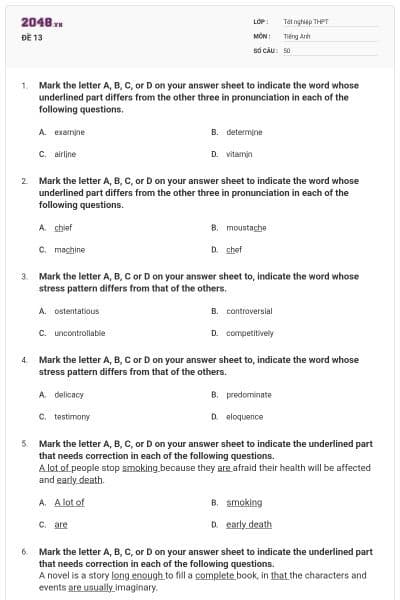
Mark the letter A, B, C, or D on your answer sheet to indicate the word whose underlined part differs from the other three in pronunciation in each of the following questions.
examine
determine
airline
vitamin
Đáp án C
Đọc là âm [ai], còn lại đọc là âm [i]
A. /ɪɡˈzæmɪn/
B. /dɪˈtɜːmɪn/
C. /ˈeəlaɪn/
D. /ˈvɪtəmɪn/
Mark the letter A, B, C, or D on your answer sheet to indicate the word whose underlined part differs from the other three in pronunciation in each of the following questions.
chief
moustache
machine
chef
Đáp án A
Đọc là âm [tʃ], còn lại đọc là âm [ʃ]
A. /tʃiːf/
B. /məˈstɑːʃ/
C. /məˈʃiːn/
D. /ʃef/
Mark the letter A, B, C or D on your answer sheet to, indicate the word whose stress pattern differs from that of the others.
ostentatious
controversial
uncontrollable
competitively
Đáp án D
Trọng âm nhấn âm số 2, âm còn lại nhấn âm số 3
A. /ɒstenˈteɪʃəs/
B. /kɒntrəˈvɜːʃl/
C. /ˌʌnkənˈtrəʊləbl/
D. /kəmˈpetətɪvli/
Mark the letter A, B, C or D on your answer sheet to, indicate the word whose stress pattern differs from that of the others.
delicacy
predominate
testimony
eloquence
Đáp án B
Trọng âm nhấn âm số 2, âm còn lại nhấn âm số 1
A. /ˈdelɪkəsi/
B. /prɪˈdɒmɪneɪt/
C. /ˈtestɪməni/
D. /ˈeləkwəns/
Mark the letter A, B, C, or D on your answer sheet to indicate the underlined part that needs correction in each of the following questions.
A lot of people stop smoking because they are afraid their health will be affected and early death.
A lot of
smoking
are
early death
Đáp án D
D. they may die early: liên từ “and” không thể nối một động từ quá khứ phân từ “affected” với một cụm danh từ “early death”.
Khi dùng “and” để nối hai từ hoặc hai cụm từ, thì thành phần của hai từ hoặc hai cụm từ phải cùng một loại từ (part of speech), ví dụ: danh từ nối với danh từ, động từ nối với động từ, tính từ nối với tính từ…
Mark the letter A, B, C, or D on your answer sheet to indicate the underlined part that needs correction in each of the following questions.
A novel is a story long enough to fill a complete book, in that the characters and events are usually imaginary.
long enough
complete
that
are usually
Đáp án C
C. which: chúng ta không dùng đại từ quan hệ “that” sau các giới từ mà phải dùng “which”.
Mark the letter A, B, C, or D on your answer sheet to indicate the underlined part that needs correction in each of the following questions.
Globally and internationally, the 1990's stood out as the warmest decade in the history of weather records
Globally and internationally
out
warmest
weather records
Đáp án A
A. cả hai từ “globally” và “internationally” cũng cùng một ý nghĩa “trên khắp thế giới”, cho nên chúng ta chỉ cần dùng một trong hai; không thể dùng cả hai trong cùng một mệnh đề.
Choose the best answer from A, B, C or D to indicate the right answer to each of the following sentences.
I am sorry I have no time at present to ……detail of our plan
bring in
take into
come in
go into
Đáp án D
D. go into: thành ngữ “to go into detail” có nghĩa là “ to explain sth fully = giải thích cặn kẽ điều gì”. Ý nghĩa cả câu: “Tôi lấy làm tiếc không có đủ thời gian bây giờ để giải thích cặn kẽ kế hoạch của chúng ta”.
Vì đây là cách nói theo thành ngữ (idiom) nên các phương án A, B và C không thể dùng được.
Choose the best answer from A, B, C or D to indicate the right answer to each of the following sentences.
Nowadays, with the help of the computer, teachers have developed a ______ approach to teaching.
multilingual
multilateral
multiple-choice
multimedia
Đáp án D
D. multimedia: “sử dụng thông tin đa phương tiện để dạy học = (in teaching and art) using several diffirent ways of giving information or several diffirent materials”.
Từ này hợp với ý nghĩa cả câu: “Ngày nay, với sự trợ giúp của máy tính, các giáo viên đã triển khai được phương pháp sử dụng thông tin đa phương tiện để dạy học”.
Choose the best answer from A, B, C or D to indicate the right answer to each of the following sentences.
________ I might, I couldn’t open the door
However hard
As try
Try as
No matter
Đáp án C
Đảo ngữ với AS/THOUGH: adj + as + S + be ( cho dù …)
Trong câu có các mệnh đề với “as, though, no matter how, however”
-> Thường đưa: n/adj./verb/adv lên trước.
Child as he is, she knows a great deal.
Youngest as he is , he studies best in our class.
Try as he does, she will never pass it.
Choose the best answer from A, B, C or D to indicate the right answer to each of the following sentences.
Anna is holding her shopping bag with one hand and turning the door handle with ______
other
another
the other
others
Đáp án C
C. the other: chúng ta dùng “the other” như một đại từ thay vì nói đầy đủ “the other hand”.
Vì mỗi người thường chỉ có hai tay nên chúng ta nói “Anna cầm giỏ mua sắm bằng một tay và mở nắm cửa bằng tay còn lại”.
Chúng ta dùng “the other” khi chỉ có hai người hoặc hai vật mà chúng ta đã đề cập đến một trong hai trước rồi.
Ví dụ: “He hes two cars. One is American. The other Japanese”.
Choose the best answer from A, B, C or D to indicate the right answer to each of the following sentences.
She passed the National High School Graduation Exam with ______ colours.
flying bright
flying
red
true
Đáp án B
B. flying: thành ngữ “with flying colours” có nghĩa là “rất giỏi hoăc đạt điểm rất cao = very well, or with very high mark or grade”.
Thành ngữ này thường được dùng với việc học sinh, sinh viên thi đỗ.
Choose the best answer from A, B, C or D to indicate the right answer to each of the following sentences.
That cannot be a true story. He ______ it up
must have made
should have made
would have made
can have made
Đáp án A
A. must have been: đây là cách dùng động từ khiếm khuyết “must + have + past participle” để diễn tả “một sự suy đoán về một hành động đã xảy ra”.
Cách dùng này hợp với ý nghĩa của cả câu: “Đây không thể là một câu chuyện có thật. Anh ấy chắc là đã bịa đặt ra nó”.
Câu B không đúng vì “should have + past participle = đáng lẽ nên làm gì”.
Câu C “would have + past participle” được dùng trong mệnh đề chính của câu điều kiện loại ba. Câu D không đúng, vì chúng ta thường chỉ có cách dùng phủ định “can’t have + p.p = chắc là đã không làm gì”.
Choose the best answer from A, B, C or D to indicate the right answer to each of the following sentences.
My mother had to work 12 hours a day in a factory just to______.
make ends meet
call it a day
tighten the belt
break the ice
Đáp án A
A. make ends meet: kiếm đủ tiền để sống, không mắc nợ, hay là cân đối được số thu và số chi.
B. call it a day : bạn sắp kết thúc một công việc, hoặc một cuộc vui chơi, hoặc một điều gì đó mà bạn đang làm trong ngày.
C. tighten the belt: bạn phải phải tiêu tiền một cách thật sự cẩn thận
D. break the ice: làm cho người chưa gặp bao giờ cảm thấy thoải mái và bắt đầu nói chuyện với nhau.
Choose the best answer from A, B, C or D to indicate the right answer to each of the following sentences.
The language centre offers courses of various levels, such as elementary, intermediate and ______
advance
advancement
advanced
advancing
Đáp án C
advanced: tính từ “advanced” được dùng với bậc học có nghĩa là “cao cấp” hoặc “nâng cao = at a higher, more difficult level”.
Tính từ này thích hợp với ý nghĩa của câu: “Trung tâm ngoại ngữ này cung cấp những khóa học trình độ, từ sơ cấp, trung cấp tới cao cấp”.
Choose the best answer from A, B, C or D to indicate the right answer to each of the following sentences.
Geometry is a branch of mathematics ______ the properties of lines, curves, shapes, and surfaces.
that concerning with
that concerned with
that it is concerned with
concerned with
Đáp án: D
Giải thích:
Cụm từ “to be concerned with sth” có nghĩa là “liên quan đến điều gì
Chú ý: trong câu này chỉ dùng hình thức tính từ quá khứ phân từ “concerned with” như là một dạng giản lược mệnh đề quan hệ, thay vì nói đầy đủ:
“Geometry is a branch of mathemetics that/which is concerned with the properties of lines, curves, shapes, and surfaces.”
Các phương án A và B không đúng vì thừa “that”.
Phương án C thừa đại từ “it”.
Dịch: Hình học là một nhánh của toán học liên quan đến tính chất của đường thẳng, đường cong, hình khối và bề mặt.
Choose the best answer from A, B, C or D to indicate the right answer to each of the following sentences.
Our industrial output________ from $2 million in 2002 to $4 million this year.
rises
has risen
was rising
rose
Đáp án B
Ta thấy câu này diễn tả hành động tăng giá phải dùng thì HTHT vì giá cả có thể tiếp tục tăng.
Choose the best answer from A, B, C or D to indicate the right answer to each of the following sentences.
Education in many countries is compulsory ……. the age of 16
for
when
until
forwards
Đáp án C
C. until: giới từ “until = cho đến” thích hợp với ý nghĩa của cả câu: “Việc học vấn trong nhiều nước thì bắt buộc cho đến 16 tuổi”.
Trước danh từ “the age” ngoài giới từ “until” chúng ta có thể dùng giới từ “at the age of = ở độ tuổi…”
Chúng ta không thể dùng “for”, “when” hay “forward” trong ngữ cảnh này.
Choose the best answer from A, B, C or D to indicate the right answer to each of the following sentences.
We must push the piano to the comer of the hall to …….our party tonight.
make place for
take up room to
make room for
give place to
Đáp án C
C. make room for: cụm từ “make room for” có nghĩa là “dành chỗ trống cho”.
Ý nghĩa cả câu: “Chúng ta phải để cây đàn dương cầm vào góc của tiền sảnh để dành chỗ trống cho buổi liên hoan tối nay”.
Mark the letter A, B, C, or D on your answer sheet to indicate the word that is OPPOSITE in meaning to the underlined part in each sentence.
A good dictionary is indispensable for learning a foreign language.
essential
understandable
remarkable
unnecessary
Đáp án D
Một từ điển tốt là cần thiết cho việc học một ngôn ngữ nước ngoài.
A. cần thiết
B. dễ hiểu
C. đáng chú ý
D. không cần thiết
Ta thấy đap án D – có ý nghĩa trái nghĩa với câu đề bài
Mark the letter A, B, C, or D on your answer sheet to indicate the word that is OPPOSITE in meaning to the underlined part in each sentence.
Within hours of the tragedy happening, an emergency rescue team had been assembled.
dismissed
gathered
restored
congregated
Đáp án A
Trong vòng vài giờ sau thảm kịch xảy ra, một đội cứu hộ khẩn cấp đã được triệu tập
A. bác bỏ, giải tán
B. tụ tập
C. phục hồi
D. tụ họp
Ta thấy đáp án A – nghĩa hoàn toàn trái ngược với: :assembled
Mark the letter A, B, C, or D on your answer sheet to indicate the word that is CLOSEST in meaning to the underlined part in each sentence
Stay away from someone who always feels superior to you!
friendly with
better than
worse than
pity on
Đáp án B
Superior to: tốt hơn
A. thân thiện với
B. tốt hơn
C. tồi tệ hơn
D. đáng tiếc
Đáp án B– có nghĩa giống với câu đề bài
Mark the letter A, B, C, or D on your answer sheet to indicate the word that is CLOSEST in meaning to the underlined part in each sentence
The neighbors' constant wrangles with each other shattered our tranquility.
wrecks
wraths
quarrels
conversations
Đáp án B
Hàng xóm liên tục cãi nhau với nhua làm vỡi tan sự yên tĩnh của chúng tôi
A. xóa sổ
B. wraths : sự tức giận, sự phẫn nộ
C. cãi vã
D. hội thoại
Đáp án C – có nghĩa giống với câu đề bài
Mark the letter A, B, C, or D on your answer sheet to indicate the most suitable response to complete each of the following exchanges.
Sarah: “Oh my God, I’ve missed my bus.”
Christ: “_____. Another will come here in ten minutes.”
Thank you
Don’t mention it
I hope so
Don’t worry
Đáp án D
Sarah: "Ôi Chúa ơi, tôi đã bỏ lỡ xe buýt của tôi."
Kitô: "_____. Một xe khác sẽ đến đây trong mười phút. "
A. Cảm ơn bạn
B. Không đề cập đến nó
C. Tôi hy vọng như vậy
D. Đừng lo lắng
Đáp án D – câu đáp lại thích hợp
Mark the letter A, B, C, or D on your answer sheet to indicate the most suitable response to complete each of the following exchanges.
Jack : “What’s wrong with you?” Jill: “______.”
I’m having a slight headache
No, I don’t care
Yes, I was tired yesterday
Thank you very much
Đáp án: A
Giải thích:
Dịch: Jack: “Bạn bị sao vậy?”
Jill: “______.”
A. Tôi bị đau đầu nhẹ
B. Không, tôi không quan tâm
C. Vâng, hôm qua tôi mệt
D. Cảm ơn bạn rất nhiều
Dựa vào nghĩa câu, chọn A.
Read the following passage and mark the letter A, B, C, or D on your answer sheet to indicate the correct word for each of the blanks.
Wind, water, air, ice and heat all work to cause erosion. As the wind blows over the land, it often (26) _______ small grains of sand. When these grains of sand strike against solid rocks, the rocks are slowly worn away. In this way, even very hard rocks are worn away by the wind.
When particles of rocks or soil became loosened in any way, running water carries them down the hillsides. Some rocks and soil particles are carried into streams and then into the sea.
Land that is covered with trees, grass and other plants wears away very slowly, and so loses very (27) _______ of its soil. The roots of plants help to (28) _______ the rocks and soil in place. Water that falls on grasslands runs away more slowly than water that falls on bare ground. Thus, forests and grasslands help to slow down erosion.
Even where the land is (29) _______ covered with plants, some erosion goes on. In the spring, the (30) _______ snow turns into a large quantity of water that then runs downhill in streams. As a stream carries away some of the soil, the stream bed gets deeper and deeper. After thousands of years of such erosion, wide valleys are often formed.
Điền ô số 26
holds up
cleans out
carries out
picks up
Đáp án D
Các phương án khác không có ý nghĩa thích hợp vì “hold up = làm trì hoãn (= to delay the movement or progress of sb/sth);
“clean out = làm sạch bên trong (= to clean the inside of sth thoroughly);
“carry out = thực hiện (= to conduct or to perform).
Read the following passage and mark the letter A, B, C, or D on your answer sheet to indicate the correct word for each of the blanks.
Wind, water, air, ice and heat all work to cause erosion. As the wind blows over the land, it often (26) _______ small grains of sand. When these grains of sand strike against solid rocks, the rocks are slowly worn away. In this way, even very hard rocks are worn away by the wind.
When particles of rocks or soil became loosened in any way, running water carries them down the hillsides. Some rocks and soil particles are carried into streams and then into the sea.
Land that is covered with trees, grass and other plants wears away very slowly, and so loses very (27) _______ of its soil. The roots of plants help to (28) _______ the rocks and soil in place. Water that falls on grasslands runs away more slowly than water that falls on bare ground. Thus, forests and grasslands help to slow down erosion.
Even where the land is (29) _______ covered with plants, some erosion goes on. In the spring, the (30) _______ snow turns into a large quantity of water that then runs downhill in streams. As a stream carries away some of the soil, the stream bed gets deeper and deeper. After thousands of years of such erosion, wide valleys are often formed.
Điền ô số 27
large
little
few
much
Đáp án B
B. little: “and so loses vary little of its soil” = “và nhờ thế mất rất ít đất”.
Vì dùng với từ “soil” (đất) là danh từ không đếm được nên không thể dùng “few”; các từ “large” và “much” không thích hợp với nghĩa trong câu.
Read the following passage and mark the letter A, B, C, or D on your answer sheet to indicate the correct word for each of the blanks.
Wind, water, air, ice and heat all work to cause erosion. As the wind blows over the land, it often (26) _______ small grains of sand. When these grains of sand strike against solid rocks, the rocks are slowly worn away. In this way, even very hard rocks are worn away by the wind.
When particles of rocks or soil became loosened in any way, running water carries them down the hillsides. Some rocks and soil particles are carried into streams and then into the sea.
Land that is covered with trees, grass and other plants wears away very slowly, and so loses very (27) _______ of its soil. The roots of plants help to (28) _______ the rocks and soil in place. Water that falls on grasslands runs away more slowly than water that falls on bare ground. Thus, forests and grasslands help to slow down erosion.
Even where the land is (29) _______ covered with plants, some erosion goes on. In the spring, the (30) _______ snow turns into a large quantity of water that then runs downhill in streams. As a stream carries away some of the soil, the stream bed gets deeper and deeper. After thousands of years of such erosion, wide valleys are often formed.
Điền ô số 28
store
back
stay
hold
Đáp án D
D. hold: thích hợp với ý nghĩa của câu: “to hold the rocks and soil in place” = “giữ nguyên vị trí của đá tảng và đất”.
Read the following passage and mark the letter A, B, C, or D on your answer sheet to indicate the correct word for each of the blanks.
Wind, water, air, ice and heat all work to cause erosion. As the wind blows over the land, it often (26) _______ small grains of sand. When these grains of sand strike against solid rocks, the rocks are slowly worn away. In this way, even very hard rocks are worn away by the wind.
When particles of rocks or soil became loosened in any way, running water carries them down the hillsides. Some rocks and soil particles are carried into streams and then into the sea.
Land that is covered with trees, grass and other plants wears away very slowly, and so loses very (27) _______ of its soil. The roots of plants help to (28) _______ the rocks and soil in place. Water that falls on grasslands runs away more slowly than water that falls on bare ground. Thus, forests and grasslands help to slow down erosion.
Even where the land is (29) _______ covered with plants, some erosion goes on. In the spring, the (30) _______ snow turns into a large quantity of water that then runs downhill in streams. As a stream carries away some of the soil, the stream bed gets deeper and deeper. After thousands of years of such erosion, wide valleys are often formed.
Điền ô số 29
thinly
strongly
thickly
scarcely
Đáp án C
C. thickly: “dày đặc”, trạng từ này thích hợp với ý nghĩa của câu: “Ngay cả những nơi mà đất có cây cỏ bao phủ dày đặc, sự xói mòn cũng xảy ra”
Read the following passage and mark the letter A, B, C, or D on your answer sheet to indicate the correct word for each of the blanks.
Wind, water, air, ice and heat all work to cause erosion. As the wind blows over the land, it often (26) _______ small grains of sand. When these grains of sand strike against solid rocks, the rocks are slowly worn away. In this way, even very hard rocks are worn away by the wind.
When particles of rocks or soil became loosened in any way, running water carries them down the hillsides. Some rocks and soil particles are carried into streams and then into the sea.
Land that is covered with trees, grass and other plants wears away very slowly, and so loses very (27) _______ of its soil. The roots of plants help to (28) _______ the rocks and soil in place. Water that falls on grasslands runs away more slowly than water that falls on bare ground. Thus, forests and grasslands help to slow down erosion.
Even where the land is (29) _______ covered with plants, some erosion goes on. In the spring, the (30) _______ snow turns into a large quantity of water that then runs downhill in streams. As a stream carries away some of the soil, the stream bed gets deeper and deeper. After thousands of years of such erosion, wide valleys are often formed.
Điền ô số 30
melted
building
melting
formed
Đáp án C
C. melting: “(tuyết) đang tan chảy”. Hiện tại phân từ “malting” được dùng như một tính từ bổ nghĩa cho danh từ “snow”.
Ý nghĩa cả câu: “Vào mùa xuân, tuyết đang tan biến thành khối lượng nước lớn chảy xuống triền núi thành những dòng suối”.
Read the following passage and mark the letter A, B, C, or D on your answer sheet to indicate the correct answer to each of the question.
One of the factors contributing to the intense nature of twenty-first-century stress is our continual exposure to media – particularly to an overabundance of news. If you feel stressed out by the news, you are far from alone. Yet somehow many of us seem unable to prevent ourselves from tuning in to an extreme degree.
The further back we go in human history, the longer news took to travel from place to place, and the less news we had of distant people and lands altogether. The printing press obviously changed all that, as did every subsequent development in transportation and telecommunication.
When television came along, it proliferated like a poplulation of rabbits. In 1950, there were 100,000 television sets in North American homes; one year later there were more then a million. Today, it’s not unusual for a home to have three or more television sets, each with cable access to perhaps over a hundred channels. News is the subject of many of those channels, and on several of them it runs 24 hours a day.
What’s more, after the traumatic events of Sptember 11, 2001, live newcasts were paired with perennial text crawls across the bottom of the screen – so that viewers could stay abreast of every story all the time.
Needless to say, the news that is reported to us is not good news, but rather disturbing images and sound bytes alluding to diasater (natural and man-made), upheaval, crime, scandal, war, and the like. Compounding the proplem is that when actual breaking news is scarce, most broadcasts fill in with waistline, hairline, or very existence in the future. This variety of story tends to treat with equal alarm a potentially lethal flu outbreak and the bogus claims of a wrinkle cream that overpromises smooth skin.
Are humans meant to be able to process so much trauma – not to mention so much overblown anticipation of potetial trauma – at once? The human brain, remember, is programmed to slip into alarm mode when danger looms. Danger looms for someone, somewhere at every moment. Exposing ourslves to such input without respite and without perspective cannot be anything other than a source of chronic stress.
(Extracted from The Complete Idiot’s Guide to Beating Stress by Arlene Matthew Uhl – Penguin Group 2006)
According to the passage, which of the following has contributed to the intense nature of twenty-first-century stress?
An overabundance of special news
The degree to which stress affects our life
Our inability to control ourselves
Our continual exposure to the media
Đáp án D
D. Our continual exposure to the media: theo bài đọc, một điều góp phần vào bản chất căng thẳng của những áp lực trong thế kỉ 21 là việc đối mặt thường xuyên với các phương tiện truyền thông đại chúng.
Chi tiết này có trong câu đầu đoạn một: “One of the factors contributing to the intense nature of twenty-first-century stress is our continual exposure to media – particularly to an overabundance of news.”
Read the following passage and mark the letter A, B, C, or D on your answer sheet to indicate the correct answer to each of the question.
One of the factors contributing to the intense nature of twenty-first-century stress is our continual exposure to media – particularly to an overabundance of news. If you feel stressed out by the news, you are far from alone. Yet somehow many of us seem unable to prevent ourselves from tuning in to an extreme degree.
The further back we go in human history, the longer news took to travel from place to place, and the less news we had of distant people and lands altogether. The printing press obviously changed all that, as did every subsequent development in transportation and telecommunication.
When television came along, it proliferated like a poplulation of rabbits. In 1950, there were 100,000 television sets in North American homes; one year later there were more then a million. Today, it’s not unusual for a home to have three or more television sets, each with cable access to perhaps over a hundred channels. News is the subject of many of those channels, and on several of them it runs 24 hours a day.
What’s more, after the traumatic events of Sptember 11, 2001, live newcasts were paired with perennial text crawls across the bottom of the screen – so that viewers could stay abreast of every story all the time.
Needless to say, the news that is reported to us is not good news, but rather disturbing images and sound bytes alluding to diasater (natural and man-made), upheaval, crime, scandal, war, and the like. Compounding the proplem is that when actual breaking news is scarce, most broadcasts fill in with waistline, hairline, or very existence in the future. This variety of story tends to treat with equal alarm a potentially lethal flu outbreak and the bogus claims of a wrinkle cream that overpromises smooth skin.
Are humans meant to be able to process so much trauma – not to mention so much overblown anticipation of potetial trauma – at once? The human brain, remember, is programmed to slip into alarm mode when danger looms. Danger looms for someone, somewhere at every moment. Exposing ourslves to such input without respite and without perspective cannot be anything other than a source of chronic stress.
(Extracted from The Complete Idiot’s Guide to Beating Stress by Arlene Matthew Uhl – Penguin Group 2006)
In the past, we had less news of distant people and lands because ______.
means of communication and transprotation were not yet invented
the printing press changed the situation to slowly
printing, transportation, and telecommunications were not developed
most people lived in distant towns and villages
Đáp án C
C. printing, transportation, and telecommunications were not developed: trong quá khứ chúng ta có ít tin tức hơn về những dân tộc và những vùng đất xa xôi bởi vì việc in ấn, vận chuyển và truyền thông chưa phát triển.
Chúng ta có thể tìm thấy chi tiết này trong hai câu của đoạn hai “The printing press obviously changed all that, as did every subsequent development in transportation and telecommunication.”
Read the following passage and mark the letter A, B, C, or D on your answer sheet to indicate the correct answer to each of the question.
One of the factors contributing to the intense nature of twenty-first-century stress is our continual exposure to media – particularly to an overabundance of news. If you feel stressed out by the news, you are far from alone. Yet somehow many of us seem unable to prevent ourselves from tuning in to an extreme degree.
The further back we go in human history, the longer news took to travel from place to place, and the less news we had of distant people and lands altogether. The printing press obviously changed all that, as did every subsequent development in transportation and telecommunication.
When television came along, it proliferated like a poplulation of rabbits. In 1950, there were 100,000 television sets in North American homes; one year later there were more then a million. Today, it’s not unusual for a home to have three or more television sets, each with cable access to perhaps over a hundred channels. News is the subject of many of those channels, and on several of them it runs 24 hours a day.
What’s more, after the traumatic events of Sptember 11, 2001, live newcasts were paired with perennial text crawls across the bottom of the screen – so that viewers could stay abreast of every story all the time.
Needless to say, the news that is reported to us is not good news, but rather disturbing images and sound bytes alluding to diasater (natural and man-made), upheaval, crime, scandal, war, and the like. Compounding the proplem is that when actual breaking news is scarce, most broadcasts fill in with waistline, hairline, or very existence in the future. This variety of story tends to treat with equal alarm a potentially lethal flu outbreak and the bogus claims of a wrinkle cream that overpromises smooth skin.
Are humans meant to be able to process so much trauma – not to mention so much overblown anticipation of potetial trauma – at once? The human brain, remember, is programmed to slip into alarm mode when danger looms. Danger looms for someone, somewhere at every moment. Exposing ourslves to such input without respite and without perspective cannot be anything other than a source of chronic stress.
(Extracted from The Complete Idiot’s Guide to Beating Stress by Arlene Matthew Uhl – Penguin Group 2006)
The word “traumatic” in paragraph 4 is closest in meaning to _______
boring
fascinating
upsetting
exciting
Đáp án C
C. upsetting: từ “traumatic” trong đoạn bốn sát ý nghĩa với từ “upsetting= gây sốc”.
Chính xác từ “traumatic” có nghĩa là “extremely unpleasant and causing you to feel upset and/or anxious”.
Read the following passage and mark the letter A, B, C, or D on your answer sheet to indicate the correct answer to each of the question.
One of the factors contributing to the intense nature of twenty-first-century stress is our continual exposure to media – particularly to an overabundance of news. If you feel stressed out by the news, you are far from alone. Yet somehow many of us seem unable to prevent ourselves from tuning in to an extreme degree.
The further back we go in human history, the longer news took to travel from place to place, and the less news we had of distant people and lands altogether. The printing press obviously changed all that, as did every subsequent development in transportation and telecommunication.
When television came along, it proliferated like a poplulation of rabbits. In 1950, there were 100,000 television sets in North American homes; one year later there were more then a million. Today, it’s not unusual for a home to have three or more television sets, each with cable access to perhaps over a hundred channels. News is the subject of many of those channels, and on several of them it runs 24 hours a day.
What’s more, after the traumatic events of Sptember 11, 2001, live newcasts were paired with perennial text crawls across the bottom of the screen – so that viewers could stay abreast of every story all the time.
Needless to say, the news that is reported to us is not good news, but rather disturbing images and sound bytes alluding to diasater (natural and man-made), upheaval, crime, scandal, war, and the like. Compounding the proplem is that when actual breaking news is scarce, most broadcasts fill in with waistline, hairline, or very existence in the future. This variety of story tends to treat with equal alarm a potentially lethal flu outbreak and the bogus claims of a wrinkle cream that overpromises smooth skin.
Are humans meant to be able to process so much trauma – not to mention so much overblown anticipation of potetial trauma – at once? The human brain, remember, is programmed to slip into alarm mode when danger looms. Danger looms for someone, somewhere at every moment. Exposing ourslves to such input without respite and without perspective cannot be anything other than a source of chronic stress.
(Extracted from The Complete Idiot’s Guide to Beating Stress by Arlene Matthew Uhl – Penguin Group 2006)
According to the passage, when there is not enough actual breaking news, broadcasts _________.
are full of dangerous diseases such as flu
send out live newscasts paired with text across the screen
send out frightening stories about potential dangers
are forced to publicise an alarming increase in crime
Đáp án C
C. sent out frightening stories about potential dangers: theo bài đọc, những khi không có đủ những tin sốt dẻo (= breaking news), giới truyền thông thường đưa ra những câu chuyện ghê rợn và những mối nguy hiểm tiềm ẩn. Chúng ta có thể thấy chi tiết này trong đoạn năm, câu: “…when actual breaking news is scarce, most broadcasts fill in with scare stories about things that possibly might threaten our health, safety, finances, relationships, waistline, hairline, or very existence in the future”.
Read the following passage and mark the letter A, B, C, or D on your answer sheet to indicate the correct answer to each of the question.
One of the factors contributing to the intense nature of twenty-first-century stress is our continual exposure to media – particularly to an overabundance of news. If you feel stressed out by the news, you are far from alone. Yet somehow many of us seem unable to prevent ourselves from tuning in to an extreme degree.
The further back we go in human history, the longer news took to travel from place to place, and the less news we had of distant people and lands altogether. The printing press obviously changed all that, as did every subsequent development in transportation and telecommunication.
When television came along, it proliferated like a poplulation of rabbits. In 1950, there were 100,000 television sets in North American homes; one year later there were more then a million. Today, it’s not unusual for a home to have three or more television sets, each with cable access to perhaps over a hundred channels. News is the subject of many of those channels, and on several of them it runs 24 hours a day.
What’s more, after the traumatic events of Sptember 11, 2001, live newcasts were paired with perennial text crawls across the bottom of the screen – so that viewers could stay abreast of every story all the time.
Needless to say, the news that is reported to us is not good news, but rather disturbing images and sound bytes alluding to diasater (natural and man-made), upheaval, crime, scandal, war, and the like. Compounding the proplem is that when actual breaking news is scarce, most broadcasts fill in with waistline, hairline, or very existence in the future. This variety of story tends to treat with equal alarm a potentially lethal flu outbreak and the bogus claims of a wrinkle cream that overpromises smooth skin.
Are humans meant to be able to process so much trauma – not to mention so much overblown anticipation of potetial trauma – at once? The human brain, remember, is programmed to slip into alarm mode when danger looms. Danger looms for someone, somewhere at every moment. Exposing ourslves to such input without respite and without perspective cannot be anything other than a source of chronic stress.
(Extracted from The Complete Idiot’s Guide to Beating Stress by Arlene Matthew Uhl – Penguin Group 2006)
Which of the following is NOT true, according to the passage?
The news that is reported to us is not good news
Many people are under stress caused by the media
Many TV channels supply the public with breaking news
The only source of stress in our modern life is the media
Đáp án D
D. The only source of stress in our modern life is the media: theo bài đọc, các phương tiện truyền thông chỉ là một trong những nguồn – chứ không phải là duy nhất – gây chứng căng thẳng cho con người trong cuộc sống hiện đại.
Chúng ta có thể thấy chi tiết này ngay trong câu thứ nhất của đoạn một với cụm từ: “One of the factors contributing to the intense nature of twenty-first-century stress…”
Read the following passage and mark the letter A, B, C, or D on your answer sheet to indicate the correct answer to each of the question.
One of the factors contributing to the intense nature of twenty-first-century stress is our continual exposure to media – particularly to an overabundance of news. If you feel stressed out by the news, you are far from alone. Yet somehow many of us seem unable to prevent ourselves from tuning in to an extreme degree.
The further back we go in human history, the longer news took to travel from place to place, and the less news we had of distant people and lands altogether. The printing press obviously changed all that, as did every subsequent development in transportation and telecommunication.
When television came along, it proliferated like a poplulation of rabbits. In 1950, there were 100,000 television sets in North American homes; one year later there were more then a million. Today, it’s not unusual for a home to have three or more television sets, each with cable access to perhaps over a hundred channels. News is the subject of many of those channels, and on several of them it runs 24 hours a day.
What’s more, after the traumatic events of Sptember 11, 2001, live newcasts were paired with perennial text crawls across the bottom of the screen – so that viewers could stay abreast of every story all the time.
Needless to say, the news that is reported to us is not good news, but rather disturbing images and sound bytes alluding to diasater (natural and man-made), upheaval, crime, scandal, war, and the like. Compounding the proplem is that when actual breaking news is scarce, most broadcasts fill in with waistline, hairline, or very existence in the future. This variety of story tends to treat with equal alarm a potentially lethal flu outbreak and the bogus claims of a wrinkle cream that overpromises smooth skin.
Are humans meant to be able to process so much trauma – not to mention so much overblown anticipation of potetial trauma – at once? The human brain, remember, is programmed to slip into alarm mode when danger looms. Danger looms for someone, somewhere at every moment. Exposing ourslves to such input without respite and without perspective cannot be anything other than a source of chronic stress.
(Extracted from The Complete Idiot’s Guide to Beating Stress by Arlene Matthew Uhl – Penguin Group 2006)
The word “slip” in paragraph 6 is closest in meaning to ______
release
bring
fail
fall
Đáp án D
D. fall: từ “slip = rơi vào” sát nghĩa với từ “fall”.
Ý nghĩa cả câu: “The human brain, remember, is programmed to slip into alarm mode when danger looms” = “Hãy nhớ rằng bộ óc của con người được lập trình để rơi vào trạng thái báo động mỗi khi nguy hiểm xuất hiện”.
Read the following passage and mark the letter A, B, C, or D on your answer sheet to indicate the correct answer to each of the question.
One of the factors contributing to the intense nature of twenty-first-century stress is our continual exposure to media – particularly to an overabundance of news. If you feel stressed out by the news, you are far from alone. Yet somehow many of us seem unable to prevent ourselves from tuning in to an extreme degree.
The further back we go in human history, the longer news took to travel from place to place, and the less news we had of distant people and lands altogether. The printing press obviously changed all that, as did every subsequent development in transportation and telecommunication.
When television came along, it proliferated like a poplulation of rabbits. In 1950, there were 100,000 television sets in North American homes; one year later there were more then a million. Today, it’s not unusual for a home to have three or more television sets, each with cable access to perhaps over a hundred channels. News is the subject of many of those channels, and on several of them it runs 24 hours a day.
What’s more, after the traumatic events of Sptember 11, 2001, live newcasts were paired with perennial text crawls across the bottom of the screen – so that viewers could stay abreast of every story all the time.
Needless to say, the news that is reported to us is not good news, but rather disturbing images and sound bytes alluding to diasater (natural and man-made), upheaval, crime, scandal, war, and the like. Compounding the proplem is that when actual breaking news is scarce, most broadcasts fill in with waistline, hairline, or very existence in the future. This variety of story tends to treat with equal alarm a potentially lethal flu outbreak and the bogus claims of a wrinkle cream that overpromises smooth skin.
Are humans meant to be able to process so much trauma – not to mention so much overblown anticipation of potetial trauma – at once? The human brain, remember, is programmed to slip into alarm mode when danger looms. Danger looms for someone, somewhere at every moment. Exposing ourslves to such input without respite and without perspective cannot be anything other than a source of chronic stress.
(Extracted from The Complete Idiot’s Guide to Beating Stress by Arlene Matthew Uhl – Penguin Group 2006)
According to the passage, our continual exposure to bad news without perspective is obviously ________
the result of human brain’s switch to alarm mode
a source of chronic stress
the result of an overabundance of good news
a source of defects in human brain
Đáp án B
B. a source of chronic stress: theo bài đọc, việc tiếp xúc liên tục với tin tức xấu mà thiếu cân nhắc rõ ràng là cội nguồn của chứng căng thẳng kinh niên.
Chúng ta có thể thấy chi tiết này trong câu cuối của đoạn sáu.: “Exposing ourslves to such input without respite and without perspective cannot be anything other than a source of chronic stress.”
Read the following passage and mark the letter A, B, C, or D on your answer sheet to indicate the correct answer to each of the question.
One of the factors contributing to the intense nature of twenty-first-century stress is our continual exposure to media – particularly to an overabundance of news. If you feel stressed out by the news, you are far from alone. Yet somehow many of us seem unable to prevent ourselves from tuning in to an extreme degree.
The further back we go in human history, the longer news took to travel from place to place, and the less news we had of distant people and lands altogether. The printing press obviously changed all that, as did every subsequent development in transportation and telecommunication.
When television came along, it proliferated like a poplulation of rabbits. In 1950, there were 100,000 television sets in North American homes; one year later there were more then a million. Today, it’s not unusual for a home to have three or more television sets, each with cable access to perhaps over a hundred channels. News is the subject of many of those channels, and on several of them it runs 24 hours a day.
What’s more, after the traumatic events of Sptember 11, 2001, live newcasts were paired with perennial text crawls across the bottom of the screen – so that viewers could stay abreast of every story all the time.
Needless to say, the news that is reported to us is not good news, but rather disturbing images and sound bytes alluding to diasater (natural and man-made), upheaval, crime, scandal, war, and the like. Compounding the proplem is that when actual breaking news is scarce, most broadcasts fill in with waistline, hairline, or very existence in the future. This variety of story tends to treat with equal alarm a potentially lethal flu outbreak and the bogus claims of a wrinkle cream that overpromises smooth skin.
Are humans meant to be able to process so much trauma – not to mention so much overblown anticipation of potetial trauma – at once? The human brain, remember, is programmed to slip into alarm mode when danger looms. Danger looms for someone, somewhere at every moment. Exposing ourslves to such input without respite and without perspective cannot be anything other than a source of chronic stress.
(Extracted from The Complete Idiot’s Guide to Beating Stress by Arlene Matthew Uhl – Penguin Group 2006)
What is probably the best title for this passage?
Effective Ways to Beat Stress
More Modern Life - More Stress
The Media - A Major Cause of Stress
Developments in Telecommunications
Đáp án C
C. The Media – A Major Cause of Stress: tựa đề thích hợp cho bài đọc này có thể là “Các phương tiện truyền thông – Nguyên nhân chính của tình trạng căng thẳng thần kinh”.
Read-the following passage and mark the letter A, B, C or D on your answer sheet to indicate the correct answer to each of the questions.
THE SAVANNAH
The tourist looking at the African savannah on a summer afternoon might be excused for thinking that the wide yellow grass plain was completely deserted of life, almost a desert. With only a few small thorn trees sticking out through the veldt, there seems to be almost no place for a living creature to hide.
However, under those trees you might find small steenbok, sleeping in the shade, and waiting for the night to fall. There may even be a small group of lions somewhere, their bodies exactly the same shade as the tall grass around them. In the holes in the ground a host of tiny creatures, from rabbits and badgers to rats and' snakes are waiting for the heat to finish.
The tall grass also hides the fact that there may be a small stream running across the middle of the plain. One clue that there may be water here is the sight of a majestic Marshall eagle circling slowly over the grassland. When he drops, he may come up with a small fish, or maybe a grass snake that has been waiting at the edge of a pool in the hope of catching a frog.
The best time to see the animals then, is in the evening, just as the sun is setting. The best time of the year to come is in late September, or early August, just before the rains. Then the animals must come to the waterholes, as there is no other place for them to drink. And they like to come while it is still light; so they can see if any dangers are creeping up on them.
So it is at sunset, and after the night falls, that the creatures of the African veld rise and go about their business.
The savannah appears to be empty because:
The animals are sleeping
The animals have gone about their business
They have been frightened by an eagle
The temperature prevents much activity
Đáp án D
Các thảo nguyên dường như là trống rỗng, vì:
A. Các loài động vật đang ngủ
B. Các loài động vật đã đi công việc hoạt động của chúng
C. Họ đã bị hoảng sợ bởi một con đại bàng
D. Nhiệt độ ngăn chặn nhiều hoạt động
Câu cuối – Đoạn 2: “..............are waiting for the heat to finish.”
Tạm dịch: “......................đang đợi chờ kết thúc đợt nóng”
Read-the following passage and mark the letter A, B, C or D on your answer sheet to indicate the correct answer to each of the questions.
THE SAVANNAH
The tourist looking at the African savannah on a summer afternoon might be excused for thinking that the wide yellow grass plain was completely deserted of life, almost a desert. With only a few small thorn trees sticking out through the veldt, there seems to be almost no place for a living creature to hide.
However, under those trees you might find small steenbok, sleeping in the shade, and waiting for the night to fall. There may even be a small group of lions somewhere, their bodies exactly the same shade as the tall grass around them. In the holes in the ground a host of tiny creatures, from rabbits and badgers to rats and' snakes are waiting for the heat to finish.
The tall grass also hides the fact that there may be a small stream running across the middle of the plain. One clue that there may be water here is the sight of a majestic Marshall eagle circling slowly over the grassland. When he drops, he may come up with a small fish, or maybe a grass snake that has been waiting at the edge of a pool in the hope of catching a frog.
The best time to see the animals then, is in the evening, just as the sun is setting. The best time of the year to come is in late September, or early August, just before the rains. Then the animals must come to the waterholes, as there is no other place for them to drink. And they like to come while it is still light; so they can see if any dangers are creeping up on them.
So it is at sunset, and after the night falls, that the creatures of the African veld rise and go about their business.
By "go about their business" the writer means:
Tourism in Africa is big business
The animals go to the river to drink
The animals go on with their normal activity
The animals are observed by naturalists
Đáp án C
Ta có: “go about one’s business”: ai đó đang làm chuyện riêng của mình
Đáp án C – diễn tả chính nội dung ý nghĩa trong bài
Read-the following passage and mark the letter A, B, C or D on your answer sheet to indicate the correct answer to each of the questions.
THE SAVANNAH
The tourist looking at the African savannah on a summer afternoon might be excused for thinking that the wide yellow grass plain was completely deserted of life, almost a desert. With only a few small thorn trees sticking out through the veldt, there seems to be almost no place for a living creature to hide.
However, under those trees you might find small steenbok, sleeping in the shade, and waiting for the night to fall. There may even be a small group of lions somewhere, their bodies exactly the same shade as the tall grass around them. In the holes in the ground a host of tiny creatures, from rabbits and badgers to rats and' snakes are waiting for the heat to finish.
The tall grass also hides the fact that there may be a small stream running across the middle of the plain. One clue that there may be water here is the sight of a majestic Marshall eagle circling slowly over the grassland. When he drops, he may come up with a small fish, or maybe a grass snake that has been waiting at the edge of a pool in the hope of catching a frog.
The best time to see the animals then, is in the evening, just as the sun is setting. The best time of the year to come is in late September, or early August, just before the rains. Then the animals must come to the waterholes, as there is no other place for them to drink. And they like to come while it is still light; so they can see if any dangers are creeping up on them.
So it is at sunset, and after the night falls, that the creatures of the African veld rise and go about their business.
What kind of book does the text seem to be from?
A book for experts on wildlife
A fictional story
A history of Africa
General non-fiction
Đáp án D
Đọc toàn nội dung của bài, ta thấy đoạn bài trên dường như đến từ phi tiểu thuyết chung chung
Read-the following passage and mark the letter A, B, C or D on your answer sheet to indicate the correct answer to each of the questions.
THE SAVANNAH
The tourist looking at the African savannah on a summer afternoon might be excused for thinking that the wide yellow grass plain was completely deserted of life, almost a desert. With only a few small thorn trees sticking out through the veldt, there seems to be almost no place for a living creature to hide.
However, under those trees you might find small steenbok, sleeping in the shade, and waiting for the night to fall. There may even be a small group of lions somewhere, their bodies exactly the same shade as the tall grass around them. In the holes in the ground a host of tiny creatures, from rabbits and badgers to rats and' snakes are waiting for the heat to finish.
The tall grass also hides the fact that there may be a small stream running across the middle of the plain. One clue that there may be water here is the sight of a majestic Marshall eagle circling slowly over the grassland. When he drops, he may come up with a small fish, or maybe a grass snake that has been waiting at the edge of a pool in the hope of catching a frog.
The best time to see the animals then, is in the evening, just as the sun is setting. The best time of the year to come is in late September, or early August, just before the rains. Then the animals must come to the waterholes, as there is no other place for them to drink. And they like to come while it is still light; so they can see if any dangers are creeping up on them.
So it is at sunset, and after the night falls, that the creatures of the African veld rise and go about their business.
The phrase "be excused for" in paragraph 1 is closest in meaning to
easily make a mistake of
feel sorry for
be regretting for
be actually forgiven for
Đáp án A
“The tourist looking at the African savannah on a summer afternoon might be excused for thinking that the wide yellow grass plain was completely deserted of life, almost a desert.”
Tạm dịch: “Các khu du lịch nhìn vào hoang mạc châu Phi vào một buổi chiều mùa hè có thể bỏ qua nếu nghĩ rằng đồng bằng cỏ vàng rộng đã hoàn toàn vắng vẻ của cuộc sống, gần như một sa mạc.”
Cụm từ "be excuted for" trong đoạn 1 là gần nhất trong ý nghĩa cho
A. dễ dàng mắc một sai lầm
B. cảm thấy tiếc cho
C. hối hận về
D. được thực sự tha thứ cho
Đáp án A có nghĩa tương đồng, có thể thay thế vào đoạn văn
Read-the following passage and mark the letter A, B, C or D on your answer sheet to indicate the correct answer to each of the questions.
THE SAVANNAH
The tourist looking at the African savannah on a summer afternoon might be excused for thinking that the wide yellow grass plain was completely deserted of life, almost a desert. With only a few small thorn trees sticking out through the veldt, there seems to be almost no place for a living creature to hide.
However, under those trees you might find small steenbok, sleeping in the shade, and waiting for the night to fall. There may even be a small group of lions somewhere, their bodies exactly the same shade as the tall grass around them. In the holes in the ground a host of tiny creatures, from rabbits and badgers to rats and' snakes are waiting for the heat to finish.
The tall grass also hides the fact that there may be a small stream running across the middle of the plain. One clue that there may be water here is the sight of a majestic Marshall eagle circling slowly over the grassland. When he drops, he may come up with a small fish, or maybe a grass snake that has been waiting at the edge of a pool in the hope of catching a frog.
The best time to see the animals then, is in the evening, just as the sun is setting. The best time of the year to come is in late September, or early August, just before the rains. Then the animals must come to the waterholes, as there is no other place for them to drink. And they like to come while it is still light; so they can see if any dangers are creeping up on them.
So it is at sunset, and after the night falls, that the creatures of the African veld rise and go about their business.
The phrase "a host of" in paragraph 2 is closest in meaning to
a large number of
only a few
a group of
a gang of
Đáp án A
Cụm từ "hàng loạt các" trong đoạn 2 là có nghĩa gần nhất với
A. một số lượng lớn
B. chỉ có một vài
C. một nhóm
D. một băng nhóm
Đáp án A – đồng nghĩa với “ a host of”
Read-the following passage and mark the letter A, B, C or D on your answer sheet to indicate the correct answer to each of the questions.
THE SAVANNAH
The tourist looking at the African savannah on a summer afternoon might be excused for thinking that the wide yellow grass plain was completely deserted of life, almost a desert. With only a few small thorn trees sticking out through the veldt, there seems to be almost no place for a living creature to hide.
However, under those trees you might find small steenbok, sleeping in the shade, and waiting for the night to fall. There may even be a small group of lions somewhere, their bodies exactly the same shade as the tall grass around them. In the holes in the ground a host of tiny creatures, from rabbits and badgers to rats and' snakes are waiting for the heat to finish.
The tall grass also hides the fact that there may be a small stream running across the middle of the plain. One clue that there may be water here is the sight of a majestic Marshall eagle circling slowly over the grassland. When he drops, he may come up with a small fish, or maybe a grass snake that has been waiting at the edge of a pool in the hope of catching a frog.
The best time to see the animals then, is in the evening, just as the sun is setting. The best time of the year to come is in late September, or early August, just before the rains. Then the animals must come to the waterholes, as there is no other place for them to drink. And they like to come while it is still light; so they can see if any dangers are creeping up on them.
So it is at sunset, and after the night falls, that the creatures of the African veld rise and go about their business.
Why do animals come to the waterholes while it is still light?
To see their ways .better
To be alert to the possibility of danger
To drink enough water before hunting
To avoid people watching them
Đáp án B
Đọc cả bài ta thấy đáp án B là chính xác nhất, các đáp án còn lại không đúng.
Read-the following passage and mark the letter A, B, C or D on your answer sheet to indicate the correct answer to each of the questions.
THE SAVANNAH
The tourist looking at the African savannah on a summer afternoon might be excused for thinking that the wide yellow grass plain was completely deserted of life, almost a desert. With only a few small thorn trees sticking out through the veldt, there seems to be almost no place for a living creature to hide.
However, under those trees you might find small steenbok, sleeping in the shade, and waiting for the night to fall. There may even be a small group of lions somewhere, their bodies exactly the same shade as the tall grass around them. In the holes in the ground a host of tiny creatures, from rabbits and badgers to rats and' snakes are waiting for the heat to finish.
The tall grass also hides the fact that there may be a small stream running across the middle of the plain. One clue that there may be water here is the sight of a majestic Marshall eagle circling slowly over the grassland. When he drops, he may come up with a small fish, or maybe a grass snake that has been waiting at the edge of a pool in the hope of catching a frog.
The best time to see the animals then, is in the evening, just as the sun is setting. The best time of the year to come is in late September, or early August, just before the rains. Then the animals must come to the waterholes, as there is no other place for them to drink. And they like to come while it is still light; so they can see if any dangers are creeping up on them.
So it is at sunset, and after the night falls, that the creatures of the African veld rise and go about their business.
The word "he" in paragraph 3 refers to
a person
the writer
a Marshall eagle
a small fish
Đáp án C
Câu 2 – 3 – Đoạn 3: “One clue that there may be water here is the sight of a majestic Marshall eagle circling slowly over the grassland. When he drops, he may come up with a small fish, or maybe a grass snake that has been waiting at the edge of a pool in the hope of catching a frog.”
Tạm dịch: “Một manh mối rằng có thể có nước ở đây là tầm nhìn của một con đại bàng Marshall vĩ đại lượn quanh dần trên đồng cỏ. Khi nó xuống, nó có thể đi lên với một con cá nhỏ, hoặc có thể là một con rắn cỏ chờ đợi ở các cạnh của một hồ bơi với hy vọng bắt được một con ếch.”
Ta có thể “he” chính là con đại bàng Marshall
Mark the letter A, B, C, or D on your answer sheet to indicate the sentence that best combines each pair of sentences in the following questions.
We spend about one-third of our lives sleeping. We know relatively little about sleep.
We know relatively little about sleep; as a result, we spend about one-third of our lives sleeping
We shall know more about sleep if we spend more than one-third of our lives sleeping
Despite spending about one-third of our lives sleeping, we know relatively little about sleep
We spend about one-third of our lives sleeping so that we know relatively little about sleep
Đáp án C
C. Despite spending anout one-third of our lives sleeping, we know relatively little about sleep: “Mặc dầu một phần ba thời gian của cuộc đời để ngủ, chúng ta lại biết tương đối ít ỏi về giấc ngủ”, cách này nối hai mệnh đề thích hợp và có ý nghĩa nhất.
Câu A, B và D có ý nghĩa trái ngược và không hợp lí.
Mark the letter A, B, C, or D on your answer sheet to indicate the sentence that best combines each pair of sentences in the following questions.
Overeating is a cause of several deadly diseases. Physical inactivity is another cause of several deadly diseases.
Not only overeating but also physical inactivity may lead to several deadly diseases
Apart from physical activities, eating too much also contributes to several deadly diseases
Both overeating and physical inactivity result from several deadly diseases
Overeating and physical inactivity are caused by several deadly diseases
Đáp án A
A. Not only overeating but also physical inactivity may lead to several deadly diseases: “Không những chỉ có việc ăn uống quá độ mà còn cả việc cơ thể thiếu hoạt động cũng dẫn đến nhiều căn bệnh chết người”, đây là cách nối câu hợp lí nhất.
Mark the letter A, B, C, or D on your answer sheet to indicate the sentence that is CLOSEST in meaning to each of the following questions.
"Why don't we wear sunglasses?" our grandpa would say when we went out on bright sunny days.
Our grandpa used to suggest wearing sunglasses when we went out on bright sunny days
Our grandpa would warn us against wearing sunglasses on bright sunny days.
Our grandpa asked us why we did not wear sunglasses when going out on bright sunny days
Our grandpa reminded us of going out with sunglasses on bright sunny days
Đáp án A
A. Our grandpa used to suggest wearing sunglasses when we went out on bright sunny days.
Câu cho sẵn là một câu nói trực tiếp có ý đề nghị, vì thế chúng ta dùng động từ “suggest” trong câu tường thuật là thích hợp.
Câu B “warn = cảnh báo”.
Câu C. tường thuật theo cách của một câu hỏi không thích hợp với ý của câu trực tiếp.
Câu D “remind = nhắc nhở” không đúng với ý của câu trực tiếp
Mark the letter A, B, C, or D on your answer sheet to indicate the sentence that is CLOSEST in meaning to each of the following questions.
I am sure he did not know that his brother graduated with flying colors.
He should not have been envious of his brother's achievement
He cannot have known that his brother graduated with very high marks
That his brother graduated with flying colors must have been appreciated by him
He may not know that his brother is flying gradually up in a colorful balloon
Đáp án B
B. He cannot have known that his brother graduated with very high marks: cách dùng động từ khiếm khuyết “cannot have + Vp.p” để diễn tả một sự suy đoán về một sự việc đã xảy ra: “chắc là đã không làm điều gì”.
Cách dùng này hợp ý nghĩa với câu cho sẵn: “Tôi chắc rằng anh ấy không biết là anh trai của anh ta đã tốt nghiệp với hạng danh dự”.
Mark the letter A, B, C, or D on your answer sheet to indicate the sentence that is CLOSEST in meaning to each of the following questions.
People say that Mr. Goldman gave nearly a million pounds to charity last year.
Mr. Goldman is said to have given nearly a million pounds to charity last year
Mr. Goldman was said to have given nearly a million pounds to charity last year
Nearly a million pounds was said to have been given to charity by Mr. Goldman last year
Nearly a million pounds is said to be given to charity by Mr. Goldman last year
Đáp án A
A. Mr.Goldman is said to have given nearly a million pounds to charity last year: đây là cấu trúc “passive with reporting verbs: câu bị động với các động từ có ý nghĩa tường thuật”.
Chú ý: trong câu cho sẵn động từ “say”dùng ở hiện tại, nên trong câu bị động đổi thành “is said”; động từ trong câu theo sau là “gave” ở thì quá khứ đơn, nên trong câu bị động phải đổi thành “to have given”.
Câu B và C không đúng vì dùng “was said”.
Câu D không đúng vì sau “us said” dùng “to be given” là không thích hợp để diễn tả ý việc đã xảy ra (Mr Goldman gave) trong việc người ta nói hiện nay (People say).