Bộ đề thi thử 2019 Tiếng Anh cực hay có lời giải chi tiết (Đề số 16)
50 câu hỏi
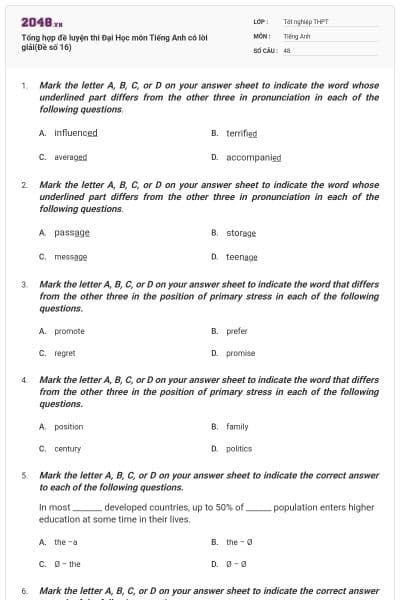
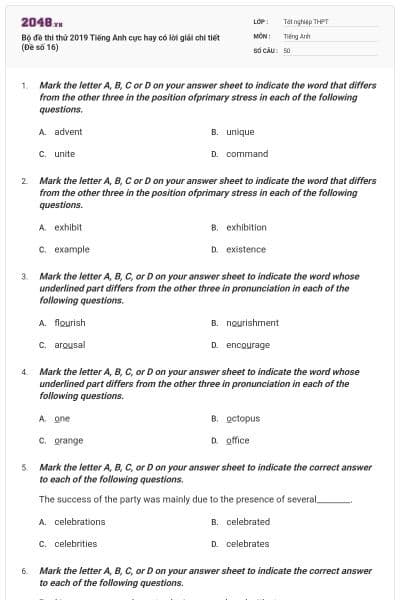
Mark the letter A, B, C or D on your answer sheet to indicate the word that differs from the other three in the position ofprimary stress in each of the following questions.
advent
unique
unite
command
Đáp án A.
Nhấn trọng âm ở âm tiết thứ 2, còn lại nhấn âm thứ 1
A. advent / 'æd.vənt / (n): sự đến, sự tới (của một sự việc quan trọng)
B. unique /ju:'ni:k/ (adj): độc nhất vô nhị
C. unite / ju'nait / (v): hợp nhất, thống nhất, đoàn kết
D. command / kə'mɑ:nd / (v, n): ra lệnh, mệnh lệnh
Mark the letter A, B, C or D on your answer sheet to indicate the word that differs from the other three in the position ofprimary stress in each of the following questions.
exhibit
exhibition
example
existence
Đáp án B.
Nhấn trọng âm ở âm tiết thứ 3, còn lại nhấn âm thứ 2
A. exhibit / ig'zibit / (v, n): trưng bày, vật trưng bày, vật triển lãm
B. exhibition /eksi'bi∫ən / (n): cuộc triển lãm cuộc trưng bày
C. example / ig'zɑ:mpl / (n): ví dụ
D. existence / ɪg'zis.təns / (n): sự tồn tại
Mark the letter A, B, C, or D on your answer sheet to indicate the word whose underlined part differs from the other three in pronunciation in each of the following questions.
flourish
nourishment
arousal
encourage
Đáp án C.
Đọc là /au/, còn lại đọc là /ʌ/
A. flourish / 'flʌr. ɪ∫/ (v): phát triển mạnh mẽ, phát đạt
B. nourishment / 'nʌr.ɪ∫.mənt / (n): sự nuôi dưỡng, đồ ăn, thực phẩm
C. arousal /ə’rauzəl/ (n): sự kích thích, thức tỉnh ngày đêm
D. encourage /ɪn'kʌr.ɪdʒ / (v): khuyến khích, động viên
Mark the letter A, B, C, or D on your answer sheet to indicate the word whose underlined part differs from the other three in pronunciation in each of the following questions.
one
octopus
orange
office
Đáp án A.
Đọc là / ʌ /, còn lại đọc là /c/
A. one / wʌn / (n): một
B. octopus / ' ɑktəpəs/ (n): con bạch tuộc
C. orange / 'ɑrɪndʒ / (n, adj): quả cam, màu da cam
D. office / 'ɑfɪs / (n): cơ quan, văn phòng
Mark the letter A, B, C, or D on your answer sheet to indicate the correct answer to each of the following questions.
The success of the party was mainly due to the presence of several________.
celebrations
celebrated
celebrities
celebrates
Đáp án C.
A. celebrations (n): lễ hội, sự tổ chức
B. celebrated (v): tổ chức
C. celebrities (n): người nổi tiếng
D. celebrates (v): tổ chức
Tạm dịch: Thành công của buổi tiệc chủ yếu là do có sự hiện diện của một vài người nổi tiếng.
Dựa vào nghĩa suy ra C là đáp án đúng
Mark the letter A, B, C, or D on your answer sheet to indicate the correct answer to each of the following questions.
Paul is a very________character; he is never relaxed with strangers.
self-confident
self-conscious
self-satisifed
selfish
Đáp án B.
A. self-confident (adj): tự tin
B. self-conscious (adj): ngượng ngùng, e thẹn, lúng túng
C. self-satisifed (adj): tự mãn
D. selfish (adj): ích kỷ
Tạm dịch: Paul là người rất rụt rè; cậu ấy không bao giờ thoải mải với người lạ.
Mark the letter A, B, C, or D on your answer sheet to indicate the correct answer to each of the following questions.
“John should have warned you about that”. “Yes, but______. He’s still my good friend”.
moreover
despite that
although
on the contrary
Đáp án B.
A. moreover: hơn thế nữa
B. despite that: dù là như vậy (“that” đóng vai trò là danh từ, thay thể cho cả mệnh đề trước đó)
C. although + mệnh đề
D. on the contrary: ngược lại
Tạm dịch: “John lẽ ra nên cảnh báo bạn về điều đó. ”
- “Đúng vậy, nhưng dù sao cậu ấy vẫn là người bạn tốt của tôi. ”
Mark the letter A, B, C, or D on your answer sheet to indicate the correct answer to each of the following questions.
Once used up,__________.
these can never be replaced
we can never replace these minerals
but these minerals can never be replaced
can these minerals be never replaced.
Đáp án A.
Once used up đi theo sau đó phải đúng là chủ ngữ sử dụng động từ này. Loại đáp án B vì sai chủ ngữ. Loại C, không sử dụng but trong cấu trúc này. Loại D vì đây không phải cấu trúc đảo ngữ.
Tạm dịch: Một khi đã bị sử dụng hết, những khoáng chất này không bao giờ có thể thay thế được.
Mark the letter A, B, C, or D on your answer sheet to indicate the correct answer to each of the following questions.
The children______“thank you” to you when you gave them the gifts.
must have said
would have said
might have said
should have said
Đáp án D.
A. must have said: chắc hẳn đã nói
B. would have said: sẽ đã nói
C. might have said: có lẽ đã nói
D. should have said: lẽ ra nên nói
Tạm dịch: Lũ trẻ lẽ ra nên nói lời cám ơn bạn khi bạn trao quà cho chúng.
Mark the letter A, B, C, or D on your answer sheet to indicate the correct answer to each of the following questions.
Suzie is shopping in Diamond Plaza.
Sales clerk: “Can I help you?”
Suzie: “________”.
No, thanks. I’m just looking
Yes, I’m watching
No, I’m seeing
Yes, I’m thinking.
Đáp án A.
No, thanks: là lời từ chối lịch sự, phù hợp với ngữ cảnh.
Mark the letter A, B, C, or D on your answer sheet to indicate the correct answer to each of the following questions.
I do not believe that this preposterous scheme is _______of our seirous consideration.
worthy
worth
worthwhile
worthless
Đáp án A.
A. worthy (adj): đáng, xứng đáng, hợp lý
B. worth (n, adj): giá trị, có giá trị
C. worthwhile (adj): đáng giá, bõ công
D. worthless (adj): vô giá trị
Tạm dịch: Tôi tin rằng kế hoạch ngớ ngẩn này không đáng để bạn xem xét nghiêm túc.
Mark the letter A, B, C, or D on your answer sheet to indicate the correct answer to each of the following questions.
Governments decided to take________measures to deal with terrorism.
profound
enormous
tough
threshing
Đáp án: C
Giải thích:
Kiến thức: Từ vựng
A. profound (adj): sâu sắc
B. enormous (adj): to lớn
C. tough (adj): dai dẳng
D. thresh (v) → threshing: đập phá
Ta có cách kết hợp từ: tough measures: những biện pháp cứng rắn
Dịch: Chính phủ quyết định thực hiện các biện pháp cứng rắn để giải quyết vấn đề khủng bố.
Mark the letter A, B, C, or D on your answer sheet to indicate the correct answer to each of the following questions.
Stop making that noise! You are getting on my _________!
brain
muscles
nerves
blood
Đáp án C.
Thành ngữ: To get on somone’s nerve: Chọc tức ai, làm cho ai phát cáu.
Tạm dịch: Đừng làm ồn nữa. Mày đang làm tao phát điên đấy.
Mark the letter A, B, C, or D on your answer sheet to indicate the correct answer to each of the following questions.
Onie and Osca are talking in a coffee break.
Onie: “________.”
Osca: “Yeah, me too. See you later.”
Oh, I should get back to class
Of course, I should have a break
Anyway, it’s a good day
I think the coffee is so nice
Đáp án A.
Động từ được chia theo trình tự thời gian. Hành động diễn ra trước hành động khác trong quá khứ chia thì quá khứ hoàn thành.
Tạm dịch: Tôi vừa mới hoàn thành mẩu chuyện ngắn thì Karen đi làm về.
Mark the letter A, B, C, or D on your answer sheet to indicate the correct answer to each of the following questions.
If Penny____a place at Oxford University, she___________philosophy and politics.
get; is going to study
gets; studies
will get; is going and politics
is getting; will study
Đáp án B.
Câu điều kiện loại I, diễn đạt khả năng xảy ra trong hiện tại hoặc tương lai. Vế có if, động từ ở thì hiện tại đơn, vế sau, động từ ở thì tương lai.
Tạm dịch: Neu Penny đỗ vào đại học Oxford, cô ấy sẽ học triết học và chính trị.
Mark the letter A, B, C, or D on your answer sheet to indicate the correct answer to each of the following questions.
What chemical is this? It’s______a horrible smell.
giving over
giving off
giving down
giving up
Đáp án B.
A. give over: ngừng làm gì (sử dụng với lối nói mệnh lệnh)
B. give off: xả ra
C. give down (give a/the thumbs - down): cử chỉ đưa ngón tay xuống (phản đối)
D. give up: từ bỏ
Tạm dịch: Đây là chất hóa học gì? Nó đang tỏa ra một mùi thật kinh khủng.
Mark the letter A, B, C, or D on your answer sheet to indicate the correct answer to each of the following questions.
The trouble with Jean is that she is________with sport!
obsessed
packed
matched
dealt
Đáp án A.
A. To be obsessed with sth: Ám ảnh về điều gì.
Ý ở đây muốn nói cô này rất đam mê thể thao. Các lựa chọn khác không hợp nghĩa.
B. To be packed with sth: nhồi nhét cái gì.
C. To match with sth: phù hợp với cải gì.
D. To be dealt with: được giải quyết, xử lý.
Tạm dịch: Vấn đề phiền toái với Jane là cô ấy quá đam mê thể thao.
Mark the letter A, B, C, or D on your answer sheet to indicate the correct answer to each of the following questions.
The committee found it very difficult_______a decision.
reaching
to reach
reached
reaching
Đáp án B.
Cấu trúc: find/ found it difficult + to V
Tạm dịch: Ủy ban thấy thật khó để đưa ra quyết định.
Read the following passage and mark the letter A, B, C, or D on your answer sheet to indicate the correct answer to each of the question.
Most people start smoking when they are in their teens and are addicted by the time they reach adulthood. Some have tried to quit but have returned to cigarettes because smoking is such a strong addiction. It is a habit that is very difficult to break. There are many different reasons why people smoke.
Three of the main reasons that young people smoke are to look mature, to be like their friends, and to experiment. Since teens see older people all around them smoking, especially their parents and relatives, they smoke to act older. If their friends or peers smoke, they may feel pressured into doing the same to be accepted. The last reason is the excitement of experimenting with something that is forbidden. In Massachusetts it is against the law for anyone under 18 years old to smoke. Usually parents do not allow their under age teens to smoke. Therefore, smoking becomes very attractive. It is exciting to get cigarettes and sneak away to smoke without being caught.
Adults smoke for other reasons. They may have a lot of stress and pressures because of economic and personal problems. They may be unemployed or working but not making enough money to take care of themselves and their families. They may be homeless, or they may be dealing with alcohol or cocaine/heroin addictions. Some may be in bad marriages or relationships in which there is physical and/or verbal abuse. All these people may smoke to feel relaxed or to give them energy while going through a hard time.
Whether young or old, some people smoke to control their weight. Smokers, on the average, weigh seven pounds less than non-smokers. Smoking reduces a person's appetite. It lessens his/her sense of taste and smell. This could be why ex-smokers gain weight after quitting cigarettes. Food tastes and smells so much better.
Finally, there are people who say they love to smoke. Smoking gives them pleasure. It just makes them feel good.
What is the purpose of the whole passage?
To contrast young and old smokers.
To explain why people start smoking.
To demonstrate the attraction of cigarettes among the young.
To show the similarities between young and old smokers.
Đáp án B.
Mục đích của toàn bộ đoạn văn là gì?
A. to contrast young and old smokers: để đối chiếu những người hút thuốc trẻ và lớn tuổi
B. to explain why people start smoking: để giải thích tại sao mọi người lại bắt đầu hút thuốc
C. to demonstrate the attraction of cigarettes among the young: để chứng minh sức hấp dẫn của thuốc lá trong giới trẻ
D. to show the similarities between young and old smokers: để cho thấy sự tương đồng giữa người hút thuốc trẻ và người già
Dẫn chứng trong các câu đầu của các đoạn văn:
“Most people start smoking when they are in their teens and are addicted by the time they reach adulthood.” “Three of the main reasons that young people smoke are to look mature.”
“Adults smoke for other reasons.”
“Whether young or old, some people smoke to control their weight.”
“Finally, there are people who say they love to smoke.”
Read the following passage and mark the letter A, B, C, or D on your answer sheet to indicate the correct answer to each of the question.
Most people start smoking when they are in their teens and are addicted by the time they reach adulthood. Some have tried to quit but have returned to cigarettes because smoking is such a strong addiction. It is a habit that is very difficult to break. There are many different reasons why people smoke.
Three of the main reasons that young people smoke are to look mature, to be like their friends, and to experiment. Since teens see older people all around them smoking, especially their parents and relatives, they smoke to act older. If their friends or peers smoke, they may feel pressured into doing the same to be accepted. The last reason is the excitement of experimenting with something that is forbidden. In Massachusetts it is against the law for anyone under 18 years old to smoke. Usually parents do not allow their under age teens to smoke. Therefore, smoking becomes very attractive. It is exciting to get cigarettes and sneak away to smoke without being caught.
Adults smoke for other reasons. They may have a lot of stress and pressures because of economic and personal problems. They may be unemployed or working but not making enough money to take care of themselves and their families. They may be homeless, or they may be dealing with alcohol or cocaine/heroin addictions. Some may be in bad marriages or relationships in which there is physical and/or verbal abuse. All these people may smoke to feel relaxed or to give them energy while going through a hard time.
Whether young or old, some people smoke to control their weight. Smokers, on the average, weigh seven pounds less than non-smokers. Smoking reduces a person's appetite. It lessens his/her sense of taste and smell. This could be why ex-smokers gain weight after quitting cigarettes. Food tastes and smells so much better.
Finally, there are people who say they love to smoke. Smoking gives them pleasure. It just makes them feel good.
The purpose of paragraph 2 is to_______.
explain why young people decide to smoke
warn young people how dangerous smoking is
show how exciting smoking can be
suggest that other people influence the decision of young people who start smoking
Đáp án A.
Mục đích của đoạn 2 là để:
A. explain why young people decide to smoke: giải thích tại sao giới trẻ lại quyết định hút thuốc
B. warn young people how dangerous smoking is: cảnh báo giới trẻ việc hút thuốc là nguy hiểm như thế nào
C. show how exciting smoking can be: chỉ ra việc hút thuốc có thể thú vị như thể nào
D. suggest that other people influence the decision of young people who start smoking: cho rằng những người khác bị ảnh hưởng đến quyết định của những người trẻ tuổi bắt đầu hút thuốc
Dẫn chứng câu đầu trong đoạn văn thứ 2: “Three of the main reasons that young people smoke are to look mature”.
Read the following passage and mark the letter A, B, C, or D on your answer sheet to indicate the correct answer to each of the question.
Most people start smoking when they are in their teens and are addicted by the time they reach adulthood. Some have tried to quit but have returned to cigarettes because smoking is such a strong addiction. It is a habit that is very difficult to break. There are many different reasons why people smoke.
Three of the main reasons that young people smoke are to look mature, to be like their friends, and to experiment. Since teens see older people all around them smoking, especially their parents and relatives, they smoke to act older. If their friends or peers smoke, they may feel pressured into doing the same to be accepted. The last reason is the excitement of experimenting with something that is forbidden. In Massachusetts it is against the law for anyone under 18 years old to smoke. Usually parents do not allow their under age teens to smoke. Therefore, smoking becomes very attractive. It is exciting to get cigarettes and sneak away to smoke without being caught.
Adults smoke for other reasons. They may have a lot of stress and pressures because of economic and personal problems. They may be unemployed or working but not making enough money to take care of themselves and their families. They may be homeless, or they may be dealing with alcohol or cocaine/heroin addictions. Some may be in bad marriages or relationships in which there is physical and/or verbal abuse. All these people may smoke to feel relaxed or to give them energy while going through a hard time.
Whether young or old, some people smoke to control their weight. Smokers, on the average, weigh seven pounds less than non-smokers. Smoking reduces a person's appetite. It lessens his/her sense of taste and smell. This could be why ex-smokers gain weight after quitting cigarettes. Food tastes and smells so much better.
Finally, there are people who say they love to smoke. Smoking gives them pleasure. It just makes them feel good.
The word “peers” in paragraph 2 means
members of the aristocracy
mentors
peeping Toms
persons of a similar age
Đáp án D.
Từ “peers ” ở đoạn 2 có nghĩa là:
A. members of the aristocracy: những thành viên quý tộc
B. mentors: người hướng dẫn
C. peeping Toms: những kẻ thích dò trộm
D. persons of a similar age: những người cùng độ tuổi
Dẫn chứng trong câu: “their friends or peers smoke, they may feel pressured into doing the same to be accepted”: "Bạn bè hoặc người ngang hàng họ hút thuốc, họ có thể cảm thấy bị áp lực phải làm như vậy để được chấp nhận."
Read the following passage and mark the letter A, B, C, or D on your answer sheet to indicate the correct answer to each of the question.
Most people start smoking when they are in their teens and are addicted by the time they reach adulthood. Some have tried to quit but have returned to cigarettes because smoking is such a strong addiction. It is a habit that is very difficult to break. There are many different reasons why people smoke.
Three of the main reasons that young people smoke are to look mature, to be like their friends, and to experiment. Since teens see older people all around them smoking, especially their parents and relatives, they smoke to act older. If their friends or peers smoke, they may feel pressured into doing the same to be accepted. The last reason is the excitement of experimenting with something that is forbidden. In Massachusetts it is against the law for anyone under 18 years old to smoke. Usually parents do not allow their under age teens to smoke. Therefore, smoking becomes very attractive. It is exciting to get cigarettes and sneak away to smoke without being caught.
Adults smoke for other reasons. They may have a lot of stress and pressures because of economic and personal problems. They may be unemployed or working but not making enough money to take care of themselves and their families. They may be homeless, or they may be dealing with alcohol or cocaine/heroin addictions. Some may be in bad marriages or relationships in which there is physical and/or verbal abuse. All these people may smoke to feel relaxed or to give them energy while going through a hard time.
Whether young or old, some people smoke to control their weight. Smokers, on the average, weigh seven pounds less than non-smokers. Smoking reduces a person's appetite. It lessens his/her sense of taste and smell. This could be why ex-smokers gain weight after quitting cigarettes. Food tastes and smells so much better.
Finally, there are people who say they love to smoke. Smoking gives them pleasure. It just makes them feel good.
Adults smoke for all of the following reasons EXCEPT________.
to deal with stress
to cope with financial difficulties
to deal with relationship problems
to appear more mature
Đáp án D.
Người lớn hút thuốc vì tất cả những lý do sau đây trừ:
A. to deal with stress: để đối phó/giải quyết căng thẳng
B. to cope with financial difficulties: để đối phó với những khó khăn về tài chính
C. to deal with relationship problems: để giải quyết các vấn đề về mối quan hệ
D. to appear more mature: để xuất hiện trưởng thành hơn
Dẫn chứng trong các câu:
“They may have a lot of stress and pressures”
“They may be unemployed or working but not making enough money”
“Some may be in bad marriages or relationships”
Read the following passage and mark the letter A, B, C, or D on your answer sheet to indicate the correct answer to each of the question.
Most people start smoking when they are in their teens and are addicted by the time they reach adulthood. Some have tried to quit but have returned to cigarettes because smoking is such a strong addiction. It is a habit that is very difficult to break. There are many different reasons why people smoke.
Three of the main reasons that young people smoke are to look mature, to be like their friends, and to experiment. Since teens see older people all around them smoking, especially their parents and relatives, they smoke to act older. If their friends or peers smoke, they may feel pressured into doing the same to be accepted. The last reason is the excitement of experimenting with something that is forbidden. In Massachusetts it is against the law for anyone under 18 years old to smoke. Usually parents do not allow their under age teens to smoke. Therefore, smoking becomes very attractive. It is exciting to get cigarettes and sneak away to smoke without being caught.
Adults smoke for other reasons. They may have a lot of stress and pressures because of economic and personal problems. They may be unemployed or working but not making enough money to take care of themselves and their families. They may be homeless, or they may be dealing with alcohol or cocaine/heroin addictions. Some may be in bad marriages or relationships in which there is physical and/or verbal abuse. All these people may smoke to feel relaxed or to give them energy while going through a hard time.
Whether young or old, some people smoke to control their weight. Smokers, on the average, weigh seven pounds less than non-smokers. Smoking reduces a person's appetite. It lessens his/her sense of taste and smell. This could be why ex-smokers gain weight after quitting cigarettes. Food tastes and smells so much better.
Finally, there are people who say they love to smoke. Smoking gives them pleasure. It just makes them feel good.
In paragraph 3, how does sentence 3 relate to sentence 1?
It is a contradiction
It is a cause
It is an example
It is an effect
Đáp án C.
Trong đoạn 3, câu 3 liên quan đến câu 1 như thế nào?
A. It is a contradiction: Đó là sự đối lập
B. It is a cause: Đó là 1 nguyên nhân
C. It is an example: Đó là 1 ví dụ
D. It is an effect: Đó là 1 sự ảnh hưởng
Dẫn chứng: “Adults smoke for other reasons.”
“They may be unemployed or working but not making enough money to take care of themselves and their families.”
“They may be homeless, or they may be dealing with alcohol or cocaine/heroin addictions.”
Read the following passage and mark the letter A, B, C, or D on your answer sheet to indicate the correct answer to each of the question.
Most people start smoking when they are in their teens and are addicted by the time they reach adulthood. Some have tried to quit but have returned to cigarettes because smoking is such a strong addiction. It is a habit that is very difficult to break. There are many different reasons why people smoke.
Three of the main reasons that young people smoke are to look mature, to be like their friends, and to experiment. Since teens see older people all around them smoking, especially their parents and relatives, they smoke to act older. If their friends or peers smoke, they may feel pressured into doing the same to be accepted. The last reason is the excitement of experimenting with something that is forbidden. In Massachusetts it is against the law for anyone under 18 years old to smoke. Usually parents do not allow their under age teens to smoke. Therefore, smoking becomes very attractive. It is exciting to get cigarettes and sneak away to smoke without being caught.
Adults smoke for other reasons. They may have a lot of stress and pressures because of economic and personal problems. They may be unemployed or working but not making enough money to take care of themselves and their families. They may be homeless, or they may be dealing with alcohol or cocaine/heroin addictions. Some may be in bad marriages or relationships in which there is physical and/or verbal abuse. All these people may smoke to feel relaxed or to give them energy while going through a hard time.
Whether young or old, some people smoke to control their weight. Smokers, on the average, weigh seven pounds less than non-smokers. Smoking reduces a person's appetite. It lessens his/her sense of taste and smell. This could be why ex-smokers gain weight after quitting cigarettes. Food tastes and smells so much better.
Finally, there are people who say they love to smoke. Smoking gives them pleasure. It just makes them feel good.
The word “abuse” in paragraph 3 means _______.
excessive use
inappropriate use
mistreatment
argument
Đáp án C.
Từ “abuse” ở đoạn 3 có nghĩa là:
A. excessive use: sử dụng quá mức
B. inappropriate use: sử dụng không phù hợp
C. mistreatment: sự ngược đãi
D. argument: sự tranh cãi
Dẫn chứng: “Some may be in bad marriages or relationships in which there is physical and/or verbal abuse”: Một số có thể có trong hôn nhân xấu hoặc các mối quan hệ trong đó có lạm dụng (ngược đãi) thể chất và/ hoặc bằng lời nói.
Read the following passage and mark the letter A, B, C, or D on your answer sheet to indicate the correct answer to each of the question.
Most people start smoking when they are in their teens and are addicted by the time they reach adulthood. Some have tried to quit but have returned to cigarettes because smoking is such a strong addiction. It is a habit that is very difficult to break. There are many different reasons why people smoke.
Three of the main reasons that young people smoke are to look mature, to be like their friends, and to experiment. Since teens see older people all around them smoking, especially their parents and relatives, they smoke to act older. If their friends or peers smoke, they may feel pressured into doing the same to be accepted. The last reason is the excitement of experimenting with something that is forbidden. In Massachusetts it is against the law for anyone under 18 years old to smoke. Usually parents do not allow their under age teens to smoke. Therefore, smoking becomes very attractive. It is exciting to get cigarettes and sneak away to smoke without being caught.
Adults smoke for other reasons. They may have a lot of stress and pressures because of economic and personal problems. They may be unemployed or working but not making enough money to take care of themselves and their families. They may be homeless, or they may be dealing with alcohol or cocaine/heroin addictions. Some may be in bad marriages or relationships in which there is physical and/or verbal abuse. All these people may smoke to feel relaxed or to give them energy while going through a hard time.
Whether young or old, some people smoke to control their weight. Smokers, on the average, weigh seven pounds less than non-smokers. Smoking reduces a person's appetite. It lessens his/her sense of taste and smell. This could be why ex-smokers gain weight after quitting cigarettes. Food tastes and smells so much better.
Finally, there are people who say they love to smoke. Smoking gives them pleasure. It just makes them feel good.
The main purpose of paragraph 4 is__________.
to contrast the reasons why young and old people take up smoking
to show a common cause for smoking among people of all ages
to describe the possible effects of smoking
to warn smokers of the dangers of smoking
Đáp án B.
Mục đích chính của đoạn 4 là:
A. to contrast the reasons why young and old people take up smoking: để đối chiếu lý do tại sao người trẻ tuổi và người già lại hút thuốc lá
A. to show a common cause for smoking among people of all ages: để chỉ ra một nguyên nhân phổ biến gây ra việc hút thuốc ở mọi lứa tuổi
C. to describe the possible effects of smoking: để mô tả những ảnh hưởng có thể có của việc hút thuốc lá D. to warn smokers of the dangers of smoking: để cảnh báo người hút thuốc về những nguy hiểm của việc hút thuốc lá
Dẫn chứng: “Whether young or old, some people smoke to control their weight”.
Mark the letter A, B, C, or D on your answer sheet to indicate the word(s) CLOSEST in meaning to the underlined word(s) in each of the following questions.
He inherited a lucrative business from his father.
lucid
losing
wealthy
profitable
Đáp án D.
Tạm dịch: Anh ta thừa kế một công ty sinh lợi từ cha mình.
- lucrative: có lợi, sinh lợi
A. lucid: sáng sủa, minh bạch, rõ ràng, trong sáng, dễ hiểu
B. losin: nhất định thua, nhất định thất bại, không hòng thắng
C. wealthy: giàu, giàu có
D. profitable: sinh lãi, mang lợi
Ta thấy câu hỏi tìm đáp án mang nghĩa gần nhất nên đáp án chính xác là D.
Mark the letter A, B, C, or D on your answer sheet to indicate the word(s) CLOSEST in meaning to the underlined word(s) in each of the following questions.
He seems to make the same mistake over and over again
for good
by the way
repeatedly
in vain
Đáp án C.
Tạm dịch: Anh ấy dường như phạm sai lầm hết lần này qua lần khác.
- over and over: lần này qua lần khác, tái diễn nhiều lần
A. for good: vĩnh viễn
B. by the way: nhân tiện
C. repeatedly: lặp đi lặp lại nhiều lần
D. in vain: trong vô vọng
Câu hỏi tìm đáp án gần nghĩa nhất. Ta thấy đáp án chính xác nhất là C.
Mark the letter A, B, C, or D on your answer sheet to indicate the word(s) OPPOSITE in meaning to the underlined word(s) in each of the following questions.
This tapestry has a very complicated pattern.
obsolete
intricate
simple
ultimate
Đáp án C.
Tạm dịch: Tấm thảm có một họa tiết rất phức tạp.
- complicated: phức tạp.
A. obsolete: cổ xưa, lỗi thời, lạc hậu
B. intricate: rắc rối, phức tạp, khó hiếu
C. simple: đơn giản
D. ultimate: cơ bản, chủ yếu
Do đó đáp án phải là simple.
Mark the letter A, B, C, or D on your answer sheet to indicate the word(s) OPPOSITE in meaning to the underlined word(s) in each of the following questions.
He was so insubordinate that he lost his job within few weeks.
fresh
disobedient
obedient
understanding
Đáp án C.
Tạm dịch: Cậu ấy quá ngỗ nghịch không chịu phục tùng đến nỗi bị mất việc.
- insubordinate: ngang bướng, không vâng lời, không phục tùng
A. fresh: tươi, mới mẻ, trong lành
B. disobedient: không vâng lời
C. obedient: vâng lời
D. understanding: thấu hiểu, hiểu biết
Read the following passage and mark the letter A, B, C, or D on your answer sheet to indicate the correct word or phrase that best fits each of the numbered blanks from 30 to 34.
Good press photographer must have an ‘eye’ for news, just as journalists must have a nose for a good
story. They must be able to interpret a story and decide rapidly how they can take advantage (30) _______
the best opportunities to take picture. The most difficult part of a press photographer’s job is that he or she has to be able to (31)_______a complicated situation with just one photograph. They rarely have second chances and must be able to take the required shot very quickly. Indeed, speed is essential- if the photographs are not ready for the printing deadline, they are very unlikely to be of any use.
Most press photographers begin work with a local newspaper. There, the demand is mostly for material of regional interest. Photographers may be expected to photograph a lot of unexciting events but to (32)___________the enthusiasm to put ‘something special’ into every picture.
There is (33) _______competition among those (34)_______want to move from local to national newspapers. Here, the work is much more centered on news. The photographer must work under greater pressure and take more responsibility. Only highly reliable, talented and resourceful photographers make this difficult move. The work is tough and can be dangerous. On an overseas assignment, photographers may have to cope with unfamiliar food and accommodation, physical and mental stress, and extreme difficulty in transporting the pictures from an isolated area to get to the newspaper on time. They also have to beat the competition from other publications.
Điền vào số 30
about
on
of
for
Đáp án C.
Cấu trúc: to take advantage of sth: tận dụng cái gì.
Clues: how they can take advantage of the best opportunities to take picture: Họ tận dụng cơ hội tốt nhất để chụp ảnh.
Read the following passage and mark the letter A, B, C, or D on your answer sheet to indicate the correct word or phrase that best fits each of the numbered blanks from 30 to 34.
Good press photographer must have an ‘eye’ for news, just as journalists must have a nose for a good
story. They must be able to interpret a story and decide rapidly how they can take advantage (30) _______
the best opportunities to take picture. The most difficult part of a press photographer’s job is that he or she has to be able to (31)_______a complicated situation with just one photograph. They rarely have second chances and must be able to take the required shot very quickly. Indeed, speed is essential- if the photographs are not ready for the printing deadline, they are very unlikely to be of any use.
Most press photographers begin work with a local newspaper. There, the demand is mostly for material of regional interest. Photographers may be expected to photograph a lot of unexciting events but to (32)___________the enthusiasm to put ‘something special’ into every picture.
There is (33) _______competition among those (34)_______want to move from local to national newspapers. Here, the work is much more centered on news. The photographer must work under greater pressure and take more responsibility. Only highly reliable, talented and resourceful photographers make this difficult move. The work is tough and can be dangerous. On an overseas assignment, photographers may have to cope with unfamiliar food and accommodation, physical and mental stress, and extreme difficulty in transporting the pictures from an isolated area to get to the newspaper on time. They also have to beat the competition from other publications.
Điền vào số 31
draw up
put out
sum up
turn out
Đáp án C.
Cấu trúc: to sum up sth: khái quát, tóm tắt cái gì.
Clues: he or she has to be able to sum up a complicated situation with just one photograph: phóng viên phải có khả năng khái quát một tình huống phức tạp chỉ với một bức ảnh.
Các phương án khác không phù hợp:
- to draw up: chuẩn bị (thường dùng với văn bản)
- to put out: dập tắt (lửa), sản xuất
- to turn out: sản xuất, dốc cạn
Read the following passage and mark the letter A, B, C, or D on your answer sheet to indicate the correct word or phrase that best fits each of the numbered blanks from 30 to 34.
Good press photographer must have an ‘eye’ for news, just as journalists must have a nose for a good
story. They must be able to interpret a story and decide rapidly how they can take advantage (30) _______
the best opportunities to take picture. The most difficult part of a press photographer’s job is that he or she has to be able to (31)_______a complicated situation with just one photograph. They rarely have second chances and must be able to take the required shot very quickly. Indeed, speed is essential- if the photographs are not ready for the printing deadline, they are very unlikely to be of any use.
Most press photographers begin work with a local newspaper. There, the demand is mostly for material of regional interest. Photographers may be expected to photograph a lot of unexciting events but to (32)___________the enthusiasm to put ‘something special’ into every picture.
There is (33) _______competition among those (34)_______want to move from local to national newspapers. Here, the work is much more centered on news. The photographer must work under greater pressure and take more responsibility. Only highly reliable, talented and resourceful photographers make this difficult move. The work is tough and can be dangerous. On an overseas assignment, photographers may have to cope with unfamiliar food and accommodation, physical and mental stress, and extreme difficulty in transporting the pictures from an isolated area to get to the newspaper on time. They also have to beat the competition from other publications.
Điền vào số 32
hold on
keep up
carry on
stay up
Đáp án B.
To keep up sth: giữ vững, duy trì
To hold st on: giữ cái gì đó ở vị trí cố định (thường nghĩa đen)
To carry st on: tiếp tục làm cái gì.
Ex: Carry on the good work!: Tốt đấy, cứ thế mà tiếp tục!
To stay up: thức khuya
Như vậy trong 4 đáp án thì chỉ có to keep up là phù hợp nghĩa nhất trong ngữ cảnh này.
Clues: To keep up the enthusiasm to put ‘something special’ into every picture: phải duy trì sự nhiệt tình để đưa một cái gì đó đặc biệt vào mỗi bức ảnh
Read the following passage and mark the letter A, B, C, or D on your answer sheet to indicate the correct word or phrase that best fits each of the numbered blanks from 30 to 34.
Good press photographer must have an ‘eye’ for news, just as journalists must have a nose for a good
story. They must be able to interpret a story and decide rapidly how they can take advantage (30) _______
the best opportunities to take picture. The most difficult part of a press photographer’s job is that he or she has to be able to (31)_______a complicated situation with just one photograph. They rarely have second chances and must be able to take the required shot very quickly. Indeed, speed is essential- if the photographs are not ready for the printing deadline, they are very unlikely to be of any use.
Most press photographers begin work with a local newspaper. There, the demand is mostly for material of regional interest. Photographers may be expected to photograph a lot of unexciting events but to (32)___________the enthusiasm to put ‘something special’ into every picture.
There is (33) _______competition among those (34)_______want to move from local to national newspapers. Here, the work is much more centered on news. The photographer must work under greater pressure and take more responsibility. Only highly reliable, talented and resourceful photographers make this difficult move. The work is tough and can be dangerous. On an overseas assignment, photographers may have to cope with unfamiliar food and accommodation, physical and mental stress, and extreme difficulty in transporting the pictures from an isolated area to get to the newspaper on time. They also have to beat the competition from other publications.
Điền vào số 33
firm
forceful
strict
strong
Đáp án D.
- strong competition: cuộc tranh đua quyết liệt
Ngoài strong ra, còn một số tính từ khác đi với competition là: fierce, intense, keen, serious, tough, fair, open, unfair,...
Tạm dịch: xảy ra một cuộc tranh đua quyết liệt trong số người muốn thăng tiến từ tờ báo địa phương lên tờ báo trung ương.
Các đáp án còn lại không phù hợp:
Firm: chắc chắn, chặt chẽ (nghĩa đen). Cương quyết, kiên định (nghĩa bóng, thường dùng đế miêu tả tính cách con người).
Forceful: cá tính, quan điểm, hành động mạnh mẽ.
Strict: nghiêm khắc.
Read the following passage and mark the letter A, B, C, or D on your answer sheet to indicate the correct word or phrase that best fits each of the numbered blanks from 30 to 34.
Good press photographer must have an ‘eye’ for news, just as journalists must have a nose for a good
story. They must be able to interpret a story and decide rapidly how they can take advantage (30) _______
the best opportunities to take picture. The most difficult part of a press photographer’s job is that he or she has to be able to (31)_______a complicated situation with just one photograph. They rarely have second chances and must be able to take the required shot very quickly. Indeed, speed is essential- if the photographs are not ready for the printing deadline, they are very unlikely to be of any use.
Most press photographers begin work with a local newspaper. There, the demand is mostly for material of regional interest. Photographers may be expected to photograph a lot of unexciting events but to (32)___________the enthusiasm to put ‘something special’ into every picture.
There is (33) _______competition among those (34)_______want to move from local to national newspapers. Here, the work is much more centered on news. The photographer must work under greater pressure and take more responsibility. Only highly reliable, talented and resourceful photographers make this difficult move. The work is tough and can be dangerous. On an overseas assignment, photographers may have to cope with unfamiliar food and accommodation, physical and mental stress, and extreme difficulty in transporting the pictures from an isolated area to get to the newspaper on time. They also have to beat the competition from other publications.
Điền vào số 34
which
who
whom
how
Đáp án B.
Đại từ quan hệ thay thế cho those và đứng trước động từ want là who.
Read the following passage and mark the letter A, B, C, or D to indicate the best answer to each of the following questions.
MEMORY
"Memorize these words". "Learn this spelling rule". "Don't forget about the quiz tomorrow".
You remember things every day, but how do you do it?
When you want to call a store or an office that you don't call often, you look in the telephone book for the number. You dial the number, and then you forget it! You use your short-term memory to remember the number. Your short-term memory lasts about 30 seconds, or half a minute. However, you don't need to look in the telephone book for your best friend’s number because you already know it. This information is in your long-term memory. Your long-term memory has everything that you remember through the years. Why do you forget things sometimes? Is there a reason? Yes, there are several. The major reason for forgetting something is that you did not learn it well in the beginning. For example, you meet some new people, and right away, you forget their names. You hear the names but you do not learn them, so you forget them.
You can help yourself remember better. Here are some ideas:
1. Move information from your short-term memory to your long-term memory. You can do this if you practice the new information. Say it to yourself out loud. Think about it.
2. After you learn something, study it again and again. Learn it more than you need to. This process is called overlearning. For example, when you learn new words, practice using them in sentences. Don't try to memorize words from a list only.
3. Make sure that you understand new information. It is very difficult to remember something that you don't understand. Ask questions when you learn something new to be certain that you understand.
4. Do not listen to music or watch TV when you study. You will remember better if you concentrate on one thing at a time.
5. Try to connect new information with something that you already know. For example, when you learn the name of a new kind of food, think of a similar kind of food that you already know.
6. Divide new information into several parts (about five or six). Learn one part at time and stop for few minutes. Don't sit down and try to learn a very large amount of new information all at once.
7. Try to make a picture in your mind. For example, if you hear or see a new word, make a picture of how it looks to you in your mind. This “mental” picture will help you remember that word the next time you see or hear it.
8. Think of word clues to help you remember information. One very helpful kind of word clue is an acronym. An acronym is a word formed from the first letter of a group of words. For example, many American schoolchildren learn the names of the Great Lakes in the North America by remembering the word homes. Homes is an acronym that comes from the names of the Great Lakes: Huron, Ontario, Michigan, Erie, Superior.
9. Relax when you study! Try to enjoy yourself. You are learning new things every minute. You will remember better if you are happy and relaxed.
What is the main idea of the passage?
People have short-term and long-term memories and how they can learn to improve their memory
How acronyms help people remember better
What you should do when you forget a phone number
The main reasons for forgetting things
Đáp án A.
Ý chính của đoạn văn là gì?
A. People have short-term and long-term memories and how they can learn to improve their memory: con người có trí nhớ tạm thời và trí nhớ dài hạn và cách mà họ có thể học để cải thiện khả năng ghi nhớ.
B. How acronyms help people remember better: làm thế nào mà những từ viết tắt có thế khiến con người ta nhớ tốt hơn.
C. What you should do when you forget a phone number: bạn nên làm gì khi quên mất một số điện thoại.
D. The main reasons for forgetting things: những lí do chính cho việc lãng quên.
Đáp án là A, dẫn chứng ở đoạn đầu và đoạn sau của đoạn văn: Có nhắc đến trí nhớ ngắn hạn, trí nhớ dài hạn và liệt kê một loạt những cách để cải thiện trí nhớ.
Read the following passage and mark the letter A, B, C, or D to indicate the best answer to each of the following questions.
MEMORY
"Memorize these words". "Learn this spelling rule". "Don't forget about the quiz tomorrow".
You remember things every day, but how do you do it?
When you want to call a store or an office that you don't call often, you look in the telephone book for the number. You dial the number, and then you forget it! You use your short-term memory to remember the number. Your short-term memory lasts about 30 seconds, or half a minute. However, you don't need to look in the telephone book for your best friend’s number because you already know it. This information is in your long-term memory. Your long-term memory has everything that you remember through the years. Why do you forget things sometimes? Is there a reason? Yes, there are several. The major reason for forgetting something is that you did not learn it well in the beginning. For example, you meet some new people, and right away, you forget their names. You hear the names but you do not learn them, so you forget them.
You can help yourself remember better. Here are some ideas:
1. Move information from your short-term memory to your long-term memory. You can do this if you practice the new information. Say it to yourself out loud. Think about it.
2. After you learn something, study it again and again. Learn it more than you need to. This process is called overlearning. For example, when you learn new words, practice using them in sentences. Don't try to memorize words from a list only.
3. Make sure that you understand new information. It is very difficult to remember something that you don't understand. Ask questions when you learn something new to be certain that you understand.
4. Do not listen to music or watch TV when you study. You will remember better if you concentrate on one thing at a time.
5. Try to connect new information with something that you already know. For example, when you learn the name of a new kind of food, think of a similar kind of food that you already know.
6. Divide new information into several parts (about five or six). Learn one part at time and stop for few minutes. Don't sit down and try to learn a very large amount of new information all at once.
7. Try to make a picture in your mind. For example, if you hear or see a new word, make a picture of how it looks to you in your mind. This “mental” picture will help you remember that word the next time you see or hear it.
8. Think of word clues to help you remember information. One very helpful kind of word clue is an acronym. An acronym is a word formed from the first letter of a group of words. For example, many American schoolchildren learn the names of the Great Lakes in the North America by remembering the word homes. Homes is an acronym that comes from the names of the Great Lakes: Huron, Ontario, Michigan, Erie, Superior.
9. Relax when you study! Try to enjoy yourself. You are learning new things every minute. You will remember better if you are happy and relaxed.
New information is easier to remember if you_______.
keep it on a list
understand it
tell it to your friends
draw a picture to describe it
Đáp án B.
Thông tin mới sẽ dễ nhớ hơn nếu như:
A. keep it on a list: giữ nó trong một danh sách
B. understand it: hiểu về nó
C. tell it to your friends: nói với bạn bè của bạn
D. draw a picture to describe it: vẽ một bức tranh để miêu tả nó
Đáp án là B, dẫn chứng: Make sure that you understand new information. It is very difficult to remember something that you don't understand. Ask questions when you learn something new to be certain that you understand: Hãy chắc chắn rằng bạn hiểu những thông tin mới mẻ. Rất khó khăn để nhớ một cái gì đó mà bạn không hiểu. Để chắc rằng bạn thông hiểu về một thông tin mới nào đó, hãy luôn đặt ra những câu hỏi.
Read the following passage and mark the letter A, B, C, or D to indicate the best answer to each of the following questions.
MEMORY
"Memorize these words". "Learn this spelling rule". "Don't forget about the quiz tomorrow".
You remember things every day, but how do you do it?
When you want to call a store or an office that you don't call often, you look in the telephone book for the number. You dial the number, and then you forget it! You use your short-term memory to remember the number. Your short-term memory lasts about 30 seconds, or half a minute. However, you don't need to look in the telephone book for your best friend’s number because you already know it. This information is in your long-term memory. Your long-term memory has everything that you remember through the years. Why do you forget things sometimes? Is there a reason? Yes, there are several. The major reason for forgetting something is that you did not learn it well in the beginning. For example, you meet some new people, and right away, you forget their names. You hear the names but you do not learn them, so you forget them.
You can help yourself remember better. Here are some ideas:
1. Move information from your short-term memory to your long-term memory. You can do this if you practice the new information. Say it to yourself out loud. Think about it.
2. After you learn something, study it again and again. Learn it more than you need to. This process is called overlearning. For example, when you learn new words, practice using them in sentences. Don't try to memorize words from a list only.
3. Make sure that you understand new information. It is very difficult to remember something that you don't understand. Ask questions when you learn something new to be certain that you understand.
4. Do not listen to music or watch TV when you study. You will remember better if you concentrate on one thing at a time.
5. Try to connect new information with something that you already know. For example, when you learn the name of a new kind of food, think of a similar kind of food that you already know.
6. Divide new information into several parts (about five or six). Learn one part at time and stop for few minutes. Don't sit down and try to learn a very large amount of new information all at once.
7. Try to make a picture in your mind. For example, if you hear or see a new word, make a picture of how it looks to you in your mind. This “mental” picture will help you remember that word the next time you see or hear it.
8. Think of word clues to help you remember information. One very helpful kind of word clue is an acronym. An acronym is a word formed from the first letter of a group of words. For example, many American schoolchildren learn the names of the Great Lakes in the North America by remembering the word homes. Homes is an acronym that comes from the names of the Great Lakes: Huron, Ontario, Michigan, Erie, Superior.
9. Relax when you study! Try to enjoy yourself. You are learning new things every minute. You will remember better if you are happy and relaxed.
The following things should help you remember things better when you study, EXCEPT
asking questions when you don’t understand something
connecting new information with something you already know
trying to learn a large amount of new information all at once
overlearning them
Đáp án C.
Những điều dưới đây có thể giúp bạn ghi nhớ tốt hơn khi học, NGOẠI TRỪ:
A. asking questions when you don’t understand something: đặt câu hỏi khi bạn không hiểu điều gì đó
B. connecting new information with something you already know: liên kết thông tin mới với những thứ bạn đã biết
C. trying to learn a large amount of new information all at once: cố gắng học một lượng lớn các thông tin cùng một lúc
D. overlearning them: học đi học lại
Đáp án là C, dẫn chứng là: Divide new information into several parts (about five or six). Learn one part at time and stop for few minutes. Don't sit down and try to learn a very large amount of new information all at once: Chia nhỏ thông tin mới thành từng phần (khoảng 5 hoặc 6 phần). Học riêng từng phần mỗi lúc và nghỉ vài phút. Đừng chỉ ngồi một chỗ và cố gắng nhồi nhét cả một lượng thông tin lớn ngay lập tức.
Read the following passage and mark the letter A, B, C, or D to indicate the best answer to each of the following questions.
MEMORY
"Memorize these words". "Learn this spelling rule". "Don't forget about the quiz tomorrow".
You remember things every day, but how do you do it?
When you want to call a store or an office that you don't call often, you look in the telephone book for the number. You dial the number, and then you forget it! You use your short-term memory to remember the number. Your short-term memory lasts about 30 seconds, or half a minute. However, you don't need to look in the telephone book for your best friend’s number because you already know it. This information is in your long-term memory. Your long-term memory has everything that you remember through the years. Why do you forget things sometimes? Is there a reason? Yes, there are several. The major reason for forgetting something is that you did not learn it well in the beginning. For example, you meet some new people, and right away, you forget their names. You hear the names but you do not learn them, so you forget them.
You can help yourself remember better. Here are some ideas:
1. Move information from your short-term memory to your long-term memory. You can do this if you practice the new information. Say it to yourself out loud. Think about it.
2. After you learn something, study it again and again. Learn it more than you need to. This process is called overlearning. For example, when you learn new words, practice using them in sentences. Don't try to memorize words from a list only.
3. Make sure that you understand new information. It is very difficult to remember something that you don't understand. Ask questions when you learn something new to be certain that you understand.
4. Do not listen to music or watch TV when you study. You will remember better if you concentrate on one thing at a time.
5. Try to connect new information with something that you already know. For example, when you learn the name of a new kind of food, think of a similar kind of food that you already know.
6. Divide new information into several parts (about five or six). Learn one part at time and stop for few minutes. Don't sit down and try to learn a very large amount of new information all at once.
7. Try to make a picture in your mind. For example, if you hear or see a new word, make a picture of how it looks to you in your mind. This “mental” picture will help you remember that word the next time you see or hear it.
8. Think of word clues to help you remember information. One very helpful kind of word clue is an acronym. An acronym is a word formed from the first letter of a group of words. For example, many American schoolchildren learn the names of the Great Lakes in the North America by remembering the word homes. Homes is an acronym that comes from the names of the Great Lakes: Huron, Ontario, Michigan, Erie, Superior.
9. Relax when you study! Try to enjoy yourself. You are learning new things every minute. You will remember better if you are happy and relaxed.
Acronyms should help you remember_______.
dates
telephone numbers
chemical formulas
names
Đáp án D.
Những từ viết tắt sẽ giúp bạn nhớ
A. dates: những ngày
B. telephone numbers: những số điện thoại
C. chemical formulas: những công thức hóa học
D. names: những cái tên
Đáp án D, dẫn chứng: Think of word clues to help you remember information. One very helpful kind of word clue is an acronym. An acronym is a word formed from the first letter of a group of words. For example, many American schoolchildren leam the names of the Great Lakes in the North America by remembering the word homes. Homes is an acronym that comes from the names of the Great Lakes: Huron, Ontario, Michigan, Erie, Superior: Hãy suy nghĩ về những đầu mối của từ để giúp bạn nhớ thông tin. Có một loại manh mối từ rất hữu ích là từ viết tắt. Từ viết tắt là một từ được hình thành từ các chữ cái đầu tiên của một nhóm các từ. Ví dụ, nhiều học sinh Mỹ học tên của Ngũ đại hồ ở Bắc Mỹ bằng cách ghi nhớ từ “homes” (những ngôi nhà). H.o.m.e.s là một từ viết tắt được xuất phát từ tên của năm hồ lớn: Huron, Ontario, Michigan, Erie, Superior.
Read the following passage and mark the letter A, B, C, or D to indicate the best answer to each of the following questions.
MEMORY
"Memorize these words". "Learn this spelling rule". "Don't forget about the quiz tomorrow".
You remember things every day, but how do you do it?
When you want to call a store or an office that you don't call often, you look in the telephone book for the number. You dial the number, and then you forget it! You use your short-term memory to remember the number. Your short-term memory lasts about 30 seconds, or half a minute. However, you don't need to look in the telephone book for your best friend’s number because you already know it. This information is in your long-term memory. Your long-term memory has everything that you remember through the years. Why do you forget things sometimes? Is there a reason? Yes, there are several. The major reason for forgetting something is that you did not learn it well in the beginning. For example, you meet some new people, and right away, you forget their names. You hear the names but you do not learn them, so you forget them.
You can help yourself remember better. Here are some ideas:
1. Move information from your short-term memory to your long-term memory. You can do this if you practice the new information. Say it to yourself out loud. Think about it.
2. After you learn something, study it again and again. Learn it more than you need to. This process is called overlearning. For example, when you learn new words, practice using them in sentences. Don't try to memorize words from a list only.
3. Make sure that you understand new information. It is very difficult to remember something that you don't understand. Ask questions when you learn something new to be certain that you understand.
4. Do not listen to music or watch TV when you study. You will remember better if you concentrate on one thing at a time.
5. Try to connect new information with something that you already know. For example, when you learn the name of a new kind of food, think of a similar kind of food that you already know.
6. Divide new information into several parts (about five or six). Learn one part at time and stop for few minutes. Don't sit down and try to learn a very large amount of new information all at once.
7. Try to make a picture in your mind. For example, if you hear or see a new word, make a picture of how it looks to you in your mind. This “mental” picture will help you remember that word the next time you see or hear it.
8. Think of word clues to help you remember information. One very helpful kind of word clue is an acronym. An acronym is a word formed from the first letter of a group of words. For example, many American schoolchildren learn the names of the Great Lakes in the North America by remembering the word homes. Homes is an acronym that comes from the names of the Great Lakes: Huron, Ontario, Michigan, Erie, Superior.
9. Relax when you study! Try to enjoy yourself. You are learning new things every minute. You will remember better if you are happy and relaxed.
You move information from your short-term memory to your long-term memory when you____.
call a friend over and over again
practice it by saying it to yourself out loud
relax in front of the TV set
write it out on a piece of paper
Đáp án B.
Bạn chuyển những thông tin mới từ trí nhớ tạm thời sang trí nhớ dài hạn bằng cách:
A. call a friend over and over again: gọi đi gọi lại cho một người bạn
B. practice it by saying it to yourself out loud: thực hành bằng cách nói thành tiếng với bản thân
C. relax in front of the TV set: thư giãn trước chiếc TV
D. write it out on a piece of paper: viết lên một mẩu giấy
Đáp án B, dẫn chứng: Move information from your short-term memory to your long-term memory. You can do this if you practice the new information. Say it to yourself out loud. Think about it: Hãy chuyển những thông tin từ trí nhớ tạm thời của bạn vào trí nhớ dài hạn. Bạn có thể dùng cách này khi thực hành với những nguồn thông tin mới. Nói thành tiếng với chính mình. Hãy suy nghĩ về nó.
Read the following passage and mark the letter A, B, C, or D to indicate the best answer to each of the following questions.
MEMORY
"Memorize these words". "Learn this spelling rule". "Don't forget about the quiz tomorrow".
You remember things every day, but how do you do it?
When you want to call a store or an office that you don't call often, you look in the telephone book for the number. You dial the number, and then you forget it! You use your short-term memory to remember the number. Your short-term memory lasts about 30 seconds, or half a minute. However, you don't need to look in the telephone book for your best friend’s number because you already know it. This information is in your long-term memory. Your long-term memory has everything that you remember through the years. Why do you forget things sometimes? Is there a reason? Yes, there are several. The major reason for forgetting something is that you did not learn it well in the beginning. For example, you meet some new people, and right away, you forget their names. You hear the names but you do not learn them, so you forget them.
You can help yourself remember better. Here are some ideas:
1. Move information from your short-term memory to your long-term memory. You can do this if you practice the new information. Say it to yourself out loud. Think about it.
2. After you learn something, study it again and again. Learn it more than you need to. This process is called overlearning. For example, when you learn new words, practice using them in sentences. Don't try to memorize words from a list only.
3. Make sure that you understand new information. It is very difficult to remember something that you don't understand. Ask questions when you learn something new to be certain that you understand.
4. Do not listen to music or watch TV when you study. You will remember better if you concentrate on one thing at a time.
5. Try to connect new information with something that you already know. For example, when you learn the name of a new kind of food, think of a similar kind of food that you already know.
6. Divide new information into several parts (about five or six). Learn one part at time and stop for few minutes. Don't sit down and try to learn a very large amount of new information all at once.
7. Try to make a picture in your mind. For example, if you hear or see a new word, make a picture of how it looks to you in your mind. This “mental” picture will help you remember that word the next time you see or hear it.
8. Think of word clues to help you remember information. One very helpful kind of word clue is an acronym. An acronym is a word formed from the first letter of a group of words. For example, many American schoolchildren learn the names of the Great Lakes in the North America by remembering the word homes. Homes is an acronym that comes from the names of the Great Lakes: Huron, Ontario, Michigan, Erie, Superior.
9. Relax when you study! Try to enjoy yourself. You are learning new things every minute. You will remember better if you are happy and relaxed.
Which of the following may not be in your long-term memory?
The telephone number of a person you don’t call very often.
Your way home.
Your date of birth.
Your address.
Đáp án A.
Thứ nào dưới đây có thể không có trong trí nhớ lâu dài của bạn:
A. the telephone number of a person you don’t call very often: số điện thoại của một người mà bạn không thường xuyên gọi
B. your way home: đường về nhà của bạn
C. your date of birth: ngày sinh nhật của bạn
D. your address: địa chỉ nhà bạn
Đáp án A, dẫn chứng: When you want to call a store or an office that you don't call often, you look in the telephone book for the number. You dial the number, and then you forget it! You use your short-term memory to remember the number. Your short-term memory lasts about 30 seconds, or half a minute: Khi mà bạn muốn gọi cho một cửa hàng hoặc một cơ quan mà bạn không hay gọi, bạn thường nhìn vào danh bạ để tìm số điện thoại. Quay số xong, rồi bạn quên luôn số điện thoại đó. Bạn dùng trí nhớ tạm thời (hay trí nhớ ngắn hạn) của mình để nhớ dãy số đó. Trí nhớ ngắn hạn thường chỉ kéo dài tầm 30 giây-nửa phút.
Read the following passage and mark the letter A, B, C, or D to indicate the best answer to each of the following questions.
MEMORY
"Memorize these words". "Learn this spelling rule". "Don't forget about the quiz tomorrow".
You remember things every day, but how do you do it?
When you want to call a store or an office that you don't call often, you look in the telephone book for the number. You dial the number, and then you forget it! You use your short-term memory to remember the number. Your short-term memory lasts about 30 seconds, or half a minute. However, you don't need to look in the telephone book for your best friend’s number because you already know it. This information is in your long-term memory. Your long-term memory has everything that you remember through the years. Why do you forget things sometimes? Is there a reason? Yes, there are several. The major reason for forgetting something is that you did not learn it well in the beginning. For example, you meet some new people, and right away, you forget their names. You hear the names but you do not learn them, so you forget them.
You can help yourself remember better. Here are some ideas:
1. Move information from your short-term memory to your long-term memory. You can do this if you practice the new information. Say it to yourself out loud. Think about it.
2. After you learn something, study it again and again. Learn it more than you need to. This process is called overlearning. For example, when you learn new words, practice using them in sentences. Don't try to memorize words from a list only.
3. Make sure that you understand new information. It is very difficult to remember something that you don't understand. Ask questions when you learn something new to be certain that you understand.
4. Do not listen to music or watch TV when you study. You will remember better if you concentrate on one thing at a time.
5. Try to connect new information with something that you already know. For example, when you learn the name of a new kind of food, think of a similar kind of food that you already know.
6. Divide new information into several parts (about five or six). Learn one part at time and stop for few minutes. Don't sit down and try to learn a very large amount of new information all at once.
7. Try to make a picture in your mind. For example, if you hear or see a new word, make a picture of how it looks to you in your mind. This “mental” picture will help you remember that word the next time you see or hear it.
8. Think of word clues to help you remember information. One very helpful kind of word clue is an acronym. An acronym is a word formed from the first letter of a group of words. For example, many American schoolchildren learn the names of the Great Lakes in the North America by remembering the word homes. Homes is an acronym that comes from the names of the Great Lakes: Huron, Ontario, Michigan, Erie, Superior.
9. Relax when you study! Try to enjoy yourself. You are learning new things every minute. You will remember better if you are happy and relaxed.
All of these things would be useless for remembering new words EXCEPT________.
making a list of them and memorizing them
writing them down in your notebook
putting them in alphabetical order
practicing using them in sentences
Đáp án D.
Những điều dưới đây là vô ích khi dùng để ghi nhớ những từ mới, NGOẠI TRỪ:
A. making a list of them and memorizing them: làm một danh sách các từ và ghi nhớ chúng
B. writing them down in your notebook: viết các từ mới vào trong sổ ghi chép của bạn
C. putting them in alphabetical order: xếp chúng theo thứ tự bảng chữ cái
D. practicing using them in sentences: thực hành sử dụng các từ mới trong các câu
Đáp án đúng D, dẫn chứng: For example, when you learn new words, practice using them in sentences. Don't try to memorize words from a list only: Ví dụ, khi bạn học từ mới, hãy luyện tập áp dụng chúng vào trong các câu. Đừng chỉ cố gắng ghi nhớ từ theo danh sách.
Read the following passage and mark the letter A, B, C, or D to indicate the best answer to each of the following questions.
MEMORY
"Memorize these words". "Learn this spelling rule". "Don't forget about the quiz tomorrow".
You remember things every day, but how do you do it?
When you want to call a store or an office that you don't call often, you look in the telephone book for the number. You dial the number, and then you forget it! You use your short-term memory to remember the number. Your short-term memory lasts about 30 seconds, or half a minute. However, you don't need to look in the telephone book for your best friend’s number because you already know it. This information is in your long-term memory. Your long-term memory has everything that you remember through the years. Why do you forget things sometimes? Is there a reason? Yes, there are several. The major reason for forgetting something is that you did not learn it well in the beginning. For example, you meet some new people, and right away, you forget their names. You hear the names but you do not learn them, so you forget them.
You can help yourself remember better. Here are some ideas:
1. Move information from your short-term memory to your long-term memory. You can do this if you practice the new information. Say it to yourself out loud. Think about it.
2. After you learn something, study it again and again. Learn it more than you need to. This process is called overlearning. For example, when you learn new words, practice using them in sentences. Don't try to memorize words from a list only.
3. Make sure that you understand new information. It is very difficult to remember something that you don't understand. Ask questions when you learn something new to be certain that you understand.
4. Do not listen to music or watch TV when you study. You will remember better if you concentrate on one thing at a time.
5. Try to connect new information with something that you already know. For example, when you learn the name of a new kind of food, think of a similar kind of food that you already know.
6. Divide new information into several parts (about five or six). Learn one part at time and stop for few minutes. Don't sit down and try to learn a very large amount of new information all at once.
7. Try to make a picture in your mind. For example, if you hear or see a new word, make a picture of how it looks to you in your mind. This “mental” picture will help you remember that word the next time you see or hear it.
8. Think of word clues to help you remember information. One very helpful kind of word clue is an acronym. An acronym is a word formed from the first letter of a group of words. For example, many American schoolchildren learn the names of the Great Lakes in the North America by remembering the word homes. Homes is an acronym that comes from the names of the Great Lakes: Huron, Ontario, Michigan, Erie, Superior.
9. Relax when you study! Try to enjoy yourself. You are learning new things every minute. You will remember better if you are happy and relaxed.
The names of the Great Lakes in North America are easier to remember_______.
thanks to the useful acronym homes
when they are connected with the mental picture of your home
if they are near your home
because they remind you of your home
Đáp án A.
Tên của những hồ lớn ở Bắc Mỹ sẽ dễ nhớ hơn
A. thanks to the useful acronym homes: nhờ vào từ viết tắt Homes
B. when they are connected with the mental picture of your home: khi những cái tên được kết nối với những bức tranh tinh thần về tổ ấm của bạn
C. if they are near your home: nếu như những cái hồ đó gần nhà của bạn
D. because they remind you of your home: bởi vì những cái hồ gợi nhắc bạn đến tổ ấm của bạn
Đáp án là A, dẫn chứng ở: For example, many American schoolchildren leam the names of the Great Lakes in the North America by remembering the word homes. Homes is an acronym that comes from the names of the Great Lakes: Huron, Ontario, Michigan, Erie, Superior: Ví dụ, nhiều học sinh Mỹ học tên của Ngũ đại hồ ở Bắc Mỹ bằng cách ghi nhớ từ “homes ” (những ngôi nhà). H.o.m.e.s là một từ viết tắt được xuất phát từ tên của năm hồ lớn: Huron, Ontario, Michigan, Erie, Superior.
Mark the letter A, B, C, or D on your answer sheet to indicate the underlined part that needs correction in each of the following questions.
It was not until (A) the late 1970s when (B) these country (C) people could enjoy the benefits (D) of electricity.
was not until
when
country
benefits
Đáp án B.
Đổi when thành that.
Cấu trúc: It was not until.... that: mãi tới khi
Tạm dịch: Mãi tới cuối những năm 1970 những người ở vùng nông thôn mới có thể thụ hưởng được lợi ích của điện.
Mark the letter A, B, C, or D on your answer sheet to indicate the underlined part that needs correction in each of the following questions.
Food prices have raised (A) so rapidly in (B) the past few months that soe families have been forced (C) to alter their eating habits.(D)
raised
in
been forced
habits
Đáp án A.
Đổi raised thành risen.
- rise (rose, risen): Là nội động từ, mang nghĩa dậy, đứng dậy, mọc, lên cao, dâng lên, nổi lên, tăng lên.
- raise (raised): Là ngoại động từ, mang nghĩa nâng lên, giơ lên, kéo lên, nuôi trồng, cất cao giọng, nâng cao tiếng,...
Tạm dịch: Giá thực phẩm đã tăng nhanh trong vài tháng qua đến nỗi mà một vài gia đình đã buộc phải thay đổi thói quan ăn uống của họ.
Mark the letter A, B, C, or D on your answer sheet to indicate the underlined part that needs correction in each of the following questions.
Those (A) who had already purchased (B) tickets were instructed to go (C) to gate first (D) immediately.
those
had already purchased
instructed go to
to gate first
Đáp án D.
Đổi gate first thành the first gate ý nói là: đi cổng thứ nhất.
Tạm dịch: Những người đã mua được vé đều được hướng dẫn đi ngay đến cổng đầu tiên.
Mark the letter A, B, C, or D on your answer sheet to indicate the sentence that is closest in meaning to each of the following questions.
Califonia attracted people from many countries when gold was discovered in 1848.
Discovered in 1848, gold was attractive to people in California.
Discovered in California in 1848, gold attracted many people from different countries.
Gold in California was discovered in 1848 after many people came here.
When people were attracted to California, they discovered gold in 1848.
Đáp án B.
Dịch câu đề: Califonia thu hút nhiều người từ khắp các quốc gia khi vàng được tìm thấy ở đó vào năm 1848.
Đáp án B là chính xác: Được tìm thấy ở Califonia vào năm 1848, vàng thu hút nhiều người đến từ các quốc gia khác nhau.
Các đáp án còn lại sai về nghĩa.
Mark the letter A, B, C, or D on your answer sheet to indicate the sentence that is closest in meaning to each of the following questions.
You’ll have no hope of growing crops here unless you find a way to irrigate this land.
Without discovering how to water this land, there is no chance that you can grow crops here.
Even if you find a method of watering this land, there is no hope that any crops will grow on it.
Because there is no way you can irrigate this land, you had batter give up trying to grow crops on it.
You’ll have to try growing crops elsewhere if you prove unable to irrigate this land here.
Đáp án A.
Dịch câu đề: Không có hi vọng trồng vụ mùa nào ở đây nếu không tìm được cách thức tưới tiêu.
Đáp án A là đúng, các lựa chọn còn lại không phù hợp.
“Without sth, clause” - cũng là một cách để diễn đạt câu điều kiện: Nếu không có cái gì, thì ……
Mark the letter A, B, C, or D on your answer sheet to indicate the sentence that is closest in meaning to each of the following questions.
As we were heading out of the door of the café, we bumped into our plumber, who we still owned money to.
When we met our plumber in the cafe as we were about to leave, we realized that we hadn’t yet paid him all the money we owed him.
Our plumber, whom we hadn’t paid back yet, was the person we encountered by chance at the moment we were exiting the cafe.
Not wanting to see the plumber to whom we still owed a debt, we quickly headed out the door of the cafe when we saw him coming in.
Our plumber, when we ran into him as he was entering the cafe that we were leaving, didn’t bring up our debt to him.
Đáp án B.
Dịch câu đề: Khi ra khỏi quán café thì chúng tôi gặp người thợ nước, chúng tôi vẫn nợ tiền ông ấy.
Đáp án B là chính xác, Các lựa chọn còn lại sai thông tin.
Mark the letter A, B, c, or D on your answer sheet to indicate the sentence that best combines each pair of sentences in the following questions.
The painting displayed in the museum has been stolen. They are rumouring about that.
There is a rumour that the painting displayed in the museum has been stolen.
The displayed painting is rumoured to be stolen.
Displaying in the museum, the painting was rumour to be stolen.
As being displayed and rumoured, the painting has been stolen.
Đáp án A.
Dịch câu đề: Bức tranh được trưng bày trong bảo tàng đã bị đánh cắp. Họ đang đồn đại về điều đó.
Dịch câu A: có tin đồn rằng bức tranh trưng bày trong bảo tàng đã bị đánh cắp.
Đáp án C sai vì bức tranh không thể tự trưng bày.
Đáp án B chưa nói hết đầy đủ ý của cả đề bài.
Đáp án D sai vì nghĩa.
Mark the letter A, B, c, or D on your answer sheet to indicate the sentence that best combines each pair of sentences in the following questions.
“I will let you know the result by the end of this week” Tom said to Jane
Tom suggested giving Jane the result by the end of that week.
Tom promised to give Jane the result by the end of that week
Tom insisted on letting Jane know the result by the end of that week.
Tom offered to give Jane the result by the end of that week.
Đáp án: B
Giải thích:
A. suggest doing something: gợi ý làm gì
B. promise to do something: hứa sẽ làm gì
C. insist on doing something: năn nỉ, khăng khăng làm gì
D. offer to do something: đưa ra đề nghị sẵn sàng làm gì
Dựa vào nghĩa câu gốc: Tim nói với Jane: "Tôi sẽ cho cô biết câu trả lời vào cuối tuần này".
Chọn B.
Dịch: Tim hứa sẽ trả lời Jane vào cuối tuần.