Bộ đề thi thử 2019 Tiếng Anh cực hay có lời giải chi tiết (Đề số 13)
50 câu hỏi
Mark the letter A, B, C or D on your answer sheet to indicate the correct answer to each of the following questions.
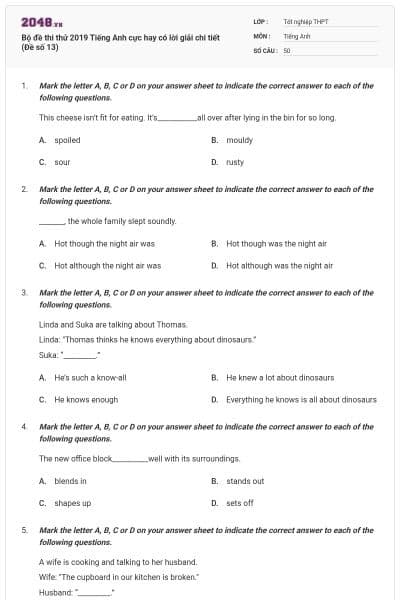
This cheese isn’t fit for eating. It’s___________all over after lying in the bin for so long.
spoiled
mouldy
sour
rusty
Đáp án B.
Tạm dịch: Pho mát này không ăn được nữa. Nó_____hết sau khi bị để trong thùng quá lâu.
A. spoiled: thối (dùng cho hoa quả, cá, thịt...)
B. mouldy: bị mốc
C. sour: chua, lên men
D. rusty: han gỉ
Ta dễ dàng loại đáp án A và D. Ngoài ra pho mát là một sản phẩm lên men nên nó sẽ không thể bị hỏng do lên men. Vậy đáp án chính xác là B.
Mark the letter A, B, C or D on your answer sheet to indicate the correct answer to each of the following questions.
_______, the whole family slept soundly.
Hot though the night air was
Hot though was the night air
Hot although the night air was
Hot although was the night air
Đáp án A.
Cấu trúc đảo ngữ với mệnh đề though:
N/ V/ Adj/ Adv + though + S + V/ trợ động từ
Child though she is, she knows a great deal.
Try though she does, she will never pass it.
Young though he is, he has won the Nobel Prize.
Hard though he works, he makes little progress.
Vậy đáp án chính xác là A
Mark the letter A, B, C or D on your answer sheet to indicate the correct answer to each of the following questions.
Linda and Suka are talking about Thomas.
Linda: "Thomas thinks he knows everything about dinosaurs.”
Suka: “_________.”
He’s such a know-all
He knew a lot about dinosaurs
He knows enough
Everything he knows is all about dinosaurs
Đáp án A.
Tạm dịch: “Thomas nghĩ cậu ta biết hết mọi thứ về khủng long. ”
Ta có cụm từ cố định: A know-all: người tự cho mình biết tuốt, biết tất cả mọi thứ
Vì Thomas nghĩ mình biết hết tất cả về khủng long nên Jill nói Thomas là người tự cho mình biết tuốt Vậy đáp án chính xác là A
Mark the letter A, B, C or D on your answer sheet to indicate the correct answer to each of the following questions.
The new office block__________well with its surroundings.
blends in
stands out
shapes up
sets off
Đáp án A.
A. blends in with sb/ sth: phù hợp
B. stands out: nổi bật
C. shapes up: tiến bộ, cải thiện
D. sets off: khởi hành, rung chuông báo động, nổ bom
Trong câu có giới từ with: cùng, với → đáp án chính xác là A.
Mark the letter A, B, C or D on your answer sheet to indicate the correct answer to each of the following questions.
A wife is cooking and talking to her husband.
Wife: "The cupboard in our kitchen is broken."
Husband: “_________.”
But it’s big
We have to pay extra money
But it’s small
We’ll get it fixed
Đáp án D.
Tạm dịch: “Cái chạn bát trong bếp bị hỏng rồi.”
A. But it’s big: Nhưng nó to mà
B. We have to pay extra money: Chúng ta sẽ phải trả thêm tiền.
C. But it’s small: Nhưng nó nhỏ mà
D. We’ll get it fixed: Chúng ta sẽ nhờ người sửa nó.
Vậy đáp án chính xác là D.
Mark the letter A, B, C or D on your answer sheet to indicate the correct answer to each of the following questions.
Please don’t tell me what happens in the end because I_________the book yet.
haven’t been reading
don’t read
haven’t read
haven’t been read
Đáp án C.
Ta dùng thì HTHT với not ...yet: vẫn chưa...
→ Đáp án chính xác là C. haven’t read
Mark the letter A, B, C or D on your answer sheet to indicate the correct answer to each of the following questions.
We are proud of our________staff, who are always friendly and courteous.
well-paid
well-educated
well-done
well-trained
Đáp án D.
Tạm dịch: Chúng tôi tự hào về đội ngũ nhân viên - ______của chúng tôi, những người luôn thân thiện và
lịch sự.
A. well-paid (adj): được trả lương cao
B. well-educated (adj): được giáo dục tốt
C. well-done (adj): được nấu kỹ, làm tốt (khen ngợi)
D. well-trained (adj): được đào tạo tốt, có bài bản
Vậy đáp án chính xác là D.
Mark the letter A, B, C or D on your answer sheet to indicate the correct answer to each of the following questions.
Without my parent’s support. I____ my oversea study.
will not complete
did not complete
had not completed
would not have completed
Đáp án D.
Tạm dịch: Nếu không có sự hỗ trợ của cha mẹ tôi, tôi sẽ không hoàn thành được nghiên cứu của tôi ở nước ngoài.
Câu dùng cấu trúc: Without + N, Main clause: (Nếu) không có để diễn tả điều kiện
= But for + N, Main clause.
Ex: - Without your help, I wouldn’t pass my exam: Nếu không nhờ sự giúp đỡ của bạn, mình đã không thi đỗ.
- Without Jack’s help, I wouldn't have been able to move the furniture: Không có sự giúp đỡ của Jack, tôi sẽ không thể di chuyển được đồ đạc.
Mark the letter A, B, C or D on your answer sheet to indicate the correct answer to each of the following questions.
When I got my case back, it had been damaged__________repair.
over
further
above
beyond
Đáp án D.
Tạm dịch: Khi tôi nhận lại được vali của tôi trở lại, nó đã bị hư hỏng không thể sửa chữa.
Lưu ý: beyond repair (= too badly damaged to be repaired).
Mark the letter A, B, C or D on your answer sheet to indicate the correct answer to each of the following questions.
The process of______in plants involves a complex series of______reactions.
respiration/ chemistry
respire/ chemical
respiration/ chemical
respiration/ chemist
Đáp án C.
Trước chỗ trống thứ nhất là cụm danh từ + giới từ → chỗ trống cần một danh từ → Loại B. Chỗ trống thứ 2 đứng trước danh từ → cần một tính từ → Đáp án chính xác là C. respiration/ chemical
Tạm dịch: Quá trình hô hấp trong thực vật liên quan đến một loạt các phản ứng hóa học phức tạp.
Mark the letter A, B, C or D on your answer sheet to indicate the correct answer to each of the following questions.
Not only______a good physician but also a talented violist.
she is famous as
she appears to be
is she known as
appears as she is
Đáp án C.
Ta thấy có not only đảo lên đầu câu do đó phải sử dụng cấu trúc đảo ngữ: Not only + be + S + adj/n + but also + adj/n
Vậy đáp án chính xác là C. is she known as
Tạm dịch: Cô ấy không chỉ được biết đến là một nhà vật lý học tài năng mà còn là một nghệ sĩ đàn vi ô lông giỏi.
Mark the letter A, B, C or D on your answer sheet to indicate the correct answer to each of the following questions.
Her family has gone to Edinburgh to pay their last_______ to uncle Bob who died last week.
sympathy
love
respects
honors
Đáp án C.
Ta có: To pay one’s respect to sb: tỏ lòng thành kính đến ai, tưởng niệm ai.
Vậy đáp án chính xác là C. respects
Kiến thức cần nhớ |
Lưu ý cụm từ khác dùng với respect: To have/ show respect for sb/ sth: tôn trọng ai, cái gì |
Mark the letter A, B, C or D on your answer sheet to indicate the correct answer to each of the following questions.
It’s not easy to make Janet furious. The girl is very gentle by_____.
herself
nature
personality
reaction
Đáp án B.
Tạm dịch: Không dễ để khiến Janet giận dữ. Cô gái này bản chất rất dịu dàng.
Ta có cụm từ By nature: từ trong bản chất
Mark the letter A, B, C or D on your answer sheet to indicate the correct answer to each of the following questions.
Someone left the messages,___________?
didn’t they
did they
did he
didn’t he
Đáp án A.
Tạm dịch: Ai đó đã để lại tin nhắn phải không?
Câu hỏi đuôi phải ở dạng phủ định vì phía trước là động từ left ở dạng khẳng định; chủ ngữ trong câu hỏi đuôi phải là they vì câu phía trước người ta dùng đại từ bất định Someone
Read the following passage and mark the letter A, B, C, or D on your answer sheet to indicate the correct answer to each of the questions.
Any list of the greatest thinkers in history contains the name of the brilliant physicist Albert Einstein. His theories of relativity led to entirely new ways of thinking about time, space, matter, energy, and gravity. Einstein's work led to such scientific advances as the control of atomic energy, even television as a practical application of Einstein's work. In 1902 Einstein became an examiner in the Swiss patent office at Bern. In 1905, at age 26, he published the first of five major research papers.
The first one provided a theory explaining Brownian movement, the zig-zag motion of microscopic particles in suspension. The second paper laid the foundation for the photon, or quantum, theory of light. In it he proposed that light is composed of separate packets of energy, called quanta or photons, that have some of the properties of particles and some of the properties of waves. A third paper contained the "special theory of relativity" which showed that time and motion are relative to the observer, if the speed of light is constant and the natural laws are the same everywhere in the universe.
The fourth paper was a mathematical addition to the special theory of relativity. Here Einstein presented his famous formula, E = mc2, known as the energy mass equivalence. In 1916, Einstein published his general theory of relativity. In it he proposed that gravity is not a force, but a curve in the space-time continuum, created by the presence of mass. Einstein spoke out frequently against nationalism, the exalting of one nation above all others. He opposed war and violence and supported Zionism, the movement to establish a Jewish homeland in Palestine. When the Nazis came to power in 1933, they denounced his ideas.
He then moved to the United States. In 1939 Einstein learned that two German chemists had split the uranium atom. Einstein wrote to President Franklin D.Roosevelt warning him that this scientific knowledge could lead to Germany developing an atomic bomb. He suggested the United States begin its own atomic bomb research.
Einstein's primary work was in the area of_________.
chemistry
biology
physics
engineering
Đáp án C.
Key words: Einstein's primary work
Clue: Any list of the greatest thinkers in history contains the name of the brilliant physicist Albert Einstein: Bất kỳ danh sách nào về những người vĩ đại nhất trong lịch sử đều có tên của nhà vật lý học lỗi lạc Albert Einstein.
Dễ thấy đáp án chính xác là C. physics
Read the following passage and mark the letter A, B, C, or D on your answer sheet to indicate the correct answer to each of the questions.
Any list of the greatest thinkers in history contains the name of the brilliant physicist Albert Einstein. His theories of relativity led to entirely new ways of thinking about time, space, matter, energy, and gravity. Einstein's work led to such scientific advances as the control of atomic energy, even television as a practical application of Einstein's work. In 1902 Einstein became an examiner in the Swiss patent office at Bern. In 1905, at age 26, he published the first of five major research papers.
The first one provided a theory explaining Brownian movement, the zig-zag motion of microscopic particles in suspension. The second paper laid the foundation for the photon, or quantum, theory of light. In it he proposed that light is composed of separate packets of energy, called quanta or photons, that have some of the properties of particles and some of the properties of waves. A third paper contained the "special theory of relativity" which showed that time and motion are relative to the observer, if the speed of light is constant and the natural laws are the same everywhere in the universe.
The fourth paper was a mathematical addition to the special theory of relativity. Here Einstein presented his famous formula, E = mc2, known as the energy mass equivalence. In 1916, Einstein published his general theory of relativity. In it he proposed that gravity is not a force, but a curve in the space-time continuum, created by the presence of mass. Einstein spoke out frequently against nationalism, the exalting of one nation above all others. He opposed war and violence and supported Zionism, the movement to establish a Jewish homeland in Palestine. When the Nazis came to power in 1933, they denounced his ideas.
He then moved to the United States. In 1939 Einstein learned that two German chemists had split the uranium atom. Einstein wrote to President Franklin D.Roosevelt warning him that this scientific knowledge could lead to Germany developing an atomic bomb. He suggested the United States begin its own atomic bomb research.
Which of the following inventions is mentioned in the passage as a practical application of Einstein's discoveries?
Radio
Automobiles
Computers
Television
Đáp án D.
Key words: invention, practical application
Clue: Einstein’s work led to such scientific advances as the control of atomic energy, even television as a practical application of Einstein’s work: Công việc của Einstein đã dẫn đến những tiến bộ khoa học như kiểm soát năng lượng nguyên tử, thậm chí vô tuyến được xem như một ứng dụng thực tế của công việc của Einstein
Dễ thấy đáp án chính xác là D. Television
Read the following passage and mark the letter A, B, C, or D on your answer sheet to indicate the correct answer to each of the questions.
Any list of the greatest thinkers in history contains the name of the brilliant physicist Albert Einstein. His theories of relativity led to entirely new ways of thinking about time, space, matter, energy, and gravity. Einstein's work led to such scientific advances as the control of atomic energy, even television as a practical application of Einstein's work. In 1902 Einstein became an examiner in the Swiss patent office at Bern. In 1905, at age 26, he published the first of five major research papers.
The first one provided a theory explaining Brownian movement, the zig-zag motion of microscopic particles in suspension. The second paper laid the foundation for the photon, or quantum, theory of light. In it he proposed that light is composed of separate packets of energy, called quanta or photons, that have some of the properties of particles and some of the properties of waves. A third paper contained the "special theory of relativity" which showed that time and motion are relative to the observer, if the speed of light is constant and the natural laws are the same everywhere in the universe.
The fourth paper was a mathematical addition to the special theory of relativity. Here Einstein presented his famous formula, E = mc2, known as the energy mass equivalence. In 1916, Einstein published his general theory of relativity. In it he proposed that gravity is not a force, but a curve in the space-time continuum, created by the presence of mass. Einstein spoke out frequently against nationalism, the exalting of one nation above all others. He opposed war and violence and supported Zionism, the movement to establish a Jewish homeland in Palestine. When the Nazis came to power in 1933, they denounced his ideas.
He then moved to the United States. In 1939 Einstein learned that two German chemists had split the uranium atom. Einstein wrote to President Franklin D.Roosevelt warning him that this scientific knowledge could lead to Germany developing an atomic bomb. He suggested the United States begin its own atomic bomb research.
According to the passage, Einstein supported all of the following except_______.
the establishment of a Jewish homeland in Palestine
nationalism
atomic bomb research in the United States
the defeat of the Nazis
Đáp án B.
Key words: Einstein, supported, except
Clue: Einstein spoke out frequently against nationalism, the exalting of one nation above all others: Einstein thường xuyên chống lại chủ nghĩa dân tộc, sự đề cao một quốc gia hơn các quốc gia khác.
Dễ thấy đáp án chính xác là B. nationalism
Read the following passage and mark the letter A, B, C, or D on your answer sheet to indicate the correct answer to each of the questions.
Any list of the greatest thinkers in history contains the name of the brilliant physicist Albert Einstein. His theories of relativity led to entirely new ways of thinking about time, space, matter, energy, and gravity. Einstein's work led to such scientific advances as the control of atomic energy, even television as a practical application of Einstein's work. In 1902 Einstein became an examiner in the Swiss patent office at Bern. In 1905, at age 26, he published the first of five major research papers.
The first one provided a theory explaining Brownian movement, the zig-zag motion of microscopic particles in suspension. The second paper laid the foundation for the photon, or quantum, theory of light. In it he proposed that light is composed of separate packets of energy, called quanta or photons, that have some of the properties of particles and some of the properties of waves. A third paper contained the "special theory of relativity" which showed that time and motion are relative to the observer, if the speed of light is constant and the natural laws are the same everywhere in the universe.
The fourth paper was a mathematical addition to the special theory of relativity. Here Einstein presented his famous formula, E = mc2, known as the energy mass equivalence. In 1916, Einstein published his general theory of relativity. In it he proposed that gravity is not a force, but a curve in the space-time continuum, created by the presence of mass. Einstein spoke out frequently against nationalism, the exalting of one nation above all others. He opposed war and violence and supported Zionism, the movement to establish a Jewish homeland in Palestine. When the Nazis came to power in 1933, they denounced his ideas.
He then moved to the United States. In 1939 Einstein learned that two German chemists had split the uranium atom. Einstein wrote to President Franklin D.Roosevelt warning him that this scientific knowledge could lead to Germany developing an atomic bomb. He suggested the United States begin its own atomic bomb research.
What did Einstein propose in the theory of light?
Time and motion are relative to the observer.
E = mc2
Light is composed of separate packets of energy.
Gravity is not a force.
Đáp án C.
Key words: What, propose, theory of light
Clue: The second paper laid the foundation for the photon, or quantum, theory of light. In it he proposed that light is composed of separate packets of energy: Báo cáo thứ hai đặt nền móng cho các photon, hay lượng tử, lý thuyết về ánh sáng. Trong đó, ông đề xuất rằng ánh sáng gồm các gói năng lượng riêng biệt.
Dễ thấy đáp án chính xác là C. Light is composed of separate packets of energy
Read the following passage and mark the letter A, B, C, or D on your answer sheet to indicate the correct answer to each of the questions.
Any list of the greatest thinkers in history contains the name of the brilliant physicist Albert Einstein. His theories of relativity led to entirely new ways of thinking about time, space, matter, energy, and gravity. Einstein's work led to such scientific advances as the control of atomic energy, even television as a practical application of Einstein's work. In 1902 Einstein became an examiner in the Swiss patent office at Bern. In 1905, at age 26, he published the first of five major research papers.
The first one provided a theory explaining Brownian movement, the zig-zag motion of microscopic particles in suspension. The second paper laid the foundation for the photon, or quantum, theory of light. In it he proposed that light is composed of separate packets of energy, called quanta or photons, that have some of the properties of particles and some of the properties of waves. A third paper contained the "special theory of relativity" which showed that time and motion are relative to the observer, if the speed of light is constant and the natural laws are the same everywhere in the universe.
The fourth paper was a mathematical addition to the special theory of relativity. Here Einstein presented his famous formula, E = mc2, known as the energy mass equivalence. In 1916, Einstein published his general theory of relativity. In it he proposed that gravity is not a force, but a curve in the space-time continuum, created by the presence of mass. Einstein spoke out frequently against nationalism, the exalting of one nation above all others. He opposed war and violence and supported Zionism, the movement to establish a Jewish homeland in Palestine. When the Nazis came to power in 1933, they denounced his ideas.
He then moved to the United States. In 1939 Einstein learned that two German chemists had split the uranium atom. Einstein wrote to President Franklin D.Roosevelt warning him that this scientific knowledge could lead to Germany developing an atomic bomb. He suggested the United States begin its own atomic bomb research.
What is “Brownian movement”?
The zig-zag motion of microscopic particles in suspension.
The emission of electrons from solids when struck by light.
The motion of photons in light.
The basis of the theory of relativity.
Đáp án A.
Key words: Brownian movement
Clue: The first one provided a theory explaining Brownian movement, the zig-zag motion of microscopic particles in suspension: Người đầu tiên đưa ra một học thuyết giải thích sự vận động Brownian, sự chuyển động theo đường zigzag của các hạt vi mô trong hệ thống treo.
Dễ thấy đáp án đúng là A. The zig-zag motion of microscopic particles in suspension.
Read the following passage and mark the letter A, B, C, or D on your answer sheet to indicate the correct answer to each of the questions.
Any list of the greatest thinkers in history contains the name of the brilliant physicist Albert Einstein. His theories of relativity led to entirely new ways of thinking about time, space, matter, energy, and gravity. Einstein's work led to such scientific advances as the control of atomic energy, even television as a practical application of Einstein's work. In 1902 Einstein became an examiner in the Swiss patent office at Bern. In 1905, at age 26, he published the first of five major research papers.
The first one provided a theory explaining Brownian movement, the zig-zag motion of microscopic particles in suspension. The second paper laid the foundation for the photon, or quantum, theory of light. In it he proposed that light is composed of separate packets of energy, called quanta or photons, that have some of the properties of particles and some of the properties of waves. A third paper contained the "special theory of relativity" which showed that time and motion are relative to the observer, if the speed of light is constant and the natural laws are the same everywhere in the universe.
The fourth paper was a mathematical addition to the special theory of relativity. Here Einstein presented his famous formula, E = mc2, known as the energy mass equivalence. In 1916, Einstein published his general theory of relativity. In it he proposed that gravity is not a force, but a curve in the space-time continuum, created by the presence of mass. Einstein spoke out frequently against nationalism, the exalting of one nation above all others. He opposed war and violence and supported Zionism, the movement to establish a Jewish homeland in Palestine. When the Nazis came to power in 1933, they denounced his ideas.
He then moved to the United States. In 1939 Einstein learned that two German chemists had split the uranium atom. Einstein wrote to President Franklin D.Roosevelt warning him that this scientific knowledge could lead to Germany developing an atomic bomb. He suggested the United States begin its own atomic bomb research.
According to Einstein's special theory of relativity,_______.
all properties of matter and energy can be explained in a single mathematical formula
light is composed of separate packets of energy
time and motion are relative to the observer
some solids emit electrons when struck by light
Đáp án C.
Key words: Einstein's special theory of relativity
Clue: A third paper contained the “special theory of relativity” which showed that time and motion are relative to the observer: Tài liệu thứ ba bao gồm “thuyết tương đối đặc biệt ” chỉ ra rằng thời gian và chuyển động là tùy ở người quan sát.
Dễ thấy đáp án chính xác là C. time and motion are relative to the observer
Read the following passage and mark the letter A, B, C, or D on your answer sheet to indicate the correct answer to each of the questions.
Any list of the greatest thinkers in history contains the name of the brilliant physicist Albert Einstein. His theories of relativity led to entirely new ways of thinking about time, space, matter, energy, and gravity. Einstein's work led to such scientific advances as the control of atomic energy, even television as a practical application of Einstein's work. In 1902 Einstein became an examiner in the Swiss patent office at Bern. In 1905, at age 26, he published the first of five major research papers.
The first one provided a theory explaining Brownian movement, the zig-zag motion of microscopic particles in suspension. The second paper laid the foundation for the photon, or quantum, theory of light. In it he proposed that light is composed of separate packets of energy, called quanta or photons, that have some of the properties of particles and some of the properties of waves. A third paper contained the "special theory of relativity" which showed that time and motion are relative to the observer, if the speed of light is constant and the natural laws are the same everywhere in the universe.
The fourth paper was a mathematical addition to the special theory of relativity. Here Einstein presented his famous formula, E = mc2, known as the energy mass equivalence. In 1916, Einstein published his general theory of relativity. In it he proposed that gravity is not a force, but a curve in the space-time continuum, created by the presence of mass. Einstein spoke out frequently against nationalism, the exalting of one nation above all others. He opposed war and violence and supported Zionism, the movement to establish a Jewish homeland in Palestine. When the Nazis came to power in 1933, they denounced his ideas.
He then moved to the United States. In 1939 Einstein learned that two German chemists had split the uranium atom. Einstein wrote to President Franklin D.Roosevelt warning him that this scientific knowledge could lead to Germany developing an atomic bomb. He suggested the United States begin its own atomic bomb research.
In line 15, the word “exalting” most nearly means_________.
elevation
criticism
support
elimination
Đáp án A.
Ta có: exalting: đưa lên địa vị cao = elevation: sự nâng cao phẩm giá
Vậy đáp án chính xác là A. elevation
Read the following passage and mark the letter A, B, C, or D on your answer sheet to indicate the correct answer to each of the questions.
Any list of the greatest thinkers in history contains the name of the brilliant physicist Albert Einstein. His theories of relativity led to entirely new ways of thinking about time, space, matter, energy, and gravity. Einstein's work led to such scientific advances as the control of atomic energy, even television as a practical application of Einstein's work. In 1902 Einstein became an examiner in the Swiss patent office at Bern. In 1905, at age 26, he published the first of five major research papers.
The first one provided a theory explaining Brownian movement, the zig-zag motion of microscopic particles in suspension. The second paper laid the foundation for the photon, or quantum, theory of light. In it he proposed that light is composed of separate packets of energy, called quanta or photons, that have some of the properties of particles and some of the properties of waves. A third paper contained the "special theory of relativity" which showed that time and motion are relative to the observer, if the speed of light is constant and the natural laws are the same everywhere in the universe.
The fourth paper was a mathematical addition to the special theory of relativity. Here Einstein presented his famous formula, E = mc2, known as the energy mass equivalence. In 1916, Einstein published his general theory of relativity. In it he proposed that gravity is not a force, but a curve in the space-time continuum, created by the presence of mass. Einstein spoke out frequently against nationalism, the exalting of one nation above all others. He opposed war and violence and supported Zionism, the movement to establish a Jewish homeland in Palestine. When the Nazis came to power in 1933, they denounced his ideas.
He then moved to the United States. In 1939 Einstein learned that two German chemists had split the uranium atom. Einstein wrote to President Franklin D.Roosevelt warning him that this scientific knowledge could lead to Germany developing an atomic bomb. He suggested the United States begin its own atomic bomb research.
According to Einstein, light is composed of separate packets of energy called____.
electrons
photoelectrons
quanta
gamma rays
Đáp án C.
Key words: separate packets of energy
Clue: The second paper laid the foundation for the photon, or quantum, theory of light. In it he proposed that light is composed of separate packets of energy, called quanta or photons: Báo cáo thứ hai đặt nền móng cho các photon, hay lượng tử, lý thuyết về ánh sáng. Trong đó, ông đề xuất rằng ánh sáng gồm các gói năng lượng riêng biệt gọi là lượng tử hay hạt photon.
Dễ thấy đáp án chính xác là C. quanta
Mark the letter A, B, C, or D on your answer sheet to indicate the word that differs from the other three in the position of primary stress in each of the following questions.
indigenous
significant
scientific
peculiar
Đáp án C.
C nhấn trọng âm ở âm tiết thứ 3, còn lại nhấn âm thứ 2
A. indigenous / ɪn'dɪdʒɪnəs/ (adj): bản xứ
B. significant / sɪg'nɪfɪkənt / (adj): đầy ý nghĩa, quan trọng, đáng kể
C. scientific /,saɪən'tɪfɪk / (adj): thuộc về khoa học, có tính khoa học, có kỹ thuật, đòi hỏi kỹ thuật cao
D. peculiar /pɪ'kju:ljə(r)/ (adi): lạ, khác thường; hơi ốm
Mark the letter A, B, C, or D on your answer sheet to indicate the word that differs from the other three in the position of primary stress in each of the following questions.
habitat
balcony
bachelor
gorilla
Đáp án D.
D nhấn trọng âm ở âm tiết thứ 2, còn lại nhấn âm thứ 1
A. habitat / 'hæbɪtæt/ (n): môi trường sống
B. balcony / 'bælkəni / (n): ban công
C. bachelor / 'bæt∫ələ(r) / (n): người chưa vợ, cử nhân
D. gorilla / gə'rɪlə / (n): con tinh tinh
Mark the letter A, B, C, or D on your answer sheet to indicate the word whose underlined part differs from the other three in pronunciation in each of the following questions.
download
growth
blow
shadow
Đáp án A.
Phần gạch chân của đáp án A được đọc là /au/ khác với các từ còn lại đọc là /ou/
A. download / ,daun'ləud / (v): tải xuống
B. growth / grouθ/(n): sự lớn mạnh, sự phát triển
C. blow / blou / (v): thổi
D. shadow /∫ædou/ (n): bóng tối
Mark the letter A, B, C, or D on your answer sheet to indicate the word whose underlined part differs from the other three in pronunciation in each of the following questions.
heard
search
learn
beard
Đáp án D.
Phần gạch chân của đáp án D được đọc là /iə/ khác với các từ còn lại đọc là /ɜ:/
A. heard/hɜ:d/ (adj): được nghe thấy
B. search / sɜ:t∫ / (v): tìm kiếm
C. learn/ lɜ:n /(v): học
D. beard/ biəd /(n): râu
Read the following passage and mark the letter A, B, C, or D on your answer sheet to indicate the correct answer to each of the questions.
Instructors at American colleges and universities use many different teaching methods. Some instructors give assignments everyday. They grade homework. Students in their classes have to take many quizzes, a midterm exam, and a final test. Other instructors give only writing assignments. Some teachers always follow a course outline and usually use the text book. Others send students to the library for assignments.
The atmosphere in some classrooms is very formal. Students call their instructors “Professor Smith,” “Mrs Jones,” and so on. Some teachers wear business clothes and give lectures. Other classrooms have an informal atmosphere. Students and teachers discuss their ideas. Instructors dress informally, and students call them by their first names. American teachers are not alike in their teaching styles.
At most American colleges and universities, facilities for learning and recreation are available to students. Students can often use type-writers, tape recorders, video machines, and computers at libraries and learning centres. They can buy books, notebooks, and other things at campus stores. They can get advice on their problems from counselors and individual help with their classes from tutors. Students can relax and have fun on campus, too. Some schools have swimming pools and tennis courts. Most have snack bars and cafeterias.
What is the main idea of the first paragraph?
Ways of using the textbook.
Ways of giving assignments.
Ways of teaching.
Ways of taking an exam.
Đáp án C.
Key words: main idea, first paragraph
Clue: Instructors at American colleges and universities use many different teaching methods: Các giảng viên tại các trường cao đẳng và đại học Mỹ sử dụng nhiều phương pháp giảng dạy khác nhau.
Đáp án chính xác là C. Ways of teaching.
Read the following passage and mark the letter A, B, C, or D on your answer sheet to indicate the correct answer to each of the questions.
Instructors at American colleges and universities use many different teaching methods. Some instructors give assignments everyday. They grade homework. Students in their classes have to take many quizzes, a midterm exam, and a final test. Other instructors give only writing assignments. Some teachers always follow a course outline and usually use the text book. Others send students to the library for assignments.
The atmosphere in some classrooms is very formal. Students call their instructors “Professor Smith,” “Mrs Jones,” and so on. Some teachers wear business clothes and give lectures. Other classrooms have an informal atmosphere. Students and teachers discuss their ideas. Instructors dress informally, and students call them by their first names. American teachers are not alike in their teaching styles.
At most American colleges and universities, facilities for learning and recreation are available to students. Students can often use type-writers, tape recorders, video machines, and computers at libraries and learning centres. They can buy books, notebooks, and other things at campus stores. They can get advice on their problems from counselors and individual help with their classes from tutors. Students can relax and have fun on campus, too. Some schools have swimming pools and tennis courts. Most have snack bars and cafeterias.
Where do students call their instructors “Professor Smith,” “Mrs Jones,”?
In classrooms with informal atmosphere
In classrooms with formal atmosphere
At libraries
At learning centres
Đáp án B.
Key words: call, instructors “Professor Smith,” “Mrs Jones”
Clue: The atmosphere in some classrooms is very formal. Students call their instructors “Professor Smith,” “Mrs Jones,”...: Bầu không khí trong một số lớp học rất trang trọng. Học sinh gọi giáo viên hướng dẫn của họ là “Giáo sư Smith ”, “Mrs Jones,” ...
Vậy đáp án chính xác là B. In classrooms with formal atmosphere.
Read the following passage and mark the letter A, B, C, or D on your answer sheet to indicate the correct answer to each of the questions.
Instructors at American colleges and universities use many different teaching methods. Some instructors give assignments everyday. They grade homework. Students in their classes have to take many quizzes, a midterm exam, and a final test. Other instructors give only writing assignments. Some teachers always follow a course outline and usually use the text book. Others send students to the library for assignments.
The atmosphere in some classrooms is very formal. Students call their instructors “Professor Smith,” “Mrs Jones,” and so on. Some teachers wear business clothes and give lectures. Other classrooms have an informal atmosphere. Students and teachers discuss their ideas. Instructors dress informally, and students call them by their first names. American teachers are not alike in their teaching styles.
At most American colleges and universities, facilities for learning and recreation are available to students. Students can often use type-writers, tape recorders, video machines, and computers at libraries and learning centres. They can buy books, notebooks, and other things at campus stores. They can get advice on their problems from counselors and individual help with their classes from tutors. Students can relax and have fun on campus, too. Some schools have swimming pools and tennis courts. Most have snack bars and cafeterias.
Which of the following statements is TRUE?
American teachers do not dress informally.
The atmosphere in American classrooms is always formal.
The atmosphere in American classrooms is always relaxed and friendly.
American students can call their teachers by their first names.
Đáp án D.
Key words: statements, TRUE
Clue: The atmosphere in some classrooms is very formal. Students call their instructors “Professor Smith,” “Mrs Jones,” and so on. Some teachers wear business clothes and give lectures. Other classrooms have an informal atmosphere. Students and teachers discuss their ideas. Instructors dress informally, and students call them by their first names: Bầu không khí trong một số lớp học rất trang trọng. Học sinh gọi giáo viên hướng dẫn của họ là “Giáo sư Smith ”, “Mrs Jones,” và vân vân. Một số giáo viên mặc quần áo comle và giảng bài. Các lớp học khác có một bầu không khí thân mật. Học sinh và giáo viên thảo luận ý kiến của họ. Những người hướng dẫn ăn mặc bình thường, và học sinh gọi họ bằng tên.
Vậy đáp án chính xác là D. American students can call their teachers by their first names.
Read the following passage and mark the letter A, B, C, or D on your answer sheet to indicate the correct answer to each of the questions.
Instructors at American colleges and universities use many different teaching methods. Some instructors give assignments everyday. They grade homework. Students in their classes have to take many quizzes, a midterm exam, and a final test. Other instructors give only writing assignments. Some teachers always follow a course outline and usually use the text book. Others send students to the library for assignments.
The atmosphere in some classrooms is very formal. Students call their instructors “Professor Smith,” “Mrs Jones,” and so on. Some teachers wear business clothes and give lectures. Other classrooms have an informal atmosphere. Students and teachers discuss their ideas. Instructors dress informally, and students call them by their first names. American teachers are not alike in their teaching styles.
At most American colleges and universities, facilities for learning and recreation are available to students. Students can often use type-writers, tape recorders, video machines, and computers at libraries and learning centres. They can buy books, notebooks, and other things at campus stores. They can get advice on their problems from counselors and individual help with their classes from tutors. Students can relax and have fun on campus, too. Some schools have swimming pools and tennis courts. Most have snack bars and cafeterias.
What does the phrase “business clothes” in paragraph 2 mean?
clothes that only business people wear.
trendy clothes.
casual clothes.
formal clothes.
Đáp án D.
business clothes = formal clothes
Read the following passage and mark the letter A, B, C, or D on your answer sheet to indicate the correct answer to each of the questions.
Instructors at American colleges and universities use many different teaching methods. Some instructors give assignments everyday. They grade homework. Students in their classes have to take many quizzes, a midterm exam, and a final test. Other instructors give only writing assignments. Some teachers always follow a course outline and usually use the text book. Others send students to the library for assignments.
The atmosphere in some classrooms is very formal. Students call their instructors “Professor Smith,” “Mrs Jones,” and so on. Some teachers wear business clothes and give lectures. Other classrooms have an informal atmosphere. Students and teachers discuss their ideas. Instructors dress informally, and students call them by their first names. American teachers are not alike in their teaching styles.
At most American colleges and universities, facilities for learning and recreation are available to students. Students can often use type-writers, tape recorders, video machines, and computers at libraries and learning centres. They can buy books, notebooks, and other things at campus stores. They can get advice on their problems from counselors and individual help with their classes from tutors. Students can relax and have fun on campus, too. Some schools have swimming pools and tennis courts. Most have snack bars and cafeterias.
Where do students and teachers discuss their ideas?
In classrooms with informal atmosphere.
In classrooms with formal atmosphere.
At libraries.
At learning centres.
Đáp án A.
Key words: students and teachers discuss their ideas
Clue: Other classrooms have an informal atmosphere. Students and teachers discuss their ideas.
Vậy đáp án chính xác là A. In classrooms with informal atmosphere.
Read the following passage and mark the letter A, B, C, or D on your answer sheet to indicate the correct answer to each of the questions.
Instructors at American colleges and universities use many different teaching methods. Some instructors give assignments everyday. They grade homework. Students in their classes have to take many quizzes, a midterm exam, and a final test. Other instructors give only writing assignments. Some teachers always follow a course outline and usually use the text book. Others send students to the library for assignments.
The atmosphere in some classrooms is very formal. Students call their instructors “Professor Smith,” “Mrs Jones,” and so on. Some teachers wear business clothes and give lectures. Other classrooms have an informal atmosphere. Students and teachers discuss their ideas. Instructors dress informally, and students call them by their first names. American teachers are not alike in their teaching styles.
At most American colleges and universities, facilities for learning and recreation are available to students. Students can often use type-writers, tape recorders, video machines, and computers at libraries and learning centres. They can buy books, notebooks, and other things at campus stores. They can get advice on their problems from counselors and individual help with their classes from tutors. Students can relax and have fun on campus, too. Some schools have swimming pools and tennis courts. Most have snack bars and cafeterias.
What can’t students do at most American colleges and universities?
buy anything at campus stores.
ask their counselors and tutors for advice.
use the computers that are linked to libraries.
have tutors and counselors solved their problems.
Đáp án B.
Key words: students do at most American colleges and universities
Clue: Students can often use type-writers, tape recorders, video machines, and computers at libraries and learning centres. They can buy books, notebooks, and other things at campus stores. They can get advice on their problems from counselors and individual help with their classes from tutors: Học sinh thường có thể sử dụng máy đánh chữ, máy ghi băng, mảy quay video và máy tính tại các thư viện và trung tâm học tập. Họ có thể mua sách, sổ tay và những thứ khác tại các cửa hàng trong khuôn viên trường. Họ có thể nhận được lời khuyên về các vấn đề của họ ở các lớp học từ các cố vấn và các trợ giảng.
Phân tích đáp án:
A. buy anything at campus stores. (Sai- vì Clue trên không đề cập đến việc sv có thể mua bất cứ thứ gì ở campus store)
B. ask their counselors and tutors for advice. (Đúng theo Clue)
C. use the computers that are linked to libraries. (Sai- vì theo Clue, sv có thể sử dụng máy tính ở thư viện, chứ không phải là sử dụng máy kết nối với thư viện)
D. have tutors and counselors solved their problems. (Sai- vì theo Clue, các cố vấn và các trợ giảng chỉ cho lời khuyên về các vấn đề phát sinh chứ họ không giúp sv giải quyết vấn đề của sinh viên)
Do đó đáp án chính xác là B. ask their counselors and tutors for advice.
Read the following passage and mark the letter A, B, C, or D on your answer sheet to indicate the correct answer to each of the questions.
Instructors at American colleges and universities use many different teaching methods. Some instructors give assignments everyday. They grade homework. Students in their classes have to take many quizzes, a midterm exam, and a final test. Other instructors give only writing assignments. Some teachers always follow a course outline and usually use the text book. Others send students to the library for assignments.
The atmosphere in some classrooms is very formal. Students call their instructors “Professor Smith,” “Mrs Jones,” and so on. Some teachers wear business clothes and give lectures. Other classrooms have an informal atmosphere. Students and teachers discuss their ideas. Instructors dress informally, and students call them by their first names. American teachers are not alike in their teaching styles.
At most American colleges and universities, facilities for learning and recreation are available to students. Students can often use type-writers, tape recorders, video machines, and computers at libraries and learning centres. They can buy books, notebooks, and other things at campus stores. They can get advice on their problems from counselors and individual help with their classes from tutors. Students can relax and have fun on campus, too. Some schools have swimming pools and tennis courts. Most have snack bars and cafeterias.
Which of the following statements is NOT true about schools in America?
They are well-equipped.
They have stores on campus.
They have no recreation facilities.
They offer sports and leisure facilities for students.
Đáp án C.
Key words: NOT true about schools in America
Clue: Students can relax and have fun on campus, too. Some schools have swimming pools and tennis courts. Most have snack bars and cafeterias: Học sinh có thể thư giãn và vui chơi trong khuôn viên trường. Một số trường có hồ bơi và sân tennis. Hầu hết đều có quán bar bán đồ ăn nhanh và quán ăn tự phục vụ.
Đáp án sai là C. They have no recreation facilities: Họ không có trang thiết bị phục vụ cho vui chơi giải tri.
Mark the letter A, B, C, or D on your answer sheet to indicate the underlined part that needs correction in each of the following questions.
If (A) she attended the lesson yesterday,(B) she could (C) understand it now.(D)
If
yesterday
could
now
Đáp án A. → had
Cấu trúc đảo ngữ với câu điều kiện hỗn hợp 3-2:
Had + S + (not) PPII, S + would/ could/ might + V
Ex: Had I not told her about this, she wouldn't be sad now: Nếu tôi không nói với cô ấy về điều này, bây giờ cô ấy đã không buồn.
Mark the letter A, B, C, or D on your answer sheet to indicate the underlined part that needs correction in each of the following questions.
Originated (A) in Ethiopia, coffee was drunk (B) in the Arab world before (C) it came to Europe in the 17th century.(D)
Originated
was drunk
before
Đáp án A. → Originating
Tạm dịch: Có nguồn gốc từ Ethiopia, cà phê đã được uống trong thế giới Ả Rập trước khi nó đến châu Âu vào thế kỷ 17.
Kiến thức cần nhớ |
Cách rút gọn mệnh đề khi hai vế câu có cùng chủ ngữ: Bỏ đi chủ ngữ của mệnh đề trạng ngữ, đồng thời chuyển động từ thành V- ing (dạng chủ động) hoặc (Being) + PPII (dạng bị động) Ex: - When he went home, he realized he had left his cell phone at the office. → Going home, he realized he had left his cell phone at the office. - When he was attacked by a big dog, he ran away. → Attacked by a big dog, he he ran away. |
Mark the letter A, B, C, or D on your answer sheet to indicate the underlined part that needs correction in each of the following questions.
In (A) a hot sunny climate, man acclimatizes by eating less,(B) drinking more liquids,(C) wearing A lighter clothing and experience (D) a darkening of the skin.
in
less
more liquids
experience
Đáp án D.
experience → experiences
Để đảm bảo cấu trúc song song, phù hợp với động từ acclimatizes / ə'klaɪmətaɪzɪz / đang chia ở thì HTĐ.
Tạm dịch: Trong khí hậu nắng nóng, con người thích nghi bằng cách ăn ít hơn, uống nhiều chất lỏng hơn, mặc quần áo mỏng hơn và phải chịu đựng việc da của họ sẽ bị đen.
Read the following passage and mark the letter A, B, C, or D on your answer sheet to indicate the correct word or phrase that best fits each of the numbered blanks.
When I was a little girl growing up in the 1940, we didn’t have much in the way of material things. The Great Depression had hit just about everyone, and we were just climbing out (37)______it. My dad had a job in a factory, and mom stayed at home with the kids. I got a new outfit (38)_______a year, and that was only because mom was pretty good at the sewing machine. Good thing, too, because when World War II came, mom got a job sewing uniforms for the soldiers. The extra money helped, and by the time I was in my teens in the late 1950s we had enough to get one of those fancy new TV.
I decided around that time I didn’t want to work in a factory or sew like my mom had. I wanted to go to the college. I wanted to be a lawyer. Though others scoffed, my parents told me that they would support me in any way they could. Fortunately, I worked hard at school and got a scholarship. It wasn’t easy, but a few years later I was a lawyer. In the late ‘60s I knew I could use my education and spirit to help our nation. I took a job working against discrimination. (39)______is where I met your grandpa. He was not only handsome but believed in the same things I did. When your mom came along, I took a year (40)_____but when back to work, we were able to (41)_______a color TV, and like me, your mom was a glued to it.
Điền vào số 37
of
from
into
for
Đáp án A.
Cấu trúc: climb out of sth.
Read the following passage and mark the letter A, B, C, or D on your answer sheet to indicate the correct word or phrase that best fits each of the numbered blanks.
When I was a little girl growing up in the 1940, we didn’t have much in the way of material things. The Great Depression had hit just about everyone, and we were just climbing out (37)______it. My dad had a job in a factory, and mom stayed at home with the kids. I got a new outfit (38)_______a year, and that was only because mom was pretty good at the sewing machine. Good thing, too, because when World War II came, mom got a job sewing uniforms for the soldiers. The extra money helped, and by the time I was in my teens in the late 1950s we had enough to get one of those fancy new TV.
I decided around that time I didn’t want to work in a factory or sew like my mom had. I wanted to go to the college. I wanted to be a lawyer. Though others scoffed, my parents told me that they would support me in any way they could. Fortunately, I worked hard at school and got a scholarship. It wasn’t easy, but a few years later I was a lawyer. In the late ‘60s I knew I could use my education and spirit to help our nation. I took a job working against discrimination. (39)______is where I met your grandpa. He was not only handsome but believed in the same things I did. When your mom came along, I took a year (40)_____but when back to work, we were able to (41)_______a color TV, and like me, your mom was a glued to it.
Điền vào số 38
much
X
once
many times
Đáp án C.
Ta thấy danh từ phía trước là số ít a new outfit nên ta dùng once a year: một lần một năm
Read the following passage and mark the letter A, B, C, or D on your answer sheet to indicate the correct word or phrase that best fits each of the numbered blanks.
When I was a little girl growing up in the 1940, we didn’t have much in the way of material things. The Great Depression had hit just about everyone, and we were just climbing out (37)______it. My dad had a job in a factory, and mom stayed at home with the kids. I got a new outfit (38)_______a year, and that was only because mom was pretty good at the sewing machine. Good thing, too, because when World War II came, mom got a job sewing uniforms for the soldiers. The extra money helped, and by the time I was in my teens in the late 1950s we had enough to get one of those fancy new TV.
I decided around that time I didn’t want to work in a factory or sew like my mom had. I wanted to go to the college. I wanted to be a lawyer. Though others scoffed, my parents told me that they would support me in any way they could. Fortunately, I worked hard at school and got a scholarship. It wasn’t easy, but a few years later I was a lawyer. In the late ‘60s I knew I could use my education and spirit to help our nation. I took a job working against discrimination. (39)______is where I met your grandpa. He was not only handsome but believed in the same things I did. When your mom came along, I took a year (40)_____but when back to work, we were able to (41)_______a color TV, and like me, your mom was a glued to it.
Điền vào số 39
ThatB. Which
Which
There
Here
Đáp án A.
Dùng đại từ chỉ định That là phù hợp
Tạm dịch: Đó là nơi bà đã gặp ông của cháu.
Read the following passage and mark the letter A, B, C, or D on your answer sheet to indicate the correct word or phrase that best fits each of the numbered blanks.
When I was a little girl growing up in the 1940, we didn’t have much in the way of material things. The Great Depression had hit just about everyone, and we were just climbing out (37)______it. My dad had a job in a factory, and mom stayed at home with the kids. I got a new outfit (38)_______a year, and that was only because mom was pretty good at the sewing machine. Good thing, too, because when World War II came, mom got a job sewing uniforms for the soldiers. The extra money helped, and by the time I was in my teens in the late 1950s we had enough to get one of those fancy new TV.
I decided around that time I didn’t want to work in a factory or sew like my mom had. I wanted to go to the college. I wanted to be a lawyer. Though others scoffed, my parents told me that they would support me in any way they could. Fortunately, I worked hard at school and got a scholarship. It wasn’t easy, but a few years later I was a lawyer. In the late ‘60s I knew I could use my education and spirit to help our nation. I took a job working against discrimination. (39)______is where I met your grandpa. He was not only handsome but believed in the same things I did. When your mom came along, I took a year (40)_____but when back to work, we were able to (41)_______a color TV, and like me, your mom was a glued to it.
Điền vào số 40
in
on
off
down
Đáp án C.
Ta có cấu trúc Take a year off: nghỉ (học, làm) 1 năm
Read the following passage and mark the letter A, B, C, or D on your answer sheet to indicate the correct word or phrase that best fits each of the numbered blanks.
When I was a little girl growing up in the 1940, we didn’t have much in the way of material things. The Great Depression had hit just about everyone, and we were just climbing out (37)______it. My dad had a job in a factory, and mom stayed at home with the kids. I got a new outfit (38)_______a year, and that was only because mom was pretty good at the sewing machine. Good thing, too, because when World War II came, mom got a job sewing uniforms for the soldiers. The extra money helped, and by the time I was in my teens in the late 1950s we had enough to get one of those fancy new TV.
I decided around that time I didn’t want to work in a factory or sew like my mom had. I wanted to go to the college. I wanted to be a lawyer. Though others scoffed, my parents told me that they would support me in any way they could. Fortunately, I worked hard at school and got a scholarship. It wasn’t easy, but a few years later I was a lawyer. In the late ‘60s I knew I could use my education and spirit to help our nation. I took a job working against discrimination. (39)______is where I met your grandpa. He was not only handsome but believed in the same things I did. When your mom came along, I took a year (40)_____but when back to work, we were able to (41)_______a color TV, and like me, your mom was a glued to it.
Điền vào số 41
afford
build
borrow
lend
Đáp án A.
Cấu trúc: To be able to afford sth: đủ khả năng để chi trả cái gì
Mark the letter A, B, C, or D on your answer sheet to indicate the word(s) CLOSEST in meaning to the underlined word(s) in each of the following questions.
I take my hat off to all those people who worked hard to get the contract.
encourage
congratulate
respect
welcome
Đáp án C.
Tạm dịch: Tôi kính trọng tất cả những đã làm việc chăm chỉ để giành được hợp đồng.
Take one’s hat off to sb = respect sb: kính trọng ai đó
Mark the letter A, B, C, or D on your answer sheet to indicate the word(s) CLOSEST in meaning to the underlined word(s) in each of the following questions.
After a great deal of questioning, he decided to come clean and tell the truth.
admit
confess
agree
deny
Đáp án B.
Tạm dịch: Sau khi bị tra hỏi nhiều, hắn ta đã quyết định thú tội và nói ra sự thật.
Come clean = confess / kən'fes /: thú nhận, thú tội
Mark the letter A, B, C, or D on your answer sheet to indicate the word(s) OPPOSITE in meaning to the underlined word(s) in each of the following questions.
I didn’t think his comments were very appropriate at the time.
correct
right
proper
unsuitable
Đáp án D.
Tạm dịch: Tôi không nghĩ những nhận xét của anh ấy là thích hợp vào lúc đó.
Lưu ý đề bài yêu cầu tìm từ trái nghĩa và ta thấy: appropriate / ə'prəʊpriət/: thích hợp, phù hợp >< unsuitable / 'ʌn'su:təbl /: không thích hợp
→ Đáp án chính xác là D. unsuitable
Mark the letter A, B, C, or D on your answer sheet to indicate the word(s) OPPOSITE in meaning to the underlined word(s) in each of the following questions.
If you book in advance you will certainly have a better table at our restaurant.
beforehand
afterward
immediately
now
Đáp án B.
Tạm dịch: Nếu bạn đặt trước thì bạn chắc chắn sẽ có chỗ tốt hơn trong nhà hàng của chúng tôi.
Lưu ý đề bài yêu cầu tìm từ trái nghĩa và ta thấy: in advance: trước, sớm >< afterward: sau này, về sau → Đáp án chính xác là B. afterward
Mark the letter A, B, C or D on your answer sheet to indicate the sentence that best combines each pair of sentences in the following questions.
I did not arrive in time. I was not able to attend her bridal shower.
She had left to take a shower because I was not on time.
I arrived very late to attend her bridal shower.
I did not go there, so I could not attend her bridal shower.
I was not early enough to attend her bridal shower.
Đáp án D.
Tạm dịch: Tôi không đến đủ sớm để tham dự tiệc chia tay thời độc thân của cô ấy. (Bridal shower - bữa tiệc cho những người bạn gái và chị em gái tụ tập và tặng quà cho cô dâu trước khi cô ấy đi lấy chồng)
Đáp án A, B, C truyền đạt sai nghĩa câu gốc.
Mark the letter A, B, C or D on your answer sheet to indicate the sentence that best combines each pair of sentences in the following questions.
Extreme weather may be a cause of poverty in many countries. War may be a cause of poverty in many countries.
Extreme weather and war are caused by poverty in many countries.
Both extreme weather and war result from poverty in many countries.
Not only extreme weather but also war may lead to poverty in many countries.
Apart from war, extreme weather also contributes to poverty in many countries.
Đáp án C.
Tạm dịch: Không những thời tiết cực đoan mà còn cả chiến tranh cũng có thể dẫn đến sự đói nghèo ở nhiều quốc gia.
Đáp án A, B, D truyền đạt sai nghĩa câu gốc.
Mark the letter A, B, C, or D on your answer sheet to indicate the sentence that is closest in meaning to each of the following questions.
“Can I see your ticket please?”
The inspector asked to see my ticket.
The inspector offered to see my ticket.
The inspector expected to see my ticket.
The inspector asked for my ticket.
Đáp án A.
Dịch câu đề: Vui lòng cho tôi xem vé.
Đáp án A: Người soát vé xin phép được xem vé của tôi.
Đáp án B: Người soát vé đưa ra đề nghị xem vé.
Đáp án C: Người soát vé mong chờ được xem vé của tôi.
Đáp án D: Người soát vé đòi vé của tôi.
Mark the letter A, B, C, or D on your answer sheet to indicate the sentence that is closest in meaning to each of the following questions.
Only customers with coupons may use the service
The service is availablse for coupons only
The service is restricted to customers in possession of coupons
Only rich customers can use the service with coupons
Only customers with coupons are serviced here
Đáp án B.
Dịch câu đề: Chỉ những khách hàng có phiếu dự thưởng mới được sử dụng dịch vụ này.
Đáp án A: Dịch vụ này chỉ dành cho phiếu dự thưởng.
Đáp án B: Dịch vụ này thì chỉ dành cho những ai có phiếu dự thưởng.
Đáp án C: Chỉ khách hàng giàu mới có thể dùng dịch vụ này bằng phiếu dự thưởng.
Đáp án D. Chỉ có những khách hàng có phiếu dự thưởng mới được phục vụ ở đây.
Mark the letter A, B, C, or D on your answer sheet to indicate the sentence that is closest in meaning to each of the following questions.
People believe Phở is the most typical food in Vietnam.
It is believed that Phở has been the most typical food in Vietnam.
A more typical food than Phở is believed in Vietnam.
Phở is believed to be the most typical food in Vietnam.
No food in Vietnam is less typical than Phở.
Đáp án C.
Dịch câu đề: Người ta tin là Phở là thực phẩm tiêu biểu nhất ở Việt Nam.
Câu đề có V1 (believe) ở HTĐ, V2 (is) cũng ở HTĐ → Đáp án C là phù hợp: Dùng đúng cấu trúc bị động với động từ chỉ ý kiến “believe”.