BỘ ĐỀ THI THPT QUỐC GIA CHUẨN CẤU TRÚC BỘ GIÁO DỤC MÔN TIẾNG ANH (P2)
51 câu hỏi
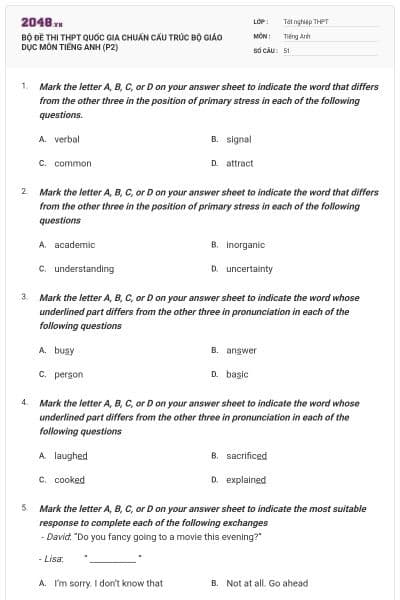
Mark the letter A, B, C, or D on your answer sheet to indicate the word that differs from the other three in the position of primary stress in each of the following questions.
verbal
signal
common
attract
Đáp án D
- Verbal /'Vɜ:bal/ (adj): bằng lời nói, bằng miệng
E.g: Verbal instructions are very important. (Hướng dẫn bằng miệng thì rất quan trọng.)
- Signal /'signəl/ (n): tín hiệu
E.g: Don’t move until I give the signal. (Đừng di chuyển cho đến khi tôi đưa ra tín hiệu.)
- Common /‘kɒmən/ (adj): chung, phổ biến, thông thường
E.g: We share a common interest in sports. (Chúng tôi có sở thích chung về thể thao.)
- Attract /ə'trækt/ (v): hấp dẫn, thu hút
E.g: We should attract more graduates to teaching. (Chúng ta nên thu hút nhiều người mới tốt nghiệp hơn về giảng dạy.)
=> Đáp án D (trọng âm rơi vào âm tiết thứ 2, các từ còn lại là thứ nhất)
Mark the letter A, B, C, or D on your answer sheet to indicate the word that differs from the other three in the position of primary stress in each of the following questions
academic
inorganic
understanding
uncertainty
Đáp án D
- Academic /,ækə'demik/ (adj): có tính chất học thuật, (thuộc) học viện
E.g: You need to have good academic qualifications. (Bạn cấn có bằng cấp học thuật tốt.)
- Inorganic /,inɔ:'gænik/ (adj): vô cơ
E.g: inorganic chemistry (hóa học vô cơ)
- Understanding /,ʌndə'stændiŋ)/ (n): sự hiểu biết
E.g: They should have a better understanding of this disease. (Họ nên có sự hiểu biết tốt hơn về căn bệnh này.)
- Uncertainty /ʌn'sɜ:tnti/ (n); sự không chắc chắn
E.g: There is uncertainty about the future of this country. (Không có sự chắc chắn về tương lai của quốc gia này.)
=> Đáp án D (trọng âm rơi vào âm tiết thứ 2, các từ còn lại là thứ 3)
Mark the letter A, B, C, or D on your answer sheet to indicate the word whose underlined part differs from the other three in pronunciation in each of the following questions
busy
answer
person
basic
Đáp án A
- Busy /'bizi/ (adj): bận rộn
E.g: I am busy doing the housework. (Tôi đang bận làm công việc nhà.)
- Answer /'ɑ:nsɜr/ (n,v): câu trả lời; trả lời
E.g: You should answer my question as soon as possible. (Bạn nên trả lời câu hỏi của tôi sớm nhất có thể.)
- Person /'pɜ:sən/ (n): người
E.g: He is a good person. (Anh ta là người tốt.)
- Basic /'beisik/ (adj): cơ bản, cơ sở, cần thiết
E.g: To get a job, you should have basic skills. (Để tìm được việc thì bạn nên có những kỹ năng cơ bản.)
=> Đáp án A (“s” phát âm là /z/, các từ còn lại là /s/)
Mark the letter A, B, C, or D on your answer sheet to indicate the word whose underlined part differs from the other three in pronunciation in each of the following questions
laughed
sacrificed
cooked
explained
Đáp án D
- Laugh /lɑ:f/ (v): cười
E.g: He makes me laugh. (Anh ấy làm tôi cười.)
- Sacrifice /'sækrifais/ (v): hi sinh
E.g: I will sacrifice everything for my daughter. (Tôi sẽ hi sinh mọi thứ vì con gái.)
- Cook /kʊk/ (v): nấu
E.g: My husband can cook well. (Chồng tôi có thể nấu ăn ngon.)
- Explain /ik’splein/ (v): giải thích
E.g: Can you explain this problem to me again? (Bạn có thể giải thích lại vấn đề này cho tôi được không?)
=> Đáp án D (“ed” được phát âm là /d/; các từ còn lại được phát âm là /t/)
Note: Quy tắc phát âm đuôi “ed” sau các động từ có quy tắc:
• TH1: phát âm là /id/ :Khi động từ có tận cùng là phụ âm /t/ hoặc /d/
E.g: wanted / wɒnntid /; needed / ni:did /
• TH2: phát âm là /t/:Khi động từ tận cùng bằng phụ âm vô thanh /p/, /f/, /k/, /s/, /ʃ/, /tʃ/
E.g: stopped / stɒpt /; laughed / lɑ:ft /; cooked / kʊkt /; watched / wɒtʃt /
• TH3: phát âm là /d/:Khi động từ tận cúng là các nguyên âm và các phụ âm còn lại
E.g: plaved / pleid/ ; opened / əʊpənd/
Mark the letter A, B, C, or D on your answer sheet to indicate the most suitable response to complete each of the following exchanges
- David: “Do you fancy going to a movie this evening?”
- Lisa: “ ___________ ”
I’m sorry. I don’t know that
Not at all. Go ahead
Not so bad. And you?
That would be nice
Đáp án D
- David: Tối nay bạn có muốn đi xem phim không?
- Lisa: “ ________ ”
A. Tớ xin lỗi. Tớ không biết điều đó.
B. Không có gì. Cứ tự nhiên.
C. Bình thường. Còn bạn thì sao?
D. Điều đó sẽ rất tuyệt
Mark the letter A, B, C, or D on your answer sheet to indicate the most suitable response to complete each of the following exchanges
- John : “What kind of job would you like?
- Tim : “___________”.
No, thanks
I heard it was very good
Anything to do with computers
Anytime after next week
Đáp án C
- John: Bạn muốn làm công việc gì?
- Tim: “_________”
A. Không, cảm ơn.
B. Tôi nghe nói nó rất tốt.
C. Bất cứ thứ gì liên quan đến máy tính
D. Sau tuần sau thì bất cứ lúc nào cũng được
Mark the letter A, B, C, or D on your answer sheet to indicate the word(s) OPPOSITE in meaning to the underlined word(s) in each of the following questions.
It was necessary to divide the movie “Roots” into five parts in order to show it on television
adapt
merge
segment
transact
Đáp án B
- Divide /di'vaid/ (v): phân chia, chia
E.g: Divide the class into two teams. (Hãy chia lớp thành 2 đội.)
-Adapt /ə'dæpt/ (v): phỏng theo, sửa lại cho thích hợp, thích nghi
E.g: It takes a lot oi'time to adapt to a new environment. (Mất rất nhiều thời gian để thích nghi với môi trường mới.)
We should adapt some exercises in this book. (Chúng ta nên thay đổi một số bài tập trong cuốn sách này cho phù hợp.)
-Merge /mɜ:dʒ/ (v): kết hợp, gộp lại
E.g: These small shops should be merged into a large one. (Những cửa hàng nhỏ này nên gộp lại thành một cùa hàng lớn.)
- Segment /seg’ment/ (v): cắt ra/ chia ra nhiều phần khác nhau
E.g: We should segment the population on the basis of age. (Chúng ta nên chia dân số dựa vào tuổi tác.)
-Transact /træn'zækt/ (v): làm kinh doanh
E.g: They transacted business in this city very well. (Họ làm kinh doanh ở thành phố này rất tốt.)
Vậy: Divide ≠ Merge
=> Đáp án B (Rất cần thiết phải chia bộ phim “Roots” thành 5 phần để chiếu lên tivi.)
Mark the letter A, B, C, or D on your answer sheet to indicate the word(s) OPPOSITE in meaning to the underlined word(s) in each of the following questions.
With the final examinations coming very soon his anxiety was rising to almost unbearable limits
joy
confidence
boredom
apprehension
Đáp án B
- Anxiety /æŋ’zaiəti/ (n): sự lo lắng
E.g: Waiting for him is a time of great anxiety. (Chờ đợi anh ấy là cả một khoảng thời gian rất lo lắng.)
- Joy /dʒɔi/ (n): niềm vui
E.g: My daughter jumped for joy at the news. (Con gái tôi đã nhảy lên vì sung sướng khi nghe tin đó.)
-Confidence /'kɒnfidəns/ (n): sự tự tin
E.g: He lacked confidences, so he didn’t get a job. (Anh ấy thiếu tự tin nên không nhận được việc.)
-Boredom /'bɔ:dəm/ (n): sự nhàm chán
E.g: She nearly died of boredom. (Cô ấy gần chết vì buồn chán.)
Apprehension /,æpri’henʃən/ (n): sự lo sợ, lo lắng
E.g: I watched the match result with some apprehension. (Tôi đã lo lắng khi xem kết quả trận đấu.)
Vậy Anxiety ≠ Confidence
=> Đáp án B (Kỳ thi cuối kỳ đang đến gần thì sự lo lắng của anh ấy càng tăng lên tới mức gần như không chịu được.)
Mark the letter A, B, C, or D on your answer sheet to indicate the word(s) CLOSEST in meaning to the underlined word(s) in each of the following questions
It was relatively easy for him to learn baseball because he had been a cricket player.
approximately
comparatively
nearly
essentially
Đáp án B
- Relatively /'relətivli/ ~ Comparatively /kəm'paerətivli/ (adv); tương đối, khá
E.g: Eating in this restaurant is relatively/ comparatively cheap. (Ăn ở nhà hàng này tương đối rẻ.)
- Approximately /ə'prɒksimətli/ (adv): xấp xỉ
E.g: My school has approximately 600 students. (Trường tôi có khoảng 600 học sinh.)
- Nearly /'niəli/ (adv): gần như
E.g: I have stayed here for nearly 3 weeks. (Tôi đã ở đây gần 3 tuần rồi.)
- Essentially /i'senʃəli/: về bản chất, về cơ bản
E.g: The pattern is essentially the same. (Kiểu mẫu này vế cơ bản thì giống nhau.)
(Tương đối dễ dàng với anh ta khi học bóng chày vì anh ta đã là một cầu thủ cricket.)
Mark the letter A, B, C, or D on your answer sheet to indicate the word(s) CLOSEST in meaning to the underlined word(s) in each of the following questions
You have to be on your toes if you want to beat her
pay all your attention to what you are doing
upset her in what she is doing
get involved in what she is doing
make her comply with your order
Đáp án: A
Giải thích:
Kiến thức: Thành ngữ - Cụm từ đồng nghĩa
be on your toes: cảnh giác, chú ý
Xét các đáp án:
A. pay all your attention to what you are doing: đặt tất cả sự chú ý của bạn vào những gì bạn đang làm
B. upset her in what she is doing: bực bội cô ấy trong những việc cô ấy đang làm
C. get involved in what she is doing: tham gia vào những gì cô ấy đang làm
D. make her comply with your orders: làm cho cô ấy tuân thủ các yêu cầu của bạn
→ be on your toes = pay all your attention to what you are doing
Dịch: Bạn phải luôn cảnh giác nếu muốn đánh bại cô ấy.
Mark the letter A, B, C, or D on your answer sheet to indicate the correct answer to each of the following questions.
Since he failed his exam, he had to ____for it again
pass
make
take
sit
Đáp án D
- Take an exam ~ Sit an exam: tham dự kỳ thì
- “Sit” và “take” đều có thể đi với exam nhưng “sit” có thể dùng với “for”, trong khi “take” thì không.
E.g: I will sit for the exam next week.
=> Đáp án D (Vì cậu ấy thi trượt nên cậu ấy phải thi lại.)
Mark the letter A, B, C, or D on your answer sheet to indicate the correct answer to each of the following questions.
Is there _____at all I can help?
everything
anything
something
one thing
Đáp án B
- Something: một cái gì đó, một việc gì đó (thường dùng trong câu khẳng định)
- Anything (at all): một việc gì đó, điều gì đó (dùng trong câu hỏi)
- Everything: mọi thứ, mọi cái
- One thing: một thứ, một điều
=> Đáp án B (Có việc gì tôi có thể giúp không?)
Mark the letter A, B, C, or D on your answer sheet to indicate the correct answer to each of the following questions.
Don’t worry. He’ll do the job as __as possible
economizing
economic
economical
economically
Đáp án D
- Economize /I'kɒnəmaiz/ (v): sự dụng tiết kiệm
E.g: I am trying to economize and spend less on food than I usually do. (Tôi đang cố gắng tiết kiệm và giảm chi tiêu vào việc mua thực phẩm ít hơn bình thường.)
- Economic /,ilkə'nɒmik, ,ekə'nɒmik/ (adj): kinh tế
E.g: economic growth (sự phát triển kinh tế)
- Economical /,i:kə'nɒmikal, .ekə'nɒmikal/ (adj): tiết kiệm => Economically (adv): một cách kinh tế/ tiết kiệm)
E.g: This car is economical and reliable. (Xe ô tô này thì tiết kiệm và đáng tin cậy.)
Trong câu này, chúng ta cần một trạng từ để bổ nghĩa cho động từ “do”
Mark the letter A, B, C, or D on your answer sheet to indicate the correct answer to each of the following questions.
They tell me about the film ____on TV last week
when they watched
which they watched it
which they watched
whom they watched
Đáp án C
Trong câu này, chúng ta dùng đại từ quan hệ “which” thay thế cho “the film” phía trước
- Whom: là đại từ quan hệ thay the cho danh từ chỉ người và làm chức năng tân ngữ trong mệnh đề quan hệ
E.g: This is the girl whom I met yesterday.
- When: là trạng từ quan hệ thay thế cho từ/ cụm từ chỉ thời gian
E.g: I remember the day when we first met at the airport.
- Which: là đại từ quan hệ thay thế cho danh từ chỉ vật và làm chức năng chủ ngữ hoặc tân ngữ trong mệnh đề quan hệ.
Vậy: They tell me about the film. They watched it on TV last week.
=> They tell me about the film which they watched on TV last week
=> Đáp án C (Họ kể cho tôi nghe về bộ phim mà họ đã xem trên ti-vi tuần trước.)
Mark the letter A, B, C, or D on your answer sheet to indicate the correct answer to each of the following questions.
It’s important to know about how developed countries have solved the urbanization problems and ____some solutions to those in Viet Nam.
think
advise
expect
propose
Đáp án D
- Think (v): suy nghĩ
- Advise (v): khuyên, khuyên bảo
- Expect (v): mong đợi, mong chờ
- Propose (v): đề xuất, đề nghị
=> Đáp án D (Thật là quan trọng để biết cách thức mà các nước phát triển giải quyết các vấn đề đô thị hóa và đề xuất giải pháp cho những điều này ở Việt Nam.)
Mark the letter A, B, C, or D on your answer sheet to indicate the correct answer to each of the following questions.
Tim’s encouraging words gave me ____to undertake the task once again.
a point
an incentive
a resolution
a target
Đáp án B
- Point /pɔint/ (n): điểm, vấn đề
E.g: She explained her point by drawing a diagram. (Cô ta giải thích vấn đề bằng cách vẽ sơ đồ.)
- Incentive /in'sentiv/ (n): sự khích lệ, sự khuyến khích
E.g: We should provide more incentives for young teachers to stay here. (Chúng ta nên khích lệ nhiều hơn để giáo viên trẻ ở lại đây.)
Resolution /,rezəl'u:ʃən/ (n): quyết định, nghị quyết
E.g: I made a resolution to find a new job. (Tôi đưa ra quyết định tìm công việc mới.)
- Target /'tɑ:git/ (n): mục tiêu, đích
E.g: If you want to lose weight, you have to set yourself a target. (Nếu bạn muốn giảm cân thì phải đặt mục tiêu cho bản thân.)
=> Đáp án B (Những lời động viên của Tim đã cho tôi sự khích lệ làm lại nhiệm vụ đó một lần nữa.)
Mark the letter A, B, C, or D on your answer sheet to indicate the correct answer to each of the following questions.
1 don’t suppose there is anyone there, ________?
do I
isn’t there
is there
don’t I
Đáp án C
- Nếu mệnh đề đầu có cấu trúc: I + V (think, believe, suppose, assume, expect, seem, etc.) + (that) + mệnh đề phụ thì phần hỏi đuôi sẽ theo mệnh đề phụ
E.g: I believe she will come, won’t she?
I don’t think that David can do this task, can he?
- Trong câu này, mệnh đề phụ bắt đầu bằng “there is” nhưng mệnh đề chính phía trước ở dạng phủ định nên phần hỏi đuôi cần điền vào là “is there”
Note: Cùng kiểu câu này nhưng nếu chủ ngữ không phải là “I” thì chúng ta dùng mệnh đề đầu làm câu hỏi đuôi
E.g: He thinks that she will come, doesn’t he?
Mark the letter A, B, C, or D on your answer sheet to indicate the correct answer to each of the following questions.
He wanted to know whose car I had borrowed _________
the last evening
last night
yesterday evening
the previous night
Đáp án D
Cấu trúc: S + wanted to know/ asked + WH- question + s + V (lùi thì) + ...
Nếu động từ tường thuật ở dạng quá khứ (said, etc.) thì trong lời nói tường thuật chúng ta phải thay đổi “thì” của động từ, đại từ, tính từ, trạng từ tương ứng
Vậy: “last night" => “the previous night"
Mark the letter A, B, C, or D on your answer sheet to indicate the correct answer to each of the following questions.
Are you taking _______ this semester?
house economics
home economic
house economic
home economics
Đáp án D
Home economics (n): Kinh tế gia đình (môn học)
=> Đáp án D (Học kỳ này bạn đang học môn kinh tế gia đình à?)
Mark the letter A, B, C, or D on your answer sheet to indicate the correct answer to each of the following questions.
We should participate in the movements ____the natural environment
organizing to conserve
organized to conserve
organized conserving
which organize to conserve
Đáp án B
Động từ “organize” trong câu này phải được chia ở dạng bị động mới phù hợp về ý nghĩa. Câu đầy đủ khi chưa rút gọn mệnh đề quan hệ:
We should participate in the movements which are organized to conserve the natural environment.
Do đó, để rút gọn mệnh đề quan hệ trong câu này thì chúng ta dùng PP (bị động):
We should participate in the movements organized to conserve the natural environment.
=> Đáp án B (Chúng ta nên tham gia vào các phong trào mà được tổ chức để bảo vệ môi trường tự nhiên.)
Mark the letter A, B, C, or D on your answer sheet to indicate the correct answer to each of the following questions.
He does not ____his fellow-workers and there are often disagreements between them.
get on with
put up with
go on with
take to
Đáp án A
- Get on with sb/ Get along with sb : hòa hợp, hòa thuận với ai đó
E.g: I don’t really get on with my sister.
- Put up with sb/ sth: chịu đựng
E.g: I don’t know how she puts up with her husband.
- Take to sb/ sth: bắt đầu thích ai đó/ điều gì
E.g: I took to my new school
=> Đáp án A (Anh ấy không hòa hợp với các đồng nghiệp và thường xuyên có bất đồng giữa họ.)
Mark the letter A, B, C, or D on your answer sheet to indicate the correct answer to each of the following questions.
Many applicants find a job interview _______ if they are not well-prepared for it.
impressive
stressful
threatening
time-consuming
Đáp án B
- Impressive /im'presiv/ (adj): gây ấn tượng sâu sắc
E.g: He was very impressive in the interview. (Anh ta đã gây ấn tượng mạnh trong cuộc phỏng vấn.)
- Stressful /‘stresful/ (adj): gây căng thẳng
E.g: It is a stressful job, so I gave it up. (Đó là công việc đầy căng thẳng nên tôi đã từ bỏ.)
- Threatening /’θretniŋ/ (adj): đe dọa
E.g: They sent me a threatening letter. (Họ đã gửi cho tôi một bức thư đe dọa.)
- Time- consuming (adj): tổn thời gian
E.g: This process is difficult and time-consuming. (Quá trình này thì khó khăn và tốn nhiều thời gian.)
=> Đáp án B (Nhiều ứng viên cảm thấy cuộc phỏng vấn xin việc rất căng thẳng nếu họ không chuẩn bị tốt cho nó.)
Read the following passage and mark the letter A, B, C, or D on your answer sheet to indicate the correct word or phrase that best fits each of the numbered blanks from 23 to 27
The warming ot the Earth is caused by exhaust gas from automobile engines, factories and power (23) ________. Carbon dioxide goes up into the atmosphere, and it form a kind of screen that keeps or allows the sunshine in but stop the Earth heat (24) _______ getting out. It works like a greenhouse, that’s why we call (25) ________ the Green House effect.
Because ot this effect, the Earth is getting warmer alt the time. This (26) ________ in temperature will cause big changes to the world’s climate. The sea level will increase as the ice (27) _______ the poles will melt.
Điền ô 23
companies
factories
sites
stations
Đáp án D
- Company (n): công ty
- Factory (n): nhà máy
- Site (n): địa điểm
- Power station (n): nhà máy phát điện
=> Đáp án D (Sự ấm lên của trái đất là do khí thải từ động cơ ô tô, các nhà máy và nhà máy phát điện.)
Read the following passage and mark the letter A, B, C, or D on your answer sheet to indicate the correct word or phrase that best fits each of the numbered blanks from 23 to 27
The warming ot the Earth is caused by exhaust gas from automobile engines, factories and power (23) ________. Carbon dioxide goes up into the atmosphere, and it form a kind of screen that keeps or allows the sunshine in but stop the Earth heat (24) _______ getting out. It works like a greenhouse, that’s why we call (25) ________ the Green House effect.
Because ot this effect, the Earth is getting warmer alt the time. This (26) ________ in temperature will cause big changes to the world’s climate. The sea level will increase as the ice (27) _______ the poles will melt.
Điền ô 24
from
up
against
away
Đáp án A
- Stop + from doing sth: ngừng, ngăn chặn ... khỏi việc gì (~ prevent ...from)
E.g: They are trying to stop the disease from spreading. (Họ đang cố gắng ngăn chặn dịch bệnh lây lan.)
=> Đáp án C (Khí CO2 đi vào bầu khí quyển, và tạo thành một loại màn mà giữ hoặc cho phép nhiệt mặt trời đi vào nhưng không cho nhiệt Trái Đất đi ra.)
Read the following passage and mark the letter A, B, C, or D on your answer sheet to indicate the correct word or phrase that best fits each of the numbered blanks from 23 to 27
The warming ot the Earth is caused by exhaust gas from automobile engines, factories and power (23) ________. Carbon dioxide goes up into the atmosphere, and it form a kind of screen that keeps or allows the sunshine in but stop the Earth heat (24) _______ getting out. It works like a greenhouse, that’s why we call (25) ________ the Green House effect.
Because ot this effect, the Earth is getting warmer alt the time. This (26) ________ in temperature will cause big changes to the world’s climate. The sea level will increase as the ice (27) _______ the poles will melt.
Điền ô 25
is
be
it
them
Đáp án C
- Call + O1 +O2: gọi, đặt tên ...
E.g: I will call the baby Cherry. (Tôi sẽ đặt tên đứa bé là Cherry.)
Vi chủ ngữ phía trước là “it” nên tân ngữ phía sau cũng sẽ là “it”
=> Đáp án C (Nó hoạt động như một nhà kính, đó là lý do tại sao chúng ta gọi nó là hiệu ứng nhà kính.)
Read the following passage and mark the letter A, B, C, or D on your answer sheet to indicate the correct word or phrase that best fits each of the numbered blanks from 23 to 27
The warming ot the Earth is caused by exhaust gas from automobile engines, factories and power (23) ________. Carbon dioxide goes up into the atmosphere, and it form a kind of screen that keeps or allows the sunshine in but stop the Earth heat (24) _______ getting out. It works like a greenhouse, that’s why we call (25) ________ the Green House effect.
Because ot this effect, the Earth is getting warmer alt the time. This (26) ________ in temperature will cause big changes to the world’s climate. The sea level will increase as the ice (27) _______ the poles will melt.
Điền ô 25
raise
rise
drop
fall
Đáp án B
- Rise: (n): sự tăng lên; (v); tăng lên (rise là nội động từ nên không cần tân ngữ đi kèm)
- Raise (v): tăng lên (raise là ngoại động từ nên cần có tân ngữ đi kèm)
- Fall/ Drop (n): sự giảm xuống; (v): giảm xuống
Từ cần điền vào là một danh từ và chì có “rise” phù hợp về nghĩa
=> Đáp án B (Sự tăng nhiệt độ này sẽ gây ra những thay đổi lớn đối với khí hậu của thế giới.)
Read the following passage and mark the letter A, B, C, or D on your answer sheet to indicate the correct word or phrase that best fits each of the numbered blanks from 23 to 27
The warming ot the Earth is caused by exhaust gas from automobile engines, factories and power (23) ________. Carbon dioxide goes up into the atmosphere, and it form a kind of screen that keeps or allows the sunshine in but stop the Earth heat (24) _______ getting out. It works like a greenhouse, that’s why we call (25) ________ the Green House effect.
Because ot this effect, the Earth is getting warmer alt the time. This (26) ________ in temperature will cause big changes to the world’s climate. The sea level will increase as the ice (27) _______ the poles will melt.
Điền ô 27
covering
covers
covered
cover
Đáp án A
- Cover (v): bao phủ
The sea level will increase as the ice which covers the poles will melt. => The sea level will increase as the ice covering the poles will melt. (rút gọn MĐQH)
=> Đáp án A (Mực nước biển sẽ tăng lên khi lớp băng bao phủ các cực sẽ tan chảy.)
Read the following passage and mark the letter A, B, C, or D on your answer sheet to indicate the correct answer to each of the questions from 28 to 34
The Hindu culture celebrates marriage as a pure and pristine rite enabling two individuals start their journey of life together. It puts emphasis on the values of happiness, harmony and growth and could be traced back from the Vedic times.
Months before the wedding ceremony, an engagement is held which is called “magni”. The couple is blessed here with gifts, jewelry and clothes. Another important ritual is the “mehendi” which is a paste made from the leaves of henna plant. It is the traditional art of adorning the hands and the feet of the bride with mehendi and the name of the groom is also hidden in the design.
On the day of marriage, the couple exchanges garlands as a gesture of acceptance of one another and a pledge to respect one another as partners which is known as «jaimala». This is followed by «jaimala», where the father of the bride places her hand in the groom’s hand requesting him to accept her as an equal partner.
Another ritual is the «havan» in which the couple invokes Agni, the god of Fire, to witness their commitment to each other. Crushed sandalwood, herbs, sugar rice and oil are offered to the ceremonial fire. The “gath bandhan” takes place where scarves of the bride and groom are tied together symbolizing their eternal bond. This signifies their pledge before God to love each other and remain loyal. The couple then takes four “mangal pheras” or walk around the ceremonial fire, representing four goals in life: “Dharma”, religious and moral duties; “Artha”, prosperity; “Kama” earthly pleasures; “Moksha”, spiritual salvation.
The couple also takes seven steps together to begin their journey, called the “saptapardi”. Then the ritual of “sindoor” takes place where the groom applies a small dot of vermilion, a red powder to the bride’s forehead and welcomes her as his partner for life. This signifies the completion of the marriage. The parents of the bride and the groom then give their blessings, “ashirwad” to the newly wed couple as they touch the feet of their parents.
What might be the most suitable title for this reading passage?
The Hindu culture
The Hindu religion
The Hindu wedding
The Hindu tradition
Đáp án C
Tiêu đề thích hợp cho bài đọc này là gì?
A. Văn hóa Hindu B. Tôn giáo Hindu
C. Đám cưới Hindu D. Truyền thống Hindu
Đọc từ đấu bài đến cuối, chúng ta thấy rằng bài đọc này nói về phong tục đám cưới Hindu (marriage, couple, engagement, bride, groom, etc.)
Note: Chúng ta nên làm câu này sau khi đã làm xong tất cả các câu hỏi khác về bài đọc này. Điều này sẽ giúp chúng ta tiết kiệm thời gian và đưa ra được lựa chọn chính xác nhất
Read the following passage and mark the letter A, B, C, or D on your answer sheet to indicate the correct answer to each of the questions from 28 to 34
The Hindu culture celebrates marriage as a pure and pristine rite enabling two individuals start their journey of life together. It puts emphasis on the values of happiness, harmony and growth and could be traced back from the Vedic times.
Months before the wedding ceremony, an engagement is held which is called “magni”. The couple is blessed here with gifts, jewelry and clothes. Another important ritual is the “mehendi” which is a paste made from the leaves of henna plant. It is the traditional art of adorning the hands and the feet of the bride with mehendi and the name of the groom is also hidden in the design.
On the day of marriage, the couple exchanges garlands as a gesture of acceptance of one another and a pledge to respect one another as partners which is known as «jaimala». This is followed by «jaimala», where the father of the bride places her hand in the groom’s hand requesting him to accept her as an equal partner.
Another ritual is the «havan» in which the couple invokes Agni, the god of Fire, to witness their commitment to each other. Crushed sandalwood, herbs, sugar rice and oil are offered to the ceremonial fire. The “gath bandhan” takes place where scarves of the bride and groom are tied together symbolizing their eternal bond. This signifies their pledge before God to love each other and remain loyal. The couple then takes four “mangal pheras” or walk around the ceremonial fire, representing four goals in life: “Dharma”, religious and moral duties; “Artha”, prosperity; “Kama” earthly pleasures; “Moksha”, spiritual salvation.
The couple also takes seven steps together to begin their journey, called the “saptapardi”. Then the ritual of “sindoor” takes place where the groom applies a small dot of vermilion, a red powder to the bride’s forehead and welcomes her as his partner for life. This signifies the completion of the marriage. The parents of the bride and the groom then give their blessings, “ashirwad” to the newly wed couple as they touch the feet of their parents.
What does the word “magni” stand for?
the wedding
the paste made from the leave of one another
the engagement
the gesture of acceptance oi one another
Đáp án C
Dẫn chứng ở dòng đầu tiên trong đoạn thứ 2: “Months before the wedding ceremony, an engagement is held which is called “magni”. (Những tháng trước lễ cưới, một lễ đính hôn được tổ chức, cái mà được gọi là “magni”
Từ “magni” ở đây là “engagement”.
Read the following passage and mark the letter A, B, C, or D on your answer sheet to indicate the correct answer to each of the questions from 28 to 34
The Hindu culture celebrates marriage as a pure and pristine rite enabling two individuals start their journey of life together. It puts emphasis on the values of happiness, harmony and growth and could be traced back from the Vedic times.
Months before the wedding ceremony, an engagement is held which is called “magni”. The couple is blessed here with gifts, jewelry and clothes. Another important ritual is the “mehendi” which is a paste made from the leaves of henna plant. It is the traditional art of adorning the hands and the feet of the bride with mehendi and the name of the groom is also hidden in the design.
On the day of marriage, the couple exchanges garlands as a gesture of acceptance of one another and a pledge to respect one another as partners which is known as «jaimala». This is followed by «jaimala», where the father of the bride places her hand in the groom’s hand requesting him to accept her as an equal partner.
Another ritual is the «havan» in which the couple invokes Agni, the god of Fire, to witness their commitment to each other. Crushed sandalwood, herbs, sugar rice and oil are offered to the ceremonial fire. The “gath bandhan” takes place where scarves of the bride and groom are tied together symbolizing their eternal bond. This signifies their pledge before God to love each other and remain loyal. The couple then takes four “mangal pheras” or walk around the ceremonial fire, representing four goals in life: “Dharma”, religious and moral duties; “Artha”, prosperity; “Kama” earthly pleasures; “Moksha”, spiritual salvation.
The couple also takes seven steps together to begin their journey, called the “saptapardi”. Then the ritual of “sindoor” takes place where the groom applies a small dot of vermilion, a red powder to the bride’s forehead and welcomes her as his partner for life. This signifies the completion of the marriage. The parents of the bride and the groom then give their blessings, “ashirwad” to the newly wed couple as they touch the feet of their parents.
What do the Hindu people think about marriage?
It is entirely a spiritual traditional ritual allowing two individuals to live together
It is a belief in the growth of a family newly formed by two individuals
It is a wish of happiness and harmony to come to two individuals
It is just a living-together announcement of two individuals
Đáp án A
Người Hindu nghĩ gì về hôn nhân?
A. Đó hoàn toàn là một nghi lễ truyền thống của tôn giáo cho phép 2 cá nhân sống với nhau.
B. Đó là niềm tin vào sự phát triển của một gia đình mới được hình thành từ 2 cá nhân
C. Đó là mong muốn hạnh phúc và hòa hợp đến với 2 cá nhân.
D. Đó chỉ là lời tuyên bố sống cùng nhau của 2 cá nhân.
Dẫn chứng ở những dòng đầu tiên trong đoạn 1: “The Hindu cultural cclehrules marriage as a pure and pristine rite enabling two individuals start their journey of life together. It puts emphasis on the values of happiness, harmony and growth and could be traced back from the Vedic times.”
Read the following passage and mark the letter A, B, C, or D on your answer sheet to indicate the correct answer to each of the questions from 28 to 34
The Hindu culture celebrates marriage as a pure and pristine rite enabling two individuals start their journey of life together. It puts emphasis on the values of happiness, harmony and growth and could be traced back from the Vedic times.
Months before the wedding ceremony, an engagement is held which is called “magni”. The couple is blessed here with gifts, jewelry and clothes. Another important ritual is the “mehendi” which is a paste made from the leaves of henna plant. It is the traditional art of adorning the hands and the feet of the bride with mehendi and the name of the groom is also hidden in the design.
On the day of marriage, the couple exchanges garlands as a gesture of acceptance of one another and a pledge to respect one another as partners which is known as «jaimala». This is followed by «jaimala», where the father of the bride places her hand in the groom’s hand requesting him to accept her as an equal partner.
Another ritual is the «havan» in which the couple invokes Agni, the god of Fire, to witness their commitment to each other. Crushed sandalwood, herbs, sugar rice and oil are offered to the ceremonial fire. The “gath bandhan” takes place where scarves of the bride and groom are tied together symbolizing their eternal bond. This signifies their pledge before God to love each other and remain loyal. The couple then takes four “mangal pheras” or walk around the ceremonial fire, representing four goals in life: “Dharma”, religious and moral duties; “Artha”, prosperity; “Kama” earthly pleasures; “Moksha”, spiritual salvation.
The couple also takes seven steps together to begin their journey, called the “saptapardi”. Then the ritual of “sindoor” takes place where the groom applies a small dot of vermilion, a red powder to the bride’s forehead and welcomes her as his partner for life. This signifies the completion of the marriage. The parents of the bride and the groom then give their blessings, “ashirwad” to the newly wed couple as they touch the feet of their parents.
What can the word adorning be best replaced by?
decorating
painting
repairing
dying
Đáp án A
- Adorn /ə'dɔ:n/ - decorate (v): trang điểm
E.g: the house is being adorned with flowers.
- Paint (v); sơn, vẽ
- Repair tv): sửa
- Dye tv): nhuộm
“It is the traditional art of adorning the hands and the feet of the bride with mehendi” (Đó là nghệ thuật truyền thống trang điểm mehendi trên tay và chân của cô dâu)
Read the following passage and mark the letter A, B, C, or D on your answer sheet to indicate the correct answer to each of the questions from 28 to 34
The Hindu culture celebrates marriage as a pure and pristine rite enabling two individuals start their journey of life together. It puts emphasis on the values of happiness, harmony and growth and could be traced back from the Vedic times.
Months before the wedding ceremony, an engagement is held which is called “magni”. The couple is blessed here with gifts, jewelry and clothes. Another important ritual is the “mehendi” which is a paste made from the leaves of henna plant. It is the traditional art of adorning the hands and the feet of the bride with mehendi and the name of the groom is also hidden in the design.
On the day of marriage, the couple exchanges garlands as a gesture of acceptance of one another and a pledge to respect one another as partners which is known as «jaimala». This is followed by «jaimala», where the father of the bride places her hand in the groom’s hand requesting him to accept her as an equal partner.
Another ritual is the «havan» in which the couple invokes Agni, the god of Fire, to witness their commitment to each other. Crushed sandalwood, herbs, sugar rice and oil are offered to the ceremonial fire. The “gath bandhan” takes place where scarves of the bride and groom are tied together symbolizing their eternal bond. This signifies their pledge before God to love each other and remain loyal. The couple then takes four “mangal pheras” or walk around the ceremonial fire, representing four goals in life: “Dharma”, religious and moral duties; “Artha”, prosperity; “Kama” earthly pleasures; “Moksha”, spiritual salvation.
The couple also takes seven steps together to begin their journey, called the “saptapardi”. Then the ritual of “sindoor” takes place where the groom applies a small dot of vermilion, a red powder to the bride’s forehead and welcomes her as his partner for life. This signifies the completion of the marriage. The parents of the bride and the groom then give their blessings, “ashirwad” to the newly wed couple as they touch the feet of their parents.
What can the word invokes be best replaced by?
tells
says
prays
talks
Đáp án C
- Invoke /in'vəuk/ ~ Pray: khấn, cầu nguyện
- Tell (v): bảo, kể
- Say (v): nói
- Talk (v): nói, nói chuyện
“Another ritual is the “havan” in which the couple invokes Agni, the god of Fire, to witness their commitment to each other” (Một nghi lễ khác là “havan”, nghi lễ mà cặp đôi khấn vái thần Agni, thần lửa, để làm chứng cho sự cam kết của họ với nhau.)
Read the following passage and mark the letter A, B, C, or D on your answer sheet to indicate the correct answer to each of the questions from 28 to 34
The Hindu culture celebrates marriage as a pure and pristine rite enabling two individuals start their journey of life together. It puts emphasis on the values of happiness, harmony and growth and could be traced back from the Vedic times.
Months before the wedding ceremony, an engagement is held which is called “magni”. The couple is blessed here with gifts, jewelry and clothes. Another important ritual is the “mehendi” which is a paste made from the leaves of henna plant. It is the traditional art of adorning the hands and the feet of the bride with mehendi and the name of the groom is also hidden in the design.
On the day of marriage, the couple exchanges garlands as a gesture of acceptance of one another and a pledge to respect one another as partners which is known as «jaimala». This is followed by «jaimala», where the father of the bride places her hand in the groom’s hand requesting him to accept her as an equal partner.
Another ritual is the «havan» in which the couple invokes Agni, the god of Fire, to witness their commitment to each other. Crushed sandalwood, herbs, sugar rice and oil are offered to the ceremonial fire. The “gath bandhan” takes place where scarves of the bride and groom are tied together symbolizing their eternal bond. This signifies their pledge before God to love each other and remain loyal. The couple then takes four “mangal pheras” or walk around the ceremonial fire, representing four goals in life: “Dharma”, religious and moral duties; “Artha”, prosperity; “Kama” earthly pleasures; “Moksha”, spiritual salvation.
The couple also takes seven steps together to begin their journey, called the “saptapardi”. Then the ritual of “sindoor” takes place where the groom applies a small dot of vermilion, a red powder to the bride’s forehead and welcomes her as his partner for life. This signifies the completion of the marriage. The parents of the bride and the groom then give their blessings, “ashirwad” to the newly wed couple as they touch the feet of their parents.
Why does the couple exchange garlands?
to do a ritual
to show both their acceptance of and the swear to respect the partner
to express their acceptance of one another and a wish of happiness
to express their vow to respect each other for the whole life
Đáp án B
Tại sao cặp đôi trao vòng hoa cho nhau?
A. để thực hiện nghi lễ.
B. để thể hiện sự chấp nhận và lời thề nguyền tôn trọng người bạn đời của mình
C. để bày tỏ sự chấp nhận nhau và mong ước hạnh phúc.
D. để bày tỏ lời thề nguyền tôn trọng nhau đến suốt cuộc đời.
Dẫn chứng ở dòng đầu tiên trong đoạn 3: “On the day of marriage, the couple exchanges garlands as ạ gesture of acceptance of one another and a pledge to respect one another as partners which is known as “jaimala”.
Read the following passage and mark the letter A, B, C, or D on your answer sheet to indicate the correct answer to each of the questions from 28 to 34
The Hindu culture celebrates marriage as a pure and pristine rite enabling two individuals start their journey of life together. It puts emphasis on the values of happiness, harmony and growth and could be traced back from the Vedic times.
Months before the wedding ceremony, an engagement is held which is called “magni”. The couple is blessed here with gifts, jewelry and clothes. Another important ritual is the “mehendi” which is a paste made from the leaves of henna plant. It is the traditional art of adorning the hands and the feet of the bride with mehendi and the name of the groom is also hidden in the design.
On the day of marriage, the couple exchanges garlands as a gesture of acceptance of one another and a pledge to respect one another as partners which is known as «jaimala». This is followed by «jaimala», where the father of the bride places her hand in the groom’s hand requesting him to accept her as an equal partner.
Another ritual is the «havan» in which the couple invokes Agni, the god of Fire, to witness their commitment to each other. Crushed sandalwood, herbs, sugar rice and oil are offered to the ceremonial fire. The “gath bandhan” takes place where scarves of the bride and groom are tied together symbolizing their eternal bond. This signifies their pledge before God to love each other and remain loyal. The couple then takes four “mangal pheras” or walk around the ceremonial fire, representing four goals in life: “Dharma”, religious and moral duties; “Artha”, prosperity; “Kama” earthly pleasures; “Moksha”, spiritual salvation.
The couple also takes seven steps together to begin their journey, called the “saptapardi”. Then the ritual of “sindoor” takes place where the groom applies a small dot of vermilion, a red powder to the bride’s forehead and welcomes her as his partner for life. This signifies the completion of the marriage. The parents of the bride and the groom then give their blessings, “ashirwad” to the newly wed couple as they touch the feet of their parents.
When is the wedding ceremony completed?
When the parents ot the bride and the groom give their blessings to the couple
When the couple touches their parents’ feet
When the couple makes seven steps together
When the groom applies a small dot of vermillion of the brides forehead
Đáp án D
Dẫn chứng trong đoạn cuối: “Then the ritual of “sindoor” takes place where the groom applies a small dot ot vermilion, a red powder to the brides forehead and welcomes her as his partner for life. This signifies the completion of the marriage.”
Read the following passage and mark the letter A, B, C, or D on your answer sheet to indicate the correct answer to each of the questions from 35 to 42
It is hard to think of a world without gas or electricity. Both are commonly used for lighting and heating today. We now can instantly flick a lighter or strike a match to make a flame. But it was not long ago that there were no such things as matches or lighters. To make fire, it was necessary to strike a piece of iron on flint for sparks to ignite some tinder. If the tinder was damp, or the flint old, you had to borrow some fire from a neighbor.
We do not know exactly when or how people first used fire. Perhaps, many ages ago, they found that sticks would burn if they were dropped into some hole where melted lava from a volcano lay boiling. They brought the lighted sticks back to make their fire in a cave. Or, they may have seen trees catch fire through being struck by lightning, and used the trees to start their own fires.
Gradually people learned they could start a fire without traveling far to find flames. They rubbed two pieces ot wood together. This method was used for thousands of years.
When people became used to making fires with which to cook food and stay warm at night, they found that certain resins or gums from trees burnt longer and brighter. They melted resins and dipped branches in the liquid to make torches that lit their homes at night. Iron stands in which torches used to be fixed can still be seen in old buildings of Europe.
There was no lighting in city streets until gas lamps, and then electric lamps were installed. Boys ran about London at night carrying torches of burning material. They were called torch boys, or link boys, and earned a living by guiding visitors to friends’ houses at night.
For centuries homes were lit by candles until oil was found. Even then, oil lamps were no more effective than a cluster of candles. We read about the splendors and marvels of ancient palaces and castles, but we forget that they must have been gloomy and murky places at night
What does “they” refer to?
people
ages
sticks
trees
Đáp án C
Dẫn chứng trong bài đọc: “ We do not know exactly when or how people first used fire. Perhaps, many ages ago, they found that sticks would burn if they were dropped into some hole ...” (Chúng ta không biết chính xác lúc nào hay bằng cách nào mà con người sử dụng lửa. Có lẽ, cách đây rất lâu, họ phát hiện ra que củi sẽ cháy nếu chúng rơi vào hố mà...)
Vậy: they = sticks
Read the following passage and mark the letter A, B, C, or D on your answer sheet to indicate the correct answer to each of the questions from 35 to 42
It is hard to think of a world without gas or electricity. Both are commonly used for lighting and heating today. We now can instantly flick a lighter or strike a match to make a flame. But it was not long ago that there were no such things as matches or lighters. To make fire, it was necessary to strike a piece of iron on flint for sparks to ignite some tinder. If the tinder was damp, or the flint old, you had to borrow some fire from a neighbor.
We do not know exactly when or how people first used fire. Perhaps, many ages ago, they found that sticks would burn if they were dropped into some hole where melted lava from a volcano lay boiling. They brought the lighted sticks back to make their fire in a cave. Or, they may have seen trees catch fire through being struck by lightning, and used the trees to start their own fires.
Gradually people learned they could start a fire without traveling far to find flames. They rubbed two pieces ot wood together. This method was used for thousands of years.
When people became used to making fires with which to cook food and stay warm at night, they found that certain resins or gums from trees burnt longer and brighter. They melted resins and dipped branches in the liquid to make torches that lit their homes at night. Iron stands in which torches used to be fixed can still be seen in old buildings of Europe.
There was no lighting in city streets until gas lamps, and then electric lamps were installed. Boys ran about London at night carrying torches of burning material. They were called torch boys, or link boys, and earned a living by guiding visitors to friends’ houses at night.
For centuries homes were lit by candles until oil was found. Even then, oil lamps were no more effective than a cluster of candles. We read about the splendors and marvels of ancient palaces and castles, but we forget that they must have been gloomy and murky places at night
According to the passage the first fire used by people was probably obtained _______.
from the suns heat through glass
by rubbing wood together
from heat or fire caused by nature
by striking iron against flint
Đáp án C
Dẫn chứng trong đoạn 2:
“Perhaps, many ages ago, they found that sticks would burn if they were dropped into some hole where melted lava from a volcano lay boiling. They brought the lighted sticks back to make their fire in a cave. Or, they may have seen trees catch fire through being struck by lightning, and used the trees to start their own fires.”
Điều này có nghĩa là từ thời xưa con người tạo ra lửa nhờ vào tự nhiên
Read the following passage and mark the letter A, B, C, or D on your answer sheet to indicate the correct answer to each of the questions from 35 to 42
It is hard to think of a world without gas or electricity. Both are commonly used for lighting and heating today. We now can instantly flick a lighter or strike a match to make a flame. But it was not long ago that there were no such things as matches or lighters. To make fire, it was necessary to strike a piece of iron on flint for sparks to ignite some tinder. If the tinder was damp, or the flint old, you had to borrow some fire from a neighbor.
We do not know exactly when or how people first used fire. Perhaps, many ages ago, they found that sticks would burn if they were dropped into some hole where melted lava from a volcano lay boiling. They brought the lighted sticks back to make their fire in a cave. Or, they may have seen trees catch fire through being struck by lightning, and used the trees to start their own fires.
Gradually people learned they could start a fire without traveling far to find flames. They rubbed two pieces ot wood together. This method was used for thousands of years.
When people became used to making fires with which to cook food and stay warm at night, they found that certain resins or gums from trees burnt longer and brighter. They melted resins and dipped branches in the liquid to make torches that lit their homes at night. Iron stands in which torches used to be fixed can still be seen in old buildings of Europe.
There was no lighting in city streets until gas lamps, and then electric lamps were installed. Boys ran about London at night carrying torches of burning material. They were called torch boys, or link boys, and earned a living by guiding visitors to friends’ houses at night.
For centuries homes were lit by candles until oil was found. Even then, oil lamps were no more effective than a cluster of candles. We read about the splendors and marvels of ancient palaces and castles, but we forget that they must have been gloomy and murky places at night
It is stated in the passage that torches for lighting were made from ______.
the wood of gum trees
iron bars dipped in melted resins
wooden poles dipped in oil
tree branches dipped in melted resins
Đáp án D
Dẫn chứng ở đoạn 4: “When people became used to making fires with which to cook food and stay warm at night, they found that certain resins or gums from trees burnt longer and brighter. They melted resins and dipped branches in the liquid to make torches that lit their homes at night.” (Khi con người đã quen với việc tạo ra lửa để nấu ăn và sưởi ấm vào ban đêm thì họ phát hiện ra nhựa cây đốt cháy được lâu hơn và sáng hơn, Họ làm tan chảy nhựa cây và nhúng cành cây trong chất lỏng để làm ngọn đuốc thắp sáng nhà vào ban đêm)
Read the following passage and mark the letter A, B, C, or D on your answer sheet to indicate the correct answer to each of the questions from 35 to 42
It is hard to think of a world without gas or electricity. Both are commonly used for lighting and heating today. We now can instantly flick a lighter or strike a match to make a flame. But it was not long ago that there were no such things as matches or lighters. To make fire, it was necessary to strike a piece of iron on flint for sparks to ignite some tinder. If the tinder was damp, or the flint old, you had to borrow some fire from a neighbor.
We do not know exactly when or how people first used fire. Perhaps, many ages ago, they found that sticks would burn if they were dropped into some hole where melted lava from a volcano lay boiling. They brought the lighted sticks back to make their fire in a cave. Or, they may have seen trees catch fire through being struck by lightning, and used the trees to start their own fires.
Gradually people learned they could start a fire without traveling far to find flames. They rubbed two pieces ot wood together. This method was used for thousands of years.
When people became used to making fires with which to cook food and stay warm at night, they found that certain resins or gums from trees burnt longer and brighter. They melted resins and dipped branches in the liquid to make torches that lit their homes at night. Iron stands in which torches used to be fixed can still be seen in old buildings of Europe.
There was no lighting in city streets until gas lamps, and then electric lamps were installed. Boys ran about London at night carrying torches of burning material. They were called torch boys, or link boys, and earned a living by guiding visitors to friends’ houses at night.
For centuries homes were lit by candles until oil was found. Even then, oil lamps were no more effective than a cluster of candles. We read about the splendors and marvels of ancient palaces and castles, but we forget that they must have been gloomy and murky places at night
It is mentioned in the passage that before the electric lamp was invented, ________.
oil lamps and then candles were used
candles and oil lamps appeared about the same time
candles and then oil lamps were used
people did not use any form of lighting in their houses
Đáp án C
Theo thông tin được để cập trong bài đọc thì trước khi đèn điện được phát minh thì _______.
A. đèn dầu rồi sau đó nến được sử dụng
B. nến và đèn dầu xuất hiện cùng một lúc
C. nến rồi sau đó đèn dầu được sử dụng
D. con người không sử dụng bất cứ hình thức thắp sáng nào trong nhà
Dẫn chứng ở đoạn cuối: “For centuries homes were lit by candles until oil was found. Even
then, oil lamps were no more effective than a cluster of candles.”
Read the following passage and mark the letter A, B, C, or D on your answer sheet to indicate the correct answer to each of the questions from 35 to 42
It is hard to think of a world without gas or electricity. Both are commonly used for lighting and heating today. We now can instantly flick a lighter or strike a match to make a flame. But it was not long ago that there were no such things as matches or lighters. To make fire, it was necessary to strike a piece of iron on flint for sparks to ignite some tinder. If the tinder was damp, or the flint old, you had to borrow some fire from a neighbor.
We do not know exactly when or how people first used fire. Perhaps, many ages ago, they found that sticks would burn if they were dropped into some hole where melted lava from a volcano lay boiling. They brought the lighted sticks back to make their fire in a cave. Or, they may have seen trees catch fire through being struck by lightning, and used the trees to start their own fires.
Gradually people learned they could start a fire without traveling far to find flames. They rubbed two pieces ot wood together. This method was used for thousands of years.
When people became used to making fires with which to cook food and stay warm at night, they found that certain resins or gums from trees burnt longer and brighter. They melted resins and dipped branches in the liquid to make torches that lit their homes at night. Iron stands in which torches used to be fixed can still be seen in old buildings of Europe.
There was no lighting in city streets until gas lamps, and then electric lamps were installed. Boys ran about London at night carrying torches of burning material. They were called torch boys, or link boys, and earned a living by guiding visitors to friends’ houses at night.
For centuries homes were lit by candles until oil was found. Even then, oil lamps were no more effective than a cluster of candles. We read about the splendors and marvels of ancient palaces and castles, but we forget that they must have been gloomy and murky places at night
The word “splendors” in the passage could be best replaced by which of the following?
expensive object
places of scenic beauty
achievements
the beautiful and impressive features
Đáp án D
“We read about the splendors and marvels of ancient palaces and castles, but we forget that they must have been gloomy and murky places at night.” (Chúng ta biết được về những vật lộng lẫy của cung điện và lâu đài, nhưng quên rằng đó chắc hẳn là những nơi tối tăm và ảm đạm vào ban đêm.)
Phía sau từ “but” có những từ như “gloomy, murky” (tối tăm, ảm đảm) nên phía trước phải có nghĩa trái ngược.
Vậy: splendors = the beautiful and impressive features: vật rực rỡ, lộng lẫy
Read the following passage and mark the letter A, B, C, or D on your answer sheet to indicate the correct answer to each of the questions from 35 to 42
It is hard to think of a world without gas or electricity. Both are commonly used for lighting and heating today. We now can instantly flick a lighter or strike a match to make a flame. But it was not long ago that there were no such things as matches or lighters. To make fire, it was necessary to strike a piece of iron on flint for sparks to ignite some tinder. If the tinder was damp, or the flint old, you had to borrow some fire from a neighbor.
We do not know exactly when or how people first used fire. Perhaps, many ages ago, they found that sticks would burn if they were dropped into some hole where melted lava from a volcano lay boiling. They brought the lighted sticks back to make their fire in a cave. Or, they may have seen trees catch fire through being struck by lightning, and used the trees to start their own fires.
Gradually people learned they could start a fire without traveling far to find flames. They rubbed two pieces ot wood together. This method was used for thousands of years.
When people became used to making fires with which to cook food and stay warm at night, they found that certain resins or gums from trees burnt longer and brighter. They melted resins and dipped branches in the liquid to make torches that lit their homes at night. Iron stands in which torches used to be fixed can still be seen in old buildings of Europe.
There was no lighting in city streets until gas lamps, and then electric lamps were installed. Boys ran about London at night carrying torches of burning material. They were called torch boys, or link boys, and earned a living by guiding visitors to friends’ houses at night.
For centuries homes were lit by candles until oil was found. Even then, oil lamps were no more effective than a cluster of candles. We read about the splendors and marvels of ancient palaces and castles, but we forget that they must have been gloomy and murky places at night
According to the passage, which of the following sentence is NOT true?
We know exactly when and how people first used fire
Before gas lamps and electric lamps appeared, streets were lit by torches
We can make a fire by striking a piece of iron on flint to ignite some tinder
Matches and lighters were invented not long ago
Đáp án A
B. đúng theo Dẫn chứng trong bài dọc: “There was no lighting in city streets until gas lamps, and then electric lamps were installed. Boys ran about London at night carrying torches of burning material.”
C. đúng theo Dẫn chứng trong bà đọc: “To make fire, it was necessary to strike a piece of iron on flint for sparks to ignite some tinder”
D. đúng theo Dẫn chứng trong bài đọc: “But it was not long ago that there were no such things as matches or lighters”
A. không đúng theo Dẫn chứng trong bài đọc: “We do not know exactly when or how people first used fire.”
Read the following passage and mark the letter A, B, C, or D on your answer sheet to indicate the correct answer to each of the questions from 35 to 42
It is hard to think of a world without gas or electricity. Both are commonly used for lighting and heating today. We now can instantly flick a lighter or strike a match to make a flame. But it was not long ago that there were no such things as matches or lighters. To make fire, it was necessary to strike a piece of iron on flint for sparks to ignite some tinder. If the tinder was damp, or the flint old, you had to borrow some fire from a neighbor.
We do not know exactly when or how people first used fire. Perhaps, many ages ago, they found that sticks would burn if they were dropped into some hole where melted lava from a volcano lay boiling. They brought the lighted sticks back to make their fire in a cave. Or, they may have seen trees catch fire through being struck by lightning, and used the trees to start their own fires.
Gradually people learned they could start a fire without traveling far to find flames. They rubbed two pieces ot wood together. This method was used for thousands of years.
When people became used to making fires with which to cook food and stay warm at night, they found that certain resins or gums from trees burnt longer and brighter. They melted resins and dipped branches in the liquid to make torches that lit their homes at night. Iron stands in which torches used to be fixed can still be seen in old buildings of Europe.
There was no lighting in city streets until gas lamps, and then electric lamps were installed. Boys ran about London at night carrying torches of burning material. They were called torch boys, or link boys, and earned a living by guiding visitors to friends’ houses at night.
For centuries homes were lit by candles until oil was found. Even then, oil lamps were no more effective than a cluster of candles. We read about the splendors and marvels of ancient palaces and castles, but we forget that they must have been gloomy and murky places at night
The word “gloomy” in the passage is closest in meaning to ________.
nearly dark
badly decorated
containing a lot of white
mysterious
Đáp án A
A. tối tăm
B. được trang trí tệ
C. có nhiều màu trắng
D. huyến bí
Thông tin trong bài đọc: “We read about the splendors and marvels of ancient palaces and castles, but we forget that they must have been gloomy and murky places at night.” (Chúng ta biết được về những vật lộng lẫy của cung điện và lâu đài, nhưng quên rằng đó chắc hẳn là những nơi tối tăm và ảm đạm vào ban đêm.)
Vậy gloomy” ~ nearly dark
Read the following passage and mark the letter A, B, C, or D on your answer sheet to indicate the correct answer to each of the questions from 35 to 42
It is hard to think of a world without gas or electricity. Both are commonly used for lighting and heating today. We now can instantly flick a lighter or strike a match to make a flame. But it was not long ago that there were no such things as matches or lighters. To make fire, it was necessary to strike a piece of iron on flint for sparks to ignite some tinder. If the tinder was damp, or the flint old, you had to borrow some fire from a neighbor.
We do not know exactly when or how people first used fire. Perhaps, many ages ago, they found that sticks would burn if they were dropped into some hole where melted lava from a volcano lay boiling. They brought the lighted sticks back to make their fire in a cave. Or, they may have seen trees catch fire through being struck by lightning, and used the trees to start their own fires.
Gradually people learned they could start a fire without traveling far to find flames. They rubbed two pieces ot wood together. This method was used for thousands of years.
When people became used to making fires with which to cook food and stay warm at night, they found that certain resins or gums from trees burnt longer and brighter. They melted resins and dipped branches in the liquid to make torches that lit their homes at night. Iron stands in which torches used to be fixed can still be seen in old buildings of Europe.
There was no lighting in city streets until gas lamps, and then electric lamps were installed. Boys ran about London at night carrying torches of burning material. They were called torch boys, or link boys, and earned a living by guiding visitors to friends’ houses at night.
For centuries homes were lit by candles until oil was found. Even then, oil lamps were no more effective than a cluster of candles. We read about the splendors and marvels of ancient palaces and castles, but we forget that they must have been gloomy and murky places at night
What form of street lighting was used in London when link boys used to work there?
Gas lighting
No lighting at all
Electric lighting
Oil lighting
Đáp án B
Dẫn chứng trong bài đọc: “There was no lighting in city streets until gas lamps, and then electric lamps were installed. Boys ran about London at night carrying torches of burning material.” (Không có điện trên đường phố cho đến khi có sự ra đời của đèn gas, đèn điện. Các cậu bé chạy khắp thành phố Luân Đôn vào ban đêm mang theo những bó đuốc từ việc đốt cháy các vật liệu)
Mark the letter A, B, C, or D on your answer sheet to indicate the sentence that is closest in meaning to each of the following questions.
It is possible that the fire in the ship was started by a bomb
They say that a bomb started the fire in the ship
The fire in the ship might have been started by a bomb
It shall be said the fire in the ship had been started by a bomb
The fire in the ship is known to have been started by a bomb
Đáp án B
Câu ban đầu: Có thể là hỏa hoạn trên con tàu là được bắt đầu từ quả bom.
Cấu trúc:
- Might + have PP: có lẽ, có thể (phỏng đoán về một việc có thể đã xảy ra trong quá khứ) A, C, D sai nghĩa so với câu đã cho
=> Đáp án B (Hỏa hoạn trên con tàu có thể là được bắt đầu từ quả bom.)
Mark the letter A, B, C, or D on your answer sheet to indicate the sentence that is closest in meaning to each of the following questions.
Nick always forgets his wife’s birthday
At no time Nick remembers his wife's birthday
Nick never remembers his wife’s birthday
Nick sometimes remembers his wife's birthday.
Nick remembers his wife’s birthday all the time
Đáp án B
Câu ban đầu: Nick luôn luôn quên sinh nhật vợ mình.
- At no time: không bao giờ
Cấu trúc: At no time + đảo ngữ (aux + S + V)
- Sometimes: thỉnh thoảng
- All the time: luôn luôn, lúc nào cũng
A sai cấu trúc
C, D sai nghĩa so với câu đã cho
=> Đáp án B (Nick chưa bao giờ nhớ sinh nhật vợ mình.)
Mark the letter A, B, C, or D on your answer sheet to indicate the sentence that is closest in meaning to each of the following questions.
If you practise harder, you will have better results
The harder you practise, the best results vou will have.
The more hardly you practise, the better results you will have
The hardest you practise, the most results vou will have
The harder you practise, the better results vou will have
Đáp án D
Câu ban đầu: Nếu bạn luyện tập chăm chỉ hơn thì bạn sẽ có kết quả tốt hơn.
Cấu trúc: The + hình thức so sánh hơn + S + V, the + hình thức so sánh hơn + S + V (so sánh kép “càng ...càng...”)
- Hình thức so sánh hơn: tính từ/ trạng từ ngắn + er/ more + tính từ/ trạng từ dài
E.g: The more you eat, the fatter you become. (Bạn càng ăn nhiều thì bạn càng béo.)
- Hard (adj/ adv): chăm chỉ, vất vả => harder (so sánh hơn)
=> Đáp án D (Bạn càng luyện tập chăm chỉ thì bạn càng có kết quả tốt hơn.)
Mark the letter A, B, C, or D on your answer sheet to indicate the underlined part that needs correction in each of the following questions.
(A) The shopkeeper warned the boys (B) don’t lean (C) their bicycles (D) against his windows.
The
don’t
their
against
Đáp án B
Cấu trúc:
- Warn sb not to do sth: cảnh báo ai không được làm gì
E.g: My father warned me not to swim too far. (Bố tôi cảnh báo tôi không được bơi quá xa.) => Đáp án B (don’t => not to)
Câu này có nghĩa là: Người bán hàng cảnh báo cậu bé không dược để xe đạp dựa vào cửa sổ.
Mark the letter A, B, C, or D on your answer sheet to indicate the underlined part that needs correction in each of the following questions.
(A) The people who (B) they hadn't seen the weather forecast (C) were caught (D) unaware by the hurricane
The
they
were
unaware
Đáp án B
Who: là đại từ quan hệ, thay thế cho chủ ngữ chì người
E.g: The girl who is sitting next to Mike is my younger sister
=> Đáp án B (they => bỏ they)
Mark the letter A, B, C, or D on your answer sheet to indicate the underlined part that needs correction in each of the following questions.
No longer (A) satisfied with the (B) emphasis ot the Denishawn school, Martha (C) has moved to (D) the staff of the Eastman school in 1925
satisfied
emphasis
has
the staff of
Đáp án C
Trong câu có trạng ngữ thời gian “in 1925” nên sự việc này đã xảy ra và chấm dứt trong quá khứ => Dùng thì quá khứ đơn
=> Đáp án C (has => bỏ has)
Mark the letter A, B, C, or D on your answer sheet to indicate the sentence that best combines each pair of sentences in the following questions.
Linda lives in a house. The house is opposite my house
Linda lives in a house where is opposite my house
Linda lives in a house which is opposite my house
Linda lives in a house who is opposite my house
Linda lives in a house and which is opposite my house
Đáp án B
Which: là đại từ quan hệ thay thế cho danh từ chỉ vật và làm chức năng chủ ngữ hoặc tân ngữ trong mệnh đề quan hệ.
- Who: là đại từ quan hệ thay thế cho danh từ chỉ người và làm chức năng chủ ngữ trong mệnh đề quan hệ
- Where: là trạng từ quan hệ thay thế cho từ/ cụm từ chỉ nơi chốn trong mệnh đề quan hệ
Câu ban đầu: Linda lives in a house. The house is opposite my house. (Linda sống ở một ngôi nhà. Ngôi nhà đó đối diện nhà tôi.) => Linda lives in a house which is opposite my house. (Dùng đại quan hệ “which”)
Mark the letter A, B, C, or D on your answer sheet to indicate the sentence that best combines each pair of sentences in the following questions.
Linda lives in a house. The house is opposite my house
Linda lives in a house where is opposite my house
Linda lives in a house which is opposite my house
Linda lives in a house who is opposite my house
Linda lives in a house and which is opposite my house
Đáp án B
Which: là đại từ quan hệ thay thế cho danh từ chỉ vật và làm chức năng chủ ngữ hoặc tân ngữ trong mệnh đề quan hệ.
- Who: là đại từ quan hệ thay thế cho danh từ chỉ người và làm chức năng chủ ngữ trong mệnh đề quan hệ
- Where: là trạng từ quan hệ thay thế cho từ/ cụm từ chỉ nơi chốn trong mệnh đề quan hệ
Câu ban đầu: Linda lives in a house. The house is opposite my house. (Linda sống ở một ngôi nhà. Ngôi nhà đó đối diện nhà tôi.) => Linda lives in a house which is opposite my house. (Dùng đại quan hệ “which”)
Mark the letter A, B, C, or D on your answer sheet to indicate the sentence that best combines each pair of sentences in the following questions.
He turned the radio on at 7.30. He was still listening to it when his mother came home at 9.00
He has been listening to the radio at 7.30
He had been listening to the radio since 7.30
He has been listening to the radio after 7.30
He had been listening to the radio by 7.30
Đáp án B
Câu ban đầu: Anh ấy bật đài vào lúc 7 giờ 30 phút. Khi mẹ anh ấy vể nhà lúc 9 giờ thì anh ấy vẫn đang nghe nó.
Do sự việc ở quá khứ nên chúng ta sẽ chia động từ ở thì quá khứ. Do đó, loại A, C
- Since + mốc thời gian
Câu D có nghĩa là anh ấy đã nghe đài trước thời điểm 7 giờ 30 phút rồi => Ta loại phương án D vì không đúng nghĩa
=> Đáp án B (Cô ấy đã nghe đài từ lúc 7 giờ 30 phút)