BỘ ĐỀ THI THPT QUỐC GIA CHUẨN CẤU TRÚC BỘ GIÁO DỤC MÔN TIẾNG ANH (P19)
50 câu hỏi
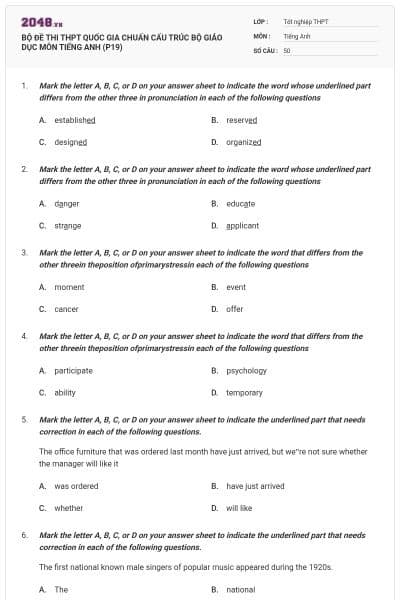
Mark the letter A, B, C, or D on your answer sheet to indicate the word whose underlined part differs from the other three in pronunciation in each of the following questions
established
reserved
designed
organized
Đáp án A
established /ɪˈstæblɪʃt/ designed /dɪˈzaɪnd/
reserved /rɪˈzɜːvd/ organized /ˈɔːɡənaɪzd/
Phần gạch chân ở câu A phát âm là /t/ còn lại phát âm là /d/
Mark the letter A, B, C, or D on your answer sheet to indicate the word whose underlined part differs from the other three in pronunciation in each of the following questions
danger
educate
strange
applicant
Đáp án D
danger /ˈdeɪndʒə(r)/ strange /streɪndʒ/
educate /ˈedʒukeɪt/ applicant /ˈæplɪkənt/
Phần được gạch chân ở câu D phát âm là /æ/ còn lại phát âm là /eɪ/
Mark the letter A, B, C, or D on your answer sheet to indicate the word that differs from the other threein theposition ofprimarystressin each of the following questions
moment
event
cancer
offer
Đáp án B
moment /ˈməʊmənt/ cancer /ˈkænsə(r)/
event /ɪˈvent/ offer /ˈɒfə(r)/
Câu B trọng âm 2 còn lại trọng âm 1
Mark the letter A, B, C, or D on your answer sheet to indicate the word that differs from the other threein theposition ofprimarystressin each of the following questions
participate
psychology
ability
temporary
Đáp án D
participate /pɑːˈtɪsɪpeɪt/ ability /əˈbɪləti/
psychology /saɪˈkɒlədʒi/ temporary /ˈtemprəri/
Câu D trọng âm 1 còn lại trọng âm 2
Mark the letter A, B, C, or D on your answer sheet to indicate the underlined part that needs correction in each of the following questions.
The office furniture that was ordered last month have just arrived, but we‟re not sure whether the manager will like it
was ordered
have just arrived
whether
will like
Đáp án B
Kiến thức: Sự hòa hợp giữa chủ ngữ và động từ
Chủ ngữ “the office furniture” là danh từ không đếm được nên
have => has
Tạm dịch: Nội thất văn phòng cái mà được đặt từ tháng trước vừa mới dến, nhưng chúng tôi không chắc ngài quản lý sẽ thích nó hay không
Mark the letter A, B, C, or D on your answer sheet to indicate the underlined part that needs correction in each of the following questions.
The first national known male singers of popular music appeared during the 1920s.
The
national
of
appeared
Đáp án B
Kiến thức: Trạng từ đứng trước tính từ
national => nationally
Tạm dịch: Những nam ca sĩ nổi tiếng cả nước đầu tiên của dòng nhạc pop đã xuất hiện trong những năm 1920
Mark the letter A, B, C, or D on your answer sheet to indicate the underlined part that needs correction in each of the following questions.
Dreaming, like all other mental processes, it is a product of the brain and its activity.
like all
it is
of the brain
its activity
Đáp án B
Kiến thức: S [ dreaming] + V [ is]
Ving là chủ ngữ động từ luôn ở dạng số ít.
it is => is
Tạm dịch: Mơ, cũng giống như các quá trình tâm hồn khác, là sản phẩm của não và hoạt động của nó
Mark the letter A, B, C, or D on your answer sheet to indicate the correct answer to each of the following questions.
My supervisor is angry with me. I didn't do all the work I ______ last week
should have done
may have done
need to have done
must have done
Đáp án A
Should have Ved/ V3: đáng lẽ ra nên
May have Ved/ V3: chắc có lẽ đã....
Must have Ved/ V3: chắc có lẽ đã
Tạm dịch: Người giám sát nổi giận với tôi. Tôi đã không làm tất cả những công việc mà đáng lẽ ra tôi nên làm tuần trước.
Mark the letter A, B, C, or D on your answer sheet to indicate the correct answer to each of the following questions.
She is very absent-minded: she ______ her cellphone three times
has lost
loses
was losing
had lost
Đáp án: A
Giải thích:
Kiến thức: Thì của động từ
Dấu hiệu nhận biết: “three times” (ba lần), chỉ số lần làm gì. Ngoài ra, câu đầu dùng “is” – thì hiện tại đơn, vế sau ta dùng thì hiện tại hoàn thành.
Cấu trúc: S + have/has + VpII
Chọn đáp án A.
Dịch: Cô ấy rất đãng trí: cô ấy đã mất điện thoại 3 lần.
Mark the letter A, B, C, or D on your answer sheet to indicate the correct answer to each of the following questions.
Whenever he had an important decision to make, he ______ a cigar to calm his nerves.
would light
would be lighting
would have lit
had lit
Đáp án A
Kiến thức: would + Vo: mô tả thói quen, hành động thường xảy ra trong quá khư.
Tạm dịch: Bất cứ khi nào đưa ra quyết định quan trọng, anh ấy l hút thuốc để tỉnh táo
Mark the letter A, B, C, or D on your answer sheet to indicate the correct answer to each of the following questions.
He always ______ the crossword in the newspaper before breakfast
writes
makes
works
does
Đáp án D
Cụm từ: do crossword [ chơi trò chơi ô chữ ]
Tạm dịch: Anh ấy luôn chơi trò chơi ô chữ trong tờ báo trước khi ăn sáng
Mark the letter A, B, C, or D on your answer sheet to indicate the correct answer to each of the following questions.
Not until the end of the 19th century ______ become a scientific discipline.
plant breeding has
did plant breeding
plant breeding had
has plant breeding
Đáp án B
Kiến thức: Not until + thời gian trong quá khứ + did + S + Vo [ mãi cho đến khi...thì...]
Tạm dịch: Mãi cho đến cuối thế kỷ 19 thì trông cây đã trở thành một quy tắc khoa học.
Mark the letter A, B, C, or D on your answer sheet to indicate the correct answer to each of the following questions.
"How can you live in this messy room? Go and ______ it up at once."
dust
sweep
tidy
do
Đáp án C
Kiến thức: cụm từ tidy up [ dọn dẹp]
do up: trang trí/ sửa chữa
Tạm dịch: “ Làm sao bạn có thể sống trong căn phòng bừa bộn như vậy được? Đi và dọn dẹp ngay đi.”
Mark the letter A, B, C, or D on your answer sheet to indicate the correct answer to each of the following questions.
This factory produced ______ motorbikes in 2008 as in the year 2006
twice as many
as twice as many
as twice many
as many as twice
Đáp án A
Kiến thức: so sánh gấp bao nhiêu lần
số lần + as + tính từ + as
Tạm dịch: Nhà máy này sản xuất xe máy năm 2008 nhiều gấp hai lần năm 2006.
Mark the letter A, B, C, or D on your answer sheet to indicate the correct answer to each of the following questions.
Preparing for a job interview can be very ______.
stress
stressful
stressed
stressing
Đáp án: B
Giải thích:
Kiến thức: Từ vựng – Từ loại
A. stress (n): áp lực, sự căng thẳng
B. stressful (adj): căng thẳng
C. stressed (adj): bị căng thẳng, cảm thấy căng thẳng
D. stressing (v-ing): làm cho căng thẳng
Vị trí cần điền đứng sau “to be”, cần một tính từ đứng làm bổ ngữ cho chủ ngữ.
Dựa vào nghĩa, chọn B.
Dịch: Việc chuẩn bị phỏng vấn việc làm rất là căng thẳng.Mark the letter A, B, C, or D on your answer sheet to indicate the correct answer to each of the following questions.
In many big cities, people have to ______ up with noise, overcrowding and bad air.
keep
catch
face
put
Đáp án D
Cụm động từ:
Keep up with: đuổi kịp/ theo kịp = Catch up with: theo kịp
Face up to/ be faced with : đối mặt
Put up with: chịu đựng
Tạm dịch: Ở nhiều thành phố lớn, mọi người phải chịu đựng tiếng ồn, quá đông đúc và không khí ô nhiễm
Mark the letter A, B, C, or D on your answer sheet to indicate the correct answer to each of the following questions.
Had she worked harder last summer, she ______.
wouldn't have been sacked
wouldn't have sacked
wouldn't sack
wouldn't be sacked
Đáp án A
Kiến thức: Đảo ngữ câu điều kiện loại 3 Had + S + Ved/ V3, S + would/ could have Ved/ V3 =>loại C và D
Tạm dịch: Nếu mùa hè năm ngoái cô ấy làm việc chăm chỉ hơn, cô ấy sẽ không bị sa thải
Mark the letter A, B, C, or D on your answer sheet to indicate the correct answer to each of the following questions.
Nobody‟s got to stay late this evening, _______?
is it
have they
isn’t it
isn’t it
Đáp án B
Kiến thức: Câu hỏi đuôi Thể phủ định ( nobody), trợ động từ + S?
Tạm dịch: Tối nay không ai ở lại muộn, phải không?
Mark the letter A, B, C, or D on your answer sheet to indicate the correct answer to each of the following questions.
With hard work and study, you can ______ the goals you set for yourself
establish
succeed
achieve
increase
Đáp án C
Cụm từ:
achieve goal [ đạt được mục tiêu] succeed: thành công
establish: thành lập increase: tăng
Tạm dịch: Với sự học tập và làm việc chăm chỉ, bạn có thể đạt được mục tiêu đã đề ra.
Mark the letter A, B, C, or D on your answer sheet to indicate the most suitable response to complete each of the following exchanges.
- "Our team has just won the last football match."
- "______"
Good idea. Thanks for the news
Yes. I guess it's very good
Well, that's very surprising!
Yes, it's our pleasure
Đáp án C
-“ Đội của chúng ta vừa mới thắng trận bóng đá vừa qua.”
A.Ý kiến hay đó. Cảm ơn vì tin tức. C. À, thật là rất ngạc nhiên.
B. Có. Mình đoán nó rất tốt. D. Có. Đó là niềm vinh hạnh của chúng tôi.
Mark the letter A, B, C, or D on your answer sheet to indicate the most suitable response to complete each of the following exchanges.
- "I can't speak English well enough to apply for that post."
- "______."
Me neither
Me too
Me either
Me also
Đáp án A
-“Tôi không thể nói tiếng Anh đủ tốt để xin vào vị trí đó.”
- Tôi cũng không.
Để diễn tả ý cũng không làm được việc gì đó ta dùng S+ trợ động từ + “not” + either.
Neither + trợ động từ + S.
Tân ngữ + neither.
Mark the letter A, B, C, or D on your answer sheet to indicate the word(s) CLOSEST in meaning to theunderlinedword(s) in each of the following questions.
Other experiments were undertaken in Europe and America, but the arc light eventually proved impractical because it burned out too quickly
funded
discovered
failed
carried out
Đáp án D
undertake:tiến hành
fund: gây quỹ fail: thất bại
discover: khám phá carry out tiến hành
=>undertake = carry out
Tạm dịch: Những thí nghiệm khác đã được tiến hành ở châu Âu và châu Mỹ, nhưng đền hình cung cuối cùng đã chứng minh là không thực tế vì nó cháy quá nhanh
Mark the letter A, B, C, or D on your answer sheet to indicate the word(s) CLOSEST in meaning to theunderlinedword(s) in each of the following questions.
He surprised me in a later conversation by mentioning he was taking steps to remedy the problem
understand
improve
face
encounter
Đáp án B
remedy:xoa dịu/ cải thiện
understand: hiểu face: đối mặt
improve: cải thiện encounter: gặp phải
=>remedy = improve
Tạm dịch: Anh ấy làm tôi ngạc nhiên ở đoạn đối thoại sau đó bằng việc đề cập đến tiến hành các biện pháp để khắc phục vấn đề
Mark the letter A, B, C, orD on youranswersheetto indicate the word(s) OPPOSITE in meaningto theunderlinedword(s) in each of the following questions.
I take my hat off to all those people who worked hard to get the contract
admire
congratulate
treasure
disregard
Đáp án D
Thành ngữ: take my hat off [ trân trọng/ tôn trọng]
admire: ngưỡng mộ treasure: trân trọng
congratulate: chúc mừng disregard: không trân trọng
=>take my hat off >< disregard
Tạm dịch: Tôi tôn trọng những người làm việc chăm chỉ để có được hợp đồng
Mark the letter A, B, C, orD on youranswersheetto indicate the word(s) OPPOSITE in meaningto theunderlinedword(s) in each of the following questions.
This flat is a far cry from the house they had before
be completely different
be exactly the same
be better than
be worse than
Đáp án B
a far cry from = a very different experience from something
A.hoàn toàn khác C. tốt hơn
B. giống chính xác D. tệ hơn
=>a far cry from >< be exactly the same
Tạm dịch: Ngôi nhà này khác hoàn toàn ngôi nhà mà họ đã có trước đó
Mark the letter A, B, C, or D on your answer sheet to indicate the sentence that is closest in meaning to each of the following questions.
“It’s not true! I have never been arrested.”
Harry denied ever having been arrested
Harry denied not having been arrested
Harry said that it was not true to have been arrested
Harry refused having been arrested
Đáp án A
Tạm dịch: “ Không đúng! Tôi chưa bao giờ bị bắt giữ”
A.Harry phủ nhận việc đã từng bị bắt giữ.
B. loại, vì đã dùng deny không dùng “not”
C. Harry nói điều đó không đúng để bị bắt giữ.
D. loại, vì refuse + to Vo ( từ chối làm việc gì đó)
Mark the letter A, B, C, or D on your answer sheet to indicate the sentence that is closest in meaning to each of the following questions.
There’s no point in phoning Caroline – she’s away
Don’t waste your time if you phone Caroline
It would be a waste of time phoning Caroline
Don’t save your time to phone Caroline because she’s away
It isn’t a waste of time to phone Caroline
Đáp án B
Tạm dịch: Không có ích gì khi gọi cho Caroline đâu – cô ấy đi vắng rồi.
A.Đừng lãng phí thời gian nếu bạn gọi cho Caroline.
B. Sẽ là lãng phí thời gian khi gọi cho Caroline.
It + be a waste of time + Ving: lãng phí thời gian làm gì đó
C. Đừng tiết kiệm thời gian để gọi cho Caroline vì cô ấy đi xa rồi.
D. Không phải là lãng phí thời gian khi gọi cho Caroline
Mark the letter A, B, C, or D on your answer sheet to indicate the sentence that is closest in meaning to each of the following questions.
Under no circumstances should you press both buttons at once
Neither of the buttons shouldn’t be pressed at once under any circumstances
Both buttons should’t be pressed at once under no circumstances
You should not press both buttons at once under any circumstances
Pressing both buttons at once should be performed under any circumstances
Đáp án C
Tạm dịch: Với bất cứ tính huống nào bạn không nên ấn cả 2 nút cùng một lúc.
A.loại, vì đã dùng “neither” thì không được dùng “not”
B. loại, vì đã dùng “not” thì phía sau không dùng “no”
C. Bạn không nên ấn cả hai nút cùng một lúc dưới bất cứ tình huống nào.
D. Việc ấn cả hai nút cùng một lúc nên được thực hiện dưới bất cứ tình huống nào.
Mark the letter A, B, C, or D on your answer sheet to indicate the sentence that best combines each pair of sentences in the following questions.
We couldn’t squeeze through the door. It was very narrow.
We couldn’t squeeze through the door, which it was very narrow
Since the door was very narrow, that we couldn’t squeeze through it
The door was so narrow for us to squeeze through
So narrow was the door that we couldn’t squeeze through
Đáp án D
Tạm dịch: Chúng ta không thể len lõi qua cách cửa được. Nó rất hẹp.
A.loại, vì không thể dùng đồng thời “which” và “it”.
B. loại, vì không dùng dấu phẩy trước “that”
C. loại, vì sai cấu trúc “so” sửa thành “too”
D. Cấu trúc đảo ngữ với “ so...that...”
So + adj + be + S + that + S + V: quá ...đến nỗi mà
Cánh cửa quá hẹp đến nỗi mà chúng tôi không thể len lõi qua được
Mark the letter A, B, C, or D on your answer sheet to indicate the sentence that best combines each pair of sentences in the following questions.
You must read the instructions. You won’t know how to use this machine without reading them
Reading the instructions, so you will know how to use this machine
Without reading the instructions, the use of this machine won’t be known
Unless you read the instructions, you won’t know how to use this machine
You will know how to use this machine unless you read the instructions
Đáp án C
Tạm dịch: Bạn phải đọc những hướng dẫn này. Bạn sẽ không biết cách sử dụng cái máy này nếu không đọc chúng.
A. Đọc hướng dẫn này, vì vậy bạn sẽ biết cách sử dụng cái máy này.
B. Không đọc hướng dẫn, việc sử dụng cái máy này sẽ không được biết.
C. Nếu bạn không đọc những hướng dẫn, bạn sẽ không biết cách sử dụng cái máy.
D. Bạn sẽ biết cách sử dụng cái máy nếu không đọc những hướng dẫn
Read the following passage and mark the letter A, B, C, or D on your answer sheet to indicate the correct word or phrase that best fits each of the numbered blanks from 31 to 35.
In the United States and Canada, it is very important to (31) ______ a person directly in the eyes when you are having a conversation with him or her. If you look down or to the side when the (32) ______ person is talking, that person will think that you are not interested in what he or she is saying. This, of course, is not polite. If you look down or to the side when you are talking, it might (33) ______ that you are not honest. However, people who are speaking will sometimes look away for (34) ______ seconds when they are thinking or trying to find the right word. But they always turn immediately back to look the listener directly in the eyes. These social "rules" are (35) ______ for two men, two women, a man and a woman, or an adult and a child.
Điền ô 31
talk
notice
get
look
Đáp án D
talk: trò chuyện get: nhận
notice: thông báo look: nhìn
Cụm từ: look in the eyes [ nhìn thẳng vào mắt] In the United States and Canada, it is very important to (31) ______ a person directly in the eyes when you are having a conversation with him or her.
[ Ở Mỹ và Canada, rất quan trọng khi nói chuyện với một người nhìn vào mắt người đó khi bạn đối thoại với họ]
Read the following passage and mark the letter A, B, C, or D on your answer sheet to indicate the correct word or phrase that best fits each of the numbered blanks from 31 to 35.
In the United States and Canada, it is very important to (31) ______ a person directly in the eyes when you are having a conversation with him or her. If you look down or to the side when the (32) ______ person is talking, that person will think that you are not interested in what he or she is saying. This, of course, is not polite. If you look down or to the side when you are talking, it might (33) ______ that you are not honest. However, people who are speaking will sometimes look away for (34) ______ seconds when they are thinking or trying to find the right word. But they always turn immediately back to look the listener directly in the eyes. These social "rules" are (35) ______ for two men, two women, a man and a woman, or an adult and a child.
Điền ô 32
others
another
one
other
Đáp án D
Others = other + danh từ số nhiều
The other: một...khác ( xác định)
Another: một...khác
If you look down or to the side when the (32) ______ person is talking, that person will think that you are not interested in what he or she is saying.
[ Nếu bạn nhìn xuống hoặc nhìn sang hướng khác khi người khác đang nói, người đó sẽ nghĩ rằng bạn không hứng thú với cái họ đang nói]
Read the following passage and mark the letter A, B, C, or D on your answer sheet to indicate the correct word or phrase that best fits each of the numbered blanks from 31 to 35.
In the United States and Canada, it is very important to (31) ______ a person directly in the eyes when you are having a conversation with him or her. If you look down or to the side when the (32) ______ person is talking, that person will think that you are not interested in what he or she is saying. This, of course, is not polite. If you look down or to the side when you are talking, it might (33) ______ that you are not honest. However, people who are speaking will sometimes look away for (34) ______ seconds when they are thinking or trying to find the right word. But they always turn immediately back to look the listener directly in the eyes. These social "rules" are (35) ______ for two men, two women, a man and a woman, or an adult and a child.
Điền ô 33
seem
become
turn
come
Đáp án A
seem: có vẻ như turn: xoay, chuyển ( hướng)
become: trở nên come: đến
This, of course, is not polite. If you look down or to the side when you are talking, it might (33) ______ that you are not honest.
[ Điều này dĩ nhiên là mất lịch sự. Nếu bạn nhìn xuống hoặc nhìn hướng khác khi bạn đang trò chuyện có vẻ như là bạn không thành thật]
Read the following passage and mark the letter A, B, C, or D on your answer sheet to indicate the correct word or phrase that best fits each of the numbered blanks from 31 to 35.
In the United States and Canada, it is very important to (31) ______ a person directly in the eyes when you are having a conversation with him or her. If you look down or to the side when the (32) ______ person is talking, that person will think that you are not interested in what he or she is saying. This, of course, is not polite. If you look down or to the side when you are talking, it might (33) ______ that you are not honest. However, people who are speaking will sometimes look away for (34) ______ seconds when they are thinking or trying to find the right word. But they always turn immediately back to look the listener directly in the eyes. These social "rules" are (35) ______ for two men, two women, a man and a woman, or an adult and a child.
Điền ô 34
a little
a few
little
few
Đáp án B
A little + danh từ không đếm được: một chút
A few + danh từ số nhiều: một vài
“Little” nghĩa tiêu cự hơn so với “ a little”
“Few” nghĩa tiêu cực hơn “ a few”
However, people who are speaking will sometimes look away for (34) ______ seconds when they are thinking or trying to find the right word.
[ Tuy nhiên những người đang trò chuyện sẽ thỉnh thoảng nhìn chỗ khác một vài giây khi họ đang suy nghĩ hoặc tìm từ thích hợp]
Read the following passage and mark the letter A, B, C, or D on your answer sheet to indicate the correct word or phrase that best fits each of the numbered blanks from 31 to 35.
In the United States and Canada, it is very important to (31) ______ a person directly in the eyes when you are having a conversation with him or her. If you look down or to the side when the (32) ______ person is talking, that person will think that you are not interested in what he or she is saying. This, of course, is not polite. If you look down or to the side when you are talking, it might (33) ______ that you are not honest. However, people who are speaking will sometimes look away for (34) ______ seconds when they are thinking or trying to find the right word. But they always turn immediately back to look the listener directly in the eyes. These social "rules" are (35) ______ for two men, two women, a man and a woman, or an adult and a child.
Điền ô 35
like
the same
likely
such as
Đáp án B
like: giống như ( + danh từ/ mệnh đề) likely (a): có vẻ như
the same + danh từ: giống nhau such as: chẳng hạn như
But they always turn immediately back to look the listener directly in the eyes. These social "rules" are (35) ______ for two men, two women, a man and a woman, or an adult and a child.
[ Nhưng họ luôn quay lại ngay lập tức để nhìn trực tiếp vào mắt người nghe. Những quy tắc xã hội này giống nhau giữa 2 người đàn ông, 2 người phụ nữ, 1 đàn ông và 1 phụ nữ, hoặc 1 người lớn và 1 trẻ con]
Read the following passage andmark the letter A, B, C, or D on your answer sheet to indicate the correctanswerto each ofthe questions from 36to 41.
The Ring of Fire is an enormous chain of volcanoes all around the Pacific Ocean. The ring goes from New Zealand up to Asia and across the ocean to Alaska. From Alaska, the ring continues southward along the coast of both North and South America. More than seventy-five percent of the world's volcanoes are located in this ring. Scientists are interested in studying the Ring of Fire because they can observe plate tectonics at work there. In 1912, a German scientist, Alfred Wegener, came up with the first theory of land movement. Wegener said continents are made up of lighter rocks resting on heavier material. Similar to the way large things move while floating on water, Wegener suggested that the positions of the continents were not fixed, but that they moved slightly. Later, scientists discovered most of Wegener's ideas were right on the mark. They then developed the theory called plate tectonics. According to plate tectonics, the surface of the Earth consists of a number of enormous plates or sections of rock, each about eighty kilometers thick. The plates float and slowly move at speeds between one to ten centimeters every year. That is about the rate your fingernails grow! Within the Ring of Fire, new material for the Earth's plates is constantly being created as hot liquid rock called magma flows from the center of the Earth up to the ocean floor. All the existing plates on the Earth's surface have to move slightly to make room for the new material. As plates move both away from and toward each other, they run into each other. When they hit each other, one plate might move under another. This process is called subduction. Subduction frequently causes earthquakes. It may also result in the bottom plate melting due to the extreme temperatures under the top plate. The magma created in this process can rise to the Earth's surface and come out through volcanoes, as can be seen along the Ring of Fire.
What is the main focus of this reading?
The most active volcanoes found in the Ring of Fire
The location of the Ring of Fire
How the plates on the Earth‟s surface move in different ways
How plate tectonics, volcanoes, and earthquakes are related
Đáp án D
Bài đọc chủ yếu thảo luận về?
A. Những núi lửa năng động nhất được tìm thấy ở Vành đai lửa.
B. Ví trí của Vành đai lửa.
C. Những mảng kiến tạo trên bề mặt Trái Đất di chuyển những hướng khác nhau như thế nào. D. Những mảng kiến tạo , núi lửa, và động đất có liên quan như thế nào.
Read the following passage andmark the letter A, B, C, or D on your answer sheet to indicate the correctanswerto each ofthe questions from 36to 41.
The Ring of Fire is an enormous chain of volcanoes all around the Pacific Ocean. The ring goes from New Zealand up to Asia and across the ocean to Alaska. From Alaska, the ring continues southward along the coast of both North and South America. More than seventy-five percent of the world's volcanoes are located in this ring. Scientists are interested in studying the Ring of Fire because they can observe plate tectonics at work there. In 1912, a German scientist, Alfred Wegener, came up with the first theory of land movement. Wegener said continents are made up of lighter rocks resting on heavier material. Similar to the way large things move while floating on water, Wegener suggested that the positions of the continents were not fixed, but that they moved slightly. Later, scientists discovered most of Wegener's ideas were right on the mark. They then developed the theory called plate tectonics. According to plate tectonics, the surface of the Earth consists of a number of enormous plates or sections of rock, each about eighty kilometers thick. The plates float and slowly move at speeds between one to ten centimeters every year. That is about the rate your fingernails grow! Within the Ring of Fire, new material for the Earth's plates is constantly being created as hot liquid rock called magma flows from the center of the Earth up to the ocean floor. All the existing plates on the Earth's surface have to move slightly to make room for the new material. As plates move both away from and toward each other, they run into each other. When they hit each other, one plate might move under another. This process is called subduction. Subduction frequently causes earthquakes. It may also result in the bottom plate melting due to the extreme temperatures under the top plate. The magma created in this process can rise to the Earth's surface and come out through volcanoes, as can be seen along the Ring of Fire.
The word “fixed” in paragraph 2 is closest in meaning to _______________.
not changing
unstable
moving
floating
Đáp án A
Từ “fixed” [ cố định] ở đoạn 2 gần nghĩa nhất với
A. không thay đổi C. đang di chuyển
B. không ổn định D. nổi lềnh bềnh
Dẫn chứng: Similar to the way large things move while floating on water, Wegener suggested that the positions of the continents were not fixed, but that they moved slightly
Read the following passage andmark the letter A, B, C, or D on your answer sheet to indicate the correctanswerto each ofthe questions from 36to 41.
The Ring of Fire is an enormous chain of volcanoes all around the Pacific Ocean. The ring goes from New Zealand up to Asia and across the ocean to Alaska. From Alaska, the ring continues southward along the coast of both North and South America. More than seventy-five percent of the world's volcanoes are located in this ring. Scientists are interested in studying the Ring of Fire because they can observe plate tectonics at work there. In 1912, a German scientist, Alfred Wegener, came up with the first theory of land movement. Wegener said continents are made up of lighter rocks resting on heavier material. Similar to the way large things move while floating on water, Wegener suggested that the positions of the continents were not fixed, but that they moved slightly. Later, scientists discovered most of Wegener's ideas were right on the mark. They then developed the theory called plate tectonics. According to plate tectonics, the surface of the Earth consists of a number of enormous plates or sections of rock, each about eighty kilometers thick. The plates float and slowly move at speeds between one to ten centimeters every year. That is about the rate your fingernails grow! Within the Ring of Fire, new material for the Earth's plates is constantly being created as hot liquid rock called magma flows from the center of the Earth up to the ocean floor. All the existing plates on the Earth's surface have to move slightly to make room for the new material. As plates move both away from and toward each other, they run into each other. When they hit each other, one plate might move under another. This process is called subduction. Subduction frequently causes earthquakes. It may also result in the bottom plate melting due to the extreme temperatures under the top plate. The magma created in this process can rise to the Earth's surface and come out through volcanoes, as can be seen along the Ring of Fire.
According to the reading, which is true about the Ring of Fire?
All of the volcanoes along the ring are active
Most of the volcanoes on Earth are part of the ring
The ring gets bigger each year
The ring was discovered in the 20th century.
Đáp án B
Theo bài đọc, ý nào đúng về vành đai núi lửa?
A.Tất cả núi lửa dọc vành đai đều hoạt động.
B. Hầu hết những núi lửa trên Trái Đất đều là một phần của vành đai.
C. Mỗi năm vành đai trở nên lớn hơn.
D. Vành đai được khám phá vào thế kỷ 20.
Dẫn chứng: More than seventy-five percent of the world's volcanoes are located in this ring
Read the following passage andmark the letter A, B, C, or D on your answer sheet to indicate the correctanswerto each ofthe questions from 36to 41.
The Ring of Fire is an enormous chain of volcanoes all around the Pacific Ocean. The ring goes from New Zealand up to Asia and across the ocean to Alaska. From Alaska, the ring continues southward along the coast of both North and South America. More than seventy-five percent of the world's volcanoes are located in this ring. Scientists are interested in studying the Ring of Fire because they can observe plate tectonics at work there. In 1912, a German scientist, Alfred Wegener, came up with the first theory of land movement. Wegener said continents are made up of lighter rocks resting on heavier material. Similar to the way large things move while floating on water, Wegener suggested that the positions of the continents were not fixed, but that they moved slightly. Later, scientists discovered most of Wegener's ideas were right on the mark. They then developed the theory called plate tectonics. According to plate tectonics, the surface of the Earth consists of a number of enormous plates or sections of rock, each about eighty kilometers thick. The plates float and slowly move at speeds between one to ten centimeters every year. That is about the rate your fingernails grow! Within the Ring of Fire, new material for the Earth's plates is constantly being created as hot liquid rock called magma flows from the center of the Earth up to the ocean floor. All the existing plates on the Earth's surface have to move slightly to make room for the new material. As plates move both away from and toward each other, they run into each other. When they hit each other, one plate might move under another. This process is called subduction. Subduction frequently causes earthquakes. It may also result in the bottom plate melting due to the extreme temperatures under the top plate. The magma created in this process can rise to the Earth's surface and come out through volcanoes, as can be seen along the Ring of Fire.
What does “subduction” mean in this reading?
Rocks moving under volcanoes
Erupting liquid rock
The theory of moving plates
Movement of a plate under another
Đáp án D
Từ “subduction” trong bài đọc có nghĩa gì?
A. Đá đang di chuyển dưới những núi lửa
B. Nham thạch phun trào
C. Lý thuyết của những mảng kiến tạo chuyển động
D. Sự chuyển động của 1 mảng kiến tạo dưới mảng kiến tạo khác
Dẫn chứng: As plates move both away from and toward each other, they run into each other. When they hit each other, one plate might move under another. This process is called subduction
Read the following passage andmark the letter A, B, C, or D on your answer sheet to indicate the correctanswerto each ofthe questions from 36to 41.
The Ring of Fire is an enormous chain of volcanoes all around the Pacific Ocean. The ring goes from New Zealand up to Asia and across the ocean to Alaska. From Alaska, the ring continues southward along the coast of both North and South America. More than seventy-five percent of the world's volcanoes are located in this ring. Scientists are interested in studying the Ring of Fire because they can observe plate tectonics at work there. In 1912, a German scientist, Alfred Wegener, came up with the first theory of land movement. Wegener said continents are made up of lighter rocks resting on heavier material. Similar to the way large things move while floating on water, Wegener suggested that the positions of the continents were not fixed, but that they moved slightly. Later, scientists discovered most of Wegener's ideas were right on the mark. They then developed the theory called plate tectonics. According to plate tectonics, the surface of the Earth consists of a number of enormous plates or sections of rock, each about eighty kilometers thick. The plates float and slowly move at speeds between one to ten centimeters every year. That is about the rate your fingernails grow! Within the Ring of Fire, new material for the Earth's plates is constantly being created as hot liquid rock called magma flows from the center of the Earth up to the ocean floor. All the existing plates on the Earth's surface have to move slightly to make room for the new material. As plates move both away from and toward each other, they run into each other. When they hit each other, one plate might move under another. This process is called subduction. Subduction frequently causes earthquakes. It may also result in the bottom plate melting due to the extreme temperatures under the top plate. The magma created in this process can rise to the Earth's surface and come out through volcanoes, as can be seen along the Ring of Fire.
What is NOT a result of shifting tectonic plates?
Earthquakes
Extreme temperatures inside the Earth
Volcanoes
Subduction
Đáp án B
Cái nào không phải là kết quả của sự dịch chuyển những mảng kiến tạo?
A. Động đất
B. Nhiệt độ khắc nghiệt bên trong trái đất.
C. Núi lửa
D. Sự dịch chuyển mảng kiến tạo dưới mảng khác
Dẫn chứng: Subduction frequently causes earthquakes. It may also result in the bottom plate melting due to the extreme temperatures under the top plate. The magma created in this process can rise to the Earth's surface and come out through volcanoes, as can be seen along the Ring of Fire
Read the following passage andmark the letter A, B, C, or D on your answer sheet to indicate the correctanswerto each ofthe questions from 36to 41.
The Ring of Fire is an enormous chain of volcanoes all around the Pacific Ocean. The ring goes from New Zealand up to Asia and across the ocean to Alaska. From Alaska, the ring continues southward along the coast of both North and South America. More than seventy-five percent of the world's volcanoes are located in this ring. Scientists are interested in studying the Ring of Fire because they can observe plate tectonics at work there. In 1912, a German scientist, Alfred Wegener, came up with the first theory of land movement. Wegener said continents are made up of lighter rocks resting on heavier material. Similar to the way large things move while floating on water, Wegener suggested that the positions of the continents were not fixed, but that they moved slightly. Later, scientists discovered most of Wegener's ideas were right on the mark. They then developed the theory called plate tectonics. According to plate tectonics, the surface of the Earth consists of a number of enormous plates or sections of rock, each about eighty kilometers thick. The plates float and slowly move at speeds between one to ten centimeters every year. That is about the rate your fingernails grow! Within the Ring of Fire, new material for the Earth's plates is constantly being created as hot liquid rock called magma flows from the center of the Earth up to the ocean floor. All the existing plates on the Earth's surface have to move slightly to make room for the new material. As plates move both away from and toward each other, they run into each other. When they hit each other, one plate might move under another. This process is called subduction. Subduction frequently causes earthquakes. It may also result in the bottom plate melting due to the extreme temperatures under the top plate. The magma created in this process can rise to the Earth's surface and come out through volcanoes, as can be seen along the Ring of Fire.
Which question is NOT answered in the reading?
How fast do tectonic plates move
How thick are the plates in tectonic theory
What is the most active volcano today
Where is the Ring of Fire
Đáp án C
Câu hỏi nào không được trả lời trong bài đọc?
A. Những mảng kiến tạo di chuyển nhanh như thế nào?
B. Những mảng kiến tạo trong thuyết kiến tạo dày như thế nào?
C. Núi lửa hoạt động mạnh mẽ nhất ngày nay là gì?
D. Vành đai núi lửa ở đâu?
Dẫn chứng: According to plate tectonics, the surface of the Earth consists of a number of enormous plates or sections of rock, each about eighty kilometers thick. => loại B
The plates float and slowly move at speeds between one to ten centimeters every year. => loại A
The Ring of Fire is an enormous chain of volcanoes all around the Pacific Ocean. The ring goes from New Zealand up to Asia and across the ocean to Alaska. From Alaska, the ring continues southward along the coast of both North and South America. => loại D
Read the following passage andmark the letter A, B, C, or D on your answer sheet to indicate the correctanswerto each ofthe questions from 42 to 50.
On a winter night last June, José Antonio Tuki, a 30-year-old artist on Easter Island, sat on Anakena beach and stared at the enormous human statues there – the moai. The statues are from four feet tall to 33 feet tall. Some weigh more than 80 tons. They were carved a long time ago, with stone tools, and then they were
moved up to 11 miles to the beach. Tuki stares at their faces and he feels a connection. ‘This is something that was produced by my ancestors’, he says. ‘How did they do it?’
The first Polynesians arrived at Rapa Nui (Easter Island), probably by canoe, hundreds of years ago. The island is 2,150 miles west of South America and 1,300 miles east of its nearest inhabited neighbour, Pitcairn. Nowadays 12 flights arrive every week from Chile, Peru and Tahiti. In 2011, 50,000 tourists – ten times the
island’s population – flew to Easter Island. Almost all of the jobs on Easter Island depend on tourism. And the tourists go there for only one thing: the moai. People around the world became curious about the statues after the Norwegian adventurer Thor Heyerdahl made Easter Island famous, and there are different theories about how the statues were moved to the beach. Many researchers think the statues were pulled along the ground using ropes and wood. Pulitzer Prize winner Jared Diamond has suggested that many people were needed to build and move the
moai. As a result, the island’s trees were cut down for wood and to create farming land. This open land was
fragile and it was soon eroded by the strong winds, so it was very difficult to grow food. The situation was an early example of an ecological disaster, according to Diamond. On the other hand, archaeologists Terry Hunt of the University of Hawaii and Carl Lipo of California State
University Long Beach have a more positive view of the island’s history. They suggest that the inhabitants actually pioneered a type of sustainable farming – they built thousands of circular stone walls, called manavai, and grew food inside them. And their theory about how the moai were moved is that they were ‘walked’ along using a system of only ropes and a few people.
As José Tuki contemplates these enormous statues, he doesn’t mind that there are no definite answers about the history of his island. ‘I want to know the truth,’ he says, ‘but maybe knowing everything would take its power away’.
The Easter Island statues __________.
are new constructions to attract tourists
aren’t completely understood by archaeologists
were destroyed by the islanders
were made by José Antonio Tuki.
Đáp án B
Những bức tượng đảo Easter................
A. là những công trình mới thu hút du khách.
B. không được hiểu hoàn toàn bởi các nhà khảo cổ học.
C. đã bị phá hủy bởi người dân trên đảo
D. được tạo ra bởi Jose Antonio Tuki.
Dẫn chứng: As José Tuki contemplates these enormous statues, he doesn‟t mind that there are no definite answers about the history of his island. ‘I want to know the truth,’ he says, ‘but maybe knowing everything would take its power away’
Read the following passage andmark the letter A, B, C, or D on your answer sheet to indicate the correctanswerto each ofthe questions from 42 to 50.
On a winter night last June, José Antonio Tuki, a 30-year-old artist on Easter Island, sat on Anakena beach and stared at the enormous human statues there – the moai. The statues are from four feet tall to 33 feet tall. Some weigh more than 80 tons. They were carved a long time ago, with stone tools, and then they were
moved up to 11 miles to the beach. Tuki stares at their faces and he feels a connection. ‘This is something that was produced by my ancestors’, he says. ‘How did they do it?’
The first Polynesians arrived at Rapa Nui (Easter Island), probably by canoe, hundreds of years ago. The island is 2,150 miles west of South America and 1,300 miles east of its nearest inhabited neighbour, Pitcairn. Nowadays 12 flights arrive every week from Chile, Peru and Tahiti. In 2011, 50,000 tourists – ten times the
island’s population – flew to Easter Island. Almost all of the jobs on Easter Island depend on tourism. And the tourists go there for only one thing: the moai. People around the world became curious about the statues after the Norwegian adventurer Thor Heyerdahl made Easter Island famous, and there are different theories about how the statues were moved to the beach. Many researchers think the statues were pulled along the ground using ropes and wood. Pulitzer Prize winner Jared Diamond has suggested that many people were needed to build and move the
moai. As a result, the island’s trees were cut down for wood and to create farming land. This open land was
fragile and it was soon eroded by the strong winds, so it was very difficult to grow food. The situation was an early example of an ecological disaster, according to Diamond. On the other hand, archaeologists Terry Hunt of the University of Hawaii and Carl Lipo of California State
University Long Beach have a more positive view of the island’s history. They suggest that the inhabitants actually pioneered a type of sustainable farming – they built thousands of circular stone walls, called manavai, and grew food inside them. And their theory about how the moai were moved is that they were ‘walked’ along using a system of only ropes and a few people.
As José Tuki contemplates these enormous statues, he doesn’t mind that there are no definite answers about the history of his island. ‘I want to know the truth,’ he says, ‘but maybe knowing everything would take its power away’.
On Easter Island today, the statues _________.
are very important for the island’s economy
have lost their significance
are abandoned
are regarded as a problem
Đáp án A
Trên đảo Easter ngày nay, những bức tượng....................
A.rất quan trọng với nền kinh tế đảo
B. đã mất đi tầm quan trọng của nó
C. bị bỏ hoang
D. được quan tâm như một vấn đề
Dẫn chứng: Almost all of the jobs on Easter Island depend on tourism. And the tourists go there for only one thing: the moai
Read the following passage andmark the letter A, B, C, or D on your answer sheet to indicate the correctanswerto each ofthe questions from 42 to 50.
On a winter night last June, José Antonio Tuki, a 30-year-old artist on Easter Island, sat on Anakena beach and stared at the enormous human statues there – the moai. The statues are from four feet tall to 33 feet tall. Some weigh more than 80 tons. They were carved a long time ago, with stone tools, and then they were
moved up to 11 miles to the beach. Tuki stares at their faces and he feels a connection. ‘This is something that was produced by my ancestors’, he says. ‘How did they do it?’
The first Polynesians arrived at Rapa Nui (Easter Island), probably by canoe, hundreds of years ago. The island is 2,150 miles west of South America and 1,300 miles east of its nearest inhabited neighbour, Pitcairn. Nowadays 12 flights arrive every week from Chile, Peru and Tahiti. In 2011, 50,000 tourists – ten times the
island’s population – flew to Easter Island. Almost all of the jobs on Easter Island depend on tourism. And the tourists go there for only one thing: the moai. People around the world became curious about the statues after the Norwegian adventurer Thor Heyerdahl made Easter Island famous, and there are different theories about how the statues were moved to the beach. Many researchers think the statues were pulled along the ground using ropes and wood. Pulitzer Prize winner Jared Diamond has suggested that many people were needed to build and move the
moai. As a result, the island’s trees were cut down for wood and to create farming land. This open land was
fragile and it was soon eroded by the strong winds, so it was very difficult to grow food. The situation was an early example of an ecological disaster, according to Diamond. On the other hand, archaeologists Terry Hunt of the University of Hawaii and Carl Lipo of California State
University Long Beach have a more positive view of the island’s history. They suggest that the inhabitants actually pioneered a type of sustainable farming – they built thousands of circular stone walls, called manavai, and grew food inside them. And their theory about how the moai were moved is that they were ‘walked’ along using a system of only ropes and a few people.
As José Tuki contemplates these enormous statues, he doesn’t mind that there are no definite answers about the history of his island. ‘I want to know the truth,’ he says, ‘but maybe knowing everything would take its power away’.
The people of Easter Island today _________.
are isolated from the modern world
are often unemployed
are very rich
depend on foreign visitors
Đáp án D
Người dân trên đảo Easter ngày nay...................
A. bị cô lập với thế giới hiện đại C. rất giàu có
B. thường bị thất nghiệp D. phụ thuộc vào du khách nước ngoài
Read the following passage andmark the letter A, B, C, or D on your answer sheet to indicate the correctanswerto each ofthe questions from 42 to 50.
On a winter night last June, José Antonio Tuki, a 30-year-old artist on Easter Island, sat on Anakena beach and stared at the enormous human statues there – the moai. The statues are from four feet tall to 33 feet tall. Some weigh more than 80 tons. They were carved a long time ago, with stone tools, and then they were
moved up to 11 miles to the beach. Tuki stares at their faces and he feels a connection. ‘This is something that was produced by my ancestors’, he says. ‘How did they do it?’
The first Polynesians arrived at Rapa Nui (Easter Island), probably by canoe, hundreds of years ago. The island is 2,150 miles west of South America and 1,300 miles east of its nearest inhabited neighbour, Pitcairn. Nowadays 12 flights arrive every week from Chile, Peru and Tahiti. In 2011, 50,000 tourists – ten times the
island’s population – flew to Easter Island. Almost all of the jobs on Easter Island depend on tourism. And the tourists go there for only one thing: the moai. People around the world became curious about the statues after the Norwegian adventurer Thor Heyerdahl made Easter Island famous, and there are different theories about how the statues were moved to the beach. Many researchers think the statues were pulled along the ground using ropes and wood. Pulitzer Prize winner Jared Diamond has suggested that many people were needed to build and move the
moai. As a result, the island’s trees were cut down for wood and to create farming land. This open land was
fragile and it was soon eroded by the strong winds, so it was very difficult to grow food. The situation was an early example of an ecological disaster, according to Diamond. On the other hand, archaeologists Terry Hunt of the University of Hawaii and Carl Lipo of California State
University Long Beach have a more positive view of the island’s history. They suggest that the inhabitants actually pioneered a type of sustainable farming – they built thousands of circular stone walls, called manavai, and grew food inside them. And their theory about how the moai were moved is that they were ‘walked’ along using a system of only ropes and a few people.
As José Tuki contemplates these enormous statues, he doesn’t mind that there are no definite answers about the history of his island. ‘I want to know the truth,’ he says, ‘but maybe knowing everything would take its power away’.
Studying the moai __________.
can tell us about the people who lived on the island
is important to the farmers on Easter Island
helps us to understand the art of José Tuki
is not important to the people on Easter Island
Đáp án A
Việc nghiên cứu những bức tượng mặt người................
A. có thể cho chúng ta biết về những người từng sống trên đảo.
B. quan trọng đối với nông dân trên đảo Easter
C. giúp chúng ta hiểu về nghệ thuật của Jose Tuki
D. không quan trọng đối với người trên đảo Easter.
Dẫn chứng: . ‘This is something that was produced by my ancestors,’ he says. ‘How did they do it?
Read the following passage andmark the letter A, B, C, or D on your answer sheet to indicate the correctanswerto each ofthe questions from 42 to 50.
On a winter night last June, José Antonio Tuki, a 30-year-old artist on Easter Island, sat on Anakena beach and stared at the enormous human statues there – the moai. The statues are from four feet tall to 33 feet tall. Some weigh more than 80 tons. They were carved a long time ago, with stone tools, and then they were
moved up to 11 miles to the beach. Tuki stares at their faces and he feels a connection. ‘This is something that was produced by my ancestors’, he says. ‘How did they do it?’
The first Polynesians arrived at Rapa Nui (Easter Island), probably by canoe, hundreds of years ago. The island is 2,150 miles west of South America and 1,300 miles east of its nearest inhabited neighbour, Pitcairn. Nowadays 12 flights arrive every week from Chile, Peru and Tahiti. In 2011, 50,000 tourists – ten times the
island’s population – flew to Easter Island. Almost all of the jobs on Easter Island depend on tourism. And the tourists go there for only one thing: the moai. People around the world became curious about the statues after the Norwegian adventurer Thor Heyerdahl made Easter Island famous, and there are different theories about how the statues were moved to the beach. Many researchers think the statues were pulled along the ground using ropes and wood. Pulitzer Prize winner Jared Diamond has suggested that many people were needed to build and move the
moai. As a result, the island’s trees were cut down for wood and to create farming land. This open land was
fragile and it was soon eroded by the strong winds, so it was very difficult to grow food. The situation was an early example of an ecological disaster, according to Diamond. On the other hand, archaeologists Terry Hunt of the University of Hawaii and Carl Lipo of California State
University Long Beach have a more positive view of the island’s history. They suggest that the inhabitants actually pioneered a type of sustainable farming – they built thousands of circular stone walls, called manavai, and grew food inside them. And their theory about how the moai were moved is that they were ‘walked’ along using a system of only ropes and a few people.
As José Tuki contemplates these enormous statues, he doesn’t mind that there are no definite answers about the history of his island. ‘I want to know the truth,’ he says, ‘but maybe knowing everything would take its power away’.
The moai __________.
are statues of animals
are all the same size
were made by José Tuki‟s ancestors
are small human statues.
Đáp án C
Những bức tượng mặt người.......................
A. là tượng của động vật
B. cùng kích thước
C. được tạo bởi tổ tiên của Jose Tuki
D. là những tượng người nhỏ
Dẫn chứng: ‘This is something that was produced by my ancestors,’ he says
Read the following passage andmark the letter A, B, C, or D on your answer sheet to indicate the correctanswerto each ofthe questions from 42 to 50.
On a winter night last June, José Antonio Tuki, a 30-year-old artist on Easter Island, sat on Anakena beach and stared at the enormous human statues there – the moai. The statues are from four feet tall to 33 feet tall. Some weigh more than 80 tons. They were carved a long time ago, with stone tools, and then they were
moved up to 11 miles to the beach. Tuki stares at their faces and he feels a connection. ‘This is something that was produced by my ancestors’, he says. ‘How did they do it?’
The first Polynesians arrived at Rapa Nui (Easter Island), probably by canoe, hundreds of years ago. The island is 2,150 miles west of South America and 1,300 miles east of its nearest inhabited neighbour, Pitcairn. Nowadays 12 flights arrive every week from Chile, Peru and Tahiti. In 2011, 50,000 tourists – ten times the
island’s population – flew to Easter Island. Almost all of the jobs on Easter Island depend on tourism. And the tourists go there for only one thing: the moai. People around the world became curious about the statues after the Norwegian adventurer Thor Heyerdahl made Easter Island famous, and there are different theories about how the statues were moved to the beach. Many researchers think the statues were pulled along the ground using ropes and wood. Pulitzer Prize winner Jared Diamond has suggested that many people were needed to build and move the
moai. As a result, the island’s trees were cut down for wood and to create farming land. This open land was
fragile and it was soon eroded by the strong winds, so it was very difficult to grow food. The situation was an early example of an ecological disaster, according to Diamond. On the other hand, archaeologists Terry Hunt of the University of Hawaii and Carl Lipo of California State
University Long Beach have a more positive view of the island’s history. They suggest that the inhabitants actually pioneered a type of sustainable farming – they built thousands of circular stone walls, called manavai, and grew food inside them. And their theory about how the moai were moved is that they were ‘walked’ along using a system of only ropes and a few people.
As José Tuki contemplates these enormous statues, he doesn’t mind that there are no definite answers about the history of his island. ‘I want to know the truth,’ he says, ‘but maybe knowing everything would take its power away’.
Jared Diamond thinks that _________.
the forest resources on Easter Island were poor
there were never any forests on Easter Island
the people on Easter Island used to be very poor
it became difficult to grow food after the forests were cut down
Đáp án D
Jared Diamond nghĩ rằng....................
A. nguồn tài nguyên rừng trên đảo Easter thì nghèo nàn.
B. chưa bao giờ có rừng trên đảo Easter.
C. người trên đảo Easter đã từng rất nghèo
D. nó trở nên khó trồng thực phẩm sau khi rừng bị chặt
Dẫn chứng: As a result, the island‟s trees were cut down for wood and to create farming land. This open land was fragile and it was soon eroded by the strong winds, so it was very difficult to grow food
Read the following passage andmark the letter A, B, C, or D on your answer sheet to indicate the correctanswerto each ofthe questions from 42 to 50.
On a winter night last June, José Antonio Tuki, a 30-year-old artist on Easter Island, sat on Anakena beach and stared at the enormous human statues there – the moai. The statues are from four feet tall to 33 feet tall. Some weigh more than 80 tons. They were carved a long time ago, with stone tools, and then they were
moved up to 11 miles to the beach. Tuki stares at their faces and he feels a connection. ‘This is something that was produced by my ancestors’, he says. ‘How did they do it?’
The first Polynesians arrived at Rapa Nui (Easter Island), probably by canoe, hundreds of years ago. The island is 2,150 miles west of South America and 1,300 miles east of its nearest inhabited neighbour, Pitcairn. Nowadays 12 flights arrive every week from Chile, Peru and Tahiti. In 2011, 50,000 tourists – ten times the
island’s population – flew to Easter Island. Almost all of the jobs on Easter Island depend on tourism. And the tourists go there for only one thing: the moai. People around the world became curious about the statues after the Norwegian adventurer Thor Heyerdahl made Easter Island famous, and there are different theories about how the statues were moved to the beach. Many researchers think the statues were pulled along the ground using ropes and wood. Pulitzer Prize winner Jared Diamond has suggested that many people were needed to build and move the
moai. As a result, the island’s trees were cut down for wood and to create farming land. This open land was
fragile and it was soon eroded by the strong winds, so it was very difficult to grow food. The situation was an early example of an ecological disaster, according to Diamond. On the other hand, archaeologists Terry Hunt of the University of Hawaii and Carl Lipo of California State
University Long Beach have a more positive view of the island’s history. They suggest that the inhabitants actually pioneered a type of sustainable farming – they built thousands of circular stone walls, called manavai, and grew food inside them. And their theory about how the moai were moved is that they were ‘walked’ along using a system of only ropes and a few people.
As José Tuki contemplates these enormous statues, he doesn’t mind that there are no definite answers about the history of his island. ‘I want to know the truth,’ he says, ‘but maybe knowing everything would take its power away’.
Hunt and Lipo‟s theory about the movement of the statues involves using ________.
wood and stone
ropes and people
wood and ropes.
ropes and stone
Đáp án B
Lý thuyết của Hunt và Lipo về việc di chuyển những bức tượng này bao gồm việc sử dụng.............
A. gỗ và đá C. gỗ và dây thừng
B. dây thừng và con người D. dây thừng và đá
Dẫn chứng: And their theory about how the moai were moved is that they were ‘walked’ along using a system of only ropes and a few people
Read the following passage andmark the letter A, B, C, or D on your answer sheet to indicate the correctanswerto each ofthe questions from 42 to 50.
On a winter night last June, José Antonio Tuki, a 30-year-old artist on Easter Island, sat on Anakena beach and stared at the enormous human statues there – the moai. The statues are from four feet tall to 33 feet tall. Some weigh more than 80 tons. They were carved a long time ago, with stone tools, and then they were
moved up to 11 miles to the beach. Tuki stares at their faces and he feels a connection. ‘This is something that was produced by my ancestors’, he says. ‘How did they do it?’
The first Polynesians arrived at Rapa Nui (Easter Island), probably by canoe, hundreds of years ago. The island is 2,150 miles west of South America and 1,300 miles east of its nearest inhabited neighbour, Pitcairn. Nowadays 12 flights arrive every week from Chile, Peru and Tahiti. In 2011, 50,000 tourists – ten times the
island’s population – flew to Easter Island. Almost all of the jobs on Easter Island depend on tourism. And the tourists go there for only one thing: the moai. People around the world became curious about the statues after the Norwegian adventurer Thor Heyerdahl made Easter Island famous, and there are different theories about how the statues were moved to the beach. Many researchers think the statues were pulled along the ground using ropes and wood. Pulitzer Prize winner Jared Diamond has suggested that many people were needed to build and move the
moai. As a result, the island’s trees were cut down for wood and to create farming land. This open land was
fragile and it was soon eroded by the strong winds, so it was very difficult to grow food. The situation was an early example of an ecological disaster, according to Diamond. On the other hand, archaeologists Terry Hunt of the University of Hawaii and Carl Lipo of California State
University Long Beach have a more positive view of the island’s history. They suggest that the inhabitants actually pioneered a type of sustainable farming – they built thousands of circular stone walls, called manavai, and grew food inside them. And their theory about how the moai were moved is that they were ‘walked’ along using a system of only ropes and a few people.
As José Tuki contemplates these enormous statues, he doesn’t mind that there are no definite answers about the history of his island. ‘I want to know the truth,’ he says, ‘but maybe knowing everything would take its power away’.
The word “fragile” in paragraph 4 is closest in meaning to ________.
easily broken
firm
hard
dry
Đáp án A
Từ “fragile” ở đoạn 4 gần nghĩa nhất với....................
A. dễ vỡ C. cứng
B. chắc/ chặt D. khô
Dẫn chứng: This open land was fragile and it was soon eroded by the strong winds, so it was very difficult to grow food
Read the following passage andmark the letter A, B, C, or D on your answer sheet to indicate the correctanswerto each ofthe questions from 42 to 50.
On a winter night last June, José Antonio Tuki, a 30-year-old artist on Easter Island, sat on Anakena beach and stared at the enormous human statues there – the moai. The statues are from four feet tall to 33 feet tall. Some weigh more than 80 tons. They were carved a long time ago, with stone tools, and then they were
moved up to 11 miles to the beach. Tuki stares at their faces and he feels a connection. ‘This is something that was produced by my ancestors’, he says. ‘How did they do it?’
The first Polynesians arrived at Rapa Nui (Easter Island), probably by canoe, hundreds of years ago. The island is 2,150 miles west of South America and 1,300 miles east of its nearest inhabited neighbour, Pitcairn. Nowadays 12 flights arrive every week from Chile, Peru and Tahiti. In 2011, 50,000 tourists – ten times the
island’s population – flew to Easter Island. Almost all of the jobs on Easter Island depend on tourism. And the tourists go there for only one thing: the moai. People around the world became curious about the statues after the Norwegian adventurer Thor Heyerdahl made Easter Island famous, and there are different theories about how the statues were moved to the beach. Many researchers think the statues were pulled along the ground using ropes and wood. Pulitzer Prize winner Jared Diamond has suggested that many people were needed to build and move the
moai. As a result, the island’s trees were cut down for wood and to create farming land. This open land was
fragile and it was soon eroded by the strong winds, so it was very difficult to grow food. The situation was an early example of an ecological disaster, according to Diamond. On the other hand, archaeologists Terry Hunt of the University of Hawaii and Carl Lipo of California State
University Long Beach have a more positive view of the island’s history. They suggest that the inhabitants actually pioneered a type of sustainable farming – they built thousands of circular stone walls, called manavai, and grew food inside them. And their theory about how the moai were moved is that they were ‘walked’ along using a system of only ropes and a few people.
As José Tuki contemplates these enormous statues, he doesn’t mind that there are no definite answers about the history of his island. ‘I want to know the truth,’ he says, ‘but maybe knowing everything would take its power away’.
The story of the moai can teach us lessons about _________.
our interaction with the environment
the role of art in society.
island communities
ecological disasters
Đáp án A
Câu chuyện của bức tượng mặt người dạy chúng ta những bài học về.................
A.sự tương tác của chúng ta với môi trường.
B. vai trò của nghệ thuật trong xã hội
C. các cộng đồng dân cư đảo
D. những thảm họa sinh thái học