BỘ ĐỀ THI THPT QUỐC GIA CHUẨN CẤU TRÚC BỘ GIÁO DỤC MÔN TIẾNG ANH (P18)
50 câu hỏi
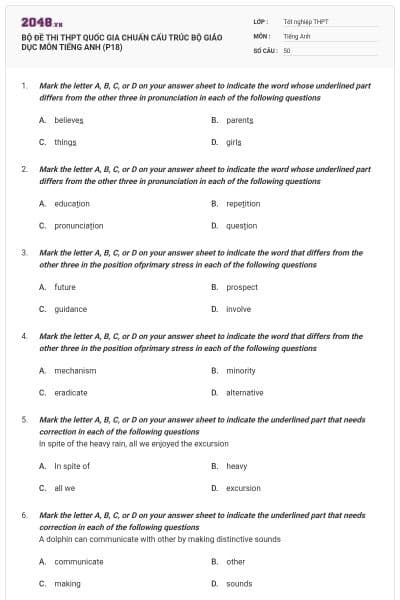
Mark the letter A, B, C, or D on your answer sheet to indicate the word whose underlined part differs from the other three in pronunciation in each of the following questions
believes
parents
things
girls
Đáp án B
believes /bɪˈliːvz/ things /θɪŋz/
parents /ˈpeərənts/ girls /ɡɜːlz/
Phần được gạch chân ở câu B phát âm là /s/ còn lại phát âm là /z/
Mark the letter A, B, C, or D on your answer sheet to indicate the word whose underlined part differs from the other three in pronunciation in each of the following questions
education
repetition
pronunciation
question
Đáp án D
education /ˌedʒuˈkeɪʃn/ pronunciation /prəˌnʌnsiˈeɪʃn/
repetition /ˌrepəˈtɪʃn/ question /ˈkwestʃən/
Phần được gạch chân ở câu D phát âm là /tʃ/ còn lại phát âm là /ʃ/
Mark the letter A, B, C, or D on your answer sheet to indicate the word that differs from the other three in the position ofprimary stress in each of the following questions
future
prospect
guidance
involve
Đáp án D
future /ˈfjuːtʃə(r)/ guidance /ˈɡaɪdns/
prospect /ˈprɒspekt/ involve /ɪnˈvɒlv/
Câu D trọng âm 2 còn lại trọng âm 1
Mark the letter A, B, C, or D on your answer sheet to indicate the word that differs from the other three in the position ofprimary stress in each of the following questions
mechanism
minority
eradicate
alternative
Đáp án A
mechanism /ˈmekənɪzəm/ eradicate /ɪˈrædɪkeɪt/
minority /maɪˈnɒrəti/ alternative /ɔːlˈtɜːnətɪv/
Câu A trọng âm 1 còn lại trọng âm 2
Mark the letter A, B, C, or D on your answer sheet to indicate the underlined part that needs correction in each of the following questions
In spite of the heavy rain, all we enjoyed the excursion
In spite of
heavy
all we
excursion
Đáp án C
Kiến thức: S + trạng ngữ + V
All of + tân ngữ
all we => we all/ all of us
Tạm dịch: Mặc dù mưa to, tất cả chúng tôi đều thích chuyến du hành
Mark the letter A, B, C, or D on your answer sheet to indicate the underlined part that needs correction in each of the following questions
A dolphin can communicate with other by making distinctive sounds
communicate
other
making
sounds
Đáp án B
Kiến thức:
another + (danh từ số ít): một... khác
other + danh từ số nhiều = others: những...khác
other => another
Tạm dịch: Một chú cá heo có thể giao tiếp với chú cá heo khác bằng cách tạo ra những âm thanh riêng biệt
Mark the letter A, B, C, or D on your answer sheet to indicate the underlined part that needs correction in each of the following questions
Opened the letter from her boyfriend, she felt extremely excited
Opened
from
felt
excited
Đáp án A
Kiến thức: Rút gọn hai mệnh đề cùng chủ ngữ khi câu mang nghĩa chủ động dùng V-ing, khi câu mang nghĩa bị động dùng Ved.
Tạm dịch: Mở lá thư nhận từ bạn trai ra xem, cô ấy cảm thấy cực kỳ phấn khởi.
Opened => Opening
Mark the letter A, B, C, or D on your answer sheet to indicate the correct answer to each of the following questions.
She was ______ angry that she could not say a word
so
too much
so many
such
Đáp án A
Kiến thức: Cấu trúc quá...đến nỗi mà...
S + be + so adj that
S + V S + be/ V such a/an + adj + noun + that S + V
Tạm dịch: Cô ấy quá tức giận đến nỗi mà cô ấy không thể nói 1 lời nào
Mark the letter A, B, C, or D on your answer sheet to indicate the correct answer to each of the following questions.
Susan, remember to apply this sun cream ______ two hours
some
several
every
each
Đáp án C
Kiến thức: every two hours [ mỗi 2 giờ]
Some + danh từ số nhiều: một số/ một vài
Several + danh từ số nhiều: một số Each + danh từ số ít: mỗi một
Tạm dịch: Susan, hãy nhớ bôi kem chống nắng mỗi 2 tiếng đồng hồ
Mark the letter A, B, C, or D on your answer sheet to indicate the correct answer to each of the following questions.
Neither Tom nor his brothers ______ willing to help their mother with the housework.
are
was
has been
is
Đáp án A
Kiến thức: Sự hòa hợp giữa chủ ngữ và động từ
Neither S1 nor S2 => động từ chia theo S2 ( his brothers)
Tạm dịch: Không Tom hay các em trai anh ấy sẵn sàng giúp mẹ làm việc nhà
Mark the letter A, B, C, or D on your answer sheet to indicate the correct answer to each of the following questions.
Spain has won the championship, ______ is not surprising
that
how
which
what
Đáp án C
Kiến thức: Mệnh đề quan hệ
Dùng đại từ quan hệ which thay thế cho cả mệnh đề trước nó, trước which phải có dấu phẩy. Tạm dịch: Tây Ban Nha giành được chức vô địch, điều này không ngạc nhiên chút nào
Mark the letter A, B, C, or D on your answer sheet to indicate the correct answer to each of the following questions.
I’d rather you ______ to the English-speaking club with me this Sunday
will come
came
come
to come
Đáp án B
Kiến thức: S1 would rather S2 + Ved/ V2
Tạm dịch: Tôi muốn bạn đến câu lạc bộ nói tiếng Anh với tôi chủ nhật tuần này
Mark the letter A, B, C, or D on your answer sheet to indicate the correct answer to each of the following questions.
Instead of staying around the house all day, you should be out there looking ______ a job.
for
after
into
at
Đáp án A
Kiến thức: Cụm động từ với look
look for: tìm kiếm look into: nhìn vào/ xem xét
look after: chăm sóc look at: nhìn chằm chằm
Tạm dịch: Thay vì ở nhà cả ngày, bạn nên ra khỏi đây tìm việc làm
Mark the letter A, B, C, or D on your answer sheet to indicate the correct answer to each of the following questions.
How long ago ______ to learn French?
have you started
were you starting
would you start
did you start
Đáp án D
Kiến thức: Thì quá khứ đơn S + Ved trong câu có dấu hiệu “ago”
Tạm dịch: Bạn bắt đầu học tiếng Pháp cách đây bao lâu?
Mark the letter A, B, C, or D on your answer sheet to indicate the correct answer to each of the following questions.
No sooner ______ my car than the alarm went off
the thief had touched
had the thief touched
touched the theif
the thief touched
Đáp án B
Kiến thức: Đảo ngữ với No sooner...than...( ngay khi...thì...)
No sooner had + S + Ved/ V3 than S + Ved/ V2
Tạm dịch: Ngay khi tên trộm chạm vào ô tô của tôi thì chuông báo động reo lên.
Mark the letter A, B, C, or D on your answer sheet to indicate the correct answer to each of the following questions.
She passed the National High School Graduation Exam with ______ colours
bright
flying
red
true
Đáp án B
Kiến thức: Cụm từ with flying colours = high mark ( điểm số cao)
Tạm dịch: Cô ấy đỗ kỳ thi trung học phổ thông quốc gia với điểm số rất cao
Mark the letter A, B, C, or D on your answer sheet to indicate the correct answer to each of the following questions.
This carpet really needs ______. Can you do it for me, son?
being cleaned
cleaned
clean
cleaning
Đáp án D
Kiến thức: Động từ “need”
Need + to Vo: cần làm gì ( câu chủ động)
Need + Ving: cần được làm gì ( câu bị động)
Tạm dịch: Chiếc thảm này thật sự cần được làm sạch. Con có thể làm việc đó cho mẹ không, con trai?
Mark the letter A, B, C, or D on your answer sheet to indicate the correct answer to each of the following questions.
I hope you will ______ notice of what I am going to tell you
gain
keep
get
take
Đáp án D
Kiến thức: Cụm động từ
Take notice of = pay attentoin to: chú ý đến
Tạm dịch: Tôi hi vọng bạn sẽ chú ý đến điều mà tôi sắp nói với bạn
Mark the letter A, B, C, or D on your answer sheet to indicate the correct answer to each of the following questions.
He gave ______ his job in order to go back to university
up
in
away
out
Đáp án A
Kiến thức: Cụm động từ với “give”
give up = stop: dừng lại/ từ bỏ give away: vứt đi
give in:chấp nhận làm điều không muốn làm give out: phân phát/ đưa ra
Tạm dịch: Anh ấy từ bỏ công việc để quay trở lại học đại học
Mark the letter A, B, C, or D on your answer sheet to indicate the most suitable response to complete each of the following exchanges.
Jack: “What’s wrong with you?”
Jill: “______.”
Thank you very much
I’m having a slight headache
No, I don’t care
Yes, I was tired yesterday
Đáp án: B
Giải thích:
Dịch: Jack: “Bạn bị sao vậy?”
Jill: “______.”
A. Cảm ơn bạn rất nhiều
B. Tôi hơi đau đầu
C. Không, tôi không quan tâm
D. Vâng, hôm qua tôi mệt
Dựa vào nghĩa, chọn B.
Mark the letter A, B, C, or D on your answer sheet to indicate the most suitable response to complete each of the following exchanges.
Sarah: “Oh my God, I’ve missed my bus.”
Christ: “______. Another will come here in ten minutes.”
I hope so
Don’t mention it
Don’t worry
Thank you
Đáp án C
Sarah: “ Ôi trời ơi, mình lỡ chuyến xe buýt rồi.”
Christ: “..................Một chiếc xe buýt khác sẽ đến trong 10 phút nữa.”
A.Mình hi vọng vậy. C. Đừng lo lắng.
B. Đừng đề cập đến nó. D. Cảm ơn.
Mark the letter A, B, C, or D on your answer sheet to indicate the word(s) CLOSEST in meaning to theunderlinedword(s) in each of the following questions.
A special exhibition of Indian art will be opened at the National Museum next month.
painting
programme
music
show
Đáp án D
exhibition: cuộc triển lãm/ trưng bày
painting: bức vẽ music: âm nhạc
programme: chương trình show: cuộc triển lãm
Tạm dịch: Một buổi triển lãm đặc biệt về nghệ thuật Ấn Độ sẽ được diễn ra tại Bảo tàng quốc gia vào thàng tới
Mark the letter A, B, C, or D on your answer sheet to indicate the word(s) CLOSEST in meaning to theunderlinedword(s) in each of the following questions.
Traffic began to flow normally again after the accident
in the usual or ordinary way
in the usual or ordinary way
strangely and irregularly
repeatedly in different modes
Đáp án B
normally: một cách bình thường
A.cùng tốc độ C. lạ lùng và bất quy tắc
B. theo cách thức bình thường D. lặp đi lặp lại theo những trạng thái khác nhau.
Tạm dịch: Giao thông bắt đầu lưu thông bình thường trở lại sau vụ tại nạn
Mark the letter A, B, C, orD on youranswersheetto indicate the word(s) OPPOSITE in meaningto theunderlinedword(s) in each ofthefollowingquestions.
That afternoon at the railway station I was surprised and made happy by the unexpected arrival of Miss Margaret and her mother, from Oakland
presumed
supposed
informed
anticipated
Đáp án C
unexpected: không mong đợi/ ngoài mong đợi
presume: giả định informed: thông báo
supposed: giả sử anticipated: biết trước =>unexpected >< anticipated
Tạm dịch: Buổi chiều hôm đó ở nhà ga tôi đã ngạc nhiên và hạnh phúc bởi sự xuất hiện ngoài mong đợi của cô Margaret và mẹ cô ấy từ Oakland
Mark the letter A, B, C, orD on youranswersheetto indicate the word(s) OPPOSITE in meaningto theunderlinedword(s) in each ofthefollowingquestions.
Population growth rates vary among regions and even among countries within the same region
restrain
stay unchanged
remain unstable
fluctuate
Đáp án B
vary: thay đổi ( theo tình hình)/ khác nhau
A.kiềm chế/ ngăn lại C. giữ không ổn định
B.giữ nguyên không đổi D. dao động =>vary >< stay unchanged
Tạm dịch: Tỉ lệ tăng trưởng dân số khác nhau giữa các khu vực và thậm chí giữa các quốc gia trong cùng khu vực
Mark the letter A, B, C, or D on your answer sheet to indicate the sentence that is closest in meaning to each of the following questions.
“May I see your passport, Mrs Scott?” said the customs officer
The customs officer asked to see Mrs Scott’s passport
The customs officer suggested seeing Mrs Scott’s passport
The customs officer asked Mrs Scott to see his passport
The customs officer promised to show Mrs Scott his passport.
Đáp án A
Tạm dịch: Nhân viên hải quan nói “ Tôi có thể xem hộ chiếu của bà được không, bà Scott?” A.Nhân viên hải quan yêu cầu xem hộ chiếu của bà Scott.
B. Nhân viên hải quan đề nghị cùng xem hộ chiếu của bà Scott.
C. Nhân viên hải quan yêu cầu bà Scott xem hộ chiếu của ông ấy.
D. Nhân viên hải quan hứa cho bà Scott xem hộ chiếu của ông ấy
Mark the letter A, B, C, or D on your answer sheet to indicate the sentence that is closest in meaning to each of the following questions.
My friend finds driving on the left difficult
My friend didn’t use to drive on the left.
My friend used to drive on the left
My friend isn’t used to driving on the left
My friend didn’t get used to driving on the left
Đáp án C
Tạm dịch: Bạn của tôi cảm thấy việc lái xem bên trái thật khó khăn.
Câu A, B, D loại vì ở thì quá khứ đơn trong khi câu gốc ở thì hiện tại đơn.
Cấu trúc: S + be used to Ving: quen với việc ( gì đó)
C. Bạn tôi không quen với việc lái xe bên trái
Mark the letter A, B, C, or D on your answer sheet to indicate the sentence that is closest in meaning to each of the following questions.
I think it is more enjoyable to play a sport than to watch it on TV
In my view, playing a sport is as enjoyable as watching it on TV
As far as I know, more people watch a sport on TV than they play it
In my opinion, to play a sport is more enjoyable than to watch it on TV
I think watching a sport on TV is more enjoyable than playing it.
Đáp án C
Tạm dịch: Tôi nghĩ sẽ vui hơn khi chơi thể thao hơn là xem nó trên tivi.
A.Theo quan điểm của tôi, chơi thể thao cũng vui như xem trên tivi.
B. Theo như tôi biết, nhiều người xem thể thao trên tivi hơn là chơi nó.
C. Theo ý kiến của tôi, chơi thể thao vui hơn là xem nó trên tivi.
D. Tôi nghĩ xem thể thao trên tivi vui hơn là chơi nó
Mark the letter A, B, C, or D on your answer sheet to indicate the sentence that best combines each pair of sentences in the following questions.
We can get a wonderful meal at a restaurant. I know it
We can get a wonderful meal which I know at a restaurant.
I know a restaurant at where we can get a wonderful meal
The restaurant which I know is where we get a wonderful meal.
I know a restaurant where we can get a wonderful meal
Đáp án D
Tạm dịch: Chúng ta có thể có bữa ăn ngon ở nhà hàng. Tôi biết nó.
A.Chúng ta có thể có một bữa ăn ngon cái mà tôi biết ở nhà hàng.
B. Câu B loại vì trước where không dùng giới từ.
Câu C sai ngữ pháp, phải dùng ”...is the place where...”
D. Tôi biết nhà hàng nơi mà chúng ta có thể có bữa ăn ngon
Mark the letter A, B, C, or D on your answer sheet to indicate the sentence that best combines each pair of sentences in the following questions.
He had just entered the house. The police arrested him at once
Hardly that he had entered the house when the police arrested him
No sooner had he entered the house than the police arrested him
Immediately had he entered the house when the police arrested him
The police immediately arrested him as soon as he’s just entered the house
Đáp án: B
Giải thích:
Anh ta vừa bước vào nhà. Cảnh sát đã bắt giữ anh ta ngay lập tức.
A. Ngay khi anh ta bước vào nhà thì cảnh sát bắt giữ anh ta. → Sai cấu trúc.
Hardly had + S + Vp2 + when + S + V (quá khứ đơn): Ngay khi…thì…
B. Anh ta vừa bước vào nhà thì bị cảnh sát bắt giữ. → Đúng.
No sooner had + S + Vp2 + than + S + V (quá khứ đơn): Ngay khi…thì…
C. Vừa vào nhà thì bị cảnh sát bắt giữ. → Sai cấu trúc. Không tồn tại công thức với “Immediately...when...”
D. Cảnh sát đã ngay lập tức bắt giữ anh ta ngay khi anh ta vừa bước vào nhà. → Sai cấu trúc.
Vế sau “as soon as” phải chia thì QKHT.
Dịch: Anh ta vừa bước vào nhà. Cảnh sát đã bắt giữ anh ta ngay lập tức.
= Anh ta vừa bước vào nhà thì bị cảnh sát bắt giữ.
Read the following passage andmark the letter A, B, C, or D on your answer sheet toindicate the correctwordorphrase thatbestfits each of the number ed blanks from 31 to 35.
Rural America is diverse in many ways. As we have seen, no one industry dominates the rural economy, no single pattern of population decline or (31)________ exists for all rural areas, and no statement about improvements and gaps in well-being holds true for all rural people.
Many of these differences are regional in nature. That is, rural areas within a particular geographic region of the country often tend to be similar (32)_______ each other and different from areas in another region. Some industries, for example, are (33)_______ with different regions – logging and sawmills in the Pacific Northwest and New England, manufacturing in the Southeast and Midwest, and farming in the Great Plains. Persistent poverty also has a regional pattern, concentrated primarily in the Southeast. Other differences follow no regional pattern. Areas that rely heavily on the services industry are located throughout rural America, as are rural areas that have little access to advanced telecommunications services. Many of these differences, regional and non-regional, are the result of a (34)______ of factors including the availability of natural resources; distance from and access to major metropolitan areas and the information and services found there; transportation and shipping facilities; political history and structure; and the racial, ethnic, and (35)______ makeup of the population.
Adapted from “Understanding Rural America”, InfoUSA
Điền ô 31
grow
growth
growing
grown
Đáp án B
Grow (v): phát triển
Growth (n) Trước “or” là danh từ “ population decline” nên sau “or” cùng là danh từ
As we have seen, no one industry dominates the rural economy, no single pattern of population decline or (31)________ exists for all rural areas, and no statement about improvements and gaps in well-being holds true for all rural people. [ Như chúng ta thấy, không có n công nghiệp nào thống trị kinh tế nông nghiệp, không có trường hợp suy giảm hay phát triển dân số nào tồn tại ở tất cả các khu vực nông thôn, và không có phát biểu nào về sự tiến bộ và khoảng trống của sự thịnh vượng là đúng đối với người ở nông thôn.]
Read the following passage andmark the letter A, B, C, or D on your answer sheet toindicate the correctwordorphrase thatbestfits each of the number ed blanks from 31 to 35.
Rural America is diverse in many ways. As we have seen, no one industry dominates the rural economy, no single pattern of population decline or (31)________ exists for all rural areas, and no statement about improvements and gaps in well-being holds true for all rural people.
Many of these differences are regional in nature. That is, rural areas within a particular geographic region of the country often tend to be similar (32)_______ each other and different from areas in another region. Some industries, for example, are (33)_______ with different regions – logging and sawmills in the Pacific Northwest and New England, manufacturing in the Southeast and Midwest, and farming in the Great Plains. Persistent poverty also has a regional pattern, concentrated primarily in the Southeast. Other differences follow no regional pattern. Areas that rely heavily on the services industry are located throughout rural America, as are rural areas that have little access to advanced telecommunications services. Many of these differences, regional and non-regional, are the result of a (34)______ of factors including the availability of natural resources; distance from and access to major metropolitan areas and the information and services found there; transportation and shipping facilities; political history and structure; and the racial, ethnic, and (35)______ makeup of the population.
Adapted from “Understanding Rural America”, InfoUSA
Điền ô 32
of
with
to
from
Đáp án C
Cụm từ: similar to [ tương tự như ]
That is, rural areas within a particular geographic region of the country often tend to be similar (32)_______ each other and different from areas in another region. [Đó là, các khu vực nông thôn trong một khu vực địa lý cụ thể của một đất nước thường có xu hướng giống nhau và khác so với khu vực khác]
Read the following passage andmark the letter A, B, C, or D on your answer sheet toindicate the correctwordorphrase thatbestfits each of the number ed blanks from 31 to 35.
Rural America is diverse in many ways. As we have seen, no one industry dominates the rural economy, no single pattern of population decline or (31)________ exists for all rural areas, and no statement about improvements and gaps in well-being holds true for all rural people.
Many of these differences are regional in nature. That is, rural areas within a particular geographic region of the country often tend to be similar (32)_______ each other and different from areas in another region. Some industries, for example, are (33)_______ with different regions – logging and sawmills in the Pacific Northwest and New England, manufacturing in the Southeast and Midwest, and farming in the Great Plains. Persistent poverty also has a regional pattern, concentrated primarily in the Southeast. Other differences follow no regional pattern. Areas that rely heavily on the services industry are located throughout rural America, as are rural areas that have little access to advanced telecommunications services. Many of these differences, regional and non-regional, are the result of a (34)______ of factors including the availability of natural resources; distance from and access to major metropolitan areas and the information and services found there; transportation and shipping facilities; political history and structure; and the racial, ethnic, and (35)______ makeup of the population.
Adapted from “Understanding Rural America”, InfoUSA
Điền ô 33
added
associated
compared
related
Đáp án B
Cụm từ:
added to: thêm vào compared with: so với
associated with: liên quan đến related to: liên quan đến
Some industries, for example, are (33)_______ with different regions – logging and sawmills in the Pacific Northwest and New England, manufacturing in the Southeast and Midwest, and farming in the Great Plains.
[Một sô nên công nghiệp,chẳng hạn như liên quan đến các khu vực khác nhau – xưởng gỗ và xưởng cưa ở Tây bắc Thái Bình Dương và New England, sản xuất ở Đông Nam và Midwest, và canh tác ở Đồng bằng rộng lớn.]
Read the following passage andmark the letter A, B, C, or D on your answer sheet toindicate the correctwordorphrase thatbestfits each of the number ed blanks from 31 to 35.
Rural America is diverse in many ways. As we have seen, no one industry dominates the rural economy, no single pattern of population decline or (31)________ exists for all rural areas, and no statement about improvements and gaps in well-being holds true for all rural people.
Many of these differences are regional in nature. That is, rural areas within a particular geographic region of the country often tend to be similar (32)_______ each other and different from areas in another region. Some industries, for example, are (33)_______ with different regions – logging and sawmills in the Pacific Northwest and New England, manufacturing in the Southeast and Midwest, and farming in the Great Plains. Persistent poverty also has a regional pattern, concentrated primarily in the Southeast. Other differences follow no regional pattern. Areas that rely heavily on the services industry are located throughout rural America, as are rural areas that have little access to advanced telecommunications services. Many of these differences, regional and non-regional, are the result of a (34)______ of factors including the availability of natural resources; distance from and access to major metropolitan areas and the information and services found there; transportation and shipping facilities; political history and structure; and the racial, ethnic, and (35)______ makeup of the population.
Adapted from “Understanding Rural America”, InfoUSA
Điền ô 34
cooperation
connection
link
combination
Đáp án D
cooperation: sự hợp tác
connection = link: sự liên kết/ kết nối
Cụm từ: a combination of factors [ sự kết hợp của các nhân tố]
Many of these differences, regional and non-regional, are the result of a (34)______ of factors including the availability of natural resources;
[ Nhiều sự khác nhau này, thuộc và không thuộc khu vực, là kết quả của sự kết hợp của nhiều yếu tố bao gồm các nguồn tài nguyên thiên nhiên sẵn có]
Read the following passage andmark the letter A, B, C, or D on your answer sheet toindicate the correctwordorphrase thatbestfits each of the number ed blanks from 31 to 35.
Rural America is diverse in many ways. As we have seen, no one industry dominates the rural economy, no single pattern of population decline or (31)________ exists for all rural areas, and no statement about improvements and gaps in well-being holds true for all rural people.
Many of these differences are regional in nature. That is, rural areas within a particular geographic region of the country often tend to be similar (32)_______ each other and different from areas in another region. Some industries, for example, are (33)_______ with different regions – logging and sawmills in the Pacific Northwest and New England, manufacturing in the Southeast and Midwest, and farming in the Great Plains. Persistent poverty also has a regional pattern, concentrated primarily in the Southeast. Other differences follow no regional pattern. Areas that rely heavily on the services industry are located throughout rural America, as are rural areas that have little access to advanced telecommunications services. Many of these differences, regional and non-regional, are the result of a (34)______ of factors including the availability of natural resources; distance from and access to major metropolitan areas and the information and services found there; transportation and shipping facilities; political history and structure; and the racial, ethnic, and (35)______ makeup of the population.
Adapted from “Understanding Rural America”, InfoUSA
Điền ô 35
cultured
culturally
cultural
culture
Đáp án C
cultured (adj): có văn hóa cultural (adj): thuộc về văn hóa
culturally (adv) culture (n): văn hóa
and the racial, ethnic, and (35)______ makeup of the population.
[và sự cấu thành về mặt chủng tộc, dân tộc và văn hóa của dân số]
Read the following passage andmark the letter A, B, C, or D on your answer sheet to indicate the correctanswerto each ofthe questions from 36to 42.
In my experience, freshmen today are different from those I knew when I started as a counselor and professor 25 years ago. College has always been demanding both academically and socially. But students now are less mature and often not ready for the responsibility of being in college.
It is really too easy to point the finger at parents who protect their children from life’s obstacles. Parents, who handle every difficulty and every other responsibility for their children from writing admission essays to picking college courses, certainly may contribute to their children’s lack of coping strategies. But we can look even more broadly to the social trends of today.
How many people do you know who are on medication to prevent anxiety or depression? The number of students who arrive at college already medicated for unwanted emotions has increased dramatically in the past 10 years. We, as a society, don’t want to “feel” anything unpleasant and we certainly don’t want our children to “suffer”.
The resulting problem is that by not experiencing negative emotions, one does not learn the necessary skills to tolerate and negotiate adversity. As a psychologist, I am well aware of the fact that some individuals suffer from depression and anxiety and can benefit from treatment, but I question the growing number of medicated adolescents today.
Our world is more stressful in general because of the current economic and political realities, but I don’t believe that the college experience itself is more intense today than that of the past 10 years. What I do think is that many students are often not prepared to be young “adults” with all the responsibilities of life. What does this mean for college faculty and staff? We are required to assist in the basic parenting of these students - the student who complains that her professor didn’t remind her of the due date for an assignment that was clearly listed on the syllabus and the student who cheats on an assignment in spite of careful instructions about plagiarism.
As college professors, we have to explain what it means to be an independent college student before we can even begin to teach. As parents and teachers we should expect young people to meet challenges. To encourage them in this direction, we have to step back and let them fail and pick themselves up and move forward. This approach needs to begin at an early age so that college can actually be a passage to independent adulthood.
(Adapted from “Students are different now” by Linda Bips. New York Times, October 11, 2010
According to the writer, students’ difficulties to cope with college life are partly due to ____.
the lack of financial support
the over-parenting from parents
the absence of parents' protection
the lack of parental support
Đáp án B
Theo tác giả, những khó khăn học sinh phải vượt qua trong đời sống sinh viên một phần là do....
A.thiếu hỗ trợ tài chính C. thiếu sự bảo vệ của bố mẹV
B. bố mẹ quan tâm quá mức D. thiếu sự ủng hộ của bố mẹ
Dẫn chứng: Parents, who handle every difficulty and every other responsibility for their children from writing admission essays to picking college courses, certainly may contribute to their children’s lack of coping strategies.
Read the following passage andmark the letter A, B, C, or D on your answer sheet to indicate the correctanswerto each ofthe questions from 36to 42.
In my experience, freshmen today are different from those I knew when I started as a counselor and professor 25 years ago. College has always been demanding both academically and socially. But students now are less mature and often not ready for the responsibility of being in college.
It is really too easy to point the finger at parents who protect their children from life’s obstacles. Parents, who handle every difficulty and every other responsibility for their children from writing admission essays to picking college courses, certainly may contribute to their children’s lack of coping strategies. But we can look even more broadly to the social trends of today.
How many people do you know who are on medication to prevent anxiety or depression? The number of students who arrive at college already medicated for unwanted emotions has increased dramatically in the past 10 years. We, as a society, don’t want to “feel” anything unpleasant and we certainly don’t want our children to “suffer”.
The resulting problem is that by not experiencing negative emotions, one does not learn the necessary skills to tolerate and negotiate adversity. As a psychologist, I am well aware of the fact that some individuals suffer from depression and anxiety and can benefit from treatment, but I question the growing number of medicated adolescents today.
Our world is more stressful in general because of the current economic and political realities, but I don’t believe that the college experience itself is more intense today than that of the past 10 years. What I do think is that many students are often not prepared to be young “adults” with all the responsibilities of life. What does this mean for college faculty and staff? We are required to assist in the basic parenting of these students - the student who complains that her professor didn’t remind her of the due date for an assignment that was clearly listed on the syllabus and the student who cheats on an assignment in spite of careful instructions about plagiarism.
As college professors, we have to explain what it means to be an independent college student before we can even begin to teach. As parents and teachers we should expect young people to meet challenges. To encourage them in this direction, we have to step back and let them fail and pick themselves up and move forward. This approach needs to begin at an early age so that college can actually be a passage to independent adulthood.
(Adapted from “Students are different now” by Linda Bips. New York Times, October 11, 2010
The phrase "on medication" in paragraph 3 is similar in meaning to
receiving medical treatment
suffering anxiety or depression
doing medical research
studying medicine at college
Đáp án A
Cụm từ “ on medication” ở đoạn 3 gần nghĩa với...........
A.nhận sự điều trị y học C. nghiên cứu y học
B. chịu sự lo lắng D. nghiên cứu ngành y ở đại học.
Dẫn chứng: How many people do you know who are on medication to prevent anxiety or depression?
Read the following passage andmark the letter A, B, C, or D on your answer sheet to indicate the correctanswerto each ofthe questions from 36to 42.
In my experience, freshmen today are different from those I knew when I started as a counselor and professor 25 years ago. College has always been demanding both academically and socially. But students now are less mature and often not ready for the responsibility of being in college.
It is really too easy to point the finger at parents who protect their children from life’s obstacles. Parents, who handle every difficulty and every other responsibility for their children from writing admission essays to picking college courses, certainly may contribute to their children’s lack of coping strategies. But we can look even more broadly to the social trends of today.
How many people do you know who are on medication to prevent anxiety or depression? The number of students who arrive at college already medicated for unwanted emotions has increased dramatically in the past 10 years. We, as a society, don’t want to “feel” anything unpleasant and we certainly don’t want our children to “suffer”.
The resulting problem is that by not experiencing negative emotions, one does not learn the necessary skills to tolerate and negotiate adversity. As a psychologist, I am well aware of the fact that some individuals suffer from depression and anxiety and can benefit from treatment, but I question the growing number of medicated adolescents today.
Our world is more stressful in general because of the current economic and political realities, but I don’t believe that the college experience itself is more intense today than that of the past 10 years. What I do think is that many students are often not prepared to be young “adults” with all the responsibilities of life. What does this mean for college faculty and staff? We are required to assist in the basic parenting of these students - the student who complains that her professor didn’t remind her of the due date for an assignment that was clearly listed on the syllabus and the student who cheats on an assignment in spite of careful instructions about plagiarism.
As college professors, we have to explain what it means to be an independent college student before we can even begin to teach. As parents and teachers we should expect young people to meet challenges. To encourage them in this direction, we have to step back and let them fail and pick themselves up and move forward. This approach needs to begin at an early age so that college can actually be a passage to independent adulthood.
(Adapted from “Students are different now” by Linda Bips. New York Times, October 11, 2010
Which of the following is NOT TRUE according to the passage?
The college experience itself is more intense today than that of the past 10 years
Our world is more stressful because of the current economic and political situation
College faculty and staff are required to help in the parenting of problematic students
Our society certainly doesn't want our children to experience unpleasant things
Đáp án A
Theo bài đọc, câu nào sau đây là không đúng?
A.Bản thân kinh nghiệm đại học ngày nay dữ dội hơn sơ với cách đây 10 năm.
B. Thế giới của chúng ta căng thẳng hơn vì tình hình kinh tế và chính trị hiện tại.
C. Các nhân viên và phòng ban ở đại học được yêu cầu giúp đỡ trong việc làm phụ huynh của những sinh viên có vấn đề.
D. Xã hội của chúng ta chắc chắn không muốn con cái của chúng ta trải nghiệm những thứ không thoải mái.
Dẫn chứng: but I don’t believe that the college experience itself is more intense today than that of the past 10 years
Read the following passage andmark the letter A, B, C, or D on your answer sheet to indicate the correctanswerto each ofthe questions from 36to 42.
In my experience, freshmen today are different from those I knew when I started as a counselor and professor 25 years ago. College has always been demanding both academically and socially. But students now are less mature and often not ready for the responsibility of being in college.
It is really too easy to point the finger at parents who protect their children from life’s obstacles. Parents, who handle every difficulty and every other responsibility for their children from writing admission essays to picking college courses, certainly may contribute to their children’s lack of coping strategies. But we can look even more broadly to the social trends of today.
How many people do you know who are on medication to prevent anxiety or depression? The number of students who arrive at college already medicated for unwanted emotions has increased dramatically in the past 10 years. We, as a society, don’t want to “feel” anything unpleasant and we certainly don’t want our children to “suffer”.
The resulting problem is that by not experiencing negative emotions, one does not learn the necessary skills to tolerate and negotiate adversity. As a psychologist, I am well aware of the fact that some individuals suffer from depression and anxiety and can benefit from treatment, but I question the growing number of medicated adolescents today.
Our world is more stressful in general because of the current economic and political realities, but I don’t believe that the college experience itself is more intense today than that of the past 10 years. What I do think is that many students are often not prepared to be young “adults” with all the responsibilities of life. What does this mean for college faculty and staff? We are required to assist in the basic parenting of these students - the student who complains that her professor didn’t remind her of the due date for an assignment that was clearly listed on the syllabus and the student who cheats on an assignment in spite of careful instructions about plagiarism.
As college professors, we have to explain what it means to be an independent college student before we can even begin to teach. As parents and teachers we should expect young people to meet challenges. To encourage them in this direction, we have to step back and let them fail and pick themselves up and move forward. This approach needs to begin at an early age so that college can actually be a passage to independent adulthood.
(Adapted from “Students are different now” by Linda Bips. New York Times, October 11, 2010
The word "them" in the last paragraph refers to __________.
college professors
young people
teachers
parents
Đáp án B
Từ “ them” ở đoạn cuối ám chỉ đến
A.các giáo sư đại học C. những giáo viên
B. những người trẻ D. những bố mẹ
Dẫn chứng: As parents and teachers we should expect young people to meet challenges. To encourage them in this direction, we have to step back and let them fail and pick themselves up and move forward
Read the following passage andmark the letter A, B, C, or D on your answer sheet to indicate the correctanswerto each ofthe questions from 36to 42.
In my experience, freshmen today are different from those I knew when I started as a counselor and professor 25 years ago. College has always been demanding both academically and socially. But students now are less mature and often not ready for the responsibility of being in college.
It is really too easy to point the finger at parents who protect their children from life’s obstacles. Parents, who handle every difficulty and every other responsibility for their children from writing admission essays to picking college courses, certainly may contribute to their children’s lack of coping strategies. But we can look even more broadly to the social trends of today.
How many people do you know who are on medication to prevent anxiety or depression? The number of students who arrive at college already medicated for unwanted emotions has increased dramatically in the past 10 years. We, as a society, don’t want to “feel” anything unpleasant and we certainly don’t want our children to “suffer”.
The resulting problem is that by not experiencing negative emotions, one does not learn the necessary skills to tolerate and negotiate adversity. As a psychologist, I am well aware of the fact that some individuals suffer from depression and anxiety and can benefit from treatment, but I question the growing number of medicated adolescents today.
Our world is more stressful in general because of the current economic and political realities, but I don’t believe that the college experience itself is more intense today than that of the past 10 years. What I do think is that many students are often not prepared to be young “adults” with all the responsibilities of life. What does this mean for college faculty and staff? We are required to assist in the basic parenting of these students - the student who complains that her professor didn’t remind her of the due date for an assignment that was clearly listed on the syllabus and the student who cheats on an assignment in spite of careful instructions about plagiarism.
As college professors, we have to explain what it means to be an independent college student before we can even begin to teach. As parents and teachers we should expect young people to meet challenges. To encourage them in this direction, we have to step back and let them fail and pick themselves up and move forward. This approach needs to begin at an early age so that college can actually be a passage to independent adulthood.
(Adapted from “Students are different now” by Linda Bips. New York Times, October 11, 2010
Students who are not well-prepared to be young “adults” with all the responsibilities of life will need ________.
to be assigned more housework from adults
to be given more social responsibilities
to be encouraged to meet challenges
daily coaching from their teachers
Đáp án C
Những sinh viên người mà chưa chuẩn bị kỹ để trưởng thành với tata cả trách nhiệm của cuộc sống sẽ cần...
A.người lớn giao cho nhiều việc nhà hơn.
B. giao phó nhiều trách nhiệm xã hội hơn.
C. được khuyến khích đối mặt với thử thách.
D. được giáo viên huấn luyện hằng ngày.
Dẫn chứng: What I do think is that many students are often not prepared to be young “adults” with all the responsibilities of life. As parents and teachers we should expect young people to meet challenges
Read the following passage andmark the letter A, B, C, or D on your answer sheet to indicate the correctanswerto each ofthe questions from 36to 42.
In my experience, freshmen today are different from those I knew when I started as a counselor and professor 25 years ago. College has always been demanding both academically and socially. But students now are less mature and often not ready for the responsibility of being in college.
It is really too easy to point the finger at parents who protect their children from life’s obstacles. Parents, who handle every difficulty and every other responsibility for their children from writing admission essays to picking college courses, certainly may contribute to their children’s lack of coping strategies. But we can look even more broadly to the social trends of today.
How many people do you know who are on medication to prevent anxiety or depression? The number of students who arrive at college already medicated for unwanted emotions has increased dramatically in the past 10 years. We, as a society, don’t want to “feel” anything unpleasant and we certainly don’t want our children to “suffer”.
The resulting problem is that by not experiencing negative emotions, one does not learn the necessary skills to tolerate and negotiate adversity. As a psychologist, I am well aware of the fact that some individuals suffer from depression and anxiety and can benefit from treatment, but I question the growing number of medicated adolescents today.
Our world is more stressful in general because of the current economic and political realities, but I don’t believe that the college experience itself is more intense today than that of the past 10 years. What I do think is that many students are often not prepared to be young “adults” with all the responsibilities of life. What does this mean for college faculty and staff? We are required to assist in the basic parenting of these students - the student who complains that her professor didn’t remind her of the due date for an assignment that was clearly listed on the syllabus and the student who cheats on an assignment in spite of careful instructions about plagiarism.
As college professors, we have to explain what it means to be an independent college student before we can even begin to teach. As parents and teachers we should expect young people to meet challenges. To encourage them in this direction, we have to step back and let them fail and pick themselves up and move forward. This approach needs to begin at an early age so that college can actually be a passage to independent adulthood.
(Adapted from “Students are different now” by Linda Bips. New York Times, October 11, 2010
According to the writer, failure in life and less support from parents will ________.
defeat students from the very beginning
help students to learn to stand on their own feet
discourage students and let them down forever
allow students to learn the first lesson in their lives
Đáp án B
Theo tác giả, sự thất bại trong cuộc sống và ít ủng hộ từ bố mẹ sẽ............
A.đánh bại sinh viên từ lúc mới bắt đầu
B. giúp sinh viên học hỏi và đứng trên đôi chân của chúng
C. không khuyến khích sinh viên và làm chúng thất vọng mãi mãi
D. cho phép sinh viên học bài học đầu tiên trong cuộc sống.
Dẫn chứng: To encourage them in this direction, we have to step back and let them fail and pick themselves up and move forward. This approach needs to begin at an early age so that college can actually be a passage to independent adulthood.
Read the following passage andmark the letter A, B, C, or D on your answer sheet to indicate the correctanswerto each ofthe questions from 36to 42.
In my experience, freshmen today are different from those I knew when I started as a counselor and professor 25 years ago. College has always been demanding both academically and socially. But students now are less mature and often not ready for the responsibility of being in college.
It is really too easy to point the finger at parents who protect their children from life’s obstacles. Parents, who handle every difficulty and every other responsibility for their children from writing admission essays to picking college courses, certainly may contribute to their children’s lack of coping strategies. But we can look even more broadly to the social trends of today.
How many people do you know who are on medication to prevent anxiety or depression? The number of students who arrive at college already medicated for unwanted emotions has increased dramatically in the past 10 years. We, as a society, don’t want to “feel” anything unpleasant and we certainly don’t want our children to “suffer”.
The resulting problem is that by not experiencing negative emotions, one does not learn the necessary skills to tolerate and negotiate adversity. As a psychologist, I am well aware of the fact that some individuals suffer from depression and anxiety and can benefit from treatment, but I question the growing number of medicated adolescents today.
Our world is more stressful in general because of the current economic and political realities, but I don’t believe that the college experience itself is more intense today than that of the past 10 years. What I do think is that many students are often not prepared to be young “adults” with all the responsibilities of life. What does this mean for college faculty and staff? We are required to assist in the basic parenting of these students - the student who complains that her professor didn’t remind her of the due date for an assignment that was clearly listed on the syllabus and the student who cheats on an assignment in spite of careful instructions about plagiarism.
As college professors, we have to explain what it means to be an independent college student before we can even begin to teach. As parents and teachers we should expect young people to meet challenges. To encourage them in this direction, we have to step back and let them fail and pick themselves up and move forward. This approach needs to begin at an early age so that college can actually be a passage to independent adulthood.
(Adapted from “Students are different now” by Linda Bips. New York Times, October 11, 2010
What is probably the writer's attitude in the passage?
Indifferent
Praising
Critical
Humorous
Đáp án C
Thái độ của tác giả trong bài đọc có thể là?
A.bàn quan/ thờ ơ C.phê phán
B. đề cao D. hài hước
Read the following passage andmark the letter A, B, C, or D on your answer sheet to indicate the correctanswerto each ofthe questions from 43 to 50.
Most of us know a little about how babies learn to talk. From the time infants are born, they hear language because their parents talk to them all the time. Between the ages of seven and ten months, most infants begin to make sounds. They repeat the same sounds over and over again. This is called babbling. When babies babble, they are practicing their language.
What happens, though, to children who cannot hear? How do deaf children learn to communicate? Recently, doctors have learned that deaf babies babble with their hands. Laura Ann Petitto, a psychologist, observed three hearing infants with English-speaking parents and two deaf infants with deaf parents using American Sign Language (ASL) to communicate. Dr. Petitto studied the babies three times: at 10, 12, and 14 months. During this time, children really begin to develop their language skills.
After watching and videotaping the children for several hundred hours, the psychologist and her assistants made many important observations. For example, they saw that the hearing children made varied motions with their hands. However, there appeared to be no pattern to these motions. The deaf babies also made different movements with their hands, but these movements were more consistent and deliberate. The deaf babies seemed to make the same hand movements over and over again. During the four-month period, the deaf babies' hand motions started to resemble some basic hand-shapes used in ASL. The children also seemed to prefer certain hand-shapes.
Hearing infants start first with simple syllable babbling, then put more syllables together to sound like real sentences and questions. Apparently, deaf babies follow this same pattern, too. First, they repeat simple hand- shapes. Next, they form some simple hand signs and use these movements together to resemble ASL sentences.
Linguists believe that our ability for language is innate. In other words, humans are born with the capacity for language: It does not matter if we are physically able to speak or not. Language can be expressed in different ways - for instance, by speech or by sign. Dr. Petitto believes this theory and wants to prove it. She plans to study hearing children who have one deaf parent and one hearing parent. She wants to see what happens when babies have the opportunity to learn both sign language and speech. Does the human brain prefer speech? Some of these studies of hearing babies who have one deaf parent and one hearing parent show that the babies babble equally with their hands and their voices. They also produce their first words, both spoken and signed, at about the same time. More studies in the future may prove that the sign system of the deaf is the physical equivalent of speech.
Adapted from “Issues for Today” by Lorraine C. Smith and Nancy Nici Mare
According to paragraph 1, babies begin to babble ___________.
at their first moment after birth
at their first experience of language
when they are more than 6 months old
when they first hear their parents talk to them
Đáp án C
Theo đoạn 1, trẻ con bắt đầu bập bẹ................
A.ngay khi vừa sinh ra C. khi chúng hơn 6 tháng tuổi
B. trải nghiệm đầu tiên về ngôn ngữ D. khi lần đầu nghe bố mẹ trò chuyện với chúng
Dẫn chứng: Between the ages of seven and ten months, most infants begin to make sounds. They repeat the same sounds over and over again. This is called babbling.
Read the following passage andmark the letter A, B, C, or D on your answer sheet to indicate the correctanswerto each ofthe questions from 43 to 50.
Most of us know a little about how babies learn to talk. From the time infants are born, they hear language because their parents talk to them all the time. Between the ages of seven and ten months, most infants begin to make sounds. They repeat the same sounds over and over again. This is called babbling. When babies babble, they are practicing their language.
What happens, though, to children who cannot hear? How do deaf children learn to communicate? Recently, doctors have learned that deaf babies babble with their hands. Laura Ann Petitto, a psychologist, observed three hearing infants with English-speaking parents and two deaf infants with deaf parents using American Sign Language (ASL) to communicate. Dr. Petitto studied the babies three times: at 10, 12, and 14 months. During this time, children really begin to develop their language skills.
After watching and videotaping the children for several hundred hours, the psychologist and her assistants made many important observations. For example, they saw that the hearing children made varied motions with their hands. However, there appeared to be no pattern to these motions. The deaf babies also made different movements with their hands, but these movements were more consistent and deliberate. The deaf babies seemed to make the same hand movements over and over again. During the four-month period, the deaf babies' hand motions started to resemble some basic hand-shapes used in ASL. The children also seemed to prefer certain hand-shapes.
Hearing infants start first with simple syllable babbling, then put more syllables together to sound like real sentences and questions. Apparently, deaf babies follow this same pattern, too. First, they repeat simple hand- shapes. Next, they form some simple hand signs and use these movements together to resemble ASL sentences.
Linguists believe that our ability for language is innate. In other words, humans are born with the capacity for language: It does not matter if we are physically able to speak or not. Language can be expressed in different ways - for instance, by speech or by sign. Dr. Petitto believes this theory and wants to prove it. She plans to study hearing children who have one deaf parent and one hearing parent. She wants to see what happens when babies have the opportunity to learn both sign language and speech. Does the human brain prefer speech? Some of these studies of hearing babies who have one deaf parent and one hearing parent show that the babies babble equally with their hands and their voices. They also produce their first words, both spoken and signed, at about the same time. More studies in the future may prove that the sign system of the deaf is the physical equivalent of speech.
Adapted from “Issues for Today” by Lorraine C. Smith and Nancy Nici Mare
The phrase “the babies” in paragraph 2 refers to _________ in the study.
the hearing infants
the deaf infants
the hearing and deaf infants
the disabled infants
Đáp án C
Từ “babies” ở đoạn 2 ám chỉ đến...........trong nghiên cứu.
A.những đứa trẻ biết nghe C. những đứa trẻ biết nghe và điếc
B. những đứa trẻ điếc D. những đứa trẻ tàn tật
Dẫn chứng: Laura Ann Petitto, a psychologist, observed three hearing infants with English-speaking parents and two deaf infants with deaf parents using American Sign Language (ASL) to communicate. Dr. Petitto studied the babies three times: at 10, 12, and 14 months
Read the following passage andmark the letter A, B, C, or D on your answer sheet to indicate the correctanswerto each ofthe questions from 43 to 50.
Most of us know a little about how babies learn to talk. From the time infants are born, they hear language because their parents talk to them all the time. Between the ages of seven and ten months, most infants begin to make sounds. They repeat the same sounds over and over again. This is called babbling. When babies babble, they are practicing their language.
What happens, though, to children who cannot hear? How do deaf children learn to communicate? Recently, doctors have learned that deaf babies babble with their hands. Laura Ann Petitto, a psychologist, observed three hearing infants with English-speaking parents and two deaf infants with deaf parents using American Sign Language (ASL) to communicate. Dr. Petitto studied the babies three times: at 10, 12, and 14 months. During this time, children really begin to develop their language skills.
After watching and videotaping the children for several hundred hours, the psychologist and her assistants made many important observations. For example, they saw that the hearing children made varied motions with their hands. However, there appeared to be no pattern to these motions. The deaf babies also made different movements with their hands, but these movements were more consistent and deliberate. The deaf babies seemed to make the same hand movements over and over again. During the four-month period, the deaf babies' hand motions started to resemble some basic hand-shapes used in ASL. The children also seemed to prefer certain hand-shapes.
Hearing infants start first with simple syllable babbling, then put more syllables together to sound like real sentences and questions. Apparently, deaf babies follow this same pattern, too. First, they repeat simple hand- shapes. Next, they form some simple hand signs and use these movements together to resemble ASL sentences.
Linguists believe that our ability for language is innate. In other words, humans are born with the capacity for language: It does not matter if we are physically able to speak or not. Language can be expressed in different ways - for instance, by speech or by sign. Dr. Petitto believes this theory and wants to prove it. She plans to study hearing children who have one deaf parent and one hearing parent. She wants to see what happens when babies have the opportunity to learn both sign language and speech. Does the human brain prefer speech? Some of these studies of hearing babies who have one deaf parent and one hearing parent show that the babies babble equally with their hands and their voices. They also produce their first words, both spoken and signed, at about the same time. More studies in the future may prove that the sign system of the deaf is the physical equivalent of speech.
Adapted from “Issues for Today” by Lorraine C. Smith and Nancy Nici Mare
The writer mentions “American Sign Language (ASL)” in paragraph 2 as a language
used by the deaf to communicate
especially formed by infants
used among psychologists
widely used by American children
Đáp án A
Tác giả đề cập đến “ Ngôn ngữ ký hiệu Mỹ” (ASL) ở đoạn 2 như là một ngôn ngữ
A.được người điếc sử dụng để giao tiếp.
B. đặc biệt do trẻ con hình thành
C. được sử dụng giữa các nhà tâm lý học
D. được sử dụng rộng rãi bởi trẻ em Mỹ
Dẫn chứng: two deaf infants with deaf parents using American Sign Language (ASL) to communicate
Read the following passage andmark the letter A, B, C, or D on your answer sheet to indicate the correctanswerto each ofthe questions from 43 to 50.
Most of us know a little about how babies learn to talk. From the time infants are born, they hear language because their parents talk to them all the time. Between the ages of seven and ten months, most infants begin to make sounds. They repeat the same sounds over and over again. This is called babbling. When babies babble, they are practicing their language.
What happens, though, to children who cannot hear? How do deaf children learn to communicate? Recently, doctors have learned that deaf babies babble with their hands. Laura Ann Petitto, a psychologist, observed three hearing infants with English-speaking parents and two deaf infants with deaf parents using American Sign Language (ASL) to communicate. Dr. Petitto studied the babies three times: at 10, 12, and 14 months. During this time, children really begin to develop their language skills.
After watching and videotaping the children for several hundred hours, the psychologist and her assistants made many important observations. For example, they saw that the hearing children made varied motions with their hands. However, there appeared to be no pattern to these motions. The deaf babies also made different movements with their hands, but these movements were more consistent and deliberate. The deaf babies seemed to make the same hand movements over and over again. During the four-month period, the deaf babies' hand motions started to resemble some basic hand-shapes used in ASL. The children also seemed to prefer certain hand-shapes.
Hearing infants start first with simple syllable babbling, then put more syllables together to sound like real sentences and questions. Apparently, deaf babies follow this same pattern, too. First, they repeat simple hand- shapes. Next, they form some simple hand signs and use these movements together to resemble ASL sentences.
Linguists believe that our ability for language is innate. In other words, humans are born with the capacity for language: It does not matter if we are physically able to speak or not. Language can be expressed in different ways - for instance, by speech or by sign. Dr. Petitto believes this theory and wants to prove it. She plans to study hearing children who have one deaf parent and one hearing parent. She wants to see what happens when babies have the opportunity to learn both sign language and speech. Does the human brain prefer speech? Some of these studies of hearing babies who have one deaf parent and one hearing parent show that the babies babble equally with their hands and their voices. They also produce their first words, both spoken and signed, at about the same time. More studies in the future may prove that the sign system of the deaf is the physical equivalent of speech.
Adapted from “Issues for Today” by Lorraine C. Smith and Nancy Nici Mare
The word “resemble” in paragraph 3 refers to ___________.
making initial movements
studying funny movements
creating strange movements
producing similar movements
Đáp án D
Từ “resemble” ở đoạn 3 ám chỉ đến...................
A.làm những cử động đầu tiên C. tạo ra những cử động lạ
B. nghiên cứu những cử động buồn cười D. tạo ra những cử động tương tự
Dẫn chứng: During the four-month period, the deaf babies' hand motions started to resemble some basic hand-shapes used in ASL
Read the following passage andmark the letter A, B, C, or D on your answer sheet to indicate the correctanswerto each ofthe questions from 43 to 50.
Most of us know a little about how babies learn to talk. From the time infants are born, they hear language because their parents talk to them all the time. Between the ages of seven and ten months, most infants begin to make sounds. They repeat the same sounds over and over again. This is called babbling. When babies babble, they are practicing their language.
What happens, though, to children who cannot hear? How do deaf children learn to communicate? Recently, doctors have learned that deaf babies babble with their hands. Laura Ann Petitto, a psychologist, observed three hearing infants with English-speaking parents and two deaf infants with deaf parents using American Sign Language (ASL) to communicate. Dr. Petitto studied the babies three times: at 10, 12, and 14 months. During this time, children really begin to develop their language skills.
After watching and videotaping the children for several hundred hours, the psychologist and her assistants made many important observations. For example, they saw that the hearing children made varied motions with their hands. However, there appeared to be no pattern to these motions. The deaf babies also made different movements with their hands, but these movements were more consistent and deliberate. The deaf babies seemed to make the same hand movements over and over again. During the four-month period, the deaf babies' hand motions started to resemble some basic hand-shapes used in ASL. The children also seemed to prefer certain hand-shapes.
Hearing infants start first with simple syllable babbling, then put more syllables together to sound like real sentences and questions. Apparently, deaf babies follow this same pattern, too. First, they repeat simple hand- shapes. Next, they form some simple hand signs and use these movements together to resemble ASL sentences.
Linguists believe that our ability for language is innate. In other words, humans are born with the capacity for language: It does not matter if we are physically able to speak or not. Language can be expressed in different ways - for instance, by speech or by sign. Dr. Petitto believes this theory and wants to prove it. She plans to study hearing children who have one deaf parent and one hearing parent. She wants to see what happens when babies have the opportunity to learn both sign language and speech. Does the human brain prefer speech? Some of these studies of hearing babies who have one deaf parent and one hearing parent show that the babies babble equally with their hands and their voices. They also produce their first words, both spoken and signed, at about the same time. More studies in the future may prove that the sign system of the deaf is the physical equivalent of speech.
Adapted from “Issues for Today” by Lorraine C. Smith and Nancy Nici Mare
It is stated in paragraph 3 that both the deaf and the hearing children made movements with their hands, but _________.
only the hearing children made different movements
the deaf children made less consistent hand movements
the hearing children only repeated the same hand motions
only the deaf children repeated the same hand motions
Đáp án A
Đoạn 3 thể hiện rằng cả trẻ em điếc và trẻ em biết nghe đều tạo ra những cử động với tay nhưng..........
A.chỉ trẻ em biết nghe làm những cử động khác nhau
B. trẻ em điếc làm ít những động tác tay ít thống nhất hơn.
C. trẻ em biết nghe chỉ thực hiện những cử động tay giống nhau
D. chỉ trẻ em điếc lặp lại những động tác tay giống nhau
Dẫn chứng: the hearing children made varied motions with their hands. However, there appeared to be no pattern to these motions. The deaf babies also made different movements with their hands, but these movements were more consistent and deliberate
Read the following passage andmark the letter A, B, C, or D on your answer sheet to indicate the correctanswerto each ofthe questions from 43 to 50.
Most of us know a little about how babies learn to talk. From the time infants are born, they hear language because their parents talk to them all the time. Between the ages of seven and ten months, most infants begin to make sounds. They repeat the same sounds over and over again. This is called babbling. When babies babble, they are practicing their language.
What happens, though, to children who cannot hear? How do deaf children learn to communicate? Recently, doctors have learned that deaf babies babble with their hands. Laura Ann Petitto, a psychologist, observed three hearing infants with English-speaking parents and two deaf infants with deaf parents using American Sign Language (ASL) to communicate. Dr. Petitto studied the babies three times: at 10, 12, and 14 months. During this time, children really begin to develop their language skills.
After watching and videotaping the children for several hundred hours, the psychologist and her assistants made many important observations. For example, they saw that the hearing children made varied motions with their hands. However, there appeared to be no pattern to these motions. The deaf babies also made different movements with their hands, but these movements were more consistent and deliberate. The deaf babies seemed to make the same hand movements over and over again. During the four-month period, the deaf babies' hand motions started to resemble some basic hand-shapes used in ASL. The children also seemed to prefer certain hand-shapes.
Hearing infants start first with simple syllable babbling, then put more syllables together to sound like real sentences and questions. Apparently, deaf babies follow this same pattern, too. First, they repeat simple hand- shapes. Next, they form some simple hand signs and use these movements together to resemble ASL sentences.
Linguists believe that our ability for language is innate. In other words, humans are born with the capacity for language: It does not matter if we are physically able to speak or not. Language can be expressed in different ways - for instance, by speech or by sign. Dr. Petitto believes this theory and wants to prove it. She plans to study hearing children who have one deaf parent and one hearing parent. She wants to see what happens when babies have the opportunity to learn both sign language and speech. Does the human brain prefer speech? Some of these studies of hearing babies who have one deaf parent and one hearing parent show that the babies babble equally with their hands and their voices. They also produce their first words, both spoken and signed, at about the same time. More studies in the future may prove that the sign system of the deaf is the physical equivalent of speech.
Adapted from “Issues for Today” by Lorraine C. Smith and Nancy Nici Mare
According to paragraph 4, hearing infants learn to talk first by ___________
hand-shapes
babbling
hand motions
eye movements
Đáp án B
Theo đoạn 4, những đứa trẻ biết nghe ban đầu học nói bằng cách....
A.hình dạng tay C. cử động tay
B. nói bập bẹ D. cử động mắt
Dẫn chứng: Hearing infants start first with simple syllable babbling, then put more syllables together to sound like real sentences and questions
Read the following passage andmark the letter A, B, C, or D on your answer sheet to indicate the correctanswerto each ofthe questions from 43 to 50.
Most of us know a little about how babies learn to talk. From the time infants are born, they hear language because their parents talk to them all the time. Between the ages of seven and ten months, most infants begin to make sounds. They repeat the same sounds over and over again. This is called babbling. When babies babble, they are practicing their language.
What happens, though, to children who cannot hear? How do deaf children learn to communicate? Recently, doctors have learned that deaf babies babble with their hands. Laura Ann Petitto, a psychologist, observed three hearing infants with English-speaking parents and two deaf infants with deaf parents using American Sign Language (ASL) to communicate. Dr. Petitto studied the babies three times: at 10, 12, and 14 months. During this time, children really begin to develop their language skills.
After watching and videotaping the children for several hundred hours, the psychologist and her assistants made many important observations. For example, they saw that the hearing children made varied motions with their hands. However, there appeared to be no pattern to these motions. The deaf babies also made different movements with their hands, but these movements were more consistent and deliberate. The deaf babies seemed to make the same hand movements over and over again. During the four-month period, the deaf babies' hand motions started to resemble some basic hand-shapes used in ASL. The children also seemed to prefer certain hand-shapes.
Hearing infants start first with simple syllable babbling, then put more syllables together to sound like real sentences and questions. Apparently, deaf babies follow this same pattern, too. First, they repeat simple hand- shapes. Next, they form some simple hand signs and use these movements together to resemble ASL sentences.
Linguists believe that our ability for language is innate. In other words, humans are born with the capacity for language: It does not matter if we are physically able to speak or not. Language can be expressed in different ways - for instance, by speech or by sign. Dr. Petitto believes this theory and wants to prove it. She plans to study hearing children who have one deaf parent and one hearing parent. She wants to see what happens when babies have the opportunity to learn both sign language and speech. Does the human brain prefer speech? Some of these studies of hearing babies who have one deaf parent and one hearing parent show that the babies babble equally with their hands and their voices. They also produce their first words, both spoken and signed, at about the same time. More studies in the future may prove that the sign system of the deaf is the physical equivalent of speech.
Adapted from “Issues for Today” by Lorraine C. Smith and Nancy Nici Mare
It is mentioned in the last paragraph that Dr. Petitto plans to study __________.
what happens when babies have the opportunity to learn both speech and sign language
whether all children speak and make motions with their hands at the same time
the assumption that the human brain prefers sign language to speech
whether the sign system of the deaf is the physical equivalent of speech
Đáp án A
Đoạn cuối đề cập rằng tiến sĩ Petitto lên kế hoạch nghiên cứu............
A.điều xảy ra khi trẻ con có cơ hội học cả nói và ngôn ngữ ký hiệu.
B. có phải tất cả trẻ con đều nói và tạo những cử động tay cùng một lúc
C. giả định rằng não người thích ngôn ngữ ký hiệu hơn lời nói
D. có phải hệ thống ký hiệu của người điếc có tương đương về mặt quy luật tự nhiên với nói. Dẫn chứng: Dr. Petitto believes this theory and wants to prove it. She plans to study hearing children who have one deaf parent and one hearing parent. She wants to see what happens when babies have the opportunity to learn both sign language and speech.Dr. Petitto believes this theory and wants to prove it. She plans to study hearing children who have one deaf parent and one hearing parent. She wants to see what happens when babies have the opportunity to learn both sign language and speech
Read the following passage andmark the letter A, B, C, or D on your answer sheet to indicate the correctanswerto each ofthe questions from 43 to 50.
Most of us know a little about how babies learn to talk. From the time infants are born, they hear language because their parents talk to them all the time. Between the ages of seven and ten months, most infants begin to make sounds. They repeat the same sounds over and over again. This is called babbling. When babies babble, they are practicing their language.
What happens, though, to children who cannot hear? How do deaf children learn to communicate? Recently, doctors have learned that deaf babies babble with their hands. Laura Ann Petitto, a psychologist, observed three hearing infants with English-speaking parents and two deaf infants with deaf parents using American Sign Language (ASL) to communicate. Dr. Petitto studied the babies three times: at 10, 12, and 14 months. During this time, children really begin to develop their language skills.
After watching and videotaping the children for several hundred hours, the psychologist and her assistants made many important observations. For example, they saw that the hearing children made varied motions with their hands. However, there appeared to be no pattern to these motions. The deaf babies also made different movements with their hands, but these movements were more consistent and deliberate. The deaf babies seemed to make the same hand movements over and over again. During the four-month period, the deaf babies' hand motions started to resemble some basic hand-shapes used in ASL. The children also seemed to prefer certain hand-shapes.
Hearing infants start first with simple syllable babbling, then put more syllables together to sound like real sentences and questions. Apparently, deaf babies follow this same pattern, too. First, they repeat simple hand- shapes. Next, they form some simple hand signs and use these movements together to resemble ASL sentences.
Linguists believe that our ability for language is innate. In other words, humans are born with the capacity for language: It does not matter if we are physically able to speak or not. Language can be expressed in different ways - for instance, by speech or by sign. Dr. Petitto believes this theory and wants to prove it. She plans to study hearing children who have one deaf parent and one hearing parent. She wants to see what happens when babies have the opportunity to learn both sign language and speech. Does the human brain prefer speech? Some of these studies of hearing babies who have one deaf parent and one hearing parent show that the babies babble equally with their hands and their voices. They also produce their first words, both spoken and signed, at about the same time. More studies in the future may prove that the sign system of the deaf is the physical equivalent of speech.
Adapted from “Issues for Today” by Lorraine C. Smith and Nancy Nici Mare
Which of the following could best serve as the title of the passage?
Education for Deaf Children
How do Children Master Language
Language: Is It Always Spoken
American Sign Language
Đáp án B
Tiêu đề nào sau đây là phù hợp nhất cho bài đọc?
A.Giáo dục cho trẻ em điếc
B. Trẻ con học để thành thạo ngôn ngữ như thế nào?
C. Ngôn ngữ: Có phải lúc nào cũng được nói?
D. Ngôn ngữ ký hiệu Mỹ