BỘ ĐỀ THI THPT QUỐC GIA CHUẨN CẤU TRÚC BỘ GIÁO DỤC MÔN TIẾNG ANH (P16)
51 câu hỏi
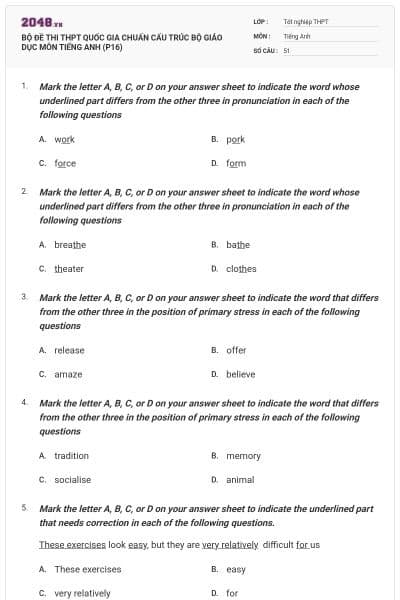
Mark the letter A, B, C, or D on your answer sheet to indicate the word whose underlined part differs from the other three in pronunciation in each of the following questions
work
pork
force
form
Đáp án A
work /wɜːk/ force /fɔːs/
pork /pɔːk/ form /fɔːm/
Phần được gạch chân ở câu A phát âm là /ɜː/ còn lại phát âm là /ɔː/
Mark the letter A, B, C, or D on your answer sheet to indicate the word whose underlined part differs from the other three in pronunciation in each of the following questions
breathe
bathe
theater
clothes
Đáp án C
breathe /briːð/ theater /ˈθɪətə(r)/
bathe /beɪð/ clothes /kləʊðz/
Phần được gạch chân ở câu C phát âm là /θ/ còn lại phát âm là /ð/
Mark the letter A, B, C, or D on your answer sheet to indicate the word that differs from the other three in the position of primary stress in each of the following questions
release
offer
amaze
believe
Đáp án B
release /rɪˈliːs/ amaze /əˈmeɪz/
offer /ˈɒfə(r)/ believe /bɪˈliːv/
Câu B trọng âm 1 còn lại trọng âm 2
Mark the letter A, B, C, or D on your answer sheet to indicate the word that differs from the other three in the position of primary stress in each of the following questions
tradition
memory
socialise
animal
Đáp án A
tradition /trəˈdɪʃn socialise /ˈsəʊʃəlaɪz/
/ memory /ˈmeməri/ animal /ˈænɪml/
Câu A trọng âm 2 còn lại trọng âm 1
Mark the letter A, B, C, or D on your answer sheet to indicate the underlined part that needs correction in each of the following questions.
These exercises look easy, but they are very relatively difficult for us
These exercises
easy
very relatively
for
Đáp án C
Kiến thức: hai trạng từ very ( rất) và relatively ( khá là) không đi cùng nhau.
Very relatively => very/ relatively
=> Chọn C
Mark the letter A, B, C, or D on your answer sheet to indicate the underlined part that needs correction in each of the following questions.
It was not until the end of prehistoric times that the first wheeled vehicles appearing .
until the end
prehistoric
the first
appearing
Đáp án D
Kiến thức: It was not until...that S + thì quá khứ đơn
Appearing => appeared
Mark the letter A, B, C, or D on your answer sheet to indicate the underlined part that needs correction in each of the following questions.
As the old one, this new copier can perform its functions in half the time
As
can perform
its functions
in half the time
Đáp án A
Kiến thức: Giới từ As: với tư cách là/ như là
Like: giống như
Unlike: không giống như
As => Unlike
Tạm dịch: Không giống như chiếc máy cũ, máy photocopy mới này có thể hoạt động tốt các chức năng nửa thời gian
Mark the letter A, B, C, or D on your answer sheet to indicate the correct answer to each of the following questions.
Communities in remote areas are extremely _____ to famine if crops fail
helpless
disappointed
vulnerable
defenseless
Đáp án C
Helpless: không thể tự chăm sóc được bản thân Vulnerable to: dễ bị tổn thương
Disappointed: thất vọng Defenseless: không có khả năng tự phòng vệ Tạm dịch: Các cộng đồng ở vùng sâu vùng xa cực kỳ dễ bị ảnh hưởng với nạn đói nếu mất mùa
Mark the letter A, B, C, or D on your answer sheet to indicate the correct answer to each of the following questions.
I could hear voices but I couldn’t ______ what they were saying
bring about
make out
try out
turn up
Đáp án B
Bring about = cause: gây ra
Make out = understand: hiểu
Try out = test :thử Turn up = arrive: đến nơi
Tạm dịch: Tôi có thể nghe các giọng nói nhưng tôi không thể biết họ đang nói gì
Mark the letter A, B, C, or D on your answer sheet to indicate the correct answer to each of the following questions.
Do you remember ______ to help us when we were in difficulty?
to offer
once offering
you offer
being offered
Đáp án B
Kiến thức: Remember + to Vo: nhớ việc cần làm nhưng chưa làm
Remember + Ving: nhớ việc đã xảy ra trong quá khứ
Tạm dịch: Bạn có nhớ đã từng đề nghị giúp đỡ chúng tôi khi chúng tôi khó khăn không?
Mark the letter A, B, C, or D on your answer sheet to indicate the correct answer to each of the following questions.
You can use my car ______ you drive carefully
though
as though
as long as
lest
Đáp án C
Though: mặc dù As long as: nếu như
As though: như thể là Lest: để mà không/ để ngăn chặn
Tạm dịch: Bạn có thể sử dụng ô tô của tôi nếu bạn lái xe cẩn thận
Mark the letter A, B, C, or D on your answer sheet to indicate the correct answer to each of the following questions.
A large number of workmen ______ because of the economic recession
have laid down
has laid aside
have been laid off
has been laid out
Đáp án C
Lay down: đề ra ( quy định, nguyên tắc) Lay off = make redundant : sa thải
Lay aside: dành dụm/ tiết kiệm ( tiền) Lay out: bày biện/ = knock out: đánh bất tỉnh Tạm dịch: Một số lượng lớn công nhân đã bị sa thải vì khủng hoảng kinh tế.
Mark the letter A, B, C, or D on your answer sheet to indicate the correct answer to each of the following questions.
“What ______ if the earth stopped moving?”
happened
would happen
happens
will happen
Đáp án B
Kiến thức: Câu điều kiện loại 2 diễn tả sự việc không có thật ở hiện tại
If S + Ved/ V2, S + would + Vo
Tạm dịch: Điều gì sẽ xảy ra nếu Trái Đất ngừng quay
Mark the letter A, B, C, or D on your answer sheet to indicate the correct answer to each of the following questions.
He wasn't attending the lecture properly and missed most of ______.
things said by the teacher
that the teacher said
which the teacher said
what the teacher said
Đáp án D
Kiến thức: what = the thing that
Most of + danh từ + that + S + V
Tạm dịch: Anh ấy không tham gia lớp học đều đặn và đã bỏ lỡ những điều mà giáo viên đã giảng
Mark the letter A, B, C, or D on your answer sheet to indicate the correct answer to each of the following questions. He's sometimes bad-tempered but he's a good fellow ______.
at heart
by heart
with heart
in heart
Đáp án A
Kiến thức: giới từ + heart by heart: thuộc lòng
At heart: sâu thẳm trong trái tim
Tạm dịch: Anh ấy thỉnh thoảng nổi nóng nhưng sâu thăm trong trái tim anh ấy là người tốt bụng
Mark the letter A, B, C, or D on your answer sheet to indicate the correct answer to each of the following questions. I'll give this dictionary to ______ wants to have it
anyone
whatever
everyone
whoever
Đáp án D
Anyone: bất cứ ai Everyone: mọi người
Whatever: bất cứ cái gì Whoever = anyone who : bất cứ ai
Tạm dịch: Tôi sẽ đưa quyển từ điển này đến cho bất cứ ai cần nó
Mark the letter A, B, C, or D on your answer sheet to indicate the correct answer to each of the following questions.
Due to ever more spreading poaching, there ______ a dramatic decline in the number of elephants over the last decade
has been
is
was
had been
Đáp án A
Kiến thức: Các thì trong tiếng Anh Over + khoảng thời gian => thì hiện tại hoàn thành
Tạm dịch: Bởi vì nạn săn bắn trái phép tràn lan, có sự suy giảm đáng kể về số lượng voi trong thập kỷ qua
Mark the letter A, B, C, or D on your answer sheet to indicate the correct answer to each of the following questions.
People don’t like the way he shows off, ______?
don’t they
do they
does he
doesn’t he
Đáp án B
Kiến thức: Câu hỏi đuôi S + thể phủ định, trợ động từ thể khẳng định + S?
Tạm dịch: Mọi người không thích cái cách mà anh ấy khoe khoang, đúng không?
Mark the letter A, B, C, or D on your answer sheet to indicate the correct answer to each of the following questions.
The language centre offers courses of various levels, such as elementary, intermediate and ______.
advance
advancement
advanced
advancing
Đáp án C
Kiến thức: từ loại
Các từ elementary (a), intermediate (a) => sau “and” cũng là tính từ
Advance (v, n): ứng trước tiền/ nâng cao/ tiến lên; sự tiến bộ
Advancement (n): sự thăng tiến
Advanced (adj): nâng cao
Tạm dịch: Trung tâm ngôn ngữ cung cấp các khóa học đa dạng về cấp độ chẳng hạn như: sơ cấp, trung cấp và nâng cao
Mark the letter A, B, C, or D on your answer sheet to indicate the most suitable response to complete each of the following exchanges.
Thanh: “Lan’s the best singer in our school.” Nadia: “______”
Yes, tell me about it
. I can’t agree with you more
That’s OK
Yes, please
Đáp án B
Thanh: Lan là người hát hay nhất ở trường của bọn mình.
Nadia: “................................”
A.Vâng, hãy kể cho mình nghe về việc đó. C. Được thôi.
B. Mình hoàn toàn đồng ý. D. Vâng, làm ơn
Mark the letter A, B, C, or D on your answer sheet to indicate the most suitable response to complete each of the following exchanges.
Mai: “Do you want another serving of chicken soup?”
Scott: “______.”
No way
No comment
No thanks
No longer
Đáp án C
Mai: “ Bạn có muốn thêm canh gà không?”
Scott: “......................”
A. Không đời nào C. Không, cảm ơn.
B. Miễn bình luận. D. Không còn nữa
Mark the letter A, B, C, or D on your answer sheet to indicate the word(s)CLOSEST in meaning to the underlined word(s) in each of the following questions.
Within a week on display at the exhibition, the painting was hailed as a masterpiece.
a large work of art
an expensive work of art
an excellent work of art
a down-to-earth work of art
Đáp án C
a masterpiece: a work of art such as a painting, film/movie, book, etc. that is an excellent, or the best, example of the artist’s work: kiệt tác
A.một tác phẩm nghệ thuật lớn C. một tác phẩm nghệ thuật xuất sắc
B. một tác phẩm nghệ thuật đắt tiền D. một tác phẩm nghệ thuật thực dụng
Tạm dịch: Trong một tuần trưng bày tại buổi triển lãm, bức tranh này đã được ca ngợi như là một tuyệt tác
Mark the letter A, B, C, or D on your answer sheet to indicate the word(s)CLOSEST in meaning to the underlined word(s) in each of the following questions.
These were the people who advocated using force to stop school violence
publicly said
publicly supported
strongly condemned
openly criticized
Đáp án B
advocated : ủng hộ/ bênh vực
A.nói công khai C. lên án mạnh mẽ
B. ủng hộ công khai D. phê bình rộng rãi
Mark the letter A,B,C, or D on your answer sheet to indicate the word(s) OPPOSITE in meaning to the underlined word(s) in each of the following questions.
Vietnam’s admission to the World Trade Organisation (WTO) has promoted its trade relations with other countries
balanced
restricted
expanded
boosted
Đáp án B
Promote: thúc đẩy Restrict: hạn chế
Balance: cân bằng Expand: mở rộng
Boost: đẩy mạnh
Tạm dịch: Việc cho phép Việt Nam tham gia vào Tổ chức thương mại Thế giới đã thúc đẩy các mối quan hệ thương mại với các nước khác
Mark the letter A,B,C, or D on your answer sheet to indicate the word(s) OPPOSITE in meaning to the underlined word(s) in each of the following questions.
The consequences of the typhoon were disastrous due to the lack of precautionary measures
physical
severe
beneficial
damaging
Đáp án C
disastrous : tàn phá severe: tàn khốc
physical: thuộc về vật lý/ thể chất beneficial: có nhiều lợi ích
damaging: hủy diệt/ tàn phá
Tạm dịch: Những hậu quả của cơn bão nhiệt đới thì tàn khốc do thiếu những giải pháp cảnh báo trước
Mark the letter A, B, C, or D on your answer sheet to indicate the sentence that is closest in meaning to each of the following questions.
Thanks to the efforts of environmentalists, people are becoming better aware of the problems of endangered species
Environmentalists are expressing their gratitude towards people who are better aware of the problems of endangered species
People owe their growing awareness of the problems of endangered species to the efforts of environmentalists
People have no idea about the problems of endangered species in spite of the efforts of environmentalists
Environmentalists are doing their best to make people aware of the problems of endangered species
Đáp án B
Tạm dịch: Nhờ vào những nỗ lực của các nhà môi trường học, con người đang có ý thức tốt hơn về các vấn đề của các loài bị đe dọa.
A.Các nhà môi trường đang thể hiện thái độ của họ hướng đến những người ý thức tốt hơn về vấn đề các loài bị đe dọa.
B. Con người có được nhận thức đang phát triển về các vấn đề các loài bị đe dọa đối nhờ vào sự nỗ lực của các nhà môi trường học.
Cấu trúc: owe sth to sth/ sb: có được cái gì nhờ vào ai
C. Con người không biết gì về những vấn đề các loài bị đe dọa mặc dù những nỗ lực của các nhà môi trường.
D. Các nhà môi trường đang làm hết sức để làm con người ý thức về các vấn đề các loài bị đe dọa.
Chọn B
Mark the letter A, B, C, or D on your answer sheet to indicate the sentence that is closest in meaning to each of the following questions.
Peter’s main subject at university is electronics
The university lets Peter major in electronics
Electronics is among the subjects that Peter likes
Peter thinks electronics is a special subject
Peter majors in electronics at university
Đáp án D
Tạm dịch: Mô học chính của Peter ở trường đại học là điện tử.
A.Trường đại học để Peter học chuyên về điện tử.
B. Điện tử là trong số các môn học mà Peter thích.
C. Peter nghĩ điện tử là một môn đặc biệt.
D. Peter học chuyên ngành điện tử ở trường đại học
Mark the letter A, B, C, or D on your answer sheet to indicate the sentence that is closest in meaning to each of the following questions.
I could not get the job because I did not speak English well.
I would have spoken English well if I could get that job
I wish I had got the job so that I could speak English well
Despite my poor English, I was successful in the job
I failed to get the job because of my poor English
Đáp án D
Tạm dịch: Tôi không thể có công việc bởi vì tôi không nói tiếng Anh tốt.
A.Tôi sẽ nói tiếng Anh tốt nếu tôi có việc làm.
B. Tôi ước gì tôi có việc làm để mà tôi có thể nói tiếng Anh tốt.
C. Mặc dù tiếng Anh kém, tôi thành công trong công việc.
D. Tôi không có được việc làm vì tiếng Anh kém
Mark the letter A, B, C, or D on your answer sheet to indicate the sentence that best combines each pair of sentences in the following questions.
The demand was so great. They had to reprint the book immediately
They demanded that the book be reprinted immediately
So great was the demand that they had to reprint the book immediately
The book would be reprinted immediately since the demand was great
They demanded to reprint the book immediately
Đáp án B
Tạm dịch: Nhu cầu quá lớn. Họ phải tái bản quyển sách ngay lập tức.
A.Họ yêu cầu rằng quyển sách nên được tái bản ngay lập tức.
B. Cấu trúc đảo ngữ : So + adj + noun + that S + V: quá...đến nỗi mà
Nhu cầu quá lớn đến nỗi mà họ phải tái bản quyển sách ngay lập tức.
C. Quyển sách sẽ được tái bản ngay lập tức bởi vì nhu cầu lớn.
D. Họ yêu cầu tái bản quyển sách ngay lập tức
Mark the letter A, B, C, or D on your answer sheet to indicate the sentence that best combines each pair of sentences in the following questions.
He did not work hard. He failed the exam
Even though he failed the exam, he didn’t work hard
Unless he had worked hard, he would have failed the exam
If he had worked hard, he would have passed the exam
However hard he worked, he failed the exam
Đáp án C
Tạm dịch: Anh ấy không làm việc chăm chỉ. Anh ấy trượt kỳ thi.
-Ngữ cảnh ở quá khứ nên viết lại câu điều kiện loại 3 và ngược lại với ngữ cảnh
If + S + had + Ved/ V3, S + would have Ved/ V3
A. Mặc dù anh trượt kỳ thi, anh ấy đã không làm việc chăm chỉ.
B. Nếu anh ấy không làm việc chăm chỉ, anh ấy sẽ trượt kỳ thi.
C. Nếu anh ấy làm việc chăm chỉ, anh ấy sẽ đỗ kỳ thi.
D. Cho dù anh ấy làm việc chăm chỉ thế nào đi nữa, anh ấy cũng trượt kỳ thi
Read the following passage and mark the letter A, B, C, or D on your answer sheet to indicate the correct word or phrase that bestfits each of the numbered blanks from 31 to35.
In addition to the challenge to be excellent, American schools have been facing novel problems. They must (31)______ with an influx of immigrant children, many of whom speak little or no English. They must respond to demands that the curriculum reflect the various cultures of all children. Schools must make sure that students develop basic skills for the job market, and they must consider the needs of nontraditional students, such as teenage mothers.
Schools are (32)______ these problems in ways that reflect the diversity of the US educational system. They are hiring or training large numbers of teachers of English as a second language and, in some communities, setting up bilingual schools. They are opening up the traditional European-centered curriculum to embrace material from African, Asian, and other cultures.
Schools are also teaching cognitive skills to the (33)______ 40 percent of American students who do not go on to higher education. In the (34)______ of a recent report by the Commission on Achieving Necessary Skills, “A strong back, the willingness to work, and a high school diploma were once all that was necessary to (35)______ a start in America. They are no longer. A well- developed mind, a continued willingness to learn and the ability to put knowledge to work are the new keys to the future of our young people, the success of our business, and the economic well-being of the nation.”
Điền ô 31
do
stay
fight
cope
Đáp án D
Cope with = deal with: giải quyết Do with: làm gì với
Fight with: cãi nhau với Stay with: ở lại với
They must (31)______ with an influx of immigrant children, many of whom speak little or no English.
[Họ phải giải quyết dòng trẻ nhập cư, nhiều trong số chúng nói rất ít hoặc không nói tiếng Anh.]
Read the following passage and mark the letter A, B, C, or D on your answer sheet to indicate the correct word or phrase that bestfits each of the numbered blanks from 31 to35.
In addition to the challenge to be excellent, American schools have been facing novel problems. They must (31)______ with an influx of immigrant children, many of whom speak little or no English. They must respond to demands that the curriculum reflect the various cultures of all children. Schools must make sure that students develop basic skills for the job market, and they must consider the needs of nontraditional students, such as teenage mothers.
Schools are (32)______ these problems in ways that reflect the diversity of the US educational system. They are hiring or training large numbers of teachers of English as a second language and, in some communities, setting up bilingual schools. They are opening up the traditional European-centered curriculum to embrace material from African, Asian, and other cultures.
Schools are also teaching cognitive skills to the (33)______ 40 percent of American students who do not go on to higher education. In the (34)______ of a recent report by the Commission on Achieving Necessary Skills, “A strong back, the willingness to work, and a high school diploma were once all that was necessary to (35)______ a start in America. They are no longer. A well- developed mind, a continued willingness to learn and the ability to put knowledge to work are the new keys to the future of our young people, the success of our business, and the economic well-being of the nation.”
Điền ô 32
addressing
delivering
distributing
discharging
Đáp án A
Address: nhắm đến/ hướng đến Distribute: phân phát/ phân phối
Deliver: giao (hàng) Discharge: phóng điện/ ra viện/ thải ra Cụm từ: address problems ( giải quyết vấn đề)
Schools are (32)______ these problems in ways that reflect the diversity of the US educational system.
[ Các trường học đang giải quyết những vấn đề này bằng các cách phản ánh sự đa dạng của hệ thống giáo dục Mỹ.]
Read the following passage and mark the letter A, B, C, or D on your answer sheet to indicate the correct word or phrase that bestfits each of the numbered blanks from 31 to35.
In addition to the challenge to be excellent, American schools have been facing novel problems. They must (31)______ with an influx of immigrant children, many of whom speak little or no English. They must respond to demands that the curriculum reflect the various cultures of all children. Schools must make sure that students develop basic skills for the job market, and they must consider the needs of nontraditional students, such as teenage mothers.
Schools are (32)______ these problems in ways that reflect the diversity of the US educational system. They are hiring or training large numbers of teachers of English as a second language and, in some communities, setting up bilingual schools. They are opening up the traditional European-centered curriculum to embrace material from African, Asian, and other cultures.
Schools are also teaching cognitive skills to the (33)______ 40 percent of American students who do not go on to higher education. In the (34)______ of a recent report by the Commission on Achieving Necessary Skills, “A strong back, the willingness to work, and a high school diploma were once all that was necessary to (35)______ a start in America. They are no longer. A well- developed mind, a continued willingness to learn and the ability to put knowledge to work are the new keys to the future of our young people, the success of our business, and the economic well-being of the nation.”
Điền ô 33
slightly
mostly
fairly
nearly
Đáp án D
Slightly: nhẹ Fairly: tương đối/ khá là
Mostly: hầu như Nearly: gần như
Schools are also teaching cognitive skills to the (33)______ 40 percent of American students who do not go on to higher education.
[Các trường học cũng dạy những kỹ năng nhận thức cho khoảng gần 40% học sinh Mỹ người mà không tiếp tục đến bậc giáo dục cao hơn.]
Read the following passage and mark the letter A, B, C, or D on your answer sheet to indicate the correct word or phrase that bestfits each of the numbered blanks from 31 to35.
In addition to the challenge to be excellent, American schools have been facing novel problems. They must (31)______ with an influx of immigrant children, many of whom speak little or no English. They must respond to demands that the curriculum reflect the various cultures of all children. Schools must make sure that students develop basic skills for the job market, and they must consider the needs of nontraditional students, such as teenage mothers.
Schools are (32)______ these problems in ways that reflect the diversity of the US educational system. They are hiring or training large numbers of teachers of English as a second language and, in some communities, setting up bilingual schools. They are opening up the traditional European-centered curriculum to embrace material from African, Asian, and other cultures.
Schools are also teaching cognitive skills to the (33)______ 40 percent of American students who do not go on to higher education. In the (34)______ of a recent report by the Commission on Achieving Necessary Skills, “A strong back, the willingness to work, and a high school diploma were once all that was necessary to (35)______ a start in America. They are no longer. A well- developed mind, a continued willingness to learn and the ability to put knowledge to work are the new keys to the future of our young people, the success of our business, and the economic well-being of the nation.”
Điền ô 34
minds
directions
words
ways
Đáp án C
Mind: tinh thần Words: từ Ways: cách thức
Directions: phương hướng
Cụm từ: in the words of ( trích dẫn lại) In the (34)______ of a recent report by the Commission on Achieving Necessary Skills
[Trích dẫn theo báo cáo gần đây bởi Ủy ban về phát triển những kỹ năng cần thiết]
Read the following passage and mark the letter A, B, C, or D on your answer sheet to indicate the correct word or phrase that bestfits each of the numbered blanks from 31 to35.
In addition to the challenge to be excellent, American schools have been facing novel problems. They must (31)______ with an influx of immigrant children, many of whom speak little or no English. They must respond to demands that the curriculum reflect the various cultures of all children. Schools must make sure that students develop basic skills for the job market, and they must consider the needs of nontraditional students, such as teenage mothers.
Schools are (32)______ these problems in ways that reflect the diversity of the US educational system. They are hiring or training large numbers of teachers of English as a second language and, in some communities, setting up bilingual schools. They are opening up the traditional European-centered curriculum to embrace material from African, Asian, and other cultures.
Schools are also teaching cognitive skills to the (33)______ 40 percent of American students who do not go on to higher education. In the (34)______ of a recent report by the Commission on Achieving Necessary Skills, “A strong back, the willingness to work, and a high school diploma were once all that was necessary to (35)______ a start in America. They are no longer. A well- developed mind, a continued willingness to learn and the ability to put knowledge to work are the new keys to the future of our young people, the success of our business, and the economic well-being of the nation.”
Điền ô 35
make
take
get
bring
Đáp án A
Make: tạo ra Get: nhận
Take: cầm lấy Bring: mang
Cụm từ: make a start ( khởi đầu)
“A strong back, the willingness to work, and a high school diploma were once all that was necessary to (35)______ a start in America.
[ Một sức khỏe tốt, tinh thần sẵn sàng làm việc và bằng cấp là tất cả những thứ cần thiết đối để khởi đầu ở Mỹ]
Read the following passage and mark the letter A, B, C, or D on your answer sheet to indicate the correct answer to each of the questions from 36 to 42
The ability to conduct electricity is one of the key properties of a metal. Other solid materials such as silicon can conduct electricity but only effectively at certain temperatures. Also, some substances such as salt (sodium chloride) can conduct when molten or when dissolved in water. The ability of metals to conduct electricity is due to how their atoms bond together. In order to bond together the metal atoms lose at least one of their outermost electrons. This leaves the metal atoms with a positive charge and they are now strictly ions. The lost electrons are free to move in what is known as a sea of electrons. Since the electrons are negatively charged they attract the ions and this is what keeps the structure together.
An electric current is a flow of charge and since the electrons in the sea of electrons are free to move they can be made to flow in one direction when a source of electrical energy such as a battery is connected to the metal. Hence we have an electric current flowing through the wire, and this is what makes metals such good conductors of electricity. The only other common solid conducting material that pencil users are likely to encounter is graphite (what the „lead’ of a pencil is made from). Graphite is a form of carbon and again the carbon atoms bond in such a way that there is a sea of electrons that can be made to flow as an electric current. Likewise, if we have an ionic substance like salt we can make the electrically charged ions flow to create a current but only when those ions are free to move, either when the substance is a liquid or dissolved in water. In its solid state an ionic substance like salt cannot conduct electricity as its charged ions cannot flow.
Electrical insulators are substances that cannot conduct electricity well either, because they contain no charged particles or any charged particles they might contain do not flow easily. Water itself is a poor conductor of electricity as it does not contain a significant amount of fully charged particles (the ends of a water molecule are partly charged but overall the molecule is neutral). However, most water we encounter does contain dissolved charged particles, so it will be more conductive than pure water. Many of the problems that occur when touching electrical devices with wet hands result from the ever-present salt that is left on our skin through perspiration and it dissolves in the water to make it more conductive.
By Helena Gillespie and Rob Gillespie. Science for Primary School Teachers. OUP
According to the passage, a metal can conduct electricity due to ______.
the way its atoms bond together
the absence of free electrons
its atoms with a positive charge
the loss of one electron in the core of its atoms
Đáp án A
Theo bài đọc, kim loại có thể dẫn điện là do
A. cách mà các phân tử kết hợp với nhau
B. sự thiếu các electron tự do
C. các nguyên tử của nó với cực dương
D. mất 1 electron trong nhân của nguyên tử
Dẫn chứng:The ability of metals to conduct electricity is due to how their atoms bond together
Read the following passage and mark the letter A, B, C, or D on your answer sheet to indicate the correct answer to each of the questions from 36 to 42
The ability to conduct electricity is one of the key properties of a metal. Other solid materials such as silicon can conduct electricity but only effectively at certain temperatures. Also, some substances such as salt (sodium chloride) can conduct when molten or when dissolved in water. The ability of metals to conduct electricity is due to how their atoms bond together. In order to bond together the metal atoms lose at least one of their outermost electrons. This leaves the metal atoms with a positive charge and they are now strictly ions. The lost electrons are free to move in what is known as a sea of electrons. Since the electrons are negatively charged they attract the ions and this is what keeps the structure together.
An electric current is a flow of charge and since the electrons in the sea of electrons are free to move they can be made to flow in one direction when a source of electrical energy such as a battery is connected to the metal. Hence we have an electric current flowing through the wire, and this is what makes metals such good conductors of electricity. The only other common solid conducting material that pencil users are likely to encounter is graphite (what the „lead’ of a pencil is made from). Graphite is a form of carbon and again the carbon atoms bond in such a way that there is a sea of electrons that can be made to flow as an electric current. Likewise, if we have an ionic substance like salt we can make the electrically charged ions flow to create a current but only when those ions are free to move, either when the substance is a liquid or dissolved in water. In its solid state an ionic substance like salt cannot conduct electricity as its charged ions cannot flow.
Electrical insulators are substances that cannot conduct electricity well either, because they contain no charged particles or any charged particles they might contain do not flow easily. Water itself is a poor conductor of electricity as it does not contain a significant amount of fully charged particles (the ends of a water molecule are partly charged but overall the molecule is neutral). However, most water we encounter does contain dissolved charged particles, so it will be more conductive than pure water. Many of the problems that occur when touching electrical devices with wet hands result from the ever-present salt that is left on our skin through perspiration and it dissolves in the water to make it more conductive.
By Helena Gillespie and Rob Gillespie. Science for Primary School Teachers. OUP
The word “outermost” in paragraph 1 mostly means ______.
the heaviest
furthest from the inside
nearest to the inside
the lightest
Đáp án B
Từ “ outermost” ( lớp ngoài cùng) ở đoạn 1 gần như có nghĩa là
A.nặng nhất C. gần nhất so với bên trong
B. xa nhất từ bên trong D. nhẹ nhất
Dẫn chứng: In order to bond together the metal atoms lose at least one of their outermost electrons
Read the following passage and mark the letter A, B, C, or D on your answer sheet to indicate the correct answer to each of the questions from 36 to 42
The ability to conduct electricity is one of the key properties of a metal. Other solid materials such as silicon can conduct electricity but only effectively at certain temperatures. Also, some substances such as salt (sodium chloride) can conduct when molten or when dissolved in water. The ability of metals to conduct electricity is due to how their atoms bond together. In order to bond together the metal atoms lose at least one of their outermost electrons. This leaves the metal atoms with a positive charge and they are now strictly ions. The lost electrons are free to move in what is known as a sea of electrons. Since the electrons are negatively charged they attract the ions and this is what keeps the structure together.
An electric current is a flow of charge and since the electrons in the sea of electrons are free to move they can be made to flow in one direction when a source of electrical energy such as a battery is connected to the metal. Hence we have an electric current flowing through the wire, and this is what makes metals such good conductors of electricity. The only other common solid conducting material that pencil users are likely to encounter is graphite (what the „lead’ of a pencil is made from). Graphite is a form of carbon and again the carbon atoms bond in such a way that there is a sea of electrons that can be made to flow as an electric current. Likewise, if we have an ionic substance like salt we can make the electrically charged ions flow to create a current but only when those ions are free to move, either when the substance is a liquid or dissolved in water. In its solid state an ionic substance like salt cannot conduct electricity as its charged ions cannot flow.
Electrical insulators are substances that cannot conduct electricity well either, because they contain no charged particles or any charged particles they might contain do not flow easily. Water itself is a poor conductor of electricity as it does not contain a significant amount of fully charged particles (the ends of a water molecule are partly charged but overall the molecule is neutral). However, most water we encounter does contain dissolved charged particles, so it will be more conductive than pure water. Many of the problems that occur when touching electrical devices with wet hands result from the ever-present salt that is left on our skin through perspiration and it dissolves in the water to make it more conductive.
By Helena Gillespie and Rob Gillespie. Science for Primary School Teachers. OUP
Salt in its solid state is not able to conduct electricity because ______.
. its charged ions can flow easily
it cannot create any charged ions
it has free electrons
its charged ions are not free to move
Đáp án D
Muối ở thể rắn không thể dẫn điện bởi vì
A.các ion mang điện của nó có thể chảy dễ dàng
B. nó không thể tạo ra ion mang điện
C. nó có các electron tự do
D. các ion mang điện của nó không tự do di chuyển
Dẫn chứng: In its solid state an ionic substance like salt cannot conduct electricity as its charged ions cannot flow
Read the following passage and mark the letter A, B, C, or D on your answer sheet to indicate the correct answer to each of the questions from 36 to 42
The ability to conduct electricity is one of the key properties of a metal. Other solid materials such as silicon can conduct electricity but only effectively at certain temperatures. Also, some substances such as salt (sodium chloride) can conduct when molten or when dissolved in water. The ability of metals to conduct electricity is due to how their atoms bond together. In order to bond together the metal atoms lose at least one of their outermost electrons. This leaves the metal atoms with a positive charge and they are now strictly ions. The lost electrons are free to move in what is known as a sea of electrons. Since the electrons are negatively charged they attract the ions and this is what keeps the structure together.
An electric current is a flow of charge and since the electrons in the sea of electrons are free to move they can be made to flow in one direction when a source of electrical energy such as a battery is connected to the metal. Hence we have an electric current flowing through the wire, and this is what makes metals such good conductors of electricity. The only other common solid conducting material that pencil users are likely to encounter is graphite (what the „lead’ of a pencil is made from). Graphite is a form of carbon and again the carbon atoms bond in such a way that there is a sea of electrons that can be made to flow as an electric current. Likewise, if we have an ionic substance like salt we can make the electrically charged ions flow to create a current but only when those ions are free to move, either when the substance is a liquid or dissolved in water. In its solid state an ionic substance like salt cannot conduct electricity as its charged ions cannot flow.
Electrical insulators are substances that cannot conduct electricity well either, because they contain no charged particles or any charged particles they might contain do not flow easily. Water itself is a poor conductor of electricity as it does not contain a significant amount of fully charged particles (the ends of a water molecule are partly charged but overall the molecule is neutral). However, most water we encounter does contain dissolved charged particles, so it will be more conductive than pure water. Many of the problems that occur when touching electrical devices with wet hands result from the ever-present salt that is left on our skin through perspiration and it dissolves in the water to make it more conductive.
By Helena Gillespie and Rob Gillespie. Science for Primary School Teachers. OUP
Water is a poor conductor because it contains ______.
only a positive electric charge
only a small amount of fully charged particles
only a negative electric charge
no positive or negative electric
Đáp án B
Nước là chất dẫn điện kém bởi vì nó chứa
A.chỉ có điện tích dương
B. chỉ một lượng nhỏ các phân tử mang đầy điện
C. chỉ mang điện tích âm
D. không có điện tích âm hay điện tích dương
Dẫn chứng:Water itself is a poor conductor of electricity as it does not contain a significant amount of fully charged particles (the ends of a water molecule are partly charged but overall the molecule is neutral).
Read the following passage and mark the letter A, B, C, or D on your answer sheet to indicate the correct answer to each of the questions from 36 to 42
The ability to conduct electricity is one of the key properties of a metal. Other solid materials such as silicon can conduct electricity but only effectively at certain temperatures. Also, some substances such as salt (sodium chloride) can conduct when molten or when dissolved in water. The ability of metals to conduct electricity is due to how their atoms bond together. In order to bond together the metal atoms lose at least one of their outermost electrons. This leaves the metal atoms with a positive charge and they are now strictly ions. The lost electrons are free to move in what is known as a sea of electrons. Since the electrons are negatively charged they attract the ions and this is what keeps the structure together.
An electric current is a flow of charge and since the electrons in the sea of electrons are free to move they can be made to flow in one direction when a source of electrical energy such as a battery is connected to the metal. Hence we have an electric current flowing through the wire, and this is what makes metals such good conductors of electricity. The only other common solid conducting material that pencil users are likely to encounter is graphite (what the „lead’ of a pencil is made from). Graphite is a form of carbon and again the carbon atoms bond in such a way that there is a sea of electrons that can be made to flow as an electric current. Likewise, if we have an ionic substance like salt we can make the electrically charged ions flow to create a current but only when those ions are free to move, either when the substance is a liquid or dissolved in water. In its solid state an ionic substance like salt cannot conduct electricity as its charged ions cannot flow.
Electrical insulators are substances that cannot conduct electricity well either, because they contain no charged particles or any charged particles they might contain do not flow easily. Water itself is a poor conductor of electricity as it does not contain a significant amount of fully charged particles (the ends of a water molecule are partly charged but overall the molecule is neutral). However, most water we encounter does contain dissolved charged particles, so it will be more conductive than pure water. Many of the problems that occur when touching electrical devices with wet hands result from the ever-present salt that is left on our skin through perspiration and it dissolves in the water to make it more conductive.
By Helena Gillespie and Rob Gillespie. Science for Primary School Teachers. OUP
We can have problems when touching electrical devices with wet hands because ______.
the water itself is a good conductor of electricity
the water contains too many neutral molecules
the water containing no charged particles makes it more conductive
the water dissolves the salt on our skin and becomes more conductive
Đáp án D
Chúng ta có thể gặp vấn đề khi chạm vào các dụng cụ điện với tay ướt bởi vì
A.bản thân nước là chất dẫn điện tốt
B. nước chứa quá nhiều các phân tử trung hòa
C. nước không chứa những phân tử mang điện làm cho nó dẫn điện tốt hơn.
D. nước hòa tan muối trên da chúng ta và trở nên có tính dẫn điện hơn.
Dẫn chứng: Many of the problems that occur when touching electrical devices with wet hands result from the ever-present salt that is left on our skin through perspiration and it dissolves in the water to make it more conductive
Read the following passage and mark the letter A, B, C, or D on your answer sheet to indicate the correct answer to each of the questions from 36 to 42
The ability to conduct electricity is one of the key properties of a metal. Other solid materials such as silicon can conduct electricity but only effectively at certain temperatures. Also, some substances such as salt (sodium chloride) can conduct when molten or when dissolved in water. The ability of metals to conduct electricity is due to how their atoms bond together. In order to bond together the metal atoms lose at least one of their outermost electrons. This leaves the metal atoms with a positive charge and they are now strictly ions. The lost electrons are free to move in what is known as a sea of electrons. Since the electrons are negatively charged they attract the ions and this is what keeps the structure together.
An electric current is a flow of charge and since the electrons in the sea of electrons are free to move they can be made to flow in one direction when a source of electrical energy such as a battery is connected to the metal. Hence we have an electric current flowing through the wire, and this is what makes metals such good conductors of electricity. The only other common solid conducting material that pencil users are likely to encounter is graphite (what the „lead’ of a pencil is made from). Graphite is a form of carbon and again the carbon atoms bond in such a way that there is a sea of electrons that can be made to flow as an electric current. Likewise, if we have an ionic substance like salt we can make the electrically charged ions flow to create a current but only when those ions are free to move, either when the substance is a liquid or dissolved in water. In its solid state an ionic substance like salt cannot conduct electricity as its charged ions cannot flow.
Electrical insulators are substances that cannot conduct electricity well either, because they contain no charged particles or any charged particles they might contain do not flow easily. Water itself is a poor conductor of electricity as it does not contain a significant amount of fully charged particles (the ends of a water molecule are partly charged but overall the molecule is neutral). However, most water we encounter does contain dissolved charged particles, so it will be more conductive than pure water. Many of the problems that occur when touching electrical devices with wet hands result from the ever-present salt that is left on our skin through perspiration and it dissolves in the water to make it more conductive.
By Helena Gillespie and Rob Gillespie. Science for Primary School Teachers. OUP
Which of the following is NOT true according to the passage?
Graphite is a common solid substance that can conduct electricity
Salt can conduct electricity when it is molten or dissolved
Pure water is much more conductive than most water we encounter every day
Some materials are more conductive than others
Đáp án C
Câu nào không đúng theo như bài đọc?
A.Than chì là chất rắn phổ biến có thể dẫn điện.
B. Muối có thể dẫn điện khi nó nóng chảy hoặc hòa tan
C. Nước tinh khiết dẫn điện tốt hơn hầu hết nước mà chúng ta gặp phải mỗi ngày.
D. Một số chất dẫn điện tốt hơn những chất khác.
Dẫn chứng: Water itself is a poor conductor of electricity as it does not contain a significant amount of fully charged particles (the ends of a water molecule are partly charged but overall the molecule is neutral).
Read the following passage and mark the letter A, B, C, or D on your answer sheet to indicate the correct answer to each of the questions from 36 to 42
The ability to conduct electricity is one of the key properties of a metal. Other solid materials such as silicon can conduct electricity but only effectively at certain temperatures. Also, some substances such as salt (sodium chloride) can conduct when molten or when dissolved in water. The ability of metals to conduct electricity is due to how their atoms bond together. In order to bond together the metal atoms lose at least one of their outermost electrons. This leaves the metal atoms with a positive charge and they are now strictly ions. The lost electrons are free to move in what is known as a sea of electrons. Since the electrons are negatively charged they attract the ions and this is what keeps the structure together.
An electric current is a flow of charge and since the electrons in the sea of electrons are free to move they can be made to flow in one direction when a source of electrical energy such as a battery is connected to the metal. Hence we have an electric current flowing through the wire, and this is what makes metals such good conductors of electricity. The only other common solid conducting material that pencil users are likely to encounter is graphite (what the „lead’ of a pencil is made from). Graphite is a form of carbon and again the carbon atoms bond in such a way that there is a sea of electrons that can be made to flow as an electric current. Likewise, if we have an ionic substance like salt we can make the electrically charged ions flow to create a current but only when those ions are free to move, either when the substance is a liquid or dissolved in water. In its solid state an ionic substance like salt cannot conduct electricity as its charged ions cannot flow.
Electrical insulators are substances that cannot conduct electricity well either, because they contain no charged particles or any charged particles they might contain do not flow easily. Water itself is a poor conductor of electricity as it does not contain a significant amount of fully charged particles (the ends of a water molecule are partly charged but overall the molecule is neutral). However, most water we encounter does contain dissolved charged particles, so it will be more conductive than pure water. Many of the problems that occur when touching electrical devices with wet hands result from the ever-present salt that is left on our skin through perspiration and it dissolves in the water to make it more conductive.
By Helena Gillespie and Rob Gillespie. Science for Primary School Teachers. OUP
Which of the following could best serve as the title of the passage?
Electrical Insulators
Electrical Energy
Electrical Conductivity
Electrical Devices
Đáp án C
Tiêu đề hay nhất cho bài đọc là?
A. Các chất cách điện
B. Năng lượng điện
C. Chất dẫn điện
D. Các thiết bị điện
Read the following passage and mark the letter A, B, C, or D on your answer sheet to indicate the correct answer to each of the questions from 43 to 50.
Most journeys in Britain and the US are made by road. Some of these are made on public transport but most are by private car.
In Britain many people rely on their cars for daily local activities, e.g. getting to work, doing the shopping, and visiting friends. People living in urban areas may use buses, trains or, in London, the Underground, to get to city centres, mainly because traffic is often heavy and it is difficult to find anywhere to park a car. Some places in the country may have a bus only two or three times a week so people living there have no choice but to rely on their cars.
In the US large cities have good public transportation systems. The El railroad in Chicago and the underground systems of New York, Boston, San Francisco and Washington, DC are heavily used. Elsewhere, most Americans prefer to use their cars. Families often have two cars and, outside major cities, have to drive fairly long distances to schools, offices, shops, banks, etc. Many college and even high-school students have their own cars.
Long-distance travel in Britain is also mainly by road, though railways link most towns and cities. Most places are linked by motorways or other fast roads and many people prefer to drive at their own convenience rather than use a train, even though they may get stuck in a traffic jam. Long-distance coach/bus services are usually a cheaper alternative to trains, but they take longer and may be less comfortable. Some long-distance travel, especially that undertaken for business reasons, may be by air. There are regular flights between regional airports, as well as to and from London. A lot of freight is also distributed by road, though heavier items and raw materials often go by rail.
In the US much long-distance travel is by air. America has two main long-distance bus companies, Greyhound and Trailways. Amtrak, the national network, provides rail services for passengers. Private railway companies such as Union Pacific now carry only freight, though in fact over 70% of freight goes by road.
The main problems associated with road transport in both Britain and the US are traffic congestion and pollution. It is predicted that the number of cars on British roads will increase by a third within a few years, making both these problems worse. The British government would like more people to use public transport, but so far they have had little success in persuading people to give up their cars or to share rides with neighbours. Most people say that public transport is simply not good enough. Americans too have resisted government requests to share cars because it is less convenient and restricts their freedom. Petrol/gasoline is relatively cheap in the US and outside the major cities public transport is bad, so they see no reason to use their cars less.
(Extracted from Oxford Guide to British and American Culture, Oxford University Press, 2000)
According to the passage, people in London may prefer the Underground to their own cars due to ______.
heavy traffic
cheap tickets
long distances
air pollution
Đáp án A
Theo bài đọc người ở Luân Đôn có thể thích đường hầm cho xe riêng của họ bởi vì
A.giao thông ùn tắc C. khoảng đường xa
B. vé rẻ D. air pollution
Dẫn chứng: People living in urban areas may use buses, trains or, in London, the Underground, to get to city centres, mainly because traffic is often heavy and it is difficult to find anywhere to park a car
Read the following passage and mark the letter A, B, C, or D on your answer sheet to indicate the correct answer to each of the questions from 43 to 50.
Most journeys in Britain and the US are made by road. Some of these are made on public transport but most are by private car.
In Britain many people rely on their cars for daily local activities, e.g. getting to work, doing the shopping, and visiting friends. People living in urban areas may use buses, trains or, in London, the Underground, to get to city centres, mainly because traffic is often heavy and it is difficult to find anywhere to park a car. Some places in the country may have a bus only two or three times a week so people living there have no choice but to rely on their cars.
In the US large cities have good public transportation systems. The El railroad in Chicago and the underground systems of New York, Boston, San Francisco and Washington, DC are heavily used. Elsewhere, most Americans prefer to use their cars. Families often have two cars and, outside major cities, have to drive fairly long distances to schools, offices, shops, banks, etc. Many college and even high-school students have their own cars.
Long-distance travel in Britain is also mainly by road, though railways link most towns and cities. Most places are linked by motorways or other fast roads and many people prefer to drive at their own convenience rather than use a train, even though they may get stuck in a traffic jam. Long-distance coach/bus services are usually a cheaper alternative to trains, but they take longer and may be less comfortable. Some long-distance travel, especially that undertaken for business reasons, may be by air. There are regular flights between regional airports, as well as to and from London. A lot of freight is also distributed by road, though heavier items and raw materials often go by rail.
In the US much long-distance travel is by air. America has two main long-distance bus companies, Greyhound and Trailways. Amtrak, the national network, provides rail services for passengers. Private railway companies such as Union Pacific now carry only freight, though in fact over 70% of freight goes by road.
The main problems associated with road transport in both Britain and the US are traffic congestion and pollution. It is predicted that the number of cars on British roads will increase by a third within a few years, making both these problems worse. The British government would like more people to use public transport, but so far they have had little success in persuading people to give up their cars or to share rides with neighbours. Most people say that public transport is simply not good enough. Americans too have resisted government requests to share cars because it is less convenient and restricts their freedom. Petrol/gasoline is relatively cheap in the US and outside the major cities public transport is bad, so they see no reason to use their cars less.
(Extracted from Oxford Guide to British and American Culture, Oxford University Press, 2000)
It is mentioned in paragraph 3 that the public transportation systems in the US are good in ______.
large cities
large states
some states
all cities
Đáp án A
Như được đề cập ở đoạn 3 hệ thống giao thông công cộng Mỹ tốt ở
A.các thành phố lớn C. một số bang
B. các bang lớn D. tất cả thành phố
Dẫn chứng: In the US large cities have good public transportation systems
Read the following passage and mark the letter A, B, C, or D on your answer sheet to indicate the correct answer to each of the questions from 43 to 50.
Most journeys in Britain and the US are made by road. Some of these are made on public transport but most are by private car.
In Britain many people rely on their cars for daily local activities, e.g. getting to work, doing the shopping, and visiting friends. People living in urban areas may use buses, trains or, in London, the Underground, to get to city centres, mainly because traffic is often heavy and it is difficult to find anywhere to park a car. Some places in the country may have a bus only two or three times a week so people living there have no choice but to rely on their cars.
In the US large cities have good public transportation systems. The El railroad in Chicago and the underground systems of New York, Boston, San Francisco and Washington, DC are heavily used. Elsewhere, most Americans prefer to use their cars. Families often have two cars and, outside major cities, have to drive fairly long distances to schools, offices, shops, banks, etc. Many college and even high-school students have their own cars.
Long-distance travel in Britain is also mainly by road, though railways link most towns and cities. Most places are linked by motorways or other fast roads and many people prefer to drive at their own convenience rather than use a train, even though they may get stuck in a traffic jam. Long-distance coach/bus services are usually a cheaper alternative to trains, but they take longer and may be less comfortable. Some long-distance travel, especially that undertaken for business reasons, may be by air. There are regular flights between regional airports, as well as to and from London. A lot of freight is also distributed by road, though heavier items and raw materials often go by rail.
In the US much long-distance travel is by air. America has two main long-distance bus companies, Greyhound and Trailways. Amtrak, the national network, provides rail services for passengers. Private railway companies such as Union Pacific now carry only freight, though in fact over 70% of freight goes by road.
The main problems associated with road transport in both Britain and the US are traffic congestion and pollution. It is predicted that the number of cars on British roads will increase by a third within a few years, making both these problems worse. The British government would like more people to use public transport, but so far they have had little success in persuading people to give up their cars or to share rides with neighbours. Most people say that public transport is simply not good enough. Americans too have resisted government requests to share cars because it is less convenient and restricts their freedom. Petrol/gasoline is relatively cheap in the US and outside the major cities public transport is bad, so they see no reason to use their cars less.
(Extracted from Oxford Guide to British and American Culture, Oxford University Press, 2000)
Which of the following is NOT true according to the passage?
Few college students in the US have their own cars
The underground systems are popular in some major US cities
Most Americans prefer to drive their cars outside large cities
Families in the US often have more than one car
Đáp án A
Câu nào sau đây không đúng theo như bài đọc?
A. Một vài sinh viên đại học ở Mỹ có xe riêng.
B. Hệ thống đường ngầm phổ biến ở các thành phố lớn của Mỹ.
C. Hầu hết người Mỹ thích lái xe ra ngoài các thành phố lớn.
D. Các gia đình Mỹ thường có 1 ô tô trở lên.
Dẫn chứng: Many college and even high-school students have their own cars
Read the following passage and mark the letter A, B, C, or D on your answer sheet to indicate the correct answer to each of the questions from 43 to 50.
Most journeys in Britain and the US are made by road. Some of these are made on public transport but most are by private car.
In Britain many people rely on their cars for daily local activities, e.g. getting to work, doing the shopping, and visiting friends. People living in urban areas may use buses, trains or, in London, the Underground, to get to city centres, mainly because traffic is often heavy and it is difficult to find anywhere to park a car. Some places in the country may have a bus only two or three times a week so people living there have no choice but to rely on their cars.
In the US large cities have good public transportation systems. The El railroad in Chicago and the underground systems of New York, Boston, San Francisco and Washington, DC are heavily used. Elsewhere, most Americans prefer to use their cars. Families often have two cars and, outside major cities, have to drive fairly long distances to schools, offices, shops, banks, etc. Many college and even high-school students have their own cars.
Long-distance travel in Britain is also mainly by road, though railways link most towns and cities. Most places are linked by motorways or other fast roads and many people prefer to drive at their own convenience rather than use a train, even though they may get stuck in a traffic jam. Long-distance coach/bus services are usually a cheaper alternative to trains, but they take longer and may be less comfortable. Some long-distance travel, especially that undertaken for business reasons, may be by air. There are regular flights between regional airports, as well as to and from London. A lot of freight is also distributed by road, though heavier items and raw materials often go by rail.
In the US much long-distance travel is by air. America has two main long-distance bus companies, Greyhound and Trailways. Amtrak, the national network, provides rail services for passengers. Private railway companies such as Union Pacific now carry only freight, though in fact over 70% of freight goes by road.
The main problems associated with road transport in both Britain and the US are traffic congestion and pollution. It is predicted that the number of cars on British roads will increase by a third within a few years, making both these problems worse. The British government would like more people to use public transport, but so far they have had little success in persuading people to give up their cars or to share rides with neighbours. Most people say that public transport is simply not good enough. Americans too have resisted government requests to share cars because it is less convenient and restricts their freedom. Petrol/gasoline is relatively cheap in the US and outside the major cities public transport is bad, so they see no reason to use their cars less.
(Extracted from Oxford Guide to British and American Culture, Oxford University Press, 2000)
The phrase “at their own convenience” in paragraph 4 is closest in meaning to ______.
at an early time and nearby place
at the fastest time and nearest place
at the latest time and nearest place
at an appropriate time and place
Đáp án D
Cụm từ “at their own convenience” ở đoạn 4 gần nghĩa nhất với
A. tại vào thời gian sớm và nơi lân cận
B. thời gian nhanh nhất và nơi gần nhất
C. thời gian muộn nhất và nơi gần nhất
D. thời gian và địa điểm thích hợp
Dẫn chứng:Most places are linked by motorways or other fast roads and many people prefer to drive at their own convenience rather than use a train, even though they may get stuck in a traffic jam
Read the following passage and mark the letter A, B, C, or D on your answer sheet to indicate the correct answer to each of the questions from 43 to 50.
Most journeys in Britain and the US are made by road. Some of these are made on public transport but most are by private car.
In Britain many people rely on their cars for daily local activities, e.g. getting to work, doing the shopping, and visiting friends. People living in urban areas may use buses, trains or, in London, the Underground, to get to city centres, mainly because traffic is often heavy and it is difficult to find anywhere to park a car. Some places in the country may have a bus only two or three times a week so people living there have no choice but to rely on their cars.
In the US large cities have good public transportation systems. The El railroad in Chicago and the underground systems of New York, Boston, San Francisco and Washington, DC are heavily used. Elsewhere, most Americans prefer to use their cars. Families often have two cars and, outside major cities, have to drive fairly long distances to schools, offices, shops, banks, etc. Many college and even high-school students have their own cars.
Long-distance travel in Britain is also mainly by road, though railways link most towns and cities. Most places are linked by motorways or other fast roads and many people prefer to drive at their own convenience rather than use a train, even though they may get stuck in a traffic jam. Long-distance coach/bus services are usually a cheaper alternative to trains, but they take longer and may be less comfortable. Some long-distance travel, especially that undertaken for business reasons, may be by air. There are regular flights between regional airports, as well as to and from London. A lot of freight is also distributed by road, though heavier items and raw materials often go by rail.
In the US much long-distance travel is by air. America has two main long-distance bus companies, Greyhound and Trailways. Amtrak, the national network, provides rail services for passengers. Private railway companies such as Union Pacific now carry only freight, though in fact over 70% of freight goes by road.
The main problems associated with road transport in both Britain and the US are traffic congestion and pollution. It is predicted that the number of cars on British roads will increase by a third within a few years, making both these problems worse. The British government would like more people to use public transport, but so far they have had little success in persuading people to give up their cars or to share rides with neighbours. Most people say that public transport is simply not good enough. Americans too have resisted government requests to share cars because it is less convenient and restricts their freedom. Petrol/gasoline is relatively cheap in the US and outside the major cities public transport is bad, so they see no reason to use their cars less.
(Extracted from Oxford Guide to British and American Culture, Oxford University Press, 2000)
The phrase “at their own convenience” in paragraph 4 is closest in meaning to ______.
at an early time and nearby place
at the fastest time and nearest place
at the latest time and nearest place
at an appropriate time and place
Đáp án C
Ý nào sau đây đúng về vận tải ở nước Anh?
A.Tàu hỏa thường rẻ hơn các dịch vụ xe khách đường dài.
B. Có những chuyến bay không thường xuyên đến các sân bay trong khu vực.
C. Những món hàng nặng hơn và nguyên liệu thô thường được vận chuyển và tàu hỏa.
D. Việc đi lại đường dài ở Anh chỉ bằng đường bộ.
Dẫn chứng: A lot of freight is also distributed by road, though heavier items and raw materials often go by rail
Read the following passage and mark the letter A, B, C, or D on your answer sheet to indicate the correct answer to each of the questions from 43 to 50.
Most journeys in Britain and the US are made by road. Some of these are made on public transport but most are by private car.
In Britain many people rely on their cars for daily local activities, e.g. getting to work, doing the shopping, and visiting friends. People living in urban areas may use buses, trains or, in London, the Underground, to get to city centres, mainly because traffic is often heavy and it is difficult to find anywhere to park a car. Some places in the country may have a bus only two or three times a week so people living there have no choice but to rely on their cars.
In the US large cities have good public transportation systems. The El railroad in Chicago and the underground systems of New York, Boston, San Francisco and Washington, DC are heavily used. Elsewhere, most Americans prefer to use their cars. Families often have two cars and, outside major cities, have to drive fairly long distances to schools, offices, shops, banks, etc. Many college and even high-school students have their own cars.
Long-distance travel in Britain is also mainly by road, though railways link most towns and cities. Most places are linked by motorways or other fast roads and many people prefer to drive at their own convenience rather than use a train, even though they may get stuck in a traffic jam. Long-distance coach/bus services are usually a cheaper alternative to trains, but they take longer and may be less comfortable. Some long-distance travel, especially that undertaken for business reasons, may be by air. There are regular flights between regional airports, as well as to and from London. A lot of freight is also distributed by road, though heavier items and raw materials often go by rail.
In the US much long-distance travel is by air. America has two main long-distance bus companies, Greyhound and Trailways. Amtrak, the national network, provides rail services for passengers. Private railway companies such as Union Pacific now carry only freight, though in fact over 70% of freight goes by road.
The main problems associated with road transport in both Britain and the US are traffic congestion and pollution. It is predicted that the number of cars on British roads will increase by a third within a few years, making both these problems worse. The British government would like more people to use public transport, but so far they have had little success in persuading people to give up their cars or to share rides with neighbours. Most people say that public transport is simply not good enough. Americans too have resisted government requests to share cars because it is less convenient and restricts their freedom. Petrol/gasoline is relatively cheap in the US and outside the major cities public transport is bad, so they see no reason to use their cars less.
(Extracted from Oxford Guide to British and American Culture, Oxford University Press, 2000)
Which of the following is true about transport in Britain?
Trains are usually cheaper than long-distance coach services
There are no regular flights between regional airports
Heavier items and raw materials are often transported by train
Long-distance travel in Britain is only by road
Đáp án C
Bài đọc thể hiện rằng những vấn đề lớn của vận tải đường bộ ở Anh và Mỹ thì
A. nhanh và đường xấu C. ùn tắc giao thông và ô nhiễm
B. uống rượu lái xe và ùn tắc giao thông D. các tai nạn và ô nhiễm
Dẫn chứng:The main problems associated with road transport in both Britain and the US are traffic congestion and pollution
Read the following passage and mark the letter A, B, C, or D on your answer sheet to indicate the correct answer to each of the questions from 43 to 50.
Most journeys in Britain and the US are made by road. Some of these are made on public transport but most are by private car.
In Britain many people rely on their cars for daily local activities, e.g. getting to work, doing the shopping, and visiting friends. People living in urban areas may use buses, trains or, in London, the Underground, to get to city centres, mainly because traffic is often heavy and it is difficult to find anywhere to park a car. Some places in the country may have a bus only two or three times a week so people living there have no choice but to rely on their cars.
In the US large cities have good public transportation systems. The El railroad in Chicago and the underground systems of New York, Boston, San Francisco and Washington, DC are heavily used. Elsewhere, most Americans prefer to use their cars. Families often have two cars and, outside major cities, have to drive fairly long distances to schools, offices, shops, banks, etc. Many college and even high-school students have their own cars.
Long-distance travel in Britain is also mainly by road, though railways link most towns and cities. Most places are linked by motorways or other fast roads and many people prefer to drive at their own convenience rather than use a train, even though they may get stuck in a traffic jam. Long-distance coach/bus services are usually a cheaper alternative to trains, but they take longer and may be less comfortable. Some long-distance travel, especially that undertaken for business reasons, may be by air. There are regular flights between regional airports, as well as to and from London. A lot of freight is also distributed by road, though heavier items and raw materials often go by rail.
In the US much long-distance travel is by air. America has two main long-distance bus companies, Greyhound and Trailways. Amtrak, the national network, provides rail services for passengers. Private railway companies such as Union Pacific now carry only freight, though in fact over 70% of freight goes by road.
The main problems associated with road transport in both Britain and the US are traffic congestion and pollution. It is predicted that the number of cars on British roads will increase by a third within a few years, making both these problems worse. The British government would like more people to use public transport, but so far they have had little success in persuading people to give up their cars or to share rides with neighbours. Most people say that public transport is simply not good enough. Americans too have resisted government requests to share cars because it is less convenient and restricts their freedom. Petrol/gasoline is relatively cheap in the US and outside the major cities public transport is bad, so they see no reason to use their cars less.
(Extracted from Oxford Guide to British and American Culture, Oxford University Press, 2000)
It is stated in the passage that the major problems of road transport in Britain and the US are ______.
Đáp án C
Bài đọc thể hiện rằng những vấn đề lớn của vận tải đường bộ ở Anh và Mỹ thì
A. nhanh và đường xấu C. ùn tắc giao thông và ô nhiễm
B. uống rượu lái xe và ùn tắc giao thông D. các tai nạn và ô nhiễm
Dẫn chứng:The main problems associated with road transport in both Britain and the US are traffic congestion and pollution
Read the following passage and mark the letter A, B, C, or D on your answer sheet to indicate the correct answer to each of the questions from 43 to 50.
Most journeys in Britain and the US are made by road. Some of these are made on public transport but most are by private car.
In Britain many people rely on their cars for daily local activities, e.g. getting to work, doing the shopping, and visiting friends. People living in urban areas may use buses, trains or, in London, the Underground, to get to city centres, mainly because traffic is often heavy and it is difficult to find anywhere to park a car. Some places in the country may have a bus only two or three times a week so people living there have no choice but to rely on their cars.
In the US large cities have good public transportation systems. The El railroad in Chicago and the underground systems of New York, Boston, San Francisco and Washington, DC are heavily used. Elsewhere, most Americans prefer to use their cars. Families often have two cars and, outside major cities, have to drive fairly long distances to schools, offices, shops, banks, etc. Many college and even high-school students have their own cars.
Long-distance travel in Britain is also mainly by road, though railways link most towns and cities. Most places are linked by motorways or other fast roads and many people prefer to drive at their own convenience rather than use a train, even though they may get stuck in a traffic jam. Long-distance coach/bus services are usually a cheaper alternative to trains, but they take longer and may be less comfortable. Some long-distance travel, especially that undertaken for business reasons, may be by air. There are regular flights between regional airports, as well as to and from London. A lot of freight is also distributed by road, though heavier items and raw materials often go by rail.
In the US much long-distance travel is by air. America has two main long-distance bus companies, Greyhound and Trailways. Amtrak, the national network, provides rail services for passengers. Private railway companies such as Union Pacific now carry only freight, though in fact over 70% of freight goes by road.
The main problems associated with road transport in both Britain and the US are traffic congestion and pollution. It is predicted that the number of cars on British roads will increase by a third within a few years, making both these problems worse. The British government would like more people to use public transport, but so far they have had little success in persuading people to give up their cars or to share rides with neighbours. Most people say that public transport is simply not good enough. Americans too have resisted government requests to share cars because it is less convenient and restricts their freedom. Petrol/gasoline is relatively cheap in the US and outside the major cities public transport is bad, so they see no reason to use their cars less.
(Extracted from Oxford Guide to British and American Culture, Oxford University Press, 2000)
According to the passage, people in Britain refuse public transport because ______.
they think it is not good enough
they see no reason to use their cars less
petrol is relatively cheap in Britain
they like to share rides with neighbours
Đáp án A
Theo bài đọc, người Anh từ chối dùng các phương tiện công cộng bởi vì
A. họ nghĩ rằng nó không đủ tốt
B. họ thấy không có lý do gì để sử dụng ô tô ít đi
C. xăng khá rẻ ở nước Anh
D. họ thích đi xe cùng với hàng xóm
Dẫn chứng: Most people say that public transport is simply not good enough
Read the following passage and mark the letter A, B, C, or D on your answer sheet to indicate the correct answer to each of the questions from 43 to 50.
Most journeys in Britain and the US are made by road. Some of these are made on public transport but most are by private car.
In Britain many people rely on their cars for daily local activities, e.g. getting to work, doing the shopping, and visiting friends. People living in urban areas may use buses, trains or, in London, the Underground, to get to city centres, mainly because traffic is often heavy and it is difficult to find anywhere to park a car. Some places in the country may have a bus only two or three times a week so people living there have no choice but to rely on their cars.
In the US large cities have good public transportation systems. The El railroad in Chicago and the underground systems of New York, Boston, San Francisco and Washington, DC are heavily used. Elsewhere, most Americans prefer to use their cars. Families often have two cars and, outside major cities, have to drive fairly long distances to schools, offices, shops, banks, etc. Many college and even high-school students have their own cars.
Long-distance travel in Britain is also mainly by road, though railways link most towns and cities. Most places are linked by motorways or other fast roads and many people prefer to drive at their own convenience rather than use a train, even though they may get stuck in a traffic jam. Long-distance coach/bus services are usually a cheaper alternative to trains, but they take longer and may be less comfortable. Some long-distance travel, especially that undertaken for business reasons, may be by air. There are regular flights between regional airports, as well as to and from London. A lot of freight is also distributed by road, though heavier items and raw materials often go by rail.
In the US much long-distance travel is by air. America has two main long-distance bus companies, Greyhound and Trailways. Amtrak, the national network, provides rail services for passengers. Private railway companies such as Union Pacific now carry only freight, though in fact over 70% of freight goes by road.
The main problems associated with road transport in both Britain and the US are traffic congestion and pollution. It is predicted that the number of cars on British roads will increase by a third within a few years, making both these problems worse. The British government would like more people to use public transport, but so far they have had little success in persuading people to give up their cars or to share rides with neighbours. Most people say that public transport is simply not good enough. Americans too have resisted government requests to share cars because it is less convenient and restricts their freedom. Petrol/gasoline is relatively cheap in the US and outside the major cities public transport is bad, so they see no reason to use their cars less.
(Extracted from Oxford Guide to British and American Culture, Oxford University Press, 2000)
The word “they” in the last sentence of the passage can best be replaced by ______.
major cities
Americans
the government
neighbours
Đáp án B
Từ “they” ở câu cuối của bài đọc có thể được thay thế tốt nhất bởi
A. các thành phố lớn C. chính phủ
B. người Mỹ D. những người hàng xóm
Dẫn chứng: Americans too have resisted government requests to share cars because it is less convenient and restricts their freedom. Petrol/gasoline is relatively cheap in the US and outside the major cities public transport is bad, so they see no reason to use their cars