BỘ ĐỀ THI THPT QUỐC GIA CHUẨN CẤU TRÚC BỘ GIÁO DỤC MÔN TIẾNG ANH (P14)
50 câu hỏi
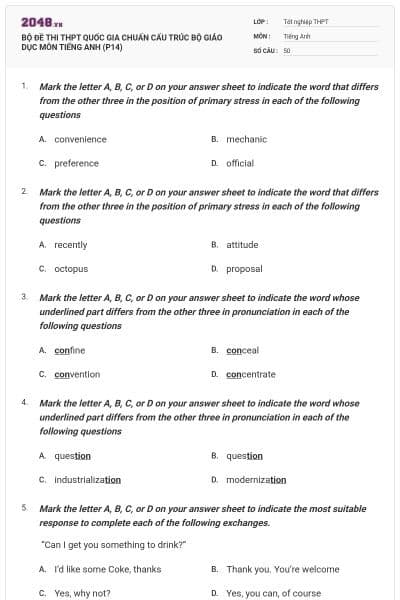
Mark the letter A, B, C, or D on your answer sheet to indicate the word that differs from the other three in the position of primary stress in each of the following questions
convenience
mechanic
preference
official
Đáp án C
- Convenience /kən'vi:njəns/ (n): sự thuận lợi
- Mechanic /mə'kænik/ (n): thợ cơ khí
- Preference /'prefərəns/ (n): sự yêu thích hơn
- Official /ə'fiʃəl/ (ad;): chính thức
ð Đáp án C (trọng âm rơi vào âm tiết thứ nhất; các từ còn lại là âm tiết thứ 2)
Mark the letter A, B, C, or D on your answer sheet to indicate the word that differs from the other three in the position of primary stress in each of the following questions
recently
attitude
octopus
proposal
Đáp án D
- Recently /'ri:sntli/ (adv): gần đây
- Attitude /'ætitju:d/ (n): thái độ, quan điểm
- Octopus /'ɔktəpəs/ (n): con bạch tuộc
- Proposal /prə’pəu.zəl/ (n): lời đề nghị, sự cầu hôn
ð Đáp án D (trọng âm rơi vào âm tiết thứ 2; các từ còn lại là thứ nhất)
Mark the letter A, B, C, or D on your answer sheet to indicate the word whose underlined part differs from the other three in pronunciation in each of the following questions
confine
conceal
convention
concentrate
Đáp án D
- Confine /kən'fain/ (v): hạn chế, giới hạn; giam giữ, giam cầm, nhốt/giữ lại
- Conceal /kən'si:l/ (v): giấu giếm, giấu, che đậy
- Convention /kən'venʃn/ (n): công ước, hiệp định, hội nghị, quy ước
- Concentrate /'kɔnsəntreit/ (v) : tập trung
Mark the letter A, B, C, or D on your answer sheet to indicate the word whose underlined part differs from the other three in pronunciation in each of the following questions
question
question
industrialization
modernization
Đáp án A
- Question /'kwestʃən/ (n): câu hỏi
- Presentation /,pri:zen'teiʃn/ (n): bài thuyết trình; sự trình diễn, trưng bày
- Industrialization /in,dʌstriələ'zeiʃn/ (n): sự công nghiệp hóa
- Modernization /,mɔ:dərnə'zeiʃn/ (n): sự hiện đại hóa
Mark the letter A, B, C, or D on your answer sheet to indicate the most suitable response to complete each of the following exchanges.
“Can I get you something to drink?”
I’d like some Coke, thanks
Thank you. You’re welcome
Yes, why not?
Yes, you can, of course
Đáp án A
“Mình lấy cho bạn cái gì để uống nhé?”
Mình muốn uống coca- cola, cảm ơn bạn nhé
Cảm ơn. Không có gì
Vâng, tại sao không?
Vâng, tất nhiên bạn có thể
Mark the letter A, B, C, or D on your answer sheet to indicate the most suitable response to complete each of the following exchanges.
Mike: “I apologize to you for not keeping my promise”
Mary: “______________”
Well, that’s out of question
Your apology is accepted
I am grateful to that
That was very sweet of you
Đáp án B
Mike; “Tớ xin lỗi vì không giữ lời hứa.”
Ồ, đó là không thể được.
Tớ biết ơn điều đó.
Cậu rất ngọt ngào.
- Your apology is accepted ~ Never mind: đáp lại lời xin lỗi (chấp nhận và tha thứ)
Mark the letter A, B, C, or D on your answer sheet to indicate the word(s) OPPOSITE in meaning to the underlined word(s) in each of the following questions.
Names of people in the book were changed to preserve anonymity
reveal
conserve
cover
presume
Đáp án A
- Preserve /pri'zə:v/ (v); giữ, giữ gìn, duy trì
- Reveal /ri'vi:l/ (v) : để lộ, tiết lộ
- Cover /'kʌvə/ (v): che đậy, che giấu
- Conserve /kən'sə:v/ (v); giữ gìn, duy trì, bảo tồn
- Presume /pri'zju:m/ (v); cho là, coi như là
ð Đáp án A (Tên của những người trong quyển sách thì được thay đổi để giấu tên.)
Mark the letter A, B, C, or D on your answer sheet to indicate the word(s) OPPOSITE in meaning to the underlined word(s) in each of the following questions.
In remote communities, it’s important to replenish stocks before the winter sets in
empty
refill
repeat
remake
Đáp án A
- Replenish /ri'pleniʃ/ (v): lại làm đầy, cung cấp thêm (replenish sth with sth)
- Empty (v): làm trống rỗng
- Refill /'ri:fil/ (v); làm đầy lại (refill sth with sth)
- Repeat /ri'pi:t/ (v): lặp lại
- Remake /'ri:'meik/ (v): làm lại
ð Đáp án A (Trong những cộng đồng xa xôi hẻo lánh thì rất quan trọng phải bổ sung thêm nguyên vật liệu trước khi mùa đông đến.)
Mark the letter A, B, C, or D on your answer sheet to indicate the word(s) CLOSEST in meaning to the underlined word(s) in each of the following questions.
It was boiling yesterday. We have a very humid and dry summer this year
very hot
cooking
dry
cooked
Đáp án A
- Boiling ~ Very hot: rất nóng
- Cooking : đang nấu
- Dry (adj): khô
- Cooked: được nấu
ð Đáp án A (Hôm qua trời rất nóng. Năm nay chúng ta có một mùa hè khô và ẩm.)
Mark the letter A, B, C, or D on your answer sheet to indicate the word(s) CLOSEST in meaning to the underlined word(s) in each of the following questions.
It was inevitable that the smaller company should merge with the larger one
vital
unnecessary
urgent
unavoidable
Đáp án: D
Giải thích:
Kiến thức: Từ vựng – Từ đồng nghĩa
inevitable (adj): không tránh được
Xét các đáp án:
A. vital (adj): quan trọng
B. unnecessary (adj): không cần thiết
C. urgent (adj): khẩn cấp, gấp
D. unavoidable (adj): không tránh được
→ inevitable = unavoidable
Dịch: Việc công ty nhỏ hơn sáp nhập với công ty lớn hơn là điều không thể tránh khỏi.
Mark the letter A, B, C, or D on your answer sheet to indicate the correct answer to each of the following questions.
Dr. Evans has___________a valuable contribution to the life of the school
done
created
caused
made
Đáp án D
Cấu trúc:
- Make a contribution to sth: đóng góp vào cái gì
ð Đáp án D (Tiến sỹ Evan đã đóng góp to lớn vào sự trường tồn của ngôi trường.)
Mark the letter A, B, C, or D on your answer sheet to indicate the correct answer to each of the following questions.
It was difficult to guess what her __________ to the news would be
feelings
reaction
capital
opinion
Đáp án B
Feeling of sth (n): cảm giác về cái gì
Reaction to sb/ sth: sự phản ứng với ai/ cái gì
Capital (n): thủ đô/ vốn
Opinion of/ about/ on sb/ sth: quan điểm về ai/ cái gì
ð Đáp án B (Thật là khó để đoán xem phản ứng của cô ấy với tin đó sẽ như thế nào.)
Mark the letter A, B, C, or D on your answer sheet to indicate the correct answer to each of the following questions.
Sportsmen_________their political differences on the sports field
take part
put aside
take place
keep apart
Đáp án: B
Giải thích:
A. take apart + in: tham gia vào cái gì
B. put aside: gạt sang, để sang một bên
C. take place: diễn ra
D. keep apart: tránh xa
Dựa vào nghĩa câu, chọn B.
Dịch: Khi ở sân chơi thể thao, các vận động viên gạt những khác biệt về quan điểm chính trị sang một bên.
Mark the letter A, B, C, or D on your answer sheet to indicate the correct answer to each of the following questions.
It is a biological fact that children __________ their parents
take after
take to
look up
care for
Đáp án A
- Take after: giống (ai)
- Take to: bắt đầu làm gì như thói quen, bắt đầu thích ai/ cái gì
E.g: I’ve taken to waking up very early.
He hasn’t taken to his new school.
- Look up : tra cứu (từ)
- Care for: chăm sóc
ð Đáp án A (Một thực tế về mặt sinh học rằng những người con giống bố mẹ mình.)
Mark the letter A, B, C, or D on your answer sheet to indicate the correct answer to each of the following questions.
I can’t__________who it is. He is too far away
take in
stand for
make out
look for
Đáp án C
- Take sth in: hiểu được, nắm được
- Take sb in ~ Deceive: đánh lừa ai
E.g: She took me in completely with her story.
- Stand for: viết tắt cho, đại diện cho cái gì
- Make out ~ Distinguish: phân biệt, nhận ra, nhìn thấy
E.g: I could hear voices but I couldn’t make out what they were saying.
- Look for: tìm kiếm
ð Đáp án C (Tôi không thể nhận ra đó là ai. Anh ta thì quá xa.)
Mark the letter A, B, C, or D on your answer sheet to indicate the correct answer to each of the following questions.
Looking down at the coral reef, we saw _________ of tiny, multi-coloured fish
teams
flocks
shoals
swarms
Đáp án C
- Team (n): đội
- Flock (n): a group of sheep, goats or birds of the same type: đàn, bầy
E.g: a flock of ducks: một đàn vịt
- Shoal (n): đàn cá
- Swarm (n): a large group of insects, especially bees, moving together in the same direction: đàn, đám, bầy (côn trùng, đặc biệt là ong)
E.g: a swarm of bees
ð Đáp án C (Khi nhìn xuống rặng san hô, chúng ta thấy những đàn cá nhiều màu sắc bé nhỏ.)
Mark the letter A, B, C, or D on your answer sheet to indicate the correct answer to each of the following questions.
A bridge must be strong enough to support its own weight_______the weight
of the people and vehicles that use it.
as far as
as long as
so well as
as well as
Đáp án D
- As far as: theo như
E.g: As far as we knew, there was no cause for concern.
- As long as: miễn là
E.g: We'll go as long as the weather is good.
- So well as: tốt/ giỏi như (thường dùng trong câu phủ định)
E.g: I don’t play so well as my brother.
- As well as: cũng như
E.g: They sell books as well as newspapers.
ð Đáp án D (Một cây cầu phải đủ mạnh đê hỗ trợ trọng lượng riêng của nó cũng như
trọng lượng của con người và phương tiện sử dụng nó)
Mark the letter A, B, C, or D on your answer sheet to indicate the correct answer to each of the following questions.
I must take this watch to be repaired as it _________ over 20 minutes a day
accelerates
increases
progresses
gains
Đáp án D
- Accelerate /æk'seləreit/ (v): tăng nhanh hơn, mau hơn
- Increase (v): tăng
- Progress (v): phát triển, tiến triển, tiến bộ
- Gain (v): nhanh # lose : chậm (dùng cho đồng hồ)
ð Đáp án D (Tôi phải đưa chiếc đồng hồ này đi sửa vì nó chạy nhanh hơn 20 phút một ngày.)
Mark the letter A, B, C, or D on your answer sheet to indicate the correct answer to each of the following questions.
The hall was very crowded with over a hundred people _______ into it.
stuck
packed
pushed
stuffed
Đáp án B
- Pack sb/ sth in/ into sth: to put a lot of things or people into a limited space: nhồi nhét
- Stuck: sa lầy, mắc kẹt
- Push: kéo ra, giật
- Stuff: nhồi, nhét
ð Đáp án B (Hội trường rất đông với hơn một trăm người được nhét vào trong đó.)
Mark the letter A, B, C, or D on your answer sheet to indicate the correct answer to each of the following questions.
Vietnamese parents normally do not let their children make a decision ________ their own future career
in
of
on
for
Đáp án C
- Make a decision on sth: đưa ra quyết định về điều gì
ð Đáp án C (Bố mẹ người Việt thường không để các con tự quyết định nghề nghiệp
tương lai của mình.)
Mark the letter A, B, C, or D on your answer sheet to indicate the correct answer to each of the following questions.
The move to a different environment brought about a significant ________in my cousin’s state of mind
change
impact
effect
influence
Đáp án: A
Giải thích:
change in something: sự thay đổi về cái gì
impact/effect/influence on somebody/something: ảnh hưởng lên ai/cái gì
Dựa vào nghĩa và giới từ “in”, chọn A.
Dịch: Việc chuyển đến một môi trường khác đã mang lại sự thay đổi đáng kể trong suy nghĩ của anh họ tôi.
Mark the letter A, B, C, or D on your answer sheet to indicate the correct answer to each of the following questions.
When finding a new house, parents should _________all the conditions for their children's education and entertainment
take into account
take actions
put pressure
put up with
Đáp án: A
Giải thích:
Xét các đáp án:
A. take into account: cân nhắc, xem xét
B. take actions: hành động
C. put pressure + on: đặt áp lực lên
D. put up with: chịu đựng
Dựa vào nghĩa, chọn A.
Dịch: Khi tìm nhà mới, các bậc phụ huynh nên cân nhắc tất cả những điều kiện cho giáo dục và giải trí của con họ.
Read the following passage and mark the letter A, B, C, or D on your answer sheet to indicate the correct word or phrase that best fits each of the numbered blanks from 23 to 27
Face-to-face conversation is a two-way process: You speak to me, I reply to you and so on. Two-way (23)________ depends on having a coding system that is understood by both sender and (24)________, and an agreed convention about signaling the beginning and end of the message. In speech, the coding system is the language like English or Spanish; the convention that one person speaks at a time may seem too obvious to mention. In fact, the signals (25)______in conversation and meetings are often (26)______. For example, lowering the pitch of the voice may mean the end of a sentence, a sharp intake of breath may signal the desire to interrupt, catching the chairmans eye may indicate the desire to speak in a formal setting like a debate, a clenched fist may indicate anger. When (27)______ visual signals are not possible, more formal signals may be needed.
Điền ô 23
exchange
interchange
communication
correspondence
Đáp án C
- Exchange (n): sự trao đổi
- Interchange (n): sự trao đổi lẫn nhau
- Communication (n): sự giao tiếp, liên lạc
- Correspondence (n): sự tương xứng; quan hệ thư tù
Đáp án C (two-way communication : giao tiếp hai chiều)
Read the following passage and mark the letter A, B, C, or D on your answer sheet to indicate the correct word or phrase that best fits each of the numbered blanks from 23 to 27
Face-to-face conversation is a two-way process: You speak to me, I reply to you and so on. Two-way (23)________ depends on having a coding system that is understood by both sender and (24)________, and an agreed convention about signaling the beginning and end of the message. In speech, the coding system is the language like English or Spanish; the convention that one person speaks at a time may seem too obvious to mention. In fact, the signals (25)______in conversation and meetings are often (26)______. For example, lowering the pitch of the voice may mean the end of a sentence, a sharp intake of breath may signal the desire to interrupt, catching the chairmans eye may indicate the desire to speak in a formal setting like a debate, a clenched fist may indicate anger. When (27)______ visual signals are not possible, more formal signals may be needed.
Điền ô 24
announcer
receiver
messenger
transmitter
Đáp án A
Phía sau có động từ “are” => chỗ trống cần điền là mệnh đề quan hệ để bổ sung nghĩa
Read the following passage and mark the letter A, B, C, or D on your answer sheet to indicate the correct word or phrase that best fits each of the numbered blanks from 23 to 27
Face-to-face conversation is a two-way process: You speak to me, I reply to you and so on. Two-way (23)________ depends on having a coding system that is understood by both sender and (24)________, and an agreed convention about signaling the beginning and end of the message. In speech, the coding system is the language like English or Spanish; the convention that one person speaks at a time may seem too obvious to mention. In fact, the signals (25)______in conversation and meetings are often (26)______. For example, lowering the pitch of the voice may mean the end of a sentence, a sharp intake of breath may signal the desire to interrupt, catching the chairmans eye may indicate the desire to speak in a formal setting like a debate, a clenched fist may indicate anger. When (27)______ visual signals are not possible, more formal signals may be needed.
Điền ô 25
that people
are used
using
being used
Đáp án B
- Informai (adj): thân mật
- Formal (adj): trang trọng
- Verbal (adj): bằng lời nói
- Non-verbal (adj): phi ngôn từ, không bằng lời nói
“In fact, the signals that people use in conversation and meetings are often non-verbal.” (Thực ra, dấu hiệu mà người ta dùng trong hội thoại và trong các cuộc họp thường không bằng lời nói.)
Read the following passage and mark the letter A, B, C, or D on your answer sheet to indicate the correct word or phrase that best fits each of the numbered blanks from 23 to 27
Face-to-face conversation is a two-way process: You speak to me, I reply to you and so on. Two-way (23)________ depends on having a coding system that is understood by both sender and (24)________, and an agreed convention about signaling the beginning and end of the message. In speech, the coding system is the language like English or Spanish; the convention that one person speaks at a time may seem too obvious to mention. In fact, the signals (25)______in conversation and meetings are often (26)______. For example, lowering the pitch of the voice may mean the end of a sentence, a sharp intake of breath may signal the desire to interrupt, catching the chairmans eye may indicate the desire to speak in a formal setting like a debate, a clenched fist may indicate anger. When (27)______ visual signals are not possible, more formal signals may be needed.
Điền ô 26
informal
non-verbal
verbal
formal
Đáp án B
- These + N số nhiều: những ...này
“When these visual signals are not possible, more formal signals may be needed.” (Khi những tín hiệu bằng giác quan này không hiệu quả thì có thể cần đến những tín hiệu trang trọng hơn.)
Read the following passage and mark the letter A, B, C, or D on your answer sheet to indicate the correct word or phrase that best fits each of the numbered blanks from 23 to 27
Face-to-face conversation is a two-way process: You speak to me, I reply to you and so on. Two-way (23)________ depends on having a coding system that is understood by both sender and (24)________, and an agreed convention about signaling the beginning and end of the message. In speech, the coding system is the language like English or Spanish; the convention that one person speaks at a time may seem too obvious to mention. In fact, the signals (25)______in conversation and meetings are often (26)______. For example, lowering the pitch of the voice may mean the end of a sentence, a sharp intake of breath may signal the desire to interrupt, catching the chairmans eye may indicate the desire to speak in a formal setting like a debate, a clenched fist may indicate anger. When (27)______ visual signals are not possible, more formal signals may be needed.
Điền ô 27
their
these
this
that
Đáp án C
Câu nào diễn đạt tốt nhất ý chính của đoạn đầu tiên?
A. Nhìn chung thì phụ nữ nói nhiều hơn đàn ông
B. Câu chuyện của phụ nữ thì rập khuôn
C. Phụ nữ nói nhiều ở những nơi riêng tư; và đàn ông nói nhiều ở nơi công cộng
D. Rất ít nam và nữ có cách chơi khác nhau
Dẫn chứng: “women are more verbal - talk more - in private situations .... men talk more in public situations”
Read the following passage and mark the letter A, B, C, or D on your answer sheet to indicate the correct answer to each of the questions from 28 to 34.
Who talks more - men or women? Most people believe that women talk more. However, linguist Deborah Tannen, who has the studied the communication style of men and women, says that this is a stereotype. According to Tannen, women are more verbal - talk more - in private situations, where they use conversation as the “glue’ to hold relationships together. But, she says, men talk more in public situations, where they use conversation to exchange information and gain status. Tannen points out that we can see these difference even in children. Little girls often play with one ‘best friend’ and their play includes a lot of conversation. Little boys often play games in groups, their play usually involves more doing than talking. In school, girls are often better at verbal skills, while boys are often better at mathematics.
A recent study at Emory University helps to shed light on the roots of this difference. Researchers studied conversation between children aged 3-6 and their parents. They found evidence that parents talk very differently to their sons than they do to their daughters. The startling conclusion was that parents use more language with their girls. Specifically, when parents talk with their daughters, they use more descriptive language and more details. There is also far more talk about emotions, especially with daughters than with sons.
Which sentence best expresses the main idea of the first paragraph?
Women talk more than men on the whole
Women’s talking is a stereotype
Women talk more in private, and men talk more in public
Little boys and little girls have different ways of playing
Đáp án C
Câu nào diễn đạt tốt nhất ý chính của đoạn đầu tiên?
A. Nhìn chung thì phụ nữ nói nhiều hơn đàn ông
B. Câu chuyện của phụ nữ thì rập khuôn
C. Phụ nữ nói nhiều ở những nơi riêng tư; và đàn ông nói nhiều ở nơi công cộng
D. Rất ít nam và nữ có cách chơi khác nhau
Dẫn chứng: “women are more verbal - talk more - in private situations .... men talk more in public situations”
Read the following passage and mark the letter A, B, C, or D on your answer sheet to indicate the correct answer to each of the questions from 28 to 34.
Who talks more - men or women? Most people believe that women talk more. However, linguist Deborah Tannen, who has the studied the communication style of men and women, says that this is a stereotype. According to Tannen, women are more verbal - talk more - in private situations, where they use conversation as the “glue’ to hold relationships together. But, she says, men talk more in public situations, where they use conversation to exchange information and gain status. Tannen points out that we can see these difference even in children. Little girls often play with one ‘best friend’ and their play includes a lot of conversation. Little boys often play games in groups, their play usually involves more doing than talking. In school, girls are often better at verbal skills, while boys are often better at mathematics.
A recent study at Emory University helps to shed light on the roots of this difference. Researchers studied conversation between children aged 3-6 and their parents. They found evidence that parents talk very differently to their sons than they do to their daughters. The startling conclusion was that parents use more language with their girls. Specifically, when parents talk with their daughters, they use more descriptive language and more details. There is also far more talk about emotions, especially with daughters than with sons.
Which word is similar in meaning to the word “glue” ?
games
sticky substance
rope
means
Đáp án B
- Verbal ~ connected with use of spoken language: bằng lời nói
A. bắt nguồn từ động từ
C. sử dụng tiếng ồn to
D. nói rất nhiều
Read the following passage and mark the letter A, B, C, or D on your answer sheet to indicate the correct answer to each of the questions from 28 to 34.
Who talks more - men or women? Most people believe that women talk more. However, linguist Deborah Tannen, who has the studied the communication style of men and women, says that this is a stereotype. According to Tannen, women are more verbal - talk more - in private situations, where they use conversation as the “glue’ to hold relationships together. But, she says, men talk more in public situations, where they use conversation to exchange information and gain status. Tannen points out that we can see these difference even in children. Little girls often play with one ‘best friend’ and their play includes a lot of conversation. Little boys often play games in groups, their play usually involves more doing than talking. In school, girls are often better at verbal skills, while boys are often better at mathematics.
A recent study at Emory University helps to shed light on the roots of this difference. Researchers studied conversation between children aged 3-6 and their parents. They found evidence that parents talk very differently to their sons than they do to their daughters. The startling conclusion was that parents use more language with their girls. Specifically, when parents talk with their daughters, they use more descriptive language and more details. There is also far more talk about emotions, especially with daughters than with sons.
Which of the following phrases best explains the meaning of the word “verbal”?
Deriving from verbs
Connected with use of spoken language
Using very loud noise
Being very talkative
Đáp án B
- Verbal ~ connected with use of spoken language: bằng lời nói
A. bắt nguồn từ động từ
C. sử dụng tiếng ồn to
D. nói rất nhiều
Read the following passage and mark the letter A, B, C, or D on your answer sheet to indicate the correct answer to each of the questions from 28 to 34.
Who talks more - men or women? Most people believe that women talk more. However, linguist Deborah Tannen, who has the studied the communication style of men and women, says that this is a stereotype. According to Tannen, women are more verbal - talk more - in private situations, where they use conversation as the “glue’ to hold relationships together. But, she says, men talk more in public situations, where they use conversation to exchange information and gain status. Tannen points out that we can see these difference even in children. Little girls often play with one ‘best friend’ and their play includes a lot of conversation. Little boys often play games in groups, their play usually involves more doing than talking. In school, girls are often better at verbal skills, while boys are often better at mathematics.
A recent study at Emory University helps to shed light on the roots of this difference. Researchers studied conversation between children aged 3-6 and their parents. They found evidence that parents talk very differently to their sons than they do to their daughters. The startling conclusion was that parents use more language with their girls. Specifically, when parents talk with their daughters, they use more descriptive language and more details. There is also far more talk about emotions, especially with daughters than with sons.
The word “they” refers to___________.
Situations
Men
Men and women
Women
Đáp án B
“But, she says, men talk more in public situations, where they use conversation to exchange information” (Nhưng bà ấy nói rằng đàn ông nói nhiều hơn trong những tình huống công cộng, nơi mà họ dùng cuộc trò chuyện để trao đổi thông tin)
Read the following passage and mark the letter A, B, C, or D on your answer sheet to indicate the correct answer to each of the questions from 28 to 34.
Who talks more - men or women? Most people believe that women talk more. However, linguist Deborah Tannen, who has the studied the communication style of men and women, says that this is a stereotype. According to Tannen, women are more verbal - talk more - in private situations, where they use conversation as the “glue’ to hold relationships together. But, she says, men talk more in public situations, where they use conversation to exchange information and gain status. Tannen points out that we can see these difference even in children. Little girls often play with one ‘best friend’ and their play includes a lot of conversation. Little boys often play games in groups, their play usually involves more doing than talking. In school, girls are often better at verbal skills, while boys are often better at mathematics.
A recent study at Emory University helps to shed light on the roots of this difference. Researchers studied conversation between children aged 3-6 and their parents. They found evidence that parents talk very differently to their sons than they do to their daughters. The startling conclusion was that parents use more language with their girls. Specifically, when parents talk with their daughters, they use more descriptive language and more details. There is also far more talk about emotions, especially with daughters than with sons.
Which sentence best expresses the main idea of the second paragraph
Researchers have studied the conversations of children and their parents
Parents do not talk much about sadness with their sons
Study at Emory University can help to explain the differences between communication styles of boys and girls
An Emory University study found than parents talk more with their daughters than with their sons
Đáp án D
Câu nào diễn đạt tốt nhất ý chính của đoạn 2?
A. Các nhà nghiên cứu đã nghiên cứu các cuộc nói chuyện của trẻ con và bố mẹ của chúng.
B. Bố mẹ không nói chuyện nhiều về nỗi buồn với con trai
C. Học ở trường đại học Emory có thể giúp giải thích sự khác nhau giữa kiểu giao tiếp của nam và nữ
D. Một nghiên cứu của trường đại học Emory đã khám phá ra rằng bố mẹ nói chuyện với con gái nhiều hơn với con trai
Dẫn chứng: “A recent study at Emory University helps to shed light on the roots of this difference... The startling conclusion was that parents use more language with their girls”
Read the following passage and mark the letter A, B, C, or D on your answer sheet to indicate the correct answer to each of the questions from 28 to 34.
Who talks more - men or women? Most people believe that women talk more. However, linguist Deborah Tannen, who has the studied the communication style of men and women, says that this is a stereotype. According to Tannen, women are more verbal - talk more - in private situations, where they use conversation as the “glue’ to hold relationships together. But, she says, men talk more in public situations, where they use conversation to exchange information and gain status. Tannen points out that we can see these difference even in children. Little girls often play with one ‘best friend’ and their play includes a lot of conversation. Little boys often play games in groups, their play usually involves more doing than talking. In school, girls are often better at verbal skills, while boys are often better at mathematics.
A recent study at Emory University helps to shed light on the roots of this difference. Researchers studied conversation between children aged 3-6 and their parents. They found evidence that parents talk very differently to their sons than they do to their daughters. The startling conclusion was that parents use more language with their girls. Specifically, when parents talk with their daughters, they use more descriptive language and more details. There is also far more talk about emotions, especially with daughters than with sons.
Which can be used as a synonym of the word “feelings” ?
anger
emotions
thinking
worries
Đáp án B
- Feelings ~ Emotions: cảm xúc
- Anger: sự tức giận
- Thinking: suy nghĩ
- Worries: lo lắng
“There is also far more talk about emotions, especially with daughters than with sons.” (Cũng có nhiều cuộc nói chuyện về cảm xúc với con gái hơn với con trai.)
Read the following passage and mark the letter A, B, C, or D on your answer sheet to indicate the correct answer to each of the questions from 28 to 34.
Who talks more - men or women? Most people believe that women talk more. However, linguist Deborah Tannen, who has the studied the communication style of men and women, says that this is a stereotype. According to Tannen, women are more verbal - talk more - in private situations, where they use conversation as the “glue’ to hold relationships together. But, she says, men talk more in public situations, where they use conversation to exchange information and gain status. Tannen points out that we can see these difference even in children. Little girls often play with one ‘best friend’ and their play includes a lot of conversation. Little boys often play games in groups, their play usually involves more doing than talking. In school, girls are often better at verbal skills, while boys are often better at mathematics.
A recent study at Emory University helps to shed light on the roots of this difference. Researchers studied conversation between children aged 3-6 and their parents. They found evidence that parents talk very differently to their sons than they do to their daughters. The startling conclusion was that parents use more language with their girls. Specifically, when parents talk with their daughters, they use more descriptive language and more details. There is also far more talk about emotions, especially with daughters than with sons.
Which of the following statement is TRUE about the passage?
Parents give more love to their daughters than to their sons
Boys don’t like to be with their parents as much as girls do.
Parents use more language to talk with their daughters
Boys don’t like showing emotions
Đáp án C
Phát biểu nào sau đây ĐÚNG về bài đọc?
A. Bố mẹ đã dành nhiều tình yêu cho con gái hơn cho con trai của họ.
B. Con trai không thích ở với bố mẹ nhiều như con gái. ’
C. Bố mẹ dùng nhiều ngôn ngữ nói chuyện với con gái hơn.
D. Con trai không thích thể hiện cảm xúc.
Dẫn chứng: “The startling conclusion was that parents use more language with their girls. Specifically, when parents talk with their daughters, they use more descriptive language and more details.”
Read the following passage and mark the letter A, B, C, or D on your answer sheet to indicate the correct answer to each of the questions from 35 to 42.
A number of factors related to the voice reveal the personality of the speaker. The first is the broad area of communication, which includes imparting information by use of language, communicating with a group or an individual and specialized communication through performance. A person conveys thoughts and ideas through choice of words, by a tone of voice that is pleasant or unpleasant, gentle or harsh, by the rhythm that is inherent within the language itself, and by speech rhythms that are flowing and regular or uneven and hesitant, and finally, by the pitch and melody of the utterance. When speaking before a group, a person's tone may indicate uncertainty or fright, confidence or calm. At interpersonal levels, the tone may reflect ideas and feelings over and above the words chosen, or may believe them. Here, the participant's tone can consciously or unconsciously reflect intuitive sympathy or antipathy, lack of concern or interest, fatigue, anxiety, enthusiasm or excitement, all of which are usually discernible by the acute listener. Public performance is a manner of communication that is highly specialized with its own techniques for obtaining effects by voice and /or gesture. The motivation derived from the text, and in the case of singing, the music, in combination with the performers skills, personality, and ability to create empathy will determine the success of artistic, political, or pedagogic communication.
Second, the voice gives psychological clues to a person's self-image, perception of others, and emotional health. Self-image can be indicated by a tone of voice that is confident, pretentious, shy, aggressive, outgoing, or exuberant, to name only a few personality traits. Also the sound may give a clue to the facade or mask of that person, for example, a shy person hiding behind an overconfident front.
How a speaker perceives the listener’s receptiveness, interest, or sympathy in any given conversation can drastically alter the tone of presentation, by encouraging or discouraging the speaker. Emotional health is evidenced in the voice by free and melodic sounds of the happy, by constricted and harsh sound of the angry, and by dull and lethargic qualities of the depressed.
The word “Here” in the passage refers to__________.
interpersonal interaction
the tone
ideas and feelings
words chosen
Đáp án A
Dẫn chứng:At interpersonal levels, the tone may reflect ideas and feelings over and above the words chosen, or may belie them. Here the participant's tone can consciously or unconsciously reflect intuitive sympathy or antipathy”
Vậy: “here” = At interpersonal levels
ð Đáp án A (interpersonal interactions: sự tương tác cá nhân với nhau)
Read the following passage and mark the letter A, B, C, or D on your answer sheet to indicate the correct answer to each of the questions from 35 to 42.
A number of factors related to the voice reveal the personality of the speaker. The first is the broad area of communication, which includes imparting information by use of language, communicating with a group or an individual and specialized communication through performance. A person conveys thoughts and ideas through choice of words, by a tone of voice that is pleasant or unpleasant, gentle or harsh, by the rhythm that is inherent within the language itself, and by speech rhythms that are flowing and regular or uneven and hesitant, and finally, by the pitch and melody of the utterance. When speaking before a group, a person's tone may indicate uncertainty or fright, confidence or calm. At interpersonal levels, the tone may reflect ideas and feelings over and above the words chosen, or may believe them. Here, the participant's tone can consciously or unconsciously reflect intuitive sympathy or antipathy, lack of concern or interest, fatigue, anxiety, enthusiasm or excitement, all of which are usually discernible by the acute listener. Public performance is a manner of communication that is highly specialized with its own techniques for obtaining effects by voice and /or gesture. The motivation derived from the text, and in the case of singing, the music, in combination with the performers skills, personality, and ability to create empathy will determine the success of artistic, political, or pedagogic communication.
Second, the voice gives psychological clues to a person's self-image, perception of others, and emotional health. Self-image can be indicated by a tone of voice that is confident, pretentious, shy, aggressive, outgoing, or exuberant, to name only a few personality traits. Also the sound may give a clue to the facade or mask of that person, for example, a shy person hiding behind an overconfident front.
How a speaker perceives the listener’s receptiveness, interest, or sympathy in any given conversation can drastically alter the tone of presentation, by encouraging or discouraging the speaker. Emotional health is evidenced in the voice by free and melodic sounds of the happy, by constricted and harsh sound of the angry, and by dull and lethargic qualities of the depressed.
What does the passage mainly discuss?
The production of speech
The function of the voice in performance
Communication styles
The connection between voice and personality
Đáp án D
Bài đọc chủ yếu thảo luận điều gì?
A. Việc tạo ra lời nói
B. Chức năng của giọng nói trong biểu diễn
C. Các kiểu giao tiếp
D. Sự kết nối giữa giọng nói và tính cách
“A number of factors related to the voice reveal the personality of the speaker”
Read the following passage and mark the letter A, B, C, or D on your answer sheet to indicate the correct answer to each of the questions from 35 to 42.
A number of factors related to the voice reveal the personality of the speaker. The first is the broad area of communication, which includes imparting information by use of language, communicating with a group or an individual and specialized communication through performance. A person conveys thoughts and ideas through choice of words, by a tone of voice that is pleasant or unpleasant, gentle or harsh, by the rhythm that is inherent within the language itself, and by speech rhythms that are flowing and regular or uneven and hesitant, and finally, by the pitch and melody of the utterance. When speaking before a group, a person's tone may indicate uncertainty or fright, confidence or calm. At interpersonal levels, the tone may reflect ideas and feelings over and above the words chosen, or may believe them. Here, the participant's tone can consciously or unconsciously reflect intuitive sympathy or antipathy, lack of concern or interest, fatigue, anxiety, enthusiasm or excitement, all of which are usually discernible by the acute listener. Public performance is a manner of communication that is highly specialized with its own techniques for obtaining effects by voice and /or gesture. The motivation derived from the text, and in the case of singing, the music, in combination with the performers skills, personality, and ability to create empathy will determine the success of artistic, political, or pedagogic communication.
Second, the voice gives psychological clues to a person's self-image, perception of others, and emotional health. Self-image can be indicated by a tone of voice that is confident, pretentious, shy, aggressive, outgoing, or exuberant, to name only a few personality traits. Also the sound may give a clue to the facade or mask of that person, for example, a shy person hiding behind an overconfident front.
How a speaker perceives the listener’s receptiveness, interest, or sympathy in any given conversation can drastically alter the tone of presentation, by encouraging or discouraging the speaker. Emotional health is evidenced in the voice by free and melodic sounds of the happy, by constricted and harsh sound of the angry, and by dull and lethargic qualities of the depressed.
The word “evidenced” in the passage is closest in meaning to _________.
questioned
repeated
indicated
exaggerated
Đáp án C
- Evidence /'evidəns/ (v): chứng minh, chứng tỏ
- Indicate (v): chỉ ra, chứng tỏ, cho biết
- Repeat (v): lặp lại
- Question /'kwestʃən/: hỏi
- Exaggerate /ig'zædʤəreit/ (v): thổi phồng, phóng đại
Read the following passage and mark the letter A, B, C, or D on your answer sheet to indicate the correct answer to each of the questions from 35 to 42.
A number of factors related to the voice reveal the personality of the speaker. The first is the broad area of communication, which includes imparting information by use of language, communicating with a group or an individual and specialized communication through performance. A person conveys thoughts and ideas through choice of words, by a tone of voice that is pleasant or unpleasant, gentle or harsh, by the rhythm that is inherent within the language itself, and by speech rhythms that are flowing and regular or uneven and hesitant, and finally, by the pitch and melody of the utterance. When speaking before a group, a person's tone may indicate uncertainty or fright, confidence or calm. At interpersonal levels, the tone may reflect ideas and feelings over and above the words chosen, or may believe them. Here, the participant's tone can consciously or unconsciously reflect intuitive sympathy or antipathy, lack of concern or interest, fatigue, anxiety, enthusiasm or excitement, all of which are usually discernible by the acute listener. Public performance is a manner of communication that is highly specialized with its own techniques for obtaining effects by voice and /or gesture. The motivation derived from the text, and in the case of singing, the music, in combination with the performers skills, personality, and ability to create empathy will determine the success of artistic, political, or pedagogic communication.
Second, the voice gives psychological clues to a person's self-image, perception of others, and emotional health. Self-image can be indicated by a tone of voice that is confident, pretentious, shy, aggressive, outgoing, or exuberant, to name only a few personality traits. Also the sound may give a clue to the facade or mask of that person, for example, a shy person hiding behind an overconfident front.
How a speaker perceives the listener’s receptiveness, interest, or sympathy in any given conversation can drastically alter the tone of presentation, by encouraging or discouraging the speaker. Emotional health is evidenced in the voice by free and melodic sounds of the happy, by constricted and harsh sound of the angry, and by dull and lethargic qualities of the depressed.
Why does the author mention “artistic, political, or pedagogic communication” in the passage?
To introduce the idea of self-image
As examples of public performance
As examples of basic styles of communication
To contrast them to singing
Đáp án C
Tại sao tác giả đề cập “giao tiếp nghệ thuật, chính trị hay sư phạm” trong bài đọc?
A. để giới thiệu hình ảnh tự nhận thức
B. như những ví dụ của việc biểu diễn nơi công cộng
C. như những ví dụ của những kiểu giao tiếp cơ bản
D. để đối chiếu chúng với việc ca hát
“The motivation derived from the text, and in the case of singing, the music, in combination with the performer's skills, personality, and ability to create empathy will determine the success of artistic, political, or pedagogic communication.”
(Tác giả muốn liệt kê những loại hình giao tiếp trên như là những loại hình giao tiếp cơ bản cùa con người)
Read the following passage and mark the letter A, B, C, or D on your answer sheet to indicate the correct answer to each of the questions from 35 to 42.
A number of factors related to the voice reveal the personality of the speaker. The first is the broad area of communication, which includes imparting information by use of language, communicating with a group or an individual and specialized communication through performance. A person conveys thoughts and ideas through choice of words, by a tone of voice that is pleasant or unpleasant, gentle or harsh, by the rhythm that is inherent within the language itself, and by speech rhythms that are flowing and regular or uneven and hesitant, and finally, by the pitch and melody of the utterance. When speaking before a group, a person's tone may indicate uncertainty or fright, confidence or calm. At interpersonal levels, the tone may reflect ideas and feelings over and above the words chosen, or may believe them. Here, the participant's tone can consciously or unconsciously reflect intuitive sympathy or antipathy, lack of concern or interest, fatigue, anxiety, enthusiasm or excitement, all of which are usually discernible by the acute listener. Public performance is a manner of communication that is highly specialized with its own techniques for obtaining effects by voice and /or gesture. The motivation derived from the text, and in the case of singing, the music, in combination with the performers skills, personality, and ability to create empathy will determine the success of artistic, political, or pedagogic communication.
Second, the voice gives psychological clues to a person's self-image, perception of others, and emotional health. Self-image can be indicated by a tone of voice that is confident, pretentious, shy, aggressive, outgoing, or exuberant, to name only a few personality traits. Also the sound may give a clue to the facade or mask of that person, for example, a shy person hiding behind an overconfident front.
How a speaker perceives the listener’s receptiveness, interest, or sympathy in any given conversation can drastically alter the tone of presentation, by encouraging or discouraging the speaker. Emotional health is evidenced in the voice by free and melodic sounds of the happy, by constricted and harsh sound of the angry, and by dull and lethargic qualities of the depressed.
The word “derived” in the passage is closest in meaning to __________.
prepared
registered
discussed
obtained
Đáp án D
- Derive /di'raiv/ (v): nhận được, bắt nguồn từ (derive from sth)
- Prepare / pri'peə /(v): chuẩn bị
- Register / reʤistə / (v): ghi vào sổ
- Discuss / dis'kʌs/ (v): thảo luận (discuss sth)
- Obtain / əb'tein / (v): đạt được, thu được
Read the following passage and mark the letter A, B, C, or D on your answer sheet to indicate the correct answer to each of the questions from 35 to 42.
A number of factors related to the voice reveal the personality of the speaker. The first is the broad area of communication, which includes imparting information by use of language, communicating with a group or an individual and specialized communication through performance. A person conveys thoughts and ideas through choice of words, by a tone of voice that is pleasant or unpleasant, gentle or harsh, by the rhythm that is inherent within the language itself, and by speech rhythms that are flowing and regular or uneven and hesitant, and finally, by the pitch and melody of the utterance. When speaking before a group, a person's tone may indicate uncertainty or fright, confidence or calm. At interpersonal levels, the tone may reflect ideas and feelings over and above the words chosen, or may believe them. Here, the participant's tone can consciously or unconsciously reflect intuitive sympathy or antipathy, lack of concern or interest, fatigue, anxiety, enthusiasm or excitement, all of which are usually discernible by the acute listener. Public performance is a manner of communication that is highly specialized with its own techniques for obtaining effects by voice and /or gesture. The motivation derived from the text, and in the case of singing, the music, in combination with the performers skills, personality, and ability to create empathy will determine the success of artistic, political, or pedagogic communication.
Second, the voice gives psychological clues to a person's self-image, perception of others, and emotional health. Self-image can be indicated by a tone of voice that is confident, pretentious, shy, aggressive, outgoing, or exuberant, to name only a few personality traits. Also the sound may give a clue to the facade or mask of that person, for example, a shy person hiding behind an overconfident front.
How a speaker perceives the listener’s receptiveness, interest, or sympathy in any given conversation can drastically alter the tone of presentation, by encouraging or discouraging the speaker. Emotional health is evidenced in the voice by free and melodic sounds of the happy, by constricted and harsh sound of the angry, and by dull and lethargic qualities of the depressed.
According to the passage, an overconfident front may hide __________.
hostility
shyness
friendliness
strength
Đáp án B
Theo bài đọc, một bộ mặt quá tự tin có thể che giấu __________.
A. sự thù địch
B. sự e thẹn
C. sự thân thiện
D. sức mạnh
“Also the sound may give a clue to the facade or mask of that person, for example, a shy person hiding behind an overconfident front”
Read the following passage and mark the letter A, B, C, or D on your answer sheet to indicate the correct answer to each of the questions from 35 to 42.
A number of factors related to the voice reveal the personality of the speaker. The first is the broad area of communication, which includes imparting information by use of language, communicating with a group or an individual and specialized communication through performance. A person conveys thoughts and ideas through choice of words, by a tone of voice that is pleasant or unpleasant, gentle or harsh, by the rhythm that is inherent within the language itself, and by speech rhythms that are flowing and regular or uneven and hesitant, and finally, by the pitch and melody of the utterance. When speaking before a group, a person's tone may indicate uncertainty or fright, confidence or calm. At interpersonal levels, the tone may reflect ideas and feelings over and above the words chosen, or may believe them. Here, the participant's tone can consciously or unconsciously reflect intuitive sympathy or antipathy, lack of concern or interest, fatigue, anxiety, enthusiasm or excitement, all of which are usually discernible by the acute listener. Public performance is a manner of communication that is highly specialized with its own techniques for obtaining effects by voice and /or gesture. The motivation derived from the text, and in the case of singing, the music, in combination with the performers skills, personality, and ability to create empathy will determine the success of artistic, political, or pedagogic communication.
Second, the voice gives psychological clues to a person's self-image, perception of others, and emotional health. Self-image can be indicated by a tone of voice that is confident, pretentious, shy, aggressive, outgoing, or exuberant, to name only a few personality traits. Also the sound may give a clue to the facade or mask of that person, for example, a shy person hiding behind an overconfident front.
How a speaker perceives the listener’s receptiveness, interest, or sympathy in any given conversation can drastically alter the tone of presentation, by encouraging or discouraging the speaker. Emotional health is evidenced in the voice by free and and melodic sounds of the happy, by constricted and harsh sound of the angry, and by dull and lethargic qualities of the depressed.
According to the passage, what does a constricted and harsh voice indicate?
Lethargy
Depression
Boredom
Anger
Đáp án D
Theo bài đọc, giọng điệu khó chịu và gay gắt chỉ ra cái gì?
A. sự thờ ơ
B. sự chán nản, tuyệt vọng
C. sự nhàm chán, buồn tẻ
D. sự tức giận
“Emotional health is evidenced in the voice by constricted and harsh sound of the angry”
Read the following passage and mark the letter A, B, C, or D on your answer sheet to indicate the correct answer to each of the questions from 35 to 42.
A number of factors related to the voice reveal the personality of the speaker. The first is the broad area of communication, which includes imparting information by use of language, communicating with a group or an individual and specialized communication through performance. A person conveys thoughts and ideas through choice of words, by a tone of voice that is pleasant or unpleasant, gentle or harsh, by the rhythm that is inherent within the language itself, and by speech rhythms that are flowing and regular or uneven and hesitant, and finally, by the pitch and melody of the utterance. When speaking before a group, a person's tone may indicate uncertainty or fright, confidence or calm. At interpersonal levels, the tone may reflect ideas and feelings over and above the words chosen, or may believe them. Here, the participant's tone can consciously or unconsciously reflect intuitive sympathy or antipathy, lack of concern or interest, fatigue, anxiety, enthusiasm or excitement, all of which are usually discernible by the acute listener. Public performance is a manner of communication that is highly specialized with its own techniques for obtaining effects by voice and /or gesture. The motivation derived from the text, and in the case of singing, the music, in combination with the performers skills, personality, and ability to create empathy will determine the success of artistic, political, or pedagogic communication.
Second, the voice gives psychological clues to a person's self-image, perception of others, and emotional health. Self-image can be indicated by a tone of voice that is confident, pretentious, shy, aggressive, outgoing, or exuberant, to name only a few personality traits. Also the sound may give a clue to the facade or mask of that person, for example, a shy person hiding behind an overconfident front.
How a speaker perceives the listener’s receptiveness, interest, or sympathy in any given conversation can drastically alter the tone of presentation, by encouraging or discouraging the speaker. Emotional health is evidenced in the voice by free and and melodic sounds of the happy, by constricted and harsh sound of the angry, and by dull and lethargic qualities of the depressed.
According to the passage, an exuberant tone of voice may be an indication of a person’s ____________.
general physical health
personality
ability to communicate
vocal quality
Đáp án B
Theo bài đọc, một giọng điệu cởi mở có là dấu hiệu của _________ của một người.
A. sức khỏe thể chất tổng thể
B. tính cách
C. khả năng giao tiếp
D. chất lượng thanh âm
"Self-image can be indicated by a tone of voice that is confident, pretentious, shy, aggressive, outgoing, or exuberant, to name only a few personality traits”
Mark the letter A, B, C, or D on your answer sheet to indicate the sentence that is closest in meaning to each of the following questions
“Leave my house now or I’ll call the police!”, shouted the lady to the man
The lady said she will call the police if the man didn’t leave her house
The lady told the man that she would call the police he didn’t leave her house
The lady informed the man that she would call the police if he didn’t leave her house
The lady threatened to call the police if the man didn’t leave her house.
Đáp án: D
Giải thích:
Đáp án A sai vì động từ “said” chia thì quá khứ đơn, do đó phần lời nói gián tiếp không dùng “will”.
Đáp án B sai vì thiếu “if”.
Đáp án C có động từ “informed” chưa đủ để diễn tả ý nghĩa sắc thái tương đương với “động từ “shouted” ở câu gốc.
Đáp án D đúng về cả ngữ pháp và nghĩa. Ta có cấu trúc: threaten to do something: đe dọa làm gì
Dịch: “Rời khỏi nhà tôi ngay hoặc tôi sẽ gọi cảnh sát!”, người phụ nữ hét lên vào người đàn ông.
→ Người phụ nữ đe dọa sẽ gọi cảnh sát nếu người đàn ông không rời khỏi nhà bà ấy.
Mark the letter A, B, C, or D on your answer sheet to indicate the sentence that is closest in meaning to each of the following questions
He last had his eyes tested ten months ago
He had tested his eyes ten months before
He didn’t have any test on his eyes ten months before
He had not tested his eyes for ten months then
He hasn’t had his eyes tested for ten months
Đáp án D
Câu ban đầu: “Lần cuối cùng anh ấy kiểm tra mắt là 10 tháng trước.”
Cấu trúc:
- S + last + V2/ed + ...
=> S + have/ has + not + PP + ...
ð Đáp án D (Anh ấy đã không kiểm tra mắt được 10 tháng rồi.)
Mark the letter A, B, C, or D on your answer sheet to indicate the sentence that is closest in meaning to each of the following questions
He survived the operation thanks to the skillful surgeon
He survived because he was a skillful surgeon
He wouldn’t have survived the operation without the skillful surgeon
There was no skillful surgeon, so he died
Though the surgeon was skillful, he couldn’t survive the operation
Đáp án B
Câu ban đầu: “Anh ấy đã sống sót qua cuộc phẫu thuật nhờ vào vị bác sĩ phẫu thuật tài giỏi.
A. Anh ấy sống sót bởi vì anh là bác sĩ phẫu thuật giỏi.
B. Anh ấy đã không sống sót qua cuộc phẫu thuật nếu không có vị bác sĩ phẫu thuật giỏi.
C. Đã không có bác sĩ phẫu thuật giỏi nên anh ấy đã chết.
D. Mặc dù bác sĩ phẫu thuật giỏi nhưng anh ấy không thể sống sót qua cuộc phẫu thuật.
ð Đáp án B
Mark the letter A, B, C, or D on your answer sheet to indicate the underlined part that needs correction in each of the following questions.
If you take the train, it would be much more convenient
If
the train
would be
much
Đáp án C
Đây là câu điều kiện loại 1: Mệnh đề “if” ở thì hiện tại; còn mệnh đề chính ở thì tương lai đơn
ð Đáp án C (would be => will be)
Mark the letter A, B, C, or D on your answer sheet to indicate the underlined part that needs correction in each of the following questions.
Some of his favourite subjects at school are Maths, English and Geographical
Some
subjects
are
Geographical
Đáp án D
- Geographical (adj): (thuộc) địa lí
- Geography (n): môn Địa lí
ð Đáp án D (Geographical => Geography)
Mark the letter A, B, C, or D on your answer sheet to indicate the underlined part that needs correction in each of the following questions.
Could you tell me how can I get to the city library, please?
Could
me
how can I get
the
Đáp án: C
Giải thích:
Thành phần hỏi chính của câu là “Could you tell me” nên phần sau cấu trúc vẫn như một câu khẳng định bình thường.
Sửa: how can I → how I can
Dịch: Bạn có thể cho tôi biết làm thế nào để đến được thư viện thành phố không?
Mark the letter A, B, C, or D on your answer sheet to indicate the sentence that best combines each pair of sentences in the following questions.
John is studying hard. He doesn’t want to fail the next exam
John is studying hard in order that he not fail the next exam
John is studying hard in order not to fail the next exam
John is studying hard in order to not to fail the next exam
John is studying hard so as to fail the next exam
Đáp án B
“John đang học chăm chỉ. Cậu ấy không muốn trượt kì thi sắp tới.”
Cấu trúc:
- In order that/ So that + mệnh đề: để mà
- In order (not) to/ So as (not) to + V: để(không) làm gì
A, C sai ngữ pháp; D sai nghĩa
ð Đáp án B (John đang học chăm chỉ để không trượt kì thi sắp tới.)
Mark the letter A, B, C, or D on your answer sheet to indicate the sentence that best combines each pair of sentences in the following questions.
Joe does a lot of exercise. He’s still very fat
Despite the tact that doing a lot of exercise, Joe’s still very fat
Joe does a lot of exercise, so he’s very fat.
Even though Joe does a lot of exercise, he’s very fat
Joes very fat, but he does a lot of exercise.
Đáp án C
“Joe tập thể dục nhiều. Cậu ấy vẫn rất béo.”
Cấu trúc: Despite/ In spite of + N/the fact that + S + V,.....:Mặc dù...nhưng...
E.g: Despite his illness, he still works overtime.
~ Despite the fact that he is ill,... ~ Although/Even though/Though he is ill,...
A. sai ngữ pháp
B, D sai nghĩa của cảu
B. Joe tập thể dục nhiều, vì vậy cậu ấy rất béo.
D. Joe rất béo, nhưng cậu ấy vẫn tập thể dục nhiều.
ð Đáp án C ( Mặc dù Joe tập thể dục nhiều nhưng cậu ấy vẫn béo)