BỘ ĐỀ THI THPT QUỐC GIA CHUẨN CẤU TRÚC BỘ GIÁO DỤC MÔN TIẾNG ANH (P13)
50 câu hỏi
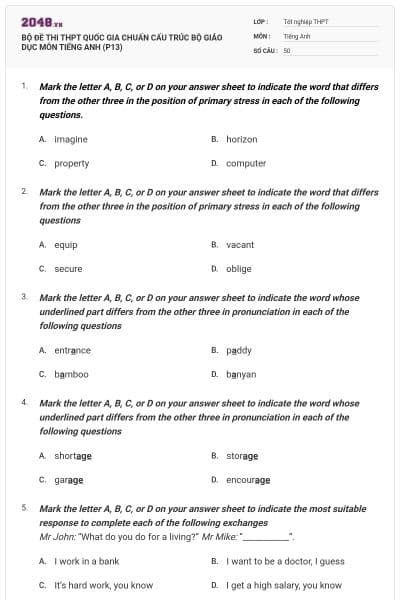
Mark the letter A, B, C, or D on your answer sheet to indicate the word that differs from the other three in the position of primary stress in each of the following questions.
imagine
horizon
property
computer
Đáp án C
- Imagine /i'mædʒin/ (v): tưởng tượng
- Horizon /hə'raizn/ (n): chân trời, tầm nhìn
- Property /ˈprɒpəti/ (n): tài sản
- Computer /kəm'pju:tə(r)/ (n): máy tính
ð Đáp án C (trọng âm rơi vào âm tiết thứ nhất; các từ còn lại là âm tiết thứ 2)
Mark the letter A, B, C, or D on your answer sheet to indicate the word that differs from the other three in the position of primary stress in each of the following questions
equip
vacant
secure
oblige
Đáp án B
- Equip /i'kwip/ (v): trang bị
- Vacant /'veikənt/ (adj): trống, rỗng
- Secure /si'kjʊə(r)/ (adj): an toàn (secure against/from something)
- Oblige /ə'blaidʒ/ (v): bắt buộc
ð Đáp án B (trọng âm rơi vào âm tiết thứ nhất; các từ còn lại là âm tiết thứ 2)
Mark the letter A, B, C, or D on your answer sheet to indicate the word whose underlined part differs from the other three in pronunciation in each of the following questions
entrance
paddy
bamboo
banyan
Đáp án A
- Entrance /'entrəns/ (n): sự vào, lối vào
- Paddy /'pædi/ (n): thóc, lúa, gạo
- Bamboo /bæm'bu:/ (n): cây tre
- Banyan /'bænjən/ (n): cây đa
ð Đáp án A (“a” được phát âm là /ə/; các từ còn lại là /æ/)
Mark the letter A, B, C, or D on your answer sheet to indicate the word whose underlined part differs from the other three in pronunciation in each of the following questions
shortage
storage
garage
encourage
Đáp án C
- Shortage /'∫ɔ:tidʒ/ (n): sự thiếu
- Storage /'stɔ:ridʒ/ (n): kho, sự lưu trữ
- Garage /'gærɑ:ʒ/ (n): nhà để xe
- Encourage /in'kʌridʒ/ (v): khuyến khích, động viên
ð Đáp án C (“age” được phát âm /ɑ:ʒ/; các từ còn lại là /idʒ/)
Mark the letter A, B, C, or D on your answer sheet to indicate the most suitable response to complete each of the following exchanges
Mr John: “What do you do for a living?” Mr Mike: “___________”.
I work in a bank
I want to be a doctor, I guess
It’s hard work, you know
I get a high salary, you know
Đáp án A
Mr John: “Ông làm nghề gì kiếm sống vậy?” Mr Mike: “__________.”
A. Tôi làm việc ở một ngân hàng.
B. Tôi đoán là tôi muốn trở thành bác sỹ.
C. Đó là một công việc vất cả, bạn thấy đó.
D. Tôi nhận được lương cao, bạn thấy đó
Mark the letter A, B, C, or D on your answer sheet to indicate the most suitable response to complete each of the following exchanges
- “Well, cats are very good at catching mice around the house.”
- “_______.”
Nothing more to say
You can say that again
Yes, I hope so
No, dogs are very good, too
Đáp án B
- “Ồ, những con mèo rất giỏi bắt chuột khắp nhà.”
Không có gì để nói hơn
Mình đồng ý với bạn
Vàng, mình hi vọng vậy
Không, những con chó cũng giỏi
ð Đáp án B (You can say that again. = I agree with you.)
Mark the letter A, B, C, or D on your answer sheet to indicate the word(s) OPPOSITE in meaning to the underlined word(s) in each of the following questions.
She lived with a rich family in London during her childhood
selfish
well-off
famous
penniless
Đáp án D
- Rich ~ Well-off (adj): giàu có
- Penniless ~ Poor (adj): nghèo khó
- Selfish (adj): ích kỉ
- Famous (adj): nổi tiếng
ð Đáp án D (Cô ấy đã sống với một gia đình giàu có ở London trong suốt thời thơ ấu của mình.)
Mark the letter A, B, C, or D on your answer sheet to indicate the word(s) OPPOSITE in meaning to the underlined word(s) in each of the following questions.
There has been no discernible improvement in the noise levels since lorries were banned.
clear
obvious
thin
insignificant
Đáp án D
- Discernible (adj): rõ ràng
- Clear ~ Obvious (adj): rõ ràng
- Thin (adj): mỏng manh, gầy
- Insignificant (adj): không đáng kể, không rõ ràng
ð Đáp án D (Đã không có sự cải thiện rõ ràng về mức độ tiếng ồn từ khi cấm xe tải.)
Mark the letter A, B, C, or D on your answer sheet to indicate the word(s) CLOSEST in meaning to the underlined word(s) in each of the following questions.
My wife was so keen on the picture that she paid through her nose for it
paid nothing
turned a deaf car
was offered
paid much more than usual
Đáp án D
- Pay through her nose ~ Pay much more than usual: trả nhiều tiền hơn mức bình thường
A. không trả gì
B. làm ngơ như không nghe thấy
C. được cung cấp
ð Đáp án D (Vợ tôi rất thích bức tranh này đến nỗi cô ấy trả rất nhiều tiền để có nó.)
Mark the letter A, B, C, or D on your answer sheet to indicate the word(s) CLOSEST in meaning to the underlined word(s) in each of the following questions.
My hard-working students expected a good fortune to come in addition to their intelligence.
thoughtful
dilligent
courteous
bright
Đáp án B
- Hard-working ~ Diligent /'dilidʒənt/ (adj): chăm chỉ
- Thoughtful /θɔ:tfəl/ (adj): có suy nghĩ, thận trọng; trầm tư
- Courteous /'kɔ:tiəs/ (adj): lịch sự
- Bright /brait/ (adj): sáng sủa; thông minh
Mark the letter A, B, C, or D on your answer sheet to indicate the correct answer to each of the following questions.
Does television adequately reflect the ethnic and cultural ____________ of the country.
custom
diversity
alternation
minority
Đáp án B
- Custom (n): tập quán, phong tục
- Diversity (n): sự đa dạng
- Alternation (n): sự xen kẽ, sự thay phiên
- Minority (n): thiểu số
ð Đáp án B (Ti vi có phản ánh đầy đủ sự đa dạng sắc tộc và văn hóa của đất nước không?)
Mark the letter A, B, C, or D on your answer sheet to indicate the correct answer to each of the following questions.
She _________ him for her father’s death
accused
charged
complained
blamed
Đáp án D
- Accuse sb of sth: buộc tội ai về điều gì
- Charge sb with sth: buộc tội ai về điều gì
- Complain to sb about/ of sth: phàn nàn với ai về điều gì
- Blame sb for sth: đổ lỗi cái gì cho ai
ð Đáp án D (Cô ấy đổ lỗi cho anh ấy về cái chết của bố mình.)
Mark the letter A, B, C, or D on your answer sheet to indicate the correct answer to each of the following questions.
John proposed __________Mary on a fine day at the crowded beach in their hometown.
to
of
on
with
Đáp án A
- Propose to sb : cầu hôn ai
ð Đáp án A (John đã cẩu hôn Mary vào một ngày đẹp trời tại bãi biển đông đúc ở quê nhà của họ.)
Mark the letter A, B, C, or D on your answer sheet to indicate the correct answer to each of the following questions.
“Have you __________ this contract yet?” – “Not yet. I’ll try to read it this weekend.”
looked over
looked out
looked up
looked into
Đáp án A
- Look over: xem xét, kiểm tra
- Look out: coi chừng, cẩn thận, tìm ra
- Look up: tra (từ điển)
- Look into: điều tra, khám xét ~ investigate
ð Đáp án A (“Bạn đã xem hợp đồng này chưa?” - Chưa, mình sẽ cố gắng đọc nó cuối tuần này.)
Mark the letter A, B, C, or D on your answer sheet to indicate the correct answer to each of the following questions.
He left the country ________ arrest if he returned
in fear of
under threat of
with fear of
with threat of
Đáp án B
- For fear of sth/For fear that: để đề phòng, vì sợ rằng
- Under threat of sh: đang bị đe dọa
ð Đáp án B (Anh ấy đã rời khỏi đất nước mà bị dọa bắt nếu anh trở lại.)
Mark the letter A, B, C, or D on your answer sheet to indicate the correct answer to each of the following questions.
She brought three children up __________.
single-handed
single-mindedly
single-handedly
single-minded
Đáp án C
- Bring up (v): nuôi dưỡng ~ Raise
- Single-handed (adj) à single-handedly (adv): một mình, đơn thương độc mã
- Single-minded (adj) à single-mindedly (adv): chuyên tâm, quyết tâm đạt cái gì đó,chỉ theo đuối một mục đích duy nhất.
- V + adv
ð Đáp án C (Cô ấy đã một mình nuôi ba đứa con.)
Mark the letter A, B, C, or D on your answer sheet to indicate the correct answer to each of the following questions.
He was a natural singer with a voice that was as clear as __________.
a bell
a mirror
a waterfall
a lake
Đáp án A
- Bell (n): chuông
- Mirror(n): cái gương
- Waterfall (n): thác nước
- Lake (n): hồ
- As clear as bell: dễ nghe, rành rọt (1 thành ngữ)
ð Đáp án A (Anh ấy là một ca sĩ bẩm sinh với một chất giọng rất dễ nghe.)
Mark the letter A, B, C, or D on your answer sheet to indicate the correct answer to each of the following questions.
He may be shy now, but he will soon come out of his __________when he meets the right girl.
shoe
hole
shed
shell
Đáp án D
Come of one’s shell: bớt nhút nhát và bắt đầu hòa đồng hơn, đỡ ngại (1 thành ngữ)
ð Đáp án D (Có thể bây giờ anh ấy còn nhút nhát, nhưng chẳng bao lâu nữa anh ấy sẽ đỡ ngại hơn khi gặp một có gái thích hợp.)
Mark the letter A, B, C, or D on your answer sheet to indicate the correct answer to each of the following questions.
The city has _________ of young consumers who are sensitive to trends, and can, therefore, help industries predict the potential risks and success of products
a high proportion
a great level
a high rate
a high tendency
Đáp án A
- Level: mức, mức độ
- Tendency /'tendənsi/: khuynh hướng, xu hướng
- Rate: tốc độ, hạng, mức, lệ phí, giá
- Proportion /prə'pɔ:∫n/: tỉ lệ/ tỉ số (chỉ sự tương đồng, một phần (size) trong toàn thể)
E.g: Water covers a large proportion of the earths surface. (Nước bao phủ một tỉ lệ lớn của bé mặt trái đất.)
ð Đáp án A (Thành phố có một tỉ lệ cao về khách hàng trẻ mà nhạy bén với các xu hướng và do đó có thể giúp nền công nghiệp dự đoán được những nguy cơ tiềm tàng và sự thành công của các sản phẩm.)
Mark the letter A, B, C, or D on your answer sheet to indicate the correct answer to each of the following questions.
It’s not easy to make Lisa furious. The girl is very gentle by _________.
herself
nature
personality
reaction
Đáp án B
- By herself: một mình cô ấy
- Personality (n): cá tính, tính cách
- Reaction (n): phản ứng
- Be gentle by nature: có bản tính hiền lành, lương thiện
ð Đáp án B (Thật không dễ để làm Lisa giận dữ. Cô gái ấy có bản tính hiền lành.)
Mark the letter A, B, C, or D on your answer sheet to indicate the correct answer to each of the following questions.
________ eighty percent of the students in our school are eager to work with foreign teachers, aren’t they?
Most
Most of
Almost
Mostly
Đáp án C
Most + danh từ: hầu hết, đa số
Most ot + the/ tính từ sở hữu + danh từ: hầu hết, đa số
Almost (adv): gần (như), hầu (như)
Mostly (adv) ~ Mainly: Generally: nhìn chung là, chủ yếu là
ð Đáp án C (gần 80% học sinh trường chúng ta rất háo hức làm việc với giáo viên nước ngoài, đúng không?)
Mark the letter A, B, C, or D on your answer sheet to indicate the correct answer to each of the following questions.
_______ we work with her, we get confused because of her fast speaking pace
So that
Although
Whenever
Lest
Đáp án C
- So that: Để mà
- Although: Mặc dù
- Whenever: bất cứ khi nào
- Lest: kẻo; để… khỏi
ð Đáp án C (Bất cứ khi nào làm việc với cô ấy chúng tôi rất bối rối vì cô ấy nói rất nhanh.)
Read the following passage and mark the letter A, B, C, or D on your answer sheet to indicate the correct word or phrase that best fits each of the numbered blanks from 23 to 27
Tim Samaras is a storm chaser. His job is to find tornadoes and follow them. When he gets close to a tornado, he puts a special tool (23) ______ a turtle probe on the ground. This tool measures things like a twister’s temperature. Humidity, and wind speed. With this information, Samaras can learn what causes tornadoes to develop. If meteorilogists understand this, they can warn people (24) _____ twisters sooner and save lives.
How does Samaras hunt tornadoes? It’s not easy. First, he has to find one. Tornadoes are too small to see using weather satellites. So Samaras can’t rely on these tools to find a twister. (25) ______, he waits for tornadoes to develop.
Once Samaras sees a tornado, the chase begins. But a tornado is hard to follow. Some tornadoes change (26) _____ several times – for example, moving east and then west and then east again. When Samaras finally gets near a tornado, her puts the turtle probe on the ground. Being this close to a twister is (27) ______. He must get away quickly.
Điền ô 23
called
known
made
meant
Đáp án A
- Called: được gọi là
- Known: được biết rằng
- Made: được làm
- Meant: có nghĩa là
“When he gets close to a tornado, he puts a special tool called a turtle probe on the ground.” (Khi anh ấy đến gần một cơn lốc xoáy, anh ấy đặt một công cụ đặc biệt được gọi là con rùa thăm dò trên mặt đất.)
Read the following passage and mark the letter A, B, C, or D on your answer sheet to indicate the correct word or phrase that best fits each of the numbered blanks from 23 to 27
Tim Samaras is a storm chaser. His job is to find tornadoes and follow them. When he gets close to a tornado, he puts a special tool (23) ______ a turtle probe on the ground. This tool measures things like a twister’s temperature. Humidity, and wind speed. With this information, Samaras can learn what causes tornadoes to develop. If meteorilogists understand this, they can warn people (24) _____ twisters sooner and save lives.
How does Samaras hunt tornadoes? It’s not easy. First, he has to find one. Tornadoes are too small to see using weather satellites. So Samaras can’t rely on these tools to find a twister. (25) ______, he waits for tornadoes to develop.
Once Samaras sees a tornado, the chase begins. But a tornado is hard to follow. Some tornadoes change (26) _____ several times – for example, moving east and then west and then east again. When Samaras finally gets near a tornado, her puts the turtle probe on the ground. Being this close to a twister is (27) ______. He must get away quickly.
Điền ô 24
with
about
at
for
Đáp án B
- Warn sb about sth: cảnh báo ai về việc gì
“If meteorologists understand this, they can warn people about twisters sooner and save lives.” Nếu các nhà khí tượng học hiểu được điều này thì họ có thể cảnh báo mọi người về cơn lốc sớm hơn và cứu sống được nhiều người.)
Read the following passage and mark the letter A, B, C, or D on your answer sheet to indicate the correct word or phrase that best fits each of the numbered blanks from 23 to 27
Tim Samaras is a storm chaser. His job is to find tornadoes and follow them. When he gets close to a tornado, he puts a special tool (23) ______ a turtle probe on the ground. This tool measures things like a twister’s temperature. Humidity, and wind speed. With this information, Samaras can learn what causes tornadoes to develop. If meteorilogists understand this, they can warn people (24) _____ twisters sooner and save lives.
How does Samaras hunt tornadoes? It’s not easy. First, he has to find one. Tornadoes are too small to see using weather satellites. So Samaras can’t rely on these tools to find a twister. (25) ______, he waits for tornadoes to develop.
Once Samaras sees a tornado, the chase begins. But a tornado is hard to follow. Some tornadoes change (26) _____ several times – for example, moving east and then west and then east again. When Samaras finally gets near a tornado, her puts the turtle probe on the ground. Being this close to a twister is (27) ______. He must get away quickly.
Điền ô 25
Rather
Still
Instead
Yet
Đáp án C
- Rather: hơn
- Still: vẫn
- Instead: thay vì
- Yet: nhưng, rồi
“Tornadoes are too small to see using weather satellites, so Samaras can’t rely on these tools to fint a twister. Instead, he waits for tornadoes to develop.” (Các cơn lốc xoáy quá nhỏ để có thể sử dụng vệ tinh thời tiết, vì vậy Samaras không thể dựa vào những công cụ này để tìm lốc xoáy. Thay vào đó, anh ấy chờ cơn lốc xoáy phát triển.)
Read the following passage and mark the letter A, B, C, or D on your answer sheet to indicate the correct word or phrase that best fits each of the numbered blanks from 23 to 27
Tim Samaras is a storm chaser. His job is to find tornadoes and follow them. When he gets close to a tornado, he puts a special tool (23) ______ a turtle probe on the ground. This tool measures things like a twister’s temperature. Humidity, and wind speed. With this information, Samaras can learn what causes tornadoes to develop. If meteorilogists understand this, they can warn people (24) _____ twisters sooner and save lives.
How does Samaras hunt tornadoes? It’s not easy. First, he has to find one. Tornadoes are too small to see using weather satellites. So Samaras can’t rely on these tools to find a twister. (25) ______, he waits for tornadoes to develop.
Once Samaras sees a tornado, the chase begins. But a tornado is hard to follow. Some tornadoes change (26) _____ several times – for example, moving east and then west and then east again. When Samaras finally gets near a tornado, her puts the turtle probe on the ground. Being this close to a twister is (27) ______. He must get away quickly.
Điền ô 26
progression
movement
dimension
direction
Đáp án D
- Progression (n); sự phát triển, sự tiến triển
- Movement (n): sự di chuyển
- Dimension (n): chiều
- Direction (n) : phương hướng
“Some tornadoes change direction several times - for example, moving east and then west and then east again.” (Một vài lốc xoáy thay đổi phương hướng nhiều lần - chẳng hạn di chuyển về hướng đông sau đó về hướng tây sau đó lại về hướng đông.)
Read the following passage and mark the letter A, B, C, or D on your answer sheet to indicate the correct word or phrase that best fits each of the numbered blanks from 23 to 27
Tim Samaras is a storm chaser. His job is to find tornadoes and follow them. When he gets close to a tornado, he puts a special tool (23) ______ a turtle probe on the ground. This tool measures things like a twister’s temperature. Humidity, and wind speed. With this information, Samaras can learn what causes tornadoes to develop. If meteorilogists understand this, they can warn people (24) _____ twisters sooner and save lives.
How does Samaras hunt tornadoes? It’s not easy. First, he has to find one. Tornadoes are too small to see using weather satellites. So Samaras can’t rely on these tools to find a twister. (25) ______, he waits for tornadoes to develop.
Once Samaras sees a tornado, the chase begins. But a tornado is hard to follow. Some tornadoes change (26) _____ several times – for example, moving east and then west and then east again. When Samaras finally gets near a tornado, her puts the turtle probe on the ground. Being this close to a twister is (27) ______. He must get away quickly.
Điền ô 27
terrifly
terrifying
terrified
terrifies
Đáp án B
- Terrify (v): làm khiếp sợ
- Terrifying (adj): đáng sợ, ỉàm cho ai hoảng sợ (tính từ mang nghĩa chủ động dùng để diễn tả bản chất của người/ vật)
-Terrified (adj): hoảng sợ (tính từ mang nghĩa bị động thường dùng để diễn tả cảm xúc, thái độ,...của người nào đó)
Sau động từ to be, ta cần dùng tính từ => loại A và D
“Being close to twister is terrifying. He must get away quickly” (Việc đến gần lốc xoáy rất đáng sợ. Anh ấy phải chạy đi rất nhanh.)
Dùng “terrifying” để mô tả bản chất của sự việc
Read the following passage and mark the letter A, B, C, or D on your answer sheet to indicate the correct answer to each of the questions from 28 to 34.
The human criterionfor perfect vision is 20/20 for reading the standard lines on a Snellen eye chart without a hitch. The score is determined by how well you read lines of letters of different sizes from 20 feet away. But being able to read the bottom line on the eye chart does not approximate perfection as far as other species are concerned. Most birds would consider us very visually handicapped. The hawk, for instance, has such sharp eyes that can spot a dime on the sidewalk while perched on top of the Empire State Building. It can make fine visual distinctions because it is blessed with one million cones per square millimetre in its retina. And in water, humans are farsighted, while the kingfisher, swooping down to spear fish, can see well both in the air and water because it is endowed with two foveae – areas of the eyes, consisting mostly of cones that provide visual distinctions. One foveae permits the bird, while in the air, to scan the water below with one eye at a time. This is called monocular vision. Once it hits the water, the other foveae joins in, allowing the kingfisher to focus both eyes, like binoculars, on its prey at the same time. A frog’s vision is distinguished by its ability to perceive things as a constant moving picture. Known as “bug detectors”, a highly developed set of cells in a frog’s eyes responds mainly to moving objects. So, it is said that a frog sitting in a field of dead bugs wouldn’t see them as food and would starve.
The bee has a “compound” eye, which is used for navigation. It has 15,000 facets that divide what it sees into a pattern of dots, or mosaic. With this kind of vision, the bee sees the sun only as a single dot, a constant point of reference. Thus, the eye is a superb navigational instrument that constantly measures the angle of its line of flight in relation to the sun. A bee’s eye also gauges flight speed. And if that is not enough to leave our 20/20 “perfect vision” paling into insignificance, the bee is capable of seeing something we can’t – ultraviolet light. Thus, what humans consider to be “perfect vision” is in fact rather limited when we look at other species. However, there is still much to be said for the human eye. Of all mammals, only humans and some primates can enjoy pleasures of colour vision.
What does the passage mainly discuss?
limits of the human eye
perfect vision
different eyes for different uses
eye variation among different species
Đáp án D
Bài đọc chủ yếu thảo luận về điều gì?
A. Những giới hạn của mắt con người
B. Tầm nhìn hoàn hảo
C. Những con mắt khác nhau cho những cách dùng khác nhau
D. Sự khác nhau về mắt trong những loài khác nhau
Dẫn chứng:
- But being able to read the bottom line on the eye chart does not approximate perfection as
far as other species are concerned.
- The hawk, for instance, has such sharp eyes that it can spot a dime on the sidewalk.
- The bee has a “compound” eye, which is used for navigation.
- Of all the mammals, only humans and some primates can enjoy the pleasures of color vision.
ð Đáp án D (Đoạn văn nói về mắt của những loài khác nhau )
Read the following passage and mark the letter A, B, C, or D on your answer sheet to indicate the correct answer to each of the questions from 28 to 34.
The human criterionfor perfect vision is 20/20 for reading the standard lines on a Snellen eye chart without a hitch. The score is determined by how well you read lines of letters of different sizes from 20 feet away. But being able to read the bottom line on the eye chart does not approximate perfection as far as other species are concerned. Most birds would consider us very visually handicapped. The hawk, for instance, has such sharp eyes that can spot a dime on the sidewalk while perched on top of the Empire State Building. It can make fine visual distinctions because it is blessed with one million cones per square millimetre in its retina. And in water, humans are farsighted, while the kingfisher, swooping down to spear fish, can see well both in the air and water because it is endowed with two foveae – areas of the eyes, consisting mostly of cones that provide visual distinctions. One foveae permits the bird, while in the air, to scan the water below with one eye at a time. This is called monocular vision. Once it hits the water, the other foveae joins in, allowing the kingfisher to focus both eyes, like binoculars, on its prey at the same time. A frog’s vision is distinguished by its ability to perceive things as a constant moving picture. Known as “bug detectors”, a highly developed set of cells in a frog’s eyes responds mainly to moving objects. So, it is said that a frog sitting in a field of dead bugs wouldn’t see them as food and would starve.
The bee has a “compound” eye, which is used for navigation. It has 15,000 facets that divide what it sees into a pattern of dots, or mosaic. With this kind of vision, the bee sees the sun only as a single dot, a constant point of reference. Thus, the eye is a superb navigational instrument that constantly measures the angle of its line of flight in relation to the sun. A bee’s eye also gauges flight speed. And if that is not enough to leave our 20/20 “perfect vision” paling into insignificance, the bee is capable of seeing something we can’t – ultraviolet light. Thus, what humans consider to be “perfect vision” is in fact rather limited when we look at other species. However, there is still much to be said for the human eye. Of all mammals, only humans and some primates can enjoy pleasures of colour vision.
The phrase “without a hitch” is closet in meaning to __________.
unaidedB. without glasses
without glasses
with little hesitation
easily
Đáp án D
- without a hitch : mọi việc trôi chảy, không có gì vướng mắc
- unaided: không được giúp đỡ
- without glasses: không có kính
- without little hesitation: không có sự do dự
- easily: dễ dàng
Read the following passage and mark the letter A, B, C, or D on your answer sheet to indicate the correct answer to each of the questions from 28 to 34.
The human criterionfor perfect vision is 20/20 for reading the standard lines on a Snellen eye chart without a hitch. The score is determined by how well you read lines of letters of different sizes from 20 feet away. But being able to read the bottom line on the eye chart does not approximate perfection as far as other species are concerned. Most birds would consider us very visually handicapped. The hawk, for instance, has such sharp eyes that can spot a dime on the sidewalk while perched on top of the Empire State Building. It can make fine visual distinctions because it is blessed with one million cones per square millimetre in its retina. And in water, humans are farsighted, while the kingfisher, swooping down to spear fish, can see well both in the air and water because it is endowed with two foveae – areas of the eyes, consisting mostly of cones that provide visual distinctions. One foveae permits the bird, while in the air, to scan the water below with one eye at a time. This is called monocular vision. Once it hits the water, the other foveae joins in, allowing the kingfisher to focus both eyes, like binoculars, on its prey at the same time. A frog’s vision is distinguished by its ability to perceive things as a constant moving picture. Known as “bug detectors”, a highly developed set of cells in a frog’s eyes responds mainly to moving objects. So, it is said that a frog sitting in a field of dead bugs wouldn’t see them as food and would starve.
The bee has a “compound” eye, which is used for navigation. It has 15,000 facets that divide what it sees into a pattern of dots, or mosaic. With this kind of vision, the bee sees the sun only as a single dot, a constant point of reference. Thus, the eye is a superb navigational instrument that constantly measures the angle of its line of flight in relation to the sun. A bee’s eye also gauges flight speed. And if that is not enough to leave our 20/20 “perfect vision” paling into insignificance, the bee is capable of seeing something we can’t – ultraviolet light. Thus, what humans consider to be “perfect vision” is in fact rather limited when we look at other species. However, there is still much to be said for the human eye. Of all mammals, only humans and some primates can enjoy pleasures of colour vision.
According to the passage, why might birds and animals consider humans very visually handicapped?
humans can’t see very well in either air or water
humans eyes are not as well suited to our needs
the main outstanding feature of human eyes is color vision
human eyes can’t do what their eyes can do
Đáp án D
Theo bài đọc, tại sao loài chim và động vật xem loài người có mắt bị tật?
A. Con người không thể nhìn rõ trong không khí hoặc trong nước
B. Mắt con người không thích hợp với nhu cầu của chúng ta
C. Khía cạnh nổi bật chính của mắt con người là nhìn màu sắc
D. Mắt con người không thể làm những gì mắt của chúng có thể làm
Dẫn chứng: “The hawk, for instance, has such sharp eyes that it can spot a dime on the sidewalk while perched on top of the Empire State Building. It can make fine visual distinctions because it is blessed with one million cones per square millimeter in its retinA. And in water, humans are farsighted, while the kingfisher, swooping down to spear fish, can see well in both the air and water because it is endowed with two foveae …”
Read the following passage and mark the letter A, B, C, or D on your answer sheet to indicate the correct answer to each of the questions from 28 to 34.
The human criterionfor perfect vision is 20/20 for reading the standard lines on a Snellen eye chart without a hitch. The score is determined by how well you read lines of letters of different sizes from 20 feet away. But being able to read the bottom line on the eye chart does not approximate perfection as far as other species are concerned. Most birds would consider us very visually handicapped. The hawk, for instance, has such sharp eyes that can spot a dime on the sidewalk while perched on top of the Empire State Building. It can make fine visual distinctions because it is blessed with one million cones per square millimetre in its retina. And in water, humans are farsighted, while the kingfisher, swooping down to spear fish, can see well both in the air and water because it is endowed with two foveae – areas of the eyes, consisting mostly of cones that provide visual distinctions. One foveae permits the bird, while in the air, to scan the water below with one eye at a time. This is called monocular vision. Once it hits the water, the other foveae joins in, allowing the kingfisher to focus both eyes, like binoculars, on its prey at the same time. A frog’s vision is distinguished by its ability to perceive things as a constant moving picture. Known as “bug detectors”, a highly developed set of cells in a frog’s eyes responds mainly to moving objects. So, it is said that a frog sitting in a field of dead bugs wouldn’t see them as food and would starve.
The bee has a “compound” eye, which is used for navigation. It has 15,000 facets that divide what it sees into a pattern of dots, or mosaic. With this kind of vision, the bee sees the sun only as a single dot, a constant point of reference. Thus, the eye is a superb navigational instrument that constantly measures the angle of its line of flight in relation to the sun. A bee’s eye also gauges flight speed. And if that is not enough to leave our 20/20 “perfect vision” paling into insignificance, the bee is capable of seeing something we can’t – ultraviolet light. Thus, what humans consider to be “perfect vision” is in fact rather limited when we look at other species. However, there is still much to be said for the human eye. Of all mammals, only humans and some primates can enjoy pleasures of colour vision.
The word “that” in line 9 refers to _________.
foveae
areas of the eye
cones
visual distinctions
Đáp án A
“And in water, humans are farsighted, while the kingfisher, swooping down to spear fish, can
see well in both the air and water because it is endowed with two foveae - areas of the eye, consisting mostly of cones, that provide visual distinctions”
=> “that” = foveae
Read the following passage and mark the letter A, B, C, or D on your answer sheet to indicate the correct answer to each of the questions from 28 to 34.
The human criterionfor perfect vision is 20/20 for reading the standard lines on a Snellen eye chart without a hitch. The score is determined by how well you read lines of letters of different sizes from 20 feet away. But being able to read the bottom line on the eye chart does not approximate perfection as far as other species are concerned. Most birds would consider us very visually handicapped. The hawk, for instance, has such sharp eyes that can spot a dime on the sidewalk while perched on top of the Empire State Building. It can make fine visual distinctions because it is blessed with one million cones per square millimetre in its retina. And in water, humans are farsighted, while the kingfisher, swooping down to spear fish, can see well both in the air and water because it is endowed with two foveae – areas of the eyes, consisting mostly of cones that provide visual distinctions. One foveae permits the bird, while in the air, to scan the water below with one eye at a time. This is called monocular vision. Once it hits the water, the other foveae joins in, allowing the kingfisher to focus both eyes, like binoculars, on its prey at the same time. A frog’s vision is distinguished by its ability to perceive things as a constant moving picture. Known as “bug detectors”, a highly developed set of cells in a frog’s eyes responds mainly to moving objects. So, it is said that a frog sitting in a field of dead bugs wouldn’t see them as food and would starve.
The bee has a “compound” eye, which is used for navigation. It has 15,000 facets that divide what it sees into a pattern of dots, or mosaic. With this kind of vision, the bee sees the sun only as a single dot, a constant point of reference. Thus, the eye is a superb navigational instrument that constantly measures the angle of its line of flight in relation to the sun. A bee’s eye also gauges flight speed. And if that is not enough to leave our 20/20 “perfect vision” paling into insignificance, the bee is capable of seeing something we can’t – ultraviolet light. Thus, what humans consider to be “perfect vision” is in fact rather limited when we look at other species. However, there is still much to be said for the human eye. Of all mammals, only humans and some primates can enjoy pleasures of colour vision.
According to the passage, “bug detectors” are useful for _______.
navigation
seeing moving objects
avoiding bugs when getting food
avoiding starvation
Đáp án B
Theo bài đọc, “bug detectors” hữu ích cho
A. nghề hàng hải
B. nhìn vật thể chuyển động
C. tránh những con rệp lấy thức ăn
D. tránh sự chết đói.
Dẫn chứng: “Known as “bug detectors”, a highly developed set of cells in a frog’s eyes responds mainly to moving objects.”
Read the following passage and mark the letter A, B, C, or D on your answer sheet to indicate the correct answer to each of the questions from 28 to 34.
The human criterionfor perfect vision is 20/20 for reading the standard lines on a Snellen eye chart without a hitch. The score is determined by how well you read lines of letters of different sizes from 20 feet away. But being able to read the bottom line on the eye chart does not approximate perfection as far as other species are concerned. Most birds would consider us very visually handicapped. The hawk, for instance, has such sharp eyes that can spot a dime on the sidewalk while perched on top of the Empire State Building. It can make fine visual distinctions because it is blessed with one million cones per square millimetre in its retina. And in water, humans are farsighted, while the kingfisher, swooping down to spear fish, can see well both in the air and water because it is endowed with two foveae – areas of the eyes, consisting mostly of cones that provide visual distinctions. One foveae permits the bird, while in the air, to scan the water below with one eye at a time. This is called monocular vision. Once it hits the water, the other foveae joins in, allowing the kingfisher to focus both eyes, like binoculars, on its prey at the same time. A frog’s vision is distinguished by its ability to perceive things as a constant moving picture. Known as “bug detectors”, a highly developed set of cells in a frog’s eyes responds mainly to moving objects. So, it is said that a frog sitting in a field of dead bugs wouldn’t see them as food and would starve.
The bee has a “compound” eye, which is used for navigation. It has 15,000 facets that divide what it sees into a pattern of dots, or mosaic. With this kind of vision, the bee sees the sun only as a single dot, a constant point of reference. Thus, the eye is a superb navigational instrument that constantly measures the angle of its line of flight in relation to the sun. A bee’s eye also gauges flight speed. And if that is not enough to leave our 20/20 “perfect vision” paling into insignificance, the bee is capable of seeing something we can’t – ultraviolet light. Thus, what humans consider to be “perfect vision” is in fact rather limited when we look at other species. However, there is still much to be said for the human eye. Of all mammals, only humans and some primates can enjoy pleasures of colour vision.
According to the passage, which of the following is NOT true?
kingfishers have monocular vision
bees see patterns of dots
hawks eyes consist mostly of cones that can allow it to scan with one eye at a time
humans are farsighted in water
Đáp án C
Theo bài đọc, cái nào sau dây không ĐÚNG?
A. Chim bói cả nhìn một mắt
B. Ong nhìn thấy những những mô hình chấm
C. Mắt diếu hâu gồm chủ yếu hình nón mà có thể cho phép nó nhìn lướt với một mắt tại một thời điểm
D. Con người thì nhìn xa được trong nước
A. đúng (while the kingfisher... This is called monocular vision.)
B. đúng (The bee has a “compound” eye, which is used for navigation. It has 15,000 facets that divide what it sees into a pattern of dots, or mosaic)
D. đúng (And in water, humans are farsighted)
C. sai (while the kingfisher... consisting mostly of cones, that provide visual distinctions...)
Read the following passage and mark the letter A, B, C, or D on your answer sheet to indicate the correct answer to each of the questions from 28 to 34.
The human criterionfor perfect vision is 20/20 for reading the standard lines on a Snellen eye chart without a hitch. The score is determined by how well you read lines of letters of different sizes from 20 feet away. But being able to read the bottom line on the eye chart does not approximate perfection as far as other species are concerned. Most birds would consider us very visually handicapped. The hawk, for instance, has such sharp eyes that can spot a dime on the sidewalk while perched on top of the Empire State Building. It can make fine visual distinctions because it is blessed with one million cones per square millimetre in its retina. And in water, humans are farsighted, while the kingfisher, swooping down to spear fish, can see well both in the air and water because it is endowed with two foveae – areas of the eyes, consisting mostly of cones that provide visual distinctions. One foveae permits the bird, while in the air, to scan the water below with one eye at a time. This is called monocular vision. Once it hits the water, the other foveae joins in, allowing the kingfisher to focus both eyes, like binoculars, on its prey at the same time. A frog’s vision is distinguished by its ability to perceive things as a constant moving picture. Known as “bug detectors”, a highly developed set of cells in a frog’s eyes responds mainly to moving objects. So, it is said that a frog sitting in a field of dead bugs wouldn’t see them as food and would starve.
The bee has a “compound” eye, which is used for navigation. It has 15,000 facets that divide what it sees into a pattern of dots, or mosaic. With this kind of vision, the bee sees the sun only as a single dot, a constant point of reference. Thus, the eye is a superb navigational instrument that constantly measures the angle of its line of flight in relation to the sun. A bee’s eye also gauges flight speed. And if that is not enough to leave our 20/20 “perfect vision” paling into insignificance, the bee is capable of seeing something we can’t – ultraviolet light. Thus, what humans consider to be “perfect vision” is in fact rather limited when we look at other species. However, there is still much to be said for the human eye. Of all mammals, only humans and some primates can enjoy pleasures of colour vision.
Which of the following can be inferred from the passage?
eyes have developed differently in each species
bees have the most complex eye
humans should not envy what they don’t need
perfect vision is not perfect
Đáp án A
Câu nào sau có thể được suy ra từ bài đọc?
A. Những con mắt đã phát triển khác nhau trong mỗi loài
B. Những con ong có mắt phức tạp nhất
C. Con người không nên thèm muốn những gì họ không cần đến
D. Tầm nhìn hoàn hảo thì không hoàn hảo
Read the following passage and mark the letter A, B, C, or D on your answer sheet to indicate the correct answer to each of the questions from 35 to 42.
It’s often said that we learn things at the wrong time. University students frequently do the minimum of work because they’re crazy about a good social life instead. Children often scream before their piano practice because it’s so boring. They have to be given gold stars and medals to be persuaded to swim, or have to be bribed to take exams. But the story is different when you’re older.
Over the years, I’ve done my share of adult learning. At 30, I went to a college and did courses in History and English. It was an amazing experience. For starters, I was paying, so there was no reason to be late – I was the one frowning and drumming my fingers if the tutor was late, not the other way round. Indeed, if I could persuade him to linger for an extra five minutes, it was a bonus, not a nuisance. I wasn’t frightened to ask questions, and homework was a pleasure not a pain. When I passed an exam, I had passed it for me and me alone, not for my parents or my teachers. The satisfaction I got was entirely personal.
Some people fear going back to school because they worry that their brains have got rusty. But the joy is that, although some parts have rusted up, your brain has learnt all kinds of other things since you were young. It has learnt to think independently and flexibly and is much better at relating one thing to another. What you lose in the rust department, you gain in the maturity department.
In some ways, age is a positive plus. For instance, when you’re older, you get less frustrated. Experience has told you that, if you’re calm and simply do something carefully again and again, eventually you’ll get the hang of it. The confidence you have in other areas – from being able to drive a car, perhaps – means that if you can’t, say, build a chair instantly, you don’t, like a child, want to destroy your first pathetic attempts. Maturity tells you that you will, with application, eventually get there.
It is implied in paragraph 1 that ______.
young learners often lack a good motivation for learning
young learners are usually lazy in their class
teachers should give young learners less homework
parents should encourage young learners to study more
Đáp án A
Đoạn 1 ngụ ý rằng _________.
A. người trẻ thường thiếu động lực tốt để học tập
B. người trẻ thường lười biếng trên lớp
C. giáo viên nên giao cho học sinh ít bài tập về nhà hơn
D. bố mẹ nên khuyến khích con cái học nhiều hơn
Dẫn chứng: “Children often scream before their piano practice because it’s so boring. They have to be given gold stars and medals to be persuaded to swim, or have to he bribed to take
exams.”
=> Người trẻ thường phải có những phần thưởng thì mới có động lực học
Read the following passage and mark the letter A, B, C, or D on your answer sheet to indicate the correct answer to each of the questions from 35 to 42.
It’s often said that we learn things at the wrong time. University students frequently do the minimum of work because they’re crazy about a good social life instead. Children often scream before their piano practice because it’s so boring. They have to be given gold stars and medals to be persuaded to swim, or have to be bribed to take exams. But the story is different when you’re older.
Over the years, I’ve done my share of adult learning. At 30, I went to a college and did courses in History and English. It was an amazing experience. For starters, I was paying, so there was no reason to be late – I was the one frowning and drumming my fingers if the tutor was late, not the other way round. Indeed, if I could persuade him to linger for an extra five minutes, it was a bonus, not a nuisance. I wasn’t frightened to ask questions, and homework was a pleasure not a pain. When I passed an exam, I had passed it for me and me alone, not for my parents or my teachers. The satisfaction I got was entirely personal.
Some people fear going back to school because they worry that their brains have got rusty. But the joy is that, although some parts have rusted up, your brain has learnt all kinds of other things since you were young. It has learnt to think independently and flexibly and is much better at relating one thing to another. What you lose in the rust department, you gain in the maturity department.
In some ways, age is a positive plus. For instance, when you’re older, you get less frustrated. Experience has told you that, if you’re calm and simply do something carefully again and again, eventually you’ll get the hang of it. The confidence you have in other areas – from being able to drive a car, perhaps – means that if you can’t, say, build a chair instantly, you don’t, like a child, want to destroy your first pathetic attempts. Maturity tells you that you will, with application, eventually get there.
The writer’s main point in paragraph 2 is to show that as people grow up, ______.
they tend to learn less as they are discouraged
they cannot learn as well as younger learners
they get more impatient with their teachers
they have a more positive attitude towards learning
Đáp án D
Ý chính của tác giả trong đoạn 2 là chỉ ra rằng khi con người lớn lên thì ________.
A. Họ có khuynh hướng học ít hơn vì họ thiếu quyết tâm
B. Họ không thể học tốt như khi người trẻ
C. Họ trở nên thiếu kiên nhẫn hơn với giáo viên
D. Họ có thái độ tích cực hơn đối với việc học
Dẫn chứng:
- At 30, I went to a college and did courses in History and English. It was an amazing experience.
- I wasn’t frightened to ask questions, and homework was a pleasure not a pain. When I passed an exam, I had passed it for me and me alone, not for my parents or my teachers. The satisfaction I got was entirely personal.
Read the following passage and mark the letter A, B, C, or D on your answer sheet to indicate the correct answer to each of the questions from 35 to 42.
It’s often said that we learn things at the wrong time. University students frequently do the minimum of work because they’re crazy about a good social life instead. Children often scream before their piano practice because it’s so boring. They have to be given gold stars and medals to be persuaded to swim, or have to be bribed to take exams. But the story is different when you’re older.
Over the years, I’ve done my share of adult learning. At 30, I went to a college and did courses in History and English. It was an amazing experience. For starters, I was paying, so there was no reason to be late – I was the one frowning and drumming my fingers if the tutor was late, not the other way round. Indeed, if I could persuade him to linger for an extra five minutes, it was a bonus, not a nuisance. I wasn’t frightened to ask questions, and homework was a pleasure not a pain. When I passed an exam, I had passed it for me and me alone, not for my parents or my teachers. The satisfaction I got was entirely personal.
Some people fear going back to school because they worry that their brains have got rusty. But the joy is that, although some parts have rusted up, your brain has learnt all kinds of other things since you were young. It has learnt to think independently and flexibly and is much better at relating one thing to another. What you lose in the rust department, you gain in the maturity department.
In some ways, age is a positive plus. For instance, when you’re older, you get less frustrated. Experience has told you that, if you’re calm and simply do something carefully again and again, eventually you’ll get the hang of it. The confidence you have in other areas – from being able to drive a car, perhaps – means that if you can’t, say, build a chair instantly, you don’t, like a child, want to destroy your first pathetic attempts. Maturity tells you that you will, with application, eventually get there.
The phrase “For starters” in paragraph 2 could best be replaced by “______”.
For beginners
At the starting point
At the beginning
First and foremost
Đáp án D
- For starters ~ First and foremost: đầu tiên, trước hết
“For starters, I was paying, so there was no reason to be late” (Đầu tiên, tôi đã trả tiền, vì thế không có lý do gì để đi trễ)
Read the following passage and mark the letter A, B, C, or D on your answer sheet to indicate the correct answer to each of the questions from 35 to 42.
It’s often said that we learn things at the wrong time. University students frequently do the minimum of work because they’re crazy about a good social life instead. Children often scream before their piano practice because it’s so boring. They have to be given gold stars and medals to be persuaded to swim, or have to be bribed to take exams. But the story is different when you’re older.
Over the years, I’ve done my share of adult learning. At 30, I went to a college and did courses in History and English. It was an amazing experience. For starters, I was paying, so there was no reason to be late – I was the one frowning and drumming my fingers if the tutor was late, not the other way round. Indeed, if I could persuade him to linger for an extra five minutes, it was a bonus, not a nuisance. I wasn’t frightened to ask questions, and homework was a pleasure not a pain. When I passed an exam, I had passed it for me and me alone, not for my parents or my teachers. The satisfaction I got was entirely personal.
Some people fear going back to school because they worry that their brains have got rusty. But the joy is that, although some parts have rusted up, your brain has learnt all kinds of other things since you were young. It has learnt to think independently and flexibly and is much better at relating one thing to another. What you lose in the rust department, you gain in the maturity department.
In some ways, age is a positive plus. For instance, when you’re older, you get less frustrated. Experience has told you that, if you’re calm and simply do something carefully again and again, eventually you’ll get the hang of it. The confidence you have in other areas – from being able to drive a car, perhaps – means that if you can’t, say, build a chair instantly, you don’t, like a child, want to destroy your first pathetic attempts. Maturity tells you that you will, with application, eventually get there.
While doing some adult learning courses at a college, the writer was surprised ______.
to have more time to learn
to be able to learn more quickly
to feel learning more enjoyable
to get on better with the tutor
Đáp án C
Dẫn chứng: “Indeed, if I could persuade him to linger for an extra five minutes, it was a bonus, not a nuisance. I wasn’t frightened to ask questions, and homework was a pleasure not a pain. When I passed an exam, I had passed it for me and me alone, not for my parents or my teachers. The satisfaction I got was entirely personal.”
=> trong quá trình học, tác giả đã cảm thấy thích thú việc học
Read the following passage and mark the letter A, B, C, or D on your answer sheet to indicate the correct answer to each of the questions from 35 to 42.
It’s often said that we learn things at the wrong time. University students frequently do the minimum of work because they’re crazy about a good social life instead. Children often scream before their piano practice because it’s so boring. They have to be given gold stars and medals to be persuaded to swim, or have to be bribed to take exams. But the story is different when you’re older.
Over the years, I’ve done my share of adult learning. At 30, I went to a college and did courses in History and English. It was an amazing experience. For starters, I was paying, so there was no reason to be late – I was the one frowning and drumming my fingers if the tutor was late, not the other way round. Indeed, if I could persuade him to linger for an extra five minutes, it was a bonus, not a nuisance. I wasn’t frightened to ask questions, and homework was a pleasure not a pain. When I passed an exam, I had passed it for me and me alone, not for my parents or my teachers. The satisfaction I got was entirely personal.
Some people fear going back to school because they worry that their brains have got rusty. But the joy is that, although some parts have rusted up, your brain has learnt all kinds of other things since you were young. It has learnt to think independently and flexibly and is much better at relating one thing to another. What you lose in the rust department, you gain in the maturity department.
In some ways, age is a positive plus. For instance, when you’re older, you get less frustrated. Experience has told you that, if you’re calm and simply do something carefully again and again, eventually you’ll get the hang of it. The confidence you have in other areas – from being able to drive a car, perhaps – means that if you can’t, say, build a chair instantly, you don’t, like a child, want to destroy your first pathetic attempts. Maturity tells you that you will, with application, eventually get there.
In paragraph 3, the word “rusty” means ______..
not as good as it used to be through lack of practice
impatient because of having nothing to do
staying alive and becoming more active
covered with rust and not as good as it used to be
Đáp án A
“Some people fear going back to school because they worry that their brains have got rusty.” (Mọt số người sợ đi học trở lại vì họ lo lắng rằng bộ não của họ không còn được như trước.)
- Rusty ~ not as good as it used to be through lack of practice: không được tốt như trước bởi vì thiếu sự luyện tập
Read the following passage and mark the letter A, B, C, or D on your answer sheet to indicate the correct answer to each of the questions from 35 to 42.
It’s often said that we learn things at the wrong time. University students frequently do the minimum of work because they’re crazy about a good social life instead. Children often scream before their piano practice because it’s so boring. They have to be given gold stars and medals to be persuaded to swim, or have to be bribed to take exams. But the story is different when you’re older.
Over the years, I’ve done my share of adult learning. At 30, I went to a college and did courses in History and English. It was an amazing experience. For starters, I was paying, so there was no reason to be late – I was the one frowning and drumming my fingers if the tutor was late, not the other way round. Indeed, if I could persuade him to linger for an extra five minutes, it was a bonus, not a nuisance. I wasn’t frightened to ask questions, and homework was a pleasure not a pain. When I passed an exam, I had passed it for me and me alone, not for my parents or my teachers. The satisfaction I got was entirely personal.
Some people fear going back to school because they worry that their brains have got rusty. But the joy is that, although some parts have rusted up, your brain has learnt all kinds of other things since you were young. It has learnt to think independently and flexibly and is much better at relating one thing to another. What you lose in the rust department, you gain in the maturity department.
In some ways, age is a positive plus. For instance, when you’re older, you get less frustrated. Experience has told you that, if you’re calm and simply do something carefully again and again, eventually you’ll get the hang of it. The confidence you have in other areas – from being able to drive a car, perhaps – means that if you can’t, say, build a chair instantly, you don’t, like a child, want to destroy your first pathetic attempts. Maturity tells you that you will, with application, eventually get there.
All of the following are true about adult learning EXCEPT ______.
young people usually feel less patient than adults
experience in doing other things can help one’s learning
adult learners have fewer advantages than young learners
adults think more independently and flexibly than young people
Đáp án C
A, B, D. đúng theo bài đọc:
“Age is a positive plus. For instance, when you’re older, you get less frustrated. Experience has told you that, if you re calm and simply do something carefully again and again, eventually you’ll get the hang of it”
“Although some parts have rusted up, your brain has learnt all kinds of other things since you were young. It has learnt to think independently and flexibly and is much better at relating one thing to another”
Read the following passage and mark the letter A, B, C, or D on your answer sheet to indicate the correct answer to each of the questions from 35 to 42.
It’s often said that we learn things at the wrong time. University students frequently do the minimum of work because they’re crazy about a good social life instead. Children often scream before their piano practice because it’s so boring. They have to be given gold stars and medals to be persuaded to swim, or have to be bribed to take exams. But the story is different when you’re older.
Over the years, I’ve done my share of adult learning. At 30, I went to a college and did courses in History and English. It was an amazing experience. For starters, I was paying, so there was no reason to be late – I was the one frowning and drumming my fingers if the tutor was late, not the other way round. Indeed, if I could persuade him to linger for an extra five minutes, it was a bonus, not a nuisance. I wasn’t frightened to ask questions, and homework was a pleasure not a pain. When I passed an exam, I had passed it for me and me alone, not for my parents or my teachers. The satisfaction I got was entirely personal.
Some people fear going back to school because they worry that their brains have got rusty. But the joy is that, although some parts have rusted up, your brain has learnt all kinds of other things since you were young. It has learnt to think independently and flexibly and is much better at relating one thing to another. What you lose in the rust department, you gain in the maturity department.
In some ways, age is a positive plus. For instance, when you’re older, you get less frustrated. Experience has told you that, if you’re calm and simply do something carefully again and again, eventually you’ll get the hang of it. The confidence you have in other areas – from being able to drive a car, perhaps – means that if you can’t, say, build a chair instantly, you don’t, like a child, want to destroy your first pathetic attempts. Maturity tells you that you will, with application, eventually get there.
It can be inferred from paragraph 4 that maturity is a positive plus in the learning process because adult learners ______.
pay more attention to detail than younger learners
are able to organize themselves better than younger learners
are less worried about learning than younger learners
have become more patient than younger learners
Đáp án D
Có thể suy ra từ đoạn cuối rằng sự trưởng thành là điểm cộng tích cực trong quá trình học vì người lớn________. .
Dẫn chứng: “when you’re older, you get less frustrated. Experience has told you that, if you’re calm and simply do something carefully again and again, eventually you’ll get the hang of it.” (khi bạn lớn tuổi hơn, bạn sẽ thấy ít chán nản hơn. Kinh nghiệm nói với bạn rằng, nếu bạn bình tĩnh và chỉ cần làm điều gì đó một cách cẩn thận lặp đi lặp lại thì cuối cùng bạn sẽ học được cách thực hiện nó.)
=> người lớn sẽ trở nên kiên nhẫn hơn người trẻ
Read the following passage and mark the letter A, B, C, or D on your answer sheet to indicate the correct answer to each of the questions from 35 to 42.
It’s often said that we learn things at the wrong time. University students frequently do the minimum of work because they’re crazy about a good social life instead. Children often scream before their piano practice because it’s so boring. They have to be given gold stars and medals to be persuaded to swim, or have to be bribed to take exams. But the story is different when you’re older.
Over the years, I’ve done my share of adult learning. At 30, I went to a college and did courses in History and English. It was an amazing experience. For starters, I was paying, so there was no reason to be late – I was the one frowning and drumming my fingers if the tutor was late, not the other way round. Indeed, if I could persuade him to linger for an extra five minutes, it was a bonus, not a nuisance. I wasn’t frightened to ask questions, and homework was a pleasure not a pain. When I passed an exam, I had passed it for me and me alone, not for my parents or my teachers. The satisfaction I got was entirely personal.
Some people fear going back to school because they worry that their brains have got rusty. But the joy is that, although some parts have rusted up, your brain has learnt all kinds of other things since you were young. It has learnt to think independently and flexibly and is much better at relating one thing to another. What you lose in the rust department, you gain in the maturity department.
In some ways, age is a positive plus. For instance, when you’re older, you get less frustrated. Experience has told you that, if you’re calm and simply do something carefully again and again, eventually you’ll get the hang of it. The confidence you have in other areas – from being able to drive a car, perhaps – means that if you can’t, say, build a chair instantly, you don’t, like a child, want to destroy your first pathetic attempts. Maturity tells you that you will, with application, eventually get there.
What is the writer’s main purpose in the passage?
To encourage adult learning
To encourage adult learning is
To explain reasons for learning
To describe adult learning methods
Đáp án A
Mục đích chính của tác giả trong bài đọc là gì?
A. Để khuyến khích việc học của người lớn
B. Để cho thấy người lớn học nhanh như thế nào
C. Để giải thích lý do cho việc học
D. Để miêu tả phương pháp học của người lớn
Mark the letter A, B, C, or D on your answer sheet to indicate the sentence that is closest in meaning to each of the following questions.
It is not until the sun is shining brightly that the little girl woke up
No sooner is the sun shining brightly than the little girl woke up
Not until the little girl woke up is the sun shining brightly
Not until the sun is shining brightly did the little girl wake up
As soon as the little girl woke up, the sun hasn’t shone brightly yet
Đáp án C
Câu ban đầu: “Mãi đến khi mặt trời chiếu nắng chói chang thì con bé mới thức dậy.”
It is not until + C + V + that +S+ V = Not until + S + V + mệnh đề đảo (trợ động từ + S + V): Mãi cho đến khi ...thì
B. sai cấu trúc; A, D. sai nghĩa
Mark the letter A, B, C, or D on your answer sheet to indicate the sentence that is closest in meaning to each of the following questions.
“What language do you find the most difficult to learn of all?”, Mary asked Tim
Mary asked Tim what language Tim found the most difficult to learn of all.
Mary wanted to know what language they founded the most difficult to learn of all
Mary asked Tim what language did you find the most difficult to learn of all
Mary asked Tim what language you found the most difficult to learn of all.
Đáp án A
“Ngôn ngữ nào bạn thấy khó học nhất?”, Mary hỏi Tim
Cấu trúc: S + asked + (O) + WH_ + s + V lùi thì... (câu hỏi tường thuật)
Trong câu này, chúng ta sẽ đổi ngôi, thì của động từ tương ứng, nhưng không đảo ngữ (you=> he; hiện tại đơn => quá khứ đơn)
Mark the letter A, B, C, or D on your answer sheet to indicate the sentence that is closest in meaning to each of the following questions.
Calling Jim is pointless because his phone is out of order
It's worth not calling Jim because his phone is out of order
It's no use to call Jim because his phone is out of order
It's useless calling Jim because his phone is out of order
There's no point calling Jim because his phone is out of order
Đáp án C
Câu ban đầu: “Gọi cho Jim thì vô ích vì điện thoại của cậu ấy hỏng rồi”
Cấu trúc:
There is no point in + Ving=It’s no use/no good/useless + Ving = It’s not worth + Ving (Thật là vô ích/không đáng để làm gì)
E.g: It’s no use persuading her to go to the cinema.
A , B, D sai cấu trúc.
ð Đáp án C (Thật là vô ích khi gọi cho Jim bởi vì điện thoại của cậu ấy hỏng rồi)
Mark the letter A, B, C, or D on your answer sheet to indicate the underlined part that needs correction in each of the following questions.
United Nations is aimed at develop friendly relations among nations based on respect for the principle of equal rights and self-determination of peoples
develop
based
principle
self-determination
Đáp án A
- Aim at + V-ing: nhằm mục đích làm gì
Dịch nghĩa: Liên Hợp quốc nhằm mục đích phát triển tình hữu nghị giữa các nước dựa trên tinh thần tôn trọng quy tắc của các quyền bình đẳng và tự quyết của con người.
ð Đáp án A (develop => developing)
Mark the letter A, B, C, or D on your answer sheet to indicate the underlined part that needs correction in each of the following questions.
All members shall give the United Nations every assistance in any action it does in accordance with the present Charter
shall
every
it does
the
Đáp án C
- Take actions: hành động
Dịch nghĩa: Tất cả các thành viên sẽ cung cấp cho Liên Hợp Quốc mọi sự hỗ trợ trong bất cứ hành động nào liên quan đến hiến chương hiện hành.
ð Đáp án C (it does => it takes)
Mark the letter A, B, C, or D on your answer sheet to indicate the underlined part that needs correction in each of the following questions.
Cutural diversity is important because out country, workplaces, and schools increasingly consist of various culture, racial and ethnic groups
is
increasingly consist
culture
groups
Đáp án C
- Various + N số nhiều
Phía trước từ “groups” là các tính từ “racial, ethnic”. Do đó từ “culture” => cultural (cấu trúc song song)
Dịch nghĩa: Đa dạng văn hóa rất quan trọng vì đất nước chúng ta, các nơi làm việc và trường học ngày càng gồm nhiều nhóm dân tộc, chủng tộc và văn hóa khác nhau.
ð Đáp án C (culture => cultural)
Mark the letter A, B, C, or D on your answer sheet to indicate the sentence that best combines each pair of sentences in the following questions.
The teacher has done his best to help all students. However, none of them made any effort on their part.
The teacher has done his best to help all student, or none of them made any effort on their part
Although the teacher has done his best to help all students, none of them made any effort on their part
Because the teacher has done his best to help all students, none of them made any effort on their part
When the teacher has done his best to help all students, none of them made any effort on their part
Đáp án B
“Giáo viên đã làm hết sức để giúp đỡ tất cả học sinh. Tuy nhiên, không ai trong số họ nỗ lực dù chỉ một chút.”
A. Giáo viên đã làm hết sức để giúp đỡ tất cả học sinh, hoặc là không ai trong số họ nỗ lực dù chỉ một chút.
B. Mặc dù giáo viên đã làm hết sức để giúp đỡ tất cả học sinh nhưng không ai trong số họ nỗ lực dù chỉ một chút.
C. Bởi vì giáo viên đã làm hết sức để giúp đỡ tất cả học sinh nên không ai trong số họ nỗ lực dù chỉ một chút.
D. Khi giáo viên đã làm hết sức để giúp đỡ tất cả học sinh, không ai trong số họ nỗ lực dù chỉ một chút.
Mark the letter A, B, C, or D on your answer sheet to indicate the sentence that best combines each pair of sentences in the following questions.
Finish your work. And then you can go home
You can’t go home until you finish your work
You finish your work to go home as early as you can.
When you go home, finish your work then.
Because you have finished your work, you can go home
Đáp án A
“Làm xong công việc đi. Và sau đó bạn có thể về nhà.”
A. Bạn không thể về nhà cho đến khi làm xong công việc
B. Bạn làm xong công việc để về nhà sớm nhất có thể.
C. Khi bạn về nhà, làm công việc sau cũng được.
D. Bởi vi bạn đã xong việc nên có thể về nhà.