BỘ ĐỀ THI THPT QUỐC GIA CHUẨN CẤU TRÚC BỘ GIÁO DỤC MÔN TIẾNG ANH (P11)
50 câu hỏi
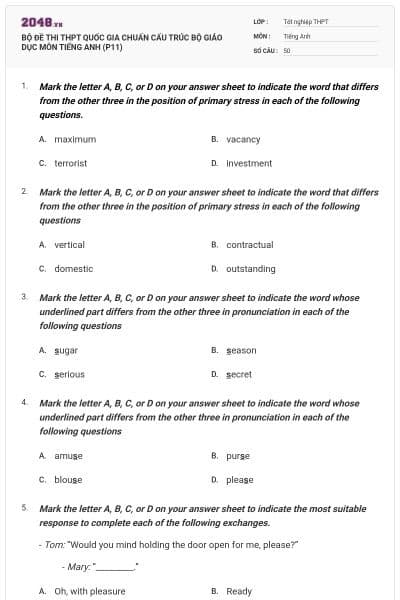
Mark the letter A, B, C, or D on your answer sheet to indicate the word that differs from the other three in the position of primary stress in each of the following questions.
maximum
vacancy
terrorist
investment
Đáp án D
- Maximum /'mæksiməm/ (adj): tối đa
- Vacancy /'veikənsi/ (n): chỗ trống
- Terrorist /'terərist/ (n): kẻ khủng bố
- Investment /in'vestmənt/ (n): sự đầu tư
ð Đáp án D (trọng âm rơi vào âm tiết thứ 2; các từ còn lại là âm tiết thứ nhất)
Mark the letter A, B, C, or D on your answer sheet to indicate the word that differs from the other three in the position of primary stress in each of the following questions
vertical
contractual
domestic
outstanding
Đáp án A
- Vertical /'vɜ:tikl/ (adj): thẳng đứng
- Contractual /kən'trækt∫ʊəl/ (adj): bằng hợp đồng
- Domestic /də'mestik/ (adj): trong nước, (thuộc) gia đình
- Outstanding /,aʊt'stændiŋ/ (adj): nổi bật, đáng chú ý
ð Đáp án A (trọng âm rơi vào âm tiết thứ nhất; các từ còn lại là âm tiết thứ 2)
Mark the letter A, B, C, or D on your answer sheet to indicate the word whose underlined part differs from the other three in pronunciation in each of the following questions
sugar
season
serious
secret
Đáp án A
Sugar /'∫ʊgə(r)/ (n): đường ăn
Season /'si:zn/ (n): mùa
Serious /'siəriəs/ (adj): nghiêm trọng
Secret /'si:krit/ (n): bí mật
ð Đáp án A (“s” được phát âm là /∫/; các từ còn lại là /s/)
Mark the letter A, B, C, or D on your answer sheet to indicate the word whose underlined part differs from the other three in pronunciation in each of the following questions
amuse
purse
blouse
please
Đáp án B
- Amuse /ə'mju:z/ (v): làm buồn cười, làm vui
- Purse /pɜ:s/ (n): ví tiền
- Blouse /blaʊz/ (n): áo choàng
- Please /pli:z/ (v): làm hài lòng
ð Đáp án B (“s” được phát âm là /s/; các từ còn lại là /z/)
Mark the letter A, B, C, or D on your answer sheet to indicate the most suitable response to complete each of the following exchanges.
- Tom: “Would you mind holding the door open for me, please?”
- Mary: “_________.”
Oh, with pleasure
Ready
You’re welcome
I can do
Đáp án A
Tom: “Phiền cậu giữ cửa mở hộ tớ được không?”
A. Ồ, tớ rất sẵn lòng.
B. Đã sẵn lòng (làm việc gì)
C. Không có gì (Dùng để đáp lại lời cảm ơn của ai)
D. Tớ có thể làm.
Mark the letter A, B, C, or D on your answer sheet to indicate the most suitable response to complete each of the following exchanges.
Mary is talking to her professor in his office.
- Mary: “Can you tell me how to find material for my science report, professor?”
- Professor: “___________”
I like it that you understand
Try your best, Mary
You can borrow books from the library
You mean the podcasts from other students
Đáp án C
Mary đang nói chuyện với giáo sư ở văn phòng thầy ấy.
Mary: “Thưa giáo sư, thầy có thể chỉ cho em biết cách tìm tài liệu cho bài báo cáo khoa học không ạ?”
Giáo sư: “______________”
A. Thấy vui vì em đã hiểu.
B. Cô hết sức nhé, Mary.
C. Em có thể mượn sách từ thư viện.
D. Ý em là những bản audio từ những học sinh khác
Mark the letter A, B, C, or D on your answer sheet to indicate the word(s) OPPOSITE in meaning to the underlined word(s) in each of the following questions.
People in Vietnam nod their head to show thatt they agree with something
blink
shake
wave
slump
Đáp án B
- Nod (v): gật (đầu) Shake (v): lắc (đầu)
- Blink (v): làm đui mù
- Wave (v): phất, vẫy
- Slump (v): hạ nhanh, sụp xuống
ð Đáp án B (Người Việt Nam gật đầu để cho thấy họ đồng ý với điều đó.)
Mark the letter A, B, C, or D on your answer sheet to indicate the word(s) OPPOSITE in meaning to the underlined word(s) in each of the following questions.
It’s difficult to tell him to give in because he is so big-headed
wise
modest
arrogant
generous
Đáp án B
- Big-headed /,big'hedid/ (adj): tự phụ, kiêu căng, ngạo mạn Modest (adj): khiêm tốn
- Wise /waiz/ (adj): khôn ngoan
- Arrogant /'ærəgənt/ (adj): kiêu căng, ngạo mạn
- Generous /'dʒenərəs/ (adj): hào phóng, rộng lượng
ð Đáp án B (Khó mà bảo anh ta chịu thua vì anh ta quá kiêu ngạo.)
Mark the letter A, B, C, or D on your answer sheet to indicate the word(s) CLOSEST in meaning to the underlined word(s) in each of the following questions.
The weather is horrible at the moment, isn’t it? I hope it clears up later
becomes brighter
shines
is not cloudy
clean
Đáp án C
- Clear up: hết mây/mưa
trở nên sáng sủa hơn
chiếu sáng
không có mây
sạch sẽ
ð Đáp án C (Thời tiết bây giờ đang rất tệ có phải không? Tôi hi vọng trời sẽ hết mây mưa.)
Mark the letter A, B, C, or D on your answer sheet to indicate the word(s) CLOSEST in meaning to the underlined word(s) in each of the following questions.
There used to be a shop at the end of the street but it went out of business a year ago
closed up
closed
closed down
closed into
Đáp án C
- Go out of business ~ Close down: phá sản, đóng cửa
- Close up: khít lại, sát lại gần nhau
- Close: đóng
- Close into: không có nghĩa
ð Đáp án C (Đã từng có một cửa hàng ở cuối phố này nhưng một năm trước nó đã bị đóng cửa.)
Mark the letter A, B, C, or D on your answer sheet to indicate the correct answer to each of the following questions.
He was offered the job thanks to his _________ performance during his job interview
impressive
impressively
impression
impress
Đáp án A
- Impress (v): gây ấn tượng
- Impressive (adj): gây ấn tượng mạnh => Impressively (adv)
- Impression (n): ấn tượng
Trước danh từ “perfomance” ta phải dùng tính từ “impressive”
Mark the letter A, B, C, or D on your answer sheet to indicate the correct answer to each of the following questions.
Someone who is _______is hopeful about the future or the success of something in particular.
pessimist
optimistic
optimist
pessimistic
Đáp án B
- Optimist (n): người lạc quan
- Pessimist (n): người bi quan
- Optimistic (adj): lạc quan
- Pessimistic (adj): bi quan
Sau động từ to be “is” thì ta dùng tính từ => ta loại A và C
Xét về nghĩa của câu thì ta loại D
ð Đáp án B (Một người lạc quan là người luôn hi vọng về tương lai hoặc sự thành công của việc nào đó.)
Mark the letter A, B, C, or D on your answer sheet to indicate the correct answer to each of the following questions.
Ben went _______the competition and won the first prize
on
in for
away
through
Đáp án B
Go in for ~ Take part in ~ Participate in: tham gia
Go on: tiếp tục
Go away: đi khỏi, biến mất, đi nghỉ
Go through: khám xét, kiểm tra cẩn thận
ð Đáp án B (Ben đã tham gia cuộc thi và đã giành giải nhất.)
Mark the letter A, B, C, or D on your answer sheet to indicate the correct answer to each of the following questions.
As an _______, Mr.Pike is very worried about the increasing of teenager crimes
educational
education
educator
educate
Đáp án C
- Educate (v): giáo dục
- Education (n): sự giáo dục
- Educational (adj): (thuộc) giáo dục
- Educator (n): nhà giáo dục
ð Đáp án C (Với tư cách là một nhà giáo, ông Pike rất lo lắng về việc tăng tội phạm thanh thiếu niên).
Mark the letter A, B, C, or D on your answer sheet to indicate the correct answer to each of the following questions.
I ________hurry. It’s nearly 8.00, and my first class starts at 8.15
would prefer
can’t help
can’t
had better
Đáp án D
- Had better ~ Should + V (bare-inf): nên làm gì
- Would prefer + to V: muốn làm gì
- Can’t help + V-ing: không thể nhịn được/chịu được
ð Đáp án D (Tôi nên nhanh lên thôi. Giờ gần 8h rồi, và tiết học đầu tiên của tôi bắt đầu lúc 8h15.)
Mark the letter A, B, C, or D on your answer sheet to indicate the correct answer to each of the following questions.
He managed to keep his job ________ the manager had threatened to sack him
although
despite
unless
therefore
Đáp án A
- Although + một mệnh đề: Mặc dù
- Despite + N/V-ing: Mặc dù
- Unless ~ If…not: trừ phi, nếu … không
- Therefore: vì vậy
ð Đáp án A (Anh ấy đã giữ được công việc mặc dù quản lý đã dọa sa thải anh ấy.)
Mark the letter A, B, C, or D on your answer sheet to indicate the correct answer to each of the following questions.
Don’t touch that wire or you’ll get an electric __________.
shock
fire
charge
current
Đáp án A
- Get an electric shock: bị điện giật
ð Đáp án A (Đừng chạm vào dây điện đó hoặc bạn sẽ bị điện giật.)
Mark the letter A, B, C, or D on your answer sheet to indicate the correct answer to each of the following questions.
The car had a(n) _________tire, so we had to change the wheel
bent
flat
cracked
injured
Đáp án: B
Giải thích:
bent: bị cong
flat: phẳng
cracked: bị nứt
injured: bị thương
Ta có cụm: a flat tyre: lốp xịt/hết hơi
Chọn B.
Dịch: Chiếc xe bị xẹp lốp nên chúng tôi phải thay bánh.
Mark the letter A, B, C, or D on your answer sheet to indicate the correct answer to each of the following questions.
The children have every reason to be proud _________ their efforts
at
to
in
of
Đáp án D
- To be proud ò sb/sth: tự hào về ai/ cái gì
E.g: She is proud of her son.
ð Đáp án D (Bọn trẻ có lý do để tự hào về nỗ lực của chúng.)
Mark the letter A, B, C, or D on your answer sheet to indicate the correct answer to each of the following questions.
As a famous person _______ many children admire, it is important for her to act responsibly.
whose
which
when
whom
Đáp án D
- Whose: thay thế cho tính từ sở hữu trong mệnh đề quan hệ (whose + N)
- Which: thay thế cho chủ ngữ/ tân ngữ chỉ vật trong mệnh đề quan hệ
- When: thay thế cho trạng ngữ chỉ thời gian trong mệnh đề quan hệ
- Whom: thay thế cho tân ngữ chỉ người trong mệnh đề quan hệ
Trong câu này, “whom” thay thế cho “a famous person”; làm tân ngữ
ð Đáp án D (Với tư cách là một người nổi tiếng được bọn trẻ ngưỡng mộ, rất quan trọng đối với cô ấy trong việc hành động có trách nhiệm.)
Mark the letter A, B, C, or D on your answer sheet to indicate the correct answer to each of the following questions.
A number of students _______ for a rise since last year
ask
have asked
has asked
asked
Đáp án B
- Since + mốc thời gian => sử dụng thì hoàn thành
- A number of N số nhiều + V (chia số nhiều): Một số những => dùng “have”
Mark the letter A, B, C, or D on your answer sheet to indicate the correct answer to each of the following questions.
Our flight was delayed, but the plane finally _______shortly after midnight
took on
put off
took up
took off
Đáp án D
- Take on: đảm nhận, gánh vác
- Put off: trì hoãn
- Take up: bắt đầu làm gì đó (sở thích/ công việc)
- Take off: cất cánh (máy bay)
ð Đáp án D (Chuyến bay của chúng tôi đã bị trì hoãn, nhưng cuối cùng máy bay đã cất cánh ngay sau nửa đêm.)
Read the following passage and mark the letter A, B, C, or D on your answer sheet to indicate the correct word or phrase that best fits each of the numbered blanks from 23 to 27
Perry had a rough childhood. He was physically and sexually abused growing up, gotkicked out of high school, and tried to commit suicide ___(23)___—once as a preteen andagain at 22. At 23 he move to Atlanta and took ___(24)___ odd jobs as he started working onhis stage career.
In 1992 he wrote, produced, and starred in his first theater ___(25)___, I Know I’ve BeenChanged, somewhat informed by his difficult upbringing. Perry put all his savings into theshow and it failed miserably; the run lasted just one weekend and only 30 people came towatch. He kept up with the production, working more odd jobs and often slept in his car toget by. Six years later, Perry finally ___(26)___ through when, on its seventh run, the showbecame a success. He‘s since gone on to have an extremely successful career ___(27)___ adirector, writer, and actor. In fact, Perry was named Forbes’ highest paid man in the field.
Điền số 23
twice
two
second
double
Đáp án A
- Twice: hai lần
- Two: hai (số)
- Second: thứ hai (thứ tự)
- Double: đôi, hai
“Perry had a rough childhood. He was physically and sexually abused growing up, got kicked out of high school, and tried to commit suicide twice- once as a preteen and again at 22” (Perry đã có một thời thơ ấu khó khăn. Anh bị lạm dụng cả vể thể chất và tình dục trong suốt quá trình trưởng thành bị đuổi khỏi trường trung học, và đã tự sát hai lần không thành - một lần khi còn là một thiếu niên và lần còn lại ở tuổi 22.)
Read the following passage and mark the letter A, B, C, or D on your answer sheet to indicate the correct word or phrase that best fits each of the numbered blanks from 23 to 27
Perry had a rough childhood. He was physically and sexually abused growing up, gotkicked out of high school, and tried to commit suicide ___(23)___—once as a preteen andagain at 22. At 23 he move to Atlanta and took ___(24)___ odd jobs as he started working onhis stage career.
In 1992 he wrote, produced, and starred in his first theater ___(25)___, I Know I’ve BeenChanged, somewhat informed by his difficult upbringing. Perry put all his savings into theshow and it failed miserably; the run lasted just one weekend and only 30 people came towatch. He kept up with the production, working more odd jobs and often slept in his car toget by. Six years later, Perry finally ___(26)___ through when, on its seventh run, the showbecame a success. He‘s since gone on to have an extremely successful career ___(27)___ adirector, writer, and actor. In fact, Perry was named Forbes’ highest paid man in the field.
Điền số 24
up
off
in
to
Đáp án A
- Take up: bắt đầu (công việc)
“At 23 he moved to Atlanta and took up odd jobs as he started working on his stage career.” (Khi 23 tuổi, anh đã chuyển đến Atlanta và làm những công việc lặt vặt khi mới bắt đầu sự nghiệp diễn xuất..)
Read the following passage and mark the letter A, B, C, or D on your answer sheet to indicate the correct word or phrase that best fits each of the numbered blanks from 23 to 27
Perry had a rough childhood. He was physically and sexually abused growing up, gotkicked out of high school, and tried to commit suicide ___(23)___—once as a preteen andagain at 22. At 23 he move to Atlanta and took ___(24)___ odd jobs as he started working onhis stage career.
In 1992 he wrote, produced, and starred in his first theater ___(25)___, I Know I’ve BeenChanged, somewhat informed by his difficult upbringing. Perry put all his savings into theshow and it failed miserably; the run lasted just one weekend and only 30 people came towatch. He kept up with the production, working more odd jobs and often slept in his car toget by. Six years later, Perry finally ___(26)___ through when, on its seventh run, the showbecame a success. He‘s since gone on to have an extremely successful career ___(27)___ adirector, writer, and actor. In fact, Perry was named Forbes’ highest paid man in the field.
Điền số 25
producer
productivity
production
productive
Đáp án C
- Producer (n): nhà sản xuất
- Productivity (n): năng suất
- Production (n): tác phẩm
- Productive (adj): năng suất cao
“In 1992 he wrote, produced, and starred in his first theater production. I Know I’ve Been Changed, somewhat informed by his difficult upbringing.” (Vào năm 1992, anh đã viết kịch bản, sản xuất, và đóng vai chính trong tác phẩm kịch đầu tiên của mình, “Tôi biết tôi đã được thay đổi”, vở kịch bị ảnh hưởng một phần bởi thời thơ ấu khó khăn của anh.)
Read the following passage and mark the letter A, B, C, or D on your answer sheet to indicate the correct word or phrase that best fits each of the numbered blanks from 23 to 27
Perry had a rough childhood. He was physically and sexually abused growing up, gotkicked out of high school, and tried to commit suicide ___(23)___—once as a preteen andagain at 22. At 23 he move to Atlanta and took ___(24)___ odd jobs as he started working onhis stage career.
In 1992 he wrote, produced, and starred in his first theater ___(25)___, I Know I’ve BeenChanged, somewhat informed by his difficult upbringing. Perry put all his savings into theshow and it failed miserably; the run lasted just one weekend and only 30 people came towatch. He kept up with the production, working more odd jobs and often slept in his car toget by. Six years later, Perry finally ___(26)___ through when, on its seventh run, the showbecame a success. He‘s since gone on to have an extremely successful career ___(27)___ adirector, writer, and actor. In fact, Perry was named Forbes’ highest paid man in the field.
Điền số 26
went
broke
got
put
Đáp án B
- Go through: kiểm tra kĩ lưỡng
- Break through: đột phá
- Get through: vượt qua kì thi, hoàn thành
- Put through: hoàn thành công việc/ kế hoạch ...
“Six years later, Perry finally broke through when, on its seventh run, the show became a success.” (Sáu năm sau, Perry cuối cùng cũng đạt được bước đột phá khi vào lần công chiếu thứ bảy, show diễn đã trở thành một thành công.)
Read the following passage and mark the letter A, B, C, or D on your answer sheet to indicate the correct word or phrase that best fits each of the numbered blanks from 23 to 27
Perry had a rough childhood. He was physically and sexually abused growing up, gotkicked out of high school, and tried to commit suicide ___(23)___—once as a preteen andagain at 22. At 23 he move to Atlanta and took ___(24)___ odd jobs as he started working onhis stage career.
In 1992 he wrote, produced, and starred in his first theater ___(25)___, I Know I’ve BeenChanged, somewhat informed by his difficult upbringing. Perry put all his savings into theshow and it failed miserably; the run lasted just one weekend and only 30 people came towatch. He kept up with the production, working more odd jobs and often slept in his car toget by. Six years later, Perry finally ___(26)___ through when, on its seventh run, the showbecame a success. He‘s since gone on to have an extremely successful career ___(27)___ adirector, writer, and actor. In fact, Perry was named Forbes’ highest paid man in the field.
Điền số 27
same
as
like
as soon as
Đáp án B
- Same: giống như
- As: với tư cách là (as + nghề nghiệp)
- Like: như
- As soon as: ngay khi
“He’s since gone on to have an extremely successful career as a director, writer, and actor.” (Kể từ đó, anh đã tiếp tục có một sự nghiệp vô cùng thành công với tư cách đạo diễn, biên kịch kiêm diễn viên.)
Read the following passage and mark the letter A, B, C, or D on your answer sheet to indicate the correct answer to each of the questions from 28 to 34.
One of the highest honors for formalists, writers, and musical composers is the PulitzerPrize. First awarded in 1927, the Pulitzer Prize has been won by Ernest Hemingway, Harper Lee,John F. Kennedy, and Rodgers and Hammerstein, among others. As with many famous awards,this prize was named after its founder, Joseph Pulitzer.
Joseph Pulitzer’s story, like that of many immigrants to the United States, is one ofhardship, hard work and triumph. Born in Hungary, Joseph Pulitzer moved to United States in1864. He wanted to be a reporter, but he started his American life by fighting in the AmericanCivil War. After the war, Pulitzer worked for the German - language newspaper, the WestlichePost. His skills as a reporter were wonderful, and he soon became a partial owner of the paper.
In 1978, Pulitzer was able to start a newspaper of his own. Right from the first edition,the newspaper took a controversial approach to new. Pulitzer wanted to appeal to the averagereader, so he produced exciting stories of scandal and intrigue. Such an approach iscommonplace today, but in Pulitzer’s time it was new and different. The approach led to thediscovery of many instances of corruption by influential people. Pulitzer ‘paper became veryfamous and is still produced today.
The success of Joseph Pulitzer’s newspaper made him a very wealthy man, so he wantedto give something back to his profession. Throughout his later years, he worked to establishuniversity programs for the teaching of journalism, and he funded numerous scholarships toassist journalism students. Finally, he wanted to leave a legacy that would encourage writers toremember the importance of quality. On his death, he gave two million dollars to ColumbiaUniversity so they could award prizes to great writers
The Pulitzer Prize recipients are a very select group. For most, winning a Pulitzer Prize isthe highlight of their career. If an author, journalist, or composer you know has won a PulitzerPrize, you can be sure they are at the top of their profession.
Why does the writer mention “John F. Kennedy” in line 3?
He was one of the inventors of the famous awards
He was one of the winners of the Pulitzer Prize
He was one of the people who selected the Pulitzer winners
He was in one of the scandals reported on by Joseph Pulitzer
Đáp án B
Tại sao tác giả đề cập đến “ John F. Kennedy” ở dòng 3?
A. Ông ấy là một trong những nhà phát minh ra các giải thưởng nổi tiếng.
B. Ông ấy là một trong những người giành giải thưởng Pulitzer.
C. Ông ấy là một trong những người chọn người chiến thắng giải Pulitzer.
D. Ông ấy liên quan đến một trong các vụ bê bối bị Joseph Pulitzer báo cáo lại.
Dẫn chứng trong bài đọc: “First awarded in 1927, the Pulitzer Prize has been won by Ernest Hemingway, Harper Lee, John F. Kennedy, and Rodgers and Hammerstein, among others.”
Read the following passage and mark the letter A, B, C, or D on your answer sheet to indicate the correct answer to each of the questions from 28 to 34.
One of the highest honors for formalists, writers, and musical composers is the PulitzerPrize. First awarded in 1927, the Pulitzer Prize has been won by Ernest Hemingway, Harper Lee,John F. Kennedy, and Rodgers and Hammerstein, among others. As with many famous awards,this prize was named after its founder, Joseph Pulitzer.
Joseph Pulitzer’s story, like that of many immigrants to the United States, is one ofhardship, hard work and triumph. Born in Hungary, Joseph Pulitzer moved to United States in1864. He wanted to be a reporter, but he started his American life by fighting in the AmericanCivil War. After the war, Pulitzer worked for the German - language newspaper, the WestlichePost. His skills as a reporter were wonderful, and he soon became a partial owner of the paper.
In 1978, Pulitzer was able to start a newspaper of his own. Right from the first edition,the newspaper took a controversial approach to new. Pulitzer wanted to appeal to the averagereader, so he produced exciting stories of scandal and intrigue. Such an approach iscommonplace today, but in Pulitzer’s time it was new and different. The approach led to thediscovery of many instances of corruption by influential people. Pulitzer ‘paper became veryfamous and is still produced today.
The success of Joseph Pulitzer’s newspaper made him a very wealthy man, so he wantedto give something back to his profession. Throughout his later years, he worked to establishuniversity programs for the teaching of journalism, and he funded numerous scholarships toassist journalism students. Finally, he wanted to leave a legacy that would encourage writers toremember the importance of quality. On his death, he gave two million dollars to ColumbiaUniversity so they could award prizes to great writers
The Pulitzer Prize recipients are a very select group. For most, winning a Pulitzer Prize isthe highlight of their career. If an author, journalist, or composer you know has won a PulitzerPrize, you can be sure they are at the top of their profession.
According to the reading passage, why did Joseph Pulitzer invent the Pulitzer Prize?
to encourage people to remember his name and success
encourage writers to remember the importance of quality
to encourage journalism students to achieve their goals
to encourage people to appreciate the work of the Pulitzer winners
Đáp án B
Theo bài đọc, tại sao Joseph Pulitzer lập ra giải thưởng Pulitzer?
A. để khuyến khích mọi người nhớ đến tên tuổi và thành công của ông.
B. để khuyến khích các nhà văn nhớ về tầm quan trọng của chất lượng.
C. để khuyến khích những sinh viên ngành báo chí đạt được mục đích.
D. để khuyến khích mọi người đánh giá cao các tác phẩm của những người giành giải Pulitzer.
Dẫn chứng trong bài đọc: “Finally, he wanted to leave a legacy that would encourage writers to remember the importance of quality.”
Read the following passage and mark the letter A, B, C, or D on your answer sheet to indicate the correct answer to each of the questions from 28 to 34.
One of the highest honors for formalists, writers, and musical composers is the PulitzerPrize. First awarded in 1927, the Pulitzer Prize has been won by Ernest Hemingway, Harper Lee,John F. Kennedy, and Rodgers and Hammerstein, among others. As with many famous awards,this prize was named after its founder, Joseph Pulitzer.
Joseph Pulitzer’s story, like that of many immigrants to the United States, is one ofhardship, hard work and triumph. Born in Hungary, Joseph Pulitzer moved to United States in1864. He wanted to be a reporter, but he started his American life by fighting in the AmericanCivil War. After the war, Pulitzer worked for the German - language newspaper, the WestlichePost. His skills as a reporter were wonderful, and he soon became a partial owner of the paper.
In 1978, Pulitzer was able to start a newspaper of his own. Right from the first edition,the newspaper took a controversial approach to new. Pulitzer wanted to appeal to the averagereader, so he produced exciting stories of scandal and intrigue. Such an approach iscommonplace today, but in Pulitzer’s time it was new and different. The approach led to thediscovery of many instances of corruption by influential people. Pulitzer ‘paper became veryfamous and is still produced today.
The success of Joseph Pulitzer’s newspaper made him a very wealthy man, so he wantedto give something back to his profession. Throughout his later years, he worked to establishuniversity programs for the teaching of journalism, and he funded numerous scholarships toassist journalism students. Finally, he wanted to leave a legacy that would encourage writers toremember the importance of quality. On his death, he gave two million dollars to ColumbiaUniversity so they could award prizes to great writers
The Pulitzer Prize recipients are a very select group. For most, winning a Pulitzer Prize isthe highlight of their career. If an author, journalist, or composer you know has won a PulitzerPrize, you can be sure they are at the top of their profession.
The word “partial" in the passage is closest in meaning to......
in part only
brand new
one and only
very important
Đáp án A
A. chỉ một phần B. nhãn hiệu mới C. một và chỉ một D. rất quan trọng
Dẫn chứng: “His skills as a reporter were wonderful, and he soon became a partial owner of the paper.” (Ông có kỹ năng làm nhà báo rất tuyệt vời và ông sớm trở thành người đồng sở hữu của một tờ báo)
=> partial – in part only
Read the following passage and mark the letter A, B, C, or D on your answer sheet to indicate the correct answer to each of the questions from 28 to 34.
One of the highest honors for formalists, writers, and musical composers is the PulitzerPrize. First awarded in 1927, the Pulitzer Prize has been won by Ernest Hemingway, Harper Lee,John F. Kennedy, and Rodgers and Hammerstein, among others. As with many famous awards,this prize was named after its founder, Joseph Pulitzer.
Joseph Pulitzer’s story, like that of many immigrants to the United States, is one ofhardship, hard work and triumph. Born in Hungary, Joseph Pulitzer moved to United States in1864. He wanted to be a reporter, but he started his American life by fighting in the AmericanCivil War. After the war, Pulitzer worked for the German - language newspaper, the WestlichePost. His skills as a reporter were wonderful, and he soon became a partial owner of the paper.
In 1978, Pulitzer was able to start a newspaper of his own. Right from the first edition,the newspaper took a controversial approach to new. Pulitzer wanted to appeal to the averagereader, so he produced exciting stories of scandal and intrigue. Such an approach iscommonplace today, but in Pulitzer’s time it was new and different. The approach led to thediscovery of many instances of corruption by influential people. Pulitzer ‘paper became veryfamous and is still produced today.
The success of Joseph Pulitzer’s newspaper made him a very wealthy man, so he wantedto give something back to his profession. Throughout his later years, he worked to establishuniversity programs for the teaching of journalism, and he funded numerous scholarships toassist journalism students. Finally, he wanted to leave a legacy that would encourage writers toremember the importance of quality. On his death, he gave two million dollars to ColumbiaUniversity so they could award prizes to great writers
The Pulitzer Prize recipients are a very select group. For most, winning a Pulitzer Prize isthe highlight of their career. If an author, journalist, or composer you know has won a PulitzerPrize, you can be sure they are at the top of their profession.
According the passage, who receives the Pulitzer Prize?
Columbia University graduates
journalism students
noted writers and composers
most newspaper reporters
Đáp án C
Theo bài đọc, ai nhận được giải Pulitzer?
A. những sinh viên tốt nghiệp trường đại học Columbia
B. những sinh viên ngành báo chí
C. những nhà văn và nhà sáng tác nổi tiếng
D. đa số những nhà báo
Dẫn chứng: “On his death, he gave two million dollars to Columbia University so they could award prizes to great writers.”
Read the following passage and mark the letter A, B, C, or D on your answer sheet to indicate the correct answer to each of the questions from 28 to 34.
One of the highest honors for formalists, writers, and musical composers is the PulitzerPrize. First awarded in 1927, the Pulitzer Prize has been won by Ernest Hemingway, Harper Lee,John F. Kennedy, and Rodgers and Hammerstein, among others. As with many famous awards,this prize was named after its founder, Joseph Pulitzer.
Joseph Pulitzer’s story, like that of many immigrants to the United States, is one ofhardship, hard work and triumph. Born in Hungary, Joseph Pulitzer moved to United States in1864. He wanted to be a reporter, but he started his American life by fighting in the AmericanCivil War. After the war, Pulitzer worked for the German - language newspaper, the WestlichePost. His skills as a reporter were wonderful, and he soon became a partial owner of the paper.
In 1978, Pulitzer was able to start a newspaper of his own. Right from the first edition,the newspaper took a controversial approach to new. Pulitzer wanted to appeal to the averagereader, so he produced exciting stories of scandal and intrigue. Such an approach iscommonplace today, but in Pulitzer’s time it was new and different. The approach led to thediscovery of many instances of corruption by influential people. Pulitzer ‘paper became veryfamous and is still produced today.
The success of Joseph Pulitzer’s newspaper made him a very wealthy man, so he wantedto give something back to his profession. Throughout his later years, he worked to establishuniversity programs for the teaching of journalism, and he funded numerous scholarships toassist journalism students. Finally, he wanted to leave a legacy that would encourage writers toremember the importance of quality. On his death, he gave two million dollars to ColumbiaUniversity so they could award prizes to great writers
The Pulitzer Prize recipients are a very select group. For most, winning a Pulitzer Prize isthe highlight of their career. If an author, journalist, or composer you know has won a PulitzerPrize, you can be sure they are at the top of their profession.
According to the reading passage, how did Joseph Pulitzer appeal to the average reader?
He wrote about famous writers of journalism and literature
He wrote stories about the war
He produced his own experience
He produced exciting stories of scandal and inreigue
Đáp án D
Theo bài đọc, loseph Pulitzer đã thu hút lượng đọc giả bằng cách nào?
A. Ông viết về những nhà báo và nhà văn nổi tiếng.
B. Ông viết những câu chuyện về chiến tranh.
C. Ông tự sản xuất tờ báo riêng của mình.
D. Ông sáng tác ra những câu chuyện thú vị về các vụ bê bối và vận động ngầm.
Dẫn chứng trong bài đọc: “Pulitzer wanted to appeal to the average reader, so he produced
exciting stories ot scandal and intrigue”
Read the following passage and mark the letter A, B, C, or D on your answer sheet to indicate the correct answer to each of the questions from 28 to 34.
One of the highest honors for formalists, writers, and musical composers is the PulitzerPrize. First awarded in 1927, the Pulitzer Prize has been won by Ernest Hemingway, Harper Lee,John F. Kennedy, and Rodgers and Hammerstein, among others. As with many famous awards,this prize was named after its founder, Joseph Pulitzer.
Joseph Pulitzer’s story, like that of many immigrants to the United States, is one ofhardship, hard work and triumph. Born in Hungary, Joseph Pulitzer moved to United States in1864. He wanted to be a reporter, but he started his American life by fighting in the AmericanCivil War. After the war, Pulitzer worked for the German - language newspaper, the WestlichePost. His skills as a reporter were wonderful, and he soon became a partial owner of the paper.
In 1978, Pulitzer was able to start a newspaper of his own. Right from the first edition,the newspaper took a controversial approach to new. Pulitzer wanted to appeal to the averagereader, so he produced exciting stories of scandal and intrigue. Such an approach iscommonplace today, but in Pulitzer’s time it was new and different. The approach led to thediscovery of many instances of corruption by influential people. Pulitzer ‘paper became veryfamous and is still produced today.
The success of Joseph Pulitzer’s newspaper made him a very wealthy man, so he wantedto give something back to his profession. Throughout his later years, he worked to establishuniversity programs for the teaching of journalism, and he funded numerous scholarships toassist journalism students. Finally, he wanted to leave a legacy that would encourage writers toremember the importance of quality. On his death, he gave two million dollars to ColumbiaUniversity so they could award prizes to great writers
The Pulitzer Prize recipients are a very select group. For most, winning a Pulitzer Prize isthe highlight of their career. If an author, journalist, or composer you know has won a PulitzerPrize, you can be sure they are at the top of their profession.
Which sentece about Joseoph Pulitzer is true according to the reading passage?
He received a scholarship when he was a university student
He was rich even when he was young
He was a reported during the American Civil War
He immigated to the United States from Hungary
Đáp án D
Theo bài đọc, câu nào về Joseph Pulitzer là đúng?
A. Ông đã nhận học bổng khi còn là sinh viên đại học.
B. Ông giàu có ngay khi còn trẻ.
C. Ông là nhà báo trong cuộc nội chiến Mỹ.
D. Ông đã di cư từ Hungary vào Mỹ.
Dẫn chứng trong bài đọc: “.... Born in Hungary, Joseph Pulitzer moved to United States in 1984.”
Read the following passage and mark the letter A, B, C, or D on your answer sheet to indicate the correct answer to each of the questions from 28 to 34.
One of the highest honors for formalists, writers, and musical composers is the PulitzerPrize. First awarded in 1927, the Pulitzer Prize has been won by Ernest Hemingway, Harper Lee,John F. Kennedy, and Rodgers and Hammerstein, among others. As with many famous awards,this prize was named after its founder, Joseph Pulitzer.
Joseph Pulitzer’s story, like that of many immigrants to the United States, is one ofhardship, hard work and triumph. Born in Hungary, Joseph Pulitzer moved to United States in1864. He wanted to be a reporter, but he started his American life by fighting in the AmericanCivil War. After the war, Pulitzer worked for the German - language newspaper, the WestlichePost. His skills as a reporter were wonderful, and he soon became a partial owner of the paper.
In 1978, Pulitzer was able to start a newspaper of his own. Right from the first edition,the newspaper took a controversial approach to new. Pulitzer wanted to appeal to the averagereader, so he produced exciting stories of scandal and intrigue. Such an approach iscommonplace today, but in Pulitzer’s time it was new and different. The approach led to thediscovery of many instances of corruption by influential people. Pulitzer ‘paper became veryfamous and is still produced today.
The success of Joseph Pulitzer’s newspaper made him a very wealthy man, so he wantedto give something back to his profession. Throughout his later years, he worked to establishuniversity programs for the teaching of journalism, and he funded numerous scholarships toassist journalism students. Finally, he wanted to leave a legacy that would encourage writers toremember the importance of quality. On his death, he gave two million dollars to ColumbiaUniversity so they could award prizes to great writers
The Pulitzer Prize recipients are a very select group. For most, winning a Pulitzer Prize isthe highlight of their career. If an author, journalist, or composer you know has won a PulitzerPrize, you can be sure they are at the top of their profession.
Which sentence about Joseph Pulitzer is NOT true according to the reading passage?
Joseph Pulitzer was the first time writer to the win the prize in 1917
The prize is aimed at encouraging a writer’s career
Joseph Pulitzer left money to award the prizewinners
Receiving the prize on the highest honors for writers.
Đáp án A
Theo bài đọc, câu nào về Joseph Pulitzer là KHÔNG đúng?
A. Joseph Pulitzer là nhà văn đầu tiên giành giải thưởng vào năm 1917.
B. Giãi thưởng nhằm mục đích khích lệ sự nghiệp của nhà văn,
C. Joseph Pulitzer đã để lại tiền đề trao thưởng cho những người giành được giải thưởng
D. Nhận được giải thưởng là một trong những vinh dự cao quý nhất của các nhà văn.
Dẫn chứng trong bài đọc: “One of the highest honors tor formalists, writers, and musical composers is the Pulitzer Prize. First awarded in 1927, the Pulitzer Prize has been won by Ernest Hemingway, Harper Lee, John F.Kennedy, and Rodgers and Hammerstein, among others.”
Read the following passage and mark the letter A, B, C, or D on your answer sheet to indicate the correct answer to each of the questions from 35 to 42.
Being aware of one's own emotions - recognizing and acknowledging feelings as they happen - is at the very heart of Emotional Intelligence. And this awareness encompasses not only moods but also thoughts about those moods. People who are able to monitor their feelings as they arise are less likely to be ruled by them and are thus better able to manage their emotions.
Managing emotions does not mean suppressing them; nor does it mean giving free rein to every feeling. Psychologist Daniel Goleman, one of several authors who have popularized the notion of Emotional Intelligence, insisted that the goal is balance and that every feeling has value and significance. As Goleman said, "A life without passion would be a dull wasteland of neutrality, cut off and isolated from the richness of life itself." Thus, we manage our emotions by expressing them in an appropriate manner. Emotions can also be managed by engaging in activities that cheer us up, soothe our hurts, or reassure us when we feel anxious.
Clearly, awareness and management of emotions are not independent. For instance, you might think that individuals who seem to experience their feelings more intensely than others would be less able to manage them. However, a critical component of awareness of emotions is the ability to assign meaning to them - to know why we are experiencing a particular feeling or mood. Psychologists have found that, among individuals who experience intense emotions, individual differences in the ability to assign meaning to those feelings predict differences in the ability to manage them. In other words, if two individuals are intensely angry, the one who is better able to understand why he or she is angry will also be better able to manage the anger.
Self-motivation refers to strong emotional self-control, which enables a person to get moving and pursue worthy goals, persist at tasks even when frustrated, and resist the temptation to act on impulse. Resisting impulsive behavior is, according to Goleman, "the root of all emotional self-control."
Of all the attributes of Emotional Intelligence, the ability to postpone immediate gratification and to persist in working toward some greater future gain is most closely related to success - whether one is trying to build a business, get a college degree, or even stay on a diet. One researcher examined whether this trait can predict a child's success in school. The study showed that 4-year-old children who can delay instant gratification in order to advance toward some future goal will be “far superior as students” when they graduate from high school than will 4-year-olds who are not able to resist the impulse to satisfy their immediate wishes.
Which of the following can we infer from paragraph 1?
If people pay attention to their feelings, they will not be also able to manage them
If people pay attention to their feelings, they can control their emotions better
People who can manage their emotions will be controlled by them
Some people can understand their feelings better than others
Đáp án B
Chúng ta có thể suy ra điều nào sau từ đoạn 1?
A. Nếu con người chú ý đến cảm xúc của mình thì họ sẽ không thể điểu khiển được mình.
B. Nếu con người chú ý đến cảm xúc của mình thì họ có thể kiểm soát cảm xúc của mình tốt hơn.
C. Người mà có thể chế ngự cảm xúc của mình sẽ bị cảm xúc điều khiển.
D. Một số người có thể hiểu cảm xúc của mình tốt hơn người khác.
Dẫn chứng: “People who are able to monitor their feelings as they arise are less likely to be ruled by them and are thus better able to manage their emotions.” (Những người có thể chú ý những cảm xúc của mình ngay khi mới phát sinh thì ít có khả năng bị chúng chế ngự và do đó có khả năng điểu khiển cảm xúc của mình tốt hơn.)
Read the following passage and mark the letter A, B, C, or D on your answer sheet to indicate the correct answer to each of the questions from 35 to 42.
Being aware of one's own emotions - recognizing and acknowledging feelings as they happen - is at the very heart of Emotional Intelligence. And this awareness encompasses not only moods but also thoughts about those moods. People who are able to monitor their feelings as they arise are less likely to be ruled by them and are thus better able to manage their emotions.
Managing emotions does not mean suppressing them; nor does it mean giving free rein to every feeling. Psychologist Daniel Goleman, one of several authors who have popularized the notion of Emotional Intelligence, insisted that the goal is balance and that every feeling has value and significance. As Goleman said, "A life without passion would be a dull wasteland of neutrality, cut off and isolated from the richness of life itself." Thus, we manage our emotions by expressing them in an appropriate manner. Emotions can also be managed by engaging in activities that cheer us up, soothe our hurts, or reassure us when we feel anxious.
Clearly, awareness and management of emotions are not independent. For instance, you might think that individuals who seem to experience their feelings more intensely than others would be less able to manage them. However, a critical component of awareness of emotions is the ability to assign meaning to them - to know why we are experiencing a particular feeling or mood. Psychologists have found that, among individuals who experience intense emotions, individual differences in the ability to assign meaning to those feelings predict differences in the ability to manage them. In other words, if two individuals are intensely angry, the one who is better able to understand why he or she is angry will also be better able to manage the anger.
Self-motivation refers to strong emotional self-control, which enables a person to get moving and pursue worthy goals, persist at tasks even when frustrated, and resist the temptation to act on impulse. Resisting impulsive behavior is, according to Goleman, "the root of all emotional self-control."
Of all the attributes of Emotional Intelligence, the ability to postpone immediate gratification and to persist in working toward some greater future gain is most closely related to success - whether one is trying to build a business, get a college degree, or even stay on a diet. One researcher examined whether this trait can predict a child's success in school. The study showed that 4-year-old children who can delay instant gratification in order to advance toward some future goal will be “far superior as students” when they graduate from high school than will 4-year-olds who are not able to resist the impulse to satisfy their immediate wishes.
According to paragraphs 1 to 3, people should be aware of their emotions so that they can ________.
stop feeling angry
manage their emotions appropriately
experience feelings more intensively
explain their emotions to others
Đáp án B
Theo đoạn 1 đến 3, con người nên nhận thức về cảm xúc của mình để họ có thể _______.
A. ngừng cảm thấy tức giận
B. điều khiển cảm xúc mình thích hợp hơn
C. trải qua cảm xúc mãnh liệt hơn
D. giải thích cảm xúc của mình với người khác
Read the following passage and mark the letter A, B, C, or D on your answer sheet to indicate the correct answer to each of the questions from 35 to 42.
Being aware of one's own emotions - recognizing and acknowledging feelings as they happen - is at the very heart of Emotional Intelligence. And this awareness encompasses not only moods but also thoughts about those moods. People who are able to monitor their feelings as they arise are less likely to be ruled by them and are thus better able to manage their emotions.
Managing emotions does not mean suppressing them; nor does it mean giving free rein to every feeling. Psychologist Daniel Goleman, one of several authors who have popularized the notion of Emotional Intelligence, insisted that the goal is balance and that every feeling has value and significance. As Goleman said, "A life without passion would be a dull wasteland of neutrality, cut off and isolated from the richness of life itself." Thus, we manage our emotions by expressing them in an appropriate manner. Emotions can also be managed by engaging in activities that cheer us up, soothe our hurts, or reassure us when we feel anxious.
Clearly, awareness and management of emotions are not independent. For instance, you might think that individuals who seem to experience their feelings more intensely than others would be less able to manage them. However, a critical component of awareness of emotions is the ability to assign meaning to them - to know why we are experiencing a particular feeling or mood. Psychologists have found that, among individuals who experience intense emotions, individual differences in the ability to assign meaning to those feelings predict differences in the ability to manage them. In other words, if two individuals are intensely angry, the one who is better able to understand why he or she is angry will also be better able to manage the anger.
Self-motivation refers to strong emotional self-control, which enables a person to get moving and pursue worthy goals, persist at tasks even when frustrated, and resist the temptation to act on impulse. Resisting impulsive behavior is, according to Goleman, "the root of all emotional self-control."
Of all the attributes of Emotional Intelligence, the ability to postpone immediate gratification and to persist in working toward some greater future gain is most closely related to success - whether one is trying to build a business, get a college degree, or even stay on a diet. One researcher examined whether this trait can predict a child's success in school. The study showed that 4-year-old children who can delay instant gratification in order to advance toward some future goal will be “far superior as students” when they graduate from high school than will 4-year-olds who are not able to resist the impulse to satisfy their immediate wishes.
All of the following are mentioned in paragraph 2 about our emotions EXCEPT _________.
we can manage our emotions
we should ignore some feelings
every feeling is important
emotions are part of a satisfying life
Đáp án B
Tất cả những điều sau được đề cập trong đoạn thứ 2 về cảm xúc của chúng ta NGOẠI TRỪ…
Chúng ta có thể điều khiển cảm xúc của mình (we manage our emotions by expressing them in an appropriate manner)
Chúng ta nên lờ đi một số cảm xúc
Mỗi cảm xúc đều quan trọng (....every feeling has value and significance.)
Cảm xúc là một phần của một cuộc sống thỏa mãn. (A life without passion would be a dull wasteland of neutrality, cut off and isolated from the richness of life itself: Một cuộc sống không có niềm đam mê sẽ là một khu đất hoang tẻ nhạt của sự trung lập, chia cắt và cô lập từ sự phong phú của chính cuộc sống.)
Read the following passage and mark the letter A, B, C, or D on your answer sheet to indicate the correct answer to each of the questions from 35 to 42.
Being aware of one's own emotions - recognizing and acknowledging feelings as they happen - is at the very heart of Emotional Intelligence. And this awareness encompasses not only moods but also thoughts about those moods. People who are able to monitor their feelings as they arise are less likely to be ruled by them and are thus better able to manage their emotions.
Managing emotions does not mean suppressing them; nor does it mean giving free rein to every feeling. Psychologist Daniel Goleman, one of several authors who have popularized the notion of Emotional Intelligence, insisted that the goal is balance and that every feeling has value and significance. As Goleman said, "A life without passion would be a dull wasteland of neutrality, cut off and isolated from the richness of life itself." Thus, we manage our emotions by expressing them in an appropriate manner. Emotions can also be managed by engaging in activities that cheer us up, soothe our hurts, or reassure us when we feel anxious.
Clearly, awareness and management of emotions are not independent. For instance, you might think that individuals who seem to experience their feelings more intensely than others would be less able to manage them. However, a critical component of awareness of emotions is the ability to assign meaning to them - to know why we are experiencing a particular feeling or mood. Psychologists have found that, among individuals who experience intense emotions, individual differences in the ability to assign meaning to those feelings predict differences in the ability to manage them. In other words, if two individuals are intensely angry, the one who is better able to understand why he or she is angry will also be better able to manage the anger.
Self-motivation refers to strong emotional self-control, which enables a person to get moving and pursue worthy goals, persist at tasks even when frustrated, and resist the temptation to act on impulse. Resisting impulsive behavior is, according to Goleman, "the root of all emotional self-control."
Of all the attributes of Emotional Intelligence, the ability to postpone immediate gratification and to persist in working toward some greater future gain is most closely related to success - whether one is trying to build a business, get a college degree, or even stay on a diet. One researcher examined whether this trait can predict a child's success in school. The study showed that 4-year-old children who can delay instant gratification in order to advance toward some future goal will be “far superior as students” when they graduate from high school than will 4-year-olds who are not able to resist the impulse to satisfy their immediate wishes.
The word “critical” in paragraph 3 is closest in meaning to _______.
indecisive
inessential
dynamic
important
Đáp án D
- Critical ~ Important (adj): quan trọng
- Indecisive /,indi'saisiv/ (adj): lưỡng lự, không quả quyết
- Inessential (adj): không cần thiết, không thiết yếu
- Dynamic /dai'næmik/ (adj): năng động, năng nổ
Read the following passage and mark the letter A, B, C, or D on your answer sheet to indicate the correct answer to each of the questions from 35 to 42.
Being aware of one's own emotions - recognizing and acknowledging feelings as they happen - is at the very heart of Emotional Intelligence. And this awareness encompasses not only moods but also thoughts about those moods. People who are able to monitor their feelings as they arise are less likely to be ruled by them and are thus better able to manage their emotions.
Managing emotions does not mean suppressing them; nor does it mean giving free rein to every feeling. Psychologist Daniel Goleman, one of several authors who have popularized the notion of Emotional Intelligence, insisted that the goal is balance and that every feeling has value and significance. As Goleman said, "A life without passion would be a dull wasteland of neutrality, cut off and isolated from the richness of life itself." Thus, we manage our emotions by expressing them in an appropriate manner. Emotions can also be managed by engaging in activities that cheer us up, soothe our hurts, or reassure us when we feel anxious.
Clearly, awareness and management of emotions are not independent. For instance, you might think that individuals who seem to experience their feelings more intensely than others would be less able to manage them. However, a critical component of awareness of emotions is the ability to assign meaning to them - to know why we are experiencing a particular feeling or mood. Psychologists have found that, among individuals who experience intense emotions, individual differences in the ability to assign meaning to those feelings predict differences in the ability to manage them. In other words, if two individuals are intensely angry, the one who is better able to understand why he or she is angry will also be better able to manage the anger.
Self-motivation refers to strong emotional self-control, which enables a person to get moving and pursue worthy goals, persist at tasks even when frustrated, and resist the temptation to act on impulse. Resisting impulsive behavior is, according to Goleman, "the root of all emotional self-control."
Of all the attributes of Emotional Intelligence, the ability to postpone immediate gratification and to persist in working toward some greater future gain is most closely related to success - whether one is trying to build a business, get a college degree, or even stay on a diet. One researcher examined whether this trait can predict a child's success in school. The study showed that 4-year-old children who can delay instant gratification in order to advance toward some future goal will be “far superior as students” when they graduate from high school than will 4-year-olds who are not able to resist the impulse to satisfy their immediate wishes.
The word “them” in paragraph 3 refers to_______.
intense emotions
psychologists
individuals
individual differences
Đáp án A
“Psychologists have found that, among individuals who experience intense emotions, individual differences in the ability to assign meaning to those feelings predict differences in the ability to manage them.” (Những nhà tâm lý học thấy rằng, trong số những cá nhân trải nghiệm những cảm xúc mạnh, những khác biệt cá nhân trong khả năng gán ý nghĩa cho những cảm xúc dự đoán được những sự khác biệt trong khả năng để điều khiển chúng.)
Vậy: “them” = intense emotions (những cảm xúc mạnh)
Read the following passage and mark the letter A, B, C, or D on your answer sheet to indicate the correct answer to each of the questions from 35 to 42.
Being aware of one's own emotions - recognizing and acknowledging feelings as they happen - is at the very heart of Emotional Intelligence. And this awareness encompasses not only moods but also thoughts about those moods. People who are able to monitor their feelings as they arise are less likely to be ruled by them and are thus better able to manage their emotions.
Managing emotions does not mean suppressing them; nor does it mean giving free rein to every feeling. Psychologist Daniel Goleman, one of several authors who have popularized the notion of Emotional Intelligence, insisted that the goal is balance and that every feeling has value and significance. As Goleman said, "A life without passion would be a dull wasteland of neutrality, cut off and isolated from the richness of life itself." Thus, we manage our emotions by expressing them in an appropriate manner. Emotions can also be managed by engaging in activities that cheer us up, soothe our hurts, or reassure us when we feel anxious.
Clearly, awareness and management of emotions are not independent. For instance, you might think that individuals who seem to experience their feelings more intensely than others would be less able to manage them. However, a critical component of awareness of emotions is the ability to assign meaning to them - to know why we are experiencing a particular feeling or mood. Psychologists have found that, among individuals who experience intense emotions, individual differences in the ability to assign meaning to those feelings predict differences in the ability to manage them. In other words, if two individuals are intensely angry, the one who is better able to understand why he or she is angry will also be better able to manage the anger.
Self-motivation refers to strong emotional self-control, which enables a person to get moving and pursue worthy goals, persist at tasks even when frustrated, and resist the temptation to act on impulse. Resisting impulsive behavior is, according to Goleman, "the root of all emotional self-control."
Of all the attributes of Emotional Intelligence, the ability to postpone immediate gratification and to persist in working toward some greater future gain is most closely related to success - whether one is trying to build a business, get a college degree, or even stay on a diet. One researcher examined whether this trait can predict a child's success in school. The study showed that 4-year-old children who can delay instant gratification in order to advance toward some future goal will be “far superior as students” when they graduate from high school than will 4-year-olds who are not able to resist the impulse to satisfy their immediate wishes.
In paragraph 3, the author explains the concept of awareness and management of emotions by ________.
giving an example of why people get angry
describing how people learn to control their emotions
comparing how two people might respond to an intense emotion
explaining why some people are aware of their emotions
Đáp án C
Trong đoạn 3, tác giả giải thích khái niệm về việc nhận thức và điều khiển cảm xúc bằng cách
A. đưa ra một ví dụ về việc tại sao con người trở nên tức giận
B. mô tả việc mọi người học cách kiểm soát cảm xúc như thế nào
C. so sánh hai người có thể phản ứng với một cảm xúc mạnh như thế nào
D. giải thích tại sao một số người không nhận thức được cảm xúc của mình
Dẫn chứng: “In other words, if two individuals are intensely angry, the one who is better able to understand why he or she is angry will also be better able to manage the anger.”
Read the following passage and mark the letter A, B, C, or D on your answer sheet to indicate the correct answer to each of the questions from 35 to 42.
Being aware of one's own emotions - recognizing and acknowledging feelings as they happen - is at the very heart of Emotional Intelligence. And this awareness encompasses not only moods but also thoughts about those moods. People who are able to monitor their feelings as they arise are less likely to be ruled by them and are thus better able to manage their emotions.
Managing emotions does not mean suppressing them; nor does it mean giving free rein to every feeling. Psychologist Daniel Goleman, one of several authors who have popularized the notion of Emotional Intelligence, insisted that the goal is balance and that every feeling has value and significance. As Goleman said, "A life without passion would be a dull wasteland of neutrality, cut off and isolated from the richness of life itself." Thus, we manage our emotions by expressing them in an appropriate manner. Emotions can also be managed by engaging in activities that cheer us up, soothe our hurts, or reassure us when we feel anxious.
Clearly, awareness and management of emotions are not independent. For instance, you might think that individuals who seem to experience their feelings more intensely than others would be less able to manage them. However, a critical component of awareness of emotions is the ability to assign meaning to them - to know why we are experiencing a particular feeling or mood. Psychologists have found that, among individuals who experience intense emotions, individual differences in the ability to assign meaning to those feelings predict differences in the ability to manage them. In other words, if two individuals are intensely angry, the one who is better able to understand why he or she is angry will also be better able to manage the anger.
Self-motivation refers to strong emotional self-control, which enables a person to get moving and pursue worthy goals, persist at tasks even when frustrated, and resist the temptation to act on impulse. Resisting impulsive behavior is, according to Goleman, "the root of all emotional self-control."
Of all the attributes of Emotional Intelligence, the ability to postpone immediate gratification and to persist in working toward some greater future gain is most closely related to success - whether one is trying to build a business, get a college degree, or even stay on a diet. One researcher examined whether this trait can predict a child's success in school. The study showed that 4-year-old children who can delay instant gratification in order to advance toward some future goal will be “far superior as students” when they graduate from high school than will 4-year-olds who are not able to resist the impulse to satisfy their immediate wishes.
The word “pursue” in paragraph 4 mostly means __________.
be involved in something
improve or develop something
try to achieve something
find out about something
Đáp án C
- Pursue /pə'sju:/ (v): theo đuổi
A. liên quan vào một cái gì đó
B. cải thiện hoặc phát triển một cái gì
C. cố gắng đạt được cái gì đó
D. tìm ra cái gì đó
“pursue worthy goals” (theo đuổi mục tiêu xứng đáng)
Read the following passage and mark the letter A, B, C, or D on your answer sheet to indicate the correct answer to each of the questions from 35 to 42.
Being aware of one's own emotions - recognizing and acknowledging feelings as they happen - is at the very heart of Emotional Intelligence. And this awareness encompasses not only moods but also thoughts about those moods. People who are able to monitor their feelings as they arise are less likely to be ruled by them and are thus better able to manage their emotions.
Managing emotions does not mean suppressing them; nor does it mean giving free rein to every feeling. Psychologist Daniel Goleman, one of several authors who have popularized the notion of Emotional Intelligence, insisted that the goal is balance and that every feeling has value and significance. As Goleman said, "A life without passion would be a dull wasteland of neutrality, cut off and isolated from the richness of life itself." Thus, we manage our emotions by expressing them in an appropriate manner. Emotions can also be managed by engaging in activities that cheer us up, soothe our hurts, or reassure us when we feel anxious.
Clearly, awareness and management of emotions are not independent. For instance, you might think that individuals who seem to experience their feelings more intensely than others would be less able to manage them. However, a critical component of awareness of emotions is the ability to assign meaning to them - to know why we are experiencing a particular feeling or mood. Psychologists have found that, among individuals who experience intense emotions, individual differences in the ability to assign meaning to those feelings predict differences in the ability to manage them. In other words, if two individuals are intensely angry, the one who is better able to understand why he or she is angry will also be better able to manage the anger.
Self-motivation refers to strong emotional self-control, which enables a person to get moving and pursue worthy goals, persist at tasks even when frustrated, and resist the temptation to act on impulse. Resisting impulsive behavior is, according to Goleman, "the root of all emotional self-control."
Of all the attributes of Emotional Intelligence, the ability to postpone immediate gratification and to persist in working toward some greater future gain is most closely related to success - whether one is trying to build a business, get a college degree, or even stay on a diet. One researcher examined whether this trait can predict a child's success in school. The study showed that 4-year-old children who can delay instant gratification in order to advance toward some future goal will be “far superior as students” when they graduate from high school than will 4-year-olds who are not able to resist the impulse to satisfy their immediate wishes.
According to paragraph 5, children might be more successful in school if they can resist impulses because they can _________.
have more friends at school
easily understand new information
focus on their work and not get distracted
be more popular with their teachers
Đáp án C
Theo đoạn 5, bọn trẻ có thể thành công hơn ở trường nếu chúng cưỡng lại được sự bốc đồng bởi vì chúng có thể _________.
A. có nhiều bạn hơn ở trường
B. hiểu được thông tin mới dễ dàng hơn
C. tập trung vào công việc của mình và không bị sao nhãng
D. nổi tiếng hơn với giáo viên của mình
Dẫn chúng: “The study showed that 4-year-old children who can delay instant gratification in order to advance toward some future goal will be “far superior as students” when they graduate from high school than will 4-year-olds who are not able to resist the impulse to satisfy them immediate wishes."
Mark the letter A, B, C, or D on your answer sheet to indicate the sentence that is closest in meaning to each of the following questions.
I would rather you wore something more formal to work
I’d prefer you wearing something more formal to work
I’d prefer you to wear something more formal to work
I’d prefer you will wear something more formal to work
I’d prefer you wear something more formal to work
Đáp án B
Câu ban đầu: “Tôi muốn bạn mặc cái gì đó trang trọng hơn để đi làm.”
Cấu trúc:
- S1+ would rather + (that) + S2 + Ved/ V2 = S+ would prefer +O + to V (muốn ai đó làm gì)
Mark the letter A, B, C, or D on your answer sheet to indicate the sentence that is closest in meaning to each of the following questions.
Had we left any later, we would have missed the train
We didn't miss the train because it left late
We left too late to catch the train
Because the train was late, we missed it
We almost missed the train
Đáp án D
Câu ban đầu: “Nếu chúng ta rời đi muộn hơn tý nữa thì chúng ta đã lỡ mất chuyến tàu rồi." Đây là câu điều kiện loại 3 => sự việc trái với thực tế ở quá khứ
A. Chúng tôi đã không lỡ chuyến tàu vì nó rời đi muộn.
B. Chúng tôi rời đi quá muộn để kịp bắt chuyến tàu.
C. Vì chuyến tàu muộn nên chúng tôi đã lỡ mất.
D. Chúng tôi suýt nữa bị lỡ mất chuyến tàu.
Mark the letter A, B, C, or D on your answer sheet to indicate the sentence that is closest in meaning to each of the following questions.
“Why can’t you do your work more carefully?” said Henry’s boss
Henry's boss criticized him for doing his job carelessly
Henry's boss asked him not to do his job with care
Henry's boss suggested doing the job more carefully
Henry's boss warned him to to the job carefully
Đáp án A
Câu ban đầu: “Sếp của Henry bảo: Sao cậu không làm việc cẩn thận hơn?” => Sếp Henry muốn chỉ trích anh ấy đã làm việc bất cẩn
Cấu trúc:
- Critcize sb for doing sth: chỉ trích ai vì việc gì
- Ask sb (not) to do sth: yêu cầu ai (không) làm gì
- Suggest doing sth: gợi ý/ để nghị làm gì
- Warn sb to do sth: cảnh báo ai làm gì
Mark the letter A, B, C, or D on your answer sheet to indicate the underlined part that needs correction in each of the following questions.
Helen Killer, who was both blind and deafness, overcame her inabilitites with the help of her teacher, Ann Sulivan
who
blind
deafness
inabilities
Đáp án C
- Deafness (n): tật điếc
- Deaf (adj): điếc
Trong câu này, ta cần một tính từ chứ không phải là danh từ (to be + adj)
ð Đáp án C (deafness => deaf)
Mark the letter A, B, C, or D on your answer sheet to indicate the underlined part that needs correction in each of the following questions.
Education, whether it happens at school or anywhere else, is a important part in our life.
Education
whether
or
a important part
Đáp án D
Trước “important” ta phải sử dụng mạo từ “an” chứ không phải “a” vì “important” bắt đầu bằng nguyên âm “i”
Trước những từ bắt đầu bằng các nguyên âm “u,e,o,a,i” thì ta dùng mạo từ “an”
ð Đáp án D (a important part => an important part
Mark the letter A, B, C, or D on your answer sheet to indicate the underlined part that needs correction in each of the following questions.
I can’t go out tonight because I have too many work to do
can’t
because
too many
to do
Đáp án C
- Many + N đếm được số nhiều: nhiều
- Much + N không đếm được: nhiều
Vì “work” là danh từ không đếm được nên ta phải dùng “much”
ð Đáp án C (too many => too much)
Mark the letter A, B, C, or D on your answer sheet to indicate the sentence that best combines each pair of sentences in the following questions.
Computer is a miraculous device. It is capable of doing almost anything you ask it to
Computer can’t do anything you ask it to because it is a miraculous device
Computer is unable to do almost anything you ask it to so it is a miraculous device
Computer is a miraculous device since it is possible for doing anything you ask it to
Computer is a miraculous device because it is impossible for doing almost anything you ask it to
Đáp án C
“Máy tính là một thiết bị kỳ diệu. Nó có khả năng làm hầu hết bất cứ điều gì mà bạn yêu cầu.”
A. Máy tính không thể làm bất cứ điều gì bạn yêu cầu vì nó là thiết bị kỳ diệu.
B. Máy tính không thể làm hầu hết bất cứ điều gì bạn yêu cầu, cho nên nó là thiết bị kỳ diệu, C. Máy tính là một thiết bị kỳ diệu vì nó có thể để làm bất cứ điều gì bạn yêu cầu.
D. Máy tính là một thiết bị kỳ diệu vì nó không thể để làm bất cứ điều gì bạn yêu cầu
Mark the letter A, B, C, or D on your answer sheet to indicate the sentence that best combines each pair of sentences in the following questions.
The house is very beautiful. Its gate was painted blue
The house, which is very beautiful, was painted blue
The house, the gate of whom was painted blue, is very beautiful
The house, the gate of which was painted blue, is very beautiful
The house, the gate of that was painted blue, is very beautiful
Đáp án C
“Ngôi nhà rất đẹp. Cổng của nó được sơn màu xanh da trời.”
Ở đây ta phải dùng “which” để thay thế cho danh từ chỉ vật “the house”
A. không đúng nghĩa; B, D sai ngữ pháp
ð Đáp án C (Ngôi nhà mà cổng của nó được sơn màu xanh da trời thì rất đẹp.)