BỘ ĐỀ THI THPT QUỐC GIA CHUẨN CẤU TRÚC BỘ GIÁO DỤC MÔN TIẾNG ANH (P1)
50 câu hỏi
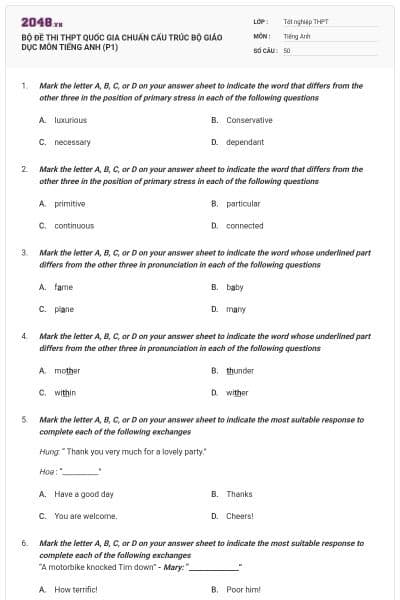
Mark the letter A, B, C, or D on your answer sheet to indicate the word that differs from the other three in the position of primary stress in each of the following questions
luxurious
Conservative
necessary
dependant
Đáp án C
- Luxurious /lʌg'zjuəriəs/ (adj) : Lộng lẫy, xa hoa
- Conservative / kən'sə:vətiv / (adj): bảo tồn, bảo thủ
- Necessary /'nesisəri/ (adj): cần thiết
- Dependant /di'pendənt/ (n): người phụ thuộc
ð Đáp án C (trọng tâm rơi vào âm ttiết thứ nhất, các từ còn lại là âm tiết thứ 2)
Mark the letter A, B, C, or D on your answer sheet to indicate the word that differs from the other three in the position of primary stress in each of the following questions
primitive
particular
continuous
connected
Đáp án A
Primitive /'primitiv/ (adj): nguyên bản, nguyên thủy
Particular /pə'tikjuələ/ (adj): cụ thể
Continuous /kən'tinjuəs/ (adj): liên tục, không ngừng
Connected /kə'nektid/ (adj): được kết nối
ð Đáp án A (trọng âm rơi vào âm tiết đầu, các từ còn lại là âm tiết thứ 2)
Mark the letter A, B, C, or D on your answer sheet to indicate the word whose underlined part differs from the other three in pronunciation in each of the following questions
fame
baby
plane
many
Đáp án D
Fame /feim/ (n): danh tiếng
Baby /'beibi/ (n): đứa bé
Plane /plein/ (n): máy bay
Many /'meni/ (adj): nhiều
ð Đáp án D (“a” được phát âm là /e/; các từ còn lại là /ei/)
Mark the letter A, B, C, or D on your answer sheet to indicate the word whose underlined part differs from the other three in pronunciation in each of the following questions
mother
thunder
within
wither
Đáp án B
Mother /'mʌðə/ (n): mẹ
Thunder /'θʌndə/ (n): sấm
Within /wi'ðin/ (prep): trong vòng 1 khoảng thời gian
Wither /'wiðə/ (v): làm khô, làm héo quắt lại
ð Đáp án B (“th” được phát âm là /θ/; các từ còn lại là /ð/)
Mark the letter A, B, C, or D on your answer sheet to indicate the most suitable response to complete each of the following exchanges
Hung: “ Thank you very much for a lovely party.”
Hoa : “__________”
Have a good day
Thanks
You are welcome.
Cheers!
Đáp án C
Hùng: “Cảm ơn bạn rất nhiều vì một bữa tuyệt vời”.
Chúc một ngày tốt lành
Cảm ơn
Không có gì (Đáp lại lời cảm ơn)
Cạn li
Mark the letter A, B, C, or D on your answer sheet to indicate the most suitable response to complete each of the following exchanges
“A motorbike knocked Tim down” - Mary: “______________”
How terrific!
Poor him!
Why do you say so?
What a cheap motorbike!
Đáp án B
Mike: “Một chiếc xe máy đã làm Tim ngã”.
A. Thật tuyệt!
B. Tội nghiệp cậu ấy quá.
C. Tại sao bạn nói vậy?
D. Chiếc xe máy thật rẻ!
Mark the letter A, B, C, or D on your answer sheet to indicate the word(s) OPPOSITE in meaning to the underlined word(s) in each of the following questions.
Thousands are going starving because of the failure of this year’s harvest
hungry
poor
rich
full
Đáp án D
Starving: đói, thiếu ăn
Hungry: (adj): đói
Poor (adj): nghèo, đói
Rich (adj): giàu
Full (adj): no, đầy đủ
ð Đáp án D (Hàng ngàn người đang bị chết đói vì năm nay mất mùa)
Mark the letter A, B, C, or D on your answer sheet to indicate the word(s) OPPOSITE in meaning to the underlined word(s) in each of the following questions
Mr. Smith’s new neighbors appear to be very friendly
amicable
inapplicable
hostile
futile
Đáp án: C
Giải thích:
friendly (adj): thân thiện
amicable / æmikəbl / (adj): thân ái, thân mật
inapplicable /,inə'pri:ʃəbl / (adj): không thể áp dụng được (+to sb/sth)
hostile /’hɔstail / (adj): thù địch, không thân thiện
futile /'fju:tail/ (adj): không có hiệu quả, vô ích
=> Đáp án C
Dịch: Những người hàng xóm mới của ông Smith dường như rất thân thiện.
Mark the letter A, B, C, or D on your answer sheet to indicate the word(s) CLOSEST in meaning to the underlined word(s) in each of the following questions
The Civil War in 1863 cut the United States into two nations - a southern Confederacy and a northern Union
acknowledged
alienated
severed
integrated
Đáp án C
Cut ~ Sever /'sevə/ (v): chia cắt, cắt đức
Acknowledge: thừa nhận, công nhận, biết ơn
Alienate /'eiljəneit/ (v): làm cho xa lánh
Integrate /'intigreit/ (v): hợp nhất
ð Đáp án C (Cuộc nội chiến vào năm 1863 đã chia cắt nước Mỹ thành hai quốc gia – một liên minh phía nam và một liên minh phía bắc)
Mark the letter A, B, C, or D on your answer sheet to indicate the word(s) CLOSEST in meaning to the underlined word(s) in each of the following questions.
Unselfishness is the very essence of friendship
important part
difficult part
romantic part
interesting part
Đáp án A
- Essence (n) ~ Important part: phần quan trọng, phẩm chất, tính chất quan trọng
- Difficult part: phần khó khăn
- Romantic part: phần lãng mạn
- Interesting part: phần thú vị
ð Đáp án A (Sự không ích kỷ là phần quan trọng nhất trong tình bạn.)
Mark the letter A, B, C, or D on your answer sheet to indicate the correct answer to each of the following questions
The atmosphere at the meeting was very __________and everyone was on the first name terms
formal
informal
formality
informality
Đáp án B
- Formal /'fɔ:məl/ (adj): trang trọng, hình thức
- Informal /in'fɔ:ml/ (adj): không trang trọng, thân mật
- Formality /fɔ:'mæliti/ (n): sự trang trọng
- Informality /,infɔ:'mæliti/ (n): sự không trang trọng, thân mật
- on the first name terms/ On the first name basis: xưng hô bằng tên để chỉ những mối quan hệ thân thiết.
Sau động từ be (was) và trạng từ (very) thì ta dùng tính từ => loại C và D
A không phù hợp nghĩa
ð Đáp án B (Không khí tại cuộc họp rất thân mật và mọi người gọi nhau bằng tên)
Mark the letter A, B, C, or D on your answer sheet to indicate the correct answer to each of the following questions
Mark enjoys having fun by causing trouble. He’s a very_________boy
strong willed
mischievous
obedient
well
Đáp án B
- Strong-willed /'strɔɳ'wild/ (adj): kiên quyết, cứng cỏi
- Mischievous /'mistʃivəs/ ~ Naughty (adj): nghịch ngợm, tinh nghịch
- Obedient /əu'bi:djənt/ (adi): ngoan ngoãn, biết vâng lời
- Well - behaved (adj): có giáo dục
ð Đáp án B (Mark thích vui đùa bằng cách gây phiền toái. Cậu ấy là một chàng trai tinh nghịch.)
Mark the letter A, B, C, or D on your answer sheet to indicate the correct answer to each of the following questions
He________ a football game to go out with a girl
satisfied
sacrificed
preferred
confided
Đáp án B
- Satisfy /'sætisfai/ (v): làm hài long
- Sacrifice /'sækrifais/ (v): hi sinh
- Prefer /pri'fə:/ (v): thích hơn
- Confide /kən'faid/ (v): tâm sự, nói bí mật
ð Đáp án B (Anh ấy đã hi sinh một trận bóng đá để đi hẹn hò với bạn gái.)
Mark the letter A, B, C, or D on your answer sheet to indicate the correct answer to each of the following questions
This device helps you to __________ with other computers and with people around the world
demonstrate
interact
content
transmit
Đáp án B
- Demonstrate (v): biểu lộ, bày tỏ
- Interact: tương tác với
- Content (v): làm bằng lòng, thỏa mãn
- Transmit (v): truyền
ð Đáp án B (Thiết bị này giúp bạn tương tác với các máy tính khác và mọi người khắp thế giới.)
Mark the letter A, B, C, or D on your answer sheet to indicate the correct answer to each of the following questions
I remembe _________ the letter a few days before going on holiday.
received
to have received
to receive
receiving
Đáp án D
- Remember to do sth: nhớ để làm gì
- Remember doing sth: nhớ đã làm gì
ð Đáp án D (Tôi nhớ đã nhận bức thư vài ngày trước khi đi nghỉ.)
Mark the letter A, B, C, or D on your answer sheet to indicate the correct answer to each of the following questions
Nam and his family had ________ to their home village
a two-day trip
a two-days trip
a two-day trips
two-day trips
Đáp án A
Danh từ ghép: số đếm – N chia số ít + N
E.g: A three-floor house ( 1 ngôi nhà 3 tầng); Two twenty-minute breaks (2 giờ giải lao 20 phút)
ð Đáp án A (Nam và gia đình cậu ấy đã có một chuyến đi 2 ngày về quê của họ.)
Mark the letter A, B, C, or D on your answer sheet to indicate the correct answer to each of the following questions
The film__________by the time we________to the cinema
had already started/got
already started/ had gotten
had already started/had gotten
has already started/ got
Đáp án A
Câu này có nghĩa: Bộ phim đã được chiếu trước khi chúng tôi đến rạp chiếu phim.
Hành động “start” xảy ra trước hành động "get to the cinema” => vế trước dùng thì quá khứ hoàn thành; vế sau dùng thì quá khứ đơn
Mark the letter A, B, C, or D on your answer sheet to indicate the correct answer to each of the following questions
The teacher____________ her to improve her listening skills
persisted
insisted
encouraged
made
Đáp án C
Cấu trúc:
- Insist on - Persist in + doing sth: khăng khăng làm gì
- Make sb do sth: khiến ai đó làm gì
- Encourage sb to do sth: khuyến khích, động viên ai đó làm gì
ð Đáp án C (Giáo viên khuyến khích cô ấy cải thiện kỹ năng nghe.)
Mark the letter A, B, C, or D on your answer sheet to indicate the correct answer to each of the following questions
I have been fascinated by__________ since I was at secondary school
photographer
photography
photograph
photographic
Đáp án B
- Photographer (n): thợ chụp ảnh, nhà nhiếp ảnh
- Photography (n): nhiếp ảnh, thuật chụp ảnh
- Photograph (n): bức ảnh
- Photographic (adj): như ảnh
ð Đáp án B (Tôi đã bị lôi cuốn bởi nhiếp ảnh từ khi còn ở trường trung học.)
Mark the letter A, B, C, or D on your answer sheet to indicate the correct answer to each of the following questions
My parents________tommorrow to stay with me for a few days
came
have come
come
are coming
Đáp án D
- Ở đây ta dùng thì hiện tại tiếp diễn để diễn tả hành động chắc chắn xảy ra ở tương lai
- Thì hiện tại tiếp diễn: is/am/are + V-ing
ð Đáp án D (Ngày mai bố mẹ tôi sẽ đến ở với tôi vài ngày )
Mark the letter A, B, C, or D on your answer sheet to indicate the correct answer to each of the following questions
The police have just found the man and his car___________were swept away during the heavy storm last week.
that
which
whose
when
Đáp án A
Phía trước chỗ trống là danh từ “the man” và “his car” => chúng ta phải dùng đại từ quan hệ “that” để thay thế cho danh từ chỉ cả người lẫn vật
ð Đáp án A (Cảnh sát đã tìm được người đàn ông và ô tô của ông đã bị cuốn trôi trong cơn bão lớn tuần trước.)
Mark the letter A, B, C, or D on your answer sheet to indicate the correct answer to each of the following questions
_________, the more terrible the terrorism will become
The more weapons are powerful
The more powerful weapons are
The weapons more powerful
Weapons are the more powerful
Đáp án B
Cấu trúc so sánh kép: ( càng....càng...):
- The + hình thức so sánh hơn S+ V, the + hình thức so sánh hơn + S+ V
ð Đáp án B (Vũ khí càng mạnh thì bọn khủng bố càng trở nên khủng khiếp.)
Read the following passage and mark the letter A, B, C, or D on your answer sheet to indicate the correct word or phrase that best fits each of the numbered blanks from 23 to 27.
Every child in Great Britain between the age of five and fifteen must (23)_________school.
There (24)_________ three main types of educational institutions: primary (elementary) schools, secondary schools and universities.
State schools are free, and attendance is compulsory. Morning school begins at nine o’clock and lasts until half past four. School is open five days a week.
(25)_________ Saturdays and Sundays there are no lessons. There are holidays at Christmas,
Easter and in summer. In London as in all cities there are two grades of state schools for those (26)_________will go to work at fifteen: primary schools for boys and girls between the ages of five and eleven, and secondary schools for children from eleven to fifteen years.
The lessons are reading, writing, the English language, English literature, English history, geography, (27)________, nature study, drawing, painting, singing, woodwork and drill.
Điền ô 23
attend
come
arrive
go
Đáp án A
- Attend (v): tham gia, tham dự
+ Attend school ~ Go to school: đi học
Các động từ “come, arrive, go” phải có giới từ đi kèm phía sau
Every child in Great Britain between the age of five and fifteen must attend school. (Mỗi đứa trẻ ở Anh trong độ tuổi từ năm đến mười lăm phải đi học.)
Read the following passage and mark the letter A, B, C, or D on your answer sheet to indicate the correct word or phrase that best fits each of the numbered blanks from 23 to 27.
Every child in Great Britain between the age of five and fifteen must (23)_________school.
There (24)_________ three main types of educational institutions: primary (elementary) schools, secondary schools and universities.
State schools are free, and attendance is compulsory. Morning school begins at nine o’clock and lasts until half past four. School is open five days a week.
(25)_________ Saturdays and Sundays there are no lessons. There are holidays at Christmas,
Easter and in summer. In London as in all cities there are two grades of state schools for those (26)_________will go to work at fifteen: primary schools for boys and girls between the ages of five and eleven, and secondary schools for children from eleven to fifteen years.
The lessons are reading, writing, the English language, English literature, English history, geography, (27)________, nature study, drawing, painting, singing, woodwork and drill.
Điền ô 24
have
has
are
is
Đáp án C
Phía sau chỗ trống là danh từ số nhiều “types” => dùng “there are”
There are three main types of educational institutions” (Có ba loại cơ sở giáo dục chính)
A. have | B. has | C. are | D. is |
Read the following passage and mark the letter A, B, C, or D on your answer sheet to indicate the correct word or phrase that best fits each of the numbered blanks from 23 to 27.
Every child in Great Britain between the age of five and fifteen must (23)_________school.
There (24)_________ three main types of educational institutions: primary (elementary) schools, secondary schools and universities.
State schools are free, and attendance is compulsory. Morning school begins at nine o’clock and lasts until half past four. School is open five days a week.
(25)_________ Saturdays and Sundays there are no lessons. There are holidays at Christmas,
Easter and in summer. In London as in all cities there are two grades of state schools for those (26)_________will go to work at fifteen: primary schools for boys and girls between the ages of five and eleven, and secondary schools for children from eleven to fifteen years.
The lessons are reading, writing, the English language, English literature, English history, geography, (27)________, nature study, drawing, painting, singing, woodwork and drill.
Điền ô 25
On
At
For
In
Đáp án A
- On + thứ ngày
“On Saturdays and Sundays there are no lessons.” (Vào các ngày thứ Bảy và Chủ Nhật không có tiết học.)
Read the following passage and mark the letter A, B, C, or D on your answer sheet to indicate the correct word or phrase that best fits each of the numbered blanks from 23 to 27.
Every child in Great Britain between the age of five and fifteen must (23)_________school.
There (24)_________ three main types of educational institutions: primary (elementary) schools, secondary schools and universities.
State schools are free, and attendance is compulsory. Morning school begins at nine o’clock and lasts until half past four. School is open five days a week.
(25)_________ Saturdays and Sundays there are no lessons. There are holidays at Christmas,
Easter and in summer. In London as in all cities there are two grades of state schools for those (26)_________will go to work at fifteen: primary schools for boys and girls between the ages of five and eleven, and secondary schools for children from eleven to fifteen years.
The lessons are reading, writing, the English language, English literature, English history, geography, (27)________, nature study, drawing, painting, singing, woodwork and drill.
Điền ô 26
when
where
which
who
Đáp án D
- When: trạng từ quan hệ thay cho từ/ cụm từ chỉ thời gian
- Where: trạng từ quan hệ thay cho từ/cụm từ chỉ nơi chốn
- Which: đại từ quan hệ thay cho chủ ngữ/tân ngữ chỉ vật
- Which: đại từ quan hệ thay cho chủ ngữ chỉ người
Ở đây dùng đại từ quan hệ who để thay thế cho those - người
Read the following passage and mark the letter A, B, C, or D on your answer sheet to indicate the correct word or phrase that best fits each of the numbered blanks from 23 to 27.
Every child in Great Britain between the age of five and fifteen must (23)_________school.
There (24)_________ three main types of educational institutions: primary (elementary) schools, secondary schools and universities.
State schools are free, and attendance is compulsory. Morning school begins at nine o’clock and lasts until half past four. School is open five days a week.
(25)_________ Saturdays and Sundays there are no lessons. There are holidays at Christmas,
Easter and in summer. In London as in all cities there are two grades of state schools for those (26)_________will go to work at fifteen: primary schools for boys and girls between the ages of five and eleven, and secondary schools for children from eleven to fifteen years.
The lessons are reading, writing, the English language, English literature, English history, geography, (27)________, nature study, drawing, painting, singing, woodwork and drill.
Điền ô 27
scientist
scientifically
science
scientific
Đáp án C
- Science (n): môn Khoa học
- Scientist (n): nhà khoa học
- Scientific (adj): khoa học => Scientifically (adv): một cách khoa học
Chỗ trống cần điền là một môn học
Read the following passage and mark the letter A, B, C, or D on your answer sheet to indicate the correct answer to each of the questions from 28 to 34.
Biological diversity has become widely recognized as a critical conservation issue only in the past two decades. The rapid destruction of the tropical rain forests, which are the ecosystems with the highest known species diversity on Earth, has awakened people to the importance and fragility of biological diversity. The high rate of species extinctions in these environments is jolting, but it is important to recognize the significance of biological diversity in all ecosystems. As the human population continues to expand, it will negatively affect one after another of Earth's ecosystems. In terrestrial ecosystems and in fringe marine ecosystems (such as wetlands), the most common problem is habitat destruction. In most situations, the result is irreversible. Now humans are beginning to destroy marine ecosystems through other types of activities, such as disposal and runoff of poisonous waste; in less than two centuries, by significantly reducing the variety of species on Earth, they have irrevocably redirected the course of evolution.
Certainly, there have been periods in Earth's history when mass extinctions have occurred. The extinction of the dinosaurs was caused by some physical event, either climatic or cosmic. There have also been less dramatic extinctions, as when natural competition between species reached an extreme conclusion. Only 0.01 percent of the species that have lived on Earth have survived to the present, and it was largely chance that determined which species survived and which died out.
However, nothing has ever equaled the magnitude and speed with which the human species is altering the physical and chemical world and demolishing the environment. In fact, there is wide agreement that it is the rate of change humans are inflicting, even more than the changes selves, that will lead to biological devastation. Life on Earth has continually been in flux as slow physical and chemical changes have occurred on Earth, but life needs time to adapt-time for migration and genetic adaptation within existing species and time for the proliferation of new genetic material and new species that may be able to survive in new environments
What does the passage mainly discuss?
The variety of species found in tropical rain forests
The cause of the extinction of the dinosaurs
The time required for species to adapt to new environments
The impact of human activities on Earth's ecosystems
Đáp án D
Bài đọc chủ yếu thảo luận về điều gì?
A. Sự đa dạng loài được tìm thấy ở những rừng mưa nhiệt đới
B. Nguyên nhân sự tuyệt chủng của loài khủng long.
C. Thời gian cần cho các loài để thích nghi với môi trường mới.
D. Tác động của hoạt động con người vào hệ sinh thái của trái đất.
Dẫn chứng: “As the human population continues to expand, it will negatively affect one after another of Earth’s ecosystems”
Read the following passage and mark the letter A, B, C, or D on your answer sheet to indicate the correct answer to each of the questions from 28 to 34.
Biological diversity has become widely recognized as a critical conservation issue only in the past two decades. The rapid destruction of the tropical rain forests, which are the ecosystems with the highest known species diversity on Earth, has awakened people to the importance and fragility of biological diversity. The high rate of species extinctions in these environments is jolting, but it is important to recognize the significance of biological diversity in all ecosystems. As the human population continues to expand, it will negatively affect one after another of Earth's ecosystems. In terrestrial ecosystems and in fringe marine ecosystems (such as wetlands), the most common problem is habitat destruction. In most situations, the result is irreversible. Now humans are beginning to destroy marine ecosystems through other types of activities, such as disposal and runoff of poisonous waste; in less than two centuries, by significantly reducing the variety of species on Earth, they have irrevocably redirected the course of evolution.
Certainly, there have been periods in Earth's history when mass extinctions have occurred. The extinction of the dinosaurs was caused by some physical event, either climatic or cosmic. There have also been less dramatic extinctions, as when natural competition between species reached an extreme conclusion. Only 0.01 percent of the species that have lived on Earth have survived to the present, and it was largely chance that determined which species survived and which died out.
However, nothing has ever equaled the magnitude and speed with which the human species is altering the physical and chemical world and demolishing the environment. In fact, there is wide agreement that it is the rate of change humans are inflicting, even more than the changes selves, that will lead to biological devastation. Life on Earth has continually been in flux as slow physical and chemical changes have occurred on Earth, but life needs time to adapt-time for migration and genetic adaptation within existing species and time for the proliferation of new genetic material and new species that may be able to survive in new environments
The word “critical” is closest in meaning to__________.
essential
negative
complicated
interesting
Đáp án A
- Critical /'kritikəl/ (adj): quan trọng, cần thiết
- Essential /i'senʃəl/ (adj): cần thiết
- Negative /'negətiv/ (adj): tiêu cực
- Complicated /'kɔmplikeitid/ (ad)): phức tạp (~ Complex)
- Interesting /'intristiɳ/ (adj): thú vị
“Biological diversity has become widely recognized as a critical conservation issue only in the past two decades.” (Đa dạng sinh học đã được thừa nhận là vấn đề bảo tồn quan trọng chỉ trong hai thập kỉ qua.)
Read the following passage and mark the letter A, B, C, or D on your answer sheet to indicate the correct answer to each of the questions from 28 to 34.
Biological diversity has become widely recognized as a critical conservation issue only in the past two decades. The rapid destruction of the tropical rain forests, which are the ecosystems with the highest known species diversity on Earth, has awakened people to the importance and fragility of biological diversity. The high rate of species extinctions in these environments is jolting, but it is important to recognize the significance of biological diversity in all ecosystems. As the human population continues to expand, it will negatively affect one after another of Earth's ecosystems. In terrestrial ecosystems and in fringe marine ecosystems (such as wetlands), the most common problem is habitat destruction. In most situations, the result is irreversible. Now humans are beginning to destroy marine ecosystems through other types of activities, such as disposal and runoff of poisonous waste; in less than two centuries, by significantly reducing the variety of species on Earth, they have irrevocably redirected the course of evolution.
Certainly, there have been periods in Earth's history when mass extinctions have occurred. The extinction of the dinosaurs was caused by some physical event, either climatic or cosmic. There have also been less dramatic extinctions, as when natural competition between species reached an extreme conclusion. Only 0.01 percent of the species that have lived on Earth have survived to the present, and it was largely chance that determined which species survived and which died out.
However, nothing has ever equaled the magnitude and speed with which the human species is altering the physical and chemical world and demolishing the environment. In fact, there is wide agreement that it is the rate of change humans are inflicting, even more than the changes selves, that will lead to biological devastation. Life on Earth has continually been in flux as slow physical and chemical changes have occurred on Earth, but life needs time to adapt-time for migration and genetic adaptation within existing species and time for the proliferation of new genetic material and new species that may be able to survive in new environments.
The author mentions the reduction of the variety of species on Earth in line 7-8 to suggest that ___________.
humans are often made ill by polluted water
new habitats can be created for species
some species have been made extinct by human activity
understanding evolution can prevent certain species from disappearing
Đáp án D
Tác giả đề cập đến việc giảm sự đa dạng loài trên trái đất trong dòng 7-8 để gợi ý rằng
A. con người thường bị bệnh vì nước bị ô nhiễm
B. môi trường sống mới có thể được tạo ra cho các loài
C. một số loài bị tuyệt chủng bởi hoạt động của con người
D. hiểu được sự tiến hóa có thể ngăn chặn được việc các loài nào đó biến mất
Dẫn chứng: “Now humans are beginning to destroy marine ecosystems through other types of activities, such as disposal and runoff of poisonous waste; in less than two centuries, by significantly reducing the variety of species on Earth, they have irrevocably redirected the course of evolution.”
Read the following passage and mark the letter A, B, C, or D on your answer sheet to indicate the correct answer to each of the questions from 28 to 34.
Biological diversity has become widely recognized as a critical conservation issue only in the past two decades. The rapid destruction of the tropical rain forests, which are the ecosystems with the highest known species diversity on Earth, has awakened people to the importance and fragility of biological diversity. The high rate of species extinctions in these environments is jolting, but it is important to recognize the significance of biological diversity in all ecosystems. As the human population continues to expand, it will negatively affect one after another of Earth's ecosystems. In terrestrial ecosystems and in fringe marine ecosystems (such as wetlands), the most common problem is habitat destruction. In most situations, the result is irreversible. Now humans are beginning to destroy marine ecosystems through other types of activities, such as disposal and runoff of poisonous waste; in less than two centuries, by significantly reducing the variety of species on Earth, they have irrevocably redirected the course of evolution.
Certainly, there have been periods in Earth's history when mass extinctions have occurred. The extinction of the dinosaurs was caused by some physical event, either climatic or cosmic. There have also been less dramatic extinctions, as when natural competition between species reached an extreme conclusion. Only 0.01 percent of the species that have lived on Earth have survived to the present, and it was largely chance that determined which species survived and which died out.
However, nothing has ever equaled the magnitude and speed with which the human species is altering the physical and chemical world and demolishing the environment. In fact, there is wide agreement that it is the rate of change humans are inflicting, even more than the changes selves, that will lead to biological devastation. Life on Earth has continually been in flux as slow physical and chemical changes have occurred on Earth, but life needs time to adapt-time for migration and genetic adaptation within existing species and time for the proliferation of new genetic material and new species that may be able to survive in new environments
The author mentions all of the following as examples of the effect of humans on the world’s ecosystems EXCEPT_________.
damage to marine ecosystems
habitat destruction in wetlandsC. the introduction of new varieties of plant species
the introduction of new varieties of plant species
destruction of the tropical rain forests
Đáp án C
Tác giả đề cập tất cả những điều sau như những ví dụ về tác động của con người vào hệ sinh thái NGOẠI TRỪ_________.
A. phá hủy hệ sinh thái biển (humans are beginning to destroy marine ecosystems)
B. phá hủy môi trường sống ở những nơi ẩm ướt (In terrestrial ecosystems and in fringe marine ecosystems (such as wetlands), the most common problem is habitat destruction)
C. việc giới thiệu nhiều loài thực vật mới.
D. việc tàn phá những khu rừng mưa nhiệt đới (The rapid destruction of the tropical rain forests...)
Read the following passage and mark the letter A, B, C, or D on your answer sheet to indicate the correct answer to each of the questions from 28 to 34.
Biological diversity has become widely recognized as a critical conservation issue only in the past two decades. The rapid destruction of the tropical rain forests, which are the ecosystems with the highest known species diversity on Earth, has awakened people to the importance and fragility of biological diversity. The high rate of species extinctions in these environments is jolting, but it is important to recognize the significance of biological diversity in all ecosystems. As the human population continues to expand, it will negatively affect one after another of Earth's ecosystems. In terrestrial ecosystems and in fringe marine ecosystems (such as wetlands), the most common problem is habitat destruction. In most situations, the result is irreversible. Now humans are beginning to destroy marine ecosystems through other types of activities, such as disposal and runoff of poisonous waste; in less than two centuries, by significantly reducing the variety of species on Earth, they have irrevocably redirected the course of evolution.
Certainly, there have been periods in Earth's history when mass extinctions have occurred. The extinction of the dinosaurs was caused by some physical event, either climatic or cosmic. There have also been less dramatic extinctions, as when natural competition between species reached an extreme conclusion. Only 0.01 percent of the species that have lived on Earth have survived to the present, and it was largely chance that determined which species survived and which died out.
However, nothing has ever equaled the magnitude and speed with which the human species is altering the physical and chemical world and demolishing the environment. In fact, there is wide agreement that it is the rate of change humans are inflicting, even more than the changes selves, that will lead to biological devastation. Life on Earth has continually been in flux as slow physical and chemical changes have occurred on Earth, but life needs time to adapt-time for migration and genetic adaptation within existing species and time for the proliferation of new genetic material and new species that may be able to survive in new environments
The author mentions the extinction of the dinosaurs in the 2nd paragraph to emphasize that ____________.
not all mass extinctions have been caused by human activity
actions by humans could not stop the irreversible process of a species’ extinction
Earth’s climate has changed significantly since the dinosaurs’ extinction
the cause of the dinosaurs’ extinction is unknown
Đáp án A
Tác giả đề cập đến sự tuyệt chủng của loài khủng long trong giai đoạn thứ 2 để nhấn mạnh rằng __________.
A. không phải tất cả sự tuyệt chủng lớn do hoạt động con người gây ra.
B. Những hành động của con người không thể ngăn cản được quá trình tuyệt chủng của các loài không thể thay đổi.
C. Khí hậu của trái đất đã thay đổi đáng kể từ sự tuyệt chủng của loài khủng long.
D. nguyên nhân của sự tuyệt chủng khủng long thì không được biết đến
Dẫn chứng: “The extinction of the dinosaurs was caused by some physical event, either climatic or cosmic...”
Read the following passage and mark the letter A, B, C, or D on your answer sheet to indicate the correct answer to each of the questions from 28 to 34.
Biological diversity has become widely recognized as a critical conservation issue only in the past two decades. The rapid destruction of the tropical rain forests, which are the ecosystems with the highest known species diversity on Earth, has awakened people to the importance and fragility of biological diversity. The high rate of species extinctions in these environments is jolting, but it is important to recognize the significance of biological diversity in all ecosystems. As the human population continues to expand, it will negatively affect one after another of Earth's ecosystems. In terrestrial ecosystems and in fringe marine ecosystems (such as wetlands), the most common problem is habitat destruction. In most situations, the result is irreversible. Now humans are beginning to destroy marine ecosystems through other types of activities, such as disposal and runoff of poisonous waste; in less than two centuries, by significantly reducing the variety of species on Earth, they have irrevocably redirected the course of evolution.
Certainly, there have been periods in Earth's history when mass extinctions have occurred. The extinction of the dinosaurs was caused by some physical event, either climatic or cosmic. There have also been less dramatic extinctions, as when natural competition between species reached an extreme conclusion. Only 0.01 percent of the species that have lived on Earth have survived to the present, and it was largely chance that determined which species survived and which died out.
However, nothing has ever equaled the magnitude and speed with which the human species is altering the physical and chemical world and demolishing the environment. In fact, there is wide agreement that it is the rate of change humans are inflicting, even more than the changes selves, that will lead to biological devastation. Life on Earth has continually been in flux as slow physical and chemical changes have occurred on Earth, but life needs time to adapt-time for migration and genetic adaptation within existing species and time for the proliferation of new genetic material and new species that may be able to survive in new environments
The word “magnitude” is closest in meaning to_________.
carelessness
extent
determination
concern
Đáp án B
- Magnitude (n): độ lớn, cường độ ~ Extent
- Carelessness (n): sự bất cẩn
- Determination (n): sự xác định, quyết tâm
- Concern (n): mối quan tâm
“However, nothing has ever equaled the magnitude and speed with which the human species is altering the physical and chemical world and demolishing the environment” (Tuy nhiên, không gì sánh được cường độ và tốc độ mà loài người đang làm thay đổi thế giới và phá hủy môi trường).
Read the following passage and mark the letter A, B, C, or D on your answer sheet to indicate the correct answer to each of the questions from 28 to 34.
Biological diversity has become widely recognized as a critical conservation issue only in the past two decades. The rapid destruction of the tropical rain forests, which are the ecosystems with the highest known species diversity on Earth, has awakened people to the importance and fragility of biological diversity. The high rate of species extinctions in these environments is jolting, but it is important to recognize the significance of biological diversity in all ecosystems. As the human population continues to expand, it will negatively affect one after another of Earth's ecosystems. In terrestrial ecosystems and in fringe marine ecosystems (such as wetlands), the most common problem is habitat destruction. In most situations, the result is irreversible. Now humans are beginning to destroy marine ecosystems through other types of activities, such as disposal and runoff of poisonous waste; in less than two centuries, by significantly reducing the variety of species on Earth, they have irrevocably redirected the course of evolution.
Certainly, there have been periods in Earth's history when mass extinctions have occurred. The extinction of the dinosaurs was caused by some physical event, either climatic or cosmic. There have also been less dramatic extinctions, as when natural competition between species reached an extreme conclusion. Only 0.01 percent of the species that have lived on Earth have survived to the present, and it was largely chance that determined which species survived and which died out.
However, nothing has ever equaled the magnitude and speed with which the human species is altering the physical and chemical world and demolishing the environment. In fact, there is wide agreement that it is the rate of change humans are inflicting, even more than the changes selves, that will lead to biological devastation. Life on Earth has continually been in flux as slow physical and chemical changes have occurred on Earth, but life needs time to adapt-time for migration and genetic adaptation within existing species and time for the proliferation of new genetic material and new species that may be able to survive in new environments
According to the passage, natural evolutionary change is different from changes caused by humans in that changes caused by humans___________.
affect fewer ecosystems
are occurring at a much faster rate
are reversible
are less devastating to most species
Đáp án B
Theo bài đọc, sự thay đổi về mặt tiến hóa tự nhiên thì khác với những thay đổi mà con người gây ra ở chỗ là những thay đổi mà con người gây ra ________________.
A. Ảnh hưởng tới ít hệ sinh thái hơn.
B. thì xảy ra ở tốc độ nhanh hơn nhiều
C. thì không có mặt trái
D. Thì ít tàn phá tới các loài.
Dẫn chứng: “However, nothing has ever equaled the magnitude and speed with which the human species is altering the physical and chemical world and demolishing the environment”
Read the following passage and mark the letter A, B, C, or D on your answer sheet to indicate the correct answer to each of the questions from 35 to 42.
Clara Barton became known as “The Angel of the Battlefield” during the American Civial War. Born in Oxford, Massachusetts in 1821, Clara Barton’s interest in helping soldiers on the battlefield began when she was told army stories from her father. Another event that influenced her decision to help soldiers was an accident her brother had. His injuries were cared for by Barton for 2 years. At the time, she was only 11 years old. Barton began teaching school at the age of 15. She taught for 18 years before she moved to Washington, D.C. in 1854.
The civil war broke out 6 years later. Immediately, Barton started was service by helping the soldiers with their needs. At the battle of Bull Run, Clara Barton received permission from the government to take care of the sick and hurt. Barton did this with great empathy and kindness. She acknowledged each soldier as a person. Her endurance and courage on the battlefield were admired by many. When the war ended in 1865, she used 4 years of her life to assist the government in searching for soldiers who were missing during the war.
The search for missing soldiers and years of hard work made her feeble physically. In 1869, her doctors recommended a trip to Europe for a rest. While she was on vacation, she became involved with the International Red Cross, an organization set up by the Geneva Convention in 1864. Clara Barton realized that the red Cross would be a big help to the United States. After she returned to the United States, she worked very hard to create an American red Cross. She talked to government leaders and let American people know about the Red Cross. In 1881, the Notional Society of the Red Cross was finally established with its headquarters in Washington, D.C. Clara Barton managed its activities for 23 years.
Barton never let her age stop her from helping people. At the age of 79, she helped flood victims in Galveston, Texas. Barton finally resigned from the Red Cross in 1904. She was 92 years old and had truly earned her titled “The Angel of the Battlefield”.
According to paragraph 1, which of the following is true of the young Clara Barton?
She helped her father when he was a soldier
She suffered from an accident when she was 11
She helped her brother who hurt in an accident
She made a decision to live with her brother for 2 years
Đáp án C
Theo đoạn 1, câu nào sau đây đúng về Clara Barton lúc còn trẻ?
A. Bà ấy giúp bố khi ông là quân nhân.
B. Bà ấy đã bị tai nạn khi 11 tuổi
C. Bà ấy giúp đỡ anh trai đã bị thương trong một tai nạn
C. Cô ấy đã quyết định sống với anh trai khoảng 2 năm.
Dẫn chứng trong bài đọc: “Another event that influenced her decision to help soldiers was an accident her brother had. His injuries were cared for by Barton for 2 years”. (Một sự khác nữa mà ảnh hưởng đến quyết định của bà về việc giúp đỡ các quân nhân là anh trai bà gặp tai nạn. Barton đã chăm sóc anh trai bị thương khoảng 2 năm).
Read the following passage and mark the letter A, B, C, or D on your answer sheet to indicate the correct answer to each of the questions from 35 to 42.
Clara Barton became known as “The Angel of the Battlefield” during the American Civial War. Born in Oxford, Massachusetts in 1821, Clara Barton’s interest in helping soldiers on the battlefield began when she was told army stories from her father. Another event that influenced her decision to help soldiers was an accident her brother had. His injuries were cared for by Barton for 2 years. At the time, she was only 11 years old. Barton began teaching school at the age of 15. She taught for 18 years before she moved to Washington, D.C. in 1854.
The civil war broke out 6 years later. Immediately, Barton started was service by helping the soldiers with their needs. At the battle of Bull Run, Clara Barton received permission from the government to take care of the sick and hurt. Barton did this with great empathy and kindness. She acknowledged each soldier as a person. Her endurance and courage on the battlefield were admired by many. When the war ended in 1865, she used 4 years of her life to assist the government in searching for soldiers who were missing during the war.
The search for missing soldiers and years of hard work made her feeble physically. In 1869, her doctors recommended a trip to Europe for a rest. While she was on vacation, she became involved with the International Red Cross, an organization set up by the Geneva Convention in 1864. Clara Barton realized that the red Cross would be a big help to the United States. After she returned to the United States, she worked very hard to create an American red Cross. She talked to government leaders and let American people know about the Red Cross. In 1881, the Notional Society of the Red Cross was finally established with its headquarters in Washington, D.C. Clara Barton managed its activities for 23 years.
Barton never let her age stop her from helping people. At the age of 79, she helped flood victims in Galveston, Texas. Barton finally resigned from the Red Cross in 1904. She was 92 years old and had truly earned her titled “The Angel of the Battlefield”.
The phrase “broke out” in paragraph 2 is closest in meaning to
extended
broke down
closed
began
Đáp án D
- Extend (v): mở rộng
- Break down (phrasal verb): hư hỏng
- Close (v): đóng
- Begin (v): bắt đầu
“The civil war broke out 6 years later”. (cuộc nội chiến đã bùng bổ 6 năm sau đó).
Vậy: Broke out ~ began : bắt đầu
Read the following passage and mark the letter A, B, C, or D on your answer sheet to indicate the correct answer to each of the questions from 35 to 42.
Clara Barton became known as “The Angel of the Battlefield” during the American Civial War. Born in Oxford, Massachusetts in 1821, Clara Barton’s interest in helping soldiers on the battlefield began when she was told army stories from her father. Another event that influenced her decision to help soldiers was an accident her brother had. His injuries were cared for by Barton for 2 years. At the time, she was only 11 years old. Barton began teaching school at the age of 15. She taught for 18 years before she moved to Washington, D.C. in 1854.
The civil war broke out 6 years later. Immediately, Barton started was service by helping the soldiers with their needs. At the battle of Bull Run, Clara Barton received permission from the government to take care of the sick and hurt. Barton did this with great empathy and kindness. She acknowledged each soldier as a person. Her endurance and courage on the battlefield were admired by many. When the war ended in 1865, she used 4 years of her life to assist the government in searching for soldiers who were missing during the war.
The search for missing soldiers and years of hard work made her feeble physically. In 1869, her doctors recommended a trip to Europe for a rest. While she was on vacation, she became involved with the International Red Cross, an organization set up by the Geneva Convention in 1864. Clara Barton realized that the red Cross would be a big help to the United States. After she returned to the United States, she worked very hard to create an American red Cross. She talked to government leaders and let American people know about the Red Cross. In 1881, the Notional Society of the Red Cross was finally established with its headquarters in Washington, D.C. Clara Barton managed its activities for 23 years.
Barton never let her age stop her from helping people. At the age of 79, she helped flood victims in Galveston, Texas. Barton finally resigned from the Red Cross in 1904. She was 92 years old and had truly earned her titled “The Angel of the Battlefield”.
The word “this” in paragraph 2 refers to
recognized each soldier as a person
cooked for soldiers
took care of the sick and hurt
received permission
Đáp án C
Từ “this” ở đoạn 2 đề cập đến __________
Dẫn chứng: “At the battle of Bull Run, Clara Barton received permission from the government to take care of the sick and hurt. Barton did this with great empathy and kindness”. (Tại chiến trường Bull Run, Clara Barton đã được chính phủ cho phép chăm sóc người ốm và người bị thương. Barton đã làm điều này bằng sự thấu cảm và lòng tốt của mình)
Read the following passage and mark the letter A, B, C, or D on your answer sheet to indicate the correct answer to each of the questions from 35 to 42.
Clara Barton became known as “The Angel of the Battlefield” during the American Civial War. Born in Oxford, Massachusetts in 1821, Clara Barton’s interest in helping soldiers on the battlefield began when she was told army stories from her father. Another event that influenced her decision to help soldiers was an accident her brother had. His injuries were cared for by Barton for 2 years. At the time, she was only 11 years old. Barton began teaching school at the age of 15. She taught for 18 years before she moved to Washington, D.C. in 1854.
The civil war broke out 6 years later. Immediately, Barton started was service by helping the soldiers with their needs. At the battle of Bull Run, Clara Barton received permission from the government to take care of the sick and hurt. Barton did this with great empathy and kindness. She acknowledged each soldier as a person. Her endurance and courage on the battlefield were admired by many. When the war ended in 1865, she used 4 years of her life to assist the government in searching for soldiers who were missing during the war.
The search for missing soldiers and years of hard work made her feeble physically. In 1869, her doctors recommended a trip to Europe for a rest. While she was on vacation, she became involved with the International Red Cross, an organization set up by the Geneva Convention in 1864. Clara Barton realized that the red Cross would be a big help to the United States. After she returned to the United States, she worked very hard to create an American red Cross. She talked to government leaders and let American people know about the Red Cross. In 1881, the Notional Society of the Red Cross was finally established with its headquarters in Washington, D.C. Clara Barton managed its activities for 23 years.
Barton never let her age stop her from helping people. At the age of 79, she helped flood victims in Galveston, Texas. Barton finally resigned from the Red Cross in 1904. She was 92 years old and had truly earned her titled “The Angel of the Battlefield”.
The word “acknowledged” in paragraph 2 could best be replaced by
nursed
recognized
pleaded
believed
Đáp án B
Từ “acknowledge” ở đoạn 2 có thể được thay thế bởi ________
- Nurse (v): săn sóc
- Recognize ~ Acknowledge (v): nhìn nhận, thừa nhận, công nhận
- Plead (v): nài xin
- Believe (v): tin tưởng
Read the following passage and mark the letter A, B, C, or D on your answer sheet to indicate the correct answer to each of the questions from 35 to 42.
Clara Barton became known as “The Angel of the Battlefield” during the American Civial War. Born in Oxford, Massachusetts in 1821, Clara Barton’s interest in helping soldiers on the battlefield began when she was told army stories from her father. Another event that influenced her decision to help soldiers was an accident her brother had. His injuries were cared for by Barton for 2 years. At the time, she was only 11 years old. Barton began teaching school at the age of 15. She taught for 18 years before she moved to Washington, D.C. in 1854.
The civil war broke out 6 years later. Immediately, Barton started was service by helping the soldiers with their needs. At the battle of Bull Run, Clara Barton received permission from the government to take care of the sick and hurt. Barton did this with great empathy and kindness. She acknowledged each soldier as a person. Her endurance and courage on the battlefield were admired by many. When the war ended in 1865, she used 4 years of her life to assist the government in searching for soldiers who were missing during the war.
The search for missing soldiers and years of hard work made her feeble physically. In 1869, her doctors recommended a trip to Europe for a rest. While she was on vacation, she became involved with the International Red Cross, an organization set up by the Geneva Convention in 1864. Clara Barton realized that the red Cross would be a big help to the United States. After she returned to the United States, she worked very hard to create an American red Cross. She talked to government leaders and let American people know about the Red Cross. In 1881, the Notional Society of the Red Cross was finally established with its headquarters in Washington, D.C. Clara Barton managed its activities for 23 years.
Barton never let her age stop her from helping people. At the age of 79, she helped flood victims in Galveston, Texas. Barton finally resigned from the Red Cross in 1904. She was 92 years old and had truly earned her titled “The Angel of the Battlefield”.
What can be inferred about the government?
It did not always agree with Clara Barton
It did not have the money to hep Clara Barton
It showed Clara Barton great empathy and kindness
It had respect for Clara Barton
Đáp án D
Điều gì có thể suy ra về chính phủ?
A. Không phải luôn đồng tình với Clara Barton
B. Không có tiền đề giúp Clara Barton
C. Dạy cho Clara Barton sự thấu cảm và sự tử tế
D. Tôn trọng Clara Barton
Dẫn chứng: “She talked to government leaders and let American people know about the Red Cross. In 1881, the Notional Society of the Red Cross was finally established with its headquarters in Washington, D.C. Clara Barton managed its activities for 23 years.”
Read the following passage and mark the letter A, B, C, or D on your answer sheet to indicate the correct answer to each of the questions from 35 to 42.
Clara Barton became known as “The Angel of the Battlefield” during the American Civial War. Born in Oxford, Massachusetts in 1821, Clara Barton’s interest in helping soldiers on the battlefield began when she was told army stories from her father. Another event that influenced her decision to help soldiers was an accident her brother had. His injuries were cared for by Barton for 2 years. At the time, she was only 11 years old. Barton began teaching school at the age of 15. She taught for 18 years before she moved to Washington, D.C. in 1854.
The civil war broke out 6 years later. Immediately, Barton started was service by helping the soldiers with their needs. At the battle of Bull Run, Clara Barton received permission from the government to take care of the sick and hurt. Barton did this with great empathy and kindness. She acknowledged each soldier as a person. Her endurance and courage on the battlefield were admired by many. When the war ended in 1865, she used 4 years of her life to assist the government in searching for soldiers who were missing during the war.
The search for missing soldiers and years of hard work made her feeble physically. In 1869, her doctors recommended a trip to Europe for a rest. While she was on vacation, she became involved with the International Red Cross, an organization set up by the Geneva Convention in 1864. Clara Barton realized that the red Cross would be a big help to the United States. After she returned to the United States, she worked very hard to create an American red Cross. She talked to government leaders and let American people know about the Red Cross. In 1881, the Notional Society of the Red Cross was finally established with its headquarters in Washington, D.C. Clara Barton managed its activities for 23 years.
Barton never let her age stop her from helping people. At the age of 79, she helped flood victims in Galveston, Texas. Barton finally resigned from the Red Cross in 1904. She was 92 years old and had truly earned her titled “The Angel of the Battlefield”.
What does the author mention about the American Red Cross?
It was disapproved again and again by the Geneva Convention
Barton tried to have it set up in America
The American people were not interested in the Red Cross
It was first established in the United States
Đáp án B
Tác giả đề cập vì về Hội chữ thập đỏ Mỹ?
A. Nó bị phản đổi nhiều lần bởi Hiệp định Geneva.
B. Barton đã cố gắng thành lập nó ở Mỹ.
C. Người Mỹ không quan tâm đến Hội chữ thập đỏ
D. Nó được thành lập lần đầu ở Mỹ.
Dẫn chứng trong bài đọc: “While she was on vacation, she became involved with the International Red Cross, an organization set up by the Geneva Convention in 1864. Clara Barton realized that the red Cross would be a big help to the United States. After she returned to the United States, she worked very hard to create an American red Cross.”
Read the following passage and mark the letter A, B, C, or D on your answer sheet to indicate the correct answer to each of the questions from 35 to 42.
Clara Barton became known as “The Angel of the Battlefield” during the American Civial War. Born in Oxford, Massachusetts in 1821, Clara Barton’s interest in helping soldiers on the battlefield began when she was told army stories from her father. Another event that influenced her decision to help soldiers was an accident her brother had. His injuries were cared for by Barton for 2 years. At the time, she was only 11 years old. Barton began teaching school at the age of 15. She taught for 18 years before she moved to Washington, D.C. in 1854.
The civil war broke out 6 years later. Immediately, Barton started was service by helping the soldiers with their needs. At the battle of Bull Run, Clara Barton received permission from the government to take care of the sick and hurt. Barton did this with great empathy and kindness. She acknowledged each soldier as a person. Her endurance and courage on the battlefield were admired by many. When the war ended in 1865, she used 4 years of her life to assist the government in searching for soldiers who were missing during the war.
The search for missing soldiers and years of hard work made her feeble physically. In 1869, her doctors recommended a trip to Europe for a rest. While she was on vacation, she became involved with the International Red Cross, an organization set up by the Geneva Convention in 1864. Clara Barton realized that the red Cross would be a big help to the United States. After she returned to the United States, she worked very hard to create an American red Cross. She talked to government leaders and let American people know about the Red Cross. In 1881, the Notional Society of the Red Cross was finally established with its headquarters in Washington, D.C. Clara Barton managed its activities for 23 years.
Barton never let her age stop her from helping people. At the age of 79, she helped flood victims in Galveston, Texas. Barton finally resigned from the Red Cross in 1904. She was 92 years old and had truly earned her titled “The Angel of the Battlefield”.
What is the main idea of the passage?
Clara Barton helped wounded soldiers and she was the founder of the Red Cross
Clara Barton was a kind and strong woman who helped people in need
Clara Barton became a nurse during the American Civil War
Clara Barton worked for disaster victims until she was old
Đáp án B
Ý chính của bài đọc là gì ?
A. Clara Barton đã giúp đỡ những quân nhân bị thương và cô ấy là người sáng lập Hội chữ thập đỏ.
B. Clara Barton là một người phụ nữ mạnh mẽ và tốt bụng mà luôn giúp đỡ mọi người khi cần.
C. Clara Barton đã trở thành một y tá trong suốt cuộc nội chiến Mỹ.
D. Clara Barton đã làm việc cho những nạn nhân trong vụ thảm họa cho đến khi già
Read the following passage and mark the letter A, B, C, or D on your answer sheet to indicate the correct answer to each of the questions from 35 to 42.
Clara Barton became known as “The Angel of the Battlefield” during the American Civial War. Born in Oxford, Massachusetts in 1821, Clara Barton’s interest in helping soldiers on the battlefield began when she was told army stories from her father. Another event that influenced her decision to help soldiers was an accident her brother had. His injuries were cared for by Barton for 2 years. At the time, she was only 11 years old. Barton began teaching school at the age of 15. She taught for 18 years before she moved to Washington, D.C. in 1854.
The civil war broke out 6 years later. Immediately, Barton started was service by helping the soldiers with their needs. At the battle of Bull Run, Clara Barton received permission from the government to take care of the sick and hurt. Barton did this with great empathy and kindness. She acknowledged each soldier as a person. Her endurance and courage on the battlefield were admired by many. When the war ended in 1865, she used 4 years of her life to assist the government in searching for soldiers who were missing during the war.
The search for missing soldiers and years of hard work made her feeble physically. In 1869, her doctors recommended a trip to Europe for a rest. While she was on vacation, she became involved with the International Red Cross, an organization set up by the Geneva Convention in 1864. Clara Barton realized that the red Cross would be a big help to the United States. After she returned to the United States, she worked very hard to create an American red Cross. She talked to government leaders and let American people know about the Red Cross. In 1881, the Notional Society of the Red Cross was finally established with its headquarters in Washington, D.C. Clara Barton managed its activities for 23 years.
Barton never let her age stop her from helping people. At the age of 79, she helped flood victims in Galveston, Texas. Barton finally resigned from the Red Cross in 1904. She was 92 years old and had truly earned her titled “The Angel of the Battlefield”.
What can be the best title of the reading passage?
The angel of the Battlefield
The American Red Cross
The American Civil War
The International Red Cros
Đáp án A
Tiêu đề tốt nhất cho bài đọc là gì?
A. Thiên thần của Chiến trường. B. Hội chữ thập đỏ Mỹ
C. Nội chiến Mỹ D. Hội chữ thập đỏ quốc tế
B, C, D chỉ là một ý nhỏ trong bài đọc.
Dẫn chứng: Clara Barton became know as “The Angel of the Battlefield”.
Mark the letter A, B, C, or D on your answer sheet to indicate the sentence that is closest in meaning to each of the following questions.
Jane finds it difficult to drive on the left.
Jane is used to drive on the left
Jane is not used to drive on the left
Jane is not used to driving on the left.
It’s difficult for Jane to driving on the left
Đáp án C
Câu ban đầu: “Jane cảm thấy khó khăn khi lái xe bên trái.” Cấu trúc:
- Find + it + adj + to V: cảm thấy như thế nào khi làm gì
- To be + used to + V-ing: quen làm gì
A. vừa sai nghĩa vừa sai cấu trúc ngữ pháp
B. sai cấu trúc ngữ pháp (drive => driving)
D. sai cấu trúc ngữ pháp (to driving => to drive)
ð Đáp án C (Jane không quen lái xe bên trái.)
Mark the letter A, B, C, or D on your answer sheet to indicate the sentence that is closest in meaning to each of the following questions.
“No, I didn’t come to see her that night!”
He denied having come to see her that night
He denied to have come to see her that night
He denied not having come to see her that night
He refused to have come to see her that night
Đáp án A
Câu ban đầu : "Không, tôi đã không đến gặp cô ấy vào tối hôm đó”
- Deny +Ving: phủ nhận làm gì
- Refuse to V: từ chối làm gì
ð Đáp án A (Anh ấy đã phủ nhận việc đến gặp cô ấy tối hôm đó.)
Mark the letter A, B, C, or D on your answer sheet to indicate the sentence that is closest in meaning to each of the following questions.
Sarah goes to the theater once in a blue moon
Sarah goes to the theater when the moon is full
Sarah rarely goes to the theater
Sarah goes to the theater when the blue moon is on
Sarah goes to the theater only once a month.
Đáp án B
Câu ban đầu: “Sarah hiếm khi đi xem hát”
- Once in a blue moon - Rarely: hiếm khi
E.g: My mother goes for a walk in the evening once in a blue moon
Mark the letter A, B, C, or D on your answer sheet to indicate the underlined part that needs correction in each of the following questions An increased number of city dwellers has made the obsolete infrastructure worse and required a lot of repairs in these days
has made
obsolete infrastructure
required
repairs
Đáp án A
- A number of + N số nhiều + V chia số nhiều
ð Đáp án A (has made => have made)
Mark the letter A, B, C, or D on your answer sheet to indicate the underlined part that needs correction in each of the following questions The elderly are concerning about the city’s hygienic conditions, natural resource, and elite class
about
hygienic conditions
natural resource
elite
Đáp án C
Natural resource: nguồn tài nguyên thiên thiên => đây là danh từ phải ở dạng số nhiều nên “resource” phải ở dạng số nhiều
ð Đáp án C (resource => resources)
Mark the letter A, B, C, or D on your answer sheet to indicate the underlined part that needs correction in each of the following questions In conclusion, plenty of money should, to sum up, be invested to repair the kilometer-long tube in near future
plenty of
to sum up
kilometer
near future
Đáp án B
- To sum up: Tóm lại
- In conclusion: Kết luận lại
Vì trong câu có “In conclusion” nên ta bỏ “to sum up”
ð Đáp án B (bỏ “to sum up”)
Mark the letter A, B, C, or D on your answer sheet to indicate the sentence that best combines each pair of sentences in the following questions.
They were rich; they didn’t have a happy family, though
Although they were rich, but they didn’t have a happy family
Rich though they were, they didn’t have a happy family
They were rich although they didn’t have a happy family
However they were rich, they didn’t have a happy family
Đáp án B
“Họ giàu có nhưng họ không có được một gia đình hạnh phúc.”
Cấu trúc:
- Adj + As/Though + S + be: mặc dù
A sai vì không có “but” trong cấu trúc “although”
D sai cấu trúc ngữ pháp
C sai nghĩa
Note: “though” nằm ở cuối câu có nghĩa là “nhưng, mặc dù vậy” để diễn tả ý tương phản vế/ câu trước
E.g: Our team lost. It was a good game though.
ð Đáp án B (Mặc dù họ giàu nhưng họ vẫn không có được một gia đình hạnh phúc.)
Mark the letter A, B, C, or D on your answer sheet to indicate the sentence that best combines each pair of sentences in the following questions.
You don’t try to work hard. You will fail in the exam
Unless you don’t try to work hard, you will fail in the exam
Unless you try to work hard, you won’t fail in the exam
Unless you try to work hard, you will fail in the exam
Unless do you try to work hard, you will fail in the exam
Đáp án C
“Bạn không cố gắng học chăm chỉ. Bạn sẽ trượt kì thi.”
Unless + clause = If.. .not: nếu... không, trừ phi (mệnh đề chứa unless luôn ở dạng khẳng định nhưng mang nghĩa phủ định)
- A và D sai cấu trúc
Nếu bạn không học hành chăm chỉ, bạn sẽ không trượt kì thi. (sai lô-gic về nghĩa)
Nếu bạn không học hành chăm chỉ, bạn sẽ trượt kì thi