Bộ 5 Đề thi cuối kì 2 Tiếng Anh 12 Friends global có đáp án ( Đề 1)
40 câu hỏi
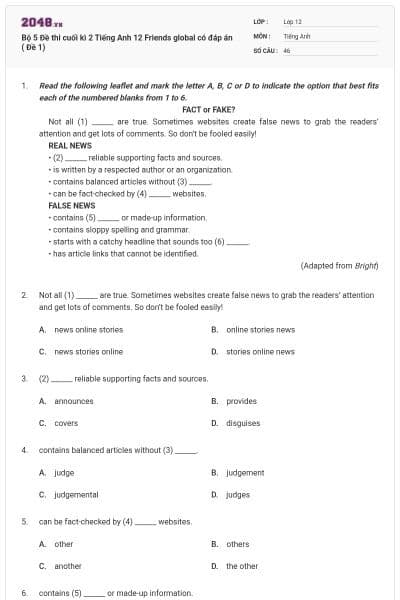
Read the following leaflet and mark the letter A, B, C or D to indicate the option that best fits each of the numbered blanks from 1 to 6.
FACT or FAKE?
Not all (1) ______ are true. Sometimes websites create false news to grab the readers’ attention and get lots of comments. So don’t be fooled easily!
REAL NEWS
• (2) ______ reliable supporting facts and sources.
• is written by a respected author or an organization.
• contains balanced articles without (3) ______.
• can be fact-checked by (4) ______ websites.
FALSE NEWS
• contains (5) ______ or made-up information.
• contains sloppy spelling and grammar.
• starts with a catchy headline that sounds too (6) ______.
• has article links that cannot be identified.
(Adapted from Bright)
Not all (1) ______ are true. Sometimes websites create false news to grab the readers’ attention and get lots of comments. So don’t be fooled easily!
news online stories
online stories news
news stories online
stories online news
Kiến thức về trật tự từ
- Ta có cụm danh từ: news stories – câu chuyện tin tức
=> Như vậy có thể chọn ngay C là đáp án duy nhất dùng đúng cụm từ trên.
- Theo quy tắc thông thường thì tính từ đơn đứng trước bổ nghĩa cho danh từ. Tuy nhiên một vài tính từ đặc biệt có thể đứng sau danh từ (trong trường hợp này cũng có thể phân loại các từ này là trạng từ). Một số ví dụ:
For a holiday abroad you need a valid passport.
We have plenty of office space available.
=> trật tự đúng: news stories online
Dịch: Không phải mọi tin tức trên mạng đều là sự thật.
Chọn C.
(2) ______ reliable supporting facts and sources.
announces
provides
covers
disguises
Kiến thức về từ vựng
A. announce /əˈnaʊns/ (v): thông báo, công bố (một thông tin mới hoặc tuyên bố chính thức, thường từ chính phủ, tổ chức, người phát ngôn,...)
B. provide /prəˈvaɪd/ (v): cung cấp (đưa ra thông tin kèm bằng chứng, số liệu, nguồn tin)
C. cover /ˈkʌvə(r)/ (v): đưa tin, tường thuật (thường chỉ mô tả hoặc báo cáo về một sự kiện)
D. disguise /dɪsˈɡaɪz/ (v): ngụy trang, che giấu => disguise the truth: che giấu sự thật
Dịch: Tin thật cung cấp thông tin và nguồn tin đáng tin cậy.
Chọn B.
contains balanced articles without (3) ______.
judge
judgement
judgemental
judges
Kiến thức về từ loại
A. judge /dʒʌdʒ/ (v, n): đánh giá, phán xét ai/chuyện gì đó; thẩm phán
B. judgement /ˈdʒʌdʒmənt/ (n): sự đánh giá, phán xét
C. judgemental /dʒʌdʒˈmentl/ (adj): (chỉ tính cách con người) hay phán xét người khác
D. judges /ˈdʒʌdʒɪz/: động từ chia hiện tại đơn số ít của ‘judge’ hoặc danh từ số nhiều ‘những thẩm phán’.
- Chỗ trống cần một danh từ theo sau làm tân ngữ cho giới từ ‘without’, xét nghĩa chọn ‘judgement’.
Dịch: Tin thật trình bày khách quan, không mang tính phán xét.
Chọn B.
can be fact-checked by (4) ______ websites.
other
others
another
the other
Kiến thức về từ hạn định, đại từ
A. other + N(không đếm được)/ N(s/es): những cái khác/ người khác
B. others: những cái khác/ người khác; dùng như đại từ, theo sau không đi với danh từ
C. another + N (đếm được số ít): một cái khác/ người khác
D. the other: cái còn lại/ người còn lại trong hai cái/ hai người; dùng như đại từ, theo sau không đi với danh từ
- Căn cứ vào vị trí sau chỗ trống là danh từ số nhiều ‘websites’ => chỉ dùng được ‘other’.
Dịch: Tin thật có thể được kiểm chứng bởi các trang web khác.
Chọn A.
contains (5) ______ or made-up information.
daunting
encouraging
misleading
flattering
Kiến thức về từ vựng
A. daunting /ˈdɔːntɪŋ/ (adj): gây lo sợ, nản lòng (dùng để miêu tả tình huống khó khăn)
B. encouraging /ɪnˈkʌrɪdʒɪŋ/ (adj): khích lệ, động viên => nghĩa tích cực, không phù hợp khi đang nói về tin tức giả mạo
C. misleading /ˌmɪsˈliːdɪŋ/ (adj): gây hiểu lầm, sai lệch
D. flattering /ˈflætərɪŋ/ (adj): tâng bốc, nịnh hót
Dịch: Tin giả chứa thông tin dễ gây hiểu lầm hoặc bịa đặt.
Chọn C.
starts with a catchy headline that sounds too (6) ______.
critical
dishonest
outrageous
genuine
Kiến thức về từ vựng
A. critical /ˈkrɪtɪkl/ (adj): có giọng điệu chỉ trích, phê phán
B. dishonest /dɪsˈɒnɪst/ (adj): không trung thực
C. outrageous /aʊtˈreɪdʒəs/ (adj): gây sốc, thái quá, khó tin
D. genuine /ˈdʒenjuɪn/ (adj): chân thật, đáng tin cậy
Dịch: Tin giả có một tiêu đề giật gân, gây sốc, nghe quá mức khó tin.
Chọn C.
Bài hoàn chỉnh:
FACT or FAKE?
Not all news stories online are true. Sometimes websites create false news to grab the readers’ attention and get lots of comments. So don’t be fooled easily!
REAL NEWS
• provides reliable supporting facts and sources.
• is written by a respected author or an organization.
• contains balanced articles without judgement.
• can be fact-checked by other websites.
FALSE NEWS
• contains misleading or made-up information.
• contains sloppy spelling and grammar.
• starts with a catchy headline that sounds too outrageous.
• has article links that cannot be identified.
Dịch bài đọc:
SỰ THẬT HAY GIẢ DỐI?
Không phải mọi tin tức trên mạng đều là thật. Đôi khi, một số trang web tạo ra tin giả để thu hút sự chú ý của người đọc và nhận về nhiều bình luận. Vì vậy, đừng vội tin ngay!
TIN THẬT
• cung cấp thông tin và nguồn tin đáng tin cậy.
• được viết bởi tác giả uy tín hoặc tổ chức có danh tiếng.
• trình bày khách quan, không mang tính phán xét.
• có thể được kiểm chứng bởi các trang web khác.
TIN GIẢ
• chứa thông tin dễ gây hiểu lầm hoặc bịa đặt.
• lỗi chính tả và ngữ pháp cẩu thả.
• tiêu đề giật gân, gây sốc, nghe vô lý quá mức.
• dẫn nguồn từ các trang không rõ ràng.
Read the following short magazine article and mark the letter A, B, C or D to indicate the option that best fits each of the numbered blanks from 7 to 12.
I met Alexandria at Hot Coffee Co. on a bright summer day. She was prompt, appropriately dressed and professional. (7) ______ from the International Model contest, she still avoided a heavy schedule of events and fashion shows. (8) ______, Alexandria had many plans for her future business.
Sharing about her business idea, her eyes were beaming with joy as she had nourished
it for a long time. It would be a model (9) ______ celebrities and even normal people can exchange the clothes they had worn. “There’s no point in buying such exorbitant fashion pieces and wearing them onlyonce”. She explained that it (10) ______ our fast fashion problem.
As I doubted that celebrities would in any way wear similar clothes to the others, she agreed. “But just make it a trend. I will (11) ______ a campaign wherefamous people can contribute to save the environment, starting from their closets.” she asserted.
I really look forward to this business model so that I can (12) ______ fabulous gowns.
(Adapted from THiNK)
Just returned
Being just returned
Just returning
Having just returned
Kiến thức về phân từ hoàn thành
- Mệnh đề cần điền diễn tả hành động ‘return’ (trở về từ đâu đó) xảy ra trước hành động chính ‘avoided heavy schedule’.
- Chủ ngữ của mệnh đề chính là ‘she’ nên ta không dùng thể bị động => loại B.
- V-ing diễn tả hành động xảy ra đồng thời với mệnh đề chính, trong trường hợp này cô ấy đã trở về trước khi tránh lịch trình dày đặc, nên dùng V-ing không phù hợp => loại C.
=> Ta dùng phân từ hoàn thành having + Vp2 để nói về hành động xảy ra trước một hành động khác trong quá khứ.
Dịch: Vừa trở về từ cuộc thi Người mẫu Quốc tế, cô ấy không nhận quá nhiều sự kiện và show diễn thời trang.
Chọn D.
(8) ______, Alexandria had many plans for her future business.
On balance
Nevertheless
Instead
Even so
Kiến thức về liên từ
A. On balance: sau một hồi cân nhắc, sau khi xem xét kỹ
B. Nevertheless: tuy nhiên, mặc dù vậy
C. Instead: thay vào đó
D. Even so: kể cả là vậy
- Ta cần điền một liên từ để nối với sự kiện trong câu trước: một người mẫu vừa trở về từ cuộc thi quốc tế không tham gia sự kiện mà lại chọn làm việc khác => chọn ‘Instead’.
Dịch: Thay vào đó, Alexandria có những kế hoạch cho dự án kinh doanh của mình.
that
when
which
in which
Kiến thức về mệnh đề quan hệ
- Ta cần nối ‘a model’ trước chỗ trống với mệnh đề đầy đủ sau chỗ trống.
- A (that) và C (which) là các đại từ quan hệ thay thế cho chủ ngữ hoặc tân ngữ, nhưng mệnh đề sau chỗ trống đã có cả chủ ngữ và tân ngữ => loại A, C.
- ‘when’ là trạng từ quan hệ bổ sung thông tin về thời gian, trong khi ‘a model’ không phải là một thời điểm => loại B.
- Ta có kết hợp giới từ + đại từ quan hệ: ‘at/in/on + which’ = ‘where’ có nghĩa ‘ở đó’, ‘trong đó’ => ‘in which’ bổ nghĩa cho ‘a model’ như là một nơi hoặc phương thức để làm gì đó.
Dịch: Đây sẽ là một mô hình trong đó người nổi tiếng và cả những người bình thường có thể trao đổi quần áo đã mặc.
Chọn D.
She explained that it (10) ______ our fast fashion problem.
will worsen
would worsen
worsens
worsened
Kiến thức về câu tường thuật
- Sau động từ tường thuật ở quá khứ (‘explained’), cần lùi thì trong mệnh đề tường thuật.
=> loại A (tương lai đơn) và C (hiện tại đơn).
- Ta thấy ‘would worsen’ (dạng quá khứ của ‘will’, dùng để đưa ra dự đoán về tương lai trong quá khứ) phù hợp hơn ‘worsened’ (quá khứ đơn).
Dịch: Cô giải thích rằng điều đó chỉ góp phần làm trầm trọng thêm vấn đề thời trang nhanh.
Chọn B.
launch
protest
request
sign
Kiến thức về từ vựng, kết hợp từ
A. launch /lɔːntʃ/ (v): khởi động => launch a campaign: khởi động một chiến dịch
B. protest /prəˈtest/, /ˈprəʊtest/ (v): phản đối => protest (against) sth
C. request /rɪˈkwest/ (v): yêu cầu => request sth
D. sign /saɪn/ (v): ký vào; e.g. sign a pettition: ký vào một bản kiến nghị
Dịch: Tôi sẽ khởi động một chiến dịch kêu gọi các ngôi sao chung tay bảo vệ môi trường, bắt đầu ngay từ tủ đồ của họ.
Chọn A.
go on
hold up
shout out
put on
Kiến thức về cụm động từ
A. go on (phr.v): đi tiếp, đi thẳng; tiếp tục làm việc gì sau khi ngắt quãng
B. hold up (phr.v): giơ lên cao, e.g. hold up placards: giơ cao các tấm biển
C. shout out (phr.v): hét to lên, e.g. shout out slogans: hô hào khẩu hiệu
D. put on (phr.v): đeo lên, mặc lên người cái gì đó
Dịch: Tôi thực sự mong chờ mô hình này ra mắt để có thể khoác lên mình những bộ váy lộng lẫy.
Chọn D.
Bài hoàn chỉnh:
I met Alexandria at Hot Coffee Co. on a bright summer day. She was prompt, appropriately dressed and professional. Having just returned from the International Model contest, she still avoided a heavy schedule of events and fashion shows. Instead, Alexandria had many plans for her future business.
Sharing about her business idea, her eyes were beaming with joy as she had nourished it for a long time. It would be a model in which celebrities and even normal people can exchange the clothes they had worn. “There’s no point in buying such exorbitant fashion pieces and wearing them only once”. She explained that it would worsen our fast fashion problem.
As I doubted that celebrities would in any way wear similar clothes to the others, she agreed. “But just make it a trend. I will launch a campaign where famous people can contribute to save the environment, starting from their closets.” she asserted.
I really look forward to this business model so that I can put on fabulous gowns.
Dịch bài đọc:
Tôi gặp Alexandria ở Hot Coffee Co. vào một ngày hè rực rỡ. Cô ấy đến đúng giờ, ăn mặc chỉn chu và toát lên vẻ chuyên nghiệp. Vừa trở về từ cuộc thi Người mẫu Quốc tế, cô không nhận quá nhiều sự kiện và show diễn thời trang. Thay vào đó, Alexandria có những kế hoạch cho dự án kinh doanh của mình.
Khi chia sẻ về ý tưởng, đôi mắt cô ánh lên niềm vui bởi đây là dự án cô đã ấp ủ từ lâu. Mô hình này sẽ cho phép người nổi tiếng và cả những người bình thường trao đổi quần áo đã mặc. “Chẳng có lý gì khi mua những món đồ thời trang đắt đỏ rồi chỉ mặc một lần cả.” Cô giải thích rằng điều này sẽ chỉ góp phần làm trầm trọng thêm vấn đề thời trang nhanh.
Tôi tỏ ra nghi ngờ liệu người nổi tiếng có chịu mặc lại đồ của người khác hay không, và Alexandria gật đầu đồng ý. “Nhưng hãy biến nó thành xu hướng. Tôi sẽ khởi động một chiến dịch kêu gọi các ngôi sao chung tay bảo vệ môi trường, bắt đầu ngay từ tủ đồ của họ.” Cô khẳng định chắc chắn.
Tôi rất mong chờ mô hình này ra mắt để có thể khoác lên mình những bộ váy lộng lẫy.
Mark the letter A, B, C or D to indicate the best arrangement of sentences to make a meaningful exchange or text in each of the following questions from 13 to 17.
a. Mike: Oh, I’m sorry to hear that. Nowadays, youhear more and more stories of how extreme weather is harming people’s lives.
b. Mike: How long is this rain going to last?
c. Lan: I hope it will end soon. I’m gettingconcerned about my father’s farm.It rained a lot last year and nearly destroyed all of his crops.
(Adapted from English Discovery)
c-a-b
a-c-b
b-a-c
b-c-a
Kiến thức về sắp xếp câu tạo thành đoạn hội thoại
Thứ tự sắp xếp đúng:
b. Mike: How long is this rain going to last?
c. Lan: I hope it will end soon. I’m getting concerned about my father’s farm. It rained a lot last year and nearly destroyed all of his crops.
a. Mike: Oh, I’m sorry to hear that. Nowadays, you hear more and more stories of how extreme weather is harming people’s lives.
Dịch:
b. Mike: Trời còn mưa bao lâu nữa đây?
c. Lan: Mong là sớm tạnh. Mình bắt đầu lo cho trang trại của bố rồi. Năm ngoái mưa suốt, suýt nữa thì phá hỏng hết mùa màng.
a. Mike: Ôi, tiếc quá! Dạo này mình nghe ngày càng nhiều chuyện về thời tiết khắc nghiệt ảnh hưởng đến cuộc sống của mọi người.
Chọn D.
a. Mark: How exciting! But how will the classrooms be judged?
b. Mai: I guess we should start by cleaning up our classroom more frequently and having more plants in it.
c. Nam: Hey guys, look at this notice! Our school is holding a Green Classroom Competition. The greenest classroom will win an ecotour!
d. Nam: It says here that the criteria are the following: raising environmental awareness, reducing our carbon footprint, and using resources efficiently.
e. Nam: Yes, this is the easiest thing to do, but we also need to change our classmates’ behaviour so that we can develop eco-friendly habits in our class.
(Adapted from Global Success)
c-a-b-d-e
c-b-e-a-d
c-a-d-b-e
c-d-a-e-b
Kiến thức về sắp xếp câu tạo thành đoạn hội thoại
Thứ tự sắp xếp đúng:
c. Nam: Hey guys, look at this notice! Our school is holding a Green Classroom Competition. The greenest classroom will win an ecotour!
a. Mark: How exciting! But how will the classrooms be judged?
d. Nam: It says here that the criteria are the following: raising environmental awareness, reducing our carbon footprint, and using resources efficiently.
b. Mai: I guess we should start by cleaning up our classroom more frequently and having more plants in it.
e. Nam: Yes, this is the easiest thing to do, but we also need to change our classmates’ behaviour so that we can develop eco-friendly habits in our class.
Dịch:
c. Nam: Các cậu, xem thông báo này đi! Trường mình đang tổ chức cuộc thi Lớp học Xanh. Lớp xanh nhất sẽ giành được một chuyến du lịch sinh thái!
a. Mark: Nghe hay quá! Nhưng mà các lớp sẽ được chấm điểm dựa trên tiêu chí nào?
d. Nam: Ở đây ghi các tiêu chí là: nâng cao nhận thức về môi trường, giảm dấu chân carbon và sử dụng tài nguyên hiệu quả.
b. Mai: Mình nghĩ trước tiên ta nên dọn dẹp lớp học thường xuyên hơn và trồng thêm nhiều cây xanh.
e. Nam: Ừ, đó là cách đơn giản nhất. Bên cạnh đó, ta cũng cần thay đổi thói quen của cả lớp để hướng đến lối sống thân thiện với môi trường hơn.
Chọn C.
Hi Pablo,
Lovely to hear from you.
a. It’s not perfect, though. Most neighborhoods are nice, but some are dirty with a lot of trash on the streets.
b. About half of the population comes from different cultures from around the world, so it’s an exciting, multicultural place.
c. And these days, people are less friendly and don’t try to help each other. I guess society has changed a lot since we were kids!
d. I’m excited that you’ve been thinking of moving here. Like many residents, I think there are many great communities in the city.
e. Anyway, before you make a decision, read books on migration problems. I’ve read several, and they have some good advice.
Emily
(Adapted from Explore New Worlds)
d-a-b-e-c
d-b-a-c-e
d-a-e-b-c
d-b-c-a-e
Kiến thức về sắp xếp câu tạo thành lá thư
Thứ tự sắp xếp đúng:
Hi Pablo,
Lovely to hear from you.
d. I’m excited that you’ve been thinking of moving here. Like many residents, I think there are many great communities in the city.
b. About half of the population comes from different cultures from around the world, so it’s an exciting, multicultural place.
a. It’s not perfect, though. Most neighborhoods are nice, but some are dirty with a lot of trash on the streets.
c. And these days, people are less friendly and don’t try to help each other. I guess society has changed a lot since we were kids!
e. Anyway, before you make a decision, read books on migration problems. I’ve read several, and they have some good advice.
Emily
Dịch:
Chào Pablo,
Rất vui khi nhận được tin từ cậu.
d. Mình rất hào hứng khi biết cậu đang xem xét chuyển đến đây. Giống như nhiều cư dân
khác, mình thấy thành phố này có rất nhiều cộng đồng tuyệt vời.
b. Khoảng một nửa dân số đến từ các nền văn hóa khác nhau trên thế giới, nên nơi đây rất sôi động và đa văn hóa.
a. Dù vậy, nó không hoàn hảo. Hầu hết các khu phố đều đẹp, nhưng vẫn có những nơi khá bẩn với rác thải đầy trên đường.
c. Và dạo này, mọi người có vẻ không còn thân thiện như thời xưa và ít giúp đỡ nhau hơn. Xã hội đã thay đổi nhiều so với khi chúng ta còn nhỏ!
e. Dù sao thì trước khi đưa ra quyết định, cậu nên đọc sách về các vấn đề khi di cư. Mình đã đọc vài cuốn và thấy có nhiều lời khuyên hữu ích đấy.
Emily
Chọn B.
a. The Tasmanian tiger, passenger pigeon, and dodo are just a few examples of species driven to extinction.
b. Some animals now have dangerously small populations, and they might disappear if poaching activities don’t cease.
c. The government should make people pay really high fines for hunting rare animals and ensure public awareness through signs and TV commercials.
d. Rare animals are often hunted and sold for their fur, skin, or meat, or as pets.
e. Illegal hunting is one of the main environmental issues in the world today, which has made many species go extinct.
(Adapted from i-Learn Smart World)
d-b-e-c-a
e-a-c-d-b
e-d-a-b-c
d-e-b-a-c
Kiến thức về sắp xếp trật tự câu tạo thành đoạn văn
Thứ tự sắp xếp đúng:
e. Illegal hunting is one of the main environmental issues in the world today, which has made many species go extinct.
d. Rare animals are often hunted and sold for their fur, skin, or meat, or as pets.
a. The Tasmanian tiger, passenger pigeon, and dodo are just a few examples of species driven to extinction.
b. Some animals now have dangerously small populations, and they might disappear if poaching activities don’t cease.
c. The government should make people pay really high fines for hunting rare animals and ensure public awareness through signs and TV commercials.
Dịch:
e. Nạn săn bắn trái phép là một trong những vấn đề môi trường nghiêm trọng nhất hiện nay, khiến nhiều loài tuyệt chủng.
d. Các loài động vật quý hiếm thường bị săn bắt và buôn bán để lấy lông, da, thịt hoặc làm thú cưng.
a. Hổ Tasmania, bồ câu viễn khách và chim cưu (dodo) chỉ là một vài ví dụ về những loài đã bị con người đẩy đến bước đường tuyệt chủng.
b. Hiện nay, một số loài có số lượng cá thể còn lại quá ít, và nếu tình trạng săn trộm không dừng lại, chúng có thể biến mất hoàn toàn.
c. Chính phủ nên áp dụng mức phạt thật cao đối với hành vi săn bắt động vật quý hiếm và
nâng cao nhận thức cộng đồng thông qua biển báo, quảng cáo trên TV.
Chọn C.
a. According to the Cyberbullying Research Centre, one in four teenagers say they have been bullied more than once in their lifetime.
b. Bullying, especially if it takes place over long periods of time, can have a long-lasting impact on mental health.
c. In study after study, cyberbullying has been linked to depression and anxiety.
d. Sadly, 40% of those who are bullied never tell anyone about what is happening, and too often, parents and schools are unaware of the situation until it reaches crisis point.
e. We have all seen reports of youngsters getting depressed, emotionally or physically hurt by cyberbullying.
(Adapted from C-21 Smart)
a-d-b-c-e
b-a-c-e-d
c-b-e-d-a
e-c-d-a-b
Kiến thức về sắp xếp trật tự câu tạo thành đoạn văn
Thứ tự sắp xếp đúng:
a. According to the Cyberbullying Research Centre, one in four teenagers say they have been bullied more than once in their lifetime.
d. Sadly, 40% of those who are bullied never tell anyone about what is happening, and too often, parents and schools are unaware of the situation until it reaches crisis point.
b. Bullying, especially if it takes place over long periods of time, can have a long-lasting impact on mental health.
c. In study after study, cyberbullying has been linked to depression and anxiety.
e. We have all seen reports of youngsters getting depressed, emotionally or physically hurt by cyberbullying.
Dịch:
a. Theo Trung tâm Nghiên cứu Bắt nạt Trực tuyến, cứ bốn thanh thiếu niên thì có một em cho biết đã bị bắt nạt nhiều hơn một lần trong đời.
d. Đáng buồn thay, 40% trong số đó không bao giờ nói với ai về chuyện xảy ra, và rất nhiều trường hợp, bố mẹ và nhà trường chỉ nhận ra vấn đề khi nó đã trở nên nghiêm trọng.
b. Bắt nạt, đặc biệt là khi kéo dài trong thời gian dài, có thể gây ảnh hưởng lâu dài đến sức khỏe tinh thần.
c. Nhiều nghiên cứu đã chỉ ra mối liên hệ giữa bắt nạt trên mạng với chứng trầm cảm lo âu.
e. Chúng ta đều đã thấy những báo cáo về xu hướng giới trẻ mắc bệnh trầm cảm, tổn thương về mặt tinh thần hoặc thể chất do bắt nạt trên mạng.
Chọn A.
Read the following passage about robots and mark the letter A, B, C or D to indicate the option that best fits each of the numbered blanks from 18 to 22.
THE EVOLUTION OF ROBOTS
The word ‘robot’ was first used in 1920. It comes from the Czech word ‘robota’, (18) ______ to describe artificial people.
In 1949, introduced by British inventor William Grey Walter, (19) ______. Ten years later, the first industrial robotic arm was installed at a General Motors plant in the US. Such robots were mostly employed in car and computer industries.
The first robot to utilize Artificial Intelligence was known as Shakey, developed at Stanford Research Institute between 1966 and 1972. (20) ______. Twenty years later, a walking robot called Dante, which was capable of climbing steep slopes, (21) ______. The late 1990s marked a milestone in the history of robots with the creation of Kismet, a robotic head designed to provoke and react to emotions.
Since the beginning of the 21st century, more robots have been created to improve our life. Examples worth mentioning are: the first self-driving car (a Volkswagen Touareg named ‘Stanley’) in 2005, the first accurate visual recognition system introduced by AI expert Geoffrey Hinton and his team in 2012, Sophia the human-like robot in 2016, etc. In the future, we may see more robots and AI applications. (22) ______.
(Adapted from Global Success)
used in a play by Karel Čapek which means ‘forced labour’
was used in a play by Karel Čapek meaning ‘forced labour’
which means ‘forced labour’ used in a play by Karel Čapek
whose meaning ‘forced labour’ used in a play by Karel Čapek
Kiến thức về mệnh đề quan hệ
- Câu đã có chủ ngữ ‘It’ và động từ chính là ‘comes’ nên nếu có thêm động từ thì phải ở trong MĐQH hoặc dạng rút gọn MĐQH.
=> Loại B (động từ ‘was used’ dùng ở dạng bị động quá khứ đơn).
- Ta thấy phần bổ nghĩa có hai động từ đó là ‘used in a play’ (được dùng trong một vở kịch) và ‘means ‘forced labour’ (có nghĩa ‘lao động ép buộc’).
- Sau chỗ trống là một cụm trạng ngữ chỉ mục đích to V ‘to describe artificial people’ (để miêu tả người nhân tạo) => cụm này đứng ngay sau ‘used in a play’ là hợp lý.
=> Loại A (chèn ‘means ‘forced labour’ vào giữa khiến ý mất đi tính mạch lạc).
- Ta có ‘whose’ là đại từ quan hệ chỉ sự sở hữu, cấu trúc ‘whose + N + V’.
=> D dùng sai cấu trúc vì sau N (meaning) không có động từ chính (nếu ‘used’ là động từ chủ động chia quá khứ đơn thì không đi được với ‘meaning’, nếu là dạng rút gọn MĐQH nghĩa bị động Vp2 thì không thể làm động từ chính) => loại D.
- C dùng đại từ quan hệ ‘which’ thay thế và bổ nghĩa cho tân ngữ ‘the Czech word ‘robota’, là đáp án chính xác nhất.
Dịch: Từ này bắt nguồn từ tiếng Séc ‘robota’, có nghĩa là ‘lao động ép buộc’ và được nhà viết kịch Karel Čapek dùng để mô tả những người nhân tạo trong vở kịch của ông.
Chọn C.
this year saw the first robot machine to move slowly in response to light stimulus
the robot machine became the first to slowly move in response to light stimulus
he invented the first robot machine to move slowly in response to light stimulus
the first robot machine could slowly move in response to light stimulus
Kiến thức về mệnh đề trạng ngữ
- Ta thấy trước chỗ trống có cấu trúc phân từ bị động Vp2 lược bỏ đi chủ ngữ => MĐTN có cùng chủ ngữ với mệnh đề chính.
- Ta xác định chủ ngữ của Vp2, hay chính là cái mà ‘được giới thiệu bởi nhà phát minh người Anh’ chính là máy robot đầu tiên.
=> loại A (chủ ngữ ‘this year’ – năm này, ý chỉ năm 1949), C (chủ ngữ ‘he’ – ông ấy, ý chỉ nhà phát minh).
- Ta loại B vì dùng mạo từ xác định ‘the’ để chỉ đối tượng đã được nhắc đến trước đó, mà câu chứa chỗ trống là câu mở đầu đoạn, chưa nhắc đến máy robot nào.
- Mặc khác, ‘the’ có thể dùng trước các từ so sánh cực cấp (superlative) như first (thứ nhất), second (thứ nhì), only (duy nhất),... với đối tượng được nhắc đến lần đầu tiên.
Dịch: Năm 1949, được giới thiệu bởi nhà phát minh người Anh William Gray Walter, cỗ máy robot đầu tiên có thể di chuyển chậm để phản ứng với ánh sáng.
Chọn D.
With Shakey, people could observe their surroundings, create a plan, and find their way across a room or push a box along the floor
Shakey could observe its surroundings, create a plan, and find its way across a room or push a box along the floor
Observing its surroundings, its ability includes creating a plan, finding its way across a room,and pushing a box along the floor
In order to observe its surroundings, Shakey must create a plan, find its way across a room, and push a box along the floor
Kiến thức về mệnh đề độc lập
*Xét các đáp án:
A. Với Shakey, mọi người có thể quan sát môi trường xung quanh, tạo kế hoạch và tìm đường qua một căn phòng hoặc đẩy một chiếc hộp dọc theo sàn nhà
=> Nghĩa không hợp lý vì những hành động kể trên đều đơn giản, con người có thể tự làm được mà không cần robot hỗ trợ.
B. Shakey có thể quan sát môi trường xung quanh, tạo kế hoạch và tìm đường qua một căn phòng hoặc đẩy một chiếc hộp dọc theo sàn nhà
=> Nghĩa hợp lý, diễn tả các hành động đơn giản mà robot thời kỳ đầu có thể làm được.
C. Quan sát môi trường xung quanh, khả năng của nó bao gồm tạo kế hoạch, tìm đường qua một căn phòng và đẩy một chiếc hộp dọc theo sàn nhà
=> Dùng sai cấu trúc rút gọn đồng chủ ngữ vì ‘quan sát môi trường’ phải có chủ thể là người hoặc vật, trong bối cảnh này chủ thể phải là robot Shakey.
D. Để quan sát môi trường xung quanh, Shakey phải tạo kế hoạch, tìm đường qua một căn phòng và đẩy một chiếc hộp dọc theo sàn nhà
=> Dùng cụm trạng ngữ chỉ mục đích ‘In order to + V’, nghĩa không logic vì không cần phải tạo kế hoạch hay tìm đường mới có thể quan sát được.
Chọn B.
enabling it to go into active volcanoes
having been built to go into active volcanoes
meant it could go into active volcanoes
was built to go into active volcanoes
Kiến thức về cấu trúc câu
- Ta có cấu trúc của một mệnh đề độc lập: S + V ...
- Căn cứ vào vị trí chỗ trống, ta thấy câu đã có chủ ngữ là ‘walking robot’ và chưa có động từ chính => Ta cần một động từ chính hòa hợp với chủ ngữ để tạo thành câu hoàn chỉnh.
=> Loại A (ta không dùng V-ing) và B (ta không dùng dạng phân từ hoàn thành).
- C (động từ ‘meant’) và D (động từ ‘was built’) đều chia ở quá khứ đơn, hòa hợp với thì và ngữ cảnh của câu, vậy ta xét nghĩa từng lựa chọn:
C. có nghĩa là nó có thể thám hiểm núi lửa đang hoạt động
D. được chế tạo để thám hiểm núi lửa đang hoạt động
=> D phù hợp hơn với chủ ngữ của câu (robot biết đi được chế tạo để...)
Dịch: 20 năm sau, một robot biết đi có tên Dante được chế tạo để thám hiểm núi lửa đang hoạt động.
Chọn D.
(22) ______.
It is us who have to accept that they will continue to play an important role in all aspects of our lives
We should accept them and admit to them continuing to play an important role in all aspects of our lives
Whether we accept them or not, they will continue to play an important role in all aspects of our lives
Not merely accepting them, we would prefer them to play an important role in all aspects of our lives
Kiến thức về mệnh đề độc lập
*Xét các đáp án:
A. Chính chúng ta phải chấp nhận rằng chúng (robot) sẽ tiếp tục đóng vai trò quan trọng trong tất cả các khía cạnh của cuộc sống chúng ta
=> Cấu trúc nhấn mạnh ‘It is/was ... that ...’, đối tượng được nhấn mạnh trong câu này là con người => nghĩa không phù hợp vì trọng tâm của bài là về robot.
B. Chúng ta nên chấp nhận chúng (robot) và thừa nhận rằng chúng sẽ tiếp tục đóng vai trò quan trọng trong tất cả các khía cạnh của cuộc sống chúng ta
=> Cấu trúc bổ nghĩa của động từ ‘V + prep. + V-ing’: admit to V-ing – thừa nhận việc gì.
C. Cho dù chúng ta có chấp nhận chúng (robot) hay không, chúng sẽ tiếp tục đóng vai trò quan trọng trong tất cả các khía cạnh của cuộc sống chúng ta
=> Phù hợp nhất về nghĩa và sắc thái.
D. Không chỉ đơn thuần chấp nhận chúng (robot), chúng ta muốn chúng đóng vai trò quan trọng trong tất cả các khía cạnh của cuộc sống chúng ta
=> Cấu trúc thể sai khiến: would prefer sb to V.
Chọn C.
Bài hoàn chỉnh:
THE EVOLUTION OF ROBOTS
The word ‘robot’ was first used in 1920. It comes from the Czech word ‘robota’, which means ‘forced labour’ used in a play by Karel Čapek to describe artificial people.
In 1949, introduced by British inventor William Grey Walter, the first robot machine could slowly move in response to light stimulus. Ten years later, the first industrial robotic arm was installed at a General Motors plant in the US. Such robots were mostly employed in car and computer industries.
The first robot to utilize Artificial Intelligence was known as Shakey, developed at Stanford Research Institute between 1966-1972. Shakey could observe its surroundings, create a plan, and find its way across a room or push a box along the floor. 20 years later, a walking robot called Dante, which was capable of climbing steep slopes, was built to go into active volcanoes. The late 1990s marked a milestone in the history of robots with the creation of Kismet, a robotic head designed to provoke and react to emotions.
Since the beginning of the 21st century, more robots have been created to improve our life. Examples worth mentioning are: the first self-driving car (a Volkswagen Touareg named ‘Stanley’) in 2005, the first accurate visual recognition system introduced by AI expert Geoffrey Hinton and his team in 2012, Sophia the human-like robot in 2016, etc. In the future, we may see more robots and AI applications. Whether we accept them or not, they will continue to play an important role in all aspects of our lives.
Dịch bài đọc:
SỰ PHÁT TRIỂN CỦA NGƯỜI MÁY
Thuật ngữ ‘robot’ lần đầu được sử dụng vào năm 1920. Từ này bắt nguồn từ tiếng Séc ‘robota’, có nghĩa là ‘lao động ép buộc’ và được nhà viết kịch Karel Čapek dùng để mô tả những người nhân tạo trong vở kịch của ông.
Năm 1949, nhà phát minh người Anh William Grey Walter đã giới thiệu cỗ máy robot đầu tiên có thể di chuyển chậm để phản ứng với ánh sáng. 10 năm sau, cánh tay robot công nghiệp đầu tiên được lắp đặt tại một nhà máy của hãng General Motors ở Mỹ. Những robot này chủ yếu được sử dụng trong ngành công nghiệp sản xuất ô tô và máy tính.
Robot đầu tiên ứng dụng trí tuệ nhân tạo có tên là Shakey, được phát triển tại Viện Nghiên cứu Stanford từ năm 1966 đến 1972. Shakey có thể quan sát môi trường xung quanh, lập kế hoạch di chuyển và tìm đường đi qua một căn phòng hoặc đẩy một chiếc hộp trên sàn. 20 năm sau, một robot biết đi có tên Dante được chế tạo để thám hiểm núi lửa đang hoạt động. Dante có khả năng leo lên các sườn dốc cao. Cuối những năm 1990 đánh dấu một bước ngoặt quan trọng trong lịch sử robot với sự ra đời của Kismet, một chiếc đầu robot có thể biểu lộ và phản ứng với cảm xúc.
Từ đầu thế kỷ 21 đến nay, ngày càng có nhiều robot được tạo ra để cải thiện cuộc sống của con người. Một số phát minh đáng chú ý bao gồm: ô tô tự lái đầu tiên (một chiếc Volkswagen Touareg tên Stanley) vào năm 2005, hệ thống nhận diện hình ảnh chính xác đầu tiên do chuyên gia AI Geoffrey Hinton và nhóm của ông giới thiệu vào năm 2012, robot hình người Sophia vào năm 2016, v.v. Trong tương lai, chúng ta có thể sẽ chứng kiến thêm nhiều robot và ứng dụng AI hơn nữa. Dù có chấp nhận hay không, chúng vẫn sẽ tiếp tục đóng vai trò quan trọng trong mọi lĩnh vực của cuộc sống.
Read the following passage about lifelong learning and mark the letter A, B, C or D to indicate the option that best fits each of the following questions from 23 to 30.
‘Lifelong learning’ means continuing to acquire new knowledge and skills throughout your life. It is voluntary, but often requires lots of self-discipline and motivation to continue. It can occur in many ways, for example, by joining a local course, taking virtual lessons online, or reading books. These days, it has become easier than ever to learn new skills and improve your professional, personal, and social life thanks to new technology.
First of all, lifelong learning can offer benefits for your professional development. For example, if you are working for a company that does business internationally, learning a new language might help you get a better salary, or open up opportunities to work in a different country. Learning new things, especially high-tech skills like computer programming or data analysis, will also help you be more competitive in the job market because having a wide range of abilities makes you more attractive to employers.
Another benefit is personal development, like taking a yoga class or learning how to cook a new dish you like. Lifelong learning can help you find new passions and hobbies. For example, you could take a course in digital design in your free time and then discover that you really love making fun and beautiful images!
Lifelong learning also helps your social life. If you join a class, you will likely meet people who share the same interests. As you learn and gain skills, and make new friends, you will likely become more confident in yourself, which can lead to greater fulfillment and happiness.
Over all, lifelong learning is an important part of personal and professional development. It is an enjoyable process that can bring many opportunities to help you improve your work life, meet new friends, and achieve personal satisfaction.
(Adapted from i-Learn Smart World)
engaging in books
attending professional workshops
enrolling in local classes
studying through digital platforms
Kiến thức về thông tin chi tiết
Dịch: Việc nào sau đây không được đề cập đến như một phương pháp học tập suốt đời?
A. đọc sách B. tham dự hội thảo chuyên nghiệp
C. ghi danh vào các lớp học ở địa phương D. học qua các nền tảng kỹ thuật số
Thông tin: It can occur in many ways, for example, by joining a local course (C), taking virtual lessons online (D), or reading books (A). (Việc học có thể diễn ra theo nhiều cách, chẳng hạn như tham gia một khóa học tại địa phương, học trực tuyến hay đọc sách.)
=> A, C, D đều được diễn giải lại dùng các từ đồng nghĩa; chỉ có B không được nhắc đến.
Chọn B.
self-directed
optional
mandatory
intentional
Kiến thức về từ vựng trái nghĩa
Dịch: Từ ‘voluntary’ trong đoạn 1 TRÁI NGƯỢC với ý nghĩa của từ ______.
- voluntary /ˈvɒləntri/, /ˈvɑːlənteri/ (adj) = done willingly, not because you are forced (Oxford): tự nguyện, không ép buộc
A. self-directed /ˌself dəˈrektɪd/ (adj): tự chủ, tự định hướng, tự quản lý hành động của mình
B. optional /ˈɒpʃənl/, /ˈɑːpʃənl/ (adj): tùy chọn, không bắt buộc
C. mandatory /mænˈdeɪtəri/, /ˈmændətɔːri/ (adj): bắt buộc
D. intentional /ɪnˈtenʃənl/ (adj): cố tình, có chủ ý
Thông tin: It is voluntary, but often requires lots of self-discipline and motivation to continue. (Đây là một quá trình tự nguyện, nhưng thường đòi hỏi kỷ luật cao và động lực để duy trì.) => voluntary >< mandatory
Chọn C.
Which of the following best paraphrases the underlined sentence in paragraph 2?
Acquiring in-demand technical abilities, such as coding or data analysis, can improve your employability.
Employers favor candidates who focus solely on high-tech skills like computer programming or data analysis.
Mastering new skills but unrelated to technology has little effect on one’s professional competitiveness.
Developing new competencies, particularly in tech-related areas, guarantees jobs and promotions.
Kiến thức về paraphrasing
Dịch: Câu nào sau đây diễn giải lại gần đúng nhất câu gạch chân trong đoạn 2?
*Câu gạch chân: Learning new things, especially high-tech skills like computer program-ming or data analysis, will also help you be more competitive in the job market (Học những kỹ năng mới, đặc biệt là các kỹ năng công nghệ cao như lập trình máy tính hay phân tích dữ liệu cũng sẽ giúp bạn cạnh tranh hơn trong thị trường việc làm)
A. Việc trang bị các kỹ năng kỹ thuật đang được săn đón, chẳng hạn như lập trình hay phân tích dữ liệu, có thể giúp bạn tăng cơ hội tìm được việc làm.
=> Dùng các cụm từ đồng nghĩa diễn giải đúng ý câu gốc: ‘Acquiring technical abilities’ = ‘Learning high-tech skills’, ‘coding’ = ‘computer programming’, ‘improve your employ-ability’ = ‘help you be more competitive’.
*employability /ɪmˌplɔɪəˈbɪləti/ (n) = the extent to which sb has the skills, knowledge, attitude, etc. that make them suitable for paid work (Oxford): khả năng tìm việc
B. Nhà tuyển dụng ưu tiên những ứng viên chỉ tập trung phát triển các kỹ năng công nghệ cao như lập trình hay phân tích dữ liệu.
=> Sai vì câu gốc không nói rằng chỉ tập trung vào kỹ năng công nghệ mới được nhà tuyển dụng ưa chuộng.
C. Thành thạo các kỹ năng mới nhưng không liên quan đến công nghệ ít ảnh hưởng đến khả năng cạnh tranh trong công việc.
=> Sai vì câu gốc chỉ nói rằng kỹ năng công nghệ cao đặc biệt có ích, không có nghĩa các kỹ năng khác vô dụng.
D. Phát triển các kỹ năng mới, đặc biệt trong lĩnh vực công nghệ, đảm bảo có việc làm và cơ hội thăng tiến.
=> Sai vì câu gốc chỉ nói là các kỹ năng công nghệ giúp cạnh tranh hơn, không khẳng định đảm bảo có việc làm.
*competency /ˈkɒmpɪtənsi/ (n) = the ability to do sth well (Oxford): khả năng làm tốt việc
Chọn A.
realization
discontent
satisfaction
pride
Kiến thức về từ vựng gần nghĩa
Dịch: Từ ‘fulfillment’ trong đoạn 4 có thể được thay thế bằng ______.
- fulfillment /fʊlˈfɪlmənt/ (n) = (1) the act of doing or achieving what was hoped for or expected (Oxford): sự hoàn thành, hiện thực hóa việc gì; (2) the feeling of being happy and satisfied with what you are doing or have done (Oxford): sự thỏa mãn, hài lòng về điều gì
A. realization /ˌriːəlaɪˈzeɪʃn/ (n): nhận thức về vấn đề gì; sự hoàn thành, đạt được điều gì (nghĩa này đồng nghĩa với nghĩa (1) của ‘fulfillment’)
B. discontent /ˌdɪskənˈtent/ (n): sự không hài lòng, thỏa mãn
C. satisfaction /ˌsætɪsˈfækʃn/ (n): sự hài lòng, thỏa mãn (đồng nghĩa với nghĩa (2) của ‘fulfillment’)
D. pride /praɪd/ (n): sự tự hào (về bản thân hoặc người khác)
=> Như vậy có hai lựa chọn đồng nghĩa với ‘fulfillment’, ta phải xét ngữ cảnh trong câu.
Thông tin: As you learn and gain skills, and make new friends, you will likely become more confident in yourself, which can lead to greater fulfillment and happiness. (Khi học hỏi, trau dồi kỹ năng và kết bạn mới, bạn có thể trở nên tự tin hơn, từ đó cảm thấy hài lòng và hạnh phúc hơn trong cuộc sống.)
=> Câu trên nói về những cảm xúc tích cực như tự tin, hạnh phúc thì nghĩa (2) là phù hợp (không thấy có đề cập đến ước mơ hay mục tiêu nào để dùng nghĩa (1)).
=> fulfillment = satisfaction
Chọn C.
personal development
lifelong learning
professional development
enjoyable process
Kiến thức về từ quy chiếu
Dịch: Từ ‘it’ trong đoạn 5 đề cập đến ______.
A. phát triển cá nhân B. học tập suốt đời
C. phát triển chuyên nghiệp D. quá trình thú vị
Thông tin: Over all, lifelong learning is an important part of personal and professional development. It is an enjoyable process that can bring many opportunities... (Tóm lại, học tập suốt đời là một phần quan trọng trong phát triển cá nhân và nghề nghiệp. Đây không chỉ là một quá trình bổ ích mà còn mang đến nhiều cơ hội...)
=> It = lifelong learning
Chọn B.
Which of the following is NOT true according to the passage?
Discovering unexpected passions is a potential outcome of lifelong learning.
Taking part in a course gives you the chance to meet like-minded individuals.
In a company with international operations, learning a foreign language could lead to possibilities to work abroad.
Lifelong learning is as effective as formal education if one wants to achieve social connections through learning.
Kiến thức về thông tin true/not true
Dịch: Điều nào sau đây KHÔNG ĐÚNG theo văn bản?
A. Khám phá ra đam mê bất ngờ là một hệ quả tiềm năng của việc học tập suốt đời.
B. Tham gia một khóa học cho bạn cơ hội gặp gỡ những người có cùng suy nghĩ.
C. Trong một công ty vận hành quốc tế, học ngôn ngữ nước ngoài có thể dẫn đến khả năng làm việc ở nước ngoài.
D. Học tập suốt đời cũng hiệu quả như giáo dục chính quy nếu muốn có được kết nối xã hội thông qua học tập.
Thông tin:
- ...if you are working for a company that does business internationally, learning a new language might help you get a better salary, or open up opportunities to work in a different country. (...nếu bạn làm việc cho một công ty có hoạt động kinh doanh quốc tế, học thêm một ngôn ngữ mới có thể giúp bạn có mức lương tốt hơn hoặc mở ra cơ hội ra nước ngoài công tác.) => ‘a company with international operations’ = ‘a company that does business internation-ally’, ‘lead to possibilities’ = ‘open up opportunities’, ‘work abroad’ = ‘work in a different country’ => C đúng.
- Lifelong learning can help you find new passions and hobbies. For example, you could take a course in digital design in your free time and then discover that you really love making fun and beautiful images! (Học tập suốt đời có thể giúp bạn tìm thấy niềm đam mê và sở thích mới. Ví dụ, bạn có thể tham gia một khóa học về thiết kế kỹ thuật số trong thời gian rảnh và sau đó phát hiện bạn thực sự đam mê tạo ra những hình ảnh đẹp mắt và sáng tạo!) => A đúng.
- If you join a class, you will likely meet people who share the same interests. (Khi tham gia một lớp học, bạn có cơ hội gặp gỡ những người có chung sở thích.) => B đúng.
- Bài đọc tập trung nói về các lợi ích của học tập suốt đời, không nhắc đến giáo dục chính quy và vì vậy không có ý so sánh giữa hai hình thức học tập này => D sai.
Chọn D.
Paragraph 1
Paragraph 2
Paragraph 3
Paragraph 4
Kiến thức về tìm thông tin trong bài
Dịch: Trong đoạn nào tác giả đề cập đến một yếu tố khiến học suốt đời trở nên dễ tiếp cận, dễ thực hiện hơn?
Đoạn 1: These days, it has become easier than ever to learn new skills and improve your professional, personal, and social life thanks to new technology. (Ngày nay, nhờ vào công nghệ hiện đại, việc học tập và nâng cao kỹ năng để phát triển bản thân, sự nghiệp và các mối quan hệ xã hội đã trở nên dễ dàng hơn bao giờ hết.)
Chọn A.
Paragraph 2
Paragraph 3
Paragraph 4
Paragraph 5
Kiến thức về tìm thông tin trong bài
Dịch: Trong đoạn nào tác giả đề cập đến mối liên kết giữa việc học và cảm giác tự tin vào bản thân?
*self-assurance /ˌself əˈʃʊərəns/ (n) = confidence in yourself and your abilities (Oxford): sự tự tin vào bản thân và năng lực của bản thân
Đoạn 4: As you learn and gain skills, and make new friends, you will likely become more confident in yourself,... (Khi học hỏi, trau dồi kỹ năng và kết bạn mới, bạn có thể trở nên tự tin hơn,...)
Chọn C.
Dịch bài đọc:
Học tập suốt đời có nghĩa là không ngừng tiếp thu kiến thức và rèn luyện kỹ năng trong suốt cuộc đời. Đây là một quá trình tự nguyện, nhưng thường đòi hỏi kỷ luật và động lực để duy trì. Việc học có thể diễn ra theo nhiều cách, chẳng hạn như tham gia một khóa học tại địa phương, học trực tuyến hay đọc sách. Ngày nay, nhờ vào công nghệ hiện đại, việc học tập và nâng cao kỹ năng để phát triển bản thân, sự nghiệp và các mối quan hệ xã hội đã trở nên dễ dàng hơn bao giờ hết.
Trước hết, học tập suốt đời mang lại nhiều lợi ích cho sự nghiệp. Ví dụ, nếu bạn làm việc cho một công ty có hoạt động kinh doanh quốc tế, học thêm một ngôn ngữ mới có thể giúp bạn có mức lương tốt hơn hoặc mở ra cơ hội ra nước ngoài công tác. Ngoài ra, việc trang bị những kỹ năng công nghệ cao như lập trình máy tính hay phân tích dữ liệu cũng giúp bạn cạnh tranh hơn trên thị trường lao động, vì càng có nhiều kỹ năng, bạn càng trở nên hấp dẫn hơn trong mắt nhà tuyển dụng.
Bên cạnh đó, học tập suốt đời còn giúp phát triển bản thân, chẳng hạn như tham gia lớp học yoga hay học nấu một món ăn yêu thích. Quá trình này có thể giúp bạn khám phá ra sở thích mới. Bạn có thể thử một khóa học thiết kế đồ họa kỹ thuật số vào thời gian rảnh và sau đó phát hiện mình thực sự đam mê tạo ra những hình ảnh đẹp mắt và sáng tạo!
Học tập suốt đời còn giúp cải thiện đời sống xã hội. Khi tham gia một lớp học, bạn có cơ hội gặp gỡ những người có chung sở thích. Khi học hỏi, trau dồi kỹ năng và kết bạn mới, bạn có thể trở nên tự tin hơn, từ đó cảm thấy hài lòng và hạnh phúc hơn trong cuộc sống.
Tóm lại, học tập suốt đời là một phần quan trọng trong phát triển cá nhân và nghề nghiệp. Đây không chỉ là một quá trình bổ ích mà còn mang đến nhiều cơ hội để thăng tiến trong công việc, mở rộng các mối quan hệ và tìm thấy niềm vui trong cuộc sống.
Read the following passage about the selfie and mark the letter A, B, C or D to indicate the option that best fits each of the following questions from 31 to 40.
A Short History of the Selfie
They’re everywhere – people posing with their phones held out in front of them or on a
selfie-stick. And it’s not just young people – social media users of all ages take selfies, including space-walking astronauts and the Pope.
So when did this selfie mania begin? Most people would guess that it was around the beginning of this century or perhaps a bit later when smartphones became mainstream. But most people would be wrong, just as Britney Spears and Paris Hilton were wrong when they declared on Twitter in 2017 that they had invented the selfie eleven years previously. In fact, they were around 167 years too late to make that claim. The oldest existing selfie dates back to 1839 when photographer Robert Cornelius took a self-portrait photograph of himself. [I] To achieve this, he had to uncover the lens, run to his place and pose in the same position for up to fifteen minutes and then run back to cover the lens again. [II] Cornelius couldn’t take a dozen shots and choose the best one – his selfie had to be just one photo. [III] Half a century later, in 1914, thirteen-year-old Grand Duchess Anastasia Nikolaevna of Russia took a picture of herself in a mirror and became the first teenager to take a selfie. [IV]
And what about the origin of the word itself? It is thought to come from Australia where people have a habit of putting -ie on the end of words – barbie for barbecue, postie for postal worker and even Aussie for Australian. In 2002, an Australian man took a photo of an injury to his lip and put it up on a public forum to ask for advice on how to treat it. He referred to the photo as a selfie, and the term was born. Selfie became Oxford Dictionaries’ Word of the Year in 2013.
So, why do we take so many photos of ourselves? A 2017 study into ‘selfitis’, as the obsessive taking of selfies has been called, found a range of motivations, from seeking to feel more part of a group to shaking off depressive thoughts and of course – capturing a memorable moment. Since we live so much of our lives online, there is pressure to present good quality images, and so it is no surprise that airbrushing apps that enable people to retouch images and present an idealised version of themselves are gaining popularity.
(Adapted from English Discovery)
people
phones
astronauts
selfies
Kiến thức về từ quy chiếu
Dịch: Từ ‘them’ trong đoạn 1 chỉ ______.
A. người B. điện thoại C. phi hành gia D. ảnh tự sướng
Thông tin: They’re everywhere – people posing with their phones held out in front of them or on a selfie-stick. (Chúng ở khắp mọi nơi – mọi người tạo dáng với điện thoại giơ ra trước mặt hoặc gắn trên gậy selfie.)
=> them = people
Chọn A.
abnormal
apparent
persistent
prevailing
Kiến thức về từ vựng trái nghĩa
Dịch: Từ ‘mainstream’ trong đoạn 2 có TRÁI NGHĨA với ______.
- mainstream /ˈmeɪnstriːm/ (adj) = considered normal because it reflects what is done or accepted by most people (Oxford): phổ biến, đại chúng, được chấp nhận rộng rãi
A. abnormal /æbˈnɔːml/ (adj): bất thường
B. apparent /əˈpærənt/ (adj): hiển nhiên
C. persistent /pəˈsɪstənt/ (adj): kiên trì (chỉ tính cách con người)
D. prevailing /prɪˈveɪlɪŋ/ (adj): phổ biến
=> mainstream >< abnormal
Chọn A.
Where in paragraph 2 does the following sentence best fit?
Early selfies required immense patience due to long exposure times.
[I]
[II]
[III]
[IV]
Kiến thức về điền câu phù hợp vào đoạn
Dịch: Câu sau đây phù hợp nhất ở vị trí nào trong đoạn 2?
Những bức tự sướng đầu tiên đòi hỏi nhiều kiên nhẫn vì thời gian phơi sáng rất lâu.
*Xét vị trí [II]: To achieve this, he had to uncover the lens, run to his place and pose in the same position for up to fifteen minutes and then run back to cover the lens again. [II] (Để làm được điều đó, ông này phải mở ống kính, chạy vào vị trí, giữ nguyên tư thế trong khoảng 15 phút, sau đó chạy trở lại để che ống kính. [II])
=> Câu trên miêu tả quá trình chụp tấm ảnh tự sướng đầu tiên, không đơn giản giống ngày nay mà phải qua nhiều bước, có nhắc đến thời gian chờ 15 phút. Vì vậy câu cần điền ở vị trí [II] sau câu trên là hợp lý, nó có chức năng giải thích, nhận xét thêm về quá trình này.
Chọn B.
All of the following are true according to the passage EXCEPT ______.
It is far from the truth that the selfie craze started in the early 2000s with the rise of smartphones.
Two celebrities deliberately made a false statement that they were the inventors of the selfie in 2006.
The earliest known selfie was taken in the 19th century by photographer Robert Cornelius.
The first teenage selfie was of a young Russian princess who managed to do it by capturing her reflection in a mirror.
Kiến thức về thông tin true/not true
Dịch: Tất cả các câu sau đây đều đúng theo văn bản TRỪ ______.
A. Không đúng khi nói rằng cơn sốt chụp ảnh tự sướng bắt đầu vào đầu những năm 2000 với sự ra đời của điện thoại thông minh.
B. Hai người nổi tiếng cố tình đưa ra tuyên bố sai sự thật rằng họ là những người phát minh ra ảnh tự sướng vào năm 2006.
C. Bức ảnh tự sướng đầu tiên được biết đến được chụp vào thế kỷ 19 bởi nhiếp ảnh gia Robert Cornelius.
D. Bức ảnh tự sướng tuổi teen đầu tiên thuộc về một công chúa trẻ người Nga bằng cách chụp hình ảnh phản chiếu của cô trong gương.
Thông tin:
- So when did this selfie mania begin? Most people would guess that it was around the beginning of this century or perhaps a bit later when smartphones became mainstream. But most people would be wrong, just as Britney Spears and Paris Hilton were wrong when they declared on Twitter in 2017 that they had invented the selfie eleven years previously. In fact, they were around 167 years too late to make that claim. The oldest existing selfie dates back to 1839 when photographer Robert Cornelius took a self-portrait photograph of himself. (Vậy cơn sốt selfie này bắt nguồn từ đâu? Hầu hết mọi người sẽ đoán rằng nó xuất hiện vào đầu thế kỷ này hoặc muộn hơn, khi điện thoại thông minh trở nên phổ biến. Nhưng đây là một suy đoán sai, cũng giống như Britney Spears và Paris Hilton đã sai khi tuyên bố trên Twitter vào năm 2017 rằng họ đã phát minh ra selfie 11 năm trước. Thực tế, họ đã chậm đến 167 năm để đưa ra tuyên bố này. Bức ảnh tự sướng lâu đời nhất được chụp vào năm 1839 bởi nhiếp ảnh gia Robert Cornelius.)
=> (1) Như vậy chụp ảnh tự sướng đã có từ giữa thế kỷ 19, không phải đến tận đầu những năm 2000 tức đầu thế kỷ 21 mới xuất hiện => A sai; C đúng (‘earliest known selfie’ = ‘oldest existing selfie’).
*mania /ˈmeɪniə/ (for sth) (n) = craze /kreɪz/ = an extremely strong desire or enthusiasm for sth, often shared by a lot of people at the same time (Oxford): cơn sốt, xu hướng hot
=> (2) Britney Spears và Paris Hilton tuyên bố đã phát minh ra ảnh tự sướng vào năm 2006 là thông tin đúng (11 năm trước 2017 đúng là 2006), tuy nhiên B nói rằng họ ‘cố tình’ (deliberately) tuyên bố sai, tức họ tự biết mình không phát minh ra mà vẫn nói sai sự thật thì thông tin ở trên không đủ chứng minh điều này. Hai người nổi tiếng đó có thể giống như nhiều người, không biết rằng trước họ đã có những người khác thực hành chụp ảnh tự sướng => B sai.
- ...in 1914, thirteen-year-old Grand Duchess Anastasia Nikolaevna of Russia took a picture of herself in a mirror and became the first teenager to take a selfie. (...vào năm 1914, một thiếu nữ 13 tuổi, Đại công nương Anastasia Nikolaevna của Nga đã tự chụp ảnh mình trong gương, trở thành thiếu niên đầu tiên chụp ảnh tự sướng.) => D đúng.
Chọn B.
Which of the following best summarizes paragraph 3?
Linguistic trends in Australia influenced the naming of self-portrait photos.
Australians often shorten words, which led to the creation of the term ‘selfie’ in 2002.
The term ‘selfie’ originated from Australian slang and gained global recognition after an online post.
The word ‘selfie’ was coined by an injured man and later popularized by Oxford Dictionaries.
Kiến thức về ý chính của đoạn
Dịch: Câu nào sau đây tóm tắt tốt nhất đoạn 3?
A. Các xu hướng ngôn ngữ ở Úc ảnh hưởng đến việc đặt tên cho ảnh tự chụp.
B. Người Úc thường rút gọn các từ, dẫn đến việc tạo ra thuật ngữ ‘selfie’ vào năm 2002.
C. Thuật ngữ ‘selfie’ có nguồn gốc từ tiếng lóng của Úc và được công nhận trên toàn cầu sau một bài đăng trên mạng.
D. Từ ‘selfie’ được một người đàn ông bị thương đặt ra và sau đó trở nên phổ biến nhờ Từ điển Oxford.
Phân tích các ý chính của đoạn:
- Nguồn gốc từ ‘selfie’: Xuất phát từ Úc, nơi có thói quen thêm -ie vào cuối từ (“It is thought to come from Australia where people have a habit of putting -ie on the end of words”).
- Ngữ cảnh xuất hiện: Năm 2002, một người Úc đăng ảnh chấn thương môi lên diễn đàn, gọi ảnh đó là selfie (“an Australian man took a photo of an injury to his lip”, “referred to the photo as a selfie”).
- Sự phổ biến: Đến năm 2013, selfie trở thành Từ của năm của trên Từ điển Oxford (“Selfie became Oxford Dictionaries’ Word of the Year in 2013”).
=> B tóm tắt đầy đủ ba ý trên về sự ra đời và phổ biến rộng rãi của từ selfie, các lựa chọn còn lại thiếu ý, không bao quát như B.
Chọn B.
ignoring
heightening
escaping
confronting
Kiến thức về từ vựng gần nghĩa
Dịch: Cụm từ ‘shaking off’ trong đoạn 4 có thể được thay thế bằng ______.
- shake off (phr.v) = to get away from sb or sth that will not stop following you (Cambridge): rũ bỏ, thoát khỏi ai/cái gì đó khó chịu
A. ignore /ɪɡˈnɔː(r)/ (v): lờ đi, không quan tâm
B. heighten /ˈhaɪtn/ (v): làm leo thang, tăng lên
C. escape /ɪˈskeɪp/ (v): trốn thoát, thoát khỏi
D. confront /kənˈfrʌnt/ (v): đối mặt với vấn đề
=> shaking off = escaping
Chọn C.
seeking group belonging
preserving memories
combating sadness
asking for advice
Kiến thức về thông tin chi tiết
Dịch: Theo đoạn 4, cái nào sau đây KHÔNG phải là một lý do khiến mọi người chụp ảnh tự sướng?
A. tìm kiếm sự gắn kết nhóm B. lưu giữ ký ức
C. đương đầu với nỗi buồn D. xin lời khuyên
Thông tin: A 2017 study into ‘selfitis’, as the obsessive taking of selfies has been called, found a range of motivations, from seeking to feel more part of a group (A) to shaking off depressive thoughts (C) and of course – capturing a memorable moment (B). (Một nghiên cứu vào năm 2017 về ‘selfitis’ – thuật ngữ chỉ chứng nghiện chụp selfie – đã chỉ ra nhiều động cơ khác nhau, từ mong muốn gắn kết với một nhóm, tìm cách xua tan tâm trạng tiêu cực, và tất nhiên là có ghi lại khoảnh khắc đáng nhớ.)
=> A, B, C đều diễn giải lại thông tin ở trên; D có thông tin ở đoạn 3 (“an Australian man took a photo of an injury to his lip and put it up on a public forum to ask for advice on how to treat it”) thì xin lời khuyên cũng là một lý do của người chụp ảnh tự sướng, tuy nhiên thông tin này không xuất hiện ở đoạn 4 như yêu cầu của câu hỏi, và lý do cũng không phải phổ quát như ba lý do được phát hiện trong nghiên cứu trên mà chỉ là một trường hợp.
Chọn D.
Which of the following best paraphrases underlined sentence in paragraph 4?
Our digital existence pressures people to display flawless photo galleries.
The demand for polished online personas stems from our digital-centric lifestyles.
The dominance of online lifestyles creates expectations for posting aesthetically appealingimages.
High-standard visual self-presentation is now obligatory due to society’s reliance on the internet.
Kiến thức về paraphrasing
Dịch: Câu nào sau đây diễn giải lại gần đúng nhất câu gạch chân trong đoạn 4?
*Câu gạch chân: Since we live so much of our lives online, there is pressure to present good quality images (Khi cuộc sống ngày càng gắn liền với thế giới ảo, áp lực phải xuất hiện với hình ảnh đẹp nhất cũng tăng lên).
A. Cuộc sống số tạo áp lực buộc mọi người trưng bày những bộ sưu tập ảnh hoàn hảo.
=> Không phù hợp vì không nhất thiết phải có cả bộ sưu tập ảnh, chỉ cần hình ảnh cá nhân đẹp hơn thôi.
B. Nhu cầu tạo dựng hình ảnh cá nhân hoàn hảo trên mạng xuất phát từ lối sống số của chúng ta.
*persona /pəˈsəʊnə/ (n) = the aspects of a person’s character that they show to other people,
especially when their real character is different (Oxford): nhân cách, hình tượng thể hiện ra bên ngoài, thường khác với tính cách thật
=> B tập trung sâu hơn vào tính cách phô bày trên mạng, trong khi câu gốc chỉ nói về hình ảnh đẹp hơn, thêm vào đó chưa nhấn mạnh vào ‘áp lực phải đăng ảnh đẹp’.
C. Lối sống trên mạng chiếm phần lớn tạo ra kỳ vọng về những hình ảnh đẹp mắt.
=> C dùng các (cụm) từ gần nghĩa diễn giải đúng ý câu gốc: ‘dominance of online lifestyles’ = ‘live so much of our lives online’, ‘expectations’ = ‘pressure’, ‘posting aesthetically appealing images’ = ‘present good quality images’.
D. Thể hiện bản thân bằng hình ảnh chất lượng cao hiện là bắt buộc do xã hội phụ thuộc vào internet.
=> Dùng từ ‘obligatory’ (bắt buộc) làm thay đổi sắc thái so với câu gốc chỉ nói là có áp lực, tức tự người đăng cảm thấy phải đăng chứ không ai ép buộc; ‘xã hội phụ thuộc vào internet’ cũng chung chung, không rõ là phụ thuộc về khía cạnh gì.
Chọn C.
Which of the following can be inferred about modern selfies?
They are less time-consuming to create than historical self-portraits.
They must be edited or enhanced to create an idealized version of oneself.
They primarily serve medical purposes, like documenting injuries.
Unlike selfies in the past, people only had one attempt to get them right.
Kiến thức về thông tin suy luận
Dịch: Có thể suy ra điều nào sau đây về ảnh tự sướng thời hiện đại?
A. Chúng tốn ít thời gian để tạo ra hơn là ảnh tự sướng trong quá khứ.
B. Chúng phải được chỉnh sửa hoặc nâng cao để tạo ra phiên bản lý tưởng của người đăng.
C. Chúng chủ yếu phục vụ mục đích y tế, như ghi lại chấn thương.
D. Không giống như ảnh tự sướng trước đây, mọi người chỉ có một cơ hội để chụp đúng.
Phân tích:
- To achieve this, he had to uncover the lens, run to his place and pose in the same position for up to fifteen minutes and then run back to cover the lens again. Cornelius couldn’t take a dozen shots and choose the best one – his selfie had to be just one photo. (Để làm được điều đó, ông này phải mở ống kính, chạy vào vị trí, giữ nguyên tư thế trong khoảng 15 phút, sau đó chạy trở lại để che ống kính. Cornelius không thể chụp hàng chục bức rồi chọn ra tấm đẹp nhất – ông chỉ có duy nhất một cơ hội.)
=> Như đã phân tích ở câu 33 (điền vị trí), quy trình chụp ảnh tự sướng trước đây nhiều công đoạn hơn và đòi hỏi phải kiên nhẫn. Vậy có thể suy ra chụp ảnh tự sướng thời nay nhanh chóng, ít phí sức hơn trước và có thể một lần chụp nhiều bức => A đúng; D sai.
- Như đã phân tích ở câu 37 (hỏi về lý do mọi người chụp ảnh tự sướng), có ba lý do chính theo như nghiên cứu, còn lý do liên quan đến y tế chỉ là một trường hợp ví dụ cho sự ra đời
của từ selfie, không phải động lực chính => C sai.
- ...it is no surprise that airbrushing apps that enable people to retouch images and present an idealised version of themselves are gaining popularity. (...không có gì ngạc nhiên khi các ứng dụng chỉnh ảnh cho phép mọi người trưng ra phiên bản hoàn mỹ nhất của chính họ đang ngày càng phổ biến.)
=> Ý cuối bài đọc nói về sự phổ biến của các ứng dụng chỉnh ảnh như một hệ quả của áp lực đăng ảnh đẹp lên mạng, để hỗ trợ chụp ảnh đẹp hơn. Tuy nhiên nhận định ảnh tự sướng luôn phải được chỉnh sửa để trông hoàn mỹ nhất là một ý suy ra không đủ căn cứ => B sai.
Chọn A.
Which of the following best summarizes the passage?
The invention of smartphones revolutionized self-portrait, leading to the global obsession with selfies and image-editing apps.
The term ‘selfie’ emerged from Australian slang, and its evolution mirrors advance-ments in photographic technology.
From Robert Cornelius to the Pope, selfies reflect humanity’s timeless desire for self-documentation, now amplified by social media.
Selfies, though considered a modern trend, have historical roots and complex social motivations, fueled by technology and cultural shifts.
Kiến thức về ý chính toàn bài
Dịch: Câu nào sau đây tóm tắt tốt nhất văn bản?
A. Phát minh ra điện thoại thông minh đã cách mạng hóa ảnh tự chụp, dẫn đến nỗi ám ảnh trên quy mô toàn cầu với ảnh tự sướng và các ứng dụng chỉnh sửa ảnh.
B. Thuật ngữ ‘selfie’ xuất phát từ tiếng lóng của Úc và sự phát triển của nó phản ánh những tiến bộ trong công nghệ nhiếp ảnh.
C. Từ Robert Cornelius đến Giáo hoàng, ảnh tự chụp phản ánh mong muốn ghi lại bản thân vượt thời gian của nhân loại, hiện được khuếch đại bởi mạng xã hội.
D. Ảnh tự chụp, mặc dù được coi là một xu hướng hiện đại, đã có nguồn gốc từ xưa và động cơ xã hội phức tạp, được thúc đẩy bởi công nghệ và sự thay đổi văn hóa.
*Phân tích ý chính từng đoạn:
- Đoạn 1: Giới thiệu về sự phổ biến của selfie trong xã hội hiện đại.
- Đoạn 2: Phản bác quan niệm rằng selfie là trào lưu mới, tóm tắt sự ra đời của ảnh tự sướng.
- Đoạn 3: Giải thích nguồn gốc và sự phổ biến của từ ‘selfie’.
- Đoạn 4: Phân tích lý do tại sao con người thích chụp ảnh tự sướng, với các lý do xuất phát từ xã hội và có sự góp phần của công nghệ (các ứng dụng chỉnh ảnh).
=> D bao quát đủ các ý chính nói trên.
Chọn D.
Dịch bài đọc:
Lịch sử ngắn gọn về ảnh selfie
Chúng ở khắp mọi nơi – mọi người tạo dáng với điện thoại giơ ra trước mặt hoặc gắn trên gậy selfie. Và không chỉ giới trẻ – người dùng mạng xã hội ở mọi lứa tuổi đều chụp selfie, kể cả các phi hành gia đi bộ ngoài không gian hay thậm chí là Đức Giáo hoàng.
Vậy cơn sốt selfie này bắt nguồn từ đâu? Hầu hết mọi người sẽ đoán rằng nó xuất hiện vào đầu thế kỷ này hoặc muộn hơn, khi điện thoại thông minh trở nên phổ biến. Nhưng đây là một suy đoán sai, cũng giống như Britney Spears và Paris Hilton đã sai khi tuyên bố trên Twitter vào năm 2017 rằng họ đã phát minh ra selfie 11 năm trước. Thực tế, họ đã chậm đến 167 năm để đưa ra tuyên bố này. Bức ảnh tự sướng lâu đời nhất được chụp vào năm 1839 bởi nhiếp ảnh gia Robert Cornelius. Để làm được điều đó, ông này phải mở ống kính, chạy vào vị trí, giữ nguyên tư thế trong khoảng 15 phút, sau đó chạy trở lại để che ống kính. Những bức tự sướng đầu tiên đòi hỏi nhiều kiên nhẫn vì thời gian phơi sáng rất lâu. Cornelius không thể chụp hàng chục bức rồi chọn ra tấm đẹp nhất – ông chỉ có duy nhất một cơ hội. Nửa thế kỷ sau, vào năm 1914, một thiếu nữ 13 tuổi, Đại công nương Anastasia Nikolaevna của Nga đã tự chụp ảnh mình trong gương, trở thành thiếu niên đầu tiên chụp ảnh tự sướng.
Vậy còn nguồn gốc của từ ‘selfie’ thì sao? Người ta cho rằng từ này bắt nguồn từ Úc, nơi có thói quen thêm hậu tố ‘-ie’ vào cuối từ – như barbie (viết tắt của ‘barbecue’ - tiệc nướng), postie (‘postal worker’ - nhân viên bưu điện) hay thậm chí là Aussie (‘Australian’ - người Úc). Vào năm 2002, một người đàn ông Úc đã chụp ảnh vết thương trên môi mình và đăng lên một diễn đàn để hỏi cách chữa trị. Anh ta gọi bức ảnh đó là ‘selfie’, và từ này ra đời. Đến năm 2013, ‘selfie’ đã trở thành Từ của năm do Từ điển Oxford bình chọn.
Vậy tại sao chúng ta lại chụp nhiều ảnh selfie đến vậy? Một nghiên cứu vào năm 2017 về ‘selfitis’ – thuật ngữ chỉ chứng nghiện chụp selfie – đã chỉ ra nhiều động cơ khác nhau, từ mong muốn gắn kết với một nhóm, tìm cách xua tan tâm trạng tiêu cực cho đến lưu giữ khoảnh khắc đáng nhớ. Khi cuộc sống ngày càng gắn liền với thế giới ảo, áp lực phải xuất hiện với hình ảnh đẹp nhất cũng tăng lên. Do đó, không có gì ngạc nhiên khi các ứng dụng chỉnh sửa ảnh giúp người dùng tô hồng diện mạo của mình ngày càng được ưa chuộng.