Bộ 25 đề thi thử THPT Quốc gia môn Tiếng anh có đáp án năm 2022 (Đề 10)
50 câu hỏi
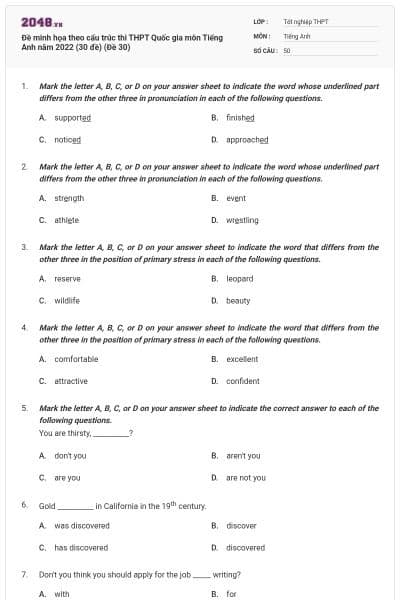
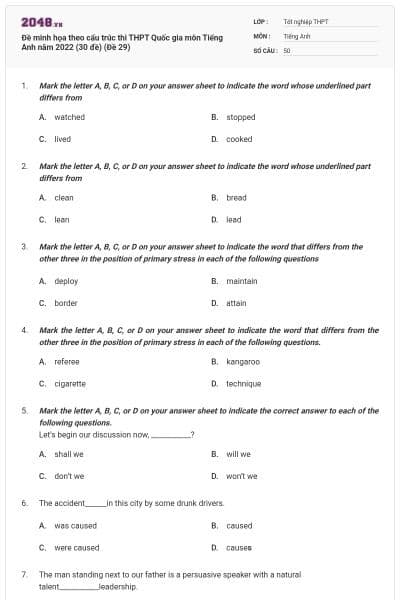
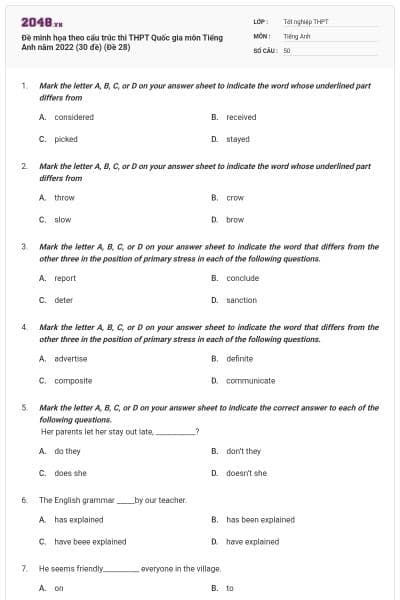
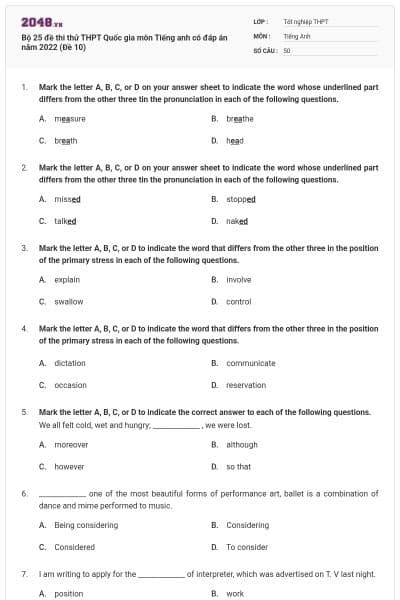
Mark the letter A, B, C, or D on your answer sheet to indicate the word whose underlined part differs from the other three tin the pronunciation in each of the following questions.
measure
breathe
breath
head
Đáp án: B. (to) breathe /bri:ð/: thở
Các đáp án còn lại:
Measure /'meʒə[r]/ (n): sự đo, đơn vị đo; thước đo; biện pháp
Breath /breθ/ (n): hơi thở
Head /hed/ (n): đầu
Mark the letter A, B, C, or D on your answer sheet to indicate the word whose underlined part differs from the other three tin the pronunciation in each of the following questions.
missed
stopped
talked
naked
Đáp án: D
Giải thích: Âm /ed/ ở đáp án D được phát âm là /id/ do đây là một tính từ (naked: trần truồng) còn các đáp án còn lại là động từ chia ở thì quá khứ, có âm /ed/ phát âm là /t/.
Mark the letter A, B, C, or D to indicate the word that differs from the other three in the position of the primary stress in each of the following questions.
explain
involve
swallow
control
(to) swallow /'swɒləʊ/: nuốt có trọng âm rơi vào âm tiết đầu tiên
Các đáp án còn lại có trọng âm rơi vào âm tiết thứ 2:
(to) explain /ik'splein/: giải thích
(to) involve /in'vɒlv/: bao gồm, liên quan tới
(to) control /kən'trəʊl/: kiểm soát
dictation
communicate
occasion
reservation
Đáp án: D. Reservation /,rezə'vei∫n/ (n): khu bảo tồn; sự dành chỗ trước (nhà hàng, khách sạn,...); sự dè dặt có trọng âm rơi vào âm tiết thứ 3
Các đáp án còn lại có trọng âm rơi vào âm tiết thứ 2:
Dictation /dik'tei∫n/ (n): sự đọc cho viết, đọc chính tả; sự ra lệnh
(to) communicate /kə'mju:nikeit/: giao tiếp; truyền đạt
Mark the letter A, B, C, or D to indicate the correct answer to each of the following questions.
We all felt cold, wet and hungry; _____________ , we were lost.
moreover
although
however
so that
Đáp án: A. Moreover: hơn nữa, ngoài ra
Các đáp án còn lại không phải là một liên từ phù hợp:
Although: mặc dù
However: tuy nhiên
So that: để mà
Dịch nghĩa: Chúng tôi đều thấy lạnh, ướt và đói; hơn nữa, chúng tôi còn bị lạc.
_____________ one of the most beautiful forms of performance art, ballet is a combination of dance and mime performed to music.
Being considering
Considering
Considered
To consider
Đáp án: C
Giải thích: giảm mệnh đề dùng quá khứ phân từ vì động từ phải ở thể bị động (phải dịch là được xem là chứ không phải xem là)
Dịch nghĩa: Được xem là một trong những hình thức nghệ thuật trình diễn đẹp nhất, múa ba lê là sự kết hợp giữa múa và kịch được biểu diễn theo âm nhạc
I am writing to apply for the _____________ of interpreter, which was advertised on T. V last night.
position
work
task
role
Đáp án: A. Position (n): vị trí, chức vụ
Các đáp án còn lại:
Work (n): việc; việc làm, nghề nghiệp
Task (n): nhiệm vụ; bài tập; công tác, công việc
Role (n): vai; vai trò
Dịch nghĩa: Tôi đang viết thư xin ứng tuyển vào vị trí phiên dịch viênđược quảng cáo trên TV tối qua.
Your responsibilities _____________ managing a team of 4 people, and setting up meetings with clients.
consider
have
involve
engage
Đáp án: C. (to) involve: đòi hỏi phải; bao gồm, bao hàm; lôi kéo vào
Các đáp án còn lại:
(to) consider: cân nhắc, xem xét, tính đến
(to) have: có
(to) engage: dính líu tới, tham dự; thuê người làm, ...
Dịch nghĩa: Trách nhiệm của bạn bao gồm quản lí một đội 4 người và lên lịch họp với các khách háng.
We planned everything carefully, but unfortunately the holiday didn't meet our_____________
suspicions
calculations
hopes
expectations
Đáp án: D
Giải thích: (to) meet one’s expectations: đạt được đến kỳ vọng, lòng mong đợi của ai
Các đáp án còn lại:
Suspicion (n): sự nghi ngờ
Calculation (n): sự tính toán
Hope (n): niềm hy vọng
Dịch nghĩa: Chúng tôi đã lên kế hoạch mọi thứ cẩn thận, nhưng không may kì nghỉ đã không được như sự kì vọng của chúng tôi.
She _____________ with her brother when he broke her favorite toy.
got out
fell in
got on
fell out
Đáp án: D. (to) fall out with sb: cãi nhau với ai
Các đáp án còn lại:
(to) get out: ra ngoài
(to) fall in: sụp đổ, sụp
(to) get on: hòa hợp, hòa thuận
Dịch nghĩa: Cô bé đã cãi nhau với anh trai khi cậu bé làm hỏng đồ chơi ưa thích của cô bé.
Before you sign the contract, _____________ in mind that you won't be able to change anything later.
bear
hold
retain
reserve
Đáp án: A
Giải thích: có cụm bear in mind that…: nhớ rằng
Các đáp án khác:
(to) hold: giữ, nắm, chứa, …
(to) retain: giữ lại
(to) reserve: để dành, dự trữ; dành trước (chỗ, ghế,…)
Dịch nghĩa: TrướcShe doesn't say very much. It is very difficult to a conversation with her.
do
take
make
talk
Đáp án: C
Giải thích: (to) make conversation: bắt chuyện với một người mà bạn không biết rõ để tỏ ra lịch sự
Dịch nghĩa: Cô ấy chẳng nói mấy. Rất khó để bắt chuyện với cô ấy.
It is said the Robinhood robbed _____________ rich and gave the money to _____________ poor.
a/ a
a/ the
the/ the
the/ a
Đáp án: C
Giải thích: mạo từ the được đặt trước một tính từ để chỉ một nhóm người mang đặc điểm ấy.
Dịch nghĩa: Người ta nói rằng Robinhood cướp của người giàu và đưa tiền cho những người nghèo.
The presenter started his speech with a few _____________ jokes to build rapport with the audience.
whole-hearted
light-hearted
soft-hearted
kind-hearted
Đáp án: B. light-hearted (adj): vui vẻ, vô tư
Các đáp án còn lại:
Whole-hearted (adj): toàn tâm toàn ý, một lòng một dạ
Soft-hearted (adj): đa cảm, mềm lòng
Kind-hearted (adj): tốt bụng
Dịch nghĩa: Người dẫn chương trình bắt đầu bài phát biểu của mình bằng một vài câu chuyện cười vui vẻ để xây dựng mối quan hệ với khán giả.
My purse _____________ at the station while I _____________ for the train.
must have been stolen/was waiting
should have stolen/had been waiting
will be stolen/am waiting
had to steal/would be waiting
Đáp án: A
Giải thích: my purse không thể lấy trộm mà phải bị lấy trộm nên động từ cần điền đầu tiên phải ở dạng bị động loại B và D. Trong hai đáp án A và C còn lại, có thể thấy đáp án A phù hợp về thì hơn.
Dịch nghĩa: Cái ví của tôi chắc hẳn đã bị lấy cắp khi tôi đang đợi tàu.
The curriculum at this public school is as good _____________ of any private school.
as or better that
as or better than that
as or better than those
better than
Đáp án: B
Giải thích: cấu trúc so sánh bằng: as + adj/adv + as, so sánh hơn của good: better than
Vì câu này so sánh chương trình giảng dạy của public school và private school chứ không phải so sánh các trường với nhau, và curriculum đang ở dạng số ít nên sau than ta dùng that để thay thế cho curriculum, tránh bị lặp từ.
Dịch nghĩa: Chương trình giảng dạy của trường công lập này tốt ngang bằng hoặc còn tốt hơn chương trình giảng dạy của bất kì trường tư nào.
Hed hardly finished doing his homework when you arrived, _____________ ?
didn't he
had he
would he
hadn't he
Đáp án: B
Giải thích: Hardly dùng trong mệnh đề tường thuật trước câu hỏi đuôi mang nghĩa phủ định nên câu hỏi đuôi phải là phủ định. Mệnh đề tưởng thuật là một câu ở thì quá khứ hoàn thành nên ta mượn trợ động từ had cho câu hỏi đuôi had he? Dịch nghĩa: Cậu ấy vẫn chưa làm xong bài tập về nhà khi cậu đến, có phải không?
My mother often _____________ our mistakes, whereas my father is very strict and punishes us for even the slightest one.
appreciates
overlooks
avoids
enjoys
Đáp án: B. (to) overlook: lờ đi, bỏ qua; không chú ý tới, bỏ sót
Các đáp án còn lại:
(to) appreciate: cảm kích; đánh giá cao, thưởng thức
(to) avoid: tránh
(to) enjoy: tận hưởng
Dịch nghĩa: Mẹ tôi thường lờ đi những lỗi lầm của chúng tôi, trong khi bố tôi rất nghiêm khắc và phạt chúng tôi kể cả vì lỗi nhỏ nhất.
Mark the letter A, B, C, or D to indicate the word(s) CLOSEST in meaning to the underlined bold word(s) in each of the following questions.
To absorb a younger workforce, many companies offered retirement plans as incentives for older workers to retire and make way for the young ones who earned lower salary.
rewards
opportunities
motives
encouragements
Đáp án: D. Encouragement (n): sự khuyến khích, khích lệ = incentive (n): cái khuyến khích, khích lệ
Các đáp án còn lại:
Reward (n): phần thưởng, tiền thưởng
Opportunity (n): cơ hội
Motive (n): cớ, lý do, động cơ
Dịch nghĩa: Để thu hút lực lượng lao động trẻ hơn, nhiều công ty đã đưa ra kế hoạch nghỉ hưu như những động lực cho người lao động lớn tuổi nghỉ hưu và nhường chỗ cho những người trẻ tuổi có mức lương thấp hơn.
keep
destroy
decrease
upgrade
Đáp án: B. (to) destroy: phá hủy
Giải thích: (to) do away with: bãi bỏ, hủy bỏ
Các đáp án còn lại:
(to) keep: giữ
(to) decrease: giảm
(to) upgrade: nâng cấp
Dịch nghĩa: Sao họ có thể phá hủy một tòa nhà cổ đáng yêu như thế và đặt một bãi đậu xe ở đó?
Mark the letter A, B, C, or D to indicate the word(s) OPPOSITE in meaning to the underlined word(s) in each of the following questions.
The first year at university was probably the most challenging year of her life, which caused her plenty of troubles.
tricky
tough
difficult
easy
Đáp án: D. Easy (adj): dễ >< challenging (adj): thách thức
Các đáp án còn lại:
Tricky (adj): tế nhị; khó khăn, nan giải; gian xảo, thủ đoạn
Tough (adj): khó khăn, gay go
Difficult (adj): khó, khó khăn
Dịch nghĩa: Năm đầu tiên ở trường đại học có lẽ là năm thử thách nhất trong cuộc đời cô, điều mà đã gây ra cho cô nhiều rắc rối.
I don't know what they are going to ask in the job interview. I'll just play it by ear.
plan well in advance
be careful about it
listen to others saying
do not plan beforehand
Đáp án: A. (to) plan well in advance: kế hoạch cẩn thận từ trước >< (to) play it by ear: tùy cơ ứng biến, ứng tác
Các đáp án còn lại:
(to) be careful about it: cẩn thận về nó
(to) listen to others saying: nghe những người khác nói
do not plan beforehand: không chuẩn bị từ trước
Dịch nghĩa: Tôi không biết những gì họ sẽ hỏi trong cuộc phỏng vấn xin việc. Tôi sẽ tùy cơ ứng biến.
Mark the letter A, B, C, or D to indicate the most suitable response to complete each of the following exchanges.
Tom is apologizing to Peter for being late.
- Tom: "Sorry, I'm late, Peter. My car has broken down on the way here."
- Peter: “_____________”
No, I wouldn't mind at all.
Not on my account.
That's all right.
Well, it's worth a try.
Đáp án: C
Giải thích: Tom đang xin lỗi Peter vì đã đến muộn.
- Tom: Xin lỗi, tôi tới muộn, Peter. Xe của tôi bị hỏng trên đường tới đây.
- Peter: Không sao đâu.
Các đáp án còn lại không hợp về ngữ cảnh:
A. Không, tôi không phiền gì cả. (dùng để đáp lại lời xin phép cho người khác làm việc gì, ví dụ như hút thuốc)
B. Không có trên tài khoản của tôi.
D. Chà, nó rất đáng để thử.
Two friends, Peter and Linda, are talking about pets.
- Peter: "Well, cats are very good at catching mice around the house"
- Linda: “_____________”
Nothing more to say.
You can say that again.
Yes, I hope so.
No, dogs are good, too.
Đáp án: B
Giải thích: Hai người bạn, Peter và Linda, đang nói về thú cưng.
- Peter: Ôi, mèo rất giỏi bắt chuột quanh nhà.
- Linda: Mình đồng ý.
Các đáp án khác không hợp về ngữ cảnh:
A. Không còn gì để nói nữa.
C. Vâng, tôi hy vọng như vậy.
D. Không, chó cũng tốt.
Read the following passage and mark the letter A, B, C, or D to choose the word or phrase that best fits each of the numbered blanks from 25 to 29
GREEN ENERGY
Fossil fuels are used to generate the majority of the world's energy, and they come in different forms. For example, coal may be burned in a power (25) _____________ to generate electricity, but gasoline is burned in a car's engine to make it run. Neither of these two sources is considered green energy because they produce a lot of pollution when they are burned. In addition, they come from a source that is inevitably going to (26) _____________
Green energy can be defined as any energy source that is to some degree nonpolluting. When it is called (27) _____________, this means that a person can replace the same amount of energy that was consumed by that person (28) _____________ that person's lifetime. Since it look millions and millions of years to create the fossil fuels that we now burn, we know that they cannot be replaced by us.
Wind power and solar power, (29) _____________ harnessed properly, are two excellent sources of green energy. Once the necessary parts such as wind turbines to generate wind power and solar panels to create solar power have been produced, only the pollution from the production is left.
point
outlet
factory
plant
Đáp án: D. Plant (n): nhà máy sản xuất một sản phẩm đặc biệt hoặc sản xuất năng lượng
Các đáp án còn lại:
Point (n): điểm
Outlet (n): chỗ thoát ra, lối thoát; cửa hàng đại lý
Factory (n): nhà máy
In addition, they come from a source that is inevitably going to (26) _____________
run out
run out of
burn out
cut out
Đáp án: A. (to) run out: cạn kiệt, hết
Không chọn đáp án B vì sau of phải là một danh từ
Các đáp án khác:
(to) burn out: đốt hết, đốt sạch
(to) cut out: cắ ra, cắt bỏ; thôi, ngưng
durable
sustainable
harmful
effective
Đáp án: B. Sustainable (adj): bền vững, có thể chống đỡ được
Các đáp án còn lại:
Durable (adj): bền, lâu bền
Harmful (adj): có hại, gây hại
Effective (adj): có hiệu quả
along
about
within
during
Đáp án: C. Within
Giải thích: within khi đề cập đến thời gian sẽ ám chỉ “trong suốt một khoảng thời gian cụ thể”. Điều này có nghĩa là trong suốt thời gian ấy, sự việc có thể xảy ra vào bất kỳ thời điểm nào, miễn là không ra ngoài thời gian ấy. Hay nói cách khác, trước khi thời hạn cụ thể qua đi, chúng ta nhấn mạnh rằng sự việc hoặc hành động phải xảy ra hay được thực hiện.
Giới từ during ám chỉ đến trong suốt một thời kỳ, bao gồm tất cả thời gian xảy ra trong đó. Như vậy during bao hàm tất cả thời gian trong thời kỳ đó. Bao hàm tất cả thời gian là sự khác biệt với within (bất cứ thời điểm nào trong một thời gian).
where
when
which
what
Đáp án: B
Giải thích: một quá khứ phân từ (harnessed) có thể thay cho một chủ ngữ + động từ ở dạng bị động trong mệnh đề chứa when, với nghĩa là khi được…, khi bị…
Read the following passage and mark the letter A, B, C, or D to indicate the correct answer to each of the questions from 30 to 34
Anthropologists have pieced together the little they know about the history of left-handedness and right handedness from indirect evidence. Though early men and women did not leave written records, they did leave tools, bones, and pictures. Stone Age hand axes and hatchets were made from stones that were carefully chipped away to form sharp cutting edges. In some, the pattern of chipping shows that these tools and weapons were made by right handed people designed to fit comfortably into a right hand. Other Stone Age implements were made by or for left-handers. Prehistoric pictures. painted on the walls of caves. provide further clues to the handedness of ancient people. A right-hander finds it easier to draw faces of people and animals facing toward the left. Whereas a left-hander finds it easier to draw faces facing toward the right. Both kinds of faces have been found in ancient painting. On the whole, the evidence seems to indicate that prehistoric people were either ambidextrous or about equally likely to be left or right handed.
But, in the Bronze Age, the picture changed. The tools and weapons found from that period are mostly made for right-handed use. The predominance of right-handedness among humans today had apparently already been established.
What is the main topic of the passage?
The purpose of ancient implements
The significance of prehistoric cave paintings
The development of right-handedness and left-handedness
The similarities between the Stone Age and Bronze Age
Chủ đề chính của đoạn văn là gì?
A. Mục đích của dụng cụ cổ xưa
B. Ý nghĩa của tranh hang động thời tiền sử
C. Sự phát triển của thuận tay phải và thuận tay trái
D. Sự tương đồng giữa thời kỳ đồ đá và thời đại đồ đồng
Đáp án: C
Giải thích: toàn bộ văn bản nói về sự phát triển của sự thuận tay phải và tay trái, từ khi còn cân bằng nhau ở thời kỳ đồ đá cho đến khi sự thuận tay phải chiếm ưu thế ở thời kỳ đồ đồng
Which of the following helped lead to conclusions about whether Stone Age, people preferred one hand to the other?
Petrified forms of vegetation
Patterns of stone chipping
Fossilized waste material
Fossilized footprints
Điều nào sau đây giúp dẫn đến kết luận về việc mọi người trong thời đồ đá thích dùng một tay hơn tay kia?
A. Các dạng thực vật hóa đá
B. Mô hình đẽo bào đá
C. Chất thải hóa thạch
D. Dấu chân hóa thạch
Đáp án: B
Giải thích: “Stone Age hand axes and hatchets were made from stones that were carefully chipped away to form sharp cutting edges. In some, the pattern of chipping shows that these tools and weapons were made by right handed people designed to fit comfortably into a right hand. Other Stone Age implements were made by or for lefthanders”: Rìu tay và rìu nhỏ thời kỳ đồ đá được làm từ đá được bào cẩn thận để tạo thành các cạnh cắt sắc nét. Trong một sô thứ, kiểu đẽo bào cho thấy những công cụ và vũ khí này được tạo ra bởi những người thuận tay phải, được thiết kế để phù hợp thoải mái với một bàn tay phải. Các dụng cụ thời đồ đá khác được thực hiện bởi hoặc cho người thuận tay trái.
The word “further” is closest in meaning to which of the following?
advanced
additional
artistic
actual
Từ “futher” ở đoạn 2 gần nghĩa nhất với từ _____
Đáp án: B. Addtitional (adj): thêm, bổ sung
Giải thích: further (adj): xa hơn; thêm nữa
Các đáp án còn lại:
Advanced (adj): tiên tiến, tiến bộ
Artistic (adj): có tính nghệ thuật, thẩm mỹ
Actual (adj): thực sự, trên thực tế; hiện nay
According to the passage, a person who is right-handed is more likely to draw people and animals that are facing _____________
upward
downward
toward the right
toward the left
Theo đoạn văn, một người thuận tay phải có nhiều khả năng vẽ người và động vật đang hướng mặt
A. hướng lên
B. hướng xuống
C. về phía bên phải
D. về phía bên trái
Đáp án: D
Giải thích: “A right - hander finds it easier to draw faces of people and animals facing toward the left”: Một người thuận tay phải thấy việc vẽ mặt người và động vật hướng về bên trái dễ dàng hơn.
The words "the picture” refer to which of the following?
Faces of animals and people
People's view from inside a cave
People's tendency to work with either hand
The kinds of paint used on cave walls
Cụm “the picture” ám chỉ đến cái gì sau đây?
A. Khuôn mặt của động vật và con người
B. Quan điểm của mọi người từ bên trong một hang động
C. Xu hướng làm việc của mọi người bằng một trong hai tay
D. Các loại sơn được sử dụng trên tường hang
Đáp án: C
Giải thích: picture không được dùng với nghĩa bức tranh ở đây (vì đã có nhiều hình các khuôn mặt được vẽ nên nếu dùng với nghĩa này phải thêm s ở cuối) mà là cảnh ngộ, sự việc, tình hình. tình hình thuận tay trái hay tay phải của con người đã thay đổi từ thời đồ đá đến thời đồ đồng.
Read the following passage and mark the letter A, B, C, or D to indicate the correct answer to each of the questions from 35 to 42
THE GREAT DEBATE OVER GM FOODS
One of the hottest topics in agriculture today is genetically modified (GM) foods. GM foods are foods that come from plants that have had their DNA altered using biotechnology. GM foods have been on the market since 1994, when a company called Calgene started selling GM tomatoes. Since then, other GM foods including papaya, corn, and plums to name a few have been developed.
The main benefit of GM foods is that they can be a more economical solution than non-GM foods. Scientists found a way to modify many plants to make them more resistant to weeds, diseases, and pests. This allows the plants to grow in tougher climates and conditions, which should lead to lower food prices and increase the overall food supply
However, many consumers still have their doubts about GM foods. For one they feel that by eating GM foods people are messing with nature. Until now humans have survived on food that was produced without any interference from science. Even though many lab studies show that GM foods are safe in the short term, opponents feel that not enough long-term testing has been done yet.
Another major issue in the GM foods debate is its labelling. Current US laws do not require producers to label their foods as GM. This has upset many consumers who feel they have the right to clearly know how the food they are buying is produced. On the other hand, producers are afraid to label their foods as GM because they feel it will result in less product sales, as people may assume that there is something wrong with GM foods.
This controversy is not just on the level of consumers and producers. The issue of non-GM foods has also become a block to a major free trade agreement between the US and Europe. GM foods are banned throughout most of Europe, while they are quite common throughout the US. Since many American GM food producers would like to sell their foods overseas in Europe, the US is requesting that European nations eliminate laws banning GM foods. However, many European nations are not fully convinced that these products are safe.
What did Calgene do?
It invented the first GM food.
It discovered the tomato.
It sold the first GM food.
It argued against the sales of GM foods.
Calgene đã làm gì?
A. Nó đã phát minh ra thực phẩm GM đầu tiên.
B. Nó phát hiện ra cà chua.
C. Nó đã bán thực phẩm GM đầu tiên.
D. Nó lập luận chống lại việc bán thực phẩm GM.
Đáp án: C
Giải thích: “GM foods have been on the market since 1994, when a company called Calgene started selling GM tomatoes”: Thực phẩm GM đã có mặt trên thị trường từ năm 1994, khi một công ty có tên Calgene bắt đầu bán cà chua GM.
According to the passage, why did scientists invent GM foods?
To make more delicious foods
To create a new type of dessert
So plants would be stronger
So the scientists could win a prize
Theo đoạn văn, tại sao các nhà khoa học phát minh ra thực phẩm biến đổi gen?
A. Để làm nhiều món ăn ngon hơn
B. Để tạo ra một loại món tráng miệng mới
C. Để các cây mạnh mẽ hơn
D. Để các nhà khoa học có thể giành được giải thưởng
Đáp án: C
Giải thích: “The main benefit of GM foods is that they can be a more economical solution than non - GM foods. Scientists found a way to modify many plants to make them more resistant to weeds, diseases, and pests. This allows the plants to grow in tougher climates and conditions,...”: Lợi ích chính của thực phẩm biến đổi gen là chúng có thể là một giải pháp kinh tế hơn so với thực phẩm không biến đổi gen. Các nhà khoa học tìm thấy một cách để sửa đổi nhiều loại cây để làm cho chúng kháng sâu hơn với cỏ dại, bệnh tật và sâu bệnh. Điều này cho phép cây phát triển ở vùng khí hậu và điều kiện khắc nghiệt hơn,...
What is the third paragraph mainly about?
The laws that make GM foods illegal
How some GM foods are grown
The future of GM foods in America
Some reasons why people don't like GM foods
Đoạn thứ ba chủ yếu nói về điều gì?
A. Luật làm cho thực phẩm biến đổi gen bất hợp pháp
B. Làm thế nào một số thực phẩm biến đổi gen được trồng
C. Tương lai của thực phẩm biến đổi gen ở Mỹ
D. Một số lý do tại sao mọi người không thích thực phẩm GM
Đáp án: D
Giải thích: đoạn văn nói về một số lí do mọi người vẫn chưa chuộng thực phẩm GM (làm rối tung tự nhiên lên, chưa đủ thử nghiệm lâu dài)
The word “this" in paragraph 2 refers to _____________
resistance
modification
increase in food supply
tougher climate
Từ “this” ở đoạn 2 ý chỉ _____
Đáp án: B. Modification (n): sự thay đổi, biến đối
Giải thích: “Scientists found a way to modify many plants to make them more resistant to weeds, diseases, and pests. This allows the plants to grow in tougher climates and conditions,...”: Các nhà khoa học tìm thấy một cách để sửa đổi nhiều loại cây để làm cho chúng chống chịu hơn với cỏ dại, bệnh tật và sâu bệnh. Điều này (sự biến đổi gen) cho phép cây phát triển ở vùng khí hậu và điều kiện khắc nghiệt hơn,...
The phrase “messing with” in paragraph 3 is closest in meaning to _____________
making nature dirty and untidy
getting involved with GM foods that may be harmful
spending time doing things for no pleasure
spoiling nature with using GM foods
Cụm “messing with” ở đoạn 3 gần nghĩa nhất với _____
A. làm cho thiên nhiên trở nên bẩn thỉu và không gọn gàng
B. tham gia với thực phẩm biến đổi gen có thể gây hại
C. dành thời gian làm những việc không có niềm vui
D. làm hỏng thiên nhiên bằng cách sử dụng thực phẩm biến đổi gen
Đáp án: D
Giải thích: (to) mess with sth: phá hỏng, làm rối tung lên
Which of the following statements is true?
GM foods are more accepted in the US than in Europe
Scientists understand the long-term effects of GM foods.
People in Europe want to import more GM foods.
GM food is not an important issue between nations
Khẳng định nào sau đây là đúng?
A. Thực phẩm biến đổi gen được chấp nhận ở Mỹ hơn ở châu Âu
B. Các nhà khoa học hiểu tác dụng lâu dài của thực phẩm biến đổi gen.
C. Người dân ở châu Âu muốn nhập khẩu nhiều thực phẩm biến đổi gen.
D. Thực phẩm biến đổi gen không phải là vấn đề quan trọng giữa các quốc gia
Đáp án: A
Giải thích: “GM foods are banned throughout most of Europe, while they are quite common throughout the US”: Thực phẩm biến đổi gen bị cấm ở hầu hết châu Âu, trong khi chúng khá phổ biến trên khắp Hoa Kỳ.
Đáp án B không được nhắc đến trong bài, đáp án C và D mâu thuẫn với thông tin trong bài.
Why don't corporations want to label their foods as GM?
They think it will make their prices higher.
They don t believe their foods are really GM.
They think the label will scare some consumers.
They believe all foods should have the GM label.
Tại sao các công ty không muốn gắn nhãn thực phẩm của họ là GM?
A. Họ nghĩ rằng nó sẽ làm cho giá của họ cao hơn.
B. Họ không tin rằng thực phẩm của họ thực sự là GM
C. Họ nghĩ rằng nhãn hiệu sẽ khiến một số người tiêu dùng sợ hãi.
D. Họ tin rằng tất cả các loại thực phẩm nên có nhãn GM.
Đáp án: C
Giải thích: “On the other hand, producers are afraid to label their foods as GM because they feel it will result in less product sales, as people may assume that there is something wrong with GM foods”: Mặt khác, các nhà sản xuất sợ dán nhãn thực phẩm của họ là GM vì họ cảm thấy điều đó sẽ dẫn đến doanh số sản phẩm ít hơn, vì mọi người có thể cho rằng có gì đó không ổn với thực phẩm GM.
All of the following are the reasons why European people don't like GM foods EXCEPT that _____________
scientists haven't proved that GM foods are safe in the long term
European farmers can't sell their produce in Europe
people like eating foods without any interference of science
American companies will get big profits from their GM foods
Tất cả những điều sau đây là lý do tại sao người châu Âu không thích thực phẩm GM NGOẠI TRỪ __________.
A. các nhà khoa học chưa chứng minh được là thực phẩm GM là an toàn về lâu dài
B. Nông dân châu Âu không thể bán sản phẩm của họ ở châu Âu
C. mọi người thích ăn thực phẩm mà không có sự can thiệp của khoa học
D. Các công ty Mỹ sẽ nhận được lợi nhuận lớn từ thực phẩm GM của họ
Đáp án: B
Giải thích: có thể thấy các các đáp án A, C và D có thể dược tìm thấy hoặc suy ra ở trong bài (đoạn cuối). Chỉ có đáp án B là không.
Mark the letter A, B, C or D to indicate the underlined part that needs correction in each of the following questions
I saw the blind woman crossed the busy road without any help.
the
crossed
without
help
Đáp án: B
Giải thích: (to) see sb doing sth: thấy ai làm gì. Chúng ta cũng có thể dùng một nguyên mẫu không “to” khi ngụ ý muốn nói chứng kiên trọn vẹn một hành động sửa crossed thành crossing/cross. Dịch nghĩa: Tôi thấy người phụ nữ mù băng qua con đường đông đúc mà không cần sự trợ giúp nào cả
They believe in protecting endangered animals, and they protect them from controversial ways.
believe in
endangered
and
from
Đáp án: D
Giải thích: Nếu muốn nói làm việc gì theo cách như thế nào, chúng ta dùng giới từ in chứ không phải from. Dùng from khi muốn nói bảo vệ ai/cái gì khỏi cái gì.
Dịch nghĩa: Họ tin vào việc bảo vệ động vật đang bị đe dọa, và họ bảo vệ chúng theo những cách gây tranh cãi.
Even though she looks very young, she is twice older than my thirty-year-old sister.
Even though
very young
older than
thirty-year-old
Đáp án: C
Giải thích: Khi nói gấp bao nhiêu lần, ta dùng cấu trúc twice as … as, three times as … as, etc. sửa older than thành as old as.
Dịch nghĩa: Bà ấy trông rất trẻ, nhưng bà lớn gấp đôi người chị ba mươi tuổi của tôi.
Mark the letter A, B, C, or D to indicate the sentence that is closest in meaning to each of the following questions.
At no time did the two sides look likely to reach an agreement.
The two sides had no time to reach an agreement.
The two sides never looked likely to reach an agreement.
If the two sides had had more time, they would have reached an agreement.
The two sides would never like to reach an agreement.
Câu gốc: Không có lúc nào hai bên có vẻ sẽ đạt được thỏa thuận.
Đáp án: B. Hai bên dường như không bao giờ đạt được thỏa thuận.
Các đáp án còn lại sai về nghĩa:
A. Hai bên không có thời gian để đạt được thỏa thuận.
C. Nếu hai bên có nhiều thời gian hơn, họ sẽ đạt được thỏa thuận
D. Hai bên sẽ không bao giờ muốn đạt được thỏa thuận.
The movie bears little resemblance to the original novel.
The movie is very similar to the original novel.
The movie is quite different from the original novel.
The movie and the original novel resemble in many ways.
The movie and the original novel differ in some ways.
Câu gốc: Bộ phim ít giống với tiểu thuyết gốc.
Đáp án: D. Bộ phim và tiểu thuyết gốc khác nhau theo một số điểm.
Các đáp án còn lại sai về nghĩa:
A. Bộ phim rất giống với tiểu thuyết gốc.
B. Bộ phim khá khác biệt so với tiểu thuyết gốc.
C. Bộ phim và tiểu thuyết gốc giống nhau theo nhiều cách.
The waiter said: “Would you mind moving to another table?”
The waiter asked me to move to another table.
The waiter advised me to move to another table.
The waiter insisted me to move to another table.
The waiter told me not to move to another table
Câu gốc: Người phục vụ nói: Phiền bạn chuyển sang bàn khác được không?
Đáp án: A. Người phục vụ yêu cầu tôi chuyển sang bàn khác.
Các đáp án còn lại sai về nghĩa:
B. Người phục vụ khuyên tôi nên chuyển sang bàn khác.
C. Người phục vụ khăng khăng tôi chuyển sang bàn khác.
D. Người phục vụ bảo tôi không được chuyển sang bàn khác
Mark the letter A, B, C, or D to indicate the sentence that best combines each pair of sentences in the following questions.
Domestic cats enjoy playing and sitting in the sun. Cats in the wild like doing so.
Domestic cats enjoy playing and sitting in the sun the sun and so cats in the wild do.
Domestic cats enjoy playing and sitting in the sun and so do cats in the wild.
Domestic cats enjoy playing and sitting in the sun and cats in the wild do so too.
Domestic cats enjoy playing and sitting in the sun and so cats do in the wild.
Câu gốc: Mèo nhà thích chơi và ngồi dưới nắng. Mèo trong hoang dã cũng thích làm như vậy.
Đáp án: B
Giải thích: Khi muốn nói một người hoặc vật nào đó làm một việc gì đó và một người, vật khác cũng làm một việc như vậy, người ta dùng cấu trúc đồng tình. Để tránh phải lặp lại các từ của câu trước (mệnh đề chính), người ta dùng liên từ and và thêm một câu (mệnh đề phụ) có sử dụng so hoặc too. Nếu dùng so, so luôn đứng đầu câu và phải mượn trợ động từ phù hợp đi liền sau. Trợ động từ đứng liền trước chủ ngữ. Dịch nghĩa: Mèo nhà thích chơi và ngồi dưới ánh mặt trời và mèo trong hoang dã cũng vậy.
I owed Bill a favor. I agreed to help him.
I only agreed to help Bill because I owed him some money.
If I hadn't owed Bill a favor, I would have agreed to help him.
It was only because I owed Bill a favor that I agreed to help him.
Although I owed Bill a favor, I agreed to help him.
Câu gốc: Tôi nợ Bill một ân huệ. Tôi đồng ý giúp anh ấy
Đáp án: C. Chỉ vì tôi nợ Bill một ân huệ mà tôi đã đồng ý giúp anh ấy.
Các đáp án còn lại sai về nghĩa:
A. Tôi chỉ đồng ý giúp Bill vì tôi nợ anh ấy một số tiền.
B. Nếu tôi đã nợ Bill một ân huệ, tôi đã đồng ý giúp anh ta.
D. Mặc dù tôi nợ Bill một ân huệ, tôi đồng ý giúp anh ta.