Bộ 25 đề thi ôn luyện THPT Quốc gia môn Tiếng anh có lời giải năm 2022 (Đề 22)
50 câu hỏi
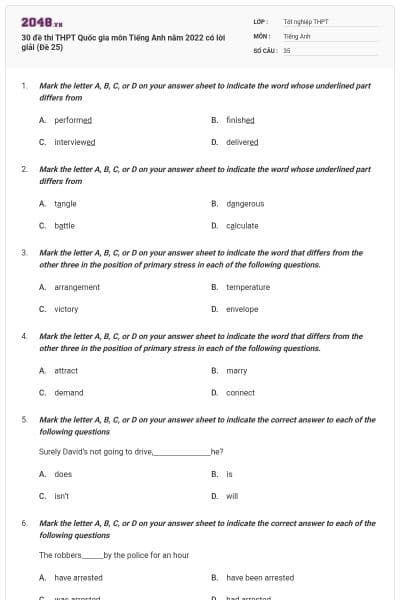
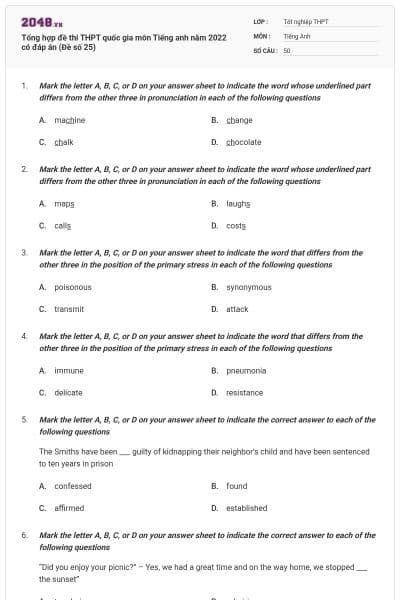
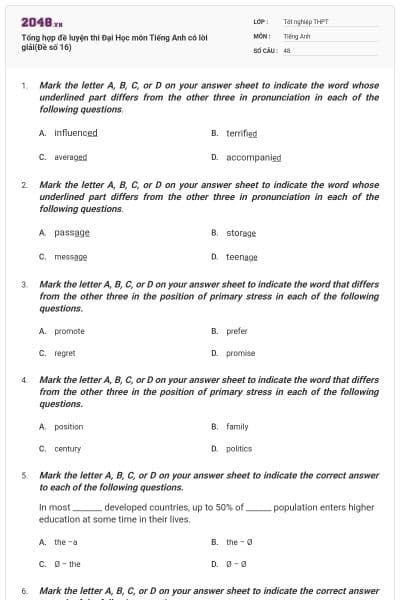
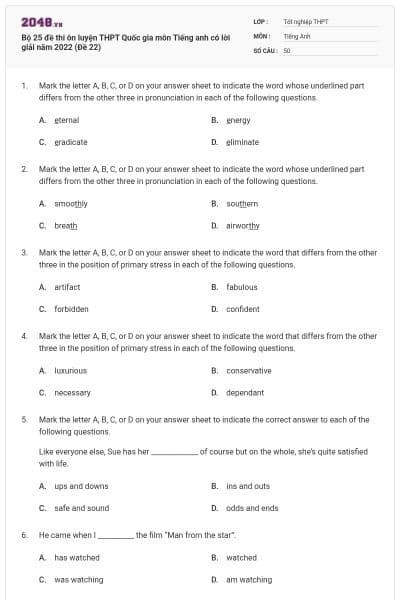
Mark the letter A, B, C, or D on your answer sheet to indicate the word whose underlined part differs from the other three in pronunciation in each of the following questions.
eternal
energy
eradicate
eliminate
Chọn đáp án B
Eternal /ɪˈtɜːrnl/ (adj): vĩnh viễn, không ngừng
Energy /ˈenərdʒi/ (n): năng lượng
Eradicate /ɪˈrædɪkeɪt/ (v): diệt trừ, phá hủy hoàn toàn
Eliminate /ɪˈlɪmɪneɪt/ (v): loại ra, loại trừ
Mark the letter A, B, C, or D on your answer sheet to indicate the word whose underlined part differs from the other three in pronunciation in each of the following questions.
smoothly
southern
breath
airworthy
Chọn đáp án C
Smoothly /ˈsmuːðli/(adv): trôi chảy, êm dịu, mượt
Southern / ˈsʌðən /(adj): thuộc miền Nam
Breath /breθ/ (n): hơi thở
Airworthy /ˈeəwɜːði/(adj): bay được (máy bay)
Mark the letter A, B, C, or D on your answer sheet to indicate the word that differs from the other three in the position of primary stress in each of the following questions.
artifact
fabulous
forbidden
confident
Chọn đáp án C
Artifact /ˈɑ:tɪfækt/ (n.): đồ tạo tác
Fabulous (adj) /ˈfæbjələs/: tuyệt vời, tuyệt diệu
Forbidden (adj) /fəˈbɪdn/: bịcấm
Confident (adj) /ˈkɒnfɪdənt/: tự tin
Mark the letter A, B, C, or D on your answer sheet to indicate the word that differs from the other three in the position of primary stress in each of the following questions.
luxurious
conservative
necessary
dependant
Chọn đáp án C
Luxurious /lʌɡˈʒʊəriəs / (adj): lộng lẫy, xa hoa
Conservative /kənˈsɜːvətɪv / (adj): bảo tồn, bảo thủ
Necessary /ˈnesəsəri/ (adj): cần thiết
Dependant /dɪˈpendənt/ (n): người phụ thuộc
Mark the letter A, B, C, or D on your answer sheet to indicate the correct answer to each of the following questions.
Like everyone else, Sue has her _____________ of course but on the whole, she’s quite satisfied with life.
ups and downs
ins and outs
safe and sound
odds and ends
Đáp án: A
Giải thích:
A. những lúc thăng trầm
B. chi tiết
C. an toàn/ khỏe mạnh
D. những chuyện vặt vãnh/ linh tinh
Dựa vào nghĩa, chọn đáp án A.
Dịch: Cũng giống như mọi người khác, Sue cũng có những lúc thăng trầm nhưng nhìn chung cô ấy khá là hài lòng với cuộc sống của mình.
He came when I __________ the film “Man from the star”.
has watched
watched
was watching
am watching
Chọn đáp án C
- Thì quá khứ tiếp diễn: was/ were + Ving
- Thì quá khứ tiếp diễn diễn tảmột hành động đang xảy ra thì có một hành động khác xen vào trong quá khứ (hành động đang xảy ra thì ta chia thì QKTD; hành động xen vào thì ta chia thì QKĐ)
E.g: When I came home, my mother was cooking dinner yesterday. (Hôm qua lúc tôi về nhà thì mẹ tôi đang nấu bữa tối.)
“Anh ấy đến khi tôi đang xem bộphim “Vì sao đưa anh tới”.”
After the tourists ___________ two hours in the supermarket, they ____________ to a traditional craft village.
had spent - travelled
has spent - travelled
had spent - were travelling
spent - had travelled
Chọn đáp án A
Cấu trúc: After + S + had + PP, S + V-past: thì quá khứ hoàn thành diễn tả một hành động xảy ra trước một hành động khác trong quá khứ
“Sau khi các du khách dành hai tiếng ở siêu thị, họ đã đi đến làng nghề truyền thống.”
She will have to _________ if she wants to pass the final exam.
pull up her socks
work miracles
take the trouble
keep her hand in
Chọn đáp án A
- pull up one’s socks: để khuyến khích ai đó cần cố gắng hơn nữa để đạt đến những thành công; phải cải thiện cách cư xử hay cách làm một việc gì đó
E.g: You’ll have to pull your socks up if you want a promotion next year. (Bạn sẽ phải cố gắng hơn nữa nếu bạn muốn thăng tiến trong năm tới.)
- work/ perform miracles: đạt được kết quảrất tốt, tạo kết quảkỳ diệu
E.g: Her exercise programme has worked miracles for her.
- take the trouble to do sth: chịu khó làm việc gì/không ngại khó khăn để làm việc gì
E.g: She didn’t even take the trouble to find out how to spell my name.
- keep one’s hand in: to practise a skill often enough so that you do not lose the skill: luyện tập một kĩ năng đủ để bạn không mất/ mai một kĩ năng đó.
E.g: I do a bit of teaching now and then just to keep my hand in.
“Cô ấy sẽ phải cố gắng nhiều nếu cô ấy muốn vượt qua kì thi.”
It is raining heavily with rolls of thunder. We ________ such a terrible thunderstorm.
would never see
had never seen
have never seen
never see
Chọn đáp án C
Thì hiện tại hoàn thành với trạng từ never: S + have/ has + never + PP...
see saw seen
“Trời đang mưa rất to với nhiều tiếng sấm. Tôi chưa bao giờ thấy một trận bão có sấm sét kinh khủng như thế này.”
He suggested __________ money for charity.
to raise
raised
raising
raise
Chọn đáp án C
-suggest + V-ing: gợi ý/ đềxuất làm gì
“Anh ấy đề xuất quyên góp tiền cho từ thiện.”
Most guests __________ the party by the time we came.
leave
left
leaves
had left
Chọn đáp án D
Cấu trúc: S + had + PP + by the time + S + V(past)
Ghi chú Thì quá khứ hoàn thành (had + PP) để diễn tả hành động xảy ra trước một hành động khác trong quá khứ. |
There is _________ water in the well, not enough for everyone in the village.
few
a few
little
a little
Chọn đáp án C
- few + N–plural: rất ít, hầu như không có
- little + N-uncountable: rất ít, hầu như không có
- a few + N-plural: một vài
- a little + N-uncountable: một ít, một vài
“Có rất ít nước trong giếng, không đủ cho mọi người trong làng.”
This car is so expensive that my father can’t afford _____________ it.
buy
buying
to buy
to buying
Chọn đáp án C
- afford + to V: có đủ khảnăng/ điều kiện (kinh tế) để làm gì
“Chiếc ô tô quá đắt nên bố tôi không thể có đủ tiền để mua nó.”
The artisans in my village can ________ basket weaving. They earn enough money from it.
deal with
come back
live on
pass down
Chọn đáp án C
- deal with: giải quyết
- come back: trởlại
- live on: sống dựa vào
- pass down: truyền lại cho thế hệ sau
“Những người thợ thủ công ở làng tôi sống dựa vào nghề đan rổ. Họ kiếm đủ tiền từ nghề đó.”
Please turn off _____________ light when you leave _____________ room.
the - the
a - a
the - a
a – the
Chọn đáp án A
- Mạo từ “the” dùng trước danh từ mà người nói và người nghe biết rõ về đối tượng đó.
“Xin hãy tắt điện khi bạn ra khỏi căn phòng.”
She _________ me a very charming compliment on my painting.
showed
paid
made
took
Chọn đáp án B
Cấu trúc: Pay sb a compliment on sth ~ praise sb for sth: khen ngợi ai đó về điều gì
"Cô ấy đã dành lời khen cho bức tranh của tôi."
Tet is the most important festival ___________ occurs in late January or early February.
whom
when
where
which
Chọn đáp án D
- Which: thay cho chủ ngữ/ tân ngữ chỉ vật trong mệnh đề quan hệ.
“Tết là lễ hội quan trọng nhất mà diễn ra vào cuối tháng 1 hoặc đầu tháng 2.”
When he retires at sixty, he’ll get a very good ___________.
pay
salary
wage
pension Lời giải
- pay /peɪ/ (n): tiền lương
E.g: His job is hard work, but the pay is good.
- salary /ˈsæləri/ (n): lương (thường trả theo tháng)
E.g: commencing rate of salary (mức lương khởi đầu)
- wage /weɪdʒ/ (n): tiền công (trả theo giờ, ngày, tuần)
E.g: Wages are paid on Fridays.
- pension /ˈpen.ʃən/ (n): lương hưu
E.g: Many people live on a pension.
“Khi nghỉ hưu vào tuổi 60, ông ấy sẽ nhận được một khoản lương hưu cao.”
Smoking cigarettes is harmful __________ your health.
to
for
with
of
Chọn đáp án A
- harmful to sb/ sth: có hại cho ai/ điều gì
“Hút thuốc lá có hại cho sức khỏe của bạn.”
Mark the letter A, B, C, or D on your answer sheet to indicate the word(s) CLOSEST in meaning to the underlined word(s) in each of the following questions.
It is a great place for us to enjoy the stunning landscape.
unattractive
unpleasant
beautiful
bad
Chọn đáp án C
- stunning ~ beautiful (adj): tuyệt đẹp
- unattractive (adj): không hấp dẫn, không lôi cuốn
- unpleasant (adj): khó chịu
- bad (adj): xấu
“Đó là một nơi tuyệt vời để chúng ta ngắm cảnh đẹp.”
It really gets on my nerves when people talk loudly on the phone in public.
annoys me
satisfies me
makes me sad
makes me happy
Chọn đáp án A
- get on one’s nerves ~ annoy sb: làm ai tức giận, bực mình
B. làm tôi hài lòng
C. làm tôi buồn
D. làm tôi vui
“Thực sự làm tôi bực mình khi mọi người nói chuyện điện thoại to ở nơi công cộng.”
Mark the letter A, B, C, or D on your answer sheet to indicate the word(s) OPPOSITE in meaning to the underlined word(s) in each of the following questions.
Things in my village have changed dramatically in the last decade.
significantly
considerably
rapidly
slightly
Chọn đáp án D
- dramatically (adv): mạnh mẽ # slightly (adv): nhẹ
- considerably ~ significantly (adv): đáng kể
- rapidly (adv): nhanh
“Mọi thứ ởlàng tôi đã thay đổi mạnh mẽ trong thập kỉ qua.”
People in this village seem to be inhospitable to strangers whom they don’t know well.
unwelcoming
friendly
unkind
impolite
Chọn đáp án B
- inhospitable (adj): không mến khách, không thân thiện # friendly (adj): thân thiện
- unwelcoming (adj): không chào đón, không thân thiện
- unkind (adj): không tử tế, không tốt bụng
- impolite (adj): không lịch sự
“Người dân làng này dường như không thân thiện với những người lạ mà họ không biết rõ.”
Mark the letter A, B, C, or D on your answer sheet to indicate the option that best completes each of the following exchanges.
The waiter: What would you like to drink?
Mr. David: “___________.”
I don’t like coffee.
I prefer tea to coffee.
Coffee, please.
I’m very thirsty.
Chọn đáp án C
- Nam phục vụ: "Ông muốn uống gì ạ?" – Ông David: "Cho tôi cà phê nhé."
A. Tôi không thích cà phê.
B. Tôi thích trà hơn cà phê.
D. Tôi rất khát nước.
Lisa: “Have you heard that Tim and Daisy have just got engaged?”
Susan: “___________”
Really? That’s fantastic!
Congratulations!
Let’s go out!
Good luck!
Chọn đáp án A
- Lisa: "Bạn đã nghe tin Tim và Daisy vừa mới đính hôn chưa?"
- Susan: "Thật à? Điều đó thật tuyệt vời.”
Read the following passage and mark the letter A, B, C, or D on your answer sheet to indicate the correct word or phrase that best fits each of the numbered blanks from 26 to 30.
Stress is one of the most common causes of health problems in modern life. Too much stress results (26) ____________ physical, and mental health problems.
There are numerous physical (27) ____________ of stress. Stress can affect the heart. It can increase the pulse rate, make the heart miss beats, and can cause high blood pressure. Stress can affect the (28) ____________ system. It can lead to asthma. It can cause a person to breathe too fast, leading to a loss of important carbon dioxide. Stress can affect the stomach. It can cause stomachache and problems of digesting food. These are only (29) ____________ examples of the wide range of illnesses and symptoms resulting from stress.
Long-term stress can lead to a variety of serious mental illnesses. Depression, an extreme feeling of sadness and hopelessness, can be the result of continued and increasing stress. Alcoholism and other addictions often develop as a result of overuse of alcohol or drugs to try to relieve stress. Eating disorders, such as anorexia, are sometimes caused by stress and are often made worse by stress. If stress is allowed to continue, then one’s mental health is put (30) ____________ risk.
from
on
at
in
Chọn đáp án D
- result in: dẫn đến, đưa đến, gây ra
“Quá nhiều căng thẳng gây ra những vấn đề về sức khỏe thể chất và sức khỏe tinh thần.”
There are numerous physical (27) ____________ of stress. Stress can affect the heart
affects
causes
effects
actions
Chọn đáp án C
- affect (v): ảnh hưởng
- cause (n): nguyên nhân
- effect (n): ảnh hưởng, tác động
- action (n): hành động
“Có nhiều tác động của căng thẳng đến thể chất.”
Stress can affect the (28) ____________ system.
respiratory
digestive
circulatory
nervous
- respiratory system: hệ hô hấp
- digestive system: hệ tiêu hóa
- circulatory system: hệ tuần hoàn
- nervous system: hệ thần kinh
“Căng thẳng có thể ảnh hưởng đến hệ hô hấp. Nó có thể dẫn đến bệnh hen suyễn.”
These are only (29) ____________ examples of the wide range of illnesses and symptoms resulting from stress.
a little
many
much
a few
Chọn đáp án D
- a few: một vài, một ít
- a little: một ít, một chút
- many: nhiều
- much: nhiều
“Những điều này chỉ là một vài ví dụ của nhiều căn bệnh và triệu chứng do căng thẳng gây ra.”
Ghi chú a few + N- plural; a little + N-uncountable; many + N-plural; much + N-uncountable |
If stress is allowed to continue, then one’s mental health is put (30) ____________ risk.
in
at
of
from
Chọn đáp án B
- be put at risk: đặt vào nguy hiểm
Read the following passage and mark the letter A, B, C, or D on your answer sheet to indicate the correct answer to each of the questions from 31 to 35.
Getting recipes and cooking tips was a complicated process in the past. A person had to go to the store and buy a cook book, or get recipes from friends. Fortunately, the internet has changed all that. Today, if you want to find a recipe for lasagna or cob salad, you just search online. It couldn’t be simpler.
Cooking blogs are a great source of information because they are free and there are so many of them. They are also nice because they give all different kinds of ideas. The problems with blogs is that because we don’t know who is writing them, we need to use with caution. When you are looking at a new blog, you don’t know if the writer knows what he or she is talking about.
We’d like to introduce two popular cooking blogs. The first is called Smitten Kitchen. This website is run by a family living in New York City. It focuses on food that doesn’t require many ingredients. If you want to make food that is simple but wonderful, then this is the site for you. It offers hundreds and hundreds of recipes, divided into categories. You will be amazed at how many there are.
Wednesday Chef is another great cooking blog. It is run by a writer who lives in Berlin. This blog also offers many recipes, along with recommendations for great restaurants in Berlin, and advice for people who want to start their own blogs. Wednesday Chef has great pictures of its food, as well as interesting pictures of Berlin. The blog got its name because in the past, newspapers published their food articles on Wednesdays.
There are a lot of cooking blogs on the internet, and most of them are pretty good. Go online and check some of them out. You might be surprised at how much they can help you improve your cooking.
How did Wednesday Chef get its name?
The writer posts recipes on Wednesdays.
The writer only cooks on Wednesdays.
The writer was born on Wednesdays.
Newspapers used to publish food articles on Wednesdays.
Chọn đáp án D
Thông tin trong bài: "The blog got its name because in the past, newspapers published their food articles on Wednesdays." (Blog này có tên như vậy vì trước đây, các tờ báo đã đăng các bài báo về thực phẩm của họ vào thứ Tư.)
Which of the following is NOT a benefit of cooking blogs?
There are many of them.
Everyone who writes them is an expert.
They are free.
They give a lot of different ideas.
Chọn đáp án B
Thông tin trong bài: "Cooking blogs are a great source of information because they are free and there are so many of them. They are also nice because they give all different kinds of ideas." (Các blog nấu ăn là một nguồn thông tin tuyệt vời vì chúng miễn phí và có rất nhiều. Chúng cũng tốt vì đưa ra tất cả các loại ý tưởng khác nhau)
Who runs the blog Smitten Kitchen?
A family in New York
A woman in New York
A family in Berlin
A woman in Berlin
Chọn đáp án A
Thông tin trong bài: "The first is called Smitten Kitchen. This website is run by a family living in New York City." (Blog đầu tiên được gọi là Smitten Kitchen. Trang web này được điều hành bởi một gia đình sống ở thành phố New York.)
What does the passage say about Smitten Kitchen?
It only gives recipes on Italian food.
It focuses on simple recipes.
It only offers a few recipes.
Most of the food on that blog is hard to make.
Chọn đáp án B
Thông tin trong bài: "It focuses on food that doesn’t require many ingredients. If you want to make food that is simple but wonderful, then this is the site for you." (Nó tập trung vào các món ăn mà không yêu cầu nhiều nguyên liệu. Nếu bạn muốn làm những món ăn đơn giản nhưng tuyệt vời, thì đây là trang web dành cho bạn.)
Why should we be careful when we are looking at new blogs?
We don’t know who the writers are.
Most new blogs are terrible.
The recipes on new blogs are usually hard to make.
They charge you some fees to get the recipes.
Chọn đáp án A
Thông tin trong bài: "The problems with blogs is that because we don’t know who is writing them, we need to use with caution. When you are looking at a new blog, you don’t know if the writer knows what he or she is talking about." (Vấn đề với các blog là vì chúng ta không biết ai đang viết chúng nên chúng ta cần sử dụng một cách thận trọng. Khi bạn đang xem một blog mới, bạn không biết liệu người viết có biết mình đang nói về điều gì hay không.)
Read the following passage and mark the letter A, B, C, or D on your answer sheet to indicate the correct answer to each of the questions from 36 to 42.
Course numbers are an indication of which courses are to various categories of students at the University. Undergraduate courses with the numbers 100 or 200 are generally introductory courses appropriate for freshmen or sophomores, whereas courses with the numbers 300 or 400 often have prerequisites and are often to juniors and seniors only. Courses with the numbers 800 or above are open only to graduate students. Certain graduate courses, generally those devoted to introductory material, are numbered 400 for undergraduate students who qualify to take them and 600 for graduate students. Courses designed for students seeking a professional degree carry a 500 number for undergraduate students and a 700 number for graduate students. Courses numbered 99 or below are special interest courses that do not carry academic credit. If students elect to take a special interest course, it will not count toward the number of hours needed to complete graduation requirements.
Full-time undergraduate student is expected to take courses that total twelve to eighteen credit hours. A full-time graduate student is expected to take courses that total ten to sixteen credit hours. Student holding assistantships are expected to enroll for proportionately fewer hours. A part-time graduate may register for minimum of three credit hours. An overload, that is, more than the maximum number of hours, may be taken with the approval of an academic advisor. To register for an overload, students must submit the appropriate approval form when registering. Overloads above 24 hours will not be approved under any circumstances.
(From: Practice Exercises for the TOEFL iBT, by Pamela J. Sharpe, Ph.D)
Where would the passage most likely be found?
In a graduate course
In an undergraduate course
In a college catalog
In a syllabus
Chọn đáp án C
Đoạn văn khả năng được tìm thấy nhiều nhất ở đâu?
A. Trong một khóa học tốt nghiệp đại học
B. Trong một khóa học chưa tốt nghiệp đại học
C. Trong một danh mục trường đại học/ cao đẳng
D. Trong một chương trình học
Đoạn văn nói vềcon số các khóa học cho sinh viên chưa tốt nghiệp đại học và sinh viên tốt nghiệp đại học, số giờ tín chỉ, cách đăng kí và những vấn đề phát sinh khi đăng kí tín chỉ.
The word “categories” in paragraph 1 is closest in meaning to______.
teachers
courses
jobs
groups
Chọn đáp án D
- category /ˈkætəɡɔːri/ (n): hạng, loại ~ group /ɡruːp/ (n): nhóm
- teacher /ˈtiːtʃər/ (n): giáo viên
- course /kɔːrs/ (n): khóa học
- job /dʒɑːb/ (n): công việc
The word “those” in paragraph 1 refers to_______.
graduate courses
course numbers
introductory courses
graduate students
Chọn đáp án A
Thông tin trong bài: "Certain graduate courses, generally those devoted to introductory material, are numbered 400 for undergraduate students who qualify to take them and 600 for graduate students." (Một số khóa học sau đại học, thường là những khóa học dành cho tài liệu giới thiệu, được đánh số 400 dành cho sinh viên đại học đủ điều kiện tham gia và 600 dành cho sinh viên sau đại học.)
Which classification of students would be eligible to enroll in Mechanical Engineering 850?
A part- time student
An undergraduate student
A full- time student
A graduate student
Chọn đáp án D
- Phân loại sinh viên nào sẽ đủ tư cách để ghi tên đăng kí vào Kỹ sư cơ khí 850?
Thông tin trong bài: "Courses with the numbers 800 or above are open only to graduate students." (Khóa học với số hiệu 800 hoặc cao hơn chỉ mở cửa cho sinh viên tốt nghiệp đại học.)
If an undergraduate student uses the number 520 to register a accounting course, what number would a graduate student probably use to register for the same course?
Accounting 620
Accounting 820
Accounting 520
Accounting 720
Chọn đáp án D
- Nếu một sinh viên đại học sử dụng số 520 để đăng ký một khóa học kế toán, sinh viên tốt nghiệp có thể sử dụng con số nào để đăng ký các khóa học tương tự?
Thông tin trong bài: "Courses designed for students seeking a professional degree carry a 500 number for undergraduate students and a 700 number for graduate students." (Các khóa học được thiết kế cho sinh viên tìm kiếm bằng cấp chuyên nghiệp mang số 500 cho sinh viên đại học và 700 cho sinh viên sau đại học.)
How is a student who registers for eight credit hours classified?
Full-time student
Graduate student
Part-time student
Non-degree student Lời giải
- Một sinh viên đăng kí 8 giờ tín chỉ được phân loại như thế nào?
Thông tin trong bài: "Full-time undergraduate student is expected to take courses that total twelve to eighteen credit hours. A full-time graduate student is expected to take courses that total ten to sixteen credit hours. Student holding assistantships are expected to enroll for proportionately fewer hours. A part-time graduate may register for minimum of three credit hours." (Sinh viên đại học toàn thời gian phải tham gia các khóa học có tổng số từ 12 đến 18 giờ tín chỉ. Một sinh viên tốt nghiệp toàn thời gian phải tham gia các khóa học tổng cộng từ 10 đến 16 giờ tín chỉ. Sinh viên nắm giữ chức vụ trợ lý dự kiến sẽ đăng ký với số giờ tương ứng ít hơn. Một sinh viên tốt nghiệp bán thời gian có thể đăng ký tối thiểu ba giờ tín chỉ.)
Which of the following courses would NOT be included in the list of courses for graduation?
English 90
English 100
English 300
English 400
Chọn đáp án A
- Khóa học nào sau đây không được bao gồm trong danh sách khóa học cần để tốt nghiệp?
Thông tin trong bài: "Courses numbered 99 or below are special interest courses that do not carry academic credit. If students elect to take a special interest course, it will not count toward the number of hours needed to complete graduation requirements." (Khóa học được đánh số 99 hoặc thấp hơn là khóa học chuyên biệt mà không mang tín chỉ học tập. Nếu sinh viên chọn để tham gia khóa học này, nó sẽ không được tính vào số giờ cần thiết để hoàn thành các yêu cầu tốt nghiệp.)
Mark the letter A, B, C, or D on your answer sheet to indicate the underlined part that needs correction in each of the following questions.
Food prices have (A) raised (B) so rapidly in the past few months (C) that some families have been (D) forced to alter their eating habits.
Chọn đáp án A (raised risen)
- raise + O: tăng lên, giơ lên (raise là ngoại động từ nên phải có tân ngữ đi kèm)
- rise: tăng lên (rise là nội động từ nên không cần tân ngữ đi kèm)
“Giá thực phẩm đã tăng quá nhanh trong vài tháng gần đây nên một số gia đình bắt buộc phải thay đổi thói quen ăn uống của mình."
(A) Poverty in this country is (B) noticeable different (C) from that in other (D) countries.
Chọn đáp án B (noticeable noticeably)
- noticeable (adj): đáng chú ý
- noticeably (adv)
- To be + adv + adj
“Sự nghèo nàn ở nước này thì khác biệt lớn với các nước khác.”
(A) The more paper we (B) save, (C) the less trees we use (D) for making it.
Chọn đáp án C (the less the fewer)
- the fewer + N đếm được số nhiều
“Chúng ta càng tiết kiệm nhiều giấy thì chúng ta càng sử dụng ít cây để làm giấy hơn.”
Mark the letter A, B, C, or D on your answer sheet to indicate the sentence that is closest in meaning to each of the following questions.
I used to go swimming with my friends in the afternoons.
I usually went swimming with my friends in the afternoons.
I got used to go swimming with my friends in the afternoons.
I didn’t go swimming with my friends in the afternoons.
I usually go swimming with my friends in the afternoons.
Chọn đáp án A
“Tôi đã thường đi bơi với những người bạn của mình vào những buổi chiều.”
- used to + V (bare-inf): đã từng/ đã thường làm gì (thói quen trong quá khứ)
They are not allowed to go out by their parents.
Their parents do not want to go out.
Their parents don’t let them go out.
Going out is permitted by their parents.
Although their parents do not allow, they still go out.
Đáp án: B
Giải thích:
Dịch: Họ không được cha mẹ cho ra ngoài.
Cấu trúc: allow somebody to do something: cho phép ai làm gì
Bị động: somebody be allowed to do something: ai đó được cho phép làm gì
A. Cha mẹ họ không muốn ra ngoài.
Sai nghĩa
B. Cha mẹ họ không cho họ ra ngoài.
Đúng nghĩa và cấu trúc
let somebody do something: cho phép ai làm gì
C. Ra ngoài được cha mẹ cho phép.
Sai nghĩa
D. Mặc dù cha mẹ họ không cho, họ vẫn ra ngoài.
Sai nghĩa
Her car is more expensive than mine.
My car is as expensive as hers.
My car isn’t as expensive as hers.
My car isn’t as expensive as hers car.
My car is more expensive than hers.
Chọn đáp án B
“Xe ô tô của cô ấy đắt hơn xe của tôi." Xe ô tô của tôi không đắt bằng xe cô ấy.
Mark the letter A, B, C, or D on your answer sheet to indicate the sentence that best combines each pair of sentences in the following questions.
Anne jogs every morning. It is very good for her health.
Anne jogs every morning and is very good for her health.
Anne jogs every morning, which is very good for her health.
Anne jogs every morning and then it is very good for her health.
Anne jogs every morning that it is very good for her health.
Chọn đáp án B
“Anne chạy bộ vào mỗi sáng. Điều đó rất tốt cho sức khỏe cho cô ấy.”
Mệnh đề quan hệ Which: thay thế cho danh từ chỉ vật, làm chức năng chủ ngữ và tân ngữ trong mệnh đề quan hệ. Ngoài ra which còn dùng để thay thế cho cả một mệnh đề trước đó
E.g: She passed the exam, which made her family very happy.
“Anne chạy bộ vào mỗi sáng, điều màrất tốt cho sức khỏe cho cô ấy.”
A, C, D không hợp lý.
We didn‘t want to spend a lot of money. We stayed in a cheap hotel.
Rather than spending a lot of money, we stayed in a cheap hotel.
In spite of spending a lot of money, we stayed in a cheap hotel.
We stayed in a cheap hotel, but we had to spend a lot of money.
We didn‘t stay in a cheap hotel as we had a lot of money to spend.
Chọn đáp án A
"Chúng tôi đã không muốn tiêu nhiều tiền. Chúng tôi đã ở khách sạn rẻ tiền."
Cấu trúc: - Rather than + Ving ~ Instead of: Thay vì
- In spite of + N/ Ving: Mặc dù... nhưng
A. Thay vì tiêu nhiều tiền thì chúng tôi đã ở khách sạn rẻ tiền.
B. Mặc dù tiêu nhiều tiền nhưng chúng tôi đã ở khách sạn rẻ tiền.
C. Chúng tôi đã ởkhách sạn rẻ tiền, nhưng chúng tôi đã phải tiêu nhiều tiền.
D. Chúng tôi đã không ở khách sạn rẻ tiền vì chúng tôi có nhiều tiền để tiêu.
B, C, D sai nghĩa so với câu đề