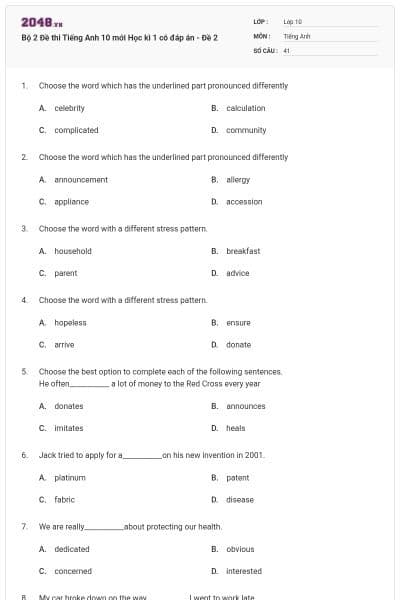
Bộ 2 Đề thi Tiếng Anh 10 mới Học kì 1 có đáp án - Đề 2
41 câu hỏi
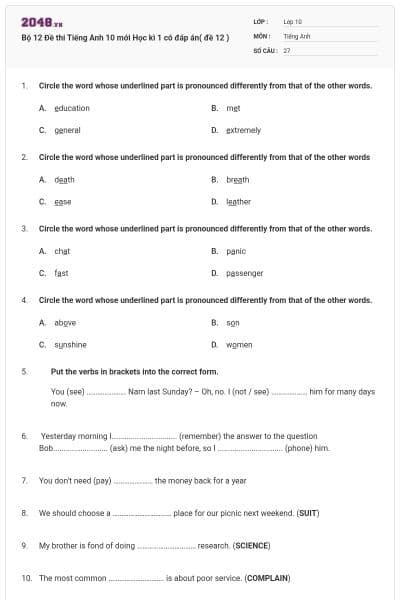
celebrity
calculation
complicated
community
Giải thích: celebrity /səˈlebrəti/ có “c” được phát âm là /s/, các phương án còn lại có “c” được phát âm là /k/.
B. calculation /ˌkælkjuˈleɪʃn/ C. complicated /ˈkɒmplɪkeɪtɪd/ D. community /kəˈmjuːnəti/
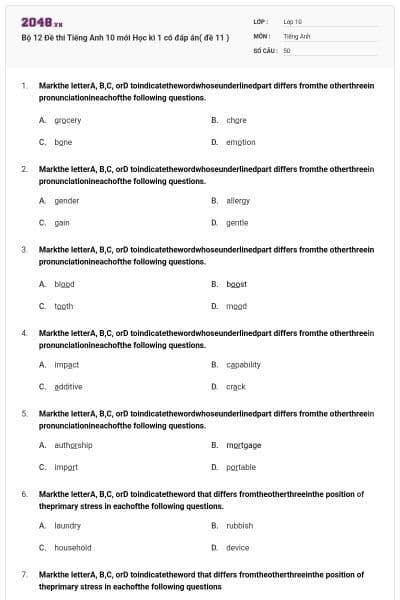
announcement
allergy
appliance
accession
Giải thích: allergy /ˈælədʒi/ có “a” được phát âm là /æ/, các phương án còn lại có “a” được phát âm là /ə/.
A. announcement /əˈnaʊnsmənt/ C. appliance /əˈplaɪəns/ D. accession /əkˈseʃn/
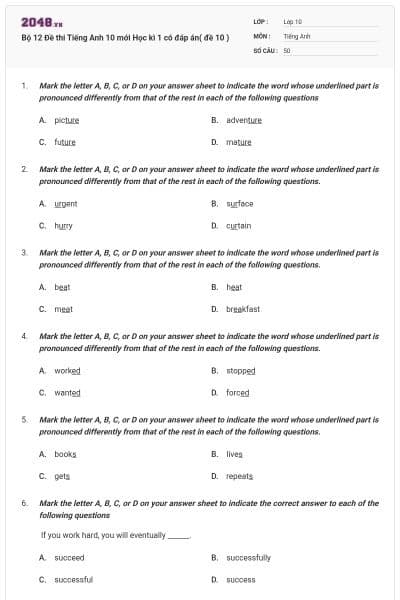
household
breakfast
parent
advice
Giải thích: advice /ədˈvaɪs/ có trọng âm được nhấn vào âm tiết thứ hai, các phương án còn lại có trọng âm được nhấn vào âm tiết đầu tiên.
A. household /ˈhaʊshəʊld/ B. breakfast /ˈbrekfəst/ C. parent /ˈpeərənt/
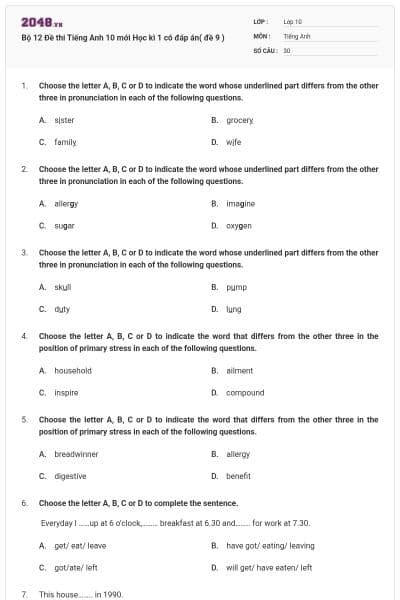
hopeless
ensure
arrive
donate
Giải thích: hopeless /ˈhəʊpləs/ có trọng âm được nhấn vào âm tiết đầu tiên, các phương án còn lại có trọng âm được nhấn vào âm tiết thứ hai.
B. ensure /ɪnˈʃʊə(r)/ C. arrive /əˈraɪv/ D. donate /dəʊˈneɪt/
He often___________ a lot of money to the Red Cross every year
donates
announces
imitates
heals
Giải thích:
A. donates (Vs.): tặng, cho B. announces (Vs.): thông báo
C. imitates (Vs.): bắt chước D. heals (Vs.): chữa, lành lại
Xét về nghĩa, phương án A phù hợp nhất.
Dịch nghĩa: He often donates a lot of money to the Red Cross every year. (Anh ấy thường quyên góp rất nhiều tiền cho Hội Chữ Thập Đỏ mỗi năm.)
platinum
patent
fabric
disease
Giải thích:
A. platinum (n.): bạch kim B. patent (n.): bằng sáng chế
C. fabric (n.): vải, chất liệu từ vải D. disease (n.): bệnh
Xét về nghĩa, phương án B phù hợp nhất.
Dịch nghĩa: Jack tried to apply for a patent on his new invention in 2001. (Jack đã cố gắng xin cấp bằng sáng chế cho phát minh mới của mình vào năm 2001.)
We are really___________about protecting our health.
dedicated
obvious
concerned
interested
Giải thích:
A. dedicated (adj.): tận tâm (+ to) B. obvious (adj.): rõ ràng
C. concerned (adj.): quan tâm (+about) D. interested (adj.): thích, quan tâm (+ in)
Xét về nghĩa và ngữ pháp, phương án C phù hợp nhất.
Dịch nghĩa: We are really concerned about protecting our health. (Chúng tôi thực sự quan tâm tới việc bảo vệ sức khỏe.)
My car broke down on the way, ___________I went to work late.
but
yet
or
so
Giải thích:
A. but (conj.): nhưng B. yet (conj.): nhưng
C. or (conj.): hoặc D. so (conj.): vì vậy
Xét về nghĩa, phương án D phù hợp nhất.
Dịch nghĩa: My car broke down on the way, so I went to work late. (Xe ô tô của tôi đã hỏng trên đường, vì thế tôi đã đi làm muộn.)
We___________this film twice.
have seen
are seeing
saw
will see
Giải thích: Ta sử dụng thì hiện tại hoàn thành để diễn tả hành động đã xảy ra nhiều lần từ quá khứ đến hiện tại, với dấu hiệu “twice” (hai lần), cấu trúc của thì hiện tại hoàn thành là: chủ ngữ + have/ has + động từ chia ở dạng quá khứ phân từ. Chủ ngữ “we” ta dùng với “have”, dạng quá khứ phân từ của “see” là “seen”.
Dịch nghĩa: We have seen this film twice. (Chúng tôi đã từng xem bộ phim này hai lần rồi.)
Mr. Smith___________ TV while his wife___________the dishes.
watched-washed
watched-was washing
was watching-washed
was watching-was washing
Giải thích: Với liên từ “while” (trong khi), xét về nghĩa, câu đã cho diễn tả hai hành động xảy ra cùng một lúc/ song song. Do đó, ta sử dụng thì quá khứ tiếp diễn cho cả hai mệnh đề. cấu trúc dạng khẳng định của thì quá khứ tiếp diễn: S + was/were + V-ing. Chủ ngữ “Mr. Smith” và “his wife” là ngôi thứ ba số ít nên ta dùng “was”.
Dịch nghĩa: Mr. Smith was watching TV while his wife was washing the dishes (Ông Smith đang xem tivi trong khi vợ ông ấy đang rửa bát.)
My close friend, John has just come from USA. I___________him tonight.
will meet
met
am going to meet
was meeting
Giải thích: Với tình huống đã cho “My close friend, John has just come from USA.” (Bạn thân của tôi là Jack vừa mới từ Mỹ về.), đây là dấu hiệu diễn tả dự định cho một việc trong tương lai, nên trong câu sau đó, ta sử dụng thì tương lai gần. cấu trúc dạng khẳng định của thì tương lai gần: S + is/ am/ are + going to + V. Ngôi ì” dùng với “am”.
Dịch nghĩa: My close friend, John has just come from USA. I am going to meet him tonight. (Bạn thân của tôi là Jack vừa mới từ Mỹ về. Tôi dự định gặp cậu ấy vào tối nay.)
I don’t know what___________for this job interview.
wear
wearing
to wearing
to wear
Giải thích: Sau đại từ “what” (cái gì), ta sử dụng động từ nguyên thể có “to” (what to V: làm gì)
Dịch nghĩa: I don’t know what to wear for this job interview. (Tôi không biết phải mặc gì trong buổi phỏng vấn xin việc này.)
Choose the word or phrase that is OPPOSITE in meaning to the underlined part in each of the following sentences.
The movie was so interesting that we saw it again and again.
boring
exciting
fascinating
good
Giải thích: The movie was so interesting that we saw it again and again. (Bộ phim hay đến nỗi mà chúng tôi đã xem đi xem lại nó.)
A. boring: buồn tẻ, chán ngắt B. exciting: thú vị, hứng thú
C. fascinating: hứng thú D. good: hay, tốt
Như vậy, “interesting” (hay, thú vị) có nghĩa tương phản với phương án A.
Mary was never able to heal the rift between herself and her father.
fix
rebuild
hurt
cure
Giải thích: Mary was never able to heal the rift between herself and her father. (Mary không bao giờ có thể hàn gắn rạn nứt giữa cô và bố mình.)
A. fix: sửa chữa B. rebuild: xây dựng lại
C. hurt: làm tổn hại D. cure: chữa trị
Như vậy, “heal” (hàn gắn) có nghĩa tương phản với phương án C.
His___________made a great impression on me. (GENEROUS)
Giải thích: Sau tính từ sở hữu “her” (của cô ấy), ta sử dụng một danh từ. Từ đã cho “generous” (rộng lượng) là tính từ, vậy danh từ của nó là “generosity” (sự rộng lượng).
Dịch nghĩa: His generosity made a great impression on me. (Hành động rộng lượng của cô đã tạo một ấn tượng lớn với tôi.)
Giải thích: ô trống cần điền đứng sau mạo từ “the” và trước danh từ “system” nên ta sử dụng một tính từ. Từ trong ngoặc “nerve” (dây thần kinh) là danh từ, vậy tính từ của nó là “nervous”.
Dịch nghĩa: The brain is a part of the nervous system of the human body. (Bộ não là một phần của hệ thần kinh của cơ thể con người.)
Giải thích: Ta có cấu trúc: offer to + động từ nguyên thể: tự nguyện làm gì. Từ trong ngoặc “donation” (quà tặng) là một danh từ, vậy động từ của nó là “donate”.
Dịch nghĩa: Many people offered to donate blood to these patients. (Nhiều người tình nguyện hiến máu cho những bệnh nhân này.)
The band consists___________two female singers and one male singer.
Giải thích: Ta có cấu trúc: consist of: chứa đựng, bao gồm
Dịch nghĩa: The band consists of two female singers and one male singer. (Ban nhạc này gồm hai ca sĩ nữ và một ca sĩ nam.)
Giải thích: Ta có cấu trúc: be dedicated to: tận tâm, tận tụy
Dịch nghĩa: Linda is completely dedicated to her volunteer work. (Linda hoàn toàn tận tâm làm công việc tình nguyện.)
Giải thích: Ta có cấu trúc: have an impact on: có ảnh hưởng tới
Dịch nghĩa: Music has a big impact on his life. (Âm nhạc có ảnh hưởng lớn tới cuộc sống của anh ấy.)
Two people are talking about doing the housework in their family. Listen and choose the best option to complete the sentences.
Nancy thinks doing household chores is beneficial for kids because it helps___________.
improve their life skills
develop confidence
teach them self-discipline
All of them are correct
Đáp án: D. All of them are correct.
Dịch nghĩa câu hỏi: Nancy nghĩ rằng làm việc nhà có lợi cho trẻ bởi vì việc đó giúp________.
A. nâng cao kỹ năng sống cho trẻ B. phát triển sự tự tin C. dạy trẻ tính kỷ luậtD. Tất cả các phương án trên đều đúng.
Giải thích: Thông tin nằm ở câu:” Doing household chores is beneficial for us, especially kids. It helps kids develop confidence, improve their life skills and teaches them self-discipline
Nancy’s mum is NOT responsible for___________.
doing the cooking
watering the plants
sweeping the house
Both A & B are correct.
Dịch nghĩa câu hỏi: Mẹ của Nancy KHÔNG có trách nhiệm__________.
A. nấu ăn B. tưới cây
C. quét nhà D. Cả A và B đều đúng.
Giải thích: Thông tin nằm ở câu: “Cooking and watering the plants are things that my mum takes charge of every day”. Theo như thông tin trên, mẹ của Nancy làm 2 việc là nấu ăn (cooking) và tưới cây (watering the plants). Như vậy với câu đã cho, việc mà mẹ Nancy KHÔNG làm là quét nhà (sweeping the house).
Nancy takes out the rubbish___________.
twice a week
in the afternoons
every morning
on Saturdays
Dịch nghĩa câu hỏi: Nancy đổ rác_________.
A. hai lần một tuần B. vào các buổi chiều
C. mọi buổi sáng D. vào các ngày thứ bảy
Giải thích: Thông tin nằm ở câu: “[...] And I help my parents take out the rubbish every afternoon”.
John’s dad___________ .
often goes on business
does heavy lifting in the house
dislikes doing housework
thinks that doing housework is not his duty
Dịch nghĩa câu hỏi: Bố của John__________.
A. thường đi công tác
B. làm việc nặng trong nhà
C. không thích làm việc nhà
D. nghĩ rằng làm việc nhà không phải nhiệm vụ của mình
Giải thích: Thông tin nằm ở câu: “[...] in my family, my dad often goes on business, so he can’t share it with us”. Những phương án B, C, D đều KHÔNG xuất hiện trong đoạn nghe liên quan đến thông tin về bố của John.
John___________after school.
shops for grocery
cleans the floor
cooks
does the washing-up
Dịch nghĩa câu hỏi: John__________sau giờ học.
A. mua hàng tạp hóa B. lau sàn
C. nấu ăn D. rửa bát
Giải thích: Thông tin nằm ở câu: “After school, I help her clean the floor and my younger sister washes the dishes after meals”. Với thông tin ở trên ta thấy em gái John rửa bát, còn John thì lau sàn. Như vậy, phương án B phù hợp nhất.
Research has scientifically proven that meditation is a safe and simple way (1) ___________your physical, emotional, and mental state, and its countless values have been known for thousands of years. More and more doctors promote the benefits of meditation to cure many stress-related illnesses. One of the (2) ___________important benefits of meditation is how it releases stress from our bodies. Meditation practiced regularly will lead you (3) ___________a deeper level of relaxation and contemplation. If you want to be free of constant worry, pressure and stress, meditation can give you a life that is calm, peaceful, happy and relaxing. If you practice (4) ___________, meditation will promote a sense of calm and control, you will feel far more relaxed and happy. Your ability to (5) ___________will be greater. You won’t become stressed about things any more. You’ll feel more peaceful and relaxed about everything instead.
balance
balancing
to balance
to balancing
Giải thích: Trong ô trống cần điền, ta sử dụng dạng động từ nguyên thể có “to” mang nghĩa với mục đích làm gì đó.
more
most
many
much
Giải thích: Trong trường hợp này, xét về nghĩa và ngữ pháp của câu, ta sử dụng dạng thức so sánh bậc nhất, “important” là một tính từ dài, trước đó có mạo từ “the”, với cấu trúc so sánh bậc nhất là: the + most + tính từ dài + danh từ.... Do đó, phương án B phù hợp nhất.
to
for
with
at
Giải thích: Ta có cấu trúc: lead sb to...: làm cho, khiến cho ai... Do đó, phương án A phù hợp nhất.
regular
regularly
regularize
regularity
Giải thích:
A. regular (adj.): đều đặn B. regularly (adv.): một cách đều đặn
C. regularize (v.): làm theo đúng quy tắc D. regularity (n.): sự thường xuyên
Trong ô trống đã cho, ta chọn một trạng từ vì trước đó có động từ “practice”. Do đó, phương án B phù hợp nhất.
take
give
practice
concentrate
Giải thích:
A. take (v.): mang đi B. give (v.): cho, tặng
C. practice (v.): luyện tập D. concentrate (v.): tập trung
Xét về nghĩa, phương án D phù hợp nhất
Folk music is traditional melodies, words, and songs of the common people that are often handed down from one generation to the next. Folk music songs are related to almost every kind of human activity. Folk music often expresses the character of ethnic and social groups and sometimes a nation. A folk song can express political or religious beliefs, tell a story or describe history, or just provide amusement.
Folk music is usually learned by listening rather than by reading the notes or words. The music is shared from person to person, from place to place, and from generation to generation. Folk songs sometimes change either by accident or from a purposeful alteration. Folk song melodies and words often evolve over time. Tunes are shortened or lengthened, pitches and rhythms are altered, and portions of one song may be combined with part of another.
Folk songs can often be classified into different types. The ballad, a song that often tells a story about real events, is one of the main types of folk songs. Ballads are in stanza form, where a melody is repeated for each of several verses, and may have a refrain that is repeated several times. Another type of folk song is those that deal with a particular activity, occupation, or set of circumstances. This group includes work songs, prison songs and war songs. There are also spiritual songs, songs for children and songs about life’s stages.
Đáp án: It often expresses the character of ethnic and social groups and sometimes a nation.
Dịch nghĩa cây hỏi: Nhạc dân gian thường diễn tả cái gì?
Giải thích: Thông tin nằm ở câu: “Folk music often expresses the character of ethnic and social groups and sometimes a nation”.
Đáp án: It is learned by listening rather than by reading the notes or words.
Dịch nghĩa câu hỏi: Nhạc dân gian được học như thế nào?
Giải thích: Thông tin nằm ở câu: “..Folk music is usually learned by listening rather than by reading the notes or words”.
Đáp án: Tunes are shortened or lengthened, pitches and rhythms are altered.
Dịch nghĩa câu hỏi: Các giai điệu, cao độ và nhịp điệu như thế nào?
Giải thích: Thông tin nằm ở câu: “..Tunes are shortened or lengthened, pitches and rhythms are altered”.
Đáp án: The ballad (is one of the main types of folk songs.).
Dịch nghĩa câu hỏi: Cái gì là một trong những thề loại chính của nhạc dân ca?
Giải thích: Thông tin nằm ở câu: “..The ballad, a song that often tells a story about real events, is one of the main types of folk songs”.
Đáp án: It includes work songs, prison songs, war songs, spiritual songs, songs for children and songs about life’s stages.
Dịch nghĩa câu hỏi: Loại khác của nhạc dân ca gồm cái gì?
Giải thích: Thông tin nằm ở câu: “…Another type of folk song is those that deal with a particular activity, occupation, or set of circumstances. This group includes work songs, prison songs and war songs. There are also spiritual songs, songs for children and songs about life’s stages”.
John used to play the drum when he was small.
→ John___________the drum any more.
Đáp án: John doesn’t/ does not play the drum any more.
Giải thích: John used to play the drum when he was small. (John đã từng chơi trống khi cậu ấy còn nhỏ.) Câu đã cho thể hiện một hành động xảy ra trong quá khứ (used to + V) và hiện tại không làm nữa. Với trường hợp này, ta sử dụng cấu trúc tương đương: don’t/ doesn’t (do/ does + not) + động từ nguyên thể... + any more, ở đây, John là ngôi thứ ba số ít nên ta dùng “doesn’t” hoặc “does not”.
Dịch nghĩa: John doesn’t/ does not play the drum any more. (John không còn chơi trống nữa.)
→ A lot of trees___________along the streets by foreign volunteers now.
Đáp án: A lot of trees are being planted along the streets now by foreign volunteers.
Giải thích: Foreign volunteers are planting a lot of trees along the streets now. (Những tình nguyện viên nước ngoài đang trồng nhiều cây dọc theo con phố này bây giờ.)
Với những gợi ý trong câu viết lại, ta phải sử dụng câu bị động thì hiện tại tiếp diễn với cấu trúc là: chủ ngữ + is/are/am + being + động từ chia ở dạng quá khứ phân từ + by...Do “Alot of trees” là chủ ngữ số nhiều nên ta dùng “are”.
Dịch nghĩa: A lot of trees are being planted along the streets by foreign volunteers now. (Nhiều cây được các tình nguyện viên nước ngoài trồng dọc theo con phố này bây giờ.)
→ This new laptop___________one thousand dollar.
Giải thích: Mark spent one thousand dollar on this new laptop. (Mark đã chi một nghìn đô la mua chiếc máy tính xách tay mới này.)
Câu cho trước mang ý nghĩa chi bao nhiêu tiền để làm gì (spend + số tiền + on + st), như vậy trong câu viết lạị ta sử dụng cấu trúc: chủ ngữ + cost + sb + số tiền. Câu đã cho sử dụng thì quá khứ đơn, nên trong câu viết lại, ta sử dụng thì tương tự, dạng quá khứ của động từ “cost” là chính nó.
Dịch nghĩa: This new laptop cost Mark one thousand dollar. (Chiếc máy tính xách tay mới này tiêu tốn của Mark một nghìn đô la.)
Mary took care of my children. I went on business (because)
Giải thích: Ta sử dụng “because” kết nối hai câu để chỉ nguyên nhân-kết quả. Trong trường hợp này, “because” + mệnh đề nguyên nhân, đó là “because I went on business” (bởi vì tôi đi công tác); mệnh đề kết quả là “Mary took care of my children” (Mary đã chăm sóc các con tôi.)
Lưu ý: Ta có thể đặt “because” ở đầu câu hoặc giữa câu. Nếu đặt ở đầu câu thì phải có dấu phẩy ngăn cách hai mệnh đề.
Dịch nghĩa: Because I went on business, Mary took care of my children./ Mary took care of my children because I went on business. (Bởi vì tôi đi công tác nên Mary đã chăm sóc các con tôi./ Mary đã chăm sóc các con tôi bởi vì tôi đi công tác.)
Giải thích: Ta áp dụng cấu trúc của mệnh đề trạng ngữ chỉ kết quả “so...that” như sau: chủ ngữ + to be + so + tính từ + that + mệnh đề: ....quá....đến nỗi...
Dịch mghĩa: The lakes are so dirty that we will clean them up tomorrow morning. (Hồ quá bẩn đến nỗi chúng tôi sẽ làm sạch chúng vào sáng mai.)
You can use the following questions as cues or your own ideas:
• What is it?
• How do you know it?
• When do you do it?
• Why do you think it is healthy?
Viết một đoạn (120 - 150 từ) về những thói quen mà bạn làm để có một lối sống lành mạnh.
Bạn có thể sử dụng những câu hỏi sau làm gợi ý:
• Đó là gì?
• Bạn biết nó như thế nào?
• Bạn thực hiện nó vào khi nào?
• Tại sao bạn nghĩ nó có lợi cho sức khỏe của bạn?
Gợi ý trả lời:
MAIN IDEAS (Ý chính)
What (Cái gì)
* do yoga (v. phr.) (tập yoga)
* go on a diet (v. phr.) (ăn kiêng)
* play tennis (v. phr.) (chơi tennis)
* cycle (v.) (đạp xe)
How (Như thế nào)
* on TV (adv.) (trên truyền hình)
* through friends (adv.) (qua bạn bè)
* by reading newspaper (adv.) (bằng việc đọc báo)
* on the radio (adv.) (trên đài)
When (Khi nào)
* after work (adv.) (sau giờ làm việc)
* every month (adv.) (hàng tháng)
* every week (adv.) (hàng tuần)
* at the weekend (adv.) (vào ngày cuối tuần)
Why (Tại sao)
* lose weight (v. phr.) (giảm cân)
* avoid diseases (v. phr.) (ngăn ngừa bệnh tật)
* keep body healthy (v. phr.) (giữ cho cơ thể khỏe mạnh)
* good blood circulation (n. phr.) (máu lưu thông tốt)
Bài mẫu:
I think that these habits keep my body and mind healthy, help blood circulate well. What’s more, those who have such a healthy lifestyle are not likely to suffer from diseases such as mental stress or cancer.
Tôi vô tình đọc một bài báo về sức khỏe trên tờ CNN 5 năm trước nói về các thói quen lành mạnh, chế độ ăn uống phù hợp và một số cách để giữ dáng. Họ đề nghị tập ít nhất một bài thể dục mỗi tuần một lần, một hoạt động để thư giãn và chế độ ăn uống hợp lý. Sau giờ làm việc, tôi chơi tennis với bạn bè trong 1,5 giờ mỗi tuần một lần. Ngoài ra, tôi cũng tập yoga ít nhất trong 15 phút, đặc biệt là vào buổi sáng mỗi ngày vì nó giúp tôi thư giãn và cải thiện khả năng tập trung. Hơn nữa, tôi cũng duy trì chế độ ăn uống hợp lí với những thực phẩm chứa ít calo và chất béo. Tôi thường ăn nhiều cá, rau, trái cây cũng như cắt giảm thịt và đồ ăn nhanh.
Tôi nghĩ rằng những thói quen này giúp cho cơ thể và tâm trí của tôi khỏe mạnh, giúp máu lưu thông tốt. Những người có lối sống lành mạnh như vậy ít nguy cơ mắc các bệnh như căng thẳng tinh thần hoặc ung thư.