6 câu hỏi
Cho hình hộp ABCD. A′B′C′D′ có AC′ và A′C cắt nhau tại O (Hình vẽ)
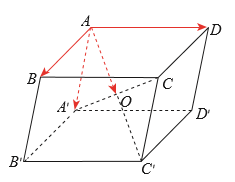
a) Tìm vec tơ \[\overrightarrow {AB} + \overrightarrow {AD} + \overrightarrow {AA'} \].
b) Cho biết mối quan hệ giữa vec tơ tìm được ở câu a) và vec tơ \[\overrightarrow {AO} \].
a) Theo quy tắc hình hộp ta có: \(\overrightarrow {AB} + \overrightarrow {AD} + \overrightarrow {A{A^\prime }} = \overrightarrow {A{C^\prime }} \).
\({\rm{b}})\) Vì \(A{A^\prime }//C{C^\prime }\) và \(A{A^\prime } = C{C^\prime }\) (vì cùng song song và bằng \(B{B^\prime }\) )
Nên \(A{A^\prime }{C^\prime }C\) là hình bình hành.
Mà \(A{C^\prime }\) và \({{\rm{A}}^\prime }C\) cắt nhau tại \({\rm{O}}\) nên \({\rm{O}}\) là trung điếm của \({\rm{AC}}\) '.
Suy ra \(AO = \frac{1}{2}A{C^\prime }\) mà \(\overrightarrow {AO} \) và \(\overrightarrow {A{C^\prime }} \) cùng hướng nên \(\overrightarrow {AO} = \frac{1}{2}\overrightarrow {A{C^\prime }} \) hay \(\overrightarrow {A{C^\prime }} = 2\overrightarrow {AO} \).
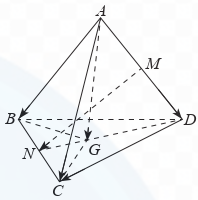
a) \[\overrightarrow {MN} = \frac{1}{2}\left( {\overrightarrow {AB} + \overrightarrow {DC} } \right)\]
b) \[\overrightarrow {AB} + \overrightarrow {AC} + \overrightarrow {AD} = 3\overrightarrow {AG} \]
a) Ta có: \(\overrightarrow {MN} = \overrightarrow {MA} + \overrightarrow {AB} + \overrightarrow {BN} ,\overrightarrow {MN} = \overrightarrow {MD} + \overrightarrow {DC} + \overrightarrow {CN} \).
Do đó \(2\overrightarrow {MN} = \overrightarrow {MA} + \overrightarrow {MD} + \overrightarrow {AB} + \overrightarrow {DC} + \overrightarrow {BN} + \overrightarrow {CN} \).
Vì \(M\) là trung điểm của đoạn thẳng AD nên \(\overrightarrow {MA} + \overrightarrow {MD} = \vec 0\).
Vì \(N\) là trung diểm của đoạn thẳng BC nên \(\overrightarrow {BN} + \overrightarrow {CN} = \vec 0\).
Do đó \(\overrightarrow {MN} = \frac{1}{2}(\overrightarrow {AB} + \overrightarrow {DC} )\).
b) Ta có: \(\overrightarrow {AB} = \overrightarrow {AG} + \overrightarrow {GB} ,\overrightarrow {AC} = \overrightarrow {AG} + \overrightarrow {GC} ,\overrightarrow {AD} = \overrightarrow {AG} + \overrightarrow {GD} \).
Suy ra \(\overrightarrow {AB} + \overrightarrow {AC} + \overrightarrow {AD} = 3\overrightarrow {AG} + \overrightarrow {GB} + \overrightarrow {GC} + \overrightarrow {GD} \).
Vì \(G\) là trọng tâm của tam giác BCD nên \(\overrightarrow {GB} + \overrightarrow {GC} + \overrightarrow {GD} = \vec 0\).
Do đó \(\overrightarrow {AB} + \overrightarrow {AC} + \overrightarrow {AD} = 3\overrightarrow {AG} \).
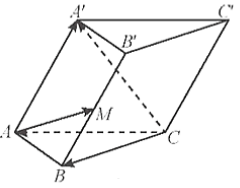
Vì \({\rm{M}}\) là trung diếm của \({\rm{BB}}\) nên \(\overrightarrow {BM} = \frac{1}{2}\overrightarrow {B{B^\prime }} \).
Do \(ABC \cdot {A^\prime }{B^\prime }{C^\prime }\) là lăng trụ nên \(\overrightarrow {B{B^\prime }} = \overrightarrow {C{C^\prime }} \).
Có \(\overrightarrow {AM} = \overrightarrow {AB} + \overrightarrow {BM} = \overrightarrow {AC} + \overrightarrow {CB} + \frac{1}{2}\overrightarrow {B{B^\prime }} = \overrightarrow {CB} - \overrightarrow {CA} + \frac{1}{2}\overrightarrow {B{B^\prime }} = \vec b - \vec a + \frac{1}{2}\vec c\).
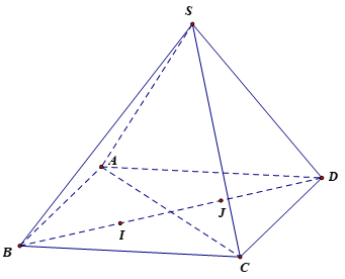
Vì \({\rm{I}}\) là trọng tâm của \({\rm{DABC}}\) nên \(\overrightarrow {IA} + \overrightarrow {IB} + \overrightarrow {IC} = \vec 0\)
\( \Leftrightarrow \overrightarrow {SA} - \overrightarrow {SI} + \overrightarrow {SB} - \overrightarrow {SI} + \overrightarrow {SC} - \overrightarrow {SI} = \vec 0 \Leftrightarrow \overrightarrow {SA} + \overrightarrow {SB} + \overrightarrow {SC} = 3\overrightarrow {SI} (1).\)Tương tự, \(\overrightarrow {SA} + \overrightarrow {SD} + \overrightarrow {SC} = 3\overrightarrow {SJ} \) (2).
Cộng từng vế (1) và (2), ta có: \(2\overrightarrow {SA} + \overrightarrow {SB} + 2\overrightarrow {SC} + \overrightarrow {SD} = 3(SI + \overrightarrow {SJ} )\).
Cho hình hộp ABCD.EFGH. Điểm M là trọng tâm của tam giác AFH (Hình 2.16).
a) Tìm \[\overrightarrow u = \overrightarrow {AB} + \overrightarrow {CB} + \overrightarrow {GH} + \overrightarrow {EH} \]
b) Tìm \[\overrightarrow v = \overrightarrow {FA} - \overrightarrow {BD} \]
c) Chứng minh rằng ba điểm E, M, C thẳng hàng.
d) Tính độ dài của \[\overrightarrow {EM} \] trong trường hợp ABCD.EFGH là hình hộp đứng có các cạnh AB = 5, AD = 6, AE = 10 và \[\widehat {ABC}\] = 120°.
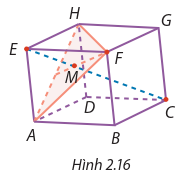
Khi ABCD.EFGH là hình hộp đứng thì EAC là tam giác vuông tại A, do đó:
EC2 = EA2 + AC2 = 100 + 91 = 191. Suy ra EM = \[EM = \frac{1}{3}\sqrt {191} \].
Bạn có thích hoạt động này không?
Ý kiến của bạn sẽ giúp chúng tôi đề xuất nội dung phù hợp hơn.