20 câu trắc nghiệm Toán 12 Chân trời sáng tạo Bài 1. Vectơ và các phép toán trong không gian (Đúng sai - Trả lời ngắn) có đáp án
20 câu hỏi
\(\overrightarrow {AC'} = \overrightarrow {AB} + \overrightarrow {AC} + \overrightarrow {AB} \).
\(\overrightarrow {AC'} = \overrightarrow {AB} + \overrightarrow {AD} + \overrightarrow {AA'} \).
\(\overrightarrow {AC'} = \overrightarrow {AB'} + \overrightarrow {AC} + \overrightarrow {AD'} \).
\(\overrightarrow {AC'} = \overrightarrow {AB'} + \overrightarrow {AD'} + \overrightarrow {AA'} \).
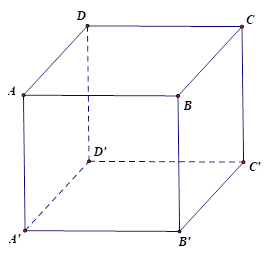
Theo quy tắc hình hộp ta có: \(\overrightarrow {AC'} = \overrightarrow {AB} + \overrightarrow {AD} + \overrightarrow {AA'} \).
\(\overrightarrow {SA} + \overrightarrow {SB} + \overrightarrow {SC} + \overrightarrow {SD} = 4\overrightarrow {SO} \).
\(\overrightarrow {SA} - \overrightarrow {SB} + \overrightarrow {SC} - \overrightarrow {SD} = \overrightarrow 0 \).
\(\overrightarrow {SA} + \overrightarrow {SB} + \overrightarrow {SC} + \overrightarrow {SD} = \overrightarrow 0 \).
\(\overrightarrow {OA} + \overrightarrow {OB} + \overrightarrow {OC} + \overrightarrow {OD} = \overrightarrow 0 \).

Vì O là trung điểm của AC nên \(\overrightarrow {SA} + \overrightarrow {SC} = 2\overrightarrow {SO} \).
Vì O là trung điểm của BD nên \(\overrightarrow {SB} + \overrightarrow {SD} = 2\overrightarrow {SO} \).
Suy ra \(\overrightarrow {SA} + \overrightarrow {SB} + \overrightarrow {SC} + \overrightarrow {SD} = 4\overrightarrow {SO} \).
\(\overrightarrow {DD'} \).
\(\overrightarrow {AD} \).
\(\overrightarrow {AB} \).
\(\overrightarrow {CD} \).

Có \(\overrightarrow {D'C'} = \overrightarrow {A'B'} = \overrightarrow {AB} \).
\(\overrightarrow {AB} - \overrightarrow {AD} = \overrightarrow {DB} \).
\(\overrightarrow {AB} + \overrightarrow {AD} = \overrightarrow {DB} \).
\(\overrightarrow {AB} + \overrightarrow {CD} = \overrightarrow {AD} \).
\(\overrightarrow {AB} - \overrightarrow {CD} = \overrightarrow {AD} \).
\(\overrightarrow {AM} = \overrightarrow {AB} + \overrightarrow {AA'} \).
\(\overrightarrow {AM} = 2\overrightarrow {AB} + \overrightarrow {AA'} \).
\(\overrightarrow {AM} = \overrightarrow {AB} + \frac{1}{2}\overrightarrow {AA'} \).
\(\overrightarrow {AM} = \frac{1}{2}\overrightarrow {AB} + \frac{1}{2}\overrightarrow {AA'} \).

Vì M là trung điểm của BB' nên ta có:
\(2\overrightarrow {AM} = \overrightarrow {AB} + \overrightarrow {AB'} = \overrightarrow {AB} + \overrightarrow {AA'} + \overrightarrow {A'B'} = 2\overrightarrow {AB} + \overrightarrow {AA'} \) \( \Rightarrow \overrightarrow {AM} = \overrightarrow {AB} + \frac{1}{2}\overrightarrow {AA'} \).
\[\overrightarrow {AD} \, + \,\overrightarrow {BC} \].
\[\overrightarrow {DA} \, + \,\overrightarrow {CB} \] .
\[\overrightarrow {DA} \, + \,\overrightarrow {BC} \].
\[\overrightarrow {AD} \, + \,\overrightarrow {CB} \].
Theo quy tắc ba điểm, ta có: \[\overrightarrow {AB\,} \, = \overrightarrow {AD} \, + \,\overrightarrow {DB} \]
Do đó:\[\overrightarrow {AB} \, + \,\overrightarrow {CD} \, = \,\overrightarrow {AD} \, + \,\overrightarrow {DB} \, + \,\overrightarrow {CD} \]
\( = \overrightarrow {AD} \, + \left( {\,\overrightarrow {DB} \, + \,\overrightarrow {CD} } \right)\) \( = \,\overrightarrow {AD} \, + \left( {\,\,\overrightarrow {CD} \, + \,\overrightarrow {DB} } \right)\)\( = \,\overrightarrow {AD} \, + \,\overrightarrow {CB} \).
\(30^\circ \).
\(45^\circ \).
\(60^\circ \).
\(90^\circ \).
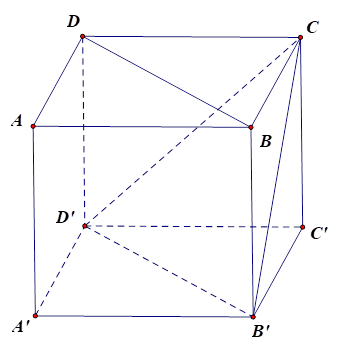
Ta có: \(\overrightarrow {BD} \, = \,\,\overrightarrow {B'D'} \). Do đó \(\left( {\overrightarrow {BD} \,,\,\overrightarrow {B'C} } \right)\, = \,\left( {\overrightarrow {B'D'} \,,\,\overrightarrow {B'C} } \right)\, = \widehat {\,D'B'C'}\)
Vì \(B'C = \,CD'\, = \,D'B'\)nên tam giác \(B'CD'\)là tam giác đều.
Suy ra \(\widehat {\,D'B'C'}\, = \,60^\circ \). Vậy \(\left( {\overrightarrow {BD} \,,\,\overrightarrow {B'C} } \right)\, = \,60^\circ \).
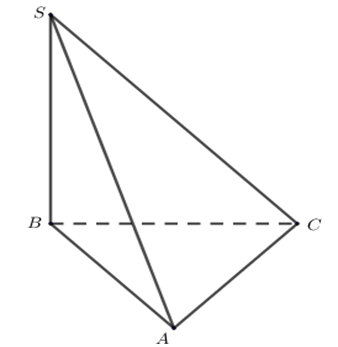
Cho tứ diện \(S.ABC\) có đáy là tam giác đều cạnh \(a\), \(SB\) vuông góc với đáy và \(SB = \sqrt 3 a\). Góc giữa hai vectơ \(\left( {\overrightarrow {AB} ,\overrightarrow {AS} } \right)\) là
\[60^\circ \].
\[30^\circ \].
\[45^\circ \].
\[90^\circ \].
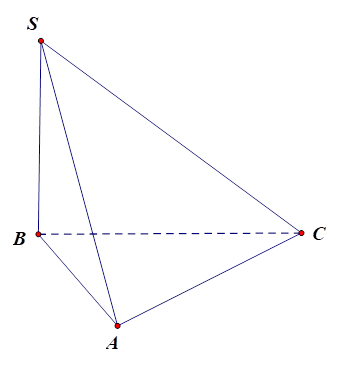
Ta có: \(\left( {\overrightarrow {AB} ,\overrightarrow {AS} } \right) = \widehat {SAB}\).
Xét \(\Delta SBA\) vuông tại \(B\) ta có: \[\tan \widehat {SAB} = \frac{{SB}}{{AB}}\]\[ = \sqrt 3 \] . Suy ra: \(\left( {\overrightarrow {AB} ,\overrightarrow {AS} } \right) = 60^\circ \) .
\[\sqrt 2 {a^2}\].
\[{a^2}\].
\[ - \sqrt 2 {a^2}\].
\[0\].

Vì DD' ^ A'C' nên \(\overrightarrow {DD'} .\overrightarrow {A'C'} = 0\).

Học thông minh hơn mỗi ngày
Xem toàn bộ 20 câu hỏi và nhiều hơn nữa với tài khoản miễn phí

2.
4.
−2.
−4.

Ta có: \(\left( {\overrightarrow {AB} ,\overrightarrow {A'C'} } \right) = \left( {\overrightarrow {AB} ,\overrightarrow {AC} } \right) = 45^\circ \).
Khi đó: \(\overrightarrow {AB} .\overrightarrow {A'C'} = AB.A'C'.\cos \left( {\overrightarrow {AB} ,\overrightarrow {A'C'} } \right) = 2.2\sqrt 2 .\cos 45^\circ = 4\).
PHẦN II. TRẮC NGHIỆM ĐÚNG – SAI
Cho hình chóp \[S.ABCD\] có đáy \[ABCD\]là hình vuông, \(SA\)vuông góc với mặt phẳng \((ABCD)\).Gọi \[I,J\] lần lượt là trung điểm của \[SA,SC\]. \[G\]là trọng tâm tam giác \[SBD\]
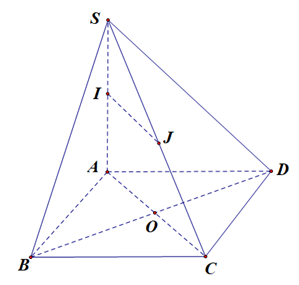
a) \(\overrightarrow {AC} - \overrightarrow {AB} = \overrightarrow {AD} \).
b) \(\overrightarrow {AS} + \overrightarrow {AB} + \overrightarrow {AD} = \overrightarrow {AG} \).
c) \[\overrightarrow {{\rm{IJ}}} .\overrightarrow {BD} = \overrightarrow 0 \]
d) \({\overrightarrow {AG} ^2} = {\overrightarrow {AS} ^2} + {\overrightarrow {AB} ^2} + {\overrightarrow {AD} ^2}\).
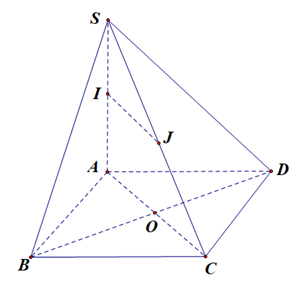
a) Ta có \[ABCD\] là hình vuông nên \(\overrightarrow {AC} = \overrightarrow {AB} + \overrightarrow {AD} \) ( qui tắc hình bình hành) suy ra\(\overrightarrow {AC} - \overrightarrow {AB} = \overrightarrow {AD} \).
b) Do \[G\]là trọng tâm tam giác \[SBD\] nên
\(\overrightarrow {GS} + \overrightarrow {GB} + \overrightarrow {GD} = \overrightarrow 0 \Rightarrow \left( {\overrightarrow {GA} + \overrightarrow {AS} } \right) + \left( {\overrightarrow {GA} + \overrightarrow {AB} } \right) + \left( {\overrightarrow {GA} + \overrightarrow {AD} } \right) = \overrightarrow 0 \)
\( \Rightarrow \overrightarrow {AS} + \overrightarrow {AB} + \overrightarrow {AD} = 3\overrightarrow {AG} .\)
c) Ta có\[ABCD\] là hình vuông nên \(AC \bot BD \Rightarrow \overrightarrow {AC} .\overrightarrow {BD} = 0 \Rightarrow 2\overrightarrow {{\rm{IJ}}} .\overrightarrow {BD} = 0 \Rightarrow \overrightarrow {{\rm{IJ}}} .\overrightarrow {BD} = 0\).
d) Do \[G\]là trọng tâm tam giác \[SBD\] nên
\(\overrightarrow {AS} + \overrightarrow {AB} + \overrightarrow {AD} = 3\overrightarrow {AG} \)\({\left( {3\overrightarrow {AG} } \right)^2} = {\left( {\overrightarrow {AS} + \overrightarrow {AB} + \overrightarrow {AD} } \right)^2} \Rightarrow 9A{G^2} = A{S^2} + A{B^2} + A{D^2} + 2\overrightarrow {AS} \overrightarrow {AB} + 2\overrightarrow {AS} \overrightarrow {AD} + 2\overrightarrow {AD} \overrightarrow {AB} \;\left( 1 \right)\).
Vì \(SA\)vuông góc với mặt phẳng \((ABCD)\) nên\(\left\{ \begin{array}{l}SA \bot AB\\SA \bot AD\end{array} \right. \Rightarrow \left\{ \begin{array}{l}\overrightarrow {SA} .\overrightarrow {AD} = 0\\\overrightarrow {SA} .\overrightarrow {AB} = 0\end{array} \right.\;\left( 2 \right)\).
\[ABCD\] là hình vuông nên \(\overrightarrow {AB} .\overrightarrow {AD} = 0\left( 3 \right)\).
Từ \[\left( 1 \right);\left( 2 \right);\left( 3 \right)\] ta được \(9A{G^2} = A{S^2} + A{B^2} + A{D^2}.\)
Đáp án: a) Đúng; b) Sai; c) Sai; d) Sai.
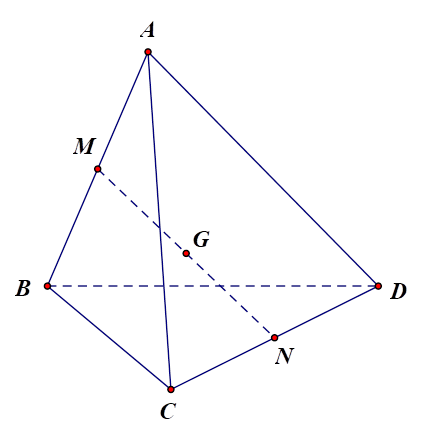
a) Có \(\overrightarrow {GA} + \overrightarrow {GB} = 2\overrightarrow {GM} ;\overrightarrow {GC} + \overrightarrow {GD} = 2\overrightarrow {GN} \).
Do đó \(\overrightarrow {GA} + \overrightarrow {GB} + \overrightarrow {GC} + \overrightarrow {GD} = 2\left( {\overrightarrow {GM} + \overrightarrow {GN} } \right) = \overrightarrow 0 \).
b) \(\overrightarrow {MA} + \overrightarrow {MB} + \overrightarrow {MC} + \overrightarrow {MD} \)\( = 4\overrightarrow {MG} + \overrightarrow {GA} + \overrightarrow {GB} + \overrightarrow {GC} + \overrightarrow {GD} \)\( = 4\overrightarrow {MG} \).
c) d) Ta có \(\overrightarrow {MN} = \overrightarrow {MB} + \overrightarrow {BC} + \overrightarrow {CN} \);
\(\overrightarrow {MN} = \overrightarrow {MA} + \overrightarrow {AD} + \overrightarrow {DN} \).
Suy ra \(2\overrightarrow {MN} = \overrightarrow {MB} + \overrightarrow {MA} + \overrightarrow {BC} + \overrightarrow {AD} + \overrightarrow {CN} + \overrightarrow {DN} \)\( = \overrightarrow {BC} + \overrightarrow {AD} \)\( = \overrightarrow {BA} + \overrightarrow {AC} + \overrightarrow {AB} + \overrightarrow {BD} \)\( = \overrightarrow {AC} + \overrightarrow {BD} \).
Đáp án: a) Đúng; b) Đúng; c) Sai; d) Đúng.
Trong không gian, cho hình chóp S.ABCD có đáy ABCD là hình bình hành tâm O. Gọi G là điểm thỏa mãn \(\overrightarrow {GS} + \overrightarrow {GA} + \overrightarrow {GB} + \overrightarrow {GC} + \overrightarrow {GD} = \overrightarrow 0 \)(tham khảo hình vẽ)
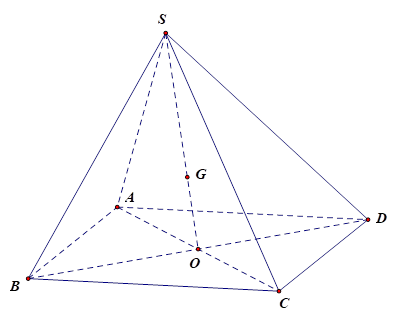
a) Hai vectơ \(\overrightarrow {AO} ;\overrightarrow {CO} \) bằng nhau.
b) \(\overrightarrow {SB} + \overrightarrow {SD} = \overrightarrow {SA} + \overrightarrow {SC} \).
c) \(\overrightarrow {GS} = 4\overrightarrow {OG} \).
d) Nếu tam giác DABC có AB = 2a; \(BC = a\sqrt 7 \); AC = 3a thì \(\overrightarrow {AB} .\overrightarrow {AC} = 3{a^2}\).
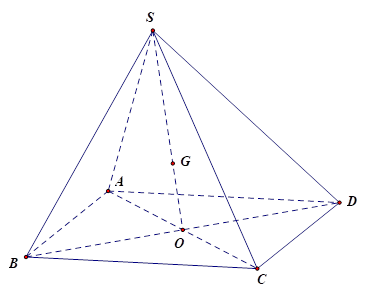
a) Hai vectơ \(\overrightarrow {AO} ;\overrightarrow {CO} \) cùng độ dài nhưng ngược hướng nên hai vectơ này không bằng nhau.
b) Ta có \(\overrightarrow {SB} + \overrightarrow {SD} = \overrightarrow {SA} + \overrightarrow {SC} = 2\overrightarrow {SO} \).
c) \(\overrightarrow {GS} + \overrightarrow {GA} + \overrightarrow {GB} + \overrightarrow {GC} + \overrightarrow {GD} = \overrightarrow 0 \)\( \Leftrightarrow \overrightarrow {GS} + \overrightarrow {OA} + \overrightarrow {OB} + \overrightarrow {OC} + \overrightarrow {OD} - 4\overrightarrow {OG} = \overrightarrow 0 \)
\( \Leftrightarrow \overrightarrow {GS} - 4\overrightarrow {OG} = \overrightarrow 0 \) (vì \(\overrightarrow {OA} + \overrightarrow {OB} + \overrightarrow {OC} + \overrightarrow {OD} = \overrightarrow 0 \))
\( \Leftrightarrow \overrightarrow {GS} = 4\overrightarrow {OG} \).
d) Xét DABC có \(\cos \widehat {BAC} = \frac{{A{B^2} + A{C^2} - B{C^2}}}{{2.AB.AC}} = \frac{{4{a^2} + 9{a^2} - 7{a^2}}}{{2.2a.3a}} = \frac{{6{a^2}}}{{12{a^2}}} = \frac{1}{2}\).
Ta có \(\overrightarrow {AB} .\overrightarrow {AC} = \left| {\overrightarrow {AB} } \right|.\left| {\overrightarrow {AC} } \right|.\cos \left( {\overrightarrow {AB} ,\overrightarrow {AC} } \right) = \left| {\overrightarrow {AB} } \right|.\left| {\overrightarrow {AC} } \right|.\cos \widehat {BAC}\)\( = 2a.3a.\frac{1}{2} = 3{a^2}\).
Đáp án: a) Sai; b) Đúng; c) Đúng; d) Đúng.
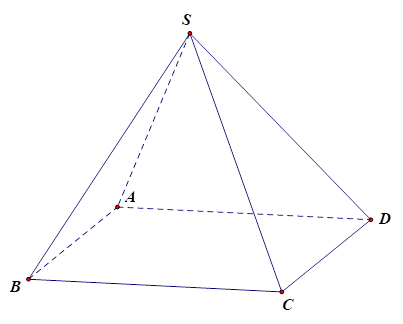
a) Do S.ABCD là hình chóp đều nên ABCD là hình vuông.
b) Do S.ABCD là hình chóp đều tất cả các cạnh bằng a Þ SB = SD = a.
c) Do tứ giác ABCD là hình vuông có độ dài cạnh bằng a nên độ dài đường chéo \(BD = a\sqrt 2 \).
Tam giác SBD có SB = SD = a và \(BD = a\sqrt 2 \) nên tam giác SBD vuông cân tại S, suy ra \(\widehat {SBD} = 45^\circ \).
Vậy \(\left( {\overrightarrow {SB} ,\overrightarrow {BD} } \right) = 180^\circ - \widehat {SBD} = 135^\circ \).
d) Ta có \(\overrightarrow {SB} .\overrightarrow {BD} = \left| {\overrightarrow {SB} } \right|.\left| {\overrightarrow {BD} } \right|.\cos \left( {\overrightarrow {SB} ,\overrightarrow {BD} } \right) = a.a\sqrt 2 .\cos 135^\circ = - {a^2}\).
Đáp án: a) Đúng; b) Đúng; c) Sai; d) Đúng.

a) Ta có \(\overrightarrow {AA'} \) cùng phương với \(\overrightarrow {CM} \) và \(AA' = \frac{3}{2}CM\), suy ra \(\overrightarrow {AA'} = \frac{3}{2}\overrightarrow {CM} \).
b) Do \(\overrightarrow {AC} \) cùng phương với \(\overrightarrow {A'C'} \), suy ra \(\left( {\overrightarrow {AM} ,\overrightarrow {A'C'} } \right) = \left( {\overrightarrow {AM} ,\overrightarrow {AC} } \right) = \widehat {CAM}\),
suy ra \(\cos \left( {\overrightarrow {AM} ,\overrightarrow {A'C'} } \right) = \cos \widehat {CAM} = \frac{{AC}}{{AM}} = \frac{{\sqrt 5 }}{3}\).
c) Ta có \(\overrightarrow {AM} = \overrightarrow {AC} + \overrightarrow {CM} = \overrightarrow {AB} + \overrightarrow {AD} + \frac{2}{3}\overrightarrow {AA'} \).
d) Ta có \(\overrightarrow {B'D} = \overrightarrow {AD} - \overrightarrow {AB'} = \overrightarrow {AD} - \left( {\overrightarrow {AB} + \overrightarrow {AA'} } \right) = - \overrightarrow {AB} + \overrightarrow {AD} - \overrightarrow {AA'} \).
Do đó \(\overrightarrow {AM} .\overrightarrow {B'D} = \left( {\overrightarrow {AB} + \overrightarrow {AD} + \frac{2}{3}\overrightarrow {AA'} } \right).\left( { - \overrightarrow {AB} + \overrightarrow {AD} - \overrightarrow {AA'} } \right)\)
\( = - A{B^2} + A{D^2} - \frac{2}{3}A{A'^2} = - 1 + 4 - 6 = - 3\).
Đáp án: a) Đúng; b) Sai; c) Sai; d) Sai.Đổi 105 g = 0,105 kg.
Độ lớn của lực hấp dẫn của Trái Đất tác dụng lên một quả táo là:
\(\left| {\overrightarrow P } \right| = m\left| {\overrightarrow g } \right| = 0,105.9,8 = 1,029N \approx 1,03N\).
Trả lời: 1,03.
Một chiếc cân đòn tay đang cân một vật có khối lượng \(m = 3\,{\rm{kg}}\)được thiết kế với đĩa cân được giữ bởi bốn đoạn xích \(SA\,,\,SB\,,\,SC\,,\,SD\) sao cho \(S.ABCD\) là hình chóp tứ giác đều có \(\widehat {ASC} = 90^\circ \). Biết độ lớn của lực căng cho mỗi sợi xích có dạng \(\frac{{a\sqrt 2 }}{4}\). Lấy \(g = 10\,{\rm{m/}}{{\rm{s}}^{\rm{2}}}\), khi đó giá trị của \[a\] bằng bao nhiêu?


Gọi \(O\) là tâm của hình vuông \(ABCD\).
Ta có \[\overrightarrow {{\rm{O}}A} + \overrightarrow {OB} + \overrightarrow {OC} + \overrightarrow {OD} = \overrightarrow 0 \Leftrightarrow \overrightarrow {O\,S} + \overrightarrow {SA} + \overrightarrow {OS} + \overrightarrow {SB} + \overrightarrow {OS} + \overrightarrow {SC} + \overrightarrow {OS} + \overrightarrow {SD} = \overrightarrow 0 \]
\[ \Leftrightarrow \overrightarrow {SA} + \overrightarrow {SB} + \overrightarrow {SC} + \overrightarrow {SD} = - 4\overrightarrow {OS} = 4\overrightarrow {SO} \Rightarrow \left| {\overrightarrow {SA} + \overrightarrow {SB} + \overrightarrow {SC} + \overrightarrow {SD} } \right| = \left| {4\overrightarrow {SO} } \right| = 4SO\].
Trọng lượng của vật nặng là \(P = mg = 3.10 = 30\,\left( N \right)\). Suy ra \(4\left| {\overrightarrow {SO} } \right| = P = 30\,\left( N \right) \Rightarrow SO = \frac{{15}}{2}\).
Lại có tam giác \(ASC\) vuông cân tại \(S\) nên
\(SO = SA.\sin \widehat {SAC} \Rightarrow SA = \frac{{SO}}{{\sin \widehat {SAC}}} = \frac{{\frac{{15}}{2}}}{{\sin 45^\circ }} = \frac{{15\sqrt 2 }}{2} = \frac{{30\sqrt 2 }}{4} \Rightarrow a = 30\).
Vậy \(a = 30\).
Trả lời: 30.
Ta có:
\[\overrightarrow {AB} \left( {\overrightarrow {AB} - \overrightarrow {CA} } \right) = \overrightarrow {AB} .\overrightarrow {AB} + \overrightarrow {AB} .\overrightarrow {AC} = {\overrightarrow {AB} ^2} + \left| {\overrightarrow {AB} } \right|.\left| {\overrightarrow {AC} } \right|.\cos \left( {\overrightarrow {AB} ,\overrightarrow {AC} } \right)\]
\[ = A{B^2} + AB.AC.\cos \left( {\widehat {BAC}} \right) = {4^2} + 4.4.\cos 60^\circ = {4^2} + \frac{{{4^2}}}{2} = \frac{{{{3.4}^2}}}{2} = 24\].
Trả lời: 24.
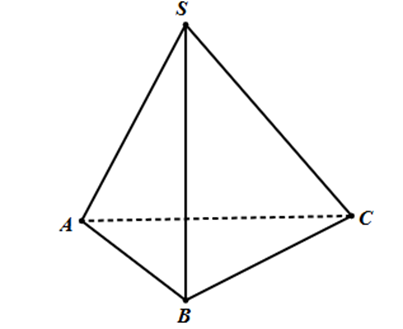
Vì BC2 = SB2 + SC2 nên DSBC vuông cân tại S.
Mặt khác SA = AC = SC = 2 Þ DSAC là tam giác đều.
Ta có \(\overrightarrow {SC} .\overrightarrow {AB} = \overrightarrow {SC} .\left( {\overrightarrow {SB} - \overrightarrow {SA} } \right) = \overrightarrow {SC} .\overrightarrow {SB} - \overrightarrow {SC} .\overrightarrow {SA} \)\( = 0 - \left| {\overrightarrow {SC} } \right|.\left| {\overrightarrow {SA} } \right|.\cos \widehat {ASC} = - 2.2.\cos 60^\circ = \frac{{ - {2^2}}}{2} = - 2\).
Vậy \(\overrightarrow {SC} .\overrightarrow {AB} = - 2\).
Trả lời: −2.
Một chất điểm A nằm trên mặt phẳng nằm ngang (α), chịu tác động bởi ba lực \(\overrightarrow {{F_1}} ,\overrightarrow {{F_2}} ,\overrightarrow {{F_3}} \). Các lực \(\overrightarrow {{F_1}} ,\overrightarrow {{F_2}} \) có giá nằm trong (α) và \(\left( {\overrightarrow {{F_1}} ,\overrightarrow {{F_2}} } \right) = 135^\circ \), còn lực \(\overrightarrow {{F_3}} \) có giá vuông góc với (α) và hướng lên trên. Xác định cường độ hợp lực của các lực \(\overrightarrow {{F_1}} ,\overrightarrow {{F_2}} ,\overrightarrow {{F_3}} \)biết độ lớn của ba lực đó lần lượt là 20 N, 15 N và 10 N (làm tròn kết quả đến hàng phần mười).
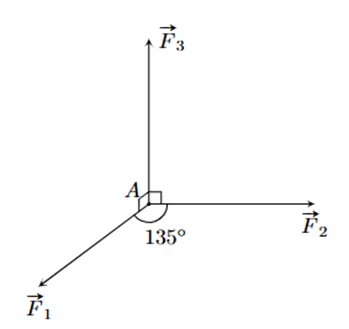
Ta có \(\overrightarrow F = \overrightarrow {{F_1}} + \overrightarrow {{F_2}} + \overrightarrow {{F_3}} \).
Khi đó \(\left| {\overrightarrow F } \right| = \left| {\overrightarrow {{F_1}} + \overrightarrow {{F_2}} + \overrightarrow {{F_3}} } \right|\)\( \Rightarrow {\left| {\overrightarrow F } \right|^2} = {\left| {\overrightarrow {{F_1}} + \overrightarrow {{F_2}} + \overrightarrow {{F_3}} } \right|^2}\)
\( \Rightarrow {\left| {\overrightarrow F } \right|^2} = {\left| {\overrightarrow {{F_1}} } \right|^2} + {\left| {\overrightarrow {{F_2}} } \right|^2} + {\left| {\overrightarrow {{F_3}} } \right|^2} + 2\left( {\overrightarrow {{F_1}} .\overrightarrow {{F_2}} + \overrightarrow {{F_1}} .\overrightarrow {{F_3}} + \overrightarrow {{F_3}} .\overrightarrow {{F_2}} } \right)\)
\[ \Rightarrow {\left| {\overrightarrow F } \right|^2} = {\left| {\overrightarrow {{F_1}} } \right|^2} + {\left| {\overrightarrow {{F_2}} } \right|^2} + {\left| {\overrightarrow {{F_3}} } \right|^2} + 2\left( {\left| {\overrightarrow {{F_1}} } \right|.\left| {\overrightarrow {{F_2}} } \right|.\cos \left( {\overrightarrow {{F_1}} ,\overrightarrow {{F_2}} } \right) + \left| {\overrightarrow {{F_1}} } \right|.\left| {\overrightarrow {{F_3}} } \right|.\cos \left( {\overrightarrow {{F_1}} ,\overrightarrow {{F_3}} } \right) + \left| {\overrightarrow {{F_3}} } \right|.\left| {\overrightarrow {{F_2}} } \right|.\cos \left( {\overrightarrow {{F_3}} ,\overrightarrow {{F_2}} } \right)} \right)\]
\[ \Rightarrow {\left| {\overrightarrow F } \right|^2} = {20^2} + {15^2} + {10^2} + 2\left( {20.15.\cos 135^\circ + 20.10.\cos 90^\circ + 10.15.\cos 90^\circ } \right)\]
\( \Rightarrow \left| {\overrightarrow F } \right| \approx 17,3\) N.
Trả lời: 17,3.
Bạn có thích hoạt động này không?
Hãy lưu hoặc chia sẻ nội dung này đến mọi người.
Gợi ý cho bạn

Ý tưởng của bạn, bài học của bạn
Tự thiết kế đề thi, bài giảng hoặc flashcard theo cách riêng.