30 đề thi thử thpt quốc gia tiếng anh năm 2020 cực hay có lời giải (Đề số 5)
80 câu hỏi
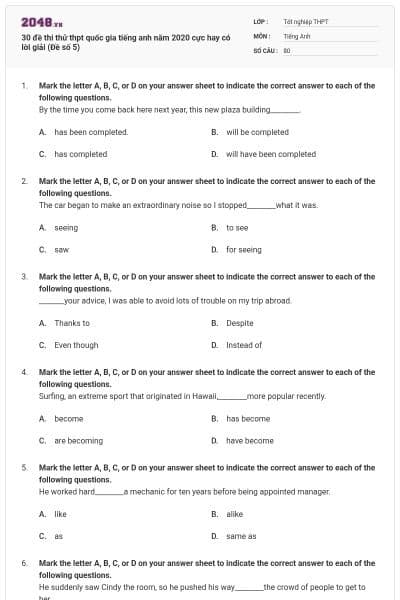
Mark the letter A, B, C, or D on your answer sheet to indicate the correct answer to each of the following questions.
By the time you come back here next year, this new plaza building________.
has been completed.
will be completed
has completed
will have been completed
Đáp án là D. Cấu trúc: by the time + mệnh đề thời gian ở thì hiện tại đơn, mệnh đề thì tương lai hoàn thành: diễn tả một hành động sẽ xảy ra trước một hành động khác trong tương lai
Mark the letter A, B, C, or D on your answer sheet to indicate the correct answer to each of the following questions.
The car began to make an extraordinary noise so I stopped________what it was.
seeing
to see
saw
for seeing
Đáp án là B. stop + to V: dừng lại để làm một việc khác. Còn stop + V-ing: từ bỏ việc gì đó.
Nghĩa câu: The car began to make an extraordinary noise so I stopped to see what it was. (Chiếc xe bắt đầu gây ra một tiếng ồn bất thường nên tôi dừng lại để xem nó là cái gì.)
Mark the letter A, B, C, or D on your answer sheet to indicate the correct answer to each of the following questions.
_______your advice, I was able to avoid lots of trouble on my trip abroad.
Thanks to
Despite
Even though
Instead of
Đáp án là A. Thanks to + N: nhờ vào ....
Nghĩa câu: Thanks to your advice, I was able to avoid lots of trouble on my trip abroad. ( Nhờ lời khuyên của bạn, tôi đã có thể tránh được rất nhiều rắc rối trong chuyến đi ra nước ngoài.)
Cách dùng các liên từ khác: Despite + N: mặc dù; Even though + clause: mặc dù...; Instead of + N: thay vì. ...
Mark the letter A, B, C, or D on your answer sheet to indicate the correct answer to each of the following questions.
Surfing, an extreme sport that originated in Hawaii,________more popular recently.
become
has become
are becoming
have become
Chủ ngữ chính trong câu là “Surfing”. Với danh động từ V-ing đứng đầu câu làm chủ ngữ, động từ theo sau phải chia ở dạng số ít => Đáp án là B.
Mark the letter A, B, C, or D on your answer sheet to indicate the correct answer to each of the following questions.
He worked hard________a mechanic for ten years before being appointed manager.
like
alike
as
same as
Đáp án là C. work as +a/an + N ( nghề nghiệp): làm việc như một ....
Mark the letter A, B, C, or D on your answer sheet to indicate the correct answer to each of the following questions.
He suddenly saw Cindy the room, so he pushed his way________the crowd of people to get to her.
across/through
over/through
over / over
through/ across
Đáp án là A. Các cấu trúc: See someone across ....: nhìn ai đi ngang qua..; to push one's way through the crowd: chen lấn (rẽ lối) qua đám đông
Mark the letter A, B, C, or D on your answer sheet to indicate the correct answer to each of the following questions.
Did you paint it yourself or did you________it painted?
make
do
have
ask
Đáp án là C. Cấu trúc “ nhờ ai đó làm gì” ở dạng bị động: have something done (by someone)
Mark the letter A, B, C, or D on your answer sheet to indicate the correct answer to each of the following questions.
He________for that company for five months when it went bankrupt.
has been worked
has worked
had been working
was working
Đáp án: B
Giải thích:
Kiến thức: Thì của động từ
since + mệnh đề thì quá khứ đơn: kể từ khi… → dấu hiệu thì hiện tại hoàn thành
Loại C và D.
Xét nghĩa câu, ta thấy dùng dạng chủ động, loại A.
Dịch: Anh ấy đã làm việc cho công ty đó kể từ khi anh ấy đến đây.
Mark the letter A, B, C, or D on your answer sheet to indicate the correct answer to each of the following questions.
Alex failed his English exam, but his teacher is going to give him________chance to pass it.
another
the other
the others
other
Đáp án là A. another + N(ít, đếm được): khi được nhắc đến lần đầu tiên.
Cách dùng các từ còn lại:
B.the other + N: khi danh từ đó đã được nhắc đến trước đó, ta sẽ dùng mạo từ “the”
C.the others = the other + Ns
D.other là một tính từ, vị trí của nó thường đứng trước những danh từ số nhiều, hoặc danh từ số ít nhưng phải có mạo từ trước nó.
Mark the letter A, B, C, or D on your answer sheet to indicate the correct answer to each of the following questions.
You look exhausted. You________in the garden all day.
can’t have worked hard
couldn’t have worked hard
should have worked hard
must have worked hard
Đáp án là D. must have done: chắc là đã, hẳn là đã - Chỉ sự suy đoán logic dựa trên những hiện tượng có sẵn. Nghĩa câu: Bạn trông mệt mỏi quá. Chắc bạn đã làm việc vất vả ở ngoài vườn cả ngày.
Cách dùng các từ còn lại:
Can’t / Couldn’t have done: được sử dụng khi chắc chắn rằng một cái gì đó đã không xảy ra trong quá khứ. Should have done: đáng lẽ ra .... - được dùng để nói về những sự việc đã không hoặc có thể xảy ra trong quá khứ..
Mark the letter A, B, C, or D on your answer sheet to indicate the correct answer to each of the following questions.
Nobody knew that Uncle Ben was coming to see us. He arrived________.
unexpecting
unexpected
unexpectedly
expectantly
Đáp án là C. Từ cần điền là một trạng từ chỉ thể cách bổ sung nghĩa cho động từ “arrive” => A và B loại.
Còn 2 đáp án C và D. Sự khác nhau giữa hai trạng từ: expectantly : cách trông đợi ( mang nghĩa chủ động); Unexpectedly: một cách không được trông đợi ( mang nghĩa bị động)
=> Đáp án hợp lý là C. Dựa vào nghĩa. Nobody knew that Uncle Ben was coming to see us. He arrived
unexpectedly. (Không ai biết rằng Bác Ben đã đến xem chúng tôi. Bác ấy đến một cách không được trông đợi.)
Mark the letter A, B, C, or D on your answer sheet to indicate the correct answer to each of the following questions.
Don't walk too fast. I can't keep ________ you.
on to
on with
up to
up with
Đáp án: D
Giải thích:
Kiến thức: Cụm động từ
keep up with: theo kịp ai
Dịch: Đừng đi quá nhanh. Tôi không thể theo kịp bạn.
Mark the letter A, B, C, or D on your answer sheet to indicate the correct answer to each of the following questions.
Older people________a large proportion of those living in poverty.
comprise
consist
compose
compound
Đáp án là A. comprise a ( large ) proportion of : chiếm tỷ lệ ( lớn )
Mark the letter A, B, C, or D on your answer sheet to indicate the correct answer to each of the following questions.
Many people________that natural resources will never be used up.
view
consider
believe
regard
Đáp án là C. believe + that clause : tin rằng Nghĩa câu: Many people believe that natural resources will never be used up. (Nhiều người tin rằng các nguồn tự nhiên sẽ không bao giờ được sử dụng hết.)
Nghĩa các từ còn lại: view: xem, quan sát; consider: cân nhắc; regard: đánh giá.
Mark the letter A, B, C, or D on your answer sheet to indicate the correct answer to each of the following questions.
“Good luck and have a nice weekend”. “________bye- bye”
The same to you
You have it too
You are too
The same as you
Đáp án: A
Giải thích:
Kiến thức: Tình huống giao tiếp
Khi đáp lại lời chúc "Good luck and have a nice weekend.", cách tự nhiên và lịch sự nhất là "The same to you.", có nghĩa là "Chúc bạn cũng vậy."
Đây là một cách phổ biến để chúc lại đối phương trong tiếng Anh.
Xét các đáp án khác:
B. You have it too. → Sai vì câu này không tự nhiên trong tiếng Anh.
C. You are too. → Sai vì "You are too" không phù hợp trong ngữ cảnh này.
D. The same as you. → Sai vì "The same as you" không dùng để đáp lại lời chúc.
Chọn A.
Dịch:
"Chúc may mắn và cuối tuần vui vẻ nhé."
"Chúc bạn cũng vậy. Tạm biệt."
Mark the letter A, B, C, or D on your answer sheet to indicate the correct answer to each of the following questions.
I saw him hiding something in a________.
plastic small black bag
small plastic black bag
black small plastic bag
small black plastic bag
Câu này hỏi về thứ tự các tính từ. plastic: nhựa ( chất liệu ); small: nhỏ ( kích cỡ ); black: đen ( màu sắc ). Thứ tự các tính từ như sau: kích cỡ - màu sắc - chất liệu => Đáp án là D
Mark the letter A, B, C, or D on your answer sheet to indicate the correct answer to each of the following questions.
- What an attractive hair style you have got, Mary! –________
Thank you very much.
You are telling a lie
Thank you for your compliment
I don't like your sayings
Câu này hỏi về kỹ năng giao tiếp. What an attractive hair style you have got, Mary! -Kiểu tóc của bạn thật thu hút , Mary! -. Đây là lời khen.
=> Đáp án phù hợp nhất là C. Thank you for your compliment - Cảm ơn lời khen của bạn.
Mark the letter A, B, C, or D on your answer sheet to indicate the correct answer to each of the following questions.
In________most social situations,________informality is appreciated.
0 / 0
the / an
a / the
the / a
Đáp án là A. most + N là lượng từ => không dùng mạo từ trước “most”; informality: tính phi chính thức, là danh từ không đếm được => cũng không dùng mạo từ
Mark the letter A, B, C, or D on your answer sheet to indicate the correct answer to each of the following questions.
I told him________the word to Jane somehow that I________to reach her during the early hours.
passing / will try
he will pass / tried
to pass / would be trying
he passed / have tried
Đáp án: C
Giải thích:
tell somebody to do something: bảo ai làm gì
Vậy vị trí đầu dùng “to pass”, chọn C.
Ở vị trí thứ 2, dùng “would be V-ing” là dạng lùi thì của “will be V-ing” (do câu gián tiếp cần lùi “will” về “would”). Thì tương lai tiếp diễn dùng để diễn tả hành động sẽ đang xảy ra tại một thời điểm xác định trong tương lai.
Dịch: Tôi bảo anh ấy bằng cách nào đó chuyển lời tới Jane rằng tôi sẽ cố gắng liên lạc với cô ấy vào sáng sớm.
Mark the letter A, B, C, or D on your answer sheet to indicate the correct answer to each of the following questions.
Concern for the environment is now at the________of many governments' policies.
core
aim
target
purpose
Đáp án là A. the core of : cốt lõi, nòng cốt.
Nghĩa các từ còn lại: aim: mục đích; target: mục tiêu; purpose: mục đích.
Mark the letter A, B, C, or D on your answer sheet to indicate the correct answer to each of the following questions.
What is minimum entrance________for this course?
condition
requirement
certificate
ability
Đáp án: B
Giải thích:
Kiến thức: Từ vựng
A. condition (n): điều kiện
B. requirement (n): yêu cầu
C. certificate (n): chứng chỉ
D. ability (n): khả năng
Dựa vào nghĩa câu, chọn B.
Dịch: Yêu cầu đầu vào tối thiểu của khóa học này là gì?
Mark the letter A, B, C, or D on your answer sheet to indicate the correct answer to each of the following questions.
“Your parents must be proud of your result at school”. - “________”
Sorry to hear that.
Thanks. It’s certainly encouraging.
Of course
I am glad you like it.
Câu này hỏi về kỹ năng giao tiếp.
Your parents must be proud of your result at school. - Cha mẹ của bạn chắc phải tự hào về kết quả của bạn ở trường.
Đáp án là B, Thanks. It’s certainly encouraging. -Cảm ơn. Đó chắc chắn sự khuyến lệ.
Các đáp án khác không hợp ngữ cảnh:
A. Rất lấy làm tiếc khi nghe điều đó.
C. Dĩ nhiên rồi.
D. Tôi rất vui vì bạn thích nó.
Mark the letter A, B, C, or D on your answer sheet to indicate the correct answer to each of the following questions.
Nobody seemed to be interested in the news. It was greeted with a lack of________.
enthusiastic
enthusiasm
enthusiastically
enthusiast
Đáp án: B
Giải thích:
Sau giới từ “of’ chúng ta phải dùng một danh từ.
enthusiastic (adj): nhiệt tình
enthusiasm (n): sự nhiệt tình, nồng nhiệt
enthusiastically (adv): một cách nhiệt tình
enthusiast (n): người hăng hái
Dựa vào nghĩa, chọn danh từ “enthusiasm”.
Dịch: Có vẻ như không ai quan tâm đến tin tức. Nó được chào đón thiếu nồng nhiệt.
Mark the letter A, B, C, or D on your answer sheet to indicate the correct answer to each of the following questions.
The role of women in society has been greatly________in the last few years.
overlooked
overtaken
overcome
overcast
Đáp án là A. overlooked: bị bỏ qua
Nghĩa các từ còn lại: overtaken : qua mặt; overcome: vượt qua; overcast: u ám
Mark the letter A, B, C, or D on your answer sheet to indicate the correct answer to each of the following questions.
When a fire broke out in the Louvre, at least twenty________paintings were destroyed, including two by Picasso.
worthless
priceless
valueless
worthy
Đáp án là B. priceless: vô giá => rất có giá trị
Nghĩa các từ còn lại: worthless = valueless: vô giá trị; worthy: xứng đáng
Mark the letter A, B, C, or D on your answer sheet to indicate the correct answer to each of the following questions.
I would be very rich now________working long ago.
if I gave up
if I wouldn’t give up
were I to give up
had I not given up
Đáp án là D. ->D đảo ngự câu điều kiện dạng phức ( có now ở mệnh đề chính): If + S + had + PII, S+ would + V. => Had S + PII, S+ would + V.
Mark the letter A, B, C, or D on your answer sheet to indicate the correct answer to each of the following questions.
Tom: “ Sorry, I forgot to phone you last night.”
-Mary: “________”
I have nothing to tell you.
Oh. Poor me!
Never mind!
You was absent - minded.
Câu này hỏi về kỹ năng giao tiếp. “Sorry, I forgot to phone you last night.” - “Xin lỗi, tôi quên gọi điện cho anh tối qua. "
Đáp án là C. Để đáp lại lời xin lỗi của ai đó, ta dùng cấu trúc “ Nevermind”
Mark the letter A, B, C, or D on your answer sheet to indicate the correct answer to each of the following questions.
He tried to________himself with everyone by paying them compliments.
ingratiate
gratify
please
commend
Đáp án là A. to ingratiate oneself with everybody: làm cho mọi người mến mình
Mark the letter A, B, C, or D on your answer sheet to indicate the correct answer to each of the following questions.
“Have you read that book that just came out about UFOs?” - “________”
Sure, of course.
Oh, I guess I did.
Yeah, what a waste of time!
I haven’t either.
Câu này hỏi về kỹ năng giao tiếp. “Have you read that book that just came out about UFOs?” - “Bạn đã đọc cuốn sách vừa xuất bản về UFO chưa ? "
Đáp án là C. Yeah, what a waste of time! - Vâng, Thật sự lãng phí thời gian!
Các đáp án không hợp ngữ cảnh:
A. Chắc chắn, dĩ nhiên rồi.
B. Ồ. Tôi đoán tôi đã.
D. Tôi cũng chưa.
Mark the letter A, B, C, or D on your answer sheet to indicate the correct answer to each of the following questions.
The villagers strongly recommend that a new school________immediately.
must be built
is going to be built
will be built
be built
Đáp án là D. Cấu trúc: S + recommend (giới thiệu) + that + S + V( bare).
Mark the letter A, B, C, or D on your answer sheet to indicate the word that differs from the rest in the position of the main stress in each of the following questions
insecticide
fertilizer
pesticide
herbicide
Đáp án là A. Từ insecticide nhấn trọng âm vào âm tiết thứ hai, các từ còn lại nhấn trọng âm vào âm tiết thứ nhất.
Mark the letter A, B, C, or D on your answer sheet to indicate the word that differs from the rest in the position of the main stress in each of the following questions.
supposedly
curriculum
surprisingly
supernatural
Đáp án là D. Từ supernatural nhấn trọng âm vào âm tiết thứ ba, các từ còn lại nhấn trọng âm vào âm tiết thứ hai.
Mark the letter A, B, C, or D on your answer sheet to indicate the word that differs from the rest in the position of the main stress in each of the following questions.
historian
architecture
biography
thermometer
Đáp án là B. Từ architecture nhấn trọng âm vào âm tiết thứ nhất, các từ còn lại nhấn trọng âm vào âm tiết thứ hai.
Mark the letter A, B, C or D on your answer sheet to indicate the word that has its underlined part pronounced differently from the other three words in each question.
reserved
locked
forced
touched
Đáp án là A. Từ reserved có phần gạch chân được phát âm là /d/, các từ còn lại có phần gạch chân được phát âm là /t/
Mark the letter A, B, C or D on your answer sheet to indicate the word that has its underlined part pronounced differently from the other three words in each question.
command
compose
complain
comment
Đáp án là D. Từ comment có phần gạch chân được phát âm là / /, các từ còn lại có phần gạch chân được phát âm là /ə/
Mark the letter A, B, C or D on your answer sheet to indicate the word or phrase that is OPPOSITE in meaning to the underlined part in each of the following questions:
The Red Cross is an international humanitarian agency dedicated to reducing the sufferings of wounded soldiers, civilians and prisoners of war.
happiness
worry and sadness
pain and sorrow
loss
Đáp án là A. sufferings: sự đau khổ >< happiness: hạnh phúc
Nghĩa các từ khác: worry and sadness; sự lo lắng và buồn phiền; pain and sorrow: đau buồn; loss: sự mất mát
Mark the letter A, B, C or D on your answer sheet to indicate the word or phrase that is OPPOSITE in meaning to the underlined part in each of the following questions:
She was unhappy that she lost contact with a lot of her old friends when she went abroad to study.
made room for
put in charge of
lost control of
got in touch with
Đáp án là D. lose contact with : mất liên lạc với... >< get in touch with: giữ liên lạc với ....
Nghĩa các từ còn lại: make room for: dành chỗ cho; put someone in charge of : giao phó/ ủy thác cho ai trách nhiệm làm gì; lost control of: mất kiểm soát
Mark the letter A, B, C, or D on your answer sheet to indicate the word or phrase that is CLOSEST in meaning to the underlined part in each of the following questions.
Hypertension is one of the most widespread and potential dangerous diseases
colossal
popular
common
scattered
Đáp án là C. widespread = common: phổ thông
Nghĩa các từ còn lại: colossal :khổng lồ; popular: phổ biến, nổi tiếng; scattered: rải rác
Mark the letter A, B, C, or D on your answer sheet to indicate the word or phrase that is CLOSEST in meaning to the underlined part in each of the following questions.
My uncle, who is an accomplished guitarist, taught me how to play.
skillful
famous
perfect
modest
Đáp án là A. accomplished = skillful: khéo léo
Nghĩa các từ còn lại: famous: nổi tiếng; perfect; hoàn hảo; modest: khiêm tốn
Mark the letter A, B, C, or D on your answer sheet to indicate the word or phrase that is CLOSEST in meaning to the underlined part in each of the following questions.
In America, when a woman and a man are introduced, shaking hands is up to a woman.
depends on
replies on
waits on
congratulates on
Đáp án là A. be up to = depend on: tùy thuộc, phụ thuộc vào ...
Nghĩa các từ còn lại: replies on : trả lời trên .; congratulates on: chúc mừng về …; wait on: hầu hạ
Mark the letter A, B, C,or D on your answer sheet to show the underlined part that needs correction.
Can you let the students to continue with this course if he makes up all missed work?
to continue
with
makes
missed
Đáp án là A. to continue => continue. Vì, ta có cấu trúc: let someone do something: cho phép ai làm gì ...
Mark the letter A, B, C,or D on your answer sheet to show the underlined part that needs correction.
A professor of economy and history at our university developed a new theory of the relationship between historical events and financial crises.
economy
developed
between
financial crises
Đáp án là A. economy —> economics. Sự khác nhau về nghĩa giữa hai từ: economy: nền kinh tế; economics: môn kinh tế
Mark the letter A, B, C,or D on your answer sheet to show the underlined part that needs correction.
The Concorde can fy across the Atlantic without re-fueling and carrying 11 tons of freight.
across
without
carrying
of freight
Đáp án là C. carrying > carry, chia theo sau động từ khuyết thiếu “can”
Mark the letter A, B, C,or D on your answer sheet to show the underlined part that needs correction.
The president refuses to accept either of the four new proposals made by the contractors.
to accept
either
new proposals
made by
Đáp án là B. either => none. Cấu trúc: none + Ns: không ai/ cái gì trong
Mark the letter A, B, C,or D on your answer sheet to show the underlined part that needs correction.
What we know about certain diseases are still not sufficient to prevent them from spreading easily among the population.
What we know about
are
from spreading
among
Đáp án là B. are => is. Với mệnh đề danh ngữ “ What + S+ V” đứng đầu câu làm chủ ngữ, động từ sẽ chia ở dạng số ít.
Read the following passage and mark the letter A, B, C, or D on your answer sheet to indicate the correct answer to each of the questions.
In Britain, greetings cards are sold in chain stores and supermarkets, in newsagents’ shops, corner shops and, increasingly, in shops that specialize in the sale of cards and paper for wrapping presents in.
The most common cards are birthday and Christmas cards. Many Christmas cards are sold in aid of charity and special ‘charity card shops’ are often set up in temporary premises in the weeks before Christmas. A wide variety of birthday cards is available to cater for different ages and tastes. Some, especially ones for young children or for people celebrating a particular birthday, have the person’s age on the front. Many have comic, often risqué, messages printed on them, and cartoon-style illustrations. Others are more sober, with reproductions of famous paintings or attractive original designs. The usual greeting on a birthday card is ‘Happy Birthday’, ‘Many Happy Returns’ or ‘Best Wishes for a Happy Birthday’.
Some people also send special cards for Easter and New Year. Easter cards either portray images of spring, such as chicks, eggs, lambs, spring flowers, etc, or have a religious theme.
Cards are produced for every ‘milestone’ in a person’s life. There are special cards for an engagement, a marriage, a new home, a birth, success in an examination, retirement, a death in the family, etc. Some are ‘good luck’ or ‘congratulations’ cards. Others, for example ‘get well’ cards for people who are ill, express sympathy.
Question: What is the passage mainly about?
Easter Cards
Greetings Cards
Christmas Cards
Birthday Cards
Đáp án là B. Dựa vào ý đầu tiên trong bài : In Britain, greetings cards are sold in chain stores and supermarkets, in newsagents’ shops
Read the following passage and mark the letter A, B, C, or D on your answer sheet to indicate the correct answer to each of the questions.
In Britain, greetings cards are sold in chain stores and supermarkets, in newsagents’ shops, corner shops and, increasingly, in shops that specialize in the sale of cards and paper for wrapping presents in.
The most common cards are birthday and Christmas cards. Many Christmas cards are sold in aid of charity and special ‘charity card shops’ are often set up in temporary premises in the weeks before Christmas. A wide variety of birthday cards is available to cater for different ages and tastes. Some, especially ones for young children or for people celebrating a particular birthday, have the person’s age on the front. Many have comic, often risqué, messages printed on them, and cartoon-style illustrations. Others are more sober, with reproductions of famous paintings or attractive original designs. The usual greeting on a birthday card is ‘Happy Birthday’, ‘Many Happy Returns’ or ‘Best Wishes for a Happy Birthday’.
Some people also send special cards for Easter and New Year. Easter cards either portray images of spring, such as chicks, eggs, lambs, spring flowers, etc, or have a religious theme.
Cards are produced for every ‘milestone’ in a person’s life. There are special cards for an engagement, a marriage, a new home, a birth, success in an examination, retirement, a death in the family, etc. Some are ‘good luck’ or ‘congratulations’ cards. Others, for example ‘get well’ cards for people who are ill, express sympathy.
Question:The word some’ in paragraph 2 refers to________.
young children
ages and tastes
birthday cards
card shops
Đáp án là C. Ý trong bài: Some, especially ones for young children or for people celebrating a particular birthday .... => Có thể dựa vào cụm từ “a particular birthday “ để suy ra some = birthday cards
Read the following passage and mark the letter A, B, C, or D on your answer sheet to indicate the correct answer to each of the questions.
In Britain, greetings cards are sold in chain stores and supermarkets, in newsagents’ shops, corner shops and, increasingly, in shops that specialize in the sale of cards and paper for wrapping presents in.
The most common cards are birthday and Christmas cards. Many Christmas cards are sold in aid of charity and special ‘charity card shops’ are often set up in temporary premises in the weeks before Christmas. A wide variety of birthday cards is available to cater for different ages and tastes. Some, especially ones for young children or for people celebrating a particular birthday, have the person’s age on the front. Many have comic, often risqué, messages printed on them, and cartoon-style illustrations. Others are more sober, with reproductions of famous paintings or attractive original designs. The usual greeting on a birthday card is ‘Happy Birthday’, ‘Many Happy Returns’ or ‘Best Wishes for a Happy Birthday’.
Some people also send special cards for Easter and New Year. Easter cards either portray images of spring, such as chicks, eggs, lambs, spring flowers, etc, or have a religious theme.
Cards are produced for every ‘milestone’ in a person’s life. There are special cards for an engagement, a marriage, a new home, a birth, success in an examination, retirement, a death in the family, etc. Some are ‘good luck’ or ‘congratulations’ cards. Others, for example ‘get well’ cards for people who are ill, express sympathy.
Question:Which of the following is NOT the usual greeting on a birthday card?
‘Many Happy Returns’
‘Good luck’
‘Happy Birthday’
‘Best Wishes for a Happy Birthday’
Đáp án là B. Các đáp án còn lại được đề cập trong câu sau: The usual greeting on a birthday card is ‘Happy Birthday’, ‘Many Happy Returns’ or ‘Best Wishes for a Happy Birthday’
Read the following passage and mark the letter A, B, C, or D on your answer sheet to indicate the correct answer to each of the questions.
In Britain, greetings cards are sold in chain stores and supermarkets, in newsagents’ shops, corner shops and, increasingly, in shops that specialize in the sale of cards and paper for wrapping presents in.
The most common cards are birthday and Christmas cards. Many Christmas cards are sold in aid of charity and special ‘charity card shops’ are often set up in temporary premises in the weeks before Christmas. A wide variety of birthday cards is available to cater for different ages and tastes. Some, especially ones for young children or for people celebrating a particular birthday, have the person’s age on the front. Many have comic, often risqué, messages printed on them, and cartoon-style illustrations. Others are more sober, with reproductions of famous paintings or attractive original designs. The usual greeting on a birthday card is ‘Happy Birthday’, ‘Many Happy Returns’ or ‘Best Wishes for a Happy Birthday’.
Some people also send special cards for Easter and New Year. Easter cards either portray images of spring, such as chicks, eggs, lambs, spring flowers, etc, or have a religious theme.
Cards are produced for every ‘milestone’ in a person’s life. There are special cards for an engagement, a marriage, a new home, a birth, success in an examination, retirement, a death in the family, etc. Some are ‘good luck’ or ‘congratulations’ cards. Others, for example ‘get well’ cards for people who are ill, express sympathy.
Question:The word milestone’ in paragraph 4 is closest in meaning to________.
a convenient way
a positive view
a special gift
an important
Đáp án là D. milestone = an important event: sự kiện quan trọng
Read the following passage and mark the letter A, B, C, or D on your answer sheet to indicate the correct answer to each of the questions.
In Britain, greetings cards are sold in chain stores and supermarkets, in newsagents’ shops, corner shops and, increasingly, in shops that specialize in the sale of cards and paper for wrapping presents in.
The most common cards are birthday and Christmas cards. Many Christmas cards are sold in aid of charity and special ‘charity card shops’ are often set up in temporary premises in the weeks before Christmas. A wide variety of birthday cards is available to cater for different ages and tastes. Some, especially ones for young children or for people celebrating a particular birthday, have the person’s age on the front. Many have comic, often risqué, messages printed on them, and cartoon-style illustrations. Others are more sober, with reproductions of famous paintings or attractive original designs. The usual greeting on a birthday card is ‘Happy Birthday’, ‘Many Happy Returns’ or ‘Best Wishes for a Happy Birthday’.
Some people also send special cards for Easter and New Year. Easter cards either portray images of spring, such as chicks, eggs, lambs, spring flowers, etc, or have a religious theme.
Cards are produced for every ‘milestone’ in a person’s life. There are special cards for an engagement, a marriage, a new home, a birth, success in an examination, retirement, a death in the family, etc. Some are ‘good luck’ or ‘congratulations’ cards. Others, for example ‘get well’ cards for people who are ill, express sympathy.
Question:It can be inferred from the passage that________.
greetings cards are not very popular in Britain
greetings cards are for children only
greetings cards are used on many different occasions
there are few choices of birthday cards
Đáp án là C. Dựa vào ý: There are special cards for an engagement, a marriage, a new home, a birth, success in an examination, retirement, a death in the family, etc
Read the following passage and mark the letter A, B, C or D on your answer sheet to indicate the correct word for each of the blanks.
Can you imagine what life would be like if there were no telephone? You could not call (51)________your friends on the phone and talk to them. If fire (52)________out in your house you could not call the fire department. If somebody was sick, you could not call a doctor.
In our daily life we need to (53)________with one another. We need do this mostly by speaking to other people and listening to (54)________they have to say to us, and when you are close (55)________them you can do this very easily. However, our voices will not travel very far even when we shout.
The man who (56)________this possible was Alexander Graham Bell, a Scotsman, born in Edinburgh in 1847. Bell, a teacher of visible speech who later moved to Canada, (57)________all his spare time experimenting. (58)________enthusiastic was he in his research for a means of sending speech (59)________electricity that he left much time for his day-to-day work and at one time was (60)________ penniless.
Question 51
on
up
for
in
Đáp án là B. call up: gọi đi lính, gọi điện thoại, nhắc lại kỉ niệm
Read the following passage and mark the letter A, B, C or D on your answer sheet to indicate the correct word for each of the blanks.
Can you imagine what life would be like if there were no telephone? You could not call (51)________your friends on the phone and talk to them. If fire (52)________out in your house you could not call the fire department. If somebody was sick, you could not call a doctor.
In our daily life we need to (53)________with one another. We need do this mostly by speaking to other people and listening to (54)________they have to say to us, and when you are close (55)________them you can do this very easily. However, our voices will not travel very far even when we shout.
The man who (56)________this possible was Alexander Graham Bell, a Scotsman, born in Edinburgh in 1847. Bell, a teacher of visible speech who later moved to Canada, (57)________all his spare time experimenting. (58)________enthusiastic was he in his research for a means of sending speech (59)________electricity that he left much time for his day-to-day work and at one time was (60)________ penniless.
Question 52
burst
broke
went
got
Đáp án là B. break out: nổ. Nghĩa câu: If fire broke out in your house.. Nếu đám cháy xảy ra trong ngôi nhà của bạn.
Read the following passage and mark the letter A, B, C or D on your answer sheet to indicate the correct word for each of the blanks.
Can you imagine what life would be like if there were no telephone? You could not call (51)________your friends on the phone and talk to them. If fire (52)________out in your house you could not call the fire department. If somebody was sick, you could not call a doctor.
In our daily life we need to (53)________with one another. We need do this mostly by speaking to other people and listening to (54)________they have to say to us, and when you are close (55)________them you can do this very easily. However, our voices will not travel very far even when we shout.
The man who (56)________this possible was Alexander Graham Bell, a Scotsman, born in Edinburgh in 1847. Bell, a teacher of visible speech who later moved to Canada, (57)________all his spare time experimenting. (58)________enthusiastic was he in his research for a means of sending speech (59)________electricity that he left much time for his day-to-day work and at one time was (60)________ penniless.
Question 53
communicate
contact
address
tell
Đáp án là A. communicate with someone: giao tiếp, nói chuyện với ai. Nghĩa câu: In our daily life we need to communicate with one another. Trong cuộc sống hàng ngày, chúng ta cần giao tiếp với một người khác
Read the following passage and mark the letter A, B, C or D on your answer sheet to indicate the correct word for each of the blanks.
Can you imagine what life would be like if there were no telephone? You could not call (51)________your friends on the phone and talk to them. If fire (52)________out in your house you could not call the fire department. If somebody was sick, you could not call a doctor.
In our daily life we need to (53)________with one another. We need do this mostly by speaking to other people and listening to (54)________they have to say to us, and when you are close (55)________them you can do this very easily. However, our voices will not travel very far even when we shout.
The man who (56)________this possible was Alexander Graham Bell, a Scotsman, born in Edinburgh in 1847. Bell, a teacher of visible speech who later moved to Canada, (57)________all his spare time experimenting. (58)________enthusiastic was he in his research for a means of sending speech (59)________electricity that he left much time for his day-to-day work and at one time was (60)________ penniless.
Question 54
that
this
what
which
Đáp án là C. “What + S+ V” là mệnh đề danh ngữ, có thể đóng vai trò như một danh từ. Trong câu này, mệnh đề đứng sau giới từ “to”
Read the following passage and mark the letter A, B, C or D on your answer sheet to indicate the correct word for each of the blanks.
Can you imagine what life would be like if there were no telephone? You could not call (51)________your friends on the phone and talk to them. If fire (52)________out in your house you could not call the fire department. If somebody was sick, you could not call a doctor.
In our daily life we need to (53)________with one another. We need do this mostly by speaking to other people and listening to (54)________they have to say to us, and when you are close (55)________them you can do this very easily. However, our voices will not travel very far even when we shout.
The man who (56)________this possible was Alexander Graham Bell, a Scotsman, born in Edinburgh in 1847. Bell, a teacher of visible speech who later moved to Canada, (57)________all his spare time experimenting. (58)________enthusiastic was he in his research for a means of sending speech (59)________electricity that he left much time for his day-to-day work and at one time was (60)________ penniless.
Question 55
from
out
to
on
Đáp án là C. be close to someone: thân thiết với ai
Read the following passage and mark the letter A, B, C or D on your answer sheet to indicate the correct word for each of the blanks.
Can you imagine what life would be like if there were no telephone? You could not call (51)________your friends on the phone and talk to them. If fire (52)________out in your house you could not call the fire department. If somebody was sick, you could not call a doctor.
In our daily life we need to (53)________with one another. We need do this mostly by speaking to other people and listening to (54)________they have to say to us, and when you are close (55)________them you can do this very easily. However, our voices will not travel very far even when we shout.
The man who (56)________this possible was Alexander Graham Bell, a Scotsman, born in Edinburgh in 1847. Bell, a teacher of visible speech who later moved to Canada, (57)________all his spare time experimenting. (58)________enthusiastic was he in his research for a means of sending speech (59)________electricity that he left much time for his day-to-day work and at one time was (60)________ penniless.
Question 56
made
had
did
brought
Đáp án là A. make someone/something + adj: làm ai/ cái gì trở nên như thế nào . Trong bài: The man who made this possible was. Người mà khiến điều này trở nên có thể là ...
Read the following passage and mark the letter A, B, C or D on your answer sheet to indicate the correct word for each of the blanks.
Can you imagine what life would be like if there were no telephone? You could not call (51)________your friends on the phone and talk to them. If fire (52)________out in your house you could not call the fire department. If somebody was sick, you could not call a doctor.
In our daily life we need to (53)________with one another. We need do this mostly by speaking to other people and listening to (54)________they have to say to us, and when you are close (55)________them you can do this very easily. However, our voices will not travel very far even when we shout.
The man who (56)________this possible was Alexander Graham Bell, a Scotsman, born in Edinburgh in 1847. Bell, a teacher of visible speech who later moved to Canada, (57)________all his spare time experimenting. (58)________enthusiastic was he in his research for a means of sending speech (59)________electricity that he left much time for his day-to-day work and at one time was (60)________ penniless.
Question 57
took
wasted
cost
spent
Đáp án là D. Cấu trúc: spend + a period of time + V-ing: dành một khoảng thời gian làm gì
Read the following passage and mark the letter A, B, C or D on your answer sheet to indicate the correct word for each of the blanks.
Can you imagine what life would be like if there were no telephone? You could not call (51)________your friends on the phone and talk to them. If fire (52)________out in your house you could not call the fire department. If somebody was sick, you could not call a doctor.
In our daily life we need to (53)________with one another. We need do this mostly by speaking to other people and listening to (54)________they have to say to us, and when you are close (55)________them you can do this very easily. However, our voices will not travel very far even when we shout.
The man who (56)________this possible was Alexander Graham Bell, a Scotsman, born in Edinburgh in 1847. Bell, a teacher of visible speech who later moved to Canada, (57)________all his spare time experimenting. (58)________enthusiastic was he in his research for a means of sending speech (59)________electricity that he left much time for his day-to-day work and at one time was (60)________ penniless.
Question 58
Such
Very
Too
So
Đáp án là D. Cấu trúc chỉ sự tương phản : So + adj + S + V, S + V: mặc dù.....nhưng
Read the following passage and mark the letter A, B, C or D on your answer sheet to indicate the correct word for each of the blanks.
Can you imagine what life would be like if there were no telephone? You could not call (51)________your friends on the phone and talk to them. If fire (52)________out in your house you could not call the fire department. If somebody was sick, you could not call a doctor.
In our daily life we need to (53)________with one another. We need do this mostly by speaking to other people and listening to (54)________they have to say to us, and when you are close (55)________them you can do this very easily. However, our voices will not travel very far even when we shout.
The man who (56)________this possible was Alexander Graham Bell, a Scotsman, born in Edinburgh in 1847. Bell, a teacher of visible speech who later moved to Canada, (57)________all his spare time experimenting. (58)________enthusiastic was he in his research for a means of sending speech (59)________electricity that he left much time for his day-to-day work and at one time was (60)________ penniless.
Question 59
with
in
by
on
Đáp án là A. with: với. - giới từ chỉ cách thức.
Read the following passage and mark the letter A, B, C or D on your answer sheet to indicate the correct word for each of the blanks.
Can you imagine what life would be like if there were no telephone? You could not call (51)________your friends on the phone and talk to them. If fire (52)________out in your house you could not call the fire department. If somebody was sick, you could not call a doctor.
In our daily life we need to (53)________with one another. We need do this mostly by speaking to other people and listening to (54)________they have to say to us, and when you are close (55)________them you can do this very easily. However, our voices will not travel very far even when we shout.
The man who (56)________this possible was Alexander Graham Bell, a Scotsman, born in Edinburgh in 1847. Bell, a teacher of visible speech who later moved to Canada, (57)________all his spare time experimenting. (58)________enthusiastic was he in his research for a means of sending speech (59)________electricity that he left much time for his day-to-day work and at one time was (60)________ penniless.
Question 60
almost
hardly
most
never
Đáp án là A. almost: hầu hết . Từ : almost penniless (hầu như không xu dính túi)
Read the passage and mark the letter A, B, C or D on your answer sheet to indicate the correct answer to each of the questions
Very few people in the modern world obtain their food supply by hunting and gathering in the natural environment surrounding their homes. This method of harvesting from nature’s provision is the oldest known subsistence strategy and has been practiced for at least the last two million years. It was, indeed, the only way to obtain food until rudimentary farming and the domestication of wild animals were introduced about 10,000 years ago.
Because hunter-gatherers have fared poorly in comparison with their agricultural cousins, their numbers have dwindled, and they have been forced to live in marginal environments, such as deserts and arctic wastelands. In higher latitudes, the shorter growing seasons have restricted the availability of plant life. Such conditions have caused a greater dependence on hunting, and on fishing along the coasts and waterways. The abundance of vegetation in the lower latitudes of the tropics, on the other hand, has provided a greater opportunity for gathering a variety of plants. In short, the environmental differences have restricted the diet and have limited possibilities for the development of subsistence societies.
Contemporary hunter-gatherers may help us understand our prehistoric ancestors. We know from the observation of modern hunter- gatherers in both Africa and Alaska that a society based on hunting and gathering must be very mobile. While the entire community camps in a central location, a smaller party harvests the food within a reasonable distance from the camp. When the food in the area has become exhausted, the community moves on to exploit another site. We also notice seasonal migration patterns evolving for most hunter-gatherers, along with a strict division of labor between the sexes. These patterns of behavior may be similar to those practiced by mankind during the Paleolithic Period.
Question 61:What does it mean “domestication” in the first paragraph?
adapting animals to suit a new working environment
hatching and raising new species of wild animals in the home
teaching animals to do a particular job or activity in the home
making wild animals used to living with and working for humans
Đáp án là D. domestication: thuần hóa = making wild animals used to living with and working for humans ( làm cho động vật hoang dã quen với việc sinh sống và làm việc với con người )
Read the passage and mark the letter A, B, C or D on your answer sheet to indicate the correct answer to each of the questions
Very few people in the modern world obtain their food supply by hunting and gathering in the natural environment surrounding their homes. This method of harvesting from nature’s provision is the oldest known subsistence strategy and has been practiced for at least the last two million years. It was, indeed, the only way to obtain food until rudimentary farming and the domestication of wild animals were introduced about 10,000 years ago.
Because hunter-gatherers have fared poorly in comparison with their agricultural cousins, their numbers have dwindled, and they have been forced to live in marginal environments, such as deserts and arctic wastelands. In higher latitudes, the shorter growing seasons have restricted the availability of plant life. Such conditions have caused a greater dependence on hunting, and on fishing along the coasts and waterways. The abundance of vegetation in the lower latitudes of the tropics, on the other hand, has provided a greater opportunity for gathering a variety of plants. In short, the environmental differences have restricted the diet and have limited possibilities for the development of subsistence societies.
Contemporary hunter-gatherers may help us understand our prehistoric ancestors. We know from the observation of modern hunter- gatherers in both Africa and Alaska that a society based on hunting and gathering must be very mobile. While the entire community camps in a central location, a smaller party harvests the food within a reasonable distance from the camp. When the food in the area has become exhausted, the community moves on to exploit another site. We also notice seasonal migration patterns evolving for most hunter-gatherers, along with a strict division of labor between the sexes. These patterns of behavior may be similar to those practiced by mankind during the Paleolithic Period.
Question 62:According to the passage, subsistence societies depend mainly on________.
hunter-gatherers’ tools
nature’s provision
farming methods
agricultural products
Đáp án là B. nature’s provision = sự cung cấp của tự nhiên
Ý trong bài: This method of harvesting from nature’s provision is the oldest known subsistence strategy and has been practiced for at least the last two million years.
Read the passage and mark the letter A, B, C or D on your answer sheet to indicate the correct answer to each of the questions
Very few people in the modern world obtain their food supply by hunting and gathering in the natural environment surrounding their homes. This method of harvesting from nature’s provision is the oldest known subsistence strategy and has been practiced for at least the last two million years. It was, indeed, the only way to obtain food until rudimentary farming and the domestication of wild animals were introduced about 10,000 years ago.
Because hunter-gatherers have fared poorly in comparison with their agricultural cousins, their numbers have dwindled, and they have been forced to live in marginal environments, such as deserts and arctic wastelands. In higher latitudes, the shorter growing seasons have restricted the availability of plant life. Such conditions have caused a greater dependence on hunting, and on fishing along the coasts and waterways. The abundance of vegetation in the lower latitudes of the tropics, on the other hand, has provided a greater opportunity for gathering a variety of plants. In short, the environmental differences have restricted the diet and have limited possibilities for the development of subsistence societies.
Contemporary hunter-gatherers may help us understand our prehistoric ancestors. We know from the observation of modern hunter- gatherers in both Africa and Alaska that a society based on hunting and gathering must be very mobile. While the entire community camps in a central location, a smaller party harvests the food within a reasonable distance from the camp. When the food in the area has become exhausted, the community moves on to exploit another site. We also notice seasonal migration patterns evolving for most hunter-gatherers, along with a strict division of labor between the sexes. These patterns of behavior may be similar to those practiced by mankind during the Paleolithic Period.
Question 63:The word “marginal” in the second paragraph is closest in meaning to “________”
disadvantaged
suburban
forgotten
abandoned
Đáp án là A. marginal: khó trồng trọt, trồng trọt không có lợi => disadvantaged : thiệt thòi Nghĩa các từ còn lại: suburban: khu ngoại ô; forgotten: bị lãng quên; abandoned : bị bỏ rơi
Read the passage and mark the letter A, B, C or D on your answer sheet to indicate the correct answer to each of the questions
Very few people in the modern world obtain their food supply by hunting and gathering in the natural environment surrounding their homes. This method of harvesting from nature’s provision is the oldest known subsistence strategy and has been practiced for at least the last two million years. It was, indeed, the only way to obtain food until rudimentary farming and the domestication of wild animals were introduced about 10,000 years ago.
Because hunter-gatherers have fared poorly in comparison with their agricultural cousins, their numbers have dwindled, and they have been forced to live in marginal environments, such as deserts and arctic wastelands. In higher latitudes, the shorter growing seasons have restricted the availability of plant life. Such conditions have caused a greater dependence on hunting, and on fishing along the coasts and waterways. The abundance of vegetation in the lower latitudes of the tropics, on the other hand, has provided a greater opportunity for gathering a variety of plants. In short, the environmental differences have restricted the diet and have limited possibilities for the development of subsistence societies.
Contemporary hunter-gatherers may help us understand our prehistoric ancestors. We know from the observation of modern hunter- gatherers in both Africa and Alaska that a society based on hunting and gathering must be very mobile. While the entire community camps in a central location, a smaller party harvests the food within a reasonable distance from the camp. When the food in the area has become exhausted, the community moves on to exploit another site. We also notice seasonal migration patterns evolving for most hunter-gatherers, along with a strict division of labor between the sexes. These patterns of behavior may be similar to those practiced by mankind during the Paleolithic Period.
Question 64:In the lower latitudes of the tropics, hunter-gatherers________.
can free themselves from hunting
have better food gathering from nature
live along the coasts and waterways for fishing
harvest shorter seasonal crops
Đáp án là B. Ý trong bài: The abundance of vegetation in the lower latitudes of the tropics, on the other hand, has provided a greater opportunity for gathering a variety of plants.
Read the passage and mark the letter A, B, C or D on your answer sheet to indicate the correct answer to each of the questions
Very few people in the modern world obtain their food supply by hunting and gathering in the natural environment surrounding their homes. This method of harvesting from nature’s provision is the oldest known subsistence strategy and has been practiced for at least the last two million years. It was, indeed, the only way to obtain food until rudimentary farming and the domestication of wild animals were introduced about 10,000 years ago.
Because hunter-gatherers have fared poorly in comparison with their agricultural cousins, their numbers have dwindled, and they have been forced to live in marginal environments, such as deserts and arctic wastelands. In higher latitudes, the shorter growing seasons have restricted the availability of plant life. Such conditions have caused a greater dependence on hunting, and on fishing along the coasts and waterways. The abundance of vegetation in the lower latitudes of the tropics, on the other hand, has provided a greater opportunity for gathering a variety of plants. In short, the environmental differences have restricted the diet and have limited possibilities for the development of subsistence societies.
Contemporary hunter-gatherers may help us understand our prehistoric ancestors. We know from the observation of modern hunter- gatherers in both Africa and Alaska that a society based on hunting and gathering must be very mobile. While the entire community camps in a central location, a smaller party harvests the food within a reasonable distance from the camp. When the food in the area has become exhausted, the community moves on to exploit another site. We also notice seasonal migration patterns evolving for most hunter-gatherers, along with a strict division of labor between the sexes. These patterns of behavior may be similar to those practiced by mankind during the Paleolithic Period.
Question 65:According to the passage, studies of contemporary subsistence societies can provide a________.
further understanding of prehistoric times
broader vision of prehistoric natural environments
further understanding of modern subsistence societies
deeper insight into the dry-land farming
Đáp án là A. Ý trong bài: Contemporary hunter-gatherers may help us understand our prehistoric ancestors
Read the passage and mark the letter A, B, C or D on your answer sheet to indicate the correct answer to each of the questions
Very few people in the modern world obtain their food supply by hunting and gathering in the natural environment surrounding their homes. This method of harvesting from nature’s provision is the oldest known subsistence strategy and has been practiced for at least the last two million years. It was, indeed, the only way to obtain food until rudimentary farming and the domestication of wild animals were introduced about 10,000 years ago.
Because hunter-gatherers have fared poorly in comparison with their agricultural cousins, their numbers have dwindled, and they have been forced to live in marginal environments, such as deserts and arctic wastelands. In higher latitudes, the shorter growing seasons have restricted the availability of plant life. Such conditions have caused a greater dependence on hunting, and on fishing along the coasts and waterways. The abundance of vegetation in the lower latitudes of the tropics, on the other hand, has provided a greater opportunity for gathering a variety of plants. In short, the environmental differences have restricted the diet and have limited possibilities for the development of subsistence societies.
Contemporary hunter-gatherers may help us understand our prehistoric ancestors. We know from the observation of modern hunter- gatherers in both Africa and Alaska that a society based on hunting and gathering must be very mobile. While the entire community camps in a central location, a smaller party harvests the food within a reasonable distance from the camp. When the food in the area has become exhausted, the community moves on to exploit another site. We also notice seasonal migration patterns evolving for most hunter-gatherers, along with a strict division of labor between the sexes. These patterns of behavior may be similar to those practiced by mankind during the Paleolithic Period.
Question 66:The word “conditions” in the second paragraph refers to________.
the places where plenty of animals and fish can be found
the situations in which hunter-gatherers can grow some crops
the environments where it is not favorable for vegetation to grow
the situations in which hunter-gatherers hardly find anything to eat
Đáp án là C. Dựa vào ý các câu trước đó, để suy nghĩa của từ “condition”: they have been forced to live in_marginal environments, such as deserts and arctic wastelands. In higher latitudes, the shorter growing seasons have restricted the availability of plant life.
Read the passage and mark the letter A, B, C or D on your answer sheet to indicate the correct answer to each of the questions
Very few people in the modern world obtain their food supply by hunting and gathering in the natural environment surrounding their homes. This method of harvesting from nature’s provision is the oldest known subsistence strategy and has been practiced for at least the last two million years. It was, indeed, the only way to obtain food until rudimentary farming and the domestication of wild animals were introduced about 10,000 years ago.
Because hunter-gatherers have fared poorly in comparison with their agricultural cousins, their numbers have dwindled, and they have been forced to live in marginal environments, such as deserts and arctic wastelands. In higher latitudes, the shorter growing seasons have restricted the availability of plant life. Such conditions have caused a greater dependence on hunting, and on fishing along the coasts and waterways. The abundance of vegetation in the lower latitudes of the tropics, on the other hand, has provided a greater opportunity for gathering a variety of plants. In short, the environmental differences have restricted the diet and have limited possibilities for the development of subsistence societies.
Contemporary hunter-gatherers may help us understand our prehistoric ancestors. We know from the observation of modern hunter- gatherers in both Africa and Alaska that a society based on hunting and gathering must be very mobile. While the entire community camps in a central location, a smaller party harvests the food within a reasonable distance from the camp. When the food in the area has become exhausted, the community moves on to exploit another site. We also notice seasonal migration patterns evolving for most hunter-gatherers, along with a strict division of labor between the sexes. These patterns of behavior may be similar to those practiced by mankind during the Paleolithic Period.
Question 67:A typical feature of both modern and prehistoric hunter-gatherers is that________.
they live in the forests for all their life
they don’t have a healthy and balanced diet
they don’t have a strong sense of community
they often change their living places
Đáp án là D. Ý trong bài: When the food in the area has become exhausted, the community moves on to exploit another site. => Địa điểm ở không cố định.
Read the passage and mark the letter A, B, C or D on your answer sheet to indicate the correct answer to each of the questions
Very few people in the modern world obtain their food supply by hunting and gathering in the natural environment surrounding their homes. This method of harvesting from nature’s provision is the oldest known subsistence strategy and has been practiced for at least the last two million years. It was, indeed, the only way to obtain food until rudimentary farming and the domestication of wild animals were introduced about 10,000 years ago.
Because hunter-gatherers have fared poorly in comparison with their agricultural cousins, their numbers have dwindled, and they have been forced to live in marginal environments, such as deserts and arctic wastelands. In higher latitudes, the shorter growing seasons have restricted the availability of plant life. Such conditions have caused a greater dependence on hunting, and on fishing along the coasts and waterways. The abundance of vegetation in the lower latitudes of the tropics, on the other hand, has provided a greater opportunity for gathering a variety of plants. In short, the environmental differences have restricted the diet and have limited possibilities for the development of subsistence societies.
Contemporary hunter-gatherers may help us understand our prehistoric ancestors. We know from the observation of modern hunter- gatherers in both Africa and Alaska that a society based on hunting and gathering must be very mobile. While the entire community camps in a central location, a smaller party harvests the food within a reasonable distance from the camp. When the food in the area has become exhausted, the community moves on to exploit another site. We also notice seasonal migration patterns evolving for most hunter-gatherers, along with a strict division of labor between the sexes. These patterns of behavior may be similar to those practiced by mankind during the Paleolithic Period.
Question 68:According to the passage, which of the following is NOT mentioned?
Harvesting from the natural environment had existed long before farming was taken up.
Hunting or fishing develops where there are no or short growing seasons.
The number of hunter-gatherers decreases where farming is convenient.
The environmental differences produce no effect on subsistence societies.
A: Hái lượm từ thiên nhiên tồn tại thời gian dài trước khi trồng trọt được canh tác => Ý này có đề cập tro ng bài , ở đoạn 1.
B. Săn bắt và đánh cá phát triển ở những nơi có ít mùa trồng trọt. => Đề cập trong đoạn 2.
C. Sô lượng người săn bắt và hái lượm giảm ở những nơi trồng trọt thuận lợi => Đề cập ở đoạn 3.
=> Đáp án là D.
Read the passage and mark the letter A, B, C or D on your answer sheet to indicate the correct answer to each of the questions
Very few people in the modern world obtain their food supply by hunting and gathering in the natural environment surrounding their homes. This method of harvesting from nature’s provision is the oldest known subsistence strategy and has been practiced for at least the last two million years. It was, indeed, the only way to obtain food until rudimentary farming and the domestication of wild animals were introduced about 10,000 years ago.
Because hunter-gatherers have fared poorly in comparison with their agricultural cousins, their numbers have dwindled, and they have been forced to live in marginal environments, such as deserts and arctic wastelands. In higher latitudes, the shorter growing seasons have restricted the availability of plant life. Such conditions have caused a greater dependence on hunting, and on fishing along the coasts and waterways. The abundance of vegetation in the lower latitudes of the tropics, on the other hand, has provided a greater opportunity for gathering a variety of plants. In short, the environmental differences have restricted the diet and have limited possibilities for the development of subsistence societies.
Contemporary hunter-gatherers may help us understand our prehistoric ancestors. We know from the observation of modern hunter- gatherers in both Africa and Alaska that a society based on hunting and gathering must be very mobile. While the entire community camps in a central location, a smaller party harvests the food within a reasonable distance from the camp. When the food in the area has become exhausted, the community moves on to exploit another site. We also notice seasonal migration patterns evolving for most hunter-gatherers, along with a strict division of labor between the sexes. These patterns of behavior may be similar to those practiced by mankind during the Paleolithic Period.
Question 69:According to the author, most contemporary and prehistoric hunter -gatherers share________.
some methods of production
some patterns of behavior
some restricted daily rules
only the way of duty division
Đáp án là B. Ý cuối trong bài: These patterns of behavior may be similar to those practiced by mankind during the Paleolithic Period.
Read the passage and mark the letter A, B, C or D on your answer sheet to indicate the correct answer to each of the questions
Very few people in the modern world obtain their food supply by hunting and gathering in the natural environment surrounding their homes. This method of harvesting from nature’s provision is the oldest known subsistence strategy and has been practiced for at least the last two million years. It was, indeed, the only way to obtain food until rudimentary farming and the domestication of wild animals were introduced about 10,000 years ago.
Because hunter-gatherers have fared poorly in comparison with their agricultural cousins, their numbers have dwindled, and they have been forced to live in marginal environments, such as deserts and arctic wastelands. In higher latitudes, the shorter growing seasons have restricted the availability of plant life. Such conditions have caused a greater dependence on hunting, and on fishing along the coasts and waterways. The abundance of vegetation in the lower latitudes of the tropics, on the other hand, has provided a greater opportunity for gathering a variety of plants. In short, the environmental differences have restricted the diet and have limited possibilities for the development of subsistence societies.
Contemporary hunter-gatherers may help us understand our prehistoric ancestors. We know from the observation of modern hunter- gatherers in both Africa and Alaska that a society based on hunting and gathering must be very mobile. While the entire community camps in a central location, a smaller party harvests the food within a reasonable distance from the camp. When the food in the area has become exhausted, the community moves on to exploit another site. We also notice seasonal migration patterns evolving for most hunter-gatherers, along with a strict division of labor between the sexes. These patterns of behavior may be similar to those practiced by mankind during the Paleolithic Period.
Question 70:Which of the following would serve as the best title of the passage?
Hunter-gatherers and Subsistence Societies
Evolution of Humans’ Farming Methods
A Brief History of Subsistence Farming
Hunter-gatherers: Always on the Move
Đáp án là A. Hunter-gatherers and Subsistence Societies - Săn bắn hái lượm và sinh hoạt xã hội. Từ việc trả lời các câu hỏi trên, ta có thể dễ dàng chọn đáp án cho câu hỏi này.
Mark the letter A, B, C or D on your answer sheet to choose the sentence which is closest in meaning to the one in bold.
His eel soup is better than any other soups I have ever eaten.
Of all the soups I have ever eaten, his eel soup is the best.
I have ever eaten many soups that are better than his eel soup.
His eel soup is the worst of all soups I have eaten.
His eel soup is good but I have ever eaten many others better.
Câu gốc: His eel soup is better than any other soups I have ever eaten. ( Súp lươn của anh ta làm là tuyệt hơn so với bất kỳ loại súp khác tôi đã từng ăn. )
=> Đáp án là A. Of all the soups I have ever eaten, his eel soup is the best. ( Trong tất cả các món súp tôi đã từng ăn, súp lươn của anh ta làm là tuyệt nhất. )
Mark the letter A, B, C or D on your answer sheet to choose the sentence which is closest in meaning to the one in bold.
Rather than disturb the meeting, I left without saying goodbye.
I would rather disturb the meeting than leave without saying goodbye.
I left without saying goodbye as I didn't want to disturb the meeting.
I disturbed the meeting because I said goodbye.
The meeting was disturbed as I left saying goodbye.
Câu gốc: Rather than disturb the meeting, I left without saying goodbye. (Thay vì làm phiền cuộc họp, tôi bỏ đi mà không nói lời tạm biệt.)
=> Đáp án là B. I left without saying goodbye as I didn't want to disturb the meeting. ( Tôi bỏ đi mà không nói lời chia tay vì tôi không muốn làm phiền đến cuộc họp.)
Mark the letter A, B, C or D on your answer sheet to choose the sentence which is closest in meaning to the one in bold.
"I will let you know the answer by the end of this week," Tom said to Janet.
Tom suggested giving Janet the answer by the end of this week.
Tom promised to give Janet the answer by the end of this week.
Tom insisted on letting Janet know the answer by the end of this week.
Tom offered to give Janet the answer by the end of this week.
Đáp án: B
Giải thích:
A. offer to do something: đưa ra đề nghị sẵn sàng làm gì
B. promise to do something: hứa sẽ làm gì
C. suggest doing something: gợi ý làm gì
D. insist on doing something: năn nỉ, khăng khăng làm gì
Dựa vào nghĩa câu gốc: Tim nói với Janet: "Tôi sẽ cho cô biết câu trả lời vào cuối tuần này".
Chọn B.
Dịch: Tim hứa sẽ trả lời Janet vào cuối tuần.
Mark the letter A, B, C or D on your answer sheet to choose the sentence which is closest in meaning to the one in bold.
They expect that the government will lose the election.
The government is expected to have lost the election.
They expect the government to lose the election.
The government is expected to lose the election.
They expect the government have lost election.
Cấu trúc biến đổi bị đông với câu hai mệnh đề: People/ Someone + V1(ý kiến) + that + S2 + V(2) + ... => S2 + be+ V-ed(ý kiến) + to + V2 => Đáp án là C
Mark the letter A, B, C or D on your answer sheet to choose the sentence which is closest in meaning to the one in bold.
He was suspected to have stolen credit cards. The police have investigated him for days.
Suspected to have stolen credit cards, he has been investigated for days.
Suspecting to have stolen credit cards, he has been investigated for days.
Having suspected to have stolen credit cards, he has been investigated for days.
He has investigated for days, suspected to have stolen credit cards.
Câu gốc: He was suspected to have stolen credit cards. The police have investigated him for days. Anh ta bị nghi ngờ có trộm thẻ tín dụng . Cảnh sát đã điều tra anh ta vài ngày rồi.
Đáp án là A. Khi hai vế có cùng chủ ngữ, ta có thể chủ ngữ của một vế, động từ chuyển về dạng V-ing ( nếu là câu chủ động ) và V-ed ( nếu là câu bị động ). Câu đầy đủ sẽ là: He was suspected to have stolen credit cards, he has been investigated for days.
Mark the letter A, B, C or D on your answer sheet to choose the sentence which is closest in meaning to the one in bold.
Although my parents are busy at work, they try to find time for their children.
My parents are so busy at work that they cannot find time for their children.
Busy at work as my parents are, they try to find time for their children.
My parents are too busy at work to find time for their children.
My friends rarely have time for their children because they are busy at work.
Đáp án A
Hai cấu trúc tương đương “ mặc dù ... nhưng ...” : Adj/Adv + as + S1 + V1, S2+ V2 = Although S1 + V1 + adj/adv, S2+ V2
Mark the letter A, B, C or D on your answer sheet to choose the sentence which is closest in meaning to the one in bold.
Everyone expected her to win the tournament, but she didn’t.
Unlike everyone expected, she didn’t win the tournament
Everyone was unexpected when she won the tournament
To everyone’s expectation, she won the tournament
Contrary to everyone’s expectation, she lost the tournament
Câu gốc: Everyone expected her to win the tournament, but she didn’t. Mọi người đều mong đợi cố ấy giành chiến thắng trong giải đấu, nhưng cô ấy đã không làm được.
Đáp án là D. Contrary to everyone’s expectation, she lost the tournament. (Trái ngược với sự mong đợi của mọi người, cô đã đánh mất giải đấu)
Mark the letter A, B, C or D on your answer sheet to choose the sentence which is closest in meaning to the one in bold.
Their chances of success are small.
They will certainly be successful.
It's possible that they will achieve success.
They have no chances of being successful.
It's not very likely that they will succeed.
Câu gốc: Their chances of success are small.( Cơ hội thành công của họ là nhỏ. )
Đáp án là D. It's not very likely that they will succeed. ( Không đời nào họ sẽ thành công. )
Cấu trúc: It’s ( not) likely...: chỉ khả năng sự việc/ hành động có thể ( hoặc không thể) xảy ra
Mark the letter A, B, C or D on your answer sheet to choose the sentence which is closest in meaning to the one in bold.
When I heard the telephone ring, I answered it immediately.
On hear the phone rang, I answered it immediately.
On hear the phone ring, I answered it immediately.
On hearing the phone ring, I answered it immediately.
On hearing rang, I answered the phone immediately.
Câu gốc: When I heard the telephone ring, I answered it immediately. Khi tôi nghe thấy chuông điện thoại, tôi đã trả lời nó ngay lập tức.
B và A loại vì sau giới từ “On + V-ing”. Đáp án là C. Cấu trúc hear something/someone + V: nghe thấy ai/ cái gì
Mark the letter A, B, C or D on your answer sheet to choose the sentence which is closest in meaning to the one in bold.
If you don’t wake up early, you can’t catch the first bus to the city center.
You haven’t to wake up early to catch the first bus to the city center.
You don’t have to wake up early to catch the first bus to the city center.
You have to not wake up early to catching the first bus to the city center.
You have to wake up early to catch the first bus to the city center.
Câu gốc: If you don’t wake up early, you can’t catch the first bus to the city center. Nếu bạn không thức dậy sớm, bạn không thể bắt chuyến xe buýt đầu tiên đến trung tâm thành phố.
Đáp án là D. You have to wake up early to catch the first bus to the city center. Bạn phải thức dậy sớm để bắt chuyến xe buýt đầu tiên đến trung tâm thành phố.