30 đề thi thử thpt quốc gia tiếng anh năm 2020 cực hay có lời giải (Đề số 25)
50 câu hỏi
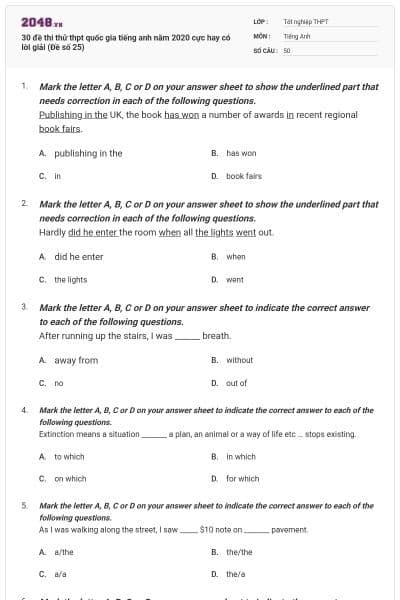
Mark the letter A, B, C or D on your answer sheet to show the underlined part that needs correction in each of the following questions.
Publishing in the UK, the book has won a number of awards in recent regional book fairs.
publishing in the
has won
in
book fairs
Đáp án A
Kiến thức: Quá khứ phân từ
Giải thích:
Sử dụng quá khứ phân từ ( P2) để thay thế cho mệnh đề mang nghĩa bị động
publishing in the => published in the
Tạm dịch: Xuất bản ở Vương quốc Anh, cuốn sách đã giành được một số giải thưởng trong các hội chợ sách khu vực gần đây.
Mark the letter A, B, C or D on your answer sheet to show the underlined part that needs correction in each of the following questions.
Hardly did he enter the room when all the lights went out.
did he enter
when
the lights
went
Đáp án A
Kiến thức: Câu đảo ngữ
Giải thích:
Cấu trúc đảo ngữ với “hardly…when…”:
Hardly + had+ S + P2 +when…: ngay khi…thì …
did he enter => had he entered
Tạm dịch: Ngay khi cậu ấy vước vào phòng thì đèn tắt.
Mark the letter A, B, C or D on your answer sheet to indicate the correct answer to each of the following questions.
After running up the stairs, I was ______ breath.
away from
without
no
out of
Đáp án D
Kiến thức: Giới từ
Giải thích:
(be) out of breath: hết hơi, thở không ra hơi.
Tạm dịch: Sauk hi đi lên cầu thang thì tôi thở không ra hơi.
Mark the letter A, B, C or D on your answer sheet to indicate the correct answer to each of the following questions.
Extinction means a situation _______ a plan, an animal or a way of life etc … stops existing.
to which
in which
on which
for which
Đáp án: B
Giải thích:
Với “situation”, dùng giới từ “in” (trong tình huống/trường hợp)
Chọn B.
Dịch: Tuyệt chủng có nghĩa là tình trạng mà một loài thực vật, động vật hoặc một lối sống, v.v. không còn tồn tại nữa.
Mark the letter A, B, C or D on your answer sheet to indicate the correct answer to each of the following questions.
As I was walking along the street, I saw _____ $10 note on _______ pavement.
a/the
the/the
a/a
the/a
Đáp án: A
Giải thích:
Kiến thức: Mạo từ
Vị trí đầu: một đối tượng dạng số ít đếm được lần đầu nhắc đến, ta sử dụng mạo từ “a”/ “an”, loại B và D.
Vị trí thứ hai: dùng “the“ trước một danh từ đã được xác định cụ thể về mặt tính chất, đặc điểm, vị trí hoặc đã được đề cập đến trước đó, hoặc những khái niệm phổ thông, ai cũng biết.
“on the pavement”: trên vỉa hè
Chọn A.
Dịch: Khi đang đi trên phố, tôi nhìn thấy một tờ 10 đô la trên vỉa hè.
Mark the letter A, B, C or D on your answer sheet to indicate the correct answer to each of the following questions.
I’ve never really enjoyed going to the ballet or the opera; they’re not really my _______.
piece of cake
sweets and candy
biscuit
cup of tea
Đáp án D
Kiến thức: Thành ngữ
Giải thích:
(be not) one’s cup of tea: (không) phải sở trường của ai đó
piece of cake: việc dễ như ăn kẹo, rất dễ
Tạm dịch: Tôi không thích đi xem mua ba lê hay nhạc kịch, chúng không phải sở trường của tôi.
Mark the letter A, B, C or D on your answer sheet to indicate the correct answer to each of the following questions.
I will stand here and wait for you _______ you come back.
because
though
so
until
Đáp án D
Kiến thức: Từ vựng
Giải thích:
Because: bởi vì So: vì thế
Though: mặc dù Until: mãi đến khi
Tạm dịch: Anh sẽ vẫn đứng đây chờ em cho đến khi em quay lại.
Mark the letter A, B, C or D on your answer sheet to indicate the correct answer to each of the following questions.
Let’s begin our discussion now, ________?
shall we
will we
don’t we
won’t we
Đáp án A
Kiến thức: Câu hỏi đuôi
Giải thích:
Câu hỏi đuôi với mệnh đề chính “ let’s …” là “ “ Shall we?”
Tạm dịch: Chúng ta bắt đầu thảo luận bây giờ chứ nhỉ?”
Mark the letter A, B, C or D on your answer sheet to indicate the correct answer to each of the following questions.
Of all the factors affecting agricultural yields, weather is the one ______ the most.
that influences farmers
farmers that is influences
why farmers influence it
it influences farmers
Đáp án: A
Giải thích:
Kiến thức: Mệnh đề quan hệ
Dùng mệnh đề quan hệ để bổ nghĩa cho “the one”, có thể dùng đại từ quan hệ “which/that”.
Loại B vì đại từ quan hệ “that” phải đứng ngay sau “the one”, “influences” là động từ chính rồi, không cần “is” nữa.
Loại C vì “why” chỉ thay cho nguyên nhân
Loại D vì “it” không phải đại từ quan hệ.
Đáp án A đúng ngữ pháp.
Dịch: Trong tất cả các yếu tố ảnh hưởng đến năng suất nông nghiệp, thời tiết là yếu tố ảnh hưởng nhiều nhất đến người nông dân.
Mark the letter A, B, C or D on your answer sheet to indicate the correct answer to each of the following questions.
_________, we tried our best to complete it.
Thanks to the difficult homework
Despite the homework was difficult
Difficult as the homework was
As though the homework was difficult
Đáp án C
Kiến thức: Cấu trúc câu
Giải thích:
Thanks to N/V-ing: nhờ có …
In spite of/ Despite + N/ V-ing: mặc dù …
Although +S+ be+ tính từ,…= Tính từ +as +S+be…: mặc dù …
As though = as if: cứ như thể là…
Tạm dịch: Dù bài về nhà có khó thế nào chăng nữa, chúng tôi cũng sẽ cố gắng hết sức.
Mark the letter A, B, C or D on your answer sheet to indicate the correct answer to each of the following questions.
The twins look so much alike that almost no one can _______ them ________.
take/apart
tell/away
tell/apart
take/on
Đáp án C
Kiến thức: Phrasal verbs
Giải thích:
Take apart: tách ra Tell apart: phân biệt
Tell away: nói ra Take on: đảm nhận
Tạm dịch: Cặp sinh đôi quá giống nhau đến mức hầu như không ai phân biệt được họ.
Mark the letter A, B, C or D on your answer sheet to indicate the correct answer to each of the following questions.
Tom looks so frightened and upset. He ________ something terrible.
must experience
can have experienced
should have experienced
must have experienced
Đáp án D
Kiến thức: Động từ khuyết thiếu
Giải thích:
Could/ May/ Might + have P2: có thể là…
=> Dùng để chỉ một tiên đoán trong quá khứ nhưng không có cơ sở.
Must have P2 / Can't have P2
=> Diễn đạt một ý kiến của mình theo suy luận logic.(về 1 hành động trong quá khứ)
Must + have P2
=> Dùng để nói về một tiên đoán xảy ra trong quá khứ nhưng dựa trên những cơ sở rõ ràng
Should + have P2: đã nên…
Tạm dịch: Tom trông rất sợ hãi và buồn bã. Cậu ấy hẳn là đã trải qua điều gì kinh khủng lắm.
Mark the letter A, B, C or D on your answer sheet to indicate the correct answer to each of the following questions.
Ann was very surprised to find the door unlocked. She remembered _______ it before she left.
to lock
having locked
to have locked
she locks
Đáp án B
Kiến thức: Động từ
Giải thích:
Remember +V-ing: nhớ đã làm gì
# Remember +to V: nhớ phải làm gì
Tạm dịch: Ann rất ngạc nhiêu khi thấy cửa mở. Cô ấy nhớ là đã khóa cửa trước khi đi mà.
Mark the letter A, B, C or D on your answer sheet to indicate the correct answer to each of the following questions.
Tom: “Sorry, I forgot to phone you last night”
have nothing to tell you.
Oh. Poor me!
Never mind!
You was absent- minded.
Đáp án C
Kiến thức: Chức năng giao tiếp
Giải thích:
Tom: “ Xin lỗi, tớ quên gọi cậu tối qua” – “____”
A. Không còn gì để nói C. Không sao đâu
B. Ôi tội nghiệp tớ! D. Cậu thật đãng trí.
Mark the letter A, B, C or D on your answer sheet to indicate the correct answer to each of the following questions.
The players’ protests ________ no difference to the referee’s decision at all.
did
made
caused
created
Đáp án B
Kiến thức: Từ vựng
Giải thích:
Do (v): làm Cause (v): gây ra
Make (v): tạo ra Create (v): tạo nên
Make no difference: không tạo ra sự khác biệt
Tạm dịch: Sự phản kháng của các cầu thủ không tạo sự khác biệt quá nhiều so với quyết định của trọng tài.
Mark the letter A, B, C or D on your answer sheet to indicate the correct answer to each of the following questions.
In a formal interview, it is essential to maintain good eye _____ with the interviewers.
link
connection
touch
contact
Đáp án D
Kiến thức: Từ vựng
Giải thích:
Link = connection(n): sự kết nối
Touch (n): sự cảm ứng
Eye contact (n): giao tiếp bằng mắt.
Tạm dịch: Trong 1 buổi phòng vấn chính thức, cần giữ sự giao tiếp bằng mắt thật tốt với người phòng vấn.
Mark the letter A, B, C or D on your answer sheet to indicate the correct answer to each of the following questions.
Grace Kelly was first famous as a Hollywood actress and then _______ Prince Rainier of Monaco.
to be the wife of
she was the wife of
the wife of
as the wife of
Đáp án D
Kiến thức: Cấu trúc câu
Giải thích:
(be) famous as: nổi tiếng là, được biết đến là…
Cần có sự đồng nhất giữa 2 vế của 1 câu. Vế trước “as a Hollywood actress” => vế sau sẽ là “ as the wife of …”
Tạm dịch: Grace Kelly đầu tiên được biết đến như một nữ diễn viên Hollywood và sau đó là vợ của hoàng tử Rainier của Monaco.
Mark the letter A, B, C or D on your answer sheet to indicate the correct answer to each of the following questions.
When he came to the counter of pay, he found that he had _______ cash _______ his credit card with him.
either/or
neither/nor
both/and
not/neither
Đáp án B
Kiến thức: Từ vựng
Giải thích:
Either …or…: không 1 trong 2
Neither …nor…: không cả 2
Both …and…: cả 2
Tạm dịch: Khi cậu ấy ra bàn thanh toán, cậu ấy nhận ra mình không có tiền mặt cũng như thẻ tín dụng.
Mark the letter A, B, C, or D on your answer sheet to indicate the word whose underlined part differs from the other three in pronunciation in each of the following questions.
crucial
partial
material
financial
Đáp án C
Kiến thức: Cách phát âm “ial”
Giải thích:
crucial /'kru:ʃjəl/ material /mə'tiəriəl/
partial /'pɑ:ʃəl/ financial /fai'nænʃəl/
Đáp án C có phần gạch chân đọc là /iəl/, các đáp án còn lại đọc là /əl/
Mark the letter A, B, C, or D on your answer sheet to indicate the word whose underlined part differs from the other three in pronunciation in each of the following questions.
land
sandy
many
candy
Đáp án C
Kiến thức: Cách phát âm “a”
land /lænd/ sandy /'sændi/
many /'meni/ candy /'kændi/
Đáp án C có phần gạch chân đọc là /e/, các đáp án khác đọc là /æ/
Mark the letter A, B, C, or D on your answer sheet to indicate the word that differs from the other three in the position of primary stress in each of the following questions.
familiar
impatient
uncertain
arrogant
Đáp án D
Kiến thức: Trọng âm 3 âm tiết
Giải thích:
familiar /fə'miljə/ uncertain /ʌn'sə:tn/
impatient /im'peiʃənt/ arrogant /'ærəgənt/
Đáp án D có trọng âm rơi vào âm tiết thứ 1, các đáp án còn lại rơi vào âm tiết thứ 2
Mark the letter A, B, C, or D on your answer sheet to indicate the word that differs from the other three in the position of primary stress in each of the following questions.
disappear
arrangement
opponent
contractual
Đáp án A
Kiến thức: Trọng âm 3 âm tiết
Giải thích:
disappear /,disə'piə/ opponent /ə'pounənt/
arrangement /ə'reindʤmənt/ contractual /kən'træktjuəl/
Đáp án A có trong âm rơi vào âm tiết thứ 3, các đáp án còn lại rơi vào âm tiết thứ 2
Mark the letter A, B, C, or D on your answer sheet to indicate the word(s) OPPOSITE in meaning to the underlined word(s)in each of the following questions.
This speedy and secure service of transferring money can be useful.
slow
rapid
careful
hurried
Đáp án A
Kiến thức: Từ trái nghĩa
Giải thích:
Speedy (a): tốc độ, nhanh
Slow (a): châm Careful (a): cẩn thận
Rapid (a): nhanh Hurried (a): vội vã
=> Speedy >< Slow
Tạm dịch: Dịch vụ chuyển tiền nhanh chóng và an toàn này có thể hữu ích.
Mark the letter A, B, C, or D on your answer sheet to indicate the word(s) OPPOSITE in meaning to the underlined word(s)in each of the following questions.
Our well- trained staff are always courteous to customers.
helpful
friendly
rude
polite
Đáp án C
Kiến thức: Từ trái nghĩa
Giải thích:
Courteous (a): trang nhã, lịch thiệp
Helpful (a): hữu ích Rude (a): thô lỗ
Friendly (a): thân thiện Polite (a): lịch sự
=> Courteous >< Rude
Tạm dịch: Đội ngũ nhân viên được đào tạo của chúng tôi luôn lịch sự với khách hàng.
Mark the letter A, B, C or D on your answer sheet to indicate the sentences that is CLOSEST in meaning to each of the following question.
“ You shouldn’t have leaked our confidential report to the press, Frank!” said Jane.
Jane suspected that Frank had leaked their confidential report to the press.
Jane criticized Frank for having disclosed their confidential report to the press.
Jane accused Frank of having cheated the press with their confidential report.
Jane blamed Frank for having flattered the press with their confidential report.
Đáp án B
Kiến thức: Câu đồng nghĩa
Giải thích:
"Bạn không nên tiết lộ thông tin mật của chúng tôi cho báo chí, Frank!" Jane nói.
A. Jane nghi ngờ rằng Frank đã tiết lộ thông tin mật của họ cho báo chí.
B. Jane chỉ trích Frank vì tiết lộ thông tin mật của họ cho báo chí.
C. Jane cáo buộc Frank đã lừa dối báo chí với các báo cáo bí mật của họ.
D. Jane đổ lỗi cho Frank vì đã nịnh hót báo chí với báo cáo bí mật của họ.
Mark the letter A, B, C or D on your answer sheet to indicate the sentences that is CLOSEST in meaning to each of the following question.
“Don’t forget to tidy up the final draft before submission,” the team leaser told us.
The team leader ordered us to tidy up the final draft before submission.
The team leader reminded us to tidy up the final draft before submission.
The team leader asked us to tidy up the final draft before submission.
The team leader simply wanted us to tidy up the final draft before submission.
Đáp án B
Kiến thức: Câu đồng nghĩa
Giải thích:
"Đừng quên rà soát bản dự thảo cuối cùng trước khi nộp bài," trưởng nhóm nói với chúng tôi.
A. Trưởng nhóm ra lệnh chúng tôi rà soát bản dự thảo cuối cùng trước khi nộp.
B. Trưởng nhóm nhắc nhở chúng tôi rà soát bản dự thảo cuối cùng trước khi trình.
C. Trưởng nhóm yêu cầu chúng tôi rà soát bản dự thảo cuối cùng trước khi trình.
D. Trưởng nhóm chỉ đơn giản muốn chúng tôi rà soát bản dự thảo cuối cùng trước khi nộp.
Mark the letter A, B, C or D on your answer sheet to indicate the sentences that is CLOSEST in meaning to each of the following question.
“If you don’t pay the ransom, we’ll kill your boy,” the kidnappers told us.
The kidnappers ordered to kill our boy if we did not pay the ransom.
The kidnappers pledged to kill our boy if we did not pay the ransom.
The kidnappers threatened to kill our boy if we did not pay the ransom.
The kidnappers promised to kill our boy if we did not pay the ransom.
Đáp án C
Kiến thức: Câu đồng nghĩa
Giải thích:
"Nếu mày không trả tiền chuộc, chúng tao sẽ giết thằng bé", những kẻ bắt cóc nói với chúng tôi.
A. Những kẻ bắt cóc đã ra lệnh giết chết con trai của chúng tôi nếu chúng tôi không trả tiền chuộc.
B. Những kẻ bắt cóc cam kết giết chết con trai của chúng tôi nếu chúng tôi không trả tiền chuộc.
C. Những kẻ bắt cóc đe doạ giết chết con trai của chúng tôi nếu chúng tôi không trả tiền chuộc.
D. Những kẻ bắt cóc hứa sẽ giết chết con trai của chúng tôi nếu chúng tôi không trả tiền chuộc.
Mark the letter A, B, C, or D on your answer sheet to indicate the word CLOSEST in meaning to the underlined word in each of the following questions.
When the protestor entered the meeting clad only in a beach tower, the audience was dumbfounded.
speechless
excited
content
applauding
Đáp án A
Kiến thức: Từ đồng nghĩa
Giải thích:
Dumbfounded (a): im lặng, câm lặng Speechless (a): câm lặng
Contented (a): bằng lòng Excited (a): thích thú
Applauding (a): tán dương
=> Dumbfounded = Speechless
Tạm dịch: Khi kẻ chống đối bước vào cuộc họp chỉ với chiếc khăn tắm, khán giả câm lặng điếng người.
Mark the letter A, B, C, or D on your answer sheet to indicate the word CLOSEST in meaning to the underlined word in each of the following questions.
She is always diplomatic when she deals with angry students.
strict
outspoken
tactful
firm
Đáp án C
Kiến thức: Từ đồng nghĩa
Giải thích:
Diplomatic (a): quảng giao, hòa nhã
Strict (a): nghiêm khắc Tactful (a): lịch thiệp
Outspoken (a): thẳng thắn Firm (a): chắc chắn
=> Diplomatic = Tactful
Tạm dịch: Cô ấy luôn hòa nhã khi xử lý các học sinh đang nổi nóng.
Mark the letter A, B, C, or D on your answer sheet to indicate the word CLOSEST in meaning to the underlined word in each of the following questions.
The dog saw his reflection in the pool of water.
imagination
bone
leash
image
Đáp án D
Kiến thức: Từ đồng nghĩa
Giải thích:
Reflection (n): sự phản ánh, hình ảnh
Imagination (n): sự tưởng tượng Leash (n): xích chó
Bone (n): xương Image (n): hình ảnh
=> Reflection = Image
Tạm dịch: Con chó nhìn thấy mình trong hồ nước.
Read the following passage and mark the letter A, B, C or D on your answer sheet to indicate the correct answer to each of the following questions
Simply being bilingual doesn’t qualify someone to interpret. Interpreting is not only a mechanical process of converting one sentence in language A into the same sentence in languageb. Rather, its a complex art in which thoughts and idioms that have no obvious counterparts from tongue to tongue _ or words that have several meanings must be quickly transformed in such a way that the message is clearly and accurately expressed to the listener.
At one international conference, an American speaker said, “You cant make a silk purse out of a sows ear”, which meant nothing to the Spanish audience. The interpretation was, “A monkey in a silk dress is still a monkey” _ an idiom the Spanish understood and that expressed the same idea.
There are 2 kinds of interpreters, simultaneous and consecutive. The former, sitting in a separated booth, usually at a large multilingual conference, speaks to listeners wearing headphones, interpreting what a foreign language speaker says _ actually a sentence behind. Consecutive interpreters are the ones most international negotiations use. They are employed for smaller meetings without sound booths and headphones. Consecutive interpretation also requires two-person teams. A foreign speaker says his piece while the interpreter, using a special shorthand, takes notes and during a pause, tells the client what was said.
Question:What is the purpose of the passage?
To differentiate between simultaneous and consecutive interpreters.
To state the qualifications of an interpreter.
To point out the importance of an interpreter.
To explain the scope of interpreting.
Đáp án D
Kiến thức: Đọc hiểu
Giải thích:
Mục đích của đoạn văn là gì?
A. Để phân biệt giữa các thông dịch viên đồng thời và liên tục.
B. Trình bày bằng cấp của một thông dịch viên.
C. Để chỉ ra tầm quan trọng của một thông dịch viên.
D. Giải thích về phiên dịch.
Read the following passage and mark the letter A, B, C or D on your answer sheet to indicate the correct answer to each of the following questions
Simply being bilingual doesn’t qualify someone to interpret. Interpreting is not only a mechanical process of converting one sentence in language A into the same sentence in languageb. Rather, its a complex art in which thoughts and idioms that have no obvious counterparts from tongue to tongue _ or words that have several meanings must be quickly transformed in such a way that the message is clearly and accurately expressed to the listener.
At one international conference, an American speaker said, “You cant make a silk purse out of a sows ear”, which meant nothing to the Spanish audience. The interpretation was, “A monkey in a silk dress is still a monkey” _ an idiom the Spanish understood and that expressed the same idea.
There are 2 kinds of interpreters, simultaneous and consecutive. The former, sitting in a separated booth, usually at a large multilingual conference, speaks to listeners wearing headphones, interpreting what a foreign language speaker says _ actually a sentence behind. Consecutive interpreters are the ones most international negotiations use. They are employed for smaller meetings without sound booths and headphones. Consecutive interpretation also requires two-person teams. A foreign speaker says his piece while the interpreter, using a special shorthand, takes notes and during a pause, tells the client what was said.
Question:What is a difference mentioned between a simultaneous interpreter and a consecutive interpreter?
The size of group with whom they work.
Their proficiency in the language.
The type of dictionary they use.
The money they are paid.
Đáp án A
Kiến thức: Đọc hiểu
Giải thích:
Sự khác biệt được đề cập giữa một thông dịch viên đồng thời với thông dịch viên liên tục là gì?
A. Số người trong nhóm mà họ làm việc. C. Loại từ điển mà họsử dụng.
B. Thành thạo ngôn ngữ. D. Số tiền họ được trả.
Dẫn chứng: The former, sitting in a separated booth, usually at a large multilingual conference, speaks to listeners wearing headphones, interpreting what a foreign language speaker says _ actually a sentence behind.
Consecutive interpreters are the ones most international negotiations use. They are employed for smaller meetings without sound booths and headphones. Consecutive interpretation also requires two-person teams. A foreign speaker says his piece while the interpreter, using a special shorthand, takes notes and during a pause, tells the client what was said.
Read the following passage and mark the letter A, B, C or D on your answer sheet to indicate the correct answer to each of the following questions
Simply being bilingual doesn’t qualify someone to interpret. Interpreting is not only a mechanical process of converting one sentence in language A into the same sentence in languageb. Rather, its a complex art in which thoughts and idioms that have no obvious counterparts from tongue to tongue _ or words that have several meanings must be quickly transformed in such a way that the message is clearly and accurately expressed to the listener.
At one international conference, an American speaker said, “You cant make a silk purse out of a sows ear”, which meant nothing to the Spanish audience. The interpretation was, “A monkey in a silk dress is still a monkey” _ an idiom the Spanish understood and that expressed the same idea.
There are 2 kinds of interpreters, simultaneous and consecutive. The former, sitting in a separated booth, usually at a large multilingual conference, speaks to listeners wearing headphones, interpreting what a foreign language speaker says _ actually a sentence behind. Consecutive interpreters are the ones most international negotiations use. They are employed for smaller meetings without sound booths and headphones. Consecutive interpretation also requires two-person teams. A foreign speaker says his piece while the interpreter, using a special shorthand, takes notes and during a pause, tells the client what was said.
Question:The word “converting” is closest in meaning to…
changing
concluding
understanding
reading
Đáp án A
Kiến thức: Đọc hiểu
Giải thích:
Từ “converting” gần nghĩa với…..
Converting (n): chuyển đổi
Changing (n):thay đổi Understanding (n): sự hiểu
Concluding (n): Kết luận Reading (n): việc đọc
=> Converting = changing
Dẫn chứng: Interpreting is not only a mechanical process of converting one sentence in language A into the same sentence in language B.
Read the following passage and mark the letter A, B, C or D on your answer sheet to indicate the correct answer to each of the following questions
Simply being bilingual doesn’t qualify someone to interpret. Interpreting is not only a mechanical process of converting one sentence in language A into the same sentence in languageb. Rather, its a complex art in which thoughts and idioms that have no obvious counterparts from tongue to tongue _ or words that have several meanings must be quickly transformed in such a way that the message is clearly and accurately expressed to the listener.
At one international conference, an American speaker said, “You cant make a silk purse out of a sows ear”, which meant nothing to the Spanish audience. The interpretation was, “A monkey in a silk dress is still a monkey” _ an idiom the Spanish understood and that expressed the same idea.
There are 2 kinds of interpreters, simultaneous and consecutive. The former, sitting in a separated booth, usually at a large multilingual conference, speaks to listeners wearing headphones, interpreting what a foreign language speaker says _ actually a sentence behind. Consecutive interpreters are the ones most international negotiations use. They are employed for smaller meetings without sound booths and headphones. Consecutive interpretation also requires two-person teams. A foreign speaker says his piece while the interpreter, using a special shorthand, takes notes and during a pause, tells the client what was said.
Question:The author implies that most people have the opinion that the skill of interpreting is …..
very complex and demanding
based on principles of business
simpler than it really is
highly valued and admired
Đáp án A
Kiến thức: Đọc hiểu
Giải thích:
Tác giả muốn chỉ ra hầu hết mọi người có ý kiến rằng kỹ năng phiên dịch là ... ..
A. rất phức tạp và đòi hỏi C. đơn giản hơn thực tee
B. dựa trên các nguyên tắc kinh doanh D. có giá trị và đáng ngưỡng mộ
Dẫn chứng: Rather, its a complex art in which thoughts and idioms that have no obvious counterparts from tongue to tongue _ or words that have several meanings must be quickly transformed in such a way that the message is clearly and accurately expressed to the listener.
Read the following passage and mark the letter A, B, C or D on your answer sheet to indicate the correct answer to each of the following questions
Simply being bilingual doesn’t qualify someone to interpret. Interpreting is not only a mechanical process of converting one sentence in language A into the same sentence in languageb. Rather, its a complex art in which thoughts and idioms that have no obvious counterparts from tongue to tongue _ or words that have several meanings must be quickly transformed in such a way that the message is clearly and accurately expressed to the listener.
At one international conference, an American speaker said, “You cant make a silk purse out of a sows ear”, which meant nothing to the Spanish audience. The interpretation was, “A monkey in a silk dress is still a monkey” _ an idiom the Spanish understood and that expressed the same idea.
There are 2 kinds of interpreters, simultaneous and consecutive. The former, sitting in a separated booth, usually at a large multilingual conference, speaks to listeners wearing headphones, interpreting what a foreign language speaker says _ actually a sentence behind. Consecutive interpreters are the ones most international negotiations use. They are employed for smaller meetings without sound booths and headphones. Consecutive interpretation also requires two-person teams. A foreign speaker says his piece while the interpreter, using a special shorthand, takes notes and during a pause, tells the client what was said.
Question:The phrase “the former“ refers to…
simultaneous interpreters
the conference
consecutive interpreters
the booth
Đáp án A
Kiến thức: Đọc hiểu
Giải thích:
Cụm từ "the former" dùng để chỉ ...
A. Các phiên dịch đồng thời C. Thông dịch viên liên tiếp
B. Hội nghị D. Gian âm thanh
The former: thứ/vật đầu tiên (trong 2 đối tượng)
The latter: thứ/ vật sau ( trong 2 đối tượng )
Dẫn chứng: There are 2 kinds of interpreters, simultaneous and consecutive. The former, sitting in a separated booth, usually at a large multilingual conference, speaks to listeners wearing headphones, interpreting what a foreign language speaker says _ actually a sentence behind.
Read the following passage and mark the letter A, B, C or D on your answer sheet to indicate the correct answer to each of the following questions
Simply being bilingual doesn’t qualify someone to interpret. Interpreting is not only a mechanical process of converting one sentence in language A into the same sentence in languageb. Rather, its a complex art in which thoughts and idioms that have no obvious counterparts from tongue to tongue _ or words that have several meanings must be quickly transformed in such a way that the message is clearly and accurately expressed to the listener.
At one international conference, an American speaker said, “You cant make a silk purse out of a sows ear”, which meant nothing to the Spanish audience. The interpretation was, “A monkey in a silk dress is still a monkey” _ an idiom the Spanish understood and that expressed the same idea.
There are 2 kinds of interpreters, simultaneous and consecutive. The former, sitting in a separated booth, usually at a large multilingual conference, speaks to listeners wearing headphones, interpreting what a foreign language speaker says _ actually a sentence behind. Consecutive interpreters are the ones most international negotiations use. They are employed for smaller meetings without sound booths and headphones. Consecutive interpretation also requires two-person teams. A foreign speaker says his piece while the interpreter, using a special shorthand, takes notes and during a pause, tells the client what was said.
Question:The example “You cant make a silk purse out of a sows ear” is used to...
point out the difference in attributes of animals in English and Spanish
emphasize the need for translation of the meaning of what is said
show the differences in language A and language B
stress the importance of word for word translation
Đáp án B
Kiến thức: Đọc hiểu
Giải thích:
Ví dụ "Bạn không thể tạo ra một ví tơ từ lợn nái" được sử dụng để ...
A. chỉ ra sự khác nhau về thuộc tính của động vật bằng tiếng Anh và tiếng Tây Ban Nha
B. nhấn mạnh sự cần thiết phải dịch nghĩa của những gì được nói .
C. thể hiện sự khác biệt trong ngôn ngữ A và ngôn ngữ B
D. nhấn mạnh tầm quan trọng của từ đối với phiên dịch
Dẫn chứng: At one international conference, an American speaker said, “You cant make a silk purse out of a sows ear”, which meant nothing to the Spanish audience. The interpretation was, “A monkey in a silk dress is still a monkey” _ an idiom the Spanish understood and that expressed the same idea.
Read the following passage and mark the letter A, B, C or D on your answer sheet to indicate the correct answer to each of the following questions
Simply being bilingual doesn’t qualify someone to interpret. Interpreting is not only a mechanical process of converting one sentence in language A into the same sentence in languageb. Rather, its a complex art in which thoughts and idioms that have no obvious counterparts from tongue to tongue _ or words that have several meanings must be quickly transformed in such a way that the message is clearly and accurately expressed to the listener.
At one international conference, an American speaker said, “You cant make a silk purse out of a sows ear”, which meant nothing to the Spanish audience. The interpretation was, “A monkey in a silk dress is still a monkey” _ an idiom the Spanish understood and that expressed the same idea.
There are 2 kinds of interpreters, simultaneous and consecutive. The former, sitting in a separated booth, usually at a large multilingual conference, speaks to listeners wearing headphones, interpreting what a foreign language speaker says _ actually a sentence behind. Consecutive interpreters are the ones most international negotiations use. They are employed for smaller meetings without sound booths and headphones. Consecutive interpretation also requires two-person teams. A foreign speaker says his piece while the interpreter, using a special shorthand, takes notes and during a pause, tells the client what was said.
Question:The word “rather” is closest in meaning to….
in brief
on the contrary
in general
as a result
Đáp án B
Kiến thức: Đọc hiểu
Giải thích:
Từ “rather” có nghĩa là …...
rather: thay vì, trái lại
in brief: tóm tắt in general: nói chung
on the contrary: ngược lại as a result: vì thế
=> rather = on the contrary
Dẫn chứng: Rather, its a complex art in which thoughts and idioms that have no obvious counterparts from tongue to tongue _ or words that have several meanings must be quickly transformed in such a way that the message is clearly and accurately expressed to the listener.
Read the following passage and mark the letter A, B, C or D on your answer sheet to indicate the correct answer to each of the following questions
Simply being bilingual doesn’t qualify someone to interpret. Interpreting is not only a mechanical process of converting one sentence in language A into the same sentence in languageb. Rather, its a complex art in which thoughts and idioms that have no obvious counterparts from tongue to tongue _ or words that have several meanings must be quickly transformed in such a way that the message is clearly and accurately expressed to the listener.
At one international conference, an American speaker said, “You cant make a silk purse out of a sows ear”, which meant nothing to the Spanish audience. The interpretation was, “A monkey in a silk dress is still a monkey” _ an idiom the Spanish understood and that expressed the same idea.
There are 2 kinds of interpreters, simultaneous and consecutive. The former, sitting in a separated booth, usually at a large multilingual conference, speaks to listeners wearing headphones, interpreting what a foreign language speaker says _ actually a sentence behind. Consecutive interpreters are the ones most international negotiations use. They are employed for smaller meetings without sound booths and headphones. Consecutive interpretation also requires two-person teams. A foreign speaker says his piece while the interpreter, using a special shorthand, takes notes and during a pause, tells the client what was said.
Question:Which of the following would a consecutive interpreter be used for?
An interpretation of a major literary work.
A business transaction between 2 foreign speakers.
A large meeting of many nations.
A translation of a foreign book.
Đáp án B
Kiến thức: Đọc hiểu
Giải thích:
Người phiên dịch liên tục sẽ sử dụng những thông tin nào dưới đây?
A. Giải thích một tác phẩm văn học lớn.
B. Một giao dịch kinh doanh giữa 2 diễn giả nước ngoài.
C. Một cuộc họp lớn của nhiều quốc gia.
D. Một bản dịch của một cuốn sách nước ngoài.
Dẫn chứng: Consecutive interpretation also requires two-person teams. A foreign speaker says his piece while the interpreter, using a special shorthand, takes notes and during a pause, tells the client what was said.
Read the following passage and mark the letter A, B, C, or D on your answer sheet to indicate the word or phrase that best fits each of the numbered blanks.
Why is it that many teenagers have the energy to play computer games until late at night but can't find the energy to get out of bed (39) ________ for school? According to a new report, today's generation of children are in danger of getting so (40)_______ sleep that they are putting their mental and physical health at (41)_______. Adults can easily survive on seven to eight hours' sleep a night, (42)_______teenagers require nine or ten hours. According to medical experts, one in five youngsters (43)________ anything between two and five hours' sleep a night less than their parents did at their age.
Question 39:
behind time
about time
in time
at time
Đáp án C
Kiến thức: Đọc hiểu, từ vựng
Giải thích:
In time: kịp giờ # on time: đúng giờ
Tạm dịch:
Why is it that many teenagers have the energy to play computer games until late at night but can't find the energy to get out of bed (39) ________ for school?
Tại sao nhiều thanh thiếu niên lại có sức để chơi trò chơi điện tử cho đến khuya, nhưng không đủ sức ra khỏi
giường đến trường kịp giờ?
Read the following passage and mark the letter A, B, C, or D on your answer sheet to indicate the word or phrase that best fits each of the numbered blanks.
Why is it that many teenagers have the energy to play computer games until late at night but can't find the energy to get out of bed (39) ________ for school? According to a new report, today's generation of children are in danger of getting so (40)_______ sleep that they are putting their mental and physical health at (41)_______. Adults can easily survive on seven to eight hours' sleep a night, (42)_______teenagers require nine or ten hours. According to medical experts, one in five youngsters (43)________ anything between two and five hours' sleep a night less than their parents did at their age.
Question 40
few
less
much
little
Đáp án D
Kiến thức: Đọc hiểu, từ vựng
Giải thích:
Few+ danh từ số nhiều đếm được : rất ít, một ít Much + Danh từ không đếm được: nhiều
Little + danh từ không đếm được: rất ít, một ít Less… than: ít …hơn
Tạm dịch:
According to a new report, today's generation of children are in danger of getting so (40)_______ sleep that they are putting their mental and physical health at (41)_______.
Theo một báo cáo mới, thế hệ trẻ em ngày nay đang gặp nguy hiểm vì ngủ quá ít đến mức họ đang có nguy cơ về sức khoẻ tinh thần và thể chất của mình.
Read the following passage and mark the letter A, B, C, or D on your answer sheet to indicate the word or phrase that best fits each of the numbered blanks.
Why is it that many teenagers have the energy to play computer games until late at night but can't find the energy to get out of bed (39) ________ for school? According to a new report, today's generation of children are in danger of getting so (40)_______ sleep that they are putting their mental and physical health at (41)_______. Adults can easily survive on seven to eight hours' sleep a night, (42)_______teenagers require nine or ten hours. According to medical experts, one in five youngsters (43)________ anything between two and five hours' sleep a night less than their parents did at their age.
Question 41:
jeopardy
threat
risk
danger
Đáp án C
Kiến thức: Đọc hiểu, từ vựng
Giải thích:
Jeopardy (n): ngu cơ Risk (n): nguy hiểm
Threat (n): đe dọa Danger (n): sự nguy hiểm
(be) at risk: gặp nguy hiểm
Tạm dịch:
According to a new report, today's generation of children are in danger of getting so (40)_______ sleep that they are putting their mental and physical health at (41)_______.
Theo một báo cáo mới, thế hệ trẻ em ngày nay đang gặp nguy hiểm vì ngủ quá ít đến mức họ đang có nguy cơ về sức khoẻ tinh thần và thể chất của mình.
Read the following passage and mark the letter A, B, C, or D on your answer sheet to indicate the word or phrase that best fits each of the numbered blanks.
Why is it that many teenagers have the energy to play computer games until late at night but can't find the energy to get out of bed (39) ________ for school? According to a new report, today's generation of children are in danger of getting so (40)_______ sleep that they are putting their mental and physical health at (41)_______. Adults can easily survive on seven to eight hours' sleep a night, (42)_______teenagers require nine or ten hours. According to medical experts, one in five youngsters (43)________ anything between two and five hours' sleep a night less than their parents did at their age.
Question 42:
or
because
whereas
so
Đáp án C
Kiến thức: Đọc hiểu, từ vựng
Giải thích:
Or: hoặc Whereas: trong khi
Because: bởi vì So: vì thế
Tạm dịch:
Adults can easily survive on seven to eight hours' sleep a night, (42)_______teenagers require nine or ten hours.
Người lớn có thể chỉ cần từ 7 đến 8 tiếng ngủ mỗi đêm, trong khi thanh thiếu niên cần 9 đến 10 tiếng.
Read the following passage and mark the letter A, B, C, or D on your answer sheet to indicate the word or phrase that best fits each of the numbered blanks.
Why is it that many teenagers have the energy to play computer games until late at night but can't find the energy to get out of bed (39) ________ for school? According to a new report, today's generation of children are in danger of getting so (40)_______ sleep that they are putting their mental and physical health at (41)_______. Adults can easily survive on seven to eight hours' sleep a night, (42)_______teenagers require nine or ten hours. According to medical experts, one in five youngsters (43)________ anything between two and five hours' sleep a night less than their parents did at their age.
Question 43:
puts
gets
brings
makes
Đáp án B
Kiến thức: Đọc hiểu, từ vựng
Giải thích:
Put (v): động từ Bring (v): mang lại
Get (v): đạt được, có Make (v): tạo nên
Tạm dịch:
Theo các chuyên gia y khoa thì cứ 5 thanh thiều niên thì có 1 người ngủ ít hơn bố mẹ họ khi cùng tuổi từ 2 đến 5 tiếng.
Read the following passage and mark the letter A, B, C or D on your answer sheet to indicate the correct answer to each of the following questions
Fish that live on the sea bottom benefit by being flat and hugging the contours. There are two very different types of flatfish and they have evolved in very separate ways. The skates and rays, relatives of the sharks have become flat in what might be called the obvious way. Their bodies have grown out sideways to form great “wings” They look as though they have been flattened but have remained symmetrical and “the right way up”. Conversely fish such as plaice, sole, and halibut have become flat in a different way. There are bony fish which have a marked tendency to be flattened in a vertical direction; they are much “taller” than they are wide. They use their whole vertically flattened bodies as swimming surfaces, which undulate through the water as they move. Therefore when * their ancestors migrated to the seabed, they lay on one side than on their bellies. However, this raises the problem that one eye was always looking down into the sand and was effectively useless - In evolution this problem was solved by the lower eye “moving” around the other side. We see this process of moving around enacted in the development of every young bony flatfish. It starts life swimming near the surface, and is symmetrical and vertically flattened, but then the skull starts to grow in a strange asymmetrical twisted fashion, so that one eye for instance the left, moves over the top of the head upwards, an old Picasso - like vision. Incidentally, some species of 20 flatfish settle on the right side, others on the left, and others on either side.
Question:The passage is mainly concerned with:
symmetrical flatfish
bony flatfish
evolution of flatfish
different types of flatfish
Đáp án C
Kiến thức: Đọc hiểu
Giải thích:
Các đoạn văn chủ yếu liên quan đến_____
A. cá dẹt 1 cách cân đối C. sự phát triển của cá dẹt
B. cá bơn xương D. các loại cá khác nhau
Read the following passage and mark the letter A, B, C or D on your answer sheet to indicate the correct answer to each of the following questions
Fish that live on the sea bottom benefit by being flat and hugging the contours. There are two very different types of flatfish and they have evolved in very separate ways. The skates and rays, relatives of the sharks have become flat in what might be called the obvious way. Their bodies have grown out sideways to form great “wings” They look as though they have been flattened but have remained symmetrical and “the right way up”. Conversely fish such as plaice, sole, and halibut have become flat in a different way. There are bony fish which have a marked tendency to be flattened in a vertical direction; they are much “taller” than they are wide. They use their whole vertically flattened bodies as swimming surfaces, which undulate through the water as they move. Therefore when * their ancestors migrated to the seabed, they lay on one side than on their bellies. However, this raises the problem that one eye was always looking down into the sand and was effectively useless - In evolution this problem was solved by the lower eye “moving” around the other side. We see this process of moving around enacted in the development of every young bony flatfish. It starts life swimming near the surface, and is symmetrical and vertically flattened, but then the skull starts to grow in a strange asymmetrical twisted fashion, so that one eye for instance the left, moves over the top of the head upwards, an old Picasso - like vision. Incidentally, some species of 20 flatfish settle on the right side, others on the left, and others on either side.
Question:The author mentions skates and rays as examples of fish that ____
become asymmetrical
appear to fly
have spread horizontally
resemble sharks
Đáp án C
Kiến thức: Đọc hiểu
Giải thích:
Tác giả đề cập đến cá đuối là ví dụ chó việc các dẹt ____
A. có thể xuất hiện bất thường B. bay
C. dẹt ra theo chiều ngang D. giống với cá mập
Dẫn chứng: The skates and rays, relatives of the sharks have become flat in what might be called the obvious way. Their bodies have grown out sideways to form great “wings” They look as though they have been flattened but have remained symmetrical and “the right way up”.
Read the following passage and mark the letter A, B, C or D on your answer sheet to indicate the correct answer to each of the following questions
Fish that live on the sea bottom benefit by being flat and hugging the contours. There are two very different types of flatfish and they have evolved in very separate ways. The skates and rays, relatives of the sharks have become flat in what might be called the obvious way. Their bodies have grown out sideways to form great “wings” They look as though they have been flattened but have remained symmetrical and “the right way up”. Conversely fish such as plaice, sole, and halibut have become flat in a different way. There are bony fish which have a marked tendency to be flattened in a vertical direction; they are much “taller” than they are wide. They use their whole vertically flattened bodies as swimming surfaces, which undulate through the water as they move. Therefore when * their ancestors migrated to the seabed, they lay on one side than on their bellies. However, this raises the problem that one eye was always looking down into the sand and was effectively useless - In evolution this problem was solved by the lower eye “moving” around the other side. We see this process of moving around enacted in the development of every young bony flatfish. It starts life swimming near the surface, and is symmetrical and vertically flattened, but then the skull starts to grow in a strange asymmetrical twisted fashion, so that one eye for instance the left, moves over the top of the head upwards, an old Picasso - like vision. Incidentally, some species of 20 flatfish settle on the right side, others on the left, and others on either side.
Question:It can be inferred from the passage that the early life of a flatfish is_____
often confusing
pretty normal
very difficult
full of danger
Đáp án C
Kiến thức: Đọc hiểu
Giải thích:
Có thể suy luận từ đoạn văn rằng giai đoạn đầu đời của cá dẹt thì_____
A. thường gây nhầm lẫn B. khá bình thường
C. rất khó khăn D. đầy nguy hiểm
Dẫn chứng: We see this process of moving around enacted in the development of every young bony flatfish.
Read the following passage and mark the letter A, B, C or D on your answer sheet to indicate the correct answer to each of the following questions
Fish that live on the sea bottom benefit by being flat and hugging the contours. There are two very different types of flatfish and they have evolved in very separate ways. The skates and rays, relatives of the sharks have become flat in what might be called the obvious way. Their bodies have grown out sideways to form great “wings” They look as though they have been flattened but have remained symmetrical and “the right way up”. Conversely fish such as plaice, sole, and halibut have become flat in a different way. There are bony fish which have a marked tendency to be flattened in a vertical direction; they are much “taller” than they are wide. They use their whole vertically flattened bodies as swimming surfaces, which undulate through the water as they move. Therefore when * their ancestors migrated to the seabed, they lay on one side than on their bellies. However, this raises the problem that one eye was always looking down into the sand and was effectively useless - In evolution this problem was solved by the lower eye “moving” around the other side. We see this process of moving around enacted in the development of every young bony flatfish. It starts life swimming near the surface, and is symmetrical and vertically flattened, but then the skull starts to grow in a strange asymmetrical twisted fashion, so that one eye for instance the left, moves over the top of the head upwards, an old Picasso - like vision. Incidentally, some species of 20 flatfish settle on the right side, others on the left, and others on either side.
Question:It can be inferred from the passage that horizontal symmetrical fish _____
have one eye each side of the head
have one eye underneath the head
have two eyes on top of the head
have eyes that move around the head
Đáp án C
Kiến thức: Đọc hiểu
Giải thích:
Có thể suy luận từ đoạn văn rằng cá dẹt ngang _____
A. Có một mắt mỗi bên đầu C. có hai mắt trên đỉnh
B. có một mắt bên dưới đầu D. có mắt chuyển động quanh đầu
Dẫn chứng: It starts life swimming near the surface, and is symmetrical and vertically flattened, but then the skull starts to grow in a strange asymmetrical twisted fashion, so that one eye for instance the left, moves over the top of the head upwards, an old Picasso - like vision. Incidentally, some species of 20 flatfish settle on the right side, others on the left, and others on either side.
Read the following passage and mark the letter A, B, C or D on your answer sheet to indicate the correct answer to each of the following questions
Fish that live on the sea bottom benefit by being flat and hugging the contours. There are two very different types of flatfish and they have evolved in very separate ways. The skates and rays, relatives of the sharks have become flat in what might be called the obvious way. Their bodies have grown out sideways to form great “wings” They look as though they have been flattened but have remained symmetrical and “the right way up”. Conversely fish such as plaice, sole, and halibut have become flat in a different way. There are bony fish which have a marked tendency to be flattened in a vertical direction; they are much “taller” than they are wide. They use their whole vertically flattened bodies as swimming surfaces, which undulate through the water as they move. Therefore when * their ancestors migrated to the seabed, they lay on one side than on their bellies. However, this raises the problem that one eye was always looking down into the sand and was effectively useless - In evolution this problem was solved by the lower eye “moving” around the other side. We see this process of moving around enacted in the development of every young bony flatfish. It starts life swimming near the surface, and is symmetrical and vertically flattened, but then the skull starts to grow in a strange asymmetrical twisted fashion, so that one eye for instance the left, moves over the top of the head upwards, an old Picasso - like vision. Incidentally, some species of 20 flatfish settle on the right side, others on the left, and others on either side.
Question:The word “conversely” is closest in meaning to:
Similarly
Alternatively
Inversely
Contrarily
Đáp án D
Kiến thức: Đọc hiểu, từ vựng
Giải thích:
Từ "conversely" gần nghĩa nhất với_____
A. Tương tự C. Nghịch đảo
B. Thay thế D. Trái lại
Conversely: trái lại
=> conversely = contrarily
Read the following passage and mark the letter A, B, C or D on your answer sheet to indicate the correct answer to each of the following questions
Fish that live on the sea bottom benefit by being flat and hugging the contours. There are two very different types of flatfish and they have evolved in very separate ways. The skates and rays, relatives of the sharks have become flat in what might be called the obvious way. Their bodies have grown out sideways to form great “wings” They look as though they have been flattened but have remained symmetrical and “the right way up”. Conversely fish such as plaice, sole, and halibut have become flat in a different way. There are bony fish which have a marked tendency to be flattened in a vertical direction; they are much “taller” than they are wide. They use their whole vertically flattened bodies as swimming surfaces, which undulate through the water as they move. Therefore when * their ancestors migrated to the seabed, they lay on one side than on their bellies. However, this raises the problem that one eye was always looking down into the sand and was effectively useless - In evolution this problem was solved by the lower eye “moving” around the other side. We see this process of moving around enacted in the development of every young bony flatfish. It starts life swimming near the surface, and is symmetrical and vertically flattened, but then the skull starts to grow in a strange asymmetrical twisted fashion, so that one eye for instance the left, moves over the top of the head upwards, an old Picasso - like vision. Incidentally, some species of 20 flatfish settle on the right side, others on the left, and others on either side.
Question:The word “this” refers to_____
the migration of the ancestors
the practice of lying on one side
the problem of the one eye looking downwards
the difficulty of the only one eye being useful
Đáp án B
Kiến thức: Đọc hiểu
Giải thích:
Từ "this" dùng để chỉ _____
A. sự di chuyển của tổ tiên C. sự cố của một mắt khi nhìn xuống
B. thực hành nằm một phía D. sự khó khăn của việc chỉ sử dụng được một mắt.
Dẫn chứng: However, this raises the problem that one eye was always looking down into the sand and was effectively useless - In evolution this problem was solved by the lower eye “moving” around the other side.
Read the following passage and mark the letter A, B, C or D on your answer sheet to indicate the correct answer to each of the following questions
Fish that live on the sea bottom benefit by being flat and hugging the contours. There are two very different types of flatfish and they have evolved in very separate ways. The skates and rays, relatives of the sharks have become flat in what might be called the obvious way. Their bodies have grown out sideways to form great “wings” They look as though they have been flattened but have remained symmetrical and “the right way up”. Conversely fish such as plaice, sole, and halibut have become flat in a different way. There are bony fish which have a marked tendency to be flattened in a vertical direction; they are much “taller” than they are wide. They use their whole vertically flattened bodies as swimming surfaces, which undulate through the water as they move. Therefore when * their ancestors migrated to the seabed, they lay on one side than on their bellies. However, this raises the problem that one eye was always looking down into the sand and was effectively useless - In evolution this problem was solved by the lower eye “moving” around the other side. We see this process of moving around enacted in the development of every young bony flatfish. It starts life swimming near the surface, and is symmetrical and vertically flattened, but then the skull starts to grow in a strange asymmetrical twisted fashion, so that one eye for instance the left, moves over the top of the head upwards, an old Picasso - like vision. Incidentally, some species of 20 flatfish settle on the right side, others on the left, and others on either side.
Question:According to the passage, the ability of a bony flatfish to move its eyes around is______
average
weak
excellent
variable
Đáp án C
Kiến thức: Đọc hiểu
Giải thích:
Theo đoạn văn, khả năng của một con cá dẹt có xương để di chuyển mắt của mình là ____
A. trung bình C. tuyệt vời
B. yếu D. biến
Dẫn chứng: In evolution this problem was solved by the lower eye “moving” around the other side.