30 đề thi thử thpt quốc gia tiếng anh năm 2020 cực hay có lời giải (Đề số 20)
50 câu hỏi
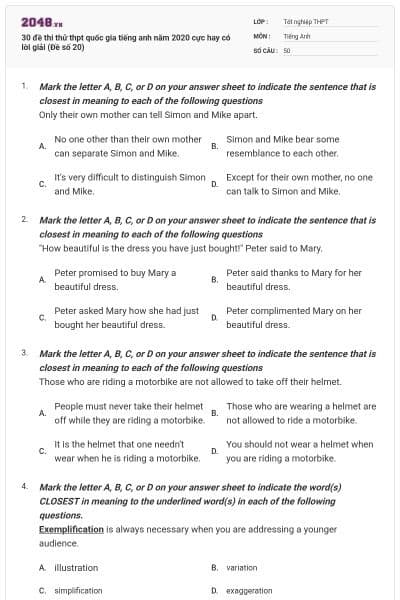
Mark the letter A, B, C, or D on your answer sheet to indicate the sentence that is closest in meaning to each of the following questions
Only their own mother can tell Simon and Mike apart.
No one other than their own mother can separate Simon and Mike.
Simon and Mike bear some resemblance to each other.
It's very difficult to distinguish Simon and Mike.
Except for their own mother, no one can talk to Simon and Mike.
Đáp án C
Kiến thức: Viết lại câu
Giải thích:
Tạm dịch: Chỉ có mẹ của họ mới có thể phân biệt Simon và Mike.
A. Không ai ngoài mẹ của họ có thể tách Simon và Mike.
B. Simon và Mike có một số điểm tương đồng với nhau.
C. Rất khó để phân biệt Simon và Mike.
D. Ngoại trừ mẹ của họ, không ai có thể nói chuyện với Simon và Mike.
Mark the letter A, B, C, or D on your answer sheet to indicate the sentence that is closest in meaning to each of the following questions
"How beautiful is the dress you have just bought!" Peter said to Mary.
Peter promised to buy Mary a beautiful dress.
Peter said thanks to Mary for her beautiful dress.
Peter asked Mary how she had just bought her beautiful dress.
Peter complimented Mary on her beautiful dress.
Đáp án D
Kiến thức: Viết lại câu, reported speech
Giải thích:
Tạm dịch: "Chiếc váy mà bạn vừa mới mua thật đẹp!" Peter nói với Mary.
A. Peter hứa mua cho Mary một chiếc váy đẹp.
B. Peter nói cám ơn với Mary về chiếc váy đẹp của cô.
C. Peter hỏi Mary cách cô vừa mua chiếc váy đẹp.
D. Peter khen Mary về chiếc váy đẹp của cô.
Mark the letter A, B, C, or D on your answer sheet to indicate the sentence that is closest in meaning to each of the following questions
Those who are riding a motorbike are not allowed to take off their helmet.
People must never take their helmet off while they are riding a motorbike.
Those who are wearing a helmet are not allowed to ride a motorbike.
It is the helmet that one needn't wear when he is riding a motorbike.
You should not wear a helmet when you are riding a motorbike.
Đáp án A
Kiến thức: Viết lại câu
Giải thích:
Tạm dịch: Những người đang đi xe máy không được phép cởi mũ bảo hiểm.
A. Mọi người không bao giờ được cởi mũ bảo hiểm khi đang đi xe máy.
B. Những người đội mũ bảo hiểm không được phép đi xe máy.
C. Một người không cần đội mũ bảo hiểm khi đi xe máy
D. Bạn không nên đội mũ bảo hiểm khi bạn đang đi xe máy.
Mark the letter A, B, C, or D on your answer sheet to indicate the word(s) CLOSEST in meaning to the underlined word(s) in each of the following questions.
Exemplification is always necessary when you are addressing a younger audience.
illustration
variation
simplification
exaggeration
Đáp án A
Kiến thức: Từ vựng, từ đồng nghĩa
Giải thích:
exemplification (n): sự minh hoạ bằng ví dụ
illustration (n): sự minh họa, ví dụ minh họa
variation (n): sự thay đổi, sự biến đổi
simplification (n): sự đơn giản hóa
exaggeration (n): sự cường điệu, sự phóng đại
=> exemplification = illustration
Tạm dịch: Ví dụ minh hoạ luôn cần thiết khi bạn đề cập đến một khán giả trẻ hơn.
Mark the letter A, B, C, or D on your answer sheet to indicate the word(s) CLOSEST in meaning to the underlined word(s) in each of the following questions.
When heated to temperatures above 1250 degrees Centigrade, clay fuses and becomes pottery or stoneware.
melts together
steams up
breaks down
burns off
Đáp án A
Kiến thức: Từ vựng, từ đồng nghĩa
Giải thích:
fuse (v): nấu chảy (kim loại)
melt together (v): tan chảy cùng nhau steam up (v): bốc hơi lên
break down (v): hỏng burn off (v): bỏng, cháy
=> fuse = melt together
Tạm dịch: Khi nung nóng ở nhiệt độ trên 1250 độ Celsius, đất sét nung chảy và trở thành đồ gốm hoặc đồ đá.
Mark the letter A, B, C, or D on your answer sheet to indicate the correct answer to each of the following questions.
Steve______his chances of passing by spending too much time on the first question.
threw away
threw in
threw off
threw out
Đáp án A
Kiến thức: Phrasal verb
Giải thích:
To throw away: vứt bỏ, bỏ phí To throw in: thêm vào, đưa ra (nhận xét)
To throw off: cố tống khứ đi To throw out: bác bỏ
Tạm dịch: Steve đã bỏ qua cơ hội vượt qua kì thi bằng cách dành quá nhiều thời gian cho câu hỏi đầu tiên.
Mark the letter A, B, C, or D on your answer sheet to indicate the correct answer to each of the following questions.
By the time Brown's daughter graduates,_______retired.
he'll have
he
he'll being
he has
Đáp án A
Kiến thức: Thì trong tiếng anh
Giải thích:
Ta dùng thì tương lai hoàn thành diễn tả một hành động sẽ xảy ra trước một hành động/một thời điểm trong tương lai
Dấu hiệu: By + mốc thời gian trong tương lai
Tạm dịch: Trước khi con gái của Brown tốt nghiệp, anh sẽ nghỉ hưu.
Mark the letter A, B, C, or D on your answer sheet to indicate the correct answer to each of the following questions.
Nobody likes his behavior,______?
doesn’t he
do they
don't they
does he
Đáp án B
Kiến thức: Câu hỏi đuôi
Giải thích:
Nếu vế chính có “Nobody” thì ở câu hỏi đuôi ta dùng “they” và ở thể khẳng định
Thì ở vế chính là hiện tại đơn (likes) nên trợ động từ ở câu hỏi đuôi ta dùng “do”
Tạm dịch: Không ai thích cách hành xử của anh ấy, phải không?
Mark the letter A, B, C, or D on your answer sheet to indicate the correct answer to each of the following questions.
______ ten minutes earlier, you would have got a better seat.
Were you arrived
If you arrived
If you hadn't arrived
Had you arrived
Đáp án D
Kiến thức: Câu điều kiện
Giải thích:
Trong câu ta sử dụng câu điều kiện loại 3, diễn tả một hành động không có thật trong quá khứ.
Cấu trúc câu điều kiện loại 3: If + mệnh đề quá khứ đơn, S + would/could… + have + PP +…
Câu điều kiện loại 3 ở dạng đảo: Had + S + PP +…, S + would/could… + have + PP +…
Tạm dịch: Nếu cậu đã đến sớm hơn mười phút, cậu hẳn đã có được chỗ ngồi tốt hơn rồi.
Mark the letter A, B, C, or D on your answer sheet to indicate the correct answer to each of the following questions.
After congratulating his team, the coach left, allowing the players to let their ______ down for a while.
hearts
hair
souls
heads
Đáp án B
Kiến thức: Phrase, từ vựng
Giải thích:
Cụm let one's hair down: thư giãn, xả hơi
Tạm dịch: Sau khi chúc mừng đội bóng, huấn luyện viên rời đi, cho phép các cầu thủ thư giãn một lúc.
Mark the letter A, B, C, or D on your answer sheet to indicate the correct answer to each of the following questions.
Extinction means a situation ______ a plant, an animal or a way of life stops existing.
to which
for which
on which
in which
Đáp án D
Kiến thức: Mệnh đề quan hệ
Giải thích:
Trong câu này, ta dùng mệnh đề quan hệ “in which” với nghĩa tương đương với “where” để chỉ một địa điểm, nơi chốn,…
Tạm dịch: Sự tuyệt chủng có nghĩa là một tình huống trong đó thực vật, động vật hoặc lối sống không còn nữa.
Mark the letter A, B, C, or D on your answer sheet to indicate the correct answer to each of the following questions.
Making mistake is all ________ of growing up.
bits and bobs
odds and ends
part and parcel
top and bottom
Đáp án C
Kiến thức: Phrase, từ vựng
Giải thích:
bits and bobs: những vật linh tinh, những thứ lặt vặt
odds and ends: đồ vật linh tinh, phần còn lại
part and parcel: phần cơ bản, quan trọng/thiết yếu
Tạm dịch: Phạm lỗi là điều cơ bản của trưởng thành.
Mark the letter A, B, C, or D on your answer sheet to indicate the correct answer to each of the following questions.
The judge ______ murderer to a lifetime imprisonment.
prosecuted
sentenced
convicted
accused
Đáp án B
Kiến thức: Phrase, từ vựng
Giải thích:
Cụm To sentence sb to…: kết án, tuyên án, xử án ai đó
Tạm dịch: Thẩm phán tuyên kẻ giết người chịu tù chung thân.
Mark the letter A, B, C, or D on your answer sheet to indicate the correct answer to each of the following questions.
When my children _____ their toys, I donated them to a charity.
outnumbered
outworn
outlasted
outgrew
Đáp án D
Kiến thức: Từ vựng
Giải thích:
outnumber (v): đông hơn outworn (a): cũ kỹ; lỗi thời
outlast (v): tồn tại lâu hơn; sống lâu hơn outgrow (v): quá lớn để làm gì đó
Tạm dịch: Khi những đứa trẻ của tôi quá lớn để chơi đồ chơi của chúng, tôi quyên góp chúng cho quỹ từ thiện.
Mark the letter A, B, C, or D on your answer sheet to indicate the correct answer to each of the following questions.
The song has______been selected for the 2018 World Cup, Russia.
office
officer
officially
official
Đáp án C
Kiến thức: Từ vựng, từ loại
Giải thích:
office (n): văn phòng officer (n): nhân viên; viên chức
officially (adv): [một cách] chính thức official (a): chính thức
Vị trí này ta cần một trạng từ để bổ sung ý nghĩa cho động từ phía sau
Tạm dịch: Bài hát đã chính thức được chọn cho World Cup 2018, Nga.
Mark the letter A, B, C, or D on your answer sheet to indicate the correct answer to each of the following questions.
Alice said: “That guy is______ gorgeous. I wish he would ask rne out.”
dead-centre
drop shot
jumped-up
drop-dead
Đáp án D
Kiến thức: Phrase, từ vựng
Giải thích:
Cụm “drop-dead gorgeous” có nghĩa: thể chất, cơ thể tuyệt đẹp
Tạm dịch: Alice nói: “Anh chàng kia thân hình thật đẹp. Ước gì anh ấy hẹn tôi ra ngoài.”
Mark the letter A, B, C, or D on your answer sheet to indicate the correct answer to each of the following questions.
This factory produced_______motorbikes in 2008 as in the year 2006.
as many as twice
as twice many
twice as many
as twice as many
Đáp án C
Kiến thức: So sánh bằng
Giải thích:
Cấu trúc so sánh bằng as… as… khi kết hợp với trạng từ chỉ số lần như once, twice, three times,…: Từ chỉ số lần + as +….+ as
Tạm dịch: Nhà máy này sản xuất xe máy vào năm 2008 gấp 2 lần so với năm 2006.
Mark the letter A, B, C, or D on your answer sheet to indicate the underlined part that needs correction in each of the following questions.
The continental shelf is the shadow area of the ocean floor that is closest to the continents.
The continental shelf
the shadow area
ocean floor
closest to
Đáp án D
Kiến thức: Sửa lỗi sai
Giải thích:
closest to => far from
Câu này sai về kiến thức trên thực tế, đáy đại dương cách xa lục địa, chứ không phải gần nhất với lục địa
Tạm dịch: Thềm lục địa là khu vực bóng tối của đại dương cách xa các lục địa.
Mark the letter A, B, C, or D on your answer sheet to indicate the underlined part that needs correction in each of the following questions.
She had so many luggage that there was not enough room in the car for it.
so many
was
enough room
it
Đáp án A
Kiến thức: Sửa lỗi sai
Giải thích:
so many => so much
luggage là danh từ không đếm được, vì thế ta không thể dùng “many” mà phải dùng “much”
Tạm dịch: Cô có nhiều hành lý đến mức không có đủ chỗ trong xe cho nó.
Mark the letter A, B, C, or D on your answer sheet to indicate the underlined part that needs correction in each of the following questions.
Her application for a visa was turned down not only because it was incomplete and incorrectly filled out but also because it was written in pencil.
for a visa
down
incomplete
pencil
Đáp án C
Kiến thức: Từ loại, sửa lại câu
Giải thích:
incomplete => incompletely
Vị trí này ta cần một trạng từ để bổ sung ý nghĩa cho động từ “fill” ở phía sau
Tạm dịch: Đơn xin thị thực của cô bị từ chối không chỉ bởi vì nó không được điền đầy đủ và chính xác mà còn bởi vì nó được viết bằng bút chì.
Mark the letter A, B, C, or D on your answer sheet to indicate the word that differs from the other three in the position of primary stress in each of the following questions.
energetic
epidemic
initiative
economic
Đáp án C
Kiến thức: Trọng âm của từ có 3 âm tiết trở lên
Giải thích:
energetic /,enə'dʒetik/ epidemic /,epi'demik/
initiative /i'ni∫ətiv/ economic /,i:kə'nɒmik/
Câu C trọng âm rơi vào âm tiết thứ 2, còn lại là thứ 3
Mark the letter A, B, C, or D on your answer sheet to indicate the word that differs from the other three in the position of primary stress in each of the following questions.
expert
mature
channel
secret
Đáp án B
Kiến thức: Trọng âm của từ có 2 âm tiết
Giải thích:
expert /'ekspɜ:t/ mature /mə't∫ʊə[r]/
channel /'t∫ænl/ secret /'si:krit/
Câu B trọng âm rơi vào âm tiết thứ 2, còn lại là thứ nhất
Read the following passage and mark the letter A, B, C, or D on your answer sheet to indicate the correct answer to each of the questions from 23 to 30
The Forbidden City is the former imperial palace in the center of Beijing, China. Construction began in 1406, and the emperor's court officially moved in by 1420. The Forbidden City got its name because most people were barred from entering the 72-hectare site, surrounded by walls. Even government officials and the imperial family were permitted only limited access. Only the emperor could enter any section at will.
The architecture of the Forbidden City conforms rigidly to traditional Chinese principles. All buildings within the walls follow a north-south line and the most important ones face south to honor the sun. The designers arranged the other buildings, and the ceremonial spaces between them, to impress all visitors with the great power of the Emperor, while reinforcing the insignificance of the individual. This architectural concept was carried out to the smallest detail. For example, the importance of a building was determined not only by its height or width but also by the style of its roof and the quantity of statuettes placed on the roof’s ridges.
In recognition of the importance of its unparalleled architecture, UNESCO added the palace to its World Heritage List in 1987. Today, visitors from all over the world do not wait for an imperial invitation to walk about this palace, now a museum of imperial art.
One of the most impressive landmarks of the Forbidden City is the Meridian Gate, the formal entrance to the southern side of the Forbidden City. The gate, with its auxiliary wings on either side of the entryway, is 38 meters high at its roof ridge. When you stand in front of this majestic structure, you understand how awed people felt when they stood there listening to imperial proclamations.
As you walk through the gate, you come into a large courtyard, 140 meters long and 210 meters wide. Running through the courtyard is the Golden River, which is crossed by five parallel white marble bridges. These bridges lead to the Gate of Supreme Harmony, which, in turn, leads to the heart of the Forbidden City. At the northernmost end of the Forbidden City is the Imperial Garden, which is totally different from the rest of the compound. Instead of rigid formality, you see a seemingly spontaneous arrangement of trees, fishponds, flowerbeds, and sculpture. Here is the place of relaxation for the emperor.
Question:According to the passage, what do the bridges over the Golden River lead to?
The Meridian gate
The Gate of Supreme Harmon
The Imperial Gardens
The center of Beijing
Đáp án B
Kiến thức: Đọc hiểu
Giải thích:
Theo đoạn văn, những cây cầu bắc qua sông Vàng dẫn đến?
A. Cổng Meridian B. Cánh cổng Tối cao
C. Hoa viên D. Trung tâm Bắc Kinh
Thông tin: Running through the courtyard is the Golden River, which is crossed by five parallel white marble bridges. These bridges lead to the Gate of Supreme Harmony
Read the following passage and mark the letter A, B, C, or D on your answer sheet to indicate the correct answer to each of the questions from 23 to 30
The Forbidden City is the former imperial palace in the center of Beijing, China. Construction began in 1406, and the emperor's court officially moved in by 1420. The Forbidden City got its name because most people were barred from entering the 72-hectare site, surrounded by walls. Even government officials and the imperial family were permitted only limited access. Only the emperor could enter any section at will.
The architecture of the Forbidden City conforms rigidly to traditional Chinese principles. All buildings within the walls follow a north-south line and the most important ones face south to honor the sun. The designers arranged the other buildings, and the ceremonial spaces between them, to impress all visitors with the great power of the Emperor, while reinforcing the insignificance of the individual. This architectural concept was carried out to the smallest detail. For example, the importance of a building was determined not only by its height or width but also by the style of its roof and the quantity of statuettes placed on the roof’s ridges.
In recognition of the importance of its unparalleled architecture, UNESCO added the palace to its World Heritage List in 1987. Today, visitors from all over the world do not wait for an imperial invitation to walk about this palace, now a museum of imperial art.
One of the most impressive landmarks of the Forbidden City is the Meridian Gate, the formal entrance to the southern side of the Forbidden City. The gate, with its auxiliary wings on either side of the entryway, is 38 meters high at its roof ridge. When you stand in front of this majestic structure, you understand how awed people felt when they stood there listening to imperial proclamations.
As you walk through the gate, you come into a large courtyard, 140 meters long and 210 meters wide. Running through the courtyard is the Golden River, which is crossed by five parallel white marble bridges. These bridges lead to the Gate of Supreme Harmony, which, in turn, leads to the heart of the Forbidden City. At the northernmost end of the Forbidden City is the Imperial Garden, which is totally different from the rest of the compound. Instead of rigid formality, you see a seemingly spontaneous arrangement of trees, fishponds, flowerbeds, and sculpture. Here is the place of relaxation for the emperor.
Question:Which phrase is closest in meaning to the word 'unparalleled' as used in paragraph 3?
high quality found nowhere else
at an angle from the main line
careless of small details in design
partially designed in a foreign country
Đáp án A
Kiến thức: Đọc hiểu
Giải thích:
Cụm từ nào gần nghĩa nhất với từ 'unparalleled' được sử dụng trong đoạn 3?
A. chất lượng cao không tìm thấy ở nơi nào khác
B. ở một góc từ đường chính
C. bất cẩn trong các chi tiết nhỏ trong thiết kế
D. thiết kế một phần ở nước ngoài
'unparalleled': không ai sánh kịp, chưa từng thấy, vô song
In recognition of the importance of its unparalleled architecture, UNESCO added the palace to its World Heritage List in 1987.
Để thừa nhận tầm quan trọng của kiến trúc vô song của nó,UNESCO đã bổ sung cung điện vào danh sách di sản thế giới vào năm 1987.
Read the following passage and mark the letter A, B, C, or D on your answer sheet to indicate the correct answer to each of the questions from 23 to 30
The Forbidden City is the former imperial palace in the center of Beijing, China. Construction began in 1406, and the emperor's court officially moved in by 1420. The Forbidden City got its name because most people were barred from entering the 72-hectare site, surrounded by walls. Even government officials and the imperial family were permitted only limited access. Only the emperor could enter any section at will.
The architecture of the Forbidden City conforms rigidly to traditional Chinese principles. All buildings within the walls follow a north-south line and the most important ones face south to honor the sun. The designers arranged the other buildings, and the ceremonial spaces between them, to impress all visitors with the great power of the Emperor, while reinforcing the insignificance of the individual. This architectural concept was carried out to the smallest detail. For example, the importance of a building was determined not only by its height or width but also by the style of its roof and the quantity of statuettes placed on the roof’s ridges.
In recognition of the importance of its unparalleled architecture, UNESCO added the palace to its World Heritage List in 1987. Today, visitors from all over the world do not wait for an imperial invitation to walk about this palace, now a museum of imperial art.
One of the most impressive landmarks of the Forbidden City is the Meridian Gate, the formal entrance to the southern side of the Forbidden City. The gate, with its auxiliary wings on either side of the entryway, is 38 meters high at its roof ridge. When you stand in front of this majestic structure, you understand how awed people felt when they stood there listening to imperial proclamations.
As you walk through the gate, you come into a large courtyard, 140 meters long and 210 meters wide. Running through the courtyard is the Golden River, which is crossed by five parallel white marble bridges. These bridges lead to the Gate of Supreme Harmony, which, in turn, leads to the heart of the Forbidden City. At the northernmost end of the Forbidden City is the Imperial Garden, which is totally different from the rest of the compound. Instead of rigid formality, you see a seemingly spontaneous arrangement of trees, fishponds, flowerbeds, and sculpture. Here is the place of relaxation for the emperor.
Question:From the passage, it is implied that the main entrance area to the Forbidden City is
not very impressive
surrounded by three tall walls
decorated with statuettes
painted gold and green
Đáp án B
Kiến thức: Đọc hiểu
Giải thích:
Từ đoạn văn, ngụ ý rằng khu vực lối vào chính của Tử Cấm Thành
A. không phải rất ấn tượng
B. bao quanh bởi ba bức tường cao
C. được trang trí bằng những bức tượng nhỏ
D. được sơn màu vàng và xanh lá cây
Thông tin: The gate, with its auxiliary wings on either side of the entryway, is 38 meters high at its roof ridge.
Read the following passage and mark the letter A, B, C, or D on your answer sheet to indicate the correct answer to each of the questions from 23 to 30
The Forbidden City is the former imperial palace in the center of Beijing, China. Construction began in 1406, and the emperor's court officially moved in by 1420. The Forbidden City got its name because most people were barred from entering the 72-hectare site, surrounded by walls. Even government officials and the imperial family were permitted only limited access. Only the emperor could enter any section at will.
The architecture of the Forbidden City conforms rigidly to traditional Chinese principles. All buildings within the walls follow a north-south line and the most important ones face south to honor the sun. The designers arranged the other buildings, and the ceremonial spaces between them, to impress all visitors with the great power of the Emperor, while reinforcing the insignificance of the individual. This architectural concept was carried out to the smallest detail. For example, the importance of a building was determined not only by its height or width but also by the style of its roof and the quantity of statuettes placed on the roof’s ridges.
In recognition of the importance of its unparalleled architecture, UNESCO added the palace to its World Heritage List in 1987. Today, visitors from all over the world do not wait for an imperial invitation to walk about this palace, now a museum of imperial art.
One of the most impressive landmarks of the Forbidden City is the Meridian Gate, the formal entrance to the southern side of the Forbidden City. The gate, with its auxiliary wings on either side of the entryway, is 38 meters high at its roof ridge. When you stand in front of this majestic structure, you understand how awed people felt when they stood there listening to imperial proclamations.
As you walk through the gate, you come into a large courtyard, 140 meters long and 210 meters wide. Running through the courtyard is the Golden River, which is crossed by five parallel white marble bridges. These bridges lead to the Gate of Supreme Harmony, which, in turn, leads to the heart of the Forbidden City. At the northernmost end of the Forbidden City is the Imperial Garden, which is totally different from the rest of the compound. Instead of rigid formality, you see a seemingly spontaneous arrangement of trees, fishponds, flowerbeds, and sculpture. Here is the place of relaxation for the emperor.
Question:Which word(s) does the word 'its' refer to in paragraph 3?
Architecture
World Heritage List
Palace
UNESCO
Đáp án D
Kiến thức: Đọc hiểu
Giải thích:
Từ nào từ "its" có đề cập đến trong đoạn 3?
A. Kiến trúc B. Danh sách di sản thế giới
C. Cung điện D. UNESCO
“its” đề cập đến UNESCO’s
In recognition of the importance of its unparalleled architecture, UNESCO added the palace to its World Heritage List in 1987.
Để thừa nhận tầm quan trọng của kiến trúc vô song của nó,UNESCO đã bổ sung cung điện vào danh sách di sản thế giới vào năm 1987.
Read the following passage and mark the letter A, B, C, or D on your answer sheet to indicate the correct answer to each of the questions from 23 to 30
The Forbidden City is the former imperial palace in the center of Beijing, China. Construction began in 1406, and the emperor's court officially moved in by 1420. The Forbidden City got its name because most people were barred from entering the 72-hectare site, surrounded by walls. Even government officials and the imperial family were permitted only limited access. Only the emperor could enter any section at will.
The architecture of the Forbidden City conforms rigidly to traditional Chinese principles. All buildings within the walls follow a north-south line and the most important ones face south to honor the sun. The designers arranged the other buildings, and the ceremonial spaces between them, to impress all visitors with the great power of the Emperor, while reinforcing the insignificance of the individual. This architectural concept was carried out to the smallest detail. For example, the importance of a building was determined not only by its height or width but also by the style of its roof and the quantity of statuettes placed on the roof’s ridges.
In recognition of the importance of its unparalleled architecture, UNESCO added the palace to its World Heritage List in 1987. Today, visitors from all over the world do not wait for an imperial invitation to walk about this palace, now a museum of imperial art.
One of the most impressive landmarks of the Forbidden City is the Meridian Gate, the formal entrance to the southern side of the Forbidden City. The gate, with its auxiliary wings on either side of the entryway, is 38 meters high at its roof ridge. When you stand in front of this majestic structure, you understand how awed people felt when they stood there listening to imperial proclamations.
As you walk through the gate, you come into a large courtyard, 140 meters long and 210 meters wide. Running through the courtyard is the Golden River, which is crossed by five parallel white marble bridges. These bridges lead to the Gate of Supreme Harmony, which, in turn, leads to the heart of the Forbidden City. At the northernmost end of the Forbidden City is the Imperial Garden, which is totally different from the rest of the compound. Instead of rigid formality, you see a seemingly spontaneous arrangement of trees, fishponds, flowerbeds, and sculpture. Here is the place of relaxation for the emperor.
Question:Which word or phrase is closest in meaning to the word "spontaneous"?
Without thinking
Unique
Without planning
Strange
Đáp án C
Kiến thức: Đọc hiểu
Giải thích:
Từ hoặc cụm từ nào gần nghĩa nhất với từ "spontaneous"?
A. không suy nghĩ B. duy nhất
C. không có kế hoạch trước D. kỳ lạ
"spontaneous": tự phát, tự sinh, tự nhiên, không kế hoạch trước
Instead of rigid formality, you see a seemingly spontaneous arrangement of trees, fishponds, flowerbeds, and sculpture. Here is the place of relaxation for the emperor.
Thay vì hình thức cứng nhắc, bạn sẽ thấy một sự sắp xếp tự nhiên của cây, ao cá, thảm hoa, và điêu khắc. Đây là nơi thư giãn cho hoàng đế.
Read the following passage and mark the letter A, B, C, or D on your answer sheet to indicate the correct answer to each of the questions from 23 to 30
The Forbidden City is the former imperial palace in the center of Beijing, China. Construction began in 1406, and the emperor's court officially moved in by 1420. The Forbidden City got its name because most people were barred from entering the 72-hectare site, surrounded by walls. Even government officials and the imperial family were permitted only limited access. Only the emperor could enter any section at will.
The architecture of the Forbidden City conforms rigidly to traditional Chinese principles. All buildings within the walls follow a north-south line and the most important ones face south to honor the sun. The designers arranged the other buildings, and the ceremonial spaces between them, to impress all visitors with the great power of the Emperor, while reinforcing the insignificance of the individual. This architectural concept was carried out to the smallest detail. For example, the importance of a building was determined not only by its height or width but also by the style of its roof and the quantity of statuettes placed on the roof’s ridges.
In recognition of the importance of its unparalleled architecture, UNESCO added the palace to its World Heritage List in 1987. Today, visitors from all over the world do not wait for an imperial invitation to walk about this palace, now a museum of imperial art.
One of the most impressive landmarks of the Forbidden City is the Meridian Gate, the formal entrance to the southern side of the Forbidden City. The gate, with its auxiliary wings on either side of the entryway, is 38 meters high at its roof ridge. When you stand in front of this majestic structure, you understand how awed people felt when they stood there listening to imperial proclamations.
As you walk through the gate, you come into a large courtyard, 140 meters long and 210 meters wide. Running through the courtyard is the Golden River, which is crossed by five parallel white marble bridges. These bridges lead to the Gate of Supreme Harmony, which, in turn, leads to the heart of the Forbidden City. At the northernmost end of the Forbidden City is the Imperial Garden, which is totally different from the rest of the compound. Instead of rigid formality, you see a seemingly spontaneous arrangement of trees, fishponds, flowerbeds, and sculpture. Here is the place of relaxation for the emperor.
Question:From the passage, it can be inferred that
Chinese architects borrowed ideas from many different countries.
the garden of the Forbidden City was laid out in a strict, rectangular pattern.
the design of the Forbidden City is dull and colorless.
the architecture of the Forbidden City exemplifies traditional Chinese values.
Đáp án D
Kiến thức: Đọc hiểu
Giải thích:
Từ đoạn văn, có thể suy ra rằng
A. các kiến trúc sư Trung Quốc đã mượn ý tưởng từ nhiều quốc gia khác nhau
B. khu vườn của Tử Cấm Thành được bố trí theo một hình chữ nhật rất hẹp.
C. thiết kế của Tử Cấm Thành đơn điệu và không màu.
D. kiến trúc của Tử Cấm Thành minh hoạ các giá trị truyền thống của Trung Quốc.
Thông tin: The architecture of the Forbidden City conforms rigidly to traditional Chinese principles.
Read the following passage and mark the letter A, B, C, or D on your answer sheet to indicate the correct answer to each of the questions from 23 to 30
The Forbidden City is the former imperial palace in the center of Beijing, China. Construction began in 1406, and the emperor's court officially moved in by 1420. The Forbidden City got its name because most people were barred from entering the 72-hectare site, surrounded by walls. Even government officials and the imperial family were permitted only limited access. Only the emperor could enter any section at will.
The architecture of the Forbidden City conforms rigidly to traditional Chinese principles. All buildings within the walls follow a north-south line and the most important ones face south to honor the sun. The designers arranged the other buildings, and the ceremonial spaces between them, to impress all visitors with the great power of the Emperor, while reinforcing the insignificance of the individual. This architectural concept was carried out to the smallest detail. For example, the importance of a building was determined not only by its height or width but also by the style of its roof and the quantity of statuettes placed on the roof’s ridges.
In recognition of the importance of its unparalleled architecture, UNESCO added the palace to its World Heritage List in 1987. Today, visitors from all over the world do not wait for an imperial invitation to walk about this palace, now a museum of imperial art.
One of the most impressive landmarks of the Forbidden City is the Meridian Gate, the formal entrance to the southern side of the Forbidden City. The gate, with its auxiliary wings on either side of the entryway, is 38 meters high at its roof ridge. When you stand in front of this majestic structure, you understand how awed people felt when they stood there listening to imperial proclamations.
As you walk through the gate, you come into a large courtyard, 140 meters long and 210 meters wide. Running through the courtyard is the Golden River, which is crossed by five parallel white marble bridges. These bridges lead to the Gate of Supreme Harmony, which, in turn, leads to the heart of the Forbidden City. At the northernmost end of the Forbidden City is the Imperial Garden, which is totally different from the rest of the compound. Instead of rigid formality, you see a seemingly spontaneous arrangement of trees, fishponds, flowerbeds, and sculpture. Here is the place of relaxation for the emperor.
Question:Which phrase is closest in meaning to the word “proclamations”?
Poetry written for the emperor.
Music composed for public ceremonies.
Speeches encouraging soldiers to fight.
Official public announcements.
Đáp án D
Kiến thức: Đọc hiểu
Giải thích:
Cụm từ nào gần nghĩa nhất với từ "proclamations"?
A. Thơ viết cho hoàng đế.
B. Âm nhạc sáng tác cho các nghi lễ công cộng.
C. Bài phát biểu khuyến khích binh sĩ chiến đấu.
D. Thông báo công khai chính thức.
"proclamations": lời tuyên bố, thông báo chính thức
When you stand in front of this majestic structure, you understand how awed people felt when they stood there listening to imperial proclamations.
Khi bạn đứng trước cấu trúc hùng vĩ này, bạn hiểu người ta cảm thấy thế nào khi họ đứng đó lắng nghe chiếu chỉ của hoàng đế.
Read the following passage and mark the letter A, B, C, or D on your answer sheet to indicate the correct answer to each of the questions from 23 to 30
The Forbidden City is the former imperial palace in the center of Beijing, China. Construction began in 1406, and the emperor's court officially moved in by 1420. The Forbidden City got its name because most people were barred from entering the 72-hectare site, surrounded by walls. Even government officials and the imperial family were permitted only limited access. Only the emperor could enter any section at will.
The architecture of the Forbidden City conforms rigidly to traditional Chinese principles. All buildings within the walls follow a north-south line and the most important ones face south to honor the sun. The designers arranged the other buildings, and the ceremonial spaces between them, to impress all visitors with the great power of the Emperor, while reinforcing the insignificance of the individual. This architectural concept was carried out to the smallest detail. For example, the importance of a building was determined not only by its height or width but also by the style of its roof and the quantity of statuettes placed on the roof’s ridges.
In recognition of the importance of its unparalleled architecture, UNESCO added the palace to its World Heritage List in 1987. Today, visitors from all over the world do not wait for an imperial invitation to walk about this palace, now a museum of imperial art.
One of the most impressive landmarks of the Forbidden City is the Meridian Gate, the formal entrance to the southern side of the Forbidden City. The gate, with its auxiliary wings on either side of the entryway, is 38 meters high at its roof ridge. When you stand in front of this majestic structure, you understand how awed people felt when they stood there listening to imperial proclamations.
As you walk through the gate, you come into a large courtyard, 140 meters long and 210 meters wide. Running through the courtyard is the Golden River, which is crossed by five parallel white marble bridges. These bridges lead to the Gate of Supreme Harmony, which, in turn, leads to the heart of the Forbidden City. At the northernmost end of the Forbidden City is the Imperial Garden, which is totally different from the rest of the compound. Instead of rigid formality, you see a seemingly spontaneous arrangement of trees, fishponds, flowerbeds, and sculpture. Here is the place of relaxation for the emperor.
Question:Which sentence in the first paragraph explains who could go anywhere in the Forbidden City at any time?
Sentence 2
Sentence 5
Sentence 4
Sentence 3
Đáp án B
Kiến thức: Đọc hiểu
Giải thích:
Câu nào trong đoạn 1 giải thích việc ai có thể đi bất cứ đâu trong Tử Cấm Thành bất cứ lúc nào?
A. Câu 2 B. Câu 5
C. Câu 4 D. Câu 3
Thông tin: (Câu 5) Only the emperor could enter any section at will.
Read the following passage and mark the letter A, B, C, or D on your answer sheet to indicate the correct answer to each of the questions from 31 to 37.
People have been donating blood since the early twentieth century to help accident victims and patients undergoing surgical procedures. Usually a pint of whole blood is donated, and it is then divided into platelets, white blood cells, and red blood cells. People can donate blood (for red blood cells) about once every two months. Transfusing the blood from the donor to the recipient is straightforward. It involves taking the blood from a donor’s arm vein by means of a hypodermic syringe. The blood flows through a plastic tube to a collection bag or bottle that contains sodium citrate, which prevents the blood from clotting. When the blood is given to a patient, a plastic tube and hypodermic needle are connected to the recipient's arm. The blood flows down from the container by gravity. This is a slow process and may last as long as 2 hours to complete the infusion of blood into the recipient. The patient is protected from being infected during the transfusion. Only sterile containers, tubing, and needles are used, and this helps ensure that transfused or stored blood is not exposed to disease causing bacteria. Negative reactions to transfusions are not unusual. The recipient may suffer an allergic reaction or be sensitive to donor leukocytes. Some may suffer from an undetected red cell incompatibility. Unexplained reactions are also fairly common. Although they are rare, other causes of such negative reactions include contaminated blood, air bubbles in the blood, overloading of the circulatory system through administration of excess blood, or sensitivity to donor plasma or platelets. Today, hospitals and blood banks go to great lengths to screen alt blood donors and their blood. All donated blood is routinely and rigorously tested for diseases, such as HIV, hepatitis B, and syphilis. When the recipient is a newborn or an infant, the blood is usually irradiated to eliminate harmful elements. Donated blood is washed, and the white blood cells and platelets removed. Storing the blood sometimes requires a freezing process. To freeze the red blood cells, a glycerol solution is added. To unfreeze the, the glycerolis removed. The ability to store blood for long periods has been a boon to human health.
Question:All of the following are mentioned as potential negative reactions to transfusion EXCEPT
Sensitivity to donor leukocytes
Air bubbles in the blood
Allergies
Red-cell incompatibility
Đáp án B
Kiến thức: Đọc hiểu
Giải thích:
Tất cả những điều sau đây được đề cập như là những phản ứng tiêu cực có thể xảy ra đối với truyền máu TRỪ
A. Nhạy cảm với bạch cầu B. Bong bóng khí trong máu
C. Dị ứng D. Sự không tương thích của hồng cầu
Thông tin: Negative reactions to transfusions are not unusual. The recipient may suffer an allergic reaction or be sensitive to donor leukocytes. Some may suffer from an undetected red cell incompatibility.
Chỉ có đáp án B không được đề cập
Read the following passage and mark the letter A, B, C, or D on your answer sheet to indicate the correct answer to each of the questions from 31 to 37.
People have been donating blood since the early twentieth century to help accident victims and patients undergoing surgical procedures. Usually a pint of whole blood is donated, and it is then divided into platelets, white blood cells, and red blood cells. People can donate blood (for red blood cells) about once every two months. Transfusing the blood from the donor to the recipient is straightforward. It involves taking the blood from a donor’s arm vein by means of a hypodermic syringe. The blood flows through a plastic tube to a collection bag or bottle that contains sodium citrate, which prevents the blood from clotting. When the blood is given to a patient, a plastic tube and hypodermic needle are connected to the recipient's arm. The blood flows down from the container by gravity. This is a slow process and may last as long as 2 hours to complete the infusion of blood into the recipient. The patient is protected from being infected during the transfusion. Only sterile containers, tubing, and needles are used, and this helps ensure that transfused or stored blood is not exposed to disease causing bacteria. Negative reactions to transfusions are not unusual. The recipient may suffer an allergic reaction or be sensitive to donor leukocytes. Some may suffer from an undetected red cell incompatibility. Unexplained reactions are also fairly common. Although they are rare, other causes of such negative reactions include contaminated blood, air bubbles in the blood, overloading of the circulatory system through administration of excess blood, or sensitivity to donor plasma or platelets. Today, hospitals and blood banks go to great lengths to screen alt blood donors and their blood. All donated blood is routinely and rigorously tested for diseases, such as HIV, hepatitis B, and syphilis. When the recipient is a newborn or an infant, the blood is usually irradiated to eliminate harmful elements. Donated blood is washed, and the white blood cells and platelets removed. Storing the blood sometimes requires a freezing process. To freeze the red blood cells, a glycerol solution is added. To unfreeze the, the glycerolis removed. The ability to store blood for long periods has been a boon to human health.
Question:What can the phrase "go to great length" best replaced by?
irradiated
rigorously
routinely
removed
Đáp án B
Kiến thức: Đọc hiểu
Giải thích:
Cụm từ "go to great length" có thể được thay thế tốt nhất bằng?
A. chiếu xạ B. một cách nghiêm ngặt
C. thường xuyên D. loại bỏ
Today, hospitals and blood banks go to great lengths to screen alt blood donors and their blood.
Ngày nay, các bệnh viện và ngân hàng máu nghiêm ngặt theo dõi những người hiến máu và máu của họ.
Read the following passage and mark the letter A, B, C, or D on your answer sheet to indicate the correct answer to each of the questions from 31 to 37.
People have been donating blood since the early twentieth century to help accident victims and patients undergoing surgical procedures. Usually a pint of whole blood is donated, and it is then divided into platelets, white blood cells, and red blood cells. People can donate blood (for red blood cells) about once every two months. Transfusing the blood from the donor to the recipient is straightforward. It involves taking the blood from a donor’s arm vein by means of a hypodermic syringe. The blood flows through a plastic tube to a collection bag or bottle that contains sodium citrate, which prevents the blood from clotting. When the blood is given to a patient, a plastic tube and hypodermic needle are connected to the recipient's arm. The blood flows down from the container by gravity. This is a slow process and may last as long as 2 hours to complete the infusion of blood into the recipient. The patient is protected from being infected during the transfusion. Only sterile containers, tubing, and needles are used, and this helps ensure that transfused or stored blood is not exposed to disease causing bacteria. Negative reactions to transfusions are not unusual. The recipient may suffer an allergic reaction or be sensitive to donor leukocytes. Some may suffer from an undetected red cell incompatibility. Unexplained reactions are also fairly common. Although they are rare, other causes of such negative reactions include contaminated blood, air bubbles in the blood, overloading of the circulatory system through administration of excess blood, or sensitivity to donor plasma or platelets. Today, hospitals and blood banks go to great lengths to screen alt blood donors and their blood. All donated blood is routinely and rigorously tested for diseases, such as HIV, hepatitis B, and syphilis. When the recipient is a newborn or an infant, the blood is usually irradiated to eliminate harmful elements. Donated blood is washed, and the white blood cells and platelets removed. Storing the blood sometimes requires a freezing process. To freeze the red blood cells, a glycerol solution is added. To unfreeze the, the glycerolis removed. The ability to store blood for long periods has been a boon to human health.
Question:According to the passage, how often can people donate blood for red blood cells?
Every four months
Every three month
Every two months
Every month
Đáp án C
Kiến thức: Đọc hiểu
Giải thích:
Theo đoạn văn, người ta thường hiến máu cho hồng cầu như thế nào?
A. Mỗi bốn tháng B. Mỗi ba tháng
C. mỗi hai tháng D. mỗi tháng
Thông tin: People can donate blood (for red blood cells) about once every two months.
Read the following passage and mark the letter A, B, C, or D on your answer sheet to indicate the correct answer to each of the questions from 31 to 37.
People have been donating blood since the early twentieth century to help accident victims and patients undergoing surgical procedures. Usually a pint of whole blood is donated, and it is then divided into platelets, white blood cells, and red blood cells. People can donate blood (for red blood cells) about once every two months. Transfusing the blood from the donor to the recipient is straightforward. It involves taking the blood from a donor’s arm vein by means of a hypodermic syringe. The blood flows through a plastic tube to a collection bag or bottle that contains sodium citrate, which prevents the blood from clotting. When the blood is given to a patient, a plastic tube and hypodermic needle are connected to the recipient's arm. The blood flows down from the container by gravity. This is a slow process and may last as long as 2 hours to complete the infusion of blood into the recipient. The patient is protected from being infected during the transfusion. Only sterile containers, tubing, and needles are used, and this helps ensure that transfused or stored blood is not exposed to disease causing bacteria. Negative reactions to transfusions are not unusual. The recipient may suffer an allergic reaction or be sensitive to donor leukocytes. Some may suffer from an undetected red cell incompatibility. Unexplained reactions are also fairly common. Although they are rare, other causes of such negative reactions include contaminated blood, air bubbles in the blood, overloading of the circulatory system through administration of excess blood, or sensitivity to donor plasma or platelets. Today, hospitals and blood banks go to great lengths to screen alt blood donors and their blood. All donated blood is routinely and rigorously tested for diseases, such as HIV, hepatitis B, and syphilis. When the recipient is a newborn or an infant, the blood is usually irradiated to eliminate harmful elements. Donated blood is washed, and the white blood cells and platelets removed. Storing the blood sometimes requires a freezing process. To freeze the red blood cells, a glycerol solution is added. To unfreeze the, the glycerolis removed. The ability to store blood for long periods has been a boon to human health.
Question:Based on the information in the passage, what can be inferred about blood transfused to infants and newborns?
It is treated with radiant energy.
It is not treated differently from adults.
It is not dangerous for children.
It is rigorously tested as blood for adults.
Đáp án A
Kiến thức: Đọc hiểu
Giải thích:
Dựa vào những thông tin trong đoạn văn, có thể suy ra những gì về truyền máu cho trẻ sơ sinh và trẻ nhỏ?
A. Nó được xử lý bằng năng lượng bức xạ.
B. Nó không được xử lý khác với người lớn.
C. Nó không gây nguy hiểm cho trẻ em.
D. Nó được kiểm tra nghiêm ngặt như máu cho người lớn.
Thông tin: When the recipient is a newborn or an infant, the blood is usually irradiated to eliminate harmful elements.
Read the following passage and mark the letter A, B, C, or D on your answer sheet to indicate the correct answer to each of the questions from 31 to 37.
People have been donating blood since the early twentieth century to help accident victims and patients undergoing surgical procedures. Usually a pint of whole blood is donated, and it is then divided into platelets, white blood cells, and red blood cells. People can donate blood (for red blood cells) about once every two months. Transfusing the blood from the donor to the recipient is straightforward. It involves taking the blood from a donor’s arm vein by means of a hypodermic syringe. The blood flows through a plastic tube to a collection bag or bottle that contains sodium citrate, which prevents the blood from clotting. When the blood is given to a patient, a plastic tube and hypodermic needle are connected to the recipient's arm. The blood flows down from the container by gravity. This is a slow process and may last as long as 2 hours to complete the infusion of blood into the recipient. The patient is protected from being infected during the transfusion. Only sterile containers, tubing, and needles are used, and this helps ensure that transfused or stored blood is not exposed to disease causing bacteria. Negative reactions to transfusions are not unusual. The recipient may suffer an allergic reaction or be sensitive to donor leukocytes. Some may suffer from an undetected red cell incompatibility. Unexplained reactions are also fairly common. Although they are rare, other causes of such negative reactions include contaminated blood, air bubbles in the blood, overloading of the circulatory system through administration of excess blood, or sensitivity to donor plasma or platelets. Today, hospitals and blood banks go to great lengths to screen alt blood donors and their blood. All donated blood is routinely and rigorously tested for diseases, such as HIV, hepatitis B, and syphilis. When the recipient is a newborn or an infant, the blood is usually irradiated to eliminate harmful elements. Donated blood is washed, and the white blood cells and platelets removed. Storing the blood sometimes requires a freezing process. To freeze the red blood cells, a glycerol solution is added. To unfreeze the, the glycerolis removed. The ability to store blood for long periods has been a boon to human health.
Question:The word "it" referst
surgical procedures
accident victims
a pint of whole blood
surgery patients
Đáp án C
Kiến thức: Đọc hiểu
Giải thích:
Từ "it" dùng để chỉ
A. thủ tục phẫu thuật B. người bị tai nạn
C. một lượng máu D. bệnh nhân phẫu thuật
“it” chỉ “a pint of whole blood”: Usually a pint of whole blood is donated, and it is then divided into platelets, white blood cells, and red blood cells.
Thông thường, một lượng máu được hiến tặng, sau đó chia thành tiểu cầu, bạch cầu và hồng cầu.
Read the following passage and mark the letter A, B, C, or D on your answer sheet to indicate the correct answer to each of the questions from 31 to 37.
People have been donating blood since the early twentieth century to help accident victims and patients undergoing surgical procedures. Usually a pint of whole blood is donated, and it is then divided into platelets, white blood cells, and red blood cells. People can donate blood (for red blood cells) about once every two months. Transfusing the blood from the donor to the recipient is straightforward. It involves taking the blood from a donor’s arm vein by means of a hypodermic syringe. The blood flows through a plastic tube to a collection bag or bottle that contains sodium citrate, which prevents the blood from clotting. When the blood is given to a patient, a plastic tube and hypodermic needle are connected to the recipient's arm. The blood flows down from the container by gravity. This is a slow process and may last as long as 2 hours to complete the infusion of blood into the recipient. The patient is protected from being infected during the transfusion. Only sterile containers, tubing, and needles are used, and this helps ensure that transfused or stored blood is not exposed to disease causing bacteria. Negative reactions to transfusions are not unusual. The recipient may suffer an allergic reaction or be sensitive to donor leukocytes. Some may suffer from an undetected red cell incompatibility. Unexplained reactions are also fairly common. Although they are rare, other causes of such negative reactions include contaminated blood, air bubbles in the blood, overloading of the circulatory system through administration of excess blood, or sensitivity to donor plasma or platelets. Today, hospitals and blood banks go to great lengths to screen alt blood donors and their blood. All donated blood is routinely and rigorously tested for diseases, such as HIV, hepatitis B, and syphilis. When the recipient is a newborn or an infant, the blood is usually irradiated to eliminate harmful elements. Donated blood is washed, and the white blood cells and platelets removed. Storing the blood sometimes requires a freezing process. To freeze the red blood cells, a glycerol solution is added. To unfreeze the, the glycerolis removed. The ability to store blood for long periods has been a boon to human health.
Question:What answer choice is closest in meaning to the word “undetected”?
not illustrated
not captured
not found
not wanted
Đáp án C
Kiến thức: Đọc hiểu
Giải thích:
Từ nào gần nghĩa nhất với từ "undetected"?
A. không minh họa B. không bị bắt
C. không tìm thấy D. không muốn
"undetected": không bị phát hiện
Some may suffer from an undetected red cell incompatibility. Unexplained reactions are also fairly common.
Một số có thể bị ảnh hưởng bởi sự không tương thích của các tế bào hồng cầu không bị phát hiện. Các phản ứng không giải thích được cũng khá phổ biến.
Read the following passage and mark the letter A, B, C, or D on your answer sheet to indicate the correct answer to each of the questions from 31 to 37.
People have been donating blood since the early twentieth century to help accident victims and patients undergoing surgical procedures. Usually a pint of whole blood is donated, and it is then divided into platelets, white blood cells, and red blood cells. People can donate blood (for red blood cells) about once every two months. Transfusing the blood from the donor to the recipient is straightforward. It involves taking the blood from a donor’s arm vein by means of a hypodermic syringe. The blood flows through a plastic tube to a collection bag or bottle that contains sodium citrate, which prevents the blood from clotting. When the blood is given to a patient, a plastic tube and hypodermic needle are connected to the recipient's arm. The blood flows down from the container by gravity. This is a slow process and may last as long as 2 hours to complete the infusion of blood into the recipient. The patient is protected from being infected during the transfusion. Only sterile containers, tubing, and needles are used, and this helps ensure that transfused or stored blood is not exposed to disease causing bacteria. Negative reactions to transfusions are not unusual. The recipient may suffer an allergic reaction or be sensitive to donor leukocytes. Some may suffer from an undetected red cell incompatibility. Unexplained reactions are also fairly common. Although they are rare, other causes of such negative reactions include contaminated blood, air bubbles in the blood, overloading of the circulatory system through administration of excess blood, or sensitivity to donor plasma or platelets. Today, hospitals and blood banks go to great lengths to screen alt blood donors and their blood. All donated blood is routinely and rigorously tested for diseases, such as HIV, hepatitis B, and syphilis. When the recipient is a newborn or an infant, the blood is usually irradiated to eliminate harmful elements. Donated blood is washed, and the white blood cells and platelets removed. Storing the blood sometimes requires a freezing process. To freeze the red blood cells, a glycerol solution is added. To unfreeze the, the glycerolis removed. The ability to store blood for long periods has been a boon to human health.
Question:What does the author imply in the passage?
Motoring blood benefits mankind.
Clotting cannot be prevented.
Freezing blood destroys platelets.
Transfusing blood is a dangerous process.
Đáp án A
Kiến thức: Đọc hiểu
Giải thích:
Tác giả có ý gì trong đoạn văn?
A. Máu có lợi cho nhân loại. B. Không thể ngăn ngừa đông máu.
C. Làm đông máu sẽ phá hủy tiểu cầu. D. Truyền máu là một quá trình nguy hiểm.
Thông tin: The ability to store blood for long periods has been a boon to human health.
Read the following passage and mark the letter A, B, C, or D on your answer sheet to indicate the correct word or phrase that best fits each of the numbered blanks from 38 to 42.
Working as a novelist is not really a career like being a doctor or a scientist. Although a fewwell-known ones, like Harry Potter author J. K. Rowling, have become wealthy, most writers find it difficult even to make a living from their book sales. Novels take a long time towrite, and authors can get into financial (38) _____ if they don’t have money coming in regularly from another job. But for those determined to write novels, it is without (39)______ one of the most enjoyable kinds of work to do. The writer has to be creative, thinking up completely new stories, and (40) _____, meaning they put all their time and effort into their work. They also need to be able to cope in a crisis, as nobody else can write their book for them. For this, a good sense of (41)______ often helps. Or the thought that maybe their novel might one day be turned into a film and become a Hollywood (42) _____!
Question 38:
problem
trouble
upset
worry
Đáp án B
Kiến thức: Từ vựng, đọc hiểu
Giải thích:
problem (n): vấn đề trouble (n): điều phiền toái, trục trặc
upset (n): sự làm xáo trộn; sự bị xáo trộn worry (n): sự lo lắng
Read the following passage and mark the letter A, B, C, or D on your answer sheet to indicate the correct word or phrase that best fits each of the numbered blanks from 38 to 42.
Working as a novelist is not really a career like being a doctor or a scientist. Although a fewwell-known ones, like Harry Potter author J. K. Rowling, have become wealthy, most writers find it difficult even to make a living from their book sales. Novels take a long time towrite, and authors can get into financial (38) _____ if they don’t have money coming in regularly from another job. But for those determined to write novels, it is without (39)______ one of the most enjoyable kinds of work to do. The writer has to be creative, thinking up completely new stories, and (40) _____, meaning they put all their time and effort into their work. They also need to be able to cope in a crisis, as nobody else can write their book for them. For this, a good sense of (41)______ often helps. Or the thought that maybe their novel might one day be turned into a film and become a Hollywood (42) _____!
Question 39:
difficulty
suspicion
thinking
doubt
Đáp án D
Kiến thức: Từ vựng, đọc hiểu
Giải thích:
difficulty (n): sự khó khăn suspicion (n): sự tình nghi
thinking (n): sự suy nghĩ; sự lý luận doubt (n): sự nghi ngờ
Cụm without doubt: chắc chắn, không nghi ngờ gì
Read the following passage and mark the letter A, B, C, or D on your answer sheet to indicate the correct word or phrase that best fits each of the numbered blanks from 38 to 42.
Working as a novelist is not really a career like being a doctor or a scientist. Although a fewwell-known ones, like Harry Potter author J. K. Rowling, have become wealthy, most writers find it difficult even to make a living from their book sales. Novels take a long time towrite, and authors can get into financial (38) _____ if they don’t have money coming in regularly from another job. But for those determined to write novels, it is without (39)______ one of the most enjoyable kinds of work to do. The writer has to be creative, thinking up completely new stories, and (40) _____, meaning they put all their time and effort into their work. They also need to be able to cope in a crisis, as nobody else can write their book for them. For this, a good sense of (41)______ often helps. Or the thought that maybe their novel might one day be turned into a film and become a Hollywood (42) _____!
Question 40:
deliberate
delivered
decided
dedicated
Đáp án D
Kiến thức: Từ vựng, đọc hiểu
Giải thích:
deliberate (v): cân nhắc kỹ; bàn bạc kỹ deliver (v): giao (hàng)
decided (a): quả quyết, quyết tâm, rõ ràng dedicated (a): tận tụy, tận tâm
Read the following passage and mark the letter A, B, C, or D on your answer sheet to indicate the correct word or phrase that best fits each of the numbered blanks from 38 to 42.
Working as a novelist is not really a career like being a doctor or a scientist. Although a fewwell-known ones, like Harry Potter author J. K. Rowling, have become wealthy, most writers find it difficult even to make a living from their book sales. Novels take a long time towrite, and authors can get into financial (38) _____ if they don’t have money coming in regularly from another job. But for those determined to write novels, it is without (39)______ one of the most enjoyable kinds of work to do. The writer has to be creative, thinking up completely new stories, and (40) _____, meaning they put all their time and effort into their work. They also need to be able to cope in a crisis, as nobody else can write their book for them. For this, a good sense of (41)______ often helps. Or the thought that maybe their novel might one day be turned into a film and become a Hollywood (42) _____!
Question 41:
hoping
humor
smiling
joking
Đáp án B
Kiến thức: Phrase, đọc hiểu
Giải thích:
Cụm “sense of humor”: khiếu hài hước
Read the following passage and mark the letter A, B, C, or D on your answer sheet to indicate the correct word or phrase that best fits each of the numbered blanks from 38 to 42.
Working as a novelist is not really a career like being a doctor or a scientist. Although a fewwell-known ones, like Harry Potter author J. K. Rowling, have become wealthy, most writers find it difficult even to make a living from their book sales. Novels take a long time towrite, and authors can get into financial (38) _____ if they don’t have money coming in regularly from another job. But for those determined to write novels, it is without (39)______ one of the most enjoyable kinds of work to do. The writer has to be creative, thinking up completely new stories, and (40) _____, meaning they put all their time and effort into their work. They also need to be able to cope in a crisis, as nobody else can write their book for them. For this, a good sense of (41)______ often helps. Or the thought that maybe their novel might one day be turned into a film and become a Hollywood (42) _____!
Question 42:
best-seller
attraction
blockbuster
victory
Đáp án C
Kiến thức: Từ vựng, đọc hiểu
Giải thích:
best-seller (n): cuốn sách bán chạy nhất attraction (n): sự thu hút, sự lôi cuốn
blockbuster (n): bom tấn, cuốn sách thành công victory (n): sự chiến thắng
Mark the letter A, B, C, or D on your answer sheet to indicate the word(s) OPPOSITE in meaning to the underlined word(s) in each of the following questions.
The situation seems to be changing minute by minute.
from time to time
time after time
again and again
very slowly
Đáp án D
Kiến thức: Từ vựng, từ trái nghĩa
Giải thích:
minute by minute: từng phút một (thể hiện sự nhanh chóng)
from time to time: thỉnh thoảng time after time: để nói tới một điều gì lặp đi lặp lại
again and again: lặp đi lặp lại very slowly: rất chậm
=> minute by minute >< very slowly
Tạm dịch: Tình hình dường như thay đổi từng phút một.
Mark the letter A, B, C, or D on your answer sheet to indicate the word(s) OPPOSITE in meaning to the underlined word(s) in each of the following questions.
Jose had a hard time comparing the iPhone to the Samsung phone because to him they were apples and oranges.
containing too many technical details
very similar
completely different
very complicated
Đáp án B
Kiến thức: Từ vựng, từ trái nghĩa
Giải thích:
apples and oranges: hoàn toàn khác nhau
containing too many technical details: chứa quá nhiều chi tiết kỹ thuật
very similar: rất tương đồng
completely different: hoàn toàn khác nhau
very complicated: rất phức tạp
=> apples and oranges >< very similar
Tạm dịch: Jose đã có một thời gian khó khăn so sánh iPhone với Samsung vì đối với anh ấy chúng rất khác nhau.
Mark the letter A, B, C, or D on your answer sheet to indicate the sentence that best completes each of the following exchanges.
Liz and Laura is going shopping together.
Liz: "Look! This sweater is beautiful."
Laura: “______?”
Why not trying it on
Why not trying on it
Why not try it on
Why not try on it
Đáp án C
Kiến thức: Văn hoá giao tiếp
Giải thích:
Cụm “Why not try it on?”: Tại sao không thử mặc nó xem? (Dùng khi đi mua quần áo ở cửa hàng)
Tạm dịch:
Liz và Laura đang đi mua sắm cùng nhau.
Liz: "Nhìn này chiếc áo len này thật đẹp."
Laura: "Tại sao không thử nó xem?"
Mark the letter A, B, C, or D on your answer sheet to indicate the sentence that best completes each of the following exchanges.
Anna is seeing Bill off at the airport.
Anna: "_______"
Bill: "I will."
I'll miss you much.
Give my best wishes to your parents.
Have a nice trip!
Wish you a happy journey.
Đáp án B
Kiến thức: Văn hoá giao tiếp
Giải thích:
Tạm dịch: Anna đang tiễn Bill ở sân bay.
Anna: "_______"
Bill: "Tôi sẽ."
A. Tôi sẽ nhớ bạn rất nhiều. B. Gửi lời chúc của tôi đến cha mẹ bạn nhé.
C. Có một chuyến đi tốt đẹp nhé! D. Chúc bạn có một cuộc hành trình vui vẻ.
Mark the letter A, B, C, or D on your answer sheet to indicate the word whose underlined part differs from the other three in pronunciation in each of the following questions.
promised
conserved
destroyed
proposed
Đáp án A
Kiến thức: Phát âm “-ed”
Giải thích:
Có 3 cách phát âm ed trong tiếng anh
Đuôi /ed/ được phát âm là /id/ khi động từ có phát âm kết thúc là /t/ hay /d/
Đuôi /ed/ được phát âm là /t/ khi động từ có phát âm kết thúc là /s/,/f/,/p/,/ʃ/,/tʃ/,/k/
Đuôi /ed/ được phát âm là /d/ với các trường hợp còn lại.
Phần gạch chân câu A được phát âm là /t/ còn lại là /d/
Mark the letter A, B, C, or D on your answer sheet to indicate the word whose underlined part differs from the other three in pronunciation in each of the following questions.
champagne
chaos
scheme
chemist
Đáp án A
Kiến thức: Phát âm “-ch”
Giải thích:
champagne /∫æm'pein/ chaos /'keiɒs/
scheme /ski:m/ chemist /'kemist/
Phần gạch chân câu A được phát âm là /∫/ còn lại là /k/
Mark the letter A, B, C, or D on your answer sheet to indicate the sentence that best combines each pair of sentences in the following questions.
The government knows the extent of the problem. The government needs to take action soon.
Knowing the extent of the problem, the government needs to take action soon.
The government knows the extent of the problem whereas it needs to take action soon.
The government knows the extent of the problem so that it needs to take action soon.
The government knows the extent of the problem or else it needs to take action soon.
Đáp án A
Kiến thức: Viết lại câu
Giải thích:
Tạm dịch: Chính phủ biết mức độ của vấn đề. Chính phủ cần sớm hành động.
A. Hiểu được mức độ của vấn đề, chính phủ cần hành động sớm.
B. Chính phủ biết mức độ của vấn đề trong khi nó cần phải hành động sớm.
C. Chính phủ biết mức độ của vấn đề để nó cần phải hành động sớm.
D. Chính phủ biết mức độ của vấn đề hoặc nếu không nó cần phải hành động sớm.
Mark the letter A, B, C, or D on your answer sheet to indicate the sentence that best combines each pair of sentences in the following questions.
He didn't notice anything. We might have been in trouble otherwise.
If he noticed anything, we would be in trouble.
If he hadn't noticed anything, we couldn't have been in trouble.
If he had noticed anything, we could have been in trouble.
If he noticed anything, we could have been in trouble.
Đáp án C
Kiến thức: Viết lại câu
Giải thích:
Tạm dịch: Anh ta không để ý gì cả. Nếu không chúng ta có thể đã gặp rắc rối.
A. Nếu anh ta nhận thấy bất cứ điều gì, chúng ta sẽ gặp rắc rối.
B. Nếu anh ta không nhận thấy bất cứ điều gì, chúng tôi không thể đã gặp rắc rối.
C. Nếu anh ta đã nhận thấy bất cứ điều gì, chúng tôi có thể đã gặp rắc rối.
D. Sai cấu trúc câu điều kiện