30 đề thi thử thpt quốc gia tiếng anh năm 2020 cực hay có lời giải (Đề số 19)
50 câu hỏi
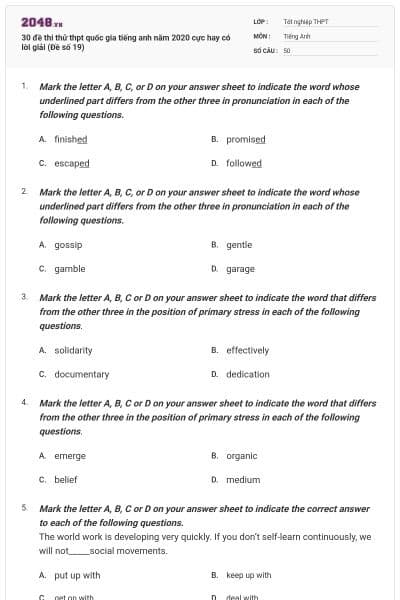
Mark the letter A, B, C, or D on your answer sheet to indicate the word whose underlined part differs from the other three in pronunciation in each of the following questions.
finished
promised
escaped
followed
Đáp án D
Kiến thức: Phát âm “-ed”
Giải thích:
Có 3 cách phát âm ed trong tiếng anh là -/id/ /-t/ -/d/
Đuôi /ed/ được phát âm là /id/ khi động từ có phát âm kết thúc là /t/ hay /d/
Đuôi /ed/ được phát âm là /t/ khi động từ có phát âm kết thúc là /s/,/f/,/p/,/ʃ/,/tʃ/,/k/
Đuôi /ed/ được phát âm là /d/ với các trường hợp còn lại.
Phần gạch chân câu D được phát âm là /d/ còn lại là /t/
Mark the letter A, B, C, or D on your answer sheet to indicate the word whose underlined part differs from the other three in pronunciation in each of the following questions.
gossip
gentle
gamble
garage
Đáp án B
Kiến thức: Phát âm “-g”
Giải thích:
gossip /'gɔsip/ gentle /'dʒentl/
gamble /'gæmbl/ garage /'gærɑ:ʒ/
Phần gạch chân câu B được phát âm là /dʒ/ còn lại là /g/
Mark the letter A, B, C or D on your answer sheet to indicate the word that differs from the other three in the position of primary stress in each of the following questions.
solidarity
effectively
documentary
dedication
Đáp án B
Kiến thức: Trọng âm của từ có 3 âm tiết trở lên
Giải thích:
solidarity /,sɒli'dærəti/ effectively /i'fektivli/
documentary /,dɒkjʊ'mentri/ dedication /dedi'kei∫n/
Câu B trọng âm rơi vào âm tiết thứ 2, còn lại là thứ 3
Mark the letter A, B, C or D on your answer sheet to indicate the word that differs from the other three in the position of primary stress in each of the following questions.
emerge
organic
belief
medium
Đáp án D
Kiến thức: Trọng âm của từ có 2 và 3 âm tiết
Giải thích:
emerge /i'mɜ:dʒ/ organic /ɔ:'gænik/
belief /bi'li:f/ medium /'mi:diəm/
Câu D trọng âm rơi vào âm tiết thứ nhất, còn lại là thứ 2
Mark the letter A, B, C or D on your answer sheet to indicate the correct answer to each of the following questions.
The world work is developing very quickly. If you don’t self-learn continuously, we will not_____social movements.
put up with
keep up with
get on with
deal with
Đáp án B
Kiến thức: Phrasal verb
Giải thích:
put up with: chịu đựng ai hoặc cái gì đấy keep up with: bắt kịp với
get on with: thân thiện (với ai), ăn ý (với ai) deal with: giải quyết cái gì
Tạm dịch: Công việc của thế giới đang phát triển rất nhanh. Nếu bạn không tự học liên tục, chúng ta sẽ không theo kịp các chuyển động của xã hội.
Mark the letter A, B, C or D on your answer sheet to indicate the correct answer to each of the following questions.
She ______ on her computer for more than two hours when she decided to stop for a rest.
has worked
has been working
was working
had been working
Đáp án D
Kiến thức: Thì trong tiếng anh
Giải thích:
Ta dùng thì quá khứ hoàn thành tiếp diễn diễn tả một hành động bắt đầu trong quá khứ kéo dài đến một thời điểm trong quá khứ (nhấn mạnh tính liên tục)
Tạm dịch: Cô đã làm việc trên máy tính trong hơn hai giờ thì quyết định nghỉ ngơi.
Mark the letter A, B, C or D on your answer sheet to indicate the correct answer to each of the following questions.
The teacher recommended that Tom_____his composition as soon as possible.
finish writing
finished writing
should finish to write
finishes writing
Đáp án A
Kiến thức: Conjunction, phrase
Giải thích:
To recommend (that) S (should) do sth => B, D loại
To finish doing sth: hoàn thành việc làm gì
To finish (sth) to do sth: hoàn thành (cái gì) để làm cái gì
Tạm dịch: Giáo viên khuyên Tom nên hoàn thành bài luận của mình càng sớm càng tốt.
Mark the letter A, B, C or D on your answer sheet to indicate the correct answer to each of the following questions.
He has been waiting for this letter for days, and at_______it has come.
the end
last
the moment
present
Đáp án B
Kiến thức: Phrase, từ vựng
Giải thích:
at the end (of something) = thời điểm kết thúc (một việc, sự kiện, thời gian…)
at last = finally: cuối cùng
at the moment: ở thời điểm hiện tại
at present: hiện tại, bây giờ
Tạm dịch: Anh ấy đã chờ đợi bức thư này trong nhiều ngày, và cuối cùng nó đã đến.
Mark the letter A, B, C or D on your answer sheet to indicate the correct answer to each of the following questions.
I’m sorry I haven’t got any money. I’ve______my wallet at home.
missed
let
left
forgotten
Đáp án C
Kiến thức: Từ vựng
Giải thích:
miss (v): nhớ, nhỡ let (v): để, để cho
leave (v): để lại forget (v): quên
Tạm dịch: Tôi xin lỗi tôi không có tiền. Tôi đã bỏ ví của mình ở nhà.
Mark the letter A, B, C or D on your answer sheet to indicate the correct answer to each of the following questions.
There’s a list of repairs as long as_______.
your arm
a pole
your arms
a mile
Đáp án A
Kiến thức: Idiom, từ vựng
Giải thích:
Cấu trúc "as long as your arm" có nghĩa là rất dài - very long
Tạm dịch: Có một danh sách sửa chữa rất dài.
Mark the letter A, B, C or D on your answer sheet to indicate the correct answer to each of the following questions.
I tried to talk to her, but she was as high as a______.
kite
house
sky
wall
Đáp án A
Kiến thức: Idiom, từ vựng
Giải thích:
as high as a kite: quá phấn khích, thường là do bị ảnh hưởng bởi đồ uống có cồn hoặc ma túy
Tạm dịch: Tôi cố gắng không nói chuyện với cô ấy, vì cô ấy quá phấn khích
Mark the letter A, B, C or D on your answer sheet to indicate the correct answer to each of the following questions.
Not only______to determine the depth of the ocean floor, but it is also used to locate oil.
seismology is used
using seismology
is seismology used
to use seismology
Đáp án C
Kiến thức: Đảo ngữ với Not only…
Giải thích:
Not only + to be/trợ động từ + S +…, mệnh đề bình thường
Tạm dịch: Địa chấn học không chỉ được sử dụng để xác định độ sâu của đáy đại dương, mà nó còn được sử dụng để định vị dầu.
Mark the letter A, B, C or D on your answer sheet to indicate the correct answer to each of the following questions.
______advised on what and how to prepare for the interview, he might have got the jo
Had he been
If he had
Unless he had been
Were he to be
Đáp án A
Kiến thức: Câu điều kiện
Giải thích:
Trong câu sử dụng câu điều kiện loại 3, diễn tả một hành động không có thật trong quá khứ
Cấu trúc câu điều kiện loại 3: If + mệnh đề quá khứ hoàn thành, S + would/could/might/… + have + PP => B, D loại
Đáp án C không phù hợp về nghĩa
Đáp án A là câu điều kiện đảo: If + S + had PP = Had + S + PP
Tạm dịch: Nếu đã được tư vấn về việc làm thế nào để chuẩn bị cho cuộc phỏng vấn, anh ta có thể đã có việc làm.
Mark the letter A, B, C or D on your answer sheet to indicate the correct answer to each of the following questions.
The jury_____her compliments______her excellent knowledge of the subject.
returned/ to
paid/ to
returned/ on
paid / on
Đáp án D
Kiến thức: Phrase, từ vựng
Giải thích:
pay sb compliment (n) on sth = compliment (v) sb on sth : khen ngợi ai về việc gì.
Tạm dịch: Ban giám khảo khen ngợi kiến thức tuyệt vời của cô về chủ đề này.
Mark the letter A, B, C or D on your answer sheet to indicate the correct answer to each of the following questions.
Determining the mineral content of soil samples is an exacting process; ______,experts must perform detail tests to analyze soil specimens.
therefore
afterward
so that
however
Đáp án A
Kiến thức: Liên từ
Giải thích:
therefore: do đó, vì vậy afterward: sau này, về sau
so that: để, sao cho however: tuy nhiên
Tạm dịch: Xác định hàm lượng khoáng chất của mẫu đất là một quá trình chính xác; do đó, các chuyên gia phải thực hiện các bài kiểm tra chi tiết để phân tích mẫu đất.
Mark the letter A, B, C or D on your answer sheet to indicate the correct answer to each of the following questions.
John lost the______bicycle he bought last week and his parents were very angry with him because
new beautiful blue Japanses
beautiful blue Japanese new
beautiful new blue Japanese
Japanese beautiful new blue
Đáp án C
Kiến thức: Vị trí của tính từ trước danh từ
Giải thích:
Opinion (quan điểm) – beautiful + Age (tuổi tác) – new + Color (màu sắc) – blue + Origin (xuất xứ) – Japanese + N
Tạm dịch: John đã mất chiếc xe đạp Nhật màu xanh mới rất đẹp mà anh đã mua vào tuần trước và bố mẹ anh rất giận vì sự bất cẩn của anh.
Mark the letter A, B, C, or D on your answer sheet to indicate the underlined part that needs correction in each of the following questions.
Miranda still has trauma from the tragic accident, that took away her closest friend.
has
tragic
that
closest
Đáp án C
Kiến thức: Mệnh đề quan hệ
Giải thích:
that => which
Ta dùng mệnh đề quan hệ which để thay thế cho cả vế câu phía trước
Mệnh đề quan hệ that không đi đằng sau dấu phảy
Tạm dịch: Miranda vẫn bị khủng hoảng từ vụ tai nạn bi thảm này, cái mà đã lấy đi người bạn thân nhất của cô.
Mark the letter A, B, C, or D on your answer sheet to indicate the underlined part that needs correction in each of the following questions.
The office furniture that was ordered last month have just arrived, but we’re not sure whether the manager likes it.
that
have just arrived
whether
likes
Đáp án B
Kiến thức: Hoà hợp chủ ngữ và động từ
Giải thích:
have just arrived => has just arrived
Chủ ngữ trong câu là “furniture” nên ta phải dùng has
Tạm dịch: Đồ nội thất văn phòng được đặt hàng tháng trước vừa đến, nhưng chúng tôi không chắc người quản lý có thích nó không.
Mark the letter A, B, C, or D on your answer sheet to indicate the underlined part that needs correction in each of the following questions.
Don’t go up to your hotel room because the maid is making the beds, cleaning the bathroom, and vacuum the carpet.
Don’t go
because
cleaning
vacuum
Đáp án D
Kiến thức: Thì trong tiếng anh
Giải thích:
vacuum => vacuuming
Vế sau đang sử dụng thì hiện tại tiếp diễn, cho nên động từ phải chia ở dạng V-ing
Tạm dịch: Đừng đi đến phòng khách sạn của bạn bởi vì nhân viên phục vụ đang dọn giường, lau dọn phòng tắm, và hút bụi thảm.
Mark the letter A, B, C, or D on your answer sheet to indicate the word(s) CLOSEST in meaning to the underlined word(s) in each of the following questions.
After many years of unsuccessfully endeavoring to form his own orchestra, Glenn Miller finally achieved world fame in 1939 as a big band leader.
offering
deciding
requesting
trying
Đáp án D
Kiến thức: Từ vựng, từ đồng nghĩa
Giải thích:
endeavor (v): cố gắng, cố
offer (v): đề nghị decide (v): quyết định
request (v): thỉnh cầu, yêu cầu try (v): cố gắng
=> endeavor = try
Tạm dịch: Sau nhiều năm nỗ lực thành lập dàn nhạc riêng không thành công, Glenn Miller cuối cùng đã nổi tiếng thế giới vào năm 1939 với tư cách là đội trưởng của một ban nhạc lớn.
Mark the letter A, B, C, or D on your answer sheet to indicate the word(s) CLOSEST in meaning to the underlined word(s) in each of the following questions.
My uncle, who is an accomplished guitarist, taught me how to play.
skillful
perfect
modest
famous
Đáp án A
Kiến thức: Từ vựng, từ đồng nghĩa
Giải thích:
accomplished (a): thành thạo, giỏi
skillful (a): khéo léo, thành thạo perfect (a): hoàn hảo
modest (a): khiêm tốn, nhún nhường famous (a): nổi tiếng
=> accomplished = skillful
Tạm dịch: Chú tôi, một tay guitar thành giỏi, đã dạy tôi cách chơi.
Mark the letter A, B, C, or D on your answer sheet to indicate the word(s) OPPOSITE in meaning to the underlined word(s) in each of the following questions.
The Red Cross is an international humanitarian agency dedicated to reducing the sufferings of wounded soldiers, civilians and prisoners of war.
happiness
loss
sadness
pain and sorrow
Đáp án A
Kiến thức: Từ vựng, từ trái nghĩa
Giải thích:
suffering (n): sự đau đớn, sự đau khổ
happiness (n): sự vui vẻ, hạnh phúc loss (n): sự mất mát
sadness (n): sự buồn, nỗi buồn pain and sorrow: đau đớn và đau buồn
=> suffering >< happiness
Tạm dịch: Hội Chữ Thập Đỏ là một cơ quan nhân đạo quốc tế nhằm giảm bớt những đau khổ của những người lính bị thương, dân thường và tù nhân chiến tranh.
Mark the letter A, B, C, or D on your answer sheet to indicate the word(s) OPPOSITE in meaning to the underlined word(s) in each of the following questions.
They are launching a campaign to promote awareness of environmental issues.
encourage
publicize
hinder
strengthen
Đáp án C
Kiến thức: Từ vựng, từ trái nghĩa
Giải thích:
promote (v): đẩy mạnh, nâng cao
encourage (v): khuyến khích publicize (v): quảng cáo
hinder (v): cản trở strengthen (v): củng cố; tăng cường
=> promote >< hinder
Tạm dịch: Họ đang tiến hành một chiến dịch nhằm nâng cao nhận thức về các vấn đề môi trường.
Mark the letter A, B, C, or D on your answer sheet to indicate the most suitable response to complete each of the following exchanges.
– “I passed the TOEFL test, Mom.” – “_______.”
All right
Well done
Good luck
Thank you
Đáp án B
Kiến thức: Văn hoá giao tiếp
Giải thích:
Tạm dịch: - "Mẹ, con đã vượt qua kỳ thi TOEFL." - "_______."
A. Được rồi B. Làm tốt lắm
C. Chúc may mắn D. Cảm ơn
Mark the letter A, B, C, or D on your answer sheet to indicate the most suitable response to complete each of the following exchanges.
- Roger: “Wow! You look terrific in that new dress!” - Tina: “________”
Oh, what a pity!
I’m afraid so!
Thank you. I’m glad you think so.
Why dare you say so?
Đáp án C
Kiến thức: Văn hoá giao tiếp
Tạm dịch: - Roger: "Wow! Bạn nhìn thật tuyệt vời trong chiếc váy mới đó! "- Tina:" ________ "
A. Ôi, thật tiếc! B. Tôi sợ như vậy!
C. Cảm ơn bạn. Tôi vui vì bạn nghĩ như vậy. D. Tại sao bạn dám nói như vậy?
Mark the letter A, B, C, or D on your answer sheet to indicate the sentence that is closest in meaning to each of the following questions.
When the unemployment rale is high, the crime rate is usually also high.
The unemployment rate is as high as the crime rate.
The high rate of unemployment depends on the high rate of crime.
The higher the unemployment rate is, the higher the crime rate is.
The unemployment rate and crime rate are both higher.
Đáp án C
Kiến thức: Viết lại câu
Giải thích:
Tạm dịch: Khi tỷ lệ thất nghiệp cao, tỷ lệ tội phạm cũng thường cao.
A. Tỷ lệ thất nghiệp cao như tỷ lệ tội phạm.
B. Tỷ lệ thất nghiệp cao phụ thuộc vào tỷ lệ tội phạm cao.
C. Tỷ lệ thất nghiệp càng cao, tỷ lệ tội phạm càng cao.
D. Tỷ lệ thất nghiệp và tỷ lệ tội phạm đều cao hơn.
Mark the letter A, B, C, or D on your answer sheet to indicate the sentence that is closest in meaning to each of the following questions.
You will get a rise in salary after six months.
Your salary will be risen after you work six months.
After six months your salary will be raised.
You'll get your salary after six months' work.
After six month your salary will be raised.
Đáp án B
Kiến thức: Viết lại câu
Giải thích:
Tạm dịch: Bạn sẽ nhận được mức lương tăng sau sáu tháng.
A. Dùng sai động từ, ở đây ta phải dùng động từ “raise” chứ không phải “rise”
B. Sau sáu tháng tiền lương của bạn sẽ được tăng lên.
C. Bạn sẽ nhận được lương sau sáu tháng làm việc.
D. “month” phải chia số nhiều, vì phía trước có “six”
Mark the letter A, B, C, or D on your answer sheet to indicate the sentence that is closest in meaning to each of the following questions.
The captain said to his men: “Abandon the ship immediately!”
The captain ordered his men to abandon the ship immediately.
The captain threatened his men to abandon the ship immediately.
The captain invited his men to abandon the ship immediately.
The captain suggested his men abandon the ship immediately.
Đáp án A
Kiến thức: Reported speech, Viết lại câu
Tạm dịch: Thuyền trưởng nói với những người lính tàu của mình: "Hãy rời khỏi tàu ngay!"
A. Thuyền trưởng ra lệnh cho những người lính tàu của mình phải rời khỏi tàu ngay.
B. Thuyền trưởng đe doạ những người lính tàu của mình phải rời khỏi tàu ngay.
C. Thuyền trưởng mời những người lính tàu của mình phải rời khỏi tàu ngay.
D. Thuyền trưởng gợi ý những người lính tàu của mình phải rời khỏi tàu ngay.
Mark the letter A, B, C, or D on your answer sheet to indicate the sentence that best combines each pair of sentences in the following questions.
Mr.Smith is a professor. His car was stolen yesterday.
His car was stolen yesterday, he is a professor.
Mr.Smith, who his car was stolen yesterday, is a professor.
Mr.Smith, who is a professor, his car was stolen yesterday.
Mr.Smith, whose car was stolen yesterday, is a professor.
Đáp án D
Kiến thức: Mệnh đề quan hệ, viết lại câu
Giải thích:
Ta dùng mệnh đề quan hệ “whose” thể hiện mối quan hệ sở hữu, sau whose là một danh từ
Tạm dịch:
Ông Smith là một giáo sư. Xe của ông đã bị đánh cắp hôm qua.
=> Ông Smith, người đã bị mất cắp xe hôm qua, là một giáo sư.
Mark the letter A, B, C, or D on your answer sheet to indicate the sentence that best combines each pair of sentences in the following questions.
I never received the letter. It was sent to the wrong address.
Since it was sent to the wrong address, I have never received the letter.
I never received the letter because it was sent to the wrong address.
I never received the letter because of sending to the wrong address.
Sent to wrong address, I never received the letter.
Đáp án B
Kiến thức: Viết lại câu
Giải thích:
Tạm dịch: Tôi chưa bao giờ nhận được lá thư. Nó đã bị gửi nhầm địa chỉ.
A. Sai thì. Phải dùng thì quá khứ đơn, chứ không dùng thì hiện tại hoàn thành.
B. Tôi chưa bao giờ nhận được bức thư vì nó đã bị gửi nhầm địa chỉ.
C. Tôi chưa bao giờ nhận được bức thư vì (tôi) gửi nhầm địa chỉ.
D. Gửi nhầm địa chỉ, tôi chưa bao giờ nhận được bức thư.
Read the following passage and mark the letter A, B, C, or D on your answer sheet to indicate the correct word or phrase that best fits each of the numbered blanks
New cycling schemes
The County Council has decided to give a higher (31)______ to cycling and agreed a new strategy to guide the way ahead in East Sussex.
Cycling is a (32) ______, healthy and environmentally friendly form of transport. It is (33) ______ to make it safer, more convenient, and to increase the proportion of journeys made by bicycle.
Cycling is being encouraged both for utility purposes (such as journeys to work, school and the shops) and for recreation trips for exercise and enjoyment, including longer trips by tour. Recent cycle schemes carried out in conjunction with District Councils and other bodies (34) ______ the Brighton and Hove seafront route and the Cross Levels Way cycle route, in Eastbourne.
Local people will be consulted as the strategy is implemented. The County council will work with local cycling and other groups, and a countrywide Cycling Forum will be formed to (35) ______ that all bodies concerned with cycling are in regular (36) ______ .
The (37) ______ of the Cycling strategy are given in a leaflet, and a copy of the full strategy document can be seen in County Council Public Libraries.
Question 31:
advantage
benefit
priority
income
Đáp án C
Kiến thức: Từ vựng, đọc hiểu
Giải thích:
advantage (n): lợi; lợi thế benefit (n): lợi ích, phúc lợi
priority (n): ưu tiên, quyền ưu tiên income (n): thu nhập
Read the following passage and mark the letter A, B, C, or D on your answer sheet to indicate the correct word or phrase that best fits each of the numbered blanks
New cycling schemes
The County Council has decided to give a higher (31)______ to cycling and agreed a new strategy to guide the way ahead in East Sussex.
Cycling is a (32) ______, healthy and environmentally friendly form of transport. It is (33) ______ to make it safer, more convenient, and to increase the proportion of journeys made by bicycle.
Cycling is being encouraged both for utility purposes (such as journeys to work, school and the shops) and for recreation trips for exercise and enjoyment, including longer trips by tour. Recent cycle schemes carried out in conjunction with District Councils and other bodies (34) ______ the Brighton and Hove seafront route and the Cross Levels Way cycle route, in Eastbourne.
Local people will be consulted as the strategy is implemented. The County council will work with local cycling and other groups, and a countrywide Cycling Forum will be formed to (35) ______ that all bodies concerned with cycling are in regular (36) ______ .
The (37) ______ of the Cycling strategy are given in a leaflet, and a copy of the full strategy document can be seen in County Council Public Libraries.
Question 32:
low-cost
dangerous
shortcut
high-speed
Đáp án A
Kiến thức: Từ vựng, đọc hiểu
Giải thích:
low-cost (a): giá rẻ dangerous (a): nguy hiểm
shortcut: rút gọn, phím tắt high-speed (a): cao tốc
Read the following passage and mark the letter A, B, C, or D on your answer sheet to indicate the correct word or phrase that best fits each of the numbered blanks
New cycling schemes
The County Council has decided to give a higher (31)______ to cycling and agreed a new strategy to guide the way ahead in East Sussex.
Cycling is a (32) ______, healthy and environmentally friendly form of transport. It is (33) ______ to make it safer, more convenient, and to increase the proportion of journeys made by bicycle.
Cycling is being encouraged both for utility purposes (such as journeys to work, school and the shops) and for recreation trips for exercise and enjoyment, including longer trips by tour. Recent cycle schemes carried out in conjunction with District Councils and other bodies (34) ______ the Brighton and Hove seafront route and the Cross Levels Way cycle route, in Eastbourne.
Local people will be consulted as the strategy is implemented. The County council will work with local cycling and other groups, and a countrywide Cycling Forum will be formed to (35) ______ that all bodies concerned with cycling are in regular (36) ______ .
The (37) ______ of the Cycling strategy are given in a leaflet, and a copy of the full strategy document can be seen in County Council Public Libraries.
Question 33:
written
convinced
spoken
intended
Đáp án D
Kiến thức: Từ vựng, đọc hiểu
Giải thích:
be written: được viết be convinced: được/bị thuyết phục
be spoken: được nói be intended: có ý định, dụng ý
Read the following passage and mark the letter A, B, C, or D on your answer sheet to indicate the correct word or phrase that best fits each of the numbered blanks
New cycling schemes
The County Council has decided to give a higher (31)______ to cycling and agreed a new strategy to guide the way ahead in East Sussex.
Cycling is a (32) ______, healthy and environmentally friendly form of transport. It is (33) ______ to make it safer, more convenient, and to increase the proportion of journeys made by bicycle.
Cycling is being encouraged both for utility purposes (such as journeys to work, school and the shops) and for recreation trips for exercise and enjoyment, including longer trips by tour. Recent cycle schemes carried out in conjunction with District Councils and other bodies (34) ______ the Brighton and Hove seafront route and the Cross Levels Way cycle route, in Eastbourne.
Local people will be consulted as the strategy is implemented. The County council will work with local cycling and other groups, and a countrywide Cycling Forum will be formed to (35) ______ that all bodies concerned with cycling are in regular (36) ______ .
The (37) ______ of the Cycling strategy are given in a leaflet, and a copy of the full strategy document can be seen in County Council Public Libraries.
Question 34:
consist
include
improve
participate
Đáp án B
Kiến thức: Từ vựng, đọc hiểu
Giải thích:
consist (+ of) (v): bao gồm include (v): gồm, bao gồm
improve (v): nâng cao, cải thiện participate (+in) (v): tham gia
Read the following passage and mark the letter A, B, C, or D on your answer sheet to indicate the correct word or phrase that best fits each of the numbered blanks
New cycling schemes
The County Council has decided to give a higher (31)______ to cycling and agreed a new strategy to guide the way ahead in East Sussex.
Cycling is a (32) ______, healthy and environmentally friendly form of transport. It is (33) ______ to make it safer, more convenient, and to increase the proportion of journeys made by bicycle.
Cycling is being encouraged both for utility purposes (such as journeys to work, school and the shops) and for recreation trips for exercise and enjoyment, including longer trips by tour. Recent cycle schemes carried out in conjunction with District Councils and other bodies (34) ______ the Brighton and Hove seafront route and the Cross Levels Way cycle route, in Eastbourne.
Local people will be consulted as the strategy is implemented. The County council will work with local cycling and other groups, and a countrywide Cycling Forum will be formed to (35) ______ that all bodies concerned with cycling are in regular (36) ______ .
The (37) ______ of the Cycling strategy are given in a leaflet, and a copy of the full strategy document can be seen in County Council Public Libraries.
Question 35:
improve
ensure
maintain
assert
Đáp án B
Kiến thức: Từ vựng, đọc hiểu
Giải thích:
improve (v): nâng cao, cải thiện ensure (v): bảo đảm
maintain (v): giữ, duy trì assert (v): khẳng định, đòi (quyền lợi …)
Read the following passage and mark the letter A, B, C, or D on your answer sheet to indicate the correct word or phrase that best fits each of the numbered blanks
New cycling schemes
The County Council has decided to give a higher (31)______ to cycling and agreed a new strategy to guide the way ahead in East Sussex.
Cycling is a (32) ______, healthy and environmentally friendly form of transport. It is (33) ______ to make it safer, more convenient, and to increase the proportion of journeys made by bicycle.
Cycling is being encouraged both for utility purposes (such as journeys to work, school and the shops) and for recreation trips for exercise and enjoyment, including longer trips by tour. Recent cycle schemes carried out in conjunction with District Councils and other bodies (34) ______ the Brighton and Hove seafront route and the Cross Levels Way cycle route, in Eastbourne.
Local people will be consulted as the strategy is implemented. The County council will work with local cycling and other groups, and a countrywide Cycling Forum will be formed to (35) ______ that all bodies concerned with cycling are in regular (36) ______ .
The (37) ______ of the Cycling strategy are given in a leaflet, and a copy of the full strategy document can be seen in County Council Public Libraries.
Question 36:
basis
touch
contact
account
Đáp án C
Kiến thức: Từ vựng, đọc hiểu
Giải thích:
basis (n): nền tảng;cơ sở touch (n, v): đụng, chạm; sờ
contact (n): sự tiếp xúc account (n): tài khoản, báo cáo, sự thuật lại
Read the following passage and mark the letter A, B, C, or D on your answer sheet to indicate the correct word or phrase that best fits each of the numbered blanks
New cycling schemes
The County Council has decided to give a higher (31)______ to cycling and agreed a new strategy to guide the way ahead in East Sussex.
Cycling is a (32) ______, healthy and environmentally friendly form of transport. It is (33) ______ to make it safer, more convenient, and to increase the proportion of journeys made by bicycle.
Cycling is being encouraged both for utility purposes (such as journeys to work, school and the shops) and for recreation trips for exercise and enjoyment, including longer trips by tour. Recent cycle schemes carried out in conjunction with District Councils and other bodies (34) ______ the Brighton and Hove seafront route and the Cross Levels Way cycle route, in Eastbourne.
Local people will be consulted as the strategy is implemented. The County council will work with local cycling and other groups, and a countrywide Cycling Forum will be formed to (35) ______ that all bodies concerned with cycling are in regular (36) ______ .
The (37) ______ of the Cycling strategy are given in a leaflet, and a copy of the full strategy document can be seen in County Council Public Libraries.
Question 37
rights
cyclists
objectives
vehicles
Đáp án C
Kiến thức: Từ vựng, đọc hiểu
Giải thích:
right (n): quyền lợi cyclist (n): người đi xe đạp
objective (n): mục tiêu vehicle (n): xe, xe cộ
Read the following passage and mark the letter A, B, C, or D on your answer sheet to indicate the correct answer to each of the questions
The days of the camera-toting tourist may be numbered. Insensitive travelers are being ordered to stop pointing their cameras and camcorders at reluctant local residents. Tour companies selling expensive trips to remote corners of the world, off the well-trodden path of the average tourist, have become increasingly irritated at the sight of the visitors upsetting locals. Now one such operator plans to ban clients from taking any photographic equipment on holidays. Julian Mathews is the director of Discovery Initiatives, a company that is working hand-in-hand with other organizations to offer holidays combining high adventure with working on environmental projects. His trips are not cheap; two weeks of white-water rafting and monitoring wildlife in Canada cost several thousand pounds.
Matthews says he is providing 'holidays without guilt', insisting that Discovery Initiatives is not a tour operator but an environmental support company. Clients are referred to as 'participants' or 'ambassadors'. 'We see ourselves as the next step on from eco-tourism, which is merely a passive form. of sensitive travel - our approach is more proactive.'
However, says Matthews, there is a price to pay. 'I am planning to introduce tours with a total ban on cameras and camcorders because of the damage they do to our relationships with local people. I have seen some horrendous things, such as a group of six tourists arriving at a remote village in the South American jungle, each with a video camera attached to their face. That sort of thing tears me up inside. Would you like somebody to come into your home and take a photo of you cooking? A camera is like a weapon; it puts up a barrier and you lose all the communication that comes through body language, which effectively means that the host communities are denied access to the so-called cultural exchange.'
Matthews started organizing environmental holidays after a scientific expedition for young people. He subsequently founded Discovery Expeditions, which has helped support 13 projects worldwide. With the launch of Discovery Initiatives, he is placing a greater emphasis on adventure and fun, omitting in the brochure all references to scientific research. But his rules of conduct are strict. 'In some parts of the world, for instance, I tell people they should wear long trousers, not shorts, and wear a tie, when eating out. It may sound dictatorial, but I find one has a better experience if one is well dressed. I don't understand why people dress down when they go to other countries.'
Matthews' views reflect a growing unease among some tour companies at the increasingly cavalier behaviour of well-heeled tourists. Chris Parrott, of Journey Latin America, says: 'We tell our clients that indigenous people are often shy about being photographed, but we certainly don't tell them not to take a camera. If they take pictures without asking, they may have tomatoes thrown at them.' He also reports that increasing numbers of clients are taking camcorders and pointing them indiscriminately at locals. He says: 'People with camcorders tend to be more intrusive than those with cameras, but there is a payoff - the people they are filming get a tremendous thrill from seeing themselves played back on the viewfinder.'
Crispin Jones, of Exodus, the overland truck specialist, says: 'We don't have a policy but, should cameras cause offence, our tour leaders will make it quite clear that they cannot be used. Clients tend to do what they are told.
Earthwatch, which pioneered the concept of proactive eco-tourism by sending paying volunteers to work on scientific projects around the world, does not ban cameras, but operates strict rules on their use. Ed Wilson, the marketing director of the company, says: 'We try to impress on people the common courtesy of getting permission before using their cameras, and one would hope that every tour operator would do the same. People have to be not only environmentally aware but also culturally aware. Some people use the camera as a barrier; it allows them to distance themselves from the reality of what they see. I would like to see tourists putting their cameras away for once, rather than trying to record everything they see.'
Question:The word ‘indigenous’ in paragraph 5 is closest in meaning to
timid
native
ignorant
impoverished
Đáp án B
Kiến thức: Đọc hiểu
Giải thích:
Từ ‘indigenous’ trong đoạn 5 gần nhất có nghĩa là
A. nhút nhát B. người bản địa
C. ngu dốt D. nghèo khó
‘indigenous’ = native: người bản địa
'We tell our clients that indigenous people are often shy about being photographed, but we certainly don't tell them not to take a camera.
Chúng tôi nói với khách hàng rằng người dân bản địa thường nhút nhát khi chụp ảnh, nhưng chắc chắn chúng tôi không bảo họ không chụp ảnh.
Read the following passage and mark the letter A, B, C, or D on your answer sheet to indicate the correct answer to each of the questions
The days of the camera-toting tourist may be numbered. Insensitive travelers are being ordered to stop pointing their cameras and camcorders at reluctant local residents. Tour companies selling expensive trips to remote corners of the world, off the well-trodden path of the average tourist, have become increasingly irritated at the sight of the visitors upsetting locals. Now one such operator plans to ban clients from taking any photographic equipment on holidays. Julian Mathews is the director of Discovery Initiatives, a company that is working hand-in-hand with other organizations to offer holidays combining high adventure with working on environmental projects. His trips are not cheap; two weeks of white-water rafting and monitoring wildlife in Canada cost several thousand pounds.
Matthews says he is providing 'holidays without guilt', insisting that Discovery Initiatives is not a tour operator but an environmental support company. Clients are referred to as 'participants' or 'ambassadors'. 'We see ourselves as the next step on from eco-tourism, which is merely a passive form. of sensitive travel - our approach is more proactive.'
However, says Matthews, there is a price to pay. 'I am planning to introduce tours with a total ban on cameras and camcorders because of the damage they do to our relationships with local people. I have seen some horrendous things, such as a group of six tourists arriving at a remote village in the South American jungle, each with a video camera attached to their face. That sort of thing tears me up inside. Would you like somebody to come into your home and take a photo of you cooking? A camera is like a weapon; it puts up a barrier and you lose all the communication that comes through body language, which effectively means that the host communities are denied access to the so-called cultural exchange.'
Matthews started organizing environmental holidays after a scientific expedition for young people. He subsequently founded Discovery Expeditions, which has helped support 13 projects worldwide. With the launch of Discovery Initiatives, he is placing a greater emphasis on adventure and fun, omitting in the brochure all references to scientific research. But his rules of conduct are strict. 'In some parts of the world, for instance, I tell people they should wear long trousers, not shorts, and wear a tie, when eating out. It may sound dictatorial, but I find one has a better experience if one is well dressed. I don't understand why people dress down when they go to other countries.'
Matthews' views reflect a growing unease among some tour companies at the increasingly cavalier behaviour of well-heeled tourists. Chris Parrott, of Journey Latin America, says: 'We tell our clients that indigenous people are often shy about being photographed, but we certainly don't tell them not to take a camera. If they take pictures without asking, they may have tomatoes thrown at them.' He also reports that increasing numbers of clients are taking camcorders and pointing them indiscriminately at locals. He says: 'People with camcorders tend to be more intrusive than those with cameras, but there is a payoff - the people they are filming get a tremendous thrill from seeing themselves played back on the viewfinder.'
Crispin Jones, of Exodus, the overland truck specialist, says: 'We don't have a policy but, should cameras cause offence, our tour leaders will make it quite clear that they cannot be used. Clients tend to do what they are told.
Earthwatch, which pioneered the concept of proactive eco-tourism by sending paying volunteers to work on scientific projects around the world, does not ban cameras, but operates strict rules on their use. Ed Wilson, the marketing director of the company, says: 'We try to impress on people the common courtesy of getting permission before using their cameras, and one would hope that every tour operator would do the same. People have to be not only environmentally aware but also culturally aware. Some people use the camera as a barrier; it allows them to distance themselves from the reality of what they see. I would like to see tourists putting their cameras away for once, rather than trying to record everything they see.'
Question:Which of the following does Chris Parrott believe?
Local people may react angrily towards tourists who use cameras.
Tourists are becoming more sensitive about their use of cameras.
Camcorders always cause more trouble with local people than cameras.
Tourists are unlikely to agree to travel without their cameras.
Đáp án A
Kiến thức: Đọc hiểu
Giải thích:
Phát biểu nào sau đây Chris Parrott tin?
A. Người dân địa phương có thể phản ứng giận dữ với khách du lịch sử dụng máy ản
B. Khách du lịch đang trở nên nhạy cảm hơn về việc sử dụng máy ảnh của họ.
C. Máy quay phim luôn gây rắc rối cho người dân địa phương hơn là máy ảnh
D. Khách du lịch có khả năng không đồng ý đi du lịch mà không dùng máy ảnh
Thông tin: 'We tell our clients that indigenous people are often shy about being photographed, but we certainly don't tell them not to take a camera. If they take pictures without asking, they may have tomatoes thrown at them.'
Read the following passage and mark the letter A, B, C, or D on your answer sheet to indicate the correct answer to each of the questions
The days of the camera-toting tourist may be numbered. Insensitive travelers are being ordered to stop pointing their cameras and camcorders at reluctant local residents. Tour companies selling expensive trips to remote corners of the world, off the well-trodden path of the average tourist, have become increasingly irritated at the sight of the visitors upsetting locals. Now one such operator plans to ban clients from taking any photographic equipment on holidays. Julian Mathews is the director of Discovery Initiatives, a company that is working hand-in-hand with other organizations to offer holidays combining high adventure with working on environmental projects. His trips are not cheap; two weeks of white-water rafting and monitoring wildlife in Canada cost several thousand pounds.
Matthews says he is providing 'holidays without guilt', insisting that Discovery Initiatives is not a tour operator but an environmental support company. Clients are referred to as 'participants' or 'ambassadors'. 'We see ourselves as the next step on from eco-tourism, which is merely a passive form. of sensitive travel - our approach is more proactive.'
However, says Matthews, there is a price to pay. 'I am planning to introduce tours with a total ban on cameras and camcorders because of the damage they do to our relationships with local people. I have seen some horrendous things, such as a group of six tourists arriving at a remote village in the South American jungle, each with a video camera attached to their face. That sort of thing tears me up inside. Would you like somebody to come into your home and take a photo of you cooking? A camera is like a weapon; it puts up a barrier and you lose all the communication that comes through body language, which effectively means that the host communities are denied access to the so-called cultural exchange.'
Matthews started organizing environmental holidays after a scientific expedition for young people. He subsequently founded Discovery Expeditions, which has helped support 13 projects worldwide. With the launch of Discovery Initiatives, he is placing a greater emphasis on adventure and fun, omitting in the brochure all references to scientific research. But his rules of conduct are strict. 'In some parts of the world, for instance, I tell people they should wear long trousers, not shorts, and wear a tie, when eating out. It may sound dictatorial, but I find one has a better experience if one is well dressed. I don't understand why people dress down when they go to other countries.'
Matthews' views reflect a growing unease among some tour companies at the increasingly cavalier behaviour of well-heeled tourists. Chris Parrott, of Journey Latin America, says: 'We tell our clients that indigenous people are often shy about being photographed, but we certainly don't tell them not to take a camera. If they take pictures without asking, they may have tomatoes thrown at them.' He also reports that increasing numbers of clients are taking camcorders and pointing them indiscriminately at locals. He says: 'People with camcorders tend to be more intrusive than those with cameras, but there is a payoff - the people they are filming get a tremendous thrill from seeing themselves played back on the viewfinder.'
Crispin Jones, of Exodus, the overland truck specialist, says: 'We don't have a policy but, should cameras cause offence, our tour leaders will make it quite clear that they cannot be used. Clients tend to do what they are told.
Earthwatch, which pioneered the concept of proactive eco-tourism by sending paying volunteers to work on scientific projects around the world, does not ban cameras, but operates strict rules on their use. Ed Wilson, the marketing director of the company, says: 'We try to impress on people the common courtesy of getting permission before using their cameras, and one would hope that every tour operator would do the same. People have to be not only environmentally aware but also culturally aware. Some people use the camera as a barrier; it allows them to distance themselves from the reality of what they see. I would like to see tourists putting their cameras away for once, rather than trying to record everything they see.'
Question:In the first paragraph we learn that Discovery Initiatives
organizes trips to places where few tourists go
offers trips that no other tour company offers
has decided to respond to its customers’ complaints
has already succeeded in changing the kind of tourist it attracts
Đáp án D
Kiến thức: Đọc hiểu
Giải thích:
Trong đoạn 1, chúng ta biết rằng Discovery Initiatives
A. tổ chức các chuyến đi đến những nơi ít khách du lịch đi
B. cung cấp các chuyến đi mà không có công ty du lịch khác cung cấp
C. đã quyết định trả lời khiếu nại của khách hàng
D. đã thành công trong việc thay đổi loại hình du lịch mà nó thu hút
Thông tin: Julian Mathews is the director of Discovery Initiatives, a company that is working hand-in-hand with other organizations to offer holidays combining high adventure with working on environmental projects. His trips are not cheap; two weeks of white-water rafting and monitoring wildlife in Canada cost several thousand pounds.
Read the following passage and mark the letter A, B, C, or D on your answer sheet to indicate the correct answer to each of the questions
The days of the camera-toting tourist may be numbered. Insensitive travelers are being ordered to stop pointing their cameras and camcorders at reluctant local residents. Tour companies selling expensive trips to remote corners of the world, off the well-trodden path of the average tourist, have become increasingly irritated at the sight of the visitors upsetting locals. Now one such operator plans to ban clients from taking any photographic equipment on holidays. Julian Mathews is the director of Discovery Initiatives, a company that is working hand-in-hand with other organizations to offer holidays combining high adventure with working on environmental projects. His trips are not cheap; two weeks of white-water rafting and monitoring wildlife in Canada cost several thousand pounds.
Matthews says he is providing 'holidays without guilt', insisting that Discovery Initiatives is not a tour operator but an environmental support company. Clients are referred to as 'participants' or 'ambassadors'. 'We see ourselves as the next step on from eco-tourism, which is merely a passive form. of sensitive travel - our approach is more proactive.'
However, says Matthews, there is a price to pay. 'I am planning to introduce tours with a total ban on cameras and camcorders because of the damage they do to our relationships with local people. I have seen some horrendous things, such as a group of six tourists arriving at a remote village in the South American jungle, each with a video camera attached to their face. That sort of thing tears me up inside. Would you like somebody to come into your home and take a photo of you cooking? A camera is like a weapon; it puts up a barrier and you lose all the communication that comes through body language, which effectively means that the host communities are denied access to the so-called cultural exchange.'
Matthews started organizing environmental holidays after a scientific expedition for young people. He subsequently founded Discovery Expeditions, which has helped support 13 projects worldwide. With the launch of Discovery Initiatives, he is placing a greater emphasis on adventure and fun, omitting in the brochure all references to scientific research. But his rules of conduct are strict. 'In some parts of the world, for instance, I tell people they should wear long trousers, not shorts, and wear a tie, when eating out. It may sound dictatorial, but I find one has a better experience if one is well dressed. I don't understand why people dress down when they go to other countries.'
Matthews' views reflect a growing unease among some tour companies at the increasingly cavalier behaviour of well-heeled tourists. Chris Parrott, of Journey Latin America, says: 'We tell our clients that indigenous people are often shy about being photographed, but we certainly don't tell them not to take a camera. If they take pictures without asking, they may have tomatoes thrown at them.' He also reports that increasing numbers of clients are taking camcorders and pointing them indiscriminately at locals. He says: 'People with camcorders tend to be more intrusive than those with cameras, but there is a payoff - the people they are filming get a tremendous thrill from seeing themselves played back on the viewfinder.'
Crispin Jones, of Exodus, the overland truck specialist, says: 'We don't have a policy but, should cameras cause offence, our tour leaders will make it quite clear that they cannot be used. Clients tend to do what they are told.
Earthwatch, which pioneered the concept of proactive eco-tourism by sending paying volunteers to work on scientific projects around the world, does not ban cameras, but operates strict rules on their use. Ed Wilson, the marketing director of the company, says: 'We try to impress on people the common courtesy of getting permission before using their cameras, and one would hope that every tour operator would do the same. People have to be not only environmentally aware but also culturally aware. Some people use the camera as a barrier; it allows them to distance themselves from the reality of what they see. I would like to see tourists putting their cameras away for once, rather than trying to record everything they see.'
Question: Which of the following best summarizes the view of Earthwatch?
There are more problems concerning the use of cameras these days.
Cameras enable people to be detached from places they visit.
Too many tour operators ignore the problems caused by cameras.
Most tourists realize when they have caused offence to local people.
Đáp án B
Kiến thức: Đọc hiểu
Giải thích:
Câu nào dưới đây tóm tắt đúng nhất quan điểm của Earthwatch?
A. Có nhiều vấn đề hơn liên quan đến việc sử dụng máy ảnh ngày nay.
B. Máy ảnh khiến mọi người tách rời khỏi những địa điểm họ đến thăm.
C. Quá nhiều công ty du lịch bỏ qua những vấn đề gây ra bởi máy ảnh.
D. Hầu hết khách du lịch nhận ra khi họ đã gây ra sự khó chịu cho người dân địa phương.
Thông tin: Some people use the camera as a barrier; it allows them to distance themselves from the reality of what they see. I would like to see tourists putting their cameras away for once, rather than trying to record everything they see
Read the following passage and mark the letter A, B, C, or D on your answer sheet to indicate the correct answer to each of the questions
The days of the camera-toting tourist may be numbered. Insensitive travelers are being ordered to stop pointing their cameras and camcorders at reluctant local residents. Tour companies selling expensive trips to remote corners of the world, off the well-trodden path of the average tourist, have become increasingly irritated at the sight of the visitors upsetting locals. Now one such operator plans to ban clients from taking any photographic equipment on holidays. Julian Mathews is the director of Discovery Initiatives, a company that is working hand-in-hand with other organizations to offer holidays combining high adventure with working on environmental projects. His trips are not cheap; two weeks of white-water rafting and monitoring wildlife in Canada cost several thousand pounds.
Matthews says he is providing 'holidays without guilt', insisting that Discovery Initiatives is not a tour operator but an environmental support company. Clients are referred to as 'participants' or 'ambassadors'. 'We see ourselves as the next step on from eco-tourism, which is merely a passive form. of sensitive travel - our approach is more proactive.'
However, says Matthews, there is a price to pay. 'I am planning to introduce tours with a total ban on cameras and camcorders because of the damage they do to our relationships with local people. I have seen some horrendous things, such as a group of six tourists arriving at a remote village in the South American jungle, each with a video camera attached to their face. That sort of thing tears me up inside. Would you like somebody to come into your home and take a photo of you cooking? A camera is like a weapon; it puts up a barrier and you lose all the communication that comes through body language, which effectively means that the host communities are denied access to the so-called cultural exchange.'
Matthews started organizing environmental holidays after a scientific expedition for young people. He subsequently founded Discovery Expeditions, which has helped support 13 projects worldwide. With the launch of Discovery Initiatives, he is placing a greater emphasis on adventure and fun, omitting in the brochure all references to scientific research. But his rules of conduct are strict. 'In some parts of the world, for instance, I tell people they should wear long trousers, not shorts, and wear a tie, when eating out. It may sound dictatorial, but I find one has a better experience if one is well dressed. I don't understand why people dress down when they go to other countries.'
Matthews' views reflect a growing unease among some tour companies at the increasingly cavalier behaviour of well-heeled tourists. Chris Parrott, of Journey Latin America, says: 'We tell our clients that indigenous people are often shy about being photographed, but we certainly don't tell them not to take a camera. If they take pictures without asking, they may have tomatoes thrown at them.' He also reports that increasing numbers of clients are taking camcorders and pointing them indiscriminately at locals. He says: 'People with camcorders tend to be more intrusive than those with cameras, but there is a payoff - the people they are filming get a tremendous thrill from seeing themselves played back on the viewfinder.'
Crispin Jones, of Exodus, the overland truck specialist, says: 'We don't have a policy but, should cameras cause offence, our tour leaders will make it quite clear that they cannot be used. Clients tend to do what they are told.
Earthwatch, which pioneered the concept of proactive eco-tourism by sending paying volunteers to work on scientific projects around the world, does not ban cameras, but operates strict rules on their use. Ed Wilson, the marketing director of the company, says: 'We try to impress on people the common courtesy of getting permission before using their cameras, and one would hope that every tour operator would do the same. People have to be not only environmentally aware but also culturally aware. Some people use the camera as a barrier; it allows them to distance themselves from the reality of what they see. I would like to see tourists putting their cameras away for once, rather than trying to record everything they see.'
Question:The word ‘courtesy’ in the last paragraph is closest in meaning to
dignity
politeness
nobility
elite
Đáp án B
Kiến thức: Đọc hiểu
Giải thích:
Từ ‘courtesy’ trong đoạn cuối cùng gần nhất có nghĩa là
A. nhân phẩm B. lịch sự
C. quý tộc D. ưu tú
‘courtesy’ = politeness: lịch sự
We try to impress on people the common courtesy of getting permission before using their cameras Chúng tôi cố gắng gây ấn tượng với mọi người về sự lịch sự của việc xin phép trước khi sử dụng máy ảnh của họ
Read the following passage and mark the letter A, B, C, or D on your answer sheet to indicate the correct answer to each of the questions
The days of the camera-toting tourist may be numbered. Insensitive travelers are being ordered to stop pointing their cameras and camcorders at reluctant local residents. Tour companies selling expensive trips to remote corners of the world, off the well-trodden path of the average tourist, have become increasingly irritated at the sight of the visitors upsetting locals. Now one such operator plans to ban clients from taking any photographic equipment on holidays. Julian Mathews is the director of Discovery Initiatives, a company that is working hand-in-hand with other organizations to offer holidays combining high adventure with working on environmental projects. His trips are not cheap; two weeks of white-water rafting and monitoring wildlife in Canada cost several thousand pounds.
Matthews says he is providing 'holidays without guilt', insisting that Discovery Initiatives is not a tour operator but an environmental support company. Clients are referred to as 'participants' or 'ambassadors'. 'We see ourselves as the next step on from eco-tourism, which is merely a passive form. of sensitive travel - our approach is more proactive.'
However, says Matthews, there is a price to pay. 'I am planning to introduce tours with a total ban on cameras and camcorders because of the damage they do to our relationships with local people. I have seen some horrendous things, such as a group of six tourists arriving at a remote village in the South American jungle, each with a video camera attached to their face. That sort of thing tears me up inside. Would you like somebody to come into your home and take a photo of you cooking? A camera is like a weapon; it puts up a barrier and you lose all the communication that comes through body language, which effectively means that the host communities are denied access to the so-called cultural exchange.'
Matthews started organizing environmental holidays after a scientific expedition for young people. He subsequently founded Discovery Expeditions, which has helped support 13 projects worldwide. With the launch of Discovery Initiatives, he is placing a greater emphasis on adventure and fun, omitting in the brochure all references to scientific research. But his rules of conduct are strict. 'In some parts of the world, for instance, I tell people they should wear long trousers, not shorts, and wear a tie, when eating out. It may sound dictatorial, but I find one has a better experience if one is well dressed. I don't understand why people dress down when they go to other countries.'
Matthews' views reflect a growing unease among some tour companies at the increasingly cavalier behaviour of well-heeled tourists. Chris Parrott, of Journey Latin America, says: 'We tell our clients that indigenous people are often shy about being photographed, but we certainly don't tell them not to take a camera. If they take pictures without asking, they may have tomatoes thrown at them.' He also reports that increasing numbers of clients are taking camcorders and pointing them indiscriminately at locals. He says: 'People with camcorders tend to be more intrusive than those with cameras, but there is a payoff - the people they are filming get a tremendous thrill from seeing themselves played back on the viewfinder.'
Crispin Jones, of Exodus, the overland truck specialist, says: 'We don't have a policy but, should cameras cause offence, our tour leaders will make it quite clear that they cannot be used. Clients tend to do what they are told.
Earthwatch, which pioneered the concept of proactive eco-tourism by sending paying volunteers to work on scientific projects around the world, does not ban cameras, but operates strict rules on their use. Ed Wilson, the marketing director of the company, says: 'We try to impress on people the common courtesy of getting permission before using their cameras, and one would hope that every tour operator would do the same. People have to be not only environmentally aware but also culturally aware. Some people use the camera as a barrier; it allows them to distance themselves from the reality of what they see. I would like to see tourists putting their cameras away for once, rather than trying to record everything they see.'
Question:What does Matthews say in paragraph 3 about cameras and camcorders?
They prevent local people from learning about other societies.
They encourage holidaymakers to behave unpredictably.
They discourage holidaymakers from intruding on local people.
They give local people a false impression of holidaymakers.
Đáp án A
Kiến thức: Đọc hiểu
Giải thích:
Matthews nói gì trong đoạn 3 về máy ảnh và máy quay?
A. Chúng ngăn cản người dân địa phương học hỏi về các xã hội khác.
B. Chúng khuyến khích các du khách cư xử không đoán trước.
C. Chúng ngăn cản các du khách xâm nhập sâu vào người dân địa phương.
D. Chúng tạo cho người dân địa phương một ấn tượng sai lầm về khách du lịch.
Thông tin: A camera is like a weapon; it puts up a barrier and you lose all the communication that comes through body language, which effectively means that the host communities are denied access to the so-called cultural exchange
Read the following passage and mark the letter A, B, C, or D on your answer sheet to indicate the correct answer to each of the questions
The days of the camera-toting tourist may be numbered. Insensitive travelers are being ordered to stop pointing their cameras and camcorders at reluctant local residents. Tour companies selling expensive trips to remote corners of the world, off the well-trodden path of the average tourist, have become increasingly irritated at the sight of the visitors upsetting locals. Now one such operator plans to ban clients from taking any photographic equipment on holidays. Julian Mathews is the director of Discovery Initiatives, a company that is working hand-in-hand with other organizations to offer holidays combining high adventure with working on environmental projects. His trips are not cheap; two weeks of white-water rafting and monitoring wildlife in Canada cost several thousand pounds.
Matthews says he is providing 'holidays without guilt', insisting that Discovery Initiatives is not a tour operator but an environmental support company. Clients are referred to as 'participants' or 'ambassadors'. 'We see ourselves as the next step on from eco-tourism, which is merely a passive form. of sensitive travel - our approach is more proactive.'
However, says Matthews, there is a price to pay. 'I am planning to introduce tours with a total ban on cameras and camcorders because of the damage they do to our relationships with local people. I have seen some horrendous things, such as a group of six tourists arriving at a remote village in the South American jungle, each with a video camera attached to their face. That sort of thing tears me up inside. Would you like somebody to come into your home and take a photo of you cooking? A camera is like a weapon; it puts up a barrier and you lose all the communication that comes through body language, which effectively means that the host communities are denied access to the so-called cultural exchange.'
Matthews started organizing environmental holidays after a scientific expedition for young people. He subsequently founded Discovery Expeditions, which has helped support 13 projects worldwide. With the launch of Discovery Initiatives, he is placing a greater emphasis on adventure and fun, omitting in the brochure all references to scientific research. But his rules of conduct are strict. 'In some parts of the world, for instance, I tell people they should wear long trousers, not shorts, and wear a tie, when eating out. It may sound dictatorial, but I find one has a better experience if one is well dressed. I don't understand why people dress down when they go to other countries.'
Matthews' views reflect a growing unease among some tour companies at the increasingly cavalier behaviour of well-heeled tourists. Chris Parrott, of Journey Latin America, says: 'We tell our clients that indigenous people are often shy about being photographed, but we certainly don't tell them not to take a camera. If they take pictures without asking, they may have tomatoes thrown at them.' He also reports that increasing numbers of clients are taking camcorders and pointing them indiscriminately at locals. He says: 'People with camcorders tend to be more intrusive than those with cameras, but there is a payoff - the people they are filming get a tremendous thrill from seeing themselves played back on the viewfinder.'
Crispin Jones, of Exodus, the overland truck specialist, says: 'We don't have a policy but, should cameras cause offence, our tour leaders will make it quite clear that they cannot be used. Clients tend to do what they are told.
Earthwatch, which pioneered the concept of proactive eco-tourism by sending paying volunteers to work on scientific projects around the world, does not ban cameras, but operates strict rules on their use. Ed Wilson, the marketing director of the company, says: 'We try to impress on people the common courtesy of getting permission before using their cameras, and one would hope that every tour operator would do the same. People have to be not only environmentally aware but also culturally aware. Some people use the camera as a barrier; it allows them to distance themselves from the reality of what they see. I would like to see tourists putting their cameras away for once, rather than trying to record everything they see.'
Question:What is Matthews keen for clients to realize?
that the brochure does not contain all the information they need.
that certain behavior may spoil their enjoyment of a trip.
that it is likely that they will not be allowed in certain places.
that they may find certain local customs rather surprising.
Đáp án A
Kiến thức: Đọc hiểu
Giải thích:
Matthews muốn khách hàng nhận ra điều gì?
A. rằng cuốn sách nhỏ không chứa tất cả các thông tin mà họ cần.
B. rằng hành vi nhất định có thể làm hỏng sự hưởng thụ của họ về một chuyến đi.
C. rằng có khả năng là họ sẽ không được phép ở những nơi nhất định.
D. rằng họ có thể thấy một số phong tục địa phương khá ngạc nhiên.
Thông tin: With the launch of Discovery Initiatives, he is placing a greater emphasis on adventure and fun, omitting in the brochure all references to scientific research.
Read the following passage and mark the letter A, B, C or D on your answer sheet to indicate the correct answer to each of the questions.
Biological diversity has become widely recognized as a critical conservation issue only in the past two decades. The rapid destruction of the tropical rain forests, which are the ecosystems with the highest known species diversity on Earth, has awakened people to the importance and fragility of biological diversity. The high rate of species extinctions in these environments is jolting, but it is important to recognize the significance of biological diversity in all ecosystems. As the human population continues to expand, it will negatively affect one after another of Earth’s ecosystems. In terrestrial ecosystems and in fringe marine ecosystems (such as wetlands), the most common problem is habitat destruction. In most situations, the result is irreversible. Now humans are beginning to destroy marine ecosystems through other types of activities, such as disposal and runoff of poisonous waste; in less than two centuries, by significantly reducing the variety of species on Earth, they have irrevocably redirected the course of evolution.
Certainly, there have been periods in Earth’s history when mass extinctions have occurred. The extinction of the dinosaurs was caused by some physical event, either climatic or cosmic. There have also been less dramatic extinctions, as when natural competition between species reached an extreme conclusion. Only 0.01 percent of the species that have lived on Earth have survived to the present, and it was largely chance that determined which species survived and which died out.
However, nothing has ever equaled the magnitude and speed with which the human species is altering the physical and chemical world and demolishing the environment. In fact, there is wide agreement that it is the rate of change humans are inflicting, even more than the changes themselves, that will lead to biological devastation. Life on Earth has continually been in flux as slow physical and chemical changes have occurred on Earth, but life needs time to adapt-time for migration and genetic adaptation within existing species and time for the proliferation of new genetic material and new species that may be able to survive in new environments.
Question:What does the passage mainly discuss?
The cause of the extinction of the dinosaurs
The variety of species found in tropical rain forests
The time required for species to adapt to new environments
The impact of human activities on Earth’s ecosystems
Đáp án D
Kiến thức: Đọc hiểu
Giải thích:
Đoạn văn chủ yếu thảo luận gì?
A. Nguyên nhân của sự tuyệt chủng khủng long
B. Sự đa dạng của các loài được tìm thấy trong rừng mưa nhiệt đới
C. Thời gian cần thiết để các loài thích ứng với môi trường mới
D. Tác động của các hoạt động con người đến các hệ sinh thái của trái đất
Read the following passage and mark the letter A, B, C or D on your answer sheet to indicate the correct answer to each of the questions.
Biological diversity has become widely recognized as a critical conservation issue only in the past two decades. The rapid destruction of the tropical rain forests, which are the ecosystems with the highest known species diversity on Earth, has awakened people to the importance and fragility of biological diversity. The high rate of species extinctions in these environments is jolting, but it is important to recognize the significance of biological diversity in all ecosystems. As the human population continues to expand, it will negatively affect one after another of Earth’s ecosystems. In terrestrial ecosystems and in fringe marine ecosystems (such as wetlands), the most common problem is habitat destruction. In most situations, the result is irreversible. Now humans are beginning to destroy marine ecosystems through other types of activities, such as disposal and runoff of poisonous waste; in less than two centuries, by significantly reducing the variety of species on Earth, they have irrevocably redirected the course of evolution.
Certainly, there have been periods in Earth’s history when mass extinctions have occurred. The extinction of the dinosaurs was caused by some physical event, either climatic or cosmic. There have also been less dramatic extinctions, as when natural competition between species reached an extreme conclusion. Only 0.01 percent of the species that have lived on Earth have survived to the present, and it was largely chance that determined which species survived and which died out.
However, nothing has ever equaled the magnitude and speed with which the human species is altering the physical and chemical world and demolishing the environment. In fact, there is wide agreement that it is the rate of change humans are inflicting, even more than the changes themselves, that will lead to biological devastation. Life on Earth has continually been in flux as slow physical and chemical changes have occurred on Earth, but life needs time to adapt-time for migration and genetic adaptation within existing species and time for the proliferation of new genetic material and new species that may be able to survive in new environments.
Question:The word “critical” is closest in meaning to
complicated
interesting
negative
essential
Đáp án D
Kiến thức: Đọc hiểu
Giải thích:
Từ “critical” gần nhất có nghĩa là
A. phức tạp B. thú vị
C. tiêu cực D. cần thiết
“critical” = essential: quan trọng, cần thiết
Biological diversity has become widely recognized as a critical conservation issue only in the past two decades. Sự đa dạng sinh học đã trở thành một vấn đề bảo tồn quan trọng chỉ trong hai thập kỷ qua.
Read the following passage and mark the letter A, B, C or D on your answer sheet to indicate the correct answer to each of the questions.
Biological diversity has become widely recognized as a critical conservation issue only in the past two decades. The rapid destruction of the tropical rain forests, which are the ecosystems with the highest known species diversity on Earth, has awakened people to the importance and fragility of biological diversity. The high rate of species extinctions in these environments is jolting, but it is important to recognize the significance of biological diversity in all ecosystems. As the human population continues to expand, it will negatively affect one after another of Earth’s ecosystems. In terrestrial ecosystems and in fringe marine ecosystems (such as wetlands), the most common problem is habitat destruction. In most situations, the result is irreversible. Now humans are beginning to destroy marine ecosystems through other types of activities, such as disposal and runoff of poisonous waste; in less than two centuries, by significantly reducing the variety of species on Earth, they have irrevocably redirected the course of evolution.
Certainly, there have been periods in Earth’s history when mass extinctions have occurred. The extinction of the dinosaurs was caused by some physical event, either climatic or cosmic. There have also been less dramatic extinctions, as when natural competition between species reached an extreme conclusion. Only 0.01 percent of the species that have lived on Earth have survived to the present, and it was largely chance that determined which species survived and which died out.
However, nothing has ever equaled the magnitude and speed with which the human species is altering the physical and chemical world and demolishing the environment. In fact, there is wide agreement that it is the rate of change humans are inflicting, even more than the changes themselves, that will lead to biological devastation. Life on Earth has continually been in flux as slow physical and chemical changes have occurred on Earth, but life needs time to adapt-time for migration and genetic adaptation within existing species and time for the proliferation of new genetic material and new species that may be able to survive in new environments.
Question:The author mentions the extinction of the dinosaurs in the 2nd paragraph to emphasize that
the cause of the dinosaurs’ extinction is unknown
actions by humans could not stop the irreversible process of a species’ extinction
not all mass extinctions have been caused by human activity
Earth’s climate has changed significantly since the dinosaurs’extinction
Đáp án C
Kiến thức: Đọc hiểu
Giải thích:
Tác giả đề cập đến sự tuyệt chủng của khủng long ở đoạn 2 để nhấn mạnh rằng
A. nguyên nhân gây ra sự tuyệt chủng của loài khủng long chưa được biết đến
B. hành động của con người không thể ngăn chặn quá trình không thể đảo ngược tuyệt chủng của một loài
C. không phải tất cả sự tuyệt chủng hàng loạt đều do hoạt động của con người gây ra
D. khí hậu Trái Đất đã thay đổi đáng kể kể từ khi khủng long tuyệt chủng
Thông tin: Certainly, there have been periods in Earth’s history when mass extinctions have occurred. The extinction of the dinosaurs was caused by some physical event, either climatic or cosmic.
Read the following passage and mark the letter A, B, C or D on your answer sheet to indicate the correct answer to each of the questions.
Biological diversity has become widely recognized as a critical conservation issue only in the past two decades. The rapid destruction of the tropical rain forests, which are the ecosystems with the highest known species diversity on Earth, has awakened people to the importance and fragility of biological diversity. The high rate of species extinctions in these environments is jolting, but it is important to recognize the significance of biological diversity in all ecosystems. As the human population continues to expand, it will negatively affect one after another of Earth’s ecosystems. In terrestrial ecosystems and in fringe marine ecosystems (such as wetlands), the most common problem is habitat destruction. In most situations, the result is irreversible. Now humans are beginning to destroy marine ecosystems through other types of activities, such as disposal and runoff of poisonous waste; in less than two centuries, by significantly reducing the variety of species on Earth, they have irrevocably redirected the course of evolution.
Certainly, there have been periods in Earth’s history when mass extinctions have occurred. The extinction of the dinosaurs was caused by some physical event, either climatic or cosmic. There have also been less dramatic extinctions, as when natural competition between species reached an extreme conclusion. Only 0.01 percent of the species that have lived on Earth have survived to the present, and it was largely chance that determined which species survived and which died out.
However, nothing has ever equaled the magnitude and speed with which the human species is altering the physical and chemical world and demolishing the environment. In fact, there is wide agreement that it is the rate of change humans are inflicting, even more than the changes themselves, that will lead to biological devastation. Life on Earth has continually been in flux as slow physical and chemical changes have occurred on Earth, but life needs time to adapt-time for migration and genetic adaptation within existing species and time for the proliferation of new genetic material and new species that may be able to survive in new environments.
Question:The word “jolting” is closest in meaning to
shocking
unknown
illuminating
predicted
Đáp án A
Kiến thức: Đọc hiểu
Giải thích:
Từ "jolting" gần nghĩa nhất với
A. gây sốc B. không biết
C. chiếu sáng D. dự đoán
"jolting" = shocking: gây sốc, chao đảo
The high rate of species extinctions in these environments is jolting, but it is important to recognize the significance of biological diversity in all ecosystems.
Tỷ lệ tuyệt chủng của các loài trong những môi trường này đang chao đảo, nhưng điều quan trọng là nhận ra tầm quan trọng của đa dạng sinh học trong tất cả các hệ sinh thái.
Read the following passage and mark the letter A, B, C or D on your answer sheet to indicate the correct answer to each of the questions.
Biological diversity has become widely recognized as a critical conservation issue only in the past two decades. The rapid destruction of the tropical rain forests, which are the ecosystems with the highest known species diversity on Earth, has awakened people to the importance and fragility of biological diversity. The high rate of species extinctions in these environments is jolting, but it is important to recognize the significance of biological diversity in all ecosystems. As the human population continues to expand, it will negatively affect one after another of Earth’s ecosystems. In terrestrial ecosystems and in fringe marine ecosystems (such as wetlands), the most common problem is habitat destruction. In most situations, the result is irreversible. Now humans are beginning to destroy marine ecosystems through other types of activities, such as disposal and runoff of poisonous waste; in less than two centuries, by significantly reducing the variety of species on Earth, they have irrevocably redirected the course of evolution.
Certainly, there have been periods in Earth’s history when mass extinctions have occurred. The extinction of the dinosaurs was caused by some physical event, either climatic or cosmic. There have also been less dramatic extinctions, as when natural competition between species reached an extreme conclusion. Only 0.01 percent of the species that have lived on Earth have survived to the present, and it was largely chance that determined which species survived and which died out.
However, nothing has ever equaled the magnitude and speed with which the human species is altering the physical and chemical world and demolishing the environment. In fact, there is wide agreement that it is the rate of change humans are inflicting, even more than the changes themselves, that will lead to biological devastation. Life on Earth has continually been in flux as slow physical and chemical changes have occurred on Earth, but life needs time to adapt-time for migration and genetic adaptation within existing species and time for the proliferation of new genetic material and new species that may be able to survive in new environments.
Question:The author mentions all of the following as examples of the effect of humans on the world’s ecosystems EXCEPT
habitat destruction in wetlands
the introduction of new varieties of plant species
damage to marine ecosystems
destruction of the tropical rain forests
Đáp án B
Kiến thức: Đọc hiểu
Giải thích:
Tác giả đề cập đến tất cả những điều dưới đây như là những ví dụ về ảnh hưởng của con người lên các hệ sinh thái của thế giới TRỪ
A. môi trường sống bị phá hủy ở vùng đất ngập nước
B. giới thiệu các giống cây trồng mới
C. thiệt hại cho hệ sinh thái biển
D. phá hủy rừng mưa nhiệt đới
Thông tin:
- In terrestrial ecosystems and in fringe marine ecosystems (such as wetlands), the most common problem is habitat destruction.
- Now humans are beginning to destroy marine ecosystems through other types of activities
- The rapid destruction of the tropical rain forests, which are the ecosystems with the highest known species diversity on Earth
Chỉ có đáp án B không được đề cập
Read the following passage and mark the letter A, B, C or D on your answer sheet to indicate the correct answer to each of the questions.
Biological diversity has become widely recognized as a critical conservation issue only in the past two decades. The rapid destruction of the tropical rain forests, which are the ecosystems with the highest known species diversity on Earth, has awakened people to the importance and fragility of biological diversity. The high rate of species extinctions in these environments is jolting, but it is important to recognize the significance of biological diversity in all ecosystems. As the human population continues to expand, it will negatively affect one after another of Earth’s ecosystems. In terrestrial ecosystems and in fringe marine ecosystems (such as wetlands), the most common problem is habitat destruction. In most situations, the result is irreversible. Now humans are beginning to destroy marine ecosystems through other types of activities, such as disposal and runoff of poisonous waste; in less than two centuries, by significantly reducing the variety of species on Earth, they have irrevocably redirected the course of evolution.
Certainly, there have been periods in Earth’s history when mass extinctions have occurred. The extinction of the dinosaurs was caused by some physical event, either climatic or cosmic. There have also been less dramatic extinctions, as when natural competition between species reached an extreme conclusion. Only 0.01 percent of the species that have lived on Earth have survived to the present, and it was largely chance that determined which species survived and which died out.
However, nothing has ever equaled the magnitude and speed with which the human species is altering the physical and chemical world and demolishing the environment. In fact, there is wide agreement that it is the rate of change humans are inflicting, even more than the changes themselves, that will lead to biological devastation. Life on Earth has continually been in flux as slow physical and chemical changes have occurred on Earth, but life needs time to adapt-time for migration and genetic adaptation within existing species and time for the proliferation of new genetic material and new species that may be able to survive in new environments.
Question:With which of the following statements would the author be most likely to agree?
Human influence on ecosystems should not be a factor in determining public policy.
Humansshould be more conscious of the influence they have on ecosystems.
The extinction of a few species is an acceptable consequence of human progress.
Technology will provide solutions to problems caused by the destruction of ecosystems.
Đáp án B
Kiến thức: Đọc hiểu
Giải thích:
Tác giả có thể đồng ý với phát biểu nào sau đây?
A. Ảnh hưởng của con người lên hệ sinh thái không phải là một yếu tố quyết định chính sách công.
B. Con người cần ý thức hơn về ảnh hưởng của họ đối với các hệ sinh thái.
C. Sự tuyệt chủng của một vài loài là một kết quả có thể chấp nhận được của sự tiến bộ con người.
D. Công nghệ sẽ cung cấp các giải pháp cho các vấn đề gây ra bởi sự phá hủy các hệ sinh thái.