30 đề thi thử thpt quốc gia tiếng anh năm 2020 cực hay có lời giải (Đề số 12)
50 câu hỏi
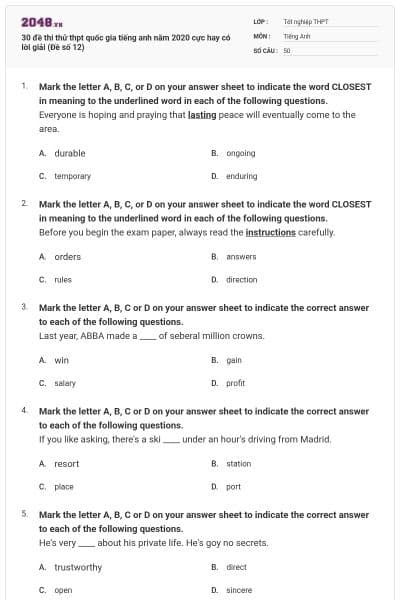
Mark the letter A, B, C, or D on your answer sheet to indicate the word CLOSEST in meaning to the underlined word in each of the following questions.
Everyone is hoping and praying that lasting peace will eventually come to the area.
durable
ongoing
temporary
enduring
Đáp án D
Kiến thức: Từ vựng, từ đồng nghĩa
Giải thích:
lasting (a): lâu dài
durable (a): bền bỉ
ongoing (a): đang diễn ra
temporary (a): tạm thời
enduring (a): lâu dài
=> lasting = enduring
Tạm dịch: Mọi người đang hi vọng và cầu nguyện hòa bình lâu dài cuối cùng sẽ đến với khu vực
Mark the letter A, B, C, or D on your answer sheet to indicate the word CLOSEST in meaning to the underlined word in each of the following questions.
Before you begin the exam paper, always read the instructions carefully.
orders
answers
rules
direction
Kiến thức: Từ vựng, từ đồng nghĩa
Giải thích:
instructions (n): sự hướng dẫn
orders (n): đơn đặt hàng, yêu cầu
answers (n): câu trả lời
rules (n): quy luật, quy định
directions (n): sự chỉ dẫn, phương hướng
=> instructions = directions
Tạm dịch: Trước khi bắt đầu làm bài thi, luôn luôn đọc kỹ hướng dẫn.
Đáp án: D
Mark the letter A, B, C or D on your answer sheet to indicate the correct answer to each of the following questions.
Last year, ABBA made a ____ of seberal million crowns.
win
gain
salary
profit
Kiến thức: Từ vựng
Giải thích:
win (n): sự chiến thắng
gain (n): sự đạt được
salary (n): lương
profit (n): lợi nhuận
Tạm dịch: Năm ngoái, bang nhạc ABBA đạt lợi nhuận vài triệu
Đáp án: D
Mark the letter A, B, C or D on your answer sheet to indicate the correct answer to each of the following questions.
If you like asking, there's a ski ____ under an hour's driving from Madrid.
resort
station
place
port
Kiến thức: Từ vựng
Giải thích:
resort (n): khu nghỉ dưỡng
station (n): trạm, nhà ga
place (n): nơi chốn
port (n): cảng
Cụm từ ski resort: khu trượt tuyết
Tạm dịch: Nếu bạn thích trượt tuyết, có một khu trượt tuyết lái xe khoảng 1 giờ đồng hồ đi từ Marid.
Đáp án: A
Mark the letter A, B, C or D on your answer sheet to indicate the correct answer to each of the following questions.
He's very ____ about his private life. He's goy no secrets.
trustworthy
direct
open
sincere
Kiến thức: Từ vựng
Giải thích:
trustworthy (a): đáng tin cậy
direct (a): trực tiếp
open (a): cởi mở, thẳng thắn
sinsere (a): chân thành
Tạm dịch: Anh ấy rất cởi mở về đời sống riêng tư. Anh ấy không có bí mật.
Đáp án: C
Mark the letter A, B, C or D on your answer sheet to indicate the correct answer to each of the following questions.
Even though they don't agree with what's happening, they're too ____ to protest.
apathetic
subdued
quiet
outgoing
Kiến thức: Từ vựng
Giải thích:
apathetic (a): hờ hửng, lãnh đạm
subdued (a): bị chinh phục
quiet (a): yên tĩnh, trầm lặng
outgoing (a): dễ gần, thân thiện
Tạm dịch: Mặc dù họ không đồng tình với việc đang xảy ra, nhưng họ quá hờ hửng để phản đối lại.
Đáp án: A
Mark the letter A, B, C or D on your answer sheet to indicate the correct answer to each of the following questions.
Though I didn't want my son to leave home since he was twenty-one, there was nothing I could do to ____ it.
hinder
resist
prevent
cease
Kiến thức: Từ vựng
Giải thích:
hinder (v): cản trở
resist (v): kháng cự
prevent (v): ngăn cản
cease (v): ngừng
Tạm dịch: Mặc dù tôi không muốn con trai mình rời khỏi nhà năm 21 tuổi, nhưng tôi không thể làm gì để ngăn cản nó.
Đáp án: C
Mark the letter A, B, C or D on your answer sheet to indicate the correct answer to each of the following questions.
She noticed ____ away from the house.
him to run
him running
his running
him run
Kiến thức: Dạng của động từ
Giải thích: Cấu trúc với các động từ chỉ giác quan, nhận thức
S + notice/ see/ hear/ feel/ touch/... + O + Vo: chứng kiến hành động xảy ra từ đầu đến cuối
S + notice/ see/ hear/ feel/ touch/... + O + V-ing: bất chợt bắt gặp hành động đang xảy ra
Tạm dịch: Cô ấy thấy anh ấy đang chạy ra khỏi nhà.
Đáp án: B
Mark the letter A, B, C or D on your answer sheet to indicate the correct answer to each of the following questions.
George has ____; he loves cakes, chocolate, ice- cream- anything which is sweet.
a sweet mouth
sweet lips
a sweet tooth
a sweet tongue
Kiến thức: Thành ngữ
Giải thích: Thành ngữ “a sweet tooth” ( người thích ăn đồ ăn ngọt bánh kẹo)
Tạm dịch: George là người thích ăn ngọt; anh ấy thích bánh, sô-cô-la, kem - bất cứ cái gì ngọt.
Đáp án: C
Mark the letter A, B, C or D on your answer sheet to indicate the correct answer to each of the following questions.
She's so ____; you really have to watch you say or she'll walk out of the room.
high and dry
prim and proper
rough and ready
sick and tired
Kiến thức: Thành ngữ
Giải thích:
high and dry = in a difficult situation, without help or money: trong tình huống khó khăn
prim and proper = always behaving in a careful and formal way, and easily shocked by anything that is rude: kỹ
lưỡng (quá mức), có chút bảo thủ
rough and ready = simple and prepared quickly but good enough for a particular situation: đơn giản và nhanh
chóng nhưng vẫn đảm bảo chất lượng
sick and tired: vô cùng mệt mỏi
Tạm dịch: Cô ấy quá là kỹ tính; bạn thật sự phải cân nhắc điều bạn nói nếu không cô ấy sẽ bước ra khỏi phòng.
Đáp án: B
Mark the letter A, B, C or D on your answer sheet to indicate the correct answer to each of the following questions.
You've all ____ the point. The film itself is not racist – it simply tries to make us question our own often racist attitude.
mistaken
misunderstood
missed
lost
Kiến thức: Sự kết hợp từ “collocations”
Giải thích: Cụm từ “miss the point” = don‟t understand
Tạm dịch: Bạn hoàn toàn hiểu sai rồi. Bộ phim không phải mang tính phân biệt chủng tộc – nó đơn giản cố gắng làm cho chúng ta tự hỏi mình rằng chúng ta có thường có thái độ phân biệt chủng tộc không.
Đáp án: C
Mark the letter A, B, C or D on your answer sheet to indicate the correct answer to each of the following questions.
____ one or more units of living substance called protoplasm.
Although all living things that consist of
All living things consisting of
All living things consist of
In all living things consisting of
Kiến thức: Cấu trúc câu cơ bản
Giải thích: Câu cơ bản có đầy đủ thành phần chủ ngữ (S) và động từ chính (V)
Câu đã có thành phần tân ngữ là “one or more units of living substance” và “called protoplasm” là mệnh đề quan hệ rút gọn bổ trợ nghĩa cho “living substance”
=> Cần chọn đáp án có S và V
Tạm dịch: Tất cả những vật sống bao gồm một hay nhiều đơn vị tế bào sống cái mà được gọi là nguyên sinh vật.
Đáp án: C
Mark the letter A, B, C or D on your answer sheet to indicate the correct answer to each of the following questions.
The production of tin ore in the United States is relatively insignificant, ____ less than one hundred tons annually.
amount to
in the amount
amount to it
to the amount of
Kiến thức: Cụm từ “collocations”
Giải thích: Cụm từ amount of sth ( một số lượng/ một lượng cái gì đó)
Tạm dịch: Sản lượng quặng thiếc ở Mỹ hầu như không nhiều, hằng năm sản lượng ít hơn 100 tấn .
Đáp án: D
Mark the letter A, B, C or D on your answer sheet to indicate the correct answer to each of the following questions.
It all happened so quickly, one minute I was making chips and the next the whole kitchen was ____ fire!
at
on
by
in
Kiến thức: Sự kết hợp từ collocations
Giải thích: Cụm từ “on fire” (đang nướng)
Tạm dịch: Tất cả đều xảy ra quá nhanh, một phút tôi làm món khoai tây chiên và tiếp theo toàn bộ con gà đã được nướng.
Đáp án: B
Read the following passage and mark the letter A, B, C, or D on your answer sheet to indicate the correct word or phrase for each of the blanks from 15 to 19
About 50 or so kinds modern plastic are made from oil, gas, or coal-non-renewable natural resources. We (15)___ well over three million tons of the stuff in Japan each year and, sooner or later, most of it is thrown away. A high proportion of our animal consumption is in the (16)____ of packaging and this constitutes about seven percent by weight, of our domestic(17) ____ . Almost all of it can be recycled, but very little of it is, though the plastic recycling industry is growing fast. The plastics themselves are extremely energy - rich – they have a higher calorific(18) ____ than coal and one methodn of “recovery” strongly (19)____ by plastic manufacturers if the conversion of waste plastic into a fuel.
Question 15:
consign
import
consume
remove
Kiến thức: Từ vựng, đọc hiểu
Giải thích:
consign (v): chuyển giao
import (v): nhập khẩu
consume (v): tiêu tốn
remove (v): chuyển đổi, di dời
We (15)____ well over three million tones of the stuff in Japan each year and, sooner or later, most of it is
thrown away.
Tạm dịch: Ở Nhật Bản, chúng ta nhập khẩu cũng hơn ba triệu tấn vật liệu mỗi năm, và sớm hay muộn, hầu hết chúng sẽ bị ném đi.
Đáp án: B
Read the following passage and mark the letter A, B, C, or D on your answer sheet to indicate the correct word or phrase for each of the blanks from 15 to 19
About 50 or so kinds modern plastic are made from oil, gas, or coal-non-renewable natural resources. We (15)___ well over three million tons of the stuff in Japan each year and, sooner or later, most of it is thrown away. A high proportion of our animal consumption is in the (16)____ of packaging and this constitutes about seven percent by weight, of our domestic(17) ____ . Almost all of it can be recycled, but very little of it is, though the plastic recycling industry is growing fast. The plastics themselves are extremely energy - rich – they have a higher calorific(18) ____ than coal and one methodn of “recovery” strongly (19)____ by plastic manufacturers if the conversion of waste plastic into a fuel.
Question 16:
form
way
type
kind
Kiến thức: Từ vựng, đọc hiểu
Giải thích:
form (n): dạng
way (n): cách
type (n): loại
kind (n): loại
A high proportion of our animal consumption is in the (16)_____of packaging, and this constitutes about seven percent by weight of our domestic(17)____ .
Tạm dịch: Một tỷ lệ cao được tiêu thụ là ở dạng bao bì, và điều này tạo nên khoảng bảy phần trăm theo trọng lượng rác thải sinh hoạt. Hầu như tất cả chúng đều có thể được tái chế, nhưng rất ít được tái chế mặc dù ngành công nghiệp tái chế nhựa phát triển nhanh.
Đáp án: A
Read the following passage and mark the letter A, B, C, or D on your answer sheet to indicate the correct word or phrase for each of the blanks from 15 to 19
About 50 or so kinds modern plastic are made from oil, gas, or coal-non-renewable natural resources. We (15)___ well over three million tons of the stuff in Japan each year and, sooner or later, most of it is thrown away. A high proportion of our animal consumption is in the (16)____ of packaging and this constitutes about seven percent by weight, of our domestic(17) ____ . Almost all of it can be recycled, but very little of it is, though the plastic recycling industry is growing fast. The plastics themselves are extremely energy - rich – they have a higher calorific(18) ____ than coal and one methodn of “recovery” strongly (19)____ by plastic manufacturers if the conversion of waste plastic into a fuel.
Question 17
goods
refuse
rubble
requirements
Kiến thức: Từ vựng, đọc hiểu
Giải thích:
goods (n): hàng hóa
refuse (n): chất thải
rubble (n): dây điện
requirement (n): nhu cầu
A high proportion of our animal consumption is in the (16)_____of packaging, and this constitutes about seven per cent by weight of our domestic(17)____ .
Tạm dịch: Một tỷ lệ cao được tiêu thụ là ở dạng bao bì, và điều này tạo nên khoảng bảy phần trăm theo trọng lượng rác thải sinh hoạt. Hầu như tất cả chúng đều có thể được tái chế, nhưng rất ít được tái chế mặc dù ngành công nghiệp tái chế nhựa phát triển nhanh.
Đáp án: B
Read the following passage and mark the letter A, B, C, or D on your answer sheet to indicate the correct word or phrase for each of the blanks from 15 to 19
About 50 or so kinds modern plastic are made from oil, gas, or coal-non-renewable natural resources. We (15)___ well over three million tons of the stuff in Japan each year and, sooner or later, most of it is thrown away. A high proportion of our animal consumption is in the (16)____ of packaging and this constitutes about seven percent by weight, of our domestic(17) ____ . Almost all of it can be recycled, but very little of it is, though the plastic recycling industry is growing fast. The plastics themselves are extremely energy - rich – they have a higher calorific(18) ____ than coal and one methodn of “recovery” strongly (19)____ by plastic manufacturers if the conversion of waste plastic into a fuel.
Question 18:
effect
degree
value
demand
Kiến thức: Từ vựng, đọc hiểu
Giải thích:
effect (n): ảnh hưởng
degree (n): bằng cấp
value (n): giá trị
demand (n): nhu cầu
The plastics themselves are extremely energy-rich – they have a higher calorific (18)_____ than coal and one method of 'recovery' strongly (19)____ by the plastic manufacturers is the conversion of waste plastic into a fuel.
Tạm dịch: Bản thân nhựa là nguồn năng lượng cực kì phong phú- chúng có giá trị năng lượng cao hơn cả than
và một phương pháp 'khôi phục' rất được ưa thích bởi các nhà sản xuất nhựa là biến đổi chất thải nhựa thành nhiên liệu
Đáp án: C
Read the following passage and mark the letter A, B, C, or D on your answer sheet to indicate the correct word or phrase for each of the blanks from 15 to 19
About 50 or so kinds modern plastic are made from oil, gas, or coal-non-renewable natural resources. We (15)___ well over three million tons of the stuff in Japan each year and, sooner or later, most of it is thrown away. A high proportion of our animal consumption is in the (16)____ of packaging and this constitutes about seven percent by weight, of our domestic(17) ____ . Almost all of it can be recycled, but very little of it is, though the plastic recycling industry is growing fast. The plastics themselves are extremely energy - rich – they have a higher calorific(18) ____ than coal and one methodn of “recovery” strongly (19)____ by plastic manufacturers if the conversion of waste plastic into a fuel.
Question 19
argued
presented
desired
favored
Kiến thức: Từ vựng, đọc hiểu
Giải thích:
argued (quá khứ phân từ): tranh cãi
presented (quá khứ phân từ): thể hiện
desired (quá khứ phân từ): ham muốn
favored (quá khứ phân từ): thích thú
The plastics themselves are extremely energy-rich – they have a higher calorific (18)_____ than coal and one method of 'recovery' strongly (19)____ by the plastic manufacturers is the conversion of waste plastic into a fuel.
Tạm dịch: Bản thân nhựa là nguồn năng lượng cực kì phong phú- chúng có giá trị năng lượng cao hơn cả than và một phương pháp 'khôi phục' rất được ưa thích bởi các nhà sản xuất nhựa là biến đổi chất thải nhựa thành nhiên liệu
Đáp án: D
Read the following passage and mark the letter A, B, C or D on your answer sheet to indicate the correct answer to each of the questions from 20 to 25.
FIRST TIME IN THE AIR
When John Mills was going to fly in an aeroplane for the first time, he was frightened. He did not like the idea of being thousands of feet up in the air. “ I also didn't like the fact that I wouldn't be in control,” says John.
“I'm a terrible passenger in the car. When somebody else is driving, I tell them what to so. It drives everybody crazy.”
However John couldn't avoid flying any longer. It was the only way he could visit his grandchildren in Canada.
“I had made up my mind that I was going to do it, I couldn't let my son, his wife and their three children travel all the way here to visit me. It would be so expensive for them and I know Tom's business isn't doing so well at the moment – it would also be tiring for the children – it's a nine-hour flight!” he says.
To get ready for the flight John did lots of reading about aeroplanes. When he booked his seat, he was told that he would be flying on a Boeing 747, which is better known as a jumbo jet. “I needed to know as much as possible before getting in that plane. I suppose it was a way of making myself feel better. The Boeing 747 is the largest passenger aircraft in the world at the moment. The first one flew on February 9th 1969 in the USA. It can carry up to 524 passengers and 3.400 pieces of luggage. The fuel for aeroplanes is kept in the wings and the 747 is wings are so big that they can carry enough fuel for an average car to be able to travel 16,000 kilometres a year for 70 years. Isn't that unbelievable? Even though I had discovered all this very interesting information about the jumbo, when I saw it for the first time, just before I was going to travel to Canada, I still couldn't believe that something so enormous was going to get up in the air and fly. I was even more impressed when I saw how big it was inside with hundreds of people!”
The biggest surprise of all for John was the flight itself. “The take-off itself was much smoother than I expected although I was still quite scared until we were in the air. In the end, I managed to relax, enjoy the food and watch one of the movies and the view from the window was spectacular. I even managed to sleep for a while! Of course,” continues John, “the best reward of all was when I arrived in Canada and saw my son and his family, particularly my beautiful grandchildren. Suddenly, I felt so silly about all the years when I couldn't even think of getting on a plane. I had let my fear of living stop me from seeing the people I love most in the world. I can visit my son and family as often as I like now!”
Question:Why did John Mills fly in an aeroplane?
He wanted to go on holiday
He wanted to try it.
He wanted to see his family.
He had to travel on business.
Kiến thức: Đọc hiểu
Giải thích:
Tại sao ông John Mills đi máy bay?
A. Ông ấy muốn đi nghỉ. B. Ông ấy muốn thử.
C. Ông ấy muốn thăm gia đình. D. Ông ấy phải đi công tác.
Dẫn chứng: It was the only way he could visit his grandchildren in Canada. “I had made up my mind that I was going to do it, I couldn't let my son, his wife and their three children travel all the way here to visit me. It would be so expensive for them and I know Tom's business isn't doing so well at the moment – it would also be tiring for the children – it's a nine-hour flight!” he says.
Đáp án: C
Read the following passage and mark the letter A, B, C or D on your answer sheet to indicate the correct answer to each of the questions from 20 to 25.
FIRST TIME IN THE AIR
When John Mills was going to fly in an aeroplane for the first time, he was frightened. He did not like the idea of being thousands of feet up in the air. “ I also didn't like the fact that I wouldn't be in control,” says John.
“I'm a terrible passenger in the car. When somebody else is driving, I tell them what to so. It drives everybody crazy.”
However John couldn't avoid flying any longer. It was the only way he could visit his grandchildren in Canada.
“I had made up my mind that I was going to do it, I couldn't let my son, his wife and their three children travel all the way here to visit me. It would be so expensive for them and I know Tom's business isn't doing so well at the moment – it would also be tiring for the children – it's a nine-hour flight!” he says.
To get ready for the flight John did lots of reading about aeroplanes. When he booked his seat, he was told that he would be flying on a Boeing 747, which is better known as a jumbo jet. “I needed to know as much as possible before getting in that plane. I suppose it was a way of making myself feel better. The Boeing 747 is the largest passenger aircraft in the world at the moment. The first one flew on February 9th 1969 in the USA. It can carry up to 524 passengers and 3.400 pieces of luggage. The fuel for aeroplanes is kept in the wings and the 747 is wings are so big that they can carry enough fuel for an average car to be able to travel 16,000 kilometres a year for 70 years. Isn't that unbelievable? Even though I had discovered all this very interesting information about the jumbo, when I saw it for the first time, just before I was going to travel to Canada, I still couldn't believe that something so enormous was going to get up in the air and fly. I was even more impressed when I saw how big it was inside with hundreds of people!”
The biggest surprise of all for John was the flight itself. “The take-off itself was much smoother than I expected although I was still quite scared until we were in the air. In the end, I managed to relax, enjoy the food and watch one of the movies and the view from the window was spectacular. I even managed to sleep for a while! Of course,” continues John, “the best reward of all was when I arrived in Canada and saw my son and his family, particularly my beautiful grandchildren. Suddenly, I felt so silly about all the years when I couldn't even think of getting on a plane. I had let my fear of living stop me from seeing the people I love most in the world. I can visit my son and family as often as I like now!”
Question:Why did John read about aeroplane?
He wanted to know how they work.
It was his hobby.
It made him feel safer.
He had found a book on them.
Kiến thức: Đọc hiểu
Giải thích:
Tại sao ông John đọc về máy bay ?
A. Ông muốn biết nó hoặt động như nào? B. Sở thích của ông.
C. Để đảm bảo an toàn cho ông. D. Ông ấy tìm được 1 quyển sách về máy bay.
Dẫn chứng: To get ready for the flight John did lots of reading about aeroplanes. When he booked his seat, he was told that he would be flying on a Boeing 747, which is better known as a jumbo jet. “I needed to know as much as possible before getting in that plane.
Đáp án: A
Read the following passage and mark the letter A, B, C or D on your answer sheet to indicate the correct answer to each of the questions from 20 to 25.
FIRST TIME IN THE AIR
When John Mills was going to fly in an aeroplane for the first time, he was frightened. He did not like the idea of being thousands of feet up in the air. “ I also didn't like the fact that I wouldn't be in control,” says John.
“I'm a terrible passenger in the car. When somebody else is driving, I tell them what to so. It drives everybody crazy.”
However John couldn't avoid flying any longer. It was the only way he could visit his grandchildren in Canada.
“I had made up my mind that I was going to do it, I couldn't let my son, his wife and their three children travel all the way here to visit me. It would be so expensive for them and I know Tom's business isn't doing so well at the moment – it would also be tiring for the children – it's a nine-hour flight!” he says.
To get ready for the flight John did lots of reading about aeroplanes. When he booked his seat, he was told that he would be flying on a Boeing 747, which is better known as a jumbo jet. “I needed to know as much as possible before getting in that plane. I suppose it was a way of making myself feel better. The Boeing 747 is the largest passenger aircraft in the world at the moment. The first one flew on February 9th 1969 in the USA. It can carry up to 524 passengers and 3.400 pieces of luggage. The fuel for aeroplanes is kept in the wings and the 747 is wings are so big that they can carry enough fuel for an average car to be able to travel 16,000 kilometres a year for 70 years. Isn't that unbelievable? Even though I had discovered all this very interesting information about the jumbo, when I saw it for the first time, just before I was going to travel to Canada, I still couldn't believe that something so enormous was going to get up in the air and fly. I was even more impressed when I saw how big it was inside with hundreds of people!”
The biggest surprise of all for John was the flight itself. “The take-off itself was much smoother than I expected although I was still quite scared until we were in the air. In the end, I managed to relax, enjoy the food and watch one of the movies and the view from the window was spectacular. I even managed to sleep for a while! Of course,” continues John, “the best reward of all was when I arrived in Canada and saw my son and his family, particularly my beautiful grandchildren. Suddenly, I felt so silly about all the years when I couldn't even think of getting on a plane. I had let my fear of living stop me from seeing the people I love most in the world. I can visit my son and family as often as I like now!”
Question:What happened when he saw the jumbo jet for the first time?
He felt much safer.
He liked the shape of it.
He couldn‟t believe how big it was.
He thought the wings were very small.
Kiến thức: Đọc hiểu
Giải thích:
Điều gì đã diễn ra khi ông ấy nhìn thấy chiếc máy bay phản lực lần đầu tiên?
A. Ông ấy cảm thấy an toàn hơn. B. Ông ấy thích hình dáng của nó.
C. Ông ngạc nhiên về độ lớn của nó. D. Ông ấy nghĩ cánh của nó rất nhỏ.
Dẫn chứng: Even though I had discovered all this very interesting information about the jumbo, when I saw it for the first time, just before I was going to travel to Canada, I still couldn't believe that something so enormous was going to get up in the air and fly. I was even more impressed when I saw how big it was inside with hundreds of people!”
Đáp án: C
Read the following passage and mark the letter A, B, C or D on your answer sheet to indicate the correct answer to each of the questions from 20 to 25.
FIRST TIME IN THE AIR
When John Mills was going to fly in an aeroplane for the first time, he was frightened. He did not like the idea of being thousands of feet up in the air. “ I also didn't like the fact that I wouldn't be in control,” says John.
“I'm a terrible passenger in the car. When somebody else is driving, I tell them what to so. It drives everybody crazy.”
However John couldn't avoid flying any longer. It was the only way he could visit his grandchildren in Canada.
“I had made up my mind that I was going to do it, I couldn't let my son, his wife and their three children travel all the way here to visit me. It would be so expensive for them and I know Tom's business isn't doing so well at the moment – it would also be tiring for the children – it's a nine-hour flight!” he says.
To get ready for the flight John did lots of reading about aeroplanes. When he booked his seat, he was told that he would be flying on a Boeing 747, which is better known as a jumbo jet. “I needed to know as much as possible before getting in that plane. I suppose it was a way of making myself feel better. The Boeing 747 is the largest passenger aircraft in the world at the moment. The first one flew on February 9th 1969 in the USA. It can carry up to 524 passengers and 3.400 pieces of luggage. The fuel for aeroplanes is kept in the wings and the 747 is wings are so big that they can carry enough fuel for an average car to be able to travel 16,000 kilometres a year for 70 years. Isn't that unbelievable? Even though I had discovered all this very interesting information about the jumbo, when I saw it for the first time, just before I was going to travel to Canada, I still couldn't believe that something so enormous was going to get up in the air and fly. I was even more impressed when I saw how big it was inside with hundreds of people!”
The biggest surprise of all for John was the flight itself. “The take-off itself was much smoother than I expected although I was still quite scared until we were in the air. In the end, I managed to relax, enjoy the food and watch one of the movies and the view from the window was spectacular. I even managed to sleep for a while! Of course,” continues John, “the best reward of all was when I arrived in Canada and saw my son and his family, particularly my beautiful grandchildren. Suddenly, I felt so silly about all the years when I couldn't even think of getting on a plane. I had let my fear of living stop me from seeing the people I love most in the world. I can visit my son and family as often as I like now!”
Question:How did John feel when the aeroplane was taking off?
excited
happy
sad
frightened
Kiến thức: Đọc hiểu
Giải thích:
Ông John cảm thấy thế nào khi máy bay cất cánh?
A. thú vị B. vui C. buồn D. sợ hãi
Dẫn chứng: “The take-off itself was much smoother than I expected although I was still quite scared until we were in the air.
Đáp án: D
Read the following passage and mark the letter A, B, C or D on your answer sheet to indicate the correct answer to each of the questions from 20 to 25.
FIRST TIME IN THE AIR
When John Mills was going to fly in an aeroplane for the first time, he was frightened. He did not like the idea of being thousands of feet up in the air. “ I also didn't like the fact that I wouldn't be in control,” says John.
“I'm a terrible passenger in the car. When somebody else is driving, I tell them what to so. It drives everybody crazy.”
However John couldn't avoid flying any longer. It was the only way he could visit his grandchildren in Canada.
“I had made up my mind that I was going to do it, I couldn't let my son, his wife and their three children travel all the way here to visit me. It would be so expensive for them and I know Tom's business isn't doing so well at the moment – it would also be tiring for the children – it's a nine-hour flight!” he says.
To get ready for the flight John did lots of reading about aeroplanes. When he booked his seat, he was told that he would be flying on a Boeing 747, which is better known as a jumbo jet. “I needed to know as much as possible before getting in that plane. I suppose it was a way of making myself feel better. The Boeing 747 is the largest passenger aircraft in the world at the moment. The first one flew on February 9th 1969 in the USA. It can carry up to 524 passengers and 3.400 pieces of luggage. The fuel for aeroplanes is kept in the wings and the 747 is wings are so big that they can carry enough fuel for an average car to be able to travel 16,000 kilometres a year for 70 years. Isn't that unbelievable? Even though I had discovered all this very interesting information about the jumbo, when I saw it for the first time, just before I was going to travel to Canada, I still couldn't believe that something so enormous was going to get up in the air and fly. I was even more impressed when I saw how big it was inside with hundreds of people!”
The biggest surprise of all for John was the flight itself. “The take-off itself was much smoother than I expected although I was still quite scared until we were in the air. In the end, I managed to relax, enjoy the food and watch one of the movies and the view from the window was spectacular. I even managed to sleep for a while! Of course,” continues John, “the best reward of all was when I arrived in Canada and saw my son and his family, particularly my beautiful grandchildren. Suddenly, I felt so silly about all the years when I couldn't even think of getting on a plane. I had let my fear of living stop me from seeing the people I love most in the world. I can visit my son and family as often as I like now!”
Question:What surprised John most about the flight?
that he liked the food
that he was able to sleep
that there was a movie being shown
that the view was good
Kiến thức: Đọc hiểu
Giải thích:
Điều gì khiến ông John ngạc nhiên nhất về chuyến bay?
A. Ông ấy thích đồ ăn. B. Ông ấy có thể ngủ.
C. Có chiếu phim. D. Cảnh rất đẹp.
Dẫn chứng: In the end, I managed to relax, enjoy the food and watch one of the movies and the view from the window was spectacular. I even managed to sleep for a while! Of course,”
Đáp án: B
Read the following passage and mark the letter A, B, C or D on your answer sheet to indicate the correct answer to each of the questions from 20 to 25.
FIRST TIME IN THE AIR
When John Mills was going to fly in an aeroplane for the first time, he was frightened. He did not like the idea of being thousands of feet up in the air. “ I also didn't like the fact that I wouldn't be in control,” says John.
“I'm a terrible passenger in the car. When somebody else is driving, I tell them what to so. It drives everybody crazy.”
However John couldn't avoid flying any longer. It was the only way he could visit his grandchildren in Canada.
“I had made up my mind that I was going to do it, I couldn't let my son, his wife and their three children travel all the way here to visit me. It would be so expensive for them and I know Tom's business isn't doing so well at the moment – it would also be tiring for the children – it's a nine-hour flight!” he says.
To get ready for the flight John did lots of reading about aeroplanes. When he booked his seat, he was told that he would be flying on a Boeing 747, which is better known as a jumbo jet. “I needed to know as much as possible before getting in that plane. I suppose it was a way of making myself feel better. The Boeing 747 is the largest passenger aircraft in the world at the moment. The first one flew on February 9th 1969 in the USA. It can carry up to 524 passengers and 3.400 pieces of luggage. The fuel for aeroplanes is kept in the wings and the 747 is wings are so big that they can carry enough fuel for an average car to be able to travel 16,000 kilometres a year for 70 years. Isn't that unbelievable? Even though I had discovered all this very interesting information about the jumbo, when I saw it for the first time, just before I was going to travel to Canada, I still couldn't believe that something so enormous was going to get up in the air and fly. I was even more impressed when I saw how big it was inside with hundreds of people!”
The biggest surprise of all for John was the flight itself. “The take-off itself was much smoother than I expected although I was still quite scared until we were in the air. In the end, I managed to relax, enjoy the food and watch one of the movies and the view from the window was spectacular. I even managed to sleep for a while! Of course,” continues John, “the best reward of all was when I arrived in Canada and saw my son and his family, particularly my beautiful grandchildren. Suddenly, I felt so silly about all the years when I couldn't even think of getting on a plane. I had let my fear of living stop me from seeing the people I love most in the world. I can visit my son and family as often as I like now!”
Question:How did John feel about his fears in the end?
He thought he had wasted time being afraid.
He realized it was okay to be afraid.
He hoped his grandchildren weren‟t afraid of flying.
He realized that being afraid kept him safe.
Kiến thức: Đọc hiểu
Giải thích:
Cuối cùng thì ông John cảm thấy thế nào về nhưng nỗi sợ?
A. Ông nghĩ mình đã phí thời gian để sợ hãi
B. Ông nhận ra khá ổn khi sợ hãi
C. Ông hi vọng cháu mình sẽ không sợ bay
D. Ông nhận ra việc sợ hãi giúp ông được an toàn.
Dẫn chứng: Suddenly, I felt so silly about all the years when I couldn't even think of getting on a plane. I had let my fear of living stop me from seeing the people I love most in the world. I can visit my son and family as often as I like now!”
Đáp án: A
Read the following passage and mark the letter A, B, C or D on your answer sheet to indicate the correct answer to each of the questions from 26 to 34.
Although noise, commonly defined as unwanted sound, is a widely recognized form of pollution, it is very difficult to measure because the discomfort experienced by different individuals is highly subjective and, therefore, variable. Exposure to lower levels of noise may be slightly irritating, whereas exposure to higher levels may actually cause hearing loss. Particularly in congested urban areas, the noise produced as a by-product of our advancing technology causes physical and psychological harm, and detracts from the quality of life for those who are exposed to it.
Unlike the eyes, which can be covered by the eyelids against strong light, the ear has no lid, and is, therefore, always open and vulnerable; noise penetrates without protection.
Noise causes effects that the hearer cannot control and to which the body never becomes accustomed. Loud noises instinctively signal danger to any organism with a hearing mechanism, including human beings. In response, heartbeat and respiration accelerate, blood vessels constrict, the skin pales, and muscles tense. In fact, there is a general increase in functioning brought about by the flow of adrenaline released in response to fear, and some of these responses persist even longer than the noise, occasionally as long as thirty minutes after the sound has ceased.
Because noise is unavoidable in a complex, industrial society, we are constantly responding in the same way that we would respond to danger. Recently, researchers have concluded that noise and our response may be much more than an annoyance. It may be a serious threat to physical and psychological health and well-being, causing damage not only to the ear and brain but also to the heart and stomach. We have long known that hearing loss is America's number one nonfatal health problem, but now we are learning that some of us with heart disease and ulcers may be victims of noise as well. Fetuses exposed to noise tend to be overactive, they cry easily, and they are more sensitive to gastrointestinal problems after birth. In addition, the psychic effect of noise is very important. Nervousness, irritability, tension, and anxiety increase affecting the quality of rest during sleep, and the efficiency of activities during waking hours, as well as the way that we interact with each other
Question:Which of the following is the author‟s main point?
Hearing loss is America's number one nonfatal health problem.
Loud noises signal danger.
Noise may pose a serious threat to our physical and psychological health.
The ear is not like the eye.
Kiến thức: Đọc hiểu
Giải thích:
Câu nào sau đây là ý chính tác giải muốn gửi gắm?
A. Mất thính giác là vấn đề sức khỏe nhỏ ở Mỹ.
B. Tiếng ồn lớn báo hiệu sự nguy hiểm.
C. Tiếng ồn có thể gây ra một mối đe dọa nghiêm trọng đối với sức khoẻ thể chất và tâm lý của chúng ta.
D. Tai không giống như mắt.
Đáp án: C
Read the following passage and mark the letter A, B, C or D on your answer sheet to indicate the correct answer to each of the questions from 26 to 34.
Although noise, commonly defined as unwanted sound, is a widely recognized form of pollution, it is very difficult to measure because the discomfort experienced by different individuals is highly subjective and, therefore, variable. Exposure to lower levels of noise may be slightly irritating, whereas exposure to higher levels may actually cause hearing loss. Particularly in congested urban areas, the noise produced as a by-product of our advancing technology causes physical and psychological harm, and detracts from the quality of life for those who are exposed to it.
Unlike the eyes, which can be covered by the eyelids against strong light, the ear has no lid, and is, therefore, always open and vulnerable; noise penetrates without protection.
Noise causes effects that the hearer cannot control and to which the body never becomes accustomed. Loud noises instinctively signal danger to any organism with a hearing mechanism, including human beings. In response, heartbeat and respiration accelerate, blood vessels constrict, the skin pales, and muscles tense. In fact, there is a general increase in functioning brought about by the flow of adrenaline released in response to fear, and some of these responses persist even longer than the noise, occasionally as long as thirty minutes after the sound has ceased.
Because noise is unavoidable in a complex, industrial society, we are constantly responding in the same way that we would respond to danger. Recently, researchers have concluded that noise and our response may be much more than an annoyance. It may be a serious threat to physical and psychological health and well-being, causing damage not only to the ear and brain but also to the heart and stomach. We have long known that hearing loss is America's number one nonfatal health problem, but now we are learning that some of us with heart disease and ulcers may be victims of noise as well. Fetuses exposed to noise tend to be overactive, they cry easily, and they are more sensitive to gastrointestinal problems after birth. In addition, the psychic effect of noise is very important. Nervousness, irritability, tension, and anxiety increase affecting the quality of rest during sleep, and the efficiency of activities during waking hours, as well as the way that we interact with each other
Question:According to the passage, what is noise?
A byproduct of technology.
Physical and psychological harm.
Congestion.
Unwanted sound.
Kiến thức: Đọc hiểu
Giải thích:
Theo như đoạn văn, tiếng ồn là gì?
A. Sản phẩm phụ của công nghệ B. Tác hại tâm lý và thể chất.
C. Sự đông đúc D. Âm thanh không mong muốn
Dẫn chứng: Although noise, commonly defined as unwanted sound, is a widely recognized form of pollution.
Đáp án: D
Read the following passage and mark the letter A, B, C or D on your answer sheet to indicate the correct answer to each of the questions from 26 to 34.
Although noise, commonly defined as unwanted sound, is a widely recognized form of pollution, it is very difficult to measure because the discomfort experienced by different individuals is highly subjective and, therefore, variable. Exposure to lower levels of noise may be slightly irritating, whereas exposure to higher levels may actually cause hearing loss. Particularly in congested urban areas, the noise produced as a by-product of our advancing technology causes physical and psychological harm, and detracts from the quality of life for those who are exposed to it.
Unlike the eyes, which can be covered by the eyelids against strong light, the ear has no lid, and is, therefore, always open and vulnerable; noise penetrates without protection.
Noise causes effects that the hearer cannot control and to which the body never becomes accustomed. Loud noises instinctively signal danger to any organism with a hearing mechanism, including human beings. In response, heartbeat and respiration accelerate, blood vessels constrict, the skin pales, and muscles tense. In fact, there is a general increase in functioning brought about by the flow of adrenaline released in response to fear, and some of these responses persist even longer than the noise, occasionally as long as thirty minutes after the sound has ceased.
Because noise is unavoidable in a complex, industrial society, we are constantly responding in the same way that we would respond to danger. Recently, researchers have concluded that noise and our response may be much more than an annoyance. It may be a serious threat to physical and psychological health and well-being, causing damage not only to the ear and brain but also to the heart and stomach. We have long known that hearing loss is America's number one nonfatal health problem, but now we are learning that some of us with heart disease and ulcers may be victims of noise as well. Fetuses exposed to noise tend to be overactive, they cry easily, and they are more sensitive to gastrointestinal problems after birth. In addition, the psychic effect of noise is very important. Nervousness, irritability, tension, and anxiety increase affecting the quality of rest during sleep, and the efficiency of activities during waking hours, as well as the way that we interact with each other
Question:Why is noise difficult to measure?
All people do not respond to it in the same way.
It causes hearing loss.
It is unwanted.
People become accustomed to it.
Kiến thức: Đọc hiểu
Giải thích:
Tại sao âm thanh khó đo lường ?
A. Mọi người phản ứng với nó theo các cách khác nhau. B. Nó gây ra bệnh mất thính giác.
C. Nó không được mong muốn. D. Mọi người đã quen với nó.
Dẫn chứng: it is very difficult to measure because the discomfort experienced by different individuals is highly subjective and, therefore, variable.
Đáp án: A
Read the following passage and mark the letter A, B, C or D on your answer sheet to indicate the correct answer to each of the questions from 26 to 34.
Although noise, commonly defined as unwanted sound, is a widely recognized form of pollution, it is very difficult to measure because the discomfort experienced by different individuals is highly subjective and, therefore, variable. Exposure to lower levels of noise may be slightly irritating, whereas exposure to higher levels may actually cause hearing loss. Particularly in congested urban areas, the noise produced as a by-product of our advancing technology causes physical and psychological harm, and detracts from the quality of life for those who are exposed to it.
Unlike the eyes, which can be covered by the eyelids against strong light, the ear has no lid, and is, therefore, always open and vulnerable; noise penetrates without protection.
Noise causes effects that the hearer cannot control and to which the body never becomes accustomed. Loud noises instinctively signal danger to any organism with a hearing mechanism, including human beings. In response, heartbeat and respiration accelerate, blood vessels constrict, the skin pales, and muscles tense. In fact, there is a general increase in functioning brought about by the flow of adrenaline released in response to fear, and some of these responses persist even longer than the noise, occasionally as long as thirty minutes after the sound has ceased.
Because noise is unavoidable in a complex, industrial society, we are constantly responding in the same way that we would respond to danger. Recently, researchers have concluded that noise and our response may be much more than an annoyance. It may be a serious threat to physical and psychological health and well-being, causing damage not only to the ear and brain but also to the heart and stomach. We have long known that hearing loss is America's number one nonfatal health problem, but now we are learning that some of us with heart disease and ulcers may be victims of noise as well. Fetuses exposed to noise tend to be overactive, they cry easily, and they are more sensitive to gastrointestinal problems after birth. In addition, the psychic effect of noise is very important. Nervousness, irritability, tension, and anxiety increase affecting the quality of rest during sleep, and the efficiency of activities during waking hours, as well as the way that we interact with each other
Question:The word congested in paragraph 1 could best be replaced by ___.
hazardous
crowded
polluted
rushed
Kiến thức: Từ vựng
Giải thích:
Từ “congested” ở đoạn 1 gần nghĩa với?
A. khó khăn B. đông đúc C. ô nhiễm D. vội vàng.
congested = crowded (a): đông đúc
Đáp án: B
Read the following passage and mark the letter A, B, C or D on your answer sheet to indicate the correct answer to each of the questions from 26 to 34.
Although noise, commonly defined as unwanted sound, is a widely recognized form of pollution, it is very difficult to measure because the discomfort experienced by different individuals is highly subjective and, therefore, variable. Exposure to lower levels of noise may be slightly irritating, whereas exposure to higher levels may actually cause hearing loss. Particularly in congested urban areas, the noise produced as a by-product of our advancing technology causes physical and psychological harm, and detracts from the quality of life for those who are exposed to it.
Unlike the eyes, which can be covered by the eyelids against strong light, the ear has no lid, and is, therefore, always open and vulnerable; noise penetrates without protection.
Noise causes effects that the hearer cannot control and to which the body never becomes accustomed. Loud noises instinctively signal danger to any organism with a hearing mechanism, including human beings. In response, heartbeat and respiration accelerate, blood vessels constrict, the skin pales, and muscles tense. In fact, there is a general increase in functioning brought about by the flow of adrenaline released in response to fear, and some of these responses persist even longer than the noise, occasionally as long as thirty minutes after the sound has ceased.
Because noise is unavoidable in a complex, industrial society, we are constantly responding in the same way that we would respond to danger. Recently, researchers have concluded that noise and our response may be much more than an annoyance. It may be a serious threat to physical and psychological health and well-being, causing damage not only to the ear and brain but also to the heart and stomach. We have long known that hearing loss is America's number one nonfatal health problem, but now we are learning that some of us with heart disease and ulcers may be victims of noise as well. Fetuses exposed to noise tend to be overactive, they cry easily, and they are more sensitive to gastrointestinal problems after birth. In addition, the psychic effect of noise is very important. Nervousness, irritability, tension, and anxiety increase affecting the quality of rest during sleep, and the efficiency of activities during waking hours, as well as the way that we interact with each other
Question:The word it in the first paragraph refers to ___.
the quality of life
advancing technology
the noise
physical and psychological harm
Kiến thức: Từ vựng, đọc hiểu
Giải thích:
Từ “ it” ở đoạn 1 chỉ____?
A. chất lượng cuộc sống B. công nghệ tiên tiến
C. âm thanh D. tác hại tâm lý và thể chất.
Dẫn chứng: Particularly in congested urban areas, the noise produced as a by-product of our advancing technology causes physical and psychological harm, and detracts from the quality of life for those who are exposed to it.
Đáp án: C
Read the following passage and mark the letter A, B, C or D on your answer sheet to indicate the correct answer to each of the questions from 26 to 34.
Although noise, commonly defined as unwanted sound, is a widely recognized form of pollution, it is very difficult to measure because the discomfort experienced by different individuals is highly subjective and, therefore, variable. Exposure to lower levels of noise may be slightly irritating, whereas exposure to higher levels may actually cause hearing loss. Particularly in congested urban areas, the noise produced as a by-product of our advancing technology causes physical and psychological harm, and detracts from the quality of life for those who are exposed to it.
Unlike the eyes, which can be covered by the eyelids against strong light, the ear has no lid, and is, therefore, always open and vulnerable; noise penetrates without protection.
Noise causes effects that the hearer cannot control and to which the body never becomes accustomed. Loud noises instinctively signal danger to any organism with a hearing mechanism, including human beings. In response, heartbeat and respiration accelerate, blood vessels constrict, the skin pales, and muscles tense. In fact, there is a general increase in functioning brought about by the flow of adrenaline released in response to fear, and some of these responses persist even longer than the noise, occasionally as long as thirty minutes after the sound has ceased.
Because noise is unavoidable in a complex, industrial society, we are constantly responding in the same way that we would respond to danger. Recently, researchers have concluded that noise and our response may be much more than an annoyance. It may be a serious threat to physical and psychological health and well-being, causing damage not only to the ear and brain but also to the heart and stomach. We have long known that hearing loss is America's number one nonfatal health problem, but now we are learning that some of us with heart disease and ulcers may be victims of noise as well. Fetuses exposed to noise tend to be overactive, they cry easily, and they are more sensitive to gastrointestinal problems after birth. In addition, the psychic effect of noise is very important. Nervousness, irritability, tension, and anxiety increase affecting the quality of rest during sleep, and the efficiency of activities during waking hours, as well as the way that we interact with each other
Question:According to the passage, people respond to loud noises in the same way that they respond to ___.
annoyance
danger
damage
disease
Kiến thức: Đọc hiểu
Giải thích:
Theo đoạn văn, con người phản ứng với tiếng ồn lớn giống phản ứng với ______
A. sự khó chịu B. nguy hiểm C. tổn thất D. căn bệnh
Dẫn chứng: Because noise is unavoidable in a complex, industrial society, we are constantly responding in the same way that we would respond to danger.
Đáp án: B
Read the following passage and mark the letter A, B, C or D on your answer sheet to indicate the correct answer to each of the questions from 26 to 34.
Although noise, commonly defined as unwanted sound, is a widely recognized form of pollution, it is very difficult to measure because the discomfort experienced by different individuals is highly subjective and, therefore, variable. Exposure to lower levels of noise may be slightly irritating, whereas exposure to higher levels may actually cause hearing loss. Particularly in congested urban areas, the noise produced as a by-product of our advancing technology causes physical and psychological harm, and detracts from the quality of life for those who are exposed to it.
Unlike the eyes, which can be covered by the eyelids against strong light, the ear has no lid, and is, therefore, always open and vulnerable; noise penetrates without protection.
Noise causes effects that the hearer cannot control and to which the body never becomes accustomed. Loud noises instinctively signal danger to any organism with a hearing mechanism, including human beings. In response, heartbeat and respiration accelerate, blood vessels constrict, the skin pales, and muscles tense. In fact, there is a general increase in functioning brought about by the flow of adrenaline released in response to fear, and some of these responses persist even longer than the noise, occasionally as long as thirty minutes after the sound has ceased.
Because noise is unavoidable in a complex, industrial society, we are constantly responding in the same way that we would respond to danger. Recently, researchers have concluded that noise and our response may be much more than an annoyance. It may be a serious threat to physical and psychological health and well-being, causing damage not only to the ear and brain but also to the heart and stomach. We have long known that hearing loss is America's number one nonfatal health problem, but now we are learning that some of us with heart disease and ulcers may be victims of noise as well. Fetuses exposed to noise tend to be overactive, they cry easily, and they are more sensitive to gastrointestinal problems after birth. In addition, the psychic effect of noise is very important. Nervousness, irritability, tension, and anxiety increase affecting the quality of rest during sleep, and the efficiency of activities during waking hours, as well as the way that we interact with each other
Question:Look at the verb accelerate in paragraph 3. Which of the following is the closest in meaning to _____.
decrease
alter
increase
release
Kiến thức: Từ vựng, đọc hiểu
Giải thích:
Từ “ accelerate” ở đoạn 3 gần nghĩa với?
A. sự kết thúc B. mọc, nhô lên C. chỗ sưng lên D. tăng
Đáp án: D
Read the following passage and mark the letter A, B, C or D on your answer sheet to indicate the correct answer to each of the questions from 26 to 34.
Although noise, commonly defined as unwanted sound, is a widely recognized form of pollution, it is very difficult to measure because the discomfort experienced by different individuals is highly subjective and, therefore, variable. Exposure to lower levels of noise may be slightly irritating, whereas exposure to higher levels may actually cause hearing loss. Particularly in congested urban areas, the noise produced as a by-product of our advancing technology causes physical and psychological harm, and detracts from the quality of life for those who are exposed to it.
Unlike the eyes, which can be covered by the eyelids against strong light, the ear has no lid, and is, therefore, always open and vulnerable; noise penetrates without protection.
Noise causes effects that the hearer cannot control and to which the body never becomes accustomed. Loud noises instinctively signal danger to any organism with a hearing mechanism, including human beings. In response, heartbeat and respiration accelerate, blood vessels constrict, the skin pales, and muscles tense. In fact, there is a general increase in functioning brought about by the flow of adrenaline released in response to fear, and some of these responses persist even longer than the noise, occasionally as long as thirty minutes after the sound has ceased.
Because noise is unavoidable in a complex, industrial society, we are constantly responding in the same way that we would respond to danger. Recently, researchers have concluded that noise and our response may be much more than an annoyance. It may be a serious threat to physical and psychological health and well-being, causing damage not only to the ear and brain but also to the heart and stomach. We have long known that hearing loss is America's number one nonfatal health problem, but now we are learning that some of us with heart disease and ulcers may be victims of noise as well. Fetuses exposed to noise tend to be overactive, they cry easily, and they are more sensitive to gastrointestinal problems after birth. In addition, the psychic effect of noise is very important. Nervousness, irritability, tension, and anxiety increase affecting the quality of rest during sleep, and the efficiency of activities during waking hours, as well as the way that we interact with each other
Question:The phrase as well in paragraph 4 is closest in meaning to ___.
after all
instead
also
regardless
Kiến thức: Từ vựng, đọc hiểu
Giải thích:
Từ “as well as” ở đoạn 4 gần nghĩa với?
A. sau tất cả B. thay vì C. cũng, và D. bất chấp
as well as = also = and
Đáp án: C
Read the following passage and mark the letter A, B, C or D on your answer sheet to indicate the correct answer to each of the questions from 26 to 34.
Although noise, commonly defined as unwanted sound, is a widely recognized form of pollution, it is very difficult to measure because the discomfort experienced by different individuals is highly subjective and, therefore, variable. Exposure to lower levels of noise may be slightly irritating, whereas exposure to higher levels may actually cause hearing loss. Particularly in congested urban areas, the noise produced as a by-product of our advancing technology causes physical and psychological harm, and detracts from the quality of life for those who are exposed to it.
Unlike the eyes, which can be covered by the eyelids against strong light, the ear has no lid, and is, therefore, always open and vulnerable; noise penetrates without protection.
Noise causes effects that the hearer cannot control and to which the body never becomes accustomed. Loud noises instinctively signal danger to any organism with a hearing mechanism, including human beings. In response, heartbeat and respiration accelerate, blood vessels constrict, the skin pales, and muscles tense. In fact, there is a general increase in functioning brought about by the flow of adrenaline released in response to fear, and some of these responses persist even longer than the noise, occasionally as long as thirty minutes after the sound has ceased.
Because noise is unavoidable in a complex, industrial society, we are constantly responding in the same way that we would respond to danger. Recently, researchers have concluded that noise and our response may be much more than an annoyance. It may be a serious threat to physical and psychological health and well-being, causing damage not only to the ear and brain but also to the heart and stomach. We have long known that hearing loss is America's number one nonfatal health problem, but now we are learning that some of us with heart disease and ulcers may be victims of noise as well. Fetuses exposed to noise tend to be overactive, they cry easily, and they are more sensitive to gastrointestinal problems after birth. In addition, the psychic effect of noise is very important. Nervousness, irritability, tension, and anxiety increase affecting the quality of rest during sleep, and the efficiency of activities during waking hours, as well as the way that we interact with each other
Question:It can be inferred from the passage that the eye ___.
responds to fear
enjoys greater protection than the ear
increases functions
is damaged by noise
Đáp án B
Kiến thức: Đọc hiểu
Giải thích:
Có thể suy ra từ đoạn văn rằng mắt thì ___
A. phản ứng với nỗi sợ B. bảo vệ tốt hơn tai
C. tăng chức năng D. bị tổn thương do tiếng ồn
Dẫn chứng: Unlike the eyes, which can be covered by the eyelids against strong light, the ear has no lid, and is, therefore, always open and vulnerable; noise penetrates without protection.
Mark the letter A, B, C or D on your answer sheet to indicate the sentences that is closest in meaning to each of the following question.
Wouldn't it better to let them know about the alternations to the plan?
Why haven't they have been informed about the new development?
Shouldn't they have been consulted before the scheme was changed?
Don't they think they should be informed about the changes in the plan?
We'd better ask them to change the plan, hadn't we?
Kiến thức: Câu đồng nghĩa
Giải thích:
Câu gốc: Sẽ không tốt khi cho họ biết về sự thay đổi kế hoạch à?
A. Tại sao họ không được thông báo về sự phát triển mới?
B. Họ đáng lẽ ra không nên được cố vấn trước khi kế hoạch thay đổi à?
C. Bạn không nghĩ rằng họ nên được thông báo về sự thay đổi kế hoạch à?
D. Chúng ta nên yêu cầu họ thay đổi kế hoạch, nhỉ?
Đáp án: C
Mark the letter A, B, C or D on your answer sheet to indicate the sentences that is closest in meaning to each of the following question.
Don't take any notice of all his complaints about his health; there's nothing wrong with him.
You can ignore all his talk of being ill; he's actually perfectly healthy.
Try to avoid the subject of his health as I am tired of hearing all about his complaints.
Don't listen to him talking about his health; it's his favorite subject.
If you let him, he would talk only about his ill- health though actually he is quite healthy.
Kiến thức: Câu đồng nghĩa
Giải thích:
Câu gốc: Đừng chú ý gì đến những lời kêu ca của anh ấy về sức khỏe; anh ấy không bị gì đâu.
A. Bạn có thể phớt lờ việc anh ấy bảo rằng bị bệnh; anh ấy thật ra hoàn toàn khỏe mạnh.
B. Cố gắng tránh nói về sức khỏe của anh ấy vì tôi mệt mỏi khi nghe những lời kêu ca của anh ấy.
C. Đừng nghe anh ấy nói về sức khỏe của anh ấy; đó là đề tài yêu thích của anh ấy đó.
D. Nếu bạn cứ để anh ấy nói, anh ấy sẽ chỉ nói rằng anh ấy bị bệnh mặc dù thật ra là anh ấy khá khỏe mạnh.
Đáp án: A
Mark the letter A, B, C or D on your answer sheet to indicate the sentences that is closest in meaning to each of the following question.
We had planned to walk right round the lake, but the heavy rain made this impossible.
In spite of the heavy rain we managed to walk half way round the lake as planned.
The heavy rain nearly prevented us from walking right round the lake.
We would have walked right round the lake even if it had rained heavily.
If it hadn‟t rained so heavily, we would have walked right round the lake.
Kiến thức: Câu đồng nghĩa
Giải thích:
Câu gốc: Chúng tôi đã dự định đi dạo quanh hồ, nhưng trời mưa nên không thể đi được.
A. Mặc dù mưa to nhưng chúng tôi vẫn đi dạo quanh nửa hồ như đã dự định.
B. Mưa to gần như ngăn cản chúng tôi đi dạo quanh hồ.
C. Chúng tôi vẫn đi dạo quanh hồ thậm chí mưa to.
D. Nếu trời không mưa quá to, chúng tôi sẽ đi dạo quanh hồ.
Đáp án: D
Mark the letter A, B, C or D on your answer sheet to show the underlined part that needs correction in each of the following questions.
The doctor's records must be kept (A) thorough and (B) neatly (C) so as to insure (D) good book – keeping.
thorough
neatly
so as to
good
Kiến thức: Tính từ và cấu trúc song song
Giải thích: Cấu trúc keep + something + adj
Hai từ được nối với nhau bằng “and” phải cùng từ loại
thorough (a) => neatly (adv) phải sửa thành “neat”
Tạm dịch: Những đơn khám của bác sĩ phải được giữ gìn cẩn thận và gọn gàng để đảm bảo được kiểm kê tốt.
Đáp án: B
Mark the letter A, B, C or D on your answer sheet to show the underlined part that needs correction in each of the following questions.
Rabbit and hares (A) look much (B) like and are often (C) mistaken for (D) each other.
look
like
mistaken for
each other
Kiến thức: Nghĩa của từ, gia đình từ của “like”
Giải thích:
look like: trông có vể như, trông giống như look alike: trông giống nhau
Tạm dịch: Thỏ rừng và thỏ trông rất là giống nhau và thường bị nhầm lẫn với nhau.
like => alike
Đáp án: B
Mark the letter A, B, C or D on your answer sheet to show the underlined part that needs correction in each of the following questions.
In the United States (A) among 60 percent (B) of the space on the pages of newspapers (C) is reserved for (D) advertising.
among
of the space
is reserved
advertising
Kiến thức: Giới từ
Giải thích:
among : ở giữa (trong số bao nhiêu đó) about: khoảng
Tạm dịch: Ở Mỹ khoảng 60% không gian của các trang báo dành chỗ cho quảng cáo.
among => about
Đáp án: A
Mark the letter A, B, C, or D on your answer sheet to indicate the sentence that best combines each pair of sentences in the following questions.
The traffic is so heavy. It will take us at least an hour to get there.
Unless the traffic is heavy, it will take us at least an hour to get there.
As the traffic is so heavy, it will take us at least an hour to get there.
The traffic was so heavy that it took us an hour to get there.
We will spend more than an hour to get there to avoid heavy traffic.
Kiến thức: Câu đồng nghĩa, kết hợp câu
Giải thích:
Câu gốc: Giao thông quá trì trệ. Chúng ta sẽ mất ít nhất 1 giờ để đến đó.
A. Nếu giao thông không trì trệ, chúng ta sẽ mất ít nhất 1 giờ để đến đó.
B. Bởi vì giao thông quá trì trệ, chúng ta sẽ mất ít nhất 1 giờ để đến đó.
C. Câu C loại vì sai thì. Ngữ cảnh đề bài ở thì hiện tại đơn nhưng đáp án C lại ở thì quá khứ đơn.
D. Chúng ta sẽ mất hơn 1 giờ để đến đó để tránh giao thông trì trệ.
Đáp án: B
Mark the letter A, B, C, or D on your answer sheet to indicate the sentence that best combines each pair of sentences in the following questions.
There were no poor performance. Moreover, that of the Russian dancers was certainly the best.
The best performance was the one of the Russians while some of the others were poor.
The Russian dancers were well- worth watching but the others weren't.
All the dancers but the Russian performed poorly.
They all danced well, but the Russian did the best.
Kiến thức: Câu đồng nghĩa, kết hợp câu
Giải thích:
Câu gốc: Không có màn trình diễn nào tệ cả. Hơn thế nữa, những vũ công người Nga chắc chắn là giỏi nhất.
A. Màn trình diễn tốt nhất là một trong số những người Nga trong khi một số người khác thì dở tệ.
B. Những vũ công người Nga rất đáng xem nhưng những người khác thì không.
C. Tất cả các vũ công trừ người Nga đều trình diễn tệ.
D. Tất cả họ đều khiêu vũ tốt, nhưng người Nga là tốt nhất.
Đáp án: D
Mark the letter A, B, C, or D on your answer sheet to indicate the word that differs from the other three in the position of primary stress in each of the following questions
rhetoric
dynamic
climatic
phonetic
Kiến thức: Trọng âm từ có 3 âm tiết
Giải thích:
rhetoric /ˈretərɪk/ dynamic /daɪˈnæmɪk/
climatic /klaɪˈmætɪk/ phonetic /fəˈnetɪk/
Câu A có trọng âm chính rơi vào âm tiết thứ 1 còn lại rơi vào âm tiết thứ 2
Đáp án: A
Mark the letter A, B, C, or D on your answer sheet to indicate the word that differs from the other three in the position of primary stress in each of the following questions
medieval
malarial
mediocre
magnificent
Kiến thức: Trọng âm từ có 4 âm tiết
Giải thích:
medieval /ˌmiːdˈiːvl/ malarial /məˈleəriəl/
mediocre /ˌmiːdiˈəʊkə(r)/ megnificent /mæɡˈnɪfɪsnt/
Câu C có trọng âm chính rơi vào âm tiết thứ 3 còn lại rơi vào âm tiết thứ 2
Đáp án: C
Mark the letter A, B, C, or D on your answer sheet to indicate the word whose underlined part differs from the other three in pronunciation in each of the following questions.
A. moment B. monument C. slogan D. quotient
moment
monument
slogan
quotient
Kiến thức: Phát âm
Giải thích:
moment /'moumənt/ monument /'mɔnjumənt/
slogan /'slougən/ quotient /'kwouʃənt/
Phần được gạch chân ở đáp án B được phát âm là /ɔ/, các đáp án còn lại đọc là /ou/
Đáp án: B
Mark the letter A, B, C, or D on your answer sheet to indicate the word whose underlined part differs from the other three in pronunciation in each of the following questions.
A. bother B. worthy C. weather D. wealthy
bother
worthy
weather
wealthy
Kiến thức: Phát âm
Giải thích:
bother /'bɔðə/ worthy /'wə:ði/ weather /'weðə/ wealthy /'welθi/
Phần được gạch chân ở đáp án D được phát âm là /θ/, các đáp án còn lại đọc là /ð/
Đáp án: D
Mark the letter A, B, C or D on your answer sheet to indicate the most suitable answer to complete each of the following exchanges.
Anne: “ Fancy a bite to eat?”
Barbara: “_____”
No thanks, I've just had some.
No thanks, I've just had something.
No thanks, I'm not neatly very thirsty.
No thanks, I'm trying to give up.
Kiến thức: Chức năng giao tiếp
Giải thích: Anna: “ Cậu muốn đi ăn gì không?”
Barbara: “_____”
A: Không cảm ơn. Mình có một ít rồi.
B: Không cảm ơn. Mình ăn rồi.
C: Không cảm ơn. Mình không thực sự khát lắm.
D: Không cảm ơn. Mình đang cố gắng bỏ.
Đáp án: C
Mark the letter A, B, C or D on your answer sheet to indicate the most suitable answer to complete each of the following exchanges.
Receptionist: “ Good morning.”
Chris: “ Good morning. I‟ve come to ____ Mrs. Dabria.”
see
visit
do business with
hold a talk with
Kiến thức: Chức năng giao tiếp
Giải thích: Lễ tân: “ Chào buổi sáng.”
Chris: “ Chào buổi sáng. Tôi đến để gặp bà Dabria”.
see (v): nhìn visit (v): thăm, gặp
do business with: kinh doanh với hold a talk with: nói chuyện
Đáp án: B
Mark the letter A, B, C, or D on your answer sheet to indicate the word(s) OPPOSITE in meaning to the underlined word(s) in each of the following questions.
He is over the moon about his examination result.
stressed
very sad
very happy
satisfied
Kiến thức: Từ vựng, thành ngữ, từ trái nghĩa
Giải thích: Thành ngữ: over the moon (rất vui, rất phấn khởi)
stressed (a): căng thẳng very sad: rất buồn
very happy: rất vui satisfied (a): hài lòng
over the moon >< very sad
Tạm dịch: Anh ấy rất vui về kết quả thi.
Đáp án: B
Mark the letter A, B, C, or D on your answer sheet to indicate the word(s) OPPOSITE in meaning to the underlined word(s) in each of the following questions.
The only means of access to the station is through a dark subway.
arrival
admission
outlet
output
Kiến thức: Từ vựng, từ trái nghĩa
Giải thích: access (n): lối vào, sự tiếp cận, sự truy cập
arrival (n): sự đến admission (n): sự cho phép
outlet (n): lối ra output (n): sản lượng
=> access >< outlet
Tạm dịch: Lối vào duy nhất để đến trạm là đi qua đường ngầm tối đen.
Đáp án: C