30 đề thi thử thpt quốc gia tiếng anh năm 2020 cực hay có lời giải (Đề số 1)
80 câu hỏi
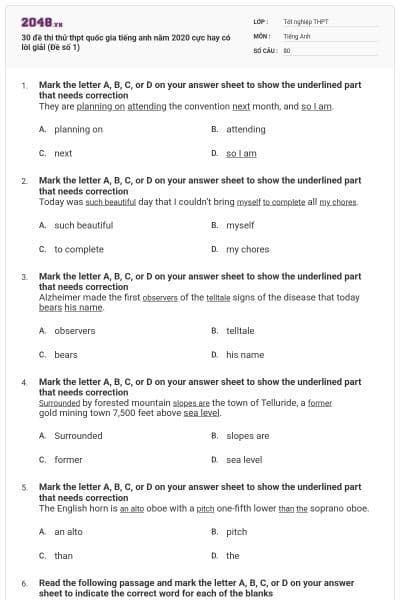
Mark the letter A, B, C, or D on your answer sheet to show the underlined part that needs correction
They are planning on attending the convention next month, and so I am.
planning on
attending
next
so I am
Đáp án là D. so I am => so am I.
Mark the letter A, B, C, or D on your answer sheet to show the underlined part that needs correction
Today was such beautiful day that I couldn’t bring myself to complete all my chores.
such beautiful
myself
to complete
my chores
Đáp án là A. such beautiful => such a beautiful, vì “day” là danh từ số ít, phải có mạo từ “a” trước tính từ “beautiful”
Mark the letter A, B, C, or D on your answer sheet to show the underlined part that needs correction
Alzheimer made the first observers of the telltale signs of the disease that today bears his name.
observers
telltale
bears
his name
Đáp án là A. observers => observations
Mark the letter A, B, C, or D on your answer sheet to show the underlined part that needs correction
Surrounded by forested mountain slopes are the town of Telluride, a former gold mining town 7,500 feet above sea level.
Surrounded
slopes are
former
sea level
Đáp án là B. slopes are => are slopes
Mark the letter A, B, C, or D on your answer sheet to show the underlined part that needs correction
The English horn is an alto oboe with a pitch one-fifth lower than the soprano oboe.
an alto
pitch
than
the
Đáp án là D. the => a
Read the following passage and mark the letter A, B, C, or D on your answer sheet to indicate the correct word for each of the blanks
THE EARTH GALLERIES
To many people, the word ‘geology’ conjures up rather dull image of lumps of rock in glass cases. People tend to regard geology as an academic subject that you don’t need to know about (56)________you have to study it at school. If you visit te Earth Galleries at London’s Natural history Museum, however, you’ll (57)________that this image couldn’t be further from the truth.
The aim of the exhibition is not to procedure future geologists, but rather to inspire interest in a subject which is relevant to everyday life. The Earth Galleries turn the traditional idea of geological museum (58)________, literacy because you begin at the top. The central space in the museum is a glass-topped atrium. As you enter, you (59)________up to the top of this by escalator. On the (60)________, the escalator passed through a massive revolving globe, measuring eleven metres (61)________diameter. This represents a planet, not necessarily the Earth. (62)________at the top, you work your way down through the six different exhibitions that (63)________the museum.
The individual exhibitions explain natural phenomena such as earthquakes and volcanoes as well as looking at the Earth’s energy (64)________and where our most common building (65)__________come from. These exhibitions allow everyone to appreciate the fascination of geology.
despite
unless
owing
whether
Đáp án là B. unless: nếu không. Dịch: ... you don’t need to know about unless you have to study it at school. ( Nếu bạn không học nó ở trường thì bạn không cần biết. )
Read the following passage and mark the letter A, B, C, or D on your answer sheet to indicate the correct word for each of the blanks
THE EARTH GALLERIES
To many people, the word ‘geology’ conjures up rather dull image of lumps of rock in glass cases. People tend to regard geology as an academic subject that you don’t need to know about (56)________you have to study it at school. If you visit te Earth Galleries at London’s Natural history Museum, however, you’ll (57)________that this image couldn’t be further from the truth.
The aim of the exhibition is not to procedure future geologists, but rather to inspire interest in a subject which is relevant to everyday life. The Earth Galleries turn the traditional idea of geological museum (58)________, literacy because you begin at the top. The central space in the museum is a glass-topped atrium. As you enter, you (59)________up to the top of this by escalator. On the (60)________, the escalator passed through a massive revolving globe, measuring eleven metres (61)________diameter. This represents a planet, not necessarily the Earth. (62)________at the top, you work your way down through the six different exhibitions that (63)________the museum.
The individual exhibitions explain natural phenomena such as earthquakes and volcanoes as well as looking at the Earth’s energy (64)________and where our most common building (65)__________come from. These exhibitions allow everyone to appreciate the fascination of geology.
Question 57
discover
found
catch
convince
Đáp án là A. discover: khám phá.
Nghĩa các từ còn lại: find: tìm; catch: bắt gặp; convince: thuyết phục
Read the following passage and mark the letter A, B, C, or D on your answer sheet to indicate the correct word for each of the blanks
THE EARTH GALLERIES
To many people, the word ‘geology’ conjures up rather dull image of lumps of rock in glass cases. People tend to regard geology as an academic subject that you don’t need to know about (56)________you have to study it at school. If you visit te Earth Galleries at London’s Natural history Museum, however, you’ll (57)________that this image couldn’t be further from the truth.
The aim of the exhibition is not to procedure future geologists, but rather to inspire interest in a subject which is relevant to everyday life. The Earth Galleries turn the traditional idea of geological museum (58)________, literacy because you begin at the top. The central space in the museum is a glass-topped atrium. As you enter, you (59)________up to the top of this by escalator. On the (60)________, the escalator passed through a massive revolving globe, measuring eleven metres (61)________diameter. This represents a planet, not necessarily the Earth. (62)________at the top, you work your way down through the six different exhibitions that (63)________the museum.
The individual exhibitions explain natural phenomena such as earthquakes and volcanoes as well as looking at the Earth’s energy (64)________and where our most common building (65)__________come from. These exhibitions allow everyone to appreciate the fascination of geology.
Question 58
head to toe
upside down
back to front
inside out
Đáp án là B. turn something upside down: làm xáo lộn tung bành cái gì đó
Read the following passage and mark the letter A, B, C, or D on your answer sheet to indicate the correct word for each of the blanks
THE EARTH GALLERIES
To many people, the word ‘geology’ conjures up rather dull image of lumps of rock in glass cases. People tend to regard geology as an academic subject that you don’t need to know about (56)________you have to study it at school. If you visit te Earth Galleries at London’s Natural history Museum, however, you’ll (57)________that this image couldn’t be further from the truth.
The aim of the exhibition is not to procedure future geologists, but rather to inspire interest in a subject which is relevant to everyday life. The Earth Galleries turn the traditional idea of geological museum (58)________, literacy because you begin at the top. The central space in the museum is a glass-topped atrium. As you enter, you (59)________up to the top of this by escalator. On the (60)________, the escalator passed through a massive revolving globe, measuring eleven metres (61)________diameter. This represents a planet, not necessarily the Earth. (62)________at the top, you work your way down through the six different exhibitions that (63)________the museum.
The individual exhibitions explain natural phenomena such as earthquakes and volcanoes as well as looking at the Earth’s energy (64)________and where our most common building (65)__________come from. These exhibitions allow everyone to appreciate the fascination of geology.
Question 59
drive
ride
run
steer
Đáp án là B. ride up: từ từ di chuyển cao hơn, ra khỏi vị trí
Read the following passage and mark the letter A, B, C, or D on your answer sheet to indicate the correct word for each of the blanks
THE EARTH GALLERIES
To many people, the word ‘geology’ conjures up rather dull image of lumps of rock in glass cases. People tend to regard geology as an academic subject that you don’t need to know about (56)________you have to study it at school. If you visit te Earth Galleries at London’s Natural history Museum, however, you’ll (57)________that this image couldn’t be further from the truth.
The aim of the exhibition is not to procedure future geologists, but rather to inspire interest in a subject which is relevant to everyday life. The Earth Galleries turn the traditional idea of geological museum (58)________, literacy because you begin at the top. The central space in the museum is a glass-topped atrium. As you enter, you (59)________up to the top of this by escalator. On the (60)________, the escalator passed through a massive revolving globe, measuring eleven metres (61)________diameter. This represents a planet, not necessarily the Earth. (62)________at the top, you work your way down through the six different exhibitions that (63)________the museum.
The individual exhibitions explain natural phenomena such as earthquakes and volcanoes as well as looking at the Earth’s energy (64)________and where our most common building (65)__________come from. These exhibitions allow everyone to appreciate the fascination of geology.
Question 60
trip
route
way
path
Đáp án là C. On the way : Trên đường đi.
Read the following passage and mark the letter A, B, C, or D on your answer sheet to indicate the correct word for each of the blanks
THE EARTH GALLERIES
To many people, the word ‘geology’ conjures up rather dull image of lumps of rock in glass cases. People tend to regard geology as an academic subject that you don’t need to know about (56)________you have to study it at school. If you visit te Earth Galleries at London’s Natural history Museum, however, you’ll (57)________that this image couldn’t be further from the truth.
The aim of the exhibition is not to procedure future geologists, but rather to inspire interest in a subject which is relevant to everyday life. The Earth Galleries turn the traditional idea of geological museum (58)________, literacy because you begin at the top. The central space in the museum is a glass-topped atrium. As you enter, you (59)________up to the top of this by escalator. On the (60)________, the escalator passed through a massive revolving globe, measuring eleven metres (61)________diameter. This represents a planet, not necessarily the Earth. (62)________at the top, you work your way down through the six different exhibitions that (63)________the museum.
The individual exhibitions explain natural phenomena such as earthquakes and volcanoes as well as looking at the Earth’s energy (64)________and where our most common building (65)__________come from. These exhibitions allow everyone to appreciate the fascination of geology.
Question 61
on
around
across
in
Đáp án là D . measuring eleven metres in diameter: đo mười một mét đường kính
Read the following passage and mark the letter A, B, C, or D on your answer sheet to indicate the correct word for each of the blanks
THE EARTH GALLERIES
To many people, the word ‘geology’ conjures up rather dull image of lumps of rock in glass cases. People tend to regard geology as an academic subject that you don’t need to know about (56)________you have to study it at school. If you visit te Earth Galleries at London’s Natural history Museum, however, you’ll (57)________that this image couldn’t be further from the truth.
The aim of the exhibition is not to procedure future geologists, but rather to inspire interest in a subject which is relevant to everyday life. The Earth Galleries turn the traditional idea of geological museum (58)________, literacy because you begin at the top. The central space in the museum is a glass-topped atrium. As you enter, you (59)________up to the top of this by escalator. On the (60)________, the escalator passed through a massive revolving globe, measuring eleven metres (61)________diameter. This represents a planet, not necessarily the Earth. (62)________at the top, you work your way down through the six different exhibitions that (63)________the museum.
The individual exhibitions explain natural phenomena such as earthquakes and volcanoes as well as looking at the Earth’s energy (64)________and where our most common building (65)__________come from. These exhibitions allow everyone to appreciate the fascination of geology.
Question 62
From
Once
Got
Yet
Đáp án là B .Once = when: khi
Read the following passage and mark the letter A, B, C, or D on your answer sheet to indicate the correct word for each of the blanks
THE EARTH GALLERIES
To many people, the word ‘geology’ conjures up rather dull image of lumps of rock in glass cases. People tend to regard geology as an academic subject that you don’t need to know about (56)________you have to study it at school. If you visit te Earth Galleries at London’s Natural history Museum, however, you’ll (57)________that this image couldn’t be further from the truth.
The aim of the exhibition is not to procedure future geologists, but rather to inspire interest in a subject which is relevant to everyday life. The Earth Galleries turn the traditional idea of geological museum (58)________, literacy because you begin at the top. The central space in the museum is a glass-topped atrium. As you enter, you (59)________up to the top of this by escalator. On the (60)________, the escalator passed through a massive revolving globe, measuring eleven metres (61)________diameter. This represents a planet, not necessarily the Earth. (62)________at the top, you work your way down through the six different exhibitions that (63)________the museum.
The individual exhibitions explain natural phenomena such as earthquakes and volcanoes as well as looking at the Earth’s energy (64)________and where our most common building (65)__________come from. These exhibitions allow everyone to appreciate the fascination of geology.
Question 63
bring together
consist of
make up
show off
Đáp án là C. make up: tạo nên
Nghĩa các từ còn lại: bring together: mang lại vói nhau; consist of: bao gồm; show off: thể hiện, khoe
Read the following passage and mark the letter A, B, C, or D on your answer sheet to indicate the correct word for each of the blanks
THE EARTH GALLERIES
To many people, the word ‘geology’ conjures up rather dull image of lumps of rock in glass cases. People tend to regard geology as an academic subject that you don’t need to know about (56)________you have to study it at school. If you visit te Earth Galleries at London’s Natural history Museum, however, you’ll (57)________that this image couldn’t be further from the truth.
The aim of the exhibition is not to procedure future geologists, but rather to inspire interest in a subject which is relevant to everyday life. The Earth Galleries turn the traditional idea of geological museum (58)________, literacy because you begin at the top. The central space in the museum is a glass-topped atrium. As you enter, you (59)________up to the top of this by escalator. On the (60)________, the escalator passed through a massive revolving globe, measuring eleven metres (61)________diameter. This represents a planet, not necessarily the Earth. (62)________at the top, you work your way down through the six different exhibitions that (63)________the museum.
The individual exhibitions explain natural phenomena such as earthquakes and volcanoes as well as looking at the Earth’s energy (64)________and where our most common building (65)__________come from. These exhibitions allow everyone to appreciate the fascination of geology.
Question 64
treasures
talents
resources
reservations
Đáp án là C. energy resources: nguồn tài nguyên năng lượng
Read the following passage and mark the letter A, B, C, or D on your answer sheet to indicate the correct word for each of the blanks
THE EARTH GALLERIES
To many people, the word ‘geology’ conjures up rather dull image of lumps of rock in glass cases. People tend to regard geology as an academic subject that you don’t need to know about (56)________you have to study it at school. If you visit te Earth Galleries at London’s Natural history Museum, however, you’ll (57)________that this image couldn’t be further from the truth.
The aim of the exhibition is not to procedure future geologists, but rather to inspire interest in a subject which is relevant to everyday life. The Earth Galleries turn the traditional idea of geological museum (58)________, literacy because you begin at the top. The central space in the museum is a glass-topped atrium. As you enter, you (59)________up to the top of this by escalator. On the (60)________, the escalator passed through a massive revolving globe, measuring eleven metres (61)________diameter. This represents a planet, not necessarily the Earth. (62)________at the top, you work your way down through the six different exhibitions that (63)________the museum.
The individual exhibitions explain natural phenomena such as earthquakes and volcanoes as well as looking at the Earth’s energy (64)________and where our most common building (65)__________come from. These exhibitions allow everyone to appreciate the fascination of geology.
Question 65
ingredients
materials
contents
substances
Đáp án là B. building materials: vật liệu xây dựng
Choose the word (A, B, C, D) whose primary stress is on a different position from that of the others in each group below.
terrific
Pacific
Arabic
mechanic
Đáp án là: B. Pacific nhấn âm tiết thứ nhất, các từ còn lại nhấn âm tiết thứ hai.
Choose the word (A, B, C, D) whose primary stress is on a different position from that of the others in each group below.
benevolent
profitable
essential
equivalent
Đáp án là: B. profitable nhấn âm tiết thứ nhất, các từ còn lại nhấn âm tiết thứ hai.
Choose the word (A, B, C, D) whose primary stress is on a different position from that of the others in each group below.
evaporate
consulate
contemplate
coordinate
Đáp án là: B. consulate nhấn âm tiết thứ nhất, các từ còn lại nhấn âm tiết thứ hai.
Choose the word (A, B, C, D) whose primary stress is on a different position from that of the others in each group below.
compressor
transistor
equator
ancestor
Đáp án là: D. ancestor nhấn âm tiết thứ nhất, các từ còn lại nhấn âm tiết thứ hai.
Choose the word (A, B, C, D) whose primary stress is on a different position from that of the others in each group below.
nutritious
contagious
contemptuous
numerous
Đáp án là: D. numerous nhấn âm tiết thứ nhất, các từ còn lại nhấn âm tiết thứ hai
Read the following passage and mark the letter A, B, C, or D on your answer sheet to indicate the correct answer to each of the questions that follow
Line (5)
(10) | Jazz has been called “the art of expression set to music”, and “America’s great contribution to music”. It has functioned as popular art and enjoyed periods of fairly widespread public response, in the “jazz age” of the Line 1920s, in the “swing era” of the late 1930s and in the peak popularity of modern jazz in the late 1950s. The standard legend about Jazz is that it originated around the end of the 19th century in New Orleans and moved up the Mississippi River to Memphis, St. Louis, and finally to Chicago. It welded together the elements of Ragtime, marching band music, and the Blues. However, the influences of what led to those early sounds goes back (10)________to tribal African drum beats and European musical structures. Buddy Bolden, a New Orleans barber and cornet player, is generally considered to have been the first real Jazz musician, around 1891. |
(15)
(20)
| What made Jazz significantly different from the other earlier forms of music was the use of improvisation. Jazz displayed a break from traditional (15)________music where composers wrote an entire piece of music on paper, leaving the musicians to break their backs playing exactly what was written on the score. In a Jazz piece, however, the song is simply a starting point, or sort of skeletal guide for the Jazz musicians to improvise around. Actually, many of the early Jazz musicians were bad sight readers and some couldn’t even read (20)________music at all. Generally speaking, these early musicians couldn’t make very much money and were stuck working menial jobs to make a living. The second wave of New Orleans Jazz musicians included such memorable players as Joe Oliver, Kid Ory, and Jelly Roll Morton. These men formed small bands and took the music of earlier musicians, improved its complexity, and gained greater success. This music is known as “hot Jazz” (25)________due to the enormously fast speeds and rhythmic drive. |
(25) | A young cornet player by the name of Louis Armstrong was discovered by Joe Oliver in New Orleans. He soon grew up to become one of the greatest and most successful musicians of all time, and later one of the biggest stars in the world. The impact of Armstrong and other talented early Jazz musicians changed the way we look at music. |
The Passage answers which of the following questions?
(A) Why did Ragtime, marching band music, and the Blues lose popularity after about 1900?
(B) What were the origins of Jazz and how did it differ from other forms of music?
(C) What has been the greatest contribution of cornet players to music in the twentieth century?
(D) Which early Jazz musicians most influenced the development of Blues music?
Đáp án là B. Dễ dàng nhận thấy đoạn 1 nói về nguồn gốc của nhạc Jazz, đoạn 2 nói về sự khác nhau giữa nhạc Jazz và các dòng nhạc khác.
Read the following passage and mark the letter A, B, C, or D on your answer sheet to indicate the correct answer to each of the questions that follow
Line (5)
(10) | Jazz has been called “the art of expression set to music”, and “America’s great contribution to music”. It has functioned as popular art and enjoyed periods of fairly widespread public response, in the “jazz age” of the Line 1920s, in the “swing era” of the late 1930s and in the peak popularity of modern jazz in the late 1950s. The standard legend about Jazz is that it originated around the end of the 19th century in New Orleans and moved up the Mississippi River to Memphis, St. Louis, and finally to Chicago. It welded together the elements of Ragtime, marching band music, and the Blues. However, the influences of what led to those early sounds goes back (10)________to tribal African drum beats and European musical structures. Buddy Bolden, a New Orleans barber and cornet player, is generally considered to have been the first real Jazz musician, around 1891. |
(15)
(20)
| What made Jazz significantly different from the other earlier forms of music was the use of improvisation. Jazz displayed a break from traditional (15)________music where composers wrote an entire piece of music on paper, leaving the musicians to break their backs playing exactly what was written on the score. In a Jazz piece, however, the song is simply a starting point, or sort of skeletal guide for the Jazz musicians to improvise around. Actually, many of the early Jazz musicians were bad sight readers and some couldn’t even read (20)________music at all. Generally speaking, these early musicians couldn’t make very much money and were stuck working menial jobs to make a living. The second wave of New Orleans Jazz musicians included such memorable players as Joe Oliver, Kid Ory, and Jelly Roll Morton. These men formed small bands and took the music of earlier musicians, improved its complexity, and gained greater success. This music is known as “hot Jazz” (25)________due to the enormously fast speeds and rhythmic drive. |
(25) | A young cornet player by the name of Louis Armstrong was discovered by Joe Oliver in New Orleans. He soon grew up to become one of the greatest and most successful musicians of all time, and later one of the biggest stars in the world. The impact of Armstrong and other talented early Jazz musicians changed the way we look at music. |
According to the passage, Jazz originated in
(A) Chicago
(B) St. Louis
(C) along the Mississippi river
(D) New Orleans
Đáp án là D. Ý trong bài: The standard legend about Jazz is that it originated around the end of the 19th century in New Orleans
Read the following passage and mark the letter A, B, C, or D on your answer sheet to indicate the correct answer to each of the questions that follow
Line (5)
(10) | Jazz has been called “the art of expression set to music”, and “America’s great contribution to music”. It has functioned as popular art and enjoyed periods of fairly widespread public response, in the “jazz age” of the Line 1920s, in the “swing era” of the late 1930s and in the peak popularity of modern jazz in the late 1950s. The standard legend about Jazz is that it originated around the end of the 19th century in New Orleans and moved up the Mississippi River to Memphis, St. Louis, and finally to Chicago. It welded together the elements of Ragtime, marching band music, and the Blues. However, the influences of what led to those early sounds goes back (10)________to tribal African drum beats and European musical structures. Buddy Bolden, a New Orleans barber and cornet player, is generally considered to have been the first real Jazz musician, around 1891. |
(15)
(20)
| What made Jazz significantly different from the other earlier forms of music was the use of improvisation. Jazz displayed a break from traditional (15)________music where composers wrote an entire piece of music on paper, leaving the musicians to break their backs playing exactly what was written on the score. In a Jazz piece, however, the song is simply a starting point, or sort of skeletal guide for the Jazz musicians to improvise around. Actually, many of the early Jazz musicians were bad sight readers and some couldn’t even read (20)________music at all. Generally speaking, these early musicians couldn’t make very much money and were stuck working menial jobs to make a living. The second wave of New Orleans Jazz musicians included such memorable players as Joe Oliver, Kid Ory, and Jelly Roll Morton. These men formed small bands and took the music of earlier musicians, improved its complexity, and gained greater success. This music is known as “hot Jazz” (25)________due to the enormously fast speeds and rhythmic drive. |
(25) | A young cornet player by the name of Louis Armstrong was discovered by Joe Oliver in New Orleans. He soon grew up to become one of the greatest and most successful musicians of all time, and later one of the biggest stars in the world. The impact of Armstrong and other talented early Jazz musicians changed the way we look at music. |
Which of the following distinguished Jazz as a new form of musical expression?
(A) the use of cornets
(B) “hot Jazz”
(C) improvisation
(D) New Orleans
Đáp án là C. What made Jazz significantly different from the other earlier forms of music was the use of improvisation.
Read the following passage and mark the letter A, B, C, or D on your answer sheet to indicate the correct answer to each of the questions that follow
Line (5)
(10) | Jazz has been called “the art of expression set to music”, and “America’s great contribution to music”. It has functioned as popular art and enjoyed periods of fairly widespread public response, in the “jazz age” of the Line 1920s, in the “swing era” of the late 1930s and in the peak popularity of modern jazz in the late 1950s. The standard legend about Jazz is that it originated around the end of the 19th century in New Orleans and moved up the Mississippi River to Memphis, St. Louis, and finally to Chicago. It welded together the elements of Ragtime, marching band music, and the Blues. However, the influences of what led to those early sounds goes back (10)________to tribal African drum beats and European musical structures. Buddy Bolden, a New Orleans barber and cornet player, is generally considered to have been the first real Jazz musician, around 1891. |
(15)
(20)
| What made Jazz significantly different from the other earlier forms of music was the use of improvisation. Jazz displayed a break from traditional (15)________music where composers wrote an entire piece of music on paper, leaving the musicians to break their backs playing exactly what was written on the score. In a Jazz piece, however, the song is simply a starting point, or sort of skeletal guide for the Jazz musicians to improvise around. Actually, many of the early Jazz musicians were bad sight readers and some couldn’t even read (20)________music at all. Generally speaking, these early musicians couldn’t make very much money and were stuck working menial jobs to make a living. The second wave of New Orleans Jazz musicians included such memorable players as Joe Oliver, Kid Ory, and Jelly Roll Morton. These men formed small bands and took the music of earlier musicians, improved its complexity, and gained greater success. This music is known as “hot Jazz” (25)________due to the enormously fast speeds and rhythmic drive. |
(25) | A young cornet player by the name of Louis Armstrong was discovered by Joe Oliver in New Orleans. He soon grew up to become one of the greatest and most successful musicians of all time, and later one of the biggest stars in the world. The impact of Armstrong and other talented early Jazz musicians changed the way we look at music. |
The word “skeletal” in line 16 is closest in meaning to
(A) framework
(B) musical
(C) basic
(D) essential
Đáp án là A. skeletal = framework: khung, bộ xương
Nghĩa các từ còn lại: musical: (thuộc) âm nhạc; basic: nền tảng; essential: cần thiết
Read the following passage and mark the letter A, B, C, or D on your answer sheet to indicate the correct answer to each of the questions that follow
Line (5)
(10) | Jazz has been called “the art of expression set to music”, and “America’s great contribution to music”. It has functioned as popular art and enjoyed periods of fairly widespread public response, in the “jazz age” of the Line 1920s, in the “swing era” of the late 1930s and in the peak popularity of modern jazz in the late 1950s. The standard legend about Jazz is that it originated around the end of the 19th century in New Orleans and moved up the Mississippi River to Memphis, St. Louis, and finally to Chicago. It welded together the elements of Ragtime, marching band music, and the Blues. However, the influences of what led to those early sounds goes back (10)________to tribal African drum beats and European musical structures. Buddy Bolden, a New Orleans barber and cornet player, is generally considered to have been the first real Jazz musician, around 1891. |
(15)
(20)
| What made Jazz significantly different from the other earlier forms of music was the use of improvisation. Jazz displayed a break from traditional (15)________music where composers wrote an entire piece of music on paper, leaving the musicians to break their backs playing exactly what was written on the score. In a Jazz piece, however, the song is simply a starting point, or sort of skeletal guide for the Jazz musicians to improvise around. Actually, many of the early Jazz musicians were bad sight readers and some couldn’t even read (20)________music at all. Generally speaking, these early musicians couldn’t make very much money and were stuck working menial jobs to make a living. The second wave of New Orleans Jazz musicians included such memorable players as Joe Oliver, Kid Ory, and Jelly Roll Morton. These men formed small bands and took the music of earlier musicians, improved its complexity, and gained greater success. This music is known as “hot Jazz” (25)________due to the enormously fast speeds and rhythmic drive. |
(25) | A young cornet player by the name of Louis Armstrong was discovered by Joe Oliver in New Orleans. He soon grew up to become one of the greatest and most successful musicians of all time, and later one of the biggest stars in the world. The impact of Armstrong and other talented early Jazz musicians changed the way we look at music. |
Which of the following can be inferred from the passage?
(A) many early Jazz musicians had poor sight
(B) there is no slow music in Jazz
(C) many early Jazz musicians had little formal musical training
(D) the cornet is the most common musical instrument used in Jazz
Đáp án là C. Ý trong bài: these early musicians couldn’t make very much money and were stuck working menial jobs to make a living
Read the following passage and mark the letter A, B, C, or D on your answer sheet to indicate the correct answer to each of the questions that follow
Line (5)
(10) | Jazz has been called “the art of expression set to music”, and “America’s great contribution to music”. It has functioned as popular art and enjoyed periods of fairly widespread public response, in the “jazz age” of the Line 1920s, in the “swing era” of the late 1930s and in the peak popularity of modern jazz in the late 1950s. The standard legend about Jazz is that it originated around the end of the 19th century in New Orleans and moved up the Mississippi River to Memphis, St. Louis, and finally to Chicago. It welded together the elements of Ragtime, marching band music, and the Blues. However, the influences of what led to those early sounds goes back (10)________to tribal African drum beats and European musical structures. Buddy Bolden, a New Orleans barber and cornet player, is generally considered to have been the first real Jazz musician, around 1891. |
(15)
(20)
| What made Jazz significantly different from the other earlier forms of music was the use of improvisation. Jazz displayed a break from traditional (15)________music where composers wrote an entire piece of music on paper, leaving the musicians to break their backs playing exactly what was written on the score. In a Jazz piece, however, the song is simply a starting point, or sort of skeletal guide for the Jazz musicians to improvise around. Actually, many of the early Jazz musicians were bad sight readers and some couldn’t even read (20)________music at all. Generally speaking, these early musicians couldn’t make very much money and were stuck working menial jobs to make a living. The second wave of New Orleans Jazz musicians included such memorable players as Joe Oliver, Kid Ory, and Jelly Roll Morton. These men formed small bands and took the music of earlier musicians, improved its complexity, and gained greater success. This music is known as “hot Jazz” (25)________due to the enormously fast speeds and rhythmic drive. |
(25) | A young cornet player by the name of Louis Armstrong was discovered by Joe Oliver in New Orleans. He soon grew up to become one of the greatest and most successful musicians of all time, and later one of the biggest stars in the world. The impact of Armstrong and other talented early Jazz musicians changed the way we look at music. |
The word “menial” in line 20 is closest in meaning to
(A) mens
(B) attractive
(C) degrading
(D) skilled
menial: công việc như người hầu => Đáp án là C. degrading: làm mất danh giá
Read the following passage and mark the letter A, B, C, or D on your answer sheet to indicate the correct answer to each of the questions that follow
Line (5)
(10) | Jazz has been called “the art of expression set to music”, and “America’s great contribution to music”. It has functioned as popular art and enjoyed periods of fairly widespread public response, in the “jazz age” of the Line 1920s, in the “swing era” of the late 1930s and in the peak popularity of modern jazz in the late 1950s. The standard legend about Jazz is that it originated around the end of the 19th century in New Orleans and moved up the Mississippi River to Memphis, St. Louis, and finally to Chicago. It welded together the elements of Ragtime, marching band music, and the Blues. However, the influences of what led to those early sounds goes back (10)________to tribal African drum beats and European musical structures. Buddy Bolden, a New Orleans barber and cornet player, is generally considered to have been the first real Jazz musician, around 1891. |
(15)
(20)
| What made Jazz significantly different from the other earlier forms of music was the use of improvisation. Jazz displayed a break from traditional (15)________music where composers wrote an entire piece of music on paper, leaving the musicians to break their backs playing exactly what was written on the score. In a Jazz piece, however, the song is simply a starting point, or sort of skeletal guide for the Jazz musicians to improvise around. Actually, many of the early Jazz musicians were bad sight readers and some couldn’t even read (20)________music at all. Generally speaking, these early musicians couldn’t make very much money and were stuck working menial jobs to make a living. The second wave of New Orleans Jazz musicians included such memorable players as Joe Oliver, Kid Ory, and Jelly Roll Morton. These men formed small bands and took the music of earlier musicians, improved its complexity, and gained greater success. This music is known as “hot Jazz” (25)________due to the enormously fast speeds and rhythmic drive. |
(25) | A young cornet player by the name of Louis Armstrong was discovered by Joe Oliver in New Orleans. He soon grew up to become one of the greatest and most successful musicians of all time, and later one of the biggest stars in the world. The impact of Armstrong and other talented early Jazz musicians changed the way we look at music. |
According to the passage, which of the following belonged to the second wave of New Orleans Jazz musicians?
(A) Louis Armstrong
(B) Buddy Bolden
(C) St. Louis
(D) Joe Oliver
Đáp án là D. Ý trong bài: The second wave of New Orleans Jazz musicians included such memorable players as Joe Oliver, Kid Ory, and Jelly Roll Morton.
Read the following passage and mark the letter A, B, C, or D on your answer sheet to indicate the correct answer to each of the questions that follow
Line (5)
(10) | Jazz has been called “the art of expression set to music”, and “America’s great contribution to music”. It has functioned as popular art and enjoyed periods of fairly widespread public response, in the “jazz age” of the Line 1920s, in the “swing era” of the late 1930s and in the peak popularity of modern jazz in the late 1950s. The standard legend about Jazz is that it originated around the end of the 19th century in New Orleans and moved up the Mississippi River to Memphis, St. Louis, and finally to Chicago. It welded together the elements of Ragtime, marching band music, and the Blues. However, the influences of what led to those early sounds goes back (10)________to tribal African drum beats and European musical structures. Buddy Bolden, a New Orleans barber and cornet player, is generally considered to have been the first real Jazz musician, around 1891. |
(15)
(20)
| What made Jazz significantly different from the other earlier forms of music was the use of improvisation. Jazz displayed a break from traditional (15)________music where composers wrote an entire piece of music on paper, leaving the musicians to break their backs playing exactly what was written on the score. In a Jazz piece, however, the song is simply a starting point, or sort of skeletal guide for the Jazz musicians to improvise around. Actually, many of the early Jazz musicians were bad sight readers and some couldn’t even read (20)________music at all. Generally speaking, these early musicians couldn’t make very much money and were stuck working menial jobs to make a living. The second wave of New Orleans Jazz musicians included such memorable players as Joe Oliver, Kid Ory, and Jelly Roll Morton. These men formed small bands and took the music of earlier musicians, improved its complexity, and gained greater success. This music is known as “hot Jazz” (25)________due to the enormously fast speeds and rhythmic drive. |
(25) | A young cornet player by the name of Louis Armstrong was discovered by Joe Oliver in New Orleans. He soon grew up to become one of the greatest and most successful musicians of all time, and later one of the biggest stars in the world. The impact of Armstrong and other talented early Jazz musicians changed the way we look at music. |
All of the following are true EXCEPT
(A) the late 1930s was called the “swing era”
(B) “hot Jazz” is rhythmic
(C) Jazz has been said to be America’s greatest contribution to music
(D) Joe Oliver is generally considered to be the first real Jazz musician
Đáp án là D.
A được đề cập: .... in the “swing era” of the late 1930s and in the peak popularity of modern jazz in the late 1950s.
B được đề cập: This music is known as “hot Jazz” due to the enormously fast speeds and rhythmic drive. C được đề cập: Jazz has been called “the art of expression set to music”, and “America’s great contribution to music”.
Read the following passage and mark the letter A, B, C, or D on your answer sheet to indicate the correct answer to each of the questions that follow
Line (5)
(10) | Jazz has been called “the art of expression set to music”, and “America’s great contribution to music”. It has functioned as popular art and enjoyed periods of fairly widespread public response, in the “jazz age” of the Line 1920s, in the “swing era” of the late 1930s and in the peak popularity of modern jazz in the late 1950s. The standard legend about Jazz is that it originated around the end of the 19th century in New Orleans and moved up the Mississippi River to Memphis, St. Louis, and finally to Chicago. It welded together the elements of Ragtime, marching band music, and the Blues. However, the influences of what led to those early sounds goes back (10)________to tribal African drum beats and European musical structures. Buddy Bolden, a New Orleans barber and cornet player, is generally considered to have been the first real Jazz musician, around 1891. |
(15)
(20)
| What made Jazz significantly different from the other earlier forms of music was the use of improvisation. Jazz displayed a break from traditional (15)________music where composers wrote an entire piece of music on paper, leaving the musicians to break their backs playing exactly what was written on the score. In a Jazz piece, however, the song is simply a starting point, or sort of skeletal guide for the Jazz musicians to improvise around. Actually, many of the early Jazz musicians were bad sight readers and some couldn’t even read (20)________music at all. Generally speaking, these early musicians couldn’t make very much money and were stuck working menial jobs to make a living. The second wave of New Orleans Jazz musicians included such memorable players as Joe Oliver, Kid Ory, and Jelly Roll Morton. These men formed small bands and took the music of earlier musicians, improved its complexity, and gained greater success. This music is known as “hot Jazz” (25)________due to the enormously fast speeds and rhythmic drive. |
(25) | A young cornet player by the name of Louis Armstrong was discovered by Joe Oliver in New Orleans. He soon grew up to become one of the greatest and most successful musicians of all time, and later one of the biggest stars in the world. The impact of Armstrong and other talented early Jazz musicians changed the way we look at music. |
The word “its” in line 23 refers to________
(A) small bands
(B) earlier music
(C) men
(D) earlier musicians
Đáp án là B. its = ealier music: nền âm nhạc trước đó
Read the following passage and mark the letter A, B, C, or D on your answer sheet to indicate the correct answer to each of the questions that follow
Line (5)
(10) | Jazz has been called “the art of expression set to music”, and “America’s great contribution to music”. It has functioned as popular art and enjoyed periods of fairly widespread public response, in the “jazz age” of the Line 1920s, in the “swing era” of the late 1930s and in the peak popularity of modern jazz in the late 1950s. The standard legend about Jazz is that it originated around the end of the 19th century in New Orleans and moved up the Mississippi River to Memphis, St. Louis, and finally to Chicago. It welded together the elements of Ragtime, marching band music, and the Blues. However, the influences of what led to those early sounds goes back (10)________to tribal African drum beats and European musical structures. Buddy Bolden, a New Orleans barber and cornet player, is generally considered to have been the first real Jazz musician, around 1891. |
(15)
(20)
| What made Jazz significantly different from the other earlier forms of music was the use of improvisation. Jazz displayed a break from traditional (15)________music where composers wrote an entire piece of music on paper, leaving the musicians to break their backs playing exactly what was written on the score. In a Jazz piece, however, the song is simply a starting point, or sort of skeletal guide for the Jazz musicians to improvise around. Actually, many of the early Jazz musicians were bad sight readers and some couldn’t even read (20)________music at all. Generally speaking, these early musicians couldn’t make very much money and were stuck working menial jobs to make a living. The second wave of New Orleans Jazz musicians included such memorable players as Joe Oliver, Kid Ory, and Jelly Roll Morton. These men formed small bands and took the music of earlier musicians, improved its complexity, and gained greater success. This music is known as “hot Jazz” (25)________due to the enormously fast speeds and rhythmic drive. |
(25) | A young cornet player by the name of Louis Armstrong was discovered by Joe Oliver in New Orleans. He soon grew up to become one of the greatest and most successful musicians of all time, and later one of the biggest stars in the world. The impact of Armstrong and other talented early Jazz musicians changed the way we look at music. |
The word “their” in line 15 refers to which of the following?
composers
musicians
pieces
earlier forms
Đáp án là B. their = musicians: nhạc sỹ
Mark the letter A, B, C, or D on your answer sheet to indicate the correct answer to each of the following questions
________you’ll be coming to the meeting next week since you prepared the documents?
Likely
Predictably
Presumably
Surely
Đáp án là C. Presumably + clause: giả sử…
Các từ còn lại: likely thường đi với cấu trúc: be likely to + V...: có khả năng ,cơ hội...
Predictably( adv): tiên đoán trước; Surely (adv): một cách chắc chắn
Mark the letter A, B, C, or D on your answer sheet to indicate the correct answer to each of the following questions
The floor was so rotten that it almost gave________under his weight.
way
up
back
away
Đáp án là A. give way : lún/sụp
Các từ còn lại: give back :hoàn trả lại; give out :phân phối, công bố
Mark the letter A, B, C, or D on your answer sheet to indicate the correct answer to each of the following questions.
A: “I’m having some friends over for dinner this evening. Would you like to join us?
B: “____________”
Thanks but I mustn’t.
Come one. It’s your turn.
Can I take a rain check?
As a matter of fact.
Đáp án là C. Cấu trúc: take a rain-check (on something ) (thông tục): hẹn lần sau, dịp khác
Mark the letter A, B, C, or D on your answer sheet to indicate the correct answer to each of the following questions
A: Do you like that advanced course you are taking, John?”
B: “ ________”
No, thanks.
By and large, yes.
Not me. I’m still waiting.
No, not everyone.
Đáp án là B. By and large: nhìn chung, rút cục
Mark the letter A, B, C, or D on your answer sheet to indicate the correct answer to each of the following questions
William is an authority________medieval tapestries.
on
with
about
in
Đáp án là A. Cấu trúc: be an authority on ..: là chuyên gia về ....
Mark the letter A, B, C, or D on your answer sheet to indicate the correct answer to each of the following questions
The marathon runner________for nearly one hour and a half when she________to the pavement.
has been running/ collapsed
were running /collapsed
had been running / collapsed
ran / had been
for+ khoảng thời gian => chia thì hoàn thành => đáp án B và D loại.
A cũng loại vì không cùng thì. Do vậy, đáp án là C.
Mark the letter A, B, C, or D on your answer sheet to indicate the correct answer to each of the following questions
I can't thank enough for your help. - “________”
I'd rather not.
My pleasure.
I don't mind.
My goodness.
Đáp án là B. Đáp lại lời cảm ơn của người khác, ta có thể dùng cấu trúc “My pleasure”.
Mark the letter A, B, C, or D on your answer sheet to indicate the correct answer to each of the following questions.
John: "Do you think that we should use public transportation to protect our environment?"
Laura. "________"
Yes, it’s an absurd idea
There’s no doubt about it
Of course not. You bet
Well, that’s very surprising
Đáp án là B. Tôi không nghi ngờ về nó adsure: vô lí. you bet = you're welcome
Mark the letter A, B, C, or D on your answer sheet to indicate the correct answer to each of the following questions
If you had asked him, he______helped you to solve the problem.
will have
ought to have
should have
would have
Đáp án là D. Câu điều kiện loại III: If + S+ had + PII, S+ would+ have + PII.
Mark the letter A, B, C, or D on your answer sheet to indicate the correct answer to each of the following questions
Henry was really a silly boy when we were at high school. I still remember very________stupid questions.
him asking
him to ask
asking him
his being asked
Đáp án là A. remember + someone + V-ing: nhớ ai đó đã làm gì ...
Mark the letter A, B, C, or D on your answer sheet to indicate the correct answer to each of the following questions
"Today’s my 20 birthday.” - “________”
Take care!
Many happy returns!
Have a good time!
I don’t understand.
Đáp án là B. Cụm từ "many happy returns" thường được dùng để chúc sức khoẻ trong ngày sinh nhật.
Mark the letter A, B, C, or D on your answer sheet to indicate the correct answer to each of the following questions
does Luisa a full-time job and________.
looks after also the house
looks after the house too
looks after the house either
also looks after the house
Đáp án là B. “too -cũng” thường đứng ở cuối câu.
Mark the letter A, B, C, or D on your answer sheet to indicate the correct answer to each of the following questions
On the second level of the parking lot________
is empty
are some empty stalls
some empty stalls are
are empty
Đáp án là B. Trạng từ đứng đầu câu ta sử dụng đảo ngữ: Adverb + V+ S
Mark the letter A, B, C, or D on your answer sheet to indicate the correct answer to each of the following questions
Mr. Nixon refused to answer the questions on the________that the matter was confidential.
reasons
excuses
grounds
foundation
Đáp án là D. on the grounds: với lý do
Mark the letter A, B, C, or D on your answer sheet to indicate the correct answer to each of the following questions.
They attempted to________the painting to its original condition.
restore
renovate
repair
refurbish
Đáp án là A. restore: hồi phục lại ( dữ liệu, thông tin )
Nghĩa các từ còn lại: renovate: hồi phục lại ( một tòa nhà.. ); repair: sửa chữa; refurbish:trang trí lại
Mark the letter A, B, C, or D on your answer sheet to indicate the correct answer to each of the following questions.
Can you list the problems________poor and________countries?
facing/ overpopulation
facing/overpopulated
face/ overpopulated
facing/overpopulating
Đáp án là B. overpopulated là tính từ ( đồng cấp với poor)
Mark the letter A, B, C, or D on your answer sheet to indicate the correct answer to each of the following questions.
I feel________to inform the committee that a number of members are very unhappy with the decision.
my duty
it my duty
this my duty
that my duty
Đáp án: B
Giải thích:
Cấu trúc: to feel it + N = cảm thấy đó là gì
Dịch: Tôi cảm thấy đó là nhiệm vụ của tôi để thông báo cho ủy ban rằng nhiều thành viên không hài lòng với cái quyết định.
Mark the letter A, B, C, or D on your answer sheet to indicate the correct answer to each of the following questions
I'm sure when you've stopped looking for your keys, they'll________up somewhere.
take
look
turn
pull
Đáp án là C. turn up: đến, ở, xảy ra ...
Mark the letter A, B, C, or D on your answer sheet to indicate the correct answer to each of the following questions
To solve this problem, it is advisable________
a drastic measure to be adopted
that to adopt a drastic measure
that a drastic measure be adopted
that a drastic measure is adopted
Đáp án là C. Cấu trúc khuyên răn: It’s advisable that + S + V(bare).
Mark the letter A, B, C, or D on your answer sheet to indicate the correct answer to each of the following questions
The organs of taste are the________that are mainly located on the tongue.
groups of cells are taste buds
Taste buds are groups of cells
Taste buds, these are groups of cells
Taste buds, groups of cells
Đáp án là D. Cách rút gọn đại từ quan hệ làm chủ ngữ, trong câu: S + be + N, ta có thể bỏ đại từ quan hệ và động từ “tobe”. Câu đầy đủ: The organs of taste are the taste buds, which are groups of cells ...
Mark the letter A, B, C, or D on your answer sheet to indicate the correct answer to each of the following questions
On the second thought, I believe I will go with you to the theater.
On reflection
For this time only
After discussing with my wife
For the second time
Đáp án là A. On the second thought = on reflection: Suy nghĩa kỹ
Mark the letter A, B, C, or D on your answer sheet to indicate the correct answer to each of the following questions
Geogre wouldn’t have met Mary________to his brother’s graduation party.
had he gone
hadn’t he gone
if he had not gone
if he shouldn’t have gone
Đáp án là C. Câu điều kiện loại 3: If + S+ had + PII, S+ would+ have + PII.
Mark the letter A, B, C, or D on your answer sheet to indicate the correct answer to each of the following questions
John has a monthly bank________sent to him so that he knows how much there is in his account.
statement
overdraft
cheque
balance
Đáp án là A. statement: giấy biên lai
Nghĩa các từ còn lại: overdraft: sự rút quá số tiền gửi ngân hàng; cheque: séc; balance: sự cân bằng
Mark the letter A, B, C, or D on your answer sheet to indicate the correct answer to each of the following questions
He was sent to________prison for six months for________shoplifting.
x/x/x
the/x/x
x/x/the
a/x/a
Đáp án là A. be sent to prison: bị vào tù; for + khoảng thời gian; for + V-ing: sau giới từ là V-ing.
Mark the letter A, B, C, or D on your answer sheet to indicate the correct answer to each of the following question
What do you want to do this summer?
I think we should go somewhere________has plenty of sun and sand.
who
where
when
that
Đáp án là D. Từ cần điền là một đại từ quan hệ giữ chức năng làm chủ ngữ của động từ “has”, thay thế cho từ trước nó “ somewhere”
Mark the letter A, B, C, or D on you answer sheet to indicate the sentences that is closest in meaning to each of the following questions
It was his lack of confidence that surprised me.
He surprised me by his lack of confidence.
What surprised me was his lack of confidence.
That his lack of confidence surprised me.
That he lacked of confidence surprised me.
Đáp án là B. What + S + V là mệnh đề danh ngữ, đóng vai trò như một danh từ , động từ theo sau luôn ở dạng số ít.
Mark the letter A, B, C, or D on you answer sheet to indicate the sentences that is closest in meaning to each of the following questions
Frank doesn’t care if Jean leaves or stays.
Whatever Jean does is all right with Frank.
Frank wants Jean to stay.
Jean will stay, but Frank wants her to leave.
Jean wants to leave unless Frank stays.
Frank doesn’t care if Jean leaves or stays.- Frank không quan tâm liệu Jean đi hay ở lại.
Đáp án là A. Whatever Jean does is all right with Frank. - Jean làm bất cứ điều gì thì đề đúng với Frank.
Mark the letter A, B, C, or D on you answer sheet to indicate the sentences that is closest in meaning to each of the following questions
When the unemployment rate is high, the crime rate is usually also high.
The unemployment rate and the crime rate are both higher.
The higher the unemployment rate is, the higher the crime rate is.
The unemployment rate is as high as the crime rate.
The high rate of unemployment depends on the high rate of crime.
Đáp án là B. Cấu trúc so sánh tăng tiến “ càng… càng ...” : The + comparision + S + V, the + comparision + S + V.
Mark the letter A, B, C, or D on you answer sheet to indicate the sentences that is closest in meaning to each of the following questions
"You’re always making terrible mistakes", said the teacher.
The teacher asked his students why they always made terrible mistakes.
The teacher realized that his students always made terrible mistakes.
The teacher complained about his student making terrible mistakes.
The teacher made his students not always make terrible mistakes
Cấu trúc S + be + always + V-ing diễn tả sự phàn nàn, khó chịu của người nói đến đối tương S ... Đáp án là C. complain about: phàn nàn về ..
Mark the letter A, B, C, or D on you answer sheet to indicate the sentences that is closest in meaning to each of the following questions
Diana ran into her former teacher on the way to the stadium yesterday.
Diana caused an accident to her teacher while she was going to the stadium.
Diana’s car ran over her teacher on the way to the stadium.
Diana happened to meet her teacher while she was going to the stadium.
Diana’s teacher got run over whole she was going to the stadium.
Đáp án là C. run into someone = happen to someone : ghé thăm ai
Mark the letter A, B, C, or D on your answer sheet to indicate the one that best completes each sentence.
After seeing the movie “Pride and Prejudice”,________.
many people wanted to read the book
the reading of the book interested many people
the book was read by many people
the book made many people want to read it
Đáp án là A. Khi dùng vế rút gọn V-ing, chủ ngữ được rút gọn sẽ giống với chủ ngữ vế sau.
Dịch: Sau khi nhiêu người xem phim “Pride and Prejudice”, họ muốn đọc cuốn sách đó.
Mark the letter A, B, C, or D on your answer sheet to indicate the one that best completes each sentence.
We got on well when we shared a flat,________
in spite of the different in our old
although the difference in our age
in spite that fact that I was much older than her
despite her being much older than me
Dùng phương pháp loại trừ: A sai vì the + N, different là tính từ; B sai vì although + clause; C loại vì in spite of + N/ V-ing/ the fact that clause
Đáp án đúng là D. Despite + N/ V-ing: mặc dù.
Mark the letter A, B, C, or D on your answer sheet to indicate the one that best completes each sentence.
The instructions from air traffic control were not fully explicit, and________.
so that the pilot made an error and crashed
as a result, the pilot made an error and crashed
therefore the pilot made it crash
resulting from the pilot crashing the plane
Đáp án là B. as a result: kết quả là.
So that: để.. ( chỉ mục đích )
Therefore, vì vậy. ( thường đứng đầu câu sau dấu phẩy, không dùng sau “and” )
Resulting from + N: dẫn dến ...
Mark the letter A, B, C, or D on your answer sheet to indicate the one that best completes each sentence.
In bacteria and other organisms,________.
it is the DNA that provides the genetic information
which is the DNA that provides the genes
the DNA providing the genetic information
the DNA that provides the genetic information
Đáp án: A
Giải thích:
Đây là câu nhấn mạnh sử dụng cấu trúc "It is ... that ..." để nhấn mạnh chủ ngữ "DNA".
Cấu trúc đúng: It is + subject + that + verb
Câu đầy đủ sẽ là: "It is the DNA that provides the genetic information in bacteria and other organisms."
Xét các đáp án khác:
B. which is the DNA that provides the genes → Sai, vì "which" không thể đứng đầu câu độc lập như vậy.
C. the DNA providing the genetic information → Sai, vì thiếu động từ chính để tạo thành một câu hoàn chỉnh.
D. the DNA that provides the genetic information → Sai, vì thiếu động từ chính trước chủ ngữ "the DNA".
Dịch: Ở vi khuẩn và các sinh vật khác, chính DNA cung cấp thông tin di truyền.
Mark the letter A, B, C, or D on your answer sheet to indicate the one that best completes each sentence.
Recent evidence makes it possible for the investigators to conclude that______ .
some paintings by Rembrandt were faked
some paintings by Rembrandt must be faked
Rembrandt was attituded to some paintings
some paintings by Rembrandt to be faked
Đáp án là A. Với câu điều kiện, giả định, thường dùng động từ “were” với tất cả các ngôi.
Read the following passage and mark the letter A, B, C, or D on your answer sheet to indicate the correct answer to each of the questions that follow
Legend has it that sometime toward the end of the Civil War (1861-1865) a government train carrying oxen traveling through the northern plains of eastern Wyoming was caught in a snowstorm and had to be abandoned. The driver returned the next spring to see what had become of his cargo. Instead of the skeletons he had expected to find, he saw his oxen, living, fat, and healthy. How had they survived?
The answer lay in a resource that unknowing Americans lands trampled underfoot in their haste to cross the “Great American Desert” to reach lands that sometimes proved barren. In the eastern parts of the United States, the preferred grass for forage was a cultivated plant. It grew well with enough rain, then when cut and stored it would cure and become nourishing hay for winter feed. But in the dry grazing lands of the West that familiar bluejoint grass was often killed by drought. To raise cattle out there seemed risky or even hopeless. Who could imagine a fairy-tale grass that required no rain and somehow made it possible for cattle to feed themselves all winter? But the surprising western wild grasses did just that. They had wonderfully convenient features that made them superior to the cultivated eastern grasses. Variously known as buffalo grass, grama grass, or mesquite grass, not only were they immune to drought; but they were actually preserved by the lack of summer and autumn rains. They were not juicy like the cultivated eastern grasses, but had short, hard stems. And they did not need to be cured in a barn, but dried right where they grew on the ground.
When they dried in this way, they remained naturally sweet and nourishing through the winter. Cattle left outdoors to fend for themselves thrived on this hay. And the cattle themselves helped plant the fresh grass year after year for they trampled the natural seeds firmly into the soil to be watered by the melting snows of winter and the occasional rains of spring. The dry summer air cured them much as storing in a barn cured the cultivated grasses.
What does the passage mainly discuss?
A type of wild vegetation
Western migration after Civil War
The raising of cattle
The climate of the Western United States
Đáp án là A. Một loại thực vật hoang dã: in the dry grazing lands of the West that familiar blue joint grass was often killed by drought.. Who could imagine a fairy-tale grass that required no rain and somehow made it possible for cattle to feed themselves all winter? But the surprising western wild grasses did just that.
Read the following passage and mark the letter A, B, C, or D on your answer sheet to indicate the correct answer to each of the questions that follow
Legend has it that sometime toward the end of the Civil War (1861-1865) a government train carrying oxen traveling through the northern plains of eastern Wyoming was caught in a snowstorm and had to be abandoned. The driver returned the next spring to see what had become of his cargo. Instead of the skeletons he had expected to find, he saw his oxen, living, fat, and healthy. How had they survived?
The answer lay in a resource that unknowing Americans lands trampled underfoot in their haste to cross the “Great American Desert” to reach lands that sometimes proved barren. In the eastern parts of the United States, the preferred grass for forage was a cultivated plant. It grew well with enough rain, then when cut and stored it would cure and become nourishing hay for winter feed. But in the dry grazing lands of the West that familiar bluejoint grass was often killed by drought. To raise cattle out there seemed risky or even hopeless. Who could imagine a fairy-tale grass that required no rain and somehow made it possible for cattle to feed themselves all winter? But the surprising western wild grasses did just that. They had wonderfully convenient features that made them superior to the cultivated eastern grasses. Variously known as buffalo grass, grama grass, or mesquite grass, not only were they immune to drought; but they were actually preserved by the lack of summer and autumn rains. They were not juicy like the cultivated eastern grasses, but had short, hard stems. And they did not need to be cured in a barn, but dried right where they grew on the ground.
When they dried in this way, they remained naturally sweet and nourishing through the winter. Cattle left outdoors to fend for themselves thrived on this hay. And the cattle themselves helped plant the fresh grass year after year for they trampled the natural seeds firmly into the soil to be watered by the melting snows of winter and the occasional rains of spring. The dry summer air cured them much as storing in a barn cured the cultivated grasses.
What can be inferred by the phrase “Legend has it” in line 1?
Most history book include the story of the train.
The story of the train is similar to other ones from that time period.
The driver of the train invented the story.
The story of the train may not be completed factual.
Đáp án là B. “Legend has it that sometime toward the end of the Civil War (1861-1865)
Read the following passage and mark the letter A, B, C, or D on your answer sheet to indicate the correct answer to each of the questions that follow
Legend has it that sometime toward the end of the Civil War (1861-1865) a government train carrying oxen traveling through the northern plains of eastern Wyoming was caught in a snowstorm and had to be abandoned. The driver returned the next spring to see what had become of his cargo. Instead of the skeletons he had expected to find, he saw his oxen, living, fat, and healthy. How had they survived?
The answer lay in a resource that unknowing Americans lands trampled underfoot in their haste to cross the “Great American Desert” to reach lands that sometimes proved barren. In the eastern parts of the United States, the preferred grass for forage was a cultivated plant. It grew well with enough rain, then when cut and stored it would cure and become nourishing hay for winter feed. But in the dry grazing lands of the West that familiar bluejoint grass was often killed by drought. To raise cattle out there seemed risky or even hopeless. Who could imagine a fairy-tale grass that required no rain and somehow made it possible for cattle to feed themselves all winter? But the surprising western wild grasses did just that. They had wonderfully convenient features that made them superior to the cultivated eastern grasses. Variously known as buffalo grass, grama grass, or mesquite grass, not only were they immune to drought; but they were actually preserved by the lack of summer and autumn rains. They were not juicy like the cultivated eastern grasses, but had short, hard stems. And they did not need to be cured in a barn, but dried right where they grew on the ground.
When they dried in this way, they remained naturally sweet and nourishing through the winter. Cattle left outdoors to fend for themselves thrived on this hay. And the cattle themselves helped plant the fresh grass year after year for they trampled the natural seeds firmly into the soil to be watered by the melting snows of winter and the occasional rains of spring. The dry summer air cured them much as storing in a barn cured the cultivated grasses.
The word “they” in line 5 refers to________.
plains
skeletons
oxen
Americans
Đáp án là C. he saw his oxen, living, fat, and healthy. How had they survived?
Read the following passage and mark the letter A, B, C, or D on your answer sheet to indicate the correct answer to each of the questions that follow
Legend has it that sometime toward the end of the Civil War (1861-1865) a government train carrying oxen traveling through the northern plains of eastern Wyoming was caught in a snowstorm and had to be abandoned. The driver returned the next spring to see what had become of his cargo. Instead of the skeletons he had expected to find, he saw his oxen, living, fat, and healthy. How had they survived?
The answer lay in a resource that unknowing Americans lands trampled underfoot in their haste to cross the “Great American Desert” to reach lands that sometimes proved barren. In the eastern parts of the United States, the preferred grass for forage was a cultivated plant. It grew well with enough rain, then when cut and stored it would cure and become nourishing hay for winter feed. But in the dry grazing lands of the West that familiar bluejoint grass was often killed by drought. To raise cattle out there seemed risky or even hopeless. Who could imagine a fairy-tale grass that required no rain and somehow made it possible for cattle to feed themselves all winter? But the surprising western wild grasses did just that. They had wonderfully convenient features that made them superior to the cultivated eastern grasses. Variously known as buffalo grass, grama grass, or mesquite grass, not only were they immune to drought; but they were actually preserved by the lack of summer and autumn rains. They were not juicy like the cultivated eastern grasses, but had short, hard stems. And they did not need to be cured in a barn, but dried right where they grew on the ground.
When they dried in this way, they remained naturally sweet and nourishing through the winter. Cattle left outdoors to fend for themselves thrived on this hay. And the cattle themselves helped plant the fresh grass year after year for they trampled the natural seeds firmly into the soil to be watered by the melting snows of winter and the occasional rains of spring. The dry summer air cured them much as storing in a barn cured the cultivated grasses.
What can be inferred about the “Great American Desert” mentioned in line 7?
Many had settled there by the 1860’s.
It was not originally assumed to be a fertile area.
It was a popular place to raise cattle before the Civil War.
It was not discovered until the late 1800’s.
Đáp án là D. The answer lay in a resource that unknowing Americans lands trampled underfoot in their haste to cross the “Great American Desert” to reach lands that sometimes proved barren.
Read the following passage and mark the letter A, B, C, or D on your answer sheet to indicate the correct answer to each of the questions that follow
Legend has it that sometime toward the end of the Civil War (1861-1865) a government train carrying oxen traveling through the northern plains of eastern Wyoming was caught in a snowstorm and had to be abandoned. The driver returned the next spring to see what had become of his cargo. Instead of the skeletons he had expected to find, he saw his oxen, living, fat, and healthy. How had they survived?
The answer lay in a resource that unknowing Americans lands trampled underfoot in their haste to cross the “Great American Desert” to reach lands that sometimes proved barren. In the eastern parts of the United States, the preferred grass for forage was a cultivated plant. It grew well with enough rain, then when cut and stored it would cure and become nourishing hay for winter feed. But in the dry grazing lands of the West that familiar bluejoint grass was often killed by drought. To raise cattle out there seemed risky or even hopeless. Who could imagine a fairy-tale grass that required no rain and somehow made it possible for cattle to feed themselves all winter? But the surprising western wild grasses did just that. They had wonderfully convenient features that made them superior to the cultivated eastern grasses. Variously known as buffalo grass, grama grass, or mesquite grass, not only were they immune to drought; but they were actually preserved by the lack of summer and autumn rains. They were not juicy like the cultivated eastern grasses, but had short, hard stems. And they did not need to be cured in a barn, but dried right where they grew on the ground.
When they dried in this way, they remained naturally sweet and nourishing through the winter. Cattle left outdoors to fend for themselves thrived on this hay. And the cattle themselves helped plant the fresh grass year after year for they trampled the natural seeds firmly into the soil to be watered by the melting snows of winter and the occasional rains of spring. The dry summer air cured them much as storing in a barn cured the cultivated grasses.
The word “barren” in line 8 is closed in meaning to________.
lonely
uncomfortable
infertile
dangerous
Đáp án là C. barren = infertile: không màu mỡ, cằn cỗi
Read the following passage and mark the letter A, B, C, or D on your answer sheet to indicate the correct answer to each of the questions that follow
Legend has it that sometime toward the end of the Civil War (1861-1865) a government train carrying oxen traveling through the northern plains of eastern Wyoming was caught in a snowstorm and had to be abandoned. The driver returned the next spring to see what had become of his cargo. Instead of the skeletons he had expected to find, he saw his oxen, living, fat, and healthy. How had they survived?
The answer lay in a resource that unknowing Americans lands trampled underfoot in their haste to cross the “Great American Desert” to reach lands that sometimes proved barren. In the eastern parts of the United States, the preferred grass for forage was a cultivated plant. It grew well with enough rain, then when cut and stored it would cure and become nourishing hay for winter feed. But in the dry grazing lands of the West that familiar bluejoint grass was often killed by drought. To raise cattle out there seemed risky or even hopeless. Who could imagine a fairy-tale grass that required no rain and somehow made it possible for cattle to feed themselves all winter? But the surprising western wild grasses did just that. They had wonderfully convenient features that made them superior to the cultivated eastern grasses. Variously known as buffalo grass, grama grass, or mesquite grass, not only were they immune to drought; but they were actually preserved by the lack of summer and autumn rains. They were not juicy like the cultivated eastern grasses, but had short, hard stems. And they did not need to be cured in a barn, but dried right where they grew on the ground.
When they dried in this way, they remained naturally sweet and nourishing through the winter. Cattle left outdoors to fend for themselves thrived on this hay. And the cattle themselves helped plant the fresh grass year after year for they trampled the natural seeds firmly into the soil to be watered by the melting snows of winter and the occasional rains of spring. The dry summer air cured them much as storing in a barn cured the cultivated grasses.
The word “preferred” in line 8 is closed in meaning to________.
favored
available
ordinary
required
Đáp án là A. prefer = favor: thích hơn, thiên vị
Read the following passage and mark the letter A, B, C, or D on your answer sheet to indicate the correct answer to each of the questions that follow
Legend has it that sometime toward the end of the Civil War (1861-1865) a government train carrying oxen traveling through the northern plains of eastern Wyoming was caught in a snowstorm and had to be abandoned. The driver returned the next spring to see what had become of his cargo. Instead of the skeletons he had expected to find, he saw his oxen, living, fat, and healthy. How had they survived?
The answer lay in a resource that unknowing Americans lands trampled underfoot in their haste to cross the “Great American Desert” to reach lands that sometimes proved barren. In the eastern parts of the United States, the preferred grass for forage was a cultivated plant. It grew well with enough rain, then when cut and stored it would cure and become nourishing hay for winter feed. But in the dry grazing lands of the West that familiar bluejoint grass was often killed by drought. To raise cattle out there seemed risky or even hopeless. Who could imagine a fairy-tale grass that required no rain and somehow made it possible for cattle to feed themselves all winter? But the surprising western wild grasses did just that. They had wonderfully convenient features that made them superior to the cultivated eastern grasses. Variously known as buffalo grass, grama grass, or mesquite grass, not only were they immune to drought; but they were actually preserved by the lack of summer and autumn rains. They were not juicy like the cultivated eastern grasses, but had short, hard stems. And they did not need to be cured in a barn, but dried right where they grew on the ground.
When they dried in this way, they remained naturally sweet and nourishing through the winter. Cattle left outdoors to fend for themselves thrived on this hay. And the cattle themselves helped plant the fresh grass year after year for they trampled the natural seeds firmly into the soil to be watered by the melting snows of winter and the occasional rains of spring. The dry summer air cured them much as storing in a barn cured the cultivated grasses.
Which of the following can be inferred about the cultivated grass mentioned in the second paragraph?
Cattle raised in the Western United States refused to eat it.
It had to be imported into the United States.
It would probably not grow in the western United States.
It was difficult for cattle to digest.
Đáp án là C. “. It grew well with enough rain, then when cut and stored it would cure and become nourishing hay for winter feed. But in the dry grazing lands of the West that familiar blue joint grass was often killed by drought.”
Read the following passage and mark the letter A, B, C, or D on your answer sheet to indicate the correct answer to each of the questions that follow
Legend has it that sometime toward the end of the Civil War (1861-1865) a government train carrying oxen traveling through the northern plains of eastern Wyoming was caught in a snowstorm and had to be abandoned. The driver returned the next spring to see what had become of his cargo. Instead of the skeletons he had expected to find, he saw his oxen, living, fat, and healthy. How had they survived?
The answer lay in a resource that unknowing Americans lands trampled underfoot in their haste to cross the “Great American Desert” to reach lands that sometimes proved barren. In the eastern parts of the United States, the preferred grass for forage was a cultivated plant. It grew well with enough rain, then when cut and stored it would cure and become nourishing hay for winter feed. But in the dry grazing lands of the West that familiar bluejoint grass was often killed by drought. To raise cattle out there seemed risky or even hopeless. Who could imagine a fairy-tale grass that required no rain and somehow made it possible for cattle to feed themselves all winter? But the surprising western wild grasses did just that. They had wonderfully convenient features that made them superior to the cultivated eastern grasses. Variously known as buffalo grass, grama grass, or mesquite grass, not only were they immune to drought; but they were actually preserved by the lack of summer and autumn rains. They were not juicy like the cultivated eastern grasses, but had short, hard stems. And they did not need to be cured in a barn, but dried right where they grew on the ground.
When they dried in this way, they remained naturally sweet and nourishing through the winter. Cattle left outdoors to fend for themselves thrived on this hay. And the cattle themselves helped plant the fresh grass year after year for they trampled the natural seeds firmly into the soil to be watered by the melting snows of winter and the occasional rains of spring. The dry summer air cured them much as storing in a barn cured the cultivated grasses.
Which of the following was NOT one of the names given to the western grasses?
Mesquite grass
Bluejoint grass
Buffalo grass
Grama grass
Đáp án là B. Variously known as buffalo grass, grama grass, or mesquite grass, not only were they immune to drought;...
Read the following passage and mark the letter A, B, C, or D on your answer sheet to indicate the correct answer to each of the questions that follow
Legend has it that sometime toward the end of the Civil War (1861-1865) a government train carrying oxen traveling through the northern plains of eastern Wyoming was caught in a snowstorm and had to be abandoned. The driver returned the next spring to see what had become of his cargo. Instead of the skeletons he had expected to find, he saw his oxen, living, fat, and healthy. How had they survived?
The answer lay in a resource that unknowing Americans lands trampled underfoot in their haste to cross the “Great American Desert” to reach lands that sometimes proved barren. In the eastern parts of the United States, the preferred grass for forage was a cultivated plant. It grew well with enough rain, then when cut and stored it would cure and become nourishing hay for winter feed. But in the dry grazing lands of the West that familiar bluejoint grass was often killed by drought. To raise cattle out there seemed risky or even hopeless. Who could imagine a fairy-tale grass that required no rain and somehow made it possible for cattle to feed themselves all winter? But the surprising western wild grasses did just that. They had wonderfully convenient features that made them superior to the cultivated eastern grasses. Variously known as buffalo grass, grama grass, or mesquite grass, not only were they immune to drought; but they were actually preserved by the lack of summer and autumn rains. They were not juicy like the cultivated eastern grasses, but had short, hard stems. And they did not need to be cured in a barn, but dried right where they grew on the ground.
When they dried in this way, they remained naturally sweet and nourishing through the winter. Cattle left outdoors to fend for themselves thrived on this hay. And the cattle themselves helped plant the fresh grass year after year for they trampled the natural seeds firmly into the soil to be watered by the melting snows of winter and the occasional rains of spring. The dry summer air cured them much as storing in a barn cured the cultivated grasses.
Which of the following was NOT mentioned as a characteristic of western grasses?
They contain little moisture
They have tough stems
They can be grown indoors
They are not affected by dry weather
Đáp án là D. They are not affected by dry weather . Câu này sai vì phía tây nước Mỹ là vùng đất khô cằn. Thực vật sống ở đây được phải là các loài chịu được khô cằn.
Read the following passage and mark the letter A, B, C, or D on your answer sheet to indicate the correct answer to each of the questions that follow
Legend has it that sometime toward the end of the Civil War (1861-1865) a government train carrying oxen traveling through the northern plains of eastern Wyoming was caught in a snowstorm and had to be abandoned. The driver returned the next spring to see what had become of his cargo. Instead of the skeletons he had expected to find, he saw his oxen, living, fat, and healthy. How had they survived?
The answer lay in a resource that unknowing Americans lands trampled underfoot in their haste to cross the “Great American Desert” to reach lands that sometimes proved barren. In the eastern parts of the United States, the preferred grass for forage was a cultivated plant. It grew well with enough rain, then when cut and stored it would cure and become nourishing hay for winter feed. But in the dry grazing lands of the West that familiar bluejoint grass was often killed by drought. To raise cattle out there seemed risky or even hopeless. Who could imagine a fairy-tale grass that required no rain and somehow made it possible for cattle to feed themselves all winter? But the surprising western wild grasses did just that. They had wonderfully convenient features that made them superior to the cultivated eastern grasses. Variously known as buffalo grass, grama grass, or mesquite grass, not only were they immune to drought; but they were actually preserved by the lack of summer and autumn rains. They were not juicy like the cultivated eastern grasses, but had short, hard stems. And they did not need to be cured in a barn, but dried right where they grew on the ground.
When they dried in this way, they remained naturally sweet and nourishing through the winter. Cattle left outdoors to fend for themselves thrived on this hay. And the cattle themselves helped plant the fresh grass year after year for they trampled the natural seeds firmly into the soil to be watered by the melting snows of winter and the occasional rains of spring. The dry summer air cured them much as storing in a barn cured the cultivated grasses.
According to the passage, the cattle help promote the growth of the wild grass by
eating only small quantities of grass.
continually moving from one grazing area to another.
naturally fertilizing the soil.
stepping on and pressing the seeds into the ground.
Đáp án là B. Ý trong bài: Cattle left outdoors to fend for themselves thrived on this hay. And the cattle themselves helped plant the fresh grass year after year for they trampled the natural seeds firmly into the soil to be watered by the melting snows of winter and the occasional rains of spring.
Mark the letter A, B, C, or D on your answer sheet to indicate the word or phrase that is CLOSEST in meaning to the underlined part in each of the following questions.
The value of an old item increases with time.
an original
an antique
a facsimile
a bonus
Đáp án là B. an old item = an antique: đồ cổ
Các từ còn lại: original(n): nguyên bản; facsimile: bản sao chép; bonus: tiền thưởng
Mark the letter A, B, C, or D on your answer sheet to indicate the word or phrase that is CLOSEST in meaning to the underlined part in each of the following questions.
When he won the first prize, he realised that this was the highest attainment of his life.
accomplishment
task
shock
surprise
Đáp án là A. attainment = accomplishment : thành tích
Nghĩa các từ còn lại: task: nhiệm vụ; shock: ngạc nhiên; surprise: ngạc nhiên
Mark the letter A, B, C, or D on your answer sheet to indicate the word or phrase that is CLOSEST in meaning to the underlined part in each of the following questions.
According to scientists, it is possible that another Ice Age will soon be upon us.
in the near future
undoubtedly
some day
now
Đáp án là A. soon: sớm, tương lai gần = in the near future
Nghĩa các từ còn lại: undoubtedly: một cách không nghi ngờ; some day: vào ngày nào đó; now: bây giờ X/
Mark the letter A, B, C, or D on your answer sheet to indicate the word or phrase that is OPPOSITE in meaning to the underlined part in each of the following question
Teacher shortages hinder new English training programmes carried out in Ho Chi Minh City.
obstruct
facilitate
impede
prevent
Đáp án là B. hinder: gây khó >< facilitate: làm cho dễ dàng
Nghĩa các từ còn lại: obstruct: làm bế tắc; impede: cản trở; prevent: ngăn cản
Mark the letter A, B, C, or D on your answer sheet to indicate the word or phrase that is OPPOSITE in meaning to the underlined part in each of the following question
TPOTY is one of the world's most prestigious photography awards, receiving entries from nearly 100 countries annually.
distinguished
ordinary
renowned
famed
Đáp án là B, prestigious: có uy tín, thanh thế >< ordinary: bình thường Nghĩa các từ còn lại: distinguish: khác biêt; renown: có tiếng; fame: nổi tiếng