30 đề thi thử đề thi thử THPTQG môn Tiếng Anh có lời giải chi tiết (Đề số 27)
65 câu hỏi
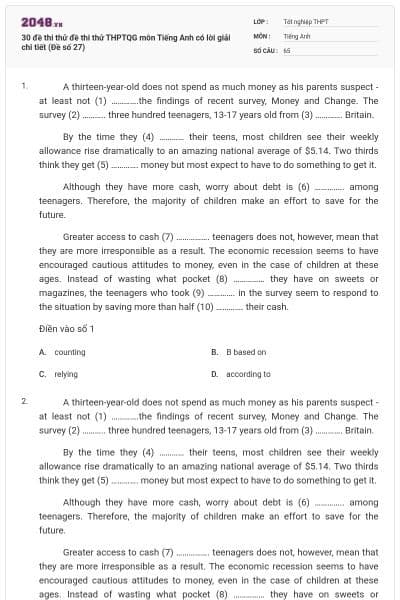
A thirteen-year-old does not spend as much money as his parents suspect - at least not (1) ………….the findings of recent survey, Money and Change. The survey (2) ……….. three hundred teenagers, 13-17 years old from (3) …………. Britain.
By the time they (4) ………… their teens, most children see their weekly allowance rise dramatically to an amazing national average of $5.14. Two thirds think they get (5) …………. money but most expect to have to do something to get it.
Although they have more cash, worry about debt is (6) ………….. among teenagers. Therefore, the majority of children make an effort to save for the future.
Greater access to cash (7) ……………. teenagers does not, however, mean that they are more irresponsible as a result. The economic recession seems to have encouraged cautious attitudes to money, even in the case of children at these ages. Instead of wasting what pocket (8) …………… they have on sweets or magazines, the teenagers who took (9) …………. in the survey seem to respond to the situation by saving more than half (10) …………. their cash.
Điền vào số 1
counting
B based on
relying
according to
Count to, Rely on -> Loại A, C, cần dùng theo thể chủ động nên loại B -> đáp án đúng nhất là D
A thirteen-year-old does not spend as much money as his parents suspect - at least not (1) ………….the findings of recent survey, Money and Change. The survey (2) ……….. three hundred teenagers, 13-17 years old from (3) …………. Britain.
By the time they (4) ………… their teens, most children see their weekly allowance rise dramatically to an amazing national average of $5.14. Two thirds think they get (5) …………. money but most expect to have to do something to get it.
Although they have more cash, worry about debt is (6) ………….. among teenagers. Therefore, the majority of children make an effort to save for the future.
Greater access to cash (7) ……………. teenagers does not, however, mean that they are more irresponsible as a result. The economic recession seems to have encouraged cautious attitudes to money, even in the case of children at these ages. Instead of wasting what pocket (8) …………… they have on sweets or magazines, the teenagers who took (9) …………. in the survey seem to respond to the situation by saving more than half (10) …………. their cash.
Điền vào số 2
included
contained
counted
enclosed
Nghĩa cần dùng là bao gồm. Lý do chọn include mà không chọn contain là vì include là gồm có nhiều thứ khác, còn contain thì chỉ gồm những thứ được kể ra trong câu.
Đáp án là A
A thirteen-year-old does not spend as much money as his parents suspect - at least not (1) ………….the findings of recent survey, Money and Change. The survey (2) ……….. three hundred teenagers, 13-17 years old from (3) …………. Britain.
By the time they (4) ………… their teens, most children see their weekly allowance rise dramatically to an amazing national average of $5.14. Two thirds think they get (5) …………. money but most expect to have to do something to get it.
Although they have more cash, worry about debt is (6) ………….. among teenagers. Therefore, the majority of children make an effort to save for the future.
Greater access to cash (7) ……………. teenagers does not, however, mean that they are more irresponsible as a result. The economic recession seems to have encouraged cautious attitudes to money, even in the case of children at these ages. Instead of wasting what pocket (8) …………… they have on sweets or magazines, the teenagers who took (9) …………. in the survey seem to respond to the situation by saving more than half (10) …………. their cash.
Điền vào số 3
entire
all over
complete
the whole
Nghĩa cần dùng: Toàn bộ. entire thì phải có the, nếu thư whole + Britain thì phải là the whole of Britain.
đáp án B
A thirteen-year-old does not spend as much money as his parents suspect - at least not (1) ………….the findings of recent survey, Money and Change. The survey (2) ……….. three hundred teenagers, 13-17 years old from (3) …………. Britain.
By the time they (4) ………… their teens, most children see their weekly allowance rise dramatically to an amazing national average of $5.14. Two thirds think they get (5) …………. money but most expect to have to do something to get it.
Although they have more cash, worry about debt is (6) ………….. among teenagers. Therefore, the majority of children make an effort to save for the future.
Greater access to cash (7) ……………. teenagers does not, however, mean that they are more irresponsible as a result. The economic recession seems to have encouraged cautious attitudes to money, even in the case of children at these ages. Instead of wasting what pocket (8) …………… they have on sweets or magazines, the teenagers who took (9) …………. in the survey seem to respond to the situation by saving more than half (10) …………. their cash.
Điền vào số 4
reach
get
make
arrive
Reach: Đạt tới một mức độ nào đó, trường hợp trong bài là đạt đến độ tuổi thiếu niên
Đáp án A
A thirteen-year-old does not spend as much money as his parents suspect - at least not (1) ………….the findings of recent survey, Money and Change. The survey (2) ……….. three hundred teenagers, 13-17 years old from (3) …………. Britain.
By the time they (4) ………… their teens, most children see their weekly allowance rise dramatically to an amazing national average of $5.14. Two thirds think they get (5) …………. money but most expect to have to do something to get it.
Although they have more cash, worry about debt is (6) ………….. among teenagers. Therefore, the majority of children make an effort to save for the future.
Greater access to cash (7) ……………. teenagers does not, however, mean that they are more irresponsible as a result. The economic recession seems to have encouraged cautious attitudes to money, even in the case of children at these ages. Instead of wasting what pocket (8) …………… they have on sweets or magazines, the teenagers who took (9) …………. in the survey seem to respond to the situation by saving more than half (10) …………. their cash.
Điền vào số 5
acceptable
adequate
satisfactory .
D enough
Enough + noun, nghĩa trong bài là có đủ tiền
Đáp án D
Fill in each numbered blank with one suitable word or phrase.
A thirteen-year-old does not spend as much money as his parents suspect - at least not (1) ………….the findings of recent survey, Money and Change. The survey (2) ……….. three hundred teenagers, 13-17 years old from (3) …………. Britain.
By the time they (4) ………… their teens, most children see their weekly allowance rise dramatically to an amazing national average of $5.14. Two thirds think they get (5) …………. money but most expect to have to do something to get it.
Although they have more cash, worry about debt is (6) ………….. among teenagers. Therefore, the majority of children make an effort to save for the future.
Greater access to cash (7) ……………. teenagers does not, however, mean that they are more irresponsible as a result. The economic recession seems to have encouraged cautious attitudes to money, even in the case of children at these ages. Instead of wasting what pocket (8) …………… they have on sweets or magazines, the teenagers who took (9) …………. in the survey seem to respond to the situation by saving more than half (10) …………. their cash.
Điền vào số 6
gaining
heightening
increasing
building
Nghĩa trong bài: tăng lên
Đáp án C
Fill in each numbered blank with one suitable word or phrase.
A thirteen-year-old does not spend as much money as his parents suspect - at least not (1) ………….the findings of recent survey, Money and Change. The survey (2) ……….. three hundred teenagers, 13-17 years old from (3) …………. Britain.
By the time they (4) ………… their teens, most children see their weekly allowance rise dramatically to an amazing national average of $5.14. Two thirds think they get (5) …………. money but most expect to have to do something to get it.
Although they have more cash, worry about debt is (6) ………….. among teenagers. Therefore, the majority of children make an effort to save for the future.
Greater access to cash (7) ……………. teenagers does not, however, mean that they are more irresponsible as a result. The economic recession seems to have encouraged cautious attitudes to money, even in the case of children at these ages. Instead of wasting what pocket (8) …………… they have on sweets or magazines, the teenagers who took (9) …………. in the survey seem to respond to the situation by saving more than half (10) …………. their cash.
Điền vào số 7
among
through
between
along
Nghĩa trong bài: Giữa một nhóm người => Chọn A among chứ không chọn between (giữa 2 vật)
Fill in each numbered blank with one suitable word or phrase.
A thirteen-year-old does not spend as much money as his parents suspect - at least not (1) ………….the findings of recent survey, Money and Change. The survey (2) ……….. three hundred teenagers, 13-17 years old from (3) …………. Britain.
By the time they (4) ………… their teens, most children see their weekly allowance rise dramatically to an amazing national average of $5.14. Two thirds think they get (5) …………. money but most expect to have to do something to get it.
Although they have more cash, worry about debt is (6) ………….. among teenagers. Therefore, the majority of children make an effort to save for the future.
Greater access to cash (7) ……………. teenagers does not, however, mean that they are more irresponsible as a result. The economic recession seems to have encouraged cautious attitudes to money, even in the case of children at these ages. Instead of wasting what pocket (8) …………… they have on sweets or magazines, the teenagers who took (9) …………. in the survey seem to respond to the situation by saving more than half (10) …………. their cash.
Điền vào số 8
cash
money
change
savings
Đáp án B
Pocket money: Tiền tiết kiệm.
Fill in each numbered blank with one suitable word or phrase.
A thirteen-year-old does not spend as much money as his parents suspect - at least not (1) ………….the findings of recent survey, Money and Change. The survey (2) ……….. three hundred teenagers, 13-17 years old from (3) …………. Britain.
By the time they (4) ………… their teens, most children see their weekly allowance rise dramatically to an amazing national average of $5.14. Two thirds think they get (5) …………. money but most expect to have to do something to get it.
Although they have more cash, worry about debt is (6) ………….. among teenagers. Therefore, the majority of children make an effort to save for the future.
Greater access to cash (7) ……………. teenagers does not, however, mean that they are more irresponsible as a result. The economic recession seems to have encouraged cautious attitudes to money, even in the case of children at these ages. Instead of wasting what pocket (8) …………… they have on sweets or magazines, the teenagers who took (9) …………. in the survey seem to respond to the situation by saving more than half (10) …………. their cash.
Điền vào số 9
part
place
share
piece
Take part in: Tham gia
Đáp án A
Fill in each numbered blank with one suitable word or phrase.
A thirteen-year-old does not spend as much money as his parents suspect - at least not (1) ………….the findings of recent survey, Money and Change. The survey (2) ……….. three hundred teenagers, 13-17 years old from (3) …………. Britain.
By the time they (4) ………… their teens, most children see their weekly allowance rise dramatically to an amazing national average of $5.14. Two thirds think they get (5) …………. money but most expect to have to do something to get it.
Although they have more cash, worry about debt is (6) ………….. among teenagers. Therefore, the majority of children make an effort to save for the future.
Greater access to cash (7) ……………. teenagers does not, however, mean that they are more irresponsible as a result. The economic recession seems to have encouraged cautious attitudes to money, even in the case of children at these ages. Instead of wasting what pocket (8) …………… they have on sweets or magazines, the teenagers who took (9) …………. in the survey seem to respond to the situation by saving more than half (10) …………. their cash.
Điền vào số 10
from
as
of
for
Half of: Một nửa.
Đáp án C
It was suggested that he studies the material more thoroughly before attempting to pass the exam.
was suggested
studies
more thoroughly
attempting
Đáp án B
Sửa thành should study
People say that during World War II, many women take over the business for their absent husbands
People
during
take over
for
Đáp án C
ð Sửa thành took over
She shouted at him, "Go away, I don't want to see you no longer."
shouted at
Go away
want to see
no longer
Đáp án D
=> Sửa thành any more.
As soon as we’ve finished supper, we’ll all go to downtown to see our friends.
we've
supper
we'll all
to
Sửa: Bỏ “to”. Go downtown nghĩa là đi xuống 1 nơi nào đó (thị trấn, phố huyện…)
Đáp án D
The 6 - year - old boy resembles to his mother some what more than does his older brother.
6 - year - old
to
some what
does
=>Sửa: Bỏ “to”. Resemble + noun không cần giới từ.
Đáp án B
Read the passage and choose the best answer.
A pilot cannot fly by sight alone. In many conditions, such as flying at night and landing in dense fog, a pilot must use radar, an alternative way of navigating. Since human eyes are not very good at determining speeds of approaching objects, radar can show a pilot how fast nearby planes are moving. The basic principle of radar is exemplified by what happens when one shouts in a cave. The echo of the sounds against the walls helps a person determine the size of the cave. With radar, however, the waves are radio waves instead of sound waves. Radio waves travel at the speed of light, about 300,000 kilometers in one second. A radar set sends out a short burst of radio waves. Then it receives the echoes produced when the waves bounce off objects. By determining the time it takes for the echoes to return to the radar set, a trained technician can determine the distance between the radar set and other objects. The word “radar”, in fact, gets its name from the term “radio detection and ranging”. “Ranging” is the term for detection of the distance between an object and the radar set. Besides being of critical importance to pilots, radar is essential for air traffic control, tracking ships at sea, and for tracking weather systems and storms.
What is the main topic of this passage?
The nature of radar.
History of radar.
Alternatives to radar.
Types of ranging.
Giải thích: Đoạn văn có nội dung nói về bản chất của hệ thống radar
Đáp án A
Read the passage and choose the best answer.
A pilot cannot fly by sight alone. In many conditions, such as flying at night and landing in dense fog, a pilot must use radar, an alternative way of navigating. Since human eyes are not very good at determining speeds of approaching objects, radar can show a pilot how fast nearby planes are moving. The basic principle of radar is exemplified by what happens when one shouts in a cave. The echo of the sounds against the walls helps a person determine the size of the cave. With radar, however, the waves are radio waves instead of sound waves. Radio waves travel at the speed of light, about 300,000 kilometers in one second. A radar set sends out a short burst of radio waves. Then it receives the echoes produced when the waves bounce off objects. By determining the time it takes for the echoes to return to the radar set, a trained technician can determine the distance between the radar set and other objects. The word “radar”, in fact, gets its name from the term “radio detection and ranging”. “Ranging” is the term for detection of the distance between an object and the radar set. Besides being of critical importance to pilots, radar is essential for air traffic control, tracking ships at sea, and for tracking weather systems and storms.
According to the passage, what can radar detect besides location of objects?
Shape.
Size.
Speed.
Weight.
Giải thích: Dựa vào “Since human eyes are not very good at determining speeds of approaching objects, radar can show a pilot how fast nearby planes are moving.”
Đáp án C
Read the passage and choose the best answer.
A pilot cannot fly by sight alone. In many conditions, such as flying at night and landing in dense fog, a pilot must use radar, an alternative way of navigating. Since human eyes are not very good at determining speeds of approaching objects, radar can show a pilot how fast nearby planes are moving. The basic principle of radar is exemplified by what happens when one shouts in a cave. The echo of the sounds against the walls helps a person determine the size of the cave. With radar, however, the waves are radio waves instead of sound waves. Radio waves travel at the speed of light, about 300,000 kilometers in one second. A radar set sends out a short burst of radio waves. Then it receives the echoes produced when the waves bounce off objects. By determining the time it takes for the echoes to return to the radar set, a trained technician can determine the distance between the radar set and other objects. The word “radar”, in fact, gets its name from the term “radio detection and ranging”. “Ranging” is the term for detection of the distance between an object and the radar set. Besides being of critical importance to pilots, radar is essential for air traffic control, tracking ships at sea, and for tracking weather systems and storms.
The word “exemplified” in the passage can be replaced by _______.
“specified”
“resembled”
“illustrated”
“justified”
Giải thích: exemplify = illustrate: Lấy ví dụ cho cái gì
Đáp án C
Read the passage and choose the best answer.
A pilot cannot fly by sight alone. In many conditions, such as flying at night and landing in dense fog, a pilot must use radar, an alternative way of navigating. Since human eyes are not very good at determining speeds of approaching objects, radar can show a pilot how fast nearby planes are moving. The basic principle of radar is exemplified by what happens when one shouts in a cave. The echo of the sounds against the walls helps a person determine the size of the cave. With radar, however, the waves are radio waves instead of sound waves. Radio waves travel at the speed of light, about 300,000 kilometers in one second. A radar set sends out a short burst of radio waves. Then it receives the echoes produced when the waves bounce off objects. By determining the time it takes for the echoes to return to the radar set, a trained technician can determine the distance between the radar set and other objects. The word “radar”, in fact, gets its name from the term “radio detection and ranging”. “Ranging” is the term for detection of the distance between an object and the radar set. Besides being of critical importance to pilots, radar is essential for air traffic control, tracking ships at sea, and for tracking weather systems and storms.
The word “shouts” in the passage most closely means _______.
“exclaims”
“yells”
“shoots”
“whispers”
Giải thích: Shout = Yell: La hét
Đáp án B
Read the passage and choose the best answer.
A pilot cannot fly by sight alone. In many conditions, such as flying at night and landing in dense fog, a pilot must use radar, an alternative way of navigating. Since human eyes are not very good at determining speeds of approaching objects, radar can show a pilot how fast nearby planes are moving. The basic principle of radar is exemplified by what happens when one shouts in a cave. The echo of the sounds against the walls helps a person determine the size of the cave. With radar, however, the waves are radio waves instead of sound waves. Radio waves travel at the speed of light, about 300,000 kilometers in one second. A radar set sends out a short burst of radio waves. Then it receives the echoes produced when the waves bounce off objects. By determining the time it takes for the echoes to return to the radar set, a trained technician can determine the distance between the radar set and other objects. The word “radar”, in fact, gets its name from the term “radio detection and ranging”. “Ranging” is the term for detection of the distance between an object and the radar set. Besides being of critical importance to pilots, radar is essential for air traffic control, tracking ships at sea, and for tracking weather systems and storms.
Which of the following words best describes the tone of this passage?
argumentative
explanatory
humorous
imaginative
Đoạn văn được viết như để giải thích cho người đọc về bản chất của radar, vậy nên có tính chất giảng giải, giải thích cho vấn đề => Explanatory
Đáp án B
Read the passage and choose the best answer.
A pilot cannot fly by sight alone. In many conditions, such as flying at night and landing in dense fog, a pilot must use radar, an alternative way of navigating. Since human eyes are not very good at determining speeds of approaching objects, radar can show a pilot how fast nearby planes are moving. The basic principle of radar is exemplified by what happens when one shouts in a cave. The echo of the sounds against the walls helps a person determine the size of the cave. With radar, however, the waves are radio waves instead of sound waves. Radio waves travel at the speed of light, about 300,000 kilometers in one second. A radar set sends out a short burst of radio waves. Then it receives the echoes produced when the waves bounce off objects. By determining the time it takes for the echoes to return to the radar set, a trained technician can determine the distance between the radar set and other objects. The word “radar”, in fact, gets its name from the term “radio detection and ranging”. “Ranging” is the term for detection of the distance between an object and the radar set. Besides being of critical importance to pilots, radar is essential for air traffic control, tracking ships at sea, and for tracking weather systems and storms.
According to the passage, the distance between a radar set and an object can be determined by _______.
the time it takes for a burst of radio waves to produce echoes when the waves bounce off the object
the term “ranging” used for detection of the distance between an object and the radar set
the time it takes for the radio waves to produce echoes and bounce off the object
the time it takes for the echoes produced by the radio waves to return to the radar set
Giải thích: Dựa vào “The echo of the sounds against the walls helps a person determine the size of the cave.”
Đáp án D
Read the passage and choose the best answer.
A pilot cannot fly by sight alone. In many conditions, such as flying at night and landing in dense fog, a pilot must use radar, an alternative way of navigating. Since human eyes are not very good at determining speeds of approaching objects, radar can show a pilot how fast nearby planes are moving. The basic principle of radar is exemplified by what happens when one shouts in a cave. The echo of the sounds against the walls helps a person determine the size of the cave. With radar, however, the waves are radio waves instead of sound waves. Radio waves travel at the speed of light, about 300,000 kilometers in one second. A radar set sends out a short burst of radio waves. Then it receives the echoes produced when the waves bounce off objects. By determining the time it takes for the echoes to return to the radar set, a trained technician can determine the distance between the radar set and other objects. The word “radar”, in fact, gets its name from the term “radio detection and ranging”. “Ranging” is the term for detection of the distance between an object and the radar set. Besides being of critical importance to pilots, radar is essential for air traffic control, tracking ships at sea, and for tracking weather systems and storms.
Which type of waves does radar use?
tidal
sound
heat
radio
Dựa vào “With radar, however, the waves are radio waves instead of sound waves.”
Đáp án D
Read the passage and choose the best answer.
A pilot cannot fly by sight alone. In many conditions, such as flying at night and landing in dense fog, a pilot must use radar, an alternative way of navigating. Since human eyes are not very good at determining speeds of approaching objects, radar can show a pilot how fast nearby planes are moving. The basic principle of radar is exemplified by what happens when one shouts in a cave. The echo of the sounds against the walls helps a person determine the size of the cave. With radar, however, the waves are radio waves instead of sound waves. Radio waves travel at the speed of light, about 300,000 kilometers in one second. A radar set sends out a short burst of radio waves. Then it receives the echoes produced when the waves bounce off objects. By determining the time it takes for the echoes to return to the radar set, a trained technician can determine the distance between the radar set and other objects. The word “radar”, in fact, gets its name from the term “radio detection and ranging”. “Ranging” is the term for detection of the distance between an object and the radar set. Besides being of critical importance to pilots, radar is essential for air traffic control, tracking ships at sea, and for tracking weather systems and storms.
The word “tracking” in the passage most closely means _______.
sending
searching for
ranging
repairing
Giải thích: Track = Search: Tìm kiếm, dò tìm
Đáp án B
Read the passage and choose the best answer.
A pilot cannot fly by sight alone. In many conditions, such as flying at night and landing in dense fog, a pilot must use radar, an alternative way of navigating. Since human eyes are not very good at determining speeds of approaching objects, radar can show a pilot how fast nearby planes are moving. The basic principle of radar is exemplified by what happens when one shouts in a cave. The echo of the sounds against the walls helps a person determine the size of the cave. With radar, however, the waves are radio waves instead of sound waves. Radio waves travel at the speed of light, about 300,000 kilometers in one second. A radar set sends out a short burst of radio waves. Then it receives the echoes produced when the waves bounce off objects. By determining the time it takes for the echoes to return to the radar set, a trained technician can determine the distance between the radar set and other objects. The word “radar”, in fact, gets its name from the term “radio detection and ranging”. “Ranging” is the term for detection of the distance between an object and the radar set. Besides being of critical importance to pilots, radar is essential for air traffic control, tracking ships at sea, and for tracking weather systems and storms.
Which of the following would most likely be the topic of the next paragraph?
A history of flying.
Other uses of radar.
The technology used by pilots.
Uses of some technology.
Giải thích: Sauk hi giải thích về bản chất của radar thì hẳn nhiên phần sau (nếu có) của bài viết sẽ nói tiếp về radar, đặc biệt là các công dụng của nó.
Đáp án B
Read the passage and choose the best answer.
A pilot cannot fly by sight alone. In many conditions, such as flying at night and landing in dense fog, a pilot must use radar, an alternative way of navigating. Since human eyes are not very good at determining speeds of approaching objects, radar can show a pilot how fast nearby planes are moving. The basic principle of radar is exemplified by what happens when one shouts in a cave. The echo of the sounds against the walls helps a person determine the size of the cave. With radar, however, the waves are radio waves instead of sound waves. Radio waves travel at the speed of light, about 300,000 kilometers in one second. A radar set sends out a short burst of radio waves. Then it receives the echoes produced when the waves bounce off objects. By determining the time it takes for the echoes to return to the radar set, a trained technician can determine the distance between the radar set and other objects. The word “radar”, in fact, gets its name from the term “radio detection and ranging”. “Ranging” is the term for detection of the distance between an object and the radar set. Besides being of critical importance to pilots, radar is essential for air traffic control, tracking ships at sea, and for tracking weather systems and storms.
What might be inferred about radar?
It takes the place of a radio.
It has improved navigational safety.
It was developed from a study of sound waves.
It gave birth to the invention of the airplane.
Dựa vào “Besides being of critical importance to pilots, radar is essential for air traffic control, tracking ships at sea, and for tracking weather systems and storms.”
Đáp án B
PHONETICS
. A. myth
breath
tooth
with
Đáp án C
Đáp án: âm /ð/, các đáp án còn lại âm /θ/
PHONETICS
biscuits
magazines
newspapers
vegetables
Đáp án A phát âm là /s/, các câu còn lại phát âm là /z/
PHONETICS
packed
punched
pleased
pushed
Đáp án C phát âm là /d/, các câu còn lại phát âm là /t/
STRESS
assistant
holiday
colony
possible
Đáp án A nhấn âm 2, các câu còn lại nhấn âm 1
STRESS
faithfully
sincerely
completely
extremely
Đáp án A nhấn âm 1, các câu còn lại nhấn âm 2
Read the passage, then choose the best answer by circling the letter A, B, C or D ( 15p ):
In the very distant geological past, all animals were aquatic. The very first vertebrates or animals with backbones, of which we have any fossil record, lived in water. These vertebrates, the fish, were adapted to underwater living. Their streamlined bodies were covered with scales to reduce surface friction: they had muscular tails so that they could swim swiftly in such a dense medium as water; and they were endowed with gills for breathing underwater.
Descendants of fish-type ancestors crossed the seashore barrier and accommodated themselves to life on land.
As amphibians, they possessed limbs instead of fins and lungs instead of gills. But they never became completely free of the bonds that tied them to the water; even today many amphibians return to the water to lay their eggs.
Millions of years after the first clumsy amphibians crawled over the land, newer types of land dwellers appeared, these animals give rise to the present-day reptiles and mammals. They were completely converted for land dwelling, with bodies and biological activities far different from those of fish. With these special adaptations, mammals have been able to colonize the woods and meadows, the deserts and high mountains, often far removed from the sea.
Of the animals with backbones, the first to appear were………………
Mammals
Birds
amphibians
Fish
Giải thích: Dựa vào đoạn “The very first vertebrates or animals with backbones, of which we have any fossil record, lived in water. These vertebrates, the fish, were adapted to underwater living.”
Đáp án B
Read the passage, then choose the best answer by circling the letter A, B, C or D ( 15p ):
In the very distant geological past, all animals were aquatic. The very first vertebrates or animals with backbones, of which we have any fossil record, lived in water. These vertebrates, the fish, were adapted to underwater living. Their streamlined bodies were covered with scales to reduce surface friction: they had muscular tails so that they could swim swiftly in such a dense medium as water; and they were endowed with gills for breathing underwater.
Descendants of fish-type ancestors crossed the seashore barrier and accommodated themselves to life on land.
As amphibians, they possessed limbs instead of fins and lungs instead of gills. But they never became completely free of the bonds that tied them to the water; even today many amphibians return to the water to lay their eggs.
Millions of years after the first clumsy amphibians crawled over the land, newer types of land dwellers appeared, these animals give rise to the present-day reptiles and mammals. They were completely converted for land dwelling, with bodies and biological activities far different from those of fish. With these special adaptations, mammals have been able to colonize the woods and meadows, the deserts and high mountains, often far removed from the sea.
Fish are suited to underwater life because of their……………………
scales
Gills
Streamline shapes
All are correct
Giải thích: Dựa vào đoạn “Their streamlined bodies were covered with scales to reduce surface friction: they had muscular tails so that they could swim swiftly in such a dense medium as water; and they were endowed with gills for breathing underwater.”
Đáp án D
Read the passage, then choose the best answer by circling the letter A, B, C or D ( 15p ):
In the very distant geological past, all animals were aquatic. The very first vertebrates or animals with backbones, of which we have any fossil record, lived in water. These vertebrates, the fish, were adapted to underwater living. Their streamlined bodies were covered with scales to reduce surface friction: they had muscular tails so that they could swim swiftly in such a dense medium as water; and they were endowed with gills for breathing underwater.
Descendants of fish-type ancestors crossed the seashore barrier and accommodated themselves to life on land.
As amphibians, they possessed limbs instead of fins and lungs instead of gills. But they never became completely free of the bonds that tied them to the water; even today many amphibians return to the water to lay their eggs.
Millions of years after the first clumsy amphibians crawled over the land, newer types of land dwellers appeared, these animals give rise to the present-day reptiles and mammals. They were completely converted for land dwelling, with bodies and biological activities far different from those of fish. With these special adaptations, mammals have been able to colonize the woods and meadows, the deserts and high mountains, often far removed from the sea.
In converting to land life, animals acquired…………..
eyes
Warm blood
tails
Lungs
Giải thích: Dựa vào đoạn “Millions of years after the first clumsy amphibians crawled over the land, newer types of land dwellers appeared, these animals give rise to the present-day reptiles and mammals. They were completely converted for land dwelling, with bodies and biological activities far different from those of fish. “
Đáp án B
Read the passage, then choose the best answer by circling the letter A, B, C or D ( 15p ):
In the very distant geological past, all animals were aquatic. The very first vertebrates or animals with backbones, of which we have any fossil record, lived in water. These vertebrates, the fish, were adapted to underwater living. Their streamlined bodies were covered with scales to reduce surface friction: they had muscular tails so that they could swim swiftly in such a dense medium as water; and they were endowed with gills for breathing underwater.
Descendants of fish-type ancestors crossed the seashore barrier and accommodated themselves to life on land.
As amphibians, they possessed limbs instead of fins and lungs instead of gills. But they never became completely free of the bonds that tied them to the water; even today many amphibians return to the water to lay their eggs.
Millions of years after the first clumsy amphibians crawled over the land, newer types of land dwellers appeared, these animals give rise to the present-day reptiles and mammals. They were completely converted for land dwelling, with bodies and biological activities far different from those of fish. With these special adaptations, mammals have been able to colonize the woods and meadows, the deserts and high mountains, often far removed from the sea.
The word "descendants" is closest in meaning to…………..
descenders
Grand children
Offspring
Ancestors
Giải thích: Descendant = grand child nghĩa là con cháu, đời sau
Đáp án B
Read the passage, then choose the best answer by circling the letter A, B, C or D ( 15p ):
In the very distant geological past, all animals were aquatic. The very first vertebrates or animals with backbones, of which we have any fossil record, lived in water. These vertebrates, the fish, were adapted to underwater living. Their streamlined bodies were covered with scales to reduce surface friction: they had muscular tails so that they could swim swiftly in such a dense medium as water; and they were endowed with gills for breathing underwater.
Descendants of fish-type ancestors crossed the seashore barrier and accommodated themselves to life on land.
As amphibians, they possessed limbs instead of fins and lungs instead of gills. But they never became completely free of the bonds that tied them to the water; even today many amphibians return to the water to lay their eggs.
Millions of years after the first clumsy amphibians crawled over the land, newer types of land dwellers appeared, these animals give rise to the present-day reptiles and mammals. They were completely converted for land dwelling, with bodies and biological activities far different from those of fish. With these special adaptations, mammals have been able to colonize the woods and meadows, the deserts and high mountains, often far removed from the sea.
The passage suggests that the first amphibians used their limbs to…………..
jump
Crawl
swim
run
Giải thích: Dựa vào ý “Millions of years after the first clumsy amphibians crawled over the land “
Đáp án B
Read the passage, then choose the best answer by circling the letter A, B, C or D ( 15p ):
In the very distant geological past, all animals were aquatic. The very first vertebrates or animals with backbones, of which we have any fossil record, lived in water. These vertebrates, the fish, were adapted to underwater living. Their streamlined bodies were covered with scales to reduce surface friction: they had muscular tails so that they could swim swiftly in such a dense medium as water; and they were endowed with gills for breathing underwater.
Descendants of fish-type ancestors crossed the seashore barrier and accommodated themselves to life on land.
As amphibians, they possessed limbs instead of fins and lungs instead of gills. But they never became completely free of the bonds that tied them to the water; even today many amphibians return to the water to lay their eggs.
Millions of years after the first clumsy amphibians crawled over the land, newer types of land dwellers appeared, these animals give rise to the present-day reptiles and mammals. They were completely converted for land dwelling, with bodies and biological activities far different from those of fish. With these special adaptations, mammals have been able to colonize the woods and meadows, the deserts and high mountains, often far removed from the sea.
An example of an amphibian's incomplete adaptation to land life is……………………..
Need to keep its skin wet
Scales-covered skin
Return to water to lay eggs
Inability to breathe air
Giải thích: Dựa vào “As amphibians, they possessed limbs instead of fins and lungs instead of gills. But they never became completely free of the bonds that tied them to the water; even today many amphibians return to the water to lay their eggs.”
Đáp án A
Read the passage, then choose the best answer by circling the letter A, B, C or D ( 15p ):
In the very distant geological past, all animals were aquatic. The very first vertebrates or animals with backbones, of which we have any fossil record, lived in water. These vertebrates, the fish, were adapted to underwater living. Their streamlined bodies were covered with scales to reduce surface friction: they had muscular tails so that they could swim swiftly in such a dense medium as water; and they were endowed with gills for breathing underwater.
Descendants of fish-type ancestors crossed the seashore barrier and accommodated themselves to life on land.
As amphibians, they possessed limbs instead of fins and lungs instead of gills. But they never became completely free of the bonds that tied them to the water; even today many amphibians return to the water to lay their eggs.
Millions of years after the first clumsy amphibians crawled over the land, newer types of land dwellers appeared, these animals give rise to the present-day reptiles and mammals. They were completely converted for land dwelling, with bodies and biological activities far different from those of fish. With these special adaptations, mammals have been able to colonize the woods and meadows, the deserts and high mountains, often far removed from the sea.
Animals found desert living possible only…………………….
When they became amphibious
When they were fully adapted to land
After they could walk on two feet
If they migrated to sea periodically
Giải thích: Dựa vào “But they never became completely free of the bonds that tied them to the water; even today many amphibians return to the water to lay their eggs.”
Đáp án C
Read the passage, then choose the best answer by circling the letter A, B, C or D ( 15p ):
In the very distant geological past, all animals were aquatic. The very first vertebrates or animals with backbones, of which we have any fossil record, lived in water. These vertebrates, the fish, were adapted to underwater living. Their streamlined bodies were covered with scales to reduce surface friction: they had muscular tails so that they could swim swiftly in such a dense medium as water; and they were endowed with gills for breathing underwater.
Descendants of fish-type ancestors crossed the seashore barrier and accommodated themselves to life on land.
As amphibians, they possessed limbs instead of fins and lungs instead of gills. But they never became completely free of the bonds that tied them to the water; even today many amphibians return to the water to lay their eggs.
Millions of years after the first clumsy amphibians crawled over the land, newer types of land dwellers appeared, these animals give rise to the present-day reptiles and mammals. They were completely converted for land dwelling, with bodies and biological activities far different from those of fish. With these special adaptations, mammals have been able to colonize the woods and meadows, the deserts and high mountains, often far removed from the sea.
The seashore was a barrier for descendants of fish-type because …………………
Crossing it required bodily changes
The land once rose much higher above the sea
Every attempt to cross it ended in death
Once they crossed, there was no return Reptiles and mammals Amphibians
Dựa vào đoạn “Millions of years after the first clumsy amphibians crawled over the land, newer types of land dwellers appeared, these animals give rise to the present-day reptiles and mammals. They were completely converted for land dwelling, with bodies and biological activities far different from those of fish.”
Đáp án C
Read the passage, then choose the best answer by circling the letter A, B, C or D ( 15p ):
In the very distant geological past, all animals were aquatic. The very first vertebrates or animals with backbones, of which we have any fossil record, lived in water. These vertebrates, the fish, were adapted to underwater living. Their streamlined bodies were covered with scales to reduce surface friction: they had muscular tails so that they could swim swiftly in such a dense medium as water; and they were endowed with gills for breathing underwater.
Descendants of fish-type ancestors crossed the seashore barrier and accommodated themselves to life on land.
As amphibians, they possessed limbs instead of fins and lungs instead of gills. But they never became completely free of the bonds that tied them to the water; even today many amphibians return to the water to lay their eggs.
Millions of years after the first clumsy amphibians crawled over the land, newer types of land dwellers appeared, these animals give rise to the present-day reptiles and mammals. They were completely converted for land dwelling, with bodies and biological activities far different from those of fish. With these special adaptations, mammals have been able to colonize the woods and meadows, the deserts and high mountains, often far removed from the sea.
The adaptation process described in the article was completed……………….
Over millions of years
Through biological changes
By the receding of the sea
A and B
Giải thích: Đại ý của bài cho ta biết đây là quá trình diễn ra hàng triệu năm và bắt nguồn từ những sinh vật biển => Đáp án D.
We love HANOI, ___________ in the spring.
mostly
most
especially
specially
Giải thích: Especially: Đặc biệt là (trạng từ)
Đáp án C
Are you looking for anything in ___________ ?
special
detail
peculiar
particular
Giải thích: in particular: nói riêng, đặc biệt, riêng biệt
Đáp án D
Dress ___________ when you go for an interview. Don’t wear your Jeans.
nice
nicely
smart
newly
Giải thích: nicely: Lịch thiệp, đẹp… (trạng từ)
Đáp án B
Mexico is the most popular vacation ___________ for people from The United States.
target
connection
departure
destination
Giải thích: Destination: Điểm đến (điểm du lịch)
Đáp án D
To the best of my ___________ , he married an Irish girl
retention
recall
memory
recollection
Giải thích: Recolection: Hồi ức, ký ức, trí nhớ
Đáp án D
Every Sunday we ___________ go walking in the park.
seldom
usually
rarely
never
Giải thích: Hàng ngày thì không thể dùng seldom, rarely, never được (nghĩa phủ định) -> Đáp án B
I feel terrible, I didn’t sleep ___________ last night.
an eye
a wink
a jot
an inch
Giải thích: Sleep a wink: Chợp mắt, ngủ chỉ trong chốc lát.
Đáp án B
Not until 1856 ___________ across the Mississippi River
the first bridge was built
was the first bridge built
the first building a bridge
the bridge building was
Giải thích: Cấu trúc not until thì phải đảo ngữ
Đáp án B
The cost of living has ___________ over 10 percent in the past years.
raised
raise
risen
rising
Giải thích: in the past few years -> Dấu hiệu của thì HTHT
Đáp án C
Now men and women remain single longer than they once ___________
do
did
doing
were done
Giải thích: Did thay cho cụm Remain single ở thì quá khứ.
Đáp án B
When it began to rain, they ___________ in the yard
played
were playing
have played
had played
Đáp án B
Dùng thì quá khứ tiếp diễn vì một hành động quá khứ chen vào 1 hành động đang xảy ra trong quá khứ
Dịch nghĩa: Khi trời bắt đầu mưa, họ đang chơi ở sân.
Why did Berth ask you ___________ a bicycle ?
that if you had
do you have
that you had
if you had
Giải thích: Cấu trúc câu gián tiếp
Đáp án D
Come with me. I’m seeing “ The killer” tomorrow. ___________
Are you?
Do you?
Will you?
Shall you?
Giải thích: Cấu trúc câu láy đuôi mang ý nghĩa mệnh lệnh, nhờ vả, sai khiến, mong muốn người khác chấp nhận yêu cầu được đưa ra
Giải thích: Cấu trúc too adj to V(inf): Quá…đến nỗi không thể
Đáp án C
All night long people dance and sing. They do it ___________
during the whole night
in all the night
the night long
in the night
Giải thích: nghĩa của câu: Suốt cả đêm => During the whole night
Đáp án A
After he ___________ work, he went straight home
had finished
had been finishing
has finished
would finish
Đáp án: A
Giải thích:
Kiến thức: Sự kết hợp thì
Trong quá khứ, nếu có hai hành động phân biệt nhau thứ tự xảy ra trước sau, hành động xảy ra trước chia quá khứ hoàn thành, hành động xảy ra sau chia quá khứ đơn.
Cấu trúc thì quá khứ hoàn thành: had VpII
Chọn A.
Dịch: Sau khi hoàn thành công việc, anh ấy đi thẳng về nhà.
What did you think of the book ?___________ the books I’ve read. It was the most interesting
From all
All
All of
Of all
Giải thích: Of all: Trong số tất cả
Đáp án D
I can’t see the stage very well from here. “___________”
Neither can’t I
Neither I can
I can’t neither
Neither can I
Giải thích: Đồng tình phủ định => neither can I
Đáp án D
I applied for the job that I saw ___________ in the paper
advertising
advertised
be advertised
being advertising
Giải thích: See + V(inf) hoặc See + V-ing. Trong câu này động từ cần được chia ở dạng bị động -> Đáp án C
I haven’t been feeling very well ________.
of late
not long ago
currently
by now
Giải thích: Dấu hiệu của thì HTHT, đứng ở cuối câu.
Đáp án A
Mark the letter A, B, C, or D on your answer sheet to indicate the word (s) CLOSET in meaning to the underlined word(s) in each of the following questions:
I cannot understand why she did that, it really doesn't add up.
doesn't calculate
isn't mathematics
doesn't make sense
makes the wrong addition
Giải thích: Add up = Doesn’t make sense: Không có nghĩa
Đáp án A
All the students got high marks in the test but Mary stood out.
got a lot of marks
got higher marks than someone
got very good marks
got the most marks of all
Giải thích: Stand out: nổi bật = Get the most marks of all: Đạt điểm tốt nhất.
Đáp án D
I cannot understand why she did that, it really doesn't add up.
doesn't calculate
isn't mathematics
doesn't make sense
makes the wrong addition
Giải thích: Add up = Doesn’t make sense: Không có nghĩa
Đáp án C
All the students got high marks in the test but Mary stood out.
got a lot of marks
got higher marks than someone
got very good marks
got the most marks of all
Giải thích: Stand out: nổi bật = Get the most marks of all: Đạt điểm tốt nhất.
Đáp án D
He has sold his house and has no job and so now he has next to nothing
he is unemployed
he has almost no money
he has a few things
he has nothing at all
Giải thích: have next to nothing = Have no money: khoong có tiền
Đáp án B
As a newspaper reporter she always wanted to get information at first hand.
Quickly
slowly
easily
directly
Giải thích: At first hand = Directly: ngay lập tức
Đáp án D
I think we can safely say now that we have got our money back, we are home and dry.
A have not got wet
have got no water
have been successful
have got home dry
Giải thích: Home and dry là thành ngữ, nghĩa là thành công – be successful
Đáp án C