30 đề thi thử đề thi thử THPTQG môn Tiếng Anh có lời giải chi tiết (Đề số 22)
80 câu hỏi
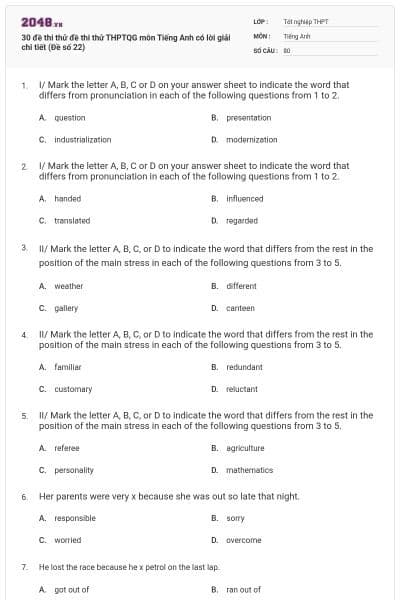
I/ Mark the letter A, B, C or D on your answer sheet to indicate the word that differs from pronunciation in each of the following questions from 1 to 2.
question
presentation
industrialization
modernization
Đáp án là A. Từ question có phần gạch chân được phát âm là /t∫ən /, các từ còn lại có phần gạch chân được phát âm là /∫ən/
I/ Mark the letter A, B, C or D on your answer sheet to indicate the word that differs from pronunciation in each of the following questions from 1 to 2.
handed
influenced
translated
regarded
Đáp án là B. Theo quy tắc đọc đuôi -ed, từ influenced có phần gạch chân được phát âm là /t/, các từ còn lại có phần gạch chân được phát âm là /id/
II/
II/ Mark the letter A, B, C, or D to indicate the word that differs from the rest in the position of the main stress in each of the following questions from 3 to 5.
weather
different
gallery
canteen
Đáp án là D. Từ canteen nhấn trọng âm vào âm tiết thứ hai, các từ còn lại nhấn âm thứ nhất.
II/ Mark the letter A, B, C, or D to indicate the word that differs from the rest in the position of the main stress in each of the following questions from 3 to 5.
familiar
redundant
customary
reluctant
Đáp án là C. Từ customary nhấn trọng âm vào âm tiết thứ nhất, các từ còn lại nhấn âm thứ hai.
II/ Mark the letter A, B, C, or D to indicate the word that differs from the rest in the position of the main stress in each of the following questions from 3 to 5.
referee
agriculture
personality
mathematics
Đáp án là B. Từ agriculture nhấn trọng âm vào âm tiết thứ nhất, các từ còn lại nhấn âm thứ ba.
Her parents were very x because she was out so late that night.
responsible
sorry
worried
overcome
Đáp án là C. worried.lo lắng.
Nghĩa câu: Bố mẹ cô ấy đã rất lo lắng, bởi vì cô ấy ra ngoài quá muộn vào đêm nay.
Nghĩa các từ còn lại: responsible: trách nhiệm; sorry: xin lỗi; overcome: vượt qua
He lost the race because he x petrol on the last lap.
got out of
ran out of
made out of
put out of
Đáp án: B
Giải thích:
Kiến thức: Cụm động từ
A. got out of: né tránh (trách nhiệm)
B. ran out of: hết, cạn kiệt
C. made out of: làm từ
D. put something out: vứt đi
Dựa vào nghĩa, chọn B.
Dịch: Anh ấy thua cuộc đua vì hết xăng ở vòng đua cuối cùng.
“Let’s go to Riverton this weekend.” - “Sounds like fun. x from here?”
How far is
How far it is
It how far is
How far is it
Đáp án là D. Đây là câu hỏi nên trật tự sẽ là: Wh - + be + S ....?
What a busy day it's been, x ?
wasn't it
hasn't it
isn't it
doesn't it
Đáp án là B. Câu này là câu hỏi láy đuôi, vế trước chia thì hiện tại hoàn thành “ it has been ..” => phần láy đuôi phải là “hasn’t it”
Apart from its convenience, one of the biggest x of public transport is its
unreliability.
dislikes
disadvantages
disorders
disappointments
Đáp án là B. disadvantages: những mặt hạn chế
Nghĩa các từ còn lại: dislike: sự không ưa; disorder: sự mất trật tự; disappointment: sự chán ngán, thất vọng
-“Don’t fail to send your parents my regards.” -“ x
You’re welcome
Good idea, thanks
Thanks, I will
It’s my pleasure
Đáp án: C
Giải thích:
Kiến thức: Tình huống giao tiếp
Don’t fail to send your parents my regards - Đừng quên gửi lời hỏi thăm của tớ đến bố mẹ cậu.
Đáp án là C. Thanks, I will - Cảm ơn. Tớ sẽ gửi lời.
Các câu khác không hợp ngữ cảnh:
A. You’re welcome – Không có gì. - Câu này thường dùng để đáp lại lời cảm ơn của ai đó.
B. Good idea, thanks - Ý kiến hay, cảm ơn. - Thường đáp lại lời đề nghị , gợi ý.
C. It’s my pleasure. - Rất hân hạnh cho tôi - Cũng dùng để đáp lại lời đề nghị, nhờ vả.
I am considering x my job. Can you recommend a good company?
to move
moving
to change
changing
consider + V-ing: cân nhắc làm việc gì => A và C loại.
Trong trường hợp này ta chọn đáp án D. “Tôi đang cân nhắc đổi việc. Bạn có thể gợi ý một công ty tốt không?”
That pipe x for ages. We must get it mended.
has been leaking
is leaking
had been leaking
leaks
Đáp án: A
Giải thích:
Kiến thức: Thì của động từ
Dấu hiệu nhận biết thì hiện tại hoàn thành/hoàn thành tiếp diễn:
for + khoảng thời gian: đã được bao lâu
Dựa vào nghĩa cả 2 câu, ta thấy hành động “leak” vẫn đang xảy ra, chia thì hiện tại hoàn thành tiếp diễn.
Dịch: Đường ống đó đã bị rò rỉ từ lâu rồi. Chúng ta phải sửa nó.
He never lets anything come x him and his weekend fishing trip.
between
up
among
on
Đáp án là A. between .... and .... : giữa ... và ... (giữa hai đối tượng )
We need to think of x our products to meet the need of potential customers.
diversify
diversification
diversifying
diverse
Đáp án là C. Think of + doing something: nghĩ làm gì ....
If Thang hadn’t quarreled with the bad boys at school, he x a black eye.
would have had
hadn’t had
won’t have had
wouldn’t have had
Đáp án là D. Đây là câu điều kiện loại III, diễn tả sự việc không có thật trong quá khứ: If + S+ had + PII, S + would + have + PII.
The price of fruit has increased recently, the price of vegetables has gone down.
whereas
whether
when
otherwise
Đáp án là A.whereas: trong khi, nhưng ngược lại - nối hai vế chỉ sự tương phản.
Nghĩa các từ còn lại: whether = if: liệu rằng; when: khi; otherwise: kẻo..
I really must go and lie down for a while; I’ve got a x headache.
cutting
ringing
splitting
cracking
Đáp án là C. splitting headache: nhức đầu
x students in our class is 45.
A large amount of
A lot of
A number of
The number of
Đáp án là D. The number of + Ns chỉ số lượng , và thường động từ theo sau sẽ chia ở dạng số ít.
Cách dùng các lượng từ còn lại, với nghĩa là nhiều:
A. A large amount of + N (không đếm được )
B. A lot of + N ( đếm được số nhiều và không đếm được )
C. A number of + N ( đếm được số nhiều )
The doctor gave the patient x examination to discover the cause of his collapse.
a thorough
a whole
an exact
a universal
Đáp án: A
Giải thích:
Kiến thức: Từ vựng
thorough (adj): hoàn toàn, kĩ lưỡng
whole (adj): toàn bộ
exact (adj): chính xác
universal (adj): vũ trụ
Cụm từ: a thorough examination: kiểm tra tổng quát
Dịch: Bác sĩ đã khám bệnh kỹ lưỡng để tìm ra nguyên nhân khiến anh suy sụp.
x of the students in my class could solve the problem yesterday.
Not much
Either
None
Neither
Từ cần điền là một đại từ quan hệ đóng vai trò chủ ngữ, thay thế cho danh từ trước nó “this island”
=> Đáp án là D.
There used to be many centenarians on this island, x attracted twenty scientists going there last year.
this
who
where
which
Đáp án: D
Giải thích:
Kiến thức: Mệnh đề quan hệ
Vị trí cần điền là một đại từ quan hệ đứng làm chủ ngữ, thay thế nghĩa cho cả mệnh đề đứng trước, dùng “which”.
Dịch: Hòn đảo này từng có rất nhiều người sống trên trăm tuổi, điều này đã thu hút 20 nhà khoa học tới đây vào năm ngoái.
He managed to keep his job x the manager had threatened to sack him.
although
despite
unless
therefore
Đáp án: A
Giải thích:
A. although + mệnh đề: mặc dù
B. despite + N/V-ing: mặc dù
C. unless: nếu không
D. therefore: do đó
Dựa vào nghĩa, loại C và D.
Sau vị trí cần điền là mệnh đề, chọn A.
Dịch: Anh ấy vẫn giữ được công việc mặc dù người quản lý đã đe dọa sẽ sa thải anh ấy.
I'll go shopping with you x I can get back in time for the lecture at 2 p.m.
in order that
so that
such that
as long as
Đáp án là D. as long as = if: khi, nếu
Nghĩa câu: Tớ sẽ đi mua sắm với câu, nếu tớ có thể quay trở lại kịp giờ lên lớp lúc 2 giờ chiều Các từ còn lại: in order that = so that: để ( chỉ mục đích ); such that: không phải là liên từ
The accident was caused by a taxi driver x the traffic light.
rushing
jumping
missing
beating
Đáp án là B. jump/ run the traffic light : vượt đèn đỏ
The building work must be finished by the end of the month x of cost.
ignorant
regardless
thoughtless
uncaring
Đáp án là B. regardless of : không quan tâm, chú ý đến..
x did I realise that the burglar was still in the house.
Only after
Only then
Seldom
Under no circumstances
Ta thấy câu này chỉ có một vế chính “ I realize .” => Đáp án A loại, vì Only after + phrase/ clause + auxiliary + S + V.
Các đáp án còn lại:
Only then + auxiliary + S + V: Chỉ sau đó….
Seldom+ auxiliary + S + V: hiếm khi…. ( thường dùng với cấu trúc ở thì hiện tại hoàn thành )
Under no circumstances + auxiliary + S + V: dù trong hoàn cảnh nào ....
Tuy nhiên, xét về ngữ cảnh, về mặt nghĩa, thì chỉ chọn được đáp án là D. Nghĩa câu: Chỉ sau đó tôi mới nhận ra kẻ trộm vẫn còn ở trong ngôi nhà.
“Can you lend me your fountain-pen?” “ x .”
It’s a great one
Yes, thanks
Yes, I’d like to
I’ m about to use it now
Câu này hỏi về kỹ năng giao tiếp.
Can you lend me your fountain-pen?” - Bạn có thể cho tớ mượn chiếc bút máy được không?
Đáp án hợp lý nhất là D. Bây giờ tớ sắp dùng nó rồi.
Các đáp án khác không hợp ngữ cảnh: A. Đó là chiếc bút rất tuyệt. B. Ừ, cảm ơn. C. Ừ, tớ thích.
The roadworks made x to the hotel from the main road difficult.
access
entrance
ways
approach
Đáp án là A. make access to: làm lối vào, đường vào ..
On Tet occasion this year, we had a meeting and decided to x to hold a party and invited all the teachers who had taught us at high school.
pay on the nail
pass the buck
dish out
chip in
Đáp án là D. Chip in: nói xen vào
Nghĩa các từ còn lại: pay on the nail: trả ngay không lần lữa; pass the buck to somebody: đổ lỗi cho ai;
dish out: phân loại, phân công
IV/
He drives me to the edge because he never stops talking.
frightens me
moves me
steers me
irritates me
Đáp án là D. Drive someone to the edge = arritate someone: làm ai phát cáu lên
I had a row with my boss and had to quit the job.
quarreled
debated
discussed
ignored
Đáp án là A. Have a row = quarrel: cãi cọ, gây chuyện
Nghĩa các từ còn lại: debate: tranh luận; discuss: thảo luận; ignore: bỏ qua
The teacher gave some suggestions on what could come out for the examination.
effects iptoms
symptoms
demonstrations
hints
Đáp án là D. suggestion = hint: gợi ý
Nghĩa các từ còn lại: effect: sự ảnh hưởng; symptom: triệu chứng; demonstration: sự biểu hiện
V/
The shop assistant have to break off the conversation to serve a customer.
interrupt
hurry
continue
begin
Đáp án là C. break off: dừng lại, thôi >< continue: tiếp tục
Nghĩa các từ còn lại: interrupt: làm gián đoạn; hurry: vội vàng; begin: bắt đầu
I can’t stand people who treat animals cruelly.
cleverly
gently
reasonably
brutally
Đáp án là B. cruelly: dữ tợn >< gently : nhẹ nhàng, êm ái
Nghĩa các từ còn lại: cleverly: khéo léo, sắc sảo; reasonably : hợp lý; brutally: hung bạo, tàn nhẫn
VI/
VI/ Read the following passage and mark the letter A, B, C or D on your answer sheet to indicate the correct answer to each of the following questions from 36 to 45 .
Stress is our body’s reaction to events or conditions that we cannot easily manage or control. When we are troubled by something, we usually experience some types of (36) x . There are thousand conditions that (37) x us to become tense. These may be major and horrible fighting for our lives in a war, being imprisoned or facing death. On the other hand, minor (38) x in our daily lives cause stress as well: waiting in lines, taking a quiz, or asking for or accepting a date. Although we usually think of stress as something caused by (39) x events, pleasant happenings also bring stress.
As a new (40) x is done on the effects of stress, new techniques are developed to help (41) x with anxiety. One aid is to plan for situations that we know will be stressful. Some imagine the event before it happens, thus preparing their minds and bodies (42) x the tension. Others pretend they are on a pleasant beach (43) x in the sunshine; soon their bodies relax and tension melts away.
Other people believe strenuous exercise helps the body handle the problems of daily life. It (44) x very little which method we use to relax; what does matter is finding the time to temporarily reduce the (45) x of modern life on our brain and body.
Điền vào số 36
pressure
stress
strain
anxiety
Đáp án là B. stress: sự căng thẳng
VI/ Read the following passage and mark the letter A, B, C or D on your answer sheet to indicate the correct answer to each of the following questions from 36 to 45 .
Stress is our body’s reaction to events or conditions that we cannot easily manage or control. When we are troubled by something, we usually experience some types of (36) x . There are thousand conditions that (37) x us to become tense. These may be major and horrible fighting for our lives in a war, being imprisoned or facing death. On the other hand, minor (38) x in our daily lives cause stress as well: waiting in lines, taking a quiz, or asking for or accepting a date. Although we usually think of stress as something caused by (39) x events, pleasant happenings also bring stress.
As a new (40) x is done on the effects of stress, new techniques are developed to help (41) x with anxiety. One aid is to plan for situations that we know will be stressful. Some imagine the event before it happens, thus preparing their minds and bodies (42) x the tension. Others pretend they are on a pleasant beach (43) x in the sunshine; soon their bodies relax and tension melts away.
Other people believe strenuous exercise helps the body handle the problems of daily life. It (44) x very little which method we use to relax; what does matter is finding the time to temporarily reduce the (45) x of modern life on our brain and body.
Điền vào số 37
bring
take
enable
cause
Đáp án là D. cause someone to do something: khiến ai đó ....
VI/ Read the following passage and mark the letter A, B, C or D on your answer sheet to indicate the correct answer to each of the following questions from 36 to 45 .
Stress is our body’s reaction to events or conditions that we cannot easily manage or control. When we are troubled by something, we usually experience some types of (36) x . There are thousand conditions that (37) x us to become tense. These may be major and horrible fighting for our lives in a war, being imprisoned or facing death. On the other hand, minor (38) x in our daily lives cause stress as well: waiting in lines, taking a quiz, or asking for or accepting a date. Although we usually think of stress as something caused by (39) x events, pleasant happenings also bring stress.
As a new (40) x is done on the effects of stress, new techniques are developed to help (41) x with anxiety. One aid is to plan for situations that we know will be stressful. Some imagine the event before it happens, thus preparing their minds and bodies (42) x the tension. Others pretend they are on a pleasant beach (43) x in the sunshine; soon their bodies relax and tension melts away.
Other people believe strenuous exercise helps the body handle the problems of daily life. It (44) x very little which method we use to relax; what does matter is finding the time to temporarily reduce the (45) x of modern life on our brain and body.
Điền vào số 38
events
things
occasions
conditions
Đáp án là B. minor things: những điều nhỏ nhặt, ( trong bài liệt kê: waiting in lines, taking a quiz, or asking for or accepting a date )
Các từ khác không hợp lý: event: sự kiện; occasion: dịp; condition: điều kiện
Read the following passage and mark the letter A, B, C or D on your answer sheet to indicate the correct answer to each of the following questions from 36 to 45 .
Stress is our body’s reaction to events or conditions that we cannot easily manage or control. When we are troubled by something, we usually experience some types of (36) x . There are thousand conditions that (37) x us to become tense. These may be major and horrible fighting for our lives in a war, being imprisoned or facing death. On the other hand, minor (38) x in our daily lives cause stress as well: waiting in lines, taking a quiz, or asking for or accepting a date. Although we usually think of stress as something caused by (39) x events, pleasant happenings also bring stress.
As a new (40) x is done on the effects of stress, new techniques are developed to help (41) x with anxiety. One aid is to plan for situations that we know will be stressful. Some imagine the event before it happens, thus preparing their minds and bodies (42) x the tension. Others pretend they are on a pleasant beach (43) x in the sunshine; soon their bodies relax and tension melts away.
Other people believe strenuous exercise helps the body handle the problems of daily life. It (44) x very little which method we use to relax; what does matter is finding the time to temporarily reduce the (45) x of modern life on our brain and body.
Điền vào số 39
unnecessary
stressful
unpleasant
unimportant
Đáp án là C. unpleasant: không vừa lòng
Nghĩa câu: Mặc dù mọi người nghĩ sự căng thẳng bị gây ra do những sự kiện không vừa lòng, nhưng những chuyện hài lòng cũng có thể dẫn đến căng thẳng.
Nghĩa các từ khác: unnecessary: không cần thiết, stressful: gây ra căng thẳng; unimportant: không quan trọng
VI/ Read the following passage and mark the letter A, B, C or D on your answer sheet to indicate the correct answer to each of the following questions from 36 to 45 .
Stress is our body’s reaction to events or conditions that we cannot easily manage or control. When we are troubled by something, we usually experience some types of (36) x . There are thousand conditions that (37) x us to become tense. These may be major and horrible fighting for our lives in a war, being imprisoned or facing death. On the other hand, minor (38) x in our daily lives cause stress as well: waiting in lines, taking a quiz, or asking for or accepting a date. Although we usually think of stress as something caused by (39) x events, pleasant happenings also bring stress.
As a new (40) x is done on the effects of stress, new techniques are developed to help (41) x with anxiety. One aid is to plan for situations that we know will be stressful. Some imagine the event before it happens, thus preparing their minds and bodies (42) x the tension. Others pretend they are on a pleasant beach (43) x in the sunshine; soon their bodies relax and tension melts away.
Other people believe strenuous exercise helps the body handle the problems of daily life. It (44) x very little which method we use to relax; what does matter is finding the time to temporarily reduce the (45) x of modern life on our brain and body.
Điền vào số 40
questionnaire
research
experiment
work
Đáp án là B. a new research: một nghiên cứu mới
Nghĩa các từ còn lại: questionnaire: bản câu hỏi; experiment: thí nghiệm; work: tác phẩm
VI/ Read the following passage and mark the letter A, B, C or D on your answer sheet to indicate the correct answer to each of the following questions from 36 to 45 .
Stress is our body’s reaction to events or conditions that we cannot easily manage or control. When we are troubled by something, we usually experience some types of (36) x . There are thousand conditions that (37) x us to become tense. These may be major and horrible fighting for our lives in a war, being imprisoned or facing death. On the other hand, minor (38) x in our daily lives cause stress as well: waiting in lines, taking a quiz, or asking for or accepting a date. Although we usually think of stress as something caused by (39) x events, pleasant happenings also bring stress.
As a new (40) x is done on the effects of stress, new techniques are developed to help (41) x with anxiety. One aid is to plan for situations that we know will be stressful. Some imagine the event before it happens, thus preparing their minds and bodies (42) x the tension. Others pretend they are on a pleasant beach (43) x in the sunshine; soon their bodies relax and tension melts away.
Other people believe strenuous exercise helps the body handle the problems of daily life. It (44) x very little which method we use to relax; what does matter is finding the time to temporarily reduce the (45) x of modern life on our brain and body.
Điền vào số 41
cope
confront
manage
come
Đáp án là A. cope with: đương đầu với
VI/ Read the following passage and mark the letter A, B, C or D on your answer sheet to indicate the correct answer to each of the following questions from 36 to 45 .
Stress is our body’s reaction to events or conditions that we cannot easily manage or control. When we are troubled by something, we usually experience some types of (36) x . There are thousand conditions that (37) x us to become tense. These may be major and horrible fighting for our lives in a war, being imprisoned or facing death. On the other hand, minor (38) x in our daily lives cause stress as well: waiting in lines, taking a quiz, or asking for or accepting a date. Although we usually think of stress as something caused by (39) x events, pleasant happenings also bring stress.
As a new (40) x is done on the effects of stress, new techniques are developed to help (41) x with anxiety. One aid is to plan for situations that we know will be stressful. Some imagine the event before it happens, thus preparing their minds and bodies (42) x the tension. Others pretend they are on a pleasant beach (43) x in the sunshine; soon their bodies relax and tension melts away.
Other people believe strenuous exercise helps the body handle the problems of daily life. It (44) x very little which method we use to relax; what does matter is finding the time to temporarily reduce the (45) x of modern life on our brain and body.
Điền vào số 43
of
with
for
about
Đáp án là C. prepare .... for...: chuẩn bị…cho ...
VI/ Read the following passage and mark the letter A, B, C or D on your answer sheet to indicate the correct answer to each of the following questions from 36 to 45 .
Stress is our body’s reaction to events or conditions that we cannot easily manage or control. When we are troubled by something, we usually experience some types of (36) x . There are thousand conditions that (37) x us to become tense. These may be major and horrible fighting for our lives in a war, being imprisoned or facing death. On the other hand, minor (38) x in our daily lives cause stress as well: waiting in lines, taking a quiz, or asking for or accepting a date. Although we usually think of stress as something caused by (39) x events, pleasant happenings also bring stress.
As a new (40) x is done on the effects of stress, new techniques are developed to help (41) x with anxiety. One aid is to plan for situations that we know will be stressful. Some imagine the event before it happens, thus preparing their minds and bodies (42) x the tension. Others pretend they are on a pleasant beach (43) x in the sunshine; soon their bodies relax and tension melts away.
Other people believe strenuous exercise helps the body handle the problems of daily life. It (44) x very little which method we use to relax; what does matter is finding the time to temporarily reduce the (45) x of modern life on our brain and body.
Điền vào số 43
which lies
lying
lie
to lie
Câu này thiếu thành phần phụ, bổ sung nghĩa cho danh từ “a pleasant beach” => C và D loại.
A cũng loại vì động từ nên chia ở thì hiện tại tiếp diễn, nên là “which is lying in the sunshine - cái mà đang nằm dưới nắng.
=> Đáp án là B. Các rút gọn đại từ quan hệ làm chủ ngữ trong câu chủ động: Ta bỏ đại từ quan hệ, động từ biến đổi về dạng V-ing
VI/ Read the following passage and mark the letter A, B, C or D on your answer sheet to indicate the correct answer to each of the following questions from 36 to 45 .
Stress is our body’s reaction to events or conditions that we cannot easily manage or control. When we are troubled by something, we usually experience some types of (36) x . There are thousand conditions that (37) x us to become tense. These may be major and horrible fighting for our lives in a war, being imprisoned or facing death. On the other hand, minor (38) x in our daily lives cause stress as well: waiting in lines, taking a quiz, or asking for or accepting a date. Although we usually think of stress as something caused by (39) x events, pleasant happenings also bring stress.
As a new (40) x is done on the effects of stress, new techniques are developed to help (41) x with anxiety. One aid is to plan for situations that we know will be stressful. Some imagine the event before it happens, thus preparing their minds and bodies (42) x the tension. Others pretend they are on a pleasant beach (43) x in the sunshine; soon their bodies relax and tension melts away.
Other people believe strenuous exercise helps the body handle the problems of daily life. It (44) x very little which method we use to relax; what does matter is finding the time to temporarily reduce the (45) x of modern life on our brain and body.
Điền vào số 44
determines
helps
matters
attends
Đáp án là C. matter (v): có ý nghĩa, có tính chất quan trọng.
Nghĩa các từ khác: determine: xác định; help: giúp đỡ; attend: tham dự
VI/ Read the following passage and mark the letter A, B, C or D on your answer sheet to indicate the correct answer to each of the following questions from 36 to 45 .
Stress is our body’s reaction to events or conditions that we cannot easily manage or control. When we are troubled by something, we usually experience some types of (36) x . There are thousand conditions that (37) x us to become tense. These may be major and horrible fighting for our lives in a war, being imprisoned or facing death. On the other hand, minor (38) x in our daily lives cause stress as well: waiting in lines, taking a quiz, or asking for or accepting a date. Although we usually think of stress as something caused by (39) x events, pleasant happenings also bring stress.
As a new (40) x is done on the effects of stress, new techniques are developed to help (41) x with anxiety. One aid is to plan for situations that we know will be stressful. Some imagine the event before it happens, thus preparing their minds and bodies (42) x the tension. Others pretend they are on a pleasant beach (43) x in the sunshine; soon their bodies relax and tension melts away.
Other people believe strenuous exercise helps the body handle the problems of daily life. It (44) x very little which method we use to relax; what does matter is finding the time to temporarily reduce the (45) x of modern life on our brain and body.
Điền vào số 45
results
value
affects
effects
Đáp án là D. effect .... on...: sự ảnh hưởng tới ....
Nghĩa các từ còn lại: result: kết quả ( không dùng giới từ “on” ); value: giá trị; affect (v): ảnh hưởng VII/
VII/ Read the following passage and mark the letter A, B, C or D on your answer sheet to indicate the correct answer to each of the following questions from 46 to 55.
The White House, the official home of the United States president, was not built in time for George Washington to live in it. It was begun in 1792 and was ready for its first inhabitants. President and Mrs. John Adams, who moved in on November 1, 1800. When the Adams moved in, the White House was not yet complete, and the Adams suffered many inconveniences; for example, the main staircase was incomplete, which hindered movement from floor to floor, and the future laundry yard was merely a pool of mud, so wet laundry was hung in the unfinished East Room to dry. Thomas Jefferson, the third president, improved the comfort of the White House in many respects and added new architectural features such as the terraces on the east and west ends.
When the British forces burned the White House on August 24, 1814, President Madison was forced to leave. All the remained after the fire was the exterior walls, the interior was completely destroyed. It was not until December of that the following president, James Monroe, was able to move into a rebuilt residence. Since then, the White House has continued to be modified but has been continuously occupied by each succeeding U.S president.
Which of the following would be the most appropriate title for this text?
George Washington’s life in the White House.
The Early History of the White House.
The burning of the White House.
Presidential Policies of Early U.S. Presidents.
Đáp án là B. White House được thành lập vào năm 1972 “It was begun in 1792”, và đọc lướt qua bài ta thấy các sự kiện theo các mốc thời gian đầu sau khi thành lập: 1800, 1814, 1817
VII/ Read the following passage and mark the letter A, B, C or D on your answer sheet to indicate the correct answer to each of the following questions from 46 to 55.
The White House, the official home of the United States president, was not built in time for George Washington to live in it. It was begun in 1792 and was ready for its first inhabitants. President and Mrs. John Adams, who moved in on November 1, 1800. When the Adams moved in, the White House was not yet complete, and the Adams suffered many inconveniences; for example, the main staircase was incomplete, which hindered movement from floor to floor, and the future laundry yard was merely a pool of mud, so wet laundry was hung in the unfinished East Room to dry. Thomas Jefferson, the third president, improved the comfort of the White House in many respects and added new architectural features such as the terraces on the east and west ends.
When the British forces burned the White House on August 24, 1814, President Madison was forced to leave. All the remained after the fire was the exterior walls, the interior was completely destroyed. It was not until December of that the following president, James Monroe, was able to move into a rebuilt residence. Since then, the White House has continued to be modified but has been continuously occupied by each succeeding U.S president.
Why did George Washington not live in the White House?
It had been burned by the British.
He did not like the architectural features.
He did not want to suffer the inconveniences that the Adamses had suffered.
Construction had not yet been completed.
Đáp án là D. Dựa vào ý: The White House, the official home of the United States president, was not built in time for George Washington to live in it. (in time: đúng lúc, đúng thời điểm ) => công trình chưa được hoàn thành.
VII/ Read the following passage and mark the letter A, B, C or D on your answer sheet to indicate the correct answer to each of the following questions from 46 to 55.
The White House, the official home of the United States president, was not built in time for George Washington to live in it. It was begun in 1792 and was ready for its first inhabitants. President and Mrs. John Adams, who moved in on November 1, 1800. When the Adams moved in, the White House was not yet complete, and the Adams suffered many inconveniences; for example, the main staircase was incomplete, which hindered movement from floor to floor, and the future laundry yard was merely a pool of mud, so wet laundry was hung in the unfinished East Room to dry. Thomas Jefferson, the third president, improved the comfort of the White House in many respects and added new architectural features such as the terraces on the east and west ends.
When the British forces burned the White House on August 24, 1814, President Madison was forced to leave. All the remained after the fire was the exterior walls, the interior was completely destroyed. It was not until December of that the following president, James Monroe, was able to move into a rebuilt residence. Since then, the White House has continued to be modified but has been continuously occupied by each succeeding U.S president.
The word “inhabitants” in line 2 is closest meaning to x .
modifications
moves
celebrations
residents
Đáp án là D. inhabitants = residents: cư dân
Các từ còn lại: modification: sự biến đổi; moves: sự chuyển đổi; celebration: lễ kỉ niệm
VII/ Read the following passage and mark the letter A, B, C or D on your answer sheet to indicate the correct answer to each of the following questions from 46 to 55.
The White House, the official home of the United States president, was not built in time for George Washington to live in it. It was begun in 1792 and was ready for its first inhabitants. President and Mrs. John Adams, who moved in on November 1, 1800. When the Adams moved in, the White House was not yet complete, and the Adams suffered many inconveniences; for example, the main staircase was incomplete, which hindered movement from floor to floor, and the future laundry yard was merely a pool of mud, so wet laundry was hung in the unfinished East Room to dry. Thomas Jefferson, the third president, improved the comfort of the White House in many respects and added new architectural features such as the terraces on the east and west ends.
When the British forces burned the White House on August 24, 1814, President Madison was forced to leave. All the remained after the fire was the exterior walls, the interior was completely destroyed. It was not until December of that the following president, James Monroe, was able to move into a rebuilt residence. Since then, the White House has continued to be modified but has been continuously occupied by each succeeding U.S president.
It can be inferred from the passage that John Adams was x .
the first president of the United States.
the second president of the United States.
the third president of the United States.
the fourth president of the United States.
Đáp án là B. Đọc đoạn đầu tiên ta có thể suy được: George Washington = the first president; John Adams = the second; Thomas Jefferson = the third
VII/ Read the following passage and mark the letter A, B, C or D on your answer sheet to indicate the correct answer to each of the following questions from 46 to 55.
The White House, the official home of the United States president, was not built in time for George Washington to live in it. It was begun in 1792 and was ready for its first inhabitants. President and Mrs. John Adams, who moved in on November 1, 1800. When the Adams moved in, the White House was not yet complete, and the Adams suffered many inconveniences; for example, the main staircase was incomplete, which hindered movement from floor to floor, and the future laundry yard was merely a pool of mud, so wet laundry was hung in the unfinished East Room to dry. Thomas Jefferson, the third president, improved the comfort of the White House in many respects and added new architectural features such as the terraces on the east and west ends.
When the British forces burned the White House on August 24, 1814, President Madison was forced to leave. All the remained after the fire was the exterior walls, the interior was completely destroyed. It was not until December of that the following president, James Monroe, was able to move into a rebuilt residence. Since then, the White House has continued to be modified but has been continuously occupied by each succeeding U.S president.
What of the White House was not yet complete when the Adamses moved in?
main staircase
laundry yard
pool
A and B
Đáp án là D. Ý trong bài: the White House was not yet complete, and the Adamses suffered many inconveniences; for example, the main staircase was incomplete, which hindered movement from floor to floor, and the future laundry yard was merely a pool of mud, so wet laundry was hung in the unfinished East Room to dry
VII/ Read the following passage and mark the letter A, B, C or D on your answer sheet to indicate the correct answer to each of the following questions from 46 to 55.
The White House, the official home of the United States president, was not built in time for George Washington to live in it. It was begun in 1792 and was ready for its first inhabitants. President and Mrs. John Adams, who moved in on November 1, 1800. When the Adams moved in, the White House was not yet complete, and the Adams suffered many inconveniences; for example, the main staircase was incomplete, which hindered movement from floor to floor, and the future laundry yard was merely a pool of mud, so wet laundry was hung in the unfinished East Room to dry. Thomas Jefferson, the third president, improved the comfort of the White House in many respects and added new architectural features such as the terraces on the east and west ends.
When the British forces burned the White House on August 24, 1814, President Madison was forced to leave. All the remained after the fire was the exterior walls, the interior was completely destroyed. It was not until December of that the following president, James Monroe, was able to move into a rebuilt residence. Since then, the White House has continued to be modified but has been continuously occupied by each succeeding U.S president.
The author most likely discusses the “staircase” in line 5 in order to x .
show the elegance of the new White House
explain the architectural features added by Jefferson.
provide an example of an inconvenience in the White House.
demonstrate what had to be rebuilt after the fire.
Đáp án là C. Ý trong bài: the Adamses suffered many inconveniences; for example, the main staircase was incomplete
VII/ Read the following passage and mark the letter A, B, C or D on your answer sheet to indicate the correct answer to each of the following questions from 46 to 55.
The White House, the official home of the United States president, was not built in time for George Washington to live in it. It was begun in 1792 and was ready for its first inhabitants. President and Mrs. John Adams, who moved in on November 1, 1800. When the Adams moved in, the White House was not yet complete, and the Adams suffered many inconveniences; for example, the main staircase was incomplete, which hindered movement from floor to floor, and the future laundry yard was merely a pool of mud, so wet laundry was hung in the unfinished East Room to dry. Thomas Jefferson, the third president, improved the comfort of the White House in many respects and added new architectural features such as the terraces on the east and west ends.
When the British forces burned the White House on August 24, 1814, President Madison was forced to leave. All the remained after the fire was the exterior walls, the interior was completely destroyed. It was not until December of that the following president, James Monroe, was able to move into a rebuilt residence. Since then, the White House has continued to be modified but has been continuously occupied by each succeeding U.S president.
The word “forces” in line 9 could best be replaced by x
military
effort
power
energy
Đáp án là A. military = force: quân đội
Nghĩa các từ khác: effort: sự nỗ lực; power: quyền lực; energy: năng lượng
VII/ Read the following passage and mark the letter A, B, C or D on your answer sheet to indicate the correct answer to each of the following questions from 46 to 55.
The White House, the official home of the United States president, was not built in time for George Washington to live in it. It was begun in 1792 and was ready for its first inhabitants. President and Mrs. John Adams, who moved in on November 1, 1800. When the Adams moved in, the White House was not yet complete, and the Adams suffered many inconveniences; for example, the main staircase was incomplete, which hindered movement from floor to floor, and the future laundry yard was merely a pool of mud, so wet laundry was hung in the unfinished East Room to dry. Thomas Jefferson, the third president, improved the comfort of the White House in many respects and added new architectural features such as the terraces on the east and west ends.
When the British forces burned the White House on August 24, 1814, President Madison was forced to leave. All the remained after the fire was the exterior walls, the interior was completely destroyed. It was not until December of that the following president, James Monroe, was able to move into a rebuilt residence. Since then, the White House has continued to be modified but has been continuously occupied by each succeeding U.S president.
According to the passage, which of the following best describes Thomas Jefferson’s tenure in the White House?
He worked to improve the appearance and convenience of the White House.
He had to flee the White House because of the war with the British.
He removed the terraces that had been added by Adams.
He was accepting of the many inconveniences.
Đáp án là A. Ý trong bài: Thomas Jefferson, the third president, improved the comfort of the White House in many respects and added new architectural features such as the terraces on the east and west ends.
VII/ Read the following passage and mark the letter A, B, C or D on your answer sheet to indicate the correct answer to each of the following questions from 46 to 55.
The White House, the official home of the United States president, was not built in time for George Washington to live in it. It was begun in 1792 and was ready for its first inhabitants. President and Mrs. John Adams, who moved in on November 1, 1800. When the Adams moved in, the White House was not yet complete, and the Adams suffered many inconveniences; for example, the main staircase was incomplete, which hindered movement from floor to floor, and the future laundry yard was merely a pool of mud, so wet laundry was hung in the unfinished East Room to dry. Thomas Jefferson, the third president, improved the comfort of the White House in many respects and added new architectural features such as the terraces on the east and west ends.
When the British forces burned the White House on August 24, 1814, President Madison was forced to leave. All the remained after the fire was the exterior walls, the interior was completely destroyed. It was not until December of that the following president, James Monroe, was able to move into a rebuilt residence. Since then, the White House has continued to be modified but has been continuously occupied by each succeeding U.S president.
According to the passage, when James Monroe came to the White House, it had been x .
repressed
reconstructed
relocated
reserved
Đáp án là B. Ý trong bài: It was not until December of that the following president, James Monroe, was able to move into a rebuilt residence. (reconstructed = rebuilt: được xây dựng lại )
VII/ Read the following passage and mark the letter A, B, C or D on your answer sheet to indicate the correct answer to each of the following questions from 46 to 55.
The White House, the official home of the United States president, was not built in time for George Washington to live in it. It was begun in 1792 and was ready for its first inhabitants. President and Mrs. John Adams, who moved in on November 1, 1800. When the Adams moved in, the White House was not yet complete, and the Adams suffered many inconveniences; for example, the main staircase was incomplete, which hindered movement from floor to floor, and the future laundry yard was merely a pool of mud, so wet laundry was hung in the unfinished East Room to dry. Thomas Jefferson, the third president, improved the comfort of the White House in many respects and added new architectural features such as the terraces on the east and west ends.
When the British forces burned the White House on August 24, 1814, President Madison was forced to leave. All the remained after the fire was the exterior walls, the interior was completely destroyed. It was not until December of that the following president, James Monroe, was able to move into a rebuilt residence. Since then, the White House has continued to be modified but has been continuously occupied by each succeeding U.S president.
The paragraph following the passage most likely discusses x
the details of the destruction of the White House by the British.
James Monroe’s policies as presidents.
modifications by presidents who followed.
other presidents who were unable to occupy the White House.
Đáp án là C. những sửa đổi do các Chủ tịch đời sau. Ta có thể dựa vào các chi tiết: Đời thứ nhất và hai George Washington và John Adams vẫn chưa hoàn thành được công trình kiến trúc này, đến đời Thomas Jefferson thì đã hoàn thiện; đến đời President Madison thì bị đốt, đến đời James Monroe thì được xây dựng lại .
VIII/ , , , ...
VIII/ Read the following passage and mark the letter A, B, C or D on your answer sheet to indicate the correct answer to each of the following questions from 56 to 65.
Psychologists have debated a long time about whether a child’s upbringing can give it the ability to do outstandingly well. Some think that it is impossible to develop genius and say that it is simply something a person is born with. Others, however, argue that the potential for great achievement can be develop. The truth lies somewhere between these two extremes.
It seems very obvious that being born with the right qualities from gifted parents will increase a child’s ability to do well. However, this ability will be fully realized only with the right upbringing and opportunities. As one psychologist says, “To have a fast car, you need both a good engine and fuel.”
Scientists have recently assessed intelligence, achievement, and ability in 50 sets of identical twins that were separated shortly birth and brought up by different parents. They found that achievement was based on intelligence, and later influenced by the child’s environment.
One case involving very intelligent twins was quoted. One of the twins received a normal upbringing, and performed well. The other twin, however, was brought up by extremely supportive parents and given every possible opportunity to develop its abilities. That twin, though starting out with the same degree of intelligence as the other, performed even better.
This case reflects the general principle of intelligence and ability. The more favorable the environment, the more a child’s intelligence and ability are developed. However, there is no link between intelligence and socioeconomic level of a child’s family. In other words, it does not matter how poor or how rich a family is, as this does not affect the intelligence.
Gifted people can not be created by supportive parents, but they can be developed by them. One professor of music said that outstanding musicians usually started two or three years earlier than ordinary performers, often because their parents had recognized their ability. These musicians then needed at least ten years’ hard work and training in order to reach the level they were capable of attaining.
People who want to have very gifted children are given the following advice:
- Marry an intelligent person.
- Allow children to follow their own interests rather than the interests of the parents.
- Start a child’s education early but avoid pushing the child too hard.
- Encourage children to play; for example, playing with musical instrument is essential for a child who wants to become an outstanding musician.
When scientists studied intelligence and ability in twins, they found that x .
different twins generally have different levels of ability
ability depends mainly on intelligence and achievement
intelligence and development are irrelevant to ability
ability depends both on intelligence and environment
Đáp án là D. Dựa ý trong đoạn 3: They found that achievement was based on intelligence, and later
influenced by the child’s environment.
VIII/ Read the following passage and mark the letter A, B, C or D on your answer sheet to indicate the correct answer to each of the following questions from 56 to 65.
Psychologists have debated a long time about whether a child’s upbringing can give it the ability to do outstandingly well. Some think that it is impossible to develop genius and say that it is simply something a person is born with. Others, however, argue that the potential for great achievement can be develop. The truth lies somewhere between these two extremes.
It seems very obvious that being born with the right qualities from gifted parents will increase a child’s ability to do well. However, this ability will be fully realized only with the right upbringing and opportunities. As one psychologist says, “To have a fast car, you need both a good engine and fuel.”
Scientists have recently assessed intelligence, achievement, and ability in 50 sets of identical twins that were separated shortly birth and brought up by different parents. They found that achievement was based on intelligence, and later influenced by the child’s environment.
One case involving very intelligent twins was quoted. One of the twins received a normal upbringing, and performed well. The other twin, however, was brought up by extremely supportive parents and given every possible opportunity to develop its abilities. That twin, though starting out with the same degree of intelligence as the other, performed even better.
This case reflects the general principle of intelligence and ability. The more favorable the environment, the more a child’s intelligence and ability are developed. However, there is no link between intelligence and socioeconomic level of a child’s family. In other words, it does not matter how poor or how rich a family is, as this does not affect the intelligence.
Gifted people can not be created by supportive parents, but they can be developed by them. One professor of music said that outstanding musicians usually started two or three years earlier than ordinary performers, often because their parents had recognized their ability. These musicians then needed at least ten years’ hard work and training in order to reach the level they were capable of attaining.
People who want to have very gifted children are given the following advice:
- Marry an intelligent person.
- Allow children to follow their own interests rather than the interests of the parents.
- Start a child’s education early but avoid pushing the child too hard.
- Encourage children to play; for example, playing with musical instrument is essential for a child who wants to become an outstanding musician.
Scientists chose twins for their study because x .
they have the same genetic background, usually with similar intelligence
they are born into the same family, hence the same upbringing
they have the same economic background and hence the same opportunities
each twin has the same environment as his/ her twin
Đáp án là A. Dựa vào đoạn 4: One of the twins received a normal upbringing, and performed well. The other twin, however, was brought up by extremely supportive parents and given every possible opportunity to develop its abilities. That twin, though starting out with the same degree of intelligence as the other, performed even better.
VIII/ Read the following passage and mark the letter A, B, C or D on your answer sheet to indicate the correct answer to each of the following questions from 56 to 65.
Psychologists have debated a long time about whether a child’s upbringing can give it the ability to do outstandingly well. Some think that it is impossible to develop genius and say that it is simply something a person is born with. Others, however, argue that the potential for great achievement can be develop. The truth lies somewhere between these two extremes.
It seems very obvious that being born with the right qualities from gifted parents will increase a child’s ability to do well. However, this ability will be fully realized only with the right upbringing and opportunities. As one psychologist says, “To have a fast car, you need both a good engine and fuel.”
Scientists have recently assessed intelligence, achievement, and ability in 50 sets of identical twins that were separated shortly birth and brought up by different parents. They found that achievement was based on intelligence, and later influenced by the child’s environment.
One case involving very intelligent twins was quoted. One of the twins received a normal upbringing, and performed well. The other twin, however, was brought up by extremely supportive parents and given every possible opportunity to develop its abilities. That twin, though starting out with the same degree of intelligence as the other, performed even better.
This case reflects the general principle of intelligence and ability. The more favorable the environment, the more a child’s intelligence and ability are developed. However, there is no link between intelligence and socioeconomic level of a child’s family. In other words, it does not matter how poor or how rich a family is, as this does not affect the intelligence.
Gifted people can not be created by supportive parents, but they can be developed by them. One professor of music said that outstanding musicians usually started two or three years earlier than ordinary performers, often because their parents had recognized their ability. These musicians then needed at least ten years’ hard work and training in order to reach the level they were capable of attaining.
People who want to have very gifted children are given the following advice:
- Marry an intelligent person.
- Allow children to follow their own interests rather than the interests of the parents.
- Start a child’s education early but avoid pushing the child too hard.
- Encourage children to play; for example, playing with musical instrument is essential for a child who wants to become an outstanding musician.
How were great musicians different from ordinary musicians in their development?
They practice playing their instruments for many years
They were exceptionally intelligent and artistic
They concentrated on music to the exclusion of other areas
Their ability was realized at an early stage and then nurtured
Đáp án là D. Dựa vào ý trong đoạn 6: One professor of music said that outstanding musicians usually started two or three years earlier than ordinary performers, often because their parents had recognized their ability. These musicians then needed at least ten years’ hard work and training in order to reach the level they were capable of attaining.
VIII/ Read the following passage and mark the letter A, B, C or D on your answer sheet to indicate the correct answer to each of the following questions from 56 to 65.
Psychologists have debated a long time about whether a child’s upbringing can give it the ability to do outstandingly well. Some think that it is impossible to develop genius and say that it is simply something a person is born with. Others, however, argue that the potential for great achievement can be develop. The truth lies somewhere between these two extremes.
It seems very obvious that being born with the right qualities from gifted parents will increase a child’s ability to do well. However, this ability will be fully realized only with the right upbringing and opportunities. As one psychologist says, “To have a fast car, you need both a good engine and fuel.”
Scientists have recently assessed intelligence, achievement, and ability in 50 sets of identical twins that were separated shortly birth and brought up by different parents. They found that achievement was based on intelligence, and later influenced by the child’s environment.
One case involving very intelligent twins was quoted. One of the twins received a normal upbringing, and performed well. The other twin, however, was brought up by extremely supportive parents and given every possible opportunity to develop its abilities. That twin, though starting out with the same degree of intelligence as the other, performed even better.
This case reflects the general principle of intelligence and ability. The more favorable the environment, the more a child’s intelligence and ability are developed. However, there is no link between intelligence and socioeconomic level of a child’s family. In other words, it does not matter how poor or how rich a family is, as this does not affect the intelligence.
Gifted people can not be created by supportive parents, but they can be developed by them. One professor of music said that outstanding musicians usually started two or three years earlier than ordinary performers, often because their parents had recognized their ability. These musicians then needed at least ten years’ hard work and training in order to reach the level they were capable of attaining.
People who want to have very gifted children are given the following advice:
- Marry an intelligent person.
- Allow children to follow their own interests rather than the interests of the parents.
- Start a child’s education early but avoid pushing the child too hard.
- Encourage children to play; for example, playing with musical instrument is essential for a child who wants to become an outstanding musician.
The writer advises that gifted children should be allowed to follow x .
only their interests in computer games
only their interests in musical instruments
their own interests
their parents’ interests
Đáp án là C. Ý trong bài: Allow children to follow their own interests rather than the interests of the parents.
VIII/ Read the following passage and mark the letter A, B, C or D on your answer sheet to indicate the correct answer to each of the following questions from 56 to 65.
Psychologists have debated a long time about whether a child’s upbringing can give it the ability to do outstandingly well. Some think that it is impossible to develop genius and say that it is simply something a person is born with. Others, however, argue that the potential for great achievement can be develop. The truth lies somewhere between these two extremes.
It seems very obvious that being born with the right qualities from gifted parents will increase a child’s ability to do well. However, this ability will be fully realized only with the right upbringing and opportunities. As one psychologist says, “To have a fast car, you need both a good engine and fuel.”
Scientists have recently assessed intelligence, achievement, and ability in 50 sets of identical twins that were separated shortly birth and brought up by different parents. They found that achievement was based on intelligence, and later influenced by the child’s environment.
One case involving very intelligent twins was quoted. One of the twins received a normal upbringing, and performed well. The other twin, however, was brought up by extremely supportive parents and given every possible opportunity to develop its abilities. That twin, though starting out with the same degree of intelligence as the other, performed even better.
This case reflects the general principle of intelligence and ability. The more favorable the environment, the more a child’s intelligence and ability are developed. However, there is no link between intelligence and socioeconomic level of a child’s family. In other words, it does not matter how poor or how rich a family is, as this does not affect the intelligence.
Gifted people can not be created by supportive parents, but they can be developed by them. One professor of music said that outstanding musicians usually started two or three years earlier than ordinary performers, often because their parents had recognized their ability. These musicians then needed at least ten years’ hard work and training in order to reach the level they were capable of attaining.
People who want to have very gifted children are given the following advice:
- Marry an intelligent person.
- Allow children to follow their own interests rather than the interests of the parents.
- Start a child’s education early but avoid pushing the child too hard.
- Encourage children to play; for example, playing with musical instrument is essential for a child who wants to become an outstanding musician.
When encouraging their gifted children, parents should avoid x
letting them play their own way
starting their education at an early age
pushing their children too hard
permitting them to follow their own interests
Đáp án là C. Ý trong bài: - Start a child’s education early but avoid pushing the child too hard.
VIII/ Read the following passage and mark the letter A, B, C or D on your answer sheet to indicate the correct answer to each of the following questions from 56 to 65.
Psychologists have debated a long time about whether a child’s upbringing can give it the ability to do outstandingly well. Some think that it is impossible to develop genius and say that it is simply something a person is born with. Others, however, argue that the potential for great achievement can be develop. The truth lies somewhere between these two extremes.
It seems very obvious that being born with the right qualities from gifted parents will increase a child’s ability to do well. However, this ability will be fully realized only with the right upbringing and opportunities. As one psychologist says, “To have a fast car, you need both a good engine and fuel.”
Scientists have recently assessed intelligence, achievement, and ability in 50 sets of identical twins that were separated shortly birth and brought up by different parents. They found that achievement was based on intelligence, and later influenced by the child’s environment.
One case involving very intelligent twins was quoted. One of the twins received a normal upbringing, and performed well. The other twin, however, was brought up by extremely supportive parents and given every possible opportunity to develop its abilities. That twin, though starting out with the same degree of intelligence as the other, performed even better.
This case reflects the general principle of intelligence and ability. The more favorable the environment, the more a child’s intelligence and ability are developed. However, there is no link between intelligence and socioeconomic level of a child’s family. In other words, it does not matter how poor or how rich a family is, as this does not affect the intelligence.
Gifted people can not be created by supportive parents, but they can be developed by them. One professor of music said that outstanding musicians usually started two or three years earlier than ordinary performers, often because their parents had recognized their ability. These musicians then needed at least ten years’ hard work and training in order to reach the level they were capable of attaining.
People who want to have very gifted children are given the following advice:
- Marry an intelligent person.
- Allow children to follow their own interests rather than the interests of the parents.
- Start a child’s education early but avoid pushing the child too hard.
- Encourage children to play; for example, playing with musical instrument is essential for a child who wants to become an outstanding musician.
The remark: “To have a fast car, you need both a good engine and fuel.” in the passage means that in order to become a genius, x
you need to have good health and good nourishment
you need intelligence and you need to develop it
you should try to move quickly and efficiently.
you must nourish your brain and train your muscles hard
Nghĩa câu : Để có một chiếc xe chạy nhanh, bạn cần cả một động cơ tốt và nhiên liệu ".
=> Động cơ tốt và nhiên liệu là điều kiện cần để xe chạy nhanh => Đáp án đúng là là B. Bạn cần sự sự thông minh và bạn cần phát triển nó.
VIII/ Read the following passage and mark the letter A, B, C or D on your answer sheet to indicate the correct answer to each of the following questions from 56 to 65.
Psychologists have debated a long time about whether a child’s upbringing can give it the ability to do outstandingly well. Some think that it is impossible to develop genius and say that it is simply something a person is born with. Others, however, argue that the potential for great achievement can be develop. The truth lies somewhere between these two extremes.
It seems very obvious that being born with the right qualities from gifted parents will increase a child’s ability to do well. However, this ability will be fully realized only with the right upbringing and opportunities. As one psychologist says, “To have a fast car, you need both a good engine and fuel.”
Scientists have recently assessed intelligence, achievement, and ability in 50 sets of identical twins that were separated shortly birth and brought up by different parents. They found that achievement was based on intelligence, and later influenced by the child’s environment.
One case involving very intelligent twins was quoted. One of the twins received a normal upbringing, and performed well. The other twin, however, was brought up by extremely supportive parents and given every possible opportunity to develop its abilities. That twin, though starting out with the same degree of intelligence as the other, performed even better.
This case reflects the general principle of intelligence and ability. The more favorable the environment, the more a child’s intelligence and ability are developed. However, there is no link between intelligence and socioeconomic level of a child’s family. In other words, it does not matter how poor or how rich a family is, as this does not affect the intelligence.
Gifted people can not be created by supportive parents, but they can be developed by them. One professor of music said that outstanding musicians usually started two or three years earlier than ordinary performers, often because their parents had recognized their ability. These musicians then needed at least ten years’ hard work and training in order to reach the level they were capable of attaining.
People who want to have very gifted children are given the following advice:
- Marry an intelligent person.
- Allow children to follow their own interests rather than the interests of the parents.
- Start a child’s education early but avoid pushing the child too hard.
- Encourage children to play; for example, playing with musical instrument is essential for a child who wants to become an outstanding musician.
The word “favorable” in the passage mostly mean x .
“of high quality or an acceptable standard”
“under the control or in the power of somebody else”
“good for someone and making him/ her likely to be successful”
“helping somebody to be more intelligent compared to the other people”
Đáp án là C. favorable: có triển vọng = good for someone and making him/ her likely to be successful: tốt cho ai đó, và khiến anh ta/ cô ta có thể thành công”
VIII/ Read the following passage and mark the letter A, B, C or D on your answer sheet to indicate the correct answer to each of the following questions from 56 to 65.
Psychologists have debated a long time about whether a child’s upbringing can give it the ability to do outstandingly well. Some think that it is impossible to develop genius and say that it is simply something a person is born with. Others, however, argue that the potential for great achievement can be develop. The truth lies somewhere between these two extremes.
It seems very obvious that being born with the right qualities from gifted parents will increase a child’s ability to do well. However, this ability will be fully realized only with the right upbringing and opportunities. As one psychologist says, “To have a fast car, you need both a good engine and fuel.”
Scientists have recently assessed intelligence, achievement, and ability in 50 sets of identical twins that were separated shortly birth and brought up by different parents. They found that achievement was based on intelligence, and later influenced by the child’s environment.
One case involving very intelligent twins was quoted. One of the twins received a normal upbringing, and performed well. The other twin, however, was brought up by extremely supportive parents and given every possible opportunity to develop its abilities. That twin, though starting out with the same degree of intelligence as the other, performed even better.
This case reflects the general principle of intelligence and ability. The more favorable the environment, the more a child’s intelligence and ability are developed. However, there is no link between intelligence and socioeconomic level of a child’s family. In other words, it does not matter how poor or how rich a family is, as this does not affect the intelligence.
Gifted people can not be created by supportive parents, but they can be developed by them. One professor of music said that outstanding musicians usually started two or three years earlier than ordinary performers, often because their parents had recognized their ability. These musicians then needed at least ten years’ hard work and training in order to reach the level they were capable of attaining.
People who want to have very gifted children are given the following advice:
- Marry an intelligent person.
- Allow children to follow their own interests rather than the interests of the parents.
- Start a child’s education early but avoid pushing the child too hard.
- Encourage children to play; for example, playing with musical instrument is essential for a child who wants to become an outstanding musician.
All of the following statements are true EXCEPT x .
a child’s intelligence is influenced by that of his/ her parents
studying different twins is useful scientific procedure
educational development depends completely on economic well-being
to become successful, a child need both native intelligence and development
Đáp án là C. educational development depends completely on economic well-being (phát triển giáo dục phụ thuộc hoàn toàn vào kinh tế thuận lợi ) - hoàn toàn không được đề cập đến trong bài.
VIII/ Read the following passage and mark the letter A, B, C or D on your answer sheet to indicate the correct answer to each of the following questions from 56 to 65.
Psychologists have debated a long time about whether a child’s upbringing can give it the ability to do outstandingly well. Some think that it is impossible to develop genius and say that it is simply something a person is born with. Others, however, argue that the potential for great achievement can be develop. The truth lies somewhere between these two extremes.
It seems very obvious that being born with the right qualities from gifted parents will increase a child’s ability to do well. However, this ability will be fully realized only with the right upbringing and opportunities. As one psychologist says, “To have a fast car, you need both a good engine and fuel.”
Scientists have recently assessed intelligence, achievement, and ability in 50 sets of identical twins that were separated shortly birth and brought up by different parents. They found that achievement was based on intelligence, and later influenced by the child’s environment.
One case involving very intelligent twins was quoted. One of the twins received a normal upbringing, and performed well. The other twin, however, was brought up by extremely supportive parents and given every possible opportunity to develop its abilities. That twin, though starting out with the same degree of intelligence as the other, performed even better.
This case reflects the general principle of intelligence and ability. The more favorable the environment, the more a child’s intelligence and ability are developed. However, there is no link between intelligence and socioeconomic level of a child’s family. In other words, it does not matter how poor or how rich a family is, as this does not affect the intelligence.
Gifted people can not be created by supportive parents, but they can be developed by them. One professor of music said that outstanding musicians usually started two or three years earlier than ordinary performers, often because their parents had recognized their ability. These musicians then needed at least ten years’ hard work and training in order to reach the level they were capable of attaining.
People who want to have very gifted children are given the following advice:
- Marry an intelligent person.
- Allow children to follow their own interests rather than the interests of the parents.
- Start a child’s education early but avoid pushing the child too hard.
- Encourage children to play; for example, playing with musical instrument is essential for a child who wants to become an outstanding musician.
The upbringing of highly intelligent children requires x .
parental support and encouragement
an expensive education
wealthy and loving parents
good musical instruments
Đáp án là A. Sự ủng hộ và đông viên của cha mẹ. Có thể dựa vào những lời khuyên cho cha mẹ ở cuối bài.
VIII/ Read the following passage and mark the letter A, B, C or D on your answer sheet to indicate the correct answer to each of the following questions from 56 to 65.
Psychologists have debated a long time about whether a child’s upbringing can give it the ability to do outstandingly well. Some think that it is impossible to develop genius and say that it is simply something a person is born with. Others, however, argue that the potential for great achievement can be develop. The truth lies somewhere between these two extremes.
It seems very obvious that being born with the right qualities from gifted parents will increase a child’s ability to do well. However, this ability will be fully realized only with the right upbringing and opportunities. As one psychologist says, “To have a fast car, you need both a good engine and fuel.”
Scientists have recently assessed intelligence, achievement, and ability in 50 sets of identical twins that were separated shortly birth and brought up by different parents. They found that achievement was based on intelligence, and later influenced by the child’s environment.
One case involving very intelligent twins was quoted. One of the twins received a normal upbringing, and performed well. The other twin, however, was brought up by extremely supportive parents and given every possible opportunity to develop its abilities. That twin, though starting out with the same degree of intelligence as the other, performed even better.
This case reflects the general principle of intelligence and ability. The more favorable the environment, the more a child’s intelligence and ability are developed. However, there is no link between intelligence and socioeconomic level of a child’s family. In other words, it does not matter how poor or how rich a family is, as this does not affect the intelligence.
Gifted people can not be created by supportive parents, but they can be developed by them. One professor of music said that outstanding musicians usually started two or three years earlier than ordinary performers, often because their parents had recognized their ability. These musicians then needed at least ten years’ hard work and training in order to reach the level they were capable of attaining.
People who want to have very gifted children are given the following advice:
- Marry an intelligent person.
- Allow children to follow their own interests rather than the interests of the parents.
- Start a child’s education early but avoid pushing the child too hard.
- Encourage children to play; for example, playing with musical instrument is essential for a child who wants to become an outstanding musician.
The word “others” used in the first paragraph refers to x .
other people
othe r scientists
other geniuses
other children
Đáp án là B. other scientists: các nhà khoa học khác.
IX/
Before she moved here, Arlene had been president of the organization since four years.
Before she moved
had been
presidentof
since
Đáp án là D. since => for, vì for + khoảng thời gian, còn since + mốc thời gian
Have you learnt the reason why does the water of the ocean becomes blue?
reason
does
of
blue
Đáp án là B. Sửa: bỏ does
It is difficult to get used to sleep in a tent after having a soft comfortable bed to lie on.
It is difficult
to get used to sleep
a soft comfortable bed
lie
Đáp án là B. to get used to sleep => to get used to sleeping. Cấu trúc : to get used to V: quen với ....
If either of you take a vacation now, we won’t be able to finish this work.
If either
take
won’t be able
to finish
Đáp án là B. take => takes. Either (có nghĩa 1 trong 2) chỉ dùng cho 2 người hoặc 2 vật, : Either of Ns + V(chia)
After writing it , the essay must be duplicated by the student and handed into the
After writing
the
himself
handed
Đáp án là A. After writing => After written.
Đây là dạng lược chủ ngữ của câu khi 2 vế có cùng chủ ngữ. Nếu là chủ động, động từ là V-ing, nếu là bị động, động từ là V3.
X/
"I will let you know the answer by the end of this week,” Tom said to Janet.
Tom suggested giving Janet the answer by the end of the week.
Tom promised to give Janet the answer by the end of the week.
Tom insisted on letting Janet know the answer by the end of the week.
Tom offered to give Janet the answer by the end of the week.
Đáp án: B
Giải thích:
A. suggest doing something: gợi ý làm gì
B. promise to do something: hứa sẽ làm gì
C. insist on doing something: năn nỉ, khăng khăng làm gì
D. offer to do something: đưa ra đề nghị sẵn sàng làm gì
Dựa vào nghĩa câu gốc: Tim nói với Janet: “Tôi sẽ cho cô biết câu trả lời vào cuối tuần này”.
Chọn B.
Dịch: Tim hứa sẽ trả lời Janet vào cuối tuần.
My father’s going to go up the wall when he finds out that I’ve lost the car keys.
My father’s going to climb up the wall when he finds out that I’ve lost the car keys.
My father’s going to be really angry when he finds out that I’ve lost the car keys.
My father’s going to be really disappointed when he finds out that I’ve lost the car keys.
My father’s going to forgive me when he finds out that I’ve lost the car keys.
Đáp án là B. go up the wall = be really angry: thực sự tức giận
I’d prefer him not to have said all those embarrassing things about me.
I’d not prefer his saying all those embarrassing things about me.
I’d prefer him not saying all those embarrassing things about me.
His having said all those things about me is preferentially embarrassing.
I’d sooner he hadn’t said all those embarrassing things about me.
Cấu trúc trong câu đã cho: would prefer someone ( not ) to do something: thích ai đó (không) làm gì hơn Đáp án là D. Would rather/sooner + clause ( past tense ) thường được dùng để diễn tả sự ưa thích cái này hơn cái khác hoặc thích làm việc này hơn việc khác.
The older he grew the more forgetful he became.
He became more forgetful and older
He grew older and more and more forgetful
He grew older when he became more forgetful
As he grew older, he became more and more forgetful
Cấu trúc “ càng ... càng ...” trong câu đã cho: the + comparision + S1 + V1, the + comparision + S2 + V2. Nghĩa câu: càng về già anh ta càng hối hận.
Đáp án là D. As = When: khi. Nghĩa câu: Khi anh ta già hơn, anh ta sẽ càng hối hận hơn.
I have not experienced such a hurricane as Chanchu since I was a child.
Not since I was a child have I experienced such a hurricane as Chanchu.
It was not until a child that I experienced such a hurricane as Chanchu.
I hadn’t experienced such a hurricane as Chanchu in my childhood.
Since I was a child have I experienced so terrible a hurricane as Chanchu.
Đáp án là A. Cấu trúc đảo ngữ với “Not since” : S + have/has + not + PII + since +phrase/ (S + V-ed).
Not since + phrase/ (S + V-ed) + have/ has + S + PII. : không làm gì kể từ khi
XI/
Although it was raining heavily, x .
he went out without a raincoat
but he went out without a raincoat
so he went out without a raincoat
however he went out without a raincoat
Đáp án là A. Cấu trúc câu chỉ sự tương phản với although ( mặc dù.. nhưng .... ) : Although + S1 +
V1, S2 + V2.
x , he gained lots of group-work skills.
Having lived abroad for years
Live abroad for years
In order to live abroad for years
To live abroad for years
Đáp án là A. Đây là dạng lược chủ ngữ của câu khi 2 vế có cùng chủ ngữ. Nếu là chủ động, động từ là V-ing, nếu là bị động, động từ là V3. Câu đầy đủ sẽ là: He had aboard for years, he gained lots of group - work skills
x but he also proved himself a good athlete.
Not only he showed himself a good student
He did not show himself only a good student
Not only did he show himself a good student
A good student not only showed him
Đáp án là C. Cấu trúc đảo ngữ “ Không những ... mà còn...”: Not only + auxiliary + S + V + but +
S + also + V…
Mary encouraged me x .
to try my best, otherwise I would pass the exam
to try my best so that I could pass the exam
trying my best and I could pass the exam
to try my best so that I can pass the exam
Encourage someone to do something: khuyến khích ai làm gì => đáp án C loại.
Cách dùng của các liên từ: otherwise: kẻo mà ( thường dùng với vế điều kiện ); and : và ; so that + clause : để ( chỉ mục đích) => A loại vì không hợp lý. D cũng loại vì hai vế không cùng thì.
=> Đáp án hợp lý nhất là B. Mary khuyến khích tôi cố gắng hết sức để có thể vượt qua kỳ thi.
When reaching the top of the hill, x .
we suddenly caught sight of the sea
it was the sea that extended below us
we extended the sea below us
the sea came into view
Đây là dạng lược chủ ngữ của câu khi 2 vế có cùng chủ ngữ. Nếu là chủ động, động từ là V-ing, nếu là bị động, động từ là V3. => B và D loại vì không thể dùng được vế “when” mang nghĩa chủ động, chỉ hành động của con người “reach”. C loại vì không hợp nghĩa: chúng tôi đã mở rông biển dưới chúng tôi. Đáp án hợp ý nhất là A. Chúng tôi bất ngờ bắt gặp cảnh đẹp của biển.