30 đề thi THPT Quốc gia môn Tiếng Anh năm 2022 có lời giải (Đề 17)
50 câu hỏi
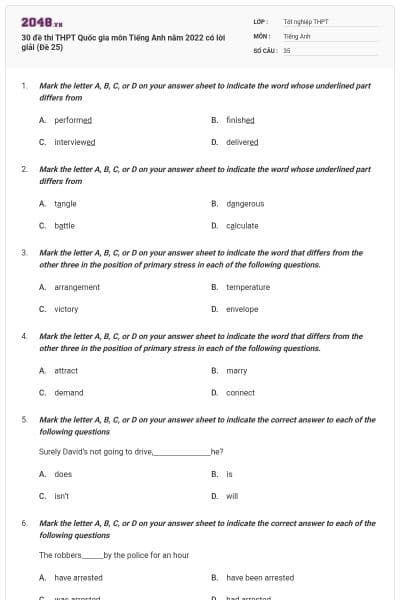
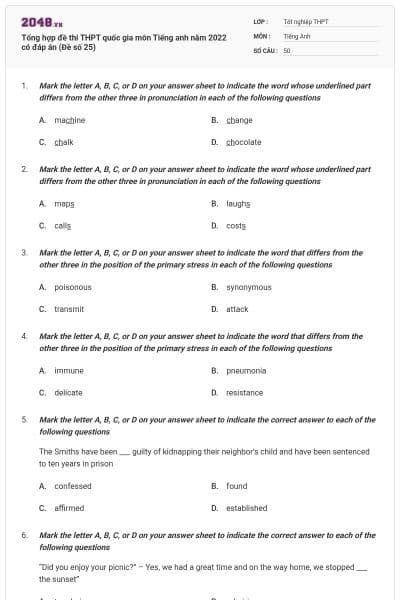
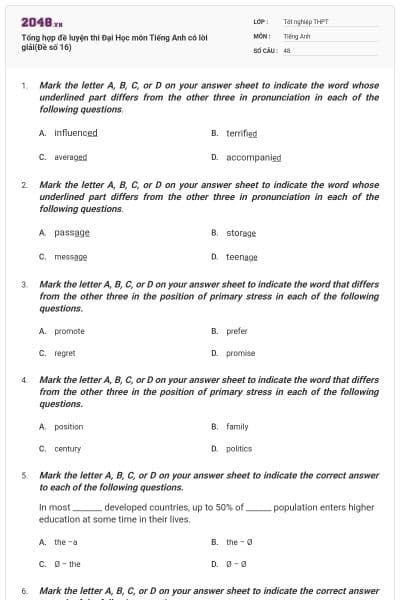
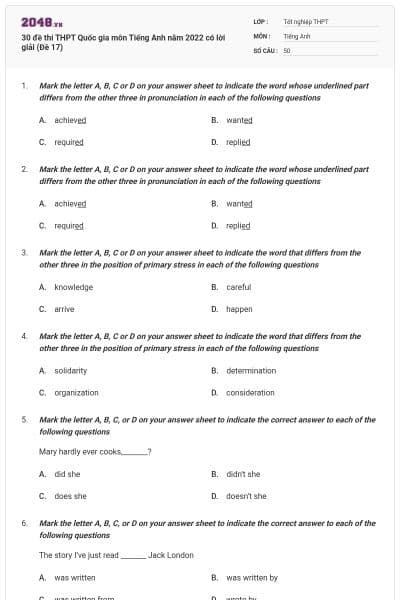
Mark the letter A, B, C or D on your answer sheet to indicate the word whose underlined part differs from the other three in pronunciation in each of the following questions
achieved
wanted
required
replied
Đáp án B
Kiến thức: Phát âm “-ed”
A. achieved /əˈtʃiːvd/
B. wanted /ˈwɒntɪd/
C. required /rɪˈkwaɪəd/
D. replied /rɪˈplaɪd/
Mark the letter A, B, C or D on your answer sheet to indicate the word whose underlined part differs from the other three in pronunciation in each of the following questions
achieved
wanted
required
replied
Đáp án B
Kiến thức: Phát âm “-a”
A. farm /fɑːm/
B. stayed /steɪd/
C. garden /ˈɡɑːdn/
D. harm /hɑːm/
Phần gạch chân đáp án B phát âm là /eɪ/, còn lại là /ɑː/
Phần gạch chân phương án B được phát âm là /e/, còn lại là /ɪ/
Mark the letter A, B, C or D on your answer sheet to indicate the word that differs from the other three in the position of primary stress in each of the following questions
knowledge
careful
arrive
happen
Đáp án C
Kiến thức: Trọng âm từ có 2 âm tiết
A. knowledge /ˈnɒlɪdʒ/
B. careful /ˈkeəfl/
C. arrive /əˈraɪv/
D. happen /ˈhæpən/
Quy tắc:
- Những động từ có 2 âm tiết thường có trọng âm rơi vào âm tiết thứ hai.
- Những danh từ, tính từ có 2 âm tiết thường có trọng âm rơi vào âm tiết thứ nhất.
Trọng âm đáp án C rơi vào âm tiết thứ hai, còn lại là âm thứ nhất
Mark the letter A, B, C or D on your answer sheet to indicate the word that differs from the other three in the position of primary stress in each of the following questions
solidarity
determination
organization
consideration
Đáp án A
Kiến thức: Trọng âm từ có 5 âm tiết
A. solidarity /sɒlɪˈdærəti/
B. determination /dɪtɜːmɪˈneɪʃn/
C. organization /ɔːɡənaɪˈzeɪʃn/
D. consideration /kənsɪdəˈreɪʃn/
Quy tắc: Những từ có tận cùng là đuôi “-ion”, “-ity” có trọng âm rơi vào âm tiết đứng ngay trước nó. Trọng âm đáp án A rơi vào âm tiết thứ ba, còn lại là âm thứ tư
Mark the letter A, B, C, or D on your answer sheet to indicate the correct answer to each of the following questions
Mary hardly ever cooks,_______?
did she
didn't she
does she
doesn't she
Đáp án B
Kiến thức: Câu hỏi đuôi
Vế trước câu hỏi đuôi mang nghĩa khẳng định (didn’t go) => câu hỏi đuôi ở dạng phủ định => loại B, C
đơn => thì ở câu hỏi đuôi dùng quá khứ đơn => loại A
Tạm dịch: Hôm qua anh ấy đi Hà Nội, đúng không?
Mark the letter A, B, C, or D on your answer sheet to indicate the correct answer to each of the following questions
The story I’ve just read _______ Jack London
was written
was written by
was written from
wrote by
Đáp án B
Kiến thức: Câu bị động:
Giải chi tiết: Câu bị động thì quá khứ đơn. Hành động được nhấn mạnh con đườngđược mở rộng
S + was/were + V-ed/V3
Tạm dịch: Câu chuyện tôi vừa đọc được viết bởi Jack London
Mark the letter A, B, C, or D on your answer sheet to indicate the correct answer to each of the following questions
Hurry or you will be late _______school.
for
at
on
from
Đáp án A
Kiến thức: Giới từ
late for: trễ
Tạm dịch: Nhanh lên hoặc bạn sẽ trễ học
Mark the letter A, B, C, or D on your answer sheet to indicate the correct answer to each of the following questions
The better the weather is, ______.
the most crowded the beaches get
the most the beaches get crowded
the more crowded the beaches get
the more the beaches get crowded
Đáp án C
Kiến thức: So sánh kép
Cấu trúc so sánh kép: The + so sánh hơn + S + V, the + so sánh hơn + S + V (càng... càng...)
Tạm dịch: Thời tiết càng đẹp thì bãi biển càng đông
Mark the letter A, B, C, or D on your answer sheet to indicate the correct answer to each of the following questions
My father gave my brothher _____________yesterday.
an old wooden thick table
a thick old wooden table
a thick wooden old table
a wooden thick old table
Đáp án B
Trật tự của các tính từ:
OpSACOMP: Opinion (Ý kiến) ; Size (Kích cỡ) ; Age (Tuổi) ; Shape (Hình dạng) ; Color (Màu sắc) ; Origin (Xuất xứ); Material (Chất liệu) ; Purpose (Công dụng)
Tạm dịch: Bố tôi cho anh tôi 1 cái bàn gỗ cũ dày
Mark the letter A, B, C, or D on your answer sheet to indicate the correct answer to each of the following questions
John _____________a book when I saw him
is reading
read
was reading
reading
Đáp án C
Kiến thức: Sự phối hợp về thì của động từ
Giải thích: Thì quá khứ đơn và quá khứ tiếp diễn kết hợp trong câu: Diễn tả hành động đang xảy ra trong quá khứ thì một hành động khác xen vào, hành động đang xảy ra chi thì quá khứ tiếp diễn, hành động xen vào chia thì quá khứ đơn.
Tạm dịch: John đang đọc sách thì tôi gặp cậu ấy
Mark the letter A, B, C, or D on your answer sheet to indicate the correct answer to each of the following questions
It is probably impossible for life to ever exist on Venus____________its intense surface heat
because
although
despite
due to
Đáp án D
Câu hỏi từ nối
Sau chỗ trống cần điền là một cụm danh từ “its intense surface heat”. Để nối danh từ vào câu, giới từ được sử dụng.
Hai đáp án A - because (bởi vì) và B - although (mặc dù) bị loại vì cả hai là liên từ.
Xét thêm yếu tố về nghĩa, có thể loại được đáp án C - despite (prep): mặc dù - và chọn đáp án D - due to (prep): do có/ bởi vì.
Tạm dịch: Có lẽ sự sống không thể có khả năng tồn tại trên sao Kim do sức nóng bề mặt khủng khiếp của nó
Mark the letter A, B, C, or D on your answer sheet to indicate the correct answer to each of the following questions
Mary will have finished all her work ____________
as soon as her boss returned
until her boss will return
by the time her boss returns
when her boss will return
Đáp án C
Câu hỏi mệnh đề trạng ngữ
Mệnh đề trạng ngữ chỉ thời gian thường được bắt đầu bằng các liên từ: when/ while/ before/ after/ as soon as/ by the time/ until... Đối với các câu ở thì tương lai, mệnh đề trạng ngữ chỉ thời gian đi kèm chỉ được phép chia ở các thì hiện tại.
Vậy nên, chỉ còn đáp án C - by the time her boss returns (chia ở thì hiện tại) là phù hợp.
Tạm dịch: Mary sẽ hoàn thành xong toàn bộ công việc không trễ hơn lúc sếp cô ấy quay về.
* Mở rộng: “By + Mốc thời gian” hoặc “By the time + mệnh đề” là dấu hiệu nhận biết các thì hoàn thành hoặc hoàn thành tiếp diễn.
Căn cứ vào “mốc thời gian” hoặc “mệnh đề” ở hiện tại, quá khứ, hoặc tương lai để chia thành các thì hiện tại, quá khứ, hoặc tương lai hoàn thành/ hoàn thành tiếp diễn.
Ví dụ: By yesterday - chia ở quá khứ hoàn thành/ hoàn thành tiếp diễn
Mark the letter A, B, C, or D on your answer sheet to indicate the correct answer to each of the following questions
________ every major judo title, Mark retired from international competition.
When he won
Having won
On winning
Winning
Đáp án: B
Giải thích:
Kiến thức: Rút gọn mệnh đề trạng ngữ ở dạng chủ động (điều kiện: 2 mệnh đề đồng chủ ngữ)
Khi động từ ở mệnh đề trạng ngữ xảy ra trước động từ ở mệnh đề chính thì ta rút gọn theo cấu trúc: Having done +…, S + V +…
Dịch: Sau khi giành được mọi danh hiệu judo lớn, Mark từ giã sự nghiệp thi đấu quốc tế.
Mark the letter A, B, C, or D on your answer sheet to indicate the correct answer to each of the following questions
We will create a stable, prosperous and highly ____ ASEAN Economic community
compete
competition
competitor
competitive
Đáp án: D
Giải thích:
Kiến thức: Cấu tạo từ
A. compete (v): cạnh tranh
B. competition (n): cuộc thi
C. competitor (n): thí sinh
D. competitive (adj): có tính cạnh tranh
Vị trí cần điền là một tính từ đứng trong cụm danh từ, bổ nghĩa cho danh từ chính “community”, đứng song hành với các tính từ “stable” và “prosperous”. Trạng từ “highly” bổ nghĩa cho tính từ cần điền.
Dịch: Chúng tôi sẽ xây dựng một cộng đồng kinh tế ASEAN ổn định, thịnh vượng và có tính cạnh tranh cao.
Mark the letter A, B, C, or D on your answer sheet to indicate the correct answer to each of the following questions
If Bill loses his job, at least they have Mary’s income to _______on.
fall behind
fall for
fall back
fall under
Đáp án C
Kiến thức về cụm động từ
Xét các đáp án:
A. fall behind: tụt lại phía sau
B. fall for: cảm thất bị thu hút và thích ai đó
C. fall back on: sử dụng đến, trông cậy vào
D. fall under: bị kiểm soát
Tạm dịch: Nếu Bill bị mất việc, ít ra họ còn có thu nhập của Marry để trông cậy vào.
Mark the letter A, B, C, or D on your answer sheet to indicate the correct answer to each of the following questions
Action movies may have a negative _________ on children
opinion
influence
dependence
decision
Đáp án B
Kiến thức: Từ vựng
- opinion (n): ý kiến
- influence (n): ảnh hưởng, tác động
- dependence (n): sự phụ thuộc
- decision (n): quyết định
Dịch: Phim hành động có thể có ảnh hưởng tiêu cực đến bọn trẻ.
Mark the letter A, B, C, or D on your answer sheet to indicate the correct answer to each of the following questions
The United States, China and India are now competing for political influence in ASEAN, and France, a leading European country, does not want to be ___________.
left out
put off
thought of
led on
Đáp án A
Kiến thức về cụm từ
Xét các đáp án:
A. leave out: bỏ rơi, loại ra ngoài
B. put off = postpone= delay: trì hoãn
Put sb off: làm cho ai mất hứng
C. think of sb/st: nghĩ về ai, cái gì
D. lead sb on: thuyết phục ai tin điều gì đó là sai.
Tạm dịch: Mỹ, Trung Quốc và Ấn Độ đang cạnh tranh nhau về sức ảnh hưởng chính trị lên ASEAN và Pháp, một quốc gia hàng đầu châu âu, không muốn bị loại ra ngoài.
Mark the letter A, B, C, or D on your answer sheet to indicate the correct answer to each of the following questions
Martin is called the teacher's pet by his classmates because he is taken under his teacher's _____.
hands
arms
wings
legs
Đáp án C
Kiến thức về cụm từ cố định
*Cụm từ: Take sb under one’s wings (coll): bắt đầu bảo vệ, chăm sóc, nâng đỡ ai đó.
Tạm dịch: Bạn bè trong lớp gọi Martin là trò cưng bởi vì cậu ta được giáo viên nâng đỡ.
*Cấu trúc cần lưu ý:
- Teacher’s pet (n): trò cưng, học sinh cưng của giáo viên (được giáo viên đối xử tốt hơn so với những người khác trong lớp)
Mark the letter A, B, C, or D on your answer sheet to indicate the correct answer to each of the following questions
Parents are always willing to lend a sympathetic ________ to their children when they have problems
hand
ear
eye
paw
Đáp án B
Kiến thức: Từ vựng, từ loại
- opinion (n): ý kiến
- influence (n): ảnh hưởng, tác động
- dependence (n): sự phụ thuộc
- decision (n): quyết định
Dịch: Phim hành động có thể có ảnh hưởng tiêu cực đến bọn trẻ
Mark the letter A, B, C, or D on your answer sheet to indicate the word(s) CLOSEST in meaning to the underlined word(s) in each of the following questions
There was a long period without rain in the countryside last year so the harvest was poor
famine
flood
epidemic
drought
Đáp án D
Kiến thức: Từ vựng
long period without rain: khoảng thời gian dài không có mưa
A. famine (n): nạn đói kém
B. flood (n): lũ lụt, nạn lụt
C. epidemic (n): bệnh dịch
D. drought (n): hạn hán
=> long period without rain = drought (n): hạn hán
Tạm dịch: Có một khoảng thời gian dài không có mưa ở vùng nông thôn vào năm ngoái nên sản lượng thu hoạch rất kém
Mark the letter A, B, C, or D on your answer sheet to indicate the word(s) CLOSEST in meaning to the underlined word(s) in each of the following questions
How many countries took part in the last Olympic Games?
participated
performed
succeeded
hosted
Đáp án A
Kiến thức: Từ vựng
took part in: đã tham gia
A. participate - participated - participated: tham gia
B. perform - performed - performed: biểu diễn, trình diễn
C. succeed - succeeded - succeeded: thành công, thịnh vượng
D. host - hosted - hosted: đăng cai tổ chức
=> took part in = participated: đã tham gia
Tạm dịch: Có bao nhiêu quốc gia tham gia Thế vận hội Olympic vừa qua?
Mark the letter A, B, C or D to indicate the word(s) OPPOSITE in meaning to the underlined word(s) in each of the following questions
“That is a well-behaved boy whose behaviour has nothing to complain about.”
behaving cleverly
good behaviour
behaving nice
behaving improperly
Đáp án D
Kiến thức: Từ vựng
well-behaved (adj): có cư xử đúng, có giáo dục
A. behaving cleverly: cư xử khéo léo
B. good behaviour: cư xử đúng mực
C. behaving nice: cư xử tử tế
D. behaving improperly: cư xử không đúng mực
=> well-behaved (adj): có cư xử đúng, có giáo dục >< behaving improperly: cư xử không đúng mực Tạm dịch: Đây là một cậu bé cư xử tốt người mà không có hành vi gì để phàn nàn.
Mark the letter A, B, C or D to indicate the word(s) OPPOSITE in meaning to the underlined word(s) in each of the following questions
When he passes the entrance exam, his parents will be walking on the air
extremely happy
feeling extremely unhappy
feeling extremely airy
extremely light
Đáp án B
Kiến thức: Thành ngữ
walking on the air: rất vui, rất hạnh phúc
A. extremely happy: vô cùng hạnh phúc
B. feeling extremely unhappy: cảm thấy vô cùng bất hạnh
C. feeling extremely airy: cảm giác cực kỳ nhẹ nhàng
D. extremely light: cực kỳ nhẹ nhàng
=> walking on the air: rất vui, rất hạnh phúc >< feeling extremely unhappy: cảm thấy vô cùng bất hạnh
Tạm dịch: Khi anh ấy vượt qua kỳ thi tuyển sinh, bố mẹ anh ấy sẽ rất hạnh phúc
Mark the letter A, B, C, or D on your answer sheet to indicate the option that best completes each of the following exchanges
Peter is having dinner at Wendy’s house.
- Peter: "This steamed crab is so delicious."
- Wendy:" ________.''
Sure. I’d love to.
I’m afraid not.
No, don’t worry.
I’m glad you like it.
Đáp án D
Kiến thức: Ngôn ngữ giao tiếp
Peter đang ăn tối tại nhà của Wendy.
- Peter: "Món cua hấp này rất ngon."
- Wendy: "________ .''
A. Chắc chắn. Mình cũng thích vậy.
B. Mình sợ rằng không được.
C. Không, đừng lo lắng.
D. Mình vui vì bạn thích nó.
Các phản hồi A, B, C không phù hợp với ngữ cảnh
Mark the letter A, B, C, or D on your answer sheet to indicate the option that best completes each of the following exchanges
Joana and David, two students, are talking about studying abroad.
- Joana: "I think studying abroad is the only way to get a well-paid job."
- David: “___________. There’re still many different ways to get it."
You're exactly right
I don’t think so
That’s what I think
There’s no doubt about it
Đáp án B
Kiến thức: Ngôn ngữ giao tiếp
Hai sinh viên Joana và David đang nói về việc đi du học.
- Joana: "Mình nghĩ du học là cách duy nhất để có được một công việc với mức lương cao."
- David: “________. Vẫn có nhiều cách khác nhau để có được công việc đó.”
A. Cậu hoàn toàn đúng
B. Mình không nghĩ vậy
C. Đó là những gì mình nghĩ
D. Chắc chắn là vậy
Các phản hồi A, C, D không phù hợp với ngữ cảnh
Read the following passage and mark the letter A, B, C or D on your answer sheet to indicate the correct word or phrase that best fits each of the numbered blanks from 26 to 30
No one runs the internet. It’s organized as a decentralized network of networks. Thousands of companies, universities, governments, and other (26) ______ operate their own networks and exchange traffic with (27) ______ other based on voluntary interconnection agreements.
The shared technical standards (28) ______ make the internet work are managed by an organization called the Internet Engineering Task Force. The IETF is an open organization; anyone is free to attend meetings, propose new standards, and recommend changes to existing standards. No one is required to adopt standards endorsed by the IETF, but the IETF’s consensus-based decision-making process helps to (29) ______ that its recommendations are generally adopted by the internet community.
The Internet Corporation for Assigned Names and Numbers (ICANN) is sometimes described as being (30) ______ for internet governance. As its name implies, ICANN is in charge of distributing domain names (like vox.com) and IP addresses. But ICANN doesn’t control who can connect to the internet or what kind of information can be sent over it.
(Adapted from https://www.vox.com/)
Điền vào ô 26
entities
terms
amounts
states
Đáp án A
Kiến thức: Từ vựng
Giải thích: Phương án A phù hợp về nghĩa.
A. entities (n.pl): thực thể
B. terms (n.pl): thuật ngữ
C. amounts (n.pl): khối lượng
D. states (n.pl): tiểu bang
Read the following passage and mark the letter A, B, C or D on your answer sheet to indicate the correct word or phrase that best fits each of the numbered blanks from 26 to 30
No one runs the internet. It’s organized as a decentralized network of networks. Thousands of companies, universities, governments, and other (26) ______ operate their own networks and exchange traffic with (27) ______ other based on voluntary interconnection agreements.
The shared technical standards (28) ______ make the internet work are managed by an organization called the Internet Engineering Task Force. The IETF is an open organization; anyone is free to attend meetings, propose new standards, and recommend changes to existing standards. No one is required to adopt standards endorsed by the IETF, but the IETF’s consensus-based decision-making process helps to (29) ______ that its recommendations are generally adopted by the internet community.
The Internet Corporation for Assigned Names and Numbers (ICANN) is sometimes described as being (30) ______ for internet governance. As its name implies, ICANN is in charge of distributing domain names (like vox.com) and IP addresses. But ICANN doesn’t control who can connect to the internet or what kind of information can be sent over it.
(Adapted from https://www.vox.com/)
Điền vào ô 27
another
every
each
all
Đáp án C
Kiến thức: Lượng từ
Giải thích: each other: lẫn nhau
Read the following passage and mark the letter A, B, C or D on your answer sheet to indicate the correct word or phrase that best fits each of the numbered blanks from 26 to 30
No one runs the internet. It’s organized as a decentralized network of networks. Thousands of companies, universities, governments, and other (26) ______ operate their own networks and exchange traffic with (27) ______ other based on voluntary interconnection agreements.
The shared technical standards (28) ______ make the internet work are managed by an organization called the Internet Engineering Task Force. The IETF is an open organization; anyone is free to attend meetings, propose new standards, and recommend changes to existing standards. No one is required to adopt standards endorsed by the IETF, but the IETF’s consensus-based decision-making process helps to (29) ______ that its recommendations are generally adopted by the internet community.
The Internet Corporation for Assigned Names and Numbers (ICANN) is sometimes described as being (30) ______ for internet governance. As its name implies, ICANN is in charge of distributing domain names (like vox.com) and IP addresses. But ICANN doesn’t control who can connect to the internet or what kind of information can be sent over it.
(Adapted from https://www.vox.com/)
Điền vào ô 28
that
who
when
what
Đáp án A
Kiến thức: Từ vựng
Giải thích: Đại từ quan hệ “that” thay cho sự vật “technical standards” giữ vai trò chủ ngữ, các phương án khác không có chức năng này
Read the following passage and mark the letter A, B, C or D on your answer sheet to indicate the correct word or phrase that best fits each of the numbered blanks from 26 to 30
No one runs the internet. It’s organized as a decentralized network of networks. Thousands of companies, universities, governments, and other (26) ______ operate their own networks and exchange traffic with (27) ______ other based on voluntary interconnection agreements.
The shared technical standards (28) ______ make the internet work are managed by an organization called the Internet Engineering Task Force. The IETF is an open organization; anyone is free to attend meetings, propose new standards, and recommend changes to existing standards. No one is required to adopt standards endorsed by the IETF, but the IETF’s consensus-based decision-making process helps to (29) ______ that its recommendations are generally adopted by the internet community.
The Internet Corporation for Assigned Names and Numbers (ICANN) is sometimes described as being (30) ______ for internet governance. As its name implies, ICANN is in charge of distributing domain names (like vox.com) and IP addresses. But ICANN doesn’t control who can connect to the internet or what kind of information can be sent over it.
(Adapted from https://www.vox.com/)
Điền vào ô 29
function
stress
exchange
ensure
Đáp án D
Kiến thức về mệnh đề quan hệ
Giải thích: Phương án D phù hợp về nghĩa.
A. function (v.): có chức năng
B. stress (v.): nhấn mạnh
C. exchange (v.): trao đổi
D. ensure (v.): đảm bảo
Read the following passage and mark the letter A, B, C or D on your answer sheet to indicate the correct word or phrase that best fits each of the numbered blanks from 26 to 30
No one runs the internet. It’s organized as a decentralized network of networks. Thousands of companies, universities, governments, and other (26) ______ operate their own networks and exchange traffic with (27) ______ other based on voluntary interconnection agreements.
The shared technical standards (28) ______ make the internet work are managed by an organization called the Internet Engineering Task Force. The IETF is an open organization; anyone is free to attend meetings, propose new standards, and recommend changes to existing standards. No one is required to adopt standards endorsed by the IETF, but the IETF’s consensus-based decision-making process helps to (29) ______ that its recommendations are generally adopted by the internet community.
The Internet Corporation for Assigned Names and Numbers (ICANN) is sometimes described as being (30) ______ for internet governance. As its name implies, ICANN is in charge of distributing domain names (like vox.com) and IP addresses. But ICANN doesn’t control who can connect to the internet or what kind of information can be sent over it.
(Adapted from https://www.vox.com/)
Điền vào ô 30
Curious
Responsible
cheerful
interested
Đáp án B
to be responsible for: chịu trách nhiệm về cái gì
Read the following passage and mark the letter A, B, C, or D on your answer sheet to indicate the correct answer to each of the questions from 31 to 35
Table manners differ around the world. If you visit a friend’s home for a meal, it’s good to know about the customs they follow.
If you are invited to a Moroccan’s home, bring a gift of sweet pastries, nuts, figs, dates, or flowers to the hostess. In many traditional homes, people often sit on the floor to eat a meal. Often, everyone shares food from the same 10 plate. The plate is put in the centre of the table. Usually, everyone also drinks water from the same glass. Only eat the food in front of you. Don’t reach across someone for food. It is common to use you your fingers and small pieces of bread to eat food. Use only your right hand to eat. Don’t say “no” to food. If the host of the meal offers you food or drink, take some and try a little. In many Moroccan homes, it is common to take off your shoes.
Tanzania is known for its fresh fish and spices. Don’t act scared if your meal comes with its head still on the plate. It is polite to try a bite of everything. In many Tanzania homes, people sit at a table on a small stools to eat. It is OK to eat with your right hand, using bread or chapati to pick up food. Everyone may take food from the same plate., but it is not usual for people to share drinks. You may compliment the cook on a delicious meal, but don’t exaggerate. In some parts of Tanzania, men and women still sit at different tables. Also remember: it is common to take off your shoes in the home, but it is rude to show the bottom of your foot.
(Adopted from Active Skills for Reading Intro by Neil J Anderson)
Which best serves as the title for the passage?
Table Manners across some cultures in the world.
Tips for foreigners when having meal in Tanzania
Table Manners in Morocco, Things to do for everyone
Table Manners - Ultimate Guide to Dining Etiquette
Đáp án A
Kiến thức: Đọc hiểu
Tiêu đề nào là phù hợp nhất cho bài đọc?
A. Phép tắc ăn uống trên một số nền văn hóa thế giới.
B. Lời khuyên cho người nước ngoài khi dùng bữa tại Tanzania
C. Cách cư xử ở Ma-rốc, những điều cần làm cho mọi người
D. Phép tắc ăn uống - Hướng dẫn cơ bản về nghi thức ăn uống
Thông tin: Table manners differ around the world.
Tạm dịch: Phép tắc ăn uống khác nhau trên khắp thế giới.
Read the following passage and mark the letter A, B, C, or D on your answer sheet to indicate the correct answer to each of the questions from 31 to 35
Table manners differ around the world. If you visit a friend’s home for a meal, it’s good to know about the customs they follow.
If you are invited to a Moroccan’s home, bring a gift of sweet pastries, nuts, figs, dates, or flowers to the hostess. In many traditional homes, people often sit on the floor to eat a meal. Often, everyone shares food from the same 10 plate. The plate is put in the centre of the table. Usually, everyone also drinks water from the same glass. Only eat the food in front of you. Don’t reach across someone for food. It is common to use you your fingers and small pieces of bread to eat food. Use only your right hand to eat. Don’t say “no” to food. If the host of the meal offers you food or drink, take some and try a little. In many Moroccan homes, it is common to take off your shoes.
Tanzania is known for its fresh fish and spices. Don’t act scared if your meal comes with its head still on the plate. It is polite to try a bite of everything. In many Tanzania homes, people sit at a table on a small stools to eat. It is OK to eat with your right hand, using bread or chapati to pick up food. Everyone may take food from the same plate., but it is not usual for people to share drinks. You may compliment the cook on a delicious meal, but don’t exaggerate. In some parts of Tanzania, men and women still sit at different tables. Also remember: it is common to take off your shoes in the home, but it is rude to show the bottom of your foot.
(Adopted from Active Skills for Reading Intro by Neil J Anderson)
According to the passage, why does the writer think it is good to know about customs in other countries?
You can know how to eat healthily.
You can act in a proper way.
You can order food in a restaurant.
You can learn the language.
Đáp án B
Kiến thức: Đọc hiểu
Theo đoạn văn, tại sao người viết nghĩ rằng thật tốt khi biết về phong tục ở các nước khác? A. Bạn có thể biết cách ăn uống lành mạnh.
B. Bạn có thể hành động một cách thích hợp.
C. Bạn có thể gọi đồ ăn trong một nhà hàng.
D. Bạn có thể học ngôn ngữ.
Thông tin: If you visit a friend’s home for a meal, it’s good to know about the customs they follow.
Tạm dịch: Nếu bạn đến thăm nhà của một người bạn để dùng bữa, thì thật tốt khi biết về phong tục mà họ tuân theo
Read the following passage and mark the letter A, B, C, or D on your answer sheet to indicate the correct answer to each of the questions from 31 to 35
Table manners differ around the world. If you visit a friend’s home for a meal, it’s good to know about the customs they follow.
If you are invited to a Moroccan’s home, bring a gift of sweet pastries, nuts, figs, dates, or flowers to the hostess. In many traditional homes, people often sit on the floor to eat a meal. Often, everyone shares food from the same 10 plate. The plate is put in the centre of the table. Usually, everyone also drinks water from the same glass. Only eat the food in front of you. Don’t reach across someone for food. It is common to use you your fingers and small pieces of bread to eat food. Use only your right hand to eat. Don’t say “no” to food. If the host of the meal offers you food or drink, take some and try a little. In many Moroccan homes, it is common to take off your shoes.
Tanzania is known for its fresh fish and spices. Don’t act scared if your meal comes with its head still on the plate. It is polite to try a bite of everything. In many Tanzania homes, people sit at a table on a small stools to eat. It is OK to eat with your right hand, using bread or chapati to pick up food. Everyone may take food from the same plate., but it is not usual for people to share drinks. You may compliment the cook on a delicious meal, but don’t exaggerate. In some parts of Tanzania, men and women still sit at different tables. Also remember: it is common to take off your shoes in the home, but it is rude to show the bottom of your foot.
(Adopted from Active Skills for Reading Intro by Neil J Anderson)
The word "offers" in paragraph 2 is closest in meaning to ________
exchanges
attends
receives
provides
Đáp án D
Kiến thức: Từ vựng
Từ “offers” trong đoạn 2 có nghĩa gần nhất với ________.
offer (v): cho, cung cấp, đề nghị
A. exchanges (v): trao đổi
B. attends (v): tham dự
C. receives (v): nhận
D. provides (v): cung cấp
=> offer = provide
Thông tin: If the host of the meal offers you food or drink, take some and try a little.
Tạm dịch: Nếu chủ nhà của bữa ăn cho bạn đồ ăn hoặc đồ uống, hãy lấy một ít và thử một chút
Read the following passage and mark the letter A, B, C, or D on your answer sheet to indicate the correct answer to each of the questions from 31 to 35
Table manners differ around the world. If you visit a friend’s home for a meal, it’s good to know about the customs they follow.
If you are invited to a Moroccan’s home, bring a gift of sweet pastries, nuts, figs, dates, or flowers to the hostess. In many traditional homes, people often sit on the floor to eat a meal. Often, everyone shares food from the same 10 plate. The plate is put in the centre of the table. Usually, everyone also drinks water from the same glass. Only eat the food in front of you. Don’t reach across someone for food. It is common to use you your fingers and small pieces of bread to eat food. Use only your right hand to eat. Don’t say “no” to food. If the host of the meal offers you food or drink, take some and try a little. In many Moroccan homes, it is common to take off your shoes.
Tanzania is known for its fresh fish and spices. Don’t act scared if your meal comes with its head still on the plate. It is polite to try a bite of everything. In many Tanzania homes, people sit at a table on a small stools to eat. It is OK to eat with your right hand, using bread or chapati to pick up food. Everyone may take food from the same plate., but it is not usual for people to share drinks. You may compliment the cook on a delicious meal, but don’t exaggerate. In some parts of Tanzania, men and women still sit at different tables. Also remember: it is common to take off your shoes in the home, but it is rude to show the bottom of your foot.
(Adopted from Active Skills for Reading Intro by Neil J Anderson)
The word "they" in paragraph 1 refers to ________
customs
manners
meals
friends
Đáp án D
Kiến thức: Đọc hiểu
Từ “they” trong đoạn 1 thay thế cho ________.
A. phong tục
B. cách cư xử
C. bữa ăn
D. bạn bè
Thông tin: If you visit a friend’s home for a meal, it’s good to know about the customs they follow.
Tạm dịch: Nếu bạn đến thăm nhà của một người bạn để dùng bữa, thì thật tốt khi biết về phong tục mà họ tuân theo
Read the following passage and mark the letter A, B, C, or D on your answer sheet to indicate the correct answer to each of the questions from 31 to 35
Table manners differ around the world. If you visit a friend’s home for a meal, it’s good to know about the customs they follow.
If you are invited to a Moroccan’s home, bring a gift of sweet pastries, nuts, figs, dates, or flowers to the hostess. In many traditional homes, people often sit on the floor to eat a meal. Often, everyone shares food from the same 10 plate. The plate is put in the centre of the table. Usually, everyone also drinks water from the same glass. Only eat the food in front of you. Don’t reach across someone for food. It is common to use you your fingers and small pieces of bread to eat food. Use only your right hand to eat. Don’t say “no” to food. If the host of the meal offers you food or drink, take some and try a little. In many Moroccan homes, it is common to take off your shoes.
Tanzania is known for its fresh fish and spices. Don’t act scared if your meal comes with its head still on the plate. It is polite to try a bite of everything. In many Tanzania homes, people sit at a table on a small stools to eat. It is OK to eat with your right hand, using bread or chapati to pick up food. Everyone may take food from the same plate., but it is not usual for people to share drinks. You may compliment the cook on a delicious meal, but don’t exaggerate. In some parts of Tanzania, men and women still sit at different tables. Also remember: it is common to take off your shoes in the home, but it is rude to show the bottom of your foot.
(Adopted from Active Skills for Reading Intro by Neil J Anderson)
According to paragraph 3, which of the following should NOT do in Tanzania?
eat with your hands
take food from the same plate
show the bottom of your foot
take off your shoes
Đáp án C
Kiến thức: Đọc hiểu
Theo đoạn 3, điều nào sau đây KHÔNG nên làm ở Tanzania?
A. ăn bằng tay
B. lấy thức ăn từ cùng một đĩa
C. khoe lòng bàn chân
D. cởi giày ra
Thông tin: Also remember: it is common to take off your shoes in the home, but it is rude to show the bottom of your foot.
Tạm dịch: Cũng nên nhớ rằng: việc cởi giày trong nhà là điều thường thấy, nhưng thật thô lỗ khi để lộ lòng bàn chân của bạn
Read the following passage and mark the letter A, B, C, or D on your answer sheet to indicate the correct answer to each of the questions from 36 to 42
Nepal has made important progress over the past few years to promote equality, but the country still has one of the highest rates of child marriage in the world. 41% of Nepalese girls are married before the age of 18.
Poverty is both a cause and consequence of child marriage in Nepal. Girls from the wealthiest families marry 2 years later than those from the poorest, who are seen as an economic burden, and who drop out of school and earn little money.
Food insecurity plays an important role too. Nepalese families that do not have enough food to eat are more likely to marry their daughters at a young age to decrease the financial burden. One study shows that 91% of people who had secure access to food married over the age of 19.
Dowry is also common practice in many communities. Parents marry their daughters as soon as possible because the money they have to pay to the groom’s family is higher if their daughter is older. Since 2010, the legal age of marriage is 20 for both men and women, or 18 with parental consent, according to the Nepalese Country Code.
The law states that punishment for child marriage is imprisonment for up to three years and a fine of up to 10,000 rupees (£102). But reports suggest that this law is rarely applied. There has been quite a lot of progress in Nepal over the past 3 years with a clear government commitment to ending child marriage and civil society cooperation. The Ministry of Women, Children and Social Welfare is currently developing Nepal’s first national strategy on child marriage in collaboration with UNICEF Nepal and Girls Not Brides Nepal. However, the post-earthquake and post-fuel crisis environment has meant progress is slow and the national strategy has been delayed.
(Adapted from http://www.girlsnotbrides.org/)
Which of the following best serves as the title for the passage?
Nepal Government in an attempt to reduce social inequality.
Child marriage - A completely tractable problem in Nepal.
Nepal’s strategies to child protection programming.
One type of child abuse in Nepal: Child Marriage.
Đáp án D
Kiến thức: Đọc hiểu
Tiêu đề nào là phù hợp nhất cho bài đọc?
A. Chính phủ Nepal trong nỗ lực giảm bất bình đẳng xã hội.
B. Hôn nhân trẻ em - Một vấn đề khó giải quyết ở Nepal.
C. Chiến lược Nepal để thiết lập bảo vệ trẻ em.
D. Một loại lạm dụng trẻ em ở Nepal: Hôn nhân trẻ em.
Thông tin: Nepal has made important progress over the past few years to promote equality, but the country still has one of the highest rates of child marriage in the world. 41% of Nepalese girls are married before the age of 18… Nepalese families that do not have enough food to eat are more likely to marry their daughters at a young age to decrease the financial burden.
Tạm dịch: Nepal đã đạt được những tiến bộ quan trọng trong vài năm qua để thúc đẩy bình đẳng, nhưng đất nước này vẫn có một trong những tỷ lệ kết hôn ở trẻ em cao nhất thế giới. 41% các cô gái Nepal đã kết hôn trước 18 tuổi… Các gia đình Nepal mà không có đủ thức ăn để ăn có nhiều khả năng cho con gái của họ kết hôn khi còn trẻ để giảm gánh nặng tài chính
Read the following passage and mark the letter A, B, C, or D on your answer sheet to indicate the correct answer to each of the questions from 36 to 42
Nepal has made important progress over the past few years to promote equality, but the country still has one of the highest rates of child marriage in the world. 41% of Nepalese girls are married before the age of 18.
Poverty is both a cause and consequence of child marriage in Nepal. Girls from the wealthiest families marry 2 years later than those from the poorest, who are seen as an economic burden, and who drop out of school and earn little money.
Food insecurity plays an important role too. Nepalese families that do not have enough food to eat are more likely to marry their daughters at a young age to decrease the financial burden. One study shows that 91% of people who had secure access to food married over the age of 19.
Dowry is also common practice in many communities. Parents marry their daughters as soon as possible because the money they have to pay to the groom’s family is higher if their daughter is older. Since 2010, the legal age of marriage is 20 for both men and women, or 18 with parental consent, according to the Nepalese Country Code.
The law states that punishment for child marriage is imprisonment for up to three years and a fine of up to 10,000 rupees (£102). But reports suggest that this law is rarely applied. There has been quite a lot of progress in Nepal over the past 3 years with a clear government commitment to ending child marriage and civil society cooperation. The Ministry of Women, Children and Social Welfare is currently developing Nepal’s first national strategy on child marriage in collaboration with UNICEF Nepal and Girls Not Brides Nepal. However, the post-earthquake and post-fuel crisis environment has meant progress is slow and the national strategy has been delayed.
(Adapted from http://www.girlsnotbrides.org/)
According to paragraph 2, in Nepal, girls from needy families ________
play an important role in bolstering their household finances
have to get married earlier than those are from affluent families
can get married two years later than those are from poor families
are forced to drop out of school because their parents have no money
Đáp án B
Kiến thức: Đọc hiểu
Theo đoạn 2, ở Nepal, các cô gái từ các gia đình nghèo khó ____.
A. đóng một vai trò quan trọng trong việc củng cố tài chính gia đình của họ
B. phải kết hôn sớm hơn các cô gái trong gia đình giàu có
C. có thể kết hôn muộn hơn hai năm so với các cô gái trong gia đình nghèo
D. bị buộc thôi học vì bố mẹ không có tiền
Thông tin: Girls from the wealthiest families marry 2 years later than those from the poorest, …
Tạm dịch: Những cô gái từ những gia đình giàu có nhất kết hôn muộn hơn 2 năm so với các cô gái từ những gia đình nghèo nhất,…
Read the following passage and mark the letter A, B, C, or D on your answer sheet to indicate the correct answer to each of the questions from 36 to 42
Nepal has made important progress over the past few years to promote equality, but the country still has one of the highest rates of child marriage in the world. 41% of Nepalese girls are married before the age of 18.
Poverty is both a cause and consequence of child marriage in Nepal. Girls from the wealthiest families marry 2 years later than those from the poorest, who are seen as an economic burden, and who drop out of school and earn little money.
Food insecurity plays an important role too. Nepalese families that do not have enough food to eat are more likely to marry their daughters at a young age to decrease the financial burden. One study shows that 91% of people who had secure access to food married over the age of 19.
Dowry is also common practice in many communities. Parents marry their daughters as soon as possible because the money they have to pay to the groom’s family is higher if their daughter is older. Since 2010, the legal age of marriage is 20 for both men and women, or 18 with parental consent, according to the Nepalese Country Code.
The law states that punishment for child marriage is imprisonment for up to three years and a fine of up to 10,000 rupees (£102). But reports suggest that this law is rarely applied. There has been quite a lot of progress in Nepal over the past 3 years with a clear government commitment to ending child marriage and civil society cooperation. The Ministry of Women, Children and Social Welfare is currently developing Nepal’s first national strategy on child marriage in collaboration with UNICEF Nepal and Girls Not Brides Nepal. However, the post-earthquake and post-fuel crisis environment has meant progress is slow and the national strategy has been delayed.
(Adapted from http://www.girlsnotbrides.org/)
The word "those" in paragraph 2 refers to ________
girls
families
years
rates
Đáp án A
Kiến thức: Đọc hiểu
Từ “those” trong đoạn 2 thay thế cho ________.
A. cô gái
B. gia đình
C. năm
D. tỷ lệ
Thông tin: Girls from the wealthiest families marry 2 years later than those from the poorest, who are seen as an economic burden, and who drop out of school and earn little money.
Tạm dịch: Những cô gái từ những gia đình giàu có nhất kết hôn muộn hơn 2 năm so với các cô gái từ những gia đình nghèo nhất, những người được coi là gánh nặng kinh tế, và họ bỏ học và kiếm được ít tiền.
Read the following passage and mark the letter A, B, C, or D on your answer sheet to indicate the correct answer to each of the questions from 36 to 42
Nepal has made important progress over the past few years to promote equality, but the country still has one of the highest rates of child marriage in the world. 41% of Nepalese girls are married before the age of 18.
Poverty is both a cause and consequence of child marriage in Nepal. Girls from the wealthiest families marry 2 years later than those from the poorest, who are seen as an economic burden, and who drop out of school and earn little money.
Food insecurity plays an important role too. Nepalese families that do not have enough food to eat are more likely to marry their daughters at a young age to decrease the financial burden. One study shows that 91% of people who had secure access to food married over the age of 19.
Dowry is also common practice in many communities. Parents marry their daughters as soon as possible because the money they have to pay to the groom’s family is higher if their daughter is older. Since 2010, the legal age of marriage is 20 for both men and women, or 18 with parental consent, according to the Nepalese Country Code.
The law states that punishment for child marriage is imprisonment for up to three years and a fine of up to 10,000 rupees (£102). But reports suggest that this law is rarely applied. There has been quite a lot of progress in Nepal over the past 3 years with a clear government commitment to ending child marriage and civil society cooperation. The Ministry of Women, Children and Social Welfare is currently developing Nepal’s first national strategy on child marriage in collaboration with UNICEF Nepal and Girls Not Brides Nepal. However, the post-earthquake and post-fuel crisis environment has meant progress is slow and the national strategy has been delayed.
(Adapted from http://www.girlsnotbrides.org/)
The word "burden” in paragraph 3 is closest in meaning to ________
issue
potency
load
cargo
Đáp án C
Kiến thức: Từ vựng
Từ “burden” trong đoạn 3 có nghĩa gần nhất với từ ________.
burden (n): gánh nặng
A. issue (n): đề tài, vấn đề
B. potency (n): hiệu lực, quyền thế
C. load (n): vật nặng, gánh nặng
D. cargo (n): hàng hóa
=> burden = load
Thông tin: Nepalese families that do not have enough food to eat are more likely to marry their daughters at a young age to decrease the financial burden.
Tạm dịch: Các gia đình Nepal mà không có đủ thức ăn để ăn có nhiều khả năng cho con gái của họ kết hôn khi còn trẻ để giảm gánh nặng tài chính
Read the following passage and mark the letter A, B, C, or D on your answer sheet to indicate the correct answer to each of the questions from 36 to 42
Nepal has made important progress over the past few years to promote equality, but the country still has one of the highest rates of child marriage in the world. 41% of Nepalese girls are married before the age of 18.
Poverty is both a cause and consequence of child marriage in Nepal. Girls from the wealthiest families marry 2 years later than those from the poorest, who are seen as an economic burden, and who drop out of school and earn little money.
Food insecurity plays an important role too. Nepalese families that do not have enough food to eat are more likely to marry their daughters at a young age to decrease the financial burden. One study shows that 91% of people who had secure access to food married over the age of 19.
Dowry is also common practice in many communities. Parents marry their daughters as soon as possible because the money they have to pay to the groom’s family is higher if their daughter is older. Since 2010, the legal age of marriage is 20 for both men and women, or 18 with parental consent, according to the Nepalese Country Code.
The law states that punishment for child marriage is imprisonment for up to three years and a fine of up to 10,000 rupees (£102). But reports suggest that this law is rarely applied. There has been quite a lot of progress in Nepal over the past 3 years with a clear government commitment to ending child marriage and civil society cooperation. The Ministry of Women, Children and Social Welfare is currently developing Nepal’s first national strategy on child marriage in collaboration with UNICEF Nepal and Girls Not Brides Nepal. However, the post-earthquake and post-fuel crisis environment has meant progress is slow and the national strategy has been delayed.
(Adapted from http://www.girlsnotbrides.org/)
According to the last paragraph, how many years will a rule-breaker spend in jail?
exactly three years
over three years
from one to three years
about two years
Đáp án C
Kiến thức: Đọc hiểu
Theo đoạn cuối, một kẻ phá luật sẽ phải ngồi tù bao nhiêu năm?
A. chính xác ba năm
B. hơn ba năm
C. từ một đến ba năm
D. khoảng hai năm
Thông tin: The law states that punishment for child marriage is imprisonment for up to three years and a fine of up to 10,000 rupees (£102).
Tạm dịch: Luật pháp quy định rằng hình phạt cho hôn nhân ở trẻ em là phạt tù tới ba năm và phạt tiền lên tới 10.000 rupee (102 bảng)
Read the following passage and mark the letter A, B, C, or D on your answer sheet to indicate the correct answer to each of the questions from 36 to 42
Nepal has made important progress over the past few years to promote equality, but the country still has one of the highest rates of child marriage in the world. 41% of Nepalese girls are married before the age of 18.
Poverty is both a cause and consequence of child marriage in Nepal. Girls from the wealthiest families marry 2 years later than those from the poorest, who are seen as an economic burden, and who drop out of school and earn little money.
Food insecurity plays an important role too. Nepalese families that do not have enough food to eat are more likely to marry their daughters at a young age to decrease the financial burden. One study shows that 91% of people who had secure access to food married over the age of 19.
Dowry is also common practice in many communities. Parents marry their daughters as soon as possible because the money they have to pay to the groom’s family is higher if their daughter is older. Since 2010, the legal age of marriage is 20 for both men and women, or 18 with parental consent, according to the Nepalese Country Code.
The law states that punishment for child marriage is imprisonment for up to three years and a fine of up to 10,000 rupees (£102). But reports suggest that this law is rarely applied. There has been quite a lot of progress in Nepal over the past 3 years with a clear government commitment to ending child marriage and civil society cooperation. The Ministry of Women, Children and Social Welfare is currently developing Nepal’s first national strategy on child marriage in collaboration with UNICEF Nepal and Girls Not Brides Nepal. However, the post-earthquake and post-fuel crisis environment has meant progress is slow and the national strategy has been delayed.
(Adapted from http://www.girlsnotbrides.org/)
The word "imprisonment” in the last paragraph could be best replaced by _________
detention
custody
salvation
emblem
Đáp án A
Kiến thức: Từ vựng
Từ “imprisonment” trong đoạn 3 có nghĩa gần nhất với từ ________.
imprisonment (n): phạt tù
A. detention (n): sự giam cầm, sự cầm tù
B. custody (n): sự chăm sóc, sự giám hộ
C. salvation (n): sự bảo vệ, sự cứu giúp
D. emblem (n): cái biểu tượng
=> imprisonment = detention
Thông tin: The law states that punishment for child marriage is imprisonment for up to three years and a fine of up to 10,000 rupees (£102).
Tạm dịch: Luật pháp quy định rằng hình phạt cho hôn nhân ở trẻ em là phạt tù tới ba năm và phạt tiền lên tới 10.000 rupee (102 bảng)
Read the following passage and mark the letter A, B, C, or D on your answer sheet to indicate the correct answer to each of the questions from 36 to 42
Nepal has made important progress over the past few years to promote equality, but the country still has one of the highest rates of child marriage in the world. 41% of Nepalese girls are married before the age of 18.
Poverty is both a cause and consequence of child marriage in Nepal. Girls from the wealthiest families marry 2 years later than those from the poorest, who are seen as an economic burden, and who drop out of school and earn little money.
Food insecurity plays an important role too. Nepalese families that do not have enough food to eat are more likely to marry their daughters at a young age to decrease the financial burden. One study shows that 91% of people who had secure access to food married over the age of 19.
Dowry is also common practice in many communities. Parents marry their daughters as soon as possible because the money they have to pay to the groom’s family is higher if their daughter is older. Since 2010, the legal age of marriage is 20 for both men and women, or 18 with parental consent, according to the Nepalese Country Code.
The law states that punishment for child marriage is imprisonment for up to three years and a fine of up to 10,000 rupees (£102). But reports suggest that this law is rarely applied. There has been quite a lot of progress in Nepal over the past 3 years with a clear government commitment to ending child marriage and civil society cooperation. The Ministry of Women, Children and Social Welfare is currently developing Nepal’s first national strategy on child marriage in collaboration with UNICEF Nepal and Girls Not Brides Nepal. However, the post-earthquake and post-fuel crisis environment has meant progress is slow and the national strategy has been delayed.
(Adapted from http://www.girlsnotbrides.org/)
It can be inferred from the passage _________
The government is not doing much to put an end to child marriage
Nepal had the highest overall prevalence of child marriage in the world
Families want to marry their daughters soon to earn money
The recent earthquake was negative for the eradication of child marriage
Đáp án D
Kiến thức: Đọc hiểu
Điều gì có thể được suy ra từ bài đọc _________.
A. Chính phủ không làm gì nhiều để chấm dứt hôn nhân trẻ em
B. Nepal có tỷ lệ kết hôn trẻ em cao nhất thế giới
C. Gia đình muốn cưới con gái sớm để kiếm tiền
D. Trận động đất gần đây thì tiêu cực tới việc việc xóa bỏ hôn nhân ở trẻ em
Thông tin: However, the post-earthquake and post-fuel crisis environment has meant progress is slow and the national strategy has been delayed.
Tạm dịch: Tuy nhiên, hoàn cảnh sau động đất và sau khủng hoảng nhiên liệu có nghĩa là tiến độ (chấm dứt hôn nhân ở trẻ em) chậm và chiến lược quốc gia đã bị trì hoãn
Mark the letter A, B, C or D on your answer sheet to indicate the underlined part that needs correction in each of the following questions
Caroline (A) has worn her new (B) yellow dress only (C) once since she (D) buys it
has worn
yellow
once
buys
Đáp án D
Kiến thức: chia động từ theo mệnh đề trạng ngữ chỉ thời gian “since”
Dựa vào “since” → câu ở thì HTHT → sau “since” động từ chia ở thì QKĐ
Chữa lỗi: buys → bought
Dịch: Caroline chỉ mặc chiếc váy vàng mới của cô ấy đúng 1 lần kể từ khi cô mua nó
Mark the letter A, B, C or D on your answer sheet to indicate the underlined part that needs correction in each of the following questions
The puppy stood up (A) slowly, wagged (B) their tail, (C) blinked its eyes, (D) and barked
slowly
their
blinked
and
Đáp án B
Kiến thức: sự hoà hợp giữa chủ ngữ và tính từ sở hữu cách
Giải thích: chủ ngữ là số ít chỉ vật à sở hữu cách cũng phải là số ít chỉ vật
Sửa: their à its
Tạm dịch: Chú chó con đứng lên một cách chậm rãi, vẫy đuôi, nheo mắt và sủa.
Mark the letter A, B, C or D on your answer sheet to indicate the underlined part that needs correction in each of the following questions
Many (A) successful (B) film directions are (C) former actors who desire to (D) expand their experience in the film industry
successful
film directions
former
expand
Đáp án: B
Giải thích:
Kiến thức: Lỗi sai về từ vựng
Câu này đã dùng sai từ: direction (n) - hướng, lẽ ra phải dùng director (n) - đạo diễn
Sửa lại: film directions → film directors.
Dịch: Nhiều đạo diễn phim thành công là cựu diễn viên mong muốn mở rộng kinh nghiệm của họ trong lĩnh vực điện ảnh.
Mark the letter A, B, C or D on your answer sheet to indicate the sentence that is closest in meaning to each of the following questions
She began to play the piano three years ago
She has played the piano since three years.
She has played the piano for three years.
She doesn’t play the piano now.
She stops playing the piano now.
Đáp án C
Kiến thức kiểm tra: tense transformation
Mark the letter A, B, C or D on your answer sheet to indicate the sentence that is closest in meaning to each of the following questions.
"Don't forget to submit your assignments by Thursday," said the teacher to the students.
The teacher reminded the students to submit their assignments by Thursday.
The teacher allowed the students to submit their assignments by Thursday.
The teacher ordered the students to submit their assignments by Thursday.
The teacher encouraged the students to submit their assignments by Thursday.
Đáp án A
Kiến thức kiểm tra: Viết lại câu/ Câu tường thuật
Câu trực tiếp:
"Don't forget to submit your assignments by Thursday," - said the teacher to the students.
"Đừng quên nộp bài tập muộn nhất là thứ 5" - giáo viên nói với học sinh.
Do cụm Don't forget to + V... mang nghĩa nhắc nhở nên ta dùng động từ: “remind some body to do something” – nhắc nhở ai làm gì” để tường thuật lại → đáp án A: “Giáo viên nhắc học sinh nộp bài muộn nhất vào thứ 5.”
Các phương án khác sai về nghĩa:
B. Giáo viên cho phép học sinh nộp bài muộn nhất vào thứ 5.
C. Giáo viên ra lệnh cho học sinh nộp bài muộn nhất vào thứ 5.
D. Giáo viên khuyến khích học sinh nộp bài muộn nhất vào thứ 5.
Mark the letter A, B, C or D on your answer sheet to indicate the sentence that is closest in meaning to each of the following questions.
It’s very likely that the company will accept his application.
The company needs accept his application.
The company might accept his application.
The company must accept his application.
The company should accept his application.
Đáp án B
It’s likely that + S + V = S + might/may + V: suy đoán sự việc có thể xảy ra trong tương lai, mức độ chắc chắn không cao
S+ must V: suy đoán sự việc chắc chắn xảy ra ở hiện tại
Mark the letter A, B, C, or D on your answer sheet to indicate the sentence that best combines each pair of sentences in the following questions
Susan didn’t apply for the job in the library. She regrets it now.
Susan wishes she had applied for the job in the library.
If only Susan applied for the job in the library.
Susan regrets applying for the job in the library.
Susan regrets to apply for the job in the library.
Đáp án A
Kiến thức: Câu ước
- Dấu hiệu: “didn’t apply” – chia thì quá khứ đơn, “regret it now” (bây giờ hối hận)
- Cách dùng: câu ước “wish” ở quá khứ: diễn tả những mong ước về một sự việc không có thật ở quá khứ, hay giả định một điều ngược lại so với thực tại đã xảy ra ở quá khứ.
- Công thức chung: S + wish(es)/ If only + S + had + Ved/ PII + O.
Tạm dịch: Susan không nộp đơn xin việc trong thư viện. Bây giờ cô thấy hối hận.
= Susan ước cô ấy đã nộp đơn xin việc trong thư viện.
B. Giá mà Susan nộp đơn xin việc trong thư viện. => sai vì đây là câu ước ở hiện tại
C. Susan hối tiếc khi đã xin việc trong thư viện. => sai về nghĩa
D. Susan hối hận khi xin việc ở thư viện. => sai về nghĩa
Mark the letter A, B, C, or D on your answer sheet to indicate the sentence that best combines each pair of sentences in the following questions
Hans told us about his investment in the company. He did it on his arrival at the meeting
Hardly had he informed us about his investment in the company when Hans arrived at the meeting.
Only after investing in the company did Hans informs us of his arrival at the meeting.
No sooner had Hans arrived at the meeting than he told us about his investment in the company.
Not until Hans told us that he would invest in the company did he arrive at the meeting.
Đáp án C
Kiến thức: Đảo ngữ Giải chi tiết:
No sooner had + S + Ved/ V3 + than S + Ved. = Hardly had + S + Ved/ V3 + when S + Ved.: vừa mới … thì
Only after + N/ Ving/ S + V + V(trợ) + S + V(chính): chỉ sau khi
Not until + S + V + V(trợ) + S + V(chính): mãi đến khi
Tạm dịch: Hans đã nói với chúng tôi về việc đầu tư vào công ty. Ông đã làm điều đó ngay khi đến cuộc họp.
= Hans vừa mới đến cuộc họp thì ông ấy đã nói với chúng tôi về việc đầu tư vào công ty.
A. Ngay sau khi thông báo cho chúng tôi về việc đầu tư của mình vào công ty thì Hans đến cuộc họp. => sai về nghĩa
B. Chỉ sau khi đầu tư vào công ty, Hans mới thông báo cho chúng tôi về việc anh ấy đến cuộc họp. => sai về nghĩa
D. Mãi cho đến khi Hans nói với chung tôi rằng ông sẽ đầu tư vào công ty, ông mới đến cuộc họp. => sai về nghĩa