30 đề thi THPT Quốc gia môn Tiếng Anh năm 2022 có lời giải (Đề 15)
50 câu hỏi
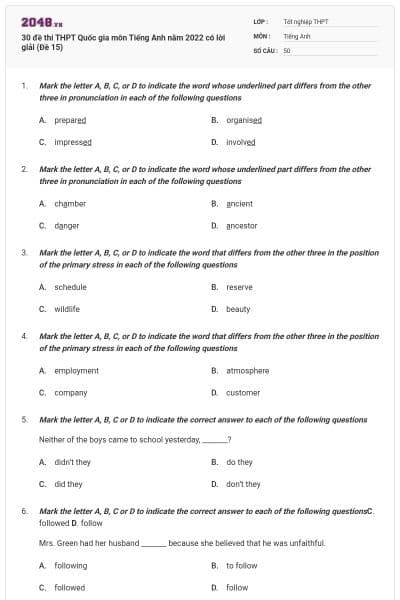
Mark the letter A, B, C, or D to indicate the word whose underlined part differs from the other three in pronunciation in each of the following questions
prepared
organised
impressed
involved
Đáp án C
Kiến thức : Phát âm đuôi – ED
Giải thích:
Phát âm là /t/, còn lại phát âm là /ɪd/
Mark the letter A, B, C, or D to indicate the word whose underlined part differs from the other three in pronunciation in each of the following questions
chamber
ancient
danger
ancestor
Đáp án D
Kiến thức : Phát âm nguyên âm
Giải thích:
- Chamber /'t∫eimbə[r]/ (n): buồng, phòng
- Ancient /'ein∫ənt/ (adj): cổ đại, cổ điển
- Danger /'deindʒə[r]/ (n): sự nguy hiểm
- Ancestor /'ænsestə[r]/ (n): tổ tiên
(“a” được phát âm là /æ/; các từ còn lại là /ei/)
Mark the letter A, B, C, or D to indicate the word that differs from the other three in the position of the primary stress in each of the following questions
schedule
reserve
wildlife
beauty
Đáp án B
Kiến thức : Trọng âm của từ 2 âm tiết
Giải thích: - nhấn âm 2 theo luật: tiền sau hậu trước
Tiền tố nhấn sau, hậu tố nhấn trước
Tiền tố: a, be, con, com, de, dis, en, il, im, in, non, pre, pro, re, un, …
Hậu tố: ion, ment, ty, ance, ence, age, ness, al, ble, ous, ly, less, ic, ics, ish, fy, en, …
Và luật danh từ trọng âm nhấn vào âm tiết 1
Mark the letter A, B, C, or D to indicate the word that differs from the other three in the position of the primary stress in each of the following questions
employment
atmosphere
company
customer
Đáp án A
Kiến thức : Trọng âm của từ 3 âm tiết trở lên
Giải thích: theo luật tiền sau hậu trước và luật 3 âm tiết với y.
A. employment: trọng âm nhấn vào âm tiết 2
B. atmosphere: trọng âm nhấn vào âm tiết 1
C. company: trọng âm nhấn vào âm tiết 1
D. customer: trọng âm nhấn vào âm tiết 1
Mark the letter A, B, C or D to indicate the correct answer to each of the following questions
Neither of the boys came to school yesterday, _______?
didn’t they
do they
did they
don’t they
Đáp án C
Kiến thức: câu hỏi đuôi
Giải thích:
Câu giới thiệu dùng “neither” mang nghĩa phủ định => câu hỏi đuôi phải ở dạng khẳng định
Câu giới thiệu dùng thì quá khứ đơn => câu hỏi đuôi dùng “did”
Câu giới thiệu dùng “the boys” (hai cậu bé) => câu hỏi đuôi dùng “they”
Tạm dịch: Hôm qua không ai trong số hai cậu bé này đi học, đúng không?
Mark the letter A, B, C or D to indicate the correct answer to each of the following questionsC. followed D. follow
Mrs. Green had her husband _______ because she believed that he was unfaithful.
following
to follow
followed
follow
Đáp án C
Kiến thức : Thể bị động
Giải thích:
Công thức bị động với động từ HAVE:
Thể chủ động: S + have + O + V
Thể bị động: S + have + O + Vp2
Tạm dịch: Bà Green thuê người theo dõi chồng vì cô ta tin rằng anh ấy không trung thủy
Mark the letter A, B, C or D to indicate the correct answer to each of the following questions
I believe that he was concerned _______ all those matters which his wife metioned.
upon
over
above
with
Đáp án D
Kiến thức : giới từ
Giải thích:
To be concerned with. Liên quan đến
Tạm dịch: Tôi tin rằng anh ta liên quan đến tất cả những vấn đề mà vợ anh ta đề cập
Mark the letter A, B, C or D to indicate the correct answer to each of the following questions
Growth is of very immediate environmental concern because_______ the more pollutants we throw out into the atmosphere.
the more the world economy grows
the more economy the world grows
the more grows the world economy
the more the world grows economy
Đáp án A
Kiến thức : So sánh kép
Giải thích:
Xét các đáp án:
A. the more the world economy grows → Cấu trúc so sánh kép: The + comparative + S + V, the + comparative + S + V
B. the more economy the world grows → không đúng trật tự cụm từ: economy the world
C. the more grows the world economy → Sai cấu trúc so sánh kép
D. the more the world grows economy → Sai cấu trúc so sánh kép
Tạm dịch: Tăng trưởng là mối quan tâm môi trường trước mắt vì nền kinh tế thế giới càng phát triển thì chúng ta càng thải ra nhiều chất gây ô nhiễm
Mark the letter A, B, C or D to indicate the correct answer to each of the following questions
When I was going to school this morning, I saw a _______ girl. She asked me how to get to Hoan Kiem Lake
beautiful young blonde Russian
beautiful young Russian blonde
blonde young beautiful Russian
Russian young blonde beautiful
Đáp án A
Kiến thức : Trật tự tính tính
Giải thích:
Ta có cách sắp xếp tính từ. OSASCOMP + N
O - opinion: ý kiến
S- size: kích cỡ
A - Age: tuổi
S - shape: hình dáng
C - colour: màu sắc
O - origin: nguồn gốc
M - material: chất liệu
P -purpose: mục đích
→ beautiful – Opinion young - Age blonde – Color Russian → Origin Ta chọn đáp án A
Tạm dịch: Khi tôi đi học sáng nay, tôi nhìn thấy một cô gái Nga trẻ đẹp tóc vàng. Cô ấy hỏi tôi làm thế nào để đến Hồ Hoàn Kiếm
Mark the letter A, B, C or D to indicate the correct answer to each of the following questions
People _______ all trees along the streets at this time two years ago.
are planting
will have been planting
were planting
will be planting
Đáp án C
Kiến thức : Thì quá khứ tiếp diễn
Giải thích:
Mốc thời gian là: “at this time two year ago” chia ở thì quá khứ tiếp diễn
Tạm dịch: Người ta đã đang trồng tất cả các cây dọc theo các con phố vào thời điểm này hai năm trước
Mark the letter A, B, C or D to indicate the correct answer to each of the following questions
Some colors disappear quickly in the sea but blue light bounces back or is reflected, to the surface. This makes the sea look blue. _______, a stormy sky will make the sea look grey
Therefore
Hence
Consequently
However
Đáp án B
Kiến thức: Liên từ
Giải thích:
A. therefore /ˈðer.fɔːr/ (adv): do đó, vì vậy (thường là gắn với một suy luận logic hay một lí do vừa được nhắc đến trước đó)
B. hence/hens/ (adv): vì lý do đó
C. consequently/ˈkɒn.sɪ.kwənt.li/ (adv): do đó, kết quả là (thường của một hành động nào đó)
D. however /ˌhaʊˈev.ər/ (adv): tuy nhiên
Tạm dịch: Một vài màu sắc biến mất nhanh chóng trong biển nhưng ánh sáng xanh dương bật trở lại hay được phản chiếu lại bề mặt. Điều này làm biển có màu xanh. Vì lí do đó, một bầu trời giông bão sẽ làm biển trông xám xịt
Mark the letter A, B, C or D to indicate the correct answer to each of the following questions
By the time I return to my country, I _______ away from home for more than three years
will have been
will be
have been
was
Đáp án A
Kiến thức : Mệnh đề thời gian
Giải thích : - Động từ của mệnh đề trạng ngữ chỉ thời gian chia ở thì hiện tại đơn với « by the time » nên động từ của mệnh đề chính chia ở thì tương lai hoàn thành.tương lai hoàn thành.
Tạm dịch : Tính đến thời điểm về nước, tôi xa quê hương hơn ba năm
Mark the letter A, B, C or D to indicate the correct answer to each of the following questions
_______ to rent a flat, we set about contacting all the accommodation agencies in the city
Deciding
Having decided
To decide
Decided
Đáp án B
Kiến thức : Rút gọn mệnh đề trạng ngữ đồng chủ ngữ
Giải thích :
Khi hai mệnh đề có cùng chủ ngữ, ta có thể lược bỏ chủ ngữ của mệnh đề đầu và chuyển động từ thành:
- V-ing/Having + Vp2 với câu chủ động (dùng Having + Vp2 để nhấn mạnh một hành động xảy ra xong trước một hành động khác trong quá khứ)
- Vp2 với câu bị động
Căn cứ về nghĩa của câu thì vế bị lược ở dạng chủ động và xảy ra trước vế chính nên phải dùng having + Vp2
Tạm dịch: Đã quyết định sẽ thuê một căn hộ, chúng tôi bắt đầu liên lạc với các cơ quan lưu trú ở trong thành phố.
Cấu trúc khác cần lưu ý:
set about: bắt đầu
Mark the letter A, B, C or D to indicate the correct answer to each of the following questions
Nobody wears clothes like that any more – they’re _______.
fashion
unfashionable
fashionable
fashionably
Đáp án B
Kiến thức : Từ loại
Giải thích :
Vị trí trống cần 1 tính từ
Có 2 tính từ:
fashionable: thời trang/ mốt
unfashionable: lỗi mốt/ lạc hậu.
Theo nghĩa của câu, chọn B - unfashionable
Không ai mặc quần áo như thế nữa, chúng lạc hậu hết rồi
Mark the letter A, B, C or D to indicate the correct answer to each of the following questions
In recent years, China has _______ the lead in global warming pollution, producing about 28 percent of all CO2 emissions
put
taken
given
done
Đáp án A
Kiến thức: Cụm từ cố định
Giải thích:
+ take a lead in st: dẫn đầu trong cái gì.
Tạm dịch: Trong những năm gần đây, Trung Quốc đã dẫn đầu trong sự ô nhiễm nóng lên toàn cầu, sản sinh ra 28% tổng khí thải CO2
Mark the letter A, B, C or D to indicate the correct answer to each of the following questions
Many others certainly don't see it that way and are adamant that the late politician was largely to blame for having a(n) _______ for the vision but scant regard for the detail
eye
ear
nose
tongue
Đáp án A
Kiến thức : Thành ngữ
Ta có:
- Have an eye for sth: giỏi, có năng khiếu về cái gì
- Have an ear for sth: có khả năng cảm thụ âm (nhạc) tốt
- Stick sb’s nose in sth: chĩa mũi vào chuyện gì
- On the tip of sb's tongue: ở ngay trên đầu lưỡi, định nói gì mà bất thình lình quên mất.
Tạm dịch: Nhiều người khác chắc chắn không thấy nó theo cách đó và kiên quyết rằng chính trị gia quá cố này đa phần sẽ bị trách cứ cho việc có tài trong việc nhìn ra trông rộng nhưng lại không quan tâm đến tiểu tiết.
Cấu trúc khác cần lưu ý:
Regard for sth: để ý, xem xét cái gì
Blame sb for sth: trách ai vì điều gì
Blame sth on sb: quy trách nhiệm việc gì cho ai
Mark the letter A, B, C or D to indicate the correct answer to each of the following questions
He decided to withdraw from the powerboat race as he had a (n) _______ of danger
omen
premonition
foreboding
prediction
Đáp án B
Kiến thức : Từ vựng
Giải thích:
A. omen /ˈəʊmən/ (n): điềm
B. premonition /ˌpreməˈnɪʃn/ (n): linh cảm
C. foreboding /fɔːˈbəʊdɪŋ/ (n): linh cảm về một điều xấu sắp xảy ra
D. prediction /prɪˈdɪkʃn/ (n): dự đoán
- Cấu trúc: to have a premonition of st: linh cảm về điều gì
- Căn cứ vào nghĩa ta loại A và D. “forebonding” không đi với giới từ “of”. Từ đó ta chọn được B.
Tạm dịch: Anh ấy quyết định rút lai khỏi giải đua xuồng máy vì anh ấy có linh cảm về sự nguy hiểm.
Cấu trúc khác cần lưu ý:
- withdraw from st: rút lui khỏi cái gì
Mark the letter A, B, C or D to indicate the correct answer to each of the following questions
If Bill loses his job, at least they have Mary’s income to _______ on
fall behind
fall for
fall back
fall under
Đáp án C
Kiến thức : Cụm động từ
Giải thích:
Kiến thức về cụm động từ
Xét các đáp án:
A. fall behind: tụt lại phía sau
B. fall for: cảm thất bị thu hút và thích ai đó
C. fall back on: sử dụng đến, trông cậy vào
D. fall under: bị kiểm soát
Tạm dịch: Nếu Bill bị mất việc, ít ra họ còn có thu nhập của Marry để trông cậy vào
Mark the letter A, B, C or D to indicate the correct answer to each of the following questions
Diseases have begun spreading in the _______ of recent disaster.
awareness
place
aftermath
Way
Đáp án C
Kiến thức: từ vựng
Giải thích:
A. awareness (n): sự nhận thức
B. place (n): nơi
C. aftermath (n) hậu quả/ sau
D. way (n): cách thức/ con đường
Tạm dịch: Dịch bệnh đã bắt đầu lây lan sau thảm họa gần đây
Mark the letter A, B, C or D to indicate the word(s) CLOSEST in meaning to the underlined word(s) in each of the following questions
After a long lunch hour, business resumes as usual
continues
resurfaces
delays
responds
Đáp án A
Kiến thức : Đồng nghĩa – trái nghĩa
Giải thích:
- Resume ~ Continue (v): bắt đầu lại, tiếp tục
- Resurface (v): làm lại bề mặt, đặt lại lớp mới (con đường)
- Delay (v): trì hoãn
- Respond (v): phản ứng lại, đáp lại
Tạm dịch: Sau một giờ nghỉ ăn trưa dài, công việc tiếp tục như thường lệ
Mark the letter A, B, C or D to indicate the word(s) CLOSEST in meaning to the underlined word(s) in each of the following questions
The building had originally been a manor house and must have looked beautiful in its heyday
the beginning stage
period of trial
a phase of depression
a time of great success
Đáp án D
Kiến thức : Đồng nghĩa – trái nghĩa
Giải thích:
=> heyday /ˈheɪdeɪ/ (n): thời hoàng kim
Xét các đáp án:
A. the beginning stage: giai đoạn đầu
B. period of trial: giai đoạn thử nghiệm
C. a phase of depression: thời kì suy sụp
D. a time of great success: thời kì thành công lớn
Tạm dịch: Toà nhà đó ban đầu là một trang viên và chắc hẳn trông rất đẹp trong những ngày hoàng kim của nó
Mark the letter A, B, C or D to indicate the word(s) OPPOSITE in meaning to the underlined word(s) in each of the following questions
He was once a benevolent man who gave a lot of his money to local charities
generous
selfish
innocent
bossy
Đáp án B
Kiến thức : Đồng nghĩa – trái nghĩa
Giải thích: - benevolent (a): nhân đức/ từ thiện/ rộng lượng
A. generous (a): rộng lượng/ hào phóng
B. selfish (a): ích kỉ/ nhỏ nhen
C. innocent (a): vô tội/ ngây thơ
D. bossy (a): hống hách/ hách dịch
→ benevolent >< selfish
Tạm dịch: Anh ấy là một người đàn ông rộng lượng người mà tặng rất nhiều tiền cho các tổ chức từ thiện
Mark the letter A, B, C or D to indicate the word(s) OPPOSITE in meaning to the underlined word(s) in each of the following questions
It's not beyond the realm of possibility that some schools may have to cut sport altogether.
possible
impossible
unlikely
certain
Đáp án A
Kiến thức : Đồng nghĩa – trái nghĩa
Giải thích:
- beyond the realm of possibility: bất khả thi/ không có khả năng
A. possible (a): có thể/ có khả năng
B. impossible (a): không có thể/ không có khả năng
C. unlikely (a): không chắc chắn xảy ra
D. certain (a): chắc chắn
beyond the realm of possibility >< possible
Tạm dịch: Không phải là không có khả năng một số trường cắt hoàn toàn thể thao
Mark the letter A, B, C, or D to indicate the sentence that best completes each of the following exchanges
Thomas asked Jane about the flight announcement.
- Thomas: “Has an annoucement been made about the nine o’clock flight to Paris?”
- Jane: “_______.”
Not yet
Yes, it is nine o’clock
I don’t think so
Sorry, I don’t
Đáp án A
Kiến thức : Giao tiếp
Giải thích:
Tạm dịch: Thomas hỏi Jane về thông báo bay.
- Thomas: “Đã có thông báo về chuyến bay 9h đến Paris chưa?”
- Jane: “________.”
A. Vẫn chưa có thông báo
B. Vâng, giờ là 9h
C. Tôi không nghĩ vậy
D. Xin lỗi, tôi không
Theo nội dung của cuộc hội thoại, chọn A
Mark the letter A, B, C, or D to indicate the sentence that best completes each of the following exchanges
Alice asks Mary’s opinion about driving to the countryside at weekend.
- Alice: “How about having a drive to the countryside this weekend?”
- Mary: “_______.”
That’s a good idea
Not at all
No, thanks
Never mind
Đáp án A
Kiến thức : Giao tiếp
Giải thích:
Tạm dịch: Alice hỏi quan điểm của Mary về việc lái xe về quê cuối tuần.
- Alice: “Cuối tuần này chúng ta lái xe về quê nhé”
- Mary: “ ______________”
A. Đó là một ý kiến hay (thể hiện sự đồng ý)
B. Không có gì
C. Không, cảm ơn (trả lời khi từ chối lời mời ăn/uống gì đó)
D. Quên chuyện đó đi
Read the following passage and mark the letter A, B, C, or D to indicate the correct word or phrase that best fits each the numbered blanks
The Covid-19 coronavirus outbreak is a new illness and scientists are still (26) _______ how it spreads from person to person, but similar viruses tend to spread via cough and sneeze droplets. When an infected person coughs or sneezes, they release droplets of saliva or mucus. These droplets can fall on people in the vicinity and can be either directly inhaled or picked up on the hands then (27) _______ when someone touches their face, causing infection. For flu, some hospital guidelines define exposure as being within six feet of an infected person (28) _______ sneezes or coughs for 10 minutes or longer. Viruses can also be spread through droplets landing on surfaces such as seats on buses or trains or desks in school. (29) _______, whether this is a main transmission route depends on how long viruses survive on surfaces – this can vary from hours to months. There is anecdotal evidence that the virus can be spread by people before they have symptoms. Some (30) _______ illnesses such as flu can be passed from one person to another before symptoms occur – but the extent to which this is happening with the new coronavirus is not well understood yet.
(Adapted from: https://medihome.com.vn)
Điền vào ô 26
admitting
Presuming
assessing
accounting
Đáp án C
Kiến thức : Đọc điền từ
Giải thích:
A. admitting: chấp nhận
B. Presuming: coi như là
C. assessing: đánh giá
D. accounting: cho là, coi như là
Thông tin: The Covid-19 coronavirus outbreak is a new illness and scientists are still (26) __assessing__ how it spreads from person to person, but similar viruses tend to spread via cough and sneeze droplets.
Tạm dịch: Bùng phát dịch vi rút Cô rô na Covid-19 là một bệnh mới và các nhà khoa học vẫn đang(26) đánh giá nó lây lan từ người sang người như thế nào, nhưng những vi rút nhỏ có xu hướng lây lan qua giọt dịch ho và hắt hơi
Read the following passage and mark the letter A, B, C, or D to indicate the correct word or phrase that best fits each the numbered blanks
The Covid-19 coronavirus outbreak is a new illness and scientists are still (26) _______ how it spreads from person to person, but similar viruses tend to spread via cough and sneeze droplets. When an infected person coughs or sneezes, they release droplets of saliva or mucus. These droplets can fall on people in the vicinity and can be either directly inhaled or picked up on the hands then (27) _______ when someone touches their face, causing infection. For flu, some hospital guidelines define exposure as being within six feet of an infected person (28) _______ sneezes or coughs for 10 minutes or longer. Viruses can also be spread through droplets landing on surfaces such as seats on buses or trains or desks in school. (29) _______, whether this is a main transmission route depends on how long viruses survive on surfaces – this can vary from hours to months. There is anecdotal evidence that the virus can be spread by people before they have symptoms. Some (30) _______ illnesses such as flu can be passed from one person to another before symptoms occur – but the extent to which this is happening with the new coronavirus is not well understood yet.
(Adapted from: https://medihome.com.vn)
Điền vào ô 27
transferred
exchanged
transformed
emerged
Đáp án A
Kiến thức : Đọc điền từ
Giải thích:
A. transferred: truyền sang
B. exchanged: trao đổi
C. transformed: chuyển đổi
D. emerged: nổi lên
Thông tin: These droplets can fall on people in the vicinity (xung quanh) and can be either directly inhaled or picked up on the hands then (27) transferred when someone touches their face, causing infection.
Tạm dịch: Những giọt dịch này có thể rơi xuống người xung quanh và có thể hoặc hít trực tiếp hoặc bám vào tay sau đó (27) truyền sang khi chạm vào mặt gây ra nhiễm trùng
Read the following passage and mark the letter A, B, C, or D to indicate the correct word or phrase that best fits each the numbered blanks
The Covid-19 coronavirus outbreak is a new illness and scientists are still (26) _______ how it spreads from person to person, but similar viruses tend to spread via cough and sneeze droplets. When an infected person coughs or sneezes, they release droplets of saliva or mucus. These droplets can fall on people in the vicinity and can be either directly inhaled or picked up on the hands then (27) _______ when someone touches their face, causing infection. For flu, some hospital guidelines define exposure as being within six feet of an infected person (28) _______ sneezes or coughs for 10 minutes or longer. Viruses can also be spread through droplets landing on surfaces such as seats on buses or trains or desks in school. (29) _______, whether this is a main transmission route depends on how long viruses survive on surfaces – this can vary from hours to months. There is anecdotal evidence that the virus can be spread by people before they have symptoms. Some (30) _______ illnesses such as flu can be passed from one person to another before symptoms occur – but the extent to which this is happening with the new coronavirus is not well understood yet.
(Adapted from: https://medihome.com.vn)
Điền vào ô 28
which
where
who
when
Đáp án C
Kiến thức : Đọc điền từ
Giải thích:
- Kiến thức về đại từ quan hệ. Trước chỗ trống là PERSON - danh từ chỉ người và sau chỗ trống là SNEEZES - động từ nên cần đại từ quan hệ WHO.
Thông tin: For flu, some hospital guidelines define exposure as being within six feet of an infected person (28) _who_ sneezes or coughs for 10 minutes or longer.
Tạm dịch: Đối với bệnh cúm, một số hướng dẫn của bệnh viện định nghĩa phơi nhiễm là khi người bị nhiễm bệnh trong vòng sáu feet (28) người mà hắt hơi hoặc ho trong 10 phút hoặc lâu hơn
Read the following passage and mark the letter A, B, C, or D to indicate the correct word or phrase that best fits each the numbered blanks
The Covid-19 coronavirus outbreak is a new illness and scientists are still (26) _______ how it spreads from person to person, but similar viruses tend to spread via cough and sneeze droplets. When an infected person coughs or sneezes, they release droplets of saliva or mucus. These droplets can fall on people in the vicinity and can be either directly inhaled or picked up on the hands then (27) _______ when someone touches their face, causing infection. For flu, some hospital guidelines define exposure as being within six feet of an infected person (28) _______ sneezes or coughs for 10 minutes or longer. Viruses can also be spread through droplets landing on surfaces such as seats on buses or trains or desks in school. (29) _______, whether this is a main transmission route depends on how long viruses survive on surfaces – this can vary from hours to months. There is anecdotal evidence that the virus can be spread by people before they have symptoms. Some (30) _______ illnesses such as flu can be passed from one person to another before symptoms occur – but the extent to which this is happening with the new coronavirus is not well understood yet.
(Adapted from: https://medihome.com.vn)
Điền vào ô 29
Moreover
However
Therefore
In fact
Đáp án B
Kiến thức : Đọc điền từ
Giải thích:
A. Moreover: hơn nữa
B. However: tuy nhiên
C. Therefore: cho nên
D. In fact: thực tế
Thông tin: Viruses can also be spread through droplets landing on surfaces such as seats on buses or trains or desks in school. (29)_However_, whether this is a main transmission route depends on how long viruses survive on surfaces – this can vary from hours to months.
Tạm dịch: Virus cũng có thể lây lan qua các giọt nhỏ rơi xuống các bề mặt như ghế ngồi trên xe buýt, xe lửa hoặc bàn trong trường học. (29) _Tuy nhiên_, liệu đây có phải là đường lây truyền chính hay không tùy thuộc vào thời gian vi rút tồn tại trên bề mặt - điều này có thể thay đổi từ hàng giờ đến hàng tháng
Read the following passage and mark the letter A, B, C, or D to indicate the correct word or phrase that best fits each the numbered blanks
The Covid-19 coronavirus outbreak is a new illness and scientists are still (26) _______ how it spreads from person to person, but similar viruses tend to spread via cough and sneeze droplets. When an infected person coughs or sneezes, they release droplets of saliva or mucus. These droplets can fall on people in the vicinity and can be either directly inhaled or picked up on the hands then (27) _______ when someone touches their face, causing infection. For flu, some hospital guidelines define exposure as being within six feet of an infected person (28) _______ sneezes or coughs for 10 minutes or longer. Viruses can also be spread through droplets landing on surfaces such as seats on buses or trains or desks in school. (29) _______, whether this is a main transmission route depends on how long viruses survive on surfaces – this can vary from hours to months. There is anecdotal evidence that the virus can be spread by people before they have symptoms. Some (30) _______ illnesses such as flu can be passed from one person to another before symptoms occur – but the extent to which this is happening with the new coronavirus is not well understood yet.
(Adapted from: https://medihome.com.vn)
Điền vào ô 30
every
one
another
other
Đáp án D
Kiến thức : Đọc điền từ
Giải thích:
- Lượng từ:
A. every + N (số it/ nhiều): mọi …
B. one + N (số it): một …
C. another + N (số ít): … khác
D. other + N (số nhiều): … khác
Thông tin: Some (30)_other_ illnesses such as flu can be passed from one person to another before symptoms occur – but the extent to which this is happening with the new coronavirus is not well understood yet.
Tạm dịch: Một số bệnh như cúm khác có thể truyền từ người này sang người khác trước khi các triệu chứng xảy ra - nhưng mức độ mà điều này xảy ra với loại coronavirus mới vẫn chưa được hiểu rõ
Read the following passage and mark the letter A, B, C, or D to indicate the answer to each of the question
In the near term, the goal of keeping AI’s impact on society beneficial motivates research in many areas, from economics and law to technical topics such as verification, validity, security and control. Whereas it may be little more than a minor nuisance if your laptop crashes or gets hacked, it becomes all the more important that an AI system does what you want it to do if it controls your car, your airplane, your pacemaker, your automated trading system or your power grid. Another short-term challenge is preventing a devastating arms race in lethal autonomous weapons.
In the long term, an important question is what will happen if the quest for strong AI succeeds and an AI system becomes better than humans at all cognitive tasks. Such a system could potentially undergo recursive self-improvement, triggering an intelligence explosion leaving human intellect far behind. By inventing revolutionary new technologies, such a superintelligence might help us eradicate war, disease, and poverty, and so the creation of strong AI might be the biggest event in human history. Some experts have expressed concern, though, that it might also be the last, unless we learn to align the goals of the AI with ours before it becomes superintelligent.
There are some who question whether strong AI will ever be achieved, and others who insist that the creation of superintelligent AI is guaranteed to be beneficial. At FLI we recognize both of these possibilities, but also recognize the potential for an artificial intelligence system to intentionally or unintentionally cause great harm. We believe research today will help us better prepare for and prevent such potentially negative consequences in the future, thus enjoying the benefits of AI while avoiding pitfalls.
(source: https://www.beyondteaching.com/)
Which best serves as the title for the passage?
Transcending complacency on superintelligent machines.
No time like the present for AI safety work.
The importance of researching AI safety.
Challenges to ensuring the safety of AI systems.
Đáp án C
Kiến thức : Đọc hiểu
Giải thích:
Đâu là tiêu đề thích hợp nhất cho bài văn?
A. Sự tự mãn quá mức của các máy tính siêu trí tuệ.
B. Hiện tại là lúc thích hợp nhất để thực hiện công tác an toàn cho AI.
C. Tầm quan trọng của việc nghiên cứu công tác an toàn cho AI.
D. Những thách thức trong việc đảm bảo sự an toàn của các hệ thống AI.
Giải thích:
Đáp án A sai vì hoàn toàn lệch với nội dung của bài văn.
Đáp án B sai vì bài văn không nhấn mạnh thời gian nghiên cứu là hiện tại.
Đáp án C đúng vì bài văn nêu ra các trường hợp xấu có thể xảy ra nếu AI mất kiểm soát.
Đáp án D sai vì bài văn nhắc đến những khó khăn AI sẽ tạo ra mà không phải là những thách thức trong quá trình loại bỏ những khó khăn này
Read the following passage and mark the letter A, B, C, or D to indicate the answer to each of the question
In the near term, the goal of keeping AI’s impact on society beneficial motivates research in many areas, from economics and law to technical topics such as verification, validity, security and control. Whereas it may be little more than a minor nuisance if your laptop crashes or gets hacked, it becomes all the more important that an AI system does what you want it to do if it controls your car, your airplane, your pacemaker, your automated trading system or your power grid. Another short-term challenge is preventing a devastating arms race in lethal autonomous weapons.
In the long term, an important question is what will happen if the quest for strong AI succeeds and an AI system becomes better than humans at all cognitive tasks. Such a system could potentially undergo recursive self-improvement, triggering an intelligence explosion leaving human intellect far behind. By inventing revolutionary new technologies, such a superintelligence might help us eradicate war, disease, and poverty, and so the creation of strong AI might be the biggest event in human history. Some experts have expressed concern, though, that it might also be the last, unless we learn to align the goals of the AI with ours before it becomes superintelligent.
There are some who question whether strong AI will ever be achieved, and others who insist that the creation of superintelligent AI is guaranteed to be beneficial. At FLI we recognize both of these possibilities, but also recognize the potential for an artificial intelligence system to intentionally or unintentionally cause great harm. We believe research today will help us better prepare for and prevent such potentially negative consequences in the future, thus enjoying the benefits of AI while avoiding pitfalls.
(source: https://www.beyondteaching.com/)
According to paragraph 1, what is NOT mentioned as a potential benefit of AI?
Facilitating the identification system.
Managing the electricity in homes.
Controlling vehicles and gadgets.
Curing life-threatening diseases.
Đáp án D
Kiến thức : Đọc hiểu
Giải thích:
Theo đoạn 1, những gì không được đề cập là lợi ích tiềm năng của Al?
A. Tạo điều kiện cho hệ thống nhận dạng
B. Quản lý điện trong nhà
C. Điều khiển phương tiện và tiện ích
D. Chữa các bệnh đe dọa đến tính mạng
Thông tin: Whereas it may be little more than a minor nuisance if your laptop crashes or gets hacked, it becomes all the more important that an Al system does what you want it to do if it controls your car, your airplane, your pacemaker, your automated trading system or your power grid.
Tạm dịch: Trong khi đó, nó có thể ít phiền toái hơn nếu máy tính xách tay của bạn gặp sự cố hoặc bị hack, điều quan trọng hơn là hệ thống Al sẽ làm những gì bạn muốn nó làm nếu nó điều khiển xe hơi, máy bay, máy tạo nhịp tim, hệ thống giao dịch tự động hoặc mạng lưới điện
Read the following passage and mark the letter A, B, C, or D to indicate the answer to each of the question
In the near term, the goal of keeping AI’s impact on society beneficial motivates research in many areas, from economics and law to technical topics such as verification, validity, security and control. Whereas it may be little more than a minor nuisance if your laptop crashes or gets hacked, it becomes all the more important that an AI system does what you want it to do if it controls your car, your airplane, your pacemaker, your automated trading system or your power grid. Another short-term challenge is preventing a devastating arms race in lethal autonomous weapons.
In the long term, an important question is what will happen if the quest for strong AI succeeds and an AI system becomes better than humans at all cognitive tasks. Such a system could potentially undergo recursive self-improvement, triggering an intelligence explosion leaving human intellect far behind. By inventing revolutionary new technologies, such a superintelligence might help us eradicate war, disease, and poverty, and so the creation of strong AI might be the biggest event in human history. Some experts have expressed concern, though, that it might also be the last, unless we learn to align the goals of the AI with ours before it becomes superintelligent.
There are some who question whether strong AI will ever be achieved, and others who insist that the creation of superintelligent AI is guaranteed to be beneficial. At FLI we recognize both of these possibilities, but also recognize the potential for an artificial intelligence system to intentionally or unintentionally cause great harm. We believe research today will help us better prepare for and prevent such potentially negative consequences in the future, thus enjoying the benefits of AI while avoiding pitfalls.
(source: https://www.beyondteaching.com/)
The word “recursive” in paragraph 2 is closest in meaning to ______.
powerful
repeated
impossible
monotonous
Đáp án B
Kiến thức : Đọc hiểu
Giải thích: Từ "recursive" trong đoạn 2 có nghĩa gần nhất với _______.
A. mạnh mẽ
B. lặp đi lặp lại
C. không thể
D. đơn điệu
Từ đồng nghĩa recursive (đệ quy - Đệ quy là quá trình lặp đi lặp lại một thành phần theo cùng một cách) = repeated
Thông tin: Such a system could potentially undergo recursive self-improvement, triggering an intelligence explosion leaving human intellect far behind.
Tạm dịch: Một hệ thống như vậy có thể có khả năng trải qua quá trình tự cải thiện đệ quy, gây ra vụ bùng nổ trí tuệ thông minh bỏ xa trí thông minh của con người
Read the following passage and mark the letter A, B, C, or D to indicate the answer to each of the question
In the near term, the goal of keeping AI’s impact on society beneficial motivates research in many areas, from economics and law to technical topics such as verification, validity, security and control. Whereas it may be little more than a minor nuisance if your laptop crashes or gets hacked, it becomes all the more important that an AI system does what you want it to do if it controls your car, your airplane, your pacemaker, your automated trading system or your power grid. Another short-term challenge is preventing a devastating arms race in lethal autonomous weapons.
In the long term, an important question is what will happen if the quest for strong AI succeeds and an AI system becomes better than humans at all cognitive tasks. Such a system could potentially undergo recursive self-improvement, triggering an intelligence explosion leaving human intellect far behind. By inventing revolutionary new technologies, such a superintelligence might help us eradicate war, disease, and poverty, and so the creation of strong AI might be the biggest event in human history. Some experts have expressed concern, though, that it might also be the last, unless we learn to align the goals of the AI with ours before it becomes superintelligent.
There are some who question whether strong AI will ever be achieved, and others who insist that the creation of superintelligent AI is guaranteed to be beneficial. At FLI we recognize both of these possibilities, but also recognize the potential for an artificial intelligence system to intentionally or unintentionally cause great harm. We believe research today will help us better prepare for and prevent such potentially negative consequences in the future, thus enjoying the benefits of AI while avoiding pitfalls.
(source: https://www.beyondteaching.com/)
The word “it” in paragraph 2 refers to _______.
event
human
history
poverty
Đáp án A
Kiến thức : Đọc hiểu
Giải thích: Từ "nó" trong đoạn 2 đề cập đến
A. sự kiện
B. con người
C. lịch sử
D. sự nghèo đói
Từ “it” dùng để thay thế cho danh từ sự kiện được nhắc tới trước đó.
Thông tin: Al might be the biggest event in human history. Some experts have expressed concern, though, that it might also be the last, unless we learn to align the goals of the Al with ours before it becomes superintelligent.
Tạm dịch: AI (trí tuệ nhân tạo) có thể là sự kiện lớn nhất trong lịch sử loài người. Một số chuyên gia đã bày tỏ sự quan tâm, mặc dù, nó cũng có thể là lần cuối cùng, trừ khi chúng ta học cách sắp xếp các mục tiêu của Al với chúng ta trước nó trở nên siêu thông minh
Read the following passage and mark the letter A, B, C, or D to indicate the answer to each of the question
In the near term, the goal of keeping AI’s impact on society beneficial motivates research in many areas, from economics and law to technical topics such as verification, validity, security and control. Whereas it may be little more than a minor nuisance if your laptop crashes or gets hacked, it becomes all the more important that an AI system does what you want it to do if it controls your car, your airplane, your pacemaker, your automated trading system or your power grid. Another short-term challenge is preventing a devastating arms race in lethal autonomous weapons.
In the long term, an important question is what will happen if the quest for strong AI succeeds and an AI system becomes better than humans at all cognitive tasks. Such a system could potentially undergo recursive self-improvement, triggering an intelligence explosion leaving human intellect far behind. By inventing revolutionary new technologies, such a superintelligence might help us eradicate war, disease, and poverty, and so the creation of strong AI might be the biggest event in human history. Some experts have expressed concern, though, that it might also be the last, unless we learn to align the goals of the AI with ours before it becomes superintelligent.
There are some who question whether strong AI will ever be achieved, and others who insist that the creation of superintelligent AI is guaranteed to be beneficial. At FLI we recognize both of these possibilities, but also recognize the potential for an artificial intelligence system to intentionally or unintentionally cause great harm. We believe research today will help us better prepare for and prevent such potentially negative consequences in the future, thus enjoying the benefits of AI while avoiding pitfalls.
(source: https://www.beyondteaching.com/)
According to paragraph 3, which information is incorrect about the future of AI?
We cannot deny the likelihood of AI turning on its creator – the human.
The emergence of superintelligence will yield valuable benefits for human.
One of the focus of AI system nowadays should be preparation and preventive measures.
The probability of malicious artificial intelligence is an unexpected zero.
Đáp án D
Kiến thức : Đọc hiểu
Giải thích:
Theo đoạn 3, thông tin nào không chính xác về tương lai của Al?
A. Chúng ta không thể phủ nhận khả năng Al phản lại người tạo ra nó - con người
B. Sự xuất hiện của siêu trí tuệ sẽ mang lại lợi ích có giá trị cho con người
C. Một trong những trọng tâm của hệ thống Al hiện nay nên là các biện pháp chuẩn bị và phòng ngừa
D. Xác suất của trí tuệ nhân tạo độc hại là một con số không mong đợi
Thông tin: There are some who question whether strong Al will ever be achieved, and others who insist that the creation of superintelligent Al is guaranteed to be beneficial. At FLI we recognize both of these possibilities, but also recognize the potential for an artificial intelligence system to intentionally or unintentionally cause great harm. We believe research today will help US better prepare for and prevent such potentially negative consequences in the future
Tạm dịch: Có một số người đặt câu hỏi liệu Al sẽ đạt được sức mạnh hay không, và những người khác khăng khăng rằng việc tạo ra Al siêu thông minh được đảm bảo là có lợi. Tại FLI, chúng tôi nhận ra cả hai khả năng này, nhưng cũng nhận ra tiềm năng của một hệ thống trí tuệ nhân tạo có thể cố ý hoặc vô ý gây ra tác hại lớn. Chúng tôi tin rằng nghiên cứu ngày hôm nay sẽ giúp Mỹ chuẩn bị tốt hơn và ngăn chặn những hậu quả tiêu cực tiềm ẩn như vậy trong tương lai
Read the following passage and mark the letter A, B, C, or D to indicate the answer to each of the question
Times are tough. The nightly news is filled with stories of people who have lost their jobs due to the economic crisis, or lost their homes in a fire or natural disaster. Have you ever seen people who have just endured an awful situation? Some focus on what they have lost, and this is easy to understand. But other people focus on what they did not lose, and they start thinking about a better future.
One good piece of advice to remember is that you cannot always control situations or other people. The only thing you can control is your own personal reaction to bad situations. Sometimes a situation may really be overwhelming. However, in many cases, you really can influence our own moods by the way you think about negative situations.
Imagine two families: Both have lost their homes and all their belongings in a devastating storm. One family cannot mask their grief. They feel that everything they hold dear has been destroyed. They cannot imagine how they will ever be able to replace things and start over again. Their normal life seems to have been completely lost. In contrast, a second family is crying with joy. All of the people in their family are unharmed and safe. This family is just happy that everyone has survived. This family is already trying to figure out how they can recover. You can’t really blame the first family for experiencing a very normal reaction to a terrible situation. However, the second family certainly seems to be better off. They are thinking about making progress rather than focusing on the tragic events.
Though this scenario is extreme, everyone experiences setbacks that seem just awful at the time. This could be a job loss, illness, or problems with family members. Nobody gets through life without having some bad things happen. In these situations, try to focus on the steps you can take to remedy the situation, instead of how awful the setback is. By doing this, you will be laying the foundation for a better tomorrow. And you will not suffer as much pain today.
Actually, controlling how you feel and trying to maintain a positive attitude can help you through many tough situations. The bottom line is, no matter what the problem is, you are more likely to fix it if you can stay positive and work out a plan. Also, never be afraid to seek help when you need it. The advice of a friend, family member, or even a professional may be all it takes to get back on track.
It may sound like a cliché. While a positive attitude may not be the answer to every problem, it can certainly give you an advantage in surviving most of life’s minor setbacks.
(Adapted from “Select Readings – Upper Intermediate” by Linda Lee and Erik Gundersen)
Which of the following could be the main idea of the passage?
Being optimistic is an effective way to get over bad situations.
Keeping positive or negative thoughts is the own choice of each person.
Positive thoughts are necessary conditions to be successful.
There seems to have more pessimists than optimists.
Đáp án A
Kiến thức : Đọc hiểu
Giải thích: Câu nào trong các câu sau đây có thể là ý chính của đoạn văn?
A. Lạc quan là một cách rất hiệu quả để vượt qua các hoàn cảnh khó khăn.
B. Giữ suy nghĩ tích cực hay tiêu cực là lựa chọn riêng của mỗi người.
C. Suy nghĩ tích cực là điều kiện cần thiết để thành công.
D. Dường như là có nhiều người bi quan hơn lạc quan.
Thông tin đoạn đầu: Have you ever seen people who have just endured an awful situation? Some focus on what they have lost, and this is easy to understand. But other people focus on what they did not lose, and they start thinking about a better future.
Tạm dịch: Bạn đã từng thấy những người phải trải qua một tình huống tồi tệ? Vài người chỉ chăm chú vào những gì họ đã mất, và điều này cũng dễ hiểu. Nhưng những người khác chỉ tập trung vào những điều họ chưa mất, và họ bắt đầu nghĩ về 1 tương lai tốt hơn.
Thông tin đoạn đầu và đoạn cuối: It may sound like a cliché. While a positive attitude may not be the answer to every problem, it can certainly give you an advantage in surviving most of life’s minor setbacks.
Tạm dịch: Nó nghe như 1 câu sáo rỗng. Mặc dù thái độ tích cực không phải là chìa khóa cho mọi vấn đề, nhưng nó chắc chắn sẽ cho bạn cơ hội vượt qua mọi khó khăn nhỏ trong cuộc sống
Read the following passage and mark the letter A, B, C, or D to indicate the answer to each of the question
Times are tough. The nightly news is filled with stories of people who have lost their jobs due to the economic crisis, or lost their homes in a fire or natural disaster. Have you ever seen people who have just endured an awful situation? Some focus on what they have lost, and this is easy to understand. But other people focus on what they did not lose, and they start thinking about a better future.
One good piece of advice to remember is that you cannot always control situations or other people. The only thing you can control is your own personal reaction to bad situations. Sometimes a situation may really be overwhelming. However, in many cases, you really can influence our own moods by the way you think about negative situations.
Imagine two families: Both have lost their homes and all their belongings in a devastating storm. One family cannot mask their grief. They feel that everything they hold dear has been destroyed. They cannot imagine how they will ever be able to replace things and start over again. Their normal life seems to have been completely lost. In contrast, a second family is crying with joy. All of the people in their family are unharmed and safe. This family is just happy that everyone has survived. This family is already trying to figure out how they can recover. You can’t really blame the first family for experiencing a very normal reaction to a terrible situation. However, the second family certainly seems to be better off. They are thinking about making progress rather than focusing on the tragic events.
Though this scenario is extreme, everyone experiences setbacks that seem just awful at the time. This could be a job loss, illness, or problems with family members. Nobody gets through life without having some bad things happen. In these situations, try to focus on the steps you can take to remedy the situation, instead of how awful the setback is. By doing this, you will be laying the foundation for a better tomorrow. And you will not suffer as much pain today.
Actually, controlling how you feel and trying to maintain a positive attitude can help you through many tough situations. The bottom line is, no matter what the problem is, you are more likely to fix it if you can stay positive and work out a plan. Also, never be afraid to seek help when you need it. The advice of a friend, family member, or even a professional may be all it takes to get back on track.
It may sound like a cliché. While a positive attitude may not be the answer to every problem, it can certainly give you an advantage in surviving most of life’s minor setbacks.
(Adapted from “Select Readings – Upper Intermediate” by Linda Lee and Erik Gundersen)
The word “grief” in paragraph 3 is closest in meaning to ________.
problem
sorrow
disappointment
damage
Đáp án B
Kiến thức : Đọc hiểu
Giải thích: Từ “grief” trong đoạn 3 gần nghĩa nhất với từ ___________.
A. vấn đề
B. nỗi buồn
C. sự thất vọng
D. sự thiệt hại
Từ đồng nghĩa: grief (nỗi đau buồn) = sorrow
Thông tin: Both have lost their homes and all their belongings in a devastating storm. One family cannot mask their grief. They feel that everything they hold dear has been destroyed.
Tạm dịch: Cả 2 gia đình đều mất nhà và toàn bộ của cải trong trận bão kinh hoàng. Một gia đình không thể che giấu nỗi buồn của họ. Họ cảm thấy rằng mọi thứ họ có đã bị phá hủy hoàn toàn
Read the following passage and mark the letter A, B, C, or D to indicate the answer to each of the question
Times are tough. The nightly news is filled with stories of people who have lost their jobs due to the economic crisis, or lost their homes in a fire or natural disaster. Have you ever seen people who have just endured an awful situation? Some focus on what they have lost, and this is easy to understand. But other people focus on what they did not lose, and they start thinking about a better future.
One good piece of advice to remember is that you cannot always control situations or other people. The only thing you can control is your own personal reaction to bad situations. Sometimes a situation may really be overwhelming. However, in many cases, you really can influence our own moods by the way you think about negative situations.
Imagine two families: Both have lost their homes and all their belongings in a devastating storm. One family cannot mask their grief. They feel that everything they hold dear has been destroyed. They cannot imagine how they will ever be able to replace things and start over again. Their normal life seems to have been completely lost. In contrast, a second family is crying with joy. All of the people in their family are unharmed and safe. This family is just happy that everyone has survived. This family is already trying to figure out how they can recover. You can’t really blame the first family for experiencing a very normal reaction to a terrible situation. However, the second family certainly seems to be better off. They are thinking about making progress rather than focusing on the tragic events.
Though this scenario is extreme, everyone experiences setbacks that seem just awful at the time. This could be a job loss, illness, or problems with family members. Nobody gets through life without having some bad things happen. In these situations, try to focus on the steps you can take to remedy the situation, instead of how awful the setback is. By doing this, you will be laying the foundation for a better tomorrow. And you will not suffer as much pain today.
Actually, controlling how you feel and trying to maintain a positive attitude can help you through many tough situations. The bottom line is, no matter what the problem is, you are more likely to fix it if you can stay positive and work out a plan. Also, never be afraid to seek help when you need it. The advice of a friend, family member, or even a professional may be all it takes to get back on track.
It may sound like a cliché. While a positive attitude may not be the answer to every problem, it can certainly give you an advantage in surviving most of life’s minor setbacks.
(Adapted from “Select Readings – Upper Intermediate” by Linda Lee and Erik Gundersen)
What does the word “they” in paragraph 3 refer to?
tragic events
all of the people
the first family
the second family
Đáp án D
Kiến thức : Đọc hiểu
Giải thích: Từ “they” trong đoạn 3 đề cập đến từ nào?
A. thảm kịch
B. tất cả mọi người
C. gia đình thứ nhất
D. gia đình thứ hai
Thông tin đoạn 3: However, the second family certainly seems to be better off. They are thinking about making progress rather than focusing on the tragic events.
Tạm dịch: Tuy nhiên, gia đình thứ 2 chắc chắn có vẻ tốt hơn. Họ đang suy nghĩ về việc làm sao để cải thiện tình hình chứ không tập trung vào thảm kịch
Read the following passage and mark the letter A, B, C, or D to indicate the answer to each of the question
Times are tough. The nightly news is filled with stories of people who have lost their jobs due to the economic crisis, or lost their homes in a fire or natural disaster. Have you ever seen people who have just endured an awful situation? Some focus on what they have lost, and this is easy to understand. But other people focus on what they did not lose, and they start thinking about a better future.
One good piece of advice to remember is that you cannot always control situations or other people. The only thing you can control is your own personal reaction to bad situations. Sometimes a situation may really be overwhelming. However, in many cases, you really can influence our own moods by the way you think about negative situations.
Imagine two families: Both have lost their homes and all their belongings in a devastating storm. One family cannot mask their grief. They feel that everything they hold dear has been destroyed. They cannot imagine how they will ever be able to replace things and start over again. Their normal life seems to have been completely lost. In contrast, a second family is crying with joy. All of the people in their family are unharmed and safe. This family is just happy that everyone has survived. This family is already trying to figure out how they can recover. You can’t really blame the first family for experiencing a very normal reaction to a terrible situation. However, the second family certainly seems to be better off. They are thinking about making progress rather than focusing on the tragic events.
Though this scenario is extreme, everyone experiences setbacks that seem just awful at the time. This could be a job loss, illness, or problems with family members. Nobody gets through life without having some bad things happen. In these situations, try to focus on the steps you can take to remedy the situation, instead of how awful the setback is. By doing this, you will be laying the foundation for a better tomorrow. And you will not suffer as much pain today.
Actually, controlling how you feel and trying to maintain a positive attitude can help you through many tough situations. The bottom line is, no matter what the problem is, you are more likely to fix it if you can stay positive and work out a plan. Also, never be afraid to seek help when you need it. The advice of a friend, family member, or even a professional may be all it takes to get back on track.
It may sound like a cliché. While a positive attitude may not be the answer to every problem, it can certainly give you an advantage in surviving most of life’s minor setbacks.
(Adapted from “Select Readings – Upper Intermediate” by Linda Lee and Erik Gundersen)
It can be inferred from the third paragraph that ________.
disappointment and sadness are all people’s common emotions in terrible situations.
your attitude in terrible situations is more important than how serious the problems are.
optimists often suffer less terrible situations than pessimists.
your attitude will decide the way you react to terrible situations.
Đáp án D
Kiến thức : Đọc hiểu
Giải thích: Có thể suy ra từ đoạn 3 rằng ______________.
A. Sự thất vọng và nỗi buồn là cảm xúc chung của tất cả mọi người trong hoàn cảnh khó khăn.
B. Thái độ của bạn trong các hoàn cảnh khó khăn thì quan trọng hơn là việc vấn đề đó nghiêm trọng đến mức nào.
C. Người lạc quan thường ít gặp phải các hoàn cảnh khó khăn hơn người bi quan.
D. Thái độ của bạn sẽ quyết định cách bạn phản ứng lại các hoàn cảnh khó khăn.
Thông tin đoạn 3: Imagine two families: Both have lost their homes and all their belongings in a devastating storm. One family cannot mask their grief. They feel that everything they hold dear has been destroyed. They cannot imagine how they will ever be able to replace things and start over again. Their normal life seems to have been completely lost. In contrast, a second family is crying with joy. All of the people in their family are unharmed and safe. This family is just happy that everyone has survived. This family is already trying to figure out how they can recover. You can’t really blame the first family for experiencing a very normal reaction to a terrible situation. However, the second family certainly seems to be better off. They are thinking about making progress rather than focusing on the tragic events.
Tạm dịch: Hãy tưởng tượng có 2 gia đình: Cả 2 gia đình đều mất nhà và toàn bộ của cải trong trận bão kinh hoàng. Một gia đình không thể che giấu nỗi buồn của họ. Họ cảm thấy rằng mọi thứ họ có đã bị phá hủy hoàn toàn. Họ không thế tưởng tượng họ có thể thay thế những thứ đã mất đi và làm lại như thế nào. Cuộc sống bình thường của họ dường như đã biến mất hoàn toàn. Ngược lại, gia đình thứ 2 lại reo hò trong niềm sung sướng. Tất cả mọi người trong gia đình của họ không bị thương và rất an toàn. Gia đình này cảm thấy hạnh phúc vì mọi người đều sống sót. Gia đình này đang cố gắng tìm ra cách để vượt qua. Bạn không thể trách gia đình số 1 vì đã phản ứng theo cách rất thông thường trước hoàn cảnh khó khăn. Tuy nhiên, gia đình thứ 2 chắc chắn có vẻ tốt hơn. Họ đang suy nghĩ về việc làm sao để cải thiện tình hình chứ không tập trung vào thảm kịch.
Từ đoạn văn này có thể thấy rằng: Mỗi gia đình có 1 thái độ khác nhau trước hoàn cảnh khó khăn, và thái độ của họ sẽ quyết định cách họ đối mặt với khó khăn như thế nào
Read the following passage and mark the letter A, B, C, or D to indicate the answer to each of the question
Times are tough. The nightly news is filled with stories of people who have lost their jobs due to the economic crisis, or lost their homes in a fire or natural disaster. Have you ever seen people who have just endured an awful situation? Some focus on what they have lost, and this is easy to understand. But other people focus on what they did not lose, and they start thinking about a better future.
One good piece of advice to remember is that you cannot always control situations or other people. The only thing you can control is your own personal reaction to bad situations. Sometimes a situation may really be overwhelming. However, in many cases, you really can influence our own moods by the way you think about negative situations.
Imagine two families: Both have lost their homes and all their belongings in a devastating storm. One family cannot mask their grief. They feel that everything they hold dear has been destroyed. They cannot imagine how they will ever be able to replace things and start over again. Their normal life seems to have been completely lost. In contrast, a second family is crying with joy. All of the people in their family are unharmed and safe. This family is just happy that everyone has survived. This family is already trying to figure out how they can recover. You can’t really blame the first family for experiencing a very normal reaction to a terrible situation. However, the second family certainly seems to be better off. They are thinking about making progress rather than focusing on the tragic events.
Though this scenario is extreme, everyone experiences setbacks that seem just awful at the time. This could be a job loss, illness, or problems with family members. Nobody gets through life without having some bad things happen. In these situations, try to focus on the steps you can take to remedy the situation, instead of how awful the setback is. By doing this, you will be laying the foundation for a better tomorrow. And you will not suffer as much pain today.
Actually, controlling how you feel and trying to maintain a positive attitude can help you through many tough situations. The bottom line is, no matter what the problem is, you are more likely to fix it if you can stay positive and work out a plan. Also, never be afraid to seek help when you need it. The advice of a friend, family member, or even a professional may be all it takes to get back on track.
It may sound like a cliché. While a positive attitude may not be the answer to every problem, it can certainly give you an advantage in surviving most of life’s minor setbacks.
(Adapted from “Select Readings – Upper Intermediate” by Linda Lee and Erik Gundersen)
The word “scenario” in paragraph 4 mostly means ________.
trouble
background
circumstance
imagination
Đáp án C
Kiến thức : Đọc hiểu
Giải thích: Từ “scenario” trong đoạn 4 có nghĩa là _____________.
A. khó khăn
B. bối cảnh
C. tình huống
D. sự tưởng tượng
Từ đồng nghĩa: scenario (kịch bản, hoàn cảnh, tình huống) = circumstance
Thông tin: Though this scenario is extreme, everyone experiences setbacks that seem just awful at the time.
Tạm dịch: Mặc dù tình huống này hơi cực đoan, nhưng dường như ai cũng có lúc trải qua khó khăn trong cuộc đời
Read the following passage and mark the letter A, B, C, or D to indicate the answer to each of the question
Times are tough. The nightly news is filled with stories of people who have lost their jobs due to the economic crisis, or lost their homes in a fire or natural disaster. Have you ever seen people who have just endured an awful situation? Some focus on what they have lost, and this is easy to understand. But other people focus on what they did not lose, and they start thinking about a better future.
One good piece of advice to remember is that you cannot always control situations or other people. The only thing you can control is your own personal reaction to bad situations. Sometimes a situation may really be overwhelming. However, in many cases, you really can influence our own moods by the way you think about negative situations.
Imagine two families: Both have lost their homes and all their belongings in a devastating storm. One family cannot mask their grief. They feel that everything they hold dear has been destroyed. They cannot imagine how they will ever be able to replace things and start over again. Their normal life seems to have been completely lost. In contrast, a second family is crying with joy. All of the people in their family are unharmed and safe. This family is just happy that everyone has survived. This family is already trying to figure out how they can recover. You can’t really blame the first family for experiencing a very normal reaction to a terrible situation. However, the second family certainly seems to be better off. They are thinking about making progress rather than focusing on the tragic events.
Though this scenario is extreme, everyone experiences setbacks that seem just awful at the time. This could be a job loss, illness, or problems with family members. Nobody gets through life without having some bad things happen. In these situations, try to focus on the steps you can take to remedy the situation, instead of how awful the setback is. By doing this, you will be laying the foundation for a better tomorrow. And you will not suffer as much pain today.
Actually, controlling how you feel and trying to maintain a positive attitude can help you through many tough situations. The bottom line is, no matter what the problem is, you are more likely to fix it if you can stay positive and work out a plan. Also, never be afraid to seek help when you need it. The advice of a friend, family member, or even a professional may be all it takes to get back on track.
It may sound like a cliché. While a positive attitude may not be the answer to every problem, it can certainly give you an advantage in surviving most of life’s minor setbacks.
(Adapted from “Select Readings – Upper Intermediate” by Linda Lee and Erik Gundersen)
According to the passage, which of the following is NOT true?
The thing people have to remember is managing their own reaction to bad situations.
Everyone will suffer some terrible experiences in their life.
Paying attention to the solutions of the setback is better than focusing on the damage it causes.
To have a good foundation for the future, you should not undergo bad situations today.
Đáp án D
Kiến thức : Đọc hiểu
Giải thích: Theo đoạn văn, câu nào là KHÔNG đúng?
A. Điều mà mọi người phải nhớ là kiểm soát phản ứng của mình trong các hoàn cảnh khó khăn.
B. Mỗi người cũng sẽ trải qua các khó khăn trong cuộc đời của họ.
C. Tập trung vào các giải pháp giải quyết khó khăn tốt hơn là chăm chú vào các thiệt hại do khó khăn gây ra.
D. Để có 1 nền tảng tốt trong tương lai, bạn không nên trải qua các hoàn cảnh khó khăn hôm nay.
Các thông tin:
- One good piece of advice to remember is that you cannot always control situations or other people. The only thing you can control is your own personal reaction to bad situations.
Tạm dịch: Một lời khuyên hữu ích phải nhớ là không phải khi nào bạn cũng kiểm soát được tình huống hay người khác. Điều duy nhất bạn có thể kiểm soát là các phản ứng của chính bạn trong hoàn cảnh khó khăn đó. (Đoạn 2)
- Nobody gets through life without having some bad things happen. In these situations, try to focus on the steps you can take to remedy the situation, instead of how awful the setback is. By doing this, you will be laying the foundation for a better tomorrow. And you will not suffer as much pain today.
Tạm dịch: Không ai có thể sống mà không phải gặp bất kì 1 hoàn cảnh khó khăn nào. Trong các tình huống này, hãy cố gắng tập trung vào các bước bạn có thể làm để vượt qua khó khăn, thay vì để ý khó khăn đó tồi tệ đến mức nào. Bằng cách này, bạn sẽ thiết lập được nền tảng cho 1 ngày mai tươi sáng hơn. Và bạn sẽ không phải chịu nhiều đau đớn như hôm nay nữa. (Đoạn 4)
Read the following passage and mark the letter A, B, C, or D to indicate the answer to each of the question
Times are tough. The nightly news is filled with stories of people who have lost their jobs due to the economic crisis, or lost their homes in a fire or natural disaster. Have you ever seen people who have just endured an awful situation? Some focus on what they have lost, and this is easy to understand. But other people focus on what they did not lose, and they start thinking about a better future.
One good piece of advice to remember is that you cannot always control situations or other people. The only thing you can control is your own personal reaction to bad situations. Sometimes a situation may really be overwhelming. However, in many cases, you really can influence our own moods by the way you think about negative situations.
Imagine two families: Both have lost their homes and all their belongings in a devastating storm. One family cannot mask their grief. They feel that everything they hold dear has been destroyed. They cannot imagine how they will ever be able to replace things and start over again. Their normal life seems to have been completely lost. In contrast, a second family is crying with joy. All of the people in their family are unharmed and safe. This family is just happy that everyone has survived. This family is already trying to figure out how they can recover. You can’t really blame the first family for experiencing a very normal reaction to a terrible situation. However, the second family certainly seems to be better off. They are thinking about making progress rather than focusing on the tragic events.
Though this scenario is extreme, everyone experiences setbacks that seem just awful at the time. This could be a job loss, illness, or problems with family members. Nobody gets through life without having some bad things happen. In these situations, try to focus on the steps you can take to remedy the situation, instead of how awful the setback is. By doing this, you will be laying the foundation for a better tomorrow. And you will not suffer as much pain today.
Actually, controlling how you feel and trying to maintain a positive attitude can help you through many tough situations. The bottom line is, no matter what the problem is, you are more likely to fix it if you can stay positive and work out a plan. Also, never be afraid to seek help when you need it. The advice of a friend, family member, or even a professional may be all it takes to get back on track.
It may sound like a cliché. While a positive attitude may not be the answer to every problem, it can certainly give you an advantage in surviving most of life’s minor setbacks.
(Adapted from “Select Readings – Upper Intermediate” by Linda Lee and Erik Gundersen)
According to paragraph 5, what is the major thing you should do when you have troubles?
Be optimistic and make out a plan.
Ask other people for help when necessary.
Control your emotions.
Determine how serious the problem is.
Đáp án A
Kiến thức : Đọc hiểu
Giải thích: Theo đoạn 5, điều cốt yếu bạn nên làm khi gặp khó khăn là gì?
A. Hãy lạc quan và vạch ra 1 kế hoạch.
B. Hãy nhờ người khác giúp đỡ khi cần thiết.
C. Hãy kiểm soát cảm xúc của bạn.
D. Hãy xác định xem khó khăn của bạn nghiêm trọng tới mức nào.
Thông tin đoạn 5: The bottom line is, no matter what the problem is, you are more likely to fix it if you can stay positive and work out a plan.
Tạm dịch: Điểm mấu chốt là, cho dù khó khăn của bạn là gì đi nữa, bạn đều có thể vượt qua được nếu bạn luôn lạc quan và vạch ra 1 kế hoạch
Mark the letter A, B, C or D to indicate the underlined part that needs correction in each of the following questions
In 1975, (A) according to the National Center for Health Statistics, the average life expectancy for people (B) born (C) during that year (D) is 72.4 years
according to
born
during
is
Đáp án D
Kiến thức: Thì của động từ
Giải thích:
Ta thấy trạng ừ chỉ thời gian “in 1975” nên động từ chia ở thì quá khứ đơn.
Sửa lỗi: is → was
Tạm dịch: Năm 1975, theo Trung tâm Thống kê Y tế Quốc gia, tuổi thọ trung bình của những người sinh ra trong năm đó là 72,4 tuổi
Mark the letter A, B, C or D to indicate the underlined part that needs correction in each of the following questions
We know that (A) in 1000 A.D. Leif Eriksson landed on the North American coast, and that (B) him and his Norwegian companions (C) were the first white men (D) to see the New World
in 1000 A.D.
him
were
to see
Đáp án B
Kiến thức: Đại từ nhân xưng
Giải thích:
Ta thấy “him” phải có chức năng làm chủ ngữ, tương đương với “his Norwegian companions” .
Sửa lỗi: him → he
Tạm dịch: Chúng ta biết rằng vào năm 1000 sau Công nguyên, Leif Eriksson đã đổ bộ lên bờ biển Bắc Mỹ, và ông cùng những người bạn đồng hành người Na Uy là những người da trắng đầu tiên nhìn thấy Thế giới Mới
Mark the letter A, B, C or D to indicate the underlined part that needs correction in each of the following questions
The next step is (A) deforestation, which involves (B) growing forests in areas (C) where there (D) were none before
deforestation
growing
where
were
Đáp án A
Kiến thức: sử dụng từ
Giải thích:
- deforestation (n): chặt phá rừng (không hợp với growing forests – trồng rừng)
- reforestation (n): tái trồng rừng
Do đó, chọn đáp án A
Sửa: DEFORESTATION thành REFORESTATION
Tạm dịch: Bước tiếp theo là tái trồng rừng, bao gồm việc trồng rừng ở những khu vực mà trước đây chưa có
Mark the letter A, B, C, or D to indicate the sentence that is closest in meaning to each of the following questions
It is over twenty years since I last got in touch with them
I can’t help keeping getting in touch with them for over 20 years.
I haven’t gotten in touch with them for over 20 years.
I used to get in touch with them for over 20 years.
I have been getting in touch with them for over 20 years.
Đáp án B
Kiến thức: So sánh
Giải thích:
Công thức: Công thức: S + haven’t/ hasn’t + Vp2 + for + time
= S + (last) + Vp1 + time ago
= It is + time + since + S + (last) + Vp1
= The last time + S + Vp1 + was + time ago
It is over twenty years since I last got in touch with them.
= B. I haven’t gotten in touch with them for over 20 years.
Tạm dịch: Đã hơn hai mươi năm kể từ lần cuối tôi liên lạc với họ
Mark the letter A, B, C, or D to indicate the sentence that is closest in meaning to each of the following questions
Steve said to Mike, “Don’t touch the electric wires. It might be deadly.”
Steve warned Mike about not touching the electric wires as it might be deadly.
Steve warned Mike against touching the wires as it might have been deadly.
Steve warned that Mike not touch the electric wires as it might be deadly.
Steve warned Mike not to touch the electric wires as it might be deadly.
Đáp án D
Kiến thức: Lời nói gián tiếp
Giải thích:
Ta có: S+ warned+ sb+ to V/ not to V + O hoặc S + Warned sb against Ving cảnh báo ai không làm gì.
Đề bài: Steve nói với Mike, "Đừng chạm vào dây điện. Nó có thể gây chết người đấy."
→ Đáp án D (Steve cảnh báo Mike đừng chạm vào dây diện vì nó có thể gây chết người.)
Không chọn đáp án B vì sai ở “might have been”
Mark the letter A, B, C, or D to indicate the sentence that is closest in meaning to each of the following questions
I guess Mary was very disappointed when she failed to get the scholarship.
Mary should have been very disappointed when she failed to get the scholarship.
Mary may have been very disappointed when she failed to get the scholarship.
Mary must have been very disappointed when she failed to get the scholarship.
Mary could have been disappointed when she failed to get the scholarship.
Đáp án B
Kiến thức: Động từ khuyết thiếu ở thức giả định
Giải thích:
Theo quy tắc:
Should have + Vp2: lẽ ra nên (trách móc)
May have + Vp2: có thể đã (không có chứng cứ và cũng không chắc chắn)
Must have + Vp3: chắc hẳn đã (có chứng cứ và khá là chắc chắn)
Could have + Vp3: có thể làm gì nhưng trên thực tế là không
Đề bài: Tôi đoán là Mary đã rất thất vọng khi cô ấy trượt học bổng.
= B. Mary có thể đã rất thất vọng khi mà cô ấy trượt học bổng.
Mark the letter A, B, C, or D to indicate the sentence that best combines each pair of sentences in the following questions
Mike didn’t follow his parents’ advice on choosing his career. He regrets it now
If Mike followed his parents’ advice on choosing his career, he would regret it now.
Mike regrets having followed his parents’ advice on choosing his career.
If only Mike followed his parents’ advice on choosing his career.
Mike wishes he had followed his parents’ advice on choosing his career.
Đáp án D
Kiến thức: Câu ước
Giải thích:
Tạm dịch: Mike đã không nghe theo lời khuyên của cha mẹ về việc lựa chọn nghề nghiệp của mình. Giờ anh ấy hối hận lắm.
A. Nếu Mike làm theo lời khuyên của cha mẹ về việc lựa chọn nghề nghiệp của mình, anh ấy sẽ hối hận ngay bây giờ. (Sai về nghĩa)
B. Mike hối hận vì đã nghe theo lời khuyên của cha mẹ về việc lựa chọn nghề nghiệp của mình. (Sai về nghĩa)
C. Giá như Mike làm theo lời khuyên của cha mẹ về việc lựa chọn nghề nghiệp của mình. (Đúng về nghĩa nhưng sai thì vì ước cho quá khứ động từ chia ở quá khứ hoàn thành)
D. Mike ước anh ấy đã nghe theo lời khuyên của cha mẹ về việc lựa chọn nghề nghiệp của mình. (Đúng cả về nghĩa và công thức)
Mark the letter A, B, C, or D to indicate the sentence that best combines each pair of sentences in the following questions
He spent all his money. He even borrowed some from me
As soon as he borrowed some money from me, he spent it all.
Hardly had he borrowed some money from me when he spent it all.
Not only did he spent all his money but also he borrowed some from me.
Not only did he spend all his money but he borrowed some from me as well.
Đáp án D
Kiến thức: đảo ngữ
Giải thích:
Công thức:
Not only + Au + S + V + but + S + also + V
Not only + Au + S + V + but + S + V + as well.
Tạm dịch: Anh ấy không chỉ tiêu hết tiền mà còn vay tôi một ít