30 đề thi THPT Quốc gia môn Tiếng Anh năm 2022 có lời giải (Đề 1)
50 câu hỏi
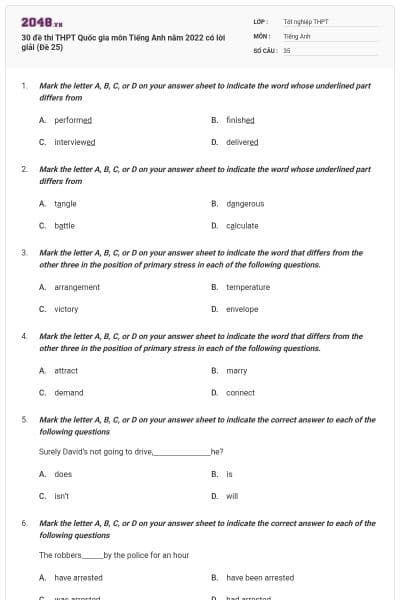
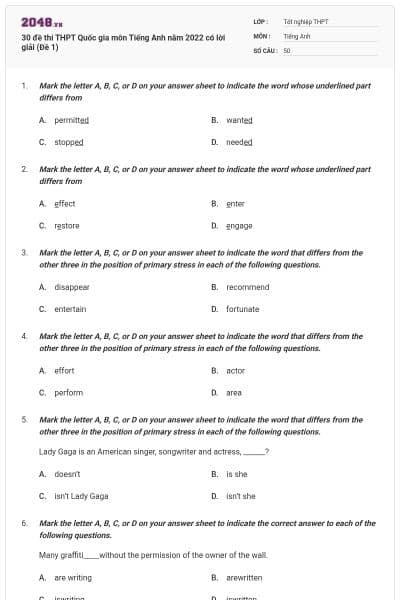
Mark the letter A, B, C, or D on your answer sheet to indicate the word whose underlined part differs from
permitted
wanted
stopped
needed
Đáp án C
Từ gạch chân trong câu C phát âm / t/ là còn lại đọc là /id/
Mark the letter A, B, C, or D on your answer sheet to indicate the word whose underlined part differs from
effect
enter
restore
engage
Đáp án B
Phương pháp giải: Kiến thức: Phát âm nguyên âm ‘e’
effect /ɪˈfekt/ B. enter /ˈentə(r)/
restore /rɪˈstɔː(r)/ D. engage /ɪnˈɡeɪdʒ/
Phần gạch chân phương án B được phát âm là /e/, còn lại là /ɪ/.
Mark the letter A, B, C, or D on your answer sheet to indicate the word that differs from the other three in the position of primary stress in each of the following questions.
disappear
recommend
entertain
fortunate
Đáp án: D
Giải thích:
Kiến thức: Trọng âm từ có 3 âm tiết
A. disappear /ˌdɪsəˈpɪə(r)/ (v): biến mất
B. recommend /ˌrekəˈmend/ (v): gợi ý
C. entertain /ˌentəˈteɪn/ (v): giải trí
D. fortunate /ˈfɔːtʃənət/ (adj): may mắn
Trọng âm phương án D rơi vào âm tiết 1, còn lại là âm 3.
Mark the letter A, B, C, or D on your answer sheet to indicate the word that differs from the other three in the position of primary stress in each of the following questions.
effort
actor
perform
area
Đáp án C
Phương pháp giải:
Kiến thức: Trọng âm từ có 2 âm tiết
Giải chi tiết:
A. effort /ˈefət/ B. actor /ˈæktə(r)/
C. perform /pəˈfɔːm/ D. area /ˈeəriə/
Trọng âm phương C rơi vào âm tiết 2, còn lại là âm 1
Mark the letter A, B, C, or D on your answer sheet to indicate the word that differs from the other three in the position of primary stress in each of the following questions.
Lady Gaga is an American singer, songwriter and actress, ______?
doesn’t
is she
isn’t Lady Gaga
isn’t she
Đáp án D
Phương pháp giải: Kiến thức: Câu hỏi đuôi
Giải chi tiết:
Vế trước câu hỏi đuôi ở dạng khẳng định => câu hỏi đuôi dạng phủ định
is => isn’t
Lady Gaga => she
Tạm dịch: Lady Gaga là ca sĩ, nhạc sĩ và nữ diễn viên Mỹ, đúng không?
Mark the letter A, B, C, or D on your answer sheet to indicate the correct answer to each of the following questions.
Many graffiti without the permission of the owner of the wall.
are writing
arewritten
iswriting
iswritten
Đáp án B
Câu bị động: S + động từ tobe + V-ed/V3
Tạm dịch : Có rất nhiều hình về graffiti trên trường mà không được sự cho phép của nhà chủ.
Mark the letter A, B, C, or D on your answer sheet to indicate the correct answer to each of the following questions.
She likes reading books ______ the library.
on
at
in
from
Đáp án C
Phương pháp giải: Kiến thức: Giới từ chỉ nơi chốn
Giải chi tiết:
on: trên => trên một địa điểm nào đó (ở trên bề mặt)
at: tại => dùng khi chỉ muốn nhắc đến địa điểm, sự có mặt của ai đó tại đâu đó (không chú ý đến vị trí cụ thể)
in: ở trong (không gian kín)
from: từ
=> in the library: ở trong thư viện (ngồi trong không gian kín của thư viện để làm gì)
Tạm dịch: Cô ấy thích đọc sách trong thư viện.
Mark the letter A, B, C, or D on your answer sheet to indicate the correct answer to each of the following questions.
The more cigarettes you smoke, you will die.
the easier
moresooner
thesooner
faster
Đáp án C
Kiến thức: So sánh kép
Giải thích:
Cấu trúc so sánh kép: The + so sánh hơn + S + V, the + so sánh hơn + S + V (càng... càng...) “die” là động từ thường nên phải dùng trạng từ “the more easily”
Tạm dịch: Bạn càng hút nhiều thuốc lá, bạn càng chết sớm.
Mark the letter A, B, C, or D on your answer sheet to indicate the correct answer to each of the following questions.
It's silly of him to spend a lot of money buying .
a thick wooden old table
a thick old woodentable
an old woodenthicktable
a wooden thick oldtable
Đáp án B
Kiến thức: Trật tự tính từ
Giải thích:
Opinion and general description (Ý kiến hoặc miêu tả chung). Ví dụ: nice, awesome, lovely.
Dimension / Size / Weight (Kích cỡ, cân nặng).Ví dụ: big, small, heavy
Age (Tuổi, niên kỷ).Ví dụ: old, new, young, ancient.
Shape (Hình dạng). Ví dụ: round, square, oval.
Color (Màu sắc).Ví dụ: green, red, blue, black
Country of origin (Xuất xứ). Ví dụ: Swiss, Italian, English.
Material (Chất liệu). Ví dụ: woolly, cotton, plastic .
Purpose and power (Công dụng). Ví dụ: walking (socks), tennis (racquet), electric (iron) thick (a): dày => size
old (a): cũ => age
wooden (a): bằng gỗ => material
Tạm dịch: Anh ấy thật ngu ngốc khi mua một cái bàn cũ bằng gỗ dày.
Mark the letter A, B, C, or D on your answer sheet to indicate the correct answer to each of the following questions
When he came, I_______ in the kitchen
cooked
am cooking
has cooked
was cooking
Đáp án D
Kiến thức: Sự phối hợp về thì của động từ
Giải thích: Thì quá khứ đơn và quá khứ tiếp diễn kết hợp trong câu: Diễn tả hành động đang xảy ra trong quá khứ thì một hành động khác xen vào, hành động đang xảy ra chi thì quá khứ tiếp diễn, hành động xen vào chia thì quá khứ đơn
Cấu trúc: S + was/ were + V_ing + when + S + Ved/bqt
Tạm dịch: Khi anh ấy đến, tôi đang nấu ăn ở trong bếp.
Mark the letter A, B, C, or D on your answer sheet to indicate the correct answer to each of the following questions.
________ he was the most prominent candidate, he was not chosen.
Though
Because
As
Since
Đáp án D
Kiến thức: Liên từ
Giải thích:
Though : Mặc dù
Because: Vì
As: Vì
Since: Vì, Từ khi
Câu hỏi 11. Mặc dù anh ấy là ứng cử viên nổi bật nhất, anh ấy đã không được chọn.
Tạm dịch: Jane nấu ăn ngon nhưng cô ấy ghét rửa bát sau đó.
Mark the letter A, B, C, or D on your answer sheet to indicate the correct answer to each of the following questions.
________ the destination, he will have been walking for about three hours.
When John will get
By the time John gets
After John has got
until John is getting
Đáp án B
Kiến thức: Thì tương lai hoàn thành
Giải thích:
Ta dùng thì tương lai hoàn thành tiếp diễn (nhấn mạnh sự liên tục) diễn tả một hành động xảy ra trước một hành động/một thời điểm trong tương lai
Dấu hiệu: By + mốc thời gian/hành động trong tương lai
Cấu trúc: S + will have Ved/ V3
12. By the time John gets the destination, he will have been walking for about three hours.
12. Vào thời điểm John đến đích, anh ấy đã đi bộ khoảng ba giờ
Mark the letter A, B, C, or D on your answer sheet to indicate the correct answer to each of the following questions.
On he had won, he jumped for joy.
he was told
havingtold
being told
get fined
Đáp án C
On being told = When he was told
Tạm dịch: Khi được thông báo rằng anh ta đã thắng cuộc, anh ta nhảy lên sung sướng.
Mark the letter A, B, C, or D on your answer sheet to indicate the correct answer to each of the following questions.
His______of the generator is very famous.
invent
inventive
invention
inventor
Đáp án C
Căn cứ bằng tính từ sở hữu "his". Sau tính từ sở hữu + N Trong đó:
A. invent (v): phát minh, sáng chế
B. inventive (a): có tài sáng chế, đầy sáng tạo
C.invention (n): sự phát minh, sự sáng chế
D.inventor (n): người phát minh, người sáng tạo
Dịch nghĩa: Phát minh về máy phát điện của ông ấy rất nổi tiếng.
The government hopes to______its plans for introducing cable TV
turn out
carry out
carry on
keepon
Đáp án là B
+ turn out: hoá ra
+ carry on = keep on = go on = continue: tiếp tục
+ carry out: tiến hành
Dịch nghĩa: Chính phủ hi vọng thực hiện được kế hoạch áp dụng cáp quang ti vi.
Mark the letter A, B, C, or D on your answer sheet to indicate the correct answer to each of the following questions.
The jury______her compliments on her excellent knowledge of the subject.
paid
gave
made
said
Đáp án là A
Câu này dịch như sau: Bồi thẩm đoàn khen ngợi cô ấy kiến thức tuyệt vời về chủ đề này.
Pay compliment /ˈkɒmplɪmənt/ (n) on sth = compliment/ˈkɒmplɪment/ (v) on sth: khen ngợi ai về việc gì
Mark the letter A, B, C, or D on your answer sheet to indicate the correct answer to each of the following questions
Nobody took any______of the warning and they went swimming in the contaminated water
information
attention
sight
notice
Đáp án là D
Cụm động từ: take notice of = notice (v): chú ý đến
Câu này dịch như sau: Không ai chú ý đến lời cảnh báo và họ đi bơi trong vùng nước bị ô nhiễm
Mark the letter A, B, C, or D on your answer sheet to indicate the correct answer to each of the following questions
I had a ______ chat with my manager and gave him an update on the project.
brief
short
quick
lull
Đáp án là A
Kiến thức về cụm từ cố định
Have a brief chat: có một cuộc trò chuyện ngắn
Tạm dịch: Tôi có một cuộc trò chuyện ngắn với quản lí của tôi và đưa cho ông ấy bản cập nhật của dự án.
Mark the letter A, B, C, or D on your answer sheet to indicate the correct answer to each of the following questions
There has been a hot debate among the scientists relating to the______of using robotic probes to study distant objects in space.
problems and solutions
pros and cons
solutions and limitations
causes and effects
Đáp án B
Kiến thức thành ngữ
A. vấn đề và giải pháp
B. ưu và nhược điểm
C. giải pháp và hạn chế
D. nguyên nhân và ảnh hưởng
Tạm dịch: Đã có một cuộc tranh luận gay gắt giữa các nhà khoa học liên quan đến những ưu và nhược điểm của việc sử dụng đầu dò robot đầu dò robot để nghiên cứu các vật thể xa xôi trong không gian
Mark the letter A, B, C, or D on your answer sheet to indicate the word(s) CLOSEST in meaning to the underlined word(s) in each of the following questions
The new air conditioner was installed yesterday.
inspected thoroughly
put in position
well repaired
delivered to the customer
Đáp án B
Giải thích: The new air conditioner was installed yesterday. (Máy điều hòa mới được lắp đặt ngày hôm qua.)
A. inspected thoroughly: kiểm tra kỹ
B. put in position: đặt vào vị trí
C. well repaired: sửa chữa tốt
D. delivered to the customer: giao đến khách hàng
Vậy installed có nghĩa tương đồng với phương án B
Mark the letter A, B, C, or D on your answer sheet to indicate the word(s) CLOSEST in meaning to the underlined word(s) in each of the following questions
We were pretty disappointed with the quality of the food
highly
rather
extremely
very
Đáp án B
Giải thích: We were pretty disappointed with the quality of the food. (Chúng tôi khá thất vọng với chất lượng thực phẩm.)
A. highly (adv.): cao
B. rather (adv.): khá, hơi
C. extremely (adv.): cực kỳ
D. very (adv.): rất
Vậy pretty có nghĩa tương đồng với phương án B
Mark the letter A, B, C, or D on your answer sheet to indicate the word(s) OPPOSITE in meaning to the underlined word(s) in each of the following questions
Many women prefer to use cosmetics to enhance their beauty and make them look younger
improve
maximize
worsen
enrich
Đáp án C
Giải thích: Many women prefer to use cosmetics to enhance their beauty and make them look younger. (Nhiều phụ nữ thích sử dụng mỹ phẩm để tăng cường vẻ đẹp và khiến họ trông trẻ hơn.)
A. improve (v.): cải thiện
B. maximize (v.): tăng tối đa
C. worsen (v.): làm tệ hơn
D. enrich (v.): làm giàu
Vậy enhance có nghĩa tương phản với phương án C
Mark the letter A, B, C, or D on your answer sheet to indicate the word(s) OPPOSITE in meaning to the underlined word(s) in each of the following questions
I think we cannot purchase this device this time as it costs an arm and a leg
is cheap
is painful
is confusing
is expensive
Đáp án A
Giải thích: I think we cannot purchase this device this time as it costs an arm and a leg. (Tôi nghĩ rằng chúng ta không thể mua thiết bị này lần này vì nó làm tốn rất nhiều tiền.)
A. is cheap: rẻ tiền
B. is painful: đau đớn
C. is confusing: nhầm lẫn
D. is expensive: đắt đỏ
Vậy costs an arm and a leg có nghĩa tương phản với phương án A
Mark the letter A, B, C, or D on your answer sheet to indicate the option that best completes each of the following exchanges
Nam and Mai are having a party at Nam’s house.
- Nam: “Would you like to have some more dessert, Mai?” - Mai: “______. I’m full.”
That would be great
Yes, I like your party
Yes, please
No, thanks
Đáp án là D
Giải thích: Lời đáp cần đưa ra sự từ chối lời mời ăn thêm vì Mai đã no.
A. Điều đó thật tuyệt vời
B. Vâng, tôi thích bữa tiệc của bạn
C. Có, xin vui lòng
D. Không, cảm ơn
Dịch nghĩa: Nam và Mai đang dự tiệc tại nhà Nam.
- Nam: “Bạn có muốn ăn thêm món tráng miệng không, Mai?”
- Mai: “Không, cảm ơn. Mình no rồi.”
Mark the letter A, B, C, or D on your answer sheet to indicate the option that best completes each of the following exchanges
Tim and Peter had a quarrel last week and now Tom is giving Tim advice.
- Tom: “I think the best way to solve that problem is to keep silent.”
- Tim: “______. Silence may kill our friendship.”
That’s a great idea
That’s not a good idea
I’m not wrong
Yes, I think much
Đáp án là B
Giải thích: Lời đáp cần đưa ra sự phủ định phù hợp vì Tim cho rằng sự im lặng sẽ làm hại tình bạn của mình.
A. Đó là một ý tưởng tuyệt vời
B. Đó không phải là một ý tưởng tốt
C. Tôi không sai
D. Vâng, tôi nghĩ nhiều
Dịch nghĩa: Tim và Peter đã cãi nhau tuần trước và bây giờ Tom đang cho Tim lời khuyên. - Tom: “Tôi nghĩ cách tốt nhất để giải quyết vấn đề đó là giữ im lặng.” - Tim: “Đó không phải là ý kiến hay. Im lặng có thể giết chết tình bạn của chúng tôi.”
Read the following passage and mark the letter A, B, C, or D on your answer sheet to indicate the correct word or phrase that best fits each of the numbered blanks from 26 to 30
Have you ever had the feeling that people older than you are hard to understand? Or, have you felt like people from younger generations just don't get it? Maybe you find it easier to connect with people (26) ______ are closer to your age than those who are older or younger than you. You can probably thank the generation gap for these feelings.
There are currently six generations living in the United States: the Greatest Generation, Silent Generation, Baby Boomers, Generation X, Millennials, and Generation Z. (27) ______ generation has its own unique set of characteristics and norms. For (28) ______ , the Greatest Generation (born 1901-1924) is known for its patriotism, hard workers, and loyalty to institutions. The Millennials (born 1980-2000) are characterized by their dependence on technology, detachment from traditional institutions, optimism, and open-mindedness. It is no (29) ______ that many people from different generations have a hard time understanding each other.
Generation gap refers to differences in actions, beliefs, interests, and opinions that (30) ______ between individuals from different generations. So, what causes these differences?
(Adapted from https://study.com/)
Điền vào ô 26
who
which
when
what
Đáp án A
Giải thích: Đại từ quan hệ “who” thay cho danh từ chỉ người “people”, các phương án khác không có chức năng này
Read the following passage and mark the letter A, B, C, or D on your answer sheet to indicate the correct word or phrase that best fits each of the numbered blanks from 26 to 30
Have you ever had the feeling that people older than you are hard to understand? Or, have you felt like people from younger generations just don't get it? Maybe you find it easier to connect with people (26) ______ are closer to your age than those who are older or younger than you. You can probably thank the generation gap for these feelings.
There are currently six generations living in the United States: the Greatest Generation, Silent Generation, Baby Boomers, Generation X, Millennials, and Generation Z. (27) ______ generation has its own unique set of characteristics and norms. For (28) ______ , the Greatest Generation (born 1901-1924) is known for its patriotism, hard workers, and loyalty to institutions. The Millennials (born 1980-2000) are characterized by their dependence on technology, detachment from traditional institutions, optimism, and open-mindedness. It is no (29) ______ that many people from different generations have a hard time understanding each other.
Generation gap refers to differences in actions, beliefs, interests, and opinions that (30) ______ between individuals from different generations. So, what causes these differences?
(Adapted from https://study.com/)
Điền vào ô 27
Another
Very
All
Each
Đáp án D
Giải thích: Phương án D phù hợp về nghĩa
Read the following passage and mark the letter A, B, C, or D on your answer sheet to indicate the correct word or phrase that best fits each of the numbered blanks from 26 to 30
Have you ever had the feeling that people older than you are hard to understand? Or, have you felt like people from younger generations just don't get it? Maybe you find it easier to connect with people (26) ______ are closer to your age than those who are older or younger than you. You can probably thank the generation gap for these feelings.
There are currently six generations living in the United States: the Greatest Generation, Silent Generation, Baby Boomers, Generation X, Millennials, and Generation Z. (27) ______ generation has its own unique set of characteristics and norms. For (28) ______ , the Greatest Generation (born 1901-1924) is known for its patriotism, hard workers, and loyalty to institutions. The Millennials (born 1980-2000) are characterized by their dependence on technology, detachment from traditional institutions, optimism, and open-mindedness. It is no (29) ______ that many people from different generations have a hard time understanding each other.
Generation gap refers to differences in actions, beliefs, interests, and opinions that (30) ______ between individuals from different generations. So, what causes these differences?
(Adapted from https://study.com/)
Điền vào ô 28
answer
process
example
study
Đáp án C
Giải thích: for example: ví dụ như
Read the following passage and mark the letter A, B, C, or D on your answer sheet to indicate the correct word or phrase that best fits each of the numbered blanks from 26 to 30
Have you ever had the feeling that people older than you are hard to understand? Or, have you felt like people from younger generations just don't get it? Maybe you find it easier to connect with people (26) ______ are closer to your age than those who are older or younger than you. You can probably thank the generation gap for these feelings.
There are currently six generations living in the United States: the Greatest Generation, Silent Generation, Baby Boomers, Generation X, Millennials, and Generation Z. (27) ______ generation has its own unique set of characteristics and norms. For (28) ______ , the Greatest Generation (born 1901-1924) is known for its patriotism, hard workers, and loyalty to institutions. The Millennials (born 1980-2000) are characterized by their dependence on technology, detachment from traditional institutions, optimism, and open-mindedness. It is no (29) ______ that many people from different generations have a hard time understanding each other.
Generation gap refers to differences in actions, beliefs, interests, and opinions that (30) ______ between individuals from different generations. So, what causes these differences?
(Adapted from https://study.com/)
Điền vào ô 29
wonder
picture
business
training
Đáp án A
Giải thích: It’s no wonder that…: không cò gì lạ rằng…
Read the following passage and mark the letter A, B, C, or D on your answer sheet to indicate the correct word or phrase that best fits each of the numbered blanks from 26 to 30
Have you ever had the feeling that people older than you are hard to understand? Or, have you felt like people from younger generations just don't get it? Maybe you find it easier to connect with people (26) ______ are closer to your age than those who are older or younger than you. You can probably thank the generation gap for these feelings.
There are currently six generations living in the United States: the Greatest Generation, Silent Generation, Baby Boomers, Generation X, Millennials, and Generation Z. (27) ______ generation has its own unique set of characteristics and norms. For (28) ______ , the Greatest Generation (born 1901-1924) is known for its patriotism, hard workers, and loyalty to institutions. The Millennials (born 1980-2000) are characterized by their dependence on technology, detachment from traditional institutions, optimism, and open-mindedness. It is no (29) ______ that many people from different generations have a hard time understanding each other.
Generation gap refers to differences in actions, beliefs, interests, and opinions that (30) ______ between individuals from different generations. So, what causes these differences?
(Adapted from https://study.com/)
Điền vào ô 29
trade
exist
credit
target
Đáp án B
Giải thích: Phương án B phù hợp về nghĩa.
A. trade (v.): buôn bán
B. exist (v.): tồn tại
C. credit (v.): tin tưởng
D. target (v.): nhắm đến
Read the following passage and mark the letter A, B, C, or D on your answer sheet to indicate the correct answer to each of the questions from 31 to 35.
Stars have been significant features in the design of many United States coins and their number has varied from one to forty-eight stars. Most of the coins issued from about 1799 to the early years of the twentieth century bore thirteen stars representing the thirteen original colonies.
Curiously enough, the first American silver coins, issued in 1794, had fifteen stars because by that time Vermont and Kentucky have joined the Union. At that time it was apparently the intention of mint officials to add a star for each new state. Following the admission of Tennessee in 1796, for example, some varieties of half dimes, dimes, and half dollars were produced with sixteen stars.
As more states were admitted to the Union, however, it quickly became apparent that this scheme would not prove practical and the coins from 1798 were issued with only thirteen Stars - one for each of the original colonies. Due to an error at the mint, one variety of the 1828 half-cent was issued with only twelve stars. There is also a variety of the large cent with only 12 stars, but this is the result of a die break and is not a true error.
What is the main topic of the passage?
Stars on American coins
The teaching of astronomy in state universities
Colonial stamps and coins
The star as national symbol of the United States
Đáp án B
Kiến thức: Đọc hiểu – ý chính
Giải chi tiết:
Chủ đề chính của đoạn văn là gì?
A. Những ngôi sao trên đồng tiền Mỹ
B. Việc giảng dạy thiên văn học trong các trường đại học bang
C. Tem thuộc địa và tiền xu
D. Ngôi sao là biểu tượng quốc gia của Hoa Kỳ
Lưu ý: làm câu hỏi này cuối cùng, sau khi làm xong 4 câu hỏi còn lại thuộc bài đọc.
Thông tin:
- Stars have been significant features in the design of many United States coins …
- Following the admission of Tennessee in 1796, for example, some varieties of half dimes, dimes, and half dollars were produced with sixteen stars.
Tạm dịch:
- Các ngôi sao là đặc điểm quan trọng trong thiết kế của nhiều đồng tiền Hoa Kỳ…
- Ví dụ, sau khi Tennessee được gia nhập vào năm 1796, một số loại đồng nửa dimes, dimes và nửa đô la đã được sản xuất với mười sáu ngôi sao.
(từ star(s) xuất hiện rất nhiều lần trong bài đọc)
Read the following passage and mark the letter A, B, C, or D on your answer sheet to indicate the correct answer to each of the questions from 31 to 35.
Stars have been significant features in the design of many United States coins and their number has varied from one to forty-eight stars. Most of the coins issued from about 1799 to the early years of the twentieth century bore thirteen stars representing the thirteen original colonies.
Curiously enough, the first American silver coins, issued in 1794, had fifteen stars because by that time Vermont and Kentucky have joined the Union. At that time it was apparently the intention of mint officials to add a star for each new state. Following the admission of Tennessee in 1796, for example, some varieties of half dimes, dimes, and half dollars were produced with sixteen stars.
As more states were admitted to the Union, however, it quickly became apparent that this scheme would not prove practical and the coins from 1798 were issued with only thirteen Stars - one for each of the original colonies. Due to an error at the mint, one variety of the 1828 half-cent was issued with only twelve stars. There is also a variety of the large cent with only 12 stars, but this is the result of a die break and is not a true error.
The expression "Curiously enough" is used because the author finds it strange that _____.
Tennessee was the first state to use half dimes
Vermont and Kentucky joined the Union in 1794
silver coins with fifteen stars appeared before coins with thirteen
no silver coins were issued until 1794
Đáp án C
Phương pháp giải:
Kiến thức: Đọc hiểu – chi tiết
Giải chi tiết:
Cụm từ "Curiously enough" được sử dụng vì tác giả thấy lạ rằng _____.
A. Tennessee là bang đầu tiên sử dụng nửa dimes
B. Vermont và Kentucky gia nhập Liên minh năm 1794
C. đồng xu bạc có mười lăm ngôi sao xuất hiện trước đồng xu có mười ba
D. không có đồng bạc nào được phát hành cho đến năm 1794
Thông tin:
- Most of the coins issued from about 1799 to the early years of the twentieth century bore thirteen stars representing the thirteen original colonies.
- Curiously enough, the first American silver coins, issued in 1794, had fifteen stars because by that time Vermont and Kentucky have joined the Union.
Tạm dịch:
- Hầu hết các đồng tiền được phát hành từ khoảng năm 1799 đến những năm đầu của thế kỷ XX đều có hình mười ba ngôi sao tượng trưng cho mười ba thuộc địa ban đầu.
- Thật kỳ lạ là, những đồng bạc đầu tiên của Mỹ, được phát hành vào năm 1794, có mười lăm ngôi sao bởi vì vào thời điểm đó Vermont và Kentucky đã gia nhập Liên minh
Read the following passage and mark the letter A, B, C, or D on your answer sheet to indicate the correct answer to each of the questions from 31 to 35.
Stars have been significant features in the design of many United States coins and their number has varied from one to forty-eight stars. Most of the coins issued from about 1799 to the early years of the twentieth century bore thirteen stars representing the thirteen original colonies.
Curiously enough, the first American silver coins, issued in 1794, had fifteen stars because by that time Vermont and Kentucky have joined the Union. At that time it was apparently the intention of mint officials to add a star for each new state. Following the admission of Tennessee in 1796, for example, some varieties of half dimes, dimes, and half dollars were produced with sixteen stars.
As more states were admitted to the Union, however, it quickly became apparent that this scheme would not prove practical and the coins from 1798 were issued with only thirteen Stars - one for each of the original colonies. Due to an error at the mint, one variety of the 1828 half-cent was issued with only twelve stars. There is also a variety of the large cent with only 12 stars, but this is the result of a die break and is not a true error.
Why was a coin produced in 1828 with only twelve stars?
Tennessee had left the Union.
The mint made a mistake.
There were twelve states at the time.
There is a change in design policy.
Đáp án B
Phương pháp giải:
Kiến thức: Đọc hiểu – chi tiết
Giải chi tiết:
Tại sao một đồng xu được sản xuất vào năm 1828 chỉ có mười hai ngôi sao?
A. Tennessee đã rời khỏi Liên minh.
B. Xưởng đúc tiền mắc lỗi.
C. Có mười hai tiểu bang vào thời điểm đó.
D. Có sự thay đổi trong chính sách thiết kế.
Thông tin: Due to an error at the mint, one variety of the A828 half-cent was issued with only twelve stars.
Tạm dịch: Do lỗi tại xưởng đúc tiền, một loại đồng nửa xu năm 1828 chỉ được phát hành với mười hai sao
Read the following passage and mark the letter A, B, C, or D on your answer sheet to indicate the correct answer to each of the questions from 31 to 35.
Stars have been significant features in the design of many United States coins and their number has varied from one to forty-eight stars. Most of the coins issued from about 1799 to the early years of the twentieth century bore thirteen stars representing the thirteen original colonies.
Curiously enough, the first American silver coins, issued in 1794, had fifteen stars because by that time Vermont and Kentucky have joined the Union. At that time it was apparently the intention of mint officials to add a star for each new state. Following the admission of Tennessee in 1796, for example, some varieties of half dimes, dimes, and half dollars were produced with sixteen stars.
As more states were admitted to the Union, however, it quickly became apparent that this scheme would not prove practical and the coins from 1798 were issued with only thirteen Stars - one for each of the original colonies. Due to an error at the mint, one variety of the 1828 half-cent was issued with only twelve stars. There is also a variety of the large cent with only 12 stars, but this is the result of a die break and is not a true error.
Which of the following is NOT mentioned as the denomination of an American coin?
Half nickel
Half-dollar
Hall cent
Half dime
Đáp án A
Phương pháp giải:
Kiến thức: Đọc hiểu – chi tiết
Giải chi tiết:
Cái nào sau đây KHÔNG được đề cập là mệnh giá của đồng xu Mỹ?
A. Half nickel
B. Half-dollar
C. Hall cent
D. Half dime
Thông tin:
- half dimes, dimes, and half dollars
- half-cent
Read the following passage and mark the letter A, B, C, or D on your answer sheet to indicate the correct answer to each of the questions from 31 to 35.
Stars have been significant features in the design of many United States coins and their number has varied from one to forty-eight stars. Most of the coins issued from about 1799 to the early years of the twentieth century bore thirteen stars representing the thirteen original colonies.
Curiously enough, the first American silver coins, issued in 1794, had fifteen stars because by that time Vermont and Kentucky have joined the Union. At that time it was apparently the intention of mint officials to add a star for each new state. Following the admission of Tennessee in 1796, for example, some varieties of half dimes, dimes, and half dollars were produced with sixteen stars.
As more states were admitted to the Union, however, it quickly became apparent that this scheme would not prove practical and the coins from 1798 were issued with only thirteen Stars - one for each of the original colonies. Due to an error at the mint, one variety of the 1828 half-cent was issued with only twelve stars. There is also a variety of the large cent with only 12 stars, but this is the result of a die break and is not a true error.
Which of the following is NOT mentioned as the denomination of an American coin?
features
coins
stars
colonies
Đáp án C
Phương pháp giải:
Kiến thức: Đọc hiểu – từ thay thế
Giải chi tiết:
Từ “their” trong dòng 1 đề cấp đến _________.
A. features: đặc điểm
B. coins: đồng xu
C. stars: ngôi sao
D. colonies: thuộc địa
Thông tin: Stars have been significant features in the design of many United States coins and their number has varied from one to forty-eight stars.
Tạm dịch: Các ngôi sao là đặc điểm quan trọng trong thiết kế của nhiều đồng tiền Hoa Kỳ và số lượng của chúng thay đổi từ một đến bốn mươi tám sao.
=> their number = the number of stars (số lượng ngôi sao)
Chú ý khi giải:
Dịch bài đọc:
Các ngôi sao là đặc điểm quan trọng trong thiết kế của nhiều đồng tiền Hoa Kỳ và số lượng của chúng thay đổi từ một đến bốn mươi tám sao. Hầu hết các đồng tiền được phát hành từ khoảng năm 1799 đến những năm đầu của thế kỷ XX đều có hình mười ba ngôi sao tượng trưng cho mười ba thuộc địa ban đầu.
Thật kỳ lạ là, những đồng bạc đầu tiên của Mỹ, được phát hành vào năm 1794, có mười lăm ngôi sao bởi vì vào thời điểm đó Vermont và Kentucky đã gia nhập Liên minh. Vào thời điểm đó, rõ ràng các quan chức của xưởng đúc tiền có ý định thêm một ngôi sao cho mỗi bang mới. Ví dụ, sau khi Tennessee được gia nhập vào năm 1796, một số loại đồng nửa dimes, dimes và nửa đô la đã được sản xuất với mười sáu ngôi sao.
Tuy nhiên, khi nhiều tiểu bang được gia nhập vào Liên minh, nhanh chóng trở nên rõ ràng rằng kế hoạch này sẽ không chứng minh được tính thực tế và các đồng tiền từ năm 1798 chỉ được phát hành với 13 sao - một sao cho mỗi thuộc địa ban đầu. Do lỗi tại xưởng đúc tiền, một loại đồng nửa xu năm 1828 chỉ được phát hành với mười hai sao. Ngoài ra còn có nhiều loại đồng xu lớn chỉ có 12 sao, nhưng đây là kết quả của sự tan vỡ và không phải là lỗi thực sự
Read the following passage and mark the letter A, B, C, or D on your answer sheet to indicate the correct answer to each of the questions from 36 to 42.
Do you feel like your teenager is spending most of the day glued to a phone screen? You're not too far off. A new survey from the Pew Research Center reveals the surprising ways that technology intersects with teen friendships – and the results show that 57 percent of teens have made at least one new friend online. Even more surprisingly, only 20 percent of those digital friends ever meet in person.
While teens do connect with their friends face-to-face outside of school, they spend 55 percent of their day texting with friends, and only 25 percent of teens are spending actual time with their friends on a daily basis (outside of school hallways). These new forms of communication are key in maintaining friendships day-to-day – 27 percent of teens instant message their friends every day, 23 percent connect through social media every day, and 7 percent even video chat daily. Text messaging remains the main form of communication – almost half of survey respondents say it's their chosen method of communication with their closest friend.
While girls are more likely to text with their close friends, boys are meeting new friends (and maintaining friendships) in the gaming world – 89 percent play with friends they know, and 54 percent play with online-only friends. Whether they're close with their teammates or not, online gamers say that playing makes them feel "more connected" to friends they know, or garners they've never met.
When making new friends, social media has also become a major part of the teenage identity – 62 percent of teens are quick to share their social media usernames when connecting with a new friend (although 80 percent still consider their phone number the best method of contact). Despite the negative consequences-21 percent of teenage users feel worse about their lives because of posts they see on social media – teens also have found support and connection through various platforms. In fact, 68 percent of teens received support during a challenging time in their lives via social media platforms.
Just as technology has become a gateway for new friendships, or a channel to stay connected with current friends, it can also make a friendship breakup more public. The study reveals that girls are more likely to block or unfriend former allies, and 68 percent of all teenage users report experiencing "drama among their friends on social media."
(Source: https://www.realsimple.com)
The word "digital" in the first paragraph is closest in meaning to _____
analogue
numeracy
numerous
online
Đáp án D
Phương pháp giải:
Kiến thức: Đọc hiểu – từ vựng
Giải chi tiết:
Từ "digital" trong đoạn 1 thì có nghĩa gần nhất với _______.
A. analogue (n): sự tương tự
B. numeracy (n): năng lực tính toán
C. numerous (adj): nhiều
D. online (adj): trực tuyến
=> digital (adj): có liên quan đến công nghệ, đặc biệt là mạng internet = online
Thông tin: and the results show that 57 percent of teens have made at least one new friend online. Even more surprisingly, only 20 percent of those digital friends ever meet in person.
Tạm dịch: và kết quả cho thấy 57% thanh thiếu niên đã có ít nhất một người bạn mới trực tuyến. Đáng ngạc nhiên hơn nữa, chỉ 20% trong số những người bạn trực tuyến đó từng gặp trực tiếp
Read the following passage and mark the letter A, B, C, or D on your answer sheet to indicate the correct answer to each of the questions from 36 to 42.
Do you feel like your teenager is spending most of the day glued to a phone screen? You're not too far off. A new survey from the Pew Research Center reveals the surprising ways that technology intersects with teen friendships – and the results show that 57 percent of teens have made at least one new friend online. Even more surprisingly, only 20 percent of those digital friends ever meet in person.
While teens do connect with their friends face-to-face outside of school, they spend 55 percent of their day texting with friends, and only 25 percent of teens are spending actual time with their friends on a daily basis (outside of school hallways). These new forms of communication are key in maintaining friendships day-to-day – 27 percent of teens instant message their friends every day, 23 percent connect through social media every day, and 7 percent even video chat daily. Text messaging remains the main form of communication – almost half of survey respondents say it's their chosen method of communication with their closest friend.
While girls are more likely to text with their close friends, boys are meeting new friends (and maintaining friendships) in the gaming world – 89 percent play with friends they know, and 54 percent play with online-only friends. Whether they're close with their teammates or not, online gamers say that playing makes them feel "more connected" to friends they know, or garners they've never met.
When making new friends, social media has also become a major part of the teenage identity – 62 percent of teens are quick to share their social media usernames when connecting with a new friend (although 80 percent still consider their phone number the best method of contact). Despite the negative consequences-21 percent of teenage users feel worse about their lives because of posts they see on social media – teens also have found support and connection through various platforms. In fact, 68 percent of teens received support during a challenging time in their lives via social media platforms.
Just as technology has become a gateway for new friendships, or a channel to stay connected with current friends, it can also make a friendship breakup more public. The study reveals that girls are more likely to block or unfriend former allies, and 68 percent of all teenage users report experiencing "drama among their friends on social media."
(Source: https://www.realsimple.com)
The word "they" in paragraph 3 refers to _____
friends
online-only friends
online gamers
their teammates
Đáp án C
Phương pháp giải:
Kiến thức: Đọc hiểu – từ thay thế
Giải chi tiết:
Từ “they” trong đoạn 3 đề cập đến _____.
A. friends: bạn bè
B. online-only friends: những bạn trực tuyến
C. online gamers: những người chơi trực tuyến
D. their teammates: đồng đội
Thông tin: Whether they're close with their teammates or not, online garners say that playing makes them feel "more connected" to friends they know, or garners they've never met.
=> they = online gamers
Tạm dịch: Cho dù họ có thân thiết với đồng đội của mình hay không, những người chơi trực tuyến nói rằng chơi khiến họ cảm thấy "kết nối" hơn với những người bạn mà họ biết hoặc những người mà họ chưa từng gặp
Read the following passage and mark the letter A, B, C, or D on your answer sheet to indicate the correct answer to each of the questions from 36 to 42.
Do you feel like your teenager is spending most of the day glued to a phone screen? You're not too far off. A new survey from the Pew Research Center reveals the surprising ways that technology intersects with teen friendships – and the results show that 57 percent of teens have made at least one new friend online. Even more surprisingly, only 20 percent of those digital friends ever meet in person.
While teens do connect with their friends face-to-face outside of school, they spend 55 percent of their day texting with friends, and only 25 percent of teens are spending actual time with their friends on a daily basis (outside of school hallways). These new forms of communication are key in maintaining friendships day-to-day – 27 percent of teens instant message their friends every day, 23 percent connect through social media every day, and 7 percent even video chat daily. Text messaging remains the main form of communication – almost half of survey respondents say it's their chosen method of communication with their closest friend.
While girls are more likely to text with their close friends, boys are meeting new friends (and maintaining friendships) in the gaming world – 89 percent play with friends they know, and 54 percent play with online-only friends. Whether they're close with their teammates or not, online gamers say that playing makes them feel "more connected" to friends they know, or garners they've never met.
When making new friends, social media has also become a major part of the teenage identity – 62 percent of teens are quick to share their social media usernames when connecting with a new friend (although 80 percent still consider their phone number the best method of contact). Despite the negative consequences-21 percent of teenage users feel worse about their lives because of posts they see on social media – teens also have found support and connection through various platforms. In fact, 68 percent of teens received support during a challenging time in their lives via social media platforms.
Just as technology has become a gateway for new friendships, or a channel to stay connected with current friends, it can also make a friendship breakup more public. The study reveals that girls are more likely to block or unfriend former allies, and 68 percent of all teenage users report experiencing "drama among their friends on social media."
(Source: https://www.realsimple.com)
According to the passage, what percentage of teens spend actual time with their friends?
23%
25%
27%
55%
Đáp án B
Kiến thức: Đọc hiểu – chi tiết
Giải chi tiết:
Theo đoạn văn, bao nhiêu phần trăm thanh thiếu niên dành thời gian thực tế cho bạn bè của họ?
A. 23%
B. 25%
C. 27%
D. 55%
Thông tin: and only 25 percent of teens are spending actual time with their friends on a daily basis (outside of school hallways).
Tạm dịch: và chỉ 25% thanh thiếu niên dành thời gian thực tế với bạn bè của họ hàng ngày (ngoài hành lang của trường học)
Read the following passage and mark the letter A, B, C, or D on your answer sheet to indicate the correct answer to each of the questions from 36 to 42.
Do you feel like your teenager is spending most of the day glued to a phone screen? You're not too far off. A new survey from the Pew Research Center reveals the surprising ways that technology intersects with teen friendships – and the results show that 57 percent of teens have made at least one new friend online. Even more surprisingly, only 20 percent of those digital friends ever meet in person.
While teens do connect with their friends face-to-face outside of school, they spend 55 percent of their day texting with friends, and only 25 percent of teens are spending actual time with their friends on a daily basis (outside of school hallways). These new forms of communication are key in maintaining friendships day-to-day – 27 percent of teens instant message their friends every day, 23 percent connect through social media every day, and 7 percent even video chat daily. Text messaging remains the main form of communication – almost half of survey respondents say it's their chosen method of communication with their closest friend.
While girls are more likely to text with their close friends, boys are meeting new friends (and maintaining friendships) in the gaming world – 89 percent play with friends they know, and 54 percent play with online-only friends. Whether they're close with their teammates or not, online gamers say that playing makes them feel "more connected" to friends they know, or garners they've never met.
When making new friends, social media has also become a major part of the teenage identity – 62 percent of teens are quick to share their social media usernames when connecting with a new friend (although 80 percent still consider their phone number the best method of contact). Despite the negative consequences-21 percent of teenage users feel worse about their lives because of posts they see on social media – teens also have found support and connection through various platforms. In fact, 68 percent of teens received support during a challenging time in their lives via social media platforms.
Just as technology has become a gateway for new friendships, or a channel to stay connected with current friends, it can also make a friendship breakup more public. The study reveals that girls are more likely to block or unfriend former allies, and 68 percent of all teenage users report experiencing "drama among their friends on social media."
(Source: https://www.realsimple.com)
The following sentences are true, EXCEPT _____
Most teenagers use video chat to maintain relationship with friends
New forms of communication play an important role in keeping friendships
According to the survey, more than half of teens have ever made new friends online
Teens only meet face-to-face one fifth of online friends they have made
Đáp án A
Phương pháp giải:
Kiến thức: Đọc hiểu – chi tiết
Giải chi tiết:
Các câu sau đây đúng, NGOẠI TRỪ _____.
A. Hầu hết thanh thiếu niên sử dụng trò chuyện video để duy trì mối quan hệ với bạn bè
B. Các hình thức giao tiếp mới đóng vai trò quan trọng trong việc duy trì tình bạn
C. Theo khảo sát, hơn một nửa thanh thiếu niên đã từng kết bạn mới trên mạng
D. Thanh thiếu niên chỉ gặp mặt trực tiếp 1/5 số bạn bè trực tuyến mà họ đã kết bạn
Thông tin: and 7 percent even video chat daily.
Tạm dịch: và 7% thậm chí trò chuyện video hàng ngày
Read the following passage and mark the letter A, B, C, or D on your answer sheet to indicate the correct answer to each of the questions from 36 to 42.
Do you feel like your teenager is spending most of the day glued to a phone screen? You're not too far off. A new survey from the Pew Research Center reveals the surprising ways that technology intersects with teen friendships – and the results show that 57 percent of teens have made at least one new friend online. Even more surprisingly, only 20 percent of those digital friends ever meet in person.
While teens do connect with their friends face-to-face outside of school, they spend 55 percent of their day texting with friends, and only 25 percent of teens are spending actual time with their friends on a daily basis (outside of school hallways). These new forms of communication are key in maintaining friendships day-to-day – 27 percent of teens instant message their friends every day, 23 percent connect through social media every day, and 7 percent even video chat daily. Text messaging remains the main form of communication – almost half of survey respondents say it's their chosen method of communication with their closest friend.
While girls are more likely to text with their close friends, boys are meeting new friends (and maintaining friendships) in the gaming world – 89 percent play with friends they know, and 54 percent play with online-only friends. Whether they're close with their teammates or not, online gamers say that playing makes them feel "more connected" to friends they know, or garners they've never met.
When making new friends, social media has also become a major part of the teenage identity – 62 percent of teens are quick to share their social media usernames when connecting with a new friend (although 80 percent still consider their phone number the best method of contact). Despite the negative consequences-21 percent of teenage users feel worse about their lives because of posts they see on social media – teens also have found support and connection through various platforms. In fact, 68 percent of teens received support during a challenging time in their lives via social media platforms.
Just as technology has become a gateway for new friendships, or a channel to stay connected with current friends, it can also make a friendship breakup more public. The study reveals that girls are more likely to block or unfriend former allies, and 68 percent of all teenage users report experiencing "drama among their friends on social media."
(Source: https://www.realsimple.com)
What can be inferred from the passage?
The majority of teenage users agree that social media has negative consequences in their lives.
Thanks to social media, more than two thirds of teens are supported when they face with challenges in their lives.
Boys are more likely to meet new friends than girls.
Most teens are not easy to give others their usernames when making new friends.
Đáp án B
Phương pháp giải:
Kiến thức: Đọc hiểu – suy luận
Giải chi tiết:
Điều gì có thể được suy ra từ đoạn văn?
A. Đa số người dùng tuổi teen đồng ý rằng mạng xã hội có những hậu quả tiêu cực trong cuộc sống của họ.
B. Nhờ có mạng xã hội, hơn 2/3 thanh thiếu niên được hỗ trợ khi họ đối mặt với những thử thách trong cuộc sống.
C. Con trai thường gặp nhiều bạn mới hơn con gái.
D. Hầu hết thanh thiếu niên không dễ dàng cung cấp cho người khác tên người dùng của họ khi kết bạn mới.
2/3 của 100% ~ 67% => hơn 2/3 = hơn 67%
Thông tin: In fact, 68 percent of teens received support during a challenging time in their lives via social media platforms.
Tạm dịch: Trên thực tế, 68% thanh thiếu niên nhận được sự hỗ trợ trong thời gian thử thách trong cuộc sống của họ thông qua các nền tảng truyền thông xã hội
Read the following passage and mark the letter A, B, C, or D on your answer sheet to indicate the correct answer to each of the questions from 36 to 42.
Do you feel like your teenager is spending most of the day glued to a phone screen? You're not too far off. A new survey from the Pew Research Center reveals the surprising ways that technology intersects with teen friendships – and the results show that 57 percent of teens have made at least one new friend online. Even more surprisingly, only 20 percent of those digital friends ever meet in person.
While teens do connect with their friends face-to-face outside of school, they spend 55 percent of their day texting with friends, and only 25 percent of teens are spending actual time with their friends on a daily basis (outside of school hallways). These new forms of communication are key in maintaining friendships day-to-day – 27 percent of teens instant message their friends every day, 23 percent connect through social media every day, and 7 percent even video chat daily. Text messaging remains the main form of communication – almost half of survey respondents say it's their chosen method of communication with their closest friend.
While girls are more likely to text with their close friends, boys are meeting new friends (and maintaining friendships) in the gaming world – 89 percent play with friends they know, and 54 percent play with online-only friends. Whether they're close with their teammates or not, online gamers say that playing makes them feel "more connected" to friends they know, or garners they've never met.
When making new friends, social media has also become a major part of the teenage identity – 62 percent of teens are quick to share their social media usernames when connecting with a new friend (although 80 percent still consider their phone number the best method of contact). Despite the negative consequences-21 percent of teenage users feel worse about their lives because of posts they see on social media – teens also have found support and connection through various platforms. In fact, 68 percent of teens received support during a challenging time in their lives via social media platforms.
Just as technology has become a gateway for new friendships, or a channel to stay connected with current friends, it can also make a friendship breakup more public. The study reveals that girls are more likely to block or unfriend former allies, and 68 percent of all teenage users report experiencing "drama among their friends on social media."
(Source: https://www.realsimple.com)
What is the synonym of the word "breakup” in the last paragraph?
commencing
popularity
termination
divorce
Đáp án D
Phương pháp giải:
Kiến thức: Đọc hiểu – từ vựng
Giải chi tiết:
Đâu là từ đồng nghĩa của "breakup” trong đoạn cuối?
A. commencing (V-ing): bắt đầu, khởi đầu
B. popularity (n): sự phổ biến
C. termination (n): sự đình chỉ, sự kết liễu
D. divorce (n): sự ly dị, sự kết thúc mối quan hệ
=> breakup (n): sự chấm dứt, kết thúc = divorce
Thông tin: it can also make a friendship breakup more public.
Tạm dịch: nó cũng có thể làm cho việc kết thúc tình bạn trở nên công khai hơn
Read the following passage and mark the letter A, B, C, or D on your answer sheet to indicate the correct answer to each of the questions from 36 to 42.
Do you feel like your teenager is spending most of the day glued to a phone screen? You're not too far off. A new survey from the Pew Research Center reveals the surprising ways that technology intersects with teen friendships – and the results show that 57 percent of teens have made at least one new friend online. Even more surprisingly, only 20 percent of those digital friends ever meet in person.
While teens do connect with their friends face-to-face outside of school, they spend 55 percent of their day texting with friends, and only 25 percent of teens are spending actual time with their friends on a daily basis (outside of school hallways). These new forms of communication are key in maintaining friendships day-to-day – 27 percent of teens instant message their friends every day, 23 percent connect through social media every day, and 7 percent even video chat daily. Text messaging remains the main form of communication – almost half of survey respondents say it's their chosen method of communication with their closest friend.
While girls are more likely to text with their close friends, boys are meeting new friends (and maintaining friendships) in the gaming world – 89 percent play with friends they know, and 54 percent play with online-only friends. Whether they're close with their teammates or not, online gamers say that playing makes them feel "more connected" to friends they know, or garners they've never met.
When making new friends, social media has also become a major part of the teenage identity – 62 percent of teens are quick to share their social media usernames when connecting with a new friend (although 80 percent still consider their phone number the best method of contact). Despite the negative consequences-21 percent of teenage users feel worse about their lives because of posts they see on social media – teens also have found support and connection through various platforms. In fact, 68 percent of teens received support during a challenging time in their lives via social media platforms.
Just as technology has become a gateway for new friendships, or a channel to stay connected with current friends, it can also make a friendship breakup more public. The study reveals that girls are more likely to block or unfriend former allies, and 68 percent of all teenage users report experiencing "drama among their friends on social media."
(Source: https://www.realsimple.com)
What is the main idea of the passage?
The difference of making new friends between girls and boys.
Social media connects friendship.
Social media affects friendship too much.
Teenagers are making and keeping friends in a surprising way.
Đáp án D
Phương pháp giải:
Kiến thức: Đọc hiểu – ý chính
Giải chi tiết:
Ý chính của đoạn văn là gì?
A. Sự khác biệt của việc kết bạn mới giữa con gái và con trai. => chỉ là chi tiết đoạn 3
B. Phương tiện truyền thông xã hội kết nối tình bạn. => chỉ có đoạn 4 nói về phương tiện truyền thông
C. Phương tiện truyền thông xã hội ảnh hưởng quá nhiều đến tình bạn. => ý nói ảnh hưởng tiêu cực => trong bài nhắc đến cả tích cực & tiêu cực
D. Thanh thiếu niên đang kết bạn và giữ bạn bè một cách đáng ngạc nhiên.
Thông tin: A new survey from the Pew Research Center reveals the surprising ways that technology intersects with teen friendships – and the results show that 57 percent of teens have made at least one new friend online. Even more surprisingly, only 20 percent of those digital friends ever meet in person.
Tạm dịch: Một cuộc khảo sát mới từ Trung tâm Nghiên cứu Pew cho thấy những cách đáng ngạc nhiên mà công nghệ giao thoa với tình bạn của thanh thiếu niên - và kết quả cho thấy 57% thanh thiếu niên đã có ít nhất một người bạn mới trực tuyến. Đáng ngạc nhiên hơn nữa, chỉ 20% trong số những người bạn trực tuyến đó từng gặp ngoài đời
Mark the letter A, B, C, or D on your answer sheet to indicate the underlined part that needs correction in each of the following questions
(A) What I told her a few days ago (B) is not the solution (C) to (D) most of her problems
What I told her
is
to
most of
Đáp án là B
Vì cụm từ "What I told her a few days ago" là 1 chủ ngữ và chia ở số ít
=> is sửa thành was
Mark the letter A, B, C, or D on your answer sheet to indicate the underlined part that needs correction in each of the following questions
Tom’s jokes are (A) inappropriate but we have to put up with (B) it just (C) because he’s (D) the boss
inappropriate
it
because
the
Đáp án B
Kiến thức: từ vựng
Giải thích:
“jokes” là danh từ ở dạng số nhiều nên phải dùng tân ngữ “them” để thay th ế.
it => them
Tạm dịch: Những câu chuyện cười của Tom không phù hợp nhưng chúng ta phải chịu đựng chúng chỉ vì ông ấy là ông chủ
Mark the letter A, B, C, or D on your answer sheet to indicate the underlined part that needs correction in each of the following questions
Modern (A) office buildings have (B) false floors under (C) which computer and phone wires (D) can be lain.
office buildings
false floors
which
can be lain
Đáp án D
Kiến thức về cặp từ dễ gây nhầm lẫn lay và lie
lay - laid - laid : đặt, xếp thứ gì đó nằm ở vị trí tĩnh
lie – lay - lain: tựa lên, nằm nghỉ trên một vị trí bằng phẳng
(can be lain => can be laid)
Tạm dịch: Những tòa văn phòng hiện đại có những sàn nâng, bên dưới chúng, dây điện máy vi tính và dây
Mark the letter A, B, C, or D on your answer sheet to indicate the sentence that is closest in meaning to each of the following questions
The last time I saw her was three years ago.
I have not seen her for three years.
About three years ago, I used to meet her.
I have often seen her for the last three years.
I saw her three years ago and will never meet her.
Đáp án A
Dịch câu đề. Lần cuối cùng tôi gặp cô ấy là 3 năm trước.
Dịch đáp án.
A. Tôi đã không gặp cô ấy 3 năm rồi.
B. Khoảng 3 năm trước, tôi đã từng gặp cô ấy
C. Tôi thường gặp cô ấy khoảng 3 năm trước
D. Tôi gặp cô ấy 3 năm trước và sẽ không bao giờ gặp cô ấy nữa.
Ta có cấu trúc: S + haven’t/ hasn’t + P2 + since/ for.. . = The last time (when) S + V (past simple) + was + a period of time + ago. Như vậy đáp án chính xác là đáp án A
Mark the letter A, B, C, or D on your answer sheet to indicate the sentence that is closest in meaning to each of the following questions
She said, "John, I'll show you round my city when you're here."
She made a trip round her city with John.
She planned to show John round her city.
She promised to show John round her city.
She organized a trip round her city for John.
Đáp án C
Kiến thức về câu trần thuật
Cấu trúc:
Plan to do st: Dự định làm gì
Promise to do st: Hứa hẹn sẽ làm gì
Đề bài: Cô ấy nói: "John, tớ sẽ dẫn bạn đi thăm thành phố của tớ trong lúc bạn ở đây = C. Cô ấy hứa sẽ dẫn John đi thăn thành phố của cô ấy.
Mark the letter A, B, C, or D on your answer sheet to indicate the sentence that is closest in meaning to each of the following questions
It is unnecessary for you to finish the report until tomorrow afternoon
You needn’t finish the report until tomorrow afternoon.
You have to finish the report unitl tomorrow afternoon.
You may finish the report after tomorrow afternoon.
You should finish the report until tomorrow afternoon.
Đáp án A
To be unnecessary for sb + to +V = S + needn’t + V + St
Kiến thức : vê động từ khuyết thiếu
To be unnecessary for sb + to +V = S + needn’t + V + St
Các cấu trúc khac:
Have to + V: phải làm gì do người khác yêu cầu
May to +V: có lẽ điều gì sẽ xảy ra
Should + V + St : nên làm gì
Mark the letter A, B, C, or D on your answer sheet to indicate the sentence that best combines each pair of sentences in the following questions
Susan didn’t apply for the summer job in the cafe. She now regrets it
Susan wishes that she applied for the summer job in the cafe.
Susan feels regret because she didn’t apply for the summer job in the cafe.
If only Susan didn’t apply for the summer job in the cafe.
Susan wishes that she had applied for the summer job in the cafe.
Đáp án D
Do động từ chia ở quá khứ nên câu ao ước có Cấu trúc: S + wish(es/ed) + S + had (not) + P2.
Dịch: Susan ước cô ấy có công việc hè tại 1 quán cafe
Mark the letter A, B, C, or D on your answer sheet to indicate the sentence that best combines each pair of sentences in the following questions
She had only just put the telephone down when the boss rang
She put the telephone down and the boss rang.
Hardly had she put the telephone down when the boss rang.
The boss rang back, but she put the telephone down.
She had put the telephone down, so she let it ring when the boss rang.
Đáp án B
Kiến thức: Inversion
Hardly/ scarely/ barely + Had + S + Vp2 when / befefore + S + V(qk) + St
Dịch: Cô ta vừa chỉ mới đặt điện thoại xuống thì ông chủ gọi
A. Cô ta đặt điện thoại xuống và ông chủ gọi (sai)
B. Ngay sau khi cô ta đặt điện thoại xuống thì ông chủ gọi ( đúng về nghĩa và cấu trúc)
C. Ông chủ gọi nhưng cô ta đặt điện thoại xuống (sai)
D. Cô ta đã đặt điện thoại xuống , vì vậy cô ấy để điện thoại kêu khi ông chủ gọi (sai)