30 đề thi THPT Quốc gia môn Tiếng Anh cực hay, có đáp án (Đề 9)
50 câu hỏi
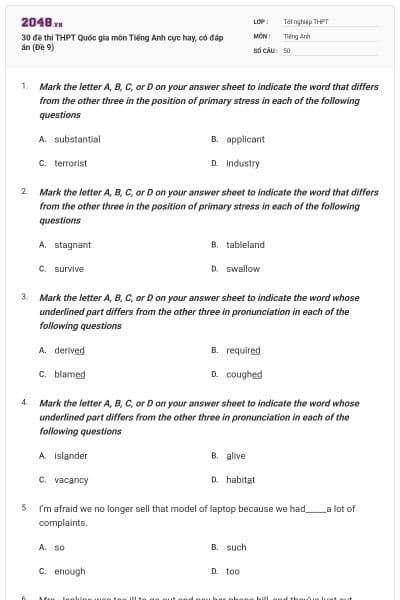
Mark the letter A, B, C, or D on your answer sheet to indicate the word that differs from the other three in the position of primary stress in each of the following questions
substantial
applicant
terrorist
industry
Đáp án A
Kiến thức: Trọng âm của từ có 3 âm tiết
Giải thích:
substantial /səb'stæn∫l/
applicant /'æplikənt/
terrorist /'terərist/
industry /ˈɪndəstri/
Câu A trọng âm rơi vào âm tiết thứ 2, còn lại là thứ nhất
Mark the letter A, B, C, or D on your answer sheet to indicate the word that differs from the other three in the position of primary stress in each of the following questions
stagnant
tableland
survive
swallow
Đáp án C
Kiến thức: Trọng âm của từ có 2 và 3 âm tiết
Giải thích:
stagnant /'stægnənt/
tableland /'teibllænd/
survive /sə'vaiv/
swallow /'swɒləʊ/
Câu C trọng âm rơi vào âm tiết thứ 2 còn lại là thứ nhất
Mark the letter A, B, C, or D on your answer sheet to indicate the word whose underlined part differs from the other three in pronunciation in each of the following questions
derived
required
blamed
coughed
Đáp án D
Kiến thức: Phát âm “-ed”
Giải thích:
Có 3 cách phát âm ed trong tiếng anh
Đuôi /ed/ được phát âm là /id/ khi động từ có phát âm kết thúc là /t/ hay /d/
Đuôi /ed/ được phát âm là /t/ khi động từ có phát âm kết thúc là /s/,/f/,/p/,/ʃ/,/tʃ/,/k/
Đuôi /ed/ được phát âm là /d/ với các trường hợp còn lại.
Phần gạch chân câu D được phát âm là /t/ còn lại là /d/
Mark the letter A, B, C, or D on your answer sheet to indicate the word whose underlined part differs from the other three in pronunciation in each of the following questions
islander
alive
vacancy
habitat
Đáp án D
Kiến thức: Phát âm “-a”
Giải thích:
islander /'ailəndə[r]/
alive /ə'laiv/
vacancy /'veikənsi/
habitat /'hæbitæt/
Phần gạch chân câu D được phát âm là /æ/ còn lại là /ə/
I’m afraid we no longer sell that model of laptop because we had_____a lot of complaints.
so
such
enough
too
Đáp án B
Kiến thức: Nhấn mạnh với so và such
Giải thích:
So và Such cả hai có thể dùng để nhấn mạnh hay tăng thêm mức độ của một điều gì đó. Chúng ta dùng Such trước một danh từ và dùng So trước một tính từ.
Ta có thể nói: so much, so many nhưng lại phải dùng “such a lot (of)”
Tạm dịch: Tôi e rằng chúng tôi không còn bán loại máy tính xách tay đó nữa bởi vì chúng tôi đã có rất nhiều phàn nàn.
Mrs. Jenkins was too ill to go out and pay her phone bill, and they’ve just cut her_____. She ought to complain!
out
off
down
up
Đáp án B
Kiến thức: Phrasal verb
To cut out: cắt ra, ngừng hoạt động
To cut off: cắt đường dây (điện thoại)
To cut down: giảm, giảm xuống
To cut sb up: chém (ai), gây vết tím bầm (cho ai)
Tạm dịch: Bà Jenkins ốm không thể ra ngoài và trả hoá đơn điện thoại, và họ vừa mới cắt đường dây điện thoại. Bà ấy nên đi khiếu nại!
There’s a lot______violent crime in this area than there used to be.
fewer
least
less
fewest
Đáp án C
Kiến thức: So sánh hơn và so sánh nhất
Giải thích:
fewer: ít hơn (dùng với danh từ đếm được)
least: ít nhất (dùng với danh từ không đếm được)
less: ít hơn (dùng với danh từ không đếm được)
fewest: ít nhất (dùng với danh từ đếm được)
Danh từ trong câu là danh từ không đếm được, ngoài ra phải sử dụng so sánh hơn vì trong câu có “more”
Tạm dịch: Có ít tội phạm bạo lực hơn rất nhiều ở khu vực này so với trước kia.
The move to a different environment had brought about a significant______in Mary’s state of mind.
impact
effect
influence
change
Đáp án D
Kiến thức: Từ vựng
Giải thích:
impact (n): sự tác động
effect (n): sự tác động, ảnh hưởng
influence (n): sự ảnh hưởng, tác động
change (n): sự thay đổi
Tạm dịch: Chuyển đến môi trường khác đã mang đến sự thay đổi lớn trong suy nghĩ của Mary.
The party leader travelled the length and_____of the country in an attempt to spread his message.
width
distance
diameter
breadth
Đáp án D
Kiến thức: Từ vựng, thành ngữ
Giải thích:
width (n): chiều rộng
distance (n): khoảng cách
diameter (n): đường kính
breadth (n): bề ngang, bề rộng
Thành ngữ: the length and breadth of sth: ngang dọc khắp cái gì
Tạm dịch: Người lãnh đạo Đảng đi khắp mọi miền đất nước để truyền bá thông điệp của mình.
The amount Sarah earned was_______ on how much she sold.
dependence
dependant
dependent
independent
Đáp án C
Kiến thức: Từ vựng, từ loại
Giải thích:
dependence (n): sự tùy thuộc vào
dependant (n): người sống dựa (vào người khác)
dependent (a): tùy thuộc, dựa vào
independent (a): độc lập, không tuỳ thuộc vào
Tạm dịch: Số tiền Sarah kiếm được tuỳ thuộc vào giá cô ấy bán.
They would ______ go by air than spend a week travelling by train.
always
rather
prefer
better
Đáp án B
Kiến thức: Các cấu trúc đi với “would”
Giải thích:
would rather do sth than do sth: thà làm cái gì còn hơn làm cái gì
would prefer to do sth rather than do sth: thích làm cái gì hơn cái gì
Tạm dịch: Họ thà đi bằng máy bay còn hơn là dành cả một tuần ngồi tàu.
The party, _______ I was the guest of honour, was extremely enjoyable.
at that
at which
to that
to which
Đáp án B
Kiến thức: Mệnh đề quan hệ
Sau dấu phảy ta không dùng mệnh đề quan hệ that => A, C loại
“party” ta dùng giới từ “at”; ngoài ra, “at which” còn có nghĩa tương đương với “where”
Tạm dịch: Bữa tiệc, nơi tôi là một khách mời danh dự, thực sự rất vui vẻ.
If only I_______play the guitar as well as you!
would
should
could
might
Đáp án C
Kiến thức: Modal verb
Giải thích:
would: sẽ (dùng trong quá khứ diễn tả một việc sẽ xảy ra)
should: nên
could: có thể (chỉ tiềm năng, khả năng)
might: có thể (chỉ khả năng xảy ra)
Tạm dịch: Ước gì tôi có thể chơi ghi ta tốt như cậu!
The windows are in ______ frames.
circular huge wooden
huge wooden circular
wooden huge circular
huge circular wooden
Đáp án D
Kiến thức: Trật tự của tính từ đứng trước danh từ
Giải thích:
Size (Kích cỡ) – huge + Shape (Hình dáng) – circular + Material (Chất liệu) – wooden + Danh từ
Tạm dịch: Cửa sổ ở trong chiếc khung gỗ tròn rất lớn.
James was asking about a lot of personal things. I didn’t like______about my private life.
asking
being asked
to ask
to be asking
Đáp án B
Kiến thức: Dạng bị động
Về nghĩa của câu, ở đây ta phải dùng dạng bị động. Dạng bị động khi dùng với động từ “like” là “like being done sth” hoặc “like to be done sth”
Tạm dịch: James đang hỏi rất nhiều thứ cá nhân. Tôi không thích bị hỏi về đời sống riêng tư.
Vietnam U23 made not only Asia but also Europe keep a close eye on them. They _____ internationally.
have made headlines
had made headlines
have done headlines
did headlines
Đáp án A
Kiến thức: Thì trong tiếng anh, phrase
Giải thích:
Ở đây ta dùng thì hiện tại hoàn thành, diễn tả một việc bắt đầu trong quá khứ và kéo dài đến hiện tại, để lại kết quả ở hiện tại => B, D loại
Cụm to make headlines: trở thành tin tức quan trọng, được lan truyền rộng rãi
Tạm dịch: U23 Việt Nam không chỉ khiến Châu Á mà cả Châu Âu chú ý đến họ. Họ trở thành tin tức quan trọng lan truyền quốc tế.
Mark the letter A, B, C, or D on your answer sheet to indicate the word(s) CLOSEST in meaning to the underlined word (s) in each of the following questions.
A US man with a large online following in Vietnam has caused widespread anger, and faces possible criminal charges, over a Facebook post thought to have insulted a military hero.
embarrassed
offended
confused
depressed
Đáp án B
Kiến thức: Từ vựng, từ đồng nghĩa
Giải thích:
insult (v): lăng mạ, sỉ nhục
embarrass (v): làm lúng túng, làm bối rối
offend (v): xúc phạm, làm mếch lòng
confuse (v): làm lung tung, làm đảo lộn
depress (v): làm chán nản, làm phiền muộn
=> insult = offend
Tạm dịch: Một người đàn ông Hoa Kỳ có số lượng người theo dõi online lớn ở Việt Nam đã gây ra sự giận dữ diện rộng, và đối mặt với những cáo buộc hình sự có thể, vì một bài đăng trên Facebook được cho là xúc phạm một vị anh hùng quân đội.
Mark the letter A, B, C, or D on your answer sheet to indicate the word(s) CLOSEST in meaning to the underlined word (s) in each of the following questions.
Jack persisted in attempting to convince his employers to use more technology and fewer people.
endured
remained
repeated
insisted
Đáp án D
Kiến thức: Từ vựng, từ đồng nghĩa
Giải thích:
persist (v): khăng khăng, cố chấp, kiên trì
endure (v): chịu đựng
remain (v): duy trì
repeat (v): lặp lại
insist (v): khăng khăng, cố nài
=> persist = insist
Tạm dịch: Jack cố chấp trong việc cố gắng thuyết phục ông chủ sử dụng nhiều kỹ thuật và ít con người hơn.
Mark the letter A, B, C, or D on your answer sheet to indicate the word(s) OPPOSITE in meaning to the underlined word(s) in each of the following questions.
The doctor asked John to exhale slowly.
imhale
move in
enter
breathe in
Đáp án D
Kiến thức: Từ vựng, từ trái nghĩa
Giải thích:
exhale (v): thở ra, nhả ra
không có từ imhale (từ chính xác là inhale)
move in (v): chuyển đến
enter (v): bước vào
breathe in (v): hít vào
=> exhale >< breathe in
Tạm dịch: Bác sĩ khuyên John thở ra chậm rãi.
Mark the letter A, B, C, or D on your answer sheet to indicate the word(s) OPPOSITE in meaning to the underlined word(s) in each of the following questions.
The soldier was demoted for improper behavior.
promoted
lowered
resigned
let off
Đáp án A
Kiến thức: Từ vựng, từ trái nghĩa
Giải thích:
demote (v): giáng cấp
promote (v): thăng chức
lower (v): hạ thấp, hạ xuống
resign (v): từ chức
let off (v): buông bỏ
=> demote >< promote
Tạm dịch: Người lính bị giáng chức vì hành vi không đúng đắn.
Arm and Mary are studying in their classroom.
Ann: “Can I borrow you dictionary?”
Mary: “______ ”
I’m afraid I can’t
Here you are!
I think so
It doesn’t matter
Đáp án B
Kiến thức: Văn hoá giao tiếp
Giải thích:
Tạm dịch: Ann và Mary đang học trong phòng học
Ann: Tớ có thể mượn từ điển của cậu không?
Mary: ____.
A. Tớ e là tớ không thể. B. Của cậu đây!
C. Tớ nghĩ vậy. D. Nó không quan trọng.
Jack and Joe are discussing how to make salad for dinner.
Jack: “______”
Joe: How about putting some grapes in it, instead?
We could fry some onions with it too
I’d rather just have some bread, thanks
Let’s put some pieces of apple in the salad
Good idea! I’ll go and make one
Đáp án B
Kiến thức: Văn hoá giao tiếp
Giải thích:
Tạm dịch: Jack và Joe đang thảo luận cách làm salad cho bữa tối.
Jack: _____.
Joe: Thay vào đó thì bỏ chút nho vào đó thì sao?
A. Chúng ta cũng có thể chiên chút hành với nó.
B. Tớ chỉ cần chút bánh mì, cám ơn.
C. Hãy bỏ vài miếng táo vào salad.
D. Ý kiến hay! Tớ sẽ đi làm một chút.
Read the following passage and mark the letter A, B, C, or D on your answer sheet to indicate the correct word or phrase that best fits each of the numbered blanks from 23 to 27.
CHESS
Chess, often (23)______ to as the Royal Game, is the oldest of all board games which do not contain an element of chance.
The origins of chess are uncertain, (24)______ there are a number of legends regarding its invention. One story says that it was King Solomon who invented chess, another that it was the Greek god Hermes, and yet another that the Chinese mandarin Han-Sing was responsible for its creation. In fact, chess almost certainly originated in India in the sixth or seventh century AD. The game’s popularity then spread quickly through Persia (now known as Iran) and from there came to Europe. The first documented reference to chess in literature is in a Persian romance which was written about 600 AD.
It is (25)_______ the word ‘chess’ comes from ‘shah’, the Persian word for ‘king’ and that ‘checkmate’, the game’s winning (26)_______, comes from the phrase ‘shah mat’, (27)______ ‘the king is dead’.
The rules and pieces used in the game have undergone changes over the centuries. Modem chess owes much to the Spaniard Lopez de Segura, who in 1561 wrote the first book on how to play the game. In it, he introduced the concept of ‘castling’, which had not been part of the game until then.
Điền vào ô số 23
mentioned
called
known
referred
Đáp án A
Kiến thức: Cụm từ với refer to sb / st as
Giải thích:
(To) refer to sb / sth as: gọi / xem ai đó / cái gì (bằng tên gọi cụ thể hoặc đặc trưng)
Tạm dịch: Cờ vua thường được xem như là một Trò chơi Hoàng Gia …
Read the following passage and mark the letter A, B, C, or D on your answer sheet to indicate the correct word or phrase that best fits each of the numbered blanks from 23 to 27.
CHESS
Chess, often (23)______ to as the Royal Game, is the oldest of all board games which do not contain an element of chance.
The origins of chess are uncertain, (24)______ there are a number of legends regarding its invention. One story says that it was King Solomon who invented chess, another that it was the Greek god Hermes, and yet another that the Chinese mandarin Han-Sing was responsible for its creation. In fact, chess almost certainly originated in India in the sixth or seventh century AD. The game’s popularity then spread quickly through Persia (now known as Iran) and from there came to Europe. The first documented reference to chess in literature is in a Persian romance which was written about 600 AD.
It is (25)_______ the word ‘chess’ comes from ‘shah’, the Persian word for ‘king’ and that ‘checkmate’, the game’s winning (26)_______, comes from the phrase ‘shah mat’, (27)______ ‘the king is dead’.
The rules and pieces used in the game have undergone changes over the centuries. Modem chess owes much to the Spaniard Lopez de Segura, who in 1561 wrote the first book on how to play the game. In it, he introduced the concept of ‘castling’, which had not been part of the game until then.
Điền vào ô số 24
despite
nevertheless
although
however
Đáp án A
Kiến thức: Liên từ
Giải thích:
despite + N/Ving : mặc dù
nevertheless: tuy nhiên
although + mệnh đề : mặc dù
however: tuy nhiên
Tạm dịch: Nguồn gốc của cờ vua không rõ ràng. Tuy nhiên, có một huyền thoại về phát minh này.
Read the following passage and mark the letter A, B, C, or D on your answer sheet to indicate the correct word or phrase that best fits each of the numbered blanks from 23 to 27.
CHESS
Chess, often (23)______ to as the Royal Game, is the oldest of all board games which do not contain an element of chance.
The origins of chess are uncertain, (24)______ there are a number of legends regarding its invention. One story says that it was King Solomon who invented chess, another that it was the Greek god Hermes, and yet another that the Chinese mandarin Han-Sing was responsible for its creation. In fact, chess almost certainly originated in India in the sixth or seventh century AD. The game’s popularity then spread quickly through Persia (now known as Iran) and from there came to Europe. The first documented reference to chess in literature is in a Persian romance which was written about 600 AD.
It is (25)_______ the word ‘chess’ comes from ‘shah’, the Persian word for ‘king’ and that ‘checkmate’, the game’s winning (26)_______, comes from the phrase ‘shah mat’, (27)______ ‘the king is dead’.
The rules and pieces used in the game have undergone changes over the centuries. Modem chess owes much to the Spaniard Lopez de Segura, who in 1561 wrote the first book on how to play the game. In it, he introduced the concept of ‘castling’, which had not been part of the game until then.
Điền vào ô số 25
believed
imagined
held
taken
Đáp án C
Kiến thức: Từ vựng
Giải thích:
believed: được tin tưởng
imagined: được tưởng tượng
held: được tổ chức
taken: được lấy
Tạm dịch: Nó được tin rằng, "cờ vua" xuất phát từ "shah"…
Read the following passage and mark the letter A, B, C, or D on your answer sheet to indicate the correct word or phrase that best fits each of the numbered blanks from 23 to 27.
CHESS
Chess, often (23)______ to as the Royal Game, is the oldest of all board games which do not contain an element of chance.
The origins of chess are uncertain, (24)______ there are a number of legends regarding its invention. One story says that it was King Solomon who invented chess, another that it was the Greek god Hermes, and yet another that the Chinese mandarin Han-Sing was responsible for its creation. In fact, chess almost certainly originated in India in the sixth or seventh century AD. The game’s popularity then spread quickly through Persia (now known as Iran) and from there came to Europe. The first documented reference to chess in literature is in a Persian romance which was written about 600 AD.
It is (25)_______ the word ‘chess’ comes from ‘shah’, the Persian word for ‘king’ and that ‘checkmate’, the game’s winning (26)_______, comes from the phrase ‘shah mat’, (27)______ ‘the king is dead’.
The rules and pieces used in the game have undergone changes over the centuries. Modem chess owes much to the Spaniard Lopez de Segura, who in 1561 wrote the first book on how to play the game. In it, he introduced the concept of ‘castling’, which had not been part of the game until then.
Điền vào ô số 26
place
stand
go
move
Đáp án D
Kiến thức: Cụm từ winning move
Giải thích:
winning move: chiến thắng của trò chơi từ một bảng điều khiển không được kiểm soát.
Tạm dịch: chiến thắng của trò chơi, xuất phát từ cụm từ "shah mat"
Read the following passage and mark the letter A, B, C, or D on your answer sheet to indicate the correct word or phrase that best fits each of the numbered blanks from 23 to 27.
CHESS
Chess, often (23)______ to as the Royal Game, is the oldest of all board games which do not contain an element of chance.
The origins of chess are uncertain, (24)______ there are a number of legends regarding its invention. One story says that it was King Solomon who invented chess, another that it was the Greek god Hermes, and yet another that the Chinese mandarin Han-Sing was responsible for its creation. In fact, chess almost certainly originated in India in the sixth or seventh century AD. The game’s popularity then spread quickly through Persia (now known as Iran) and from there came to Europe. The first documented reference to chess in literature is in a Persian romance which was written about 600 AD.
It is (25)_______ the word ‘chess’ comes from ‘shah’, the Persian word for ‘king’ and that ‘checkmate’, the game’s winning (26)_______, comes from the phrase ‘shah mat’, (27)______ ‘the king is dead’.
The rules and pieces used in the game have undergone changes over the centuries. Modem chess owes much to the Spaniard Lopez de Segura, who in 1561 wrote the first book on how to play the game. In it, he introduced the concept of ‘castling’, which had not been part of the game until then.
Điền vào ô số 27
representing
suggesting
intending
meaning
Đáp án D
Kiến thức: Từ vựng
Giải thích:
representing: đại diện suggesting: gợi ý
intending: dự định meaning: có nghĩa là
Tạm dịch: chiến thắng của trò chơi, xuất phát từ cụm từ "shah mat", có nghĩa là "nhà vua đã chết"
Dịch đoạn văn:
Cờ vua thường được xem như là một Trò chơi Hoàng Gia, là một trong những trò chơi lâu đời nhất.
Nguồn gốc của cờ vua không rõ ràng. Tuy nhiên, có một huyền thoại về phát minh này. Một câu chuyện nói rằng Vua Solomon, người đã phát minh ra cờ vua, một câu chuyện khác lại cho rằng Thần Hermes Hy Lạp, và một người khác nữa thủ lĩnh của người Trung Quốc Han-Sing đã chịu trách nhiệm về sự sáng tạo nó. Thực tế, cờ vua gần như chắc chắn có nguồn gốc từ Ấn Độ vào thế kỳ thứ 6 hoặc 7 sau Công nguyên. Sự phổ biến của trò chơi lan rộng nhanh chóng qua Ba Tư (bây giờ được biết đến là Iran) và từ đó đi đến Châu Âu. Tài liệu tham khảo đầu tiên về cờ vua trong văn học là một câu chuyện lãng mạn của người Ba Tư được viết năm 600 sau Công nguyên.
Nó được tin rằng, "cờ vua" xuất phát từ "shah", tiếng Ba Tư là "Vua" và "thất bại" , chiến thắng của trò chơi, xuất phát từ cụm từ "shah mat", có nghĩa là "nhà vua đã chết".
Các quy tắc và các bộ phận của trỏ chơi được sử dụng trong trò chơi đã trải qua những thay đổi qua nhiều thế kỷ. Cờ vua hiện đại nợ người Tây Ban Nha Ruy Lopez de Segura, người vào năm 1561 đã viết cuốn sách đầu tiên về các chơi trò chơi. Trong đó ông giới thiệu khái niệm "castling", vốn không phải là một phần của trò chơi cho đến tận khi đó.
Read the following passage and mark the letter A, B, C, or D on your answer sheet to indicate the correct answer to each of the questions from 28 to 34.
Rain pounded down on the roof. I was trying to read but the sound was too loud. I couldn’t help myself from being a little grumpy. I wanted to be outside playing, but the rain was keeping me inside.
My mom had gone to the grocery store, and my dad was spending Saturday at the office. I had planned to spend the day hiking, but Mother Nature decided that today was the perfect day for rain.
It meant that I would have to entertain myself. I spent most of the morning playing with my stuffed animals and reading. I was sitting next to the window staring out when I got a strange idea: why not just go outside anyway?
I put on my boots and a big raincoat and stepped out into the wet world. It was raining hard but it wasn’t cold. All I could hear were raindrops and the wind. I decided to go on my hike anyway.
My feet didn’t make any sound on the wet ground and the forest seemed different. I went to my favourite place and sat down. In the summer, my best friend Ellen and I would come here and sit for hours. It was our special place. All of a sudden, I thought I heard someone shouting my name. I turned and saw Ellen walking up behind me.
“Oh my Gosh! It’s really you, Martha!” she said. “I can’t believe that you are out here right now. I thought I would be the only person crazy enough to go for a walk in the rain.”
I was very happy to have some company. We decided that hiking in the rain was just as fun as hiking in the sunshine. We planned on hiking in the rain again.
What is the best title for the story?
Rainy Day Work
Rainy Day Hike
A Rainy Day Indoors
Rainy Day Homework
Đáp án B
Kiến thức: Đọc hiểu
Giải thích:
Tiêu đề của câu chuyện là gì?
A. Làm việc trong mưa
B. Đi bộ trong mưa
C. Trời mưa trong nhà
D. Bài tập về nhà ngày mưa
Read the following passage and mark the letter A, B, C, or D on your answer sheet to indicate the correct answer to each of the questions from 28 to 34.
Rain pounded down on the roof. I was trying to read but the sound was too loud. I couldn’t help myself from being a little grumpy. I wanted to be outside playing, but the rain was keeping me inside.
My mom had gone to the grocery store, and my dad was spending Saturday at the office. I had planned to spend the day hiking, but Mother Nature decided that today was the perfect day for rain.
It meant that I would have to entertain myself. I spent most of the morning playing with my stuffed animals and reading. I was sitting next to the window staring out when I got a strange idea: why not just go outside anyway?
I put on my boots and a big raincoat and stepped out into the wet world. It was raining hard but it wasn’t cold. All I could hear were raindrops and the wind. I decided to go on my hike anyway.
My feet didn’t make any sound on the wet ground and the forest seemed different. I went to my favourite place and sat down. In the summer, my best friend Ellen and I would come here and sit for hours. It was our special place. All of a sudden, I thought I heard someone shouting my name. I turned and saw Ellen walking up behind me.
“Oh my Gosh! It’s really you, Martha!” she said. “I can’t believe that you are out here right now. I thought I would be the only person crazy enough to go for a walk in the rain.”
I was very happy to have some company. We decided that hiking in the rain was just as fun as hiking in the sunshine. We planned on hiking in the rain again.
The word “grumpy” in paragraph 1 is closest in meaning to
stupid
bad-tempered
uninterested
unsatisfactory
Đáp án B
Kiến thức: Từ vựng
Giải thích:
Từ "grumpy" ở đoạn 1 gần nghĩa nhất với từ nào?
A. ngốc ghếch
B. gắt gỏng, cộc cằn
C. không thỏa mãn
D. không hài lòng
Thông tin: I couldn’t help myself from being a little grumpy
Tạm dịch: Tôi không thể tự kiềm chế mình khỏi một chút cộc cằn
Read the following passage and mark the letter A, B, C, or D on your answer sheet to indicate the correct answer to each of the questions from 28 to 34.
Rain pounded down on the roof. I was trying to read but the sound was too loud. I couldn’t help myself from being a little grumpy. I wanted to be outside playing, but the rain was keeping me inside.
My mom had gone to the grocery store, and my dad was spending Saturday at the office. I had planned to spend the day hiking, but Mother Nature decided that today was the perfect day for rain.
It meant that I would have to entertain myself. I spent most of the morning playing with my stuffed animals and reading. I was sitting next to the window staring out when I got a strange idea: why not just go outside anyway?
I put on my boots and a big raincoat and stepped out into the wet world. It was raining hard but it wasn’t cold. All I could hear were raindrops and the wind. I decided to go on my hike anyway.
My feet didn’t make any sound on the wet ground and the forest seemed different. I went to my favourite place and sat down. In the summer, my best friend Ellen and I would come here and sit for hours. It was our special place. All of a sudden, I thought I heard someone shouting my name. I turned and saw Ellen walking up behind me.
“Oh my Gosh! It’s really you, Martha!” she said. “I can’t believe that you are out here right now. I thought I would be the only person crazy enough to go for a walk in the rain.”
I was very happy to have some company. We decided that hiking in the rain was just as fun as hiking in the sunshine. We planned on hiking in the rain again.
What was keeping Martha inside?
The heat
Her parents
Bad weather
Lots of homework
Đáp án C
Kiến thức: Đọc hiểu
Giải thích:
Điều gì đã giữ Martha bên trong nhà?
A. Nhiệt
B. Bố mẹ của cô ấy
C. Thời tiết xấu
D. Nhiều bài tập về nhà
Thông tin: I wanted to be outside playing, but the rain was keeping me inside
Tạm dịch: Tôi muốn ra ngoài chơi, nhưng trời mưa đã giữ tôi ở trong nhà
Read the following passage and mark the letter A, B, C, or D on your answer sheet to indicate the correct answer to each of the questions from 28 to 34.
Rain pounded down on the roof. I was trying to read but the sound was too loud. I couldn’t help myself from being a little grumpy. I wanted to be outside playing, but the rain was keeping me inside.
My mom had gone to the grocery store, and my dad was spending Saturday at the office. I had planned to spend the day hiking, but Mother Nature decided that today was the perfect day for rain.
It meant that I would have to entertain myself. I spent most of the morning playing with my stuffed animals and reading. I was sitting next to the window staring out when I got a strange idea: why not just go outside anyway?
I put on my boots and a big raincoat and stepped out into the wet world. It was raining hard but it wasn’t cold. All I could hear were raindrops and the wind. I decided to go on my hike anyway.
My feet didn’t make any sound on the wet ground and the forest seemed different. I went to my favourite place and sat down. In the summer, my best friend Ellen and I would come here and sit for hours. It was our special place. All of a sudden, I thought I heard someone shouting my name. I turned and saw Ellen walking up behind me.
“Oh my Gosh! It’s really you, Martha!” she said. “I can’t believe that you are out here right now. I thought I would be the only person crazy enough to go for a walk in the rain.”
I was very happy to have some company. We decided that hiking in the rain was just as fun as hiking in the sunshine. We planned on hiking in the rain again.
What does Martha mean when she says “It meant that I would have to entertain myself”?
She was tired
She was feeling sick
She had to find something to do
She was bored with doing homework
Đáp án C
Kiến thức: Đọc hiểu
Giải thích:
Martha có ý gì khi nói rằng “ Có nghĩa là tôi sẽ phải tự tìm thú tiêu khiển à?”
A. Cô ấy mệt.
B. Cô ấy cảm thấy không khỏe.
C. Cô ấy phải tìm gì đó để làm.
D. Cô ấy chán với việc làm bài tập về nhà.
Read the following passage and mark the letter A, B, C, or D on your answer sheet to indicate the correct answer to each of the questions from 28 to 34.
Rain pounded down on the roof. I was trying to read but the sound was too loud. I couldn’t help myself from being a little grumpy. I wanted to be outside playing, but the rain was keeping me inside.
My mom had gone to the grocery store, and my dad was spending Saturday at the office. I had planned to spend the day hiking, but Mother Nature decided that today was the perfect day for rain.
It meant that I would have to entertain myself. I spent most of the morning playing with my stuffed animals and reading. I was sitting next to the window staring out when I got a strange idea: why not just go outside anyway?
I put on my boots and a big raincoat and stepped out into the wet world. It was raining hard but it wasn’t cold. All I could hear were raindrops and the wind. I decided to go on my hike anyway.
My feet didn’t make any sound on the wet ground and the forest seemed different. I went to my favourite place and sat down. In the summer, my best friend Ellen and I would come here and sit for hours. It was our special place. All of a sudden, I thought I heard someone shouting my name. I turned and saw Ellen walking up behind me.
“Oh my Gosh! It’s really you, Martha!” she said. “I can’t believe that you are out here right now. I thought I would be the only person crazy enough to go for a walk in the rain.”
I was very happy to have some company. We decided that hiking in the rain was just as fun as hiking in the sunshine. We planned on hiking in the rain again.
The word “company” in the last paragraph is closest in meaning to
time
space
friend
business
Đáp án C
Kiến thức: Từ vựng
Giải thích:
Từ “company” ở đoạn cuối gần nghĩa nhất với.....
time: thời gian
space: không gian
friend: bạn bè
business: kinh doanh
company (n): bạn bè = friend
Read the following passage and mark the letter A, B, C, or D on your answer sheet to indicate the correct answer to each of the questions from 28 to 34.
Rain pounded down on the roof. I was trying to read but the sound was too loud. I couldn’t help myself from being a little grumpy. I wanted to be outside playing, but the rain was keeping me inside.
My mom had gone to the grocery store, and my dad was spending Saturday at the office. I had planned to spend the day hiking, but Mother Nature decided that today was the perfect day for rain.
It meant that I would have to entertain myself. I spent most of the morning playing with my stuffed animals and reading. I was sitting next to the window staring out when I got a strange idea: why not just go outside anyway?
I put on my boots and a big raincoat and stepped out into the wet world. It was raining hard but it wasn’t cold. All I could hear were raindrops and the wind. I decided to go on my hike anyway.
My feet didn’t make any sound on the wet ground and the forest seemed different. I went to my favourite place and sat down. In the summer, my best friend Ellen and I would come here and sit for hours. It was our special place. All of a sudden, I thought I heard someone shouting my name. I turned and saw Ellen walking up behind me.
“Oh my Gosh! It’s really you, Martha!” she said. “I can’t believe that you are out here right now. I thought I would be the only person crazy enough to go for a walk in the rain.”
I was very happy to have some company. We decided that hiking in the rain was just as fun as hiking in the sunshine. We planned on hiking in the rain again.
What did Martha think about being outside?
It was too hot
It was too cold
It was very nice
It was too wet to walk
Đáp án C
Kiến thức: Đọc hiểu
Martha đã nghĩ điều gì về việc đi ra ngoài?
A. Trời quá nóng
B. Trời quá lạnh
C. Rất tuyệt
D. Quá ẩm ướt để đi bộ
Thông tin: I was very happy to have some company.
Tạm dịch: Tôi rất hạnh phúc khi có bạn bè
Read the following passage and mark the letter A, B, C, or D on your answer sheet to indicate the correct answer to each of the questions from 28 to 34.
Rain pounded down on the roof. I was trying to read but the sound was too loud. I couldn’t help myself from being a little grumpy. I wanted to be outside playing, but the rain was keeping me inside.
My mom had gone to the grocery store, and my dad was spending Saturday at the office. I had planned to spend the day hiking, but Mother Nature decided that today was the perfect day for rain.
It meant that I would have to entertain myself. I spent most of the morning playing with my stuffed animals and reading. I was sitting next to the window staring out when I got a strange idea: why not just go outside anyway?
I put on my boots and a big raincoat and stepped out into the wet world. It was raining hard but it wasn’t cold. All I could hear were raindrops and the wind. I decided to go on my hike anyway.
My feet didn’t make any sound on the wet ground and the forest seemed different. I went to my favourite place and sat down. In the summer, my best friend Ellen and I would come here and sit for hours. It was our special place. All of a sudden, I thought I heard someone shouting my name. I turned and saw Ellen walking up behind me.
“Oh my Gosh! It’s really you, Martha!” she said. “I can’t believe that you are out here right now. I thought I would be the only person crazy enough to go for a walk in the rain.”
I was very happy to have some company. We decided that hiking in the rain was just as fun as hiking in the sunshine. We planned on hiking in the rain again.
What will Martha and Ellen probably do next time it rains?
Stay inside
Do homework
Go for another hike
Go to their friend’s house
Đáp án C
Kiến thức: Đọc hiểu
Giải thích:
Martha và Ellen sẽ làm gì sau trời mưa?
A. Ở trong nhà
B. Làm bài tập về nhà
C. Đi bộ dưới trời mưa
D. Đi tới nhà bạn bè của họ
Thông tin: We decided that hiking in the rain was just as fun as hiking in the sunshine.
Tạm dịch: Chúng tôi quyết định đi bộ dưới trời mưa vì nó vui như đi bộ dưới trời nắng.
Read the following passage and mark the letter A, B, C, or D on your answer sheet to indicate the correct answer to each of the questions from 35 to 42.
Life in the Universe
Exobiology is the study of life that originates from outside of Earth. As yet, of course, no such life forms have been found. Exobiologists, however, have done important work in the theoretical study of where life is most likely to evolve, and what those extrateưestrial life forms might be like.
What sorts of planets are most likely to develop life? Most scientists agree that a habitable planet must be terrestrial, or rock-based, with liquid surface water and biogeochemical cycles that somewhat resemble Earth’s. Water is an important solvent involved in many biological processes. Biogeochemical cycles are the continuous movement and transformation of materials in the environment. These cycles include the circulation of elements and nutrients upon which life and the Earth’s climate depend. Since (as far as we know) all life is carbon-based, a stable carbon cycle is especially important.
The habitable zone is the region around a star in which planets can develop life. Assuming the need for liquid surface water, it follows that most stars around the size of our sun will be able to sustain habitable zones for billions of years. Stars that are larger than the sun are much hotter and bum out more quickly; life there may not have enough time to evolve. Stars that are smaller than the sun have different problem. First of all, planets in their habitable zones will be so close to the star that they will be “tidally locked” – that is one side of the planet will always face the star in perpetual daylight with the other side in the perpetual night. Another possible obstacle to life on smaller stars is that they tend to vary in their luminosity, or brightness, due to flares and “star spots”. The variation can be large enough to have harmful effects on the ecosystem.
Of course, not all stars of the right size will give rise to life; they also must have terrestrial planets with the right kind of orbits. Most solar systems have more than one planet, which influence each other’s orbits with their own gravity. Therefore, in order to have a stable system with no planets flying out into space, the orbits must be a good distance from one another. Interestingly, the amount of space needed is roughly the width of a star’s habitable zone. This means that for life to evolve, the largest possible number of life-supporting planets in any star’s habitable zone is two.
Finally, not all planets meeting the above conditions will necessarily develop life. One major threat is large, frequent asteroid and comet impacts, which will wipe out life each time it tries to evolve. The case of Earth teaches that having large gas giants, such as Saturn and Jupiter,.in the outer part of the solar system can help keep a planet safe for life. Due to their strong gravitation, they tend to catch or deflect large objects before they can reach Earth.
What is the topic of the passage?
The search for intelligent life
Conditions necessary for life
Characteristics of extraterrestrial life
Life in our solar system
Đáp án B
Kiến thức: Đọc hiểu
Giải thích:
Chủ đề của đoạn văn là gì?
A. Cuộc tìm kiếm cuộc sống thông minh
B. Điều kiện cần thiết cho sự sống.
C. Đặc điểm của sự sống ngoài Trái đất
D. Sự sống trong hệ mặt trời của chúng ta.
Thông tin: Exobiology is the study of life that originates from outside of Earth.
Tạm dịch: Sinh học ngoài Trái đất là một nghiên cứu về cuộc sống từ bên ngoài bề mặt Trái Đất
Read the following passage and mark the letter A, B, C, or D on your answer sheet to indicate the correct answer to each of the questions from 35 to 42.
Life in the Universe
Exobiology is the study of life that originates from outside of Earth. As yet, of course, no such life forms have been found. Exobiologists, however, have done important work in the theoretical study of where life is most likely to evolve, and what those extrateưestrial life forms might be like.
What sorts of planets are most likely to develop life? Most scientists agree that a habitable planet must be terrestrial, or rock-based, with liquid surface water and biogeochemical cycles that somewhat resemble Earth’s. Water is an important solvent involved in many biological processes. Biogeochemical cycles are the continuous movement and transformation of materials in the environment. These cycles include the circulation of elements and nutrients upon which life and the Earth’s climate depend. Since (as far as we know) all life is carbon-based, a stable carbon cycle is especially important.
The habitable zone is the region around a star in which planets can develop life. Assuming the need for liquid surface water, it follows that most stars around the size of our sun will be able to sustain habitable zones for billions of years. Stars that are larger than the sun are much hotter and bum out more quickly; life there may not have enough time to evolve. Stars that are smaller than the sun have different problem. First of all, planets in their habitable zones will be so close to the star that they will be “tidally locked” – that is one side of the planet will always face the star in perpetual daylight with the other side in the perpetual night. Another possible obstacle to life on smaller stars is that they tend to vary in their luminosity, or brightness, due to flares and “star spots”. The variation can be large enough to have harmful effects on the ecosystem.
Of course, not all stars of the right size will give rise to life; they also must have terrestrial planets with the right kind of orbits. Most solar systems have more than one planet, which influence each other’s orbits with their own gravity. Therefore, in order to have a stable system with no planets flying out into space, the orbits must be a good distance from one another. Interestingly, the amount of space needed is roughly the width of a star’s habitable zone. This means that for life to evolve, the largest possible number of life-supporting planets in any star’s habitable zone is two.
Finally, not all planets meeting the above conditions will necessarily develop life. One major threat is large, frequent asteroid and comet impacts, which will wipe out life each time it tries to evolve. The case of Earth teaches that having large gas giants, such as Saturn and Jupiter,.in the outer part of the solar system can help keep a planet safe for life. Due to their strong gravitation, they tend to catch or deflect large objects before they can reach Earth.
All of the following are mentioned in the passage as necessary for the development of life except
rock
carbon
oxygen
water
Đáp án C
Kiến thức: Đọc hiểu
Giải thích:
Tất cả những điều sau đây được đề cập trong đoạn văn để cần thiết cho sự phát triển sự sống, Trừ:
A. đá
B. Carbon
C. khí oxy
D. nước
Thông tin: Most scientists agree that a habitable planet must be
terrestn rock-based, with liquid surface water ….. Since (as far as we know) all life is carbon-based
Tạm dịch: Hầu hết các nhà khoa học đồng ý rằng một hành tinh sống phải có đá trên mặt, với nước… Như chúng ta biết, tất cả cuộc sống của chúng ta đều dựa vào carbon…
Read the following passage and mark the letter A, B, C, or D on your answer sheet to indicate the correct answer to each of the questions from 35 to 42.
Life in the Universe
Exobiology is the study of life that originates from outside of Earth. As yet, of course, no such life forms have been found. Exobiologists, however, have done important work in the theoretical study of where life is most likely to evolve, and what those extrateưestrial life forms might be like.
What sorts of planets are most likely to develop life? Most scientists agree that a habitable planet must be terrestrial, or rock-based, with liquid surface water and biogeochemical cycles that somewhat resemble Earth’s. Water is an important solvent involved in many biological processes. Biogeochemical cycles are the continuous movement and transformation of materials in the environment. These cycles include the circulation of elements and nutrients upon which life and the Earth’s climate depend. Since (as far as we know) all life is carbon-based, a stable carbon cycle is especially important.
The habitable zone is the region around a star in which planets can develop life. Assuming the need for liquid surface water, it follows that most stars around the size of our sun will be able to sustain habitable zones for billions of years. Stars that are larger than the sun are much hotter and bum out more quickly; life there may not have enough time to evolve. Stars that are smaller than the sun have different problem. First of all, planets in their habitable zones will be so close to the star that they will be “tidally locked” – that is one side of the planet will always face the star in perpetual daylight with the other side in the perpetual night. Another possible obstacle to life on smaller stars is that they tend to vary in their luminosity, or brightness, due to flares and “star spots”. The variation can be large enough to have harmful effects on the ecosystem.
Of course, not all stars of the right size will give rise to life; they also must have terrestrial planets with the right kind of orbits. Most solar systems have more than one planet, which influence each other’s orbits with their own gravity. Therefore, in order to have a stable system with no planets flying out into space, the orbits must be a good distance from one another. Interestingly, the amount of space needed is roughly the width of a star’s habitable zone. This means that for life to evolve, the largest possible number of life-supporting planets in any star’s habitable zone is two.
Finally, not all planets meeting the above conditions will necessarily develop life. One major threat is large, frequent asteroid and comet impacts, which will wipe out life each time it tries to evolve. The case of Earth teaches that having large gas giants, such as Saturn and Jupiter,.in the outer part of the solar system can help keep a planet safe for life. Due to their strong gravitation, they tend to catch or deflect large objects before they can reach Earth.
The word “which” in paragraph 3 refers to
star
zone
region
planet
Đáp án C
Kiến thức: Đọc hiểu
Giải thích:
Từ "which" trong đoạn 3 thay thế cho
A. ngôi sao
B. Vùng
C. khu vực
D. hành tinh
từ "which" thay thế cho cụm từ trước đó là "region"
Thông tin: The habitable zone is the region around a star in which planets can develop life.
Tạm dịch: Vùng có thể sinh sống là khu vực quanh những ngôi sao nở nơi mà hành tinh có thể phát triển sự sống.
Read the following passage and mark the letter A, B, C, or D on your answer sheet to indicate the correct answer to each of the questions from 35 to 42.
Life in the Universe
Exobiology is the study of life that originates from outside of Earth. As yet, of course, no such life forms have been found. Exobiologists, however, have done important work in the theoretical study of where life is most likely to evolve, and what those extrateưestrial life forms might be like.
What sorts of planets are most likely to develop life? Most scientists agree that a habitable planet must be terrestrial, or rock-based, with liquid surface water and biogeochemical cycles that somewhat resemble Earth’s. Water is an important solvent involved in many biological processes. Biogeochemical cycles are the continuous movement and transformation of materials in the environment. These cycles include the circulation of elements and nutrients upon which life and the Earth’s climate depend. Since (as far as we know) all life is carbon-based, a stable carbon cycle is especially important.
The habitable zone is the region around a star in which planets can develop life. Assuming the need for liquid surface water, it follows that most stars around the size of our sun will be able to sustain habitable zones for billions of years. Stars that are larger than the sun are much hotter and bum out more quickly; life there may not have enough time to evolve. Stars that are smaller than the sun have different problem. First of all, planets in their habitable zones will be so close to the star that they will be “tidally locked” – that is one side of the planet will always face the star in perpetual daylight with the other side in the perpetual night. Another possible obstacle to life on smaller stars is that they tend to vary in their luminosity, or brightness, due to flares and “star spots”. The variation can be large enough to have harmful effects on the ecosystem.
Of course, not all stars of the right size will give rise to life; they also must have terrestrial planets with the right kind of orbits. Most solar systems have more than one planet, which influence each other’s orbits with their own gravity. Therefore, in order to have a stable system with no planets flying out into space, the orbits must be a good distance from one another. Interestingly, the amount of space needed is roughly the width of a star’s habitable zone. This means that for life to evolve, the largest possible number of life-supporting planets in any star’s habitable zone is two.
Finally, not all planets meeting the above conditions will necessarily develop life. One major threat is large, frequent asteroid and comet impacts, which will wipe out life each time it tries to evolve. The case of Earth teaches that having large gas giants, such as Saturn and Jupiter,.in the outer part of the solar system can help keep a planet safe for life. Due to their strong gravitation, they tend to catch or deflect large objects before they can reach Earth.
It can be inferred from paragraph 3 that
the Earth is in the sun’s habitable zone
the Earth is tidally locked to the sun
the sun varies in its luminosity
variations in luminosity help life to develop
Đáp án A
Kiến thức: Đọc hiểu
Giải thích:
Có thể suy luận từ đoạn 3 rằng
A. Trái đất nằm trong vùng có sự sống của mặt trời.
B. Trái đất bị khóa chặt vào mặt trời
C. Mặt trời thay đổi theo độ sáng
D. Sự biến đổi ánh sáng giúp cuộc sống phát triển.
Read the following passage and mark the letter A, B, C, or D on your answer sheet to indicate the correct answer to each of the questions from 35 to 42.
Life in the Universe
Exobiology is the study of life that originates from outside of Earth. As yet, of course, no such life forms have been found. Exobiologists, however, have done important work in the theoretical study of where life is most likely to evolve, and what those extrateưestrial life forms might be like.
What sorts of planets are most likely to develop life? Most scientists agree that a habitable planet must be terrestrial, or rock-based, with liquid surface water and biogeochemical cycles that somewhat resemble Earth’s. Water is an important solvent involved in many biological processes. Biogeochemical cycles are the continuous movement and transformation of materials in the environment. These cycles include the circulation of elements and nutrients upon which life and the Earth’s climate depend. Since (as far as we know) all life is carbon-based, a stable carbon cycle is especially important.
The habitable zone is the region around a star in which planets can develop life. Assuming the need for liquid surface water, it follows that most stars around the size of our sun will be able to sustain habitable zones for billions of years. Stars that are larger than the sun are much hotter and bum out more quickly; life there may not have enough time to evolve. Stars that are smaller than the sun have different problem. First of all, planets in their habitable zones will be so close to the star that they will be “tidally locked” – that is one side of the planet will always face the star in perpetual daylight with the other side in the perpetual night. Another possible obstacle to life on smaller stars is that they tend to vary in their luminosity, or brightness, due to flares and “star spots”. The variation can be large enough to have harmful effects on the ecosystem.
Of course, not all stars of the right size will give rise to life; they also must have terrestrial planets with the right kind of orbits. Most solar systems have more than one planet, which influence each other’s orbits with their own gravity. Therefore, in order to have a stable system with no planets flying out into space, the orbits must be a good distance from one another. Interestingly, the amount of space needed is roughly the width of a star’s habitable zone. This means that for life to evolve, the largest possible number of life-supporting planets in any star’s habitable zone is two.
Finally, not all planets meeting the above conditions will necessarily develop life. One major threat is large, frequent asteroid and comet impacts, which will wipe out life each time it tries to evolve. The case of Earth teaches that having large gas giants, such as Saturn and Jupiter,.in the outer part of the solar system can help keep a planet safe for life. Due to their strong gravitation, they tend to catch or deflect large objects before they can reach Earth.
The word “sustain” in paragraph 3 could best be replaced by
assist
have
need
experience
Đáp án B
Kiến thức: Đọc hiểu
Từ "sustain" trong đoạn 3 có thể được thay thế bằng từ:
A. có thể có
B. có
C. cần
D. kinh nghiệm
Thông tin: … It follows that most stars around the size of our sun will be able to sustain habitable zones…
Tạm dịch: Theo đó, hầu hết các ngôi sao xung quanh vùng mặt trời của chúng ta sẽ có thể có khu vực sống được…
Read the following passage and mark the letter A, B, C, or D on your answer sheet to indicate the correct answer to each of the questions from 35 to 42.
Life in the Universe
Exobiology is the study of life that originates from outside of Earth. As yet, of course, no such life forms have been found. Exobiologists, however, have done important work in the theoretical study of where life is most likely to evolve, and what those extrateưestrial life forms might be like.
What sorts of planets are most likely to develop life? Most scientists agree that a habitable planet must be terrestrial, or rock-based, with liquid surface water and biogeochemical cycles that somewhat resemble Earth’s. Water is an important solvent involved in many biological processes. Biogeochemical cycles are the continuous movement and transformation of materials in the environment. These cycles include the circulation of elements and nutrients upon which life and the Earth’s climate depend. Since (as far as we know) all life is carbon-based, a stable carbon cycle is especially important.
The habitable zone is the region around a star in which planets can develop life. Assuming the need for liquid surface water, it follows that most stars around the size of our sun will be able to sustain habitable zones for billions of years. Stars that are larger than the sun are much hotter and bum out more quickly; life there may not have enough time to evolve. Stars that are smaller than the sun have different problem. First of all, planets in their habitable zones will be so close to the star that they will be “tidally locked” – that is one side of the planet will always face the star in perpetual daylight with the other side in the perpetual night. Another possible obstacle to life on smaller stars is that they tend to vary in their luminosity, or brightness, due to flares and “star spots”. The variation can be large enough to have harmful effects on the ecosystem.
Of course, not all stars of the right size will give rise to life; they also must have terrestrial planets with the right kind of orbits. Most solar systems have more than one planet, which influence each other’s orbits with their own gravity. Therefore, in order to have a stable system with no planets flying out into space, the orbits must be a good distance from one another. Interestingly, the amount of space needed is roughly the width of a star’s habitable zone. This means that for life to evolve, the largest possible number of life-supporting planets in any star’s habitable zone is two.
Finally, not all planets meeting the above conditions will necessarily develop life. One major threat is large, frequent asteroid and comet impacts, which will wipe out life each time it tries to evolve. The case of Earth teaches that having large gas giants, such as Saturn and Jupiter,.in the outer part of the solar system can help keep a planet safe for life. Due to their strong gravitation, they tend to catch or deflect large objects before they can reach Earth.
In order for life to develop, a planet’s orbit must not be
stable
very close to another planet’s orbit
on the same planet as another planet’s orbit
less wide than the star’s habitable zone
Đáp án B
Kiến thức: Đọc hiểu
Giải thích:
Để sự sống phát triển, quỹ đạo của hành tinh không được…
A. ổn định
B. rất gần quỹ đạo của hành tinh khác
C. cùng quỹ đạo với hành tinh khác
D. không rộng hơn vùng có thể sống được của các ngôi sao
Thông tin: Therefore, in order to have a stable system with no planets flying out into space, the orbits must be a good distance from one another.
Tạm dịch: Để có một hệ thống ổn định không có hành tinh nào bay vào không gian, các quỹ đạo phải là khoảng cách khá xa nhau.
Read the following passage and mark the letter A, B, C, or D on your answer sheet to indicate the correct answer to each of the questions from 35 to 42.
Life in the Universe
Exobiology is the study of life that originates from outside of Earth. As yet, of course, no such life forms have been found. Exobiologists, however, have done important work in the theoretical study of where life is most likely to evolve, and what those extrateưestrial life forms might be like.
What sorts of planets are most likely to develop life? Most scientists agree that a habitable planet must be terrestrial, or rock-based, with liquid surface water and biogeochemical cycles that somewhat resemble Earth’s. Water is an important solvent involved in many biological processes. Biogeochemical cycles are the continuous movement and transformation of materials in the environment. These cycles include the circulation of elements and nutrients upon which life and the Earth’s climate depend. Since (as far as we know) all life is carbon-based, a stable carbon cycle is especially important.
The habitable zone is the region around a star in which planets can develop life. Assuming the need for liquid surface water, it follows that most stars around the size of our sun will be able to sustain habitable zones for billions of years. Stars that are larger than the sun are much hotter and bum out more quickly; life there may not have enough time to evolve. Stars that are smaller than the sun have different problem. First of all, planets in their habitable zones will be so close to the star that they will be “tidally locked” – that is one side of the planet will always face the star in perpetual daylight with the other side in the perpetual night. Another possible obstacle to life on smaller stars is that they tend to vary in their luminosity, or brightness, due to flares and “star spots”. The variation can be large enough to have harmful effects on the ecosystem.
Of course, not all stars of the right size will give rise to life; they also must have terrestrial planets with the right kind of orbits. Most solar systems have more than one planet, which influence each other’s orbits with their own gravity. Therefore, in order to have a stable system with no planets flying out into space, the orbits must be a good distance from one another. Interestingly, the amount of space needed is roughly the width of a star’s habitable zone. This means that for life to evolve, the largest possible number of life-supporting planets in any star’s habitable zone is two.
Finally, not all planets meeting the above conditions will necessarily develop life. One major threat is large, frequent asteroid and comet impacts, which will wipe out life each time it tries to evolve. The case of Earth teaches that having large gas giants, such as Saturn and Jupiter,.in the outer part of the solar system can help keep a planet safe for life. Due to their strong gravitation, they tend to catch or deflect large objects before they can reach Earth.
It can be inferred from paragraph 4 that
most stars have more than two planets in their habitable zones
no star has more than two planets in its habitable zone
it is not possible for a star to have three planets with life on them
for life to develop, a star must have at least two planets in its habitable zone
Đáp án C
Kiến thức: Đọc hiểu
Giải thích:
Có thể rút ra từ đoạn 4 rằng…
A. hầu hết các ngôi sao có nhiều hơn 2 hành tinh trong khu vực có thể sống của họ
B. không có ngôi sao nào có nhiều hơn 2 hành tinh trong khu vực có thể sống của nó
C. không có khả năng cho 1 ngôi sao có 3 hành tinh cùng chúng.
D. để sự sống phát triển, một ngôi sao phải có ít nhất 2 hành tinh trong khu vực có thể sống của nó
Thông tin: This means that for life to evolve, the largest possible number of lifesupporting planets in any star’s habitable zone is two.
Tạm dịch: Điều này có nghĩa là để sự sống phát triển, số lượng lớn nhất để hỗ trợ các hành tinh trong khu vực có thể sống của một ngôi sao là 2.
Read the following passage and mark the letter A, B, C, or D on your answer sheet to indicate the correct answer to each of the questions from 35 to 42.
Life in the Universe
Exobiology is the study of life that originates from outside of Earth. As yet, of course, no such life forms have been found. Exobiologists, however, have done important work in the theoretical study of where life is most likely to evolve, and what those extrateưestrial life forms might be like.
What sorts of planets are most likely to develop life? Most scientists agree that a habitable planet must be terrestrial, or rock-based, with liquid surface water and biogeochemical cycles that somewhat resemble Earth’s. Water is an important solvent involved in many biological processes. Biogeochemical cycles are the continuous movement and transformation of materials in the environment. These cycles include the circulation of elements and nutrients upon which life and the Earth’s climate depend. Since (as far as we know) all life is carbon-based, a stable carbon cycle is especially important.
The habitable zone is the region around a star in which planets can develop life. Assuming the need for liquid surface water, it follows that most stars around the size of our sun will be able to sustain habitable zones for billions of years. Stars that are larger than the sun are much hotter and bum out more quickly; life there may not have enough time to evolve. Stars that are smaller than the sun have different problem. First of all, planets in their habitable zones will be so close to the star that they will be “tidally locked” – that is one side of the planet will always face the star in perpetual daylight with the other side in the perpetual night. Another possible obstacle to life on smaller stars is that they tend to vary in their luminosity, or brightness, due to flares and “star spots”. The variation can be large enough to have harmful effects on the ecosystem.
Of course, not all stars of the right size will give rise to life; they also must have terrestrial planets with the right kind of orbits. Most solar systems have more than one planet, which influence each other’s orbits with their own gravity. Therefore, in order to have a stable system with no planets flying out into space, the orbits must be a good distance from one another. Interestingly, the amount of space needed is roughly the width of a star’s habitable zone. This means that for life to evolve, the largest possible number of life-supporting planets in any star’s habitable zone is two.
Finally, not all planets meeting the above conditions will necessarily develop life. One major threat is large, frequent asteroid and comet impacts, which will wipe out life each time it tries to evolve. The case of Earth teaches that having large gas giants, such as Saturn and Jupiter,.in the outer part of the solar system can help keep a planet safe for life. Due to their strong gravitation, they tend to catch or deflect large objects before they can reach Earth.
Which of the following best expresses the essential information in the highlighted sentence in the passage?
Because of their nearness, habitable planets orbiting smaller stars usually have either constant daylight or constant night
The habitable zones of small stars are so close to the star that planets within them do not spin
One problem with some stars is that their habitable zones are tidally locked into either light or darkness
Some stars become tidally locked, so that they only shine light on one side of a planet
Đáp án B
Kiến thức: Đọc hiểu
Giải thích:
Câu nào sau đây thể hiện tốt nhất thông tin cần thiết trong câu được đánh dấu trong đoạn văn?
A. Do sự gần gũi của chúng, các hành tinh có thể sinh sống quay quanh các ngôi sao nhỏ hơn thường có ánh sáng ban ngày hoặc ban đêm không đổi.
B. Các vùng sinh sống của những ngôi sao nhỏ nằm gần ngôi sao mà các hành tinh trong chúng không quay.
C. Một vấn đề với một số ngôi sao là các vùng sinh sống của chúng được khóa chặt trong ánh sáng hoặc bóng tối.
D. Một số ngôi sao bị khóa chặt chẽ, để chúng chỉ chiếu sáng một bên của một hành tinh.
Dịch đoạn văn:
Cuộc sống trên vũ trụ
Sinh học ngoài Trái đất là một nghiên cứu về cuộc sống bền ngoài Trái đất. Tuy nhiên, không có cuộc sống được tìm ra. Tuy nhiên, các nhà nghiên cứu sinh vật học đã làm một việc quan trọng trong nghiên cứu lý thuyết về nơi sự sống phát triển nhất , và cuộc sống ngoài Trái đất như thế nào.
Những loại hành tinh nào có thể phát triển cuộc sống? hầu hết các nhà khoa học đồng ý rằng một hành tinh sống phải là dự trên đá trên đất liền, với nước bề mặt lỏng và các chu trình sinh học. Chu trình sinh học là sự biến đổi của bản chất môi trường. Chu trình này không giới hạn và bao gồm sự lưu thông của các nguyên tố và chất dinh dưỡng mà cuộc sống và khí hậu của Trái đất phụ thuộc. Vì (theo như chúng ta biết) tất cả cuộc sống là dựa vào carbon, chu kì carbon ổn định là điều đặc biệt quan trọng.
Khu vực có thể sinh sống là khu vực xung quanh ngôi sao, trong đó các hành tinh có thể phát triển cuộc sống. Giả sự sự cần thiết của bề mặt lỏng là nước. Theo đó hầu hết các ngôi sao sẽ có thể có khu vực sống được trong hàng tỉ năm. Các ngôi sao lớn hơn mặt trời thì sẽ nóng hơn và cháy nhanh hơn; sự sống có thể không đủ thời gian để tiến triển. Những ngôi sao nhỏ hơn mặt trời là một vấn đề khác. Điều đầu tiên trong tất cả, hành tinh trong khu vực có thể sinh sống sẽ gần hơn với các ngôi sao. Đó là một phần của hành tinh sẽ luôn đối diện với sao trong ánh sáng ban ngày với một mặt khác là ánh sáng ban đêm. Một mặt khác có thể xảy ra với các ngôi sao nhỏ là chúng có thể khác nhau về độ sáng, độ tối, hoặc các tia sáng về chùm sáng. Sự biến đổi có thể đủ lớn sẽ làm hại đối với hệ sinh thái.
Tất nhiên, không phải tất cả các ngôi sao có kích thước phù hợp có thể sống; chúng cũng phải có đúng quỹ đạo. Hầu hết các hệ mặt trời có nhiều hơn một hành tinh, ảnh hưởng đến quỹ đạo của nhau với trọng lực riêng của chúng. Để có một hệ thống ổn định không có hành tinh nào bay vào không gian, các quỹ đạo phải là khoảng cách khá xa nhau. Thật thú vị, số lượng không gian cần thiết là khoảng chiều rộng của khu vực sinh sống của một ngôi sao. Điều này có nghĩa là để cuộc sống phát triển, lượng lớn các hành tinh này có thể hỗ trợ sự sống trên các ngôi sao khác là 2.
Cuối cùng, không phải tất cả các hành tinh đáp ứng các điều kiện trên sẽ nhất thiết phải phát triển sự sống. Một mối đe dọa lớn là các hành tinh và sao chổi lớn, thường xuyên và sao chổi lớn, thường xuyên, và sẽ phá hủy cuộc sống mỗi khi sự sống cố gắng phát triển. Trường hợp của Trái đất dạy rằng có những gã khổng lồ lớn như Saturn và Jupiter, bên ngoài của hệ mặt trời có thể giúp giữ hành tinh an toàn sự sống. Do lực hút mạnh của chúng, chúng có khuynh hướng bắt hoặc làm lệch hướng lớn các vật thể trước khi chúng có thể đến Trái Đất.
Mark the letter A, B, C, or D on your answer sheet to indicate the underlined part that needs correction in each of the following questions.
The school officials are considering a comprehensive planning to alleviate the problem of overcrowding in the dormitories.
are
planning
alleviate
overcrowding
Đáp án B
Kiến thức: Từ loại, sửa lại câu
Giải thích:
planning => plan
Vị trí này ta cần một danh từ, vì phía trước có mạo từ “a” và tính từ “comprehensive”
Tạm dịch: Cán cán bộ trong trường học đang xem xét một kế hoạch toàn diện để làm giảm bớt vấn đề quá tải trong ký túc xá.
Mark the letter A, B, C, or D on your answer sheet to indicate the underlined part that needs correction in each of the following questions.
Spanish is the only course that it is not offered in the summer term, but there are several classes offered in the fall.
the only course
it
several
offered
Đáp án B
Kiến thức: Sửa lại câu
Giải thích:
Bỏ “it”
Ở đây dùng đại từ “it” là thừa. Ta đã dùng mệnh đề quan hệ that để thay thế cho danh từ “course” rồi
Tạm dịch: Tiếng Tây Ban Nha là khoá học duy nhất được cung cấp trong kỳ hè, nhưng có một số lớp được cung cấp vào mùa thu.
Mark the letter A, B, C, or D on your answer sheet to indicate the underlined part that needs correction in each of the following questions.
Sarah was not best speaker in the class, but her personality and ability to convey her feelings helped her become the most requested.
not best
ability
feelings
requested
Đáp án A
Kiến thức: So sánh nhất, sửa lại câu
Giải thích:
not best => not the best
So sánh nhất của tính từ “good” là the best
Tạm dịch: Sarah không phải là người nói tốt nhất trong lớp, nhưng cá tính và khả năng truyền đạt cảm nghĩ giúp cô ấy được yêu cầu nhiều nhất.
Mark the letter A, B, C, or D on your answer sheet to indicate the sentence that is closest in meaning to each of the following questions.
There won’t be peace in the conflict if both sides do not really desire it.
It is only if both sides actually want the conflict to end peacefully that it will happen
As both sides in the conflict apparently desire peace, it is likely that there will be peace soon
The main problem in the conflict seems to be that neither side really desires peace
There has been a lot of fighting in the conflict because both sides seem to want it that way
Đáp án A
Kiến thức: Viết lại câu
Giải thích:
Tạm dịch: Sẽ không có hòa bình trong cuộc xung đột nếu cả hai bên không thực sự mong muốn điều đó.
A. Chỉ khi cả hai bên thực sự muốn xung đột kết thúc một cách hòa bình thì điều đó sẽ xảy ra.
B. Vì cả hai bên trong xung đột dường như mong muốn hòa bình, rất có thể sẽ sớm có hòa bình.
C. Vấn đề chính trong cuộc xung đột dường như là cả hai bên thực sự mong muốn hòa bình.
D. Có rất nhiều cuộc đấu tranh trong xung đột vì hai bên dường như muốn như vậy.
Mark the letter A, B, C, or D on your answer sheet to indicate the sentence that is closest in meaning to each of the following questions.
The accident happened as a result of the driver’s not paying attention to the road.
If the driver would have paid attention to the road, the accident hadn’t happened
Had the driver been paid attention to the road, the accident wouldn’t have happened
If the driver had been paying attention to the road, the accident wouldn’t have happened
Had the accident not happened, the driver would not have had to pay attention to the road
Đáp án C
Kiến thức: Viết lại câu
Giải thích:
Tạm dịch: Tai nạn xảy ra do lái xe không chú ý đến đường.
A. Sai cấu trúc câu điều kiện loại 3.
B. Nếu người lái xe chú ý đến đường thì tai nạn sẽ không xảy ra.
C. Sai cấu trúc câu điều kiện loại 3, vế giả định dùng thì quá khứ hoàn thành.
D. Nếu tai nạn không xảy ra, người lái xe không phải chú ý đến đường.
Mark the letter A, B, C, or D on your answer sheet to indicate the sentence that is closest in meaning to each of the following questions.
“Shall I help you do the dishes, Carlo?” said Robert.
Robert suggested helping Carlo with the dishes
Robert suggested to help Carlo do the dishes
Robert offered Carlo to help do the dishes
Robert offered to help Carlo do the dishes
Đáp án D
Kiến thức: Viết lại câu
Giải thích:
Tạm dịch: "Tôi sẽ giúp bạn làm các món ăn nhé Carlo? " Robert nói.
A. Robert gợi ý giúp Carlo với các món ăn.
B. Sai cấu trúc với suggest.
C. Sai cấu trúc với offer, thường ta dùng offer + sb + sth
D. Robert đề nghị giúp Carlo làm các món ăn.
Mark the letter A, B, C, or D on your answer sheet to indicate the sentence that best combines each of sentences in the following questions.
I started training to be an accountant six months ago. I’ve got more months to go and then I have to take exams.
By the time I’ve taken my exam, I will have started training to be an accountant for a year
By the time I take my exam, I will have been in training to be an accountant for a year
By the time I took my exam, I would have trained to be an accountant for a year
By the time I’ve taken my exam, I will be training for a year
Đáp án B
Kiến thức: Viết lại câu, thì trong tiếng anh
Giải thích:
Ta dùng thì tương lai hoàn thành để diễn tả một việc sẽ xảy ra trước một hành động/một thời điểm trong tương lai
Tạm dịch:
Tôi bắt đầu đào tạo để trở thành một kế toán sáu tháng trước. Tôi đã có thêm nhiều tháng để ôn, và sau đó tôi phải thi.
=> Trước khi tôi làm bài thi, tôi sẽ đã được đào tạo làm kế toán trong một năm.
Mark the letter A, B, C, or D on your answer sheet to indicate the sentence that best combines each of sentences in the following questions.
Why did Danny decide to enter the marathon? Danny's totally unfit.
Why did Danny decide to enter the marathon who’s totally unfit?
Why did Danny, whose totally unfit, decide to enter the marathon?
Why did Danny decide to enter the marathon, who’s totally unfit?
Why did Danny, who’s totally unfit, decide to enter the marathon?
Đáp án D
Kiến thức: Viết lại câu
Giải thích:
Tạm dịch: Tại sao Danny lại quyết định tham gia marathon? Danny hoàn toàn không thích hợp.
A. Tại sao Danny lại quyết định tham gia vào marathon người hoàn toàn không phù hợp?
B. Dùng sai mệnh đề quan hệ, sau whose phải có 1 danh từ.
C. Tại sao Danny lại quyết định tham gia marathon, người hoàn toàn không thích hợp?
D. Tại sao Danny, người hoàn toàn không thích hợp, quyết định tham gia marathon?