30 đề thi THPT Quốc gia môn Tiếng Anh cực hay, có đáp án (Đề 5)
50 câu hỏi
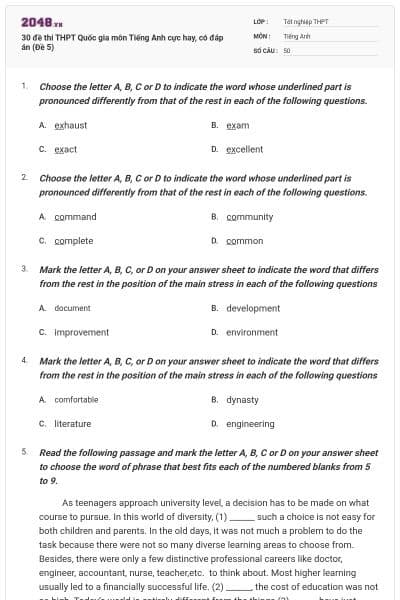
Choose the letter A, B, C or D to indicate the word whose underlined part is pronounced differently from that of the rest in each of the following questions.
exhaust
exam
exact
excellent
Đáp án D
Phần gạch chân đáp án D được phát âm là /ek/, các đáp án còn lại được phát âm là /ig/.
A. exhaust /ɪɡˈzɔːst/ (n+v): khói thải, làm cạn kiệt.
B. exam /ɪɡˈzæm/ (n): bài kiểm tra.
C. exact /ɪɡˈzækt/ (adj): chính xác.
D. excellent ˈek.səl.ənt/ (adj): xuất sắc.
Choose the letter A, B, C or D to indicate the word whose underlined part is pronounced differently from that of the rest in each of the following questions.
command
community
complete
common
Đáp án D
Phần gạch chân đáp án D được phát âm là /kɒ/, các đáp án còn lại được phát âm là /kə/.
A. command /kəˈmɑːnd/ (n+v): mệnh lệnh, ra lệnh.
B. community /kəˈmjuː.nə.ti/ (n): cộng đồng.
C. complete /kəmˈpliːt/ (v): hoàn thành.
D. common /ˈkɒm.ən/ (n): thông thường, phổ biến, chung
Mark the letter A, B, C, or D on your answer sheet to indicate the word that differs from the rest in the position of the main stress in each of the following questions
document
development
improvement
environment
Đáp án A
Trọng âm rơi vào âm tiết thứ nhất, các đáp án còn lại rơi vào âm tiết thứ 2.
A. document /ˈdɒk.jə.mənt/ (n): tài liệu.
B. development /dɪˈvel.əp.mənt/ (n): sự phát triển.
C. improvement /ɪmˈpruːv.mənt/ (n): sự tiến bộ.
D. environment /ɪnˈvaɪ.rən.mənt/: môi trường.
Mark the letter A, B, C, or D on your answer sheet to indicate the word that differs from the rest in the position of the main stress in each of the following questions
comfortable
dynasty
literature
engineering
Đáp án D
Trọng âm rơi vào âm tiết thứ 3, các đáp án còn lại rơi vào âm tiết thứ nhất.
A. comfortable /ˈkʌm.fə.tə.bəl/ (adj): thoải mái.
B. dynasty /ˈdaɪ.nə.sti/ (n): triều đại.
C. literature /ˈlɪt.rə.tʃər/ (n): văn học.
D. engineering /ˌen.dʒɪˈnɪə.rɪŋ/ (n): công việc kĩ sư.
Read the following passage and mark the letter A, B, C or D on your answer sheet to choose the word of phrase that best fits each of the numbered blanks from 5 to 9.
As teenagers approach university level, a decision has to be made on what course to pursue. In this world of diversity, (1) ______ such a choice is not easy for both children and parents. In the old days, it was not much a problem to do the task because there were not so many diverse learning areas to choose from. Besides, there were only a few distinctive professional careers like doctor, engineer, accountant, nurse, teacher,etc. to think about. Most higher learning usually led to a financially successful life. (2) ______, the cost of education was not so high. Today’s world is entirely different from the things (3) ______ have just been described. The job market is constantly changing due to innovative technology and new (4) ______. Meanwhile, most teenagers have difficulty in identifying their own interests. There are a variety of well- organized career talks and student counseling workshop to guide and help teenagers (5) ______ what course to take. Furthermore, psychological tests are also used. Certain instruments such as surveys, interviews and computer software can help to find out preferences, interests, or learning styles of the students.
Điền vào ô số 5
taking
making
giving
having
Đáp án B
(to) make a choice: lựa chọn.
Dịch: Trong thế giới đa dạng này, việc lựa chọn vốn không hề dễ dàng ngay cả với những bậc phụ huynh và học sinh.
Read the following passage and mark the letter A, B, C or D on your answer sheet to choose the word of phrase that best fits each of the numbered blanks from 5 to 9.
As teenagers approach university level, a decision has to be made on what course to pursue. In this world of diversity, (1) ______ such a choice is not easy for both children and parents. In the old days, it was not much a problem to do the task because there were not so many diverse learning areas to choose from. Besides, there were only a few distinctive professional careers like doctor, engineer, accountant, nurse, teacher,etc. to think about. Most higher learning usually led to a financially successful life. (2) ______, the cost of education was not so high. Today’s world is entirely different from the things (3) ______ have just been described. The job market is constantly changing due to innovative technology and new (4) ______. Meanwhile, most teenagers have difficulty in identifying their own interests. There are a variety of well- organized career talks and student counseling workshop to guide and help teenagers (5) ______ what course to take. Furthermore, psychological tests are also used. Certain instruments such as surveys, interviews and computer software can help to find out preferences, interests, or learning styles of the students.
Điền vào ô số 6
In addition
Otherwise
For example
Therefore
Đáp án A
A. In addition: Thêm vào đó.
B. Otherwise: Mặt khác, Nếu không thì.
C. For example: Ví dụ, Chẳng hạn như.
D. Therefore: Do đó.
Dịch: Hầu hết việc có học thức cao đều dẫn tới thành công về mặt tài chính trong cuộc sống. Thêm vào đó, chi phí giáo dục cũng không quá cao.
Read the following passage and mark the letter A, B, C or D on your answer sheet to choose the word of phrase that best fits each of the numbered blanks from 5 to 9.
As teenagers approach university level, a decision has to be made on what course to pursue. In this world of diversity, (1) ______ such a choice is not easy for both children and parents. In the old days, it was not much a problem to do the task because there were not so many diverse learning areas to choose from. Besides, there were only a few distinctive professional careers like doctor, engineer, accountant, nurse, teacher,etc. to think about. Most higher learning usually led to a financially successful life. (2) ______, the cost of education was not so high. Today’s world is entirely different from the things (3) ______ have just been described. The job market is constantly changing due to innovative technology and new (4) ______. Meanwhile, most teenagers have difficulty in identifying their own interests. There are a variety of well- organized career talks and student counseling workshop to guide and help teenagers (5) ______ what course to take. Furthermore, psychological tests are also used. Certain instruments such as surveys, interviews and computer software can help to find out preferences, interests, or learning styles of the students.
Điền vào ô số 7
when
that
where
what
Đáp án B
Đại từ quan hệ (ĐTQH) ‘that’ thay thế cho đại từ bất định “the things”, đây là trường hợp buộc phải dùng ‘that’.
Các đáp án còn lại:
A. when: khi mà.
C. where: nơi mà.
D. what: cái mà.
Dịch: Thế giới ngày nay thì hoàn toàn khác với những điều vừa được mô tả.
Read the following passage and mark the letter A, B, C or D on your answer sheet to choose the word of phrase that best fits each of the numbered blanks from 5 to 9.
As teenagers approach university level, a decision has to be made on what course to pursue. In this world of diversity, (1) ______ such a choice is not easy for both children and parents. In the old days, it was not much a problem to do the task because there were not so many diverse learning areas to choose from. Besides, there were only a few distinctive professional careers like doctor, engineer, accountant, nurse, teacher,etc. to think about. Most higher learning usually led to a financially successful life. (2) ______, the cost of education was not so high. Today’s world is entirely different from the things (3) ______ have just been described. The job market is constantly changing due to innovative technology and new (4) ______. Meanwhile, most teenagers have difficulty in identifying their own interests. There are a variety of well- organized career talks and student counseling workshop to guide and help teenagers (5) ______ what course to take. Furthermore, psychological tests are also used. Certain instruments such as surveys, interviews and computer software can help to find out preferences, interests, or learning styles of the students.
Điền vào ô số 8
competitively
competition
compete
competitive
Đáp án B
Cấu trúc song hành và sau ‘due to’ là cụm danh từ (adj + N).
A. competitively (adj): mang tính cạnh tranh.
B. competition (n): cuộc thi, cuộc tranh đấu.
C. compete (v): cạnh tranh, tranh đua.
D. competitive (adj): ganh đua, cạnh tranh.
Dịch: Thị trường việc làm thay đổi liên tục dựa trên những sáng kiến công nghệ và những cạnh tranh mới.
Read the following passage and mark the letter A, B, C or D on your answer sheet to choose the word of phrase that best fits each of the numbered blanks from 5 to 9.
As teenagers approach university level, a decision has to be made on what course to pursue. In this world of diversity, (1) ______ such a choice is not easy for both children and parents. In the old days, it was not much a problem to do the task because there were not so many diverse learning areas to choose from. Besides, there were only a few distinctive professional careers like doctor, engineer, accountant, nurse, teacher,etc. to think about. Most higher learning usually led to a financially successful life. (2) ______, the cost of education was not so high. Today’s world is entirely different from the things (3) ______ have just been described. The job market is constantly changing due to innovative technology and new (4) ______. Meanwhile, most teenagers have difficulty in identifying their own interests. There are a variety of well- organized career talks and student counseling workshop to guide and help teenagers (5) ______ what course to take. Furthermore, psychological tests are also used. Certain instruments such as surveys, interviews and computer software can help to find out preferences, interests, or learning styles of the students.
Điền vào ô số 9
employ
study
decide
apply
Đáp án C
(to) take a decision = (to) decide: quyết định.
Các đáp án còn lại:
A. employ (v): thuê làm, tận dụng.
B. study (v): học.
D. apply (v): ứng dụng, ứng tuyển.
Dịch: Có nhiều các cuộc hội thảo định hướng nghề nghiệp được tổ chức rất quy mô nhằm giúp họ quyết định được nghành học cho bản thân.
Read the following passage and mark the letter A, B, C, or D on your answer sheet to indicate the correct answer to each of the questions.
Living things include both the visible world of animals and plants as well as the invisible world of bacteria and viruses. On a basic level, we can say that life is ordered. Organisms have an enormously complex organization. Life can also “work”. Living creatures can take in energy from the environment. This energy, in the form of food, is changed to maintain metabolic processes and for survival. Life grows and develops. This means more than just getting larger in size. Living organisms also have the ability to rebuild and repair themselves when injured. Life can reproduce. Life can only come from other living creatures. Life can respond. Think about the last time you accidentally stubbed your toe. Almost instantly, you moved back in pain. Finally, life can adapt and respond to the demands placed on it by the environment. There are three basic types of adaptations that can occur in higher organisms.
Reversible changes occur as a response to changes in the environment. Let's say you live near sea level and you travel to a mountainous area. You may begin to experience difficulty breathing and an increase in heart rate as a result of the change in height. These signs of sickness go away when you go back down to sea level.
Body- related changes happen as a result of prolonged changes in the environment. Using the previous example, if you were to stay in the mountainous area for a long time, you would notice that your heart rate would begin to slow down and you would begin to breath normally. These changes are also reversible. Genotypic changes (caused by genetic change) take place within the genetic make up of the organism and are not reversible. An example would be the development of resistance to bug-killing chemicals by insects and spiders.
In what way is life organized?
Hard
Difficult
Complicated
Problematic
Đáp án C
Sự sống được tổ chức theo cách nào?
A. Gian khổ
B. Khó khăn
C. Phức tạp
D. Có vấn đề
Dẫn chứng ở câu thứ 3- đoạn 1: “Organisms have an enormously complex organization” – (Sinh vật có tổ chức cơ quan rất phức tạp)
Read the following passage and mark the letter A, B, C, or D on your answer sheet to indicate the correct answer to each of the questions.
Living things include both the visible world of animals and plants as well as the invisible world of bacteria and viruses. On a basic level, we can say that life is ordered. Organisms have an enormously complex organization. Life can also “work”. Living creatures can take in energy from the environment. This energy, in the form of food, is changed to maintain metabolic processes and for survival. Life grows and develops. This means more than just getting larger in size. Living organisms also have the ability to rebuild and repair themselves when injured. Life can reproduce. Life can only come from other living creatures. Life can respond. Think about the last time you accidentally stubbed your toe. Almost instantly, you moved back in pain. Finally, life can adapt and respond to the demands placed on it by the environment. There are three basic types of adaptations that can occur in higher organisms.
Reversible changes occur as a response to changes in the environment. Let's say you live near sea level and you travel to a mountainous area. You may begin to experience difficulty breathing and an increase in heart rate as a result of the change in height. These signs of sickness go away when you go back down to sea level.
Body- related changes happen as a result of prolonged changes in the environment. Using the previous example, if you were to stay in the mountainous area for a long time, you would notice that your heart rate would begin to slow down and you would begin to breath normally. These changes are also reversible. Genotypic changes (caused by genetic change) take place within the genetic make up of the organism and are not reversible. An example would be the development of resistance to bug-killing chemicals by insects and spiders.
Which of the followings is NOT a feature of life?
Getting a job
Giving birth
Getting larger and self-repairing
Reacting to the environment
Đáp án A
Câu nào dưới đây KHÔNG phải là đặc trưng của sự sống?
A. Có một công việc
B. Sinh sản
C. Lớn lên và tự hồi phục.
D. Phản ứng với môi trường
Dẫn chứng ở đoạn 1: “Life grows and develops. This means more than just getting larger in size (C). Living organisms also have the ability to rebuild and repair themselves (C) when injured. Life can reproduce(B).Life can only come from other living creatures. Life can respond (D)” – (Sự sống lớn lên và phát triển. Có nghĩa là hơn cả việc kích thước càng ngày càng lớn thêm. Các sinh vật sống còn có khả năng tự phục hồi khi bị thương. Sự sống có thể sinh sản. Sự sống chỉ có thể đến từ các sinh vật sống khác. Sự sống có thể phản ứng).
Read the following passage and mark the letter A, B, C, or D on your answer sheet to indicate the correct answer to each of the questions.
Living things include both the visible world of animals and plants as well as the invisible world of bacteria and viruses. On a basic level, we can say that life is ordered. Organisms have an enormously complex organization. Life can also “work”. Living creatures can take in energy from the environment. This energy, in the form of food, is changed to maintain metabolic processes and for survival. Life grows and develops. This means more than just getting larger in size. Living organisms also have the ability to rebuild and repair themselves when injured. Life can reproduce. Life can only come from other living creatures. Life can respond. Think about the last time you accidentally stubbed your toe. Almost instantly, you moved back in pain. Finally, life can adapt and respond to the demands placed on it by the environment. There are three basic types of adaptations that can occur in higher organisms.
Reversible changes occur as a response to changes in the environment. Let's say you live near sea level and you travel to a mountainous area. You may begin to experience difficulty breathing and an increase in heart rate as a result of the change in height. These signs of sickness go away when you go back down to sea level.
Body- related changes happen as a result of prolonged changes in the environment. Using the previous example, if you were to stay in the mountainous area for a long time, you would notice that your heart rate would begin to slow down and you would begin to breath normally. These changes are also reversible. Genotypic changes (caused by genetic change) take place within the genetic make up of the organism and are not reversible. An example would be the development of resistance to bug-killing chemicals by insects and spiders.
What is the energy for the living things called?
Food
Metabolic process
Green energy
Environment
Đáp án A
Năng lượng cho những sinh vật sống được gọi là gì?
A. Thức ăn
B. Qúa trình trao đổi chẩt
C. Năng lượng xanh
D. Môi trường
Dẫn chứng ở câu 5+6 đoạn 1: “Living creatures can take in energy from the environment. This energy, in the form of food, is changed to maintain metabolic processes and for survival”- (Sinh vật có thể lấy năng lượng từ môi trường. Năng lượng này ở dưới dạng thức ăn, được chuyển hoá để duy trì quá trình trao đổi chất và để tồn tại).
Read the following passage and mark the letter A, B, C, or D on your answer sheet to indicate the correct answer to each of the questions.
Living things include both the visible world of animals and plants as well as the invisible world of bacteria and viruses. On a basic level, we can say that life is ordered. Organisms have an enormously complex organization. Life can also “work”. Living creatures can take in energy from the environment. This energy, in the form of food, is changed to maintain metabolic processes and for survival. Life grows and develops. This means more than just getting larger in size. Living organisms also have the ability to rebuild and repair themselves when injured. Life can reproduce. Life can only come from other living creatures. Life can respond. Think about the last time you accidentally stubbed your toe. Almost instantly, you moved back in pain. Finally, life can adapt and respond to the demands placed on it by the environment. There are three basic types of adaptations that can occur in higher organisms.
Reversible changes occur as a response to changes in the environment. Let's say you live near sea level and you travel to a mountainous area. You may begin to experience difficulty breathing and an increase in heart rate as a result of the change in height. These signs of sickness go away when you go back down to sea level.
Body- related changes happen as a result of prolonged changes in the environment. Using the previous example, if you were to stay in the mountainous area for a long time, you would notice that your heart rate would begin to slow down and you would begin to breath normally. These changes are also reversible. Genotypic changes (caused by genetic change) take place within the genetic make up of the organism and are not reversible. An example would be the development of resistance to bug-killing chemicals by insects and spiders.
You see life respond most clearly when you______.
unintentionally hurt yourself
move part of your body due to threat
look at your toe
feel hurt
Đáp án A
Bạn nhận thấy sự sống phản ứng lại rõ nhất khi bạn______.
A. vô tình làm bị thương chính mình.
B. di chuyển một phần cơ thể do mối de đọa.
C. nhìn vào ngón chân.
D. cảm thấy đau.
Dẫn chứng ở đoạn 1: “Life can respond. Think about the last time you accidentally stubbed your toe. Almost instantly, you moved back in pain” - (Sự sống có thể phản ứng. Hãy nghĩ về lần cuối cùng bạn vô tình bị vấp ngón chân. Gần như ngay lập tức, cơn đau ập tới).
Read the following passage and mark the letter A, B, C, or D on your answer sheet to indicate the correct answer to each of the questions.
Living things include both the visible world of animals and plants as well as the invisible world of bacteria and viruses. On a basic level, we can say that life is ordered. Organisms have an enormously complex organization. Life can also “work”. Living creatures can take in energy from the environment. This energy, in the form of food, is changed to maintain metabolic processes and for survival. Life grows and develops. This means more than just getting larger in size. Living organisms also have the ability to rebuild and repair themselves when injured. Life can reproduce. Life can only come from other living creatures. Life can respond. Think about the last time you accidentally stubbed your toe. Almost instantly, you moved back in pain. Finally, life can adapt and respond to the demands placed on it by the environment. There are three basic types of adaptations that can occur in higher organisms.
Reversible changes occur as a response to changes in the environment. Let's say you live near sea level and you travel to a mountainous area. You may begin to experience difficulty breathing and an increase in heart rate as a result of the change in height. These signs of sickness go away when you go back down to sea level.
Body- related changes happen as a result of prolonged changes in the environment. Using the previous example, if you were to stay in the mountainous area for a long time, you would notice that your heart rate would begin to slow down and you would begin to breath normally. These changes are also reversible. Genotypic changes (caused by genetic change) take place within the genetic make up of the organism and are not reversible. An example would be the development of resistance to bug-killing chemicals by insects and spiders.
Which type of living creatures can adapt to the changes in the environment?
More visible
Lower
Higher
More human
Đáp án C
Loài sinh vật nào có thể thích nghi được với sự thay đổi của môi trường?
A. sinh vật hữu hình.
B. sinh vật cấp thấp hơn.
C. sinh vật cấp cao hơn.
D. loài người.
Dẫn chứng ở cuối đoạn 1: “Finally, life can adapt and respond to the demands placed on it by the environment. There are three basic types of adaptations that can occur in higher organisms”- (Cuối cùng, sự sống có thể thích nghi và phản ứng lại được với những yêu cầu mà môi trường đặt lên nó. Có 3 kiểu thích nghi có thể xảy ra ở các sinh vật cấp cao hơn).
Read the following passage and mark the letter A, B, C, or D on your answer sheet to indicate the correct answer to each of the questions.
Living things include both the visible world of animals and plants as well as the invisible world of bacteria and viruses. On a basic level, we can say that life is ordered. Organisms have an enormously complex organization. Life can also “work”. Living creatures can take in energy from the environment. This energy, in the form of food, is changed to maintain metabolic processes and for survival. Life grows and develops. This means more than just getting larger in size. Living organisms also have the ability to rebuild and repair themselves when injured. Life can reproduce. Life can only come from other living creatures. Life can respond. Think about the last time you accidentally stubbed your toe. Almost instantly, you moved back in pain. Finally, life can adapt and respond to the demands placed on it by the environment. There are three basic types of adaptations that can occur in higher organisms.
Reversible changes occur as a response to changes in the environment. Let's say you live near sea level and you travel to a mountainous area. You may begin to experience difficulty breathing and an increase in heart rate as a result of the change in height. These signs of sickness go away when you go back down to sea level.
Body- related changes happen as a result of prolonged changes in the environment. Using the previous example, if you were to stay in the mountainous area for a long time, you would notice that your heart rate would begin to slow down and you would begin to breath normally. These changes are also reversible. Genotypic changes (caused by genetic change) take place within the genetic make up of the organism and are not reversible. An example would be the development of resistance to bug-killing chemicals by insects and spiders.
What does the word “Reversible” in the passage mean?
Changeable
Visible
Fitful
Irregular
Đáp án A
Câu hỏi từ vựng.
A. Changeable (adj): có thể thay đổi.
B. Visible (adj): hữu hình.
C. Fitful (adj): hay thay đổi, thất thường.
D. Irregular (adj): không đều, không chính quy, bất quy tắc.
Reversible (adj): ngược lại, có thể đảo lộn = A. Changeable (adj): có thể thay đổi.
Read the following passage and mark the letter A, B, C, or D on your answer sheet to indicate the correct answer to each of the questions.
Living things include both the visible world of animals and plants as well as the invisible world of bacteria and viruses. On a basic level, we can say that life is ordered. Organisms have an enormously complex organization. Life can also “work”. Living creatures can take in energy from the environment. This energy, in the form of food, is changed to maintain metabolic processes and for survival. Life grows and develops. This means more than just getting larger in size. Living organisms also have the ability to rebuild and repair themselves when injured. Life can reproduce. Life can only come from other living creatures. Life can respond. Think about the last time you accidentally stubbed your toe. Almost instantly, you moved back in pain. Finally, life can adapt and respond to the demands placed on it by the environment. There are three basic types of adaptations that can occur in higher organisms.
Reversible changes occur as a response to changes in the environment. Let's say you live near sea level and you travel to a mountainous area. You may begin to experience difficulty breathing and an increase in heart rate as a result of the change in height. These signs of sickness go away when you go back down to sea level.
Body- related changes happen as a result of prolonged changes in the environment. Using the previous example, if you were to stay in the mountainous area for a long time, you would notice that your heart rate would begin to slow down and you would begin to breath normally. These changes are also reversible. Genotypic changes (caused by genetic change) take place within the genetic make up of the organism and are not reversible. An example would be the development of resistance to bug-killing chemicals by insects and spiders.
Which type of adaptation is permanent?
Body- related
Reversible
Genotypic
Environmental
Đáp án C
Kiểu thích nghi nào là vĩnh viễn?
A. có liên quan tới cơ thể.
B. có thể đảo ngược.
C. kiểu gen.
D. thuộc về môi trường.
Dẫn chứng câu gần cuối bài: “Genotypic changes (caused by genetic change) take place within the genetic make up of the organism and are not reversible” – (Sự thay đổi kiểu gen (bị gây ra bởi biến đổi di truyền) diễn ra ở trong cấu trúc gen trên cơ thể và không thể đảo ngược)
=> Tức là kiểu thích nghi biến đổi gen này một khi đã xảy ra là không thể thay đổi, không thể biến đổi ngược trở lại được.
-Bill: “Let’s stop for a drink”.
-Bruce: “______”.
Long time no see
Nice to meet you
Sorry, we’ve got little time
Your’re welcome
Đáp án C
-Bill: “Dừng lại uống chút nước nào”.
-Bruce: “______”.
A. Lâu rồi không gặp (Dùng để chào hỏi).
B. Rất vui được gặp cậu (Dùng để chào hỏi).
C. Xin lỗi, chúng ta có rất ít thời gian.
D. Không có chi (Dùng để đáp lại lời cảm ơn).
Chỉ có đáp án C là phù hợp.
-Jack: “I’m going to take a five-day trip to Rome.”
-Jill: “______”.
No, of course not
Have a good time
The same to you
Yes, let’s
Đáp án B
-Jack: “Tớ sẽ có chuyến đi 5 ngày tới Rome”
-Jill: “______”.
A. Không, đương nhiên là không.
B. Vui vẻ nhé/Đi vui nhé.
C. Như cậu thôi.
D. Ừ, đi thôi.
Chỉ có đáp án B là phù hợp.
Mark the letter A, B, C or D on your answer sheet to indicate the underlined part that needs correction in each on the following questions.
While working as a travel agency, my elder brother specialized in arranging tours of the Mekong Delta for foreign tourists.
a travel agency
While
specialized in
tours of
Đáp án A
Sửa travel agency => travel agent.
Giải nghĩa: travel agent: người đại lí du lịch, nhân viên lữ hành.
travel agency: đại lí, công ty du lịch (cung cấp các dịch vụ liên quan tới du lịch như đặt vé, đặt khách sạn…).
Dịch: Trong khi làm việc là một nhân viên lữ hành, anh trai tôi chuyên về sắp xếp các tour du lịch tới đồng bằng sông Cửu Long cho du khách nước ngoài.
Mark the letter A, B, C or D on your answer sheet to indicate the underlined part that needs correction in each on the following questions.
A lot of athletic and non-athletic extracurricular activities are available in Vietnamese high-schools, either public and private.
available in
non-athletic
either public and private
A lot of
Đáp án C
Sửa either public and private => either public or private.
Either …or…: không…hoặc không (không trong 2).
Dịch: Có rất nhiều hoạt động ngoại khóa vận động và không vận động có sẵn trong các trường trung học ở Việt Nam, trường công lập hoặc dân lập.
Mark the letter A, B, C or D on your answer sheet to indicate the underlined part that needs correction in each on the following questions.
In a restaurant, if we want to call the waiter, we can raise our hand and wave it slight to signal that we need assistance.
slight to signal
if we
assistance
wave it
Đáp án A
Sửa slight to signal = > slightly to signal.
Ta cần 1 trạng từ để bổ nghĩa cho động từ “wave”.
Dịch: Ở trong nhà hàng, nếu chúng ta muốn gọi phục vụ, chúng ta có thể giơ tay và vẫy nhẹ để ra hiệu rằng chúng ta cần sự giúp đỡ.
Mark the letter A, B, C or D on your answer sheet to indicate the sentence that is CLOSEST in meaning to the sentence given in each of the following questions.
For a cold, doctors often recommend that you rest and drink lot of fluids.
Doctors would rather give advice about cold than about fluids
Rest and liquids are frequently advised for treatment of colds
The doctors recommend that you have a cold soft drinks
You were told to come out of the cold and rest
Đáp án B
Đối với cảm lạnh, bác sĩ thường khuyên bạn nên nghỉ ngơi và uống nhiều nước.
= B. Nghỉ ngơi và nước uống thường được khuyến cáo để điều trị cảm lạnh.
Các đáp án còn lại :
A. Bác sĩ sẽ đưa ra lời khuyên về cảm lạnh hơn là về nước uống.
C. Bác sĩ khuyên rằng bạn nên uống nước lạnh.
D. Bạn được yêu cầu khỏi cảm lạnh và nghỉ ngơi. (chú ý: (to) come out of : phục hồi).
Mark the letter A, B, C or D on your answer sheet to indicate the sentence that is CLOSEST in meaning to the sentence given in each of the following questions.
“Absence makes the heart grow fonder”.
Being apart from someone you love makes you love them more
Our heart needs absence to grow
Being apart from someone you love makes you love them less
Absence makes us grow older
Đáp án A
Absence makes the heart grow fonder (idiom)
= A. Being apart from someone you love makes you love them more: xa cách ai đó sẽ khiến bạn càng yêu thương họ hơn.
Các đáp án còn lại:
B. Trái tim chúng ta cần sự xa cách để trưởng thành.
C. Xa cách ai đó sẽ khiến bạn ít yêu thương họ hơn.
D. Sự xa cách khiến chúng ta già dặn hơn.
Mark the letter A, B, C or D on your answer sheet to indicate the sentence that is CLOSEST in meaning to the sentence given in each of the following questions.
My cousin shows a desire to put aside the status of the school child.
The status of the school child makes my cousin happy.
My cousin doesn’t want to be a school child anymore.
My cousin is determined to put up with the other school children.
My cousin decides to play down the status of the school child.
Đáp án B
Đứa em họ của tôi muốn dẹp đi tình trạng là 1 đứa trẻ học sinh.
= B. Đứa em họ của tôi không muốn là 1 đứa trẻ học sinh nữa.
Chú ý: (to) put aside: đặt sang một bên, dẹp bỏ.
Các đáp án còn lại:
A. Là một đứa trẻ học sinh khiến em họ tôi hạnh phúc.
C. Đứa em họ của tôi quyết tâm chịu đựng những đứa trẻ học sinh khác.
(to) put up with = (to) tolerate: chịu đựng.
D. Đứa em họ của tôi quyết định đánh giá thấp tình trạng đang là 1 đứa trẻ học sinh.
(to) play down = (to) underestimate = (to) trivialize: make smt less important: tầm thường hóa, đánh giá thấp.
Mark the letter A, B, C, or D on your answer sheet to indicate the sentence that best combines each pair of sentences in the following questions.
I didn’t know that you were at home. I didn’t drop in.
Not knowing that you were at home, but I still dropped in
I didn’t know you were at home although I didn’t drop in
Not knowing that you were at home, I didn’t drop in
If I knew that you were at home, I would drop in
Đáp án C
Tôi đã không biết bạn có ở nhà. Tôi đã không ghé thăm.
= C. Không biết bạn đã có ở nhà, tôi đã không ghé thăm.
Hiện tại phân từ sử dụng V-ing làm chủ ngữ trong câu có 2 mệnh đề có cùng chủ ngữ, dùng để miêu tả 2 hành động xảy ra đồng thời hoặc để chỉ mối tương quan nguyên nhân- kết quả. Trong câu này là chỉ mối quan hệ nguyên nhân- kết quả.
Các đáp án còn lại:
A. Không biết bạn đã có ở nhà, nhưng tôi vẫn ghé thăm.
B. Tôi không biết bạn đã có ở nhà mặc dù tôi đã không ghé qua.
D. Nếu tôi biết bạn ở nhà thì tôi sẽ ghé thăm.
Câu điều kiện loại 2: If S V-ed, S would V dùng để 1 chỉ giả định không có thật ở hiện tại. Nhưng bản chất hành động trong câu là xảy ra trong qua khứ, nên ta không chọn D
Mark the letter A, B, C, or D on your answer sheet to indicate the sentence that best combines each pair of sentences in the following questions.
My sisters used to get on with each other. Now they hardly speak.
My sisters were once close, but they rarely speak to each other now
My sisters do not speak to each other much, but they’re good friends
My sisters rarely speak because they have never liked each other
Because they have never got on, my sisters do not speak to each other
Đáp án A
Những người chị của tôi đã từng rất thân thiết với nhau. Hiện giờ họ hầu như không nói chuyện với nhau.
= A. Những người chị của tôi từng thân thiết với nhau, nhưng hiện giờ học hiếm khi nói chuyện với nhau.
Chú ý: (to) get on well with: có mối quan hệ tốt, thân thiết.
Các đáp án khác:
B. Những người chị của tôi không nói chuyện với nhau nhiều, nhưng họ là những người bạn tốt.
C. Những người chị của tôi hiếm khi nói chuyện với nhau bởi vì họ đã không ưu nhau.
D Bởi vì họ chưa bao giờ có mối quan hệ thân thiết, những người chị của tôi không nói chuyện với nhau.
Read the following passage and mark the letter A, B, C, or D on your answer sheet to indicate the correct answer to each of the questions.
For many American university students, the weeklong spring break holiday means an endless party on a sunny beach in Florida or Mexico. In Panama City Beach, Florida, a city with a permanent population of around 36,000, more than half a million university students arrive during the month of March to play and party, making it the number one spring break destination in the United States.
A weeklong drinking binge is not for anyone, however, and a growing number of American university students have found a way to make spring break matter. For them, joining or leading a group of volunteers to travel locally or internationally and work to alleviate problems such as poverty, homelessness, or environmental damage makes spring break a unique learning experience that university students can feel good about.
During one spring break week, students at James Madison University in Virginia participated in 15 “alternative spring break” trips to nearby states, three others to more distant parts of the United States, and five international trips. One group of JMU students traveled to Bogalusa, Louisiana, to help rebuild homes damaged by Hurricane Katrina. Another group traveled to Mississippi to organize creative activities for children living in a homless shelter. One group of students did go to Florida, but not to lie on the sand. They performed exhausting physical labor such as maintaining hiking trails and destroying invasive plant species that threaten the native Florida ecosystem.
Students who participate in alternative spring break projects find them very rewarding. While most university students have to get their degrees before they can start helping people, student volunteers are able to help people now. On the other hand, the accommodations are far from glamorous. Students often sleep on the floor of a school or spend the week camping in tents. But students only pay around $250 for meals and transportation, which is much less than some of their peers spend to travel to more traditional spring break hotspots.
Alternative spring break trips appear to be growing in popularity at universities across the United States. Students cite a number of reason for participating. Some appreciate the opportunity to socialize and meet new friends. Others want to exercise their beliefs about people’s obligation to serve humanity and make the world a better place whatever their reason, these students have discovered something that gives them rich rewards along with a break from school work.
How many university students travel to Panama Beach City every March for spring break?
Around 500,000
Around 10,000
Around 36,000
Around 50,000
Đáp án A
Có bao nhiêu sinh viên du lịch tới thành phố bãi biển Panama vào mỗi tháng 3 trong kì nghỉ xuân?
A. Khoảng 500.000
B. Khoảng 10.000
C. Khoảng 36.000
D. Khoảng 50.000
Dẫn chứng ở đoạn 1: “In Panama City Beach, Florida, a city with a permanent population of around 36,000, more than half a million university students arrive during the month of March to play and party” – (Thành phố bãi biển Panama ở bang Florida, thành phố có số dân định cư dao động trong khoảng 36,000 người, nhiều hơn 1 nửa triệu số sinh viên đại học tới đây vào tháng 3 mỗi năm để vui chơi và tiệc tùng).
Read the following passage and mark the letter A, B, C, or D on your answer sheet to indicate the correct answer to each of the questions.
For many American university students, the weeklong spring break holiday means an endless party on a sunny beach in Florida or Mexico. In Panama City Beach, Florida, a city with a permanent population of around 36,000, more than half a million university students arrive during the month of March to play and party, making it the number one spring break destination in the United States.
A weeklong drinking binge is not for anyone, however, and a growing number of American university students have found a way to make spring break matter. For them, joining or leading a group of volunteers to travel locally or internationally and work to alleviate problems such as poverty, homelessness, or environmental damage makes spring break a unique learning experience that university students can feel good about.
During one spring break week, students at James Madison University in Virginia participated in 15 “alternative spring break” trips to nearby states, three others to more distant parts of the United States, and five international trips. One group of JMU students traveled to Bogalusa, Louisiana, to help rebuild homes damaged by Hurricane Katrina. Another group traveled to Mississippi to organize creative activities for children living in a homless shelter. One group of students did go to Florida, but not to lie on the sand. They performed exhausting physical labor such as maintaining hiking trails and destroying invasive plant species that threaten the native Florida ecosystem.
Students who participate in alternative spring break projects find them very rewarding. While most university students have to get their degrees before they can start helping people, student volunteers are able to help people now. On the other hand, the accommodations are far from glamorous. Students often sleep on the floor of a school or spend the week camping in tents. But students only pay around $250 for meals and transportation, which is much less than some of their peers spend to travel to more traditional spring break hotspots.
Alternative spring break trips appear to be growing in popularity at universities across the United States. Students cite a number of reason for participating. Some appreciate the opportunity to socialize and meet new friends. Others want to exercise their beliefs about people’s obligation to serve humanity and make the world a better place whatever their reason, these students have discovered something that gives them rich rewards along with a break from school work.
The article is mainly about______.
sleeping on the floor or camping in tents
alternative spring break trips
drinking problems among university students
spring break in Florida and Mexico
Đáp án B
Đoạn văn chủ yếu về______.
A. ngủ dưới sàn hoặc cắm trại trong lều.
B. các chuyến “kì nghỉ xuân thay thế”.
C. các vấn đề về uống rượu giữa các sinh viên đại học.
D. kì nghỉ mùa xuân ở Florida và Mexico.
Dạng câu hỏi tìm ý chính ưu tiên làm sau cùng. Nhận thấy cụm alternative spring break trips xuất hiện nhiều trong bài và đoạn nào cũng liên quan đến vấn đề ‘sinh viên tham gia vào những chuyến đi ‘kì nghỉ xuân thay thế’.
Read the following passage and mark the letter A, B, C, or D on your answer sheet to indicate the correct answer to each of the questions.
For many American university students, the weeklong spring break holiday means an endless party on a sunny beach in Florida or Mexico. In Panama City Beach, Florida, a city with a permanent population of around 36,000, more than half a million university students arrive during the month of March to play and party, making it the number one spring break destination in the United States.
A weeklong drinking binge is not for anyone, however, and a growing number of American university students have found a way to make spring break matter. For them, joining or leading a group of volunteers to travel locally or internationally and work to alleviate problems such as poverty, homelessness, or environmental damage makes spring break a unique learning experience that university students can feel good about.
During one spring break week, students at James Madison University in Virginia participated in 15 “alternative spring break” trips to nearby states, three others to more distant parts of the United States, and five international trips. One group of JMU students traveled to Bogalusa, Louisiana, to help rebuild homes damaged by Hurricane Katrina. Another group traveled to Mississippi to organize creative activities for children living in a homless shelter. One group of students did go to Florida, but not to lie on the sand. They performed exhausting physical labor such as maintaining hiking trails and destroying invasive plant species that threaten the native Florida ecosystem.
Students who participate in alternative spring break projects find them very rewarding. While most university students have to get their degrees before they can start helping people, student volunteers are able to help people now. On the other hand, the accommodations are far from glamorous. Students often sleep on the floor of a school or spend the week camping in tents. But students only pay around $250 for meals and transportation, which is much less than some of their peers spend to travel to more traditional spring break hotspots.
Alternative spring break trips appear to be growing in popularity at universities across the United States. Students cite a number of reason for participating. Some appreciate the opportunity to socialize and meet new friends. Others want to exercise their beliefs about people’s obligation to serve humanity and make the world a better place whatever their reason, these students have discovered something that gives them rich rewards along with a break from school work.
The word “binge” in the second paragraph probably means______.
having very little alcohol
refusing to do something
studying for too long
doing too much of something
Đáp án D
Từ “binge” ở đoạn văn thứ 2 có nghĩa là ______.
A. có ít cồn.
B. từ chối làm gì đó.
C. học quá lâu.
D. làm cái gì đó quá nhiều.
Tạm dịch: “A weeklong drinking binge is not for anyone, however, and a growing number of American university students have found a way to make spring break matter” – (Tuy nhiên không phải sinh viên nào cũng nhậu nhẹt trong suốt một tuần lễ, và một số lượng ngày càng đông các sinh viên Mĩ đã tìm ra cách để khiến cho kì nghỉ xuân có ý nghĩa). Như vậy ở đây binge có nghĩa là làm điều gì đó quá nhiều
Read the following passage and mark the letter A, B, C, or D on your answer sheet to indicate the correct answer to each of the questions.
For many American university students, the weeklong spring break holiday means an endless party on a sunny beach in Florida or Mexico. In Panama City Beach, Florida, a city with a permanent population of around 36,000, more than half a million university students arrive during the month of March to play and party, making it the number one spring break destination in the United States.
A weeklong drinking binge is not for anyone, however, and a growing number of American university students have found a way to make spring break matter. For them, joining or leading a group of volunteers to travel locally or internationally and work to alleviate problems such as poverty, homelessness, or environmental damage makes spring break a unique learning experience that university students can feel good about.
During one spring break week, students at James Madison University in Virginia participated in 15 “alternative spring break” trips to nearby states, three others to more distant parts of the United States, and five international trips. One group of JMU students traveled to Bogalusa, Louisiana, to help rebuild homes damaged by Hurricane Katrina. Another group traveled to Mississippi to organize creative activities for children living in a homless shelter. One group of students did go to Florida, but not to lie on the sand. They performed exhausting physical labor such as maintaining hiking trails and destroying invasive plant species that threaten the native Florida ecosystem.
Students who participate in alternative spring break projects find them very rewarding. While most university students have to get their degrees before they can start helping people, student volunteers are able to help people now. On the other hand, the accommodations are far from glamorous. Students often sleep on the floor of a school or spend the week camping in tents. But students only pay around $250 for meals and transportation, which is much less than some of their peers spend to travel to more traditional spring break hotspots.
Alternative spring break trips appear to be growing in popularity at universities across the United States. Students cite a number of reason for participating. Some appreciate the opportunity to socialize and meet new friends. Others want to exercise their beliefs about people’s obligation to serve humanity and make the world a better place whatever their reason, these students have discovered something that gives them rich rewards along with a break from school work.
Which of the following is NOT mentioned as a problem that alternative spring break trips try to help solve?
Alcoholism
Environmental damage
Poverty
Homelessness
Đáp án A
Cái nào dưới đây không được đề cập như là 1 vấn đề mà các kì nghỉ xuân thay thế cố gắng giúp giải quyết?
A. Nghiện rượu.
B. Thiệt hại về môi trường.
C. Nghèo đói
D. Vô gia cư
Dẫn chứng ở đoạn 2: “For them, joining or leading a group of volunteers to travel locally or internationally and work to alleviate problems such as poverty, homelessness, or environmental damage makes spring break a unique learning experience that university students can feel good about”- (Đối với họ, việc tham gia hoặc lãnh đạo 1 nhóm tình nguyện viên đi tour trong nước hoặc quốc tế và làm việc với mục đích làm giảm những vấn đề như đói nghèo, vô gia cư, hoặc thiệt hại về môi trường đã làm cho những kì nghỉ xuân trở thành những trải nghiệm học tập độc đáo mà các sinh viên cảm thấy bổ ích).
Read the following passage and mark the letter A, B, C, or D on your answer sheet to indicate the correct answer to each of the questions.
For many American university students, the weeklong spring break holiday means an endless party on a sunny beach in Florida or Mexico. In Panama City Beach, Florida, a city with a permanent population of around 36,000, more than half a million university students arrive during the month of March to play and party, making it the number one spring break destination in the United States.
A weeklong drinking binge is not for anyone, however, and a growing number of American university students have found a way to make spring break matter. For them, joining or leading a group of volunteers to travel locally or internationally and work to alleviate problems such as poverty, homelessness, or environmental damage makes spring break a unique learning experience that university students can feel good about.
During one spring break week, students at James Madison University in Virginia participated in 15 “alternative spring break” trips to nearby states, three others to more distant parts of the United States, and five international trips. One group of JMU students traveled to Bogalusa, Louisiana, to help rebuild homes damaged by Hurricane Katrina. Another group traveled to Mississippi to organize creative activities for children living in a homless shelter. One group of students did go to Florida, but not to lie on the sand. They performed exhausting physical labor such as maintaining hiking trails and destroying invasive plant species that threaten the native Florida ecosystem.
Students who participate in alternative spring break projects find them very rewarding. While most university students have to get their degrees before they can start helping people, student volunteers are able to help people now. On the other hand, the accommodations are far from glamorous. Students often sleep on the floor of a school or spend the week camping in tents. But students only pay around $250 for meals and transportation, which is much less than some of their peers spend to travel to more traditional spring break hotspots.
Alternative spring break trips appear to be growing in popularity at universities across the United States. Students cite a number of reason for participating. Some appreciate the opportunity to socialize and meet new friends. Others want to exercise their beliefs about people’s obligation to serve humanity and make the world a better place whatever their reason, these students have discovered something that gives them rich rewards along with a break from school work.
Which of the following gives the main idea of the third paragraph?
One group of JMU students worked on homes damaged by a hurricane
Some students work to help the environment on alternative spring break trips
Children living in homeless shelters enjoy creative activities
University students do many different types of work on alternative spring break trips
Đáp án D
Câu nào sau đây đưa ra ý chính cho đoạn thứ 3?
A. Một nhóm học sinh của JMU đã làm việc trong những ngôi nhà bị hư hại bởi trận bão.
B. Một số sinh viên làm việc để giúp đỡ môi trường trong những chuyến “kì nghỉ xuân thay thế”.
C. Những trẻ em sống trong các khu tạm trú vô gia cư tham gia các hoạt động sáng tạo.
D. Sinh viên đại học làm rất nhiều công việc khác nhau trong những chuyến “kì nghỉ xuân thay thế”.
Tạm dịch đoạn 3: “During one spring break week, students at James Madison University in Virginia participated in 15 “alternative spring break” trips to nearby states, three others to more distant parts of the United States, and five international trips. One group of JMU students traveled to Bogalusa, Louisiana, to help rebuild homes damaged by Hurricane Katrina. Another group traveled to Mississippi to organize creative activities for children living in a homless shelter. Once group of students did go to Florida, but not to lie on the sand. They performed exhausting physical labor such as maintaining hiking trails and destroying invasive plant species that threaten the native Florida ecosystem” – (Trong suốt 1 tuần nghỉ xuân, các sinh viên của trường đại học James Madison ở bang Virginia đã tham gia vào 15 chuyến “kì nghỉ xuân thay thế” tới những bang lân cận, 3 bang khác xa hơn ở Hoa Kì, và 5 chuyến đi quốc tế. Một nhóm sinh viên JMU đi tới Bogalusa, Louisiana để giúp xây lại những ngôi nhà bị hư hại bởi cơn bão Katrina. Một nhóm khác tới Mississippi để tổ chức các hoạt động sáng tạo dành cho trẻ em sống ở khu cư trú dành cho người vô gia cư. Một nhóm sinh viên đã đi tới bang Florida, nhưng không phải để nằm dài xả hơi trên cát. Họ cật lực lao động để tu sửa lại những con đường và dọn nhổ những loài cây đe dọa tới hệ sinh thái bản địa ở Florida).
Read the following passage and mark the letter A, B, C, or D on your answer sheet to indicate the correct answer to each of the questions.
For many American university students, the weeklong spring break holiday means an endless party on a sunny beach in Florida or Mexico. In Panama City Beach, Florida, a city with a permanent population of around 36,000, more than half a million university students arrive during the month of March to play and party, making it the number one spring break destination in the United States.
A weeklong drinking binge is not for anyone, however, and a growing number of American university students have found a way to make spring break matter. For them, joining or leading a group of volunteers to travel locally or internationally and work to alleviate problems such as poverty, homelessness, or environmental damage makes spring break a unique learning experience that university students can feel good about.
During one spring break week, students at James Madison University in Virginia participated in 15 “alternative spring break” trips to nearby states, three others to more distant parts of the United States, and five international trips. One group of JMU students traveled to Bogalusa, Louisiana, to help rebuild homes damaged by Hurricane Katrina. Another group traveled to Mississippi to organize creative activities for children living in a homless shelter. One group of students did go to Florida, but not to lie on the sand. They performed exhausting physical labor such as maintaining hiking trails and destroying invasive plant species that threaten the native Florida ecosystem.
Students who participate in alternative spring break projects find them very rewarding. While most university students have to get their degrees before they can start helping people, student volunteers are able to help people now. On the other hand, the accommodations are far from glamorous. Students often sleep on the floor of a school or spend the week camping in tents. But students only pay around $250 for meals and transportation, which is much less than some of their peers spend to travel to more traditional spring break hotspots.
Alternative spring break trips appear to be growing in popularity at universities across the United States. Students cite a number of reason for participating. Some appreciate the opportunity to socialize and meet new friends. Others want to exercise their beliefs about people’s obligation to serve humanity and make the world a better place whatever their reason, these students have discovered something that gives them rich rewards along with a break from school work.
The article implies that university students______.
many take fewer alternative spring break trips in future
would prefer to wait until they have their degrees to start helping people
complain about accommodations on alternative spring break trips
spend more than $250 for traditional spring break trips
Đáp án B
Đoạn văn ám chỉ rằng nhiều sinh viên đại học ______.
A. tham gia ít hơn những chuyến “kì nghỉ mùa xuân thay thế” trong tương lai.
B. muốn đợi tới khi có bằng tốt nghiệp để bắt đầu giúp đỡ mọi người.
C. phàn nàn về chỗ ở vào các kì nghỉ xuân thay thế.
D. chi hơn 250 đô la cho những kì nghỉ xuân truyền thống.
Dẫn chứng ở đoạn 4: “Students who participate in alternative spring break projects find them very rewarding. While most university students have to get their degrees before they can start helping people” – (Những sinh viên tham gia vào các dự án ‘kì nghỉ xuân thay thế’ nhận thấy chúng rất bổ ích. Trong khi đó hầu hết sinh viên đại học phải có được tấm bằng trước khi họ bắt tay vào giúp đỡ những người khác).
Read the following passage and mark the letter A, B, C, or D on your answer sheet to indicate the correct answer to each of the questions.
For many American university students, the weeklong spring break holiday means an endless party on a sunny beach in Florida or Mexico. In Panama City Beach, Florida, a city with a permanent population of around 36,000, more than half a million university students arrive during the month of March to play and party, making it the number one spring break destination in the United States.
A weeklong drinking binge is not for anyone, however, and a growing number of American university students have found a way to make spring break matter. For them, joining or leading a group of volunteers to travel locally or internationally and work to alleviate problems such as poverty, homelessness, or environmental damage makes spring break a unique learning experience that university students can feel good about.
During one spring break week, students at James Madison University in Virginia participated in 15 “alternative spring break” trips to nearby states, three others to more distant parts of the United States, and five international trips. One group of JMU students traveled to Bogalusa, Louisiana, to help rebuild homes damaged by Hurricane Katrina. Another group traveled to Mississippi to organize creative activities for children living in a homless shelter. One group of students did go to Florida, but not to lie on the sand. They performed exhausting physical labor such as maintaining hiking trails and destroying invasive plant species that threaten the native Florida ecosystem.
Students who participate in alternative spring break projects find them very rewarding. While most university students have to get their degrees before they can start helping people, student volunteers are able to help people now. On the other hand, the accommodations are far from glamorous. Students often sleep on the floor of a school or spend the week camping in tents. But students only pay around $250 for meals and transportation, which is much less than some of their peers spend to travel to more traditional spring break hotspots.
Alternative spring break trips appear to be growing in popularity at universities across the United States. Students cite a number of reason for participating. Some appreciate the opportunity to socialize and meet new friends. Others want to exercise their beliefs about people’s obligation to serve humanity and make the world a better place whatever their reason, these students have discovered something that gives them rich rewards along with a break from school work.
The word “them” in paragraph 4 refers to______.
degrees
projects
people
students
Đáp án B
Từ “them” ở đoạn 4 là chỉ ______.
A. những tấm bằng.
B. những dự án.
C. mọi người.
D. những sinh viên.
Tạm dịch: “Students who participate in alternative spring break projects find them very rewarding”- (Những sinh viên tham gia vào các dự án ‘kì nghỉ xuân thay thế’ nhận thấy chúng rất bổ ích).
Read the following passage and mark the letter A, B, C, or D on your answer sheet to indicate the correct answer to each of the questions.
For many American university students, the weeklong spring break holiday means an endless party on a sunny beach in Florida or Mexico. In Panama City Beach, Florida, a city with a permanent population of around 36,000, more than half a million university students arrive during the month of March to play and party, making it the number one spring break destination in the United States.
A weeklong drinking binge is not for anyone, however, and a growing number of American university students have found a way to make spring break matter. For them, joining or leading a group of volunteers to travel locally or internationally and work to alleviate problems such as poverty, homelessness, or environmental damage makes spring break a unique learning experience that university students can feel good about.
During one spring break week, students at James Madison University in Virginia participated in 15 “alternative spring break” trips to nearby states, three others to more distant parts of the United States, and five international trips. One group of JMU students traveled to Bogalusa, Louisiana, to help rebuild homes damaged by Hurricane Katrina. Another group traveled to Mississippi to organize creative activities for children living in a homless shelter. One group of students did go to Florida, but not to lie on the sand. They performed exhausting physical labor such as maintaining hiking trails and destroying invasive plant species that threaten the native Florida ecosystem.
Students who participate in alternative spring break projects find them very rewarding. While most university students have to get their degrees before they can start helping people, student volunteers are able to help people now. On the other hand, the accommodations are far from glamorous. Students often sleep on the floor of a school or spend the week camping in tents. But students only pay around $250 for meals and transportation, which is much less than some of their peers spend to travel to more traditional spring break hotspots.
Alternative spring break trips appear to be growing in popularity at universities across the United States. Students cite a number of reason for participating. Some appreciate the opportunity to socialize and meet new friends. Others want to exercise their beliefs about people’s obligation to serve humanity and make the world a better place whatever their reason, these students have discovered something that gives them rich rewards along with a break from school work.
Which of the following is mentioned as a reason for participating in alternative spring break trips?
The hope of earning money
A personal opinion that people must help other people
A desire to travel to glamorous places
A wish to get away from family and friends
Đáp án B
Ý nào dưới đây được đề cập tới như là lí do cho việc tham gia vào những chuyến “kì nghỉ xuân thay thế”?
A. Hy vọng kiếm được tiền.
B. Ý kiến cá nhân cho rằng mọi người phải đi giúp đỡ những người khác.
C. Khao khát đi tới những nơi đẹp đẽ.
D. Mong muốn rời xa khỏi bạn bè và gia đình.
Dẫn chứng ở câu cuối cùng: “Others want to exercise their beliefs about people’s obligation to serve humanity and make the world a better place whatever their reason, these students have discovered something that gives them rich rewards along with a break from school work” – (Một số khác muốn thực hiện niềm tin của bản thân về sứ mệnh của con người là phục vụ nhân loại và làm cho thế giới trở nên tốt đẹp hơn bất kể vì lí do gì, những sinh viên này đã khám phá ra điều mang lại cho họ những bài học quý giá khi không ở trong trường học).
Mark the letter A, B, C or D on your answer sheet to indicate the word(s) CLOSEST in meaning to the underlined word(s) in each of the following questions.
Yes, we went away on holiday last week, but it rained day in day out.
every single day
every other day
every two days
every second day
Đáp án A
Day in day out (thành ngữ): suốt ngày = A. every single day: mỗi này, thường ngày.
Các đáp án còn lại:
B. mỗi ngày khác.
C. hai ngày một lần.
D. mỗi ngày thứ hai.
Dịch: Đúng, chúng tôi đã đi nghỉ mát vào tuần trước, nhưng trời mưa suốt.
Mark the letter A, B, C or D on your answer sheet to indicate the word(s) CLOSEST in meaning to the underlined word(s) in each of the following questions.
The government has passed laws to protect wildlife from commercial trade
enforced
enabled
ensured
enacted
Đáp án D
(to) pass: thông qua (luật) = (to) enact: ban hành.
Các đáp án còn lại:
A. enforce (v): thi hành.
B. enable (v): làm cho có khả thi, làm cho có thể.
C. ensure (v): đảm bảo.
Dịch: Chính phủ đã ban hành bộ luật để bảo vệ động vật khỏi nạn buôn bán trái phép.
Mark the letter A, B, C or D on your answer sheet to indicate the word(s) OPPOSITE in meaning to the underlined word(s) in each of the following questions.
School uniform is compulsory in most of Vietnamese schools.
depended
optional
obligatory
required
Đáp án B
Tobe compulsory (adj): bắt buộc >< B. optional (adj): tùy chọn.
Các đáp án còn lại:
A. depended: bị phụ thuộc.
C. obligatory (adj) = compulsory (adj): bắt buộc.
D. required: bị yêu cầu, bắt buộc.
Dịch: Đồng phục học sinh là bắt buộc trong hầu hết những trường học ở Việt Nam
Mark the letter A, B, C or D on your answer sheet to indicate the word(s) OPPOSITE in meaning to the underlined word(s) in each of the following questions.
Names of people in the book were changed to preserve anonymity.
cover
conserve
presume
reveal
Đáp án D
(to) preserve: bảo về, giữ kín >< D. reveal (v): tiết lộ.
Các đáp án còn lại:
A. cover (v): bao phủ…
B. conserve (v): bảo tồn.
C. presume (v): giả sử.
Dịch: Tên của những người trong cuốn sách đã được thay đổi để bảo vệ danh tính.
County legislators called for an update of the safety______for the Darcy Power Plant
regulate
regulative
regulatory
regulation
Đáp án D
Vị trí này ta cần 1 danh từ để tạo thành 1 cụm danh từ (adj + N).
The safety regulation: quy định, nội quy an toàn.
Các đáp án còn lại:
A. regulate (v): điều chỉnh, quy định.
B. không tồn tại regulative.
C. regulatory (adj): kiểm soát, điều tiết.
Dịch: Cơ quan pháp luật đã yêu cầu cập nhật quy định an toàn cho nhà máy điên Darcy.
She has two brothers, ______ are engineer.
whom both
both who
both of whom
both whom
Đáp án C
“both of whom” thay thế cho “two brother”, đóng chức năng làm chủ ngữ. Sẽ có thắc mắc tại sao không có “both of who” vì “who” không bao giờ đi với giới từ trong Mệnh đề quan hệ.
Dịch: Cô ấy có 2 người anh trai, họ đều là kĩ sư.
It was so foggy that the driver couldn’t ______ the traffic signs.
break out
make out
keep out
take out
Đáp án B
A. break out (v): đột phá.
B. make out (v): nhận ra, hiểu, tiến bộ, giả vờ.
C. keep out (v) = not knowing sbd to enter: không cho phép đi vào.
D. take out (v): nhổ, vay tiền, giết.
Dịch: Có nhiều sương mù đến nỗi mà người lái xe không thể nhìn ra được biển báo giao thông.
In most ______ developed countries, up to 50% of ______ population enters higher education at some time in their life.
the- a
the-0
0- the
0-0
Đáp án C
developed countries chưa xác định nên ta không dùng với mạo từ “the”.
Population đã xác định, chính là the population of developed countries nên ta dùng với mạo từ “the”.
Dịch: Ở hầu hết những nước phát triển, có tới 50% dân số tham gia giáo dục bậc đại học vào một thời điểm nào đó trong cuộc đời họ.
______ her inexperience, her failure to secure the contract was not surprising.
By virtue of
With regard to
In view of
In recognition of
Đáp án A
A. By virtue of + N/V-ing: Bởi vì
B. With regard to + N/V-ing: Về mặt, về vấn đề, có liên quan tới.
C. In view of + N/V-ing: Xét thấy, Lưu tâm đến.
D. In recognition of + N/V-ing: Được công nhận về.
Dịch: Bởi vì thiếu kinh nghiệm, việc cô ấy không đảm bảo được bản hợp đồng không có gì là ngạc nhiên
George wouldn’t have met Mary______ to his brother’s graduation party.
if he has not gone
had not he gone
had he not gone
if he shouldn’t have gone
Đáp án C
Cấu trúc Đảo ngữ của câu điều kiện loại 3: Had + S (not) PII, S + would have PII.
Diễn tả giả định không có thật trong quá khứ.
Dịch: George đã không gặp Mary nếu anh ấy không tham dự tiệc tốt nghiệp của anh trai.
It was found that he lacked the ____ to pursue a difficult task to the very end
obligation
engagement
commitment
persuasion
Đáp án C
A. obligation (n): nghĩa vụ, bổn phận.
B. engagement (n): sự hứa hẹn, sự hứa hôn.
C. commitment (n): sự cam kết
D. persuasion (n): sự thuyết phục.
Dịch: Người ta nhận ra rằng anh ấy thiếu sự cam kết để theo đuổi 1 nhiệm vụ khó khăn đến cùng.
______, I decided to stop trading with them.
Despite of the fact that they were the biggest dealer
Though being the biggest dealer
Being the biggest dealer
Even though they were the biggest dealer
Đáp án D
Cấu trúc tương phản đối lập: In spite of/ Despite + N/V-ing/the fact that S V O, S V O.
= (Even) though S V O, S V O. (Mặc dù…, nhưng…).
Dịch: Mặc dù họ là những đại lí lớn nhất, tôi quyết định dừng kinh doanh với họ.
Mr Pike______ English at our school for 20 years before he retired last year.
was teaching
has been teaching
is teaching
had been teaching
Đáp án D
Before + S V-ed, S had PII.
Thì Qúa khứ hoàn thành (had PII) diễn tả hành động, sự việc xảy và hoàn thành trước 1 thời điểm hoặc 1 hành động, sự việc khác trong quá khứ.
Dịch: Ông Pike đã dạy Tiếng anh ở trường chúng ta được 20 năm trước khi ông nghỉ hưu vào năm ngoái.
She has just bought______.
an interesting French old painting
an old interesting French painting
a French interesting old painting
an interesting old French painting
Đáp án D
Trật tự tính từ trong cụm danh từ: an interesting (Opinion)+ old (Age)+ French painting (Noun).
Opinion - tính từ chỉ quan điểm, sự đánh giá. (beautiful, wonderful, terrible…)
Size - tính từ chỉ kích cỡ. (big, small, long, short, tall…
Age - tính từ chỉ độ tuổi. (old, young, old, new…)
Shape - tính từ chỉ hình dạng (circular, square, round, rectangle... )
Color - tính từ chỉ màu sắc. (orange, yellow, light blue…)
Origin – tính từ chỉ nguồn gốc, xuất xứ. (Japanese, American, Vietnamese…)
Material – tính từ chỉ chất liệu (stone, plastic, leather, steel, silk…)
Purpose – tính từ chỉ mục đích, tác dụng
OSASCOMP: Ông Sáu Ăn Súp Cơm Ông Mập Phì
-“Jenny’s always wanted to get to the top of her career, ______?”
-“Yes, she’s an ambitious girl.”
isn’t she
hasn’t her
has she
hasn’t she
Đáp án D
Chủ điểm ngữ pháp liên quan tới Câu hỏi đuôi.
Phía trước động từ là “has wanted” thì vế câu hỏi đuôi sẽ là “hasn’t she”.
Dịch: -“Jenny luôn muốn đạt được đỉnh cao trong sự nghiệp, phải không?”.
-“Đúng vậy, cô ấy là cô nàng có tham vọng”.
Not only ______ the exam but she also got a scholarship.
she passes
has she passed
she has passed
did she pass
Đáp án D
Cấu trúc đảo ngữ với Not only…but also: Not only + aux + S V+ but S also V. (Không những…mà còn…)
Dịch: Cô ấy không những vượt qua được kì kiểm tra mà còn nhận được cả học bổng.