30 đề thi THPT Quốc gia môn Tiếng Anh cực hay, có đáp án (Đề 30)
50 câu hỏi
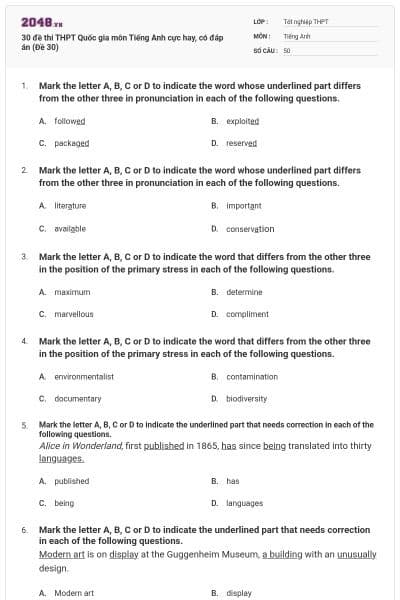
Mark the letter A, B, C or D to indicate the word whose underlined part differs from the other three in pronunciation in each of the following questions.
followed
exploited
packaged
reserved
Đáp án. B. exploited, phát âm là /ɪd/, còn lại phát âm là /d/
A. followed /’fɑ:loʊd/ (v) đi theo
B. exploited /ɪk'splɔɪtɪd/ (v) khai thác
C. packaged / 'pækɪdʒd/ (v) đóng gói
D. reserved /rɪ'zɜ:rvd/ (adj) ngại ngùng, xấu hổ
Mark the letter A, B, C or D to indicate the word whose underlined part differs from the other three in pronunciation in each of the following questions.
literature
important
available
conservation
Đáp án D. conservation, phát âm là /eɪ/, còn lại phát âm là /ə/
A. literature /'lɪtrət∫ʊr/ (n) văn học
B. important /ɪm'pɔ:rtənt/ (adj) quan trọng
C. available /ə'veɪləbl/ (adj) có sẵn
D. conservation /,kɑ:nsər'veɪ∫n/ (n) sự bảo tồn
Mark the letter A, B, C or D to indicate the word that differs from the other three in the position of the primary stress in each of the following questions.
maximum
determine
marvellous
compliment
Đáp án B. determine, trọng âm rơi vào âm tiét thứ hai, còn lại rơi vào âm tiét thứ nhất.
A. maximum /'mæksɪməm/ (adj) lớn nhất
B. determine /dɪ'tɜ:rmɪn/ (v) xác định
C. marvellous /'mɑ:rvələs/ (adj) tuyệt vời
D. compliment/'kɑ:mplɪmənt/ (n) lời khen
Mark the letter A, B, C or D to indicate the word that differs from the other three in the position of the primary stress in each of the following questions.
environmentalist
contamination
documentary
biodiversity
Đáp án C. documentary, trọng âm rơi vào âm tiét thứ ba, còn lại rơi vào âm tiét thứ tư.
A. environmentalist /ɪn,vaɪrən'mentəlɪst/ (n) nhà môi trường học
B. contamination /kən,tæmɪ'neɪ∫n/ (n) sự làm bẩn
C. documentary /,dɑ:kju'mentri/(n) phim tài liệu
D. biodiversity/,baɪoʊdaɪ'vɜ:rsəti/(n) đa dạng sinh học
Mark the letter A, B, C or D to indicate the underlined part that needs correction in each of the following questions.
Alice in Wonderland, first published in 1865, has since being translated into thirty languages.
published
has
being
languages
Đáp án C. being => been
Giải thích: Cấu trúc bị động với thì hiện tại hoàn thành: has/ have been Vpp.
Dịch nghĩa: Alice ở xứ sở thần tiên, xuất bản đầu tiên năm 1865 đã được dịch sang 30 thứ tiếng.
Mark the letter A, B, C or D to indicate the underlined part that needs correction in each of the following questions.
Modern art is on display at the Guggenheim Museum, a building with an unusually design.
Modern art
display
a building
unusually
Đáp án D. unusually => unusual
Giải thích: Để bổ sung cho danh từ design ta dùng tính từ. Phó từ unusually chỉ được bổ nghĩa cho tính từ hoặc động từ.
Dịch nghĩa: Nghệ thuật hiện đại được trưng bày ở bảo tàng Guggenheim, một tòa nhà với thiết kế khá khác lạ.
Mark the letter A, B, C or D to indicate the underlined part that needs correction in each of the following questions.
Parents can help to solve their children's learned problems by volunteering in the classroom.
to solve
learned problems
volunteering
the
Đáp án B. learned => learning
Giải thích: learning problem (n) khó khăn trong học tập
Dịch nghĩa: Bố mẹ có thể giúp giải quyết những khó khăn trong học tập của con cái bằng những công việc tình nguyện trong các lớp học.
Mark the letter A, B, C or D to indiz‘ate the correct answer to each ofthe following questions.
By the age of ten, Helen ______ Braille as well as the manual alphabet and even learned to use the typewriter
mastered
has mastered
had mastered
was mastering
Đáp án C
Giải thích: Khi có trạng ngữ By + mốc thời gian (trước khi. . .), ta nói về hành động xảy ra trước một thời điểm, một hành động cụ thể khác, nên ta dùng thì hoàn thành. Ở đây lúc Helen 10 tuổi là một thời điểm trong quá khứ, để nói về việc trước khi cô ấy 10 tuổi, ta dùng quá khứ hoàn thành had Vpp.
Dịch nghĩa: Trước khi lên 10, Helen đã thành thạo hệ thống chữ nổi dành cho người mù Bray cũng như bảng chữ cái bằng tay và học cách sử dụng máy đánh chữ.
Sportsmen ________ their political differences on the sports field.
take place
keep apart
take part
put aside
Đáp án D
Giải thích:
A. take place: diễn ra
B. keep apart: tách ra
C. take part (in): tham gia
D. put aside: gạt bỏ, không quan tâm đến
Dịch nghĩa: Những vận động viên thể thao gạt bỏ hết những khác biệt về chính trị trên đấu trường thi đấu.
He decided to buy some chocolate kept in an _______ container for his father, a _______ watch for his mother and a doll with ______ for his little sister.
tight air; proof water; white snow
air-tighted; water-proofed; snow-whited
tight aired; proof watered; white snowed
air-tight; water-proof; snow-white
Đáp án D
Giải thích:
air-tight: chân không
water-proof: chống thấm nước
snow-white: trắng như tuyết
Các phương án còn lại từ không đúng.
Dịch nghĩa: Anh ta quyết định mua sô-cô-la giữ trong hộp chân không cho bố, một đồng hồ đeo tay chống thấm nước cho mẹ và một con búp bê màu trắng như tuyết cho em gái.
Blues is a form of music that came from the American South, where slaves on plantations _______ spiritual songs and word music.
will sing
would sing
must sing
should
Đáp án B
Giải thích:
would Verb dùng để diễn tả một hành động đã từng thường xuyên xảy ra ở quá khứ không còn tiếp diễn ở hiện tại nữa.
must Verb: phải làm gì
should have Vpp: đã nên làm gì nhưng thực tế đã không làm
Dịch nghĩa: Blues là một thế loại nhạc đến từ Nam Mỹ, nơi mà những người nô lệ ở đồn điền thường hát những bài hát thánh và những bài ca lao động.
There's a list of repairs as long as _________.
a mile
a pole
your arm
your arms
Đáp án C
Giải thích: as long as your arm: rất dài
Dịch nghĩa: Có một danh sách rất dài những thứ cần sửa.
He suddenly saw Sue ______ the room. He pushed his way _______the crowd of people to get to her.
across; through
over; through
across; across
over; along
Đáp án A
Giải thích:
across (prep): ngang qua
through (prep): qua
over (prep): trên
along (prep): dọc theo
see somebody across: thấy ai ngang qua
push one’s way through the crowd: Chen ngang qua đám đông
Dịch nghĩa: Anh ta đột nhiên thấy Sue đi ngang qua phòng. Anh ta chen qua đám đông để đến chỗ cô ấy.
One difference between mathematics and language is that mathematics is precise ______.
language is not
while language is not
but language not
while is not language
Đáp án B
Giải thích: while: trong khi (dùng để nối hai về tương phản nhau). A chưa có từ nối, C thiếu động từ, D sai trật tự từ.
Dịch nghĩa: Một khác biệt giữa toán học và ngôn ngữ đó là toán học thì chính xác trong khi ngôn ngữ thì không.
I'm _______ you liked the film. I thought it was rather _________.
surprise / disappoint
surprised / disappointed
surprising / disappointed
surprised / disappointing
Đáp án D
Giải thích:
Surprise (v) làm ngạc nhiên - Disappoint (v) làm thất vọng
Có thể thành lập tính từ bằng cách thêm đuôi ing/ed vào sau động từ.
Tính từ đuôi ing để chỉ đặc điểm, bản chất của đối tượng.
Tính từ đuôi ed để chỉ cảm giác, thái độ của người nói đối với đối tượng đó, có thể coi như dạng câu bị động.
Ở đây, từ thứ nhất, người nói cảm thấy ngạc nhiên, để chỉ cảm giác, nhận xét ta dùng ed. Vế sau, bộ phim khá là đáng thất vọng, để chỉ đặc điểm bộ phim đó, ta dùng ing.
Dịch nghĩa: Tôi ngạc nhiên vì bạn thích bộ phim. Tôi đã nghĩ là nó khá là thất vọng.
________ the United States consists of many different immigrant groups, many sociologists believe there is a distinct national character.
Even though
Despite
Whether
In spite of
Đáp án A
Giải thích:
Even though + clause mặc dù
Despite = In spite of + N/V-ing: mặc dù
Whether: có hay không
Vì phía sau có “the United States consists of many diflerent immigrant groups” là cả một câu đầy đủ chủ vị nên ta dùng even though.
Dịch nghĩa: Mặc dù Hợp chủng quốc Hoa Kì bao gồm nhiều nhóm nhập cư khác nhau, nhiều nhà xã hội học tin rằng vẫn có một điểm đặc trưng về Quốc gia/dân tộc.
Our village had _________ money available for education that the schools had to close.
so little
such little
so much
such much
Đáp án A
Giải thích:
So + much/ many/ little + noun + that...: có cái gì nhiều hay ít, đến nỗi mà
Ở đây “trường học phải đóng cửa” nên ở đây không thể có nhiều tiền được.
Cũng không dùng such little nên ta chọn A.
Dịch nghĩa: Làng của chúng ta có quá ít tiền cho giáo dục nên các trường học phải đóng cửa.
Experts _______ feel that they are related to the deep wishes and fears of the dreamer.
study dreams
who dream study
who study dreams
whose dreams study
Đáp án C
Giải thích: Dịch nghĩa để chọn đáp án C.
A đúng nghĩa nhưng sai ngữ pháp, có động từ chính chức năng chủ ngữ là feel rồi nên chỉ có thể điền thêm mệnh để bổ sung, mà A lại là một động từ, nếu muốn nó thành mệnh đề, phải thêm đại từ quan hệ who hoặc chia ở dạng studying.
Dịch nghĩa: Những chuyên gia mà nghiên cứu về những giấc mơ cảm thấy rằng chúng liên quan đến những ước muốn và nỗi sợ sâu thẳm của người mơ.
We all seem to have a different opinion, so let's let Joey decide, ________?
will we
do we
shall we
are we
Đáp án C
Giải thích: Với câu let’s V thì câu hỏi đuôi ta dùng shall we.
Dịch nghĩa: Chúng ta đều khó khăn trong việc đưa ra quyết định, vì vậy hãy để Joey quyết định, được không?
Mark the letter A, B, C or D to ỉndỉcate the most suitable response to complete each of the following exchanges.
Peter: Is it important? - Thomas: _______.
It's a matter of life-and-death!
No worry, that's nothing
It's ridiculous
Not on your life!
Đáp án A
Giải thích:
A. It’s a matter of life-and-death!: Đây là việc rất quan trọng! (vấn đề sống còn rất quan trọng)
B. No worry, that’s nothing. Không cần lo lắng, không có gì đâu.
C. It’s ridiculous: Thật là lố bịch.
D. Not on your life!: Không phải chuyện của bạn.
Dịch nghĩa: Chuyện này có quan trọng không? - Vô cùng quan trọng!
A: _______ make a phone call here? B: Sure. Go ahead.
Is it Ok if I
Will I
Would you mind if I
Would I
Đáp án A
Giải thích:
Để xin phép ta có các câu trúc:
Would you mind if I Vqk?
Do you mind if I V?
Can/ Could I V?
Is it Ok if I V?
Nếu dùng Would/ Do you mind if I... (Bạn có phiền không nếu tôi …) thì khi ta đồng ý cho họ làm, ta phải trả lời là “No”.
Mark the letter A, B, C or D to indicate the word/phrases SlMlLAR in meaning to the underlined word(s) in each of the following questions.
Mark the letter A, B, C or D to indicate the word/phrases SIMILAR in meaning to the underlined word(s) in each of the following questions.
Species that have already lost habitat because of deforestation are given higher priority in the plan because of their greater risk of extinction
a thing that you do often and almost without thinking
the place where a particular type of animal or plan is normally found
a subject that students don't understand
a theme that everyone likes to discuss
Đáp án B
A. một thứ mà bạn thường làm mà không cần nghĩ tới
B. nơi mà một loài động vật hay thực vật đặc trưng thường được tìm thấy
C. một môn học mà học sinh không hiểu
D. một chủ để mà mọi người đều muốn bàn luận
habitat: môi trường sống
Dịch nghĩa: Những loài mà bị mất môi trường sống vì nạn phá rừng sẽ được ưu tiên hơn trong kế hoạch này bởi vì chúng có khả năng tuyệt chủng cao hơn.
Mark the letter A, B, C or D to indicate the word/phrases SIMILAR in meaning to the underlined word(s) in each of the following questions.
He hurled the statue to the floor with such force that it shattered.
dropped
pushed
pulled
threw
Đáp án D
Giải thích:
A. dropped: giảm, làm rơi
B. pushed: đấy
C. pulled: kéo
D. threw: ném
hurl: ném mạnh
Dịch nghĩa: Anh ta ném mạnh bức tượng xuống nền nhà làm nó vỡ tan ra.
Mark the letter A, B, C or D to indicate the word or phrase that is OPPOSITE in meaning to the underlined part in each of the following questions.
In remote communities, it's important to replenish stocks before the winter sets in.
empty
remake
repeat
refill
Đáp án A
Giải thích:
Replenish: làm đầy, bổ sung
A. empty: làm rỗng, đổ ra
B. remake: lam lại
C. repeat: lặp lại
D. refill: làm đầy lại
Dịch nghĩa: Ở một số vùng xa xôi, việc làm đầy (dự trữ) trước khi mùa đông đến rất quan trọng.
Mark the letter A, B, C or D to indicate the word or phrase that is OPPOSITE in meaning to the underlined part in each of the following questions.
Because Jack defaulted on his loan, the bank took him to court.
was paid much money
paid in full
had a bad personality
failed to pay
Đáp án B
Giải thích:
Defaulted: không trả đủ nợ
A. was paid much money: được trả nhiều tiền
B. paid in full: trả đủ
C. had a bad personality: có nhân cách tồi tệ
D. failed to pay: không trả được
Dịch nghĩa: Bởi Vì Jack không trả được nợ, ngân hàng kiện anh ta ra tòa.
Mark the letter A, B, C or D to indicate the sentence that is closest in meaning to each of the following questions.
"We shall be here the day after tomorrow", they said.
They said we would be here in two day's time
They said we should be there in two day's time
They said they could be here in two day's time
They said they would be there after two day's
Đáp án D
Giải thích:
=> Khi chuyển sang câu gián tiếp, thời gian the day after tomorrow (ngày kia) được chuyển thành after two days (sau 2 ngày)
Dịch nghĩa: “Chúng tôi sẽ ở đây vào ngày kia”, họ nói.
A. Họ nói chúng ta sẽ ở đây trong thời gian 2 ngày.
B. Họ nói chúng ta sẽ ở đó trong thời gian 2 ngày.
C. Họ nói họ có thể sẽ ở đây trong thời gian 2 ngày.
D. Họ nói họ sẽ ở đó sau 2 ngày.
Mark the letter A, B, C or D to indicate the sentence that is closest in meaning to each of the following questions.
"I am sorry, Jean. I broke your bicycle," said John.
John apologized Jean for breaking her bicycle
John apologized Jean for having broken her bicycle
John apologized to Jean to have broken her bicycle
John apologized to Jean for having broken her bicycle
Đáp án D
“Tôi xin lỗi, Jean. Tôi đã làm hỏng chiếc xe đạp của bạn”, John nói.
A, B, C sai cấu trúc.
apologize to somebody for doing something: xin lỗi ai vì việc gì
D. John xin lỗi Jean vì đã làm hỏng chiếc xe đạp của cô ấy.
Mark the letter A, B, C or D to indicate the sentence that is closest in meaning to each of the following questions.
I'm like my mum, whereas my brother looks like my dad.
I'm like my mum, whereas my brother takes after my dad
I'm like my mum, whereas my brother takes over my dad
I'm like my mum, whereas my brother takes to my dad
I'm like my mum, whereas my brother takes in my dad
Đáp án A
Dịch nghĩa: Tôi giống mẹ, trong khi đó em trai tôi lại giống bố.
A. Tôi giống mẹ, trong khi đó em trai tôi giống bố.
B. Tôi giống mẹ, trong khi đó em trai tôi nối nghiệp bố.
C. Tôi giống mẹ, trong khi đó em trai tôi nhờ cậy bố.
D. Tôi giống mẹ, trong khi đó em trai tôi tiếp đón bố.
Mark the letter A, B, C or D to indicate the sentence that best combines each pair of sentences in the following questions.
The student next to me kept chewing gum. That bothered me a lot.
The student next to me kept chewing gum, that bothered me a lot
The student next to me kept chewing gum bothering me a lot
The student next to me kept chewing gum, which bothered me a lot
The student next to me kept chewing gum bothered me a lot
Đáp án C
Dịch nghĩa: Cậu học sinh ngồi cạnh tôi cứ nhai kẹo cao su. Điều đó làm phiền tôi.
A. Sai cấu trúc, that không đứng sau dấu phẩy trong mệnh đề quan hệ.
B. Sai cấu trúc.
C. Cậu học sinh ngồi cạnh tôi cứ nhai kẹo cao su, điều đó làm phiền tôi.
D. Sai cấu trúc do hai động từ mà không có liên từ.
Mark the letter A, B, C or D to indicate the sentence that best combines each pair of sentences in the following questions.
People on Jeju Island have a unique culture.
People on Jeju Island have the same culture as other people in the world
The culture of the people on Jeju Island differs from that of any other people in the world
No people in the world have the same culture
Only the people on Jeju Island have a unique culture
Đáp án B
Dịch nghĩa: Người ở đảo Jeju có nền văn hóa rất khác biệt.
A. Người ở đảo Jeju có nền văn hóa giống với các người khác trên thế giới.
B. Nền văn hóa của người trên đảo Jeju khác với tất cả các nền văn hóa của những người khác trên thế giới.
C. Không ai trên thế giới có chung nền văn hóa.
D. Chỉ những người ở đảo Jeju mới có nền văn hóa khác biệt.
Read the following passage and mark the letter A, B, C or D to indicate the correct word or phrase that best fits each of the numbered blanks from 31 to 35.
One of the hottest topics on the international development agenda is how to harness the power of International Monetary Fund for the benefit of developing countries. What is sometimes called "the death of distance", brought about by the Internet, allow professional services such as (31) _________ education and training to be provided easily and quickly to (32) _____ areas. Some of the gains can be seen in countries as diverse as India and Morocco, where innovations range from (33)______ government announcements to local craftsmen selling their wares to a (34) _______ market. But already a huge and expanding digital divide is opening up between developed and developing nations. The major tasks facing world leaders at present is to supply everybody on the planet with clean water, basic education and the drugs needed to fight preventable diseases. Installing a modem in every classroom and linking us to (35) _______ _____ must be a lesser criteria at least.
Điền vào ô số 31
software
equipment
stationary
hardware
Đáp án A
Giải thích:
A. software: phần mềm
B. equipment: thiết bị
C. stationary: trạm
D. hardware: phần cứng
software education: phần mềm giáo dục
Read the following passage and mark the letter A, B, C or D to indicate the correct word or phrase that best fits each of the numbered blanks from 31 to 35.
One of the hottest topics on the international development agenda is how to harness the power of International Monetary Fund for the benefit of developing countries. What is sometimes called "the death of distance", brought about by the Internet, allow professional services such as (31) _________ education and training to be provided easily and quickly to (32) _____ areas. Some of the gains can be seen in countries as diverse as India and Morocco, where innovations range from (33)______ government announcements to local craftsmen selling their wares to a (34) _______ market. But already a huge and expanding digital divide is opening up between developed and developing nations. The major tasks facing world leaders at present is to supply everybody on the planet with clean water, basic education and the drugs needed to fight preventable diseases. Installing a modem in every classroom and linking us to (35) _______ _____ must be a lesser criteria at least.
Điền vào ô số 32
secluded
far
remote
uninhabited
Đáp án C
Giải thích:
A. secluded: hẻo lánh
B. far: xa (khi nói về khoảng cách địa lí giữa hai điểm)
C. remote: xa xôi
D. uninhabited: không có dân cư
remote area: vùng sâu vùng xa
Read the following passage and mark the letter A, B, C or D to indicate the correct word or phrase that best fits each of the numbered blanks from 31 to 35.
One of the hottest topics on the international development agenda is how to harness the power of International Monetary Fund for the benefit of developing countries. What is sometimes called "the death of distance", brought about by the Internet, allow professional services such as (31) _________ education and training to be provided easily and quickly to (32) _____ areas. Some of the gains can be seen in countries as diverse as India and Morocco, where innovations range from (33)______ government announcements to local craftsmen selling their wares to a (34) _______ market. But already a huge and expanding digital divide is opening up between developed and developing nations. The major tasks facing world leaders at present is to supply everybody on the planet with clean water, basic education and the drugs needed to fight preventable diseases. Installing a modem in every classroom and linking us to (35) _______ _____ must be a lesser criteria at least.
Điền vào ô số 33
recorded
online
broadcast
programmed
Đáp án B
Giải thích:
A. recorded: được ghi âm lại
B. online: trực tuyến
C. broadcast: phát sóng
D. programmed: theo hình thức đã được lập trình
Read the following passage and mark the letter A, B, C or D to indicate the correct word or phrase that best fits each of the numbered blanks from 31 to 35.
One of the hottest topics on the international development agenda is how to harness the power of International Monetary Fund for the benefit of developing countries. What is sometimes called "the death of distance", brought about by the Internet, allow professional services such as (31) _________ education and training to be provided easily and quickly to (32) _____ areas. Some of the gains can be seen in countries as diverse as India and Morocco, where innovations range from (33)______ government announcements to local craftsmen selling their wares to a (34) _______ market. But already a huge and expanding digital divide is opening up between developed and developing nations. The major tasks facing world leaders at present is to supply everybody on the planet with clean water, basic education and the drugs needed to fight preventable diseases. Installing a modem in every classroom and linking us to (35) _______ _____ must be a lesser criteria at least.
Điền vào ô số 34
shrinking
technical
village
global
Đáp án D
Giải thích:
A. shrinking: đang giảm
B. technical: công nghệ
C. village: làng
D. global: toàn cầu
global market: thị trường toàn cầu
Read the following passage and mark the letter A, B, C or D to indicate the correct word or phrase that best fits each of the numbered blanks from 31 to 35.
One of the hottest topics on the international development agenda is how to harness the power of International Monetary Fund for the benefit of developing countries. What is sometimes called "the death of distance", brought about by the Internet, allow professional services such as (31) _________ education and training to be provided easily and quickly to (32) _____ areas. Some of the gains can be seen in countries as diverse as India and Morocco, where innovations range from (33)______ government announcements to local craftsmen selling their wares to a (34) _______ market. But already a huge and expanding digital divide is opening up between developed and developing nations. The major tasks facing world leaders at present is to supply everybody on the planet with clean water, basic education and the drugs needed to fight preventable diseases. Installing a modem in every classroom and linking us to (35) _______ _____ must be a lesser criteria at least.
Điền vào ô số 35
the real world
outer space
virtual reality
cyberspace
Đáp án D
Giải thích:
A. the real world: thế giới thật
B. outer space: ngoài vũ trụ
C. virtual reality: sự thật
D. cyberspace: nơi mà các tin nhắn điện tử tồn tại khi chúng được gửi
Bài dịch
Một trong những chủ đề nóng nhất trong các hội nghị về phát triển quốc tế là làm thế nào để khai thác sức mạnh của Quỹ Tiền tệ Quốc tế vì lợi ích của các nước đang phát triển. Cái mà đôi khi vẫn được gọi là “cái chết của khoảng cách”, do Internet mang lại, cho phép các dịch vụ chuyên nghiệp như phần mềm giáo dục và đào tạo phải được cung cấp một cách dễ dàng và nhanh chóng đến vùng sâu vùng xa. Một số lợi ích có thể được nhìn thấy trong các quốc gia đa dạng như Ấn Độ và Ma-rốc, nơi mà những cải tiến thay đổi từ thông báo online của chính phủ đến thợ thủ công địa phương bán sản phẩm của mình trên thị trường quốc tế. Nhưng đã có một sự phân biệt lớn và ngày càng mở rộng giữa các quốc gia phát triển và đang phát triển. Nhiệm vụ chủ chốt phải đối mặt với các nhà lãnh đạo thế giới hiện nay là cung cấp cho tất cả mọi người nước sạch, nền giáo dục cơ bản và các loại thuốc cần thiết để chống lại các bệnh có thể phòng ngừa được. Cài đặt một modem trong mỗi lớp học và kết nối chúng ta đến không gian cyber - máy tính (không gian ảo) ít nhất phải là một ưu tiên kém quan trọng hơn, ít nhất là tạm thời.
Read the following passage and mark the letter A, B, C or D to indicate the correct answer to each of the questions from 36 to 42.
Read the following passage and mark the letter A, B, tr or I) to indicate the correct answer to each of the questions from 36 to 42.
Humans have struggled against weeds since the beginnings of agriculture. Marring our gardens is one of the milder effects of weeds - any plants that thrive where they are unwanted. They clog waterways, destroy wildlife habitats, and impede fanning. Their spread eliminates grazing areas and accounts for one-third of all crop loss. They compete for sunlight, nutrients, and water with useful plants.
The global need for weed control had been answered mainly by the chemical industry. Its herbicides are effective and sometimes necessary, but some pose serious problems, particularly if misused. Toxic compounds threaten animal and public health when they accumulate in food plants, groundwater, and drinking water. They also harm workers who apply them.
In recent years, the chemical industry has introduced several herbicides that are more ecologically sound. Yet new chemicals alone cannot solve the world's weed problems. Hence, scientists are exploring the innate weed-killing powers of living organisms, primarily insects and microorganisms.
The biological agents now in use are environmentally benign and are harmless to humans. They can be chosen for their ability to attack selected targets and leave crops and other plants untouched. In contrast, some of the most effective chemicals kill virtually all the plants they come in contact with, sparing only those that are naturally resistant or have been genetically modified for resistance. Furthermore, a number of biological agents can be administered only once, after which no added applications are needed. Chemicals typically must be used several times per growing season.
With what topic does this passage primarily deal?
The importance of the chemical industry
The dangers of toxic chemicals
A proposal to ban the use of all herbicides
Advantages of biological agents over chemical ones
Đáp án D
A. Tầm quan trọng của nền công nghiệp hóa chất.
B. Sự nguy hiểm của chất hóa học độc hại
C. Yêu cầu cấm sử dụng thuốc diệt cỏ
D. Lợi ích của việc sử dụng tác nhân sinh học so với tác nhân hóa học.
Giải thích: Đoạn 1 nói về ảnh hưởng xấu của cỏ dại, đoạn 2 nói về chất hóa học tác động xấu, đoạn 3 chuyển ý và đoạn 4 nói về mặt tốt của tác nhân sinh học. Như vậy nhìn lại toàn bộ thì mục đích chính là so sánh để làm nôi bật lợi ích của việc dùng tác nhân sinh học.
Read the following passage and mark the letter A, B, tr or I) to indicate the correct answer to each of the questions from 36 to 42.
Humans have struggled against weeds since the beginnings of agriculture. Marring our gardens is one of the milder effects of weeds - any plants that thrive where they are unwanted. They clog waterways, destroy wildlife habitats, and impede fanning. Their spread eliminates grazing areas and accounts for one-third of all crop loss. They compete for sunlight, nutrients, and water with useful plants.
The global need for weed control had been answered mainly by the chemical industry. Its herbicides are effective and sometimes necessary, but some pose serious problems, particularly if misused. Toxic compounds threaten animal and public health when they accumulate in food plants, groundwater, and drinking water. They also harm workers who apply them.
In recent years, the chemical industry has introduced several herbicides that are more ecologically sound. Yet new chemicals alone cannot solve the world's weed problems. Hence, scientists are exploring the innate weed-killing powers of living organisms, primarily insects and microorganisms.
The biological agents now in use are environmentally benign and are harmless to humans. They can be chosen for their ability to attack selected targets and leave crops and other plants untouched. In contrast, some of the most effective chemicals kill virtually all the plants they come in contact with, sparing only those that are naturally resistant or have been genetically modified for resistance. Furthermore, a number of biological agents can be administered only once, after which no added applications are needed. Chemicals typically must be used several times per growing season.
The word "marring" in bold is closest in meaning to ________.
spoiling
planting
dividing
replacing
Đáp án A
Dịch nghĩa: Từ “marring” - làm hư hại in đậm gần nghĩa nhất với ___________.
A. làm tổn hại
B. trồng
C. phân chia
D. thay thế
Read the following passage and mark the letter A, B, tr or I) to indicate the correct answer to each of the questions from 36 to 42.
Humans have struggled against weeds since the beginnings of agriculture. Marring our gardens is one of the milder effects of weeds - any plants that thrive where they are unwanted. They clog waterways, destroy wildlife habitats, and impede fanning. Their spread eliminates grazing areas and accounts for one-third of all crop loss. They compete for sunlight, nutrients, and water with useful plants.
The global need for weed control had been answered mainly by the chemical industry. Its herbicides are effective and sometimes necessary, but some pose serious problems, particularly if misused. Toxic compounds threaten animal and public health when they accumulate in food plants, groundwater, and drinking water. They also harm workers who apply them.
In recent years, the chemical industry has introduced several herbicides that are more ecologically sound. Yet new chemicals alone cannot solve the world's weed problems. Hence, scientists are exploring the innate weed-killing powers of living organisms, primarily insects and microorganisms.
The biological agents now in use are environmentally benign and are harmless to humans. They can be chosen for their ability to attack selected targets and leave crops and other plants untouched. In contrast, some of the most effective chemicals kill virtually all the plants they come in contact with, sparing only those that are naturally resistant or have been genetically modified for resistance. Furthermore, a number of biological agents can be administered only once, after which no added applications are needed. Chemicals typically must be used several times per growing season.
Which of the following terms does the author define in the first paragraph?
weeds
nutrients
wildlife habitats
grazing area
Đáp án A
Dịch nghĩa: Thuật ngữ nào được tác giả định nghĩa trong đoạn 1?
A. cỏ dại
B. chất dinh dưỡng
C. môi trường sống tự nhiên
D. đồng cỏ
Giải thích: Thông tin nằm ở đoạn 1 “Marring our gardens is one of the milder effects of weeds - any plants that thrive where they are unwanted”.
Read the following passage and mark the letter A, B, tr or I) to indicate the correct answer to each of the questions from 36 to 42.
Humans have struggled against weeds since the beginnings of agriculture. Marring our gardens is one of the milder effects of weeds - any plants that thrive where they are unwanted. They clog waterways, destroy wildlife habitats, and impede fanning. Their spread eliminates grazing areas and accounts for one-third of all crop loss. They compete for sunlight, nutrients, and water with useful plants.
The global need for weed control had been answered mainly by the chemical industry. Its herbicides are effective and sometimes necessary, but some pose serious problems, particularly if misused. Toxic compounds threaten animal and public health when they accumulate in food plants, groundwater, and drinking water. They also harm workers who apply them.
In recent years, the chemical industry has introduced several herbicides that are more ecologically sound. Yet new chemicals alone cannot solve the world's weed problems. Hence, scientists are exploring the innate weed-killing powers of living organisms, primarily insects and microorganisms.
The biological agents now in use are environmentally benign and are harmless to humans. They can be chosen for their ability to attack selected targets and leave crops and other plants untouched. In contrast, some of the most effective chemicals kill virtually all the plants they come in contact with, sparing only those that are naturally resistant or have been genetically modified for resistance. Furthermore, a number of biological agents can be administered only once, after which no added applications are needed. Chemicals typically must be used several times per growing season.
Which of the following statements about the use of chemical agents as herbicides would the author most likely agree?
It is occasionally required
It is safe but inefficient
It should be increased
It has become more dangerous recently
Đáp án A
Dịch nghĩa: Câu nào nói về việc sử dụng chất hóa học như thuốc diệt cỏ mà tác giả dễ đồng ý nhất?
A. Thỉnh thoảng nó được cần đến
B. Nó an toàn nhưng không hiệu quả.
C. Nó cần được tăng lên.
D. Dạo này nó đã trở nên nguy hiểm hơn.
Giải thích: Thông tin nằm ở đoạn 1 “Its herbicides are effective and sometimes necessary, but some pose serious problems”
Read the following passage and mark the letter A, B, tr or I) to indicate the correct answer to each of the questions from 36 to 42.
Humans have struggled against weeds since the beginnings of agriculture. Marring our gardens is one of the milder effects of weeds - any plants that thrive where they are unwanted. They clog waterways, destroy wildlife habitats, and impede fanning. Their spread eliminates grazing areas and accounts for one-third of all crop loss. They compete for sunlight, nutrients, and water with useful plants.
The global need for weed control had been answered mainly by the chemical industry. Its herbicides are effective and sometimes necessary, but some pose serious problems, particularly if misused. Toxic compounds threaten animal and public health when they accumulate in food plants, groundwater, and drinking water. They also harm workers who apply them.
In recent years, the chemical industry has introduced several herbicides that are more ecologically sound. Yet new chemicals alone cannot solve the world's weed problems. Hence, scientists are exploring the innate weed-killing powers of living organisms, primarily insects and microorganisms.
The biological agents now in use are environmentally benign and are harmless to humans. They can be chosen for their ability to attack selected targets and leave crops and other plants untouched. In contrast, some of the most effective chemicals kill virtually all the plants they come in contact with, sparing only those that are naturally resistant or have been genetically modified for resistance. Furthermore, a number of biological agents can be administered only once, after which no added applications are needed. Chemicals typically must be used several times per growing season.
Which of the following is NOT given as an advantage of using biological agents over chemical herbicides?
They are safer for workers
They are less likely to destroy desirable plants
They are more easily available
They do not have to be used as often
Đáp án C
Dịch nghĩa: Câu nào sau đây không phải là một lợi ích của việc sử dụng tác nhân sinh học so với tác nhân hóa học?
A. An toàn cho sử dụng
B. chúng ít khả năng làm hại những cây tốt
C. chúng có sẵn hơn.
D. Chúng không cần được sử dụng thường xuyên.
Giải thích: Phương án A, B và D đều được để cập trong bài, nhưng câu hỏi hỏi về KHÔNG nên chúng ta chọn C. Thông tin nằm ở đoạn 4 “The biological agents now in use are environmentally benign and are harmless to humans. They can be chosen for their ability to attack selected targets and leave crops and other plants untouched. Furthermore, a number of biological agents can be administered only once”
Read the following passage and mark the letter A, B, tr or I) to indicate the correct answer to each of the questions from 36 to 42.
Humans have struggled against weeds since the beginnings of agriculture. Marring our gardens is one of the milder effects of weeds - any plants that thrive where they are unwanted. They clog waterways, destroy wildlife habitats, and impede fanning. Their spread eliminates grazing areas and accounts for one-third of all crop loss. They compete for sunlight, nutrients, and water with useful plants.
The global need for weed control had been answered mainly by the chemical industry. Its herbicides are effective and sometimes necessary, but some pose serious problems, particularly if misused. Toxic compounds threaten animal and public health when they accumulate in food plants, groundwater, and drinking water. They also harm workers who apply them.
In recent years, the chemical industry has introduced several herbicides that are more ecologically sound. Yet new chemicals alone cannot solve the world's weed problems. Hence, scientists are exploring the innate weed-killing powers of living organisms, primarily insects and microorganisms.
The biological agents now in use are environmentally benign and are harmless to humans. They can be chosen for their ability to attack selected targets and leave crops and other plants untouched. In contrast, some of the most effective chemicals kill virtually all the plants they come in contact with, sparing only those that are naturally resistant or have been genetically modified for resistance. Furthermore, a number of biological agents can be administered only once, after which no added applications are needed. Chemicals typically must be used several times per growing season.
The word "innate" is closest in meaning to _____________.
effective
organic
natural
active
Đáp án C
Dịch nghĩa: Từ “innate” - bẩm sinh gần nghĩa nhất với ___________.
A. hiệu quả
B. hữu cơ
C. tự nhiên
D. tích cực
Read the following passage and mark the letter A, B, tr or I) to indicate the correct answer to each of the questions from 36 to 42.
Humans have struggled against weeds since the beginnings of agriculture. Marring our gardens is one of the milder effects of weeds - any plants that thrive where they are unwanted. They clog waterways, destroy wildlife habitats, and impede fanning. Their spread eliminates grazing areas and accounts for one-third of all crop loss. They compete for sunlight, nutrients, and water with useful plants.
The global need for weed control had been answered mainly by the chemical industry. Its herbicides are effective and sometimes necessary, but some pose serious problems, particularly if misused. Toxic compounds threaten animal and public health when they accumulate in food plants, groundwater, and drinking water. They also harm workers who apply them.
In recent years, the chemical industry has introduced several herbicides that are more ecologically sound. Yet new chemicals alone cannot solve the world's weed problems. Hence, scientists are exploring the innate weed-killing powers of living organisms, primarily insects and microorganisms.
The biological agents now in use are environmentally benign and are harmless to humans. They can be chosen for their ability to attack selected targets and leave crops and other plants untouched. In contrast, some of the most effective chemicals kill virtually all the plants they come in contact with, sparing only those that are naturally resistant or have been genetically modified for resistance. Furthermore, a number of biological agents can be administered only once, after which no added applications are needed. Chemicals typically must be used several times per growing season.
Which of the following best describes the organization of the passage?
A general idea is introduced and several specific examples are given
Two possible causes of a phenomenon are compared
A problem is described and possible solutions are discussed
A recommendation is analyzed and rejected
Đáp án C
Dịch nghĩa: Phương án nào miêu tả cấu trúc bài viết phù hợp nhất?
A. Một ý kiến chung được đưa ra và một vài ví dụ cụ thể được trình bày.
B. Hai nguyên nhân có thể xảy ra của một hiện tượng được so sánh.
C. Một vấn đề được trình bày và những giải pháp được bàn đến.
D. Một gợi ý được phân tích và phản đối.
Giải thích: Vấn đề cỏ dại mọc được bàn đến và giải pháp bàn đến là tác nhân hóa học và sinh học.
Bài dịch
Con người đã đấu tranh với cỏ dại từ khi bắt đầu ngành nông nghiệp. Làm hư hại vườn tược là một trong những tác hại còn nhẹ của cỏ dại - bất kỳ loài cây nào mọc lên ở chỗ mà chúng không được mong đợi. Chúng làm tắc nghẽn thủy lợi, phá hủy môi trường sống của động vật hoang dã, và cản trở nông nghiệp. Sự lan rộng của chúng loại bỏ các vùng chăn thả và chiếm một phần ba nguyên nhân của thiệt hại mùa vụ. Chúng cạnh tranh về ánh sáng, chất dinh dưỡng, và nước với những thực vật hữu ích.
Việc cần thiết phải kiểm soát cỏ dại toàn cầu đã được trả lời bởi ngành công nghiệp hóa chất,
thuốc diệt có hiệu quả và đôi khi cần thiết, nhưng một số vấn đề nghiêm trọng xảy ra, đặc biệt nếu sử dụng không đúng cách. Các hợp chất độc hại đe dọa động vật và sức khỏe cộng đồng khi chúng tích tụ trong các nhà máy thực phẩm, nước ngầm và nước uống. Chúng cũng gây tổn hại cho người lao động sử dụng chúng.
Trong những năm gần đây, ngành công nghiệp hóa học đã giới thiệu một số loại thuốc diệt cỏ thân thiện với hệ sinh thái hơn. Tuy nhiên, chỉ có hóa chất thì không thể giải quyết được vấn để cỏ dại trên toàn thế giới. Do đó, các nhà khoa học đang khám phá khả năng diệt có tự nhiên của các sinh vật sống, chủ yếu là côn trùng và vi sinh vật.
Các tác nhân sinh học đang sử dụng đầu thân thiện với môi trường và không có hại cho con người. Chúng có thể được lựa chọn tùy theo khả năng có thế tấn công các mục tiêu được ngắm đến và giữ lại các loại cây trồng mà không gây ảnh hưởng. Ngược lại, một số hóa chất hiệu quả nhất thì lại giết chết hầu như tất cả những cây mà chúng tiếp xúc với, chỉ chừa lại những cây kháng thuốc tự nhiên hoặc đã được biến đổi gen để kháng thuốc. Hơn nữa, một số tác nhân sinh học có thế chỉ cần dùng một lần duy nhất, sau đó không cần thiết phải dùng thêm. Còn hóa chất thường phải sử dụng nhiều lần trong suốt thời kì phát triển.
Read the following passage and mark the letter A, B, C or D to indicate the correct answer to each of the questions from 43 to 50.
Let children learn to judge their own work. A child learning to talk does not learn by being corrected all the time. If corrected too much, he will stop talking. He notices a thousand times a day the difference between the language he uses and the language those around him use. Bit by bit, he makes the necessary changes to make his language like other people's. In the same way, children learn all the other things they learn to do without being taught - to talk, run, climb, whistle, ride a bicycle - compare their own performances with those of more skilled people, and slowly make the needed changes. But in school we never give a child a chance to find out his mistakes for himself, let alone correct them. We do it all for him. We act as if we thought that he would never notice a mistake unless it was pointed out to him, or correct it unless he was made to. Soon he becomes dependent on the teacher. Let him do it himself. Let him work out, with the help of other children if he wants it, what this word says, what the answer is to that problem, whether this is a good way of saying or doing this or not.
If it is a matter of right answers, as it may be in mathematics or science, give him the answer book. Let him correct his own papers. Why should we teachers waste time on such routine work? Our job should be to help the child when he tells us that he can't find the way to get the right answer. Let's end all this nonsense of grades, exams, and marks. Let us throw them all out, and let the children learn what all educated persons must someday learn, how to measure their own understanding, how to know what they know or do not know.
Let them get on with this job in the way that seems most sensible to them, with our help as school teachers if they ask for it. The idea that there is a body of knowledge to be learnt at school and used for the rest of one's life is nonsense in a world as complicated and rapidly changing as ours. Anxious parents and teachers say, "But suppose they fail to learn something essential, some¬thing they will need to get on in the world?" Don't worry! If it is essential, they will go out into the world and learn it.
What does the author think is the best way for children to learn things?
By listening to explanations from skilled people
By making mistakes and having them corrected
By asking a great many questions
By copying what other people do
Đáp án D
Dịch nghĩa: Tác giả nghĩ đâu là cách tốt nhất để trẻ học hỏi?
A. Bằng cách nghe diễn giải từ những người có kinh nghiệm.
B. Bằng việc mắc lỗi và nhờ người sửa chữa.
C. Bằng việc đặt ra thật nhiều câu hỏi.
D. Bằng việc sao chép những gì người khác làm.
Giải thích: Thông tin nằm ở đoạn 1 “children learn all the other things compare their own performances with those of more skilled people, and slowly make the needed changes”
Câu B dễ gây nhầm lẫn, ở bài viết, tác giả nói là để lũ trẻ tự sửa lỗi chứ không phải nhờ người khác sửa lỗi cho như ý B.
Cấu trúc have somebody do something/ have something done: nhờ ai làm gì
Read the following passage and mark the letter A, B, tr or I) to indicate the correct answer to each of the questions from 36 to 42.
Humans have struggled against weeds since the beginnings of agriculture. Marring our gardens is one of the milder effects of weeds - any plants that thrive where they are unwanted. They clog waterways, destroy wildlife habitats, and impede fanning. Their spread eliminates grazing areas and accounts for one-third of all crop loss. They compete for sunlight, nutrients, and water with useful plants.
The global need for weed control had been answered mainly by the chemical industry. Its herbicides are effective and sometimes necessary, but some pose serious problems, particularly if misused. Toxic compounds threaten animal and public health when they accumulate in food plants, groundwater, and drinking water. They also harm workers who apply them.
In recent years, the chemical industry has introduced several herbicides that are more ecologically sound. Yet new chemicals alone cannot solve the world's weed problems. Hence, scientists are exploring the innate weed-killing powers of living organisms, primarily insects and microorganisms.
The biological agents now in use are environmentally benign and are harmless to humans. They can be chosen for their ability to attack selected targets and leave crops and other plants untouched. In contrast, some of the most effective chemicals kill virtually all the plants they come in contact with, sparing only those that are naturally resistant or have been genetically modified for resistance. Furthermore, a number of biological agents can be administered only once, after which no added applications are needed. Chemicals typically must be used several times per growing season.
The passage suggests that learning to speak and learning to ride a bicycle are _________.
basically the same as learning other skills
more important than other skills
basically different from learning adult skills
not really important skills
Đáp án A
Dịch nghĩa: Đoạn văn gợi ý là học nói và học đạp xe __________.
A. căn bản thì cũng giống như học các kĩ năng khác
B. quan trọng hơn các kĩ năng khác
C. căn bản là khác so với học các kĩ năng người lớn
D. không hẳn là những kĩ năng quan trọng
Giải thích: Thông tin nằm ở đoạn “In the same way, children learn all the other things they learn to do without being taught — to talk, run, climb, whistle, ride a bicycle”. Tác giá xếp các việc kia trong một nhóm những thứ phải học mà không cần được dạy.
Read the following passage and mark the letter A, B, tr or I) to indicate the correct answer to each of the questions from 36 to 42.
Humans have struggled against weeds since the beginnings of agriculture. Marring our gardens is one of the milder effects of weeds - any plants that thrive where they are unwanted. They clog waterways, destroy wildlife habitats, and impede fanning. Their spread eliminates grazing areas and accounts for one-third of all crop loss. They compete for sunlight, nutrients, and water with useful plants.
The global need for weed control had been answered mainly by the chemical industry. Its herbicides are effective and sometimes necessary, but some pose serious problems, particularly if misused. Toxic compounds threaten animal and public health when they accumulate in food plants, groundwater, and drinking water. They also harm workers who apply them.
In recent years, the chemical industry has introduced several herbicides that are more ecologically sound. Yet new chemicals alone cannot solve the world's weed problems. Hence, scientists are exploring the innate weed-killing powers of living organisms, primarily insects and microorganisms.
The biological agents now in use are environmentally benign and are harmless to humans. They can be chosen for their ability to attack selected targets and leave crops and other plants untouched. In contrast, some of the most effective chemicals kill virtually all the plants they come in contact with, sparing only those that are naturally resistant or have been genetically modified for resistance. Furthermore, a number of biological agents can be administered only once, after which no added applications are needed. Chemicals typically must be used several times per growing season.
The word "he" in the first paragraph refers to ___________.
other people
their own work
children
a child
Đáp án D
Dịch nghĩa: Từ “he” ở đoạn 1 liên quan đến __________.
A. người khác
B. công việc của chính họ
C. trẻ con
D. một đứa trẻ
Giải thích: Thông tin nằm ở đoạn 1 “A child learning to talk does not learn by being corrected all the time. If corrected too much, he will stop talking. Ẹ notices a thousand times” – Một đứa trẻ học nói không phải bằng cách được chữa liên tục. Nếu bị sửa nhiều quá, nó sẽ không nói nữa. Nó nhận ra …. Như vậy, he ở đây thay cho đứa trẻ - a child.
Read the following passage and mark the letter A, B, tr or I) to indicate the correct answer to each of the questions from 36 to 42.
Humans have struggled against weeds since the beginnings of agriculture. Marring our gardens is one of the milder effects of weeds - any plants that thrive where they are unwanted. They clog waterways, destroy wildlife habitats, and impede fanning. Their spread eliminates grazing areas and accounts for one-third of all crop loss. They compete for sunlight, nutrients, and water with useful plants.
The global need for weed control had been answered mainly by the chemical industry. Its herbicides are effective and sometimes necessary, but some pose serious problems, particularly if misused. Toxic compounds threaten animal and public health when they accumulate in food plants, groundwater, and drinking water. They also harm workers who apply them.
In recent years, the chemical industry has introduced several herbicides that are more ecologically sound. Yet new chemicals alone cannot solve the world's weed problems. Hence, scientists are exploring the innate weed-killing powers of living organisms, primarily insects and microorganisms.
The biological agents now in use are environmentally benign and are harmless to humans. They can be chosen for their ability to attack selected targets and leave crops and other plants untouched. In contrast, some of the most effective chemicals kill virtually all the plants they come in contact with, sparing only those that are naturally resistant or have been genetically modified for resistance. Furthermore, a number of biological agents can be administered only once, after which no added applications are needed. Chemicals typically must be used several times per growing season.
What does the author think teachers do which they should not do?
They encourage children to copy from one another
They point out children's mistakes to them
They allow children to mark their own work
They give children correct answers
Đáp án B
Dịch nghĩa: Tác giả cho rằng điều gì giáo viên đang làm nhưng thực sự thì họ không nên làm?
A. Khuyến khích trẻ chép bài người khác
B. Chỉ ra lỗi sai cho lũ trẻ.
C. Cho phép trẻ tự chấm bài
D. Đưa cho trẻ đáp án đúng.
Giải thích: Thông tin nằm ở đoạn 1 “But in school we never give a child a chance to find out his mistakes for himself, let alone correct them. We do it all for him”
Read the following passage and mark the letter A, B, tr or I) to indicate the correct answer to each of the questions from 36 to 42.
Humans have struggled against weeds since the beginnings of agriculture. Marring our gardens is one of the milder effects of weeds - any plants that thrive where they are unwanted. They clog waterways, destroy wildlife habitats, and impede fanning. Their spread eliminates grazing areas and accounts for one-third of all crop loss. They compete for sunlight, nutrients, and water with useful plants.
The global need for weed control had been answered mainly by the chemical industry. Its herbicides are effective and sometimes necessary, but some pose serious problems, particularly if misused. Toxic compounds threaten animal and public health when they accumulate in food plants, groundwater, and drinking water. They also harm workers who apply them.
In recent years, the chemical industry has introduced several herbicides that are more ecologically sound. Yet new chemicals alone cannot solve the world's weed problems. Hence, scientists are exploring the innate weed-killing powers of living organisms, primarily insects and microorganisms.
The biological agents now in use are environmentally benign and are harmless to humans. They can be chosen for their ability to attack selected targets and leave crops and other plants untouched. In contrast, some of the most effective chemicals kill virtually all the plants they come in contact with, sparing only those that are naturally resistant or have been genetically modified for resistance. Furthermore, a number of biological agents can be administered only once, after which no added applications are needed. Chemicals typically must be used several times per growing season.
According to the first paragraph, what basic skills do children learn to do without being taught?
Talking, climbing and whistling
Reading, talking and hearing
Running, walking and playing
Talking, running and skiing
Đáp án A
Dịch nghĩa: Theo đoạn 1, những kĩ năng cơ bản nào trẻ em không được dạy mà vẫn học được?
A. nói chuyện, leo trèo, huýt sáo
B. đọc, nói chuyện và nghe
C. chạy, đi, chơi
D. nói chuyện, chạy và trượt tuyết
Giải thích: Thông tin nằm ở đoạn 1 “In the same way, children learn all the other things they learn to do without being taught — to talk, run, climb, whistle, ride a bicycle”
Read the following passage and mark the letter A, B, tr or I) to indicate the correct answer to each of the questions from 36 to 42.
Humans have struggled against weeds since the beginnings of agriculture. Marring our gardens is one of the milder effects of weeds - any plants that thrive where they are unwanted. They clog waterways, destroy wildlife habitats, and impede fanning. Their spread eliminates grazing areas and accounts for one-third of all crop loss. They compete for sunlight, nutrients, and water with useful plants.
The global need for weed control had been answered mainly by the chemical industry. Its herbicides are effective and sometimes necessary, but some pose serious problems, particularly if misused. Toxic compounds threaten animal and public health when they accumulate in food plants, groundwater, and drinking water. They also harm workers who apply them.
In recent years, the chemical industry has introduced several herbicides that are more ecologically sound. Yet new chemicals alone cannot solve the world's weed problems. Hence, scientists are exploring the innate weed-killing powers of living organisms, primarily insects and microorganisms.
The biological agents now in use are environmentally benign and are harmless to humans. They can be chosen for their ability to attack selected targets and leave crops and other plants untouched. In contrast, some of the most effective chemicals kill virtually all the plants they come in contact with, sparing only those that are naturally resistant or have been genetically modified for resistance. Furthermore, a number of biological agents can be administered only once, after which no added applications are needed. Chemicals typically must be used several times per growing season.
Exams, grades and marks should be abolished because children's progress should only be estimated by _____________.
parents
the children themselves
teachers
educated persons
Đáp án B
Dịch nghĩa: Thi cử, điểm số, và chấm điểm nên bị bỏ đi vì sự tiến bộ của trẻ em chỉ nên được đánh giá bằng ______________.
A. cha mẹ
B. chính những đứa trẻ
C. giáo viên
D. những người có học
Giải thích: Thông tin nằm ở đoạn 2 “let the children learn what all educated persons must someday learn, how to measure their own understanding, how to know what they know or do not know”
Read the following passage and mark the letter A, B, tr or I) to indicate the correct answer to each of the questions from 36 to 42.
Humans have struggled against weeds since the beginnings of agriculture. Marring our gardens is one of the milder effects of weeds - any plants that thrive where they are unwanted. They clog waterways, destroy wildlife habitats, and impede fanning. Their spread eliminates grazing areas and accounts for one-third of all crop loss. They compete for sunlight, nutrients, and water with useful plants.
The global need for weed control had been answered mainly by the chemical industry. Its herbicides are effective and sometimes necessary, but some pose serious problems, particularly if misused. Toxic compounds threaten animal and public health when they accumulate in food plants, groundwater, and drinking water. They also harm workers who apply them.
In recent years, the chemical industry has introduced several herbicides that are more ecologically sound. Yet new chemicals alone cannot solve the world's weed problems. Hence, scientists are exploring the innate weed-killing powers of living organisms, primarily insects and microorganisms.
The biological agents now in use are environmentally benign and are harmless to humans. They can be chosen for their ability to attack selected targets and leave crops and other plants untouched. In contrast, some of the most effective chemicals kill virtually all the plants they come in contact with, sparing only those that are naturally resistant or have been genetically modified for resistance. Furthermore, a number of biological agents can be administered only once, after which no added applications are needed. Chemicals typically must be used several times per growing season.
The word "complicated" in the third paragraph is closest in meaning to ___________.
comfortable
competitive
complex
compliment
Đáp án C
Dịch nghĩa: Từ “complicated”- phức tạp ở đoạn 3 gần nghĩa nhất __________.
A. thoải mái
B. cạnh tranh
C. phức tạp
D. lời khen
Read the following passage and mark the letter A, B, tr or I) to indicate the correct answer to each of the questions from 36 to 42.
Humans have struggled against weeds since the beginnings of agriculture. Marring our gardens is one of the milder effects of weeds - any plants that thrive where they are unwanted. They clog waterways, destroy wildlife habitats, and impede fanning. Their spread eliminates grazing areas and accounts for one-third of all crop loss. They compete for sunlight, nutrients, and water with useful plants.
The global need for weed control had been answered mainly by the chemical industry. Its herbicides are effective and sometimes necessary, but some pose serious problems, particularly if misused. Toxic compounds threaten animal and public health when they accumulate in food plants, groundwater, and drinking water. They also harm workers who apply them.
In recent years, the chemical industry has introduced several herbicides that are more ecologically sound. Yet new chemicals alone cannot solve the world's weed problems. Hence, scientists are exploring the innate weed-killing powers of living organisms, primarily insects and microorganisms.
The biological agents now in use are environmentally benign and are harmless to humans. They can be chosen for their ability to attack selected targets and leave crops and other plants untouched. In contrast, some of the most effective chemicals kill virtually all the plants they come in contact with, sparing only those that are naturally resistant or have been genetically modified for resistance. Furthermore, a number of biological agents can be administered only once, after which no added applications are needed. Chemicals typically must be used several times per growing season.
The author fears that children will grow up into adults who are __________.
unable to think for themselves
too independent of others
unable to use basic skills
too critical of themselves
Đáp án A
Dịch nghĩa: Tác giả lo rằng những đứa trẻ lớn lên sẽ trở thành những người lớn mà ________.
A. Không thể tự suy nghĩ
B. Quá phụ thuộc vào người khác
C. Không thể sử dụng những kĩ năng cơ bản
D. Qua khắt khe với bản thân
Giải thích: Tác giả phê bình việc chỉ ra lỗi sai của trẻ và sửa nó giúp trẻ. Như vậy có thể suy ra là nếu cứ tiếp tục như vậy thì khi lớn lên, không ai chỉ cho, nó sẽ không thể độc lập suy nghĩ. Dễ nhầm lẫn với B nhưng phương án B chỉ đúng khi còn nhỏ, nó phụ thuộc vào thầy cô và cha mẹ để giúp nó, còn khi trưởng thành thì kết quả là nó không suy nghĩ được, đáp án A.
Bài dịch
Hãy để trẻ em học cách tự đánh giá hoạt động của mình. Một đứa trẻ tập nói không học bằng cách lúc nào cũng được sửa lỗi sai. Nếu sửa quá nhiều, nó sẽ không nói nữa. Nó nhận ra những khác biệt trong ngôn ngữ nó sử dụng và ngôn ngữ những người xung quanh sử dụng hàng ngàn lần mỗi ngày. Dần dần, nó thay đổi để giống những người khác. Tương tự như thế, trẻ em học tất cả những điều mà chúng phải học để làm mà không hề được dạy - như là nói chuyện, chạy, leo trèo, huýt sáo, đi xe đạp - đối chiếu sự thể hiện của mình với cái của những người điêu luyện hơn và từ từ thực hiện những thay đổi cần thiết. Nhưng ở trường, chúng ta không bao giờ cho trẻ cơ hội để tìm ra những sai lầm của chính mình, để tự mình sửa chữa. Chúng ta làm tất cả cho lũ trẻ. Chúng ta hành động như thể chúng ta nghĩ rằng nó sẽ không bao giờ nhận ra lỗi sai nếu chúng ta không chỉ ra cho nó, hoặc nó sẽ không bao giờ sửa lỗi trừ khi nó bị bắt phải sửa. Chẳng bao lâu sau nó sẽ phụ thuộc vào giáo viên. Hãy để nó tự làm điều đó. Hãy để lũ trẻ tự tìm ra, với sự giúp đỡ của các bạn khác nếu nó cần, xem từ này nói gì, câu trả lời cho bài toán đó là gì, cho dù đó có phải là cách tốt nhất hay không. Nếu đó là một vấn để đúng hay sai, ví dụ như trong toán hoặc khoa học, hãy đưa cho đứa trẻ sách giải. Để cho trẻ tự chữa bài của chúng. Tại sao chúng ta, những giáo viên lại lãng phí thời gian cho những quyển sách bình thường hàng ngày như vậy? Công việc của chúng ta là giúp đỡ lũ trẻ khi chúng nói rằng chúng không thể tìm cách làm đúng. Hãy chấm dứt tất cả những thử ngớ ngẩn như điểm số, thi cử, chấm điểm. Hãy ném hết chúng đi, hãy để lũ trẻ học tất cả những gì mà một người có học phải học, cách để đánh giá mức độ hiểu biết, cách để biết xem chúng biết những gì và không biết những gì.
Hãy để chúng tiếp cận vấn để theo cách tốt nhất cho chúng, cộng thêm sự hỗ trợ từ giáo viên nếu chúng cần. Ý nghĩ về việc có một lượng kiến thức nhất định phải học ở trường để sử dụng trong suốt cuộc đời còn lại thật là vô lí trong một thế giới phức tạp và thay đổi nhanh chóng như hiện nay. Những ông bố bà mẹ và giáo viên lo lắng cho rằng: “Nhưng nếu lỡ chúng không học được những thứ thiết yếu, những thứ mà chúng sẽ cần để bước vào đời?” Không cần lo lắng, nếu nó thật sự cần thiết, chúng sẽ ra thế giới bên ngoài kia và tự học được.