30 đề thi THPT Quốc gia môn Tiếng Anh cực hay, có đáp án (Đề 20)
50 câu hỏi
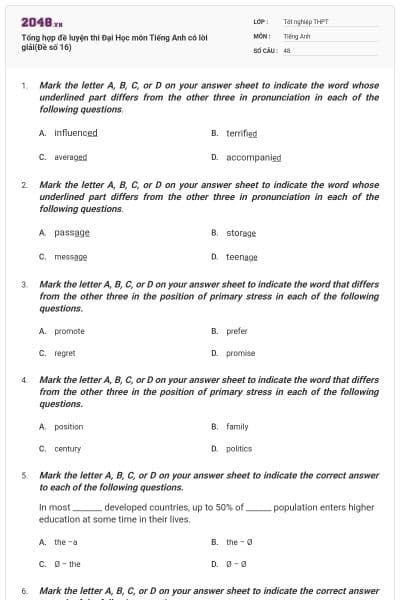
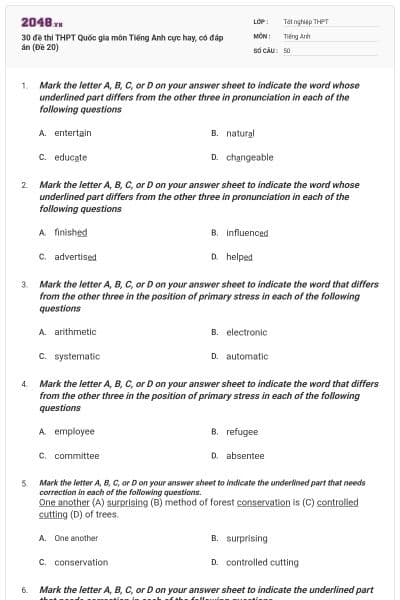
Mark the letter A, B, C, or D on your answer sheet to indicate the word whose underlined part differs from the other three in pronunciation in each of the following questions
entertain
natural
educate
changeable
Đáp án B
Âm ‘a’ phát âm là /æ/, các từ còn lại phát âm là /eɪ/
- natural: /ˈnætʃ.ər.əl/
- entertain: /en.təˈteɪn/, educate: /ˈedʒ.u.keɪt/, changeable: /ˈtʃeɪn.dʒə.bəl/
Mark the letter A, B, C, or D on your answer sheet to indicate the word whose underlined part differs from the other three in pronunciation in each of the following questions
finished
influenced
advertised
helped
Đáp án C
Đuôi ‘ed’ phát âm là /d/, các từ còn lại phát âm là /t/
Mark the letter A, B, C, or D on your answer sheet to indicate the word that differs from the other three in the position of primary stress in each of the following questions
arithmetic
electronic
systematic
automatic
Đáp án A
Trọng âm rơi vào âm tiết thứ 2, các từ còn lại âm tiết 3
- arithmetic: /əˈrɪθ.mə.tɪk/
- electronic: /ˌel.ekˈtrɒn.ɪk/, systematic: /ˌsɪs.təˈmæt.ɪk/, automatic: /ˌɔː.təˈmæt.ɪk/
Mark the letter A, B, C, or D on your answer sheet to indicate the word that differs from the other three in the position of primary stress in each of the following questions
employee
refugee
committee
absentee
Đáp án C
Mark the letter A, B, C, or D on your answer sheet to indicate the underlined part that needs correction in each of the following questions.
One another (A) surprising (B) method of forest conservation is (C) controlled cutting (D) of trees.
One another
surprising
conservation
controlled cutting
Đáp án A
Sửa One another => another
- another + N đếm được số ít: một cái khác nữa, 1 người khác nữa
- one another: lẫn nhau. Dùng one another để chỉ sự tương tác qua lại lẫn nhau giữa 3 đối tượng trở lên
Tạm dịch: Một phương pháp bảo vệ rừng đáng ngạc nhiên khác nữa là cắt cây có kiểm soát
Mark the letter A, B, C, or D on your answer sheet to indicate the underlined part that needs correction in each of the following questions.
There are many frequently (A) mentioned (B) reasons why one out of four arrests (C) involve (D) a juvenile.
frequently
mentioned
four arrests
invole
Đáp án C
Sửa involve => involves
- One (out) of + N số nhiều + V (chia ở số ít)
Tạm dịch: Có nhiều lý do được đề cập đến thường xuyên về việc vì sao một trong số 4 lệnh bắt giữ liên quan đến thanh thiếu niên
Mark the letter A, B, C, or D on your answer sheet to indicate the underlined part that needs correction in each of the following questions.
The US Congress passed the National Banks Acts, which set up (A) a system of privately owned banks (B) chartered (C) by a federal government (D).
set up
privately owned banks
chartered
a federal government
Đáp án D
Sửa a federal government -> the federal government.
Chính phủ liên bang “federal government” ở Mỹ chỉ có 1 và đã được xác định là chính phủ nào nên phải dùng mạo từ “the”
Tạm dịch: Quốc hội Hoa Kỳ đã thông qua các Đạo luật Ngân hàng Quốc gia, thành lập một hệ thống các ngân hàng tư nhân do một chính phủ liên bang điều hành.
Narcissus bulbs _____ at least three inches apart and covered with about for inches of welldrained soil
must plant
should be planted
should have been planted
should be planting
Đáp án B
Cấu trúc bị động của động từ khuyết thiếu should: should + be + V_ed/ PII
Tạm dịch: Những củ hoa Thủy Tiên nên được trồng tách ra ít nhất là 3 inches và nên được bao phủ với khoảng 4 inches lớp đất khô ráo nhất.
Who was the first person _____ the South Pole?
to reach
who reaches
reached
reaching
Đáp án: A
Giải thích:
Rút gọn mệnh đề khi có số thứ tự “the first/second/third/last/…, ta dùng to V.
Câu đầy đủ: Who was the first person who reached the South Pole?
→ Who was the first person to reach the South Pole?
Dịch: Ai là người đầu tiên tới Nam Cực?
Despite its wide range of styles and instrumentation, country music has certain common features _____ its own special character.
give it that
give which
that gives it to
that give it
Đáp án D
Đại từ quan hệ that thay thế cho which trong mệnh đề quan hệ không giới hạn
Tạm dịch: Mặc dù có nhiều phong cách và nhiều nhạc cụ nhưng nhạc đồng quê vẫn có những nét đặc trưng chung nào đó mang đến nét đặc biệt riêng của nó.
The fraction 3/5 is pronounced _____.
third-fives
three-five
three over fifth
three-fifths
Đáp án D
Cách đọc phân số:
- tử số thì dùng số đếm
- Nếu tử số là 1 chữ số và mẫu số từ 2 chữ số trở xuống thì mẫu số dùng số thứ tự (nếu tử số lớn hơn 1 thì mẫu số thêm _s)
- Nếu tử số là 2 chữ số trở lên hoặc mẫu số từ 3 chữ số trở lên thì mẫu số sẽ được viết từng chữ một và dùng số đếm, giữa tử số và mẫu số có chữ over
3/462: three over four six two
_____ he was lazy, he failed the exam.
So
Consequently
Thus
Now that
Đáp án D
- Now that + clause: bởi vì bây giờ, vì giờ, vì
- So: vì vậy, cho nên
- Consequently: do đó, vid vậy do nên = thus
Tạm dịch: Vì anh ấy lười nên anh ấy đã thi trượt
The _ of the human body towards the elements and disease is one of the miracles of all time.
sensitivity
sensibility
resistance
resilience
Đáp án D
- Resilience: (n) khả năng phục hồi nhanh sau 1 điều gì đó xấu, sức bật
- Resistance: (n) sự kháng cự, đề kháng (+ to st/ sb)
- Sensitivity (n): tính nhạy cảm
- Sensibilitly (n): cảm giác
Tạm dịch: Khả năng phục hồi của cơ thể con người trước các yếu tố và bệnh tật là 1 trong những điều kì diệu ở mọi thời điểm
_____ the crying baby into my arms, he mumbled his thanks and dashed off.
Delivering
Thrusting
Squeezing
Putting
Đáp án B
- Thrust: (v) ấn mạnh, đẩy mạnh, thọc
- Deliver (v): chuyển phát, giao hàng
- Squeeze (v): nhét, siết chặt
- Put: Đặt, để
Tạm dịch: Đẩy đứa bé đang khóc vào tay tôi, anh ấy đã thì thầm lời cảm ơn và lao đi.
Thank you very much. I haven’t been to _____ party for ages.
so enjoyable
a so enjoyable
the so enjoyable
so enjoyable a
Đáp án D
Cấu trúc: S + V + so + adj + a/an + N (đếm được số ít) + that + clause
Tạm dịch: Cảm ơn rất nhiều. Đã lâu rồi tôi không đến 1 bữa tiệc thú vị như vậy.
The bullet missed me by _____.
a hair’s breadth
the breadth of a hair
a breadth of a hair
the hair’s breadth
Đáp án A
- By a hair’s breadth: chỉ 1 ly, 1 tý, suýt nữa, trong đường tơ kẽ tóc
Tạm dịch: Viên đạn đã lệch tôi 1 tý.
__________, I still was able to get to the top of the mountain.
Even though unfit
Unfit as I was
While ever out of condition
Much as I’m unfit
Đáp án B
Cấu trúc nhấn mạnh cho trạng từ và tính từ:
- Adj + as + S + tobe, S + V
- Adv + as + S + V, S + V
A, sai cấu trúc vì even though + clause
C sai cấu trúc vì chưa đầy đủ một mệnh đề (S + V)
D sai vì khi có tobe + adj thì đảo tính từ lên đầu, còn much không thể đảo lên đầu câu trong trường hợp này vì tính từ unfit không đi cùng với much (không thể là As I’m much unfit)
Tạm dịch: Mặc dù không đủ khỏe nhưng tôi vẫn lên được đỉnh núi.
The steep ________ of the land makes cultivation difficult.
ascent
elevation
rise
slope
Đáp án B
- Elevation: (n) sự gồ ghề, sự nâng lên, sự đưa lên
- Ascent (n): sự đi lên
- Rise (v): mọc, tăng
- Slope (n): chỗ dốc
Tạm dịch: Sự gồ ghề dốc lên xuống của đất đai làm cho việc trồng trọt khó khăn.
You’re putting the cart before the _______ of you work on Project B before Project A because the former is a sequel to the latter.
horse
dog
buffalo
ox
Đáp án A
Idiom: “put the cart before the horse”: cầm đèn chạy trước ô tô
Tạm dịch: Bạn đang cầm đèn chạy trước ô tô khi bạn làm dự án B trước dự án A vì dự án B là tiếp nối sau dự án A
This city has four million _____.
residents
inhabitants
dwellers
settlers
Đáp án B
Người ta thường dùng resident để chỉ về người cư ngụ hoặc có nhà cửa trong một khu vực nào đó trong một thành phố, thị trấn… Khi nói về cư dân của một tỉnh lỵ, thành phố, hoặc một nước đặc biệt là về số lượng hoặc lịch sử, ta dùng inhabitant.
Eg. Just ten years ago the town had only 10,000 inhabitants.
Eg. The first inhabitants of the island planted coffee beans. Khi nói về cư dân sinh sống quanh một làng mạc, thành thị…có cùng những mối quan tâm, có những sinh hoạt chung, bạn có thể dùng local residents/local inhabitants/local population.
Eg. Local residents are protesting about the new road. Dweller được dùng cho người hay các con vật sinh sống trong một khu vực riêng biệt nào đó. Dweller thường được thấy dùng cặp với các từ khác như city/slum/cave/forest/town…dweller.
Eg. Eighty-five per cent of city dwellers breathe heavily polluted air. Eg. Unlike many town dwellers, farmers at least eat well. Settler thường dùng cho người từ nơi xa khác tới sinh sống và định cư. Mở rộng: Khi nói về dân chúng, mọi dân tộc trên toàn thế giới hoặc toàn bộ cư dân trong một nước, một thành phố, tỉnh lỵ… người ta cũng dùng chữ population.
Eg. The town has a population of 50,000.
Tạm dịch: thành phố này có 4 triệu cư dân
You are welcome _____ any books in the library.
to
with
for
by
Đáp án A
Cấu trúc: be welcome to st/ to V: được phép tự do lấy cái gì/ làm gì xin cứ tự nhiên
Tạm dịch: Bạn cứ tự nhiên dùng bất kỳ quyển sách nào trong thư viện nhé.
– Clerk: “Good morning, and welcome to Vietcombank. How can I help you?”
– Customer: “_____. What kind of accounts do you have?”
I’d like to withdraw some money
I’d like to borrow a loan from the bank
I’d like to open a savings account
I’d like to deposit some money into my account
Đáp án C
- Thư ký: Chào buổi sáng, chào mừng đến với Vietcombank. Tôi có thể giúp gì bạn không?
- Khách hàng: Tôi muốn mở một tài khoản tiết kiệm. Bạn có các loại tài khoản nào
Các phương án khác không phù hợp với ngữ cảnh của câu.
A. Tôi muốn rút tiền.
B. Tôi muốn vay tiền từ ngân hàng.
D. Tôi muốn gửi tiền vào tài khoản của tôi
– Emma: “What’s the matter, Kevin? _____.”
– Kevin: “There are so many courses on the website. I don’t know which ones to take.”
You look very excited
You seem very tired
You look very disappointed
You seem very puzzled
Đáp án D
- Emma: “Có vấn đề gì thế, Kevin? Trông bạn có vẻ lúng túng”
- Kevin: “Có quá nhiều khoá học trên website.Tôi không biết nên chọn cái nào”
Các phương án khác không phù hợp với ngữ cảnh của câu.
A. Trông bạn có vẻ hào hứng.
B. Trông bạn có vẻ mệt.
C. Trông bạn có vẻ thất vọng
Mark the letter A, B, C, or D on your answer sheet to indicate the word(s) CLOSEST in meaning to the underlined word(s) in each of the following questions.
Although the staff did expand somewhat, for the first century of its existence, the entire teaching staff considered of the president and three or four tutors.
back and forth
to and froth
more or less
side by side
Đáp án C
- somewhat: (adv) hơi, một chút, 1 phần nào đó = more or less
Tạm dịch: Mặc dù đội ngũ cán bộ đã mở rộng đôi chút trong thế kỷ tồn tại đầu tiên của mình nhưng toàn bộ bộ phận giảng dạy chỉ bao gồm chủ tịch và 3 hoặc 4 giáo viên dạy kèm.
Mark the letter A, B, C, or D on your answer sheet to indicate the word(s) CLOSEST in meaning to the underlined word(s) in each of the following questions.
To remedy this situation, the Constitution of the United States, approved in 1789, allowed Congress to issue money.
resolve
medicate
understand
renew
Đáp án A
- remedy: (v) cứu chữa, giải quyết khó khăn = resolve: (v) giải quyết khó khăn, vấn đề
Tạm dịch: Để giải quyết tình huống này, Hiến pháp Hoa Kỳ đã được phê duyệt vào năm 1789, cho phép Quốc Hội phát hành tiền
Mark the letter A, B, C, or D on your answer sheet to indicate the word(s) OPPOSITE in meaning to the underlined word(s) in each of the following questions.
The police tried in vain to break up the protest crowds in front of the government building; further measures needed to be employed.
unskillfully
violently
effectively
eventually
Đáp án C
- in vain: vô ích, không ăn thua gì, không hiệu quả
>< effectively: có kết quả, có hiệu lực, có hiệu quả, có ích
Mark the letter A, B, C, or D on your answer sheet to indicate the word(s) OPPOSITE in meaning to the underlined word(s) in each of the following questions.
Tony would never forget the look of intense anguish on the face of his parents when they heard the news of his failure in the exam.
delight
sadness
misery
surprise
Đáp án A
- anguish: (n) nỗi đau đớn, nỗi thống khổ, nỗi khổ não (thể xác và tinh thần)
>< delight: điều thích thú, niềm khoái cảm
Mark the letter A, B, C, or D on your answer sheet to indicate the sentence that is closest in meaning to each of the following questions.
Had I noticed that Joanne was crying, I would have called you.
If Joanne had been crying, I would have called you
I did not see that Joanne was crying or I would have called you
I called you because it was clear that Joanne was crying
Joanne was crying because I had called you
Đáp án B
Câu gốc: Nếu tôi đã biết rằng Joanne đang khóc, tôi đã gọi bạn (đây là câu điều kiện loại 3)
= Tôi đã không biết rằng Joanne đang khóc nếu không thì tôi đã gọi bạn
A. Nếu Joanne khóc, tôi đã gọi bạn -> chưa sát nghĩa với câu gốc
C. Tôi đã gọi bạn bởi vì rõ ràng là Joanne đang khóc -> chưa sát nghĩa với câu gốc
D. Joanne đang khóc bởi vì tôi đã gọi bạn -> chưa sát nghĩa với câu gốc
Mark the letter A, B, C, or D on your answer sheet to indicate the sentence that is closest in meaning to each of the following questions.
The truth is hurtful, but you have to accept it.
Hurtful as is the truth, you have to accept it
Hurtful as it is, you have to accept the truth
Much as hurtful the truth is, you have to accept it
In spite of the truth is hurtful, you have to accept it
Đáp án B
Câu gốc: Sự thật thì rất đau lòng nhưng bạn cần chấp nhận nó
Sử dụng cấu trúc đảo ngữ để nhấn mạnh: Adj + as + S + V, S + V
A. Sai cấu trúc đảo ngữ để nhấn mạnh
B. Dù rất đau lòng nhưng bạn cần chấp nhận sự thật
C. Sai cấu trúc đảo ngữ để nhấn mạnh
D. Sai cấu trúc vì in spite of + noun phrase
Mark the letter A, B, C, or D on your answer sheet to indicate the sentence that is closest in meaning to each of the following questions.
By the time my friends arrive, we will have finished dinner.
My friends will have got here by dinner time
We will be finishing dinner when my friends arrive
Dinner will be finished when my friends get here
My friends are arriving in time for dinner
Đáp án C
Câu gốc: Trước khi những người bạn của tôi đến, chúng tôi đã xong bữa tối
A. Các bạn của tôi sẽ đến đây trước bữa tối -> không sát nghĩa với câu gốc
B. Chúng tôi sẽ ăn xong bữa tối khi các bạn của chúng tôi đến ->không sát nghĩa với câu gốc
C. Bữa tối sẽ được hoàn tất khi các bạn của tôi đến đây -> Sát nghĩa với câu gốc
D. Các bạn của tôi sẽ đến đúng giờ để dùng bữa tối -> không sát nghĩa với câu gốc
Mark the letter A, B, C, or D on your answer sheet to indicate the sentence that best combines each pair of sentences in the following questions.
He was able to finish his book. It was because his wife helped him.
If only he had been able to finish his book
If his wife had helped him, he couldn’t have finished his book
Without his wife’s help, he couldn’t have finished his book
Without his wife’s help, he couldn’t finish his book
Đáp án B
Câu gốc: Anh ấy đã có thể hoàn thành sách của anh ấy. Đó là nhờ vợ anh ấy đã giúp đỡ anh ấy
A. Giá mà anh ấy đã có thể hoàn thành quyển sách
B. Nếu vợ anh ấy đã giúp anh ấy, anh ấy đã không thể hoàn thành quyển sách
C. Câu sử dụng câu điều kiện loại 3 để nối 2 câu trên: Nếu không có sự giúp đỡ của vợ anh ấy, anh ấy đã không thể hoàn thành quyển sách của anh ấy
D. Câu này sai cấu trúc ngũ pháp của câu điều kiện loại 3 vì mệnh đề chính cần chia ở dạng could + have + PP
Mark the letter A, B, C, or D on your answer sheet to indicate the sentence that best combines each pair of sentences in the following questions.
The essay is too short. It can’t be given a high grade.
It is too short an essay to earn a high grade
The essay needs to be shorter to receive a high grade
Even if it were longer, the essay would not get a higher grade
The essay is so short that it can be given a high grade
Đáp án A
Câu gốc: Bài luận văn quá ngắn. Nó có thẻ không được điểm cao
A. Sử dụng cấu trúc “too…to: quá đến nỗi không thể” để nối 2 câu trên: Bài luận văn quá ngắn đến nỗi không thể đạt được điểm cao
B. Luận văn cần được ngắn hơn để nhận được điểm cao
C. Thậm chí nó có dài hơn thì bài luận văn ấy cũng không đạt được điểm cao hơn
D. Bài luận văn thì quá ngắn đến nỗi nó có thể được điểm cao.
Read the following passage and mark the letter A, B, C, or D on your answer sheet to indicate the correct word or phrase that best fits each of the numbered blanks from 33 to 37.
AS OLD AS YOU FEEL
It might after all be true that you are only as old as you feel. A British clinic is carrying out new high-tech tests to calculate the “real” biological age of patients (33) ______ on the rate of physical deterioration. Information on every aspect of a patient’s health, fitness, lifestyle and family medical history is (34) ______ into a computer to work out whether they are older or younger than their calendar age suggests.
The availability and increasing accuracy of the tests has prompted one leading British gerontologist to call for biological age to be used to determine when workers should retire. He (35) ______ that if an employee’s biological or “real” age is shown, for example, to be 55 when he reaches his 65th birthday, he should be incited to work for another decade. Apparently most employers only take into (36) ______ a person’s calendar years, and the two may differ considerably. Some of those prepared to pay a substantial sum of money for the examinations will be able to smugly walk away with medical evidence showing that they really are as young as they feel, giving them the confidence to act and dress as if they were younger. Dr Lynette Yong, resident doctor at the clinic where the tests are offered claims that the purpose of these tests will be to motivate people to (37) _______ their health.
The concept of “real” age is set to become big business in the USA with books and websites helping people work out whether their body is older or younger than their years. Others firmly believe that looks will always be the best indicator of age.
Điền vào ô số 33
prospect
arranged
based
established
Đáp án C
- based on: dựa vào
- prospect of st: thăm dò cái gì
- arrange st: sặp xếp cái gì
- established: được thiết lập
Tạm dịch: Một phòng khám của Anh đang tiến hành các thử nghiệm công nghệ cao mới để tính tuổi sinh học "thực" của bệnh nhân dựa trên tỷ lệ suy giảm về thể chất
Read the following passage and mark the letter A, B, C, or D on your answer sheet to indicate the correct word or phrase that best fits each of the numbered blanks from 33 to 37.
AS OLD AS YOU FEEL
It might after all be true that you are only as old as you feel. A British clinic is carrying out new high-tech tests to calculate the “real” biological age of patients (33) ______ on the rate of physical deterioration. Information on every aspect of a patient’s health, fitness, lifestyle and family medical history is (34) ______ into a computer to work out whether they are older or younger than their calendar age suggests.
The availability and increasing accuracy of the tests has prompted one leading British gerontologist to call for biological age to be used to determine when workers should retire. He (35) ______ that if an employee’s biological or “real” age is shown, for example, to be 55 when he reaches his 65th birthday, he should be incited to work for another decade. Apparently most employers only take into (36) ______ a person’s calendar years, and the two may differ considerably. Some of those prepared to pay a substantial sum of money for the examinations will be able to smugly walk away with medical evidence showing that they really are as young as they feel, giving them the confidence to act and dress as if they were younger. Dr Lynette Yong, resident doctor at the clinic where the tests are offered claims that the purpose of these tests will be to motivate people to (37) _______ their health.
The concept of “real” age is set to become big business in the USA with books and websites helping people work out whether their body is older or younger than their years. Others firmly believe that looks will always be the best indicator of age.
Điền vào ô số 34
planned
provided
supplied
fed
Đáp án D
Cấu trúc: feed st into st: cung cấp cái gì cho ai
Tạm dịch: thông tin về tất cả các lĩnh vực về sức khoẻ, thể trạng, lịch sử sức khoẻ gia định được cung cấp đến 1 máy tính
Read the following passage and mark the letter A, B, C, or D on your answer sheet to indicate the correct word or phrase that best fits each of the numbered blanks from 33 to 37.
AS OLD AS YOU FEEL
It might after all be true that you are only as old as you feel. A British clinic is carrying out new high-tech tests to calculate the “real” biological age of patients (33) ______ on the rate of physical deterioration. Information on every aspect of a patient’s health, fitness, lifestyle and family medical history is (34) ______ into a computer to work out whether they are older or younger than their calendar age suggests.
The availability and increasing accuracy of the tests has prompted one leading British gerontologist to call for biological age to be used to determine when workers should retire. He (35) ______ that if an employee’s biological or “real” age is shown, for example, to be 55 when he reaches his 65th birthday, he should be incited to work for another decade. Apparently most employers only take into (36) ______ a person’s calendar years, and the two may differ considerably. Some of those prepared to pay a substantial sum of money for the examinations will be able to smugly walk away with medical evidence showing that they really are as young as they feel, giving them the confidence to act and dress as if they were younger. Dr Lynette Yong, resident doctor at the clinic where the tests are offered claims that the purpose of these tests will be to motivate people to (37) _______ their health.
The concept of “real” age is set to become big business in the USA with books and websites helping people work out whether their body is older or younger than their years. Others firmly believe that looks will always be the best indicator of age.
Điền vào ô số 35
argues
discusses
enquires
debates
Đáp án A
- argue: (v) lập luận, chỉ rõ, chứng tỏ
- discuss (v): thảo luận
- enquire (v): điều tra, hỏi
- debate (v): tranh cãi
Tạm dịch: Tính sẵn có và độ chính xác ngày càng tăng của các cuộc kiểm tra đã khiến một nhà nghiên cứu hàng đầu của Anh gọi tuổi sinh học phải được sử dụng để xác định khi nào người lao động nghỉ hưu. Ông ấy lập luận rằng nếu tuổi tác sinh học hay tuổi "thực" của nhân viên được chỉ ra, ví dụ, chỉ là 55 tuổi khi ông ấy bước đến sinh nhật lần thứ 65 của ông ta, ông ta nên được khuyến khích để làm việc trong một thập kỉ nữa.
Read the following passage and mark the letter A, B, C, or D on your answer sheet to indicate the correct word or phrase that best fits each of the numbered blanks from 33 to 37.
AS OLD AS YOU FEEL
It might after all be true that you are only as old as you feel. A British clinic is carrying out new high-tech tests to calculate the “real” biological age of patients (33) ______ on the rate of physical deterioration. Information on every aspect of a patient’s health, fitness, lifestyle and family medical history is (34) ______ into a computer to work out whether they are older or younger than their calendar age suggests.
The availability and increasing accuracy of the tests has prompted one leading British gerontologist to call for biological age to be used to determine when workers should retire. He (35) ______ that if an employee’s biological or “real” age is shown, for example, to be 55 when he reaches his 65th birthday, he should be incited to work for another decade. Apparently most employers only take into (36) ______ a person’s calendar years, and the two may differ considerably. Some of those prepared to pay a substantial sum of money for the examinations will be able to smugly walk away with medical evidence showing that they really are as young as they feel, giving them the confidence to act and dress as if they were younger. Dr Lynette Yong, resident doctor at the clinic where the tests are offered claims that the purpose of these tests will be to motivate people to (37) _______ their health.
The concept of “real” age is set to become big business in the USA with books and websites helping people work out whether their body is older or younger than their years. Others firmly believe that looks will always be the best indicator of age.
Điền vào ô số 36
detail
account
interest
importance
Đáp án B
- take into account: xem xét cái gì cẩn thận, cân nhắc khi làm gì
Tạm dịch: Rõ ràng các nhà tuyển dụng chỉ cân nhắc về tuổi dương lịch của 1 người.
Read the following passage and mark the letter A, B, C, or D on your answer sheet to indicate the correct word or phrase that best fits each of the numbered blanks from 33 to 37.
AS OLD AS YOU FEEL
It might after all be true that you are only as old as you feel. A British clinic is carrying out new high-tech tests to calculate the “real” biological age of patients (33) ______ on the rate of physical deterioration. Information on every aspect of a patient’s health, fitness, lifestyle and family medical history is (34) ______ into a computer to work out whether they are older or younger than their calendar age suggests.
The availability and increasing accuracy of the tests has prompted one leading British gerontologist to call for biological age to be used to determine when workers should retire. He (35) ______ that if an employee’s biological or “real” age is shown, for example, to be 55 when he reaches his 65th birthday, he should be incited to work for another decade. Apparently most employers only take into (36) ______ a person’s calendar years, and the two may differ considerably. Some of those prepared to pay a substantial sum of money for the examinations will be able to smugly walk away with medical evidence showing that they really are as young as they feel, giving them the confidence to act and dress as if they were younger. Dr Lynette Yong, resident doctor at the clinic where the tests are offered claims that the purpose of these tests will be to motivate people to (37) _______ their health.
The concept of “real” age is set to become big business in the USA with books and websites helping people work out whether their body is older or younger than their years. Others firmly believe that looks will always be the best indicator of age.
Điền vào ô số 37
increase
gain
improve
progress
Đáp án C
- improve: cải thiện
- increase: tăng
- gain: đạt được
- progress: tiền bộ
Tạm dịch: Mục đích của các bài kiểm tra này là để thúc đẩy mọi người cải thiện sức khỏe.
Read the following passage and mark the letter A, B, C, or D on your answer sheet to indicate the correct answer to each of the questions from 38 to 42.
(1) Though Edmund Halley was most famous because of his achievements as an astronomer, he was a scientist of diverse interests and great skill. In addition to studying the skies, Halley was also deeply interested in exploring the unknown depths of the oceans. One of his lesser-known accomplishments that were quite remarkable was his design for a diving bell that facilitated exploration of the watery depths.
(2) The diving bell that Halley designed had a major advantage over the diving bells that were in use prior to his. Earlier diving bells could only make use of the air contained within the bell itself, so divers had to surface when the air inside the bell ran low. Halley’s bell was an improvement in that its design allowed for an additional supply of fresh air that enabled a crew of divers to remain underwater for several hours.
(3) The diving contraption that Halley designed was in the shape of a bell that measured three feet across the top and five feet across the bottom and could hold several divers comfortably; it was open at the bottom so that divers could swim in and out at will. The bell was built of wood, which was first heavily tarred to make it water repellent and was then covered with a half-ton sheet of lead to make the bell heavy enough to sink in water. The bell shape held air inside for the divers to breathe as the bell sank to the bottom.
(4) The air inside the bell was not the only source of air for the divers to breathe, and it was this improvement that made Halley’s bell superior to its predecessors. In addition to the air already in the bell, air was also supplied to the divers from a lead barrel that was lowered to the ocean floor close to the bell itself. Air flowed through a leather pipe from the lead barrel on the ocean floor to the bell. The diver could breathe the air from a position inside the bell, or he could move around outside the bell wearing a diving suit that consisted of a lead bell-shaped helmet with a glass viewing window and a leather body suit, with a leather pipe carrying fresh air from the diving bell to the helmet.
The subject of the preceding passage was most likely Halley’s _____.
childhood
work as an astronomer
invention of the diving bell
many different interests
Đáp án B
Chủ đề của đoạn văn phía trước đoạn này có thể là về công việc là một nhà thiên văn học của Halley
Để trả lời câu hỏi này, thông tin thường nằm ở 1, 2 câu đầu tiên của đoạn văn – là câu nối giữa đoạn văn trước với đoạn văn này: “Though Edmund Halley was most famous because of his achievements as an astronomer, he was a scientist of diverse interests and great skill” Mặc dù Edmund Halley nổi tiếng nhất vì những thành tựu của ông như một nhà thiên văn học nhưng ông cũng là một nhà khoa học có nhiều sở thích và kỹ năng tuyệt vời.
Read the following passage and mark the letter A, B, C, or D on your answer sheet to indicate the correct answer to each of the questions from 38 to 42.
(1) Though Edmund Halley was most famous because of his achievements as an astronomer, he was a scientist of diverse interests and great skill. In addition to studying the skies, Halley was also deeply interested in exploring the unknown depths of the oceans. One of his lesser-known accomplishments that were quite remarkable was his design for a diving bell that facilitated exploration of the watery depths.
(2) The diving bell that Halley designed had a major advantage over the diving bells that were in use prior to his. Earlier diving bells could only make use of the air contained within the bell itself, so divers had to surface when the air inside the bell ran low. Halley’s bell was an improvement in that its design allowed for an additional supply of fresh air that enabled a crew of divers to remain underwater for several hours.
(3) The diving contraption that Halley designed was in the shape of a bell that measured three feet across the top and five feet across the bottom and could hold several divers comfortably; it was open at the bottom so that divers could swim in and out at will. The bell was built of wood, which was first heavily tarred to make it water repellent and was then covered with a half-ton sheet of lead to make the bell heavy enough to sink in water. The bell shape held air inside for the divers to breathe as the bell sank to the bottom.
(4) The air inside the bell was not the only source of air for the divers to breathe, and it was this improvement that made Halley’s bell superior to its predecessors. In addition to the air already in the bell, air was also supplied to the divers from a lead barrel that was lowered to the ocean floor close to the bell itself. Air flowed through a leather pipe from the lead barrel on the ocean floor to the bell. The diver could breathe the air from a position inside the bell, or he could move around outside the bell wearing a diving suit that consisted of a lead bell-shaped helmet with a glass viewing window and a leather body suit, with a leather pipe carrying fresh air from the diving bell to the helmet.
Halley’s bell was better than its predecessors because it _____.
was bigger
provided more air
weighed less
could rise more quickly
Đáp án B
Đáp án được tìm thấy ở dòng 3 + 4 đoạn (2) Halley’s bell was an improvement in that its design allowed for an additional supply of fresh air that enabled a crew of divers to remain underwater for several hours. Chuông của Halley đã được cải tiến trong thiết kế của nó cho phép cung cấp thêm một lượng không khí cho phép một đoàn thợ lặn ở dưới nước trong vài giờ.
Read the following passage and mark the letter A, B, C, or D on your answer sheet to indicate the correct answer to each of the questions from 38 to 42.
(1) Though Edmund Halley was most famous because of his achievements as an astronomer, he was a scientist of diverse interests and great skill. In addition to studying the skies, Halley was also deeply interested in exploring the unknown depths of the oceans. One of his lesser-known accomplishments that were quite remarkable was his design for a diving bell that facilitated exploration of the watery depths.
(2) The diving bell that Halley designed had a major advantage over the diving bells that were in use prior to his. Earlier diving bells could only make use of the air contained within the bell itself, so divers had to surface when the air inside the bell ran low. Halley’s bell was an improvement in that its design allowed for an additional supply of fresh air that enabled a crew of divers to remain underwater for several hours.
(3) The diving contraption that Halley designed was in the shape of a bell that measured three feet across the top and five feet across the bottom and could hold several divers comfortably; it was open at the bottom so that divers could swim in and out at will. The bell was built of wood, which was first heavily tarred to make it water repellent and was then covered with a half-ton sheet of lead to make the bell heavy enough to sink in water. The bell shape held air inside for the divers to breathe as the bell sank to the bottom.
(4) The air inside the bell was not the only source of air for the divers to breathe, and it was this improvement that made Halley’s bell superior to its predecessors. In addition to the air already in the bell, air was also supplied to the divers from a lead barrel that was lowered to the ocean floor close to the bell itself. Air flowed through a leather pipe from the lead barrel on the ocean floor to the bell. The diver could breathe the air from a position inside the bell, or he could move around outside the bell wearing a diving suit that consisted of a lead bell-shaped helmet with a glass viewing window and a leather body suit, with a leather pipe carrying fresh air from the diving bell to the helmet.
How long could divers stay underwater in Halley’s bell?
Just a few seconds
Only a few minutes
For days on end
For hours at a time
Đáp án D
Thợ lặn có thể ở bao lâu dưới nước trong chiếc chuông của Halley?
Đáp án nằm ở dòng dòng 3 + 4 đoạn (2) Halley’s bell was an improvement in that its design allowed for an additional supply of fresh air that enabled a crew of divers to remain underwater for several hours. Chuông của Halley đã được cải tiến trong thiết kế của nó cho phép cung cấp thêm một lượng không khí cho phép một đoàn thợ lặn ở dưới nước trong vài giờ.
Read the following passage and mark the letter A, B, C, or D on your answer sheet to indicate the correct answer to each of the questions from 38 to 42.
(1) Though Edmund Halley was most famous because of his achievements as an astronomer, he was a scientist of diverse interests and great skill. In addition to studying the skies, Halley was also deeply interested in exploring the unknown depths of the oceans. One of his lesser-known accomplishments that were quite remarkable was his design for a diving bell that facilitated exploration of the watery depths.
(2) The diving bell that Halley designed had a major advantage over the diving bells that were in use prior to his. Earlier diving bells could only make use of the air contained within the bell itself, so divers had to surface when the air inside the bell ran low. Halley’s bell was an improvement in that its design allowed for an additional supply of fresh air that enabled a crew of divers to remain underwater for several hours.
(3) The diving contraption that Halley designed was in the shape of a bell that measured three feet across the top and five feet across the bottom and could hold several divers comfortably; it was open at the bottom so that divers could swim in and out at will. The bell was built of wood, which was first heavily tarred to make it water repellent and was then covered with a half-ton sheet of lead to make the bell heavy enough to sink in water. The bell shape held air inside for the divers to breathe as the bell sank to the bottom.
(4) The air inside the bell was not the only source of air for the divers to breathe, and it was this improvement that made Halley’s bell superior to its predecessors. In addition to the air already in the bell, air was also supplied to the divers from a lead barrel that was lowered to the ocean floor close to the bell itself. Air flowed through a leather pipe from the lead barrel on the ocean floor to the bell. The diver could breathe the air from a position inside the bell, or he could move around outside the bell wearing a diving suit that consisted of a lead bell-shaped helmet with a glass viewing window and a leather body suit, with a leather pipe carrying fresh air from the diving bell to the helmet.
It is NOT stated in the passage that Halley’s bell _____.
was completely enclosed
was wider at the top than at the bottom
could hold more than one diver
was made of tarred wood
Đáp án A
Người ta không nói trong đoạn văn rằng chuông của Halley…
A: Được bao quanh hoàn toàn
B: Ở dưới rộng hơn ở trên. Thông tin này tìm thấy ở dòng 1 +2 đoạn 3: The diving contraption that Halley designed was in the shape of a bell that measured three feet across the top and five feet across the bottom Thiết bị lặn mà Halley thiết kế có hình dạng của một cái chuông rộng 3 feet ở phía đầu chuông và rộng 5 feet ở đáy chuông
C: Có thể chứa hơn 1 thợ lặn Thông tin này tìm thấy ở dòng 1 +2 đoạn 3: The diving contraption that Halley designed was in the shape of a bell that measured three feet across the top and five feet across the bottom and could hold several divers comfortably. Thiết bị lặn mà Halley thiết kế có hình dạng của một cái chuông rộng 3 feet ở phía đầu chuông và rộng 5 feet ở đáy chuông và có thể thoải mái chứa nhiều thợ lặn
D: Được làm bằng gỗ phủ hắc ín. Thông tin được tìm thấy ở dòng 3 đoạn 3: “The bell was built of wood, which was first heavily tarred” Chuông được làm bằng gỗ, lần đầu được phủ lớp hắc ín dầy
Read the following passage and mark the letter A, B, C, or D on your answer sheet to indicate the correct answer to each of the questions from 38 to 42.
(1) Though Edmund Halley was most famous because of his achievements as an astronomer, he was a scientist of diverse interests and great skill. In addition to studying the skies, Halley was also deeply interested in exploring the unknown depths of the oceans. One of his lesser-known accomplishments that were quite remarkable was his design for a diving bell that facilitated exploration of the watery depths.
(2) The diving bell that Halley designed had a major advantage over the diving bells that were in use prior to his. Earlier diving bells could only make use of the air contained within the bell itself, so divers had to surface when the air inside the bell ran low. Halley’s bell was an improvement in that its design allowed for an additional supply of fresh air that enabled a crew of divers to remain underwater for several hours.
(3) The diving contraption that Halley designed was in the shape of a bell that measured three feet across the top and five feet across the bottom and could hold several divers comfortably; it was open at the bottom so that divers could swim in and out at will. The bell was built of wood, which was first heavily tarred to make it water repellent and was then covered with a half-ton sheet of lead to make the bell heavy enough to sink in water. The bell shape held air inside for the divers to breathe as the bell sank to the bottom.
(4) The air inside the bell was not the only source of air for the divers to breathe, and it was this improvement that made Halley’s bell superior to its predecessors. In addition to the air already in the bell, air was also supplied to the divers from a lead barrel that was lowered to the ocean floor close to the bell itself. Air flowed through a leather pipe from the lead barrel on the ocean floor to the bell. The diver could breathe the air from a position inside the bell, or he could move around outside the bell wearing a diving suit that consisted of a lead bell-shaped helmet with a glass viewing window and a leather body suit, with a leather pipe carrying fresh air from the diving bell to the helmet.
The expression “at will” in paragraph 3 could best be replaced by _____.
in the future
upside down
as they wanted
with great speed
Đáp án C
- at will: tùy theo ý muốn, tùy ý = as they wanted: như họ muốn
Read the following passage on transport, and mark the letter A, B, C, or D on your answer sheet to indicate the correct answer to each of the questions from 43 to 50.
(1) As the twentieth century began, the importance of formal education in the United States increased. The frontier had mostly disappeared and by 1910 most Americans lived in towns and cities. Industrialization and the bureaucratization of economic life combined with a new emphasis upon credentials and expertise to make schooling increasingly important for economic and social mobility. Increasingly, too, schools were viewed as the most important means of integrating immigrants into American society.
(2) The arrival of a great wave of southern and eastern European immigrants at the turn of the century coincided with and contributed to an enormous expansion of formal schooling. By 1920 schooling to age fourteen or beyond was compulsory in most states, and the school year was greatly lengthened. Kindergartens, vacation schools, extracurricular activities, and vocational education and counseling extended the influence of public schools over the lives of students, many of whom in the larger industrial cities were the children of immigrants. Classes for adult immigrants were sponsored by public schools, corporations, unions, churches, settlement houses, and other agencies.
(3) Reformers early in the twentieth century suggested that education programs should suit the needs of specific populations. Immigrant women were once such population. Schools tried to educate young women so they could occupy productive places in the urban industrial economy, and one place many educators considered appropriate for women was the home.
(4) Although looking after the house and family was familiar to immigrant women, American education gave homemaking a new definition. In preindustrial economies, homemaking had meant the production as well as the consumption of goods, and it commonly included income-producing activities both inside and outside the home, in the highly industrialized early-twentieth-century United States, however, overproduction rather than scarcity was becoming a problem. Thus, the ideal American homemaker was viewed as a consumer rather than a producer. Schools trained women to be consumer homemakers cooking, shopping, decorating, and caring for children "efficiently" in their own homes, or if economic necessity demanded, as employees in the homes of others. Subsequent reforms have made these notions seem quite out-of-date.
The paragraph preceding the passage probably discusses _____.
the industrialization and the bureaucratization of economic life the United States in the nineteen century
the formal schooling in the United States in the nineteen century
the urbanization in the United States in the nineteen century
the most important means of integrating immigrants into American society in the nineteen century
Đáp án B
Đoạn văn trước đoạn văn này có thể thảo luận về…
Với dạng câu hỏi này, ta nhìn 1, 2 cầu đầu tiên của đoạn văn để xem câu dẫn từ đoạn văn trước với đoạn văn này là gì
(1) As the twentieth century began, the importance of formal education in the United States increased.: Bắt đầu thế kỷ 20, tầm quan trọng của việc giáo dục chính quy nhà trường ở Mỹ đã tăng lên.
-> Đoạn văn trước đó có thể thảo luận về giáo dục chính quy tại trường học ở Mỹ thế kỷ XIX.
Thay vì A. C. D.
Read the following passage on transport, and mark the letter A, B, C, or D on your answer sheet to indicate the correct answer to each of the questions from 43 to 50.
(1) As the twentieth century began, the importance of formal education in the United States increased. The frontier had mostly disappeared and by 1910 most Americans lived in towns and cities. Industrialization and the bureaucratization of economic life combined with a new emphasis upon credentials and expertise to make schooling increasingly important for economic and social mobility. Increasingly, too, schools were viewed as the most important means of integrating immigrants into American society.
(2) The arrival of a great wave of southern and eastern European immigrants at the turn of the century coincided with and contributed to an enormous expansion of formal schooling. By 1920 schooling to age fourteen or beyond was compulsory in most states, and the school year was greatly lengthened. Kindergartens, vacation schools, extracurricular activities, and vocational education and counseling extended the influence of public schools over the lives of students, many of whom in the larger industrial cities were the children of immigrants. Classes for adult immigrants were sponsored by public schools, corporations, unions, churches, settlement houses, and other agencies.
(3) Reformers early in the twentieth century suggested that education programs should suit the needs of specific populations. Immigrant women were once such population. Schools tried to educate young women so they could occupy productive places in the urban industrial economy, and one place many educators considered appropriate for women was the home.
(4) Although looking after the house and family was familiar to immigrant women, American education gave homemaking a new definition. In preindustrial economies, homemaking had meant the production as well as the consumption of goods, and it commonly included income-producing activities both inside and outside the home, in the highly industrialized early-twentieth-century United States, however, overproduction rather than scarcity was becoming a problem. Thus, the ideal American homemaker was viewed as a consumer rather than a producer. Schools trained women to be consumer homemakers cooking, shopping, decorating, and caring for children "efficiently" in their own homes, or if economic necessity demanded, as employees in the homes of others. Subsequent reforms have made these notions seem quite out-of-date.
It can be inferred from paragraph 1 that one important factor in the increasing importance of education in the United States was _____.
the expanding economic problems of schools
the growing number of schools in frontier communities
an increase in the number of trained teachers
the increased urbanization of the entire country
Đáp án D
Từ đoạn 1 có thể suy ra rằng, một trong những nhân tố giúp nâng cao tầm quan trọng của giáo dục ở Mỹ là
Thông tin được tìm thây ở dòng 3+4 đoạn (1) Industrialization and the bureaucratization of economic life combined with a new emphasis upon credentials and expertise to make schooling increasingly important for economic and social mobility.: tốc độ công nghiệp hóa và tầm quan liêu hóa trong đời sống kinh tế kết hợp với việc nâng cao tầm quan trọng của các chứng chỉ và chuyên môn để làm cho việc học trở nên ngày càng quan trọng đối với sự dịch chuyển về kinh tế và xã hội
Read the following passage on transport, and mark the letter A, B, C, or D on your answer sheet to indicate the correct answer to each of the questions from 43 to 50.
(1) As the twentieth century began, the importance of formal education in the United States increased. The frontier had mostly disappeared and by 1910 most Americans lived in towns and cities. Industrialization and the bureaucratization of economic life combined with a new emphasis upon credentials and expertise to make schooling increasingly important for economic and social mobility. Increasingly, too, schools were viewed as the most important means of integrating immigrants into American society.
(2) The arrival of a great wave of southern and eastern European immigrants at the turn of the century coincided with and contributed to an enormous expansion of formal schooling. By 1920 schooling to age fourteen or beyond was compulsory in most states, and the school year was greatly lengthened. Kindergartens, vacation schools, extracurricular activities, and vocational education and counseling extended the influence of public schools over the lives of students, many of whom in the larger industrial cities were the children of immigrants. Classes for adult immigrants were sponsored by public schools, corporations, unions, churches, settlement houses, and other agencies.
(3) Reformers early in the twentieth century suggested that education programs should suit the needs of specific populations. Immigrant women were once such population. Schools tried to educate young women so they could occupy productive places in the urban industrial economy, and one place many educators considered appropriate for women was the home.
(4) Although looking after the house and family was familiar to immigrant women, American education gave homemaking a new definition. In preindustrial economies, homemaking had meant the production as well as the consumption of goods, and it commonly included income-producing activities both inside and outside the home, in the highly industrialized early-twentieth-century United States, however, overproduction rather than scarcity was becoming a problem. Thus, the ideal American homemaker was viewed as a consumer rather than a producer. Schools trained women to be consumer homemakers cooking, shopping, decorating, and caring for children "efficiently" in their own homes, or if economic necessity demanded, as employees in the homes of others. Subsequent reforms have made these notions seem quite out-of-date.
The phrase "coincided with" in paragraph 2 is closest in meaning to _____.
happened at the same time as
ensured the success of
was influenced by
began to grow rapidly
Đáp án A
- "coincided with st": trùng khớp với, xảy ra đồng thời với
A. happened at the same time as: xảy ra cùng 1 lúc
B. ensured the success of: đảm bảo sự thành công của
C. was influenced by: bị tác động bởi
D. began to grow rapidly: bắt đầu tăng trưởng nhanh chóng
Read the following passage on transport, and mark the letter A, B, C, or D on your answer sheet to indicate the correct answer to each of the questions from 43 to 50.
(1) As the twentieth century began, the importance of formal education in the United States increased. The frontier had mostly disappeared and by 1910 most Americans lived in towns and cities. Industrialization and the bureaucratization of economic life combined with a new emphasis upon credentials and expertise to make schooling increasingly important for economic and social mobility. Increasingly, too, schools were viewed as the most important means of integrating immigrants into American society.
(2) The arrival of a great wave of southern and eastern European immigrants at the turn of the century coincided with and contributed to an enormous expansion of formal schooling. By 1920 schooling to age fourteen or beyond was compulsory in most states, and the school year was greatly lengthened. Kindergartens, vacation schools, extracurricular activities, and vocational education and counseling extended the influence of public schools over the lives of students, many of whom in the larger industrial cities were the children of immigrants. Classes for adult immigrants were sponsored by public schools, corporations, unions, churches, settlement houses, and other agencies.
(3) Reformers early in the twentieth century suggested that education programs should suit the needs of specific populations. Immigrant women were once such population. Schools tried to educate young women so they could occupy productive places in the urban industrial economy, and one place many educators considered appropriate for women was the home.
(4) Although looking after the house and family was familiar to immigrant women, American education gave homemaking a new definition. In preindustrial economies, homemaking had meant the production as well as the consumption of goods, and it commonly included income-producing activities both inside and outside the home, in the highly industrialized early-twentieth-century United States, however, overproduction rather than scarcity was becoming a problem. Thus, the ideal American homemaker was viewed as a consumer rather than a producer. Schools trained women to be consumer homemakers cooking, shopping, decorating, and caring for children "efficiently" in their own homes, or if economic necessity demanded, as employees in the homes of others. Subsequent reforms have made these notions seem quite out-of-date.
According to the passage, one important change in United States education by the 1920's was that _____.
the amount of time spent on formal education was limited
new regulations were imposed on nontraditional education
adults and children studied in the same classes
most places required children to attend school
Đáp án D
Theo đoạn văn, một sự thay đổi quan trọng trong giáo dục nước Mỹ trước năm 1920 là
Thông tin được tìm thấy ở dòng 2 + 3 đoạn 2: By 1920 schooling to age fourteen or beyond was compulsory in most states, and the school year was greatly lengthened.: Đến năm 1920, việc đến trường học cho đến lúc được 14 tuổi hoặc lâu hơn bị bắt buộc ở mọi bang. => tất cả các nơi đều yêu cầu trẻ em đến trưởng.
Read the following passage on transport, and mark the letter A, B, C, or D on your answer sheet to indicate the correct answer to each of the questions from 43 to 50.
(1) As the twentieth century began, the importance of formal education in the United States increased. The frontier had mostly disappeared and by 1910 most Americans lived in towns and cities. Industrialization and the bureaucratization of economic life combined with a new emphasis upon credentials and expertise to make schooling increasingly important for economic and social mobility. Increasingly, too, schools were viewed as the most important means of integrating immigrants into American society.
(2) The arrival of a great wave of southern and eastern European immigrants at the turn of the century coincided with and contributed to an enormous expansion of formal schooling. By 1920 schooling to age fourteen or beyond was compulsory in most states, and the school year was greatly lengthened. Kindergartens, vacation schools, extracurricular activities, and vocational education and counseling extended the influence of public schools over the lives of students, many of whom in the larger industrial cities were the children of immigrants. Classes for adult immigrants were sponsored by public schools, corporations, unions, churches, settlement houses, and other agencies.
(3) Reformers early in the twentieth century suggested that education programs should suit the needs of specific populations. Immigrant women were once such population. Schools tried to educate young women so they could occupy productive places in the urban industrial economy, and one place many educators considered appropriate for women was the home.
(4) Although looking after the house and family was familiar to immigrant women, American education gave homemaking a new definition. In preindustrial economies, homemaking had meant the production as well as the consumption of goods, and it commonly included income-producing activities both inside and outside the home, in the highly industrialized early-twentieth-century United States, however, overproduction rather than scarcity was becoming a problem. Thus, the ideal American homemaker was viewed as a consumer rather than a producer. Schools trained women to be consumer homemakers cooking, shopping, decorating, and caring for children "efficiently" in their own homes, or if economic necessity demanded, as employees in the homes of others. Subsequent reforms have made these notions seem quite out-of-date.
According to the passage, early-twentieth century education reformers believed that _____.
special programs should be set up in frontier communities to modernize them
corporations and other organizations damaged educational progress
different groups needed different kinds of education
more women should be involved in education and industry
Đáp án C
Theo đoạn văn, những nhà cải cách giáo dục ở đầu thế kỷ 20 tin rằng:
Thông tin được tìm thấy ở dòng 1 +2 đoạn (3) Reformers early in the twentieth century suggested that education programs should suit the needs of specific populations.: Những nhà cải cách ở thế kỷ XX tin rằng các chương trình giáo dục phải phù hợp với nhu cầu của các nhóm cụ thể - mỗi nhóm cần có phương pháp giáo dục riêng.
Read the following passage on transport, and mark the letter A, B, C, or D on your answer sheet to indicate the correct answer to each of the questions from 43 to 50.
(1) As the twentieth century began, the importance of formal education in the United States increased. The frontier had mostly disappeared and by 1910 most Americans lived in towns and cities. Industrialization and the bureaucratization of economic life combined with a new emphasis upon credentials and expertise to make schooling increasingly important for economic and social mobility. Increasingly, too, schools were viewed as the most important means of integrating immigrants into American society.
(2) The arrival of a great wave of southern and eastern European immigrants at the turn of the century coincided with and contributed to an enormous expansion of formal schooling. By 1920 schooling to age fourteen or beyond was compulsory in most states, and the school year was greatly lengthened. Kindergartens, vacation schools, extracurricular activities, and vocational education and counseling extended the influence of public schools over the lives of students, many of whom in the larger industrial cities were the children of immigrants. Classes for adult immigrants were sponsored by public schools, corporations, unions, churches, settlement houses, and other agencies.
(3) Reformers early in the twentieth century suggested that education programs should suit the needs of specific populations. Immigrant women were once such population. Schools tried to educate young women so they could occupy productive places in the urban industrial economy, and one place many educators considered appropriate for women was the home.
(4) Although looking after the house and family was familiar to immigrant women, American education gave homemaking a new definition. In preindustrial economies, homemaking had meant the production as well as the consumption of goods, and it commonly included income-producing activities both inside and outside the home, in the highly industrialized early-twentieth-century United States, however, overproduction rather than scarcity was becoming a problem. Thus, the ideal American homemaker was viewed as a consumer rather than a producer. Schools trained women to be consumer homemakers cooking, shopping, decorating, and caring for children "efficiently" in their own homes, or if economic necessity demanded, as employees in the homes of others. Subsequent reforms have made these notions seem quite out-of-date.
The word "it" in line 19 refers to _____.
education
consumption
production
homemaking
Đáp án D
(4) In preindustrial economies, homemaking had meant the production as well as the consumption of goods, and it commonly included income-producing activities both inside and outside the home… Trong các nền kinh tế tiền công nghiệp, công việc nội trợ có nghĩa là sản xuất cũng như tiêu thụ hàng hoá, và công việc nội trợ thường bao gồm cả hoạt động sản xuất thu nhập cả trong và ngoài nhà
Read the following passage on transport, and mark the letter A, B, C, or D on your answer sheet to indicate the correct answer to each of the questions from 43 to 50.
(1) As the twentieth century began, the importance of formal education in the United States increased. The frontier had mostly disappeared and by 1910 most Americans lived in towns and cities. Industrialization and the bureaucratization of economic life combined with a new emphasis upon credentials and expertise to make schooling increasingly important for economic and social mobility. Increasingly, too, schools were viewed as the most important means of integrating immigrants into American society.
(2) The arrival of a great wave of southern and eastern European immigrants at the turn of the century coincided with and contributed to an enormous expansion of formal schooling. By 1920 schooling to age fourteen or beyond was compulsory in most states, and the school year was greatly lengthened. Kindergartens, vacation schools, extracurricular activities, and vocational education and counseling extended the influence of public schools over the lives of students, many of whom in the larger industrial cities were the children of immigrants. Classes for adult immigrants were sponsored by public schools, corporations, unions, churches, settlement houses, and other agencies.
(3) Reformers early in the twentieth century suggested that education programs should suit the needs of specific populations. Immigrant women were once such population. Schools tried to educate young women so they could occupy productive places in the urban industrial economy, and one place many educators considered appropriate for women was the home.
(4) Although looking after the house and family was familiar to immigrant women, American education gave homemaking a new definition. In preindustrial economies, homemaking had meant the production as well as the consumption of goods, and it commonly included income-producing activities both inside and outside the home, in the highly industrialized early-twentieth-century United States, however, overproduction rather than scarcity was becoming a problem. Thus, the ideal American homemaker was viewed as a consumer rather than a producer. Schools trained women to be consumer homemakers cooking, shopping, decorating, and caring for children "efficiently" in their own homes, or if economic necessity demanded, as employees in the homes of others. Subsequent reforms have made these notions seem quite out-of-date.
Women were trained to be consumer homemakers as a result of _____.
scarcity in the highly industrialized early-twentieth-century United States
economic necessity in the highly industrialized early-twentieth-century United States
income-producing activities in the highly industrialized early-twentieth-century United States
overproduction in the highly industrialized early-twentieth-century United States
Đáp án D
Thông tin được tìm thấy ở dòng 4 + 5 đoạn 4: in the highly industrialized early-twentieth-century United States, however, overproduction rather than scarcity was becoming a problem. Thus, the ideal American homemaker was viewed as a consumer rather than a producer. Tuy nhiên ở đầu thế kỷ 20 có nền công nghiệp hoá cao, sự sản xuất quá mức thay vì sự khan hiếm đã trở thành một vấn đề. Do đó, người nội trợ Mỹ lý tưởng được xem như là người tiêu dùng chứ không phải là một người sản xuất.
Read the following passage on transport, and mark the letter A, B, C, or D on your answer sheet to indicate the correct answer to each of the questions from 43 to 50.
(1) As the twentieth century began, the importance of formal education in the United States increased. The frontier had mostly disappeared and by 1910 most Americans lived in towns and cities. Industrialization and the bureaucratization of economic life combined with a new emphasis upon credentials and expertise to make schooling increasingly important for economic and social mobility. Increasingly, too, schools were viewed as the most important means of integrating immigrants into American society.
(2) The arrival of a great wave of southern and eastern European immigrants at the turn of the century coincided with and contributed to an enormous expansion of formal schooling. By 1920 schooling to age fourteen or beyond was compulsory in most states, and the school year was greatly lengthened. Kindergartens, vacation schools, extracurricular activities, and vocational education and counseling extended the influence of public schools over the lives of students, many of whom in the larger industrial cities were the children of immigrants. Classes for adult immigrants were sponsored by public schools, corporations, unions, churches, settlement houses, and other agencies.
(3) Reformers early in the twentieth century suggested that education programs should suit the needs of specific populations. Immigrant women were once such population. Schools tried to educate young women so they could occupy productive places in the urban industrial economy, and one place many educators considered appropriate for women was the home.
(4) Although looking after the house and family was familiar to immigrant women, American education gave homemaking a new definition. In preindustrial economies, homemaking had meant the production as well as the consumption of goods, and it commonly included income-producing activities both inside and outside the home, in the highly industrialized early-twentieth-century United States, however, overproduction rather than scarcity was becoming a problem. Thus, the ideal American homemaker was viewed as a consumer rather than a producer. Schools trained women to be consumer homemakers cooking, shopping, decorating, and caring for children "efficiently" in their own homes, or if economic necessity demanded, as employees in the homes of others. Subsequent reforms have made these notions seem quite out-of-date.
Which paragraph mentions the importance of abilities and experience in formal schooling?
Paragraph 2
Paragraph 4
Paragraph 1
Paragraph 3
Đáp án C
Đoạn văn nào nói về tầm quan trọng của việc đi học
Các key words trong đoạn 1: (1) As the twentieth century began, the importance of formal education in the United States increased. The frontier had mostly disappeared and by 1910 most Americans lived in towns and cities. Industrialization and the bureaucratization of economic life combined with a new emphasis upon credentials and expertise to make schooling increasingly important for economic and social mobility. Increasingly, too, schools were viewed as the most important means of integrating immigrants into American society