30 đề thi THPT Quốc gia môn Tiếng Anh cực hay, có đáp án (Đề 10)
50 câu hỏi
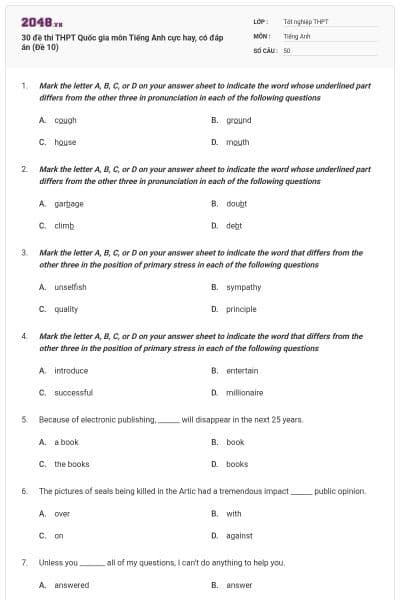
Mark the letter A, B, C, or D on your answer sheet to indicate the word whose underlined part differs from the other three in pronunciation in each of the following questions
cough
ground
house
mouth
A. cough /kɒf/
B. ground /ɡraʊnd/
C. house /haʊs/
D. mouth /maʊθ/
[ou] trong phương án A được phát âm là /ɒ/, các phương án còn lại [ou] phát âm là /aʊ/.
Chọn A
Mark the letter A, B, C, or D on your answer sheet to indicate the word whose underlined part differs from the other three in pronunciation in each of the following questions
garbage
doubt
climb
debt
A. garbage /ˈɡɑːbɪdʒ/
B. doubt /daʊt/
C. climb /klaɪm/
D. debt /det/
[b] trong phương án A được phát âm là /b/, các phương án còn lại [b] không được phát âm.
Chọn A
Mark the letter A, B, C, or D on your answer sheet to indicate the word that differs from the other three in the position of primary stress in each of the following questions
unselfish
sympathy
quality
principle
A. unselfish /ʌnˈselfɪʃ/
B. sympathy /ˈsɪmpəθi/
C. quality /ˈkwɒləti/
D. principle /ˈprɪnsəpl/
Quy tắc:
Khi thêm tiền tố “un-” không làm thay đổi trọng âm của từ gốc.
Danh từ có 3 âm tiết => trọng âm thường rơi vào âm tiết thứ nhất
Phương án A trọng âm rơi vào âm tiết thứ 2, các phương án còn lại trọng âm rơi vào âm tiết thứ 1.
Chọn A
Mark the letter A, B, C, or D on your answer sheet to indicate the word that differs from the other three in the position of primary stress in each of the following questions
introduce
entertain
successful
millionaire
A. introduce /ˌɪntrəˈdjuːs/
B. entertain /ˌentəˈteɪn/
C. successful /səkˈsesfl/
D. millionaire /ˌmɪljəˈneə(r)/
Quy tắc:
Tiền tố intro- , enter - không làm ảnh hưởng đến trọng âm gốc của từ.
Hậu tố -ful không làm thay đổi trọng âm của từ.
Từ có âm tận cùng là –naire thì trọng rơi vào chính nó.
Phương án C trọng âm rơi vào âm tiết thứ 2, các phương án còn lại trọng âm rơi vào âm tiết thứ 3.
Chọn C
Because of electronic publishing, ______ will disappear in the next 25 years.
a book
book
the books
books
Kiến thức kiểm tra: Mạo từ
book (n): quyển sách => danh từ đếm được
Khi ám chỉ những quyển sách nói chung => books
Tạm dịch: Bởi vì có sự xuất bản sách điện tử, sách truyền thống sẽ biến mất trong vòng 25 năm nữa.
Chọn D
The pictures of seals being killed in the Artic had a tremendous impact ______ public opinion.
over
with
on
against
Kiến thức kiểm tra: Giới từ
Công thức: have an impact on something: có tác động lên cái gì
Tạm dịch: Những bức tranh về những con hải cẩu bị giết chết ở Bắc Cực đã có tác động rất lớn lên quan điểm của công chúng.
Chọn C
Unless you _______ all of my questions, I can’t do anything to help you.
answered
answer
don’t answer
are answering
Kiến thức kiểm tra: Câu điều kiện
Dấu hiệu: unless
Mệnh đề chính chia ở hiện tại => câu điều kiện loại 1
Công thức: Unless + V (hiện tại đơn, dạng khẳng định) = If + V (dạng phủ định)
Tạm dịch: Trừ khi bạn trả lời tất cả các câu hỏi của tôi, tôi sẽ không thể giúp gì được bạn.
Chọn B
He promised ______ his daughter a new bicycle as a birthday present.
buy
to buy
to buying
buying
Kiến thức kiểm tra: to V / V_ing
Công thức: promise + to V (nguyên thể): hứa làm gì
Tạm dịch: Anh ấy hứa sẽ mua cho con gái anh ấy một chiếc xe đạp mới để làm quà sinh nhật.
Chọn B
We were late because we had some car problems. By the time we ___________ to the station, Susan ____________ for us for more than two hours.
are getting/had waited
got/waited
had got/had waite
got/ had been waiting
Kiến thức kiểm tra: Thì quá khứ hoàn thành tiếp diễn
Động từ “were”, “had” => quá khứ đơn => các câu còn lại cũng là thì quá khứ
Dấu hiệu: for more than two hours (trong hơn 2 tiếng)
=> vế sau chia quá khứ hoàn thành tiếp diễn
Thì hiện tại hoàn thành tiếp diễn mô tả hành động xảy ra trước một hành động khác trong quá khứ và nhấn mạnh đến tính liên tục của hành động
Công thức: By the time + S + V_ed/V2, S + had been + V_ing
Tạm dịch: Chúng tôi muộn vì có vấn đề với xe ô tô. Khi chúng tôi đến nhà ga, Susan đã chờ chúng tôi hơn 2 giờ đồng hồ.
Chọn D
It is believed that travelling is a good way to expand our ______ of the world.
knowledgeable
knowledgeably
knowledge
know
Kiến thức kiểm tra: Từ loại
Trước chỗ trống là “our” (tính từ sở hữu) => cần một danh từ
A. knowledgeable (adj): có kiến thức rộng, am hiểu
B. knowledgeably (adv): một cách am hiểu
C. knowledge (n): kiến thức
D. know (v): biết, hiểu
Tạm dịch: Người ta tin rằng đi du lịch là một cách tốt để mở rộng kiến thức của chúng về thế giới.
Chọn C
I am not against the plan at all; _______, I think it is marvelous.
nevertheless
on the other hand
in contrast
on the contrary
Kiến thức kiểm tra: Từ vựng
A. nevertheless: tuy nhiên => không phù hợp nghĩa câu
B. on the other hand: mặt khác => theo cách khác với ý đầu tiên được đề cập đến
Ví dụ: My husband likes classical music – I, on the other hand, like all kinds. (Chồng tôi thích nhạc của điển, tôi thì khác tôi thích tất cả các loại nhạc.)
C. in contrast: trái lại => so sánh, đối chiếu sự khác nhau giữa 2 người/vật khi đặt chúng ở cùng nhau.
Ví dụ: Their economy has expanded while ours, by/in contrast, has declined. (Nền kinh tế của họ thì phát triển trong khi đó nền kinh tế của chúng ta trái lại giảm.)
D. on the contrary: trái lại => dùng để thể hiện ý trái lại với ý đã nói trước đó
Tạm dịch: Tôi không hề phản đối kế hoạch này; trái lại, tôi nghĩ nó rất tuyệt vời.
Chọn D
Sometimes ___________ wears people out and is worse than the lack of sleep itself.
to sleep the desire
the desire to sleep
to desire to sleep is
the desire to sleep who
wear out = make somebody tired: khiến ai mệt mỏi
Trong câu có 2 động từ được nối bằng “and”: wear…out and is …
Câu còn thiếu chủ ngữ (thường bắt đầu bằng 1 danh từ)
=> Đáp án B: Sự khát khao muốn ngủ
Tạm dịch: Thỉnh thoảng, sự khát khao muốn ngủ khiến con người mệt mỏi và thậm chí nó còn tồi tệ hơn là việc mất ngủ.
Chọn B
They asked me __________ in London then.
is my brother working
was my brother working
if my brother was working
if my brother is working
Kiến thức kiểm tra: Câu tường thuật
Động từ tường thuật “asked” chia ở thì quá khứ đơn
=> các động từ trong câu tường thuật cũng chia ở quá khứ => loại A, D
Công thức tường thuật câu hỏi nghi vấn: asked + O + if/whether + S + V (lùi 1 thì)
Tạm dịch: Họ đã hỏi tôi liệu anh trai tôi có đang làm việc ở Luân Đôn không.
Chọn C
She complains noisily about everything she doesn’t like. She is the type of person who is always ________ a fuss.
making
doing
creating
giving
Kiến thức kiểm tra: Sự kết hợp từ
make a fuss: làm to chuyện, làm ầm ĩ (những chuyện không cần thiết)
Tạm dịch: Cô ấy phàn nàn ầm ĩ những điều mình không thích. Cô ấy là loại người lúc nào cũng làm to chuyện.
Chọn A
My _____ on life has changed a lot since leaving university.
outlook
attitude
approach
purpose
Kiến thức kiểm tra: Từ vựng
A. outlook (n): thái độ, cách nhìn về cuộc sống và thế giới của một người, nhóm người hoặc nền văn hóa
Cấu trúc: outlook on something
B. attitude (n): thái độ, quan điểm về ai, cái gì (thường ám chỉ cách cư xử, hành xử)
Cấu trúc: attitude to/towards something/somebody: thái độ về cái gì/ai
C. approach (n): cách tiếp cận, giải quyết vấn đề.
Cấu trúc: approach to something: tiếp cận cái gì
D. purpose (n): mục đích
Cấu trúc: for the purpose of something: vì mục đích gì đó
Tạm dịch: Cách nhìn của tôi về cuộc đời đã thay đổi rất nhiều kể từ khi tôi tốt nghiệp đại học.
Chọn A
Mr. Green’s job is to teach the young officers to _____ their duty in the right way.
operate
commit
perform
proceed
Kiến thức kiểm tra: Từ vựng
A. operate (v): vận hành
B. commit (v): cam kết
C. perform = carry out (v): thực hiện, tiến hành làm gì
perform one’s duty/task: thực hiện nghĩa vụ, nhiệm vụ
D. proceed = continue doing something (v): tiếp tục làm gì
Tạm dịch: Công việc của ông Green là dạy cho những nhân viên văn phòng trẻ cách để thực hiện những công việc của họ theo cách đúng đắn.
Chọn C
Jane recounted the details of her vacation so _____ that we were able to picture what she had done.
vividly
presently
punctually
obviously
Kiến thức kiểm tra: Từ vựng
A. vividly (adv): một cách sinh động
B. presently = now – currently (adv): ngay lúc này
C. punctually (adv): đúng giờ
D. obviously = clearly (adv): rõ ràng là
Ví dụ: He was obviously drunk. (Rõ ràng là anh ta bị say mà.)
Tạm dịch: Jane đã thuật lại chi tiết chuyến đi của cô ấy sinh động đến nỗi chúng tôi có thể hình dung được cô ấy đã làm gì.
Chọn A
___________________ are that stock price will go up in the coming months.
Conditions
Opportunities
Possibilities
Chances
Kiến thức kiểm tra: Thành ngữ
Công thức: (The) chances are (that) + mệnh đề = It is likely that + mệnh đề: Khả năng là…
Tạm dịch: Khả năng là giá cổ phiếu sẽ tăng lên trong những tháng tiếp theo.
Chọn D
“___________________________” - “ I have a terrible headache.”
What’s the problem to you?
What’s the matter with you?
What happens with you?
What causes you?
I have a terrible headache: Mình bị đau đầu quá
=> Câu hỏi: Bạn bị làm sao thế?
Công thức: What’s the matter with you? = What’s the problem with you?
Tạm dịch: Bạn bị làm sao thế? – Mình bị đau đầu quá.
Chọn B
Teacher: “ John, you’ve written a much better essay this time.”
John: “_______________________”
Writing? Why?
You’re welcome
Thank you. It’s really encouraging
What did you say? I’m so shy
John, you’ve written a much better essay this time: John à, lần này bài luận của em đã tốt hơn rất nhiều rồi.
=> Cô giáo khen John => John cần cảm ơn cô giáo
A. Viết á? Tại sao? => không phù hợp
B. Không có gì đâu ạ. => đáp lại lời cảm ơn
C. Cảm ơn cô. Lời nói của cô đã khích lệ em rất nhiều.
D. Cô nói gì cơ ạ? Em cảm thấy rất xấu hổ. => không phù hợp
Tạm dịch: Cô giáo: “John à, lần này bài luận của em đã tốt hơn rất nhiều rồi.”
John: “Cảm ơn cô. Lời nói của cô đã khích lệ em rất nhiều.”
Chọn C
Mark the letter A, B, C, or D on your answer sheet to indicate the word(s) CLOSEST in meaning to the underlined word(s) in each of the following questions.
Thanks to the invention of the microscope, biologists can now gain insights into the nature of the human cell.
deep understanding
in-depth studies
spectacular sightings
far-sighted views
Tạm dịch: Nhờ có sự phát minh của kính hiển vi, các nhà sinh vật học bây giờ đã hiểu biết sâu hơn nữa về tế bào của con người.
insights (n): hiểu biết sâu hơn
= deep understanding: sự hiểu biết rất sâu
Chọn A
Các phương án khác:
B. in-depth studies: nghiên cứu chuyên sâu
C. spectacular sightings: những cảnh tượng ngoạn mục
D. far-sighted views: những quan điểm nhìn xa trông rộng
Mark the letter A, B, C, or D on your answer sheet to indicate the word(s) CLOSEST in meaning to the underlined word(s) in each of the following questions.
How on earth could they do away with a lovely old building like that and put a car park there instead?
keep
eliminate
retain
upgrade
Tạm dịch: Sao trên đời này họ lại có thể phá bỏ một tòa nhà cổ đáng yêu như vật mà xây một bãi đỗ xe?
do away with: phá bỏ, gỡ bỏ cái gì đi
= eliminate = get rid of (v): phá bỏ cái gì
Chọn B
Các phương án khác:
A. keep (v): giữ
C. retain (v): giữ lại, nhớ được điều gì
D. upgrade (v): nâng cấp
Mark the letter A, B, C, or D on your answer sheet to indicate the word(s) OPPOSITE in meaning to the underlined word(s) in each of the following questions.
Psychologists encourage their patient not to get upset about trivial matters.
expectant
important
minor
unnecessary
Tạm dịch: Các nhà tâm lí học khuyên bệnh nhân của họ đừng có bực bội vì những vấn đề nhỏ nhặt.
trivial (adj): nhỏ nhặt, không quan trọng >< important (adj): quan trọng
Chọn B
Các phương án khác:
A. expectant (adj): đầy sự hi vọng
C. minor (adj): nhỏ
D. unnecessary (adj): không cần thiết
Mark the letter A, B, C, or D on your answer sheet to indicate the word(s) OPPOSITE in meaning to the underlined word(s) in each of the following questions.
I’m sorry I can’t come out this weekend – I’m up to my ears in work.
very busy
very bored
very scared
very idle
Tạm dịch: Mình xin lỗi mình không thể ra ngoài cuối tuần này. Mình có quá nhiều việc phải làm.
be up to my ears = have a lot of work to do: có quá nhiều việc phải làm >< very idle: rất rảnh rỗi
Chọn D
Các phương án khác:
A. very busy: rất bận
B. very bored: rất chán
C. very scared: rất sợ hãi
Read the following passage and mark the letter A, B, C, or D on your answer sheet to indicate the correct word or phrase that best fits each of the numbered blanks from 25 to 29.
The knock-on effect of volunteering on the lives of individuals can be profound. Voluntary work helps foster independence and imparts the ability to deal with different situations, often simultaneously, thus teaching people how to (25)______ their way through different systems. It therefore brings people into touch with the real world; and, hence, equips them for the future.
Initially, young adults in their late teens might not seem to have the expertise or knowledge to impart to others that say a teacher or an agriculturalist or a nurse would have, (26) ______ they do have many skills that can help others. And in the absence of any particular talent, their energy and enthusiasm can be harnessed for the benefit (27) ______ their fellow human beings, and ultimately themselves. From all this, the gain to any community no matter how many volunteers are involved is (28) ______.
Employers will generally look favorably on people (29) ______ have shown an ability to work as part of a team. It demonstrates a willingness to learn and an independent spirit, which would be desirable qualities in any employee.
Điền vào ô số 25
take
work
put
give
The knock-on effect of volunteering on the lives of individuals can be profound. Voluntary work helps foster independence and imparts the ability to deal with different situations, often simultaneously, thus teaching people how to (25) work their way through different systems.
Tạm dịch: Phản ứng dây chuyền của việc tình nguyện lên đời sống cá nhân có thể rất nhiều. Công việc tình nguyện giúp người ta trở nên độc lập hơn và nó giúp con người khả năng có thể đương đầu với nhiều tình huống khác nhau, thường một cách đồng thời, do đó dạy con người cách làm việc từ đầu chí cuối ở các hệ thống khác nhau.
Thành ngữ: “work one’s way through”: làm việc gì đó từ đầu đến cuối
Chọn B
Read the following passage and mark the letter A, B, C, or D on your answer sheet to indicate the correct word or phrase that best fits each of the numbered blanks from 25 to 29.
The knock-on effect of volunteering on the lives of individuals can be profound. Voluntary work helps foster independence and imparts the ability to deal with different situations, often simultaneously, thus teaching people how to (25)______ their way through different systems. It therefore brings people into touch with the real world; and, hence, equips them for the future.
Initially, young adults in their late teens might not seem to have the expertise or knowledge to impart to others that say a teacher or an agriculturalist or a nurse would have, (26) ______ they do have many skills that can help others. And in the absence of any particular talent, their energy and enthusiasm can be harnessed for the benefit (27) ______ their fellow human beings, and ultimately themselves. From all this, the gain to any community no matter how many volunteers are involved is (28) ______.
Employers will generally look favorably on people (29) ______ have shown an ability to work as part of a team. It demonstrates a willingness to learn and an independent spirit, which would be desirable qualities in any employee.
Điền vào ô số 26
but
so
or
for
Initially, young adults in their late teens might not seem to have the expertise or knowledge to impart to others that say a teacher or an agriculturalist or a nurse would have, (26) but they do have many skills that can help others.
Tạm dịch: Ban đầu, những người trẻ ở độ tuổi thanh thiếu niên dường như không có kiến thức chuyên môn hoặc hiểu biết để truyền đạt cho những người khác như những giáo viên hoặc nhà nông học hay là y tá, nhưng họ lại có những kĩ năng mà có thể giúp đỡ người khác.
“but”: nhưng => thể hiện sự tương phản
trợ động từ + V (nguyên thể) => nhấn mạnh
Chọn A
Read the following passage and mark the letter A, B, C, or D on your answer sheet to indicate the correct word or phrase that best fits each of the numbered blanks from 25 to 29.
The knock-on effect of volunteering on the lives of individuals can be profound. Voluntary work helps foster independence and imparts the ability to deal with different situations, often simultaneously, thus teaching people how to (25)______ their way through different systems. It therefore brings people into touch with the real world; and, hence, equips them for the future.
Initially, young adults in their late teens might not seem to have the expertise or knowledge to impart to others that say a teacher or an agriculturalist or a nurse would have, (26) ______ they do have many skills that can help others. And in the absence of any particular talent, their energy and enthusiasm can be harnessed for the benefit (27) ______ their fellow human beings, and ultimately themselves. From all this, the gain to any community no matter how many volunteers are involved is (28) ______.
Employers will generally look favorably on people (29) ______ have shown an ability to work as part of a team. It demonstrates a willingness to learn and an independent spirit, which would be desirable qualities in any employee.
Điền vào ô số 27
under
of
on
out
And in the absence of any particular talent, their energy and enthusiasm can be harnessed for the benefit (27) of their fellow human beings, and ultimately themselves.
Tạm dịch: Và trong trường hợp họ không có tài năng đặc biệt nào cả, năng lượng và sự nhiệt tình của họ có thể được khái thác vì lợi ích của đồng loại và cuối cùng là vì lợi ích của chính họ.
Công thức: “the benefit of something”: lợi ích của cái gì
Chọn B
Read the following passage and mark the letter A, B, C, or D on your answer sheet to indicate the correct word or phrase that best fits each of the numbered blanks from 25 to 29.
The knock-on effect of volunteering on the lives of individuals can be profound. Voluntary work helps foster independence and imparts the ability to deal with different situations, often simultaneously, thus teaching people how to (25)______ their way through different systems. It therefore brings people into touch with the real world; and, hence, equips them for the future.
Initially, young adults in their late teens might not seem to have the expertise or knowledge to impart to others that say a teacher or an agriculturalist or a nurse would have, (26) ______ they do have many skills that can help others. And in the absence of any particular talent, their energy and enthusiasm can be harnessed for the benefit (27) ______ their fellow human beings, and ultimately themselves. From all this, the gain to any community no matter how many volunteers are involved is (28) ______.
Employers will generally look favorably on people (29) ______ have shown an ability to work as part of a team. It demonstrates a willingness to learn and an independent spirit, which would be desirable qualities in any employee.
Điền vào ô số 28
impassable
unattainable
undetectable
immeasurable
From all this, the gain to any community no matter how many volunteers are involved is (28) immeasurable.
Tạm dịch: Sau khi cân nhắc tất cả những điều này, lợi ích cho bất kì cộng đồng dù là có bao nhiêu tình nguyện viên tham gia đi nữa là quá lớn (không để đo lường được).
measure (v): đo lường
=> measurable (adj): có thể đo lường
=> immeasurable (adj): không thể đo lường
Các phương án khác:
A. impassable (adj): không thể đi qua được (dùng để mô tả đường phố hoặc một khu vực nào đó)
B. unattainable (adj): không thể đạt được (thường dùng để mô tả mục tiêu)
C. undetectable (adj): không thể phát hiện ra được
Chọn D
Read the following passage and mark the letter A, B, C, or D on your answer sheet to indicate the correct word or phrase that best fits each of the numbered blanks from 25 to 29.
The knock-on effect of volunteering on the lives of individuals can be profound. Voluntary work helps foster independence and imparts the ability to deal with different situations, often simultaneously, thus teaching people how to (25)______ their way through different systems. It therefore brings people into touch with the real world; and, hence, equips them for the future.
Initially, young adults in their late teens might not seem to have the expertise or knowledge to impart to others that say a teacher or an agriculturalist or a nurse would have, (26) ______ they do have many skills that can help others. And in the absence of any particular talent, their energy and enthusiasm can be harnessed for the benefit (27) ______ their fellow human beings, and ultimately themselves. From all this, the gain to any community no matter how many volunteers are involved is (28) ______.
Employers will generally look favorably on people (29) ______ have shown an ability to work as part of a team. It demonstrates a willingness to learn and an independent spirit, which would be desirable qualities in any employee.
Điền vào ô số 29
which
what
whose
who
Employers will generally look favorably on people (29) ______ have shown an ability to work as part of a team. It demonstrates a willingness to learn and an independent spirit, which would be desirable qualities in any employee.
Tạm dịch: Những người chủ lao động thường đánh giá cao những người đã thể hiện được khả năng làm việc theo nhóm. Nó cho thấy sự sẵn lòng học hỏi và tinh thần tự lập, những phẩm chất mà bất kì người chủ lao động nào cũng mong muốn người lao động có.
people (n): con người => danh từ chỉ người
=> dùng “who” + V (thay thế cho danh từ chỉ người, làm chủ ngữ)
N1 whose N2: chỉ sở hữu (N2 thuộc sở hữu của N1)
Chọn D
Read the following passage and mark the letter A, B, C, or D on your answer sheet to indicate the correct answer to each of the questions from 30 to 34.
Body language is a vital form of communication. In fact, it is believed that the various forms of body language contribute about 70 percent to our comprehension. It is important to note, however, that body language varies in different cultures. Take for example, eye movement. In the USA a child is expected to look directly at a parent or teacher who is scolding him/her. In other cultures the opposite is true. Looking directly at a teacher or parent in such a situation is considered a sign of disrespect.
Another form of body language that is used differently, depending on the culture, is distance. In North America people don't generally stand as close to each other as in South America. Two North Americans who don't know each other well will keep a distance of four feet between them, whereas South Americans in the same situation will stand two to three feet apart. North Americans will stand closer than two feet apart only if they are having a confidential conversation or if there is intimacy between them.
Gestures are often used to communicate. We point a finger, raise an eyebrow, wave an arm – or move any other part of the body – to show what we want to say. However, this does not mean that people all over the world use the same gestures to express the same meanings. Very often we find that the same gestures can communicate different meanings, depending on the country. An example of a gesture that could be misinterpreted is sticking out the tongue. In many cultures it is a sign of making a mistake, but in some places it communicates ridicule.
The dangers of misunderstanding one another are great. Obviously, it is not enough to learn the language of another culture. You must also learn its non-verbal signals if you want to communicate successfully.
What is the passage mainly about?
The significance of non-verbal signals in America
Misunderstandings in communication
Interpretations of gestures in different cultures
Non-verbal communication across cultures
Ý chính của toàn bộ bài đọc là gì?
A. Tầm quan trọng của những tín hiệu phi lời nói ở nước Mỹ
B. Sự hiểu sai trong giao tiếp
C. Sự diễn giải điệu bộ, cử chỉ trong những nền văn hóa khác nhau
D. Sự giao tiếp phi lời nói ở các nền văn hóa khác nhau
Chọn D
Read the following passage and mark the letter A, B, C, or D on your answer sheet to indicate the correct answer to each of the questions from 30 to 34.
Body language is a vital form of communication. In fact, it is believed that the various forms of body language contribute about 70 percent to our comprehension. It is important to note, however, that body language varies in different cultures. Take for example, eye movement. In the USA a child is expected to look directly at a parent or teacher who is scolding him/her. In other cultures the opposite is true. Looking directly at a teacher or parent in such a situation is considered a sign of disrespect.
Another form of body language that is used differently, depending on the culture, is distance. In North America people don't generally stand as close to each other as in South America. Two North Americans who don't know each other well will keep a distance of four feet between them, whereas South Americans in the same situation will stand two to three feet apart. North Americans will stand closer than two feet apart only if they are having a confidential conversation or if there is intimacy between them.
Gestures are often used to communicate. We point a finger, raise an eyebrow, wave an arm – or move any other part of the body – to show what we want to say. However, this does not mean that people all over the world use the same gestures to express the same meanings. Very often we find that the same gestures can communicate different meanings, depending on the country. An example of a gesture that could be misinterpreted is sticking out the tongue. In many cultures it is a sign of making a mistake, but in some places it communicates ridicule.
The dangers of misunderstanding one another are great. Obviously, it is not enough to learn the language of another culture. You must also learn its non-verbal signals if you want to communicate successfully.
The word "intimacy" in paragraph 2 is closest in meaning to ______.
enjoyment
closeness
strength
agreement
Từ “intimacy” trong đoạn 2 gần nghĩa nhất với .
A. enjoyment (n): sự thích thú
B. closeness (n): sự gần gũi, sự thân mật
C. strength (n): sức mạnh
D. agreement (n): sự đồng ý, sự chấp thuận
Thông tin: North Americans will stand closer than two feet apart only if they are having a confidential conversation or if there is intimacy between them.
Tạm dịch: Người Bắc Mỹ sẽ đứng gần hơn khoảng cách 0,6 mét chỉ khi họ đang có một cuộc trò chuyện bí mật hoặc nếu có sự thân mật với nhau.
foot = 0,3 mét => feet = 0,6 mét
Chọn B
Read the following passage and mark the letter A, B, C, or D on your answer sheet to indicate the correct answer to each of the questions from 30 to 34.
Body language is a vital form of communication. In fact, it is believed that the various forms of body language contribute about 70 percent to our comprehension. It is important to note, however, that body language varies in different cultures. Take for example, eye movement. In the USA a child is expected to look directly at a parent or teacher who is scolding him/her. In other cultures the opposite is true. Looking directly at a teacher or parent in such a situation is considered a sign of disrespect.
Another form of body language that is used differently, depending on the culture, is distance. In North America people don't generally stand as close to each other as in South America. Two North Americans who don't know each other well will keep a distance of four feet between them, whereas South Americans in the same situation will stand two to three feet apart. North Americans will stand closer than two feet apart only if they are having a confidential conversation or if there is intimacy between them.
Gestures are often used to communicate. We point a finger, raise an eyebrow, wave an arm – or move any other part of the body – to show what we want to say. However, this does not mean that people all over the world use the same gestures to express the same meanings. Very often we find that the same gestures can communicate different meanings, depending on the country. An example of a gesture that could be misinterpreted is sticking out the tongue. In many cultures it is a sign of making a mistake, but in some places it communicates ridicule.
The dangers of misunderstanding one another are great. Obviously, it is not enough to learn the language of another culture. You must also learn its non-verbal signals if you want to communicate successfully.
The word "it" in paragraph 3 refers to ______.
an example
making a mistake
the country
sticking out the tongue
Từ “it” trong đoạn 3 liên hệ với .
A. an example: ví dụ B. making a mistake: mắc lỗi, mắc phải sai lầm
C. the country: đất nước D. sticking out the tongue: lè lưỡi
Thông tin: An example of a gesture that could be misinterpreted is sticking out the tongue. In many cultures it is a sign of making a mistake, but in some places it communicates ridicule.
Tạm dịch: Một ví dụ của cử chỉ có thể bị hiểu lầm là lè lưỡi. Trong nhiều nền văn hóa, đó là dấu hiệu của việc bạn phạm phải sai lầm, nhưng ở một số nơi, nó thể hiện sự chế giễu.
Chọn D
Read the following passage and mark the letter A, B, C, or D on your answer sheet to indicate the correct answer to each of the questions from 30 to 34.
Body language is a vital form of communication. In fact, it is believed that the various forms of body language contribute about 70 percent to our comprehension. It is important to note, however, that body language varies in different cultures. Take for example, eye movement. In the USA a child is expected to look directly at a parent or teacher who is scolding him/her. In other cultures the opposite is true. Looking directly at a teacher or parent in such a situation is considered a sign of disrespect.
Another form of body language that is used differently, depending on the culture, is distance. In North America people don't generally stand as close to each other as in South America. Two North Americans who don't know each other well will keep a distance of four feet between them, whereas South Americans in the same situation will stand two to three feet apart. North Americans will stand closer than two feet apart only if they are having a confidential conversation or if there is intimacy between them.
Gestures are often used to communicate. We point a finger, raise an eyebrow, wave an arm – or move any other part of the body – to show what we want to say. However, this does not mean that people all over the world use the same gestures to express the same meanings. Very often we find that the same gestures can communicate different meanings, depending on the country. An example of a gesture that could be misinterpreted is sticking out the tongue. In many cultures it is a sign of making a mistake, but in some places it communicates ridicule.
The dangers of misunderstanding one another are great. Obviously, it is not enough to learn the language of another culture. You must also learn its non-verbal signals if you want to communicate successfully.
As stated in the passage, in order to communicate successfully with people from another culture, it is advisable for a person ______.
to learn only non-verbal signals of that culture
to travel to as many countries as possible
to use the body language of the people from that culture
to learn both the language and non-verbal signals of that culture
Theo như thông tin trong bài đọc, để giao tiếp thành công với những người đến từ nền văn hóa khác, mọt người nên ______.
A. chỉ học tín hiệu phi ngôn ngữ của nền văn hóa đó
B. hãy đi du lịch đến càng nhiều nước càng tốt
C. hãy sử dụng những nông ngữ cơ thể của người đến từ nền văn hóa đó
D. hãy học cả ngôn ngữ và tín hiệu phi lời nói của nền văn hóa đó
Thông tin: Obviously, it is not enough to learn the language of another culture. You must also learn its non-verbal signals if you want to communicate successfully.
Tạm dịch: Rõ ràng, việc học ngôn ngữ của nền văn hóa khác là không đủ. Bạn phải học cả các tín hiệu phi ngôn ngữ của nó nếu bạn muốn giao tiếp thành công.
Chọn D
Read the following passage and mark the letter A, B, C, or D on your answer sheet to indicate the correct answer to each of the questions from 30 to 34.
Body language is a vital form of communication. In fact, it is believed that the various forms of body language contribute about 70 percent to our comprehension. It is important to note, however, that body language varies in different cultures. Take for example, eye movement. In the USA a child is expected to look directly at a parent or teacher who is scolding him/her. In other cultures the opposite is true. Looking directly at a teacher or parent in such a situation is considered a sign of disrespect.
Another form of body language that is used differently, depending on the culture, is distance. In North America people don't generally stand as close to each other as in South America. Two North Americans who don't know each other well will keep a distance of four feet between them, whereas South Americans in the same situation will stand two to three feet apart. North Americans will stand closer than two feet apart only if they are having a confidential conversation or if there is intimacy between them.
Gestures are often used to communicate. We point a finger, raise an eyebrow, wave an arm – or move any other part of the body – to show what we want to say. However, this does not mean that people all over the world use the same gestures to express the same meanings. Very often we find that the same gestures can communicate different meanings, depending on the country. An example of a gesture that could be misinterpreted is sticking out the tongue. In many cultures it is a sign of making a mistake, but in some places it communicates ridicule.
The dangers of misunderstanding one another are great. Obviously, it is not enough to learn the language of another culture. You must also learn its non-verbal signals if you want to communicate successfully.
Which form of body language is NOT mentioned in the passage?
posture
gesture
distance
eye movement
Loại hình ngôn ngữ cơ thể nào KHÔNG được đề cập trong bài?
A. posture (n): tư thế, dáng đứng
B. gesture (n): cử chỉ
C. distance (n): khoảng cách
D. eye movement (n): giao tiếp bằng mắt
Chọn A
Read the following passage and mark the letter A, B, C, or D on your answer sheet to indicate the correct answer to each of the questions from 35 to 42.
In this modern world where closed-circuit television (CCTV) cameras are everywhere and smartphones in every pocket, the routine filming of everyday life is becoming pervasive. A number of countries are rolling out body cams for police officers; other public-facing agencies such as schools, councils and hospitals are also experimenting with cameras for their employees. Private citizens are getting in on the act too: cyclists increasingly wear headcams as a deterrent to aggressive drivers. As camera technology gets smaller and cheaper, it isn't hard to envisage a future where we're all filming everything all the time, in every direction.
Would that be a good thing? There are some obvious potential upsides. If people know they are on camera, especially when at work or using public services, they are surely less likely to misbehave. The available evidence suggests that it discourages behaviours such as vandalism. Another upside is that it would be harder to get away with crimes or to evade blame for accidents.
But a world on camera could have subtle negative effects. The deluge of data we pour into the hands of Google, Facebook and others has already proved a mixed blessing. Those companies would no doubt be willing to upload and curate our body-cam data for free, but at what cost to privacy and freedom of choice?
Body-cam data could also create a legal minefield. Disputes over the veracity and interpretation of police footage have already surfaced. Eventually, events not caught on camera could be treated as if they didn't happen. Alternatively, footage could be faked or doctored to dodge blame or incriminate others.
Of course, there's always the argument that if you're not doing anything wrong, you have nothing to fear. But most people have done something embarrassing, or even illegal, that they regret and would prefer they hadn't been caught on film. People already censor their social media feeds – or avoid doing anything incriminating in public – for fear of damaging their reputation. Would ubiquitous body cams have a further chilling effect on our freedom?
The always-on-camera world could even threaten some of the attributes that make us human. We are natural gossips and backbiters, and while those might not be desirable behaviours, they oil the wheels of our social interactions. Once people assume they are being filmed, they are likely to clam up.
The argument in relation to body-cam ownership is a bit like that for guns: once you go past a critical threshold, almost everyone will feel they need one as an insurance policy. We are nowhere near that point yet – but we should think hard about whether we really want to say "lights, body cam, action."
What does the passage mainly discuss?
The current public obsession with modern technology
The ubiquity of cameras and ensuing problems
Legal disputes fuelled by body-cam data
Data overload experienced by social network users
Ý chính của bài đọc là gì?
A. Sự ám ảnh của công chúng hiện nay với công nghệ hiện đại
B. Sự hiện diện của máy quay ở khắp mọi nơi và các hệ lụy
C. Những tranh chấp pháp lý có thể bị làm cho tệ hại hơn do dữ liệu từ các máy quay đeo phía trước cơ thể
D. Sự quá tải về mặt dữ liệu trải nghiệm bởi người dùng mạng xã hội
Chọn B
Read the following passage and mark the letter A, B, C, or D on your answer sheet to indicate the correct answer to each of the questions from 35 to 42.
In this modern world where closed-circuit television (CCTV) cameras are everywhere and smartphones in every pocket, the routine filming of everyday life is becoming pervasive. A number of countries are rolling out body cams for police officers; other public-facing agencies such as schools, councils and hospitals are also experimenting with cameras for their employees. Private citizens are getting in on the act too: cyclists increasingly wear headcams as a deterrent to aggressive drivers. As camera technology gets smaller and cheaper, it isn't hard to envisage a future where we're all filming everything all the time, in every direction.
Would that be a good thing? There are some obvious potential upsides. If people know they are on camera, especially when at work or using public services, they are surely less likely to misbehave. The available evidence suggests that it discourages behaviours such as vandalism. Another upside is that it would be harder to get away with crimes or to evade blame for accidents.
But a world on camera could have subtle negative effects. The deluge of data we pour into the hands of Google, Facebook and others has already proved a mixed blessing. Those companies would no doubt be willing to upload and curate our body-cam data for free, but at what cost to privacy and freedom of choice?
Body-cam data could also create a legal minefield. Disputes over the veracity and interpretation of police footage have already surfaced. Eventually, events not caught on camera could be treated as if they didn't happen. Alternatively, footage could be faked or doctored to dodge blame or incriminate others.
Of course, there's always the argument that if you're not doing anything wrong, you have nothing to fear. But most people have done something embarrassing, or even illegal, that they regret and would prefer they hadn't been caught on film. People already censor their social media feeds – or avoid doing anything incriminating in public – for fear of damaging their reputation. Would ubiquitous body cams have a further chilling effect on our freedom?
The always-on-camera world could even threaten some of the attributes that make us human. We are natural gossips and backbiters, and while those might not be desirable behaviours, they oil the wheels of our social interactions. Once people assume they are being filmed, they are likely to clam up.
The argument in relation to body-cam ownership is a bit like that for guns: once you go past a critical threshold, almost everyone will feel they need one as an insurance policy. We are nowhere near that point yet – but we should think hard about whether we really want to say "lights, body cam, action."
The word "envisage" in paragraph 1 is closest in meaning to ______.
embrace
fantasise
reject
visualize
Từ “envisage” trong đoạn 1 có nghĩa gần nhất với __________.
A. embrace (v): ôm
B. fantasise (v): mơ mộng
C. reject (v): từ bỏ, bác bỏ
D. visualize (v): hình dung, tưởng tượng = envisage
Thông tin: As camera technology gets smaller and cheaper, it isn't hard to envisage a future where we're all filming everything all the time, in every direction.
Tạm dịch: Khi công nghệ giúp các máy quay trở nên nhỏ hơn và rẻ hơn, không khó để hình dung một tương lai khi mà tất cả mọi người đều quay phim mọi lúc, mọi hướng.
Chọn D
Read the following passage and mark the letter A, B, C, or D on your answer sheet to indicate the correct answer to each of the questions from 35 to 42.
In this modern world where closed-circuit television (CCTV) cameras are everywhere and smartphones in every pocket, the routine filming of everyday life is becoming pervasive. A number of countries are rolling out body cams for police officers; other public-facing agencies such as schools, councils and hospitals are also experimenting with cameras for their employees. Private citizens are getting in on the act too: cyclists increasingly wear headcams as a deterrent to aggressive drivers. As camera technology gets smaller and cheaper, it isn't hard to envisage a future where we're all filming everything all the time, in every direction.
Would that be a good thing? There are some obvious potential upsides. If people know they are on camera, especially when at work or using public services, they are surely less likely to misbehave. The available evidence suggests that it discourages behaviours such as vandalism. Another upside is that it would be harder to get away with crimes or to evade blame for accidents.
But a world on camera could have subtle negative effects. The deluge of data we pour into the hands of Google, Facebook and others has already proved a mixed blessing. Those companies would no doubt be willing to upload and curate our body-cam data for free, but at what cost to privacy and freedom of choice?
Body-cam data could also create a legal minefield. Disputes over the veracity and interpretation of police footage have already surfaced. Eventually, events not caught on camera could be treated as if they didn't happen. Alternatively, footage could be faked or doctored to dodge blame or incriminate others.
Of course, there's always the argument that if you're not doing anything wrong, you have nothing to fear. But most people have done something embarrassing, or even illegal, that they regret and would prefer they hadn't been caught on film. People already censor their social media feeds – or avoid doing anything incriminating in public – for fear of damaging their reputation. Would ubiquitous body cams have a further chilling effect on our freedom?
The always-on-camera world could even threaten some of the attributes that make us human. We are natural gossips and backbiters, and while those might not be desirable behaviours, they oil the wheels of our social interactions. Once people assume they are being filmed, they are likely to clam up.
The argument in relation to body-cam ownership is a bit like that for guns: once you go past a critical threshold, almost everyone will feel they need one as an insurance policy. We are nowhere near that point yet – but we should think hard about whether we really want to say "lights, body cam, action."
As mentioned in paragraph 2, misbehaviour can be discouraged if potential offenders ______.
are aware of being filmed at the time
know that they may be subjected to criticism
realise that they may be publicly punished
are employed in the public sector
Theo như thông tin trong đoạn 2, những hành vi sai trái có thể được ngăn chặn nếu như những người định có hành vi xấu ______.
A. có ý thức được họ đang bị quay phim
B. biết rằng họ có thể bị chỉ trích
C. nhận ra rằng họ có thể bị phạt công khai
D. được làm việc trong những lĩnh vực công
Thông tin: If people know they are on camera, especially when at work or using public services, they are surely less likely to misbehave.
Tạm dịch: Nếu mọi người biết họ đang bị quay phim, đặc biệt là khi đang ở nơi làm việc hoặc sử dụng các dịch vụ công cộng, họ chắc chắn sẽ ít có hành động sai trái.
know = be aware of: có ý thức, biết
Chọn A
Read the following passage and mark the letter A, B, C, or D on your answer sheet to indicate the correct answer to each of the questions from 35 to 42.
In this modern world where closed-circuit television (CCTV) cameras are everywhere and smartphones in every pocket, the routine filming of everyday life is becoming pervasive. A number of countries are rolling out body cams for police officers; other public-facing agencies such as schools, councils and hospitals are also experimenting with cameras for their employees. Private citizens are getting in on the act too: cyclists increasingly wear headcams as a deterrent to aggressive drivers. As camera technology gets smaller and cheaper, it isn't hard to envisage a future where we're all filming everything all the time, in every direction.
Would that be a good thing? There are some obvious potential upsides. If people know they are on camera, especially when at work or using public services, they are surely less likely to misbehave. The available evidence suggests that it discourages behaviours such as vandalism. Another upside is that it would be harder to get away with crimes or to evade blame for accidents.
But a world on camera could have subtle negative effects. The deluge of data we pour into the hands of Google, Facebook and others has already proved a mixed blessing. Those companies would no doubt be willing to upload and curate our body-cam data for free, but at what cost to privacy and freedom of choice?
Body-cam data could also create a legal minefield. Disputes over the veracity and interpretation of police footage have already surfaced. Eventually, events not caught on camera could be treated as if they didn't happen. Alternatively, footage could be faked or doctored to dodge blame or incriminate others.
Of course, there's always the argument that if you're not doing anything wrong, you have nothing to fear. But most people have done something embarrassing, or even illegal, that they regret and would prefer they hadn't been caught on film. People already censor their social media feeds – or avoid doing anything incriminating in public – for fear of damaging their reputation. Would ubiquitous body cams have a further chilling effect on our freedom?
The always-on-camera world could even threaten some of the attributes that make us human. We are natural gossips and backbiters, and while those might not be desirable behaviours, they oil the wheels of our social interactions. Once people assume they are being filmed, they are likely to clam up.
The argument in relation to body-cam ownership is a bit like that for guns: once you go past a critical threshold, almost everyone will feel they need one as an insurance policy. We are nowhere near that point yet – but we should think hard about whether we really want to say "lights, body cam, action."
The phrase "a mixed blessing" in paragraph 3 probably means ______.
something that is neither good nor bad
something that produces unexpected results
something that has both advantages and disadvantages
something either negative or positive in nature
Cụm từ “a mixed blessing” trong đoạn 3 gần nghĩa với .
A. cái gì đó không tốt mà không xấu B. cái gì đó mang lại kết quả không mong đợi
C. cái gì đó có cả lợi thế và bất lợi D. cái gì đó hoặc là tiêu cực hoặc là tích cực
Thông tin: But a world on camera could have subtle negative effects. The deluge of data we pour into the hands of Google, Facebook and others has already proved a mixed blessing.
Tạm dịch: Nhưng một thế giới lúc nào cũng bị quay phim có những tác động tiêu cực mà không phải ai cũng thấy được. Sự tràn ngập dữ liệu chúng ta đổ vào tay Google, Facebook và những trang mạng xã hội khác cho thấy nó vừa có lợi, vừa có hại.
Chọn C
Read the following passage and mark the letter A, B, C, or D on your answer sheet to indicate the correct answer to each of the questions from 35 to 42.
In this modern world where closed-circuit television (CCTV) cameras are everywhere and smartphones in every pocket, the routine filming of everyday life is becoming pervasive. A number of countries are rolling out body cams for police officers; other public-facing agencies such as schools, councils and hospitals are also experimenting with cameras for their employees. Private citizens are getting in on the act too: cyclists increasingly wear headcams as a deterrent to aggressive drivers. As camera technology gets smaller and cheaper, it isn't hard to envisage a future where we're all filming everything all the time, in every direction.
Would that be a good thing? There are some obvious potential upsides. If people know they are on camera, especially when at work or using public services, they are surely less likely to misbehave. The available evidence suggests that it discourages behaviours such as vandalism. Another upside is that it would be harder to get away with crimes or to evade blame for accidents.
But a world on camera could have subtle negative effects. The deluge of data we pour into the hands of Google, Facebook and others has already proved a mixed blessing. Those companies would no doubt be willing to upload and curate our body-cam data for free, but at what cost to privacy and freedom of choice?
Body-cam data could also create a legal minefield. Disputes over the veracity and interpretation of police footage have already surfaced. Eventually, events not caught on camera could be treated as if they didn't happen. Alternatively, footage could be faked or doctored to dodge blame or incriminate others.
Of course, there's always the argument that if you're not doing anything wrong, you have nothing to fear. But most people have done something embarrassing, or even illegal, that they regret and would prefer they hadn't been caught on film. People already censor their social media feeds – or avoid doing anything incriminating in public – for fear of damaging their reputation. Would ubiquitous body cams have a further chilling effect on our freedom?
The always-on-camera world could even threaten some of the attributes that make us human. We are natural gossips and backbiters, and while those might not be desirable behaviours, they oil the wheels of our social interactions. Once people assume they are being filmed, they are likely to clam up.
The argument in relation to body-cam ownership is a bit like that for guns: once you go past a critical threshold, almost everyone will feel they need one as an insurance policy. We are nowhere near that point yet – but we should think hard about whether we really want to say "lights, body cam, action."
What does the author imply in paragraph 3?
Body-cam ownership could eventually give rise to information overload, which, in turn, raises public concern
Social networks provide their users with greater freedom of choice while depriving them of their privacy and anonymity
Companies like Facebook may have their own intentions behind their willingness to take care of their users' body-cam data
Google and similar enterprises tend to refrain from harvesting their customers' data for illicit purposes
Tác giả ngụ ý điều gì trong đoạn 3?
A. Việc sở hữu máy quay cá nhân cuối cùng sẽ làm lượng thông tin quá tải, điều này sẽ làm công chúng lo ngại hơn.
B. Mạng xã hội cung cấp cho người dùng sự tự do lựa chọn thông tin tốt hơn trong khi đó tước bỏ sự riêng tư và sự ẩn danh của họ.
C. Các công ty như Facebook có thể có dụng ý đằng sau sự sẵn lòng để quản lí những dữ liệu từ máy quay cá nhân của người dùng.
D. Google và các doanh nghiệp tương tự có xu hướng không thu thập dữ liệu của khách hàng của họ cho mục đích bất hợp pháp.
Thông tin: But a world on camera could have subtle negative effects. The deluge of data we pour into the hands of Google, Facebook and others has already proved a mixed blessing. Those companies would no doubt be willing to upload and curate our body-cam data for free, but at what cost to privacy and freedom of choice?
Tạm dịch: Nhưng một thế giới lúc nào cũng bị quay phim có những tác động tiêu cực mà không phải ai cũng thấy được. Sự tràn ngập dữ liệu chúng ta đổ vào tay Google, Facebook và những trang mạng xã hội khác cho thấy nó vừa có lợi, vừa có hại. Những công ty đó chắc chắn sẽ sẵn lòng tải lên và chọn thông tin hay cho cư dân mạng thưởng thức miễn phí, nhưng với giá phải trả cho sự riêng tư và sự tự do lựa chọn thông tin muốn xem là gì?
Chọn C
Read the following passage and mark the letter A, B, C, or D on your answer sheet to indicate the correct answer to each of the questions from 35 to 42.
In this modern world where closed-circuit television (CCTV) cameras are everywhere and smartphones in every pocket, the routine filming of everyday life is becoming pervasive. A number of countries are rolling out body cams for police officers; other public-facing agencies such as schools, councils and hospitals are also experimenting with cameras for their employees. Private citizens are getting in on the act too: cyclists increasingly wear headcams as a deterrent to aggressive drivers. As camera technology gets smaller and cheaper, it isn't hard to envisage a future where we're all filming everything all the time, in every direction.
Would that be a good thing? There are some obvious potential upsides. If people know they are on camera, especially when at work or using public services, they are surely less likely to misbehave. The available evidence suggests that it discourages behaviours such as vandalism. Another upside is that it would be harder to get away with crimes or to evade blame for accidents.
But a world on camera could have subtle negative effects. The deluge of data we pour into the hands of Google, Facebook and others has already proved a mixed blessing. Those companies would no doubt be willing to upload and curate our body-cam data for free, but at what cost to privacy and freedom of choice?
Body-cam data could also create a legal minefield. Disputes over the veracity and interpretation of police footage have already surfaced. Eventually, events not caught on camera could be treated as if they didn't happen. Alternatively, footage could be faked or doctored to dodge blame or incriminate others.
Of course, there's always the argument that if you're not doing anything wrong, you have nothing to fear. But most people have done something embarrassing, or even illegal, that they regret and would prefer they hadn't been caught on film. People already censor their social media feeds – or avoid doing anything incriminating in public – for fear of damaging their reputation. Would ubiquitous body cams have a further chilling effect on our freedom?
The always-on-camera world could even threaten some of the attributes that make us human. We are natural gossips and backbiters, and while those might not be desirable behaviours, they oil the wheels of our social interactions. Once people assume they are being filmed, they are likely to clam up.
The argument in relation to body-cam ownership is a bit like that for guns: once you go past a critical threshold, almost everyone will feel they need one as an insurance policy. We are nowhere near that point yet – but we should think hard about whether we really want to say "lights, body cam, action."
It is stated in paragraph 4 that unrecorded events ______.
may go unnoticed or be ignored completely
could be manipulated to charge innocent people
should be kept open to interpretation
could provoke legal disputes among media companies
Trong đoạn 4 nói rằng những sự kiện không được ghi lại _______.
A. có thể sẽ không được chú ý đến hoặc lờ đi hoàn toàn
B. có thể bị thao túng để buộc tội những người vô tội
C. nên được công khai cho tất cả mọi người cùng diễn giải
D. có thể gây ra những tranh chấp pháp lí ở những công ty truyền thông
Thông tin: Eventually, events not caught on camera could be treated as if they didn't happen.
Tạm dịch: Cuối cùng, các sự kiện không được ghi lại trên máy quay có thể được coi như chưa từng xảy ra.
Chọn A
Read the following passage and mark the letter A, B, C, or D on your answer sheet to indicate the correct answer to each of the questions from 35 to 42.
In this modern world where closed-circuit television (CCTV) cameras are everywhere and smartphones in every pocket, the routine filming of everyday life is becoming pervasive. A number of countries are rolling out body cams for police officers; other public-facing agencies such as schools, councils and hospitals are also experimenting with cameras for their employees. Private citizens are getting in on the act too: cyclists increasingly wear headcams as a deterrent to aggressive drivers. As camera technology gets smaller and cheaper, it isn't hard to envisage a future where we're all filming everything all the time, in every direction.
Would that be a good thing? There are some obvious potential upsides. If people know they are on camera, especially when at work or using public services, they are surely less likely to misbehave. The available evidence suggests that it discourages behaviours such as vandalism. Another upside is that it would be harder to get away with crimes or to evade blame for accidents.
But a world on camera could have subtle negative effects. The deluge of data we pour into the hands of Google, Facebook and others has already proved a mixed blessing. Those companies would no doubt be willing to upload and curate our body-cam data for free, but at what cost to privacy and freedom of choice?
Body-cam data could also create a legal minefield. Disputes over the veracity and interpretation of police footage have already surfaced. Eventually, events not caught on camera could be treated as if they didn't happen. Alternatively, footage could be faked or doctored to dodge blame or incriminate others.
Of course, there's always the argument that if you're not doing anything wrong, you have nothing to fear. But most people have done something embarrassing, or even illegal, that they regret and would prefer they hadn't been caught on film. People already censor their social media feeds – or avoid doing anything incriminating in public – for fear of damaging their reputation. Would ubiquitous body cams have a further chilling effect on our freedom?
The always-on-camera world could even threaten some of the attributes that make us human. We are natural gossips and backbiters, and while those might not be desirable behaviours, they oil the wheels of our social interactions. Once people assume they are being filmed, they are likely to clam up.
The argument in relation to body-cam ownership is a bit like that for guns: once you go past a critical threshold, almost everyone will feel they need one as an insurance policy. We are nowhere near that point yet – but we should think hard about whether we really want to say "lights, body cam, action."
According to paragraph 5, why do social media users already act more carefully online?
Because they regret doing something illegal
Because they disapprove of uncensored social media feeds
Because they want to avoid being recognised in public
Because they wish to protect their image
Tại sao những người sử dụng mạng xã hội đã hành động một cách cẩn thận hơn khi ở trên mạng?
A. Vì hối tiếc vì đã làm gì đố bất hợp pháp.
B. Vì họ không tán thành những thông tin chưa được kiểm duyệt trên mạng.
C. Vì họ muốn tránh bị nhận ra ở chỗ công cộng.
D. Vì họ muốn bảo vệ hình ảnh của họ.
Thông tin: People already censor their social media feeds – or avoid doing anything incriminating in public – for fear of damaging their reputation.
Tạm dịch: Mọi người đã kiểm duyệt thông tin họ đăng lên mạng xã hội - hoặc tránh làm điều gì có thể khiến người ta hiểu lầm là họ làm gì đó trái pháp luật – để tránh làm tổn hại danh dự của họ.
Chọn D
Read the following passage and mark the letter A, B, C, or D on your answer sheet to indicate the correct answer to each of the questions from 35 to 42.
In this modern world where closed-circuit television (CCTV) cameras are everywhere and smartphones in every pocket, the routine filming of everyday life is becoming pervasive. A number of countries are rolling out body cams for police officers; other public-facing agencies such as schools, councils and hospitals are also experimenting with cameras for their employees. Private citizens are getting in on the act too: cyclists increasingly wear headcams as a deterrent to aggressive drivers. As camera technology gets smaller and cheaper, it isn't hard to envisage a future where we're all filming everything all the time, in every direction.
Would that be a good thing? There are some obvious potential upsides. If people know they are on camera, especially when at work or using public services, they are surely less likely to misbehave. The available evidence suggests that it discourages behaviours such as vandalism. Another upside is that it would be harder to get away with crimes or to evade blame for accidents.
But a world on camera could have subtle negative effects. The deluge of data we pour into the hands of Google, Facebook and others has already proved a mixed blessing. Those companies would no doubt be willing to upload and curate our body-cam data for free, but at what cost to privacy and freedom of choice?
Body-cam data could also create a legal minefield. Disputes over the veracity and interpretation of police footage have already surfaced. Eventually, events not caught on camera could be treated as if they didn't happen. Alternatively, footage could be faked or doctored to dodge blame or incriminate others.
Of course, there's always the argument that if you're not doing anything wrong, you have nothing to fear. But most people have done something embarrassing, or even illegal, that they regret and would prefer they hadn't been caught on film. People already censor their social media feeds – or avoid doing anything incriminating in public – for fear of damaging their reputation. Would ubiquitous body cams have a further chilling effect on our freedom?
The always-on-camera world could even threaten some of the attributes that make us human. We are natural gossips and backbiters, and while those might not be desirable behaviours, they oil the wheels of our social interactions. Once people assume they are being filmed, they are likely to clam up.
The argument in relation to body-cam ownership is a bit like that for guns: once you go past a critical threshold, almost everyone will feel they need one as an insurance policy. We are nowhere near that point yet – but we should think hard about whether we really want to say "lights, body cam, action."
The word "they" in paragraph 6 refers to ______.
wheels
social interactions
desirable behaviours
people
Question 42. D
Từ “they” trong đoạn 6 thay thế cho ______.
A. wheels (n): bánh xe
B. social interactions: tương tác xã hội
C. desirable behaviours: những hành vi đáng được mong đợi
D. people (n): mọi người
Thông tin: Once people assume they are being filmed, they are likely to clam up.
Tạm dịch: Một khi mọi người cho rằng họ đang bị quay phim, họ sẽ có xu hướng không nói gì hết.
Chọn D
Mark the letter A, B, C, or D on your answer sheet to indicate the underlined part that needs correction in each of the following questions.
What (A) I love most about (B) the book that was (C) the close-knit friendship (D) of the three friends.
What
about
that was
close-knit friendship
Kiến thức kiểm tra: Mệnh đề danh từ
What + S + V => mệnh đề danh từ đứng đầu câu làm chủ ngữ
Công thức: What + S + V + V’
What + S + V: chủ ngữ
V’: động từ
Sửa: that was => was
Tạm dịch: Điều tôi yêu nhất về cuốn sách đó là tình bạn khăng khít của 3 người bạn.
Chọn C
Mark the letter A, B, C, or D on your answer sheet to indicate the underlined part that needs correction in each of the following questions.
The keynote speaker (A) started with some complementary remarks (B) about the organisers (C) of the conference, and then proceed (D) with her speech
The keynote speaker
complementary remarks
organisers
proceed
Kiến thức kiểm tra: Từ vựng
complementary (adj): bổ sung, bù trừ
complimentary (adj): khen ngợi, miễn phí
Tạm dịch: Người diễn giả chính bắt đầu bằng lời khen về người tổ chức hội thảo và tiếp tục bài phát biểu.
Sửa: complementary remarks => complimentary remarks
Chọn B
Mark the letter A, B, C, or D on your answer sheet to indicate the underlined part that needs correction in each of the following questions.
My (A) classmates is (B) going on a (C) trip to Cuc Phuong National Park this weekend (D).
My
is
a
this weekend
Kiến thức kiểm tra: Sự hòa hợp giữa chủ ngữ và động từ
Chủ ngữ: My classmates (n): những người bạn cùng lớp => danh từ số nhiều
Sửa: is => are
Tạm dịch: Những người bạn cùng lớp của tôi dự định sẽ đi Vườn Quốc gia Cúc Phương vào cuối tuần này.
Chọn B
Mark the letter A, B, C, or D on your answer sheet to indicate the sentence that is closest in meaning to each of the following questions.
“You’re always making terrible mistakes,” said the teacher.
The teacher asked his students why they always made terrible mistakes
The teacher realized that his students always made terrible mistakes
The teacher complained about his students making terrible mistakes
The teacher made his students not always make terrible mistakes
Tạm dịch: Giáo viên nói “Lúc nào em cũng mắc lỗi”.
= C. Giáo viên phàn nàn về việc những học sinh lúc nào cũng mắc phải những lỗi lớn.
Cấu trúc: always + thì hiện tại tiếp diễn: than phiền về hành động diễn ra lặp đi lặp lại gây khó chịu
= complain about + O + V_ing
Chọn C
Các phương án khác:
A. Giáo viên hỏi học sinh của mình tại sao họ luôn mắc những lỗi lớn.
B. Giáo viên nhận ra rằng học sinh của mình luôn mắc những lỗi lớn.
D. Giáo viên khiến học sinh của mình không phải lúc nào cũng mắc những lỗi lớn.
Mark the letter A, B, C, or D on your answer sheet to indicate the sentence that is closest in meaning to each of the following questions.
My friend has stopped eating fast food.
My friend sometimes eats fast food
My friend doesn't like eating fast food
My friend no longer eats fast food
My friend has never eaten fast food
Chọn C
Tạm dịch: Bạn của tôi đã dừng ăn đồ ăn nhanh.
= C. Bạn của tôi đã không còn ăn đồ ăn nhanh nữa.
Cấu trúc: stop doing something = no longer do something: không còn/ngừng làm điều gì
Chọn C
Các phương án khác:
A. Bạn của tôi thỉnh thoảng ăn đồ ăn nhanh.
B. Bạn của tôi không thích ăn đồ ăn nhanh.
D. Bạn của tôi chưa bao giờ ăn đồ ăn nhanh
Mark the letter A, B, C, or D on your answer sheet to indicate the sentence that is closest in meaning to each of the following questions.
They report that soil pollution has seriously threatened the livelihood of many local farmers.
The livelihood of many local farmers was reported to be seriously endangered by soil pollution
It is reported that the livelihood of many local farmers has led to serious soil pollution
Soil pollution is reported to have posed a serious threat to the livelihood of many local farmers
It has been reported that soil pollution has actually put many local farmers' lives at risk
Chọn C
Tạm dịch: Họ đưa tin rằng sự ô nhiễm đất đã đe dọa nghiêm trọng đến kế sinh nhai của rất nhiều người dân địa phương.
= C. Sự ô nhiễm đất được người ta đưa tin rằng đã đe dọa nghiêm trọng đến kế sinh nhai của rất nhiều người dân địa phương.
Động từ “report” chia thì hiện tại đơn, vế sau “that” chia thì hiện tại hoàn thành => có sự chênh lệch về thì
=> Công thức câu bị động: be reported + to + have + V_ed/pp
Cấu trúc: “pose a threat to something”: đe dọa đến cái gì đó
Chọn C
Các phương án khác:
A. Kế sinh nhai của rất nhiều người dân địa phương đã được đưa tin rằng đe dọa nghiêm trọng đến sự ô nhiễm đất.
B. Người ta đưa tin rằng kế sinh nhai của rất nhiều người dân địa phương đã dẫn đến tình trạng ô nhiễm đất rất nghiêm trọng.
D. Người ta đã đưa tin rằng sự ô nhiễm đất đã thực sự khiến cuộc sống của nhiều người dân lâm vào nguy hiểm.
Mark the letter A, B, C, or D on your answer sheet to indicate the sentence that best combines each pair of sentences in the following questions.
We didn’t want to spend a lot of money. We stayed in a cheap hotel.
In spite of spending a lot of money, we stayed in a cheap hotel
Rather than spending a lot of money, we stayed in a cheap hotel
We stayed in a cheap hotel, but we had to spend a lot of money
We didn't stay in a cheap hotel as we had a lot of money to spend
Chọn B
Tạm dịch: Chúng tôi không muốn tiêu quá nhiều tiền. Chúng tôi đã ở trong một khách sạn rẻ.
= B. Thay vì dùng nhiều tiền, chúng tôi đã ở trong một khách sạn rẻ.
Cấu trúc: rather than = instead of + V_ing: thay vì là
Chọn B
Các phương án khác:
A. Mặc dù tiêu nhiều tiền, chúng tôi đã ở trong một khác sạn rẻ.
C. Chúng tôi đã ở trong một khách sạn rẻ nhưng chúng tôi phải tiêu nhiều tiền.
D. Chúng tôi đã không ở trong một khách sạn rẻ bởi vì chúng tôi có quá nhiều tiền để tiêu.
Mark the letter A, B, C, or D on your answer sheet to indicate the sentence that best combines each pair of sentences in the following questions.
Everyone expected Clement’s party to be a disaster. It was exactly the opposite.
Clement didn’t expect his party to go badly, but everybody else did
Completely contrary to everyone’s expectations, Clement’s party was really good
The expectation was that Clement’s party wouldn’t be successful, and it wasn’t
Just as everyone had predicted, Clement’s party was not a disaster
Tạm dịch: Mọi người đều nghĩ rằng bữa tiệc của Clement là một thảm họa. Nó hoàn toàn trái ngược lại.
= B. Hoàn toàn trái ngược với suy đoán của mọi người, bữa tiệc của Clement thực sự rất vui.
contrary to = opposite: trái ngược với
Chọn B
Các phương án khác:
A. Clement không mong là bữa tiệc của cậu ấy trở nên tồi tệ nhưng mọi người nghĩ vậy.
C. Người ta nghĩ rằng bữa tiệc của Clement không thành công và trên thực tế nó đã không thành công.
D. Như mọi người đã dự đoán từ trước, bữa tiệc của Clement không phải là một thảm họa.