30 đề luyện thi Đại Học môn Tiếng Anh cực hay có lời giải (Đề số 30)
50 câu hỏi
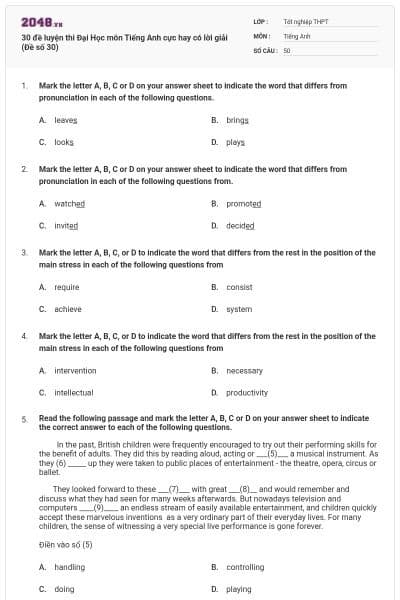
Mark the letter A, B, C or D on your answer sheet to indicate the word that differs from pronunciation in each of the following questions.
leaves
brings
looks
plays
Đáp án là C
Theo quy tắc đọc đuôi -s, looks có phần gạch chân được đọc là /s/; các từ còn lại phần gạch chân được đọc là /z/.
Mark the letter A, B, C or D on your answer sheet to indicate the word that differs from pronunciation in each of the following questions from.
watched
promoted
invited
decided
Đáp án là A
Theo quy tắc đọc đuôi -ed, watched có phần gạch chân được đọc là /t/; các từ còn lại phần gạch chân được đọc là /d/
Mark the letter A, B, C, or D to indicate the word that differs from the rest in the position of the main stress in each of the following questions from
require
consist
achieve
system
Đáp án là D
system nhấn âm thứ nhất, các từ còn lại nhấn âm hai.
Mark the letter A, B, C, or D to indicate the word that differs from the rest in the position of the main stress in each of the following questions from
intervention
necessary
intellectual
productivity
Đáp án là B
necessary nhấn âm thứ nhất, các từ còn lại nhấn âm ba
Read the following passage and mark the letter A, B, C or D on your answer sheet to indicate the correct answer to each of the following questions.
In the past, British children were frequently encouraged to try out their performing skills for the benefit of adults. They did this by reading aloud, acting or ___(5)___ a musical instrument. As they (6) _____ up they were taken to public places of entertainment - the theatre, opera, circus or ballet.
They looked forward to these ___(7)___ with great ___(8)__ and would remember and discuss what they had seen for many weeks afterwards. But nowadays television and computers ____(9)____ an endless stream of easily available entertainment, and children quickly accept these marvelous inventions as a very ordinary part of their everyday lives. For many children, the sense of witnessing a very special live performance is gone forever.
Điền vào số (5)
handling
controlling
doing
playing
Đáp án là D
play + loại nhạc cụ
Read the following passage and mark the letter A, B, C or D on your answer sheet to indicate the correct answer to each of the following questions.
In the past, British children were frequently encouraged to try out their performing skills for the benefit of adults. They did this by reading aloud, acting or ___(5)___ a musical instrument. As they (6) _____ up they were taken to public places of entertainment - the theatre, opera, circus or ballet.
They looked forward to these ___(7)___ with great ___(8)__ and would remember and discuss what they had seen for many weeks afterwards. But nowadays television and computers ____(9)____ an endless stream of easily available entertainment, and children quickly accept these marvelous inventions as a very ordinary part of their everyday lives. For many children, the sense of witnessing a very special live performance is gone forever.
Điền vào số (6)
developed
brought
advanced
grew
Đáp án là D
grow up: lớn lên
Read the following passage and mark the letter A, B, C or D on your answer sheet to indicate the correct answer to each of the following questions.
In the past, British children were frequently encouraged to try out their performing skills for the benefit of adults. They did this by reading aloud, acting or ___(5)___ a musical instrument. As they (6) _____ up they were taken to public places of entertainment - the theatre, opera, circus or ballet.
They looked forward to these ___(7)___ with great ___(8)__ and would remember and discuss what they had seen for many weeks afterwards. But nowadays television and computers ____(9)____ an endless stream of easily available entertainment, and children quickly accept these marvelous inventions as a very ordinary part of their everyday lives. For many children, the sense of witnessing a very special live performance is gone forever.
Điền vào số (7)
circumstances
occasions
incidents
situations
Đáp án là B
occasion: dịp, cơ hội
Các từ còn lại: circumstance: hoàn cảnh; incident: tai nạn; situation: trường hợ
Read the following passage and mark the letter A, B, C or D on your answer sheet to indicate the correct answer to each of the following questions.
In the past, British children were frequently encouraged to try out their performing skills for the benefit of adults. They did this by reading aloud, acting or ___(5)___ a musical instrument. As they (6) _____ up they were taken to public places of entertainment - the theatre, opera, circus or ballet.
They looked forward to these ___(7)___ with great ___(8)__ and would remember and discuss what they had seen for many weeks afterwards. But nowadays television and computers ____(9)____ an endless stream of easily available entertainment, and children quickly accept these marvelous inventions as a very ordinary part of their everyday lives. For many children, the sense of witnessing a very special live performance is gone forever.
Điền vào số (8)
sensation
action
thrill
excitement
Đáp án là D
with great excitement: với sự phấn khích lớn
Các từ còn lại: sensation:cảm giác; action: hành động; thrill: sự cảm động
Read the following passage and mark the letter A, B, C or D on your answer sheet to indicate the correct answer to each of the following questions.
In the past, British children were frequently encouraged to try out their performing skills for the benefit of adults. They did this by reading aloud, acting or ___(5)___ a musical instrument. As they (6) _____ up they were taken to public places of entertainment - the theatre, opera, circus or ballet.
They looked forward to these ___(7)___ with great ___(8)__ and would remember and discuss what they had seen for many weeks afterwards. But nowadays television and computers ____(9)____ an endless stream of easily available entertainment, and children quickly accept these marvelous inventions as a very ordinary part of their everyday lives. For many children, the sense of witnessing a very special live performance is gone forever.
Điền vào số (9)
send
supply
stock
store
Đáp án là B
supply: cung cấp.
Các từ còn lại: send: gửi; stock: tích trữ; store: lưu trữ
Read the following passage and mark the letter A, B, C or D on your answer sheet to indicate the correct answer to each of the following questions.
Although speech is the most advanced form of communication, there are many ways of communicating without using speech. Signals, signs, symbols, and gestures may be found in every known culture. The basic function of signal is to impinge upon the environment in such a way that it attracts attention, as. For example, the dots and dashes of a telegraph circuit. Coded to refer to speech, the potential for communication is very great. Less adaptable to the codiíication of words, signs also contain meaning in and of themselves. A stop sign or a barber pole conveys meaning quickly and conveniently. Symbols are more difficult to describe than either signals or signs because of their intricate relationship with the receiver’s cultural perceptions. In some cultures, applauding in a theater provides performers with an auditory symbol of approval. Gestures such as waving and handshaking also communicate certain cultural messages.
Although signals, signs, symbols, and gestures are very useful, they do have a major disadvantage. They usually do not allow ideas to be shared without the sender being directly adjacent to the receiver. As a result, means of communication intended to be used for long distances and extended periods are based upon speech. Radio, television, and the telephone are only a few.
Which of the following would be the best title for the passage?
Gestures
Signs and signals
Speech
Communication
Đáp án là D
Gesture (cử chỉ); Speech ( lời nói ); Signs and signals (Các dấu hiệu và tín hiệu) là các cách giao tiếp. => Communication ( giao tiếp) là chung nhất.
Read the following passage and mark the letter A, B, C or D on your answer sheet to indicate the correct answer to each of the following questions.
Although speech is the most advanced form of communication, there are many ways of communicating without using speech. Signals, signs, symbols, and gestures may be found in every known culture. The basic function of signal is to impinge upon the environment in such a way that it attracts attention, as. For example, the dots and dashes of a telegraph circuit. Coded to refer to speech, the potential for communication is very great. Less adaptable to the codiíication of words, signs also contain meaning in and of themselves. A stop sign or a barber pole conveys meaning quickly and conveniently. Symbols are more difficult to describe than either signals or signs because of their intricate relationship with the receiver’s cultural perceptions. In some cultures, applauding in a theater provides performers with an auditory symbol of approval. Gestures such as waving and handshaking also communicate certain cultural messages.
Although signals, signs, symbols, and gestures are very useful, they do have a major disadvantage. They usually do not allow ideas to be shared without the sender being directly adjacent to the receiver. As a result, means of communication intended to be used for long distances and extended periods are based upon speech. Radio, television, and the telephone are only a few.
What does the author say about speech?
It is dependent upon the advances made by inventors.
It is the most advanced form of communication.
It is necessary for communication to occur.
It is the only true form of communication.
Đáp án là B
Ý trong bài: Although speech is the most advanced form of communication, there are many ways of communicating without using speech.
Read the following passage and mark the letter A, B, C or D on your answer sheet to indicate the correct answer to each of the following questions.
Although speech is the most advanced form of communication, there are many ways of communicating without using speech. Signals, signs, symbols, and gestures may be found in every known culture. The basic function of signal is to impinge upon the environment in such a way that it attracts attention, as. For example, the dots and dashes of a telegraph circuit. Coded to refer to speech, the potential for communication is very great. Less adaptable to the codiíication of words, signs also contain meaning in and of themselves. A stop sign or a barber pole conveys meaning quickly and conveniently. Symbols are more difficult to describe than either signals or signs because of their intricate relationship with the receiver’s cultural perceptions. In some cultures, applauding in a theater provides performers with an auditory symbol of approval. Gestures such as waving and handshaking also communicate certain cultural messages.
Although signals, signs, symbols, and gestures are very useful, they do have a major disadvantage. They usually do not allow ideas to be shared without the sender being directly adjacent to the receiver. As a result, means of communication intended to be used for long distances and extended periods are based upon speech. Radio, television, and the telephone are only a few.
According to the passage, what is a signal?
A form of communication that interrupts the environment.
The most difficult form of communication to describe.
A form of communication which may be used across long distances.
The form of communication most related to cultural perception.
Đáp án là C
Ý trong bài: The basic function of signal is to impinge upon the environment in such a way that it attracts attention, Các chức năng cơ bản của tín hiệu là để đụng chạm vào môi trường theo cách mà nó thu hút sự chú ý, => có thể được sử dụng ở khoảng cách xa.
Read the following passage and mark the letter A, B, C or D on your answer sheet to indicate the correct answer to each of the following questions.
Although speech is the most advanced form of communication, there are many ways of communicating without using speech. Signals, signs, symbols, and gestures may be found in every known culture. The basic function of signal is to impinge upon the environment in such a way that it attracts attention, as. For example, the dots and dashes of a telegraph circuit. Coded to refer to speech, the potential for communication is very great. Less adaptable to the codiíication of words, signs also contain meaning in and of themselves. A stop sign or a barber pole conveys meaning quickly and conveniently. Symbols are more difficult to describe than either signals or signs because of their intricate relationship with the receiver’s cultural perceptions. In some cultures, applauding in a theater provides performers with an auditory symbol of approval. Gestures such as waving and handshaking also communicate certain cultural messages.
Although signals, signs, symbols, and gestures are very useful, they do have a major disadvantage. They usually do not allow ideas to be shared without the sender being directly adjacent to the receiver. As a result, means of communication intended to be used for long distances and extended periods are based upon speech. Radio, television, and the telephone are only a few.
The phrase “ impinge upon” in paragraph 1 is closest in meaning to________.
prohibit
intrude
vary
improve
Đáp án là B
impinge upon = intrude: đụng chạm, can thiệp Các từ còn lại: prohibit:cấm; vary: đa dạng; improve: nâng cao
Read the following passage and mark the letter A, B, C or D on your answer sheet to indicate the correct answer to each of the following questions.
Although speech is the most advanced form of communication, there are many ways of communicating without using speech. Signals, signs, symbols, and gestures may be found in every known culture. The basic function of signal is to impinge upon the environment in such a way that it attracts attention, as. For example, the dots and dashes of a telegraph circuit. Coded to refer to speech, the potential for communication is very great. Less adaptable to the codiíication of words, signs also contain meaning in and of themselves. A stop sign or a barber pole conveys meaning quickly and conveniently. Symbols are more difficult to describe than either signals or signs because of their intricate relationship with the receiver’s cultural perceptions. In some cultures, applauding in a theater provides performers with an auditory symbol of approval. Gestures such as waving and handshaking also communicate certain cultural messages.
Although signals, signs, symbols, and gestures are very useful, they do have a major disadvantage. They usually do not allow ideas to be shared without the sender being directly adjacent to the receiver. As a result, means of communication intended to be used for long distances and extended periods are based upon speech. Radio, television, and the telephone are only a few.
The word “it” in paragraph refers to ________.
way
environment
function
signal
Đáp án là D
The basic function of signal is to impinge uponthe environment in such a way that itattracts attention, Câu này đang đề cập về “signal” => dễ dàng có thể hiểu được “it” thay thế cho “signal”
Read the following passage and mark the letter A, B, C or D on your answer sheet to indicate the correct answer to each of the following questions.
Although speech is the most advanced form of communication, there are many ways of communicating without using speech. Signals, signs, symbols, and gestures may be found in every known culture. The basic function of signal is to impinge upon the environment in such a way that it attracts attention, as. For example, the dots and dashes of a telegraph circuit. Coded to refer to speech, the potential for communication is very great. Less adaptable to the codiíication of words, signs also contain meaning in and of themselves. A stop sign or a barber pole conveys meaning quickly and conveniently. Symbols are more difficult to describe than either signals or signs because of their intricate relationship with the receiver’s cultural perceptions. In some cultures, applauding in a theater provides performers with an auditory symbol of approval. Gestures such as waving and handshaking also communicate certain cultural messages.
Although signals, signs, symbols, and gestures are very useful, they do have a major disadvantage. They usually do not allow ideas to be shared without the sender being directly adjacent to the receiver. As a result, means of communication intended to be used for long distances and extended periods are based upon speech. Radio, television, and the telephone are only a few.
The word “ potential” in paragraph 1 could be replaced by ________.
advanced
possibility
organization
signal
Đáp án là B
potential = possibility: khả năng
Nghĩa các từ còn lại: advanced: tiên tiến; organization: tổ chức; signal: tín hiệu
Read the following passage and mark the letter A, B, C or D on your answer sheet to indicate the correct answer to each of the following questions.
Although speech is the most advanced form of communication, there are many ways of communicating without using speech. Signals, signs, symbols, and gestures may be found in every known culture. The basic function of signal is to impinge upon the environment in such a way that it attracts attention, as. For example, the dots and dashes of a telegraph circuit. Coded to refer to speech, the potential for communication is very great. Less adaptable to the codiíication of words, signs also contain meaning in and of themselves. A stop sign or a barber pole conveys meaning quickly and conveniently. Symbols are more difficult to describe than either signals or signs because of their intricate relationship with the receiver’s cultural perceptions. In some cultures, applauding in a theater provides performers with an auditory symbol of approval. Gestures such as waving and handshaking also communicate certain cultural messages.
Although signals, signs, symbols, and gestures are very useful, they do have a major disadvantage. They usually do not allow ideas to be shared without the sender being directly adjacent to the receiver. As a result, means of communication intended to be used for long distances and extended periods are based upon speech. Radio, television, and the telephone are only a few.
Why were the telephone, radio, and television invented?
Because people were unable to understand signs, signals, and symbols.
Because people wanted to communicate across long distances.
Because people believed that signs, signals, and symbols were obsolete.
Because people wanted new forms of communication.
Đáp án là B
Ý trong bài: As a result, means of communication intended to be used for long distances and extended periods are based upon speech. Radio, television, and the telephone are only a few.
Read the following passage and mark the letter A, B, C or D on your answer sheet to indicate the correct answer to each of the following questions.
Although speech is the most advanced form of communication, there are many ways of communicating without using speech. Signals, signs, symbols, and gestures may be found in every known culture. The basic function of signal is to impinge upon the environment in such a way that it attracts attention, as. For example, the dots and dashes of a telegraph circuit. Coded to refer to speech, the potential for communication is very great. Less adaptable to the codiíication of words, signs also contain meaning in and of themselves. A stop sign or a barber pole conveys meaning quickly and conveniently. Symbols are more difficult to describe than either signals or signs because of their intricate relationship with the receiver’s cultural perceptions. In some cultures, applauding in a theater provides performers with an auditory symbol of approval. Gestures such as waving and handshaking also communicate certain cultural messages.
Although signals, signs, symbols, and gestures are very useful, they do have a major disadvantage. They usually do not allow ideas to be shared without the sender being directly adjacent to the receiver. As a result, means of communication intended to be used for long distances and extended periods are based upon speech. Radio, television, and the telephone are only a few.
It may be concluded from this passage that ________.
only some cultures have signs, signals, and symbol
signs, signals, symbols, and gestures are forms of communication
symbols are very easy to define and interrupt
waving and handshaking are not related to culture
Đáp án là B
Có thể dễ dàng chọn được đáp án này, vì bài đề cập đến “signs, signals, symbols, and gestures are forms of communication”
Read the following passage and mark the letter A, B, C or D on your answer sheet to indicate the correct answer to each of the following questions.
In the mid - nineteenth century, the United States had tremendous natural resources that could be exploited in order to develop heavy industry. Most of the raw materials that are valuable in the manufacture of machinery, transportation facilities, and consumer goods lay ready to be worked into wealth. Iron, coal, and oil - the basic ingredients of industrial growth - were plentiful and needed only the application of technical expertise, organizational skill, and labor.
One crucial development in this movement toward industrialization was the growth of the railroads. The railway network expanded rapidly until the railroad map of the United States looked like a spider’s web, with the Steel filaments connecting all important sources of raw materials, their places of manufacture, and their centers of distribution. The railroads contributed to the industrial growth not only by connecting these major centers, but also by themselves consuming enormous amounts of fuel, iron, and coal.
Many factors influenced emerging modes of production. For example, machine tools, the tools used to make goods, were steadily improved in the latter part of the nineteenth century - always with an eye to speedier production and lower unit costs. The products of the factories were rapidly absorbed by the growing cities that sheltered the workers and the distributors. The increased urban population was nourished by the increased farm production that, in turn, was made more productive by the use of the new farm machinery. American agricultural production kept up with the urban demand and still had surpluses for sale to the industrial centers of Europe.
The labor that ran the factories and built the railways was recruited in part from American farm areas where people were being displaced by farm machinery, in part from Asia, and in part from Europe. Europe now began to send tides of immigrants from eastern and southern Europe - most of whom were originally poor farmers but who settled in American industrial cities. The money to finance this tremendous expansion of the American economy still came from European financiers for the most part, but the American were approaching the day when their expansion could be financed in their own “ money market”.
What does the passage mainly discuss?
The history of railroads in the United States
The major United States industrial centers
Factors that affected industrialization in the United State
The role of agriculture in the nineteenth century
Đáp án là C
Các factors có thể kể đến trong bài: the application of technical expertise, organizational skill, and labor…the growth of the railroads..., machine tools, the tools
Read the following passage and mark the letter A, B, C or D on your answer sheet to indicate the correct answer to each of the following questions.
In the mid - nineteenth century, the United States had tremendous natural resources that could be exploited in order to develop heavy industry. Most of the raw materials that are valuable in the manufacture of machinery, transportation facilities, and consumer goods lay ready to be worked into wealth. Iron, coal, and oil - the basic ingredients of industrial growth - were plentiful and needed only the application of technical expertise, organizational skill, and labor.
One crucial development in this movement toward industrialization was the growth of the railroads. The railway network expanded rapidly until the railroad map of the United States looked like a spider’s web, with the Steel filaments connecting all important sources of raw materials, their places of manufacture, and their centers of distribution. The railroads contributed to the industrial growth not only by connecting these major centers, but also by themselves consuming enormous amounts of fuel, iron, and coal.
Many factors influenced emerging modes of production. For example, machine tools, the tools used to make goods, were steadily improved in the latter part of the nineteenth century - always with an eye to speedier production and lower unit costs. The products of the factories were rapidly absorbed by the growing cities that sheltered the workers and the distributors. The increased urban population was nourished by the increased farm production that, in turn, was made more productive by the use of the new farm machinery. American agricultural production kept up with the urban demand and still had surpluses for sale to the industrial centers of Europe.
The labor that ran the factories and built the railways was recruited in part from American farm areas where people were being displaced by farm machinery, in part from Asia, and in part from Europe. Europe now began to send tides of immigrants from eastern and southern Europe - most of whom were originally poor farmers but who settled in American industrial cities. The money to finance this tremendous expansion of the American economy still came from European financiers for the most part, but the American were approaching the day when their expansion could be financed in their own “ money market”.
The word “ themselves” in the paragraph 2 refers to ________
sources
centers
railroads
places
Đáp án là C
The railroads contributed to the industrial growth not only by connecting these major centers, but also by themselves consuming enormous amounts of fuel, iron, and coal.
Read the following passage and mark the letter A, B, C or D on your answer sheet to indicate the correct answer to each of the following questions.
In the mid - nineteenth century, the United States had tremendous natural resources that could be exploited in order to develop heavy industry. Most of the raw materials that are valuable in the manufacture of machinery, transportation facilities, and consumer goods lay ready to be worked into wealth. Iron, coal, and oil - the basic ingredients of industrial growth - were plentiful and needed only the application of technical expertise, organizational skill, and labor.
One crucial development in this movement toward industrialization was the growth of the railroads. The railway network expanded rapidly until the railroad map of the United States looked like a spider’s web, with the Steel filaments connecting all important sources of raw materials, their places of manufacture, and their centers of distribution. The railroads contributed to the industrial growth not only by connecting these major centers, but also by themselves consuming enormous amounts of fuel, iron, and coal.
Many factors influenced emerging modes of production. For example, machine tools, the tools used to make goods, were steadily improved in the latter part of the nineteenth century - always with an eye to speedier production and lower unit costs. The products of the factories were rapidly absorbed by the growing cities that sheltered the workers and the distributors. The increased urban population was nourished by the increased farm production that, in turn, was made more productive by the use of the new farm machinery. American agricultural production kept up with the urban demand and still had surpluses for sale to the industrial centers of Europe.
The labor that ran the factories and built the railways was recruited in part from American farm areas where people were being displaced by farm machinery, in part from Asia, and in part from Europe. Europe now began to send tides of immigrants from eastern and southern Europe - most of whom were originally poor farmers but who settled in American industrial cities. The money to finance this tremendous expansion of the American economy still came from European financiers for the most part, but the American were approaching the day when their expansion could be financed in their own “ money market”.
According to the passage, all of the following were true of railroads in the United States in the nineteenth century EXCEPT that _____.
they connected important industrial cities
they were necessary to the industrialization process
they were expanded in a short time
they used relatively small quantities of natural resources
Đáp án là D
A và C được đề cập: The railway network expanded rapidly until the railroad map of the United States looked like a spider’s web, with the Steel filaments connecting all important sources of raw materials, their places of manufacture, and their centers of distribution.
B được đề cập: The railroads contributed to the industrial growth not only by connecting these major centers, but also by themselves consuming enormous amounts of fuel, iron, and coal.
Read the following passage and mark the letter A, B, C or D on your answer sheet to indicate the correct answer to each of the following questions.
In the mid - nineteenth century, the United States had tremendous natural resources that could be exploited in order to develop heavy industry. Most of the raw materials that are valuable in the manufacture of machinery, transportation facilities, and consumer goods lay ready to be worked into wealth. Iron, coal, and oil - the basic ingredients of industrial growth - were plentiful and needed only the application of technical expertise, organizational skill, and labor.
One crucial development in this movement toward industrialization was the growth of the railroads. The railway network expanded rapidly until the railroad map of the United States looked like a spider’s web, with the Steel filaments connecting all important sources of raw materials, their places of manufacture, and their centers of distribution. The railroads contributed to the industrial growth not only by connecting these major centers, but also by themselves consuming enormous amounts of fuel, iron, and coal.
Many factors influenced emerging modes of production. For example, machine tools, the tools used to make goods, were steadily improved in the latter part of the nineteenth century - always with an eye to speedier production and lower unit costs. The products of the factories were rapidly absorbed by the growing cities that sheltered the workers and the distributors. The increased urban population was nourished by the increased farm production that, in turn, was made more productive by the use of the new farm machinery. American agricultural production kept up with the urban demand and still had surpluses for sale to the industrial centers of Europe.
The labor that ran the factories and built the railways was recruited in part from American farm areas where people were being displaced by farm machinery, in part from Asia, and in part from Europe. Europe now began to send tides of immigrants from eastern and southern Europe - most of whom were originally poor farmers but who settled in American industrial cities. The money to finance this tremendous expansion of the American economy still came from European financiers for the most part, but the American were approaching the day when their expansion could be financed in their own “ money market”.
Which of the following in NOT true of United States farmers in the nineteenth century?
They lost some jobs because of mechanization
They were unable to produce sufficient food for urban areas
They raised their productivity by using new machinery
They sold food to European countries
Đáp án là B
A được đề cập: The labor that ran the factories and built the railways was recruited in part from American farm areas where people were being displaced by farm machinery
C được đề cập: The increased urban population was nourished by the increased farm production that, in turn, was made more productive by the use of the new farm machinery.
D được đề cập: American agricultural production kept up with the urban demand and still had surpluses for sale to the industrial centers of Europe.
Read the following passage and mark the letter A, B, C or D on your answer sheet to indicate the correct answer to each of the following questions.
In the mid - nineteenth century, the United States had tremendous natural resources that could be exploited in order to develop heavy industry. Most of the raw materials that are valuable in the manufacture of machinery, transportation facilities, and consumer goods lay ready to be worked into wealth. Iron, coal, and oil - the basic ingredients of industrial growth - were plentiful and needed only the application of technical expertise, organizational skill, and labor.
One crucial development in this movement toward industrialization was the growth of the railroads. The railway network expanded rapidly until the railroad map of the United States looked like a spider’s web, with the Steel filaments connecting all important sources of raw materials, their places of manufacture, and their centers of distribution. The railroads contributed to the industrial growth not only by connecting these major centers, but also by themselves consuming enormous amounts of fuel, iron, and coal.
Many factors influenced emerging modes of production. For example, machine tools, the tools used to make goods, were steadily improved in the latter part of the nineteenth century - always with an eye to speedier production and lower unit costs. The products of the factories were rapidly absorbed by the growing cities that sheltered the workers and the distributors. The increased urban population was nourished by the increased farm production that, in turn, was made more productive by the use of the new farm machinery. American agricultural production kept up with the urban demand and still had surpluses for sale to the industrial centers of Europe.
The labor that ran the factories and built the railways was recruited in part from American farm areas where people were being displaced by farm machinery, in part from Asia, and in part from Europe. Europe now began to send tides of immigrants from eastern and southern Europe - most of whom were originally poor farmers but who settled in American industrial cities. The money to finance this tremendous expansion of the American economy still came from European financiers for the most part, but the American were approaching the day when their expansion could be financed in their own “ money market”.
The word “ ran” in the paragraph 4 is closest in meaning to ________
operated
hurried
constructed
owned
Đáp án là A
ran = operated: hoạt động
Các từ còn lại: hurried: vội vã…; constructed: xây dựng; owned: sở hữ
Mark the letter A, B, C, or D on your answer sheet to show the underlined part that needs correction.
Men and women in the Peace Corps work with people in the developing countries to help them improving their living conditions.
work
developing
improving
living
Đáp án là C
improving => (to) improve. Cấu trúc: help someone (to) do something
Mark the letter A, B, C, or D on your answer sheet to show the underlined part that needs correction.
Although not widely sold, that book is considered to be best book on the subject.
not
sold
best
the
Đáp án là C
best => the best. So sánh hơn nhất có “the”
Mark the letter A, B, C, or D on your answer sheet to show the underlined part that needs correction.
Because his sickness, he didn’t take part in the English competition held last Sunday.
Because
he
take
held
Đáp án là A
because ( + clause ) => because of (+ N/ V-ing) .
Mark the letter A, B, C, or D on your answer sheet to show the underlined part that needs correction.
Dreaming, like all other mental processes, it is a product of the brain and its activity.
like all
it is
of the brain
its activity
Đáp án là B
it is => is, chủ ngữ là “dreaming” => thừa đại từ “it”
Mark the letter A, B, C, or D on your answer sheet to indicate the word or phrase that is CLOSEST in meaning to the underlined part in each of the following questions.
We went away on holiday last week, but it rained day in day out.
every single day
every other day
every second day
every two days
Đáp án là A
day in day out = every single day: hàng ngày
Mark the letter A, B, C, or D on your answer sheet to indicate the word or phrase that is CLOSEST in meaning to the underlined part in each of the following questions.
We can use either verbal or non - verbal forms of communication.
using gesture
using speech
using verbs
usingfacialexpressions
Đáp án là B
verbal: bằng lời nói, bằng miệng = using speech ( sử dụng lời nói
Mark the letter A, B, C or D on your answer sheet to indicate the word or phrase that is OPPOSITE in meaning to the underlined part in each of the following questions.
Thousands are going starving because of the failure of this year's harvest.
hungry
rich
poor
full
Đáp án là D
starving = hungry: đói >< full: no Rich: giàu >< poor: nghèo
Mark the letter A, B, C or D on your answer sheet to indicate the word or phrase that is OPPOSITE in meaning to the underlined part in each of the following questions.
There is growing concern about the way man has destroyed the environment.
ease
attraction
consideration
speculation
Đáp án là A
concern: mối quan tâm, bận tâm >< ease: sự rảnh rang, thảnh thơi Các từ còn lại: attraction: thu hút; consideration: sự cân nhắc; speculation: sự suy xé
A: “ Do you have a copy of The Last Leaf"?
B: “ You are________luck. I have just one copy left”
by
in
of
at
Đáp án là B
be in luck = be lucky: may mắn
Since the flood the number of homeless people ________ dramatically.
are increasing
had increased
increase
has increased
Đáp án là D
Since + mốc thòi gian => dùng thi hiện tại hoàn thành
Can you make yourself ________ in French?
understood
understand
to understand
understandin
Đáp án là A
Make someone + PII/ adj: khiến ai đó như thế nào
Today many species of plant and animal are in ________ of extinction.
danger
endangered
endanger
dangerour
Đáp án là A
in danger of : trong nguy cơ...
If the current rate of deforestation continues, the world’s rainforests ________ within 100 years.
would vanish
vanish
will vanish
would have vanished
Đáp án là C
Câu điều kiện loại I: If + S + V (HTĐG), S + will+ V.
At first she was trained to be scriptwriter, but later she worked as ________ secretary.
the / a
a / a
the / the
a / the
Đáp án là B
Trước các danh từ chỉ nghề nghiệp ta dùng mạo từ “a”
“ Don’t look so worried!. You should take the leader’s comment with ________.”
a teaspoon of salt
a cup of salt
a dose of salt
a pinch of salt
Đáp án là D
Thành ngữ: take something with a pinch/grain of salt ^ không tin ai/điều gì hoàn toàn.
If I ________ an astronaut traveling in a cabin, I’d not be annoyed by the weightlessness.
am
be
will be
were
Đáp án là D
Trong câu điều kiện loại II, ta dùng “were” với tất cả các câu
Our project was successful ________ its practicality.
in terms of
with a view to
regardless
on behalf of
Đáp án là A
in terms of : xét về mặt. ...
Các cụm còn lại:
with a view to doing something: với ý định làm cái gì, với hy vọng làm cái gì regardless of: không đếm xỉa đến on behalf of: đại diện cho
Of the two new students, one is friendly and ________.
the others are not
the other is not
another is unfriendly
other lacks friendliness
Đáp án là B
one - một người ( trong hai học sinh mới ) , the other - người còn lại ( cũng trong hai người đó)
There is one person to ________ I owe more than I can say.
whom
who
that
whose
Đáp án là A
whom thay thế cho danh từ chỉ người đóng vai trò làm tân ngữ sau giới từ “to”
After a good night’s sleep I woke up feeling as fresh as ________ and eager to start a new day.
a fruit
a daisy
a flower
a maide
Đáp án là B
as fresh as a daisy- tươi như hoa
________is the existence of a large number of different kinds of animals and plants which make a balanced environment.
extinction
biodiversity
habitat
conservation
Đáp án là B
biodiversity : đa dạng sinh học
Các từ còn lại: extinction: sự tuyệt chủng; habitat: môi trường sống; conservation: sự bảo tồn
Since we ________ to working so hard, can we rest for a while?
don’t used
aren’t used
don’t use
not use
Đáp án là B
be used to + V-ing: thói quen làm gì…
- Kate: “ How lovely your cats are!"
- David: “______”
Really? They are
Thank you, it is nice of you to say so
Can you say it again
I love them, too
Đáp án là B
How lovely your cats are! - Những chú mèo của bạn thật đáng yêu. - Lời khen
Đáp án là B. Thank you, it is nice of you to say so. - Cám ơn. Bạn thật tốt khi nói như vậy.
Peter was ejected after committing five personal ________ in water sport game yesterday.
mistakes
faults
fouls
error
Đáp án: C
Giải thích:
Kiến thức: Từ vựng
A. mistake (n): nhầm lẫn, sai lầm
B. fault (n): thiếu sót, khuyết điểm; lỗi (trách nhiệm về một sai lầm)
C. foul (n): phạm luật, phạm lỗi trong thể thao
D. error (n): sai sót kỹ thuật
Dựa vào nghĩa câu, chọn C.
Dịch: Peter đã bị đuổi ra sau khi phạm năm lỗi cá nhân trong môn thể thao dưới nước ngày hôm qua.
Toxic chemicals in the air and land have driven many species to the _____ of extinction.
tip
edge
verge
border
Đáp án là C
drive something to the verge of ..: lái xuống vực thẳm của
He managed to keep his job ________ the manager had threatened to sack him.
therefore
although
unless
despite
Đáp án là B
although + clause: mặc dù … ( chỉ sự tương phản )
Therefore: vì vậy ( thường đứng đầu câu trước dấu phẩy)
Unless + clause: nếu không ( chỉ điều kiện )
Despite + V-ing/N: mặc dù
- Anne: “ Make yourself at home” - John: “________”
Thanks! Same to you
That’s very kind. Thank you
Not at all. Don’t mention it
Yes, Can I help you?
Đáp án là B
Make yourself at home. - Hãy tự nhiên như ở nhà.
A. Cám ơn. Bạn cũng thế.
B. Thật tốt. Cám ơn bạn.
C. Không sao. Đừng để ý đến nó.
Vâng, Tôi có thể giúp bạn được không?
It’s a secret. You ________ let anyone know about it.
mustn’t
needn’t
mightn’t
may not
Đáp án là A
mustn’t: không được phép ( chỉ sự bắt buộc )
Dịch: Đây là bí mật, Anh không được phép cho người khác biết.
Các modal verbs còn lại: needn’t: không cần; mightn’t: không thể; may not: không thể