30 đề luyện thi Đại Học môn Tiếng Anh cực hay có lời giải (Đề số 24)
50 câu hỏi
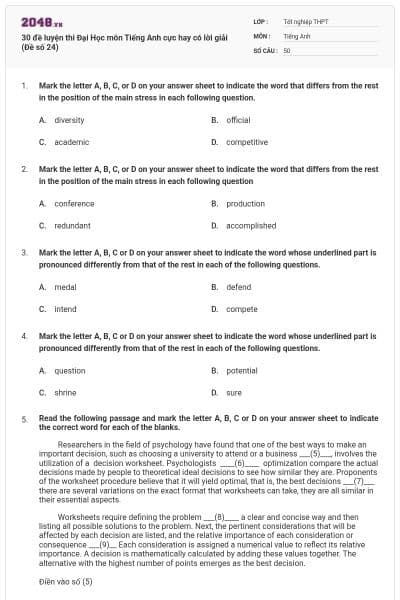
Mark the letter A, B, C, or D on your answer sheet to indicate the word that differs from the rest in the position of the main stress in each following question.
diversity
official
academic
competitive
Đáp án là C
Từ academic nhấn âm tiết thứ ba, các từ còn lại nhấn âm tiết thứ hai.
Mark the letter A, B, C, or D on your answer sheet to indicate the word that differs from the rest in the position of the main stress in each following question
conference
production
redundant
accomplished
Đáp án là A
Từ conference nhấn âm tiết thứ nhất, các từ còn lại nhấn âm tiết thứ hai.
Mark the letter A, B, C or D on your answer sheet to indicate the word whose underlined part is pronounced differently from that of the rest in each of the following questions.
medal
defend
intend
compete
Đáp án là D
compete có phần gạch chân phát âm là /i:/; các từ còn lại có phần gạch chân là /e/
Mark the letter A, B, C or D on your answer sheet to indicate the word whose underlined part is pronounced differently from that of the rest in each of the following questions.
question
potential
shrine
sure
Đáp án là A
Từ question có phần gạch chân phát âm là /t∫/; các từ còn lại có phần gạch chân là /∫/
Read the following passage and mark the letter A, B, C or D on your answer sheet to indicate the correct word for each of the blanks.
Researchers in the field of psychology have found that one of the best ways to make an important decision, such as choosing a university to attend or a business ___(5)___, involves the utilization of a decision worksheet. Psychologists ____(6)____ optimization compare the actual decisions made by people to theoretical ideal decisions to see how similar they are. Proponents of the worksheet procedure believe that it will yield optimal, that is, the best decisions ___(7)___ there are several variations on the exact format that worksheets can take, they are all similar in their essential aspects.
Worksheets require defining the problem ___(8)____ a clear and concise way and then listing all possible solutions to the problem. Next, the pertinent considerations that will be affected by each decision are listed, and the relative importance of each consideration or consequence ___(9)__ Each consideration is assigned a numerical value to reflect its relative importance. A decision is mathematically calculated by adding these values together. The alternative with the highest number of points emerges as the best decision.
Điền vào số (5)
to work
to work in
to invest in
to invest
Đáp án là C
invest in a business: đầu tư vào một ngành kinh doanh
Read the following passage and mark the letter A, B, C or D on your answer sheet to indicate the correct word for each of the blanks.
Researchers in the field of psychology have found that one of the best ways to make an important decision, such as choosing a university to attend or a business ___(5)___, involves the utilization of a decision worksheet. Psychologists ____(6)____ optimization compare the actual decisions made by people to theoretical ideal decisions to see how similar they are. Proponents of the worksheet procedure believe that it will yield optimal, that is, the best decisions ___(7)___ there are several variations on the exact format that worksheets can take, they are all similar in their essential aspects.
Worksheets require defining the problem ___(8)____ a clear and concise way and then listing all possible solutions to the problem. Next, the pertinent considerations that will be affected by each decision are listed, and the relative importance of each consideration or consequence ___(9)__ Each consideration is assigned a numerical value to reflect its relative importance. A decision is mathematically calculated by adding these values together. The alternative with the highest number of points emerges as the best decision.
Điền vào số (6)
whose study
who study
whose studying
who’s study
Đáp án là B
Thành phần chính trong câu này là : Psychologists - chủ ngữ; compare ... - động từ, mà “optimization - tối ưu hóa” là danh từ => Mệnh đề quan hệ thiếu cả S -V
Read the following passage and mark the letter A, B, C or D on your answer sheet to indicate the correct word for each of the blanks.
Researchers in the field of psychology have found that one of the best ways to make an important decision, such as choosing a university to attend or a business ___(5)___, involves the utilization of a decision worksheet. Psychologists ____(6)____ optimization compare the actual decisions made by people to theoretical ideal decisions to see how similar they are. Proponents of the worksheet procedure believe that it will yield optimal, that is, the best decisions ___(7)___ there are several variations on the exact format that worksheets can take, they are all similar in their essential aspects.
Worksheets require defining the problem ___(8)____ a clear and concise way and then listing all possible solutions to the problem. Next, the pertinent considerations that will be affected by each decision are listed, and the relative importance of each consideration or consequence ___(9)__ Each consideration is assigned a numerical value to reflect its relative importance. A decision is mathematically calculated by adding these values together. The alternative with the highest number of points emerges as the best decision.
Điền vào số (7)
Although
However
Therefore
Despite
Đáp án A
B và C loại, vì However và Therefore thường đứng đầu câu, trước dấu phẩy.
D loại vì Despite + N: mặc dù ...
Đáp án là A. Although + clause: mặc dù ...
Read the following passage and mark the letter A, B, C or D on your answer sheet to indicate the correct word for each of the blanks.
Researchers in the field of psychology have found that one of the best ways to make an important decision, such as choosing a university to attend or a business ___(5)___, involves the utilization of a decision worksheet. Psychologists ____(6)____ optimization compare the actual decisions made by people to theoretical ideal decisions to see how similar they are. Proponents of the worksheet procedure believe that it will yield optimal, that is, the best decisions ___(7)___ there are several variations on the exact format that worksheets can take, they are all similar in their essential aspects.
Worksheets require defining the problem ___(8)____ a clear and concise way and then listing all possible solutions to the problem. Next, the pertinent considerations that will be affected by each decision are listed, and the relative importance of each consideration or consequence ___(9)__ Each consideration is assigned a numerical value to reflect its relative importance. A decision is mathematically calculated by adding these values together. The alternative with the highest number of points emerges as the best decision.
Điền vào số (8)
on
in
at
under
Đáp án là B
in a clear and concise way (một cách rõ ràng và súc tích)
Read the following passage and mark the letter A, B, C or D on your answer sheet to indicate the correct word for each of the blanks.
Researchers in the field of psychology have found that one of the best ways to make an important decision, such as choosing a university to attend or a business ___(5)___, involves the utilization of a decision worksheet. Psychologists ____(6)____ optimization compare the actual decisions made by people to theoretical ideal decisions to see how similar they are. Proponents of the worksheet procedure believe that it will yield optimal, that is, the best decisions ___(7)___ there are several variations on the exact format that worksheets can take, they are all similar in their essential aspects.
Worksheets require defining the problem ___(8)____ a clear and concise way and then listing all possible solutions to the problem. Next, the pertinent considerations that will be affected by each decision are listed, and the relative importance of each consideration or consequence ___(9)__ Each consideration is assigned a numerical value to reflect its relative importance. A decision is mathematically calculated by adding these values together. The alternative with the highest number of points emerges as the best decision.
Điền vào số (9)
determined
are determined
is determined
be determined
Đáp án là C
Chủ ngữ là “the relative importance of each consideration or consequence” - số ít
Read the following passage and mark the letter A, B, C, or D on your answer sheet to indicate the correct answer to each of the following questions.
According to sociologists, there are several different ways in which a person may become recognized as the leader of a social group in the United States. In the family, traditional cultural patterns confer leadership on one or both of the parents. In other cases, such as friendship groups, one or more persons may gradually emerge as leaders, although there is no formal process of selection. In larger groups, leaders are usually chosen formally through election or recruitment.
Although leaders are often thought to be people with unusual personal ability, decades of research have failed to produce consistent evidence that there is any category of “natural leaders '" It seems that there is no set of personal qualities that all leaders have in common; rather, virtually any person may be recognized as a leader if the person has qualities that meet the needs of that particular group.
Furthermore, although it is commonly supposed that social groups have a single leader, research suggests that there are typically two different leadership roles that are held by different individuals. Instrumental leadership is leadership that emphasizes the completion of tasks by a social group. Group members look to instrumental leaders to “get things” done. Expressive leadership, on the other hand, is leadership that emphasizes the collective well-being of a social group’s member. Expressive leader are less concerned with the overall goals of the group than with providing emotional support to group members and attempting to minimize tension and conflict among them. Group members expect expressive leaders to maintain stable relationships within the group and provide support to individual members.
Instrumental leaders are likely to have a rather secondary relationship to other group members. They give orders and may discipline group members who inhibit attainment of the group’s goals. Expressive leaders cultivate a more personal or primary relationship to others in the group. They offer sympathy when someone experiences difficulties or is subjected to discipline, are quick to lighten a serious moment with humor, and try to resolve issues that threaten to divide the group. As the differences in these two roles suggest, expressive leaders generally receive more personal affection from group members; instrumental leaders, if they are successful in promoting group goals, may enjoy a mote distant respect.
What does the passage mainly discuss?
The role of leaders in social groups
How social groups determine who will lead them
How leadership differs in small and large groups
The problems faced by leaders
Đáp án là A
Từ role - vai trò, thường có ý bao quát nên ta chọn làm ý chính. Có thể dưa vào nội dung đoạn 1
để chọn đáp án này.
Read the following passage and mark the letter A, B, C, or D on your answer sheet to indicate the correct answer to each of the following questions.
According to sociologists, there are several different ways in which a person may become recognized as the leader of a social group in the United States. In the family, traditional cultural patterns confer leadership on one or both of the parents. In other cases, such as friendship groups, one or more persons may gradually emerge as leaders, although there is no formal process of selection. In larger groups, leaders are usually chosen formally through election or recruitment.
Although leaders are often thought to be people with unusual personal ability, decades of research have failed to produce consistent evidence that there is any category of “natural leaders '" It seems that there is no set of personal qualities that all leaders have in common; rather, virtually any person may be recognized as a leader if the person has qualities that meet the needs of that particular group.
Furthermore, although it is commonly supposed that social groups have a single leader, research suggests that there are typically two different leadership roles that are held by different individuals. Instrumental leadership is leadership that emphasizes the completion of tasks by a social group. Group members look to instrumental leaders to “get things” done. Expressive leadership, on the other hand, is leadership that emphasizes the collective well-being of a social group’s member. Expressive leader are less concerned with the overall goals of the group than with providing emotional support to group members and attempting to minimize tension and conflict among them. Group members expect expressive leaders to maintain stable relationships within the group and provide support to individual members.
Instrumental leaders are likely to have a rather secondary relationship to other group members. They give orders and may discipline group members who inhibit attainment of the group’s goals. Expressive leaders cultivate a more personal or primary relationship to others in the group. They offer sympathy when someone experiences difficulties or is subjected to discipline, are quick to lighten a serious moment with humor, and try to resolve issues that threaten to divide the group. As the differences in these two roles suggest, expressive leaders generally receive more personal affection from group members; instrumental leaders, if they are successful in promoting group goals, may enjoy a mote distant respect.
The passage mentions all of the following ways by which people can become leaders EXCEPT...
recruitment
traditional cultural patterns
formal election process
specific leadership training
Đáp án là D
Ý đoạn 1 có đề cập đến 3 đáp án còn lại: In t he family, traditional cultural patterns confer leadership on one or both of the parents. In other cases, such as friendship groups, one or more persons may gradually emerge as leaders, although there is no formal process of selection. In larger groups, leaders are usually chosen formally through election or recruitment.
Read the following passage and mark the letter A, B, C, or D on your answer sheet to indicate the correct answer to each of the following questions.
According to sociologists, there are several different ways in which a person may become recognized as the leader of a social group in the United States. In the family, traditional cultural patterns confer leadership on one or both of the parents. In other cases, such as friendship groups, one or more persons may gradually emerge as leaders, although there is no formal process of selection. In larger groups, leaders are usually chosen formally through election or recruitment.
Although leaders are often thought to be people with unusual personal ability, decades of research have failed to produce consistent evidence that there is any category of “natural leaders '" It seems that there is no set of personal qualities that all leaders have in common; rather, virtually any person may be recognized as a leader if the person has qualities that meet the needs of that particular group.
Furthermore, although it is commonly supposed that social groups have a single leader, research suggests that there are typically two different leadership roles that are held by different individuals. Instrumental leadership is leadership that emphasizes the completion of tasks by a social group. Group members look to instrumental leaders to “get things” done. Expressive leadership, on the other hand, is leadership that emphasizes the collective well-being of a social group’s member. Expressive leader are less concerned with the overall goals of the group than with providing emotional support to group members and attempting to minimize tension and conflict among them. Group members expect expressive leaders to maintain stable relationships within the group and provide support to individual members.
Instrumental leaders are likely to have a rather secondary relationship to other group members. They give orders and may discipline group members who inhibit attainment of the group’s goals. Expressive leaders cultivate a more personal or primary relationship to others in the group. They offer sympathy when someone experiences difficulties or is subjected to discipline, are quick to lighten a serious moment with humor, and try to resolve issues that threaten to divide the group. As the differences in these two roles suggest, expressive leaders generally receive more personal affection from group members; instrumental leaders, if they are successful in promoting group goals, may enjoy a mote distant respect.
In mentioning “natural leaders'’ in line 7, the author is making the point that ________ .
“natural leaders’ are easily accepted by the members of a social group
“natural leaders” share a similar set of characteristics
few people qualify as “natural leaders”
there is no proof that “natural leaders” exist
Đáp án là D
Ý trong bài: Although leaders are often thought to be people with unusual personal ability, decades of research have failed to produce consistent evidence that there is any category of “natural leaders.”
Read the following passage and mark the letter A, B, C, or D on your answer sheet to indicate the correct answer to each of the following questions.
According to sociologists, there are several different ways in which a person may become recognized as the leader of a social group in the United States. In the family, traditional cultural patterns confer leadership on one or both of the parents. In other cases, such as friendship groups, one or more persons may gradually emerge as leaders, although there is no formal process of selection. In larger groups, leaders are usually chosen formally through election or recruitment.
Although leaders are often thought to be people with unusual personal ability, decades of research have failed to produce consistent evidence that there is any category of “natural leaders '" It seems that there is no set of personal qualities that all leaders have in common; rather, virtually any person may be recognized as a leader if the person has qualities that meet the needs of that particular group.
Furthermore, although it is commonly supposed that social groups have a single leader, research suggests that there are typically two different leadership roles that are held by different individuals. Instrumental leadership is leadership that emphasizes the completion of tasks by a social group. Group members look to instrumental leaders to “get things” done. Expressive leadership, on the other hand, is leadership that emphasizes the collective well-being of a social group’s member. Expressive leader are less concerned with the overall goals of the group than with providing emotional support to group members and attempting to minimize tension and conflict among them. Group members expect expressive leaders to maintain stable relationships within the group and provide support to individual members.
Instrumental leaders are likely to have a rather secondary relationship to other group members. They give orders and may discipline group members who inhibit attainment of the group’s goals. Expressive leaders cultivate a more personal or primary relationship to others in the group. They offer sympathy when someone experiences difficulties or is subjected to discipline, are quick to lighten a serious moment with humor, and try to resolve issues that threaten to divide the group. As the differences in these two roles suggest, expressive leaders generally receive more personal affection from group members; instrumental leaders, if they are successful in promoting group goals, may enjoy a mote distant respect.
Which of the following statements about leadership can be inferred from paragraph 2?
A person who is an effective leader of a particular group may not be an effective leader in another group.
Few people succeed in sharing a leadership role with another person.
A person can best learn how to be an effective leader by studying research on leadership
Most people desire to be leaders but can produce little evidence of their qualifications.
Đáp án là A
Các manh mối sau giúp ta làm được câu này: It seems that there is no set of personal qualities that all leaders have in common; rather, virtually any person may be recognized as a leader if the person has qualities that meet the needs of that particular group.
no ...in common = không giống nhau còn particular = riêng biệt
Từ 2 ý đó ta suy ra là họ chỉ có thể làm tốt ở 1 nhóm nào đó thôi chứ không phải làm được hết mọi nhóm
Read the following passage and mark the letter A, B, C, or D on your answer sheet to indicate the correct answer to each of the following questions.
According to sociologists, there are several different ways in which a person may become recognized as the leader of a social group in the United States. In the family, traditional cultural patterns confer leadership on one or both of the parents. In other cases, such as friendship groups, one or more persons may gradually emerge as leaders, although there is no formal process of selection. In larger groups, leaders are usually chosen formally through election or recruitment.
Although leaders are often thought to be people with unusual personal ability, decades of research have failed to produce consistent evidence that there is any category of “natural leaders '" It seems that there is no set of personal qualities that all leaders have in common; rather, virtually any person may be recognized as a leader if the person has qualities that meet the needs of that particular group.
Furthermore, although it is commonly supposed that social groups have a single leader, research suggests that there are typically two different leadership roles that are held by different individuals. Instrumental leadership is leadership that emphasizes the completion of tasks by a social group. Group members look to instrumental leaders to “get things” done. Expressive leadership, on the other hand, is leadership that emphasizes the collective well-being of a social group’s member. Expressive leader are less concerned with the overall goals of the group than with providing emotional support to group members and attempting to minimize tension and conflict among them. Group members expect expressive leaders to maintain stable relationships within the group and provide support to individual members.
Instrumental leaders are likely to have a rather secondary relationship to other group members. They give orders and may discipline group members who inhibit attainment of the group’s goals. Expressive leaders cultivate a more personal or primary relationship to others in the group. They offer sympathy when someone experiences difficulties or is subjected to discipline, are quick to lighten a serious moment with humor, and try to resolve issues that threaten to divide the group. As the differences in these two roles suggest, expressive leaders generally receive more personal affection from group members; instrumental leaders, if they are successful in promoting group goals, may enjoy a mote distant respect.
The passage indicates that instrumental leaders generally focus on ________
achieving a goal
identifying new leaders
sharing responsibility with group members
ensuring harmonious relationship
Đáp án là A
Ý trong bài: Instrumental leadership is leadership that emphasizes the completion of tasks ( sự hoàn thành nhiệm vụ ) by a social group. => achieving a goal : đạt mục tiêu
Read the following passage and mark the letter A, B, C, or D on your answer sheet to indicate the correct answer to each of the following questions.
According to sociologists, there are several different ways in which a person may become recognized as the leader of a social group in the United States. In the family, traditional cultural patterns confer leadership on one or both of the parents. In other cases, such as friendship groups, one or more persons may gradually emerge as leaders, although there is no formal process of selection. In larger groups, leaders are usually chosen formally through election or recruitment.
Although leaders are often thought to be people with unusual personal ability, decades of research have failed to produce consistent evidence that there is any category of “natural leaders '" It seems that there is no set of personal qualities that all leaders have in common; rather, virtually any person may be recognized as a leader if the person has qualities that meet the needs of that particular group.
Furthermore, although it is commonly supposed that social groups have a single leader, research suggests that there are typically two different leadership roles that are held by different individuals. Instrumental leadership is leadership that emphasizes the completion of tasks by a social group. Group members look to instrumental leaders to “get things” done. Expressive leadership, on the other hand, is leadership that emphasizes the collective well-being of a social group’s member. Expressive leader are less concerned with the overall goals of the group than with providing emotional support to group members and attempting to minimize tension and conflict among them. Group members expect expressive leaders to maintain stable relationships within the group and provide support to individual members.
Instrumental leaders are likely to have a rather secondary relationship to other group members. They give orders and may discipline group members who inhibit attainment of the group’s goals. Expressive leaders cultivate a more personal or primary relationship to others in the group. They offer sympathy when someone experiences difficulties or is subjected to discipline, are quick to lighten a serious moment with humor, and try to resolve issues that threaten to divide the group. As the differences in these two roles suggest, expressive leaders generally receive more personal affection from group members; instrumental leaders, if they are successful in promoting group goals, may enjoy a mote distant respect.
The word “collective” in line 14 is closest in meaning to________
necessary
particular
typical
group
Đáp án là D
collective = group: tập hợp, nhóm
Các từ còn lại: necessary: cần thiết, particular : đặc biệt; typical: điển hình
Read the following passage and mark the letter A, B, C, or D on your answer sheet to indicate the correct answer to each of the following questions.
According to sociologists, there are several different ways in which a person may become recognized as the leader of a social group in the United States. In the family, traditional cultural patterns confer leadership on one or both of the parents. In other cases, such as friendship groups, one or more persons may gradually emerge as leaders, although there is no formal process of selection. In larger groups, leaders are usually chosen formally through election or recruitment.
Although leaders are often thought to be people with unusual personal ability, decades of research have failed to produce consistent evidence that there is any category of “natural leaders '" It seems that there is no set of personal qualities that all leaders have in common; rather, virtually any person may be recognized as a leader if the person has qualities that meet the needs of that particular group.
Furthermore, although it is commonly supposed that social groups have a single leader, research suggests that there are typically two different leadership roles that are held by different individuals. Instrumental leadership is leadership that emphasizes the completion of tasks by a social group. Group members look to instrumental leaders to “get things” done. Expressive leadership, on the other hand, is leadership that emphasizes the collective well-being of a social group’s member. Expressive leader are less concerned with the overall goals of the group than with providing emotional support to group members and attempting to minimize tension and conflict among them. Group members expect expressive leaders to maintain stable relationships within the group and provide support to individual members.
Instrumental leaders are likely to have a rather secondary relationship to other group members. They give orders and may discipline group members who inhibit attainment of the group’s goals. Expressive leaders cultivate a more personal or primary relationship to others in the group. They offer sympathy when someone experiences difficulties or is subjected to discipline, are quick to lighten a serious moment with humor, and try to resolve issues that threaten to divide the group. As the differences in these two roles suggest, expressive leaders generally receive more personal affection from group members; instrumental leaders, if they are successful in promoting group goals, may enjoy a mote distant respect.
The word “resolve” in line 22 is closest in meaning to________
find a solution for
avoid thinking about
talk about
avoid repeating
Đáp án là B
so sánh và tương phản.
Câu này chúng ta chú ý các liên từ " although" ( dù) , “on the other hand" ( mặt khác).... cho ta biết có sự so sánh đối chiếu.
Read the following passage and mark the letter A, B, C, or D on your answer sheet to indicate the correct answer to each of the following questions.
According to sociologists, there are several different ways in which a person may become recognized as the leader of a social group in the United States. In the family, traditional cultural patterns confer leadership on one or both of the parents. In other cases, such as friendship groups, one or more persons may gradually emerge as leaders, although there is no formal process of selection. In larger groups, leaders are usually chosen formally through election or recruitment.
Although leaders are often thought to be people with unusual personal ability, decades of research have failed to produce consistent evidence that there is any category of “natural leaders '" It seems that there is no set of personal qualities that all leaders have in common; rather, virtually any person may be recognized as a leader if the person has qualities that meet the needs of that particular group.
Furthermore, although it is commonly supposed that social groups have a single leader, research suggests that there are typically two different leadership roles that are held by different individuals. Instrumental leadership is leadership that emphasizes the completion of tasks by a social group. Group members look to instrumental leaders to “get things” done. Expressive leadership, on the other hand, is leadership that emphasizes the collective well-being of a social group’s member. Expressive leader are less concerned with the overall goals of the group than with providing emotional support to group members and attempting to minimize tension and conflict among them. Group members expect expressive leaders to maintain stable relationships within the group and provide support to individual members.
Instrumental leaders are likely to have a rather secondary relationship to other group members. They give orders and may discipline group members who inhibit attainment of the group’s goals. Expressive leaders cultivate a more personal or primary relationship to others in the group. They offer sympathy when someone experiences difficulties or is subjected to discipline, are quick to lighten a serious moment with humor, and try to resolve issues that threaten to divide the group. As the differences in these two roles suggest, expressive leaders generally receive more personal affection from group members; instrumental leaders, if they are successful in promoting group goals, may enjoy a mote distant respect.
It can be understood that________
Leaders are sometimes chosen formally or informally.
There is lots of tension and conflict in an election of a leader in the family.
There is usually an election to choose leaders in a family as well as in larger groups.
It has been said that there must be a set of personal qualities that all leaders have in common.
Đáp án là A
Ý trong bài: In other cases, such as friendship groups, one or more persons may gradually emerge as leaders, although there is no formal process of selection. => informally
In larger groups, leaders are usually chosen formally through election or recruitment.
Read the following passage and mark the letter A, B, C, or D on your answer sheet to indicate the correct answer to each of the following questions.
During the seventeenth and eighteenth centuries, almost nothing was written about the contributions of women during the colonial period and the early history of the newly formed United States. Lacking the right to vote and absence from the seats of power, women were not considered an important force in history. Anne Bradstreet wrote some significant poetry in the seventeenth century, Mercy Otis Warren produced the best contemporary history of the American Revolution, and Abigail Adams penned important letters showing she exercised great political influence over her husband, John, the second President of the United States. But little or no notice was taken of these contributions. During these centuries, women remained invisible in history books.
Throughout the nineteenth century, this lack of visibility continued, despite the efforts of female authors writing about women. These writers, like most of their male counterparts, were amateur historians. Their writings were celebratory in nature, and they were uncritical in their selection and use of sources.
During the nineteenth century, however, certain feminists showed a keen sense of history by keeping records of activities in which women were engaged. National, regional, and local women’s organizations compiled accounts of their doings. Personal correspondence, newspaper clippings, and souvenirs were saved and stored. These sources came from the core of the two greatest collections of women’s history in the United
States - one at the Elizabeth and Arthur Schlesinger Library at Radcliffe College, and the other the Sophia Smith Collection at Smith College. Such sources have provided valuable materials for later Generations of historians.
Despite the gathering of more information about ordinary women during the nineteenth century, most of the writing about women conformed to the “great women” theory of history, just as much of mainstream American history concentrated on “great men.” To demonstrate that women were making significant contributions to American life, female authors singled out women leaders and wrote biographies, or else important women produced their autobiographies. Most of these leaders were involved in public life as reformers, activists working for women’s right to vote, or authors, and were not representative at all of the great of ordinary woman. The lives of ordinary people continued, generally, to be untold in the American histories being published.
What does the passage mainly discuss?
The keen sense of history shown by American women
The “great women” approach to history used by American historians
The role of literature in early American histories
The place of American women in written histories
Đáp án là D
Vị trí, vai trò của người phụ nữ Mỹ trong lịch sử được viết lại.
Có thể dựa vào những ý đầu tiên trong bài: During the seventeenth and eighteenth centuries, almost nothing was written about the contributions of women during the colonial period and the early history of the newly formed United States. Lacking the right to vote and absence from the seats of power, women were not considered an important force in history.
Read the following passage and mark the letter A, B, C, or D on your answer sheet to indicate the correct answer to each of the following questions.
During the seventeenth and eighteenth centuries, almost nothing was written about the contributions of women during the colonial period and the early history of the newly formed United States. Lacking the right to vote and absence from the seats of power, women were not considered an important force in history. Anne Bradstreet wrote some significant poetry in the seventeenth century, Mercy Otis Warren produced the best contemporary history of the American Revolution, and Abigail Adams penned important letters showing she exercised great political influence over her husband, John, the second President of the United States. But little or no notice was taken of these contributions. During these centuries, women remained invisible in history books.
Throughout the nineteenth century, this lack of visibility continued, despite the efforts of female authors writing about women. These writers, like most of their male counterparts, were amateur historians. Their writings were celebratory in nature, and they were uncritical in their selection and use of sources.
During the nineteenth century, however, certain feminists showed a keen sense of history by keeping records of activities in which women were engaged. National, regional, and local women’s organizations compiled accounts of their doings. Personal correspondence, newspaper clippings, and souvenirs were saved and stored. These sources came from the core of the two greatest collections of women’s history in the United
States - one at the Elizabeth and Arthur Schlesinger Library at Radcliffe College, and the other the Sophia Smith Collection at Smith College. Such sources have provided valuable materials for later Generations of historians.
Despite the gathering of more information about ordinary women during the nineteenth century, most of the writing about women conformed to the “great women” theory of history, just as much of mainstream American history concentrated on “great men.” To demonstrate that women were making significant contributions to American life, female authors singled out women leaders and wrote biographies, or else important women produced their autobiographies. Most of these leaders were involved in public life as reformers, activists working for women’s right to vote, or authors, and were not representative at all of the great of ordinary woman. The lives of ordinary people continued, generally, to be untold in the American histories being published.
The word “contemporary” in line 5 means that the history was...
informative
written at that time
thoughtful
faultfinding
Đáp án là B
contemporary: đương thời = written at that time
Nghĩa các từ còn lại: informative: cung cấp nhiều tin tức; thoughtful: suy nghĩ chin chắn; faultfinding : sự bắt bẻ, chê trách
Read the following passage and mark the letter A, B, C, or D on your answer sheet to indicate the correct answer to each of the following questions.
During the seventeenth and eighteenth centuries, almost nothing was written about the contributions of women during the colonial period and the early history of the newly formed United States. Lacking the right to vote and absence from the seats of power, women were not considered an important force in history. Anne Bradstreet wrote some significant poetry in the seventeenth century, Mercy Otis Warren produced the best contemporary history of the American Revolution, and Abigail Adams penned important letters showing she exercised great political influence over her husband, John, the second President of the United States. But little or no notice was taken of these contributions. During these centuries, women remained invisible in history books.
Throughout the nineteenth century, this lack of visibility continued, despite the efforts of female authors writing about women. These writers, like most of their male counterparts, were amateur historians. Their writings were celebratory in nature, and they were uncritical in their selection and use of sources.
During the nineteenth century, however, certain feminists showed a keen sense of history by keeping records of activities in which women were engaged. National, regional, and local women’s organizations compiled accounts of their doings. Personal correspondence, newspaper clippings, and souvenirs were saved and stored. These sources came from the core of the two greatest collections of women’s history in the United
States - one at the Elizabeth and Arthur Schlesinger Library at Radcliffe College, and the other the Sophia Smith Collection at Smith College. Such sources have provided valuable materials for later Generations of historians.
Despite the gathering of more information about ordinary women during the nineteenth century, most of the writing about women conformed to the “great women” theory of history, just as much of mainstream American history concentrated on “great men.” To demonstrate that women were making significant contributions to American life, female authors singled out women leaders and wrote biographies, or else important women produced their autobiographies. Most of these leaders were involved in public life as reformers, activists working for women’s right to vote, or authors, and were not representative at all of the great of ordinary woman. The lives of ordinary people continued, generally, to be untold in the American histories being published.
In the first paragraph, Bradstreet, Warren, and Adams are mentioned to show that.
poetry produced by women was more readily accepted than other writing by women.
only three women were able to get their writing published
even the contributions of outstanding women were ignored
a woman’s status was changed by marriage.
Đáp án là C
Ý trong bài: . But little or no notice was taken of these contributions. During these
centuries, women remained invisible in history books.
Read the following passage and mark the letter A, B, C, or D on your answer sheet to indicate the correct answer to each of the following questions.
During the seventeenth and eighteenth centuries, almost nothing was written about the contributions of women during the colonial period and the early history of the newly formed United States. Lacking the right to vote and absence from the seats of power, women were not considered an important force in history. Anne Bradstreet wrote some significant poetry in the seventeenth century, Mercy Otis Warren produced the best contemporary history of the American Revolution, and Abigail Adams penned important letters showing she exercised great political influence over her husband, John, the second President of the United States. But little or no notice was taken of these contributions. During these centuries, women remained invisible in history books.
Throughout the nineteenth century, this lack of visibility continued, despite the efforts of female authors writing about women. These writers, like most of their male counterparts, were amateur historians. Their writings were celebratory in nature, and they were uncritical in their selection and use of sources.
During the nineteenth century, however, certain feminists showed a keen sense of history by keeping records of activities in which women were engaged. National, regional, and local women’s organizations compiled accounts of their doings. Personal correspondence, newspaper clippings, and souvenirs were saved and stored. These sources came from the core of the two greatest collections of women’s history in the United
States - one at the Elizabeth and Arthur Schlesinger Library at Radcliffe College, and the other the Sophia Smith Collection at Smith College. Such sources have provided valuable materials for later Generations of historians.
Despite the gathering of more information about ordinary women during the nineteenth century, most of the writing about women conformed to the “great women” theory of history, just as much of mainstream American history concentrated on “great men.” To demonstrate that women were making significant contributions to American life, female authors singled out women leaders and wrote biographies, or else important women produced their autobiographies. Most of these leaders were involved in public life as reformers, activists working for women’s right to vote, or authors, and were not representative at all of the great of ordinary woman. The lives of ordinary people continued, generally, to be untold in the American histories being published.
The word “celebratory” in line 11 means that the writings referred to were.
related to parties
full of praise
religious
serious
Đáp án là B
celebratory: tán tụng = full of praise : hết lời ca ngợi
Nghĩa các từ/cụm từ còn lại: related to parties: được liên quan đến Đảng phái; religious: thuộc tôn giáo; serious: nghiêm trọng
Read the following passage and mark the letter A, B, C, or D on your answer sheet to indicate the correct answer to each of the following questions.
During the seventeenth and eighteenth centuries, almost nothing was written about the contributions of women during the colonial period and the early history of the newly formed United States. Lacking the right to vote and absence from the seats of power, women were not considered an important force in history. Anne Bradstreet wrote some significant poetry in the seventeenth century, Mercy Otis Warren produced the best contemporary history of the American Revolution, and Abigail Adams penned important letters showing she exercised great political influence over her husband, John, the second President of the United States. But little or no notice was taken of these contributions. During these centuries, women remained invisible in history books.
Throughout the nineteenth century, this lack of visibility continued, despite the efforts of female authors writing about women. These writers, like most of their male counterparts, were amateur historians. Their writings were celebratory in nature, and they were uncritical in their selection and use of sources.
During the nineteenth century, however, certain feminists showed a keen sense of history by keeping records of activities in which women were engaged. National, regional, and local women’s organizations compiled accounts of their doings. Personal correspondence, newspaper clippings, and souvenirs were saved and stored. These sources came from the core of the two greatest collections of women’s history in the United
States - one at the Elizabeth and Arthur Schlesinger Library at Radcliffe College, and the other the Sophia Smith Collection at Smith College. Such sources have provided valuable materials for later Generations of historians.
Despite the gathering of more information about ordinary women during the nineteenth century, most of the writing about women conformed to the “great women” theory of history, just as much of mainstream American history concentrated on “great men.” To demonstrate that women were making significant contributions to American life, female authors singled out women leaders and wrote biographies, or else important women produced their autobiographies. Most of these leaders were involved in public life as reformers, activists working for women’s right to vote, or authors, and were not representative at all of the great of ordinary woman. The lives of ordinary people continued, generally, to be untold in the American histories being published.
In the second paragraph, what weakness in nineteenth-century histories does the author point out?
They put too much emphasis on daily activities
They left out discussion of the influence of money on politics.
The sources of the information they were based on were not necessarily accurate.
They were printed on poor-quality paper.
Đáp án là C
The sources of the information they were based on were not necessarily accurate. (Các nguồn thông tin mà họ đã dựa trên là không chính xác. ) , Dựa vào ý: These writers, like most of their male counterparts, were amateur historians. Their writings were celebratory in nature, and they were uncritical in their selection and use of sources. (Những nhà văn, giống như hầu hết nam giới, là nhà sử học nghiệp dư. Các tác phẩm của họ đã được ăn mừng một cách tự nhiên, và họ đã thiếu phê phán trong việc lựa chọn và sử dụng các nguồn .)
Read the following passage and mark the letter A, B, C, or D on your answer sheet to indicate the correct answer to each of the following questions.
During the seventeenth and eighteenth centuries, almost nothing was written about the contributions of women during the colonial period and the early history of the newly formed United States. Lacking the right to vote and absence from the seats of power, women were not considered an important force in history. Anne Bradstreet wrote some significant poetry in the seventeenth century, Mercy Otis Warren produced the best contemporary history of the American Revolution, and Abigail Adams penned important letters showing she exercised great political influence over her husband, John, the second President of the United States. But little or no notice was taken of these contributions. During these centuries, women remained invisible in history books.
Throughout the nineteenth century, this lack of visibility continued, despite the efforts of female authors writing about women. These writers, like most of their male counterparts, were amateur historians. Their writings were celebratory in nature, and they were uncritical in their selection and use of sources.
During the nineteenth century, however, certain feminists showed a keen sense of history by keeping records of activities in which women were engaged. National, regional, and local women’s organizations compiled accounts of their doings. Personal correspondence, newspaper clippings, and souvenirs were saved and stored. These sources came from the core of the two greatest collections of women’s history in the United
States - one at the Elizabeth and Arthur Schlesinger Library at Radcliffe College, and the other the Sophia Smith Collection at Smith College. Such sources have provided valuable materials for later Generations of historians.
Despite the gathering of more information about ordinary women during the nineteenth century, most of the writing about women conformed to the “great women” theory of history, just as much of mainstream American history concentrated on “great men.” To demonstrate that women were making significant contributions to American life, female authors singled out women leaders and wrote biographies, or else important women produced their autobiographies. Most of these leaders were involved in public life as reformers, activists working for women’s right to vote, or authors, and were not representative at all of the great of ordinary woman. The lives of ordinary people continued, generally, to be untold in the American histories being published.
In the last paragraph, the author mentions all of the following as possible roles of nineteenth- century “great women” EXCEPT
activists for women’s rights
politicians
authors
reformers
Đáp án là B
politicians: các chính trị gia. Dựa vào ý: Most of these leaders were involved in public life as reformers, activists working for women’s right to vote, or authors, and were not_representative at all of the great of ordinary woman.
Read the following passage and mark the letter A, B, C, or D on your answer sheet to indicate the correct answer to each of the following questions.
During the seventeenth and eighteenth centuries, almost nothing was written about the contributions of women during the colonial period and the early history of the newly formed United States. Lacking the right to vote and absence from the seats of power, women were not considered an important force in history. Anne Bradstreet wrote some significant poetry in the seventeenth century, Mercy Otis Warren produced the best contemporary history of the American Revolution, and Abigail Adams penned important letters showing she exercised great political influence over her husband, John, the second President of the United States. But little or no notice was taken of these contributions. During these centuries, women remained invisible in history books.
Throughout the nineteenth century, this lack of visibility continued, despite the efforts of female authors writing about women. These writers, like most of their male counterparts, were amateur historians. Their writings were celebratory in nature, and they were uncritical in their selection and use of sources.
During the nineteenth century, however, certain feminists showed a keen sense of history by keeping records of activities in which women were engaged. National, regional, and local women’s organizations compiled accounts of their doings. Personal correspondence, newspaper clippings, and souvenirs were saved and stored. These sources came from the core of the two greatest collections of women’s history in the United
States - one at the Elizabeth and Arthur Schlesinger Library at Radcliffe College, and the other the Sophia Smith Collection at Smith College. Such sources have provided valuable materials for later Generations of historians.
Despite the gathering of more information about ordinary women during the nineteenth century, most of the writing about women conformed to the “great women” theory of history, just as much of mainstream American history concentrated on “great men.” To demonstrate that women were making significant contributions to American life, female authors singled out women leaders and wrote biographies, or else important women produced their autobiographies. Most of these leaders were involved in public life as reformers, activists working for women’s right to vote, or authors, and were not representative at all of the great of ordinary woman. The lives of ordinary people continued, generally, to be untold in the American histories being published.
What use was made of the nineteenth-century women’s history materials in the Schlesinger Library and the Sophia Smith Collection?
They were combined and published in a multivolume encyclopedia
They were shared among women’s colleges throughout the United States.
They formed the basis of college courses in the nineteenth century.
They provided valuable information for twentieth-century historical researchers.
Đáp án là D
Ý trong bài : one at the Elizabeth and Arthur Schlesinger Library at Radcliffe College, and
the other the Sophia Smith Collection at Smith College. Such sources have provided valuable materials for later Generations of historians. (.... Những nguồn này đã cung cấp tài liệu có giá trị cho thế hệ sau này của các nhà sử học. ) => later Generations of historians - Thế hệ sau này của các nhà sử học , có thể nói là thế hệ các nhà nghiên cứu sử học trong thế kỷ 20
Mark the letter A, B, C or D on your answer sheet to indicate the word(s) CLOSEST in meaning to the underlined word(s) in each of the following questions
Scientists and engineers have invented filters and other methods of removing pollutants from industrial wastes.
making over
making out
taking away
taking over
Đáp án là C
removing = take away: vứt đi, lấy đi
Nghĩa các từ khác: take over : đưa, dẫn qua .. ( sông.. ); make over: chuyển nhượng; make out: lập lên
Mark the letter A, B, C or D on your answer sheet to indicate the word(s) CLOSEST in meaning to the underlined word(s) in each of the following questions
She’s very good at taking care of the others.
imitating
seeing
looking after
improving
Đáp án là C
take care of = look after : chăm sóc, trông nom....
Mark the letter A, B, C or D on your answer sheet to indicate the word(s) OPPOSITE in meaning to the underlined word(s) in each of the following questions
Beacause Jack defaulted on his loan, the bank took him to court
fail to pay
paid in full
had a bad personality
was paid much money
Đáp án là B
paid in full: trả đầy đủ
Mark the letter A, B, C or D on your answer sheet to indicate the word(s) OPPOSITE in meaning to the underlined word(s) in each of the following questions
Ha Long Bay is well-known for its beauty. That’s why it receives many visitors every year.
nationwide
famous
unfamiliar
ideal
Đáp án là C
unfamiliar: không nổi tiếng
Mark the letter A, B, C, or D on your answer sheet to indicate the sentence which is closest in meaning to the original one.
Smith’s career as a television presenter began five years ago.
Smith has been a television presenter five years ago.
Smith used to be a television presenter five years ago.
Smith had been a television presenter for five years.
Smith has been a television presenter for five years.
Đáp án là D
Smith has been a television presenter for five years. Smith là một người dẫn chương trình truyền hình được năm năm rồi.
1. Câu gốc: Smith’s career as a television presenter began five years ago. - Sự nghiệp của Smith là một người dẫn chương trình truyền hình bắt đầu cách đây năm năm.
A loại vì sai về mặt ngữ pháp, “five years ago” câu không thể chia ở thì hiện tại hoàn thành.
B loại vì cấu trúc “ used to V” diễn tả hành động đã từng làm trong quá khứ, hiện tại không còn làm nữa.
C loại vì câu này dùng sai thì, quá khứ hoàn thành, diễn tả hành động đã xảy ra và hoàn thành trước một hành động trong quá khứ.
Mark the letter A, B, C, or D on your answer sheet to indicate the sentence which is closest in meaning to the original one.
“That’s a lovely new dress, Jean,” said her mother.
Jean’s mother said she like her dress.
Jean’s mother wanted to buy a lovely new dress.
Jean’s mother complimented her on the lovely new dress.
Jean’s mother told her to buy that lovely new dress.
Đáp án là C
compliment somebody on something: khen ngợi ai về cái gì
Câu gốc: That’s a lovely new dress, Jean - Đó là một mới váy xinh xắn, Jean => lời khen.
Mark the letter A, B, C, or D on your answer sheet to indicate the sentence which is closest in meaning to the original one.
“You should have finished the report by now”, John told his secretary
John scolded his secretary for not having finished the repor
John said that his secretary had not finished the report on time.
John reproached his secretary for not having finished the report.
John reminded his secretary of finishing the report on time.
Đáp án là C
reproach someone for (not ) doing something: quở trách ai về …
Mark the letter A, B, C, or D on your answer sheet to indicate the sentence which is closest in meaning to the original one.
Much to my astonishment, I found his lecture on wildlife conservation extremely interesting.
Contrary to expectations, his lecture on wildlife conservation was the most fascinating of all.
I was fascinated by what he said in his lecture on wildlife conservation though I hadn’t expected to be.
It was at his lecture on wildlife conservation that I realized I needed to study it.
I hadn’t expected him to lecture on wild life conservation, but he spoke well.
Đáp án là B
Nghĩa câu gốc: Với rất nhiều sự ngạc nhiên , tôi thấy bài giảng của anh ta về bảo tồn động vật hoang dã vô cùng thú vị.
Xét về nghĩa, ta thấy đáp án đúng là B. Tôi bị mê hoặc bởi những gì anh ta nói trong bài giảng của mình về bả o tồn động vật hoang dã mặc dù tôi đã không mong đợi để được.
Mark the letter A, B, C, or D on your answer sheet to indicate the sentence which is closest in meaning to the original one.
We stayed in that hotel despite the noise.
No matter how noisy the hotel was, we stayed there.
Because of the noise, we stayed in the hotel.
Despite the hotel was noisy, we stayed there.
We stayed in the noisy hotel and we liked it.
Đáp án: A
Giải thích:
Câu gốc: Chúng tôi vẫn ở khách sạn đó mặc dù rất ồn ào.
despite + N/V-ing: mặc dù
no matter how + adj/adv + S + V: dù cho…
because + N/V-ing: vì
Loại C vì sai ngữ pháp
Xét các đáp án còn lại:
A. Bất kể khách sạn có ồn ào thế nào, chúng tôi vẫn ở đó.
B. Vì tiếng ồn, chúng tôi vẫn ở trong khách sạn.
D. Chúng tôi ở trong khách sạn ồn ào và chúng tôi thích điều đó.
Đáp án A phù hợp về nghĩa.
Mark the letter A, B, C or D on your answer sheet to show the underlined parts that ne correcting:
(A) It’s imperative that a graduate (B) maintains a grade point average (C) of “B” in (D) his majo
It's
maintains
of
his
Đáp án: B
Kiến thức: Bàng thái cách
Với các tính từ chỉ sự quan trọng, cấp thiết, ta dùng bàng thái cách:
It + be + adj (imperative/important/vital/necessary…) + that + S + (should) V
Động từ V không chia với mọi thì và chủ ngữ.
Sửa: maintains → maintain
Dịch: Điều bắt buộc là sinh viên tốt nghiệp phải duy trì điểm trung bình môn học là “B” trong chuyên ngành của mình.
Mark the letter A, B, C or D on your answer sheet to show the underlined parts that ne correcting:
(A) The more I got (B) to know Tom, (C) the fewer I liked (D) him
The more
to know
the fewer
him
Đáp án là C
the fewer => the less
Mark the letter A, B, C or D on your answer sheet to show the underlined parts that ne correcting:
Foreign students who (A) are doing a decision (B) about which school (C) to attend may not know exactly where (D) the choices are located.
are doing
about which
to attend
the choices
Đáp án là A
are doing => are making. Cấu trúc: make a decision: đưa ra quyết định VII/
He’s got________.
a lot of luggages
much luggage
many luggages
a great number of luggage
Đáp án là B
Luggage ( hành lý ) : là danh từ không đếm được => A và C là loại . B loại vì, vì a great number of + Ns.
I have lived near the airport for so long now that I’ve grown ______ to the noise of the airplanes
unconscious
aware
accustomed
familiar
Đáp án là C
accustomed to: quen với
Nghĩa câu: Tôi đã từng sống ở gần sân bay quá lâu rồi đến nỗi tôi đã trở nên quen với tiếng ồn từ máy bay.
He couldn’t afford to________his car repaired.
pay
get
do
make
Đáp án là B
Cấu trúc bị động “ nhờ ai đó làm gì” : get + something + done (+ by someone)
_______ a lack of fund, the university library will now close at 9 instead of at 11.
Thanks to
By means of
According to
On account of
Đáp án là D
On account of : do, vì lý do ....
Nghĩa câu: Vì thiếu quỹ, thư viện trường đại học bây giờ sẽ đóng lúc 9giờ thay vì 11 giờ.
Nghĩa các từ khác: Thanks to : nhờ vào; According to: theo ... ; By means of : bằng phương pháp ...
I am not used to________early in the morning.
getting up
get up
got up
have got ups
Đáp án là A
Cấu trúc: be used to V-ing: quen với ....
The teacher as well as the students really ________ the idea of a quiz.
liking
likes
like
are liking
Đáp án là B
Cấu trúc : S1, as well as + S2, + VS1 : Với câu có cấu trúc “as well as - cũng như là”, ta sẽ chia theo chủ ngữ trước nó.
Human beings have driven rare animals and plants ________ of extinction in the past 100 years
on the verge
under the verge
at the verge
to the verge
Đáp án là D
drive someone/something to the verge of .... : lái ai/ cái gì đến bờ vực của ....
I tried to________them from going, but they wouldn’t take any notice.
refuse
warn
prevent
forbid
Đáp án là C
Cấu trúc: prevent someone from doing something: ngăn cản ai làm gì
You can stay here _____ you don’t make a loud noise
as long as
unless
until
otherwise
Đáp án là A
as long as = if.
Nghĩa câu: Bạn có thể ở lại đây nếu bạn không làm ồn.
Các liên từ còn lại: unless : nếu không; until: cho đến khi; otherwise: kẻo
I don’t know what to do with my old typewriter, but ________ away seems wasteful.
throw
throw it
thrown
throwing it
Đáp án là D
Ta thấy câu có động từ chia ở dạng số ít “seems” => câu thiếu thành phần chủ ngữ. V-ing là danh động từ, đóng vai trò như một danh từ, có thể làm chủ ngữ.
He________having sent the anonymous letter
opposed
refused
accepted
denied
Đáp án là D
deny + having done: chối đã làm gì
Các dùng các từ khác: oppose + N: phản đối; refuse + to V: từ chối; accept+ N: chấp nhận
Smoke, dirt and noise are all kinds of ________.
preservation
conservation
erosion
pollution
Đáp án là D
kinds of pollution: những loại gây ô nhiễm.
Các từ còn lại: preservation = conservation: sự bảo tồn; erosion: xói mòn
Mark tried to solve the problem ________ the noise and interruptions.
because of
in spite of
according to
in case of
Đáp án là B
in spite of + N: mặc dù ( chỉ sự tương phản )
Các dùng các liên từ còn lại: because of + N: vì ... ( chỉ lý do ); according to + N: theo ... ( chỉ sự trích dẫn); in case of: trong trường hợp ...
We________for this opportunity for more than three years.
are waiting
were waiting
have been waiting
waited
Đáp án là C
for + khoảng thời gian => câu sẽ chia ở thì hiện tại hoàn thành hoặc thì hiện tại hoàn thành tiếp diễn ( nếu muốn nhấn mạnh hành động đó vẫn đang xảy ra.)