30 đề luyện thi Đại Học môn Tiếng Anh cực hay có lời giải (Đề số 23)
50 câu hỏi
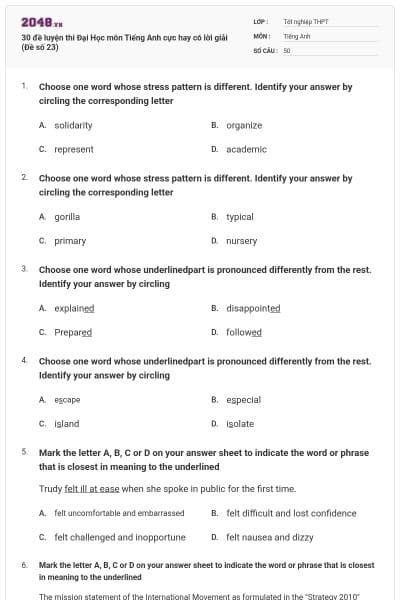
Choose one word whose stress pattern is different. Identify your answer by circling the corresponding letter
solidarity
organize
represent
academic
Đáp án là B
organize nhấn âm tiết thứ nhất, các từ còn lại nhấn âm tiết thứ ba.
Choose one word whose stress pattern is different. Identify your answer by circling the corresponding letter
gorilla
typical
primary
nursery
Đáp án là A
gorilla nhấn âm tiết thứ hai, các từ còn lại nhấn âm tiết thứ nhất.
Choose one word whose underlinedpart is pronounced differently from the rest. Identify your answer by circling
explained
disappointed
Prepared
followed
Đáp án là B
Từ disappointed có phần gạch chân được phát âm là /id/, các từ còn lại có phần gạch chân được phát âm là /d/
Choose one word whose underlinedpart is pronounced differently from the rest. Identify your answer by circling
escape
especial
island
isolate
Đáp án là B
Từ island_ có phần gạch chân không được phát âm , các từ còn lại có phần gạch chân được phát âm là /s/
Mark the letter A, B, C or D on your answer sheet to indicate the word or phrase that is closest in meaning to the underlined
Trudy felt ill at ease when she spoke in public for the first time.
felt uncomfortable and embarrassed
felt difficult and lost confidence
felt challenged and inopportune
felt nausea and dizzy
Đáp án là A
ill at ease: không thoải mái
felt uncomfortable and embarrassed - cảm thấy không thoải mái và ngượng
Mark the letter A, B, C or D on your answer sheet to indicate the word or phrase that is closest in meaning to the underlined
The mission statement of the International Movement as formulated in the "Strategy 2010" document of the Federation is to improve the lives of vulnerable people by mobilizing the power of humanity.
weak and unprotected
poor and disabled
deaf and mute
wealthy and famous
Đáp án: A
Giải thích:
Kiến thức: Từ vựng
vulnerable (adj): dễ tổn thương
Xét các đáp án:
A. weak and unprotected: yếu và không được bảo vệ
B. poor and disabled: nghèo và tàn tật
C. deaf and mute: điếc và câm
D. wealthy and famous: giàu có và nổi tiếng
Dựa vào nghĩa, chọn A.
Dịch: Tuyên bố sứ mệnh của Phong trào Quốc tế được nêu trong tài liệu "Chiến lược 2010" của Liên bang là cải thiện cuộc sống của những người dễ bị tổn thương bằng cách huy động sức mạnh của nhân loại.
Mark the letter A, B, C, or D on your answer sheet to show the underlinedpart that needs correction.
Although fewer Americans work on farms today, they are too productive that the U.S is now the world’s top food exporter.
Although
fewer
too
top
Đáp án là C
too => so
Mark the letter A, B, C, or D on your answer sheet to indicate the word that is OPPOSITE in meaning to the underlinedpart in each of the following questions.
I find it hard to work at home because there are too many distractions.
attentions
unawareness
unconcern
carelessness
Đáp án A
Distraction: sự đãng trí; điều xao lãng >< attention: sự tập trung
Các từ còn lại: unawareness: sự không ý thức; carelessness: sự bất cẩn; unconcern: sự vô tâm
Mark the letter A, B, C, or D on your answer sheet to indicate the word that is OPPOSITE in meaning to the underlinedpart in each of the following questions.
In the first two decades of its existence, the cinema developed rapidly.
shortly
sluggishly
leisurely
weakly
Đáp án B
rapidly: một cách nhanh chóng >< sluggishly: một cách chậm chạp Các từ còn lại: shortly: ngắn; leisurely: một cách thong thả; weakly: một cách yếu ớt
Mark the letter A, B, C, or D on your answer sheet to show the underlinedpart that needs correction.
Alike other forms of energy, natural gas may be used to heat homes, cook food, and even run automobiles.
may be used
Alike
run
to heat
Đáp án là B
Alike => Like
Mark the letter A, B, C, or D on your answer sheet to show the underlinedpart that needs correction.
The Federal Trade Commission, establishing in 1914, steadily increased the extent and nature of its regulation of the advertising industry.
advertising
nature
establishing
Steadilyincreased
Đáp án là C
establishing => established
Read the following passage and decide which answer bestfits each gap. Write your answer in the numbered box.
Voluntary work is work that you do not get paid for and usually involves in doing things to help other people, especially the elderly or the sick. or working on (12)__________of a charity or similar organization. Most charitable organizations rely on unpaid volunteers, and thousands of Americans and British people give many hours of their time to doing some form of social work or organizing - fund raising events to support the work. Volunteering is especially popular in the US and the reasons this may be found in (13)__________American values such as the Protestant work ethic, the idea that work improves the person whodoes it, and the belief that people can change their (14)__________if they try hard enough.
In the US young people over 18 can take part in AmeriCorps, a government programme that (15)__________them to work as volunteers for a period of time, with the (26)__________of help in paying for their education later. Older Americans who do not work may spend much of their free time volunteering.
Điền vào số (12)
behalf
basic
account
ground
Đáp án là A
on behalf of : đại diện cho....
Read the following passage and decide which answer bestfits each gap. Write your answer in the numbered box.
Voluntary work is work that you do not get paid for and usually involves in doing things to help other people, especially the elderly or the sick. or working on (12)__________of a charity or similar organization. Most charitable organizations rely on unpaid volunteers, and thousands of Americans and British people give many hours of their time to doing some form of social work or organizing - fund raising events to support the work. Volunteering is especially popular in the US and the reasons this may be found in (13)__________American values such as the Protestant work ethic, the idea that work improves the person whodoes it, and the belief that people can change their (14)__________if they try hard enough.
In the US young people over 18 can take part in AmeriCorps, a government programme that (15)__________them to work as volunteers for a period of time, with the (26)__________of help in paying for their education later. Older Americans who do not work may spend much of their free time volunteering.
Điền vào số (13)
basic
primary
top
essential
Đáp án là A
basic American values: giá trị nền tảng của Mỹ.
Các từ còn lại: primary: chính; top: chóp, đỉnh; essential: cần thiết, quan trọng
Read the following passage and decide which answer bestfits each gap. Write your answer in the numbered box.
Voluntary work is work that you do not get paid for and usually involves in doing things to help other people, especially the elderly or the sick. or working on (12)__________of a charity or similar organization. Most charitable organizations rely on unpaid volunteers, and thousands of Americans and British people give many hours of their time to doing some form of social work or organizing - fund raising events to support the work. Volunteering is especially popular in the US and the reasons this may be found in (13)__________American values such as the Protestant work ethic, the idea that work improves the person whodoes it, and the belief that people can change their (14)__________if they try hard enough.
In the US young people over 18 can take part in AmeriCorps, a government programme that (15)__________them to work as volunteers for a period of time, with the (26)__________of help in paying for their education later. Older Americans who do not work may spend much of their free time volunteering.
Điền vào số (14)
standard
nature
condition
appearance
Đáp án là C
condition : điều kiện
Các từ còn lại : standard: tiêu chuẩn ; nature : bản chất ; appearance : vẻ bề ngoài
Read the following passage and decide which answer bestfits each gap. Write your answer in the numbered box.
Voluntary work is work that you do not get paid for and usually involves in doing things to help other people, especially the elderly or the sick. or working on (12)__________of a charity or similar organization. Most charitable organizations rely on unpaid volunteers, and thousands of Americans and British people give many hours of their time to doing some form of social work or organizing - fund raising events to support the work. Volunteering is especially popular in the US and the reasons this may be found in (13)__________American values such as the Protestant work ethic, the idea that work improves the person whodoes it, and the belief that people can change their (14)__________if they try hard enough.
In the US young people over 18 can take part in AmeriCorps, a government programme that (15)__________them to work as volunteers for a period of time, with the (26)__________of help in paying for their education later. Older Americans who do not work may spend much of their free time volunteering.
Điền vào số (15)
commissions
guides
encourages
engages
Đáp án là C
encourages someone to do something :khuyến khích ai đó làm gì Các từ còn lại: commission: ủy thác, ủy nhiệm; guide : hướng dẫn ; engage: thuê
Read the following passage and decide which answer bestfits each gap. Write your answer in the numbered box.
Voluntary work is work that you do not get paid for and usually involves in doing things to help other people, especially the elderly or the sick. or working on (12)__________of a charity or similar organization. Most charitable organizations rely on unpaid volunteers, and thousands of Americans and British people give many hours of their time to doing some form of social work or organizing - fund raising events to support the work. Volunteering is especially popular in the US and the reasons this may be found in (13)__________American values such as the Protestant work ethic, the idea that work improves the person whodoes it, and the belief that people can change their (14)__________if they try hard enough.
In the US young people over 18 can take part in AmeriCorps, a government programme that (15)__________them to work as volunteers for a period of time, with the (26)__________of help in paying for their education later. Older Americans who do not work may spend much of their free time volunteering.
Điền vào số (16)
function
reply
favour
promise
Đáp án là D
promise : lời hứa
Các từ còn lại : function: chức năng; reply: sự trả lời; favour: sự ủng hộ
Read the following passage and mark the letter A, B, C or D on your answer sheet to indicate the correct answer to each of the following questions
Ethology is concerned with the study of adaptive, or survival, value of behavior and its Evolutionary history. Ethological theory began to be applied to research on children in the1960’s but has become even more influential today. The origins of ethology can be traced to the work of Darwin. Its modern foundations were laid by two European zoologists, Konrad Lorenz and Niko Tinbergen.
Watching the behaviors diverse animal species in their natural habitats, Lorenz, and Tinbergen observed behavior patterns that promote survival. The most well-known of these is imprinting, the early following behavior of certain baby birds that ensures that the young will stay close to their mother and be fed and protected from danger. Imprinting takes place during an early, restricted time period of development. If the mother goose is not present during this time, but an object resembling her in important features is, young goslings may imprint on it instead . Observations of imprinting led to major concept that has been applied in child Development” the critical period . It refers to a limited times span during which the child is biologically prepared to acquire certain adaptive behaviors but needs the support of suitably stimulating environment. Many researchers have conducted studies to find out whether complex cognitive and social behaviors must be learned during restricted time periods. for example, if children are deprived of adequate food or physical and social stimulation during the early years of life, will their intelligence be permanently impaired? If language is not mastered during the preschool years, is the child’s capacity to acquire it reduced?
Inspired by observations of imprinting, in 1969 the British psychoanalyst John Bowlby applied ethological theory to the understanding of the relationship between an infant and its parents. He argued that attachment behaviors of babies, such as smiling, babbling, grasping, and crying, are built-in social signals that encourage the parents to approach, care for, and interact with the baby. By keeping a parent near, these behaviors help ensure that the baby will be fed, protected from danger, and provided with the stimulation and affection necessary for healthy growth. The development of attachment in human infants is a lengthy process involving changes in psychological structures that lead to a deep affectional tie between parent and baby.
What was Darwin’s contribution to ethology?
Darwin was the first person to apply ethological theory to children.
Darwin’s work provided the basis for ethology.
Darwin was the professor who taught Lorenz and Tinbergen.
Darwin improved on the original principles of ethology.
Đáp án là B
Dựa vào đoạn 1: .. The origins of ethology can be traced to the work of Darwin.
Read the following passage and mark the letter A, B, C or D on your answer sheet to indicate the correct answer to each of the following questions
Ethology is concerned with the study of adaptive, or survival, value of behavior and its Evolutionary history. Ethological theory began to be applied to research on children in the1960’s but has become even more influential today. The origins of ethology can be traced to the work of Darwin. Its modern foundations were laid by two European zoologists, Konrad Lorenz and Niko Tinbergen.
Watching the behaviors diverse animal species in their natural habitats, Lorenz, and Tinbergen observed behavior patterns that promote survival. The most well-known of these is imprinting, the early following behavior of certain baby birds that ensures that the young will stay close to their mother and be fed and protected from danger. Imprinting takes place during an early, restricted time period of development. If the mother goose is not present during this time, but an object resembling her in important features is, young goslings may imprint on it instead . Observations of imprinting led to major concept that has been applied in child Development” the critical period . It refers to a limited times span during which the child is biologically prepared to acquire certain adaptive behaviors but needs the support of suitably stimulating environment. Many researchers have conducted studies to find out whether complex cognitive and social behaviors must be learned during restricted time periods. for example, if children are deprived of adequate food or physical and social stimulation during the early years of life, will their intelligence be permanently impaired? If language is not mastered during the preschool years, is the child’s capacity to acquire it reduced?
Inspired by observations of imprinting, in 1969 the British psychoanalyst John Bowlby applied ethological theory to the understanding of the relationship between an infant and its parents. He argued that attachment behaviors of babies, such as smiling, babbling, grasping, and crying, are built-in social signals that encourage the parents to approach, care for, and interact with the baby. By keeping a parent near, these behaviors help ensure that the baby will be fed, protected from danger, and provided with the stimulation and affection necessary for healthy growth. The development of attachment in human infants is a lengthy process involving changes in psychological structures that lead to a deep affectional tie between parent and baby.
The word “ensures” is closest in meaning to
assumes
guarantees
proves
teaches
Đáp án là B
ensure = guarantee: chắc chắn, đảm bảo
Các từ còn lại: assume: giả định; prove:chứng minh; teach: dạy
Read the following passage and mark the letter A, B, C or D on your answer sheet to indicate the correct answer to each of the following questions
Ethology is concerned with the study of adaptive, or survival, value of behavior and its Evolutionary history. Ethological theory began to be applied to research on children in the1960’s but has become even more influential today. The origins of ethology can be traced to the work of Darwin. Its modern foundations were laid by two European zoologists, Konrad Lorenz and Niko Tinbergen.
Watching the behaviors diverse animal species in their natural habitats, Lorenz, and Tinbergen observed behavior patterns that promote survival. The most well-known of these is imprinting, the early following behavior of certain baby birds that ensures that the young will stay close to their mother and be fed and protected from danger. Imprinting takes place during an early, restricted time period of development. If the mother goose is not present during this time, but an object resembling her in important features is, young goslings may imprint on it instead . Observations of imprinting led to major concept that has been applied in child Development” the critical period . It refers to a limited times span during which the child is biologically prepared to acquire certain adaptive behaviors but needs the support of suitably stimulating environment. Many researchers have conducted studies to find out whether complex cognitive and social behaviors must be learned during restricted time periods. for example, if children are deprived of adequate food or physical and social stimulation during the early years of life, will their intelligence be permanently impaired? If language is not mastered during the preschool years, is the child’s capacity to acquire it reduced?
Inspired by observations of imprinting, in 1969 the British psychoanalyst John Bowlby applied ethological theory to the understanding of the relationship between an infant and its parents. He argued that attachment behaviors of babies, such as smiling, babbling, grasping, and crying, are built-in social signals that encourage the parents to approach, care for, and interact with the baby. By keeping a parent near, these behaviors help ensure that the baby will be fed, protected from danger, and provided with the stimulation and affection necessary for healthy growth. The development of attachment in human infants is a lengthy process involving changes in psychological structures that lead to a deep affectional tie between parent and baby.
The word “diverse” is closest in meaning to
small
wild
varied
particular
Đáp án là C
diverse = varied: đa dạng
Nghĩa các từ còn lại: small: nhỏ, wild: hoang dã, particular: đặc biệt
Read the following passage and mark the letter A, B, C or D on your answer sheet to indicate the correct answer to each of the following questions
Ethology is concerned with the study of adaptive, or survival, value of behavior and its Evolutionary history. Ethological theory began to be applied to research on children in the1960’s but has become even more influential today. The origins of ethology can be traced to the work of Darwin. Its modern foundations were laid by two European zoologists, Konrad Lorenz and Niko Tinbergen.
Watching the behaviors diverse animal species in their natural habitats, Lorenz, and Tinbergen observed behavior patterns that promote survival. The most well-known of these is imprinting, the early following behavior of certain baby birds that ensures that the young will stay close to their mother and be fed and protected from danger. Imprinting takes place during an early, restricted time period of development. If the mother goose is not present during this time, but an object resembling her in important features is, young goslings may imprint on it instead . Observations of imprinting led to major concept that has been applied in child Development” the critical period . It refers to a limited times span during which the child is biologically prepared to acquire certain adaptive behaviors but needs the support of suitably stimulating environment. Many researchers have conducted studies to find out whether complex cognitive and social behaviors must be learned during restricted time periods. for example, if children are deprived of adequate food or physical and social stimulation during the early years of life, will their intelligence be permanently impaired? If language is not mastered during the preschool years, is the child’s capacity to acquire it reduced?
Inspired by observations of imprinting, in 1969 the British psychoanalyst John Bowlby applied ethological theory to the understanding of the relationship between an infant and its parents. He argued that attachment behaviors of babies, such as smiling, babbling, grasping, and crying, are built-in social signals that encourage the parents to approach, care for, and interact with the baby. By keeping a parent near, these behaviors help ensure that the baby will be fed, protected from danger, and provided with the stimulation and affection necessary for healthy growth. The development of attachment in human infants is a lengthy process involving changes in psychological structures that lead to a deep affectional tie between parent and baby.
According to the passage, if a mother goose is not present during the time period when imprinting takes place, which of the following will most likely occur?
The mother will later imprint on the gosling.
The gosling may not find a mate when it matures.
The gosling will not imprint on any object.
The gosling may imprint on another object.
Đáp án là D
Ý trong bài: If the mother goose is not present during this time, but an object resembling her in important features is, young goslings may imprint on it instead .
Read the following passage and mark the letter A, B, C or D on your answer sheet to indicate the correct answer to each of the following questions
Ethology is concerned with the study of adaptive, or survival, value of behavior and its Evolutionary history. Ethological theory began to be applied to research on children in the1960’s but has become even more influential today. The origins of ethology can be traced to the work of Darwin. Its modern foundations were laid by two European zoologists, Konrad Lorenz and Niko Tinbergen.
Watching the behaviors diverse animal species in their natural habitats, Lorenz, and Tinbergen observed behavior patterns that promote survival. The most well-known of these is imprinting, the early following behavior of certain baby birds that ensures that the young will stay close to their mother and be fed and protected from danger. Imprinting takes place during an early, restricted time period of development. If the mother goose is not present during this time, but an object resembling her in important features is, young goslings may imprint on it instead . Observations of imprinting led to major concept that has been applied in child Development” the critical period . It refers to a limited times span during which the child is biologically prepared to acquire certain adaptive behaviors but needs the support of suitably stimulating environment. Many researchers have conducted studies to find out whether complex cognitive and social behaviors must be learned during restricted time periods. for example, if children are deprived of adequate food or physical and social stimulation during the early years of life, will their intelligence be permanently impaired? If language is not mastered during the preschool years, is the child’s capacity to acquire it reduced?
Inspired by observations of imprinting, in 1969 the British psychoanalyst John Bowlby applied ethological theory to the understanding of the relationship between an infant and its parents. He argued that attachment behaviors of babies, such as smiling, babbling, grasping, and crying, are built-in social signals that encourage the parents to approach, care for, and interact with the baby. By keeping a parent near, these behaviors help ensure that the baby will be fed, protected from danger, and provided with the stimulation and affection necessary for healthy growth. The development of attachment in human infants is a lengthy process involving changes in psychological structures that lead to a deep affectional tie between parent and baby.
The word “it” refers to ______
time
object
development
goose
Đáp án là B
it = object. Ý trong bài:.... an object resembling her in important features is, young goslings may imprint on it instead
Read the following passage and mark the letter A, B, C or D on your answer sheet to indicate the correct answer to each of the following questions
Ethology is concerned with the study of adaptive, or survival, value of behavior and its Evolutionary history. Ethological theory began to be applied to research on children in the1960’s but has become even more influential today. The origins of ethology can be traced to the work of Darwin. Its modern foundations were laid by two European zoologists, Konrad Lorenz and Niko Tinbergen.
Watching the behaviors diverse animal species in their natural habitats, Lorenz, and Tinbergen observed behavior patterns that promote survival. The most well-known of these is imprinting, the early following behavior of certain baby birds that ensures that the young will stay close to their mother and be fed and protected from danger. Imprinting takes place during an early, restricted time period of development. If the mother goose is not present during this time, but an object resembling her in important features is, young goslings may imprint on it instead . Observations of imprinting led to major concept that has been applied in child Development” the critical period . It refers to a limited times span during which the child is biologically prepared to acquire certain adaptive behaviors but needs the support of suitably stimulating environment. Many researchers have conducted studies to find out whether complex cognitive and social behaviors must be learned during restricted time periods. for example, if children are deprived of adequate food or physical and social stimulation during the early years of life, will their intelligence be permanently impaired? If language is not mastered during the preschool years, is the child’s capacity to acquire it reduced?
Inspired by observations of imprinting, in 1969 the British psychoanalyst John Bowlby applied ethological theory to the understanding of the relationship between an infant and its parents. He argued that attachment behaviors of babies, such as smiling, babbling, grasping, and crying, are built-in social signals that encourage the parents to approach, care for, and interact with the baby. By keeping a parent near, these behaviors help ensure that the baby will be fed, protected from danger, and provided with the stimulation and affection necessary for healthy growth. The development of attachment in human infants is a lengthy process involving changes in psychological structures that lead to a deep affectional tie between parent and baby.
The author mentions all of the following as attachment behaviors of human infants EXCEPT ____
smiling
crying
eating
grasping
Đáp án là C
Ý trong bài: He argued that attachment behaviors of babies, such as smiling, babbling, grasping, and crying, ....
Read the following passage and mark the letter A, B, C or D on your answer sheet to indicate the correct answer to each of the following questions
Ethology is concerned with the study of adaptive, or survival, value of behavior and its Evolutionary history. Ethological theory began to be applied to research on children in the1960’s but has become even more influential today. The origins of ethology can be traced to the work of Darwin. Its modern foundations were laid by two European zoologists, Konrad Lorenz and Niko Tinbergen.
Watching the behaviors diverse animal species in their natural habitats, Lorenz, and Tinbergen observed behavior patterns that promote survival. The most well-known of these is imprinting, the early following behavior of certain baby birds that ensures that the young will stay close to their mother and be fed and protected from danger. Imprinting takes place during an early, restricted time period of development. If the mother goose is not present during this time, but an object resembling her in important features is, young goslings may imprint on it instead . Observations of imprinting led to major concept that has been applied in child Development” the critical period . It refers to a limited times span during which the child is biologically prepared to acquire certain adaptive behaviors but needs the support of suitably stimulating environment. Many researchers have conducted studies to find out whether complex cognitive and social behaviors must be learned during restricted time periods. for example, if children are deprived of adequate food or physical and social stimulation during the early years of life, will their intelligence be permanently impaired? If language is not mastered during the preschool years, is the child’s capacity to acquire it reduced?
Inspired by observations of imprinting, in 1969 the British psychoanalyst John Bowlby applied ethological theory to the understanding of the relationship between an infant and its parents. He argued that attachment behaviors of babies, such as smiling, babbling, grasping, and crying, are built-in social signals that encourage the parents to approach, care for, and interact with the baby. By keeping a parent near, these behaviors help ensure that the baby will be fed, protected from danger, and provided with the stimulation and affection necessary for healthy growth. The development of attachment in human infants is a lengthy process involving changes in psychological structures that lead to a deep affectional tie between parent and baby.
According to the passage, attachment behaviors of infants are intended to
prepare the infant to cope with separation
provide the infant with a means of self-stimulation
allow the infant to become imprinted on objects that resemble the parent
get the physical, emotional and social needs of the infant met
Đáp án là D
Dựa vào từ trong đoạn 4: behaviors; healthy growth ; psychological structures ,..
Read the following passage and mark the letter A, B, C or D on your answer sheet to indicate the correct answer to each of the following questions
Ethology is concerned with the study of adaptive, or survival, value of behavior and its Evolutionary history. Ethological theory began to be applied to research on children in the1960’s but has become even more influential today. The origins of ethology can be traced to the work of Darwin. Its modern foundations were laid by two European zoologists, Konrad Lorenz and Niko Tinbergen.
Watching the behaviors diverse animal species in their natural habitats, Lorenz, and Tinbergen observed behavior patterns that promote survival. The most well-known of these is imprinting, the early following behavior of certain baby birds that ensures that the young will stay close to their mother and be fed and protected from danger. Imprinting takes place during an early, restricted time period of development. If the mother goose is not present during this time, but an object resembling her in important features is, young goslings may imprint on it instead . Observations of imprinting led to major concept that has been applied in child Development” the critical period . It refers to a limited times span during which the child is biologically prepared to acquire certain adaptive behaviors but needs the support of suitably stimulating environment. Many researchers have conducted studies to find out whether complex cognitive and social behaviors must be learned during restricted time periods. for example, if children are deprived of adequate food or physical and social stimulation during the early years of life, will their intelligence be permanently impaired? If language is not mastered during the preschool years, is the child’s capacity to acquire it reduced?
Inspired by observations of imprinting, in 1969 the British psychoanalyst John Bowlby applied ethological theory to the understanding of the relationship between an infant and its parents. He argued that attachment behaviors of babies, such as smiling, babbling, grasping, and crying, are built-in social signals that encourage the parents to approach, care for, and interact with the baby. By keeping a parent near, these behaviors help ensure that the baby will be fed, protected from danger, and provided with the stimulation and affection necessary for healthy growth. The development of attachment in human infants is a lengthy process involving changes in psychological structures that lead to a deep affectional tie between parent and baby.
It can be inferred from the passage that ethological theory assumes that _____
failure to imprint has no influence on intelligence
to learn about human behavior only human subjects should be studied
there are similarities between animal and human behavior
the notion of critical periods applies only to animals
Đáp án là C
Dựa vào đoạn 2 và 3.
Read the following passage and mark the letter A, B, C or D on your answer sheet to indicate the correct answer to each of the following questions
The biologist's role in society as well as his moral and ethical responsibility in the discovery and development of new ideas has led to a reassessment of his social and scientific value systems. A scientist can no longer ignore the consequences of his discoveries; he is as concerned with the possible misuses of his findings as he is with the basic research in which he is involved. This emerging social and political role of the biologist and all other scientists requires a weighing of values that cannot be done with the accuracy or the objectivity of a laboratory balance. As a member of society, it is necessary for a biologist now to redefine his social obligations and his functions, particularly in the realm of making judgments about such ethical problems as man's control of his environment or his manipulation of genes to direct further evolutionary development.
As a result of recent discoveries concerning hereditary mechanisms, genetic engineering, by which human traits are made to order, may soon be a reality. As desirable as it_may seem to be, such an accomplishment would entail many value judgments. Who would decide, for example, which traits should be selected for change? In cases of genetic deficiencies and disease, the desirability of the change is obvious, but the possibilities for social misuse are so numerous that they may far outweigh the benefits.
Probably the greatest biological problem of the future, as it is of the present, will be to find ways to curb environmental pollution without interfering with man's constant effort to improve the quality of his life. Many scientists believe that underlying the spectre of pollution is the problem of surplus human population. A rise in population necessitates an increase in the operations of modern industry, the waste products of which increase the pollution of air, water, and soil. The question of how many people the resources of the Earth can support is one of critical importance.
Although the solutions to these and many other problems are yet to be found, they do indicate the need for biologists to work with social scientists and other members of society in order to determine the requirements necessary for maintaining a healthy and productive planet. For although many of man's present and future problems may seem to be essentially social, political, or economic in nature, they have biological ramifications that could affect the very existence of life itself.
According to the passage, a modern scientist should be more concerned about __________.
the consequences of his discoveries
his basic research
his manipulation of genes
the development of new ideas
Đáp án là A
Ý trong bài: A scientist can no longer ignore the consequences of his discoveries; he is as
concerned with the possible misuses of his findings as he is with the basic research in which he is involved
Read the following passage and mark the letter A, B, C or D on your answer sheet to indicate the correct answer to each of the following questions
The biologist's role in society as well as his moral and ethical responsibility in the discovery and development of new ideas has led to a reassessment of his social and scientific value systems. A scientist can no longer ignore the consequences of his discoveries; he is as concerned with the possible misuses of his findings as he is with the basic research in which he is involved. This emerging social and political role of the biologist and all other scientists requires a weighing of values that cannot be done with the accuracy or the objectivity of a laboratory balance. As a member of society, it is necessary for a biologist now to redefine his social obligations and his functions, particularly in the realm of making judgments about such ethical problems as man's control of his environment or his manipulation of genes to direct further evolutionary development.
As a result of recent discoveries concerning hereditary mechanisms, genetic engineering, by which human traits are made to order, may soon be a reality. As desirable as it_may seem to be, such an accomplishment would entail many value judgments. Who would decide, for example, which traits should be selected for change? In cases of genetic deficiencies and disease, the desirability of the change is obvious, but the possibilities for social misuse are so numerous that they may far outweigh the benefits.
Probably the greatest biological problem of the future, as it is of the present, will be to find ways to curb environmental pollution without interfering with man's constant effort to improve the quality of his life. Many scientists believe that underlying the spectre of pollution is the problem of surplus human population. A rise in population necessitates an increase in the operations of modern industry, the waste products of which increase the pollution of air, water, and soil. The question of how many people the resources of the Earth can support is one of critical importance.
Although the solutions to these and many other problems are yet to be found, they do indicate the need for biologists to work with social scientists and other members of society in order to determine the requirements necessary for maintaining a healthy and productive planet. For although many of man's present and future problems may seem to be essentially social, political, or economic in nature, they have biological ramifications that could affect the very existence of life itself.
The pronoun "it" in paragraph 2 refers to__________.
genetic engineering
an accomplishment
hereditary mechanism
a reality
Đáp án là A
Dựa vào câu trước: As a result of recent discoveries concerning hereditary mechanisms, genetic engineering, by which human traits are made to order, may soon be a reality.
Read the following passage and mark the letter A, B, C or D on your answer sheet to indicate the correct answer to each of the following questions
The biologist's role in society as well as his moral and ethical responsibility in the discovery and development of new ideas has led to a reassessment of his social and scientific value systems. A scientist can no longer ignore the consequences of his discoveries; he is as concerned with the possible misuses of his findings as he is with the basic research in which he is involved. This emerging social and political role of the biologist and all other scientists requires a weighing of values that cannot be done with the accuracy or the objectivity of a laboratory balance. As a member of society, it is necessary for a biologist now to redefine his social obligations and his functions, particularly in the realm of making judgments about such ethical problems as man's control of his environment or his manipulation of genes to direct further evolutionary development.
As a result of recent discoveries concerning hereditary mechanisms, genetic engineering, by which human traits are made to order, may soon be a reality. As desirable as it_may seem to be, such an accomplishment would entail many value judgments. Who would decide, for example, which traits should be selected for change? In cases of genetic deficiencies and disease, the desirability of the change is obvious, but the possibilities for social misuse are so numerous that they may far outweigh the benefits.
Probably the greatest biological problem of the future, as it is of the present, will be to find ways to curb environmental pollution without interfering with man's constant effort to improve the quality of his life. Many scientists believe that underlying the spectre of pollution is the problem of surplus human population. A rise in population necessitates an increase in the operations of modern industry, the waste products of which increase the pollution of air, water, and soil. The question of how many people the resources of the Earth can support is one of critical importance.
Although the solutions to these and many other problems are yet to be found, they do indicate the need for biologists to work with social scientists and other members of society in order to determine the requirements necessary for maintaining a healthy and productive planet. For although many of man's present and future problems may seem to be essentially social, political, or economic in nature, they have biological ramifications that could affect the very existence of life itself.
It is implied in the passage that genetic engineering __________.
will change all human traits
is no longer desirable
is the most desirable for life
may do us more harm than good
Đáp án là D
Ý trong bài: .... In cases of genetic deficiencies and disease, the desirability of the change is obvious, but the possibilities for social misuse are so numerous that they may far outweigh the benefits.
Read the following passage and mark the letter A, B, C or D on your answer sheet to indicate the correct answer to each of the following questions
The biologist's role in society as well as his moral and ethical responsibility in the discovery and development of new ideas has led to a reassessment of his social and scientific value systems. A scientist can no longer ignore the consequences of his discoveries; he is as concerned with the possible misuses of his findings as he is with the basic research in which he is involved. This emerging social and political role of the biologist and all other scientists requires a weighing of values that cannot be done with the accuracy or the objectivity of a laboratory balance. As a member of society, it is necessary for a biologist now to redefine his social obligations and his functions, particularly in the realm of making judgments about such ethical problems as man's control of his environment or his manipulation of genes to direct further evolutionary development.
As a result of recent discoveries concerning hereditary mechanisms, genetic engineering, by which human traits are made to order, may soon be a reality. As desirable as it_may seem to be, such an accomplishment would entail many value judgments. Who would decide, for example, which traits should be selected for change? In cases of genetic deficiencies and disease, the desirability of the change is obvious, but the possibilities for social misuse are so numerous that they may far outweigh the benefits.
Probably the greatest biological problem of the future, as it is of the present, will be to find ways to curb environmental pollution without interfering with man's constant effort to improve the quality of his life. Many scientists believe that underlying the spectre of pollution is the problem of surplus human population. A rise in population necessitates an increase in the operations of modern industry, the waste products of which increase the pollution of air, water, and soil. The question of how many people the resources of the Earth can support is one of critical importance.
Although the solutions to these and many other problems are yet to be found, they do indicate the need for biologists to work with social scientists and other members of society in order to determine the requirements necessary for maintaining a healthy and productive planet. For although many of man's present and future problems may seem to be essentially social, political, or economic in nature, they have biological ramifications that could affect the very existence of life itself.
The pronoun "they" in paragraph 2 refers to__________.
possibilities for genetic deficiencies
cases of genetic deficiencies
discoveries concerning hereditary mechanisms
effects of genetic engineering misuse
Đáp án là D
effects of genetic engineering misuse: ảnh hưởng của lạm dụng kỹ thuật di truyền
Read the following passage and mark the letter A, B, C or D on your answer sheet to indicate the correct answer to each of the following questions
The biologist's role in society as well as his moral and ethical responsibility in the discovery and development of new ideas has led to a reassessment of his social and scientific value systems. A scientist can no longer ignore the consequences of his discoveries; he is as concerned with the possible misuses of his findings as he is with the basic research in which he is involved. This emerging social and political role of the biologist and all other scientists requires a weighing of values that cannot be done with the accuracy or the objectivity of a laboratory balance. As a member of society, it is necessary for a biologist now to redefine his social obligations and his functions, particularly in the realm of making judgments about such ethical problems as man's control of his environment or his manipulation of genes to direct further evolutionary development.
As a result of recent discoveries concerning hereditary mechanisms, genetic engineering, by which human traits are made to order, may soon be a reality. As desirable as it_may seem to be, such an accomplishment would entail many value judgments. Who would decide, for example, which traits should be selected for change? In cases of genetic deficiencies and disease, the desirability of the change is obvious, but the possibilities for social misuse are so numerous that they may far outweigh the benefits.
Probably the greatest biological problem of the future, as it is of the present, will be to find ways to curb environmental pollution without interfering with man's constant effort to improve the quality of his life. Many scientists believe that underlying the spectre of pollution is the problem of surplus human population. A rise in population necessitates an increase in the operations of modern industry, the waste products of which increase the pollution of air, water, and soil. The question of how many people the resources of the Earth can support is one of critical importance.
Although the solutions to these and many other problems are yet to be found, they do indicate the need for biologists to work with social scientists and other members of society in order to determine the requirements necessary for maintaining a healthy and productive planet. For although many of man's present and future problems may seem to be essentially social, political, or economic in nature, they have biological ramifications that could affect the very existence of life itself.
According to the passage, to save our planet, biologists should work
with other social scientists
accurately and objectively
on social and political purposes
harder and harder
Đáp án là A
Ý trong đoạn 4: Although the solutions to these and many other problems are yet to be found, they do indicate the need for biologists to work with social scientists ....
Read the following passage and mark the letter A, B, C or D on your answer sheet to indicate the correct answer to each of the following questions
The biologist's role in society as well as his moral and ethical responsibility in the discovery and development of new ideas has led to a reassessment of his social and scientific value systems. A scientist can no longer ignore the consequences of his discoveries; he is as concerned with the possible misuses of his findings as he is with the basic research in which he is involved. This emerging social and political role of the biologist and all other scientists requires a weighing of values that cannot be done with the accuracy or the objectivity of a laboratory balance. As a member of society, it is necessary for a biologist now to redefine his social obligations and his functions, particularly in the realm of making judgments about such ethical problems as man's control of his environment or his manipulation of genes to direct further evolutionary development.
As a result of recent discoveries concerning hereditary mechanisms, genetic engineering, by which human traits are made to order, may soon be a reality. As desirable as it_may seem to be, such an accomplishment would entail many value judgments. Who would decide, for example, which traits should be selected for change? In cases of genetic deficiencies and disease, the desirability of the change is obvious, but the possibilities for social misuse are so numerous that they may far outweigh the benefits.
Probably the greatest biological problem of the future, as it is of the present, will be to find ways to curb environmental pollution without interfering with man's constant effort to improve the quality of his life. Many scientists believe that underlying the spectre of pollution is the problem of surplus human population. A rise in population necessitates an increase in the operations of modern industry, the waste products of which increase the pollution of air, water, and soil. The question of how many people the resources of the Earth can support is one of critical importance.
Although the solutions to these and many other problems are yet to be found, they do indicate the need for biologists to work with social scientists and other members of society in order to determine the requirements necessary for maintaining a healthy and productive planet. For although many of man's present and future problems may seem to be essentially social, political, or economic in nature, they have biological ramifications that could affect the very existence of life itself.
The word "underlying" in paragraph 3 could best be replaced by "__________.”
causing
depriving
finding
noticing
Đáp án là A
underlie: làm cơ sở, nền tảng cause: làm cở sở dẫn đến.
Nghĩa các từ còn lại; deprive: tước đoạt; find: tìm; notice: chú ý.
Read the following passage and mark the letter A, B, C or D on your answer sheet to indicate the correct answer to each of the following questions
The biologist's role in society as well as his moral and ethical responsibility in the discovery and development of new ideas has led to a reassessment of his social and scientific value systems. A scientist can no longer ignore the consequences of his discoveries; he is as concerned with the possible misuses of his findings as he is with the basic research in which he is involved. This emerging social and political role of the biologist and all other scientists requires a weighing of values that cannot be done with the accuracy or the objectivity of a laboratory balance. As a member of society, it is necessary for a biologist now to redefine his social obligations and his functions, particularly in the realm of making judgments about such ethical problems as man's control of his environment or his manipulation of genes to direct further evolutionary development.
As a result of recent discoveries concerning hereditary mechanisms, genetic engineering, by which human traits are made to order, may soon be a reality. As desirable as it_may seem to be, such an accomplishment would entail many value judgments. Who would decide, for example, which traits should be selected for change? In cases of genetic deficiencies and disease, the desirability of the change is obvious, but the possibilities for social misuse are so numerous that they may far outweigh the benefits.
Probably the greatest biological problem of the future, as it is of the present, will be to find ways to curb environmental pollution without interfering with man's constant effort to improve the quality of his life. Many scientists believe that underlying the spectre of pollution is the problem of surplus human population. A rise in population necessitates an increase in the operations of modern industry, the waste products of which increase the pollution of air, water, and soil. The question of how many people the resources of the Earth can support is one of critical importance.
Although the solutions to these and many other problems are yet to be found, they do indicate the need for biologists to work with social scientists and other members of society in order to determine the requirements necessary for maintaining a healthy and productive planet. For although many of man's present and future problems may seem to be essentially social, political, or economic in nature, they have biological ramifications that could affect the very existence of life itself.
Which of the following is closest in meaning to the word "ramifications" in paragraph 4?
effective techniques
latest developments
harmful consequences
useful experiments
Đáp án là C
ramifications: hậu quả
harmful consequences: hậu quả có hại
Read the following passage and mark the letter A, B, C or D on your answer sheet to indicate the correct answer to each of the following questions
The biologist's role in society as well as his moral and ethical responsibility in the discovery and development of new ideas has led to a reassessment of his social and scientific value systems. A scientist can no longer ignore the consequences of his discoveries; he is as concerned with the possible misuses of his findings as he is with the basic research in which he is involved. This emerging social and political role of the biologist and all other scientists requires a weighing of values that cannot be done with the accuracy or the objectivity of a laboratory balance. As a member of society, it is necessary for a biologist now to redefine his social obligations and his functions, particularly in the realm of making judgments about such ethical problems as man's control of his environment or his manipulation of genes to direct further evolutionary development.
As a result of recent discoveries concerning hereditary mechanisms, genetic engineering, by which human traits are made to order, may soon be a reality. As desirable as it_may seem to be, such an accomplishment would entail many value judgments. Who would decide, for example, which traits should be selected for change? In cases of genetic deficiencies and disease, the desirability of the change is obvious, but the possibilities for social misuse are so numerous that they may far outweigh the benefits.
Probably the greatest biological problem of the future, as it is of the present, will be to find ways to curb environmental pollution without interfering with man's constant effort to improve the quality of his life. Many scientists believe that underlying the spectre of pollution is the problem of surplus human population. A rise in population necessitates an increase in the operations of modern industry, the waste products of which increase the pollution of air, water, and soil. The question of how many people the resources of the Earth can support is one of critical importance.
Although the solutions to these and many other problems are yet to be found, they do indicate the need for biologists to work with social scientists and other members of society in order to determine the requirements necessary for maintaining a healthy and productive planet. For although many of man's present and future problems may seem to be essentially social, political, or economic in nature, they have biological ramifications that could affect the very existence of life itself.
According to the passage, to save our planet, biologists should work
with other social scientists
accurately and objectively
on social and political purposes
harder and harder
Đáp án là A
Ý trong đoạn 4: Although the solutions to these and many other problems are yet to be found, they do indicate the need for biologists to work with social scientists ...
Read the following passage and mark the letter A, B, C or D on your answer sheet to indicate the correct answer to each of the following questions
The biologist's role in society as well as his moral and ethical responsibility in the discovery and development of new ideas has led to a reassessment of his social and scientific value systems. A scientist can no longer ignore the consequences of his discoveries; he is as concerned with the possible misuses of his findings as he is with the basic research in which he is involved. This emerging social and political role of the biologist and all other scientists requires a weighing of values that cannot be done with the accuracy or the objectivity of a laboratory balance. As a member of society, it is necessary for a biologist now to redefine his social obligations and his functions, particularly in the realm of making judgments about such ethical problems as man's control of his environment or his manipulation of genes to direct further evolutionary development.
As a result of recent discoveries concerning hereditary mechanisms, genetic engineering, by which human traits are made to order, may soon be a reality. As desirable as it_may seem to be, such an accomplishment would entail many value judgments. Who would decide, for example, which traits should be selected for change? In cases of genetic deficiencies and disease, the desirability of the change is obvious, but the possibilities for social misuse are so numerous that they may far outweigh the benefits.
Probably the greatest biological problem of the future, as it is of the present, will be to find ways to curb environmental pollution without interfering with man's constant effort to improve the quality of his life. Many scientists believe that underlying the spectre of pollution is the problem of surplus human population. A rise in population necessitates an increase in the operations of modern industry, the waste products of which increase the pollution of air, water, and soil. The question of how many people the resources of the Earth can support is one of critical importance.
Although the solutions to these and many other problems are yet to be found, they do indicate the need for biologists to work with social scientists and other members of society in order to determine the requirements necessary for maintaining a healthy and productive planet. For although many of man's present and future problems may seem to be essentially social, political, or economic in nature, they have biological ramifications that could affect the very existence of life itself.
What is the author's purpose in this passage?
To urge biologists to solve the problem of surplus human population
To conduct a survey of the biologist's role in society
To advise biologists to carry out extensive research into genetic engineering
To emphasize the biologist's role in solving the world's problems
Đáp án là D
Để nhấn mạnh vai trò của nhà sinh học trong việc giải quyết các vấn đề của thế giới
It is essential that Alice __________ about his responsibilities in the meeting tomorrow.
must remind
will be reminded
will remind
be reminded
Đáp án là D
Cấu trúc : It’s essential that + S + V(bare - inf ): điều cần thiết là ...
Having recently bought a laptop Computer, __________.
it must have cost him more than $2000
His E-mails reach him wherever he i
he can now take his work with him wherever he goes
there is no need for him to worry about its being stolen
Đáp án là C
Với V-ing đứng đầu câu => hai vế đồng chủ ngữ.
Dịch: Gần đầy mua cái máy tính xách tay, anh ta có thể mang công việc theo mình tới bất cứ nơi nào anh ta đến.
“ Have you heard Nick has just been awarded his PhD?”
“ Yes, but intelligent__________he is, he has no basic common sense”
whereas
although
though
however
Đáp án là C
Cấu trúc chỉ sự tương phản “ tuy. nhưng..”: adj/adv + though + S + V, S + V.
It’s hard to __________ on less than a million a month.
make a mess
make up your mind
make a fuss
make ends meet
Đáp án là D
make ends meet: kiêm đu tiên đê sông, không mắc nơ
Các cụm còn lại” make a mess: làm bừa bộn; make a fuss: làm ầm ĩ lên; Make up your mind : suy nghĩ cho kỹ để có một chọn lựa sáng suốt .
My brother is a very__________character; he is never relaxed with stranger.
self-confident
self-conscious
self- satisfied
self-absorbed
Đáp án là B
self-conscious: e dè, ngượng ngùng
Các từ còn lại: self-confident: tự tin; self- satisfied: tự mãn; self-absorbed: tự nhận
Do you know the man about _____ they’re talking?
whom
whose
that
which
Đáp án là A
whom: thay thế cho danh từ chỉ người “the man” đứng sau giới từ “about”
Các đại từ quan hệ còn lại:
Whose + N: thay thế cho tính từ sở hữu
That: thay thế cho danh từ chỉ người và vật, làm chủ ngữ hoặc , tân ngữ sau động từ, hoặc giới từ. Trường hợp tân ngữ sau giới từ, ta không được đảo giới từ lên trước “that”.
Which: thay thế cho danh từ chỉ vật, làm chủ ngữ hoặc tân ngữ.
__________ that gold was discovered at Sutter’s Mill and that the California Gold Rush began.
Because in 1848
It was in 1848
In 1848 that it was
That in 1848
Đáp án là B
Câu chẻ nhấn mạnh thành phần trạng ngữ : It + be + adverb + that + clause
How boring the lecture was! I__________just in the first half of it.
made for
dropped off
fell out
patched up
Đáp án là B
drop off: ngủ gật
Các từ còn lại: make for : đi, tiến (về phía), fall out : rơi xuống; patch up vá víu, sửa chữa qua loa
__________ than the runner on first base started running towards second base.
Seeing that the bases were loaded
Hardly had the bases been loaded
By the time the bases were loaded
No sooner had the bases been loaded
Đáp án là D
No sooner+ auxiliary + S + V + than ....
In the middle of the blue river__________.
does a tiny violet flower emerge
did a tiny violet flower emerge
emerge a tiny violet flower
emerged a tiny violet flower
Đáp án là D
Đảo ngữ với trạng ngữ chỉ nơi chốn: Adverb + V + S.
Thanh and Nadia is talking about their classmate. Choose the most suitable response to fill in the blank in the following exchange.
Thanh: “Lan’s the best singer in our school.”
Nadia: “__________”
I can’t agree with you more!
Yes, please.
That’s OK!
Yes, tell me about it!
Đáp án là A
I can’t agree with you more! - câu này ý nói “ Tôi hoàn toàn đồng ý với bạn “
Các đáp án khác không hợp ngữ cảnh.
- Lan and Mai was taking about their study at school. Choose the most suitable response to fill in the blank in the following exchange.
Mai: “I thought your English skill was a lot better, Lan.”
Lan “__________”
Thank you. I’d love to.
Yes, please. Just a little.
No, thanks. I think I can do it.
You’ve got to be kidding. I thought it was bad
Đáp án là D
I thought your English skill was a lot better, Lan.” - Tớ đã nghĩ kỹ năng tiếng Anh của cậu tốt hơn nhiều Lan ạ.
Cậu đùa tớ à. Tớ nghĩ nó rất tệ.
Các đáp án khác không hợp lý
Your hair needs __________.You’d better have it done tomorrow.
to cut
being cut
cutting
cut
Đáp án là C
need +V-ing : cần được làm gì ( khi chủ ngữ chỉ vật )
_________ it not been for the intolerable heat in the hall, they would have stayed much longer.
If
Should
Had
But
Đáp án: C
Giải thích:
Kiến thức: Câu điều kiện loại 3 – Dạng đảo ngữ
Cấu trúc đảo ngữ của câu điều kiện loại 3 là:
Had + S + V3/PII, S + would/could/should + have + V3/PII
Cụm "Had it not been for..." tương đương với "If it had not been for..." (nếu không vì...)
Chọn C. Had
Dịch: Nếu không vì cái nóng không chịu nổi trong hội trường, họ đã ở lại lâu hơn.
__________, James fedimme Cooper wrote about Indians and pioneers in the forest and sailors on the high seas.
The first American novelist to achieve world-wide fame
Although he was the first American novelist to achieve world-wide fame
The first American novelist achieving world-wide fame.
He was the first American novelist to achieve world-wide fame.
Đáp án là A
Cụm danh từ đưng đầu câu trước dấu phẩy, bổ sung ý nghĩa, xác định cho tên riêng “James fedimme Cooper”
Mark the letter A, B, C, or D on your answer sheet to indicate the sentence that is CLOSEST in meaning to the sentence given in each of the following questions.
It is said that the Great Pyramid of Giza was built over a 20-year period.
The Great Pyramid of Giza is said to have been built over a 20-year period.
The Great Pyramid of Giza are said to have been built over a 20-year period.
The Great Pyramid of Giza is said to have been built over a 20-years period.
The Great Pyramid of Giza is said to has been built over a 20-year period.
Đáp án A
Mark the letter A, B, C, or D on your answer sheet to indicate the sentence that is CLOSEST in meaning to the sentence given in each of the following questions.
He did not pass his driving test until he was nearly 30.
It was not until he was nearly 30 so he passed his driving test.
It was until he was nearly 30 that he passed his driving test.
It was not until he was nearly 30 that he passed his driving test.
It was not until he was nearly 30 that he has passed his driving test.
Đáp án C