30 đề luyện thi Đại Học môn Tiếng Anh cực hay có lời giải (Đề số 22)
50 câu hỏi
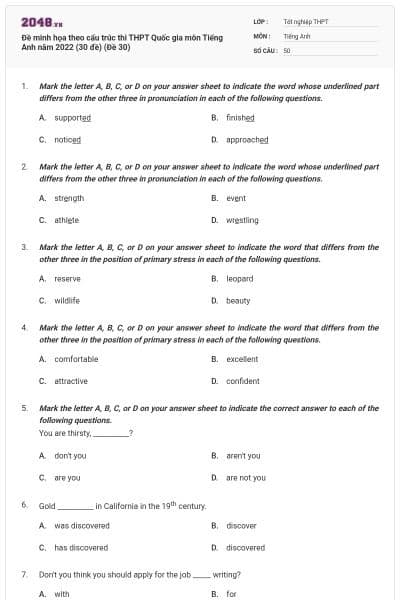
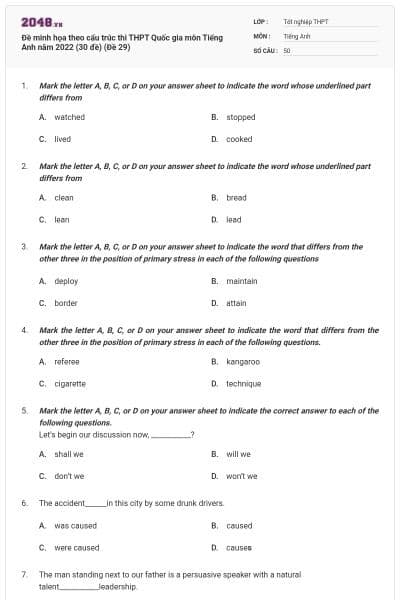
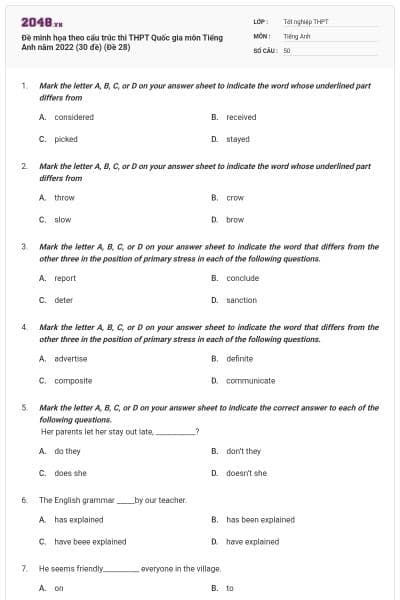
Mark the letter A, B, C, or D on your answer sheet to indicate the word whose underlined part differs from the other three in pronunciation in each of the following questions.
agreed
missed
liked
watched
Đáp án A
Từ agreed có phần gạch chân được phát âm là /d/, các từ còn lại có phần gạch chân được phát âm là /t/
Mark the letter A, B, C, or D on your answer sheet to indicate the word whose underlined part differs from the other three in pronunciation in each of the following questions.
educate
eliminate
certificate
dedicate
Đáp án C
Từ certificate có phần gạch chân được phát âm là / i/, các từ còn lại có phần gạch chân được phát âm là /ei/
Mark the letter A, B, C, or D on your answer sheet to indicate the word that differs from the other three in the position of the primary stress in each of the following questions.
religious
performance
miserable
including
Đáp án C
Từ miserable nhấn âm thứ nhất, các từ còn lại nhấn âm thứ hai.
Mark the letter A, B, C, or D on your answer sheet to indicate the word that differs from the other three in the position of the primary stress in each of the following questions.
decoration
temperament
Opportunity
expectation
Đáp án B
Từ temperament nhấn âm thứ nhất, các từ còn lại nhấn âm thứ ba.
He was determined to choose that university because of _______.
its reputation is fine
its fine reputation
it is fine
it has a fine reputatio
Đáp án B
because of + N/V-ing: bởi vì....
_______, no one was absent from the farewell party last night.
Heavily as it rained
As it rained heavily
Though it rains heavily
In spite of the heavily rain
Đáp án A
Cấu trúc chỉ sự tương phản “ tuy… nhưng…” : adj/adv + as+ S+ V, S + V.
The spy admitted _______ some highly secret information to enemy agents.
to have given
having been given
to have been given
having given
Đáp án D
admit + having done: thừa nhận đã làm gì
The teacher asked students to discuss the situation: "Which is better, supermarkets or traditional markets?” Choose the most suitable response to fill in the blank in the following exchange.
Jennifer: "I believe that supermarkets are much better than traditional markets.”
Katherine: “_______. Each has its own features.”
I couldn’t agree with you more.
That’s completely true.
I disagree with you.
I can’t help thinking thesame.
Đáp án C
I believe that supermarkets are much better than traditional markets. - Tôi tin rằng siêu thị tốt hơn nhiều so với chợ truyền thống.
Tôi không đồng tình với bạn.
When it started to snow, he_______his overcoat.
took out
put off
took off
put on
Đáp án D
put on: mặc....
We are going to have a trip to Hanoi Capital. We need to_______arrangements for the trip carefully.
do
make
get
pay
Đáp án B
make arrangements: sắp xếp
Nobody knows why_______until next week.
did the meeting postpone
the meeting was postponed
was the meeting postponed
the meeting postponed
Đáp án B
Đây là câu trần thuật => không đảo trợ động từ lên trước => A, C loại D loại vì, câu này phải chia ở thể bị động.
A _______ is money that is paid by a government or other authority in order to help an industry or business, or to pay for a public service.
subsidy
Capital
investment
salary
Đáp án A
subsidy:tiền trợ cấp
Các từ còn lại: investment: vốn đầu tư; salary: lương; capital: nguồn vốn
The picture_______was beautiful.
she was looking
at which she was looking
at it she was looking
at that she was looking
Đáp án B
look at : nhìn…. => đáp án A sai
C sai vì đây là mệnh đề quan hệ không dùng “it”, và D cũng sai vì không dùng mệnh đề “that” đứng ngay sau giới từ
_______that we had to ask a police officer for directions.
So confusing was the map
was so confusing the map
The map was so confusing
Such confusing was the map
Đáp án A
Cấu trúc đảo ngữ “quá … đến nỗi mà...”: So + adj + be + S + that +….
I don’t think Peter will come with us, ______ ?
do I
don’t I
won’t he
will he
Đáp án A
Cấu trúc láy đuôi, khi câu có “I think....” hoặc “I don’t think.”, khi láy đuôi , ta sẽ láy vế sau “that”. “I don’t think” đã mang nghĩa phủ định => vé láy đuôi khẳng định.
George wouldn't have met Mary_______to his brother’s graduation party.
hadn't he gone
had he not gone
if he has not gone
if he should not have gone
Đáp án B
Câu điều kiện loại III rút gọn If: Had + S + PII, S + would + have + PII.
_______ the issue was debated, the more people became involved
The more longer
The longer
The longest
The long
Đáp án B
So sánh tăng tiến “ càng ... càng…”: The + comparison + S + V, the + comparison + S + V. “long” là tính từ ngắn => longer.
This morning I bought _______ newspaper and a magazine. The newspaper is in my bag but I don't know where _______ magazine is.
a / a
a / the
the / the
the / a
Đáp án B
“newspaper” được nhắc đến lần đầu => dùng mạo từ “a”. “magazine” nhắc đến lần thứ 2 => dùng mạo từ “the”
Choose A, B, C, or D on your answer sheet to indicate the word or phrase CLOSEST in meaning to the underlined part in each of the following questions.
Biogas can be utilized for electricity production, cooking, space heating, water heating, and process heating.
reformation
sparing
increase
generation
Đáp án D
production = generation : (điện học) sự phát điện
Các đáp án khác: reformation: đổi mới; increase: tăng; sparing: tiết kiệm
Choose A, B, C, or D on your answer sheet to indicate the word or phrase CLOSEST in meaning to the underlined part in each of the following questions.
American children customarily go trick-or-treating on Halloween.
inevitably
readily
happily
traditionally
Đáp án D
customarily =_traditionally: thuộc truyền thống
Các đáp án khác: inevitably:chắc chắn; readily: dễ dàng, happily:vui vẻ
Mark the letter A, B, C or D on your answer sheet to indicate the word(s) that is OPPOSITE in meaning to the underlined part in each of the following questions.
For most male spiders courtship is a perilous procedure, for they may be eaten by females.
complicated
dangerous
safe
peculiar
Đáp án A
preserve: bảo tồn, giữ gìn, giấu >< reveal: tiết lộ Các từ còn lại: conserve: bảo tồn; presume: giả định,cover: bao phủ
Mark the letter A, B, C or D on your answer sheet to indicate the word(s) that is OPPOSITE in meaning to the underlined part in each of the following questions.
Names of people in the book were changed to preserve anonymity.
reveal
conserve
presume
cover
Đáp án D
attracts => attract
Choose A, B, C, or D on your answer sheet to show the underlined part that needs correction.
Alaska’s vast areas of untamed wilderness attracts many people who enioy the outdoors.
untamed
wilderness
attracts
enioy
Đáp án C
attracts => attract
Choose A, B, C, or D on your answer sheet to show the underlined part that needs correction.
Manufacturers may use food additives for preserving, to color, or to flavor, or to fortify foods.
may use
for preserving
to flavor
fortify foods
Đáp án C
for preserving => to preserve
Choose A, B, C, or D on your answer sheet to show the underlined part that needs correction.
If one type of manufacturing expands, it is like that another type will shrink considerably.
expands
like
another
considerably
Đáp án B
like => likely
Read the following passage and mark the letter A, B, C, or D on your answer sheet to indicate the correct answer to each of the questions
ACADEMICS AREN’T THE PROBLEM
Studies about how students use their time might shed light on whether they face increased academic and financial pressures compared with earlier eras.
Based on data about how students are spending time, academic or financial pressures don’t seem to be greater now than a generation ago.
The data show that full-time students in all types of colleges study much less now than they did a generation ago - a full 10 hours a week less. Students are also receiving significantly higher grades. So it appears that academic pressures are, in fact, considerably lower than they used to be.
The time-use data don’t suggest that students feel greater financial pressures, either. When the time savings and lower opportunity costs are factored in, college appears less expensive for most students than it was in the 1960s. And though there are now full-time students working to pay while in college, they study less even when paid work choices are held constantly.
In other words, full-time students do not appear to be studying less in order to work more. They appear to be studying less and spending the extra time on leisure activities or fun. It seems hard to imagine that students feeling increased financial pressures would respond by taking more leisure.
Based on how students are spending their time then, it doesn’t look as though academic or financial pressures are greater now than a generation ago. The time-use data don’t speak directly to social pressures, and it may well be that these have become more intense lately.
In one recent set of data, students reported spending more than 23 hours per week either socializing with friends or playing on the computer for fun. Social activities, in person or on computer, would seem to have become the maior focus of campus life. It is hard to tell what kinds of pressures would be associated with this change.
The study’s conclusion that students’ workload now is not greater than before is based on_______.
what students achieve with greater load
how students spend their time
how students work through college
what college demands from students
Đáp án A
Ý trong bài: Based on data about how students are spending time, academic or financial pressures don’t seem to be greater now than a generation ago.
Read the following passage and mark the letter A, B, C, or D on your answer sheet to indicate the correct answer to each of the questions
ACADEMICS AREN’T THE PROBLEM
Studies about how students use their time might shed light on whether they face increased academic and financial pressures compared with earlier eras.
Based on data about how students are spending time, academic or financial pressures don’t seem to be greater now than a generation ago.
The data show that full-time students in all types of colleges study much less now than they did a generation ago - a full 10 hours a week less. Students are also receiving significantly higher grades. So it appears that academic pressures are, in fact, considerably lower than they used to be.
The time-use data don’t suggest that students feel greater financial pressures, either. When the time savings and lower opportunity costs are factored in, college appears less expensive for most students than it was in the 1960s. And though there are now full-time students working to pay while in college, they study less even when paid work choices are held constantly.
In other words, full-time students do not appear to be studying less in order to work more. They appear to be studying less and spending the extra time on leisure activities or fun. It seems hard to imagine that students feeling increased financial pressures would respond by taking more leisure.
Based on how students are spending their time then, it doesn’t look as though academic or financial pressures are greater now than a generation ago. The time-use data don’t speak directly to social pressures, and it may well be that these have become more intense lately.
In one recent set of data, students reported spending more than 23 hours per week either socializing with friends or playing on the computer for fun. Social activities, in person or on computer, would seem to have become the maior focus of campus life. It is hard to tell what kinds of pressures would be associated with this change.
Research studies have shown that pressures put on students nowadays are_______.
not greater than the past
getting ever greater
much greater than the past
more diversified
Đáp án C
Ý trong bài: So it appears that academic pressures are, in fact, considerably lower than they used to be.
Read the following passage and mark the letter A, B, C, or D on your answer sheet to indicate the correct answer to each of the questions
ACADEMICS AREN’T THE PROBLEM
Studies about how students use their time might shed light on whether they face increased academic and financial pressures compared with earlier eras.
Based on data about how students are spending time, academic or financial pressures don’t seem to be greater now than a generation ago.
The data show that full-time students in all types of colleges study much less now than they did a generation ago - a full 10 hours a week less. Students are also receiving significantly higher grades. So it appears that academic pressures are, in fact, considerably lower than they used to be.
The time-use data don’t suggest that students feel greater financial pressures, either. When the time savings and lower opportunity costs are factored in, college appears less expensive for most students than it was in the 1960s. And though there are now full-time students working to pay while in college, they study less even when paid work choices are held constantly.
In other words, full-time students do not appear to be studying less in order to work more. They appear to be studying less and spending the extra time on leisure activities or fun. It seems hard to imagine that students feeling increased financial pressures would respond by taking more leisure.
Based on how students are spending their time then, it doesn’t look as though academic or financial pressures are greater now than a generation ago. The time-use data don’t speak directly to social pressures, and it may well be that these have become more intense lately.
In one recent set of data, students reported spending more than 23 hours per week either socializing with friends or playing on the computer for fun. Social activities, in person or on computer, would seem to have become the maior focus of campus life. It is hard to tell what kinds of pressures would be associated with this change.
According to the author, the fact that students have more time for leisure is a proof that_______.
financial pressure on students is not a problem
academic work disinterests them
they are active with extra-curricular activities
they cannot find extra jobs
Đáp án D
Ý trong bài: .... , college appears less expensive for most students ....
Read the following passage and mark the letter A, B, C, or D on your answer sheet to indicate the correct answer to each of the questions
ACADEMICS AREN’T THE PROBLEM
Studies about how students use their time might shed light on whether they face increased academic and financial pressures compared with earlier eras.
Based on data about how students are spending time, academic or financial pressures don’t seem to be greater now than a generation ago.
The data show that full-time students in all types of colleges study much less now than they did a generation ago - a full 10 hours a week less. Students are also receiving significantly higher grades. So it appears that academic pressures are, in fact, considerably lower than they used to be.
The time-use data don’t suggest that students feel greater financial pressures, either. When the time savings and lower opportunity costs are factored in, college appears less expensive for most students than it was in the 1960s. And though there are now full-time students working to pay while in college, they study less even when paid work choices are held constantly.
In other words, full-time students do not appear to be studying less in order to work more. They appear to be studying less and spending the extra time on leisure activities or fun. It seems hard to imagine that students feeling increased financial pressures would respond by taking more leisure.
Based on how students are spending their time then, it doesn’t look as though academic or financial pressures are greater now than a generation ago. The time-use data don’t speak directly to social pressures, and it may well be that these have become more intense lately.
In one recent set of data, students reported spending more than 23 hours per week either socializing with friends or playing on the computer for fun. Social activities, in person or on computer, would seem to have become the maior focus of campus life. It is hard to tell what kinds of pressures would be associated with this change.
All factors considered, college now seems_______.
more costly
ever more expensive
much more expensive
less expensive
Đáp án C
Ý trong bài: It seems hard to imagine that students feeling increased financial pressures would respond by taking more leisure.
Read the following passage and mark the letter A, B, C, or D on your answer sheet to indicate the correct answer to each of the questions
ACADEMICS AREN’T THE PROBLEM
Studies about how students use their time might shed light on whether they face increased academic and financial pressures compared with earlier eras.
Based on data about how students are spending time, academic or financial pressures don’t seem to be greater now than a generation ago.
The data show that full-time students in all types of colleges study much less now than they did a generation ago - a full 10 hours a week less. Students are also receiving significantly higher grades. So it appears that academic pressures are, in fact, considerably lower than they used to be.
The time-use data don’t suggest that students feel greater financial pressures, either. When the time savings and lower opportunity costs are factored in, college appears less expensive for most students than it was in the 1960s. And though there are now full-time students working to pay while in college, they study less even when paid work choices are held constantly.
In other words, full-time students do not appear to be studying less in order to work more. They appear to be studying less and spending the extra time on leisure activities or fun. It seems hard to imagine that students feeling increased financial pressures would respond by taking more leisure.
Based on how students are spending their time then, it doesn’t look as though academic or financial pressures are greater now than a generation ago. The time-use data don’t speak directly to social pressures, and it may well be that these have become more intense lately.
In one recent set of data, students reported spending more than 23 hours per week either socializing with friends or playing on the computer for fun. Social activities, in person or on computer, would seem to have become the maior focus of campus life. It is hard to tell what kinds of pressures would be associated with this change.
According to the author, the fact that more full-time students are working for pay_______.
does not change students’ campus life
indicates that students are academically pressured
is not an indication of pressures
shows that students are financially pressured
Đáp án A
Ý trong bài: They appear to be studying less and spending the extra time on leisure activities or fun.
Read the following passage and mark the letter A, B, C, or D on your answer sheet to indicate the correct answer to each of the questions
ACADEMICS AREN’T THE PROBLEM
Studies about how students use their time might shed light on whether they face increased academic and financial pressures compared with earlier eras.
Based on data about how students are spending time, academic or financial pressures don’t seem to be greater now than a generation ago.
The data show that full-time students in all types of colleges study much less now than they did a generation ago - a full 10 hours a week less. Students are also receiving significantly higher grades. So it appears that academic pressures are, in fact, considerably lower than they used to be.
The time-use data don’t suggest that students feel greater financial pressures, either. When the time savings and lower opportunity costs are factored in, college appears less expensive for most students than it was in the 1960s. And though there are now full-time students working to pay while in college, they study less even when paid work choices are held constantly.
In other words, full-time students do not appear to be studying less in order to work more. They appear to be studying less and spending the extra time on leisure activities or fun. It seems hard to imagine that students feeling increased financial pressures would respond by taking more leisure.
Based on how students are spending their time then, it doesn’t look as though academic or financial pressures are greater now than a generation ago. The time-use data don’t speak directly to social pressures, and it may well be that these have become more intense lately.
In one recent set of data, students reported spending more than 23 hours per week either socializing with friends or playing on the computer for fun. Social activities, in person or on computer, would seem to have become the maior focus of campus life. It is hard to tell what kinds of pressures would be associated with this change.
The word “focus” in the last paragraph can be replaced with _______.
central activity
primary theme
headline
biggest importance
Đáp án B
Ý trong bài: Social activities, in person or on computer, would seem to have become the major focus of campus life. It is hard to tell what kinds of pressures would be associated with this change.
Read the following passage and mark the letter A, B, C, or D on your answer sheet to indicate the correct answer to each of the questions
ACADEMICS AREN’T THE PROBLEM
Studies about how students use their time might shed light on whether they face increased academic and financial pressures compared with earlier eras.
Based on data about how students are spending time, academic or financial pressures don’t seem to be greater now than a generation ago.
The data show that full-time students in all types of colleges study much less now than they did a generation ago - a full 10 hours a week less. Students are also receiving significantly higher grades. So it appears that academic pressures are, in fact, considerably lower than they used to be.
The time-use data don’t suggest that students feel greater financial pressures, either. When the time savings and lower opportunity costs are factored in, college appears less expensive for most students than it was in the 1960s. And though there are now full-time students working to pay while in college, they study less even when paid work choices are held constantly.
In other words, full-time students do not appear to be studying less in order to work more. They appear to be studying less and spending the extra time on leisure activities or fun. It seems hard to imagine that students feeling increased financial pressures would respond by taking more leisure.
Based on how students are spending their time then, it doesn’t look as though academic or financial pressures are greater now than a generation ago. The time-use data don’t speak directly to social pressures, and it may well be that these have become more intense lately.
In one recent set of data, students reported spending more than 23 hours per week either socializing with friends or playing on the computer for fun. Social activities, in person or on computer, would seem to have become the maior focus of campus life. It is hard to tell what kinds of pressures would be associated with this change.
The author finds it hard to point out_______.
how students’ campus life becomes subịect to academic pressure
what is associated with the change in students’ campus life
the cause to students’ financial pressure
how the background of students’ campus life is built
Đáp án A
Academics students’ workload in college: khối lượng công việc của sinh viên trong trường đại học
Read the following passage and mark the letter A, B, C, or D on your answer sheet to indicate the correct answer to each of the questions
ACADEMICS AREN’T THE PROBLEM
Studies about how students use their time might shed light on whether they face increased academic and financial pressures compared with earlier eras.
Based on data about how students are spending time, academic or financial pressures don’t seem to be greater now than a generation ago.
The data show that full-time students in all types of colleges study much less now than they did a generation ago - a full 10 hours a week less. Students are also receiving significantly higher grades. So it appears that academic pressures are, in fact, considerably lower than they used to be.
The time-use data don’t suggest that students feel greater financial pressures, either. When the time savings and lower opportunity costs are factored in, college appears less expensive for most students than it was in the 1960s. And though there are now full-time students working to pay while in college, they study less even when paid work choices are held constantly.
In other words, full-time students do not appear to be studying less in order to work more. They appear to be studying less and spending the extra time on leisure activities or fun. It seems hard to imagine that students feeling increased financial pressures would respond by taking more leisure.
Based on how students are spending their time then, it doesn’t look as though academic or financial pressures are greater now than a generation ago. The time-use data don’t speak directly to social pressures, and it may well be that these have become more intense lately.
In one recent set of data, students reported spending more than 23 hours per week either socializing with friends or playing on the computer for fun. Social activities, in person or on computer, would seem to have become the maior focus of campus life. It is hard to tell what kinds of pressures would be associated with this change.
The word “Academics” in the title mostly means _______.
students’ workload in college
college students and tutors
professors and research students
graduate students’ workload
Đáp án C
Production: quá trình sản xuất, tạo ra “panel paintings”. Trong bài đề cập đến các bước để làm một “panel painting”
Read the following passage and mark the letter A, B, C, or D on your answer sheet to indicate the correct answer to each of the questions.
Panel painting, common in thirteenth- and fourteenth-century Europe, involved a painstaking, laborious process. Wooden planks were joined, covered with gesso to prepare the surface for painting, and then polished smooth with special tools. On this perfect surface, the artist would sketch a composition with chalk, refine it with inks, and then begin the deliberate process of applying thin layers of egg tempera paint (egg yolk in which pigments are suspended) with small brushes. The successive layering of these meticulously applied paints produced the final translucent colors.
Backgrounds or gold were made by carefully applying sheets of gold leaf, and then embellishing of decorating the gold leaf by punching it with a metal rod on which a pattern had been embossed . Every step in the process was slow and deliberate. The quick-drying tempera demanded that the artist know exactly where each stroke be placed before the brush met the panel, and it required the use of fine brushes. It was, therefore, an ideal technique for emphasizing the hard linear edges and pure, fine areas of color that were so much a part of the overall aesthetic of the time. The notion that an artist could or would dash off an idea in a fit of spontaneous inspiration was completely alien to these deliberately produced works.
Furthermore, making these paintings was so time-consuming that it demanded assistance. All such work was done by collective enterprise in the workshops. The painter or master who is credited with
having created the painting may have designed the work and overseen its production, but it is highly unlikely that the artist’s hand applied every stroke of the brush. More likely, numerous assistants, who had been trained to imitate the artist’s style, applied the paint. The carpenter’s shop probably provided the frame and perhaps supplied the panel, and yet another shop supplied the gold. Thus, not only many hands, but also many shops were involved in the final product.
In spite of problems with their condition, restoration, and preservation, many panel paintings have survived, and today many of them are housed in museum collections.
What aspect of panel paintings does the passage mainly discuss?
Different styles.
Famous examples.
Production.
Restoration.
Đáp án C
Ý trong bài: Wooden planks were joined, covered with gesso to prepare the surface for painting, and then polished smooth with special tools.
Read the following passage and mark the letter A, B, C, or D on your answer sheet to indicate the correct answer to each of the questions.
Panel painting, common in thirteenth- and fourteenth-century Europe, involved a painstaking, laborious process. Wooden planks were joined, covered with gesso to prepare the surface for painting, and then polished smooth with special tools. On this perfect surface, the artist would sketch a composition with chalk, refine it with inks, and then begin the deliberate process of applying thin layers of egg tempera paint (egg yolk in which pigments are suspended) with small brushes. The successive layering of these meticulously applied paints produced the final translucent colors.
Backgrounds or gold were made by carefully applying sheets of gold leaf, and then embellishing of decorating the gold leaf by punching it with a metal rod on which a pattern had been embossed . Every step in the process was slow and deliberate. The quick-drying tempera demanded that the artist know exactly where each stroke be placed before the brush met the panel, and it required the use of fine brushes. It was, therefore, an ideal technique for emphasizing the hard linear edges and pure, fine areas of color that were so much a part of the overall aesthetic of the time. The notion that an artist could or would dash off an idea in a fit of spontaneous inspiration was completely alien to these deliberately produced works.
Furthermore, making these paintings was so time-consuming that it demanded assistance. All such work was done by collective enterprise in the workshops. The painter or master who is credited with
having created the painting may have designed the work and overseen its production, but it is highly unlikely that the artist’s hand applied every stroke of the brush. More likely, numerous assistants, who had been trained to imitate the artist’s style, applied the paint. The carpenter’s shop probably provided the frame and perhaps supplied the panel, and yet another shop supplied the gold. Thus, not only many hands, but also many shops were involved in the final product.
In spite of problems with their condition, restoration, and preservation, many panel paintings have survived, and today many of them are housed in museum collections.
According to the passage, what was the first step in making a panel painting?
Mixing the paint.
Making ink drawings.
Preparing the panel.
Buying the gold leaf.
Đáp án A
it = composition : chế phẩm.
Các từ còn lại: artist: họa sỹ; chalk: phấn; surface: bề mặt
Read the following passage and mark the letter A, B, C, or D on your answer sheet to indicate the correct answer to each of the questions.
Panel painting, common in thirteenth- and fourteenth-century Europe, involved a painstaking, laborious process. Wooden planks were joined, covered with gesso to prepare the surface for painting, and then polished smooth with special tools. On this perfect surface, the artist would sketch a composition with chalk, refine it with inks, and then begin the deliberate process of applying thin layers of egg tempera paint (egg yolk in which pigments are suspended) with small brushes. The successive layering of these meticulously applied paints produced the final translucent colors.
Backgrounds or gold were made by carefully applying sheets of gold leaf, and then embellishing of decorating the gold leaf by punching it with a metal rod on which a pattern had been embossed . Every step in the process was slow and deliberate. The quick-drying tempera demanded that the artist know exactly where each stroke be placed before the brush met the panel, and it required the use of fine brushes. It was, therefore, an ideal technique for emphasizing the hard linear edges and pure, fine areas of color that were so much a part of the overall aesthetic of the time. The notion that an artist could or would dash off an idea in a fit of spontaneous inspiration was completely alien to these deliberately produced works.
Furthermore, making these paintings was so time-consuming that it demanded assistance. All such work was done by collective enterprise in the workshops. The painter or master who is credited with
having created the painting may have designed the work and overseen its production, but it is highly unlikely that the artist’s hand applied every stroke of the brush. More likely, numerous assistants, who had been trained to imitate the artist’s style, applied the paint. The carpenter’s shop probably provided the frame and perhaps supplied the panel, and yet another shop supplied the gold. Thus, not only many hands, but also many shops were involved in the final product.
In spite of problems with their condition, restoration, and preservation, many panel paintings have survived, and today many of them are housed in museum collections.
The word “it” refers to_______.
composition
artist
chalk
surface
Đáp án A
deliberate = careful: cẩn thận
Các từ còn lại: decisive: tính quyết định; unusual: bất thường; natural: tự nhiên
Read the following passage and mark the letter A, B, C, or D on your answer sheet to indicate the correct answer to each of the questions.
Panel painting, common in thirteenth- and fourteenth-century Europe, involved a painstaking, laborious process. Wooden planks were joined, covered with gesso to prepare the surface for painting, and then polished smooth with special tools. On this perfect surface, the artist would sketch a composition with chalk, refine it with inks, and then begin the deliberate process of applying thin layers of egg tempera paint (egg yolk in which pigments are suspended) with small brushes. The successive layering of these meticulously applied paints produced the final translucent colors.
Backgrounds or gold were made by carefully applying sheets of gold leaf, and then embellishing of decorating the gold leaf by punching it with a metal rod on which a pattern had been embossed . Every step in the process was slow and deliberate. The quick-drying tempera demanded that the artist know exactly where each stroke be placed before the brush met the panel, and it required the use of fine brushes. It was, therefore, an ideal technique for emphasizing the hard linear edges and pure, fine areas of color that were so much a part of the overall aesthetic of the time. The notion that an artist could or would dash off an idea in a fit of spontaneous inspiration was completely alien to these deliberately produced works.
Furthermore, making these paintings was so time-consuming that it demanded assistance. All such work was done by collective enterprise in the workshops. The painter or master who is credited with
having created the painting may have designed the work and overseen its production, but it is highly unlikely that the artist’s hand applied every stroke of the brush. More likely, numerous assistants, who had been trained to imitate the artist’s style, applied the paint. The carpenter’s shop probably provided the frame and perhaps supplied the panel, and yet another shop supplied the gold. Thus, not only many hands, but also many shops were involved in the final product.
In spite of problems with their condition, restoration, and preservation, many panel paintings have survived, and today many of them are housed in museum collections.
Which of the following processes produced the translucent colors found on panel paintings?
Applying many layers of paint.
Joining wooden planks to form large sheets.
Polishing the gesso.
Covering the background with gold leaf.
Đáp án C
Trong đoạn văn có đề cập cụm từ “The quick-drying tempera”
Read the following passage and mark the letter A, B, C, or D on your answer sheet to indicate the correct answer to each of the questions.
Panel painting, common in thirteenth- and fourteenth-century Europe, involved a painstaking, laborious process. Wooden planks were joined, covered with gesso to prepare the surface for painting, and then polished smooth with special tools. On this perfect surface, the artist would sketch a composition with chalk, refine it with inks, and then begin the deliberate process of applying thin layers of egg tempera paint (egg yolk in which pigments are suspended) with small brushes. The successive layering of these meticulously applied paints produced the final translucent colors.
Backgrounds or gold were made by carefully applying sheets of gold leaf, and then embellishing of decorating the gold leaf by punching it with a metal rod on which a pattern had been embossed . Every step in the process was slow and deliberate. The quick-drying tempera demanded that the artist know exactly where each stroke be placed before the brush met the panel, and it required the use of fine brushes. It was, therefore, an ideal technique for emphasizing the hard linear edges and pure, fine areas of color that were so much a part of the overall aesthetic of the time. The notion that an artist could or would dash off an idea in a fit of spontaneous inspiration was completely alien to these deliberately produced works.
Furthermore, making these paintings was so time-consuming that it demanded assistance. All such work was done by collective enterprise in the workshops. The painter or master who is credited with
having created the painting may have designed the work and overseen its production, but it is highly unlikely that the artist’s hand applied every stroke of the brush. More likely, numerous assistants, who had been trained to imitate the artist’s style, applied the paint. The carpenter’s shop probably provided the frame and perhaps supplied the panel, and yet another shop supplied the gold. Thus, not only many hands, but also many shops were involved in the final product.
In spite of problems with their condition, restoration, and preservation, many panel paintings have survived, and today many of them are housed in museum collections.
What characteristic of tempera paint is mentioned in the passage?
It has to be applied directly to wood
It is difficult to make.
It dries quickly.
It dissolves easily.
Đáp án B
demanded = required: yêu cầu
Các từ còn lại: order: ra lệnh; report: thông báo; question: hỏi
Read the following passage and mark the letter A, B, C, or D on your answer sheet to indicate the correct answer to each of the questions.
Panel painting, common in thirteenth- and fourteenth-century Europe, involved a painstaking, laborious process. Wooden planks were joined, covered with gesso to prepare the surface for painting, and then polished smooth with special tools. On this perfect surface, the artist would sketch a composition with chalk, refine it with inks, and then begin the deliberate process of applying thin layers of egg tempera paint (egg yolk in which pigments are suspended) with small brushes. The successive layering of these meticulously applied paints produced the final translucent colors.
Backgrounds or gold were made by carefully applying sheets of gold leaf, and then embellishing of decorating the gold leaf by punching it with a metal rod on which a pattern had been embossed . Every step in the process was slow and deliberate. The quick-drying tempera demanded that the artist know exactly where each stroke be placed before the brush met the panel, and it required the use of fine brushes. It was, therefore, an ideal technique for emphasizing the hard linear edges and pure, fine areas of color that were so much a part of the overall aesthetic of the time. The notion that an artist could or would dash off an idea in a fit of spontaneous inspiration was completely alien to these deliberately produced works.
Furthermore, making these paintings was so time-consuming that it demanded assistance. All such work was done by collective enterprise in the workshops. The painter or master who is credited with
having created the painting may have designed the work and overseen its production, but it is highly unlikely that the artist’s hand applied every stroke of the brush. More likely, numerous assistants, who had been trained to imitate the artist’s style, applied the paint. The carpenter’s shop probably provided the frame and perhaps supplied the panel, and yet another shop supplied the gold. Thus, not only many hands, but also many shops were involved in the final product.
In spite of problems with their condition, restoration, and preservation, many panel paintings have survived, and today many of them are housed in museum collections.
The “collective enterprise” mentioned includes all of the following EXCEPT_______.
supplying the gold leaf
applying the paint
selling then painting
building the panels
Đáp án A
imitate: mô phỏng, bắt chước = copy
Các đáp án còn lại: believe in: tin vào; promote: thúc đẩy; illustrate: minh họa
Read the following passage and mark the letter A, B, C, or D on your answer sheet to indicate the correct answer to each of the questions.
Panel painting, common in thirteenth- and fourteenth-century Europe, involved a painstaking, laborious process. Wooden planks were joined, covered with gesso to prepare the surface for painting, and then polished smooth with special tools. On this perfect surface, the artist would sketch a composition with chalk, refine it with inks, and then begin the deliberate process of applying thin layers of egg tempera paint (egg yolk in which pigments are suspended) with small brushes. The successive layering of these meticulously applied paints produced the final translucent colors.
Backgrounds or gold were made by carefully applying sheets of gold leaf, and then embellishing of decorating the gold leaf by punching it with a metal rod on which a pattern had been embossed . Every step in the process was slow and deliberate. The quick-drying tempera demanded that the artist know exactly where each stroke be placed before the brush met the panel, and it required the use of fine brushes. It was, therefore, an ideal technique for emphasizing the hard linear edges and pure, fine areas of color that were so much a part of the overall aesthetic of the time. The notion that an artist could or would dash off an idea in a fit of spontaneous inspiration was completely alien to these deliberately produced works.
Furthermore, making these paintings was so time-consuming that it demanded assistance. All such work was done by collective enterprise in the workshops. The painter or master who is credited with
having created the painting may have designed the work and overseen its production, but it is highly unlikely that the artist’s hand applied every stroke of the brush. More likely, numerous assistants, who had been trained to imitate the artist’s style, applied the paint. The carpenter’s shop probably provided the frame and perhaps supplied the panel, and yet another shop supplied the gold. Thus, not only many hands, but also many shops were involved in the final product.
In spite of problems with their condition, restoration, and preservation, many panel paintings have survived, and today many of them are housed in museum collections.
The word “imitate” is closest in meaning to ________ .
copy
believe in
promote
illustrate
Đáp án D
Ý trong bài: In spite of problems with their condition, restoration, and preservation, many panel paintings have survived, and today many of them are housed in museum collections.
Read the following passage and mark the letter A, B, C, or D on your answer sheet to indicate the correct word or phrase for each of the blanks.
During shopping trip to your supermarket, you will (41)_______many similar products. How do manufacturers (42)_______you to buy their products and not those of another company? By careful packaging!
(43)_______of the boxes and bottles that you see has been carefully designed to appeal to you, personally.
Do you care about the environment? Then buy this washing powder; it contains (44)_______chemicals. Do you want to impress your friends? Buy these trainers; they have a designer label.
Before manufacturers market a new product, they spend months discussing the packaging. Then, they try out their ideas on a group of customers. Manufacturers (45)_______customers will see more than just a box or bottle. They want to convince you that their product find out your personality more than any other product in the shop.
Điền vào số (41)
glance
mark
realize
notice
Đáp án C
persuade someone to do something : thuyết phục ai làm gì Các từ còn lại: make someone do something: bắt ai làm gì
Take someone to somewhere: đưa ai đến đâu Lead (+to): dẫn đến....
Đáp án là D. each of + Ns: mỗi cái ( hoặc mỗi người) trong....
Read the following passage and mark the letter A, B, C, or D on your answer sheet to indicate the correct word or phrase for each of the blanks.
During shopping trip to your supermarket, you will (41)_______many similar products. How do manufacturers (42)_______you to buy their products and not those of another company? By careful packaging!
(43)_______of the boxes and bottles that you see has been carefully designed to appeal to you, personally.
Do you care about the environment? Then buy this washing powder; it contains (44)_______chemicals. Do you want to impress your friends? Buy these trainers; they have a designer label.
Before manufacturers market a new product, they spend months discussing the packaging. Then, they try out their ideas on a group of customers. Manufacturers (45)_______customers will see more than just a box or bottle. They want to convince you that their product find out your personality more than any other product in the shop.
Điền vào số (42)
make
take
persuade
lead
Đáp án D
fewer + Ns: ít hơn
Các từ còn lại theo sau danh từ không đếm được.
Read the following passage and mark the letter A, B, C, or D on your answer sheet to indicate the correct word or phrase for each of the blanks.
During shopping trip to your supermarket, you will (41)_______many similar products. How do manufacturers (42)_______you to buy their products and not those of another company? By careful packaging!
(43)_______of the boxes and bottles that you see has been carefully designed to appeal to you, personally.
Do you care about the environment? Then buy this washing powder; it contains (44)_______chemicals. Do you want to impress your friends? Buy these trainers; they have a designer label.
Before manufacturers market a new product, they spend months discussing the packaging. Then, they try out their ideas on a group of customers. Manufacturers (45)_______customers will see more than just a box or bottle. They want to convince you that their product find out your personality more than any other product in the shop.
Điền vào số (43)
One
All
Every
Each
Đáp án B
hope that S + will + S : hy vọng.... sẽ....
Các từ còn lại: want to do something / want someone to do something. Muốn làm gì / muốn ai đó làm gì Desire to: mong muốn, ao ước
Wish to do something / wish that S + V ( lùi thì): mong ước ...
Read the following passage and mark the letter A, B, C, or D on your answer sheet to indicate the correct word or phrase for each of the blanks.
During shopping trip to your supermarket, you will (41)_______many similar products. How do manufacturers (42)_______you to buy their products and not those of another company? By careful packaging!
(43)_______of the boxes and bottles that you see has been carefully designed to appeal to you, personally.
Do you care about the environment? Then buy this washing powder; it contains (44)_______chemicals. Do you want to impress your friends? Buy these trainers; they have a designer label.
Before manufacturers market a new product, they spend months discussing the packaging. Then, they try out their ideas on a group of customers. Manufacturers (45)_______customers will see more than just a box or bottle. They want to convince you that their product find out your personality more than any other product in the shop.
Điền vào số (44)
less
much
little
fewer
Đáp án A
suit: phù hợp
Các từ còn lại: make : khiến; bắt; agree: đồng ý; appeal: khiếu nại
Read the following passage and mark the letter A, B, C, or D on your answer sheet to indicate the correct word or phrase for each of the blanks.
During shopping trip to your supermarket, you will (41)_______many similar products. How do manufacturers (42)_______you to buy their products and not those of another company? By careful packaging!
(43)_______of the boxes and bottles that you see has been carefully designed to appeal to you, personally.
Do you care about the environment? Then buy this washing powder; it contains (44)_______chemicals. Do you want to impress your friends? Buy these trainers; they have a designer label.
Before manufacturers market a new product, they spend months discussing the packaging. Then, they try out their ideas on a group of customers. Manufacturers (45)_______customers will see more than just a box or bottle. They want to convince you that their product find out your personality more than any other product in the shop.
Điền vào số (45)
want
hope
desire
wish
Đáp án D
research: nghiên cứ ( thực tế)
Các từ còn lại: test: bài kiểm tra; study: nghiên cứu ( trên lý thuyết); idea: ý kiến
Mark the letter A, B, C, or D on your answer sheet to indicate the sentence that is CLOSEST in meaning to the sentence given in each of the following questions.
Although I love him, I can’t tolerate his impatience.
Much as I love him, I can’t tolerate his impatience.
I can’t tolerate his impatience I love him
Much as I love him, I can tolerate his impatience.
Much as I love him as, I can’t tolerate his impatience.
Đáp án A
Mark the letter A, B, C, or D on your answer sheet to indicate the sentence that is CLOSEST in meaning to the sentence given in each of the following questions.
Would you mind not smoking in here?
Do you smoke here?
I’d rather you don't smoke.
I’d rather you smoke.
I’d rather you didn’t smoke.
Đáp án D
Mark the letter A, B, C, or D on your answer sheet to indicate the sentence that is CLOSEST in meaning to the sentence given in each of the following questions.
John missed the ferry because he got up late.
If John hadn’t got up late, he wouldn’t have missed the ferry.
If John had got up late, he wouldn’t have missed the ferry.
If John isn't got up late, he won't have missed the ferry.
If John hadn’t get up late, he wouldn’t had missed the ferry.
Đáp án A
Mark the letter A, B, C, or D on your answer sheet to indicate the sentence that is CLOSEST in meaning to the sentence given in each of the following questions.
“Don’t forget to check the internet for an application to our college,” the counselor told the students.
The counselor reminded the students check the internet for an application their college
The counselor reminded the students check the internet for an application to their college
The counselor reminded the students to check the internet for an application to their college
The counselor remind the students to check the internet for an application to their college
Đáp án C
Mark the letter A, B, C, or D on your answer sheet to indicate the sentence that is CLOSEST in meaning to the sentence given in each of the following questions.
People say that nine crew members were lost overboard.
Nine crew members are said to have been lost overboard.
Nine crew members are said to has been lost overboard.
Nine crew members are say to have been lost overboard.
Nine crew members are said have been lost overboard.
Đáp án A