30 đề luyện thi Đại Học môn Tiếng Anh cực hay có lời giải (Đề số 21)
50 câu hỏi
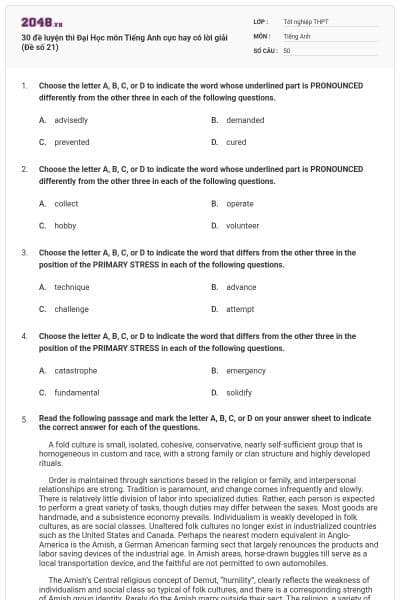
Choose the letter A, B, C, or D to indicate the word whose underlined part is PRONOUNCED differently from the other three in each of the following questions.
advisedly
demanded
prevented
cured
Đáp án D
Từ cured có phần gạch chân được phát âm là /d/, các từ còn lại có phần gạch chân được phát âm là /t/
Choose the letter A, B, C, or D to indicate the word whose underlined part is PRONOUNCED differently from the other three in each of the following questions.
collect
operate
hobby
volunteer
Đáp án A
Từ collect có phần gạch chân được phát âm là /ə/, các từ còn lại có phần gạch chân được phát âm là /d/
Choose the letter A, B, C, or D to indicate the word that differs from the other three in the position of the PRIMARY STRESS in each of the following questions.
technique
advance
challenge
attempt
Đáp án C
Từ challenge nhấn âm thứ nhất, các từ còn lại nhấn âm thứ hai.
Choose the letter A, B, C, or D to indicate the word that differs from the other three in the position of the PRIMARY STRESS in each of the following questions.
catastrophe
emergency
fundamental
solidify
Đáp án C
Từ fundamental nhấn âm thứ ba, các từ còn lại nhấn âm thứ hai
Read the following passage and mark the letter A, B, C, or D on your answer sheet to indicate the correct answer for each of the questions.
A fold culture is small, isolated, cohesive, conservative, nearly self-sufficient group that is homogeneous in custom and race, with a strong family or clan structure and highly developed rituals.
Order is maintained through sanctions based in the religion or family, and interpersonal relationships are strong. Tradition is paramount, and change comes infrequently and slowly. There is relatively little division of labor into specialized duties. Rather, each person is expected to perform a great variety of tasks, though duties may differ between the sexes. Most goods are handmade, and a subsistence economy prevails. Individualism is weakly developed in folk cultures, as are social classes. Unaltered folk cultures no longer exist in industrialized countries such as the United States and Canada. Perhaps the nearest modern equivalent in Anglo-America is the Amish, a German American farming sect that largely renounces the products and labor saving devices of the industrial age. In Amish areas, horse-drawn buggies till serve as a local transportation device, and the faithful are not permitted to own automobiles.
The Amish’s Central religious concept of Demut, “humility”, clearly reflects the weakness of individualism and social class so typical of folk cultures, and there is a corresponding strength of Amish group identity. Rarely do the Amish marry outside their sect. The religion, a variety of the Mennonite faith, provides the principal mechanism for maintaining order.
By contrast, a popular culture is a large heterogeneous group, often highly individualistic and constantly changing. Relationships tend to be impersonal, and a pronounced division of labor exists, leading to the establishment of many specialized professions. Secular institutions, of control such as the police and army take the place of religion and family in maintaining order, and a money-based economy prevails. Because of these contrasts, “popular” may be viewed as clearly difierent from “folk”.
The popular is replacing the folk in industrialized countries and in many developing nations, Folk- made objects give way to their popular equivalent, usually because the popular item is more quickly or cheaply produced, is easier or time saving to use, or lends more prestige to the owner.
What does the passage mainly discuss?
Two decades in modern society
The influence of industrial technology
The characteristics of “folk” and “popular” societies
The specialization of labor in Canada and the United States
Đáp án C
Đoạn đầu nói về characteristics of “folk” culture: small, isolated, cohesive, conservative... Đoạn sau nói về “popular” culture: ... a large heterogeneous group, often highly individualistic and constantly changing
Read the following passage and mark the letter A, B, C, or D on your answer sheet to indicate the correct answer for each of the questions.
A fold culture is small, isolated, cohesive, conservative, nearly self-sufficient group that is homogeneous in custom and race, with a strong family or clan structure and highly developed rituals.
Order is maintained through sanctions based in the religion or family, and interpersonal relationships are strong. Tradition is paramount, and change comes infrequently and slowly. There is relatively little division of labor into specialized duties. Rather, each person is expected to perform a great variety of tasks, though duties may differ between the sexes. Most goods are handmade, and a subsistence economy prevails. Individualism is weakly developed in folk cultures, as are social classes. Unaltered folk cultures no longer exist in industrialized countries such as the United States and Canada. Perhaps the nearest modern equivalent in Anglo-America is the Amish, a German American farming sect that largely renounces the products and labor saving devices of the industrial age. In Amish areas, horse-drawn buggies till serve as a local transportation device, and the faithful are not permitted to own automobiles.
The Amish’s Central religious concept of Demut, “humility”, clearly reflects the weakness of individualism and social class so typical of folk cultures, and there is a corresponding strength of Amish group identity. Rarely do the Amish marry outside their sect. The religion, a variety of the Mennonite faith, provides the principal mechanism for maintaining order.
By contrast, a popular culture is a large heterogeneous group, often highly individualistic and constantly changing. Relationships tend to be impersonal, and a pronounced division of labor exists, leading to the establishment of many specialized professions. Secular institutions, of control such as the police and army take the place of religion and family in maintaining order, and a money-based economy prevails. Because of these contrasts, “popular” may be viewed as clearly difierent from “folk”.
The popular is replacing the folk in industrialized countries and in many developing nations, Folk- made objects give way to their popular equivalent, usually because the popular item is more quickly or cheaply produced, is easier or time saving to use, or lends more prestige to the owner.
The word “homogeneous” is closest in meaning to________.
uniform
general
primitive
traditional
Đáp án A
homogeneous = uniform: đồng đều, đồng nhất
Read the following passage and mark the letter A, B, C, or D on your answer sheet to indicate the correct answer for each of the questions.
A fold culture is small, isolated, cohesive, conservative, nearly self-sufficient group that is homogeneous in custom and race, with a strong family or clan structure and highly developed rituals.
Order is maintained through sanctions based in the religion or family, and interpersonal relationships are strong. Tradition is paramount, and change comes infrequently and slowly. There is relatively little division of labor into specialized duties. Rather, each person is expected to perform a great variety of tasks, though duties may differ between the sexes. Most goods are handmade, and a subsistence economy prevails. Individualism is weakly developed in folk cultures, as are social classes. Unaltered folk cultures no longer exist in industrialized countries such as the United States and Canada. Perhaps the nearest modern equivalent in Anglo-America is the Amish, a German American farming sect that largely renounces the products and labor saving devices of the industrial age. In Amish areas, horse-drawn buggies till serve as a local transportation device, and the faithful are not permitted to own automobiles.
The Amish’s Central religious concept of Demut, “humility”, clearly reflects the weakness of individualism and social class so typical of folk cultures, and there is a corresponding strength of Amish group identity. Rarely do the Amish marry outside their sect. The religion, a variety of the Mennonite faith, provides the principal mechanism for maintaining order.
By contrast, a popular culture is a large heterogeneous group, often highly individualistic and constantly changing. Relationships tend to be impersonal, and a pronounced division of labor exists, leading to the establishment of many specialized professions. Secular institutions, of control such as the police and army take the place of religion and family in maintaining order, and a money-based economy prevails. Because of these contrasts, “popular” may be viewed as clearly difierent from “folk”.
The popular is replacing the folk in industrialized countries and in many developing nations, Folk- made objects give way to their popular equivalent, usually because the popular item is more quickly or cheaply produced, is easier or time saving to use, or lends more prestige to the owner.
Which of the following is typical of folk cultures?
There is a money-based economy.
Social change occurs slowly.
Contact with other cultures is encouraged.
Each person develops one specialized skill.
Đáp án B
Ý trong bài : Tradition is paramount, and change comes infrequently and slowly
Read the following passage and mark the letter A, B, C, or D on your answer sheet to indicate the correct answer for each of the questions.
A fold culture is small, isolated, cohesive, conservative, nearly self-sufficient group that is homogeneous in custom and race, with a strong family or clan structure and highly developed rituals.
Order is maintained through sanctions based in the religion or family, and interpersonal relationships are strong. Tradition is paramount, and change comes infrequently and slowly. There is relatively little division of labor into specialized duties. Rather, each person is expected to perform a great variety of tasks, though duties may differ between the sexes. Most goods are handmade, and a subsistence economy prevails. Individualism is weakly developed in folk cultures, as are social classes. Unaltered folk cultures no longer exist in industrialized countries such as the United States and Canada. Perhaps the nearest modern equivalent in Anglo-America is the Amish, a German American farming sect that largely renounces the products and labor saving devices of the industrial age. In Amish areas, horse-drawn buggies till serve as a local transportation device, and the faithful are not permitted to own automobiles.
The Amish’s Central religious concept of Demut, “humility”, clearly reflects the weakness of individualism and social class so typical of folk cultures, and there is a corresponding strength of Amish group identity. Rarely do the Amish marry outside their sect. The religion, a variety of the Mennonite faith, provides the principal mechanism for maintaining order.
By contrast, a popular culture is a large heterogeneous group, often highly individualistic and constantly changing. Relationships tend to be impersonal, and a pronounced division of labor exists, leading to the establishment of many specialized professions. Secular institutions, of control such as the police and army take the place of religion and family in maintaining order, and a money-based economy prevails. Because of these contrasts, “popular” may be viewed as clearly difierent from “folk”.
The popular is replacing the folk in industrialized countries and in many developing nations, Folk- made objects give way to their popular equivalent, usually because the popular item is more quickly or cheaply produced, is easier or time saving to use, or lends more prestige to the owner.
What is the main source of order in Amish society?
The government
The economy
The clan structure
The religion
Đáp án D
Ý trong bài: The Amish’s central religious concept of Demut, “humility”, clearly reflects the weakness of individualism and social class so typical of folk cultures,...
Read the following passage and mark the letter A, B, C, or D on your answer sheet to indicate the correct answer for each of the questions.
A fold culture is small, isolated, cohesive, conservative, nearly self-sufficient group that is homogeneous in custom and race, with a strong family or clan structure and highly developed rituals.
Order is maintained through sanctions based in the religion or family, and interpersonal relationships are strong. Tradition is paramount, and change comes infrequently and slowly. There is relatively little division of labor into specialized duties. Rather, each person is expected to perform a great variety of tasks, though duties may differ between the sexes. Most goods are handmade, and a subsistence economy prevails. Individualism is weakly developed in folk cultures, as are social classes. Unaltered folk cultures no longer exist in industrialized countries such as the United States and Canada. Perhaps the nearest modern equivalent in Anglo-America is the Amish, a German American farming sect that largely renounces the products and labor saving devices of the industrial age. In Amish areas, horse-drawn buggies till serve as a local transportation device, and the faithful are not permitted to own automobiles.
The Amish’s Central religious concept of Demut, “humility”, clearly reflects the weakness of individualism and social class so typical of folk cultures, and there is a corresponding strength of Amish group identity. Rarely do the Amish marry outside their sect. The religion, a variety of the Mennonite faith, provides the principal mechanism for maintaining order.
By contrast, a popular culture is a large heterogeneous group, often highly individualistic and constantly changing. Relationships tend to be impersonal, and a pronounced division of labor exists, leading to the establishment of many specialized professions. Secular institutions, of control such as the police and army take the place of religion and family in maintaining order, and a money-based economy prevails. Because of these contrasts, “popular” may be viewed as clearly difierent from “folk”.
The popular is replacing the folk in industrialized countries and in many developing nations, Folk- made objects give way to their popular equivalent, usually because the popular item is more quickly or cheaply produced, is easier or time saving to use, or lends more prestige to the owner.
Which of the following statements about Amish beliefs does the passage support?
A variety of religious practices is tolerated.
Individualism and competition are important.
Pre-modern technology is preferred.
People are defined according to their class.
Đáp án C
Ý trong bài: In Amish areas, horse-drawn buggies till serve as a local transportation device, and the faithful are not permitted to own automobiles.
Read the following passage and mark the letter A, B, C, or D on your answer sheet to indicate the correct answer for each of the questions.
A fold culture is small, isolated, cohesive, conservative, nearly self-sufficient group that is homogeneous in custom and race, with a strong family or clan structure and highly developed rituals.
Order is maintained through sanctions based in the religion or family, and interpersonal relationships are strong. Tradition is paramount, and change comes infrequently and slowly. There is relatively little division of labor into specialized duties. Rather, each person is expected to perform a great variety of tasks, though duties may differ between the sexes. Most goods are handmade, and a subsistence economy prevails. Individualism is weakly developed in folk cultures, as are social classes. Unaltered folk cultures no longer exist in industrialized countries such as the United States and Canada. Perhaps the nearest modern equivalent in Anglo-America is the Amish, a German American farming sect that largely renounces the products and labor saving devices of the industrial age. In Amish areas, horse-drawn buggies till serve as a local transportation device, and the faithful are not permitted to own automobiles.
The Amish’s Central religious concept of Demut, “humility”, clearly reflects the weakness of individualism and social class so typical of folk cultures, and there is a corresponding strength of Amish group identity. Rarely do the Amish marry outside their sect. The religion, a variety of the Mennonite faith, provides the principal mechanism for maintaining order.
By contrast, a popular culture is a large heterogeneous group, often highly individualistic and constantly changing. Relationships tend to be impersonal, and a pronounced division of labor exists, leading to the establishment of many specialized professions. Secular institutions, of control such as the police and army take the place of religion and family in maintaining order, and a money-based economy prevails. Because of these contrasts, “popular” may be viewed as clearly difierent from “folk”.
The popular is replacing the folk in industrialized countries and in many developing nations, Folk- made objects give way to their popular equivalent, usually because the popular item is more quickly or cheaply produced, is easier or time saving to use, or lends more prestige to the owner.
Which of the following would probably NOT be found in a folk culture?
carpenter
A farmer
A weaver
A banker
Đáp án D
Có thể dễ dàng chọn được đáp án D. A banker: một chủ ngân hàng, vì văn hóa dân gian chưa xuất hiện ngân hàng
Các từ còn lại: farmer: nông dân ; carpenter: thợ mộc; weaver: thợ dệt
Read the following passage and mark the letter A, B, C, or D on your answer sheet to indicate the correct answer for each of the questions.
A fold culture is small, isolated, cohesive, conservative, nearly self-sufficient group that is homogeneous in custom and race, with a strong family or clan structure and highly developed rituals.
Order is maintained through sanctions based in the religion or family, and interpersonal relationships are strong. Tradition is paramount, and change comes infrequently and slowly. There is relatively little division of labor into specialized duties. Rather, each person is expected to perform a great variety of tasks, though duties may differ between the sexes. Most goods are handmade, and a subsistence economy prevails. Individualism is weakly developed in folk cultures, as are social classes. Unaltered folk cultures no longer exist in industrialized countries such as the United States and Canada. Perhaps the nearest modern equivalent in Anglo-America is the Amish, a German American farming sect that largely renounces the products and labor saving devices of the industrial age. In Amish areas, horse-drawn buggies till serve as a local transportation device, and the faithful are not permitted to own automobiles.
The Amish’s Central religious concept of Demut, “humility”, clearly reflects the weakness of individualism and social class so typical of folk cultures, and there is a corresponding strength of Amish group identity. Rarely do the Amish marry outside their sect. The religion, a variety of the Mennonite faith, provides the principal mechanism for maintaining order.
By contrast, a popular culture is a large heterogeneous group, often highly individualistic and constantly changing. Relationships tend to be impersonal, and a pronounced division of labor exists, leading to the establishment of many specialized professions. Secular institutions, of control such as the police and army take the place of religion and family in maintaining order, and a money-based economy prevails. Because of these contrasts, “popular” may be viewed as clearly difierent from “folk”.
The popular is replacing the folk in industrialized countries and in many developing nations, Folk- made objects give way to their popular equivalent, usually because the popular item is more quickly or cheaply produced, is easier or time saving to use, or lends more prestige to the owner.
The word “prevails” is closest in meaning to________.
dominates
provides
develops
invests
Đáp án A
prevail = dominate: chiếm ưu thế
Read the following passage and mark the letter A, B, C, or D on your answer sheet to indicate the correct answer for each of the questions.
A fold culture is small, isolated, cohesive, conservative, nearly self-sufficient group that is homogeneous in custom and race, with a strong family or clan structure and highly developed rituals.
Order is maintained through sanctions based in the religion or family, and interpersonal relationships are strong. Tradition is paramount, and change comes infrequently and slowly. There is relatively little division of labor into specialized duties. Rather, each person is expected to perform a great variety of tasks, though duties may differ between the sexes. Most goods are handmade, and a subsistence economy prevails. Individualism is weakly developed in folk cultures, as are social classes. Unaltered folk cultures no longer exist in industrialized countries such as the United States and Canada. Perhaps the nearest modern equivalent in Anglo-America is the Amish, a German American farming sect that largely renounces the products and labor saving devices of the industrial age. In Amish areas, horse-drawn buggies till serve as a local transportation device, and the faithful are not permitted to own automobiles.
The Amish’s Central religious concept of Demut, “humility”, clearly reflects the weakness of individualism and social class so typical of folk cultures, and there is a corresponding strength of Amish group identity. Rarely do the Amish marry outside their sect. The religion, a variety of the Mennonite faith, provides the principal mechanism for maintaining order.
By contrast, a popular culture is a large heterogeneous group, often highly individualistic and constantly changing. Relationships tend to be impersonal, and a pronounced division of labor exists, leading to the establishment of many specialized professions. Secular institutions, of control such as the police and army take the place of religion and family in maintaining order, and a money-based economy prevails. Because of these contrasts, “popular” may be viewed as clearly difierent from “folk”.
The popular is replacing the folk in industrialized countries and in many developing nations, Folk- made objects give way to their popular equivalent, usually because the popular item is more quickly or cheaply produced, is easier or time saving to use, or lends more prestige to the owner.
Which of following is NOT given as a reason why folk-made objects are replaced by mass-produced objects?
cost
prestige
quality
convenience
Đáp án C
quality: chất lượng
Ý trong bài: Folk- made objects give way to their popular equivalent, usually because the popular item
is more quickly or cheaply produced, is easier or time saving to use, or lends more prestige to the owner.
Read the foHowing passage and mark the letter A, B, C, or D on your answer sheet to indicate the correct answer to each of the questions.
In the West, cartoons are used chiefly to make people laugh. The important feature of all these cartoons is the joke and the element of surprise which is contained. Even though it is very funny, a good cartoon is always based on close observation of a particular feature of life and usually has a serious purpose.
Cartoons in the West have been associated with political and social matters for many years. In wartime, for example, they proved to be an excellent way of spreading propaganda. Nowadays cartoons are often used to make short, sharp comments on politics and governments as well as on a variety of social matters. In this way, the modern cartoon has become a very powerful force in influencing people in Europe and the United States.
Unlike most American and European cartoons, however, many Chinese cartoon drawings in the past have also attempted to educate people, especially those who could not read and write. Such cartoons about the lives and sayings of great men in China have proved extremely useful in bringing education to illiterate and semi-literate people throughout China. Confucius, Mencius and Laozi have all appeared in very interesting stories presented in the form of cartoons. The cartoons themselves have thus served to illustrate the teachings of the Chinese sages in a very attractive way.
In this sense, many Chinese cartoons are different from Western cartoons in so far as they do not depend chiefly on telling jokes. Often, there is nothing to laugh at when you see Chinese cartoons. This is not their primary aim. In addition to commenting on serious political and social matters, Chinese cartoons have aimed at spreading the traditional Chinese thoughts and culture as widely as possible among the people.
Today, however, Chinese cartoons have an added part to play in spreading knowledge. They offer a
very attractive and useful way of reaching people throughout the world, regardless of the particular country in which they live. Thus, through cartoons, the thoughts and teachings of the old Chinese philosophers and sages can now reach people who live in such countries as Britain, France, America, Japan, Malaysia or Australia and who are unfamiliar with the Chinese culture.
Until recently, the transfer of knowledge and culture has been overwhelmingly from the West to the East and not vice versa. By means of cartoons, however, publishing companies in Taiwan, Hong Kong and Singapore are now having success in correcting this imbalance between the East and the West.
Cartoons can overcome language barriers in all foreign countries. The vast increase in the popularity of these cartoons serves to illustrate the truth of Confucius’s famous saying “One picture is worth a thousand words.”
Which of the following clearly characterizes Western cartoons?
Enjoyment, liveliness, and carefulness.
Seriousness, propaganda, and attractiveness.
Humour, unexpectedness, and criticism.
Originality, freshness, and astonishment.
Đáp án C
Ý trong bài ( đoạn 1 ) :.... the joke and the element of surprise
Read the foHowing passage and mark the letter A, B, C, or D on your answer sheet to indicate the correct answer to each of the questions.
In the West, cartoons are used chiefly to make people laugh. The important feature of all these cartoons is the joke and the element of surprise which is contained. Even though it is very funny, a good cartoon is always based on close observation of a particular feature of life and usually has a serious purpose.
Cartoons in the West have been associated with political and social matters for many years. In wartime, for example, they proved to be an excellent way of spreading propaganda. Nowadays cartoons are often used to make short, sharp comments on politics and governments as well as on a variety of social matters. In this way, the modern cartoon has become a very powerful force in influencing people in Europe and the United States.
Unlike most American and European cartoons, however, many Chinese cartoon drawings in the past have also attempted to educate people, especially those who could not read and write. Such cartoons about the lives and sayings of great men in China have proved extremely useful in bringing education to illiterate and semi-literate people throughout China. Confucius, Mencius and Laozi have all appeared in very interesting stories presented in the form of cartoons. The cartoons themselves have thus served to illustrate the teachings of the Chinese sages in a very attractive way.
In this sense, many Chinese cartoons are different from Western cartoons in so far as they do not depend chiefly on telling jokes. Often, there is nothing to laugh at when you see Chinese cartoons. This is not their primary aim. In addition to commenting on serious political and social matters, Chinese cartoons have aimed at spreading the traditional Chinese thoughts and culture as widely as possible among the people.
Today, however, Chinese cartoons have an added part to play in spreading knowledge. They offer a
very attractive and useful way of reaching people throughout the world, regardless of the particular country in which they live. Thus, through cartoons, the thoughts and teachings of the old Chinese philosophers and sages can now reach people who live in such countries as Britain, France, America, Japan, Malaysia or Australia and who are unfamiliar with the Chinese culture.
Until recently, the transfer of knowledge and culture has been overwhelmingly from the West to the East and not vice versa. By means of cartoons, however, publishing companies in Taiwan, Hong Kong and Singapore are now having success in correcting this imbalance between the East and the West.
Cartoons can overcome language barriers in all foreign countries. The vast increase in the popularity of these cartoons serves to illustrate the truth of Confucius’s famous saying “One picture is worth a thousand words.”
Chinese cartoons have been useful as an important means of________.
educating ordinary people
spreading Western ideas
amusing people all the time
political propaganda in wartime
Đáp án A
Ý trong bài ( đoạn 3 ) :…... many Chinese cartoon drawings in the past have also attempted to educate people
Read the foHowing passage and mark the letter A, B, C, or D on your answer sheet to indicate the correct answer to each of the questions.
In the West, cartoons are used chiefly to make people laugh. The important feature of all these cartoons is the joke and the element of surprise which is contained. Even though it is very funny, a good cartoon is always based on close observation of a particular feature of life and usually has a serious purpose.
Cartoons in the West have been associated with political and social matters for many years. In wartime, for example, they proved to be an excellent way of spreading propaganda. Nowadays cartoons are often used to make short, sharp comments on politics and governments as well as on a variety of social matters. In this way, the modern cartoon has become a very powerful force in influencing people in Europe and the United States.
Unlike most American and European cartoons, however, many Chinese cartoon drawings in the past have also attempted to educate people, especially those who could not read and write. Such cartoons about the lives and sayings of great men in China have proved extremely useful in bringing education to illiterate and semi-literate people throughout China. Confucius, Mencius and Laozi have all appeared in very interesting stories presented in the form of cartoons. The cartoons themselves have thus served to illustrate the teachings of the Chinese sages in a very attractive way.
In this sense, many Chinese cartoons are different from Western cartoons in so far as they do not depend chiefly on telling jokes. Often, there is nothing to laugh at when you see Chinese cartoons. This is not their primary aim. In addition to commenting on serious political and social matters, Chinese cartoons have aimed at spreading the traditional Chinese thoughts and culture as widely as possible among the people.
Today, however, Chinese cartoons have an added part to play in spreading knowledge. They offer a
very attractive and useful way of reaching people throughout the world, regardless of the particular country in which they live. Thus, through cartoons, the thoughts and teachings of the old Chinese philosophers and sages can now reach people who live in such countries as Britain, France, America, Japan, Malaysia or Australia and who are unfamiliar with the Chinese culture.
Until recently, the transfer of knowledge and culture has been overwhelmingly from the West to the East and not vice versa. By means of cartoons, however, publishing companies in Taiwan, Hong Kong and Singapore are now having success in correcting this imbalance between the East and the West.
Cartoons can overcome language barriers in all foreign countries. The vast increase in the popularity of these cartoons serves to illustrate the truth of Confucius’s famous saying “One picture is worth a thousand words.”
The major differences between Chinese cartoons and Western cartoons come from their________.
purposes
nationalities
values
styles
Đáp án A
Khác nhau ở mục đích:
Mục đích của phim hoạt hình Trung Quốc: spreading the traditional Chinese thoughts and culture as widely as possible among the people
Mục đích của phim hoạt hình phương Tây: making short, sharp comments on politics and governments as well as on a variety of social matters
Read the foHowing passage and mark the letter A, B, C, or D on your answer sheet to indicate the correct answer to each of the questions.
In the West, cartoons are used chiefly to make people laugh. The important feature of all these cartoons is the joke and the element of surprise which is contained. Even though it is very funny, a good cartoon is always based on close observation of a particular feature of life and usually has a serious purpose.
Cartoons in the West have been associated with political and social matters for many years. In wartime, for example, they proved to be an excellent way of spreading propaganda. Nowadays cartoons are often used to make short, sharp comments on politics and governments as well as on a variety of social matters. In this way, the modern cartoon has become a very powerful force in influencing people in Europe and the United States.
Unlike most American and European cartoons, however, many Chinese cartoon drawings in the past have also attempted to educate people, especially those who could not read and write. Such cartoons about the lives and sayings of great men in China have proved extremely useful in bringing education to illiterate and semi-literate people throughout China. Confucius, Mencius and Laozi have all appeared in very interesting stories presented in the form of cartoons. The cartoons themselves have thus served to illustrate the teachings of the Chinese sages in a very attractive way.
In this sense, many Chinese cartoons are different from Western cartoons in so far as they do not depend chiefly on telling jokes. Often, there is nothing to laugh at when you see Chinese cartoons. This is not their primary aim. In addition to commenting on serious political and social matters, Chinese cartoons have aimed at spreading the traditional Chinese thoughts and culture as widely as possible among the people.
Today, however, Chinese cartoons have an added part to play in spreading knowledge. They offer a
very attractive and useful way of reaching people throughout the world, regardless of the particular country in which they live. Thus, through cartoons, the thoughts and teachings of the old Chinese philosophers and sages can now reach people who live in such countries as Britain, France, America, Japan, Malaysia or Australia and who are unfamiliar with the Chinese culture.
Until recently, the transfer of knowledge and culture has been overwhelmingly from the West to the East and not vice versa. By means of cartoons, however, publishing companies in Taiwan, Hong Kong and Singapore are now having success in correcting this imbalance between the East and the West.
Cartoons can overcome language barriers in all foreign countries. The vast increase in the popularity of these cartoons serves to illustrate the truth of Confucius’s famous saying “One picture is worth a thousand words.”
The pronoun “this” in paragraph 4 mostly refers to________.
a piece of art
an educational purpose
a funny element
a propaganda campaign
Đáp án C
a funny element- yếu tố gây cười ( bạn tìm ý đằng trước hoặc sau từ"this") : Often, there is nothing to laugh at when you see Chinese cartoons.
Read the foHowing passage and mark the letter A, B, C, or D on your answer sheet to indicate the correct answer to each of the questions.
In the West, cartoons are used chiefly to make people laugh. The important feature of all these cartoons is the joke and the element of surprise which is contained. Even though it is very funny, a good cartoon is always based on close observation of a particular feature of life and usually has a serious purpose.
Cartoons in the West have been associated with political and social matters for many years. In wartime, for example, they proved to be an excellent way of spreading propaganda. Nowadays cartoons are often used to make short, sharp comments on politics and governments as well as on a variety of social matters. In this way, the modern cartoon has become a very powerful force in influencing people in Europe and the United States.
Unlike most American and European cartoons, however, many Chinese cartoon drawings in the past have also attempted to educate people, especially those who could not read and write. Such cartoons about the lives and sayings of great men in China have proved extremely useful in bringing education to illiterate and semi-literate people throughout China. Confucius, Mencius and Laozi have all appeared in very interesting stories presented in the form of cartoons. The cartoons themselves have thus served to illustrate the teachings of the Chinese sages in a very attractive way.
In this sense, many Chinese cartoons are different from Western cartoons in so far as they do not depend chiefly on telling jokes. Often, there is nothing to laugh at when you see Chinese cartoons. This is not their primary aim. In addition to commenting on serious political and social matters, Chinese cartoons have aimed at spreading the traditional Chinese thoughts and culture as widely as possible among the people.
Today, however, Chinese cartoons have an added part to play in spreading knowledge. They offer a
very attractive and useful way of reaching people throughout the world, regardless of the particular country in which they live. Thus, through cartoons, the thoughts and teachings of the old Chinese philosophers and sages can now reach people who live in such countries as Britain, France, America, Japan, Malaysia or Australia and who are unfamiliar with the Chinese culture.
Until recently, the transfer of knowledge and culture has been overwhelmingly from the West to the East and not vice versa. By means of cartoons, however, publishing companies in Taiwan, Hong Kong and Singapore are now having success in correcting this imbalance between the East and the West.
Cartoons can overcome language barriers in all foreign countries. The vast increase in the popularity of these cartoons serves to illustrate the truth of Confucius’s famous saying “One picture is worth a thousand words.”
In general, Chinese cartoons are now aiming at________.
bringing education to illiterate and semi-literate people in the world
disseminating traditional practices in China and throughout the world
inustrating the truth of Chinese great men’s famous sayings
spreading the Chinese ideas and cultural values throughout the world
Đáp án D
Ý trong bài ( đoạn 4): Chinese cartoons have aimed at spreading the traditional Chinese thoughts and culture as widely as possible among the people.
Read the foHowing passage and mark the letter A, B, C, or D on your answer sheet to indicate the correct answer to each of the questions.
In the West, cartoons are used chiefly to make people laugh. The important feature of all these cartoons is the joke and the element of surprise which is contained. Even though it is very funny, a good cartoon is always based on close observation of a particular feature of life and usually has a serious purpose.
Cartoons in the West have been associated with political and social matters for many years. In wartime, for example, they proved to be an excellent way of spreading propaganda. Nowadays cartoons are often used to make short, sharp comments on politics and governments as well as on a variety of social matters. In this way, the modern cartoon has become a very powerful force in influencing people in Europe and the United States.
Unlike most American and European cartoons, however, many Chinese cartoon drawings in the past have also attempted to educate people, especially those who could not read and write. Such cartoons about the lives and sayings of great men in China have proved extremely useful in bringing education to illiterate and semi-literate people throughout China. Confucius, Mencius and Laozi have all appeared in very interesting stories presented in the form of cartoons. The cartoons themselves have thus served to illustrate the teachings of the Chinese sages in a very attractive way.
In this sense, many Chinese cartoons are different from Western cartoons in so far as they do not depend chiefly on telling jokes. Often, there is nothing to laugh at when you see Chinese cartoons. This is not their primary aim. In addition to commenting on serious political and social matters, Chinese cartoons have aimed at spreading the traditional Chinese thoughts and culture as widely as possible among the people.
Today, however, Chinese cartoons have an added part to play in spreading knowledge. They offer a
very attractive and useful way of reaching people throughout the world, regardless of the particular country in which they live. Thus, through cartoons, the thoughts and teachings of the old Chinese philosophers and sages can now reach people who live in such countries as Britain, France, America, Japan, Malaysia or Australia and who are unfamiliar with the Chinese culture.
Until recently, the transfer of knowledge and culture has been overwhelmingly from the West to the East and not vice versa. By means of cartoons, however, publishing companies in Taiwan, Hong Kong and Singapore are now having success in correcting this imbalance between the East and the West.
Cartoons can overcome language barriers in all foreign countries. The vast increase in the popularity of these cartoons serves to illustrate the truth of Confucius’s famous saying “One picture is worth a thousand words.”
Which of the following is most likely the traditional subject of Chinese cartoons?
Jokes and other kinds of humour in political and social matters.
The philosophies and sayings of ancient Chinese thinkers.
The illiterate and semi-literate people throughout China
The stories and features of the lives of great men the world over.
Đáp án B
Ý trong bài: Confucius, Mencius and Laozi (Khổng Tử, Mạnh Tử và Lão Tử ) have all appeared in very interesting stories presented in the form of cartoons.
Read the foHowing passage and mark the letter A, B, C, or D on your answer sheet to indicate the correct answer to each of the questions.
In the West, cartoons are used chiefly to make people laugh. The important feature of all these cartoons is the joke and the element of surprise which is contained. Even though it is very funny, a good cartoon is always based on close observation of a particular feature of life and usually has a serious purpose.
Cartoons in the West have been associated with political and social matters for many years. In wartime, for example, they proved to be an excellent way of spreading propaganda. Nowadays cartoons are often used to make short, sharp comments on politics and governments as well as on a variety of social matters. In this way, the modern cartoon has become a very powerful force in influencing people in Europe and the United States.
Unlike most American and European cartoons, however, many Chinese cartoon drawings in the past have also attempted to educate people, especially those who could not read and write. Such cartoons about the lives and sayings of great men in China have proved extremely useful in bringing education to illiterate and semi-literate people throughout China. Confucius, Mencius and Laozi have all appeared in very interesting stories presented in the form of cartoons. The cartoons themselves have thus served to illustrate the teachings of the Chinese sages in a very attractive way.
In this sense, many Chinese cartoons are different from Western cartoons in so far as they do not depend chiefly on telling jokes. Often, there is nothing to laugh at when you see Chinese cartoons. This is not their primary aim. In addition to commenting on serious political and social matters, Chinese cartoons have aimed at spreading the traditional Chinese thoughts and culture as widely as possible among the people.
Today, however, Chinese cartoons have an added part to play in spreading knowledge. They offer a
very attractive and useful way of reaching people throughout the world, regardless of the particular country in which they live. Thus, through cartoons, the thoughts and teachings of the old Chinese philosophers and sages can now reach people who live in such countries as Britain, France, America, Japan, Malaysia or Australia and who are unfamiliar with the Chinese culture.
Until recently, the transfer of knowledge and culture has been overwhelmingly from the West to the East and not vice versa. By means of cartoons, however, publishing companies in Taiwan, Hong Kong and Singapore are now having success in correcting this imbalance between the East and the West.
Cartoons can overcome language barriers in all foreign countries. The vast increase in the popularity of these cartoons serves to illustrate the truth of Confucius’s famous saying “One picture is worth a thousand words.”
According to the passage, which of the following is true?
Western cartoons always have a serious purpose.
Language barriers restricted cartoons.
Cartoons will replace other forms of writing.
Cartoons can serve various purposes.
Đáp án D
Dựa vào đoạn cuối trong bài
Choose the letter A, B, C, or D to indicate the underlined part that needs correction.
Dictionaries frequently explain the origin of the defined word, State its part of speech and indication its correct use.
frequently
the origion
defined
indication
Đáp án D
indication => indicate
Choose the letter A, B, C, or D to indicate the underlined part that needs correction.
Publishing in the U.K, the book has won a number of awards in the recent regional book.
Publishing in the U.K
has won
in
book
Đáp án A
Publishing in the U.K => Published in the U.K
Choose the letter A, B, C, or D to indicate the underlined part that needs correction.
My father is very busy with his business; therefore, he is always willing to give a hand with the housework.
with
therefore
willing to give
a hand
Đáp án B
therefore => however
It’s getting too hot and stuffy in here. Would you mind ______ the windows?
open
to open
Beingopened
opening
Đáp án: D
Giải thích:
Cấu trúc "Would you mind + V-ing" được dùng để đưa ra lời đề nghị một cách lịch sự, nghĩa là:
Bạn có phiền nếu làm việc gì đó không?
→ Sau "Would you mind" phải dùng động từ ở dạng V-ing.
Dịch: Trời ngày càng nóng và ngột ngạt quá. Bạn có phiền nếu mở cửa sổ không?
Another satellite, Vina-sat2, ________ up into space by Viet Nam recently.
has been sent
has sent
sent
was sent
Đáp án A
Trạng từ “recently - gần đây” => câu chia thì hiện tại hoàn thành. Chủ ngữ chỉ vật nên câu chia ở thể bị động.
Little Jimmy is very much keen________manga and story books.
for
on
at
in
Đáp án B
be keen on: thích , ham mê ...
Because of his reaction, the problem became________than we had thought.
a lot more complicated
so much complicated
much less far complicated
more a bit complicate
Đáp án A
Ta thấy có “than” => so sánh hơn
Dựa vào nghĩa chọn đáp án A. Dịch: Bởi vì phản ứng của anh ta, vấn đề trở nên phức tạp hơn nhiều so với chúng ta đã nghĩ.
If there ________ some restaurants near the hotel, the tourists would not have to take taxis.
were
was
will be
would be
Đáp án A
Câu điều kiện loại II, ta dùng “were” với tất cả các ngôi.
He always did well at school________having his early education disrupted by illness.
on account of
in spite of
in addition to
even though
Đáp án B
in spite of + N/V-ing: mặc dù. ( chỉ sự nhượng bộ)
Các từ còn lại: in addition to + N/V-ing: thêm vào đó ... ( thêm thông tin)
Even though +clause: mặc dù
On account of: Vì, do ... (chỉ lý do )
The fire caused ________ damage that the factory building had to be demolished.
so much
too much
such much
very much
Đáp án A
Cấu trúc “quá. đến nỗi ..” : .... so + adj/adv + that + S + V ..
________ the fifth largest among the nine planets that make up our solar system is not surprising to me.
The Earth being
The Earth is
That the Earth is
Being the Earth
Đáp án C
Động từ chính trong câu là “is not surprising” => Tất cả thành phần trước động từ này đóng trò làm chủ ngữ. “That + clause” là mệnh đề danh ngữ, có thể đứng đầu câu làm chủ ngữ, và động từ theo sau chia ở dạng số ít
_______, women are responsible for the chores in the house and taking care of the children.
With tradition
On tradition
Traditional
Traditionally
Đáp án D
Đứng đầu câu, trước dấu phẩy, ta cần một trạng từ. Traditionally (adj) : theo truyền thống
What chemical is this? It is________a horrible smell.
giving down
giving off
giving up
giving out
Đáp án B
give off: tỏa ra, bốc lên ( mùi )
Các cụm từ còn lại: give up: từ bỏ; give out: phân chia
Judy: “Don’t fail to send your parents my regards.”
Jenny: “________”
You’re welcome
Good idea, thanks
Thanks, I will
It’s my pleasure
Đáp án: C
Giải thích:
Kiến thức: Tình huống giao tiếp
Dịch:
Judy: “Đừng quên gửi lời hỏi thăm của tôi đến bố mẹ bạn nhé.”
Jenny: “________.”
A. Không có gì
B. Ý tưởng hay, cảm ơn
C. Cảm ơn, tôi sẽ gửi lời
D. Rất vui được gặp bạn
Dựa vào nghĩa, chọn C.
He found ________ to answer all the questions within the time given.
that impossible
that impossibly
it impossibly
it impossible
Đáp án D
find it + adj: thấy như thế nào ...
Only when he arrived at the airport ________ that he had left his passport home.
did he realize
he realized
had he realized
he was realized
Đáp án A
Cấu trúc đảo ngữ : Only when+……+ auxiliary + S + V: Chỉ khi....
The girl ________ is my new neighbor.
talks to the lady over there
is talking to the lady over there
talking to the lady over there
was talking to the lady over there
Đáp án: C
Giải thích:
Kiến thức: Rút gọn mệnh đề quan hệ
Câu này cần một mệnh đề quan hệ rút gọn để bổ nghĩa cho "The girl".
Khi rút gọn mệnh đề quan hệ chủ động (who is talking to the lady over there), ta dùng danh động từ (V-ing) → "talking to the lady over there".
Chọn C.
Dịch: Cô gái đang nói chuyện với quý bà đằng kia là hàng xóm mới của tôi.
Choose the letter A, B, C or D to indicate the word or phrase that is CLOSEST in meaning to the underlined part in each of the following questions.
The repeated commercials on TV distract many viewers from watching their favorite films.
business
advertisements
economics
contests
Đáp án B
commercials = advertisements : quảng cáo
Các từ còn lại: business: kinh doanh; economics: kinh tế học; contests: những cuộc thi
Choose the letter A, B, C or D to indicate the word or phrase that is CLOSEST in meaning to the underlined part in each of the following questions.
Some land is best used if two or more different kinds of crops are grown on it alternately; on the other hand, it is better to grow the same crop continuously.
time after time
slowly but surely
one after another
for many years
Đáp án C
alternately: luân phiên => Đáp án là C. one after another: từng người một tiếp nhau
Choose the letter A, B, C or D to indicate the word or phrase that is OPPOSITE in meaning to the underlined part in each of the following questions.
You may find that jogging is detrimental to your health rather than beneficial.
useful
facile
depressing
harmful
Đáp án A
detrimental: có hại
useful:hữu ích; facile: dễ dãi; depressing: chán nản
Choose the letter A, B, C or D to indicate the word or phrase that is OPPOSITE in meaning to the underlined part in each of the following questions.
The mountain region of the country is thinly populated.
sparsely
densely
greatly
sparsely
Đáp án B
thinly = sparsely : thưa thớt
>< densely: đông đúc
Choose the letter A, B, C, or D to indicate the correct word for each of the blanks from 41 to 45.
When the word "endangered" is mentioned, people usually think of particular species, like the panda or whooping crane. However, we would like to encourage you to think about (41)_____ in a broader context. It is (42)________, the physical places where species live and interact with one another. Although the development of special breeding programs, also known as captive conservation, may help some species in some cases, it is clearly not (43)________answer to the global problem. Indeed, (44)________we are able to protect natural areas where endangered species actually live, they have no future. Species become endangered for a wide (45)________of reasons. By analyzing and grouping many individual cases, however, we find the same broad causes appear again and again. They are Habitat Destruction, Exotic Species, and Overexploitation. Among other factors threatening particular species are limited: distribution, disease, and pollution.
Điền vào số (41)
development
endangerment
pollution
contamination
Đáp án B
endangerment: mối nguy hiểm
Các từ còn lại: development: sự phát triển; pollution: sự ô nhiễm; contamination: sự ô nhiễm
Choose the letter A, B, C, or D to indicate the correct word for each of the blanks from 41 to 45.
When the word "endangered" is mentioned, people usually think of particular species, like the panda or whooping crane. However, we would like to encourage you to think about (41)_____ in a broader context. It is (42)________, the physical places where species live and interact with one another. Although the development of special breeding programs, also known as captive conservation, may help some species in some cases, it is clearly not (43)________answer to the global problem. Indeed, (44)________we are able to protect natural areas where endangered species actually live, they have no future. Species become endangered for a wide (45)________of reasons. By analyzing and grouping many individual cases, however, we find the same broad causes appear again and again. They are Habitat Destruction, Exotic Species, and Overexploitation. Among other factors threatening particular species are limited: distribution, disease, and pollution.
Điền vào số (42)
plants
conservations
habitats
organizatio
Đáp án C
habitat : môi trường sống
Các từ còn lại: plant: thực vật; conservation: sự bảo tồn; organization: các tổ chức
Choose the letter A, B, C, or D to indicate the correct word for each of the blanks from 41 to 45.
When the word "endangered" is mentioned, people usually think of particular species, like the panda or whooping crane. However, we would like to encourage you to think about (41)_____ in a broader context. It is (42)________, the physical places where species live and interact with one another. Although the development of special breeding programs, also known as captive conservation, may help some species in some cases, it is clearly not (43)________answer to the global problem. Indeed, (44)________we are able to protect natural areas where endangered species actually live, they have no future. Species become endangered for a wide (45)________of reasons. By analyzing and grouping many individual cases, however, we find the same broad causes appear again and again. They are Habitat Destruction, Exotic Species, and Overexploitation. Among other factors threatening particular species are limited: distribution, disease, and pollution.
Điền vào số (43)
a
an
the
this
Đáp án B
an: đứng trước những danh từ số ít đếm được mà từ đó bắt đầu bằng các nguyên âm, và được đề cập đến lần đầu.
a: đứng trước những danh từ số ít đếm được mà từ đó bắt đầu bằng các phụ, và được đề cập đến lần đầu.
the: đứng trước những danh từ đã xác định hoặc là duy nhất
this (này) : đứng trước những danh từ số ít, để xác định vị trí gần người nói.
Choose the letter A, B, C, or D to indicate the correct word for each of the blanks from 41 to 45.
When the word "endangered" is mentioned, people usually think of particular species, like the panda or whooping crane. However, we would like to encourage you to think about (41)_____ in a broader context. It is (42)________, the physical places where species live and interact with one another. Although the development of special breeding programs, also known as captive conservation, may help some species in some cases, it is clearly not (43)________answer to the global problem. Indeed, (44)________we are able to protect natural areas where endangered species actually live, they have no future. Species become endangered for a wide (45)________of reasons. By analyzing and grouping many individual cases, however, we find the same broad causes appear again and again. They are Habitat Destruction, Exotic Species, and Overexploitation. Among other factors threatening particular species are limited: distribution, disease, and pollution.
Điền vào số (44)
so
but
if
unless
Đáp án D
Unless: nếu không, trừ phi . Dịch : trừ phi chúng ta có thể bảo vệ các khu vực tự nhiên nơi các loài đang bị đe dọa thực sự sống, họ không có tương lai
Choose the letter A, B, C, or D to indicate the correct word for each of the blanks from 41 to 45.
When the word "endangered" is mentioned, people usually think of particular species, like the panda or whooping crane. However, we would like to encourage you to think about (41)_____ in a broader context. It is (42)________, the physical places where species live and interact with one another. Although the development of special breeding programs, also known as captive conservation, may help some species in some cases, it is clearly not (43)________answer to the global problem. Indeed, (44)________we are able to protect natural areas where endangered species actually live, they have no future. Species become endangered for a wide (45)________of reasons. By analyzing and grouping many individual cases, however, we find the same broad causes appear again and again. They are Habitat Destruction, Exotic Species, and Overexploitation. Among other factors threatening particular species are limited: distribution, disease, and pollution.
Điền vào số (45)
variety
commerce
extinction
destruction
Đáp án A
a variety of: đa dạng về...
Mark the letter A, B, C, or D on your answer sheet to indicate the sentence that is CLOSEST in meaning to the sentence given in each of the following questions
The last time I went to that town was ten years ago.
It is been ten years since I last went to that town.
It has been ten years since I last gone to that town.
It had been ten years since I last went to that town.
It is been ten years ago I last went to that town.
Đáp án A
Mark the letter A, B, C, or D on your answer sheet to indicate the sentence that is CLOSEST in meaning to the sentence given in each of the following questions
“I’m sorry, Jackie. I didn’t tell you the problem earlier,” said Steven.
Steven apologized to Jackie for not telling him the problem early.
Steven apologized to Jackie for not tell him the problem earlier.
Steven apologize to Jackie for not telling him the problem earlier.
Steven apologized to Jackie for not telling him the problem earlier.
Đáp án D
Mark the letter A, B, C, or D on your answer sheet to indicate the sentence that is CLOSEST in meaning to the sentence given in each of the following questions
It was such a beautiful creature that everyone stopped to have a look.
So beautiful was the creature that everyone stopped to have a look.
So beautiful was the creature that everyone stopped to had a look.
So beautiful was the creature everyone stopped to have a look.
So beautiful was the creature that everyone stopp to have a look.
Đáp án A
Mark the letter A, B, C, or D on your answer sheet to indicate the sentence that is CLOSEST in meaning to the sentence given in each of the following questions
Jenny finds it very much relaxing to listen to this wonderful type of music.
It’s very much relaxing listen to this wonderful type of music.
It’s very much relaxing for Jenny listened to this wonderful type of music.
It’s very much relaxing for Jenny to listen to this wonderful type of music.
It’s very much relaxing for Jenny to listen to this wonderful type of music.
Đáp án C
Mark the letter A, B, C, or D on your answer sheet to indicate the sentence that is CLOSEST in meaning to the sentence given in each of the following questions
That boy gets more depressed when the weather becomes hotter.
The hotter the weather (becomes), the more the boy gets.
The hotter the weather (becomes), the boy gets depressed.
The hotter the weather , the more depress the boy gets.
The hotter the weather (becomes), the more depressed the boy gets.
Đáp án D