30 đề luyện thi Đại Học môn Tiếng Anh cực hay có lời giải (Đề số 20)
50 câu hỏi
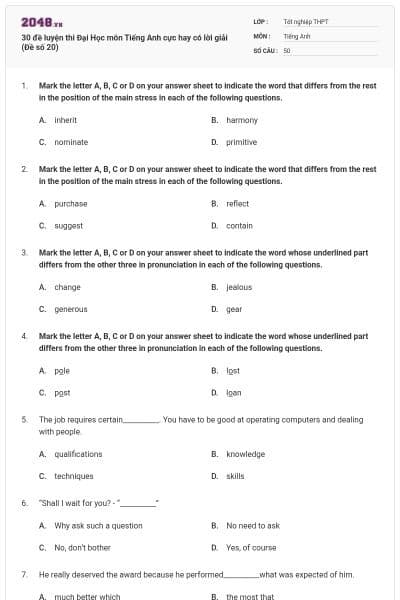
Mark the letter A, B, C or D on your answer sheet to indicate the word that differs from the rest in the position of the main stress in each of the following questions.
inherit
harmony
nominate
primitive
Đáp án A
Từ inherit có trọng âm rơi âm tiết thứ hai, các từ còn lại có trọng âm rơi âm tiết thứ nhất.
Mark the letter A, B, C or D on your answer sheet to indicate the word that differs from the rest in the position of the main stress in each of the following questions.
purchase
reflect
suggest
contain
Đáp án A
Từ purchase có trọng âm rơi âm tiết thứ nhất, các từ còn lại có trọng âm rơi âm tiết thứ hai.
Mark the letter A, B, C or D on your answer sheet to indicate the word whose underlined part differs from the other three in pronunciation in each of the following questions.
change
jealous
generous
gear
Đáp án D
Từ gear có phần gạch chân được phát âm là /g/, các từ còn lại có phần gạch chân được phát âm là /dﮋ/
Mark the letter A, B, C or D on your answer sheet to indicate the word whose underlined part differs from the other three in pronunciation in each of the following questions.
pole
lost
post
loan
Đáp án B
Từ lost có phần gạch chân được phát âm là /o/, các từ còn lại có phần gạch chân được phát âm là /o/
The job requires certain__________. You have to be good at operating computers and dealing with people.
qualifications
knowledge
techniques
skills
Đáp án D
skills: các kỹ năng. operating computers and dealing with people :điều hành máy tính và đối nhân xử thế - có thể được gọi là các kỹ năng.
Các từ còn lại: qualifications: trình độ; knowledge: kiến thức; techniques: kỹ thuật
“Shall I wait for you? - “__________”
Why ask such a question
No need to ask
No, don’t bother
Yes, of course
Đáp án C
Câu này hỏi về kỹ năng giao tiếp: “Shall I wait for you? - Tôi sẽ chờ bạn? - Lời đề nghị
He really deserved the award because he performed__________what was expected of him.
much better which
the most that
much more as
much better than
Đáp án D
Chúng ta có thể dùng “much” đứng trước cách tính từ so sánh hơn để tăng mức độ
“…….hơn nhiều”
Dịch: Anh ấy thực sự xứng đáng với giải thưởng vì anh ấy đã thực hiện tốt hơn nhiều so với những gì được mong đợi.
__________it would stop raining for a morning, we could cut the grass.
If ever
If only
On condition that
In case
Đáp án B
If only: giá như... ( giả định cách, diễn tả mong ước không có thật)
Các liên từ còn lại: On condition that: với điều kiện là; In case: phòng khi ; if ever: chắc như vậy đó, sự thật là vậy
__________attention we pay to commercials, we cannot avoid being influenced by the constant repetition of a brand name or image.
However little
In spite of the
No matter what
Only a little
Đáp án: A
Giải thích:
Cấu trúc chỉ sự nhượng bộ “ mặc dù...nhưng ”: However + adj/adv + S + V, S + V.
Dịch: Dù ít để ý đến quảng cáo, chúng ta vẫn không thể tránh bị ảnh hưởng bởi sự lặp lại liên tục của tên hoặc hình ảnh của 1 thương hiệu.
__________the phone rang later that night did Anna remember the appointment.
Not until
Just before
Only
No sooner
Đáp án A
Cấu trúc đảo ngữ: Not only + phrase/ clause + auxiliary + S+ V: cho đến khi...thì.
Dịch: Cho đến khi điện thoại reo trong đêm đó thì Anna mới nhớ cuộc hẹn.
Các từ còn lại: Just before: ngay trước khi; only: chỉ; No sooner …..than….: ngay khi…thì….
Only__________research has been carried out in this field.
a few
a little
very little
not much
Đáp án B
research là danh từ không đếm được, có only đứng trước => dùng a little. Only a little: có rất ít (nhấn mạnh).
The small,__________farms of New England were not appropriate for the Midwest.
self-supporting
supporting themselves
self-supported
they supported themselves
Đáp án A
self-supporting: tự cung
Hurry up! They’ve only got__________seats left.
a little
a few
a lot of
plenty
Đáp án B
a few + Ns: có rất ít, hầu như không có ( mang nghĩa phủ định )
Dịch: Nhanh lên! Họ chỉ có một vài chỗ còn lại.
Các từ còn lại: a little + N(uncountable): có rất ít, hầu như không có ( mang nghĩa phủ định ); a lot of: nhiều; plenty thường theo cấu trúc “ a plenty of: nhiều .”
The Computer has had an enormous__________on the way we work.
change
alteration
influence
impression
Đáp án D
have an influence on: có sự ảnh hưởng đến..
Các từ còn lại: change: sự thay đổi; alteration: sự biến đổi; impression: ấn tượng
I don’t think Mike will reject that job offer,__________?
do I
will he
won't he
don't I
Đáp án B
“I don’t think” mang nghĩ phủ định cho cả vế rồi => láy đuôi ở khẳng định.
The wet weather has__________three weeks now; It has rained every single day.
lasted
gone
run
existed
Đáp án: A
Giải thích:
Kiến thức: Từ vựng
last (v): kéo dài
go (v): đi
run (v): chạy
exist (v): tồn tại
Dựa vào nghĩa, chọn A.
Dịch: Thời tiết ẩm ướt này đã kéo dài ba tuần nay. Trời đã mưa mỗi ngày.
__________on several different television programs, the witness gave conflicting accounts of what had happened.
Appearing
Appears
He appeared
Who appeare
Đáp án A
Lược bỏ chủ ngữ khi hai vế đồng chủ ngữ, ta dùng V-ing trong câu chủ động và V-ed trong câu bị động.
I phoned the company, who _____ me that my goods had been dispatched.
guaranteed
assured
reassured
confirmed
Đáp án B
assure someone that. : cam đoan với ai rằng..
Các từ còn lại: guarantee: bảo hành; reassure: trấn an; confirm: xác nhận
Mark the letter A, B, C or D on your answer sheets to indicate the word (s) SIMILAR in meaning to the underlined word (s) in each of the following questions.
By the end of the storm, the hikers had depleted even their emergency stores.
destroyed
Lost
used almost all of
greatly dropped
Đáp án C
deplete: dùng hết, làm cạn kiệt => Đáp án là C. used almost all of: sử dụng hầu hết tất cả..
Các đáp án còn lại: A. phá hủy; B. làm mất; D. giảm đáng kể
Mark the letter A, B, C or D on your answer sheets to indicate the word (s) SIMILAR in meaning to the underlined word (s) in each of the following questions.
Originally the builders have me a price of $5,000, but now they say they underestimated it, and now it’s going to be at least $8,000.
underrated
outnumbered
undervalued
misjudged
Đáp án C
underestimate = undervalue: đánh giá thấp
Các từ còn lại: A. underrate: hạ thấp; outnumber: đông hơn; misjudge: đánh giá sa
Mark the letter A, B, C or D on your answer sheets to indicate the word (s) SIMILAR in meaning to the underlined word (s) in each of the following questions.
Please stop making that noise! It really gets on my nerves.
Cheers me up
wakes me up
annoys me
amuses me
Đáp án C
It gets on one’s nerves: làm ai phát bực lên. => Đáp án là C.
Các đáp án còn lại: A. khiến tôi phấn chấn lên; B. đánh thức tôi; khiến tôi phấn khích
Mark the letter A, B, C or D on your answer sheets to indicate the word (s) SIMILAR in meaning to the underlined word (s) in each of the following questions.
It is inevitable that smoking will damage your health.
invading
intriguing
unavoidable
unhealthy
Đáp án C
unavoidable = inevitable : không thể tránh khỏi
Nghĩa các từ còn lại: invading: xâm lược; intriguing: hấp dẫn; unhealthy: hại sức khỏe
Read the following passage and mark the letter A, B, C or D on your answer sheet to indicate the correct word or phrase for each of the blanks.
School exams are, generally speaking, the first kind of test we take. They find out how much knowledge we have gained. But do they really show how intelligent we are? After all, isn’t it a __(23)__ that some people who are very academically successful don’t have any common sense. Intelligence is the speed ___(24)___ which we can understand and react to new situations and it is usually tested by logic puzzles. Although scientist are now preparing ___(25)___ computer technology that will be able to “read” our brains, __(26)__ tests are still the most popular ways of measuring intelligence.
A person’s IQ is their intelligence ___(27)__ it is measured by a special test. The most common IT tests are run by Mensa, an organization that was found in England in 1946. By 1976, it had 1,300 members in Britain. Today there are 44,000 in Britain and 100,000 worldwide , largely inthe US.
Điền vào số (23)
truth
case
circumstances
fact
Đáp án D
a fact that +....: một thực tế rằng ....
Các từ còn lại: truth: sự thật; case: trường hợp; circumstances: hoàn cảnh
Read the following passage and mark the letter A, B, C or D on your answer sheet to indicate the correct word or phrase for each of the blanks.
School exams are, generally speaking, the first kind of test we take. They find out how much knowledge we have gained. But do they really show how intelligent we are? After all, isn’t it a__________(23)__________that some people who are very academically successful don’t have any common sense. Intelligence is the speed__________(24)__________which we can understand and react to new situations and it is usually tested by logic puzzles. Although scientist are now preparing__________(25)__________computer technology that will be able to “read” our brains,__________(26)__________tests are still the most popular ways of measuring intelligence.
A person’s IQ is their intelligence__________(27)__________it is measured by a special test. The most common IT tests are run by Mensa, an organization that was found in England in 1946. By 1976, it had 1,300 members in Britain. Today there are 44,000 in Britain and 100,000 worldwide , largely inthe US.
Điền vào số (24)
on
in
at
to
Đáp án C
at which = at the speed: ở tốc độ ..
Read the following passage and mark the letter A, B, C or D on your answer sheet to indicate the correct word or phrase for each of the blanks.
School exams are, generally speaking, the first kind of test we take. They find out how much knowledge we have gained. But do they really show how intelligent we are? After all, isn’t it a__________(23)__________that some people who are very academically successful don’t have any common sense. Intelligence is the speed__________(24)__________which we can understand and react to new situations and it is usually tested by logic puzzles. Although scientist are now preparing__________(25)__________computer technology that will be able to “read” our brains,__________(26)__________tests are still the most popular ways of measuring intelligence.
A person’s IQ is their intelligence__________(27)__________it is measured by a special test. The most common IT tests are run by Mensa, an organization that was found in England in 1946. By 1976, it had 1,300 members in Britain. Today there are 44,000 in Britain and 100,000 worldwide , largely inthe US.
Điền vào số (25)
forwward
ahead
upper
advanced
Đáp án D
advanced: tiên tiến
Nghĩa các từ còn lại: forward: phía trước; ahead: phía trước; upper: cao hơn ( vị trí, địa vị )
Read the following passage and mark the letter A, B, C or D on your answer sheet to indicate the correct word or phrase for each of the blanks.
School exams are, generally speaking, the first kind of test we take. They find out how much knowledge we have gained. But do they really show how intelligent we are? After all, isn’t it a__________(23)__________that some people who are very academically successful don’t have any common sense. Intelligence is the speed__________(24)__________which we can understand and react to new situations and it is usually tested by logic puzzles. Although scientist are now preparing__________(25)__________computer technology that will be able to “read” our brains,__________(26)__________tests are still the most popular ways of measuring intelligence.
A person’s IQ is their intelligence__________(27)__________it is measured by a special test. The most common IT tests are run by Mensa, an organization that was found in England in 1946. By 1976, it had 1,300 members in Britain. Today there are 44,000 in Britain and 100,000 worldwide , largely inthe US.
Điền vào số (26)
now and
at this age
at the time
for the
Đáp án D
for the present : bây giờ
Các từ còn lại: now and then: thỉnh thoảng; at this age: ở độ tuổi này; at the time: tại thời điểm
Read the following passage and mark the letter A, B, C or D on your answer sheet to indicate the correct word or phrase for each of the blanks.
School exams are, generally speaking, the first kind of test we take. They find out how much knowledge we have gained. But do they really show how intelligent we are? After all, isn’t it a__________(23)__________that some people who are very academically successful don’t have any common sense. Intelligence is the speed__________(24)__________which we can understand and react to new situations and it is usually tested by logic puzzles. Although scientist are now preparing__________(25)__________computer technology that will be able to “read” our brains,__________(26)__________tests are still the most popular ways of measuring intelligence.
A person’s IQ is their intelligence__________(27)__________it is measured by a special test. The most common IT tests are run by Mensa, an organization that was found in England in 1946. By 1976, it had 1,300 members in Britain. Today there are 44,000 in Britain and 100,000 worldwide , largely inthe US.
Điền vào số (27)
as
that
so
how
Đáp án A
as ( liên từ ): kh
Read the following passage and mark the letter A, B, C or D on your answer sheet to indicate the correct answer to each of the questions
At 7 pm on a dark, cold November evening, thousands of people are making their way across a vast car park. They're not here to see a film, or the ballet, or even the circus. They are all here for what is, bizarrely, a global phenomenon: they are here to see Holiday on Ice. Given that most people don’t seem to be acquainted with anyone who's ever been, the show's statistics are extraordinary: nearly 300 million people have seen Holiday on Ice since it began in 1943; it is the most popular live entertainment in the world.
But what does the production involve? And why are so many people prepared to spend their lives travelling round Europe in caravans in order to appear in it? It can't be glamorous, and it's undoubtedly hard work. The backstage atmosphere is an odd mix of gym class and workplace. A curtained-off section at the back of the arena is laughably referred to as the girls' dressing room, but is more accurately described as a corridor, with beige, cracked walls and cheap temporary tables set up along the length of it. Each girl has a small area littered with pots of orange make-up, tubes of mascara and long false eyelashes.
As a place to work, it must rank pretty low down the scale: the area round the ice-rink is grey and mucky with rows of dirty blue and brown plastic seating and red carpet tiles. It's an unimpressive picture, but the show itself is an unquestionably vast, polished global enterprise: the lights come from a firm in Texas, the people who make the audio system are in California, but Montreal supplies the smoke effects; former British Olympic skater Robin Cousins is now creative director for the company and conducts a vast master class to make sure they're ready for the show's next performance.
The next day, as the music blares out from the sound system, the case start to go through their routines under Cousins' direction. Cousins says, 'The aim is to make sure they're all still getting to exactly the right place on the ice at the right time - largely because the banks of lights in the ceiling are set to those places, and if the skaters are all half a metre out they'll be illuminating empty ice. Our challenge, ' he continues, 'is to produce something they can sell in a number of countries at the same time. My theory is that you take those things that people want to see and you give it to them, but not in the way they expect to see it. You try to twist it. And you have to find music that is challenging to the skaters, because they have to do it every night.'
It may be a job which he took to pay the rent, but you can’t doubt his enthusiasm. 'They only place you'll see certain skating moves is an ice show,' he says, 'because you're not allowed to do them in competition. It's not in the rules. So the ice show word has things to offer which the competitive world just doesn't. Cousins knows what he's talking about because he skated for the show himself when he stopped competing - he was financially unable to retire. He learnt the hard way that you can't put on an Olympic performance every night. I'd be thinking, these people have paid their money, now do your stuff, and I suddenly thought, "I really can't cope. I'm not enjoying it".' The solution, he realized, was to give 75 per cent every night, rather than striving for the sort of twice-a-year excellence which won him medals.
To be honest, for those of us whose only experience of ice-skating is watching top-class Olympic skaters, some of the movements can look a bit amateurish, but then, who are we to judge? Equally, it's impossible not to be swept up in the whole thing; well, you'd have to try pretty hard not to enjoy it.
What surprises the writer about the popularity of Holiday on Ice?
Few people know someone who has seen it.
The show has not changed since it started.
Ice-skating is not generally a popular hobby.
People often say they prefer other types of show.
Đáp án A
Dựa vào đoạn 1 trong bài: .. Given that most people don’t seem to be acquainted with anyone who's ever been.
Read the following passage and mark the letter A, B, C or D on your answer sheet to indicate the correct answer to each of the questions
At 7 pm on a dark, cold November evening, thousands of people are making their way across a vast car park. They're not here to see a film, or the ballet, or even the circus. They are all here for what is, bizarrely, a global phenomenon: they are here to see Holiday on Ice. Given that most people don’t seem to be acquainted with anyone who's ever been, the show's statistics are extraordinary: nearly 300 million people have seen Holiday on Ice since it began in 1943; it is the most popular live entertainment in the world.
But what does the production involve? And why are so many people prepared to spend their lives travelling round Europe in caravans in order to appear in it? It can't be glamorous, and it's undoubtedly hard work. The backstage atmosphere is an odd mix of gym class and workplace. A curtained-off section at the back of the arena is laughably referred to as the girls' dressing room, but is more accurately described as a corridor, with beige, cracked walls and cheap temporary tables set up along the length of it. Each girl has a small area littered with pots of orange make-up, tubes of mascara and long false eyelashes.
As a place to work, it must rank pretty low down the scale: the area round the ice-rink is grey and mucky with rows of dirty blue and brown plastic seating and red carpet tiles. It's an unimpressive picture, but the show itself is an unquestionably vast, polished global enterprise: the lights come from a firm in Texas, the people who make the audio system are in California, but Montreal supplies the smoke effects; former British Olympic skater Robin Cousins is now creative director for the company and conducts a vast master class to make sure they're ready for the show's next performance.
The next day, as the music blares out from the sound system, the case start to go through their routines under Cousins' direction. Cousins says, 'The aim is to make sure they're all still getting to exactly the right place on the ice at the right time - largely because the banks of lights in the ceiling are set to those places, and if the skaters are all half a metre out they'll be illuminating empty ice. Our challenge, ' he continues, 'is to produce something they can sell in a number of countries at the same time. My theory is that you take those things that people want to see and you give it to them, but not in the way they expect to see it. You try to twist it. And you have to find music that is challenging to the skaters, because they have to do it every night.'
It may be a job which he took to pay the rent, but you can’t doubt his enthusiasm. 'They only place you'll see certain skating moves is an ice show,' he says, 'because you're not allowed to do them in competition. It's not in the rules. So the ice show word has things to offer which the competitive world just doesn't. Cousins knows what he's talking about because he skated for the show himself when he stopped competing - he was financially unable to retire. He learnt the hard way that you can't put on an Olympic performance every night. I'd be thinking, these people have paid their money, now do your stuff, and I suddenly thought, "I really can't cope. I'm not enjoying it".' The solution, he realized, was to give 75 per cent every night, rather than striving for the sort of twice-a-year excellence which won him medals.
To be honest, for those of us whose only experience of ice-skating is watching top-class Olympic skaters, some of the movements can look a bit amateurish, but then, who are we to judge? Equally, it's impossible not to be swept up in the whole thing; well, you'd have to try pretty hard not to enjoy it.
The writer describes the backstage area in order to show
the type of skater that the show attracts
how much preparation is needed for a performance
how much fun the cast have during their work
the conditions that the skaters put up with
Đáp án D
Dựa vào đoạn 2 và 4
Read the following passage and mark the letter A, B, C or D on your answer sheet to indicate the correct answer to each of the questions
At 7 pm on a dark, cold November evening, thousands of people are making their way across a vast car park. They're not here to see a film, or the ballet, or even the circus. They are all here for what is, bizarrely, a global phenomenon: they are here to see Holiday on Ice. Given that most people don’t seem to be acquainted with anyone who's ever been, the show's statistics are extraordinary: nearly 300 million people have seen Holiday on Ice since it began in 1943; it is the most popular live entertainment in the world.
But what does the production involve? And why are so many people prepared to spend their lives travelling round Europe in caravans in order to appear in it? It can't be glamorous, and it's undoubtedly hard work. The backstage atmosphere is an odd mix of gym class and workplace. A curtained-off section at the back of the arena is laughably referred to as the girls' dressing room, but is more accurately described as a corridor, with beige, cracked walls and cheap temporary tables set up along the length of it. Each girl has a small area littered with pots of orange make-up, tubes of mascara and long false eyelashes.
As a place to work, it must rank pretty low down the scale: the area round the ice-rink is grey and mucky with rows of dirty blue and brown plastic seating and red carpet tiles. It's an unimpressive picture, but the show itself is an unquestionably vast, polished global enterprise: the lights come from a firm in Texas, the people who make the audio system are in California, but Montreal supplies the smoke effects; former British Olympic skater Robin Cousins is now creative director for the company and conducts a vast master class to make sure they're ready for the show's next performance.
The next day, as the music blares out from the sound system, the case start to go through their routines under Cousins' direction. Cousins says, 'The aim is to make sure they're all still getting to exactly the right place on the ice at the right time - largely because the banks of lights in the ceiling are set to those places, and if the skaters are all half a metre out they'll be illuminating empty ice. Our challenge, ' he continues, 'is to produce something they can sell in a number of countries at the same time. My theory is that you take those things that people want to see and you give it to them, but not in the way they expect to see it. You try to twist it. And you have to find music that is challenging to the skaters, because they have to do it every night.'
It may be a job which he took to pay the rent, but you can’t doubt his enthusiasm. 'They only place you'll see certain skating moves is an ice show,' he says, 'because you're not allowed to do them in competition. It's not in the rules. So the ice show word has things to offer which the competitive world just doesn't. Cousins knows what he's talking about because he skated for the show himself when he stopped competing - he was financially unable to retire. He learnt the hard way that you can't put on an Olympic performance every night. I'd be thinking, these people have paid their money, now do your stuff, and I suddenly thought, "I really can't cope. I'm not enjoying it".' The solution, he realized, was to give 75 per cent every night, rather than striving for the sort of twice-a-year excellence which won him medals.
To be honest, for those of us whose only experience of ice-skating is watching top-class Olympic skaters, some of the movements can look a bit amateurish, but then, who are we to judge? Equally, it's impossible not to be swept up in the whole thing; well, you'd have to try pretty hard not to enjoy it.
The word blares out in paragraph 3 is closest in meaning to
seeps out
sounds beautifully
resounds loudly
rings
Đáp án C
blares out = resounds loudly: vang lên ầm ĩ
Read the following passage and mark the letter A, B, C or D on your answer sheet to indicate the correct answer to each of the questions
At 7 pm on a dark, cold November evening, thousands of people are making their way across a vast car park. They're not here to see a film, or the ballet, or even the circus. They are all here for what is, bizarrely, a global phenomenon: they are here to see Holiday on Ice. Given that most people don’t seem to be acquainted with anyone who's ever been, the show's statistics are extraordinary: nearly 300 million people have seen Holiday on Ice since it began in 1943; it is the most popular live entertainment in the world.
But what does the production involve? And why are so many people prepared to spend their lives travelling round Europe in caravans in order to appear in it? It can't be glamorous, and it's undoubtedly hard work. The backstage atmosphere is an odd mix of gym class and workplace. A curtained-off section at the back of the arena is laughably referred to as the girls' dressing room, but is more accurately described as a corridor, with beige, cracked walls and cheap temporary tables set up along the length of it. Each girl has a small area littered with pots of orange make-up, tubes of mascara and long false eyelashes.
As a place to work, it must rank pretty low down the scale: the area round the ice-rink is grey and mucky with rows of dirty blue and brown plastic seating and red carpet tiles. It's an unimpressive picture, but the show itself is an unquestionably vast, polished global enterprise: the lights come from a firm in Texas, the people who make the audio system are in California, but Montreal supplies the smoke effects; former British Olympic skater Robin Cousins is now creative director for the company and conducts a vast master class to make sure they're ready for the show's next performance.
The next day, as the music blares out from the sound system, the case start to go through their routines under Cousins' direction. Cousins says, 'The aim is to make sure they're all still getting to exactly the right place on the ice at the right time - largely because the banks of lights in the ceiling are set to those places, and if the skaters are all half a metre out they'll be illuminating empty ice. Our challenge, ' he continues, 'is to produce something they can sell in a number of countries at the same time. My theory is that you take those things that people want to see and you give it to them, but not in the way they expect to see it. You try to twist it. And you have to find music that is challenging to the skaters, because they have to do it every night.'
It may be a job which he took to pay the rent, but you can’t doubt his enthusiasm. 'They only place you'll see certain skating moves is an ice show,' he says, 'because you're not allowed to do them in competition. It's not in the rules. So the ice show word has things to offer which the competitive world just doesn't. Cousins knows what he's talking about because he skated for the show himself when he stopped competing - he was financially unable to retire. He learnt the hard way that you can't put on an Olympic performance every night. I'd be thinking, these people have paid their money, now do your stuff, and I suddenly thought, "I really can't cope. I'm not enjoying it".' The solution, he realized, was to give 75 per cent every night, rather than striving for the sort of twice-a-year excellence which won him medals.
To be honest, for those of us whose only experience of ice-skating is watching top-class Olympic skaters, some of the movements can look a bit amateurish, but then, who are we to judge? Equally, it's impossible not to be swept up in the whole thing; well, you'd have to try pretty hard not to enjoy it.
What does the writer highlight about the show in the third paragraph?
the variety of places in which the show has been staged
the range of companies involved in the production
the need for a higher level of professional support
the difficulty of finding suitable equipment
Đáp án B
the range of companies involved in the production: phạm vi của các công ty tham gia sản xuất
Dựa vào các chi tiết: the lights come from a firm in Texas, the people who make the audio System are in California, but Montreal supplies the smoke effects; former British Olympic skater Robin Cousins is now creative director for the company and conducts a vast master class to make sure they're ready for the show's next performance.
Read the following passage and mark the letter A, B, C or D on your answer sheet to indicate the correct answer to each of the questions
At 7 pm on a dark, cold November evening, thousands of people are making their way across a vast car park. They're not here to see a film, or the ballet, or even the circus. They are all here for what is, bizarrely, a global phenomenon: they are here to see Holiday on Ice. Given that most people don’t seem to be acquainted with anyone who's ever been, the show's statistics are extraordinary: nearly 300 million people have seen Holiday on Ice since it began in 1943; it is the most popular live entertainment in the world.
But what does the production involve? And why are so many people prepared to spend their lives travelling round Europe in caravans in order to appear in it? It can't be glamorous, and it's undoubtedly hard work. The backstage atmosphere is an odd mix of gym class and workplace. A curtained-off section at the back of the arena is laughably referred to as the girls' dressing room, but is more accurately described as a corridor, with beige, cracked walls and cheap temporary tables set up along the length of it. Each girl has a small area littered with pots of orange make-up, tubes of mascara and long false eyelashes.
As a place to work, it must rank pretty low down the scale: the area round the ice-rink is grey and mucky with rows of dirty blue and brown plastic seating and red carpet tiles. It's an unimpressive picture, but the show itself is an unquestionably vast, polished global enterprise: the lights come from a firm in Texas, the people who make the audio system are in California, but Montreal supplies the smoke effects; former British Olympic skater Robin Cousins is now creative director for the company and conducts a vast master class to make sure they're ready for the show's next performance.
The next day, as the music blares out from the sound system, the case start to go through their routines under Cousins' direction. Cousins says, 'The aim is to make sure they're all still getting to exactly the right place on the ice at the right time - largely because the banks of lights in the ceiling are set to those places, and if the skaters are all half a metre out they'll be illuminating empty ice. Our challenge, ' he continues, 'is to produce something they can sell in a number of countries at the same time. My theory is that you take those things that people want to see and you give it to them, but not in the way they expect to see it. You try to twist it. And you have to find music that is challenging to the skaters, because they have to do it every night.'
It may be a job which he took to pay the rent, but you can’t doubt his enthusiasm. 'They only place you'll see certain skating moves is an ice show,' he says, 'because you're not allowed to do them in competition. It's not in the rules. So the ice show word has things to offer which the competitive world just doesn't. Cousins knows what he's talking about because he skated for the show himself when he stopped competing - he was financially unable to retire. He learnt the hard way that you can't put on an Olympic performance every night. I'd be thinking, these people have paid their money, now do your stuff, and I suddenly thought, "I really can't cope. I'm not enjoying it".' The solution, he realized, was to give 75 per cent every night, rather than striving for the sort of twice-a-year excellence which won him medals.
To be honest, for those of us whose only experience of ice-skating is watching top-class Olympic skaters, some of the movements can look a bit amateurish, but then, who are we to judge? Equally, it's impossible not to be swept up in the whole thing; well, you'd have to try pretty hard not to enjoy it.
The word them in paragraph 4 refers to
things that people want to see
skating moves
the skaters
skating competitions
Đáp án B
skating moves: chuyển động trượt
Ý trong bài; 'They only place you'll see certain skating moves is an ice show,' he says, 'because you're not allowed to do them in competition
Read the following passage and mark the letter A, B, C or D on your answer sheet to indicate the correct answer to each of the questions
At 7 pm on a dark, cold November evening, thousands of people are making their way across a vast car park. They're not here to see a film, or the ballet, or even the circus. They are all here for what is, bizarrely, a global phenomenon: they are here to see Holiday on Ice. Given that most people don’t seem to be acquainted with anyone who's ever been, the show's statistics are extraordinary: nearly 300 million people have seen Holiday on Ice since it began in 1943; it is the most popular live entertainment in the world.
But what does the production involve? And why are so many people prepared to spend their lives travelling round Europe in caravans in order to appear in it? It can't be glamorous, and it's undoubtedly hard work. The backstage atmosphere is an odd mix of gym class and workplace. A curtained-off section at the back of the arena is laughably referred to as the girls' dressing room, but is more accurately described as a corridor, with beige, cracked walls and cheap temporary tables set up along the length of it. Each girl has a small area littered with pots of orange make-up, tubes of mascara and long false eyelashes.
As a place to work, it must rank pretty low down the scale: the area round the ice-rink is grey and mucky with rows of dirty blue and brown plastic seating and red carpet tiles. It's an unimpressive picture, but the show itself is an unquestionably vast, polished global enterprise: the lights come from a firm in Texas, the people who make the audio system are in California, but Montreal supplies the smoke effects; former British Olympic skater Robin Cousins is now creative director for the company and conducts a vast master class to make sure they're ready for the show's next performance.
The next day, as the music blares out from the sound system, the case start to go through their routines under Cousins' direction. Cousins says, 'The aim is to make sure they're all still getting to exactly the right place on the ice at the right time - largely because the banks of lights in the ceiling are set to those places, and if the skaters are all half a metre out they'll be illuminating empty ice. Our challenge, ' he continues, 'is to produce something they can sell in a number of countries at the same time. My theory is that you take those things that people want to see and you give it to them, but not in the way they expect to see it. You try to twist it. And you have to find music that is challenging to the skaters, because they have to do it every night.'
It may be a job which he took to pay the rent, but you can’t doubt his enthusiasm. 'They only place you'll see certain skating moves is an ice show,' he says, 'because you're not allowed to do them in competition. It's not in the rules. So the ice show word has things to offer which the competitive world just doesn't. Cousins knows what he's talking about because he skated for the show himself when he stopped competing - he was financially unable to retire. He learnt the hard way that you can't put on an Olympic performance every night. I'd be thinking, these people have paid their money, now do your stuff, and I suddenly thought, "I really can't cope. I'm not enjoying it".' The solution, he realized, was to give 75 per cent every night, rather than striving for the sort of twice-a-year excellence which won him medals.
To be honest, for those of us whose only experience of ice-skating is watching top-class Olympic skaters, some of the movements can look a bit amateurish, but then, who are we to judge? Equally, it's impossible not to be swept up in the whole thing; well, you'd have to try pretty hard not to enjoy it.
For Robin Cousins, the key point when rehearsing skating routines is
filling all available space on the ice
the movement of the lights
keeping in time with the music
the skaters' positions onthe rice
Đáp án D
Dựa vào đoạn 4: ... 'The aim is to make sure they're all still getting to exactly the right place on the ice at the right time - largely.
Read the following passage and mark the letter A, B, C or D on your answer sheet to indicate the correct answer to each of the questions
At 7 pm on a dark, cold November evening, thousands of people are making their way across a vast car park. They're not here to see a film, or the ballet, or even the circus. They are all here for what is, bizarrely, a global phenomenon: they are here to see Holiday on Ice. Given that most people don’t seem to be acquainted with anyone who's ever been, the show's statistics are extraordinary: nearly 300 million people have seen Holiday on Ice since it began in 1943; it is the most popular live entertainment in the world.
But what does the production involve? And why are so many people prepared to spend their lives travelling round Europe in caravans in order to appear in it? It can't be glamorous, and it's undoubtedly hard work. The backstage atmosphere is an odd mix of gym class and workplace. A curtained-off section at the back of the arena is laughably referred to as the girls' dressing room, but is more accurately described as a corridor, with beige, cracked walls and cheap temporary tables set up along the length of it. Each girl has a small area littered with pots of orange make-up, tubes of mascara and long false eyelashes.
As a place to work, it must rank pretty low down the scale: the area round the ice-rink is grey and mucky with rows of dirty blue and brown plastic seating and red carpet tiles. It's an unimpressive picture, but the show itself is an unquestionably vast, polished global enterprise: the lights come from a firm in Texas, the people who make the audio system are in California, but Montreal supplies the smoke effects; former British Olympic skater Robin Cousins is now creative director for the company and conducts a vast master class to make sure they're ready for the show's next performance.
The next day, as the music blares out from the sound system, the case start to go through their routines under Cousins' direction. Cousins says, 'The aim is to make sure they're all still getting to exactly the right place on the ice at the right time - largely because the banks of lights in the ceiling are set to those places, and if the skaters are all half a metre out they'll be illuminating empty ice. Our challenge, ' he continues, 'is to produce something they can sell in a number of countries at the same time. My theory is that you take those things that people want to see and you give it to them, but not in the way they expect to see it. You try to twist it. And you have to find music that is challenging to the skaters, because they have to do it every night.'
It may be a job which he took to pay the rent, but you can’t doubt his enthusiasm. 'They only place you'll see certain skating moves is an ice show,' he says, 'because you're not allowed to do them in competition. It's not in the rules. So the ice show word has things to offer which the competitive world just doesn't. Cousins knows what he's talking about because he skated for the show himself when he stopped competing - he was financially unable to retire. He learnt the hard way that you can't put on an Olympic performance every night. I'd be thinking, these people have paid their money, now do your stuff, and I suddenly thought, "I really can't cope. I'm not enjoying it".' The solution, he realized, was to give 75 per cent every night, rather than striving for the sort of twice-a-year excellence which won him medals.
To be honest, for those of us whose only experience of ice-skating is watching top-class Olympic skaters, some of the movements can look a bit amateurish, but then, who are we to judge? Equally, it's impossible not to be swept up in the whole thing; well, you'd have to try pretty hard not to enjoy it.
What is meant by 'the hard way'?
through making a lot of errors
through difficult personal experience
by over-estimating the ability of others
by misunderstanding the expectations of others
Đáp án B
'the hard way' = through difficult personal experience: qua trải nghiệm khó khăn của cá nhân
Read the following passage and mark the letter A, B, C or D on your answer sheet to indicate the correct answer to each of the questions
At 7 pm on a dark, cold November evening, thousands of people are making their way across a vast car park. They're not here to see a film, or the ballet, or even the circus. They are all here for what is, bizarrely, a global phenomenon: they are here to see Holiday on Ice. Given that most people don’t seem to be acquainted with anyone who's ever been, the show's statistics are extraordinary: nearly 300 million people have seen Holiday on Ice since it began in 1943; it is the most popular live entertainment in the world.
But what does the production involve? And why are so many people prepared to spend their lives travelling round Europe in caravans in order to appear in it? It can't be glamorous, and it's undoubtedly hard work. The backstage atmosphere is an odd mix of gym class and workplace. A curtained-off section at the back of the arena is laughably referred to as the girls' dressing room, but is more accurately described as a corridor, with beige, cracked walls and cheap temporary tables set up along the length of it. Each girl has a small area littered with pots of orange make-up, tubes of mascara and long false eyelashes.
As a place to work, it must rank pretty low down the scale: the area round the ice-rink is grey and mucky with rows of dirty blue and brown plastic seating and red carpet tiles. It's an unimpressive picture, but the show itself is an unquestionably vast, polished global enterprise: the lights come from a firm in Texas, the people who make the audio system are in California, but Montreal supplies the smoke effects; former British Olympic skater Robin Cousins is now creative director for the company and conducts a vast master class to make sure they're ready for the show's next performance.
The next day, as the music blares out from the sound system, the case start to go through their routines under Cousins' direction. Cousins says, 'The aim is to make sure they're all still getting to exactly the right place on the ice at the right time - largely because the banks of lights in the ceiling are set to those places, and if the skaters are all half a metre out they'll be illuminating empty ice. Our challenge, ' he continues, 'is to produce something they can sell in a number of countries at the same time. My theory is that you take those things that people want to see and you give it to them, but not in the way they expect to see it. You try to twist it. And you have to find music that is challenging to the skaters, because they have to do it every night.'
It may be a job which he took to pay the rent, but you can’t doubt his enthusiasm. 'They only place you'll see certain skating moves is an ice show,' he says, 'because you're not allowed to do them in competition. It's not in the rules. So the ice show word has things to offer which the competitive world just doesn't. Cousins knows what he's talking about because he skated for the show himself when he stopped competing - he was financially unable to retire. He learnt the hard way that you can't put on an Olympic performance every night. I'd be thinking, these people have paid their money, now do your stuff, and I suddenly thought, "I really can't cope. I'm not enjoying it".' The solution, he realized, was to give 75 per cent every night, rather than striving for the sort of twice-a-year excellence which won him medals.
To be honest, for those of us whose only experience of ice-skating is watching top-class Olympic skaters, some of the movements can look a bit amateurish, but then, who are we to judge? Equally, it's impossible not to be swept up in the whole thing; well, you'd have to try pretty hard not to enjoy it.
What conclusion does the writer draw about Holiday on Ice?
It is hard to know who really enjoys it
It is more enjoyable to watch than formal ice-skating
It requires as much skill as Olympic ice-skating
It is difficult to dislike it
Đáp án D
Ý trong bài: Equally, it's impossible not to be swept up in the whole thing; well, you'd have to try pretty hard not to enjoy it.
Read the following passage and mark the letter A, B, C or D on your answer sheet to indicate the correct answer to each of the questions
Before the 1500’s, the western plains of North America were dominated by farmers. One group, the Mandans, lived in the upper Missouri River country, primarily in present - day North Dakota. They had large villages of houses built close together. The tight arrangement enabled the Mandans to protect themselves more easily from the attacks of others who might seek to obtain some of the food these highly capable farmers stored from one year to the next.
The women had primary responsibility for the fields. They had to exercise considerable skill to produce the desired results, for their northern location meant fleeting growing seasons. Winter often lingered; autumn could be ushered in by severe frost. For good measure, during the spring and summer, drought, heat, hail, grasshoppers, and other frustrations might await the wary grower.
Under such conditions, Mandan women had to grow maize capable of weathering adversity. They began as early as it appeared feasible to do so in the spring, clearing the land, using fire to clear stubble from the fields and then planting. From this point until the first green corn could be harvested, the crop required labor and vigilance.
Harvesting proceeded in two stages. In August the Mandans picked a smaller amount of the crop before it had matured fully. This green corn was boiled, dried and shelled, with some of the maize slated for immediate consumption and the rest stored in animal - skin bags. Later in the fall, the people picked the rest of the corn. They saved the best of the harvest for seeds or for trade, with the remainder eaten right away or stored for alter use in underground reserves. With appropriate banking of the extra food, the Mandans protected themselves against the disaster of crop failure and accompany hunger.
The woman planted another staple, squash, about the first of June, and harvested it near the time of the green corn harvest. After they picked it, they sliced it, dried it, and strung the slices before they stored them. Once again, they saved the seeds from the best of the year’s crop. The Mandans also grew sunflowers and tobacco; the latter was the particular task of the older men.
What is the main topic of the passage ?
The problems encountered by farmers specializing in growing once crop
The agricultural activities of a North American Society
Various ways corn can be used
Weather conditions on the western plains.
Đáp án B
Ý B là ý tổng quát nhất, A, C, D chỉ là những ý nhỏ trong bài.
Read the following passage and mark the letter A, B, C or D on your answer sheet to indicate the correct answer to each of the questions
Before the 1500’s, the western plains of North America were dominated by farmers. One group, the Mandans, lived in the upper Missouri River country, primarily in present - day North Dakota. They had large villages of houses built close together. The tight arrangement enabled the Mandans to protect themselves more easily from the attacks of others who might seek to obtain some of the food these highly capable farmers stored from one year to the next.
The women had primary responsibility for the fields. They had to exercise considerable skill to produce the desired results, for their northern location meant fleeting growing seasons. Winter often lingered; autumn could be ushered in by severe frost. For good measure, during the spring and summer, drought, heat, hail, grasshoppers, and other frustrations might await the wary grower.
Under such conditions, Mandan women had to grow maize capable of weathering adversity. They began as early as it appeared feasible to do so in the spring, clearing the land, using fire to clear stubble from the fields and then planting. From this point until the first green corn could be harvested, the crop required labor and vigilance.
Harvesting proceeded in two stages. In August the Mandans picked a smaller amount of the crop before it had matured fully. This green corn was boiled, dried and shelled, with some of the maize slated for immediate consumption and the rest stored in animal - skin bags. Later in the fall, the people picked the rest of the corn. They saved the best of the harvest for seeds or for trade, with the remainder eaten right away or stored for alter use in underground reserves. With appropriate banking of the extra food, the Mandans protected themselves against the disaster of crop failure and accompany hunger.
The woman planted another staple, squash, about the first of June, and harvested it near the time of the green corn harvest. After they picked it, they sliced it, dried it, and strung the slices before they stored them. Once again, they saved the seeds from the best of the year’s crop. The Mandans also grew sunflowers and tobacco; the latter was the particular task of the older men.
The Mandans built their houses close together in order to __________.
guard their supplies of food
protect themselves against the weather
share farming implements
allow more room for growing corn
Đáp án A
Ý trong bài: They had large villages of houses built close together. The tight arrangement enabled the Mandans to protect themselves more easily from the attacks of others who might seek to obtain some of the food these highly capable farmers stored from one year to the next.
Read the following passage and mark the letter A, B, C or D on your answer sheet to indicate the correct answer to each of the questions
Before the 1500’s, the western plains of North America were dominated by farmers. One group, the Mandans, lived in the upper Missouri River country, primarily in present - day North Dakota. They had large villages of houses built close together. The tight arrangement enabled the Mandans to protect themselves more easily from the attacks of others who might seek to obtain some of the food these highly capable farmers stored from one year to the next.
The women had primary responsibility for the fields. They had to exercise considerable skill to produce the desired results, for their northern location meant fleeting growing seasons. Winter often lingered; autumn could be ushered in by severe frost. For good measure, during the spring and summer, drought, heat, hail, grasshoppers, and other frustrations might await the wary grower.
Under such conditions, Mandan women had to grow maize capable of weathering adversity. They began as early as it appeared feasible to do so in the spring, clearing the land, using fire to clear stubble from the fields and then planting. From this point until the first green corn could be harvested, the crop required labor and vigilance.
Harvesting proceeded in two stages. In August the Mandans picked a smaller amount of the crop before it had matured fully. This green corn was boiled, dried and shelled, with some of the maize slated for immediate consumption and the rest stored in animal - skin bags. Later in the fall, the people picked the rest of the corn. They saved the best of the harvest for seeds or for trade, with the remainder eaten right away or stored for alter use in underground reserves. With appropriate banking of the extra food, the Mandans protected themselves against the disaster of crop failure and accompany hunger.
The woman planted another staple, squash, about the first of June, and harvested it near the time of the green corn harvest. After they picked it, they sliced it, dried it, and strung the slices before they stored them. Once again, they saved the seeds from the best of the year’s crop. The Mandans also grew sunflowers and tobacco; the latter was the particular task of the older men.
The word “enabled” in the first paragraph is closest in meaning to__________.
covered
helped
reminded
isolated
Đáp án B
enable = help: giúp đỡ
Các từ còn lại: cover: bao phủ; remind: nhắc nhở; isolate: cô lập
Read the following passage and mark the letter A, B, C or D on your answer sheet to indicate the correct answer to each of the questions
Before the 1500’s, the western plains of North America were dominated by farmers. One group, the Mandans, lived in the upper Missouri River country, primarily in present - day North Dakota. They had large villages of houses built close together. The tight arrangement enabled the Mandans to protect themselves more easily from the attacks of others who might seek to obtain some of the food these highly capable farmers stored from one year to the next.
The women had primary responsibility for the fields. They had to exercise considerable skill to produce the desired results, for their northern location meant fleeting growing seasons. Winter often lingered; autumn could be ushered in by severe frost. For good measure, during the spring and summer, drought, heat, hail, grasshoppers, and other frustrations might await the wary grower.
Under such conditions, Mandan women had to grow maize capable of weathering adversity. They began as early as it appeared feasible to do so in the spring, clearing the land, using fire to clear stubble from the fields and then planting. From this point until the first green corn could be harvested, the crop required labor and vigilance.
Harvesting proceeded in two stages. In August the Mandans picked a smaller amount of the crop before it had matured fully. This green corn was boiled, dried and shelled, with some of the maize slated for immediate consumption and the rest stored in animal - skin bags. Later in the fall, the people picked the rest of the corn. They saved the best of the harvest for seeds or for trade, with the remainder eaten right away or stored for alter use in underground reserves. With appropriate banking of the extra food, the Mandans protected themselves against the disaster of crop failure and accompany hunger.
The woman planted another staple, squash, about the first of June, and harvested it near the time of the green corn harvest. After they picked it, they sliced it, dried it, and strung the slices before they stored them. Once again, they saved the seeds from the best of the year’s crop. The Mandans also grew sunflowers and tobacco; the latter was the particular task of the older men.
Why does the author believe that the Mandans were skilled farmers?
They developed effective fertilizers.
They could grow crops in most types of soil.
They could grow crops despite adverse weather.
They developed new varieties of corn.
Đáp án C
Dựa vào chi tiết đoạn 3.
Read the following passage and mark the letter A, B, C or D on your answer sheet to indicate the correct answer to each of the questions
Before the 1500’s, the western plains of North America were dominated by farmers. One group, the Mandans, lived in the upper Missouri River country, primarily in present - day North Dakota. They had large villages of houses built close together. The tight arrangement enabled the Mandans to protect themselves more easily from the attacks of others who might seek to obtain some of the food these highly capable farmers stored from one year to the next.
The women had primary responsibility for the fields. They had to exercise considerable skill to produce the desired results, for their northern location meant fleeting growing seasons. Winter often lingered; autumn could be ushered in by severe frost. For good measure, during the spring and summer, drought, heat, hail, grasshoppers, and other frustrations might await the wary grower.
Under such conditions, Mandan women had to grow maize capable of weathering adversity. They began as early as it appeared feasible to do so in the spring, clearing the land, using fire to clear stubble from the fields and then planting. From this point until the first green corn could be harvested, the crop required labor and vigilance.
Harvesting proceeded in two stages. In August the Mandans picked a smaller amount of the crop before it had matured fully. This green corn was boiled, dried and shelled, with some of the maize slated for immediate consumption and the rest stored in animal - skin bags. Later in the fall, the people picked the rest of the corn. They saved the best of the harvest for seeds or for trade, with the remainder eaten right away or stored for alter use in underground reserves. With appropriate banking of the extra food, the Mandans protected themselves against the disaster of crop failure and accompany hunger.
The woman planted another staple, squash, about the first of June, and harvested it near the time of the green corn harvest. After they picked it, they sliced it, dried it, and strung the slices before they stored them. Once again, they saved the seeds from the best of the year’s crop. The Mandans also grew sunflowers and tobacco; the latter was the particular task of the older men.
The word “consumption” in the paragraph is closest in meaning to__________.
decay
conversation
eating
planting
Đáp án C
consumption: sự tiêu thụ ( ngô ) => eating: ăn
Các từ còn lại: decay: hư nát; thối rữa; conversation: cuộc trò chuyện; planting: trồng
Read the following passage and mark the letter A, B, C or D on your answer sheet to indicate the correct answer to each of the questions
Before the 1500’s, the western plains of North America were dominated by farmers. One group, the Mandans, lived in the upper Missouri River country, primarily in present - day North Dakota. They had large villages of houses built close together. The tight arrangement enabled the Mandans to protect themselves more easily from the attacks of others who might seek to obtain some of the food these highly capable farmers stored from one year to the next.
The women had primary responsibility for the fields. They had to exercise considerable skill to produce the desired results, for their northern location meant fleeting growing seasons. Winter often lingered; autumn could be ushered in by severe frost. For good measure, during the spring and summer, drought, heat, hail, grasshoppers, and other frustrations might await the wary grower.
Under such conditions, Mandan women had to grow maize capable of weathering adversity. They began as early as it appeared feasible to do so in the spring, clearing the land, using fire to clear stubble from the fields and then planting. From this point until the first green corn could be harvested, the crop required labor and vigilance.
Harvesting proceeded in two stages. In August the Mandans picked a smaller amount of the crop before it had matured fully. This green corn was boiled, dried and shelled, with some of the maize slated for immediate consumption and the rest stored in animal - skin bags. Later in the fall, the people picked the rest of the corn. They saved the best of the harvest for seeds or for trade, with the remainder eaten right away or stored for alter use in underground reserves. With appropriate banking of the extra food, the Mandans protected themselves against the disaster of crop failure and accompany hunger.
The woman planted another staple, squash, about the first of June, and harvested it near the time of the green corn harvest. After they picked it, they sliced it, dried it, and strung the slices before they stored them. Once again, they saved the seeds from the best of the year’s crop. The Mandans also grew sunflowers and tobacco; the latter was the particular task of the older men.
Which of the following crops was cultivated primarily by men?
Sunflower
Corn
Squash
Tobacco
Đáp án D
Ý trong bài: The Mandans also grew sunflowers and tobacco; the latter was the particular task of the older men.
Read the following passage and mark the letter A, B, C or D on your answer sheet to indicate the correct answer to each of the questions
Before the 1500’s, the western plains of North America were dominated by farmers. One group, the Mandans, lived in the upper Missouri River country, primarily in present - day North Dakota. They had large villages of houses built close together. The tight arrangement enabled the Mandans to protect themselves more easily from the attacks of others who might seek to obtain some of the food these highly capable farmers stored from one year to the next.
The women had primary responsibility for the fields. They had to exercise considerable skill to produce the desired results, for their northern location meant fleeting growing seasons. Winter often lingered; autumn could be ushered in by severe frost. For good measure, during the spring and summer, drought, heat, hail, grasshoppers, and other frustrations might await the wary grower.
Under such conditions, Mandan women had to grow maize capable of weathering adversity. They began as early as it appeared feasible to do so in the spring, clearing the land, using fire to clear stubble from the fields and then planting. From this point until the first green corn could be harvested, the crop required labor and vigilance.
Harvesting proceeded in two stages. In August the Mandans picked a smaller amount of the crop before it had matured fully. This green corn was boiled, dried and shelled, with some of the maize slated for immediate consumption and the rest stored in animal - skin bags. Later in the fall, the people picked the rest of the corn. They saved the best of the harvest for seeds or for trade, with the remainder eaten right away or stored for alter use in underground reserves. With appropriate banking of the extra food, the Mandans protected themselves against the disaster of crop failure and accompany hunger.
The woman planted another staple, squash, about the first of June, and harvested it near the time of the green corn harvest. After they picked it, they sliced it, dried it, and strung the slices before they stored them. Once again, they saved the seeds from the best of the year’s crop. The Mandans also grew sunflowers and tobacco; the latter was the particular task of the older men.
Throughout the passage, the author implies that the Mandans__________.
valued individuality
were very adventurous
were open to strangers
planned for the future
Đáp án D
Cả bài tập trung nói về hoạt động trồng trọt canh tác của người Mandans => Đáp án là D. họ đã lên kế hoạch cho tương lai là đáp án hợp lý nhất.
Choose the letter A, B, C or D to indicate the sentence that is closest in meaning to the sentence given in each of the following questions
The secretary said she was sorry she was late for the meeting.
The secretary apologized for (her) being late for the meeting
The secretary congratulation her being late for the meeting
The secretary consist of being late for the meeting
The secretary refused her being late for the meeting
Đáp án A
Choose the letter A, B, C or D to indicate the sentence that is closest in meaning to the sentence given in each of the following questions
The teacher started to write the lesson plan right after he returned home from the work.
Hard had the teacher returned home from work when he started to write the lesson plan.
Hardly had the teacher return home from work when he start to write the lesson plan.
Hardly had the teacher return home from work when he started to write the lesson plan.
Hardly had the teacher returned home from work when he started to write the lesson plan.
Đáp án D
Choose the letter A, B, C or D to indicate the sentence that is closest in meaning to the sentence given in each of the following questions
It is said that the thief stole everything in the house.
Everything in the house is said to has been stolen ( by the thief)
Everything in the house is said to have been stolen ( by the thief)
Everything in the house are said to have been stolen ( by the thief)
Everything in the house are say to have been stolen
Đáp án: B
Giải thích:
Kiến thức: Câu bị động với động từ tường thuật (reporting verbs – say, think, believe,...)
Cấu trúc:
It is said that + clause → Subject of clause + is/are said + to have + V3 (hoàn thành) (khi hành động trong mệnh đề xảy ra trước hành động nói)
→ Câu gốc: It is said that the thief stole everything in the house.
→ Hành động "stole" xảy ra trước hành động "is said" → dùng to have been stolen
Everything in the house là chủ ngữ số ít → dùng is said
Dạng hoàn thành bị động: to have been + V3 → to have been stolen
Xét các đáp án khác:
A. has been sai thì → phải là to have been
C. are said sai chia động từ (Everything → số ít → is said)
D. are say sai ngữ pháp, "say" không chia đúng và cũng sai thì
Chọn B. Everything in the house is said to have been stolen (by the thief).
Dịch: Người ta nói rằng mọi thứ trong ngôi nhà đã bị tên trộm lấy đi.
Choose the letter A, B, C or D to indicate the sentence that is closest in meaning to the sentence given in each of the following questions
He could not win Mike because he was not patient enough.
Had he been more patient/patient enough, he could have won Mike.
Has he been more patient/patient enough, he could have won Mike.
Has he been more patient/patient enough, he can have won Mike.
he been more patient/patient enough, he could have won Mike.
Đáp án A
Choose the letter A, B, C or D to indicate the sentence that is closest in meaning to the sentence given in each of the following questions
No matter how hard I tried, I could not open the window.
Try as hard as I might, I could open the window.
Try as hard as I might, I can not open the window.
Try as hard as I might, I could not open the window.
As hard as I might, I could not open the window.
Đáp án: C
Giải thích:
Câu gốc: No matter how hard I tried, I could not open the window.
→ Cấu trúc này có thể được viết lại bằng đảo ngữ để nhấn mạnh, sử dụng:
Cấu trúc “No matter how + adj/adv + S + V” ↔ “Adj/adv + as + S + might”
Try as hard as I might, mệnh đề sau giữ nguyên.
“Try as hard as I might” = “No matter how hard I tried”
“I could not open the window” → đúng thì quá khứ, phù hợp với “might” ở mệnh đề đầu.
Xét các đáp án khác:
A. Try as hard as I might, I could open the window. → sai nghĩa, vì “could open” = đã có thể mở, trong khi câu gốc là không thể mở.
B. Try as hard as I might, I can not open the window. → sai thì (câu gốc ở quá khứ, không dùng “can”).
D. As hard as I might, I could not open the window. → sai cấu trúc (thiếu động từ “try” ở mệnh đề đầu).
Chọn C.
Dịch: Dù tôi cố gắng thế nào đi nữa, tôi cũng không thể mở được cái cửa sổ.
Mark the letter A, B, C or D on your answer sheet to indicate the underlined part that needs correction in each of the following questions.
Economists have tried to discourage the use of the phrase “underdeveloped nation and encouraging the more accurate phase “developing nation” in order to suggest an ongoing process.
to discourage
the use
encouraging
the more
Đáp án C
encouraging => encourage. “and” nối hai động từ “discourage” và “encourage”
Mark the letter A, B, C or D on your answer sheet to indicate the underlined part that needs correction in each of the following questions.
No other quality is more important for a scientist to acquire as to observe carefully.
No other
for
as
carefully
Đáp án C
as => than. Cấu trúc so sánh hơn: No other + N +.... than
Mark the letter A, B, C or D on your answer sheet to indicate the underlined part that needs correction in each of the following questions.
It is time the government helped the unemployment to find some jobs.
time
helped
unemployment
some
Đáp án C
unemployment => unemployed. The + adj: chỉ một tập hợp, nhóm người mang tính chất đó.