30 đề luyện thi Đại Học môn Tiếng Anh cực hay có lời giải (Đề số 19)
50 câu hỏi
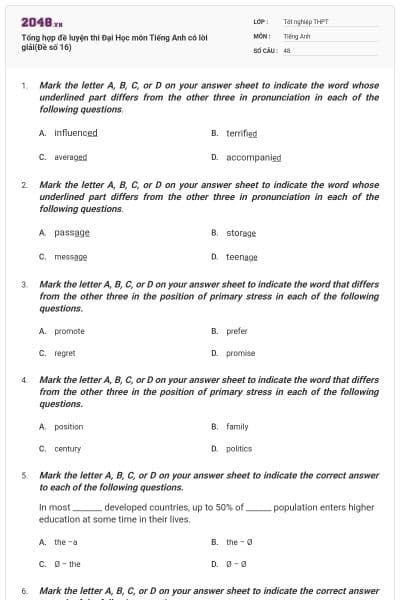
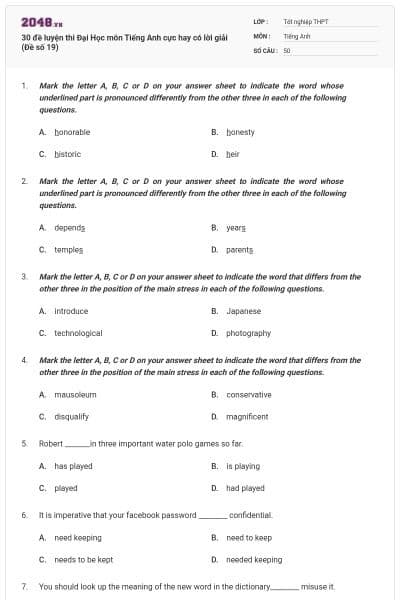
Mark the letter A, B, C or D on your answer sheet to indicate the word whose underlined part is pronounced differently from the other three in each of the following questions.
honorable
honesty
historic
heir
Đáp án C
Từ historic có phần gạch chân được phát âm là /h/, các từ còn lại h không được phát âm ( âm câm)
Mark the letter A, B, C or D on your answer sheet to indicate the word whose underlined part is pronounced differently from the other three in each of the following questions.
depends
years
temples
parents
Đáp án D
Từ parents có phần gạch chân được phát âm là /s/, các từ còn lại có phần gạch chân được phát âm là /z/
Mark the letter A, B, C or D on your answer sheet to indicate the word that differs from the other three in the position of the main stress in each of the following questions.
introduce
Japanese
technological
photography
Đáp án D
Từ photography có trọng âm rơi âm tiết thứ nhất, các từ còn lại nhấn âm thứ ba.
Mark the letter A, B, C or D on your answer sheet to indicate the word that differs from the other three in the position of the main stress in each of the following questions.
mausoleum
conservative
disqualify
magnificent
Đáp án D
Từ mausoleum có trọng âm rơi âm tiết thứ ba, các từ còn lại nhấn âm thứ hai.
Robert _______in three important water polo games so far.
has played
is playing
played
had played
Đáp án A
so far: dấu hiệu của thì hiên tại hoàn thành
It is imperative that your facebook password ________ confidential.
need keeping
need to keep
needs to be kept
needed keeping
Đáp án A
Cấu trúc gợi ý, khuyên bảo: It is imperative that + S+ V( bare-inf). Điều quan trọng là …
You should look up the meaning of the new word in the dictionary________ misuse it.
in order to not
to
so as not to
so that
Đáp án C
Các cấu trúc chỉ mục đích: In order (not) + to V; so as (not) + to V; (not) + to V; so that + clause .Dựa và cấu trúc và ý nghĩa
Tony didn’t study hard for the test. His answers ________ from someone else.
should have copied
must have been copied
can have copied
would have copie
Đáp án B
must have done: diễn tả hành động chắc chắn đã xảy ra trong quá khứ, có cơ sở.
Dị ch: Tony đã không học hành chăm chỉ cho bài kiểm tra. Câu trả l ời của anh ta chắc được sao chép từ người khác.
Các đáp án còn lại:
Should have done: điễn tả hành động, đáng lẽ ra đã nên làm trong quá khứ.
Can have done: diễn tả hành động sự việc có thể đã xảy ra trong quá khứ.
Would have done: diễn tả hành động sự việc có thể sẽ xảy ra, sau thời điểm nói trong quá khứ
On the table _____.
the disks lay
did the disks lie
lay the disks
lied the disks
Đáp án: C
Giải thích:
Câu này sử dụng cấu trúc đảo ngữ với động từ lay (quá khứ của lie - nằm). Khi đảo ngữ với trạng ngữ chỉ nơi chốn (On the table), động từ phải đi trước chủ ngữ.
Xét các đáp án khác:
A. the disks lay → Sai vì không đảo ngữ, thứ tự này là của câu bình thường (The disks lay on the table).
B. did the disks lie → Sai vì lie (nằm) là động từ bất quy tắc, không cần trợ động từ did trong quá khứ đơn.
C. lay the disks → Đúng vì đây là dạng đảo ngữ của The disks lay on the table.
D. lied the disks → Sai vì lied là quá khứ của lie (nói dối), không phải lie (nằm).
Chọn C.
Dịch: Trên bàn có những chiếc đĩa nằm đó.
The girls and flowers ___________ he painted were vivid.
who
which
whom
that
Đáp án D
that: dùng để thay thế cho danh từ chỉ người và chỉ vật, nối nhau bởi liên từ “and"
He’d prefer ___________ chicken soup rather than ___________ milk.
having / having
to have / drink
have / drink
had / drank
Đáp án: B
Giải thích:
Cấu trúc:
would prefer to do something rather than do something: thích làm gì hơn làm gì
Dịch: Cậu ấy thích ăn xúp gà hơn là uống sữa.
There is ____ in my bedroom.
a square wooden old table
an old square wooden table
a wooden old square table
an old wooden square table
Đáp án: B
Giải thích:
Kiến thức: Trật tự tính từ trong cụm danh từ
Khi có nhiều tính từ cùng đứng trước 1 danh từ, sắp xếp chúng theo thứ tự: OSASCOMP + N. Trong đó:
O – opinion: quan điểm
S – size: kích thước
A – age: độ tuổi (mới, cũ, trẻ, già,...)
S – shape: hình dạng
C – color: màu sắc
O – origin: nguồn gốc
M - material: chất liệu
P - purpose: mục đích
Ta có:
square: hình vuông => shape
old: cổ => age
wooden: bằng gỗ => material
Vậy thứ tự là: old square wooden, chọn B.
Dịch: Có một chiếc bàn gỗ vuông cũ trong phòng ngủ của tôi.
Our health is being _______ by air pollution.
dangerous
dangerously
danger
endangered
Đáp án D
Ta thấy có “ by air pollution” => câu bị động thì hiện tại tiếp diễn => Be + being + V-ed/cột 3
The 15th Asian Games was a _________ sporting event
succeed
success
successful
successfully
Đáp án C
Chỗ cần điền là 1 tính từ, trước danh từ và sau mạo từ “a”
Don’t expect to be treated _____ in this hospital.
preferential
preference
preferred
preferentially
Đáp án D
Sau động từ => ta chọn trạng từ chỉ cách thức cho vị trí này
Mrs. Jane gave her short speech to express her ________ for the retirement gift.
appeasement
applause
apportionment
appreciation
Đáp án D
appreciation: sự đề cao
Các từ còn lại: appeasement: chính sách nhượng bộ; applause: sự hoan ngênh, t án thưởng; apportionment :sự chia ra từng phần
I want to take my dogs with me. I need their _____.
company
relation
relationship
companion
Đáp án A
company: Sự cùng đi; sự cùng ở; sự có bầu có bạn
Các từ còn lại: relation: sự liên lạc, relationship: mối quan hệ; companion: người bạn
Children should be ________ by their parents on the first day of school.
accompanied
followed
involved
v
Đáp án A
accompany: đi kèm, hộ tống
Các từ còn lại: follow: theo sau; involve: gồm; associate: kết giao, kết hợp
Read the following passage, and mark the letter A, B, C, or D on your answer sheet to indicate the correct word for each of the blanks from 19 to 28.
Any change in one part of an ecosystem can cause changes in other parts. Droughts, storms and fires can change ecosystems. Some changes ___19___ ecosystems. If there is too ___20___ rainfall, plants will not have enough water to live. If a kind of plant dies off, the animals that ___21___ it may also die or move away. Some changes are good for ecosystems. Some pine forests need ___22___ for the pine trees to reproduce. The seeds are sealed inside pinecones. Heat from a forest fire melts the seal and lets the seeds___23___. Polluting the air, soil, and water can harm ecosystems. Building ___24___ on rivers for electric power and irr igation can harm ecosystems ___25___ the rivers. Bulldozing wetlands and cutting down ___26___ destroy ecosystems. Ecologists are working with companies and governments to find better ways of ___27___ fish, cutting down trees, and building dams. T hey are looking for ways to get food, lumber, and other products for people ___28___ causing harm to ecosystems.
Điền vào số 19
harms
harmful
harmless
harm
Đáp án D
Câu thiếu động từ cho chủ ngữ số nhiều “Some changes” . harm (v): làm hai
Harmful(adj): có hại; harmless (adj): vô hại
Read the following passage, and mark the letter A, B, C, or D on your answer sheet to indicate the correct word for each of the blanks from 19 to 28.
Any change in one part of an ecosystem can cause changes in other parts. Droughts, storms and fires can change ecosystems. Some changes ___19___ ecosystems. If there is too ___20___ rainfall, plants will not have enough water to live. If a kind of plant dies off, the animals that ___21___ it may also die or move away. Some changes are good for ecosystems. Some pine forests need ___22___ for the pine trees to reproduce. The seeds are sealed inside pinecones. Heat from a forest fire melts the seal and lets the seeds___23___. Polluting the air, soil, and water can harm ecosystems. Building ___24___ on rivers for electric power and irr igation can harm ecosystems ___25___ the rivers. Bulldozing wetlands and cutting down ___26___ destroy ecosystems. Ecologists are working with companies and governments to find better ways of ___27___ fish, cutting down trees, and building dams. T hey are looking for ways to get food, lumber, and other products for people ___28___ causing harm to ecosystems.
Điền vào số 20
little
a little
few
a few
Đáp án A
rainfall: danh từ không đếm được => Đáp án là A. too little: quá ít
Read the following passage, and mark the letter A, B, C, or D on your answer sheet to indicate the correct word for each of the blanks from 19 to 28.
Any change in one part of an ecosystem can cause changes in other parts. Droughts, storms and fires can change ecosystems. Some changes ___19___ ecosystems. If there is too ___20___ rainfall, plants will not have enough water to live. If a kind of plant dies off, the animals that ___21___ it may also die or move away. Some changes are good for ecosystems. Some pine forests need ___22___ for the pine trees to reproduce. The seeds are sealed inside pinecones. Heat from a forest fire melts the seal and lets the seeds___23___. Polluting the air, soil, and water can harm ecosystems. Building ___24___ on rivers for electric power and irr igation can harm ecosystems ___25___ the rivers. Bulldozing wetlands and cutting down ___26___ destroy ecosystems. Ecologists are working with companies and governments to find better ways of ___27___ fish, cutting down trees, and building dams. T hey are looking for ways to get food, lumber, and other products for people ___28___ causing harm to ecosystems.
Điền vào số 21
fed
feed
feed on
food
Đáp án C
Câu thiếu động từ trong mệnh đề quan hệ “that ….”. feed on something: ăn …
Read the following passage, and mark the letter A, B, C, or D on your answer sheet to indicate the correct word for each of the blanks from 19 to 28.
Any change in one part of an ecosystem can cause changes in other parts. Droughts, storms and fires can change ecosystems. Some changes ___19___ ecosystems. If there is too ___20___ rainfall, plants will not have enough water to live. If a kind of plant dies off, the animals that ___21___ it may also die or move away. Some changes are good for ecosystems. Some pine forests need ___22___ for the pine trees to reproduce. The seeds are sealed inside pinecones. Heat from a forest fire melts the seal and lets the seeds___23___. Polluting the air, soil, and water can harm ecosystems. Building ___24___ on rivers for electric power and irr igation can harm ecosystems ___25___ the rivers. Bulldozing wetlands and cutting down ___26___ destroy ecosystems. Ecologists are working with companies and governments to find better ways of ___27___ fish, cutting down trees, and building dams. T hey are looking for ways to get food, lumber, and other products for people ___28___ causing harm to ecosystems.
Điền vào số 22
flame
fires
blaze
burning
Đáp án B
collocation: fires: những vụ cháy ( rừng )
Các từ còn lại: flame: ngọn lửa; blaza: ngọn lửa; burning: cháy
Read the following passage, and mark the letter A, B, C, or D on your answer sheet to indicate the correct word for each of the blanks from 19 to 28.
Any change in one part of an ecosystem can cause changes in other parts. Droughts, storms and fires can change ecosystems. Some changes ___19___ ecosystems. If there is too ___20___ rainfall, plants will not have enough water to live. If a kind of plant dies off, the animals that ___21___ it may also die or move away. Some changes are good for ecosystems. Some pine forests need ___22___ for the pine trees to reproduce. The seeds are sealed inside pinecones. Heat from a forest fire melts the seal and lets the seeds___23___. Polluting the air, soil, and water can harm ecosystems. Building ___24___ on rivers for electric power and irr igation can harm ecosystems ___25___ the rivers. Bulldozing wetlands and cutting down ___26___ destroy ecosystems. Ecologists are working with companies and governments to find better ways of ___27___ fish, cutting down trees, and building dams. T hey are looking for ways to get food, lumber, and other products for people ___28___ causing harm to ecosystems.
Điền vào số 23
out
in
go
fly
Đáp án A
let something out: để lộ
Read the following passage, and mark the letter A, B, C, or D on your answer sheet to indicate the correct word for each of the blanks from 19 to 28.
Any change in one part of an ecosystem can cause changes in other parts. Droughts, storms and fires can change ecosystems. Some changes ___19___ ecosystems. If there is too ___20___ rainfall, plants will not have enough water to live. If a kind of plant dies off, the animals that ___21___ it may also die or move away. Some changes are good for ecosystems. Some pine forests need ___22___ for the pine trees to reproduce. The seeds are sealed inside pinecones. Heat from a forest fire melts the seal and lets the seeds___23___. Polluting the air, soil, and water can harm ecosystems. Building ___24___ on rivers for electric power and irr igation can harm ecosystems ___25___ the rivers. Bulldozing wetlands and cutting down ___26___ destroy ecosystems. Ecologists are working with companies and governments to find better ways of ___27___ fish, cutting down trees, and building dams. T hey are looking for ways to get food, lumber, and other products for people ___28___ causing harm to ecosystems.
Điền vào số 24
moats
ditches
bridges
dams
Đáp án D
dam: đập ( ngăn nước )
Các từ còn lại: bridge: cầu; moat: hào ( xung quanh thành trì… ); ditch: rãnh, mương
Read the following passage, and mark the letter A, B, C, or D on your answer sheet to indicate the correct word for each of the blanks from 19 to 28.
Any change in one part of an ecosystem can cause changes in other parts. Droughts, storms and fires can change ecosystems. Some changes ___19___ ecosystems. If there is too ___20___ rainfall, plants will not have enough water to live. If a kind of plant dies off, the animals that ___21___ it may also die or move away. Some changes are good for ecosystems. Some pine forests need ___22___ for the pine trees to reproduce. The seeds are sealed inside pinecones. Heat from a forest fire melts the seal and lets the seeds___23___. Polluting the air, soil, and water can harm ecosystems. Building ___24___ on rivers for electric power and irr igation can harm ecosystems ___25___ the rivers. Bulldozing wetlands and cutting down ___26___ destroy ecosystems. Ecologists are working with companies and governments to find better ways of ___27___ fish, cutting down trees, and building dams. T hey are looking for ways to get food, lumber, and other products for people ___28___ causing harm to ecosystems.
Điền vào số 25
on
around
over
under
Đáp án B
around the river: quanh khu vực ở song
Read the following passage, and mark the letter A, B, C, or D on your answer sheet to indicate the correct word for each of the blanks from 19 to 28.
Any change in one part of an ecosystem can cause changes in other parts. Droughts, storms and fires can change ecosystems. Some changes ___19___ ecosystems. If there is too ___20___ rainfall, plants will not have enough water to live. If a kind of plant dies off, the animals that ___21___ it may also die or move away. Some changes are good for ecosystems. Some pine forests need ___22___ for the pine trees to reproduce. The seeds are sealed inside pinecones. Heat from a forest fire melts the seal and lets the seeds___23___. Polluting the air, soil, and water can harm ecosystems. Building ___24___ on rivers for electric power and irr igation can harm ecosystems ___25___ the rivers. Bulldozing wetlands and cutting down ___26___ destroy ecosystems. Ecologists are working with companies and governments to find better ways of ___27___ fish, cutting down trees, and building dams. T hey are looking for ways to get food, lumber, and other products for people ___28___ causing harm to ecosystems.
Điền vào số 26
hills
jungles
forests
woods
Đáp án C
cut down forests: chặt rừng
Các từ còn lại: hill: đồi; jungle: khu đất hoang mọc đầy bụi rậm; wood: gỗ
Read the following passage, and mark the letter A, B, C, or D on your answer sheet to indicate the correct word for each of the blanks from 19 to 28.
Any change in one part of an ecosystem can cause changes in other parts. Droughts, storms and fires can change ecosystems. Some changes ___19___ ecosystems. If there is too ___20___ rainfall, plants will not have enough water to live. If a kind of plant dies off, the animals that ___21___ it may also die or move away. Some changes are good for ecosystems. Some pine forests need ___22___ for the pine trees to reproduce. The seeds are sealed inside pinecones. Heat from a forest fire melts the seal and lets the seeds___23___. Polluting the air, soil, and water can harm ecosystems. Building ___24___ on rivers for electric power and irr igation can harm ecosystems ___25___ the rivers. Bulldozing wetlands and cutting down ___26___ destroy ecosystems. Ecologists are working with companies and governments to find better ways of ___27___ fish, cutting down trees, and building dams. T hey are looking for ways to get food, lumber, and other products for people ___28___ causing harm to ecosystems.
Điền vào số 27
catching
holding
carrying
taking
Đáp án A
ctach fish: bắt cá
Các từ còn lại: hold: giữ, nắm; carry: mang; take: đưa…
Read the following passage, and mark the letter A, B, C, or D on your answer sheet to indicate the correct word for each of the blanks from 19 to 28.
Any change in one part of an ecosystem can cause changes in other parts. Droughts, storms and fires can change ecosystems. Some changes ___19___ ecosystems. If there is too ___20___ rainfall, plants will not have enough water to live. If a kind of plant dies off, the animals that ___21___ it may also die or move away. Some changes are good for ecosystems. Some pine forests need ___22___ for the pine trees to reproduce. The seeds are sealed inside pinecones. Heat from a forest fire melts the seal and lets the seeds___23___. Polluting the air, soil, and water can harm ecosystems. Building ___24___ on rivers for electric power and irr igation can harm ecosystems ___25___ the rivers. Bulldozing wetlands and cutting down ___26___ destroy ecosystems. Ecologists are working with companies and governments to find better ways of ___27___ fish, cutting down trees, and building dams. T hey are looking for ways to get food, lumber, and other products for people ___28___ causing harm to ecosystems.
Điền vào số 28
avoid
without
not
no
Đáp án B
without + N/V-ing: với không …
Read the following passage and mark the letter A, B, C, or D to indicate the correct answer to each of the questions.
In most of the earliest books for childre n, illustrations were an afterthought. But in the Caldecott “toy books”, which first appeared in 1878, they were almost as important as the lines of text, and occupied far more space in the book. One can almost read the story from the dramatic action in the pictures.
Since then, thousands of successful picture books have been published in the United States and around the world. In the best, the words and illustrations seem to complement each other perfectly. Often a single person, is responsible for both writing and illustrating the book. One of the greatest, and certainly one of the most successful, illustrator-authors was Dr. Seuss, whose real name was Theodor Geisel. His first children’s book, And to Think That I Saw It on Mulberry Street, hit the market in 1937, and the world of children’s literature was changed forever. Seuss’s playful drawings were a perfect complement to his engaging stories and unforgettable characters. In 1957, Seuss’s The Cat in the Hat became the first book in Random House’s best -selling series, Beginner Books, written by Seuss and several other authors. These combine outrageous illustrations of people, creatures, and plants, and playful stories written in very simple language.
Dr. Seuss is not the only well-known author-illustrator, of course. There is Max Sendak, who wrote and illustrated Where the Wild Things Are, the story of a little boy named Max, who becomes king of the fierce ( but funny) creatures that live in the Land of the Wilds Things. Robert McCloskey produced both the richly textured illustrations and delightful story of a family of ducks living in downtown Boston, Make Ways for Ducklings. Some books are produced by a collaborative author artist team. Author Margaret Wise Brown combined with illustrator Clement Hurd to produce two delightful books loved by very young children, Goodnight Moon and The Runaway Bunny. Another example is the husband-and-wife team of writer Audrey Wood and illustrator Don Wood, who were responsible for King Bidgood’s in the Bathtub and The Napping House.
Wordless and nearly wordless picture books have become popular. With a little help, threeand four-year-olds can follow the sequence of events, and they can understand the stories suggested in them. The marvel of books with few or no words is that they allow children and their parents the opportunity to tell and retell the same stories over and over in their own words. One of the most charming examples of a wordless book is Jan Omerod’sSunshine. Barbara Berger’s Grandfather Twilight and David Weisner’s Tuesday are examples of books containing only a few words.
U.S. publishers have also drawn on illustrators from other countries whose original, imaginative works have brought their different visions to American children’s books. Among them are Leo Lionni from Italy, Feodor Rojankovsky from Russia, and Taro Yashimi from Japan.
When did illustrations become important in books for children?
In late 19 th century
In 1937
Only recently
In 1957
Đáp án A
Dựa vào đoạn thứ 1
Read the following passage and mark the letter A, B, C, or D to indicate the correct answer to each of the questions.
In most of the earliest books for childre n, illustrations were an afterthought. But in the Caldecott “toy books”, which first appeared in 1878, they were almost as important as the lines of text, and occupied far more space in the book. One can almost read the story from the dramatic action in the pictures.
Since then, thousands of successful picture books have been published in the United States and around the world. In the best, the words and illustrations seem to complement each other perfectly. Often a single person, is responsible for both writing and illustrating the book. One of the greatest, and certainly one of the most successful, illustrator-authors was Dr. Seuss, whose real name was Theodor Geisel. His first children’s book, And to Think That I Saw It on Mulberry Street, hit the market in 1937, and the world of children’s literature was changed forever. Seuss’s playful drawings were a perfect complement to his engaging stories and unforgettable characters. In 1957, Seuss’s The Cat in the Hat became the first book in Random House’s best -selling series, Beginner Books, written by Seuss and several other authors. These combine outrageous illustrations of people, creatures, and plants, and playful stories written in very simple language.
Dr. Seuss is not the only well-known author-illustrator, of course. There is Max Sendak, who wrote and illustrated Where the Wild Things Are, the story of a little boy named Max, who becomes king of the fierce ( but funny) creatures that live in the Land of the Wilds Things. Robert McCloskey produced both the richly textured illustrations and delightful story of a family of ducks living in downtown Boston, Make Ways for Ducklings. Some books are produced by a collaborative author artist team. Author Margaret Wise Brown combined with illustrator Clement Hurd to produce two delightful books loved by very young children, Goodnight Moon and The Runaway Bunny. Another example is the husband-and-wife team of writer Audrey Wood and illustrator Don Wood, who were responsible for King Bidgood’s in the Bathtub and The Napping House.
Wordless and nearly wordless picture books have become popular. With a little help, threeand four-year-olds can follow the sequence of events, and they can understand the stories suggested in them. The marvel of books with few or no words is that they allow children and their parents the opportunity to tell and retell the same stories over and over in their own words. One of the most charming examples of a wordless book is Jan Omerod’sSunshine. Barbara Berger’s Grandfather Twilight and David Weisner’s Tuesday are examples of books containing only a few words.
U.S. publishers have also drawn on illustrators from other countries whose original, imaginative works have brought their different visions to American children’s books. Among them are Leo Lionni from Italy, Feodor Rojankovsky from Russia, and Taro Yashimi from Japan.
The word “they” in the first paragraph refers to ________.
the earliest books for children
illustrations
the Caldecott “toy books”
lines of text
Đáp án B
they = illustrations: tranh minh họa
Read the following passage and mark the letter A, B, C, or D to indicate the correct answer to each of the questions.
In most of the earliest books for childre n, illustrations were an afterthought. But in the Caldecott “toy books”, which first appeared in 1878, they were almost as important as the lines of text, and occupied far more space in the book. One can almost read the story from the dramatic action in the pictures.
Since then, thousands of successful picture books have been published in the United States and around the world. In the best, the words and illustrations seem to complement each other perfectly. Often a single person, is responsible for both writing and illustrating the book. One of the greatest, and certainly one of the most successful, illustrator-authors was Dr. Seuss, whose real name was Theodor Geisel. His first children’s book, And to Think That I Saw It on Mulberry Street, hit the market in 1937, and the world of children’s literature was changed forever. Seuss’s playful drawings were a perfect complement to his engaging stories and unforgettable characters. In 1957, Seuss’s The Cat in the Hat became the first book in Random House’s best -selling series, Beginner Books, written by Seuss and several other authors. These combine outrageous illustrations of people, creatures, and plants, and playful stories written in very simple language.
Dr. Seuss is not the only well-known author-illustrator, of course. There is Max Sendak, who wrote and illustrated Where the Wild Things Are, the story of a little boy named Max, who becomes king of the fierce ( but funny) creatures that live in the Land of the Wilds Things. Robert McCloskey produced both the richly textured illustrations and delightful story of a family of ducks living in downtown Boston, Make Ways for Ducklings. Some books are produced by a collaborative author artist team. Author Margaret Wise Brown combined with illustrator Clement Hurd to produce two delightful books loved by very young children, Goodnight Moon and The Runaway Bunny. Another example is the husband-and-wife team of writer Audrey Wood and illustrator Don Wood, who were responsible for King Bidgood’s in the Bathtub and The Napping House.
Wordless and nearly wordless picture books have become popular. With a little help, threeand four-year-olds can follow the sequence of events, and they can understand the stories suggested in them. The marvel of books with few or no words is that they allow children and their parents the opportunity to tell and retell the same stories over and over in their own words. One of the most charming examples of a wordless book is Jan Omerod’sSunshine. Barbara Berger’s Grandfather Twilight and David Weisner’s Tuesday are examples of books containing only a few words.
U.S. publishers have also drawn on illustrators from other countries whose original, imaginative works have brought their different visions to American children’s books. Among them are Leo Lionni from Italy, Feodor Rojankovsky from Russia, and Taro Yashimi from Japan.
The phrase “the best” in paragraph 2 refers to the best __________.
picture books
illustrations
authors
words
Đáp án A
Dựa vào ý trước đó: Since then, thousands of successful picture books have been published in the United States and around the world
Read the following passage and mark the letter A, B, C, or D to indicate the correct answer to each of the questions.
In most of the earliest books for childre n, illustrations were an afterthought. But in the Caldecott “toy books”, which first appeared in 1878, they were almost as important as the lines of text, and occupied far more space in the book. One can almost read the story from the dramatic action in the pictures.
Since then, thousands of successful picture books have been published in the United States and around the world. In the best, the words and illustrations seem to complement each other perfectly. Often a single person, is responsible for both writing and illustrating the book. One of the greatest, and certainly one of the most successful, illustrator-authors was Dr. Seuss, whose real name was Theodor Geisel. His first children’s book, And to Think That I Saw It on Mulberry Street, hit the market in 1937, and the world of children’s literature was changed forever. Seuss’s playful drawings were a perfect complement to his engaging stories and unforgettable characters. In 1957, Seuss’s The Cat in the Hat became the first book in Random House’s best -selling series, Beginner Books, written by Seuss and several other authors. These combine outrageous illustrations of people, creatures, and plants, and playful stories written in very simple language.
Dr. Seuss is not the only well-known author-illustrator, of course. There is Max Sendak, who wrote and illustrated Where the Wild Things Are, the story of a little boy named Max, who becomes king of the fierce ( but funny) creatures that live in the Land of the Wilds Things. Robert McCloskey produced both the richly textured illustrations and delightful story of a family of ducks living in downtown Boston, Make Ways for Ducklings. Some books are produced by a collaborative author artist team. Author Margaret Wise Brown combined with illustrator Clement Hurd to produce two delightful books loved by very young children, Goodnight Moon and The Runaway Bunny. Another example is the husband-and-wife team of writer Audrey Wood and illustrator Don Wood, who were responsible for King Bidgood’s in the Bathtub and The Napping House.
Wordless and nearly wordless picture books have become popular. With a little help, threeand four-year-olds can follow the sequence of events, and they can understand the stories suggested in them. The marvel of books with few or no words is that they allow children and their parents the opportunity to tell and retell the same stories over and over in their own words. One of the most charming examples of a wordless book is Jan Omerod’sSunshine. Barbara Berger’s Grandfather Twilight and David Weisner’s Tuesday are examples of books containing only a few words.
U.S. publishers have also drawn on illustrators from other countries whose original, imaginative works have brought their different visions to American children’s books. Among them are Leo Lionni from Italy, Feodor Rojankovsky from Russia, and Taro Yashimi from Japan.
According to the passage, pictures help make children’s books _________.
sell better
unforgettable
more successful
more original
Đáp án C
Dựa vào đoạn 2: thousands of successful picture books …. In the best, the words and illustrations seem to complement each other perfectly. Often a single person, is responsible for both writing and illustrating the book. One of the greatest, and certainly one of the most successful
Read the following passage and mark the letter A, B, C, or D to indicate the correct answer to each of the questions.
In most of the earliest books for childre n, illustrations were an afterthought. But in the Caldecott “toy books”, which first appeared in 1878, they were almost as important as the lines of text, and occupied far more space in the book. One can almost read the story from the dramatic action in the pictures.
Since then, thousands of successful picture books have been published in the United States and around the world. In the best, the words and illustrations seem to complement each other perfectly. Often a single person, is responsible for both writing and illustrating the book. One of the greatest, and certainly one of the most successful, illustrator-authors was Dr. Seuss, whose real name was Theodor Geisel. His first children’s book, And to Think That I Saw It on Mulberry Street, hit the market in 1937, and the world of children’s literature was changed forever. Seuss’s playful drawings were a perfect complement to his engaging stories and unforgettable characters. In 1957, Seuss’s The Cat in the Hat became the first book in Random House’s best -selling series, Beginner Books, written by Seuss and several other authors. These combine outrageous illustrations of people, creatures, and plants, and playful stories written in very simple language.
Dr. Seuss is not the only well-known author-illustrator, of course. There is Max Sendak, who wrote and illustrated Where the Wild Things Are, the story of a little boy named Max, who becomes king of the fierce ( but funny) creatures that live in the Land of the Wilds Things. Robert McCloskey produced both the richly textured illustrations and delightful story of a family of ducks living in downtown Boston, Make Ways for Ducklings. Some books are produced by a collaborative author artist team. Author Margaret Wise Brown combined with illustrator Clement Hurd to produce two delightful books loved by very young children, Goodnight Moon and The Runaway Bunny. Another example is the husband-and-wife team of writer Audrey Wood and illustrator Don Wood, who were responsible for King Bidgood’s in the Bathtub and The Napping House.
Wordless and nearly wordless picture books have become popular. With a little help, threeand four-year-olds can follow the sequence of events, and they can understand the stories suggested in them. The marvel of books with few or no words is that they allow children and their parents the opportunity to tell and retell the same stories over and over in their own words. One of the most charming examples of a wordless book is Jan Omerod’sSunshine. Barbara Berger’s Grandfather Twilight and David Weisner’s Tuesday are examples of books containing only a few words.
U.S. publishers have also drawn on illustrators from other countries whose original, imaginative works have brought their different visions to American children’s books. Among them are Leo Lionni from Italy, Feodor Rojankovsky from Russia, and Taro Yashimi from Japan.
According to the passage, when was the world of children’s literature changed?
Before Seuss’s first children’s book hit the market.
Before Seuss’s made playful drawings.
After Seuss’s first children’s book hit the market.
After Seuss’s book became Random House’s best-seller.
Đáp án C
Ý trong bài: His first children’s book, And to Think That I Saw It on Mulberry Street, hit the market in 1937, and the world of children’s literature was changed forever.
Read the following passage and mark the letter A, B, C, or D to indicate the correct answer to each of the questions.
In most of the earliest books for childre n, illustrations were an afterthought. But in the Caldecott “toy books”, which first appeared in 1878, they were almost as important as the lines of text, and occupied far more space in the book. One can almost read the story from the dramatic action in the pictures.
Since then, thousands of successful picture books have been published in the United States and around the world. In the best, the words and illustrations seem to complement each other perfectly. Often a single person, is responsible for both writing and illustrating the book. One of the greatest, and certainly one of the most successful, illustrator-authors was Dr. Seuss, whose real name was Theodor Geisel. His first children’s book, And to Think That I Saw It on Mulberry Street, hit the market in 1937, and the world of children’s literature was changed forever. Seuss’s playful drawings were a perfect complement to his engaging stories and unforgettable characters. In 1957, Seuss’s The Cat in the Hat became the first book in Random House’s best -selling series, Beginner Books, written by Seuss and several other authors. These combine outrageous illustrations of people, creatures, and plants, and playful stories written in very simple language.
Dr. Seuss is not the only well-known author-illustrator, of course. There is Max Sendak, who wrote and illustrated Where the Wild Things Are, the story of a little boy named Max, who becomes king of the fierce ( but funny) creatures that live in the Land of the Wilds Things. Robert McCloskey produced both the richly textured illustrations and delightful story of a family of ducks living in downtown Boston, Make Ways for Ducklings. Some books are produced by a collaborative author artist team. Author Margaret Wise Brown combined with illustrator Clement Hurd to produce two delightful books loved by very young children, Goodnight Moon and The Runaway Bunny. Another example is the husband-and-wife team of writer Audrey Wood and illustrator Don Wood, who were responsible for King Bidgood’s in the Bathtub and The Napping House.
Wordless and nearly wordless picture books have become popular. With a little help, threeand four-year-olds can follow the sequence of events, and they can understand the stories suggested in them. The marvel of books with few or no words is that they allow children and their parents the opportunity to tell and retell the same stories over and over in their own words. One of the most charming examples of a wordless book is Jan Omerod’sSunshine. Barbara Berger’s Grandfather Twilight and David Weisner’s Tuesday are examples of books containing only a few words.
U.S. publishers have also drawn on illustrators from other countries whose original, imaginative works have brought their different visions to American children’s books. Among them are Leo Lionni from Italy, Feodor Rojankovsky from Russia, and Taro Yashimi from Japan.
“Sunshine” is given in the passage as an example of a book that _______
is very charming
is only for children
contains only pictures
contains only a few words
Đáp án C
Ý trong bài: One of the most charming examples of a wordless book is Jan Omerod’sSunshine
Read the following passage and mark the letter A, B, C, or D to indicate the correct answer to each of the questions.
In most of the earliest books for childre n, illustrations were an afterthought. But in the Caldecott “toy books”, which first appeared in 1878, they were almost as important as the lines of text, and occupied far more space in the book. One can almost read the story from the dramatic action in the pictures.
Since then, thousands of successful picture books have been published in the United States and around the world. In the best, the words and illustrations seem to complement each other perfectly. Often a single person, is responsible for both writing and illustrating the book. One of the greatest, and certainly one of the most successful, illustrator-authors was Dr. Seuss, whose real name was Theodor Geisel. His first children’s book, And to Think That I Saw It on Mulberry Street, hit the market in 1937, and the world of children’s literature was changed forever. Seuss’s playful drawings were a perfect complement to his engaging stories and unforgettable characters. In 1957, Seuss’s The Cat in the Hat became the first book in Random House’s best -selling series, Beginner Books, written by Seuss and several other authors. These combine outrageous illustrations of people, creatures, and plants, and playful stories written in very simple language.
Dr. Seuss is not the only well-known author-illustrator, of course. There is Max Sendak, who wrote and illustrated Where the Wild Things Are, the story of a little boy named Max, who becomes king of the fierce ( but funny) creatures that live in the Land of the Wilds Things. Robert McCloskey produced both the richly textured illustrations and delightful story of a family of ducks living in downtown Boston, Make Ways for Ducklings. Some books are produced by a collaborative author artist team. Author Margaret Wise Brown combined with illustrator Clement Hurd to produce two delightful books loved by very young children, Goodnight Moon and The Runaway Bunny. Another example is the husband-and-wife team of writer Audrey Wood and illustrator Don Wood, who were responsible for King Bidgood’s in the Bathtub and The Napping House.
Wordless and nearly wordless picture books have become popular. With a little help, threeand four-year-olds can follow the sequence of events, and they can understand the stories suggested in them. The marvel of books with few or no words is that they allow children and their parents the opportunity to tell and retell the same stories over and over in their own words. One of the most charming examples of a wordless book is Jan Omerod’sSunshine. Barbara Berger’s Grandfather Twilight and David Weisner’s Tuesday are examples of books containing only a few words.
U.S. publishers have also drawn on illustrators from other countries whose original, imaginative works have brought their different visions to American children’s books. Among them are Leo Lionni from Italy, Feodor Rojankovsky from Russia, and Taro Yashimi from Japan.
The phrase “Another example” in the passage refers to an example of ________.
a husband-and-wife team
a delightful book
an author-artist team
a book like King Bidgood’s in the Bathtub.
Đáp án C
Dựa vào hai ý trước đó: . Some books are produced by a collaborative authorartist team. Author Margaret Wise Brown combined with illustrator Clement Hurd to produce two delightful books loved by very young children, Goodnight Moon and The Runaway Bunny.
Read the following passage and mark the letter A, B, C, or D to indicate the correct answer to each of the questions.
In most of the earliest books for childre n, illustrations were an afterthought. But in the Caldecott “toy books”, which first appeared in 1878, they were almost as important as the lines of text, and occupied far more space in the book. One can almost read the story from the dramatic action in the pictures.
Since then, thousands of successful picture books have been published in the United States and around the world. In the best, the words and illustrations seem to complement each other perfectly. Often a single person, is responsible for both writing and illustrating the book. One of the greatest, and certainly one of the most successful, illustrator-authors was Dr. Seuss, whose real name was Theodor Geisel. His first children’s book, And to Think That I Saw It on Mulberry Street, hit the market in 1937, and the world of children’s literature was changed forever. Seuss’s playful drawings were a perfect complement to his engaging stories and unforgettable characters. In 1957, Seuss’s The Cat in the Hat became the first book in Random House’s best -selling series, Beginner Books, written by Seuss and several other authors. These combine outrageous illustrations of people, creatures, and plants, and playful stories written in very simple language.
Dr. Seuss is not the only well-known author-illustrator, of course. There is Max Sendak, who wrote and illustrated Where the Wild Things Are, the story of a little boy named Max, who becomes king of the fierce ( but funny) creatures that live in the Land of the Wilds Things. Robert McCloskey produced both the richly textured illustrations and delightful story of a family of ducks living in downtown Boston, Make Ways for Ducklings. Some books are produced by a collaborative author artist team. Author Margaret Wise Brown combined with illustrator Clement Hurd to produce two delightful books loved by very young children, Goodnight Moon and The Runaway Bunny. Another example is the husband-and-wife team of writer Audrey Wood and illustrator Don Wood, who were responsible for King Bidgood’s in the Bathtub and The Napping House.
Wordless and nearly wordless picture books have become popular. With a little help, threeand four-year-olds can follow the sequence of events, and they can understand the stories suggested in them. The marvel of books with few or no words is that they allow children and their parents the opportunity to tell and retell the same stories over and over in their own words. One of the most charming examples of a wordless book is Jan Omerod’sSunshine. Barbara Berger’s Grandfather Twilight and David Weisner’s Tuesday are examples of books containing only a few words.
U.S. publishers have also drawn on illustrators from other countries whose original, imaginative works have brought their different visions to American children’s books. Among them are Leo Lionni from Italy, Feodor Rojankovsky from Russia, and Taro Yashimi from Japan.
The word “original” in the last paragraph is closest in meaning to _________.
in the first place
of the first source
imaginary and beautiful
new and creative
Đáp án D
original = new and creative: mới và sáng tạo
Read the following passage and mark the letter A, B, C, or D to indicate the correct answer to each of the questions.
In most of the earliest books for childre n, illustrations were an afterthought. But in the Caldecott “toy books”, which first appeared in 1878, they were almost as important as the lines of text, and occupied far more space in the book. One can almost read the story from the dramatic action in the pictures.
Since then, thousands of successful picture books have been published in the United States and around the world. In the best, the words and illustrations seem to complement each other perfectly. Often a single person, is responsible for both writing and illustrating the book. One of the greatest, and certainly one of the most successful, illustrator-authors was Dr. Seuss, whose real name was Theodor Geisel. His first children’s book, And to Think That I Saw It on Mulberry Street, hit the market in 1937, and the world of children’s literature was changed forever. Seuss’s playful drawings were a perfect complement to his engaging stories and unforgettable characters. In 1957, Seuss’s The Cat in the Hat became the first book in Random House’s best -selling series, Beginner Books, written by Seuss and several other authors. These combine outrageous illustrations of people, creatures, and plants, and playful stories written in very simple language.
Dr. Seuss is not the only well-known author-illustrator, of course. There is Max Sendak, who wrote and illustrated Where the Wild Things Are, the story of a little boy named Max, who becomes king of the fierce ( but funny) creatures that live in the Land of the Wilds Things. Robert McCloskey produced both the richly textured illustrations and delightful story of a family of ducks living in downtown Boston, Make Ways for Ducklings. Some books are produced by a collaborative author artist team. Author Margaret Wise Brown combined with illustrator Clement Hurd to produce two delightful books loved by very young children, Goodnight Moon and The Runaway Bunny. Another example is the husband-and-wife team of writer Audrey Wood and illustrator Don Wood, who were responsible for King Bidgood’s in the Bathtub and The Napping House.
Wordless and nearly wordless picture books have become popular. With a little help, threeand four-year-olds can follow the sequence of events, and they can understand the stories suggested in them. The marvel of books with few or no words is that they allow children and their parents the opportunity to tell and retell the same stories over and over in their own words. One of the most charming examples of a wordless book is Jan Omerod’sSunshine. Barbara Berger’s Grandfather Twilight and David Weisner’s Tuesday are examples of books containing only a few words.
U.S. publishers have also drawn on illustrators from other countries whose original, imaginative works have brought their different visions to American children’s books. Among them are Leo Lionni from Italy, Feodor Rojankovsky from Russia, and Taro Yashimi from Japan.
Leo Lionni, Feodor Rojankovsky, and Taro Yashimi are mentioned in the passage to show that____________.
there are talented authors in different countries.
U.S. publishers attract good artists from other countries
illustrators from other countries want to work for U.S. publishers.
illustrators from other countries have different visions to U.S. publishers.
Đáp án B
Đọc đoạn cuối, có thể suy luận được đáp án này.
Read the following passage and mark the letter A, B, C, or D to indicate the correct answer to each of the questions.
In most of the earliest books for childre n, illustrations were an afterthought. But in the Caldecott “toy books”, which first appeared in 1878, they were almost as important as the lines of text, and occupied far more space in the book. One can almost read the story from the dramatic action in the pictures.
Since then, thousands of successful picture books have been published in the United States and around the world. In the best, the words and illustrations seem to complement each other perfectly. Often a single person, is responsible for both writing and illustrating the book. One of the greatest, and certainly one of the most successful, illustrator-authors was Dr. Seuss, whose real name was Theodor Geisel. His first children’s book, And to Think That I Saw It on Mulberry Street, hit the market in 1937, and the world of children’s literature was changed forever. Seuss’s playful drawings were a perfect complement to his engaging stories and unforgettable characters. In 1957, Seuss’s The Cat in the Hat became the first book in Random House’s best -selling series, Beginner Books, written by Seuss and several other authors. These combine outrageous illustrations of people, creatures, and plants, and playful stories written in very simple language.
Dr. Seuss is not the only well-known author-illustrator, of course. There is Max Sendak, who wrote and illustrated Where the Wild Things Are, the story of a little boy named Max, who becomes king of the fierce ( but funny) creatures that live in the Land of the Wilds Things. Robert McCloskey produced both the richly textured illustrations and delightful story of a family of ducks living in downtown Boston, Make Ways for Ducklings. Some books are produced by a collaborative author artist team. Author Margaret Wise Brown combined with illustrator Clement Hurd to produce two delightful books loved by very young children, Goodnight Moon and The Runaway Bunny. Another example is the husband-and-wife team of writer Audrey Wood and illustrator Don Wood, who were responsible for King Bidgood’s in the Bathtub and The Napping House.
Wordless and nearly wordless picture books have become popular. With a little help, threeand four-year-olds can follow the sequence of events, and they can understand the stories suggested in them. The marvel of books with few or no words is that they allow children and their parents the opportunity to tell and retell the same stories over and over in their own words. One of the most charming examples of a wordless book is Jan Omerod’sSunshine. Barbara Berger’s Grandfather Twilight and David Weisner’s Tuesday are examples of books containing only a few words.
U.S. publishers have also drawn on illustrators from other countries whose original, imaginative works have brought their different visions to American children’s books. Among them are Leo Lionni from Italy, Feodor Rojankovsky from Russia, and Taro Yashimi from Japan.
What is the main idea of the reading passage?
Dr. Seuss was one of the most successful illustrator-authors.
Husband-and-wife teams can become successful in producing books.
Only wordless and nearly wordless picture books have become popular.
Pictures are very important in books for children.
Đáp án D
Cả bài đề cập đến “illustrations – tranh minh họa” và tầm ảnh hưởng của nó đến sách dành cho trẻ em..
Choose the word that is CLOSEST in meaning to the underlined part in the following sentence.
Roget's Thesaurus, a collection of English words and phrases, was originally arranged by the ideas they express rather than by alphabetical order.
restricted
as well as
unless
instead of
Đáp án D
rather than: hơn là…..=> Dựa vào nghĩa chọn D. instead of: thay vì..
Các đáp án khác: restricted: hạn chế; as well as: cũng như là ..; unless: nếu không
Choose the word that is CLOSEST in meaning to the underlined part in the following sentence.
The child insisted on listening to the entire story.
whole
funny
interesting
part
Đáp án A
entire: toàn bộ = whole
Choose the word that is OPPOSITE in meaning to the underlined part in the following sentence.
In remote communities, it's important to replenish stocks before the winter sets in.
remake
empty
refill
repeat
Đáp án B
replenish: làm cho đầy lại, đổ đầy >< emty: trống
Các từ còn lại: remake: làm lại; refill: đổ cho đầy; repeat: nhắc lại
Choose the word that is OPPOSITE in meaning to the underlined part in the following sentence.
Pointing at someone is considered rude in communication.
impolite
humorous
polite
generous
Đáp án C
rude: thô lỗ >< polite
Mark the letter A, B, C or D on your answer sheet to indicate the underlined part that needs correction in each of the following questions.
The students who are revising for their exams are used to stay up late.
who
are
for
used to stay
Đáp án D
used to stay => used to staying
Mark the letter A, B, C or D on your answer sheet to indicate the underlined part that needs correction in each of the following questions.
All of the cities in Texas, San Antonio is probably the most picturesque.
All of
in Taxes
is probly
most picturesque
Đáp án A
All of => Of all
Mark the letter A, B, C or D on your answer sheet to indicate the underlined part that needs correction in each of the following questions.
Wealthy people have always desired and wear precious stones because their beauty is lasting.
Wealthy
and wear
their beauty
lasting
Đáp án B
wear => ( have ) worn
Choose the letter A, B, C or D to indicate the sentence that is closest in meaning to the sentence given in each of the following questions
Alice eats very little because she doesn’t want to put on weight.
Because Alice doesn’t want to get fat, she eats quite a lot.
Alice wants to put on weight, so she doesn’t eat anything.
Alice eats very little, but she doesn’t lose weight.
Alice eats very little so as not to gain weight.
Đáp án D
Câu đã cho: Alice ăn rất ít bởi vì cô ấy không muốn tăng cân.
=> Đáp án là D. Cấu trúc chỉ mục đích: so as (not) + to V: để ( không ) làm gì…
Dịch: Alice ăn rất ít để không bị tăng cân.
Choose the letter A, B, C or D to indicate the sentence that is closest in meaning to the sentence given in each of the following questions.
The heavy rain made it impossible for us to have our picnic.
In spite of the heavy rain, we were able to have a picnic.
We were prevented from having our picnic by the heavy rain.
We could have our picnic even though it rained heavily.
The heavy rain didn’t prevent us from having our picnic
Đáp án B
Cấu trúc: make it + adj (+for someone) + to V: khiến như thế nào ….
Nghĩa câu đã cho: Trời mưa to khiến chúng tôi không thể đi dã ngoại.
=> Đáp án là B.Cấu trúc prevent someon from doing something: ngăn cản ai làm gì.
Câu này là câu bị động : Chúng tôi bị ngăn cản đi dã ngoại bởi trời mưa to.
Choose the letter A, B, C or D to indicate the sentence that is closest in meaning to the sentence given in each of the following questions
He last had his eyes tested ten months ago.
He had tested his eyes ten months before.
He had not tested his eyes for ten months then.
He hasn’t had his eyes tested for ten months.
He didn’t have any test on his eyes in ten months.
Đáp án C
Câu đã cho: Lần cuối cùng anh ta kiểm tra mắt là mười tháng trước.
=> Đáp án là C. Anh ta đã không kiểm tra mắt được 10 tháng rồi.
Choose the letter A, B, C or D to indicate the sentence that is closest in meaning to the sentence given in each of the following questions
Peter didn’t arrive in time to see her.
Peter was so late that I can’t see her.
Peter wasn’t too early to see her.
Peter wasn’t early enough to see her.
Peter wasn’t enough early to see her.
Đáp án: C
Giải thích:
Cấu trúc đúng để diễn tả "không đủ sớm để làm gì" là:
S + be + not + adjective + enough + (to V) → Peter wasn’t early enough to see her.
Phân tích các đáp án:
A. Peter was so late that I can’t see her.
Sai vì dùng đại từ I thay vì he, và sai về ý nghĩa vì so late diễn tả mức độ quá muộn, nhưng không thể hiện rõ việc không đủ thời gian để gặp cô ấy.
B. Peter wasn’t too early to see her.
Sai vì too early mang nghĩa "quá sớm", không phù hợp với ngữ cảnh vì vấn đề là anh ấy đến muộn, không phải đến quá sớm.
C. Peter wasn’t early enough to see her.
Đúng cấu trúc và đúng nghĩa: Peter không đến đủ sớm để gặp cô ấy.
D. Peter wasn’t enough early to see her.
Sai vì enough phải đứng sau tính từ (early enough), không phải trước.
Chọn C.
Dịch: Peter đã không đến đủ sớm để gặp cô ấy.
Choose the letter A, B, C or D to indicate the sentence that is closest in meaning to the sentence given in each of the following question
The sooner we solve this problem, the better it will be for all concerned.
If all concerned are better, we can solve this problem soon.
It would be better for all concerned if we can solve this problem soon.
If we could solve this problem soon, it would be better for all concerned.
If we can solve this problem soon, it will be better for all concerned.
Đáp án D
Cấu trúc so sánh tăng tiến “ càng ….. càng ….”: the + comparison + S+ V, the + comparison + S+ V.
Nghĩa câu đã cho. Chúng ta giải quyết vấn đề càng sớm, thì sẽ càng tốt hơn cho tất cả những thứ liên quan.
=> Đáp án là D. Câu điều kiện loại I, diễn tả hành động mang tính dự đoán, có thể xảy ra trong hiện tại hoặc tương lai: Nếu chúng ta có thể giải quyết vấn đề này sớm, nó sẽ tốt hơn cho những thứ liên quan.