30 đề luyện thi Đại Học môn Tiếng Anh cực hay có lời giải (Đề số 14)
50 câu hỏi
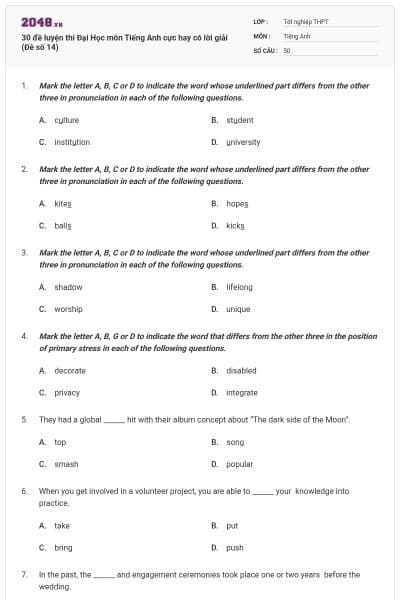
Mark the letter A, B, C or D to indicate the word whose underlined part differs from the other three in pronunciation in each of the following questions.
culture
student
institution
university
Đáp án A
Kiến thức về nguyên âm ngắn
A. culture /kʌlt∫ər/
B. student /'stju:dnt/
C. institution /,ɪnstɪ'tju:∫n/
D. university /,ju:nɪ’vɜ:səti/
Mark the letter A, B, C or D to indicate the word whose underlined part differs from the other three in pronunciation in each of the following questions.
kites
hopes
balls
kicks
Đáp án C
Kiến thức về cách phát âm đuôi -s/es
A. kites /kaɪts/
B. hopes /həʊps/
C. balls /bɔ:lz/
D. kicks /kɪks/
Mark the letter A, B, C or D to indicate the word whose underlined part differs from the other three in pronunciation in each of the following questions.
shadow
lifelong
worship
unique
Đáp án D
Kiến thức về trọng âm
A. shadow /’∫ædəʊ/: từ này có trọng âm rơi vào âm tiết thứ nhất. Vì theo nguyên tắc không bao giờ rơi vào âm /əʊ/.
B. lifelong /'laɪflɒŋ/: từ này có trọng âm rơi vào âm tiết thứ nhất. Vì theo nguyên tắc trọng âm rơi vào nguyên âm đôi /aɪ/.
C. worship /'wɜ:∫ɪp/: từ này có trọng âm rơi vào âm tiết thứ nhất. Vì theo nguyên tắc trọng âm rơi vào nguyên âm dài /ɜ:/.
D. unique /ju'ni:k/: từ này có trọng âm rơi vào âm tiết thứ hai. Vì theo nguyên tắc trọng âm rơi vào nguyên âm dài /i:/.
=> Phương án D có trọng âm rơi vào âm tiết thứ hai, các phương án còn lại có trọng âm rơi vào âm tiết thứ nhất.
Mark the letter A, B, G or D to indicate the word that differs from the other three in the position of primary stress in each of the following questions.
decorate
disabled
privacy
integrate
Đáp án: B
Giải thích:
Kiến thức về trọng âm:
A. decorate /ˈdek.ə.reɪt/: từ này có trọng âm rơi vào âm tiết thứ nhất. Vì theo nguyên tắc -ate làm trọng âm dịch chuyển ba âm tính từ cuối lên.
B. disable /dɪˈseɪ.bəl/: từ này có trọng âm rơi vào âm tiết thứ hai. Vì theo nguyên tắc trọng âm rơi vào nguyên âm đôi /eɪ/.
C. privacy /ˈprɪv.ə.si/: từ này có trọng âm rơi vào âm tiết thứ nhất. Vì theo nguyên tắc -cy làm trọng âm dịch chuyển ba âm tính từ cuối lên.
D. integrate /ˈɪn.tɪ.ɡreɪt/: từ này có trọng âm rơi vào âm tiết thứ nhất. Vì theo nguyên tắc đuôi -ate làm trọng âm dịch chuyển ba âm tính từ cuối lên.
→ Phương án B có trọng âm rơi vào âm tiết thứ hai, các phương án còn lại có trọng âm rơi vào âm tiết thứ nhất.
They had a global ______ hit with their album concept about “The dark side of the Moon”.
top
song
smash
popular
Đáp án C
Kiến thức về cụm từ cố định
A smash hit: sự thành công, sự thắng lợi
Tạm dịch: Họ đã có một sự thành công vang dội toàn cầu với tuyển tập các ca khúc mang chủ đề “The dark side of the moon”.
When you get involved in a volunteer project, you are able to ______ your knowledge into practice.
take
put
bring
push
Đáp án B
Kiến thức về cụm động từ
Put st into st: đưa/ đặt/ dành/ áp dụng cái gì vào cái gì
Tạm định: Khi bạn tham gia vào một chiến dịch tình nguyện, bạn có thể áp dụng kiến thức đã học của mình vào thực tiễn.
Cấu trúc khác cần lưu ý:
Get invevled in sth: tham gia vào
Be able to do sth: có thể, có khả năng làm gì
In the past, the ______ and engagement ceremonies took place one or two years before the wedding.
propose
proposing
proposal
proposed
Đáp án C
Kiến thức về từ loại
A. propose /prə'pəʊz/ (v): đề nghị, đề xuất
C. proposal /prə'pəʊzəl/ (n): sự cầu hôn
Dị proposed /prə'pəʊzd/ (adj): được đề nghị, trong kế hoạch
Căn cứ vào mạo từ “the” nên vị trí trống cần một danh từ => Đáp án là B.
Tạm dịch: Trong quá khứ, sự cầu hôn và lễ hứa hôn diễn ra trước lễ cưới một hoặc hai năm.
______ Japanese manage not to ask direct questions in order not to embarrass person who they are speaking with.
A - the
A - a
The - the
The - a
Đáp án C
Kiến thức về mạo từ
The + adj N(chỉ người- số nhiều) => the Iapanese: người Nhật
The + N + mệnh đề quan hệ => the person
Tạm dịch: Người Nhật hạn chế hỏi những câu hỏi trực tiếp để không gây lúng túng cho người họ đang trò chuyện cùng.
Cấu trúc khác cần lưu ý:
Manage to do st: xoay xở, điều khiển, quản lý
In oder to/so as terth + V: để, để mà
______ a hotel, we looked for somewhere to have dinner.
Finding
After finding
Having found
We found
Đáp án C
Kiến thức về phân từ hoàn thành
Phân từ hoàn thành dùng rút ngắn mệnh đề khi hành động trong mệnh đề đó đã xảy ra trước.
Tạm dịch: Khi đã tìm ra được khách sạn, chúng tôi tìm một nơi nào đó để ăn tối.
Nowadays, people ______ social networks with more and more caution.
uses
are using
used
use
Đáp án D
Kiến thức về thì động từ
Nowadays là trạng từ đi kèm với thì hiện tại đơn.
People là chủ từ số nhiều nên động từ use không thêm “s”
Tạm dịch: Ngày nay, con người sử dụng mạng xã hội càng ngày càng thận trọng.
It is predicted that over the next few decades many species will die ______ as once fertile areas turn to desert.
off
out
up
down
Đáp án B
Kiến thức về cụm giới từ
Die out: tuyệt chủng
Die off: chết lần lượt
Die down: chết dần, chết mòn
Tạm dịch: Nó được dự đoán rằng qua vài thập kỷ tới nhiều loài sinh vật sẽ tuyệt chủng khi mà những vùng đất tươi tốt chuyển thành sa mạc.
The lottery winner was willing to spend a considerable sum of money to ______ to charity to help those in need.
give away
give in
give back
give up
Đáp án A
Kiến thức về cụm động từ
A. Give away: cho, trao, phát
B. Give in: nhượng bộ, chịu thua
C. Give back: hoàn lại, trả lại
D. Give up: từ bỏ
Tạm dịch: Người trúng xổ số đó đã sẵn lòng dành số tiền đáng kể để trao từ thiện giúp đỡ những người đang cần.
Cấu trúc khác cần lưu ý: be willing to do sth: sẵn lòng làm gì
Unless you ______ well-trained, you ______ to the company.
aren't / will never be admitted
aren't / will never admit
are / will never be admitted
are / will never admit
Đáp án C
Kiến thức về dạng bị động của câu điều kiện loại 1
Unless = if...not: nếu...không
Unless luôn đi với mệnh đề khẳng định.
Tạm dịch: Nếu bạn không được đào tạo tốt, bạn sẽ không bao giờ được nhận vào công ty đó.
Cụm từ khác cần lưu ý: well-trained (adj): được đào tạo tốt
We ______ today and I got into trouble because l hadn't done it.
were checked our homework
had our homework checked
have our homework checking
had checked our homework
Đáp án B
Kiến thức về dụng bị động thể nhờ vả
Have sb do st = get sh to do st: nhờ ai đó làm gì
Have/ get st done: có cái gì được làm bởi ai
Tạm dịch: Hôm nay chúng tôi bị kiểm tra bài tập về nhà và tôi đã gặp phải rắc rối bởi vì tôi đã chưa làm nó.
Cụm từ khác cần lưu ý: get into trouble: gặp phải rắc rối
______ his poor English, he managed to communicate his problem very clearly.
Because
Even though
Because of
In spite of
Đáp án D
Kiến thức về liên từ
A. Because + clause (S + V): bởi vì
B. Even though + clause (S + V), clause (S + V): mặc dù
C. Because of + Cụm danh từ/ V-ing: bởi vì
D. In spite of + Cụm danh từ/ V-ing, clause (S + V): mặc dù
Tạm dịch: Mặc dù Tiếng Anh của anh ấy kém, anh ấy đã xoay xở để diễn đạt vấn đề của mình một cách rất rõ ràng.
Căn cứ vào cụm danh từ "his poor English" và căn cứ vào nghĩa của câu ta chọn đáp án D.
Tom looks so frightened and upset. He ______ something terrible.
must experienced
can have experienced
should have experienced
must have experienced
Đáp án: D
Giải thích:
must V: phải làm gì
Loại A vì sai ngữ pháp.
can have VpII: có thể đã làm gì trong quá khứ (đưa ra phỏng đoán)
should have VpII: lẽ ra nên làm gì trong quá khứ (thực tế đã không làm)
must have VpII: chắc hẳn đã làm gì trong quá khứ
Dựa vào nghĩa, chọn D.
Dịch: Tom trông rất sợ hãi và buồn bã. Anh ấy hẳn đã trải qua điều gì đó khủng khiếp.
When preparing a CV, university ______ can consider attaching a separate report about official work experience during the course.
graduates
leavers
candidates
applicants
Đáp án B
Kiến thức về cụm từ cố định
University graduate: sinh viên tốt nghiệp đại học
Tạm dịch: Khi chuẩn bị cho bản lý lịch cá nhân, các sinh viên tốt nghiệp đại học có thể xem xét đính kèm thêm một bài tường thuật riêng về kinh nghiệm làm việc chính thức trong suốt quá trình học tập.
Các từ vựng khác cần lưu ý
Candidate (n): ứng cử viên
Applicant (n): người ứng tuyển xin việc
The company's advertising campaign was a ______ failure - it didn't attract a single new customer.
miraculous
spectacular
wonderful
unprecedented
Đáp án B
Kiến thức về cụm từ cố định
A. miraculous (adj): kỳ diệu, phi thường .
B. spectacular (adj): gây ngạc nhiên, ngoạn mục
C. wonderful (adj): tuyệt vời
D. unprecedented (adj): chưa từng thấy
=> spectacular failure: thất bại thảm hại
Tạm dịch: Chiến dịch quảng bá đó của công ty là một sự thất bại thảm hại - nó đã không thu hút được thêm một khách hàng mới nào.
Mark the letter A, B, C, or D to indicate the word(s) CLOSEST in meaning to the underlined word (s) in each of the following questions.
In spite of poverty, we manage to raise our children properly.
give up
go up
make up
bring up
Đáp án D
Từ đồng nghĩa - Kiến thức về cụm động từ
Tạm dịch: Mặc dù nghèo khó, chúng tôi cố xoay xở để nuôi dưỡng những đứa con của mình đầy đủ.
=> raise: nuôi dưỡng
Xét các đáp án:
A. give up: từ bỏ
B. go up: tăng1ên
C. make up: tạo nên, trang điểm, bịa đặt
D. bring up: nuôi dưỡng, dạy dỗ
Mark the letter A, B, C, or D to indicate the word(s) CLOSEST in meaning to the underlined word (s) in each of the following questions.
I am now reconciled with two of my estranged siblings - not just my older brother, but my sister, whom I hadn't spoken to for 17 years.
contactable
harmonised
opposed
truthful
Đáp án B
Từ đồng nghĩa - Kiến thức về từ vựng
Tạm dịch: Bây giờ tôi đã làm hòa được với hai trong số những anh chị em ruột thịt mà xa cách của mình, không chỉ với anh trai mà cả em gái nữa, những người mà tôi đã không trò chuyện trong khoảng 17 năm rồi.
=> reconcile (v) = harmonish (v): giảng hòa, hoà giải
Các đáp án khác:
A. contactable (adj): có thể giao tiếp được
C. opposed (adj): chống lại, phản đối
D. truthful (adj): chân thật, trung thực
Mark the letter A, B, C, or D to indicate the word(s) OPPOSITE in meaning to the underlined word(s) in each of the following questions.
They fear that with the enactment event taken off, the festival may fade away in obscurity.
darkness
dimness
fuzziness
sharpness
Đáp án D
Từ trái nghĩa - kiến thức về từ vựng
Tạm dịch: Họ e sợ rằng khi đạo luật bị xóa bỏ thì lễ hội đó có thể biến mất dần trong sự tăm tối.
=> obscurity (n): sự tối tăm
Xét các đáp án:
A. darkness (n): chỗ tối, bóng tối
B. dimness (n): sự lờ mờ, sự mơ hồ
C. fuzziness (n): sự mờ nhạt
D. sharpness (n): độ sắc nét
Cụm động từ khác cần lưu ý:
Take off: xóa bỏ, cất cánh, rời đi, cởi bỏ
Fade away: biến mất dân
Mark the letter A, B, C, or D to indicate the word(s) OPPOSITE in meaning to the underlined word(s) in each of the following questions.
His performance stood head and shoulders above the rest.
was better than
was worse than
became higher than
became cheaper than
Đáp án B
Từ trái nghĩa - Kiến thức về thành ngữ
Stand head and shoulder above: tốt hơn hẳn, cao hơn hẳn
Tạm dịch: Màn trình diễn của anh ấy thì tốt hơn hẳn những màn biểu diễn còn lại.
Hung: “How was the game show last night?”
Phuong: “____________.''
It showed at 8 o'clock.
Just talking about it.
I think it wasn't a good game.
Great. I gained more knowledge about biology.
Đáp án D
Tình huống giao tiếp
Tạm dịch: Hùng hỏi Phương về chương trình truyền hình tối qua.
Hung: “Chương trình truyền hinh tối qua thì như thế nào?”
Phuong: “___________________.”
A. Nó đã chiếu vào lúc 8 giờ.
B. Hãy nói về nó.
C. Tôi nghĩ nó không phải là một trò chơi hay.
D. Tuyệt. Tôi đã có thêm nhiều kiến thức về sinh học hơn (từ chương trình đó
Hanh: “It's very generous of you to offer to pay!”
Quan: “_______________.”
I'm glad you like it.
Thanks a million.
That was the least I could do.
You can say that again.
Đáp án C
Tình huống giao tiếp
Tạm dịch: Hạnh khen ngợi Quân vì tính cách hào phóngcủa anh ấy.
Hanh: “Bạn thật hào phóng khi đã thanh toán”
Quan: “__________________.”
A. Tôi thì vui khi bạn thích nó.
B. Ngàn lần cảm ơn.
C. Đó là điều tối thiểu tôi có thể làm.
D. Bạn có thể lặp lại điều đó.
Read the passage and mark the letter A, B, C or D to complete the passage.
Some doctors think that you should drink a glass of water each morning. You should drink this water first thing before doing anything else. The (25) ______ of the water should be similar to body temperature; (26) ______ too hot nor too cold. Why should you drink this water? Water helps your body in many ways. It helps clean out your kidneys. It prepares your stomach for (27) ______, Water can also help your intestines work better. After drinking water, the intestines can more easily take out nutrients from our food. Water also helps us go to the bathroom more easily,
Scientists suggest that people (28) ______ 1,600 milliliters of water each day. But don't drink all of that water in one sitting. If you do, your kidneys will have to work much harder to eliminate it. It's better to drink some in the morning and some in the afternoon. Some people think it's better to drink between meals and not during meals. They think water dilutes the juices produced in our stomachs,(29) ______ can interfere with normal digestion. Are you drinking enough water every day? Check the color of your urine. If it is light yellow, you are probably drinking enough. If your urine is very dark yellow, you probably need to drink more water. A little more water each day could make you much healthier!
Điền vào số (25)
moisture
heat
coolness
temperatur
Đáp án D
Chủ đề Your body and you
Kiến thức về từ vựng
A. moisture /'mɔɪs.t∫ə~/ (n): độ ẩm
B. heat /hi:t/ (n): sự nóng
C. coolness /'ku:l.nəs/ (n): sự mát
D. temperature /’tem.pə~.ə.t∫ə~/ (n): nhiệt độ
Tạm dịch: “The ________ of the water should be similar to body temperature” ( _______ của nước nên bằng với nhiệt độ cơ thể.
Read the passage and mark the letter A, B, C or D to complete the passage.
Some doctors think that you should drink a glass of water each morning. You should drink this water first thing before doing anything else. The (25) ______ of the water should be similar to body temperature; (26) ______ too hot nor too cold. Why should you drink this water? Water helps your body in many ways. It helps clean out your kidneys. It prepares your stomach for (27) ______, Water can also help your intestines work better. After drinking water, the intestines can more easily take out nutrients from our food. Water also helps us go to the bathroom more easily,
Scientists suggest that people (28) ______ 1,600 milliliters of water each day. But don't drink all of that water in one sitting. If you do, your kidneys will have to work much harder to eliminate it. It's better to drink some in the morning and some in the afternoon. Some people think it's better to drink between meals and not during meals. They think water dilutes the juices produced in our stomachs,(29) ______ can interfere with normal digestion. Are you drinking enough water every day? Check the color of your urine. If it is light yellow, you are probably drinking enough. If your urine is very dark yellow, you probably need to drink more water. A little more water each day could make you much healthier!
Điền vào số (26)
either
both
neither
but
Đáp án C
Kiến thức về liên từ
Giải thích: chúng ta có cấu trúc: “Neither..... nor ....”: Không ....cũng không
Tạm dịch: “The temperature of the water should be similar to body temperature; neither too hot nor too cold.” (Nhiệt độ của nước nên bằng với nhiệt độ cơ thể không quá nóng cũng không quá lạnh.
Read the passage and mark the letter A, B, C or D to complete the passage.
Some doctors think that you should drink a glass of water each morning. You should drink this water first thing before doing anything else. The (25) ______ of the water should be similar to body temperature; (26) ______ too hot nor too cold. Why should you drink this water? Water helps your body in many ways. It helps clean out your kidneys. It prepares your stomach for (27) ______, Water can also help your intestines work better. After drinking water, the intestines can more easily take out nutrients from our food. Water also helps us go to the bathroom more easily,
Scientists suggest that people (28) ______ 1,600 milliliters of water each day. But don't drink all of that water in one sitting. If you do, your kidneys will have to work much harder to eliminate it. It's better to drink some in the morning and some in the afternoon. Some people think it's better to drink between meals and not during meals. They think water dilutes the juices produced in our stomachs,(29) ______ can interfere with normal digestion. Are you drinking enough water every day? Check the color of your urine. If it is light yellow, you are probably drinking enough. If your urine is very dark yellow, you probably need to drink more water. A little more water each day could make you much healthier!
Điền vào số (27)
digestion
digestive
digestible
digest
Đáp án A
Kiến thức về từ loại
A. digestion /dai'dʒest∫ən/ (n): sự tiêu hóa
B. digestive /di’dʒestiv/ (adj): thuộc về tiêu hóa
C. digestible /dai’dʒestibl/ (adj): dễ tiêu
D. digest /dai'dʒest/ (v): tiêu hóa
Căn cứ vào từ “for”, đáp án cần điền là một danh từ. Từ đó ta loại được phương án B, C, D.
Tạm dịch: “Water helps yo.ur:body in many ways..lt:he1ps clean out your kidneys. It prepares your stomach for digestion.” (Nước giúp cơ thể bạn theo nhiều cách. Nó giúp làm sạch thận của bạn. Nó chuẩn bị cho dạ dày của bạn cho việc tiêu hóa.)
Read the passage and mark the letter A, B, C or D to complete the passage.
Some doctors think that you should drink a glass of water each morning. You should drink this water first thing before doing anything else. The (25) ______ of the water should be similar to body temperature; (26) ______ too hot nor too cold. Why should you drink this water? Water helps your body in many ways. It helps clean out your kidneys. It prepares your stomach for (27) ______, Water can also help your intestines work better. After drinking water, the intestines can more easily take out nutrients from our food. Water also helps us go to the bathroom more easily,
Scientists suggest that people (28) ______ 1,600 milliliters of water each day. But don't drink all of that water in one sitting. If you do, your kidneys will have to work much harder to eliminate it. It's better to drink some in the morning and some in the afternoon. Some people think it's better to drink between meals and not during meals. They think water dilutes the juices produced in our stomachs,(29) ______ can interfere with normal digestion. Are you drinking enough water every day? Check the color of your urine. If it is light yellow, you are probably drinking enough. If your urine is very dark yellow, you probably need to drink more water. A little more water each day could make you much healthier!
Điền vào số (28)
take out
take up
take in
take off
Đáp án C
Kiến thức về cụm động từ
A. take out: lấy ra, rút ra
B. take up st: bắt đầu (một sở thích), bắt tay (vào làm gì)
C. take in: hấp thụ, lấy vào
D. take off: cất cánh, cởi bỏ
Tạm dịch: "Scientists suggest that people take (28)____ 1,6002 milliliters of water each day.” (Các nhà khoa học khuyên rằng mọi người nên ______ 1.600 ml nước mỗi ngày.
Read the passage and mark the letter A, B, C or D to complete the passage.
Some doctors think that you should drink a glass of water each morning. You should drink this water first thing before doing anything else. The (25) ______ of the water should be similar to body temperature; (26) ______ too hot nor too cold. Why should you drink this water? Water helps your body in many ways. It helps clean out your kidneys. It prepares your stomach for (27) ______, Water can also help your intestines work better. After drinking water, the intestines can more easily take out nutrients from our food. Water also helps us go to the bathroom more easily,
Scientists suggest that people (28) ______ 1,600 milliliters of water each day. But don't drink all of that water in one sitting. If you do, your kidneys will have to work much harder to eliminate it. It's better to drink some in the morning and some in the afternoon. Some people think it's better to drink between meals and not during meals. They think water dilutes the juices produced in our stomachs,(29) ______ can interfere with normal digestion. Are you drinking enough water every day? Check the color of your urine. If it is light yellow, you are probably drinking enough. If your urine is very dark yellow, you probably need to drink more water. A little more water each day could make you much healthier!
Điền vào số (29)
that
which
who
whom
Đáp án C
Kiến thức về đại từ quan hệ
Tạm dịch: “They think water diluteSithe juices produced in our stomaths, (29)______ can interfere with normal digestion. (Họ nghĩ rằng nước làm loãng chất dịch trong dạ dày của chúng ta, có thể cản trở việc tiêu hóa bình thường)
=> Do đó đáp án là C. Đây là trường hợp đại từ quan hệ “Which” thay thế cho cả mệnh đề phía trước, với nghĩa điều này hoặc việc này. Không sử dụng “That” vì có dấu phẩy đứng trước. Không dùng “Who” vì không có đại từ chỉ người đứng trước đó để thay thế.
Read the passage and mark the letter A, B, C or D to answer the questions.
We first learn about loving and caring relationships from our families. Family is defined as a domestic group of people with some degree of kinship - whether through blood, marriage, or adoption. Ideally, each child is nurtured, respected, and grows up to care for others and develop strong and healthy relationships. This does not mean that it is always easy to make and keep friends; it just means that we share the goal of having strong relationships.
"Family" includes your siblings and parents, as well as relatives who you may not interact with every day, such as your cousins, aunts, uncles, grandparents, and stepparents.
These are probably the people you are closest to and with whom you spend the most time. Having healthy relationships with your family members is both important and difficult.
Families in the 21st century come in all shapes and sizes: traditional, single parent, blended (more than one family together in the same house], and gay and lesbian parents -just to name a few. No matter the "type" of family you have, there are going to be highs and lows - good times and bad. Many times, however, families become blocked in their relationships by hurt, anger, mistrust, and confusion. These are natural and normal, and few families do not have at least a few experiences with them. The worst time for most families, is during a divorce. By making a few simple changes in the way we look at the world and deal with other people, it is possible to create happier, more stable relationships. Families need to be units of mutual caring and support; they can be sources of lifelong strength for all individuals.
What is the main idea of the passage?
The role of members in family.
The healthy relationships among members in family.
The importance of sharing housework in a family.
The importance of having children in a family.
Đáp án B
Chủ đề về Family life
Ýchính của đoạn văn là gì?
A. Vai trò của các thành viên trong gia đình.
B. Mối quan hệ lành mạnh giữa các thành viên trong gia đình.
C. Tầm quan trọng của việc chia sẻ công việc nhà trong một gia đình.
D. Tầm quan trọng của việc có con trong một gia đình.
Cả bài không mô tả vai trò của các thành viên trong gia đình; Tầm quan trọng của việc chia sẻ công việc nhà trong một gia đình cũng như việc có con trong một gia đình.Vì vậy, câu trả lời là B.
Read the passage and mark the letter A, B, C or D to answer the questions.
We first learn about loving and caring relationships from our families. Family is defined as a domestic group of people with some degree of kinship - whether through blood, marriage, or adoption. Ideally, each child is nurtured, respected, and grows up to care for others and develop strong and healthy relationships. This does not mean that it is always easy to make and keep friends; it just means that we share the goal of having strong relationships.
"Family" includes your siblings and parents, as well as relatives who you may not interact with every day, such as your cousins, aunts, uncles, grandparents, and stepparents.
These are probably the people you are closest to and with whom you spend the most time. Having healthy relationships with your family members is both important and difficult.
Families in the 21st century come in all shapes and sizes: traditional, single parent, blended (more than one family together in the same house], and gay and lesbian parents -just to name a few. No matter the "type" of family you have, there are going to be highs and lows - good times and bad. Many times, however, families become blocked in their relationships by hurt, anger, mistrust, and confusion. These are natural and normal, and few families do not have at least a few experiences with them. The worst time for most families, is during a divorce. By making a few simple changes in the way we look at the world and deal with other people, it is possible to create happier, more stable relationships. Families need to be units of mutual caring and support; they can be sources of lifelong strength for all individuals.
According to the passage, which example below is probably NOT TRUE about the definition of family?
wife & husband relationship
god-mother & god-son relationship
step-father & daughter relationship
nanny & baby relationship
Đáp án D
Theo đoạn văn, ví dụ nào dưới đây có lẽ KHÔNG ĐÚNG về định nghĩa của gia đình?
A. quan hệ vợ chồng
B. mối quan hệ giữa mẹ nuôi và con trai nuôi
C. mối quan hệ cha dượng và con gái
D. mối quan hệ bảo mẫu và em bé
Căn cứ vào thông tin đoạn 1:
“Family is defined as a domestic group of people with some degree of kinship - whether through blood, marriage, or adoption.” (Gia đình được định nghĩa là một nhóm người với một mức độ quan hệ họ hàng - cho dù thông qua huyết thống, hôn nhân hoặc nhận con nuôi.)
Read the passage and mark the letter A, B, C or D to answer the questions.
We first learn about loving and caring relationships from our families. Family is defined as a domestic group of people with some degree of kinship - whether through blood, marriage, or adoption. Ideally, each child is nurtured, respected, and grows up to care for others and develop strong and healthy relationships. This does not mean that it is always easy to make and keep friends; it just means that we share the goal of having strong relationships.
"Family" includes your siblings and parents, as well as relatives who you may not interact with every day, such as your cousins, aunts, uncles, grandparents, and stepparents.
These are probably the people you are closest to and with whom you spend the most time. Having healthy relationships with your family members is both important and difficult.
Families in the 21st century come in all shapes and sizes: traditional, single parent, blended (more than one family together in the same house], and gay and lesbian parents -just to name a few. No matter the "type" of family you have, there are going to be highs and lows - good times and bad. Many times, however, families become blocked in their relationships by hurt, anger, mistrust, and confusion. These are natural and normal, and few families do not have at least a few experiences with them. The worst time for most families, is during a divorce. By making a few simple changes in the way we look at the world and deal with other people, it is possible to create happier, more stable relationships. Families need to be units of mutual caring and support; they can be sources of lifelong strength for all individuals.
Ideally, each child is nurtured, respected, and grows up to ______?
to be concerned about the people around them.
to keep in touch with the people around them
to keep a track of the people around them.
to be familiar with the people around them.
Đáp án A
Lý tưởng nhất, mỗi đứa trẻ được nuôi dưỡng, tôn trọng và lớn lên để __________?
A. để quan tâm về những người xung quanh họ.
B. để giữ liên lạc với những người xung quanh.
C. để theo dõi những người xung quanh họ.
D. để làm quen với những người xung quanh.
Căn cứ vào thông tin đoạn 1:
“Ideally, each child is nurtured, respected, and grows up to care for others and develop strong and healthy relationships.” (Lý tưởng nhất, mỗi đứa trẻ được nuôi dưỡng, tôn trọng và lớn lên để chăm sóc người khác và phát triển các mối quan hệ mạnh mẽ và khỏe mạnh.)
Read the passage and mark the letter A, B, C or D to answer the questions.
We first learn about loving and caring relationships from our families. Family is defined as a domestic group of people with some degree of kinship - whether through blood, marriage, or adoption. Ideally, each child is nurtured, respected, and grows up to care for others and develop strong and healthy relationships. This does not mean that it is always easy to make and keep friends; it just means that we share the goal of having strong relationships.
"Family" includes your siblings and parents, as well as relatives who you may not interact with every day, such as your cousins, aunts, uncles, grandparents, and stepparents.
These are probably the people you are closest to and with whom you spend the most time. Having healthy relationships with your family members is both important and difficult.
Families in the 21st century come in all shapes and sizes: traditional, single parent, blended (more than one family together in the same house], and gay and lesbian parents -just to name a few. No matter the "type" of family you have, there are going to be highs and lows - good times and bad. Many times, however, families become blocked in their relationships by hurt, anger, mistrust, and confusion. These are natural and normal, and few families do not have at least a few experiences with them. The worst time for most families, is during a divorce. By making a few simple changes in the way we look at the world and deal with other people, it is possible to create happier, more stable relationships. Families need to be units of mutual caring and support; they can be sources of lifelong strength for all individuals.
Which of the following is closest in meaning to “siblings” in paragraph 2?
husband & wife
chilren
brothers & sisters
friends
Đáp án C
Kiến thức về từ vựng
Câu nào sau đây gần nghĩa nhất với từ “siblings" trong đoạn 2?
A. chồng và vợ B. con cái
C. anh chị em D. bạn bè
Căn cứ vào thông tin đoạn 2:
“Family” includes your siblings and parents, as well as relatives who you may not interact with every day.” (“Gia đình” bao gồm anh chị em và cha mẹ của bạn, cũng như những người thân mà bạn không thể tương tác hàng ngày)
Read the passage and mark the letter A, B, C or D to answer the questions.
We first learn about loving and caring relationships from our families. Family is defined as a domestic group of people with some degree of kinship - whether through blood, marriage, or adoption. Ideally, each child is nurtured, respected, and grows up to care for others and develop strong and healthy relationships. This does not mean that it is always easy to make and keep friends; it just means that we share the goal of having strong relationships.
"Family" includes your siblings and parents, as well as relatives who you may not interact with every day, such as your cousins, aunts, uncles, grandparents, and stepparents.
These are probably the people you are closest to and with whom you spend the most time. Having healthy relationships with your family members is both important and difficult.
Families in the 21st century come in all shapes and sizes: traditional, single parent, blended (more than one family together in the same house], and gay and lesbian parents -just to name a few. No matter the "type" of family you have, there are going to be highs and lows - good times and bad. Many times, however, families become blocked in their relationships by hurt, anger, mistrust, and confusion. These are natural and normal, and few families do not have at least a few experiences with them. The worst time for most families, is during a divorce. By making a few simple changes in the way we look at the world and deal with other people, it is possible to create happier, more stable relationships. Families need to be units of mutual caring and support; they can be sources of lifelong strength for all individuals.
What does the word “These” in paragraph 2 refer to?
highs and lows
relationships
good and bad tim
feelings
Đáp án D
Từ “these” trong đoạn 2 để cập đến điều gì?
A. cao và thấp
B. mối quan hệ
C. thời gian tốt và xấu
D. tình cảm
Căn cứ vào thông tin đoạn 2:
“No matter the “type” of family you have, there are going to be highs and lows - good times and bad. Many times, however, families become blocked in their relationships by hurt, anger, mistrust, and confusion. These are natural and normal, and few families do not have at least a few experiences with them.” (Bất kể “loại” gia đình bạn có, sẽ có những lúc thăng lúc trầm - thời điểm tốt và xấu. Tuy nhiên, nhiều lần, các gia đình trở nên bị gói trọn trong các mối quan hệ của họ bởi sự tổn thương, tức giận, không tin tưởng và nhầm lẫn. Đây là những điều tự nhiên và bình thường, và rất ít gia đình nào không trải qua ít nhất một vài kinh nghiệm với chúng)
Read the passage and mark the letter A, B, C or D to answer the following questions.
Environmentalists often fear that tourists will trample all over sensitive natural resource areas, but tourism may bring the needed and only economic incentives to help drive conservation, said Bynum Boley. Ecotourism and natural resource conservation already have a mutually beneficial relationship that is ideal for creating a sustainable partnership.
"Ecotourism destinations benefit in the form of enhanced tourism competitiveness from the protection of quality natural resources," he said. "Meanwhile, the conservation of these natural resources is increasingly valued since these pristine natural resources are the foundation of the ecotourism industry and the driver of all economic benefits associated with ecotourism."
Tourism is a $7.6 trillion global industry, provides 277 million jobs and is a primary income source for 20 of the world's 48 least-developed countries. It also subsidizes environmental protection and helps protect, conserve and value cultural resources that might otherwise be undervalued by the host community, Boley said. In the newpaper, Boley and co-author Gary Green said that despite past tension between the tourism industry and environmentalists, the two should team up as allies to fight off increasing conversion of land away from its natural state, Ecotourists not only provide a boost to the economy in such places, they can also motivate landowners into keeping the environment in its natural state instead of converting it into something unsustainable. They could also influence the public perception of conservation, Boley explained, which does not often favor environmental protection.
“The public has become increasing less prone to respond to environmental messages,” he said. “Economic messages are needed in order to attract the public's interest.” Too often, Boley and Green said, unique natural resource areas are converted into urban, suburban and agricultural developments without considering their ecotourism potential. In addition to the lost ecotourism revenue, there are a host of negative environmental consequences such as biodiversity loss, water and food shortages and the land being unable to mitigate the effects of climate change. These areas are not valued for their unique attributes or the valuable natural resources they provide, Green said, “so we lose them.” Tourists have historically been seen as having a negative impact on the environment. Critics complain that they violate fragile and threatened natural environments while contributing to greenhouse gases from the increased number of flights to these exotic and often remote locales. While these criticisms are justified, Boley and Green said responsible programs promote education of ecological conservation and environmental sustainability, fostering a greater understanding and appreciation of these exotic areas.
What is the best title for the passage?
How to save the environmental resources
Ecotourism - benefits and drawbacks
The consequences of ecotourism
The development of ecotourism
Đáp án B
Chủ đề về Ecotourism
Tiêu đề chính của đoạn văn là gì?
A. Làm thế nào để bảo vệ tài nguyên môi trường
B. Du lịch sinh thái: Lợi ích và mặt trái
C. Hậu quả của du lịch sinh thái
D. Sự phát triển của du lịch sinh thái
Có thể thấy đáp án B là phù hợp nhất vì bao quát ý chung toàn bài trong khi các ý còn lại chỉ nói đến nội dung của 1- 2 đoạn chứ không phải cả bài.
=> Do đó, đáp án là B
Read the passage and mark the letter A, B, C or D to answer the following questions.
Environmentalists often fear that tourists will trample all over sensitive natural resource areas, but tourism may bring the needed and only economic incentives to help drive conservation, said Bynum Boley. Ecotourism and natural resource conservation already have a mutually beneficial relationship that is ideal for creating a sustainable partnership.
"Ecotourism destinations benefit in the form of enhanced tourism competitiveness from the protection of quality natural resources," he said. "Meanwhile, the conservation of these natural resources is increasingly valued since these pristine natural resources are the foundation of the ecotourism industry and the driver of all economic benefits associated with ecotourism."
Tourism is a $7.6 trillion global industry, provides 277 million jobs and is a primary income source for 20 of the world's 48 least-developed countries. It also subsidizes environmental protection and helps protect, conserve and value cultural resources that might otherwise be undervalued by the host community, Boley said. In the newpaper, Boley and co-author Gary Green said that despite past tension between the tourism industry and environmentalists, the two should team up as allies to fight off increasing conversion of land away from its natural state, Ecotourists not only provide a boost to the economy in such places, they can also motivate landowners into keeping the environment in its natural state instead of converting it into something unsustainable. They could also influence the public perception of conservation, Boley explained, which does not often favor environmental protection.
“The public has become increasing less prone to respond to environmental messages,” he said. “Economic messages are needed in order to attract the public's interest.” Too often, Boley and Green said, unique natural resource areas are converted into urban, suburban and agricultural developments without considering their ecotourism potential. In addition to the lost ecotourism revenue, there are a host of negative environmental consequences such as biodiversity loss, water and food shortages and the land being unable to mitigate the effects of climate change. These areas are not valued for their unique attributes or the valuable natural resources they provide, Green said, “so we lose them.” Tourists have historically been seen as having a negative impact on the environment. Critics complain that they violate fragile and threatened natural environments while contributing to greenhouse gases from the increased number of flights to these exotic and often remote locales. While these criticisms are justified, Boley and Green said responsible programs promote education of ecological conservation and environmental sustainability, fostering a greater understanding and appreciation of these exotic areas.
The word “pristine” is closest in meaning to ______.
unspoiled
touched
destroyed
spoiled
Đáp án A
Từ “pristine” có nghĩa gần nhất với từ ______.
A. nguyên vẹn
B. không nguyên vẹn
C. bị phá hủy
D. bị hư hỏng
Pristine (adj) = unspoiled: nguyên sơ, chưa bị phá hủy.
Căn cứ vào thông tin đoạn 2:
“Meanwhile, the conservation of these natural resources is increasingly valued since these pristine natural resources are the foundation of the ecotourism industry and the driver of all economic benefits associated with ecotourism.” (Trong khi đó, việc bảo tồn các tài nguyên thiên nhiên này ngày càng được coi trọng vì các tài nguyên thiên nhiên nguyên sơ này là nền tảng của ngành du lịch sinh thái và là động lực của tất cả các lợi ích kinh tế liên quan đến du lịch sinh thái.)
Read the passage and mark the letter A, B, C or D to answer the following questions.
Environmentalists often fear that tourists will trample all over sensitive natural resource areas, but tourism may bring the needed and only economic incentives to help drive conservation, said Bynum Boley. Ecotourism and natural resource conservation already have a mutually beneficial relationship that is ideal for creating a sustainable partnership.
"Ecotourism destinations benefit in the form of enhanced tourism competitiveness from the protection of quality natural resources," he said. "Meanwhile, the conservation of these natural resources is increasingly valued since these pristine natural resources are the foundation of the ecotourism industry and the driver of all economic benefits associated with ecotourism."
Tourism is a $7.6 trillion global industry, provides 277 million jobs and is a primary income source for 20 of the world's 48 least-developed countries. It also subsidizes environmental protection and helps protect, conserve and value cultural resources that might otherwise be undervalued by the host community, Boley said. In the newpaper, Boley and co-author Gary Green said that despite past tension between the tourism industry and environmentalists, the two should team up as allies to fight off increasing conversion of land away from its natural state, Ecotourists not only provide a boost to the economy in such places, they can also motivate landowners into keeping the environment in its natural state instead of converting it into something unsustainable. They could also influence the public perception of conservation, Boley explained, which does not often favor environmental protection.
“The public has become increasing less prone to respond to environmental messages,” he said. “Economic messages are needed in order to attract the public's interest.” Too often, Boley and Green said, unique natural resource areas are converted into urban, suburban and agricultural developments without considering their ecotourism potential. In addition to the lost ecotourism revenue, there are a host of negative environmental consequences such as biodiversity loss, water and food shortages and the land being unable to mitigate the effects of climate change. These areas are not valued for their unique attributes or the valuable natural resources they provide, Green said, “so we lose them.” Tourists have historically been seen as having a negative impact on the environment. Critics complain that they violate fragile and threatened natural environments while contributing to greenhouse gases from the increased number of flights to these exotic and often remote locales. While these criticisms are justified, Boley and Green said responsible programs promote education of ecological conservation and environmental sustainability, fostering a greater understanding and appreciation of these exotic areas.
Which of the following statements is NOT TRUE about Tourism?
subsidizes environmental protection.
is a primary income source for 20 of the world's 48 least-developed countries.
only develops in industrialized nations.
provides 277 million jobs.
Đáp án C
Phát biểu nào sau đây KHÔNG ĐÚNG về Du lịch?
A. là nguồn trợ cấp bảo vệ môi trường
B. là nguồn thu nhập chính của 20 trong số 48 quốc gia kém phát triển nhất thế giới
C. chỉ phát triển ở các nước công nghiệp
D. cung cấp 277 triệu việc làm
Căn cứ vào thông tin đoạn 3:
“Tourism is a $7.6 trillion global industry, provides 277 million jobs and is a primary income source for 20 of the world's 48 least~developed countries, according to the World TraVel and Tourism Council. it also subsidizes environmental protection” (Theo Hội đồng Du lịch và Du lịch Thế giới, du lịch là ngành công nghiệp toàn cầu trị giá 7,6 nghìn tỷ USD, cung cấp 277 triệu việc làm và là nguồn thu nhập chính của 20 trong số 48 quốc gia kém phát triển nhất thế giới. Nó cũng trợ cấp bảo vệ môi trường.)
Trong bài cũng không nói Tourism chỉ phát triển ở các nước công nghiệp.
=> Do đó, đáp án là C
Read the passage and mark the letter A, B, C or D to answer the following questions.
Environmentalists often fear that tourists will trample all over sensitive natural resource areas, but tourism may bring the needed and only economic incentives to help drive conservation, said Bynum Boley. Ecotourism and natural resource conservation already have a mutually beneficial relationship that is ideal for creating a sustainable partnership.
"Ecotourism destinations benefit in the form of enhanced tourism competitiveness from the protection of quality natural resources," he said. "Meanwhile, the conservation of these natural resources is increasingly valued since these pristine natural resources are the foundation of the ecotourism industry and the driver of all economic benefits associated with ecotourism."
Tourism is a $7.6 trillion global industry, provides 277 million jobs and is a primary income source for 20 of the world's 48 least-developed countries. It also subsidizes environmental protection and helps protect, conserve and value cultural resources that might otherwise be undervalued by the host community, Boley said. In the newpaper, Boley and co-author Gary Green said that despite past tension between the tourism industry and environmentalists, the two should team up as allies to fight off increasing conversion of land away from its natural state, Ecotourists not only provide a boost to the economy in such places, they can also motivate landowners into keeping the environment in its natural state instead of converting it into something unsustainable. They could also influence the public perception of conservation, Boley explained, which does not often favor environmental protection.
“The public has become increasing less prone to respond to environmental messages,” he said. “Economic messages are needed in order to attract the public's interest.” Too often, Boley and Green said, unique natural resource areas are converted into urban, suburban and agricultural developments without considering their ecotourism potential. In addition to the lost ecotourism revenue, there are a host of negative environmental consequences such as biodiversity loss, water and food shortages and the land being unable to mitigate the effects of climate change. These areas are not valued for their unique attributes or the valuable natural resources they provide, Green said, “so we lose them.” Tourists have historically been seen as having a negative impact on the environment. Critics complain that they violate fragile and threatened natural environments while contributing to greenhouse gases from the increased number of flights to these exotic and often remote locales. While these criticisms are justified, Boley and Green said responsible programs promote education of ecological conservation and environmental sustainability, fostering a greater understanding and appreciation of these exotic areas.
The word “perception” can be replaced by ______.
concept
overview
insight
awareness
Đáp án D
Từ “perception”cỏ thế được thay thế bằng từ nào dưới đây?
A. concept : khái niệm
B. overview: tổng quan
C. insight: so: nhìn thấu
D. awareness: sự nhận thức
Perception = awareness.
Căn cứ vào thông tin đoạn 3:
“They could also influence the public perception of conservation, Boley explained, which does not often favor environmental protection.” (Boley giải thích rằng họ cũng có thể ảnh hưởng đến nhận thức của cộng đồng về bảo tồn, những quan điểm vốn không thường xuyên ủng hộ bảo vệ môi trường.)
Read the passage and mark the letter A, B, C or D to answer the following questions.
Environmentalists often fear that tourists will trample all over sensitive natural resource areas, but tourism may bring the needed and only economic incentives to help drive conservation, said Bynum Boley. Ecotourism and natural resource conservation already have a mutually beneficial relationship that is ideal for creating a sustainable partnership.
"Ecotourism destinations benefit in the form of enhanced tourism competitiveness from the protection of quality natural resources," he said. "Meanwhile, the conservation of these natural resources is increasingly valued since these pristine natural resources are the foundation of the ecotourism industry and the driver of all economic benefits associated with ecotourism."
Tourism is a $7.6 trillion global industry, provides 277 million jobs and is a primary income source for 20 of the world's 48 least-developed countries. It also subsidizes environmental protection and helps protect, conserve and value cultural resources that might otherwise be undervalued by the host community, Boley said. In the newpaper, Boley and co-author Gary Green said that despite past tension between the tourism industry and environmentalists, the two should team up as allies to fight off increasing conversion of land away from its natural state, Ecotourists not only provide a boost to the economy in such places, they can also motivate landowners into keeping the environment in its natural state instead of converting it into something unsustainable. They could also influence the public perception of conservation, Boley explained, which does not often favor environmental protection.
“The public has become increasing less prone to respond to environmental messages,” he said. “Economic messages are needed in order to attract the public's interest.” Too often, Boley and Green said, unique natural resource areas are converted into urban, suburban and agricultural developments without considering their ecotourism potential. In addition to the lost ecotourism revenue, there are a host of negative environmental consequences such as biodiversity loss, water and food shortages and the land being unable to mitigate the effects of climate change. These areas are not valued for their unique attributes or the valuable natural resources they provide, Green said, “so we lose them.” Tourists have historically been seen as having a negative impact on the environment. Critics complain that they violate fragile and threatened natural environments while contributing to greenhouse gases from the increased number of flights to these exotic and often remote locales. While these criticisms are justified, Boley and Green said responsible programs promote education of ecological conservation and environmental sustainability, fostering a greater understanding and appreciation of these exotic areas.
It can be inferred from the phrase “Economic messages are needed in order to attract the public's interest.” is ______.
People get more interested in issues related to environment.
People get less interested in issues related to environment
People get more interested in issues related to economy.
People get less interested in issues related to economy.
Đáp án C
Nó có thể được suy ra từ cụm từ “Thông điệp kinh tế cần thiết để thu hút sự quan tâm của công chúng."
A. Mọi người quan tâm nhiều hơn đến các vấn đề liên quan đến môi trường.
B. Mọi người ít quan tâm đến các vấn đề liên quan đến môi trường.
C. Mọi người quan tâm nhiều hơn đến các vấn đề liên quan đến kinh tế.
D. Mọi người ít quan tâm đến các vấn đề liên quan đến kinh tế.
Căn cứ vào thông tin đoạn 3:
“The public has become increasing less prone to respond to environmental messages,” he said. “Economic messages are needed in order to attract the public's interest.“ (“Công chúng đã trở nên ngày càng ít có xu hướng phản ứng với các thông điệp môi trường,” ông nói. “Thông điệp kinh tế là cần thiết để thu hút sự quan tâm của công chúng.)
Read the passage and mark the letter A, B, C or D to answer the following questions.
Environmentalists often fear that tourists will trample all over sensitive natural resource areas, but tourism may bring the needed and only economic incentives to help drive conservation, said Bynum Boley. Ecotourism and natural resource conservation already have a mutually beneficial relationship that is ideal for creating a sustainable partnership.
"Ecotourism destinations benefit in the form of enhanced tourism competitiveness from the protection of quality natural resources," he said. "Meanwhile, the conservation of these natural resources is increasingly valued since these pristine natural resources are the foundation of the ecotourism industry and the driver of all economic benefits associated with ecotourism."
Tourism is a $7.6 trillion global industry, provides 277 million jobs and is a primary income source for 20 of the world's 48 least-developed countries. It also subsidizes environmental protection and helps protect, conserve and value cultural resources that might otherwise be undervalued by the host community, Boley said. In the newpaper, Boley and co-author Gary Green said that despite past tension between the tourism industry and environmentalists, the two should team up as allies to fight off increasing conversion of land away from its natural state, Ecotourists not only provide a boost to the economy in such places, they can also motivate landowners into keeping the environment in its natural state instead of converting it into something unsustainable. They could also influence the public perception of conservation, Boley explained, which does not often favor environmental protection.
“The public has become increasing less prone to respond to environmental messages,” he said. “Economic messages are needed in order to attract the public's interest.” Too often, Boley and Green said, unique natural resource areas are converted into urban, suburban and agricultural developments without considering their ecotourism potential. In addition to the lost ecotourism revenue, there are a host of negative environmental consequences such as biodiversity loss, water and food shortages and the land being unable to mitigate the effects of climate change. These areas are not valued for their unique attributes or the valuable natural resources they provide, Green said, “so we lose them.” Tourists have historically been seen as having a negative impact on the environment. Critics complain that they violate fragile and threatened natural environments while contributing to greenhouse gases from the increased number of flights to these exotic and often remote locales. While these criticisms are justified, Boley and Green said responsible programs promote education of ecological conservation and environmental sustainability, fostering a greater understanding and appreciation of these exotic areas.
According to the passage, negative environmental outcomes ______?
have bad influence on the biodiversity.
boost local economy.
reduce the effects of climate change.
provide more water and food.
Đáp án A
Từ thông tin trong đoạn văn, các hậu quả tiêu cực từ môi trường sẽ ___________.
A. có ảnh hưởng xấu tới đa dạng sinh học.
B. thúc đẩy nền kinh tế tại địa phương.
C. làm giảm tác động của biến đổi khí hậu.
D. cung cấp thêm nhiều nước và thức ăn hơn.
Căn cứ vào thông tin đoạn 4:
“In addition to the lost ecotourism revenue, there are a host of negative environmental consequences such as biodiversity loss, water and food shortages and the land being unable to mitigate the effects of climate change.” (Ngoài doanh thu bị mất từ du lịch sinh thái, còn có một loạt các hậu quẻ tiêu cực về môi trường như mất đa dạng sinh học, thiếu nước và thực phẩm, đất đai mất khả năng dung hòa các hiệu ứng của thay đổi khí hậu.)
Read the passage and mark the letter A, B, C or D to answer the following questions.
Environmentalists often fear that tourists will trample all over sensitive natural resource areas, but tourism may bring the needed and only economic incentives to help drive conservation, said Bynum Boley. Ecotourism and natural resource conservation already have a mutually beneficial relationship that is ideal for creating a sustainable partnership.
"Ecotourism destinations benefit in the form of enhanced tourism competitiveness from the protection of quality natural resources," he said. "Meanwhile, the conservation of these natural resources is increasingly valued since these pristine natural resources are the foundation of the ecotourism industry and the driver of all economic benefits associated with ecotourism."
Tourism is a $7.6 trillion global industry, provides 277 million jobs and is a primary income source for 20 of the world's 48 least-developed countries. It also subsidizes environmental protection and helps protect, conserve and value cultural resources that might otherwise be undervalued by the host community, Boley said. In the newpaper, Boley and co-author Gary Green said that despite past tension between the tourism industry and environmentalists, the two should team up as allies to fight off increasing conversion of land away from its natural state, Ecotourists not only provide a boost to the economy in such places, they can also motivate landowners into keeping the environment in its natural state instead of converting it into something unsustainable. They could also influence the public perception of conservation, Boley explained, which does not often favor environmental protection.
“The public has become increasing less prone to respond to environmental messages,” he said. “Economic messages are needed in order to attract the public's interest.” Too often, Boley and Green said, unique natural resource areas are converted into urban, suburban and agricultural developments without considering their ecotourism potential. In addition to the lost ecotourism revenue, there are a host of negative environmental consequences such as biodiversity loss, water and food shortages and the land being unable to mitigate the effects of climate change. These areas are not valued for their unique attributes or the valuable natural resources they provide, Green said, “so we lose them.” Tourists have historically been seen as having a negative impact on the environment. Critics complain that they violate fragile and threatened natural environments while contributing to greenhouse gases from the increased number of flights to these exotic and often remote locales. While these criticisms are justified, Boley and Green said responsible programs promote education of ecological conservation and environmental sustainability, fostering a greater understanding and appreciation of these exotic areas.
The word “they” in the last paragraph refers to ______.
critics
tourists
these areas
flights
Đáp án B
Từ “they” trong đoạn cuối để cập đến _________.
A. các nhà phê bình
B. khách du lịch
C. những khu vực này
D. các chuyến bay
Căn cứ vào thông tin đoạn 4:
“Tourists have historically been seen as having a negative impact on the environment. Critics complain that they violate fragile and threatened natural environments while contributing to greenhouse gases from the increased number of flights to these exotic and often remote locales.” (Các du khách từ lâu đã được coi là có ảnh hưởng tiêu cực lên môi trường. Nhiều nhà phê bình đã phàn nàn về việc những người này gây hại lên môi trường tự nhiên, đồng thời làm tăng hiệu ứng nhà kính bằng khí gas từ các chuyến bay đến các vùng xa xôi hẻo lánh.)
Có thể thấy từ “they” trong trường hợp này là tourists.
=> Do đó, đáp án là B
Read the passage and mark the letter A, B, C or D to answer the following questions.
Environmentalists often fear that tourists will trample all over sensitive natural resource areas, but tourism may bring the needed and only economic incentives to help drive conservation, said Bynum Boley. Ecotourism and natural resource conservation already have a mutually beneficial relationship that is ideal for creating a sustainable partnership.
"Ecotourism destinations benefit in the form of enhanced tourism competitiveness from the protection of quality natural resources," he said. "Meanwhile, the conservation of these natural resources is increasingly valued since these pristine natural resources are the foundation of the ecotourism industry and the driver of all economic benefits associated with ecotourism."
Tourism is a $7.6 trillion global industry, provides 277 million jobs and is a primary income source for 20 of the world's 48 least-developed countries. It also subsidizes environmental protection and helps protect, conserve and value cultural resources that might otherwise be undervalued by the host community, Boley said. In the newpaper, Boley and co-author Gary Green said that despite past tension between the tourism industry and environmentalists, the two should team up as allies to fight off increasing conversion of land away from its natural state, Ecotourists not only provide a boost to the economy in such places, they can also motivate landowners into keeping the environment in its natural state instead of converting it into something unsustainable. They could also influence the public perception of conservation, Boley explained, which does not often favor environmental protection.
“The public has become increasing less prone to respond to environmental messages,” he said. “Economic messages are needed in order to attract the public's interest.” Too often, Boley and Green said, unique natural resource areas are converted into urban, suburban and agricultural developments without considering their ecotourism potential. In addition to the lost ecotourism revenue, there are a host of negative environmental consequences such as biodiversity loss, water and food shortages and the land being unable to mitigate the effects of climate change. These areas are not valued for their unique attributes or the valuable natural resources they provide, Green said, “so we lose them.” Tourists have historically been seen as having a negative impact on the environment. Critics complain that they violate fragile and threatened natural environments while contributing to greenhouse gases from the increased number of flights to these exotic and often remote locales. While these criticisms are justified, Boley and Green said responsible programs promote education of ecological conservation and environmental sustainability, fostering a greater understanding and appreciation of these exotic areas.
As mentioned in paragraph 4, responsible programs promote education of ecological conservation and environmental susta inability, ______.
reducing the perception and comprehension of exotic places.
worsening the perception and comprehension of exotic places.
enhancing the perception and comprehension of exotic places.
maintaining the perception and comprehension of exotic places.
Đáp án C
Như đã để cập trong đoạn 4, các chương trình có trách nhiệm thúc đẩy giáo dục bảo tồn sinh thái và bền vững môi trường, _____________.
A. làm giảm nhận thức và sự hiểu biết về những địa danh sinh thái này.
B. làm xấu đi nhận thức va sự hiểu biết về những địa danh sinh thai này.
C. tăng cường nhận thức và sự hiểu biết về những địa danh sinh thái này.
D. duy trì nhận thức và sự hiểu biết về những địa danh sinh thái này.
Can cứ vào thông tin đoạn 4:
“Boley and Green said responsible programs promote education of ecological conservation and environmental sustainability, fostering a greater understanding and appreciation of these exotic areas.” (Boley và Green cho biết các chương trình có trách nhiệm thúc đẩy giáo dục bảo tồn sinh thái và bền vững môi trường, thúc đẩy sự hiểu biết và đánh giá cao hơn về những địa danh sinh thái này.)
Mark the letter A, B, C or D to indicate the underlined part that needs correction in each of the following questions.
ASEAN was found in Bangkok, Thailand on 8 August 1967 when the five founding members signed the ASEAN Declaration.
was found
on
founding
signed
Đáp án A
Lỗi dùng từ:
find - found -found: tìm ra, tìm thấy
found - founded - founded: thành lập
Bị động của thì quá khứ: was/ were + Vp2
Tạm dịch: Tổ chức ASEAN được thành lập tại Bangkok, Thái Lan vào ngày 8 tháng 8 năm 1967 khi ấy có năm thành viên sáng lập ký vào Hiến chương ASEAN.
Đáp án là A (was found => was founded)
Mark the letter A, B, C or D to indicate the underlined part that needs correction in each of the following questions.
We need to consider if or not the disadvantages of the plan outweigh the advantages.
to consider
if or not
of
outweigh
Đáp án B
Kiến thức về cụm từ cố định
Whether or not: of: hay không, có… hay không
=> Đáp án là B (if or not => whether or not)
Tạm dịch: Chúng ta cần xem xét những bất lợi của kế hoạch có cao hơn những thuận lợi hay không.
Mark the letter A, B, C or D to indicate the underlined part that needs correction in each of the following questions.
Trigonometry concerns the functions of angels, such as sine, cosine and tangent.
concerns
of angels
such as
and
Đáp án B
Lỗi dùng từ
Tạm dịch: Lượng giác liên quan đến các chức năng của góc, chẳng hạn như sin, cos và tiếp tuyến.
=> Đáp án là B (angels => angles: thiên thần => góc
Mark the letter A, B, C, or D to indicate the sentence that is closest in meaning to each of the following questions.
"I'm sorry I couldn't come to your birthday party last Friday, Jane," Sod said.
Bob was sorry for not coming to Jane's birthday party last Friday.
Bob apologized for not coming to Jane's birthday party the last Friday
Bob made excuses for not coming to Jane's birthday party the last Friday.
Bob wished to come to Jane's birthday party the last Friday.
Đáp án B
Kiến thức về câu tường thuật
Đề bài: “Mình xin lỗi mình không thể đến bữa tiệc sinh nhật của bạn vào thứ Sáu tuần trước, Jane à!”, Bod nói.
=B. Bod xin lỗi vì đã không đến bữa tiệc sinh nhật của Jane vào thứ Sáu tuần trước.
Mark the letter A, B, C, or D to indicate the sentence that is closest in meaning to each of the following questions.
When I was young, I wasn't allowed to watch much TV.
When I was young, my parents did not make me watch much TV.
When I was young, my parents did not let me watch much TV.
When I was young, my parents did not ask me to watch much TV.
When I was young, my parents did not take me to watch much TV.
Đáp án B
Kiến thức về cấu trúc
be allowed to do sth: được cho phép làm gì
let sb do st: để ai đó làm gì
Đề bài: Khi tôi còn nhỏ, tôi không được phép xem TV nhiều.
= B. Khi tôi còn nhỏ, cha mẹ tôi không để tôi xem TV nhiều.
Các đáp án khác:
A. Khi tôi còn nhỏ, cha mẹ tôi không khiến cho tôi xem TV nhiều.
C. Khi tôi còn nhỏ, cha mẹ tôi không yêu cầu tôi xem TV nhiều.
D. Khi tôi còn nhỏ, cha mẹ tôi không bắt tôi xem TV nhiều
Mark the letter A, B, C, or D to indicate the sentence that is closest in meaning to each of the following questions.
Cultural changes have never been as accelerated as they are now during the globalization.
Never before cultural changes have been as accelerated as they are now during the globalization.
Never before cultural have changes been as accelerated as they are now during the globalization.
Never before have been cultural changes as accelerated as they are now during the globalization.
Never before have culturalchanges been as accelerated as they are now during the globalization.
Đáp án D
Kiến thức về cấu trúc đảo ngữ của thì hiện tại hoàn thành
Never before + have/has + S + Vp2
Never before: chưa từng, chưa bao giờ trước đó
Đề bài: Những thay đổi về văn hóa chưa bao giờ được thúc giục như bây giờ, lúc mà chúng đang trong quá trình toàn cầu hóa.
= D. Chưa bao giờ trước đó những thay đổi về văn hóa được thúc giục như bây giờ, lúc mà chúng đang trong quá trình toàn cầu hóa.
Các đáp án khác sai với cấu trúc này.
Cấu trúc khác cần lưu ý: as + adj + as: như là
Mark the letter A, B, C, or D to indicate the sentence that best combines each pair of sentences in the following questions.
Her living conditions were not good. However, she studied very well.
Living in difficult conditions forced she to study very well.
She studied very well just because she lived in difficult conditions.
Difficult as her living conditions were, she studied very well.
Living in difficult conditions, she had no choice but to study well.
Đáp án C
Kiến thức về liên từ và cấu trúc “dù ... đến thế nào”
Adj + ale/though + S + V, Clause (S+V)
Đề bài: Điều kiện sống của cô ấy thì không tốt. Tuy nhiên, cô ấy học rất giỏi.
= C. Dù điều kiện sống của cô ấy khó khăn đến thế nào, cô ấy vẫn học rất giỏi.
Các đáp án khác:
A. Phương án này sai vì phải dùng forced her thay vì forced she.
B. Cô ấy học rất giỏi chỉ bởi vì cô ấy sống trong điều kiện khó khăn.
D. Phương án này sai vì phải dùng have no choice but thay vì have no choice but to
Cấu trúc khác cần lưu ý:
Force sb to do st: buộc ai đó làm gì
Have nothing to do but to do st: không có việc gì để làm cả ngoài việc
Have no choice but do st: không có chọn lựa nào cả ngoài việc
Mark the letter A, B, C, or D to indicate the sentence that best combines each pair of sentences in the following questions.
Transportation has been made much easier thanks to the invention of cars. However, cars are the greatest contributor of air pollution.
The invention of cars has made transportation much easier, but cars are among the greatest contributors of air pollution.
However easier the invention of cars has made transportation, it is cars that are among the greatest contributors of fair pollution.
Although the invention of cars has made transportation much easier, cars are `thgreatest contributor of air pollution.
Although the invention of cars has made transportation much easier, people use cars to contribute to the pollution of air.
Đáp án C
Kiến thức về liên từ
Đề bài: Việc di chuyển dễ dàng hơn nhiều nhờ vào sự phát minh của xe ô tô. Tuy nhiên xe ô tô là nhân tố góp phần lớn nhất vào việc gây ô nhiễm không khí.
= C. Mặc dù sự phát minh của xe ô tô làm cho việc di chuyển dễ dàng hơn, nhưng xe ô tô là nhân tố đóng góp lớn nhất vào việc gây ô nhiễm không khí.
Các đáp án khác:
A. Sự phát minh của xe ô tô làm cho việc di chuyển dễ dàng hơn nhiều nhưng xe ô tô nằm trong những nhân tố đóng góp lớn nhất vào việc gây ô nhiễm không khí.
B. Tuy sự phát minh của xe ô tô làm cho việc di chuyển dễ dàng hơn, cũng chính chiếc xe ô tô nằm trong những nhân tố đóng góp lớn nhất vào việc gây ô nhiễm không khí.
D. Mặc dù sự phát minh của xe ô tô làm cho việc di chuyển dễ dàng hơn, nhưng con người sử dụng xe ô tô đóng góp vào việc gây ô nhiễm không khí