30 đề luyện thi Đại Học môn Tiếng Anh cực hay có lời giải (Đề số 10)
50 câu hỏi
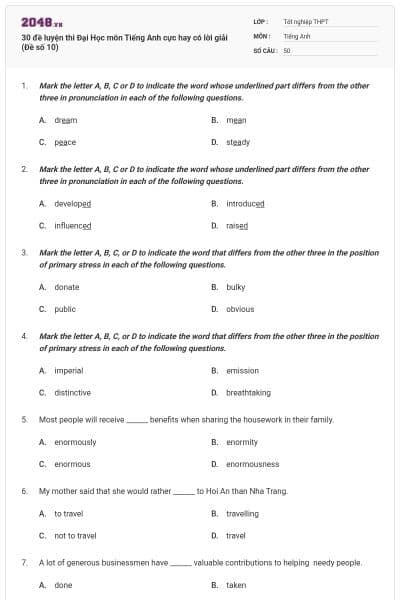
Mark the letter A, B, C or D to indicate the word whose underlined part differs from the other three in pronunciation in each of the following questions.
dream
mean
peace
steady
Đáp án D
Kiến thức về cách phát âm nguyên âm
A. dream /dri:m/
B. mean /mi:n/
C. peace /pi:s/
D. steady /'stedi/
Mark the letter A, B, C or D to indicate the word whose underlined part differs from the other three in pronunciation in each of the following questions.
developed
introduced
influenced
raised
Đáp án D
Kiến thức về cách phát âm đuôi “ed”
A. developed /dɪ’veləpt/
B. introduced /,ɪntrə'dju:st/
C. influenced /'ɪnfluənst/
D. raised /reɪzd/
Mark the letter A, B, C, or D to indicate the word that differs from the other three in the position of primary stress in each of the following questions.
donate
bulky
public
obvious
Đáp án A
Kiến thức về trọng âm
A. donate /dəʊ'neɪt/: từ này có trọng âm rơi vào âm tiết thứ hai. Vì theo quy tắc động từ có hai âm tiết thì trọng âm rơi vào âm vào âm tiết thứ hai.
B. bulky /'bʌlki/: từ này có trọng âm rơi vào âm tiết thứ nhất. Vì theo quy tắc đuôi -ly không ảnh hưởng đến trọng âm của từ.
C. public /‘pʌblɪk/: từ này có trọng âm rơi vào âm tiết thứ nhất. Vì theo quy tắc đuôi -ic làm trọng âm rơi vào trước âm đó.
D. obvious /'ɒbviəs/: từ này có trọng âm rơi vào âm tiết thứ nhất. Vì theo quy tắc đuôi -ious làm trọng âm rơi vào trước âm đó.
=> Phương án A có trọng âm rơi vào âm tiết thứ hai. Các phương án còn lại có trọng âm rơi vào âm tiết thứ nhất.
Mark the letter A, B, C, or D to indicate the word that differs from the other three in the position of primary stress in each of the following questions.
imperial
emission
distinctive
breathtaking
Đáp án D
Kiến thức về trọng âm
A. imperial /ɪm'pɪəriəl/: từ này có trọng âm rơi vào âm tiết thứ hai. Vì các từ có đuôi -ial thì trọng âm rơi vào âm tiết ngay trước nó.
B. emission /i'mɪ∫n/: từ này có trọng âm rơi vào âm tiết thứ hai. Vì các từ có hậu tố là “ion” thì trọng âm rơi vào âm tiết ngay trước nó.
C. distinctive /dɪ’stɪŋktɪv/: từ này có trọng âm rơi vào âm tiết thứ hai. Vì theo quy tắc hậu tố -ive làm trọng âm rơi vào trước nó.
D. breathtaking / 'breθteɪkɪŋ/: từ này có trọng âm rơi vào âm tiết thứ nhất. Vì theo quy tắc danh từ ghép thường có trọng âm rơi vào âm tiết thứ nhất
=> Phương án D có trọng âm rơi vào âm tiết thứ nhất, các phương án còn lại có trong âm rơi vào âm tiết thứ hai.
Most people will receive ______ benefits when sharing the housework in their family.
enormously
enormity
enormous
enormousness
Đáp án C
Kiến thức về dạng của từ
A. enormously /i’nɔ:məsli/ (adv): to lớn, khổng lồ, vô cùng, hết sức
B. enormity /i’nɔ:miti/ (n): sự tàn ác dã man; tính tàn ác, tội ác; hành động tàn ác, tầm cỡ
C. enormous /i'nɔ:məs/ (a): to lớn, khổng lồ
D. enormousness /i’nɔ:məsnis/ (n): sự to lớn, sự khổng lồ; tính to lớn
Căn cứ vào danh từ "benefìts” nên vị trí trống cần một tính từ.
Tạm dịch: Hầu hết mọi người sẽ nhận được lợi ích to lớn khi chia sẻ việc nhà, gia đình của họ.
My mother said that she would rather ______ to Hoi An than Nha Trang.
to travel
travelling
not to travel
travel
Đáp án D
Kiến thức về cấu trúc
Would rather + V + than + V: muốn làm gì hơn làm gì
Tạm dịch: Mẹ tôi nói rằng bà ấy muốn đi đến Hội An hơn Nha Trang.
A lot of generous businessmen have ______ valuable contributions to helping needy people.
done
taken
made
given
Đáp án: C
Giải thích:
Kiến thức về cụm từ cố định: Make (a lot of) contributions to st/doing st: đóng góp nhiều/cống hiến cho cái gì
Từ vựng đáng lưu ý:
The needy = needy people: những người cần được giúp đỡ/gặp khó khăn
Dịch: Rất nhiều doanh nhân hào phóng đã có những đóng góp quý giá để giúp đỡ những người gặp khó khăn.
Whenever I set out for ______ examination, I always try to avoid crossing ______ path of ______ woman.
an - the - a
an - a - the
an - the - the
the - the - a
Đáp án A
Kiến thức về mạo từ
- dùng "An" khi chữ đằng sau bắt đầu bằng nguyên âm (a, o, u e,i) và dùng “A” khi chữ đằng sau bắt đầu bằng các phụ âm còn lại.
- “A” và “An” dùng để giới thiệu về thứ lần đầu tiên nhắc tới với người nghe (người nghe chưa biết gì về thứ này). Sau khi giới thiệu, người nói có thể dùng mạo từ “The” khi nhắc tới vật đó.
- “The” đứng trước danh từ, xác định bằng một cụm từ hoặc một mệnh đề.
(the path of => path đã được xác định)
Tạm dịch: Bất cứ khi nào tôi bắt đầu chuẩn bị cho kì thi, tôi luôn cố gắng tránh gặp phải phụ nữ.
Cụm từ đáng lưu ý :
Set out for st : bắt đầu chuẩn bị cho cái gì (có mục đích)
Most of the air pollution results ______ the burning of fossil fuels, motor vehicles, factories, aircraft and rockets.
in
to
on
from
Đáp án D
Kiến thức về cụm giới từ
Resulf from: gây ra bởi, là kết quả của >< resulf in: gây ra, dẫn tới
Tạm dịch: Hầu hết các ô nhiễm không khí là kết quả của việc đốt nhiên liệu hóa thạch, xe có động cơ, nhà máy, máy bay và tên lửa.
I have a ______ on a classmate who is very near and dear to me.
crush
desire
flame
passion
Đáp án A
Kiến thức về cụm từ cố định
Have crush on sb: yêu thầm, thích thầm ai đó
Tạm dịch: Tôi đã thích thầm bạn học cùng lớp với tôi người mà rất gần gũi và thân thiết với tôi.
I was encouraged to ______ for the grandest prize in the dancing competition.
try
strive
reach
achieve
Đáp án B
Kiến thức về cụm động từ
Strive for st: cố gắng hết sức làm gì
Tạm dịch: Tôi được khích lệ cố gắng hết sức giành giải thưởng cao quý nhất trong cuộc thi nhảy.
Children with cognitive impairments may have ______ in learning basic skills like reading, writing, or problem solving.
problem
troubled
difficulty
challenge
Đáp án C
Kiến thức về cụm động từ
Have difficulty (in) st/ doing st: gặp khó khăn trong việc gì
Tạm dịch: Trẻ em khuyết tật về nhận thức có thể gặp khó khăn trong việc học các kỹ năng cơ bản như đọc, viết, hoặc giải quyết vấn đề.
Từ vựng cần lưu ý:
- children with cognitive impairments: trẻ em khuyết tật về nhận thức
- problem solving: giải quyết vấn đề
It is no use ______ a girl that she doesn't need to lose any weight.
convince
convincing
to convince
to convincing
Đáp án B
Kiến thức về thì động từ
It’s no use/good doing st = there is no point in doing st: vô ích khi làm gì
Tạm dịch: Thật vô ích khi thuyết phục một cô gái rằng cô ấy không cần thiết phải giảm cân.
Cấu trúc cần lưu ý:
Loose weight: giảm cân
Convince sb: thuyết phục ai đó tin vào điều gì
Persuade sb to do st: thuyết phục ai đó làm gì
______ in all parts of the state, pines are the most common trees in Georgia.
Found
Finding
To find
Having found
Đáp án A
Kiến thức về động chủ ngữ
Tạm dịch: Được tìm thấy ở khắp mọi miền trên thế giới, cây gỗ thông là loại cây phổ biến nhất ở Georgia.
=> Câu mang nghĩa bị động nên ta dùng ở dạng rút gọn mệnh đề bằng cách dùng Vpp.
If the primary candidates _____ more on the issue, the results of the election would have been quite different.
have focused
had focused
focused
were focused
Đáp án B
Kiến thức về câu điều kiện loại 3
Khái niệm:
Câu điều kiện loại 3 là câu điều kiện không có thực trong quá khứ.
Điều kiện không thể xảy ra trong quá khứ, chỉ mang tính ước muốn trong quá khứ, một giả thiết trái ngược với thực trạng ở quá khứ.
Cấu trúc câu điều hiện loại 3:
If + S + had + VPP (quá khứ phân từ), S + would + have + VPP
Tạm dịch: Nếu ứng cử viên chính đã tập trung hơn vào về vấn đề này thì kết quả của cuộc bầu cử sẽ khá khác đi.
When I met Walters about two years before his death he didn’t seem satisfied. He _____ no major book since he settled in Uganda.
has published
could have published
published
had published
Đáp án: D
Giải thích:
Kiến thức: Thì của động từ
Ta thấy thời gian trong ngữ cảnh này đều là trong quá khứ, loại A.
Dấu hiệu thì hoàn thành: since (kể từ khi)
Vị trí cần điền là động từ diễn tả hành động tính từ một thời điểm trong quá khứ đến một thời điểm khác trong quá khứ, dùng quá khứ hoàn thành. Chọn D.
Dịch: Khi tôi gặp Walters khoảng hai năm trước khi ông qua đời thì ông có vẻ không hài lòng. Ông đã không có cuốn sách nổi bật nào kể từ khi ông định cư tại Uganda.
You should stop working too hard _____ you'll get sick.
or else
if
in case
whereas
Đáp án A
Kiến thức về liên từ
Tạm dịch: Bạn nên đừng làm việc quá sức hoặc bạn sẽ bị ốm.
I don't have time to argue with this self - _____ women.
controlled
dominated
opinionated
liked
Đáp án C
Kiến thức về từ vựng
A. self-controlled /,self kən'trəʊld/ (adj): sự kiểm soát bản thân (về cảm xúc, hành vi)
B. self-dominated: không tồn tại từ này
C. self-opinionated /self ə'pɪnjəneɪtɪd / (adj): bảo thủ, cố chấp
D. sef-liked: không tồn tại từ này
Tạm dịch: Tôi không có thời gian cãi nhau với một người phụ nữ bảo thủ như vậy.
Mark the letter A, B, C, or D to indicate the word(s) CLOSEST in meaning to the underlined word (s) in each of the following questions.
Gary didn't always see eye to eye with his father, and this is where the honesty shows through.
agree with
be opposed to
look up to
take after
Đáp án A
Từ đồng nghĩa – Kiến thức về cụm từ cố định
See eye to eye with sb = agree with sb: đồng tình, đồng ý với ai
Các đáp án khác:
B. be opposed to: phản đối
C. look up to: kính trọng, coi trọng
D. take after: trông giống ai
Tạm dịch: Gary luôn luôn không đồng tình với bố của anh ta và đây là nơi sự trung thực được thể hiện qua.
Mark the letter A, B, C, or D to indicate the word(s) CLOSEST in meaning to the underlined word (s) in each of the following questions.
Journalists can make mistakes, so don't believe everything you read in the press.
publications
news bulletins
reference books
newspapers and magazines
Đáp án D
Từ đồng nghĩa - Kiến thức về từ vựng
Tạm dịch: Nhà báo cũng có thể có lúc sai vì vậy đừng tin mọi thứ được viết trên báo.
The press /pres/ (n): báo chí = newspaper and magazines
Các đáp án khác:
A. publications /,pʌblɪ'keɪ∫n/ (n): sự công bố, sự xuất bản sách.
B. news bulletins (n): mẩu tin tức
C. reference books (n) : sách tham khảo
Mark the letter A, B, C, or D to indicate the word(s) OPPOSITE in meaning to the underlined word(s) in each of the following questions.
If you live in an extended family, you'll have great joy and get support of other members.
close family
traditional family
nuclear family
large family
Đáp án C
Giải thích:
Extended family (n): đại gia đình >< nuclear family (n): gia đình hạt nhân (có bố mẹ và con cái)
Dịch: Nếu bạn sống trong một đại gia đình bạn sẽ cảm thấy rất vui và nhận được sự giúp đỡ từ nhiều thành viên khác trong gia đình.
Mark the letter A, B, C, or D to indicate the word(s) OPPOSITE in meaning to the underlined word(s) in each of the following questions.
In Thailand, it's against the law to litter on the pavement. If you are caught, you can be fined up to 2000 Baht.
evil
illegal
immoral
legal
Đáp án D
Từ trái nghĩa - Kiến thức về cụm từ cố định
Tạm dịch: Ở Thái Lan, xả rác trên vỉa hè là phạm pháp. Nếu bạn bị bắt gặp, bạn có thể bị phạt lên đến 2000 Bạt.
=> Against the law >< legal /'li:gl/ (adj): đúng luật, theo luật
Các đáp án khác:
A. evil /'i:vl/ (adi): xấu xa về mặt đạo đức
B. il]egal /ɪ'li:g1/ (adj): phạm pháp, trái luật
C. immoral /ɪ'mɒrə1/ (adj): trái đạo đức
Pha: "From my point of view, all family members should share the chores equally."
Tam: “____________________.”
It's a breathtaking view.
You lied to me.
But you're right.
There's no doubt about it.
Đáp án D
Tình huống giao tiếp
Pha: “Theo mình, tất cả các thành viên gia đình nên chia sẻ việc vặt như nhau.”
Tam: “______________.”
Các đáp án:
A. Nó là một quan điểm ngoạn mục.
B. Cậu nói dối tớ.
C. Nhưng cậu nói đúng.
D. Không có nghi ngờ gì về điều đó cả
Jane: "How do I sign up for the psychology course?"
Phili: “________________.”
You need to fill in the online application form first.
It's not yours.
The course was full.
Your deadline is May 15
Đáp án A
Tlnh huống giao tiếp
Jane: “Làm thế nào để đăng ký các khóa học tâm lý?”
Phili: “_____________.”
Các đáp án:
A. Bạn cần phải điền vào các mẫu đơn trực tuyến trước.
B. Đó không phải việc của bạn.
C. Khóa học đã đủ người.
D. Hạn chót là ngày 15 tháng 5.
Read the following passage and mark the letter A, B, C, or D on your answer sheet to indicate the correct word or phrase that best fits each the numbered blanks.
Despite these drawbacks, (25)_______the retirement age is still considered by policymakers as one of the key solutions to the ageing population problem in Vietnam, But these are only temporary solutions. Complementary long-term solutions such as increasing labor productivity must also be examined.
As Vietnam has specialized in manufacturing with its competitive advantage of a cheap labor force in the global supply chain, (26) _______higher education should be reoriented to focus more on vocational training rather than university degrees. The Vietnamese government has already taken action by simplifying the entrance exam to university. Previously, Vietnam's national entrance exam was very difficult and only a limited number of the most talented citizens managed to enter universities.
However, as living standards in Vietnam improve and more families can afford to send their children to university, universities have become more commercialized and entering university is no longer a rare achievement. The low quality of Vietnamese universities also means the majority of graduating students are unable to find an appropriate job. By simplifying entrance exams to deemphasise university degrees, the government has encouraged students to opt for vocational training. (27) _______, 2016 saw a remarkable decrease in the number of students applying (28) _______university.
Another supplementary policy is to have productivity-based rather than seniority-based salaries, (29)_______ are common in Asian countries. This would address public concern about aged seniors doing less work for more pay than younger employees. Companies and government agencies would employ and appreciate the young while benefiting from the experience of the old. But this issue feeds the Communist regime's dilemma between adhering to Communist principles and integrating into the capitalist culture of productivity for profits.
ĐIền vào số (25)
raising
rising
plant
feed
Đáp án A
Chủ đề về POPULATION
Kiến thức về từ vựng
A. raise (v): nâng lên
B. rise (v): mọc lên
C. plant (v): trồng trọt (cây)
D. Feed (v): nuôi, cho ăn (con vật)
Căn cứ vào ngữ cảnh thì A là đáp án đúng. Đáp án B là nội động từ nên không thể chọn.
Tạm dịch: “Despite these drawbacks, (25) _________ the retirement age is still considered by policymakers as one of the key solutions to the ageing population problem in Vietnam"
(Bất chấp những hạn chế này, (25) _______ nâng__tuổi nghỉ hưu vẫn được các nhà hoạch định chính sách coi là một trong những giải pháp chính cho vấn để dân số già ở Việt Nam.)
Read the following passage and mark the letter A, B, C, or D on your answer sheet to indicate the correct word or phrase that best fits each the numbered blanks.
Despite these drawbacks, (25)_______the retirement age is still considered by policymakers as one of the key solutions to the ageing population problem in Vietnam, But these are only temporary solutions. Complementary long-term solutions such as increasing labor productivity must also be examined.
As Vietnam has specialized in manufacturing with its competitive advantage of a cheap labor force in the global supply chain, (26) _______higher education should be reoriented to focus more on vocational training rather than university degrees. The Vietnamese government has already taken action by simplifying the entrance exam to university. Previously, Vietnam's national entrance exam was very difficult and only a limited number of the most talented citizens managed to enter universities.
However, as living standards in Vietnam improve and more families can afford to send their children to university, universities have become more commercialized and entering university is no longer a rare achievement. The low quality of Vietnamese universities also means the majority of graduating students are unable to find an appropriate job. By simplifying entrance exams to deemphasise university degrees, the government has encouraged students to opt for vocational training. (27) _______, 2016 saw a remarkable decrease in the number of students applying (28) _______university.
Another supplementary policy is to have productivity-based rather than seniority-based salaries, (29)_______ are common in Asian countries. This would address public concern about aged seniors doing less work for more pay than younger employees. Companies and government agencies would employ and appreciate the young while benefiting from the experience of the old. But this issue feeds the Communist regime's dilemma between adhering to Communist principles and integrating into the capitalist culture of productivity for profits.
Điền vào số (26)
nationally
nationality
national
nation
Đáp án C
Kiến thức về từ loại
A. nationally /'næ∫ənəli/ (adv): về mặt dân tộc, quốc gia
B. nationality /,næ∫ən'æləti/ (n): quốc tịch
C. national /'næ∫ənəl/ (adj): thuộc về quốc gia
D. nation /'nəɪ∫ən/ (n): quốc gia
Vị trí còn thiếu cần 1 tính từ, nên A, B, D loại.
Tạm dịch: “As Vietnam has specialized in manufacturing with its competitive advantage of a cheap labor force in the global supply chain, national higher education should be reoriented to focus more on vocational training rather than university degrees.” (Vì Việt Nam chuyên sản xuất với lợi thế cạnh tranh là lực lượng lao động giá rẻ trong chuỗi cung ứng toàn cầu, giáo dục đại học ở nước ta cần được định hướng lại để tập trung nhiều hơn vào đào tạo nghề thay vì bằng đại học.)
Read the following passage and mark the letter A, B, C, or D on your answer sheet to indicate the correct word or phrase that best fits each the numbered blanks.
Despite these drawbacks, (25)_______the retirement age is still considered by policymakers as one of the key solutions to the ageing population problem in Vietnam, But these are only temporary solutions. Complementary long-term solutions such as increasing labor productivity must also be examined.
As Vietnam has specialized in manufacturing with its competitive advantage of a cheap labor force in the global supply chain, (26) _______higher education should be reoriented to focus more on vocational training rather than university degrees. The Vietnamese government has already taken action by simplifying the entrance exam to university. Previously, Vietnam's national entrance exam was very difficult and only a limited number of the most talented citizens managed to enter universities.
However, as living standards in Vietnam improve and more families can afford to send their children to university, universities have become more commercialized and entering university is no longer a rare achievement. The low quality of Vietnamese universities also means the majority of graduating students are unable to find an appropriate job. By simplifying entrance exams to deemphasise university degrees, the government has encouraged students to opt for vocational training. (27) _______, 2016 saw a remarkable decrease in the number of students applying (28) _______university.
Another supplementary policy is to have productivity-based rather than seniority-based salaries, (29)_______ are common in Asian countries. This would address public concern about aged seniors doing less work for more pay than younger employees. Companies and government agencies would employ and appreciate the young while benefiting from the experience of the old. But this issue feeds the Communist regime's dilemma between adhering to Communist principles and integrating into the capitalist culture of productivity for profits.
Điền vào số (27)
However
As a result
But
Otherwise
Đáp án B
Kiến thức về liên từ
A. However: tuy nhiên (dùng để nối 2 mệnh đề)
B. As a result: kết quả là (dùng khi diễn đạt nguyên nhân-kểt quả)
C. But: nhưng (dùng để nối 2 mệnh đề có nghĩa tương phản trong cùng 1 câu)
D. Otherwise: nếu không
Căn từ vào ý nghĩa của câu, ta chọn B.
Tạm dịch: "By simplifying entrance exams to deemphasise university degrees, the government has encouraged students to opt for vocational training. (27) As a result, 2016 saw a remarkable decrease in the number of students applying (28) for university. (Bằng cách đơn giản hóa các kỳ thi tuyển sinh để lấy bằng đại học, chính phủ đã khuyến khích sinh viên lựa chọn đào tạo nghề. Do đó, năm 2016 đã chứng kiến sự sụt giảm đáng kể số lượng sinh viên đăng ký (28) cho trường đại học.)
Read the following passage and mark the letter A, B, C, or D on your answer sheet to indicate the correct word or phrase that best fits each the numbered blanks.
Despite these drawbacks, (25)_______the retirement age is still considered by policymakers as one of the key solutions to the ageing population problem in Vietnam, But these are only temporary solutions. Complementary long-term solutions such as increasing labor productivity must also be examined.
As Vietnam has specialized in manufacturing with its competitive advantage of a cheap labor force in the global supply chain, (26) _______higher education should be reoriented to focus more on vocational training rather than university degrees. The Vietnamese government has already taken action by simplifying the entrance exam to university. Previously, Vietnam's national entrance exam was very difficult and only a limited number of the most talented citizens managed to enter universities.
However, as living standards in Vietnam improve and more families can afford to send their children to university, universities have become more commercialized and entering university is no longer a rare achievement. The low quality of Vietnamese universities also means the majority of graduating students are unable to find an appropriate job. By simplifying entrance exams to deemphasise university degrees, the government has encouraged students to opt for vocational training. (27) _______, 2016 saw a remarkable decrease in the number of students applying (28) _______university.
Another supplementary policy is to have productivity-based rather than seniority-based salaries, (29)_______ are common in Asian countries. This would address public concern about aged seniors doing less work for more pay than younger employees. Companies and government agencies would employ and appreciate the young while benefiting from the experience of the old. But this issue feeds the Communist regime's dilemma between adhering to Communist principles and integrating into the capitalist culture of productivity for profits.
Điền vào số (28)
in
with
for
at
Đáp án B
Kiến thức về cụm giới từ
"Apply for university” có nghĩa là “đăng kí học đại học”
Tạm dịch: "As a result, 2016 saw a remarkable decrease in the number of students applying for university." (Do đó, năm 2016 đã chứng kiến sự sụt giảm đáng kể số lượng sinh viên đăng ký cho trường đại học.)
Read the following passage and mark the letter A, B, C, or D on your answer sheet to indicate the correct word or phrase that best fits each the numbered blanks.
Despite these drawbacks, (25)_______the retirement age is still considered by policymakers as one of the key solutions to the ageing population problem in Vietnam, But these are only temporary solutions. Complementary long-term solutions such as increasing labor productivity must also be examined.
As Vietnam has specialized in manufacturing with its competitive advantage of a cheap labor force in the global supply chain, (26) _______higher education should be reoriented to focus more on vocational training rather than university degrees. The Vietnamese government has already taken action by simplifying the entrance exam to university. Previously, Vietnam's national entrance exam was very difficult and only a limited number of the most talented citizens managed to enter universities.
However, as living standards in Vietnam improve and more families can afford to send their children to university, universities have become more commercialized and entering university is no longer a rare achievement. The low quality of Vietnamese universities also means the majority of graduating students are unable to find an appropriate job. By simplifying entrance exams to deemphasise university degrees, the government has encouraged students to opt for vocational training. (27) _______, 2016 saw a remarkable decrease in the number of students applying (28) _______university.
Another supplementary policy is to have productivity-based rather than seniority-based salaries, (29)_______ are common in Asian countries. This would address public concern about aged seniors doing less work for more pay than younger employees. Companies and government agencies would employ and appreciate the young while benefiting from the experience of the old. But this issue feeds the Communist regime's dilemma between adhering to Communist principles and integrating into the capitalist culture of productivity for profits.
Điền vào số (29)
what
why
that
which
Đáp án D
Kiến thức về đại từ quan hệ
Trong trường hợp này đáp án B loại vì "why" được dùng để thay thế cho từ/cụm từ chỉ nguyên nhân/ lý do.
Đại từ quan hệ “which, that” đều thay thế cho từ/cụm từ chỉ vật. Tuy nhiên, khi trong câu có dấu phẩy thì sẽ không sử dụng từ “that”.
Trạng từ quan hệ "where" để thay thế cho từ chỉ nơi chốn.
Tạm dịch: "Another supplementary policy is to have productivity-based rather than seniority-based salaries, (29)________ are common in Asian countries" (Một chính sách bổ sung khác là có mức lương dựa trên năng suất thay vì thâm niên, điều mà vốn phổ biến ở các nước châu Á.)
Read the following passage and mark the letter A, B, C, or D to indicate the answer to each of the question.
The first Industrial Revolution was about harnessing steam power so that muscle could be replaced by machines. The second was driven by electricity and a cluster of inventions from the late 19th century onwards - including the internal combustion engine, the aeroplane and moving pictures. A third revolution began in the 1960s and was based on digital technology, personal computing and the development of the internet. Industrial Revolution 4.0 will be shaped by a fresh wave of innovation in areas such as driverless cars, smart robotics, materials that are lighter and tougher, and a manufacturing process built around 3D printing.
There are some myths about Industrial Revolution 4.0. The first is that it won't really have as big an impact as the previous periods of change, most especially the breakthroughs associated with the second industrial revolution. In the past, it has always taken time to feel the full effects of technological change and many of today's advances are in their infancy. It is far too early to say that the car or air travel will prove to be less important than the sequencing of the human genome or synthetic biology. The second myth is that the process will be trouble free provided everything is left to the market. It is a fantasy to believe that the wealth created by the fourth Industrial Revolution will cascade down from rich to poor, and that those displaced will just walk into another job that pays just as well.
Indeed, all the evidence so far is that the benefits of the coming change will be concentrated among a relatively small elite, thus exacerbating the current trend towards greater levels of inequality. This was a point stressed by the Swiss bank UBS in a report launched in Davos. It notes that there will be a "polarisation of the labour force as low-skill jobs continue to be automated and this trend increasingly spreads to middle class jobs."
The best title for this passage could be _________________.
Four Industrial Revolutions in human history
Some myths about four Industrial Revolutions
The benefits of the fourth Industrial Revolution
The greatest inventions in human history
Đáp án A
Chủ đề về INDUSTRIAL REVOLUTION
Tiêu đề tốt nhất cho đoạn văn này có thể là ____________.
A. Bốn cuộc cách mạng công nghiệp trong lịch sử loài người.
B. Một vài chuyện tưởng tượng về cách mạng 4.0
C. Lợi ích của cách mạng 4.0
D. Những phát minh tuyệt vời nhất trong lịch sử
Căn cứ vào thông tin toàn bài:
Thông tin "chuyện tưởng tượng về cách mạng 4.0, lợi ích của 4.0" được đề cập trong bài nhưng chưa bao quát toàn bài.
Trong bài có nhắc đến các phát minh, nhưng không nói có phải tuyệt vời nhất hay không.
Read the following passage and mark the letter A, B, C, or D to indicate the answer to each of the question.
The first Industrial Revolution was about harnessing steam power so that muscle could be replaced by machines. The second was driven by electricity and a cluster of inventions from the late 19th century onwards - including the internal combustion engine, the aeroplane and moving pictures. A third revolution began in the 1960s and was based on digital technology, personal computing and the development of the internet. Industrial Revolution 4.0 will be shaped by a fresh wave of innovation in areas such as driverless cars, smart robotics, materials that are lighter and tougher, and a manufacturing process built around 3D printing.
There are some myths about Industrial Revolution 4.0. The first is that it won't really have as big an impact as the previous periods of change, most especially the breakthroughs associated with the second industrial revolution. In the past, it has always taken time to feel the full effects of technological change and many of today's advances are in their infancy. It is far too early to say that the car or air travel will prove to be less important than the sequencing of the human genome or synthetic biology. The second myth is that the process will be trouble free provided everything is left to the market. It is a fantasy to believe that the wealth created by the fourth Industrial Revolution will cascade down from rich to poor, and that those displaced will just walk into another job that pays just as well.
Indeed, all the evidence so far is that the benefits of the coming change will be concentrated among a relatively small elite, thus exacerbating the current trend towards greater levels of inequality. This was a point stressed by the Swiss bank UBS in a report launched in Davos. It notes that there will be a "polarisation of the labour force as low-skill jobs continue to be automated and this trend increasingly spreads to middle class jobs."
Which statement about four Industrial Revolutions is FALSE according to the passage?
The first Industrial Revolution brought about steam power machines.
A third revolution began in the 1970 and led to the development of the Internet.
The second was driven by electricity and a cluster of inventions from the late 19th century onwards.
Driverless cars, smart robotics can be said to be products of Industrial Revolution 4.0
Đáp án B
Phát biểu nào về 4 cuộc cánh mạng có lẽ là SAI theo đoạn văn?
A. Cuộc cách mạng công nghiệp đầu tiên đã mang đến máy hơi nước
B. Một cuộc cách mạng công nghiệp lần 3 diễn ra năm 1970 và đưa đến sự phát triển của internet.
C. Cuộc cách mạng lần hai được thúc đẩy bởi điện và một loạt các phát minh từ cuối thế kỷ 19 trở đi
D. Ô tô không người lái, robot thông minh được coi là sản phẩm của cuộc cách mạng 4.0
Căn cứ vào thông tin trong đoạn văn 1 có thể thấy đáp án B sai.
“The first Industrial Revolution was about harnessing steam power so that muscle could be replaced by machines. The second was driven by electricity and a cluster of inventions from the late 19th century onwards.” (Cuộc cách mạng công nghiệp đầu tiên là khai thác năng lượng hơi nước để sức người có thể được thay thế bằng máy móc. Cuộc cách mạng lần hai được thúc đẩy bởi điện và một loạt các phát minh từ cuối thế kỷ 19 trở đi.)
“A third revolution began in the 19603 and was based on digital technology” (Một cuộc cách mạng thứ ba bắt đầu vào những năm 1960 và dựa trên công nghệ kỹ thuật số.
Read the following passage and mark the letter A, B, C, or D to indicate the answer to each of the question.
The first Industrial Revolution was about harnessing steam power so that muscle could be replaced by machines. The second was driven by electricity and a cluster of inventions from the late 19th century onwards - including the internal combustion engine, the aeroplane and moving pictures. A third revolution began in the 1960s and was based on digital technology, personal computing and the development of the internet. Industrial Revolution 4.0 will be shaped by a fresh wave of innovation in areas such as driverless cars, smart robotics, materials that are lighter and tougher, and a manufacturing process built around 3D printing.
There are some myths about Industrial Revolution 4.0. The first is that it won't really have as big an impact as the previous periods of change, most especially the breakthroughs associated with the second industrial revolution. In the past, it has always taken time to feel the full effects of technological change and many of today's advances are in their infancy. It is far too early to say that the car or air travel will prove to be less important than the sequencing of the human genome or synthetic biology. The second myth is that the process will be trouble free provided everything is left to the market. It is a fantasy to believe that the wealth created by the fourth Industrial Revolution will cascade down from rich to poor, and that those displaced will just walk into another job that pays just as well.
Indeed, all the evidence so far is that the benefits of the coming change will be concentrated among a relatively small elite, thus exacerbating the current trend towards greater levels of inequality. This was a point stressed by the Swiss bank UBS in a report launched in Davos. It notes that there will be a "polarisation of the labour force as low-skill jobs continue to be automated and this trend increasingly spreads to middle class jobs."
The word "it" in paragraph 2 refers to ___________?
myths
IndustrialRevolution 1.0
Industrial Revolution 3.0
Industrial Revolution 4.0
Đáp án D
Từ “it” trong đoạn 2 thay thế cho từ ___________.
A. chuyện tưởng tượng
B. Cách mạng 1.0
C. Cách mạng 3.0
D. Cách mạng 4.0
Căn cứ vào thông tin đoạn 2:
“There are some myths about Industrial Revolution 4.0. The first is that it won’t really have as big an impact as the previous periods of change, most especially the breakthroughs associated with the second industrial revolution. ” (Có một số huyền thoại về Cách mạng công nghiệp 4.0. Đầu tiên là nó không có được sức ảnh hưởng lớn như các giai đoạn thay đổi trước 2, đặc biệt là những đột phá liên quan đến cuộc cách mạng công nghiệp thứ hai.)
Read the following passage and mark the letter A, B, C, or D to indicate the answer to each of the question.
The first Industrial Revolution was about harnessing steam power so that muscle could be replaced by machines. The second was driven by electricity and a cluster of inventions from the late 19th century onwards - including the internal combustion engine, the aeroplane and moving pictures. A third revolution began in the 1960s and was based on digital technology, personal computing and the development of the internet. Industrial Revolution 4.0 will be shaped by a fresh wave of innovation in areas such as driverless cars, smart robotics, materials that are lighter and tougher, and a manufacturing process built around 3D printing.
There are some myths about Industrial Revolution 4.0. The first is that it won't really have as big an impact as the previous periods of change, most especially the breakthroughs associated with the second industrial revolution. In the past, it has always taken time to feel the full effects of technological change and many of today's advances are in their infancy. It is far too early to say that the car or air travel will prove to be less important than the sequencing of the human genome or synthetic biology. The second myth is that the process will be trouble free provided everything is left to the market. It is a fantasy to believe that the wealth created by the fourth Industrial Revolution will cascade down from rich to poor, and that those displaced will just walk into another job that pays just as well.
Indeed, all the evidence so far is that the benefits of the coming change will be concentrated among a relatively small elite, thus exacerbating the current trend towards greater levels of inequality. This was a point stressed by the Swiss bank UBS in a report launched in Davos. It notes that there will be a "polarisation of the labour force as low-skill jobs continue to be automated and this trend increasingly spreads to middle class jobs."
In the 2rd, paragraph, the writer suggests that _______.
Industrial Revolution 4.0 will really have as big an impact as the previous periods of change.
many of today's advances resemble those in the past.
It is far too early to say that the sequencing of the human genorne or synthetic biology will prove to be more significant than the car or air travel.
the fourth Industrial Revolution will cascade down from rich to poor.
Đáp án C
Trong đoạn 2, tác giả gợi ý rằng ___________.
A. Cuộc cách mạng 4.0 sẽ có được sức ảnh hưởng lớn như các giai đoạn trước đây.
B. Nhiều sự tiên tiến ngày nay thì giống với quá khứ
C. Vẫn còn quá sớm để nói rằng xe hơi hoặc du lịch hàng không sẽ chứng tỏ ít quan trọng hơn trình tự bộ gen người hoặc sinh học tổng hợp.
D. cuộc cách mạng công nghiệp lần thứ tư sẽ chuyển từ giàu sang nghèo
Căn cứ vào thông tin đoạn 2:
“It is far too early to say that the car or air travel will prove to be less important than the sequencing of the human genome or synthetic biology.” (Vẫn còn quá sớm để nói rằng xe hơi hoặc du lịch hàng không sẽ tỏ ra ít quan trọng hơn so với trình tự bộ gen người hoặc sinh học tổng hợp
Read the following passage and mark the letter A, B, C, or D to indicate the answer to each of the question.
The first Industrial Revolution was about harnessing steam power so that muscle could be replaced by machines. The second was driven by electricity and a cluster of inventions from the late 19th century onwards - including the internal combustion engine, the aeroplane and moving pictures. A third revolution began in the 1960s and was based on digital technology, personal computing and the development of the internet. Industrial Revolution 4.0 will be shaped by a fresh wave of innovation in areas such as driverless cars, smart robotics, materials that are lighter and tougher, and a manufacturing process built around 3D printing.
There are some myths about Industrial Revolution 4.0. The first is that it won't really have as big an impact as the previous periods of change, most especially the breakthroughs associated with the second industrial revolution. In the past, it has always taken time to feel the full effects of technological change and many of today's advances are in their infancy. It is far too early to say that the car or air travel will prove to be less important than the sequencing of the human genome or synthetic biology. The second myth is that the process will be trouble free provided everything is left to the market. It is a fantasy to believe that the wealth created by the fourth Industrial Revolution will cascade down from rich to poor, and that those displaced will just walk into another job that pays just as well.
Indeed, all the evidence so far is that the benefits of the coming change will be concentrated among a relatively small elite, thus exacerbating the current trend towards greater levels of inequality. This was a point stressed by the Swiss bank UBS in a report launched in Davos. It notes that there will be a "polarisation of the labour force as low-skill jobs continue to be automated and this trend increasingly spreads to middle class jobs."
The word "exacerbating" in paragraph 3 means _______.
worsening
lessening
minimizing
changing
Đáp án A
Từ “exacerbating” trong đoạn 3 có nghĩa là __________.
A. worsen (v): làm tồi tệ hơn
B. lessen (v): làm giảm
C. minimize (v): thu nhỏ
D. change (v): thay đổi
Exaberate = worsen: làm tồi tệ hơn
Căn cứ vào thông tin đoạn 3:
“Indeed, all the evidence so far is that the benefits of the coming change will be concentrated among a relatively small elite, thus exacerbating the current trend towards greater levels of inequality.”
(Thật vậy, tất cả các bằng chứng cho đến nay là lợi ích của sự thay đổi sắp tới sẽ được tập trung giữa một tầng lớp tương đối nhỏ, do đó làm trầm trọng thêm xu hướng hiện tại đối với mức độ bất bình đẳng lớn hơn.)
Read the following passage and mark the letter A, B, C, or D to indicate the answer to each of the question.
Most parents want their sons and daughters to have equal chances of success when they grow up. Today, equality of the sexes is largely mandated by public policy and law. However, old-fashioned ideas and a lot of prejudice are still part of our culture and present challenging questions for parents.
Gender stereotypes are rigid ideas about how boys and girls should behave. We all know what these stereotypes are: A "feminine" girls should be insecure, accommodating and a little illogical in her thinking. A "masculine" boy should be strong, unemotional, aggressive, and competitive. How are children exposed to these stereotypes? According to the researchers David and Myra Sadker of the American University of Washington, D.C., boys and girls are often treated differently in the classroom. They found out that when boys speak, teachers usually offer constructive comments, when girls speech, teachers tend to focus on the behavior. It's more important how the girls act rather than what they say.
The emphasis on differences begins at birth and continues throughout childhood. For example, few people would give pink baby's clothes to a boy or a blue blanket to a girl. Later, many of us give girls dolls and miniature kitchenware, while boys receive action figures and construction sets. There's nothing wrong with that. The problem arises when certain activities are deemed appropriate for one sex but not the other. According to Heather J. Nicholson, Ph.D., director of the National Resource Center for Girls, Inc., this kind of practice prevents boys and girls from acquiring important skills for their future lives.
"The fact is," says Nicholson, "that society functions as a kind of sorting machine regarding gender. In a recent survey, fifty-eight percent of eighth-grade girls but only six percent of boys earned money caring for younger children. On the other hand, twenty-seven percent of boys but only three percent of girls earned money doing lawn work". If we are serious about educating a generation to be good workers and parents, we need to eliminate such stereotypes as those mentioned previously.
Gender stereotypes inevitably are passed to our children. However, by becoming aware of the messages our children receive, we can help them develop ways to overcome these incorrect ideas. To counteract these ideas, parents can look for ways to challenge and support their children, and to encourage confidence in ways that go beyond what society's fixed ideas about differences of sext are.
Which of the following could be the main idea of the passage?
Deep-seated stereotypes about genders and their effects.
Different prejudice about how girls and boys should behave and be treated.
The role of culture in the behavior of different genders.
The influence of education and society on gender stereotypes.
Đáp án A
Chủ đề GENDER EQUALITY
Câu nào trong các câu sau có thể là ý chính của đoạn văn?
A. Những định kiến lâu đời về giới tính và các tác động của nó.
B. Những định kiến khác nhau về việc con trai và con gái nên cư xử và được đối xử như thế nào.
C. Vai trò của văn hóa trong cách cư xử của các giới tính khác nhau.
D. Ảnh hưởng của giáo dục và xã hội lên định kiến về giới tính.
Căn cứ vào thông tin đoạn 1
“Most parents want their sons and daughters to have equal chances of success when they grow up. Today, equality of the sexes is largely mandated by public policy and law. However, old-fashioned ideas and a lot of prejudice are still part of our culture and present challenging questions for parents."
(Hầu hết cha mẹ nào cũng muốn con trai và con gái họ có cơ hội thành công như nhau khi chúng trưởng thành. Ngày nay, sự bình đẳng về giới tính đã được quy định rộng rãi trong các chính sách công và luật pháp. Tuy nhiên, những tư tưởng lạc hậu và nhiều định kiến vẫn là một phần trong văn hóa của chúng ta và đặt ra nhiều thách thức cho các bậc cha mẹ).
Như vậy, đoạn văn này nói về các định kiến về giới tính và những tác động của chúng.
Read the following passage and mark the letter A, B, C, or D to indicate the answer to each of the question.
Most parents want their sons and daughters to have equal chances of success when they grow up. Today, equality of the sexes is largely mandated by public policy and law. However, old-fashioned ideas and a lot of prejudice are still part of our culture and present challenging questions for parents.
Gender stereotypes are rigid ideas about how boys and girls should behave. We all know what these stereotypes are: A "feminine" girls should be insecure, accommodating and a little illogical in her thinking. A "masculine" boy should be strong, unemotional, aggressive, and competitive. How are children exposed to these stereotypes? According to the researchers David and Myra Sadker of the American University of Washington, D.C., boys and girls are often treated differently in the classroom. They found out that when boys speak, teachers usually offer constructive comments, when girls speech, teachers tend to focus on the behavior. It's more important how the girls act rather than what they say.
The emphasis on differences begins at birth and continues throughout childhood. For example, few people would give pink baby's clothes to a boy or a blue blanket to a girl. Later, many of us give girls dolls and miniature kitchenware, while boys receive action figures and construction sets. There's nothing wrong with that. The problem arises when certain activities are deemed appropriate for one sex but not the other. According to Heather J. Nicholson, Ph.D., director of the National Resource Center for Girls, Inc., this kind of practice prevents boys and girls from acquiring important skills for their future lives.
"The fact is," says Nicholson, "that society functions as a kind of sorting machine regarding gender. In a recent survey, fifty-eight percent of eighth-grade girls but only six percent of boys earned money caring for younger children. On the other hand, twenty-seven percent of boys but only three percent of girls earned money doing lawn work". If we are serious about educating a generation to be good workers and parents, we need to eliminate such stereotypes as those mentioned previously.
Gender stereotypes inevitably are passed to our children. However, by becoming aware of the messages our children receive, we can help them develop ways to overcome these incorrect ideas. To counteract these ideas, parents can look for ways to challenge and support their children, and to encourage confidence in ways that go beyond what society's fixed ideas about differences of sext are.
According to the second passage, David and Myra Sadker of the American University of Washington, D.0 found that _______.
schoolboys and schoolgirls are treated equally in the classroom.
teachers often concentrate on boys' behavior and girls' manners.
boys are commented usefully whereas girls are paid attention to behavior.
girls are taught to be insecure, accommodating and illogical while boys are strong, unemotional, aggressive, and competitive.
Đáp án C
Theo đoạn văn số 2, David và Myra Sadker ở trường Đại học Washington, D.C của Mỹ đã phát hiện ra rằng ________.
A. học sinh nam và học sinh nữ được đối xử 1 cách bình đẳng trong lớp học.
B. giáo viên thường tập trung vào hành vi ứng xử của học sinh nam và cách cư xử của học sinh nữ.
C. học sinh nam thường được nhận xét 1 cách xây dựng trong khi học sinh nữ được chú ý về hành vi ứng xử.
D. học sinh nữ được dạy phải khép nép, hay giúp đỡ và phi logic trong khi học sinh nam phải mạnh mẽ, không bị chi phối bởi cảm xúc, hăng hái và cạnh tranh.
Từ khóa: David and Myra Sadker/ found
Căn cứ thông tin đoạn 2:
“According to the researchers David and Myra Sadker of the American University of Washington, D.C., boys and girls are often treated differently in the classroom. They found out that when boys speak, teachers usually offer constructive comments, when girls speech, teachers tend to focus on the behavior. It's more important how the girls act rather than what they say.”
(Theo các nhà nghiên cứu David và Myra Sadker ở trường Đại học Washington, D.C của Mỹ, học sinh nam và học sinh nữ thường được đối xử khác nhau trong lớp học. Họ phát hiện ra rằng khi học sinh nam phát biểu, giáo viên thường đưa ra các nhận xét mang tính xây dựng, còn khi học sinh nữ phát biểu, giáo viên có khuynh hướng tập trung vào hành vi ứng xử. Việc học sinh nữ thể hiện như thể nào quan trọng hơn những gì họ nói).
Read the following passage and mark the letter A, B, C, or D to indicate the answer to each of the question.
Most parents want their sons and daughters to have equal chances of success when they grow up. Today, equality of the sexes is largely mandated by public policy and law. However, old-fashioned ideas and a lot of prejudice are still part of our culture and present challenging questions for parents.
Gender stereotypes are rigid ideas about how boys and girls should behave. We all know what these stereotypes are: A "feminine" girls should be insecure, accommodating and a little illogical in her thinking. A "masculine" boy should be strong, unemotional, aggressive, and competitive. How are children exposed to these stereotypes? According to the researchers David and Myra Sadker of the American University of Washington, D.C., boys and girls are often treated differently in the classroom. They found out that when boys speak, teachers usually offer constructive comments, when girls speech, teachers tend to focus on the behavior. It's more important how the girls act rather than what they say.
The emphasis on differences begins at birth and continues throughout childhood. For example, few people would give pink baby's clothes to a boy or a blue blanket to a girl. Later, many of us give girls dolls and miniature kitchenware, while boys receive action figures and construction sets. There's nothing wrong with that. The problem arises when certain activities are deemed appropriate for one sex but not the other. According to Heather J. Nicholson, Ph.D., director of the National Resource Center for Girls, Inc., this kind of practice prevents boys and girls from acquiring important skills for their future lives.
"The fact is," says Nicholson, "that society functions as a kind of sorting machine regarding gender. In a recent survey, fifty-eight percent of eighth-grade girls but only six percent of boys earned money caring for younger children. On the other hand, twenty-seven percent of boys but only three percent of girls earned money doing lawn work". If we are serious about educating a generation to be good workers and parents, we need to eliminate such stereotypes as those mentioned previously.
Gender stereotypes inevitably are passed to our children. However, by becoming aware of the messages our children receive, we can help them develop ways to overcome these incorrect ideas. To counteract these ideas, parents can look for ways to challenge and support their children, and to encourage confidence in ways that go beyond what society's fixed ideas about differences of sext are.
What does the word "that" in paragraph 3 refer to?
The differences between boys and girls begin at birth and continue throughout childhood.
People often give pink clothes to a boy and a blue blanket to a girl.
Many people give girls dolls and miniature kitchen and boys receive action figures and construction sets when they were born.
People give different genders of children distinct kinds of presents or clothes.
Đáp án D
Từ “that” trong đoạn 3 để cập đến điều gì?
A. Sự khác biệt giữa con trai và con gái bắt đầu lúc mới sinh và tiếp tục xuyên suốt thời thơ ấu.
B. Mọi người thường tặng quần áo màu hồng cho bé trai và chăn màu xanh cho bé gái.
C. Nhiều người tặng bé gái búp bê và đồ làm bếp thu nhỏ và bé trai được nhận nhân vật hoạt hình và đồ chơi xây dựng khi chúng mới sinh ra.
D. Mọi người tặng các đứa trẻ có giới tính khác nhau các loại quà tặng hay quần áo khác nhau.
Căn cứ thông tin đoạn 3:
“The emphasis on differences begins at birth and continues throughout childhood. For example, few people would give pink baby’s clothes to a boy or a blue blanket to a girl. Later, many of us give girls dolls and miniature kitchenware, while boys receive action figures and construction sets. There's nothing wrong with that.”
(Sự khác biệt được nhấn mạnh từ khi trẻ mới sinh ra và tiếp diễn xuyên suốt thời thơ ấu. Ví dụ, ít ai lại tặng quần áo sơ sinh màu hồng cho bé trai hay chăn màu xanh dương cho bé gái. Sau này, nhiều người trong chúng ta tặng bé gái búp bê và đồ làm bếp thu nhỏ, trong khi bé trai được nhận nhân vật hoạt hình và đồ chơi xây dựng. Điều đó không có gì là sai cả).
Như vậy, “that” ở đây là việc mọi người tặng một số món quà khác nhau cho trẻ tùy theo giới tính của chúng.
Read the following passage and mark the letter A, B, C, or D to indicate the answer to each of the question.
Most parents want their sons and daughters to have equal chances of success when they grow up. Today, equality of the sexes is largely mandated by public policy and law. However, old-fashioned ideas and a lot of prejudice are still part of our culture and present challenging questions for parents.
Gender stereotypes are rigid ideas about how boys and girls should behave. We all know what these stereotypes are: A "feminine" girls should be insecure, accommodating and a little illogical in her thinking. A "masculine" boy should be strong, unemotional, aggressive, and competitive. How are children exposed to these stereotypes? According to the researchers David and Myra Sadker of the American University of Washington, D.C., boys and girls are often treated differently in the classroom. They found out that when boys speak, teachers usually offer constructive comments, when girls speech, teachers tend to focus on the behavior. It's more important how the girls act rather than what they say.
The emphasis on differences begins at birth and continues throughout childhood. For example, few people would give pink baby's clothes to a boy or a blue blanket to a girl. Later, many of us give girls dolls and miniature kitchenware, while boys receive action figures and construction sets. There's nothing wrong with that. The problem arises when certain activities are deemed appropriate for one sex but not the other. According to Heather J. Nicholson, Ph.D., director of the National Resource Center for Girls, Inc., this kind of practice prevents boys and girls from acquiring important skills for their future lives.
"The fact is," says Nicholson, "that society functions as a kind of sorting machine regarding gender. In a recent survey, fifty-eight percent of eighth-grade girls but only six percent of boys earned money caring for younger children. On the other hand, twenty-seven percent of boys but only three percent of girls earned money doing lawn work". If we are serious about educating a generation to be good workers and parents, we need to eliminate such stereotypes as those mentioned previously.
Gender stereotypes inevitably are passed to our children. However, by becoming aware of the messages our children receive, we can help them develop ways to overcome these incorrect ideas. To counteract these ideas, parents can look for ways to challenge and support their children, and to encourage confidence in ways that go beyond what society's fixed ideas about differences of sext are.
The word "deemed" in paragraph 3 is closest in meaning to _______.
celebrated
supposed
designed
established
Đáp án B
Từ “deemed” trong đoạn 3 gần nghĩa nhất với từ ___________.
A. được tổ chức
B. được cho là
C. được thiết kế
D. được thiết lập
Từ đồng nghĩa: deemed (được cho là) = supposed
“The problem arises when certain activities are deemed appropriate for one sex but not the other.” (Vấn đề nảy sinh khi một số hoạt động cụ thể được cho là chỉ phù hợp cho 1 giới mà không dành cho giới còn lại).
Read the following passage and mark the letter A, B, C, or D to indicate the answer to each of the question.
Most parents want their sons and daughters to have equal chances of success when they grow up. Today, equality of the sexes is largely mandated by public policy and law. However, old-fashioned ideas and a lot of prejudice are still part of our culture and present challenging questions for parents.
Gender stereotypes are rigid ideas about how boys and girls should behave. We all know what these stereotypes are: A "feminine" girls should be insecure, accommodating and a little illogical in her thinking. A "masculine" boy should be strong, unemotional, aggressive, and competitive. How are children exposed to these stereotypes? According to the researchers David and Myra Sadker of the American University of Washington, D.C., boys and girls are often treated differently in the classroom. They found out that when boys speak, teachers usually offer constructive comments, when girls speech, teachers tend to focus on the behavior. It's more important how the girls act rather than what they say.
The emphasis on differences begins at birth and continues throughout childhood. For example, few people would give pink baby's clothes to a boy or a blue blanket to a girl. Later, many of us give girls dolls and miniature kitchenware, while boys receive action figures and construction sets. There's nothing wrong with that. The problem arises when certain activities are deemed appropriate for one sex but not the other. According to Heather J. Nicholson, Ph.D., director of the National Resource Center for Girls, Inc., this kind of practice prevents boys and girls from acquiring important skills for their future lives.
"The fact is," says Nicholson, "that society functions as a kind of sorting machine regarding gender. In a recent survey, fifty-eight percent of eighth-grade girls but only six percent of boys earned money caring for younger children. On the other hand, twenty-seven percent of boys but only three percent of girls earned money doing lawn work". If we are serious about educating a generation to be good workers and parents, we need to eliminate such stereotypes as those mentioned previously.
Gender stereotypes inevitably are passed to our children. However, by becoming aware of the messages our children receive, we can help them develop ways to overcome these incorrect ideas. To counteract these ideas, parents can look for ways to challenge and support their children, and to encourage confidence in ways that go beyond what society's fixed ideas about differences of sext are.
According to the passage, which of the following is UNTRUE about gender stereotypes?
Male and female children are expected to behave the same as what adults think they should.
The distinctions in treatment to boys and girls commence when they were given birth.
Its beneficial for children to practice fundamental skills if they are treated unequally quite early.
Children are differently treated not only at homes but also at schools.
Đáp án C
Theo đoạn văn, câu nào sau đây là không đúng về những định kiến giới tính?
A. Trẻ em trai và gái được cho là phải ứng xử như những gì mà người lớn nghĩ là chúng nên làm.
B. Sự khác biệt trong cách đối xử với bé trai và bé gái bắt đầu khi chúng vừa được sinh ra.
C. Trẻ em rất có lợi trong việc thực hành các kĩ năng cơ bản nếu chúng được đối xử một cách không công bằng từ khi còn khá nhỏ.
D. Trẻ em được đối xử một cách khác nhau không chỉ ở nhà mà còn ở trường.
Từ khóa: untrue/ gender stereotypes
Căn cứ các thông tin trong bài văn:
“Gender stereotypes are rigid ideas about how boys and girls should behave.” (Các định kiến giới tính là những tư tưởng khắt khe về cách con trai và con gái nên cư xử như thế nào).
“According to the researchers David and Myra Sadker of the American University of Washington, D.C., boys and girls are often treated differently in the classroom.” (Theo các nhà nghiên cứu David và Myra Sadker ở trường Đại học Washington, D.C của Mỹ, học sinh nam và học sinh nữ thường được đối xử khác nhau trong lớp học).
“The emphasis on differences begins at birth and continues throughout childhood.” (Sự khác biệt được nhấn mạnh từ khi trẻ mới sinh ra và tiếp diễn xuyên suốt thời thơ ấu.)
“The problem arises when certain activities are deemed appropriate for one sex but not the other. According to Heather J. Nicholson, Ph.D., director of the National Resource Center for Girls, lnc., this kind of practice prevents boys and girls from acquiring important skills for their future lives.” (Vấn đề nảy sinh khi một số hoạt động cụ thể được cho là chỉ phù hợp cho 1 giới mà không dành cho giới còn lại. Theo tiến sĩ Heather J. Nicholson, giám đốc trung tâm Tài nguyên quốc gia dành cho nữ, Inc, các hoạt động này ngăn cản bé trai và bé gái trong việc tiếp thu các kĩ năng quan trọng cho cuộc sống trong tương lai của chúng).
Read the following passage and mark the letter A, B, C, or D to indicate the answer to each of the question.
Most parents want their sons and daughters to have equal chances of success when they grow up. Today, equality of the sexes is largely mandated by public policy and law. However, old-fashioned ideas and a lot of prejudice are still part of our culture and present challenging questions for parents.
Gender stereotypes are rigid ideas about how boys and girls should behave. We all know what these stereotypes are: A "feminine" girls should be insecure, accommodating and a little illogical in her thinking. A "masculine" boy should be strong, unemotional, aggressive, and competitive. How are children exposed to these stereotypes? According to the researchers David and Myra Sadker of the American University of Washington, D.C., boys and girls are often treated differently in the classroom. They found out that when boys speak, teachers usually offer constructive comments, when girls speech, teachers tend to focus on the behavior. It's more important how the girls act rather than what they say.
The emphasis on differences begins at birth and continues throughout childhood. For example, few people would give pink baby's clothes to a boy or a blue blanket to a girl. Later, many of us give girls dolls and miniature kitchenware, while boys receive action figures and construction sets. There's nothing wrong with that. The problem arises when certain activities are deemed appropriate for one sex but not the other. According to Heather J. Nicholson, Ph.D., director of the National Resource Center for Girls, Inc., this kind of practice prevents boys and girls from acquiring important skills for their future lives.
"The fact is," says Nicholson, "that society functions as a kind of sorting machine regarding gender. In a recent survey, fifty-eight percent of eighth-grade girls but only six percent of boys earned money caring for younger children. On the other hand, twenty-seven percent of boys but only three percent of girls earned money doing lawn work". If we are serious about educating a generation to be good workers and parents, we need to eliminate such stereotypes as those mentioned previously.
Gender stereotypes inevitably are passed to our children. However, by becoming aware of the messages our children receive, we can help them develop ways to overcome these incorrect ideas. To counteract these ideas, parents can look for ways to challenge and support their children, and to encourage confidence in ways that go beyond what society's fixed ideas about differences of sext are.
The result of a recent survey showed that the number of girls at the age of eight paid for babysitting was _______.
58%
27%
6 %
3%
Đáp án A
Kết quả của một cuộc khảo sát gần đây chỉ ra rằng số lượng bé gái ở độ tuổi lên 8 được trả công cho việc trông em là ________.
A. 58% B. 27%
C. 6% D. 3%
Từ khóa: girls at the age of eight/ babysitting
Căn cứ vào thông tin đoạn 4:
“in a recent survey, fifty-eight percent of eighth-grade girls but only six percent of boys earned money caring for younger children. On the other hand, twenty-seven percent of boys but only three percent of girls earned money doing lawn work.”
(Trong một cuộc khảo sát gần đây, có 58% bé gái độ tuổi lên 8 nhưng chỉ có 6% bé trai kiếm được tiền nhờ trông em. Mặt khác, 27% bé trai mà chỉ có 3% bé gái kiếm được tiền bằng việc cắt cỏ).
Read the following passage and mark the letter A, B, C, or D to indicate the answer to each of the question.
Most parents want their sons and daughters to have equal chances of success when they grow up. Today, equality of the sexes is largely mandated by public policy and law. However, old-fashioned ideas and a lot of prejudice are still part of our culture and present challenging questions for parents.
Gender stereotypes are rigid ideas about how boys and girls should behave. We all know what these stereotypes are: A "feminine" girls should be insecure, accommodating and a little illogical in her thinking. A "masculine" boy should be strong, unemotional, aggressive, and competitive. How are children exposed to these stereotypes? According to the researchers David and Myra Sadker of the American University of Washington, D.C., boys and girls are often treated differently in the classroom. They found out that when boys speak, teachers usually offer constructive comments, when girls speech, teachers tend to focus on the behavior. It's more important how the girls act rather than what they say.
The emphasis on differences begins at birth and continues throughout childhood. For example, few people would give pink baby's clothes to a boy or a blue blanket to a girl. Later, many of us give girls dolls and miniature kitchenware, while boys receive action figures and construction sets. There's nothing wrong with that. The problem arises when certain activities are deemed appropriate for one sex but not the other. According to Heather J. Nicholson, Ph.D., director of the National Resource Center for Girls, Inc., this kind of practice prevents boys and girls from acquiring important skills for their future lives.
"The fact is," says Nicholson, "that society functions as a kind of sorting machine regarding gender. In a recent survey, fifty-eight percent of eighth-grade girls but only six percent of boys earned money caring for younger children. On the other hand, twenty-seven percent of boys but only three percent of girls earned money doing lawn work". If we are serious about educating a generation to be good workers and parents, we need to eliminate such stereotypes as those mentioned previously.
Gender stereotypes inevitably are passed to our children. However, by becoming aware of the messages our children receive, we can help them develop ways to overcome these incorrect ideas. To counteract these ideas, parents can look for ways to challenge and support their children, and to encourage confidence in ways that go beyond what society's fixed ideas about differences of sext are.
The word "counteract" in the last paragraph could be best replaced by _______.
promote
frustrate
encourage
inspire
Đáp án B
Từ “counteract” trong đoạn cuối có thể được thay thế bởi từ __________.
A. thúc đẩy
B. chống lại
C. khuyến khích
D. truyền cảm hứng
Từ đồng nghĩa: counteract (chống lại) = frustrate
“To counteract these ideas, parents can look for ways to challenge and support their children, and to encourage confidence in ways that go beyond what society's fixed ideas about differences ofsext are."
(Để chống lại các tư tưởng này, cha mẹ cần tìm cách để thử thách và ủng hộ con cái mình, và khuyến khích sự tự tin vượt qua các định kiến định sẵn theo sự khác biệt về giới tính).
Read the following passage and mark the letter A, B, C, or D to indicate the answer to each of the question.
Most parents want their sons and daughters to have equal chances of success when they grow up. Today, equality of the sexes is largely mandated by public policy and law. However, old-fashioned ideas and a lot of prejudice are still part of our culture and present challenging questions for parents.
Gender stereotypes are rigid ideas about how boys and girls should behave. We all know what these stereotypes are: A "feminine" girls should be insecure, accommodating and a little illogical in her thinking. A "masculine" boy should be strong, unemotional, aggressive, and competitive. How are children exposed to these stereotypes? According to the researchers David and Myra Sadker of the American University of Washington, D.C., boys and girls are often treated differently in the classroom. They found out that when boys speak, teachers usually offer constructive comments, when girls speech, teachers tend to focus on the behavior. It's more important how the girls act rather than what they say.
The emphasis on differences begins at birth and continues throughout childhood. For example, few people would give pink baby's clothes to a boy or a blue blanket to a girl. Later, many of us give girls dolls and miniature kitchenware, while boys receive action figures and construction sets. There's nothing wrong with that. The problem arises when certain activities are deemed appropriate for one sex but not the other. According to Heather J. Nicholson, Ph.D., director of the National Resource Center for Girls, Inc., this kind of practice prevents boys and girls from acquiring important skills for their future lives.
"The fact is," says Nicholson, "that society functions as a kind of sorting machine regarding gender. In a recent survey, fifty-eight percent of eighth-grade girls but only six percent of boys earned money caring for younger children. On the other hand, twenty-seven percent of boys but only three percent of girls earned money doing lawn work". If we are serious about educating a generation to be good workers and parents, we need to eliminate such stereotypes as those mentioned previously.
Gender stereotypes inevitably are passed to our children. However, by becoming aware of the messages our children receive, we can help them develop ways to overcome these incorrect ideas. To counteract these ideas, parents can look for ways to challenge and support their children, and to encourage confidence in ways that go beyond what society's fixed ideas about differences of sext are.
What can be inferred from the passage?
Parents are able to help reduce the influence of gender stereotypes on their children.
Teachers and parents have to join hands to encourage children's confidence in social activities.
Society functions often categorize jobs regardless genders.
The problems males and females get when they are adults may originate from gender stereotypes.
Đáp án A
Có thể suy ra điều gì từ đoạn văn?
A. Cha mẹ có khả năng giúp làm giảm sự ảnh hưởng của các định kiến giới tính lên con cái họ.
B. Giáo viên và cha mẹ phải chung tay khuyến khích sự tự tin của trẻ trong các hoạt động xã hội.
C. Các hoạt động xã hội thường phân loại nghề ngiệp mà không quan tâm đến giới tính.
D. Các vấn đề mà nam giới và nữ giới gặp phải khi họ trưởng thành thường bắt nguồn từ các định kiến về giới tính.
Căn cứ thông tin đoạn cuối và cả bài văn:
“Gender stereotypes inevitably are passed to our children. However, by becoming aware of the messages our children receive, we can help them develop ways to overcome these incorrect ideas. To counteract these ideas, parents can look for ways to challenge and support their children, and to encourage confidence in ways that go beyond what society's fixed ideas about differences of sext are.”
(Các định kiến giới tính chắc chắn sẽ truyền lại đến đời con cháu chúng ta. Tuy nhiên, nhận thức được các thông điệp mà con cái chúng ta sẽ nhận được, chúng ta có thể giúp chúng tìm ra cách thức phù hợp để vượt qua các tư tưởng sai trái này. Đế chống lại các tư tưởng này, cha mẹ cần tìm cách để thử thách và ủng hộ con cái mình, và khuyến khích sự tự tin vượt qua các định kiến định sẵn theo sự khác biệt về giới tính).
Mark the letter A, B. C or D to indicate the underlined part that needs correction in each of the following questions.
Alternative therapies often dismiss by orthodox medicine because they are sometimes administered by people with no formal medical training.
often dismiss
because
administered by
formal
Đáp án A
Giải thích
Câu bị động thì hiện tại đơn
Cấu trúc: S+ is/am/are+ P2
Sửa: often dismiss=> are often dismissed
Dịch: Phương pháp điều trị thay thế thường bị bỏ qua bởi y học chính thống vì chúng đôi khi được vận hành bởi những người không được đào tạo y tế một cách chính thống.
Mark the letter A, B. C or D to indicate the underlined part that needs correction in each of the following questions.
The painting was so beautiful that I stood there admired it for a long time.
painting
stood
admired
for
Đáp án C
Kiến thức về cấu trúc
Stand/sit/run+ Ving: mang nghĩa 2 hành động xảy ra đồng thời.
Tạm dịch: Bức tranh quá đẹp đến nỗi mà tôi phải vừa đứng vừa chiêm ngưỡng nó một lúc lâu.
=> Đáp án là C (Sửa admired => admiring)
Mark the letter A, B. C or D to indicate the underlined part that needs correction in each of the following questions.
Kazakova's performance made her the heroin of the Moscow Film Festival.
Kazakova's
made
the heroin of
Film Festival
Đáp án C
Kiến thức về lỗi dùng từ
Tạm dịch: Màn trình diễn của Kazakova đã biến cô ấy thành nữ anh hùng của liên hoan phim Moscow.
Heroin /'herəʊɪn/ (n): chất gây nghiện => heroine /'herəʊɪn/ (n): nữ anh hùng
Mark the letter A, B, C, or D to indicate the sentence that is closest in meaning to each of the following questions.
There are more superstitious beliefs in Eastern countries than in Western ones.
Western countries don't have fewer superstitious beliefs than Eastern ones.
Eastern countries have more superstitious beliefs than Western ones.
Eastern and Western countries have many more superstitious beliefs.
More superstitious beliefs exist in Western countries than in Eastern ones.
Đáp án B
Kiến thức về câu so sánh
Đề bài: Có rất nhiều niềm tin mê tín ớ các đất nước phương Đông so với phương Tây.
A. Các nước phương Đông không có niềm tin ít mê tín hơn so với các đất nước phương Tây.
B. Các đất nước phương Đông có nhiều niềm tin mê tín hơn các đất nước phương Tây.
C. Các đất nước phương Tây và Đông có nhiều niềm tin mê tín hơn.
D. Có nhiều niềm tin mê tín tồn tại ở các nước phương Tây hơn là phương Đông.
Mark the letter A, B, C, or D to indicate the sentence that is closest in meaning to each of the following questions.
"You 've broken my CD player, Sam," said Jenny.
jenny charged Sam with having broken her CD player.
Jenny charged Sam with having broken his CD player.
Jenny blamed Sam for having broken her CD player.
Jenny blamed Sam for having broken my CD player.
Đáp án C
Kiến thức về câu tường thuật
Đề bài: "Bạn đã làm phá vỡ CD của tôi, Sam," Jenny nói.
A. Jenny buộc tội Sam vì đã bị làm vỡ máy nghe nhạc CD của cô ấy.
B. Jenny buộc tội Sam với đã làm vỡ máy nghe nhạc CD của anh ta.
C. Jenny đổ lỗi cho Sam vì đã làm vỡ máy nghe nhạc CD của cô ấy.
D. Jenny đổ lỗi cho Sam vì đã phá vỡ máy nghe nhạc CD của tôi.
Mark the letter A, B, C, or D to indicate the sentence that is closest in meaning to each of the following questions.
When the class was over, the students ran out, screamed and shouted.
As long as the class finished, the students ran out, screamed and shouted.
No sooner was the class over, the students ran out, screamed and shouted.
As soon as the class had finished, the students ran out, screamed and shouted.
If the class was over, the students would run out, scream and shout.
Đáp án C
Kiến thức về liên từ
Đề bài: Khi lớp học vừa mới kết thúc, học sinh chạy ào ra ngoài, la hét ầm ĩ.
A. Miễn là lớp học kết thúc, học sinh chạy tràn ra ngoài, la hét ầm ĩ.
B. Chẳng bao lâu khi lớp học kết thúc, học sinh chạy tràn ra ngoài, la hét ầm ĩ. (sai cấu trúc)
C. Ngay khi lớp học kết thúc, học sinh chạy tràn ra ngoài, la hét ầm ĩ.
D. Nếu lớp học kết thúc thì học sinh sẽ chạy tràn ra ngoài, la hét ầm ĩ.
Cấu trúc cần lưu ý:
As long as: miễn là
As soon as: ngay sau khi
No sooner ............ than......... : Ngay khi.......thì.......
Mark the letter A, B, C, or D to indicate the sentence that best combines each pair of sentences in the following questions.
Hans told us about his investing in the company. He did it on his arrival at the meeting.
Only after investing in the company did Hans inform us of his arrival at the meeting.
Not until Hans told us that he would invest in the company did he arrive at the meeting.
Hardly had he informed us about his investing in the company when Hans arrived at the meeting.
No sooner had Hans arrived at the meeting than he told us about his investing in the company.
Đáp án D
Kiến thức về đảo ngữ
Đề bài: Hans noi với chúng tôi về đầu tư của mình trong công ty. Ông đã làm điều đó ngay khi đến cuộc họp.
A. Chỉ sau khi đầu tư vào công ty Hans mới bảo cho chúng tôi khi ông ấy đến cuộc họp.
B. Mãi cho đến khi Hans nói với chúng tôi rằng ông sẽ đầu tư vào công ty ông mới đến cuộc họp.
C. Ngay khi ông thông báo cho chúng tôi về việc đầu tư của mình trong công ty thì Hans đến cuộc họp.
D. Ngay khi Hans đến tại cuộc họp thì ông ấy nói với chúng tôi về đầu tư của mình trong công ty.
Mark the letter A, B, C, or D to indicate the sentence that best combines each pair of sentences in the following questions.
You criticized your son before his friends left. It was wrong of you to do that.
If you had criticzed your son after his friends had left, he wouldn't be so upset now.
Your son must have been embarrassed when you criticized him in front of his friend.
You should have delayed criticizing your son until after his friends had gone.
You must be careful not to embarrass your son when he is with his friends.
Đáp án C
Kiến thức về cấu trúc
Đề bài: Bạn đã chỉ trích con trai mình trước khi bạn bè rời đi. Đó là sai lầm của bạn khi làm điều đó.
A. nếu bạn đã chỉ trích con trai của bạn sau khi bạn bè của nó đã rời đi thì bây giờ nó sẽ không quá buồn bã như vậy.
B. con trai của bạn chắc hẳn đã rất ngại ngùng, bối rối khi bạn chỉ trích nó trước mặt bạn bè của nó.
C. Bạn lẽ ra nên hoãn việc chỉ trích con trai bạn cho đến sau khi bạn bè của nó đã đi.
D. Bạn phải cẩn thận không để gây bối rối cho con trai của bạn khi nó đang ở bên bạn bè của nó.