25 đề thi thử Tiếng Anh chuẩn cấu trúc bộ giáo dục có lời giải chi tiết(p3)
50 câu hỏi
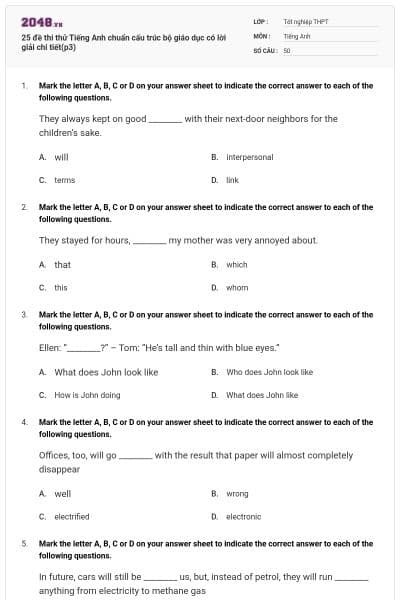
Mark the letter A, B, C or D on your answer sheet to indicate the correct answer to each of the following questions.
They always kept on good ________ with their next-door neighbors for the children’s sake.
will
interpersonal
terms
link
Đáp án C
Cấu trúc: to keep on good terms with somebody = có quan hệ tốt với ai
Dịch: Họ luôn luôn có quan hệ tốt với những người hàng xóm của họ vì lợi ích của bọn trẻ.
Mark the letter A, B, C or D on your answer sheet to indicate the correct answer to each of the following questions.
They stayed for hours, ________ my mother was very annoyed about.
that
which
this
whom
Đáp án B
Ta dùng đại từ quan hệ “which” để thay thế cho cả một mệnh đề đứng trước
Dịch: Họ đã ở đây nhiều giờ đồng hồ, điều mà mẹ tôi rất bực mình.
Mark the letter A, B, C or D on your answer sheet to indicate the correct answer to each of the following questions.
Ellen: “________?” – Tom: “He’s tall and thin with blue eyes.”
What does John look like
Who does John look like
How is John doing
What does John like
Đáp án A
Câu trả lời là miêu tả một người → Câu hỏi phải hỏi về ai đó trông như thế nào → dùng câu hỏi “What does John look like?”
Dịch: Elen: “Trông John như thế nào vậy?” – Tom: “Anh ấy cao và mảnh cùng với đôi mắt màu xanh nước biển.”
Mark the letter A, B, C or D on your answer sheet to indicate the correct answer to each of the following questions.
Offices, too, will go ________ with the result that paper will almost completely disappear
well
wrong
electrified
electronic
Đáp án D
Go electronic = điện tử hóa
Dịch: các văn phòng, cũng vậy, sẽ trở nên tự động hóa với kết quả là các loại giấy sẽ hầu như biến mất hoàn toàn.
Mark the letter A, B, C or D on your answer sheet to indicate the correct answer to each of the following questions.
In future, cars will still be ________ us, but, instead of petrol, they will run ________ anything from electricity to methane gas
for/ on
with/ by
for/ by
with/ on
Đáp án D
Chỗ trống thứ nhất ta cần dùng giới từ “with” mang nghĩa là “với”.
Cụm từ to run on = chạy bằng
Dịch: Trong tương lai, xe hơi vẫn còn với chúng ta, nhưng, thay vì dùng xăng dầu, chúng sẽ chạy bằng bất cứ thứ gì từ điện cho đến khí mê-tan.
Mark the letter A, B, C or D on your answer sheet to indicate the correct answer to each of the following questions.
I wonder if you could ________ me a small favour, Tom?
bring
make
give
do
Đáp án D
Cụm từ: do somebody a favour = giúp đỡ ai
Dịch: Tôi băn khoăn liệu bạn có thể giúp đỡ tôi một chút được không, Tom?
Mark the letter A, B, C or D on your answer sheet to indicate the correct answer to each of the following questions.
Can you take of the shop while Mr. Bontall is away?
management
running
charge
operation
Đáp án C
Cụm từ: take charge of something = chịu trách nhiệm trông nom cái gì
Dịch: Bạn có thể trông nom cửa hàng trong khi ông Bontall đi vắng không?
Mark the letter A, B, C or D on your answer sheet to indicate the correct answer to each of the following questions.
They shifted economic priority from heavy industry to three major economic programmes, ________, production of food, production of consumer goods and production of exports.
as a result
namely
especially
accordingly
Đáp án B
- as a result: vì vậy
- namely (adv): là, ấy là
- especially (adv): đặc biệt
- accordingly (adv): do đó, vì vậy
Đề bài đang kể tên các ngành kinh tế, vì vậy chọn “namely” để phù hợp với nghĩa và ngữ pháp
Dịch: Họ đã chuyển sự ưu tiên về kinh tế từ ngành công nghiệp nặng sang 3 chương trình kinh tế chính, ấy là, sản xuất thực phẩm, sản xuất đồ tiêu dùng và sản xuất hàng xuất khẩu.
Mark the letter A, B, C or D on your answer sheet to indicate the correct answer to each of the following questions.
There is a very clear relationship ________ education and academic success.
between
for
in
on
Đáp án A
Cấu trúc: between …and… = giữa…. và….
Dịch: Có một mối quan hệ rõ ràng giữa giáo dục và thành công về mặt lý thuyết.
Mark the letter A, B, C or D on your answer sheet to indicate the correct answer to each of the following questions.
Being well-dress and punctual can help you create a good on your interviewer
effectiveness
pressure
employment
impression
Đáp án D
Cấu trúc: To create (make) an impression on somebody = gây ấn tượng với ai
Dịch: Việc ăn mặc lịch sự và đến đúng giờ có thể giúp bạn gây ấn tượng tốt cho người phỏng vấn bạn.
Mark the letter A, B, C or D on your answer sheet to indicate the correct answer to each of the following questions.
Any child has the right to an education ________ of sex, creed, race or nationality
despite
regardless
because
providing
Đáp án B
Regardless of = bất chấp, bất kể
Dịch: Bất kì đứa trẻ nào đều có quyền học tập giáo dục bất kể giới tính, tín ngưỡng, chủng tộc và quốc tịch.
Mark the letter A, B, C or D on your answer sheet to indicate the correct answer to each of the following questions.
_________ her tears, she waved goodbye to her family from the station platform
Filling out
Bringing in
Turning over
Fighting back
Đáp án D
- fill out = điền vào/ làm căng ra
- bring in = đưa vào (thói quen)
- turn over = lật/ giao chuyển
- fight back = phản công, cầm lại (nước mắt)
Dựa vào ngữ cảnh của đề bài, ta chọn “Fighting back”
Dịch: cầm lại nước mắt, cô ấy vẫy tay tạm biệt gia đình của cô ấy từ sân ga
Mark the letter A, B, C or D on your answer sheet to indicate the correct answer to each of the following questions.
A: I had a really good weekend at my uncle’s.
B: “________”.
Oh, that’s very nice of you
Congratulations
It’s pleasure
Oh, I’m glad to hear that
Đáp án D
Đáp lại một tin vui của người khác một cách lịch sự, ta dùng “Oh, I’m glad to hear that”
Dịch:
A: “Tôi đã có một ngày cuối tuần tuyệt vời ở nhà chú của tôi.”
B: “Ồ, tôi rất mừng khi nghe vậy.”
Mark the letter A, B, C or D on your answer sheet to indicate the correct answer to each of the following questions.
It is essential that Alice ________ Tom of the meeting tomorrow
will remind
must remind
reminds
remind
Đáp án D
Cấu trúc của đề bài bàng thái cách: It is essential/important/necessary/… that + S + (should) + V(inf)
Dịch: Nó cần thiết rằng Alice nhắc nhở Tom về cuộc họp ngày mai.
Mark the letter A, B, C or D on your answer sheet to indicate the correct answer to each of the following questions.
If only we ________ more time, we could have seen more of the country
had
have had
had had
would have had
Đáp án C
Cấu trúc Đề bài mong ước ở quá khứ với “if only”: If only + S + had + PII,… = Giá mà…
Dịch: Giá mà chúng tôi có nhiều thời gian hơn, chúng tôi đã có thể thăm quan được đất nước nhiều hơn.
Mark the letter A, B, C or D on your answer sheet to indicate the correct answer to each of the following questions.
He always did well at school ________ having his early education disrupted by illness
in spite of
on account of
even though
in addition to
Đáp án A
- in spite of + N/V-ing,… = although + SVO,… = even though + SVO,… = mặc dù…, nhưng…
- on account of = vì
- in addition to = thêm vào
Vì hai vế của đề bài có nghĩa tương phản → dùng “in spite of” để phù hợp ngữ pháp và nghĩa
Dịch: Anh ấy luôn luôn học tập tốt ở trường mặc dù sự giáo dục của anh ấy bị gián đoạn bởi bệnh tật.
Mark the letter A, B, C or D on your answer sheet to indicate the correct answer to each of the following questions.
Developments in micro technology-computers and telecommunication are bound to have a huge influence on various ________ of our lives.
numbers
aspects
angles
results
Đáp án B
- number (n): số lượng
- aspect (n): khía cạnh, mặt
- angle (n): góc, quan điểm
- result (n): kết quả
→ Aspect of life = các khía cạnh của cuộc sống → chọn B để phù hợp nghĩa
Dịch: Sự phát triển trong các máy tính công nghệ siêu nhỏ và viễn thông có xu hướng gây ảnh hưởng lớn đến nhiều khía cạnh của cuộc sống.
Mark the letter A, B, C or D on your answer sheet to show the underlined part that needs correction
The world is becoming more industrialized and the number of animal species that have become extinct have increased
industrialized
species
extinct
have
Đáp án D
Chủ ngữ là “the number of…” thì ta chia như ngôi thứ ba số ít
Chữa lỗi: have → has
Dịch: Thế giới đang trở nên ngày càng công nghiệp hóa và số lượng những loài động vật mà bị tuyệt chủng tăng.
Mark the letter A, B, C or D on your answer sheet to show the underlined part that needs correction
Hardly had he entered the room than all the lights went out
had he entered
than
the lights
went
Đáp án B
Cấu trúc: Hardly + had + S + PII + when + clause (QK) = vừa mới … thì…
Chữa lỗi: than → when
Dịch: Anh ấy vừa bước vào phòng thì tất cả đèn điện tắt
Mark the letter A, B, C or D on your answer sheet to show the underlined part that needs correction
Mrs. Steven, along with her cousins from New Mexico, are planning to attend the festivals
with
her cousins
are
to attend
Đáp án C
Với các từ như “with”, “along with”, “together with”, “as well as”,… ta chia động từ theo chủ ngữ S1
Chữa lỗi: are → is
Dịch: Bà Steven, cùng với anh em họ của bà ấy từ New Mexico, đang dự định tham gia những lễ hội
Mark the letter A, B, C or D on your answer sheet to indicate the underlined sound that is pronounced differently from the rest or the word that differs from the rest in the position of the main stress:
drought
fought
brought
bought
Đáp án A
Từ “drought” có phần gạch chân phát âm là /au/
Các từ còn lại có phần gạch chân phát âm là /ɔː/
Mark the letter A, B, C or D on your answer sheet to indicate the underlined sound that is pronounced differently from the rest or the word that differs from the rest in the position of the main stress:
builds.
destroys
occurs
prevents
Đáp án D
Từ “prevents” có âm “s” phát âm là /s/
Các từ còn lại có âm “s” phát âm là /z
Mark the letter A, B, C or D on your answer sheet to indicate the underlined sound that is pronounced differently from the rest or the word that differs from the rest in the position of the main stress:
situation
entertainment
informality
appropriate
Đáp án D
Từ “appropriate” có trọng âm rơi vào âm tiết thứ hai
Các từ còn lại có trọng âm rơi vào âm tiết thứ ba
Read the following passage and mark the letter A, B, C or D to indicate the best option for each of the blanks.
Why do people like to chew gum? Some people say they like the taste. ____24____ say they can think better if they chew gum. Some people chew it when they have some boring work to do. Others chew gum when they are nervous.
Gum is a ____25____ of things. For many years gum companies made gum from chicle. Chicle is a natural gum from a tree in Mexico and Central America. Now companies use plastic and rubber made from petroleum instead of chicle.
Gum must be soft ____26____ you can chew it. A softener keeps it soft. The gum company makes the softener from vegetable oil. A sweetener makes the gum sweet. The sweetener is usually sugar. Then the company adds the flavor.
Thomas Adams made the first gum from chicle in 1836. ____27____, chewing gum was not new. The Greeks chewed gum from a tree over 2,000 years ago. Mayan Indians in Mexico chewed chicle. Indians in the Northeastern United States taught Europeans to chew gum from a tree there.
People first made bubble gum in 1928. Children like to ____28____ bubble with bubble gum. Some university students do too
Điền câu 24
The other
Others
The others
Other
Đáp án B
Phân biệt:
- the other: cái/người kia (còn lại trong hai cái/người) → đã xác định nên có mạo từ “the”
- the others: những cái/người kia (những cái/người còn lại trong một số lượng nhất định) → đã xác định nên có mạo từ “the”
- other: cái/người khác (không nằm trong số lượng nào cả) → không xác định nên không có mạo từ
- others: những cái/người khác (không nằm trong số lượng nào cả) → không xác định nên không có mạo từ
→ Chỗ trống cần một từ mang nghĩa số nhiều (không nằm trong số lượng nào cả) → dùng “others”
Read the following passage and mark the letter A, B, C or D to indicate the best option for each of the blanks.
Why do people like to chew gum? Some people say they like the taste. ____24____ say they can think better if they chew gum. Some people chew it when they have some boring work to do. Others chew gum when they are nervous.
Gum is a ____25____ of things. For many years gum companies made gum from chicle. Chicle is a natural gum from a tree in Mexico and Central America. Now companies use plastic and rubber made from petroleum instead of chicle.
Gum must be soft ____26____ you can chew it. A softener keeps it soft. The gum company makes the softener from vegetable oil. A sweetener makes the gum sweet. The sweetener is usually sugar. Then the company adds the flavor.
Thomas Adams made the first gum from chicle in 1836. ____27____, chewing gum was not new. The Greeks chewed gum from a tree over 2,000 years ago. Mayan Indians in Mexico chewed chicle. Indians in the Northeastern United States taught Europeans to chew gum from a tree there.
People first made bubble gum in 1928. Children like to ____28____ bubble with bubble gum. Some university students do too
Điền câu 25
mixture
roll
fix
connection
Đáp án A
Chỗ trống cần một danh từ
- mixture (n): hỗn hợp
- roll (n): cuốn, cuộn
- fix (n): tình thế khó khăn
- connection (n): sự liên quan, mối quan hệ
→ Chỉ có “mixture” phù hợp với nghĩa của câu hỏi nhất (Kẹo gôm là một hỗn hợp nhiều thứ…)
Read the following passage and mark the letter A, B, C or D to indicate the best option for each of the blanks.
Why do people like to chew gum? Some people say they like the taste. ____24____ say they can think better if they chew gum. Some people chew it when they have some boring work to do. Others chew gum when they are nervous.
Gum is a ____25____ of things. For many years gum companies made gum from chicle. Chicle is a natural gum from a tree in Mexico and Central America. Now companies use plastic and rubber made from petroleum instead of chicle.
Gum must be soft ____26____ you can chew it. A softener keeps it soft. The gum company makes the softener from vegetable oil. A sweetener makes the gum sweet. The sweetener is usually sugar. Then the company adds the flavor.
Thomas Adams made the first gum from chicle in 1836. ____27____, chewing gum was not new. The Greeks chewed gum from a tree over 2,000 years ago. Mayan Indians in Mexico chewed chicle. Indians in the Northeastern United States taught Europeans to chew gum from a tree there.
People first made bubble gum in 1928. Children like to ____28____ bubble with bubble gum. Some university students do too
Điền câu 26
so that
then
for
that
Đáp án A
Dịch: Kẹo gôm phải mềm ________ bạn có thể nhai nó.
→ Chỗ trống sẽ điền “so that” mang nghĩa là “để”
Read the following passage and mark the letter A, B, C or D to indicate the best option for each of the blanks.
Why do people like to chew gum? Some people say they like the taste. ____24____ say they can think better if they chew gum. Some people chew it when they have some boring work to do. Others chew gum when they are nervous.
Gum is a ____25____ of things. For many years gum companies made gum from chicle. Chicle is a natural gum from a tree in Mexico and Central America. Now companies use plastic and rubber made from petroleum instead of chicle.
Gum must be soft ____26____ you can chew it. A softener keeps it soft. The gum company makes the softener from vegetable oil. A sweetener makes the gum sweet. The sweetener is usually sugar. Then the company adds the flavor.
Thomas Adams made the first gum from chicle in 1836. ____27____, chewing gum was not new. The Greeks chewed gum from a tree over 2,000 years ago. Mayan Indians in Mexico chewed chicle. Indians in the Northeastern United States taught Europeans to chew gum from a tree there.
People first made bubble gum in 1928. Children like to ____28____ bubble with bubble gum. Some university students do too
Điền câu 27
However
More
But
Though
Đáp án A
Hai vế thể hiện sự trái ngược nhau nhưng không đối nghịch nhau hoàn toàn, mục đích nhấn mạnh phần sau hơn phần trước → dùng liên từ chỉ sự nhượng bộ “however”.
Read the following passage and mark the letter A, B, C or D to indicate the best option for each of the blanks.
Why do people like to chew gum? Some people say they like the taste. ____24____ say they can think better if they chew gum. Some people chew it when they have some boring work to do. Others chew gum when they are nervous.
Gum is a ____25____ of things. For many years gum companies made gum from chicle. Chicle is a natural gum from a tree in Mexico and Central America. Now companies use plastic and rubber made from petroleum instead of chicle.
Gum must be soft ____26____ you can chew it. A softener keeps it soft. The gum company makes the softener from vegetable oil. A sweetener makes the gum sweet. The sweetener is usually sugar. Then the company adds the flavor.
Thomas Adams made the first gum from chicle in 1836. ____27____, chewing gum was not new. The Greeks chewed gum from a tree over 2,000 years ago. Mayan Indians in Mexico chewed chicle. Indians in the Northeastern United States taught Europeans to chew gum from a tree there.
People first made bubble gum in 1928. Children like to ____28____ bubble with bubble gum. Some university students do too
Điền câu 28
turn
set
pass
blow
Đáp án D
- turn (v): quay, vặn
- set (v): đặt, để
- pass (v): đi qua
- blow (v): thổi
Dựa vào ngữ nghĩa ta chọn “blow” (Trẻ em thích thổi bong bóng với kẹo gôm bong bóng.)
Mark the letter A, B, C or D on your answer sheet to indicate the word(s) CLOSET in meaning to the underlined word(s) in each of the following questions
Whenever problems come up, we discuss them frankly and find solutions quickly.
clean
encounter
arrive
happen
Đáp án D
Come up = happen = xảy ra
Các từ khác:
- clean (v): lau chùi
- encounter (v): bắt gặp, chạm trán
- arrive (v): đến
Dịch: Bất cứ khi nào vấn đề xảy ra, chúng tôi thảo luận chúng một cách thẳng thắn và tìm ra giải quyết một cách nhanh chóng
Mark the letter A, B, C or D on your answer sheet to indicate the word(s) CLOSET in meaning to the underlined word(s) in each of the following questions:
When I mentioned the party, he was all ears
partially deaf
listening attentively
listening neglectfully
deaf
Đáp án B
To be all ears = to listen attentively = lắng tai nghe, nghe một cách chăm chú
Các từ còn lại:
- partially deaf = bị điếc một phần
- deaf = bị điếc
- listening neglectfully = nghe một cách không chú ý
Dịch: Khi tôi đề cập đến bữa tiệc, anh ấy lắng nghe một cách chăm chú
Read the following passage and mark the letter A, B, C or D on your answer sheet to indicate the correct answer to each of the following questions from 31 to 35:
A survey is a study, generally in the form of an interview or a questionnaire, which provides information concerning how people think and act. In the United States, the best-known surveys are the Gallup poll and the Harris poll. As anyone who watches the news during presidential campaigns knows, these polls have become an important part of political life in the United States.
North Americans are familiar with the many "person on the street" interviews on local television news shows. While such interviews can be highly entertaining, they are not necessarily an accurate indication of public opinion. First, they reflect the opinions of only those people who appear at a certain location. Thus, such samples can be biased in favor of commuters, middle-class shoppers, or factory workers, depending on which area the new people select. Second, television interviews tend to attract outgoing people who are willing to appear on the air, while they frighten away others who may feel intimidated by a camera. A survey must be based on a precise, representative sampling if it is to genuinely reflect a broad range of the population.
In preparing to conduct a survey, sociologists must exercise great care in the wording of questions. An effective survey question must be simple and clear enough for people to understand it. It must also be specific enough so that there are no problems in interpreting the results. Even questions that are less structured must be carefully phrased in order to elicit the type of information desired. Surveys can be indispensable sources of information, but only if the sampling is done properly and the questions are worded accurately.
There are two main forms of surveys: the interview and the questionnaire. Each of these forms of survey research has its advantages. An interviewer can obtain a high response rate because people find it more difficult to turn down a personal request for an interview than to throw away a written questionnaire.
In addition, an interviewer can go beyond written questions and probe for a subject's underlying feelings and reasons. However, questionnaires have the advantage of being cheaper and more consistent.
According to the passage, one advantage of live interviews over questionnaires is that live interviews _________.
minimize the influence of the researcher
are easier to interpret
costless
can produce more information
Đáp án D
Thông tin trong bài “An interviewer can obtain a high response rate because people find it more difficult to turn down a personal request for an interview than to throw away a written questionnaire.” → như vậy, một ưu điểm lớn hơn của phỏng vấn so với bản câu hỏi là có thể thu thập được nhiều thông tin hơn.
→ chọn đáp án D
Read the following passage and mark the letter A, B, C or D on your answer sheet to indicate the correct answer to each of the following questions from 31 to 35:
A survey is a study, generally in the form of an interview or a questionnaire, which provides information concerning how people think and act. In the United States, the best-known surveys are the Gallup poll and the Harris poll. As anyone who watches the news during presidential campaigns knows, these polls have become an important part of political life in the United States.
North Americans are familiar with the many "person on the street" interviews on local television news shows. While such interviews can be highly entertaining, they are not necessarily an accurate indication of public opinion. First, they reflect the opinions of only those people who appear at a certain location. Thus, such samples can be biased in favor of commuters, middle-class shoppers, or factory workers, depending on which area the new people select. Second, television interviews tend to attract outgoing people who are willing to appear on the air, while they frighten away others who may feel intimidated by a camera. A survey must be based on a precise, representative sampling if it is to genuinely reflect a broad range of the population.
In preparing to conduct a survey, sociologists must exercise great care in the wording of questions. An effective survey question must be simple and clear enough for people to understand it. It must also be specific enough so that there are no problems in interpreting the results. Even questions that are less structured must be carefully phrased in order to elicit the type of information desired. Surveys can be indispensable sources of information, but only if the sampling is done properly and the questions are worded accurately.
There are two main forms of surveys: the interview and the questionnaire. Each of these forms of survey research has its advantages. An interviewer can obtain a high response rate because people find it more difficult to turn down a personal request for an interview than to throw away a written questionnaire.
In addition, an interviewer can go beyond written questions and probe for a subject's underlying feelings and reasons. However, questionnaires have the advantage of being cheaper and more consistent.
The word “they” refers to ________.
interviews
opinions
news shows
North Americans
Đáp án A
Thông tin trong bài “While such interviews can be highly entertaining, they are not necessarily an accurate indication of public opinion. First, they reflect the opinions of only those people who appear at a certain location” → đang đề cập đến đối tượng là “interviews”→ “they” chính là “interviews”
Read the following passage and mark the letter A, B, C or D on your answer sheet to indicate the correct answer to each of the following questions from 31 to 35:
A survey is a study, generally in the form of an interview or a questionnaire, which provides information concerning how people think and act. In the United States, the best-known surveys are the Gallup poll and the Harris poll. As anyone who watches the news during presidential campaigns knows, these polls have become an important part of political life in the United States.
North Americans are familiar with the many "person on the street" interviews on local television news shows. While such interviews can be highly entertaining, they are not necessarily an accurate indication of public opinion. First, they reflect the opinions of only those people who appear at a certain location. Thus, such samples can be biased in favor of commuters, middle-class shoppers, or factory workers, depending on which area the new people select. Second, television interviews tend to attract outgoing people who are willing to appear on the air, while they frighten away others who may feel intimidated by a camera. A survey must be based on a precise, representative sampling if it is to genuinely reflect a broad range of the population.
In preparing to conduct a survey, sociologists must exercise great care in the wording of questions. An effective survey question must be simple and clear enough for people to understand it. It must also be specific enough so that there are no problems in interpreting the results. Even questions that are less structured must be carefully phrased in order to elicit the type of information desired. Surveys can be indispensable sources of information, but only if the sampling is done properly and the questions are worded accurately.
There are two main forms of surveys: the interview and the questionnaire. Each of these forms of survey research has its advantages. An interviewer can obtain a high response rate because people find it more difficult to turn down a personal request for an interview than to throw away a written questionnaire.
In addition, an interviewer can go beyond written questions and probe for a subject's underlying feelings and reasons. However, questionnaires have the advantage of being cheaper and more consistent.
Which word is given definition in the text?
sampling
poll
survey
interview
Đáp án C
Thông tin được nêu ngay trong câu hỏi đầu tiên “A survey is a study, generally in the form of an interview or a questionnaire, which provides information concerning how people think and act” → “survey” là danh từ được định nghĩa trong đoạn văn
Read the following passage and mark the letter A, B, C or D on your answer sheet to indicate the correct answer to each of the following questions from 31 to 35:
A survey is a study, generally in the form of an interview or a questionnaire, which provides information concerning how people think and act. In the United States, the best-known surveys are the Gallup poll and the Harris poll. As anyone who watches the news during presidential campaigns knows, these polls have become an important part of political life in the United States.
North Americans are familiar with the many "person on the street" interviews on local television news shows. While such interviews can be highly entertaining, they are not necessarily an accurate indication of public opinion. First, they reflect the opinions of only those people who appear at a certain location. Thus, such samples can be biased in favor of commuters, middle-class shoppers, or factory workers, depending on which area the new people select. Second, television interviews tend to attract outgoing people who are willing to appear on the air, while they frighten away others who may feel intimidated by a camera. A survey must be based on a precise, representative sampling if it is to genuinely reflect a broad range of the population.
In preparing to conduct a survey, sociologists must exercise great care in the wording of questions. An effective survey question must be simple and clear enough for people to understand it. It must also be specific enough so that there are no problems in interpreting the results. Even questions that are less structured must be carefully phrased in order to elicit the type of information desired. Surveys can be indispensable sources of information, but only if the sampling is done properly and the questions are worded accurately.
There are two main forms of surveys: the interview and the questionnaire. Each of these forms of survey research has its advantages. An interviewer can obtain a high response rate because people find it more difficult to turn down a personal request for an interview than to throw away a written questionnaire.
In addition, an interviewer can go beyond written questions and probe for a subject's underlying feelings and reasons. However, questionnaires have the advantage of being cheaper and more consistent.
According to paragraph 3, which of the following is most important for an effective survey?
A sociologist who is able to interpret the results
Carefully worded questions
An interviewer’s ability to measure respondents’ feelings
A high number of respondents
Đáp án B
Nội dung chính của đoạn ba được bao quát ở đầu đoạn “In preparing to conduct a survey, sociologists must exercise great care in the wording of questions”, các ý sau triển khai cho ý đầu → như vậy, những câu hỏi được diễn tả một cách cẩn thận là thứ quan trọng nhất cho một cuộc phỏng vấn có hiệu quả.
Read the following passage and mark the letter A, B, C or D on your answer sheet to indicate the correct answer to each of the following questions from 31 to 35:
A survey is a study, generally in the form of an interview or a questionnaire, which provides information concerning how people think and act. In the United States, the best-known surveys are the Gallup poll and the Harris poll. As anyone who watches the news during presidential campaigns knows, these polls have become an important part of political life in the United States.
North Americans are familiar with the many "person on the street" interviews on local television news shows. While such interviews can be highly entertaining, they are not necessarily an accurate indication of public opinion. First, they reflect the opinions of only those people who appear at a certain location. Thus, such samples can be biased in favor of commuters, middle-class shoppers, or factory workers, depending on which area the new people select. Second, television interviews tend to attract outgoing people who are willing to appear on the air, while they frighten away others who may feel intimidated by a camera. A survey must be based on a precise, representative sampling if it is to genuinely reflect a broad range of the population.
In preparing to conduct a survey, sociologists must exercise great care in the wording of questions. An effective survey question must be simple and clear enough for people to understand it. It must also be specific enough so that there are no problems in interpreting the results. Even questions that are less structured must be carefully phrased in order to elicit the type of information desired. Surveys can be indispensable sources of information, but only if the sampling is done properly and the questions are worded accurately.
There are two main forms of surveys: the interview and the questionnaire. Each of these forms of survey research has its advantages. An interviewer can obtain a high response rate because people find it more difficult to turn down a personal request for an interview than to throw away a written questionnaire.
In addition, an interviewer can go beyond written questions and probe for a subject's underlying feelings and reasons. However, questionnaires have the advantage of being cheaper and more consistent.
What does the passage mainly discuss?
The principles of conducting surveys
The importance of polls in American political life
Problems associated with interpreting surveys
The history of surveys in North America
Đáp án A
Toàn bộ bài nói về việc khảo sát, các hình thức khảo sát, các bước chuẩn bị tiến hành một cuộc khảo sát
→ Nội dung chính của bài xoay quanh những yếu tố cơ bản của việc tiến hành một cuộc khảo sát
→ Đáp án A bao quát nhất
Choose the sentence that is similar in meaning to the given one:
Both of the lifts were out of order
Either of the lifts was not in right order.
The order of the two lifts was wrong
Neither of the lifts was working.
Neither of the lifts was in order
Đáp án C
Dịch đề: Cả hai cái thang máy đều bị hỏng.
Neither of = Không cái nào…
Either of = Hoặc cái này hoặc cái kia
→ chỉ có đáp án C đúng nghĩa với câu đã cho
Dịch: Không cái thang máy nào làm việc cả
Choose the sentence that is similar in meaning to the given one:
The crowd became increasingly angry at the long delay
The crowd became very angry because the delay was so long.
The more increasingly the crowd became, the longer the delay was.
The longer the delay was, the angrier the crowd became.
The more the crowd became angry at the delay, the longer they feel
Đáp án C
Dịch đề: Đám đông trở nên ngày càng tức giận với sự trì hoãn dài.
→ dùng dạng so sánh kép để diễn tả lại câu → chỉ có đáp án C đúng nghĩa
Dịch: Sự trì hoãn càng dài, đám đông càng trở nên tức giận.
Choose the sentence that is similar in meaning to the given one:
Madeleine wears high heels to look taller
In order to look taller, Madeleine wears high heels.
So that to look taller, Madeleine wears high heels.
Madeleine wants high heels to make her taller.
Madeleine buys high heels to look taller
Đáp án A
Dịch đề: Madeleine đi giày cao gót để trông cao hơn.
In order to + V = to V = so that + clause = để… (chỉ mục đích của hành động)
→ chỉ có đáp án A đúng nghĩa và đúng ngữ pháp
Dịch: Để trông cao hơn, Madeleine đi giày cao gót
Choose the sentence that is similar in meaning to the given one:
That T.V is badly damaged. It cannot be repaired
That T.V is so badly damaged that is cannot be repaired.
That T.V is too badly damaged to be repaired
That T.V is so badly damaged that nobody can repair it.
All are correct
Đáp án D
Cấu trúc: so + adj/adv + that + clause = too + adj/adv + to V = quá … để làm gì/quá… đến nỗi mà
→ Cả ba đáp án đều đúng nghĩa với đề đã cho → chọn D
Choose the sentence that is similar in meaning to the given one:
We cut down many forests. The earth becomes hot
The more we cut forests, the hotter the earth becomes.
The more forests we cut down, the hotter the earth becomes.
The more we cut forests, the earth becomes hotter.
The more forests we cut down, the earth becomes hotter
Đáp án B
Dịch đề: Chúng ta chặt nhiều cây. Trái đất trở nên nóng.
→ diễn đạt lại ta dùng dạng so sánh kép
Cấu trúc: the + comparative + S + V …, the + comparative + S + V …
→ Chỉ có đáp án B đúng nghĩa và đúng cấu trúc
Dịch: Chúng ta chặt càng nhiều cây, trái đất càng trở nên nóng hơn
Choose the sentence that is similar in meaning to the given one:
Mike graduated with a good degree. However, he joined the ranks of the unemployed
Mike joined the ranks of the unemployed because he graduated with a good degree.
If Mike graduated with a good degree, he would join the ranks of the unemployed.
Although Mike graduated with a good degree, he joined the ranks of the unemployed.
That Mike graduated with a good degree helped him join the ranks of the unemployed
Đáp án C
Đề: Mike tốt nghiệp với tấm bằng giỏi. Tuy nhiên, anh ấy vẫn nằm trong hàng ngũ những người thất nghiệp. However = although: mặc dù, tuy nhiên
⇒ Mặc dù Mike tốt nghiệp với một tấm bằng giỏi, anh ấy vẫn nằm trong hàng ngũ những người thất nghiệp.
Choose the sentence that is similar in meaning to the given one:
Put your coat on. You will get cold
You will not get cold unless you put your coat on.
Put your coat on, otherwise you will get cold.
It is not until you put your coat on that you will get cold.
You not only put your coat on but also get cold
Đáp án B
Đề: Mặc áo khoác của bạn vào đi. Bạn sẽ bị cảm đấy = Mặc áo khác của bạn vào, nếu không bạn sẽ bị cảm
Read the following passage and mark the letter A, B, C or D on your answer sheet to indicate the correct answer to each of the questions from 43 to 50:
Basic to any understanding of Canada in the 20 years after the Second World War is the country’s impressive population growth. For every three Canadians in 1945, there were over five in 1966. In September 1966 Canada’s population passed the 20 million mark. Most of his surging growth came from natural increase. The depression of the 1930’s and the war had held back marriages, and the catching-up process began after 1945. The baby boom continued through the decade of the 1950s, producing a population increase of nearly fifteen percent in the five years from 1951 to 1956. This rate of increase had been exceeded only once before settle. Undoubtedly, the good economic conditions of the 1950’s supported a growth in the population, but the expansion also derived from a trend toward earlier marriages and an increase in the average size of families. In 1957 the Canadian birth rate stood at 28 per thousand, one of the highest in the world.
After the peak year of 1957, the birth rate in Canada began to decline. It continued falling until in 1966 it stood at the lowest level in 25 years. Partly this decline reflected the low level of births during the depression and the war, but it was also caused by changes in Canadian society. Young people were staying at school longer; more women were working; young married couples were buying automobiles or houses before starting families; rising living standards were cutting down the size of families. It appeared that Canada was once more falling in step with the trend toward smaller families that had occurred all through the Western world since the time of the Industrial Revolution.
Although the growth in Canada’s population had slowed down by 1966 (the increase in the first half of the 1960’s was only nine percent), another large population wave was coming over the horizon. It would be composed of the children who were born during the period of the high birth rate prior to 1957.
What does the passage mainly discuss?
Educational changes in Canadian society
Canada during the Second World War
Population trends in postwar Canada
Standards of living in Canada.
Đáp án C
Đề: Đoạn văn bàn chủ yếu về vấn đề gì?
Dựa vào đoạn văn, tác giả chủ yếu nói về xu hướng dân số ở Canada sau chiến tranh và chú ý nhiều mốc thời gian tác giả đề ra
Read the following passage and mark the letter A, B, C or D on your answer sheet to indicate the correct answer to each of the questions from 43 to 50:
Basic to any understanding of Canada in the 20 years after the Second World War is the country’s impressive population growth. For every three Canadians in 1945, there were over five in 1966. In September 1966 Canada’s population passed the 20 million mark. Most of his surging growth came from natural increase. The depression of the 1930’s and the war had held back marriages, and the catching-up process began after 1945. The baby boom continued through the decade of the 1950s, producing a population increase of nearly fifteen percent in the five years from 1951 to 1956. This rate of increase had been exceeded only once before settle. Undoubtedly, the good economic conditions of the 1950’s supported a growth in the population, but the expansion also derived from a trend toward earlier marriages and an increase in the average size of families. In 1957 the Canadian birth rate stood at 28 per thousand, one of the highest in the world.
After the peak year of 1957, the birth rate in Canada began to decline. It continued falling until in 1966 it stood at the lowest level in 25 years. Partly this decline reflected the low level of births during the depression and the war, but it was also caused by changes in Canadian society. Young people were staying at school longer; more women were working; young married couples were buying automobiles or houses before starting families; rising living standards were cutting down the size of families. It appeared that Canada was once more falling in step with the trend toward smaller families that had occurred all through the Western world since the time of the Industrial Revolution.
Although the growth in Canada’s population had slowed down by 1966 (the increase in the first half of the 1960’s was only nine percent), another large population wave was coming over the horizon. It would be composed of the children who were born during the period of the high birth rate prior to 1957.
The word “five” in bold refers to
Canadians
years
decades
marriages
Đáp án A
Đề: Từ “five” in đậm trong đoạn văn đề cập đến gì?
Dựa vào: “Basic to any understanding of Canada in the 20 years after the Second World War is the country’s impressive population growth. For every three Canadians in 1945, there were over five in 1966”: Lẽ cơ bản về Canada 20 năm sau Thế chiến thứ hai là sự gia tăng dân số ấn tượng của đất nước này. Cứ mỗi ba người Canada vào năm 1945 thì có năm người vào năm 1966 ⇒ Canadians là đáp án đúng.
Read the following passage and mark the letter A, B, C or D on your answer sheet to indicate the correct answer to each of the questions from 43 to 50:
Basic to any understanding of Canada in the 20 years after the Second World War is the country’s impressive population growth. For every three Canadians in 1945, there were over five in 1966. In September 1966 Canada’s population passed the 20 million mark. Most of his surging growth came from natural increase. The depression of the 1930’s and the war had held back marriages, and the catching-up process began after 1945. The baby boom continued through the decade of the 1950s, producing a population increase of nearly fifteen percent in the five years from 1951 to 1956. This rate of increase had been exceeded only once before settle. Undoubtedly, the good economic conditions of the 1950’s supported a growth in the population, but the expansion also derived from a trend toward earlier marriages and an increase in the average size of families. In 1957 the Canadian birth rate stood at 28 per thousand, one of the highest in the world.
After the peak year of 1957, the birth rate in Canada began to decline. It continued falling until in 1966 it stood at the lowest level in 25 years. Partly this decline reflected the low level of births during the depression and the war, but it was also caused by changes in Canadian society. Young people were staying at school longer; more women were working; young married couples were buying automobiles or houses before starting families; rising living standards were cutting down the size of families. It appeared that Canada was once more falling in step with the trend toward smaller families that had occurred all through the Western world since the time of the Industrial Revolution.
Although the growth in Canada’s population had slowed down by 1966 (the increase in the first half of the 1960’s was only nine percent), another large population wave was coming over the horizon. It would be composed of the children who were born during the period of the high birth rate prior to 1957.
The word “surging” in bold is closest in meaning to
new
extra
accelerating
surprising
Đáp án C
Đề: Từ “surging” in đậm gần nghĩa nhất với từ nào?
Dựa vào: In September 1966 Canada’s population passed the 20 million mark. Most of this surging growth came from natural increase.”: Vào năm 1966, dân số của Canada đã vượt mốc 20 triệu người.
Phần lớn của làn sóng gia tăng này là gia tăng tự nhiên.
⇒ “Surging” là trào lên, dâng lên như một làn sóng, ám chỉ sự gia tăng rất nhanh.
Read the following passage and mark the letter A, B, C or D on your answer sheet to indicate the correct answer to each of the questions from 43 to 50:
Basic to any understanding of Canada in the 20 years after the Second World War is the country’s impressive population growth. For every three Canadians in 1945, there were over five in 1966. In September 1966 Canada’s population passed the 20 million mark. Most of his surging growth came from natural increase. The depression of the 1930’s and the war had held back marriages, and the catching-up process began after 1945. The baby boom continued through the decade of the 1950s, producing a population increase of nearly fifteen percent in the five years from 1951 to 1956. This rate of increase had been exceeded only once before settle. Undoubtedly, the good economic conditions of the 1950’s supported a growth in the population, but the expansion also derived from a trend toward earlier marriages and an increase in the average size of families. In 1957 the Canadian birth rate stood at 28 per thousand, one of the highest in the world.
After the peak year of 1957, the birth rate in Canada began to decline. It continued falling until in 1966 it stood at the lowest level in 25 years. Partly this decline reflected the low level of births during the depression and the war, but it was also caused by changes in Canadian society. Young people were staying at school longer; more women were working; young married couples were buying automobiles or houses before starting families; rising living standards were cutting down the size of families. It appeared that Canada was once more falling in step with the trend toward smaller families that had occurred all through the Western world since the time of the Industrial Revolution.
Although the growth in Canada’s population had slowed down by 1966 (the increase in the first half of the 1960’s was only nine percent), another large population wave was coming over the horizon. It would be composed of the children who were born during the period of the high birth rate prior to 1957.
The author suggests that in Canada during the 1950’s
the urban population decreased rapidly
fewer people married
economic conditions were poor
the birth rate was very high
Đáp án D
Đề: Tác giả cho rằng Canada trong những năm 1950 như thế nào?
Dựa vào: The baby boom continued through the decade of the 1950s, producing a population increase of nearly fifteen percent in the five years from 1951 to 1956…Undoubtedly, the good economic conditions of the 1950’s supported a growth in the population”: Thế hệ sinh ra sau Thế chiến thứ hai tiếp tục tăng suốt những thập kỷ của những năm 1950, sản sinh ra lượng dân số tăng gần 15% trong vòng 5 năm từ 1951 đến 1956… Không nghi ngờ rằng, điều kiện kinh tế thuận lợi của những năm 1950 đã hỗ trợ cho sự gia tăng trong dân số.
Read the following passage and mark the letter A, B, C or D on your answer sheet to indicate the correct answer to each of the questions from 43 to 50:
Basic to any understanding of Canada in the 20 years after the Second World War is the country’s impressive population growth. For every three Canadians in 1945, there were over five in 1966. In September 1966 Canada’s population passed the 20 million mark. Most of his surging growth came from natural increase. The depression of the 1930’s and the war had held back marriages, and the catching-up process began after 1945. The baby boom continued through the decade of the 1950s, producing a population increase of nearly fifteen percent in the five years from 1951 to 1956. This rate of increase had been exceeded only once before settle. Undoubtedly, the good economic conditions of the 1950’s supported a growth in the population, but the expansion also derived from a trend toward earlier marriages and an increase in the average size of families. In 1957 the Canadian birth rate stood at 28 per thousand, one of the highest in the world.
After the peak year of 1957, the birth rate in Canada began to decline. It continued falling until in 1966 it stood at the lowest level in 25 years. Partly this decline reflected the low level of births during the depression and the war, but it was also caused by changes in Canadian society. Young people were staying at school longer; more women were working; young married couples were buying automobiles or houses before starting families; rising living standards were cutting down the size of families. It appeared that Canada was once more falling in step with the trend toward smaller families that had occurred all through the Western world since the time of the Industrial Revolution.
Although the growth in Canada’s population had slowed down by 1966 (the increase in the first half of the 1960’s was only nine percent), another large population wave was coming over the horizon. It would be composed of the children who were born during the period of the high birth rate prior to 1957.
The word “trend” in bold is closest in meaning to:
tendency
aim
growth
directive
Đáp án A
Trend = tendency: xu thế, xu hướng
Read the following passage and mark the letter A, B, C or D on your answer sheet to indicate the correct answer to each of the questions from 43 to 50:
Basic to any understanding of Canada in the 20 years after the Second World War is the country’s impressive population growth. For every three Canadians in 1945, there were over five in 1966. In September 1966 Canada’s population passed the 20 million mark. Most of his surging growth came from natural increase. The depression of the 1930’s and the war had held back marriages, and the catching-up process began after 1945. The baby boom continued through the decade of the 1950s, producing a population increase of nearly fifteen percent in the five years from 1951 to 1956. This rate of increase had been exceeded only once before settle. Undoubtedly, the good economic conditions of the 1950’s supported a growth in the population, but the expansion also derived from a trend toward earlier marriages and an increase in the average size of families. In 1957 the Canadian birth rate stood at 28 per thousand, one of the highest in the world.
After the peak year of 1957, the birth rate in Canada began to decline. It continued falling until in 1966 it stood at the lowest level in 25 years. Partly this decline reflected the low level of births during the depression and the war, but it was also caused by changes in Canadian society. Young people were staying at school longer; more women were working; young married couples were buying automobiles or houses before starting families; rising living standards were cutting down the size of families. It appeared that Canada was once more falling in step with the trend toward smaller families that had occurred all through the Western world since the time of the Industrial Revolution.
Although the growth in Canada’s population had slowed down by 1966 (the increase in the first half of the 1960’s was only nine percent), another large population wave was coming over the horizon. It would be composed of the children who were born during the period of the high birth rate prior to 1957.
The author mention all of the following as causes of declines in population growth after 1957
EXCEPT
people being better educated
people getting married earlier
better standards of living
couples buying houses
Đáp án B
Đề: Tác giả đề cập tới tất cả những điều sau đều là nguyên nhân của sự giảm gia tăng dân số sau năm 1957 NGOẠI TRỪ?
Dựa vào: “… this decline… was also caused by changes in Canadian society. Young people were staying at school longer; more women were working; young married couples were buying automobiles or houses before starting families; rising living standards were cutting down the size of families”: Những người trẻ tuổi học cao hơn, nhiều phụ nữ đi làm hơn; các cặp đôi đã kết hôn đang tiết kiệm mua xe và nhà trước khi sinh con; mức sống tăng cao đang cắt giảm quy mô các gia đình.
⇒ Đáp án B. people getting married earlier: con người kết hôn sớm hơn không có thông tin
Read the following passage and mark the letter A, B, C or D on your answer sheet to indicate the correct answer to each of the questions from 43 to 50:
Basic to any understanding of Canada in the 20 years after the Second World War is the country’s impressive population growth. For every three Canadians in 1945, there were over five in 1966. In September 1966 Canada’s population passed the 20 million mark. Most of his surging growth came from natural increase. The depression of the 1930’s and the war had held back marriages, and the catching-up process began after 1945. The baby boom continued through the decade of the 1950s, producing a population increase of nearly fifteen percent in the five years from 1951 to 1956. This rate of increase had been exceeded only once before settle. Undoubtedly, the good economic conditions of the 1950’s supported a growth in the population, but the expansion also derived from a trend toward earlier marriages and an increase in the average size of families. In 1957 the Canadian birth rate stood at 28 per thousand, one of the highest in the world.
After the peak year of 1957, the birth rate in Canada began to decline. It continued falling until in 1966 it stood at the lowest level in 25 years. Partly this decline reflected the low level of births during the depression and the war, but it was also caused by changes in Canadian society. Young people were staying at school longer; more women were working; young married couples were buying automobiles or houses before starting families; rising living standards were cutting down the size of families. It appeared that Canada was once more falling in step with the trend toward smaller families that had occurred all through the Western world since the time of the Industrial Revolution.
Although the growth in Canada’s population had slowed down by 1966 (the increase in the first half of the 1960’s was only nine percent), another large population wave was coming over the horizon. It would be composed of the children who were born during the period of the high birth rate prior to 1957
Read the following passage and mark the letter A, B, C or D on your answer sheet to indicate the correct answer to each of the questions from 43 to 50:
Basic to any understanding of Canada in the 20 years after the Second World War is the country’s impressive population growth. For every three Canadians in 1945, there were over five in 1966. In September 1966 Canada’s population passed the 20 million mark. Most of his surging growth came from natural increase. The depression of the 1930’s and the war had held back marriages, and the catching-up process began after 1945. The baby boom continued through the decade of the 1950s, producing a population increase of nearly fifteen percent in the five years from 1951 to 1956. This rate of increase had been exceeded only once before settle. Undoubtedly, the good economic conditions of the 1950’s supported a growth in the population, but the expansion also derived from a trend toward earlier marriages and an increase in the average size of families. In 1957 the Canadian birth rate stood at 28 per thousand, one of the highest in the world.
After the peak year of 1957, the birth rate in Canada began to decline. It continued falling until in 1966 it stood at the lowest level in 25 years. Partly this decline reflected the low level of births during the depression and the war, but it was also caused by changes in Canadian society. Young people were staying at school longer; more women were working; young married couples were buying automobiles or houses before starting families; rising living standards were cutting down the size of families. It appeared that Canada was once more falling in step with the trend toward smaller families that had occurred all through the Western world since the time of the Industrial Revolution.
Although the growth in Canada’s population had slowed down by 1966 (the increase in the first half of the 1960’s was only nine percent), another large population wave was coming over the horizon. It would be composed of the children who were born during the period of the high birth rate prior to 1957
It can be inferred from the passage that before the Industrial Revolution
families were larger
population statistics were unreliable
the population grew steadily
economic conditions were bad
Đáp án A
Đề: Có thể suy đoán điều gì từ đoạn văn về thời điểm trước khi xảy ra Cách mạng Công nghệ?
Dựa vào: “It appeared that Canada was once more falling in step with the trend toward smaller families that had occurred all through the Western world since the time of the Industrial Revolution”: Có vẻ như Canada lại một lần nữa rơi vào xu hướng gia đình nhỏ hơn, xu hướng đã từng xảy ra khắp phương Tây từ cuộc Cách mạng Công nghiệp.
⇒ Sau cuộc Cách mạng Công nghiệp gia đình có xu hướng nhỏ đi. Vậy trước đó các gia đình có quy mô lớn hơn. Vậy có thể suy luận về thời điểm trước cuộc Cách mạng Công nghiệp là các gia đình khi đó lớn hơn. Ta chọn đáp án A. families were larger: những gia đình đông hơn.
Read the following passage and mark the letter A, B, C or D on your answer sheet to indicate the correct answer to each of the questions from 43 to 50:
Basic to any understanding of Canada in the 20 years after the Second World War is the country’s impressive population growth. For every three Canadians in 1945, there were over five in 1966. In September 1966 Canada’s population passed the 20 million mark. Most of his surging growth came from natural increase. The depression of the 1930’s and the war had held back marriages, and the catching-up process began after 1945. The baby boom continued through the decade of the 1950s, producing a population increase of nearly fifteen percent in the five years from 1951 to 1956. This rate of increase had been exceeded only once before settle. Undoubtedly, the good economic conditions of the 1950’s supported a growth in the population, but the expansion also derived from a trend toward earlier marriages and an increase in the average size of families. In 1957 the Canadian birth rate stood at 28 per thousand, one of the highest in the world.
After the peak year of 1957, the birth rate in Canada began to decline. It continued falling until in 1966 it stood at the lowest level in 25 years. Partly this decline reflected the low level of births during the depression and the war, but it was also caused by changes in Canadian society. Young people were staying at school longer; more women were working; young married couples were buying automobiles or houses before starting families; rising living standards were cutting down the size of families. It appeared that Canada was once more falling in step with the trend toward smaller families that had occurred all through the Western world since the time of the Industrial Revolution.
Although the growth in Canada’s population had slowed down by 1966 (the increase in the first half of the 1960’s was only nine percent), another large population wave was coming over the horizon. It would be composed of the children who were born during the period of the high birth rate prior to 1957
The word “it” in bold refers to
horizon
population wave
nine percent
first half
Đáp án B
Đề: Từ “it” in đậm trong đoạn văn đề cập vấn đề gì?
Dựa vào: Although the growth in Canada’s population had slowed down by 1966…, another large population wave was coming over the horizon. It would be composed of the children… “: Mặc dù gia tăng dân số tại Canada đã giảm xuống vào năm 1966… một làn sóng dân số khác dự tính sắp xuất hiện. Nó có thành phần là các trẻ em…
⇒ It = population wave: làn sóng dân số